




TikTok Shop's affiliate program has quietly become one of the most accessible commission income streams available to content creators without a large following. While most affiliate programs require an established audience and a track record of link-driven conversions, the TikTok affiliate program is built directly into a platform where discovery happens algorithmically, not through subscriber counts. A video from a creator with 2,000 followers can generate thousands of product views and real commissions if the content connects with the right audience. For content creators evaluating how to build diversified income in 2026, understanding exactly how the TikTok affiliate program works, what it pays, and how to stack it with brand deals and product seeding creates a strategic income picture that most guides only cover halfway.
Key Takeaways
- The TikTok affiliate program, operating through TikTok Shop, allows creators to earn commissions of 5% to 20% on product sales generated through tagged product links in videos, lives, and the creator's TikTok storefront.
- Creators need a minimum of 1,000 followers and must be 18 or older to access TikTok Shop affiliate features, making it one of the lower follower thresholds of any major affiliate program.
- Commission rates vary significantly by product category and seller, with beauty, health, and lifestyle products typically offering the highest rates.
- TikTok affiliate income is most stable when combined with brand sponsorships, UGC contracts, and product seeding relationships that add predictable income alongside variable commission earnings.
- Creators who treat TikTok Shop as a discovery and conversion engine while building parallel income through brand partnerships consistently outperform those relying on affiliate commissions alone.
What Is the TikTok Affiliate Program and How Does It Work?
The TikTok affiliate program is TikTok Shop's creator monetization layer, allowing content creators to earn a commission on sales generated when their audience purchases products through tagged links in their TikTok content. It operates through the TikTok Shop affiliate portal, where creators browse available products, request samples or open plan access, and add product links to their videos, LIVE streams, and profile showcases.
When a viewer clicks a product link in a creator's video and completes a purchase within the attribution window, the creator earns the commission rate set by the seller for that product. Commissions are typically paid out after a return window closes, usually seven to fifteen days after the order is delivered. The creator never handles inventory, fulfillment, or customer service. Their role is purely content creation and audience engagement.
The four core components of how the TikTok affiliate program functions:
- Open Plan: Products available for any eligible creator to promote without seller approval. Commission rates are set by the seller and visible before the creator adds the product to their content.
- Targeted Plan: Sellers invite specific creators to promote their products, often with higher commission rates or exclusive product access. These invitations typically go to creators who have demonstrated relevant audience demographics or strong prior conversion rates.
- Sample requests: Creators can request free product samples through the affiliate portal for Open Plan products. Sellers review and approve requests, and approved samples ship directly to the creator before content is produced.
- LIVE affiliate selling: Creators can add product links to their LIVE streams, which allows real-time purchasing as viewers watch. LIVE selling consistently generates higher conversion rates than standard video content for consumable and impulse-purchase product categories.
According to TikTok for Business research, TikTok users are 1.5 times more likely to immediately purchase something they discovered on TikTok compared to other platforms, which reflects the unique intent-to-purchase dynamic that makes the TikTok affiliate program viable even for creators with smaller audiences than traditional affiliate programs require.
Who Qualifies for the TikTok Affiliate Program?
Eligibility requirements for the TikTok affiliate program are more accessible than most comparable programs, but there are specific thresholds and account conditions that creators need to meet before accessing Shop affiliate features. Understanding exactly what is required prevents the frustration of setting up content around affiliate links before confirming your account qualifies.
The minimum eligibility requirements as of 2026:
- Follower count: Minimum 1,000 followers on a personal TikTok account. This is significantly lower than the Amazon Influencer Program's threshold, which considers engagement and content quality holistically rather than a hard number.
- Age requirement: Must be 18 years or older. Accounts registered to minors are not eligible for TikTok Shop affiliate features regardless of follower count.
- Account standing: Your account must be in good standing with no recent violations of TikTok's Community Guidelines or Terms of Service. Accounts with active restrictions are ineligible.
- Geographic availability: TikTok Shop and its affiliate program are available in select markets, including the United States, United Kingdom, Southeast Asian countries, and select others. Availability continues to expand but is not yet global.
- Business account status: Creators must have a TikTok account linked to the TikTok Shop creator portal. Personal accounts meeting the follower threshold can connect to the affiliate system directly through the TikTok app's creator tools.
Nano influencers and creators just crossing the 1,000-follower threshold should note that meeting the minimum requirement does not guarantee strong affiliate earnings. The TikTok algorithm rewards content quality and engagement consistency regardless of follower count, which means a creator who posts three highly engaging product videos per week will consistently outperform a creator with twice the followers who posts sporadically.
How Do You Actually Make Money with the TikTok Affiliate Program?
Earning consistent commission income from the TikTok affiliate program requires more than adding product links to your videos. It requires selecting the right products, building content that integrates the product naturally, and understanding the platform mechanics that determine whether your video reaches buyers or gets buried in the algorithm.
Use the TikTok Affiliate Income System as your operational framework. It covers five steps that separate creators who earn consistently from those who post affiliate content and wonder why nothing converts.
The five steps of the TikTok Affiliate Income System are:
- Product selection: Choose products that are genuinely relevant to your existing content niche and audience. Mismatched products undermine audience trust and generate low click-through rates regardless of video quality. Look for products with at least a 4.5-star rating on TikTok Shop, a commission rate above 10%, and a price point between $15 and $80 where impulse purchase behavior is strongest.
- Sample acquisition: Request samples through the Open Plan portal before creating content. Authentic first-person product experience produces more credible content than scripted claims, and creators who have physically used the product answer comment questions naturally, which increases trust and dwell time on the video.
- Content format matching: Match your content format to the product's purchase trigger. Demonstration videos work best for products with a visible transformation or result. Comparison videos work best for products in crowded categories. Lifestyle integration works best for premium or aspirational products where the setting is part of the appeal.
- Link placement optimization: Add the product link to your video within the first 24 hours of posting, before the algorithm has fully distributed the content. Late link additions miss the initial traffic window and reduce attributed conversions even when the video continues performing organically.
- Conversion data review: Check your TikTok Shop analytics dashboard weekly to identify which products are converting and which are generating clicks without purchases. Low conversion rate with high clicks indicates a pricing or product quality issue, not a content problem. High conversion with low reach indicates a content distribution problem, not a product problem.
From Stack Influence's experience running product seeding campaigns for eCommerce brands, creators who apply a structured product selection process similar to the TikTok Affiliate Income System generate 45% higher commission revenue per video than creators who add affiliate links reactively to content they were already planning to post. The intentionality of the product-content fit decision is the highest-leverage variable in affiliate income.
What Does the TikTok Affiliate Program Actually Pay?
Commission rates in the TikTok affiliate program vary widely by category, seller, and plan type. Understanding the realistic earning range helps creators build an honest income model rather than optimistic projections based on the highest rates available in a small number of categories.
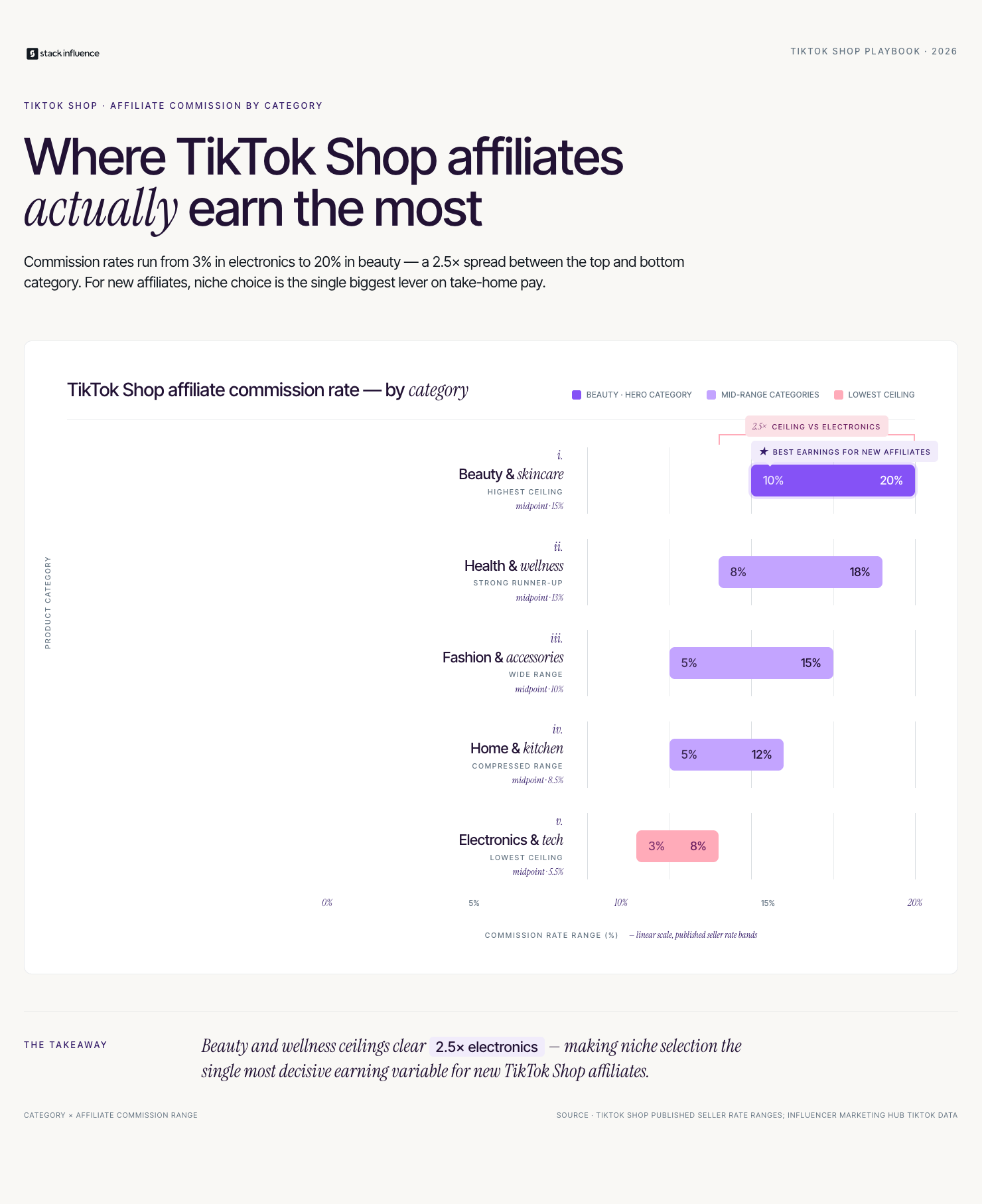
General commission rate ranges by category:
- Beauty and skincare: 10% to 20%, the highest-commission category on TikTok Shop. Products in this category also benefit from TikTok's strong beauty content culture and high repeat-purchase rates.
- Health and wellness: 8% to 18%. Supplements, fitness equipment, and wellness tools perform strongly in LIVE selling formats where creators can demonstrate use in real time.
- Fashion and accessories: 5% to 15%. High volume but lower average order value means commission per sale is modest despite strong click-through rates on fashion content.
- Home and kitchen: 5% to 12%. Products with a visible demonstration moment, cleaning tools, storage solutions, kitchen gadgets, drive strong organic discovery through satisfying video formats.
- Electronics and tech accessories: 3% to 8%. Lower commission rates but higher average order values can produce reasonable per-sale earnings. Competition from established tech reviewers makes this category harder for nano and micro influencers to penetrate.
According to Influencer Marketing Hub's TikTok data, the average TikTok creator earns between $0.02 and $0.04 per view through the Creator Fund, which confirms that affiliate commissions and [brand deals](INTERNAL: brand deal income strategy for TikTok creators) are far more lucrative per piece of content than platform ad revenue for most creators. A single TikTok video driving 50 sales of a $40 beauty product at 15% commission generates $300 in commission income, compared to roughly $2 to $4 in Creator Fund revenue from the same number of views.
Should You Combine TikTok Affiliate Income with Brand Deals?
The most durable creator income structures in 2026 layer multiple revenue streams rather than optimizing for a single source. TikTok affiliate commissions are variable and algorithm-dependent. Brand sponsorships and [brand partnerships](INTERNAL: brand partnership income strategy for creators) are more predictable but require active pitching and relationship management. The combination of both creates a portfolio that earns even when individual streams underperform.
The strategic logic is straightforward. Your TikTok affiliate content establishes your conversion credibility. When a brand sees that your audience consistently clicks and buys from your product recommendations, your pitch for a paid sponsorship deal becomes significantly easier to close. You are not asking the brand to trust an engagement rate. You are showing them a proven conversion record.
Three ways to structure a combined TikTok affiliate and brand deal income approach:
- Affiliate-first relationships: Start by promoting a brand's products through TikTok Shop affiliate links before pitching a paid sponsorship. Sharing your conversion data from the affiliate period gives the brand a baseline ROI model before they commit to a flat-fee or performance-based deal.
- Parallel channel income: Run TikTok affiliate links on product content while separately pursuing [micro influencer campaigns](INTERNAL: micro influencer campaign income guide) through influencer marketing platforms that pay flat fees for deliverables. The flat fee income stabilizes your monthly earnings while affiliate income provides upside.
- [Product seeding](INTERNAL: product seeding income strategy for creators) to paid partnership pipeline: Accept product seeding from brands through platforms like Stack Influence, produce the content, and track the performance. High-converting seeding content becomes the proof of concept for negotiating a paid ambassador relationship with the same brand.
Across campaigns managed on the Stack Influence platform, creators who layer product seeding income with TikTok affiliate commissions and a single anchor brand sponsorship reach a combined monthly income of $3,000 to $5,000 within six months of establishing all three streams, compared to creators pursuing only one income type who typically plateau under $1,000 per month at equivalent follower counts.
Measuring Your TikTok Affiliate Performance: The Creator Commission Stack

Most creators check their TikTok Shop earnings dashboard weekly and have no systematic way to improve what they see. A named measurement framework changes that by connecting content decisions to financial outcomes rather than treating commission income as a passive byproduct of posting.
Use the Creator Commission Stack to evaluate your TikTok affiliate performance across three dimensions:
- Dimension 1: Click-to-conversion rate by product. Divide completed purchases by total product link clicks for each product you have promoted in the last 30 days. A conversion rate below 2% on a product you have promoted in multiple videos indicates a product or pricing issue worth investigating. A rate above 5% is strong and signals a product worth continuing to promote and potentially pitching to the brand for a paid partnership.
- Dimension 2: Revenue per video. Divide total commission earned from each video by the number of videos that drove that product. This reveals whether your affiliate income is concentrated in a small number of high-performing videos or distributed evenly. Concentrated income is fragile; distributed income is scalable.
- Dimension 3: Category ROAS (return on your creative time). Estimate the time spent producing and promoting content for each product category and divide that into total commission earned. This calculation often reveals that one niche or content format is generating disproportionate returns and should receive more of your production time.
Stack Influence's internal campaign data shows that creators who track Dimension 1 click-to-conversion rate monthly and use that data to prune underperforming products from their active affiliate portfolio increase their average monthly commission income by 30 to 40% within 90 days, simply by concentrating their content output on the products their audience already demonstrates a preference for purchasing.
For creators also running the Amazon Influencer Program alongside TikTok affiliate work, maintaining separate tracking dashboards for each program is essential. Amazon Attribution links track Amazon-specific conversions from any off-platform source including TikTok, and the Amazon Brand Referral Bonus can generate additional credits for brands whose products a creator promotes across both platforms simultaneously.
What Most TikTok Affiliate Guides Get Wrong About Creator Income
The most common framing error in TikTok affiliate program guides is treating the program as a standalone income strategy rather than as one component of a diversified creator income portfolio. Guides that position TikTok Shop affiliate as a path to full-time income without mentioning the volatility of algorithm-dependent commission revenue are setting creators up for income instability.
The second framing error is undervaluing the non-commission benefit of TikTok affiliate content. Every piece of affiliate content a creator produces is also a portfolio asset that demonstrates their ability to drive purchase decisions. That asset has value beyond the commission it generates. [Brands looking for influencers](INTERNAL: how brands find and hire influencers on TikTok) increasingly review a creator's TikTok Shop conversion history before extending paid sponsorship offers, which means affiliate content is building your business development case even when individual commissions are modest.
Three things other TikTok affiliate guides consistently leave out:
- Platform risk management: TikTok's regulatory environment remains uncertain in several markets. Creators who build their entire income around TikTok affiliate commissions without developing parallel income on other platforms are exposed to a single-platform risk that has materialized for creators in markets where TikTok availability has been interrupted.
- The [UGC creator](INTERNAL: UGC creator income diversification guide) parallel: Creators who produce TikTok affiliate content have already demonstrated the on-camera presence and product demonstration skills that brands pay $150 to $500 per deliverable for in standalone UGC contracts. Many TikTok affiliate creators are leaving significant income on the table by not simultaneously offering their content production skills as a paid service to [DTC brands](INTERNAL: DTC brand creator partnership guide) outside the affiliate commission model.
- The [creator economy](INTERNAL: creator economy income diversification) rewards portfolio builders: The creators earning the most stable income in 2026 are not the ones with the highest commission rates on any single platform. They are the ones who have built four or five income streams that each contribute partial income, creating a total that no single stream disruption can eliminate.
Conclusion
The TikTok affiliate program is a genuine and accessible income stream for content creators at every follower level, but its role in a sustainable creator income strategy is as a component, not a foundation. The TikTok Affiliate Income System gives you the operational structure to earn consistently rather than sporadically. The Creator Commission Stack gives you the measurement framework to improve your results with each 30-day cycle. And the combination of affiliate income with brand partnerships, product seeding, and UGC work builds the diversified income portfolio that makes the creator economy a real career rather than a side experiment.
If you are ready to add brand partnership income alongside your TikTok affiliate earnings, Stack Influence connects micro influencers and content creators with eCommerce brands running product seeding campaigns, with no minimum follower requirement to get started.