




Your Amazon ads can look profitable while the next budget increase loses money. An external campaign can look expensive while producing useful content and purchases your ads would not otherwise capture. Neither dashboard, on its own, settles the decision.
For ecommerce sellers comparing Amazon PPC vs external traffic, the useful question is where the next dollar can produce additional contribution profit. This guide explains when to prioritize each approach, how to compare their real costs, and how to avoid mistaking attributed sales for new demand.
Key Takeaways
- Preserve profitable Amazon PPC when relevant demand remains available; test external channels when the growth constraint is discovery, education, or audience access.
- Compare the economics of additional spending, not one channel’s historical average against another channel’s first test.
- Include creator, product, fulfillment, creative, and management costs in external campaigns, with confirmed referral credits recorded separately.
- Evaluate Amazon Attribution alongside total marketing costs and contribution profit; a lower Amazon-only advertising cost ratio does not prove the business improved.
Amazon PPC vs External Traffic: Which Should Get More Budget?
Prioritize Amazon PPC when a conversion-ready product has relevant shopping demand you can capture profitably. Prioritize an external test when the product needs explanation, access to a different audience, or demand beyond the opportunities your current campaigns can reach economically. Repair a weak offer before scaling either.
Amazon PPC means Amazon advertising purchased on a pay-per-click basis. For example, Amazon’s Sponsored Products documentation describes cost-per-click (CPC) ads for individual listings, with keyword or product targeting and placements on Amazon and selected outside apps and websites. This article uses Sponsored Products as the principal PPC comparison, not as a definition of every Amazon ad format.
External traffic means visitors you source through non-Amazon marketing, such as Google, creator posts, paid social, email, or publishers, and send to Amazon. The categories overlap: Google advertising can also be PPC. Google’s Search campaign guidance explicitly describes reaching people actively searching for products and services, so external traffic is not automatically cold traffic.
Use the following starting decisions:
- More PPC: Relevant campaigns are budget-constrained, the listing converts, and additional orders can still meet your margin requirement.
- An external pilot: Additional marketplace advertising is becoming uneconomic, or shoppers need a demonstration before they know what to search for.
- A readiness repair: Inventory, the offer, or product presentation is failing; address those issues through focused Amazon product listing optimization before increasing acquisition spending.
The payment model also changes what the budget buys. Stack Influence’s automated product-seeding workflow connects gifted-first creator participation with completed content and campaign coordination. Completed-post accountability manages delivery risk; it does not guarantee that every post produces profitable customer demand.
The Next-Dollar Test: Compare Four Budget Inputs
The Next-Dollar Test evaluates a proposed budget increase rather than declaring a permanent winning channel. Record four inputs for each option: available opportunity, all-in cost, additional orders, and decision horizon.
1. Available Opportunity
Specify what the additional spending should accomplish. Examples include capturing a relevant query that runs out of budget, explaining a product’s unfamiliar use case, or reaching a creator’s category-specific audience.
Separate branded searches from nonbranded acquisition before comparing results. A campaign reaching shoppers already looking for your brand should not automatically set the performance hurdle for introducing the product to unfamiliar buyers.
2. All-In Cost
Calculate contribution per order after product cost, Amazon fees, fulfillment, discounts, and a reasonable allowance for returns, but before acquisition spending. The Amazon advertising cost guide provides context for separating auction costs from the broader cost structure.
For PPC, include media spending and incremental management or creative costs. For external campaigns, include media, creator fees, platform charges, products or reimbursements, shipping, licensing, and campaign labor where applicable. Record each expense once, not both as a product cost and an identical campaign charge.
Use actual Amazon FBA or merchant-fulfillment charges. For reimbursed marketplace purchases, reconcile the reimbursement with seller proceeds and product costs to calculate the net seeding expense.
3. Additional Orders
Estimate purchases that would not happen without the extra spending. That is different from every purchase credited to a clicked link.
Use additional contribution as the decision metric:
Additional contribution = incremental customer orders × contribution per order − additional campaign cost + qualifying referral credits not already included in margin.
When you only have attributed orders, label the estimate accordingly and test the assumption before making a large reallocation.
4. Decision Horizon
Compare mature results over comparable periods. An established search campaign and a creator cohort still waiting for product delivery are not at the same stage.
Include preparation, publishing, purchasing, and conversion-reporting delays in the plan. Stop broken execution promptly, but do not confuse an unfinished purchase window with proof that an audience will not buy.
An Illustrative $600 Budget Decision
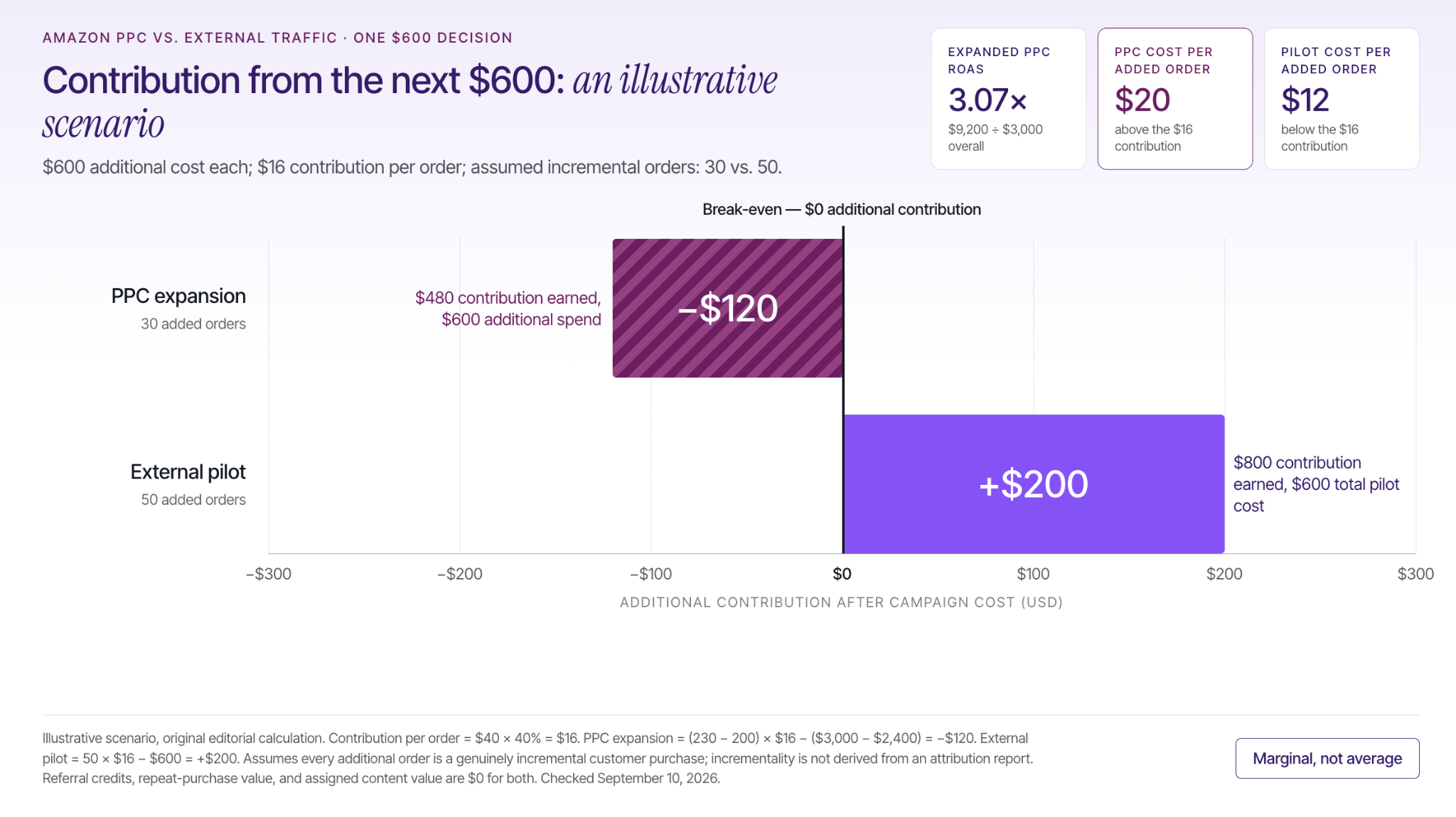
Assume a $40 product, one unit per order, and a 40% contribution margin before marketing. That leaves $16 per order after the variable costs described above. Compare two additional $600 investments over the same completed measurement period, with all incremental campaign costs included and no referral credits, repeat-purchase value, or content-value allowance.
The existing PPC campaign spends $2,400 and produces 200 orders, or $8,000 in sales. Increasing spend to $3,000 produces 230 orders and $9,200 in sales. Its overall return on ad spend (ROAS) still looks respectable at approximately 3.07, calculated as $9,200 divided by $3,000.
However, the extra $600 produced only 30 additional orders. Those orders generated $1,200 in sales and $480 in contribution before marketing, leaving an incremental loss of $120. The additional cost per order was $20, above the $16 available margin.
An alternative $600 external pilot producing 50 additional customer orders would generate $2,000 in sales and $800 in contribution before marketing. It would leave $200 after campaign costs, with a $12 additional cost per order.
These are illustrative assumptions, including that the additional orders are genuinely incremental, not industry benchmarks or client results. External traffic wins this example because of its order economics, not because it is external. Different order counts could reverse the decision.
Where Does the Brand Referral Bonus Change the Comparison?
The Brand Referral Bonus can improve qualifying external campaign economics, but it is a separate, conditional fee credit. Amazon’s Brand Referral Bonus explanation describes an average bonus of 10% on qualifying sales, with actual amounts varying by category and sales price.
For U.S. sellers, the program requires the relevant Professional selling account, Brand Registry enrollment, program enrollment, and Amazon Attribution tracking. Credits offset referral fees and typically involve a two-month wait; they are not immediate cash. Amazon also excludes Amazon-sold advertising, even when those ads appear outside Amazon.
Track expected credits separately from confirmed credits. Do not add the bonus to contribution if the same credit already reduced your fee expense.
What Does External Traffic Add Beyond Immediate Orders?
External campaigns can buy access to an audience, product explanation, and reusable creative as well as attributable purchases. Evaluate those outputs separately instead of assigning an invented dollar value to impressions and adding it to sales.
For micro influencers and nano influencers, specify whether the agreement covers a published social post, user-generated content (UGC) delivery, usage rights, or some combination. A UGC creator delivering a video file is not necessarily distributing that video to an audience. The creator-content workflow should make the deliverable and intended reuse explicit.
Reuse requires the appropriate permissions. TikTok’s Spark Ads documentation describes promoting creator posts with authorization. A brand should confirm advertising rights, authorization duration, editing permissions, and permitted channels before planning paid amplification.
Keep a content record showing which assets were delivered, approved, licensed, and actually deployed. Recognize avoided production spending only when the asset replaces work the business otherwise would have purchased. Do not count a speculative content valuation as campaign revenue.
Stack Influence’s published Targus campaign example records 120 creator promotions during a three-month new-product campaign, with average monthly unit sales increasing from 56 to 221. Those figures describe activity and sales during the campaign, not a controlled comparison against Amazon PPC.
The distinction matters when using case studies to choose a budget. Without a counterfactual, comparable PPC spending, and full campaign costs, the example cannot establish which channel caused more incremental profit. It supports evaluating creator activation as a growth experiment, not forecasting the same sales increase for another product.
How Should You Measure Sales Across Both Channels?
Use channel reporting to understand attributed activity, then use a business-level contribution calculation and a suitable comparison design to evaluate additional demand. Attribution answers which marketing interaction received credit; it does not, by itself, establish what would have happened without that interaction.
Amazon’s Amazon Attribution product overview describes free measurement for eligible advertisers across non-Amazon marketing, including search, social, video, email, and influencer activity. Eligible professional sellers enrolled in Brand Registry are among the supported users. Confirm account and marketplace access before distributing campaign links.
Build separate tags for the creator, campaign, audience, or creative distinctions that could change a spending decision. Amazon’s Attribution setup and measurement guide documents a 14-day last-touch model: the most recent qualifying click receives credit. Allow that window to mature and check the applicable window in each Amazon advertising report rather than assuming every report uses identical rules.
Keep promoted-product sales separate from broader same-brand sales, and never add a promoted subtotal to a total that already includes it. Reconcile channel reports against actual retail sales before summing their credited orders. A shopper can encounter several marketing activities before buying, so multiple dashboards are not automatically an additive customer ledger.
Distinguish Credit From Causation
A historical eBay paid-search field-experiment working paper by Thomas Blake, Chris Nosko, and Steven Tadelis illustrates the problem. The 2013 paper found that conventional attribution could substantially overstate advertising effects when existing customers would have purchased through another route. It is evidence for testing incrementality, not an Amazon PPC performance benchmark.
Where the channel and measurement system support it, use a randomized holdout with observable purchase outcomes. Otherwise, compare carefully matched products or periods while recording price, inventory, promotion, and PPC changes. Treat those observational comparisons as directional because seasonality, spillover, and product differences can remain.
Why Lower TACoS Can Hide a Weaker Business

Amazon-only advertising efficiency can improve while total marketing economics deteriorate. Moving costs from Amazon Ads into a creator or social budget changes where the expense appears, not whether the business pays it.
For this comparison, define Amazon-only total advertising cost of sales (TACoS) as Amazon ad spend divided by total Amazon sales. Define the all-in marketing ratio as Amazon ad spend plus all external campaign costs, divided by the same sales total. Advertising cost of sales (ACOS) instead uses ad-attributed sales as its denominator, so the three ratios answer different questions.
Consider a separate illustrative two-month scenario. Both months have a 35% contribution margin before marketing, a comparable product mix, no referral credits, and no marketing costs beyond those listed. Sales are net of refunds and discounts, and all external costs are included.
Month A: Amazon Advertising Only
In Month A, Amazon sales are $50,000, Amazon advertising costs $10,000, and external marketing costs $0. Amazon-only TACoS and the all-in marketing ratio are both 20%.
Contribution after marketing is $7,500:
$50,000 × 35% − $10,000 = $7,500.
Month B: Amazon Advertising Plus External Campaigns
In Month B, Amazon sales rise to $60,000, Amazon advertising falls to $9,000, and external campaign costs reach $9,000. Amazon-only TACoS improves to 15%, but the all-in marketing ratio rises to 30%.
Contribution after marketing falls to $3,000:
$60,000 × 35% − $18,000 = $3,000.
The business gained $10,000 in sales but lost $4,500 in monthly contribution. This scenario does not establish that external traffic caused the decline; it shows why Amazon-only ratios cannot establish that reallocating the budget worked.
Return to the Next-Dollar Test whenever the channel mix changes. Track reported efficiency, total spending, and contribution together, with an explicit hypothesis for any longer-term benefit.
Run a Controlled Test Without Disrupting the Core
Keep the strongest existing PPC activity stable while testing one external hypothesis. Define the product, audience, message, destination, cost ceiling, and decision date before launching. Avoid changing the price, listing, discount, and advertising mix simultaneously.
For a creator-led test, evaluate relevant Amazon influencer candidates and brief one clear use case. Match the promoted product and variation to the destination page. Build the production schedule around product delivery and content completion rather than assuming spending produces immediate traffic.
Agree on disclosure and compliance before content goes live. The FTC’s social-media disclosure guidance treats gifts and other material connections as relationships that may require clear disclosure with the endorsement. Product claims also need appropriate support.
Separate campaign procurement from customer acquisition. When products are purchased for participating creators and reimbursed, distinguish those campaign-funded orders from independently acquired customer orders in your profitability analysis. Amazon’s customer-review policy reminder prohibits incentives in exchange for customer reviews, so do not make an Amazon review part of the compensated deliverable.
Check links, product availability, completed posts, and retail engagement while the test runs. At the decision date, increase spending only when mature purchase economics support the case, or when a separately budgeted learning or content objective has been met. Hold when the conversion window is incomplete; rebuild when the audience, message, or offer fails.
Stack Influence’s Amazon creator-campaign workflow connects sourcing, product seeding, coordination, and completed content for sellers using creators in that test. Keep its delivery scorecard separate from the commercial decision about whether the next cohort earns more budget.
Allocate for Additional Profit, Not a Channel Victory
The Amazon PPC vs external traffic decision is not a vote for one permanent winner. Protect demand you already capture profitably, then test whether another audience, message, or creative asset can improve the economics of the next investment.
Start with one product’s contribution margin, one incremental budget decision, and one measurement plan. For a creator-led test, evaluate a Stack Influence product-seeding campaign with a defined deliverable and profit threshold, so the outcome informs your next budget decision rather than merely adding another report.