



A creator demonstrates your product, you add the content to Amazon, and sales rise. The missing answer is whether the new listing content persuaded more shoppers or the campaign simply brought more shoppers to the page.
Amazon listing split testing with UGC separates those questions. For ecommerce sellers, the goal is to compare a specific creator-made asset against existing content under controlled conditions, then decide whether the improvement justifies production costs and usage rights.
This guide explains which Amazon placements to check, how to commission a testable alternative, how much evidence a decision can require, and how to calculate the lift needed before a content license expires.
Key Takeaways
- Use a randomized listing experiment where the intended content type is supported; swapping content between weeks is not equivalent.
- Test one clearly defined creative contrast before attributing an improvement to UGC generally.
- Separate creator traffic and reimbursed product purchases from the question of listing conversion lift.
- Judge a winning asset against both statistical uncertainty and the time remaining to recover its cost.
Start Amazon Listing Split Testing With UGC
Amazon listing split testing with UGC compares two versions of listing content, with creator-produced material forming the alternative. Here, UGC means licensed creator-made photos or videos, not a paid Amazon customer review.
Amazon's Manage Your Experiments randomly assigns shoppers to content versions. Sellers need a Professional account, Brand Representative status for a brand enrolled in Brand Registry, and a traffic-eligible ASIN. A+ tests require published A+ content.
For an eligible product, a practical starting point is an A+ experiment that changes one image while preserving the surrounding module. That makes the production assignment manageable and the comparison interpretable.
The One-Contrast Contract
Write four decisions before commissioning the asset:
- Changed Asset: Identify the ASIN, placement, current asset, and exact creator-made replacement.
- Frozen Context: Specify the copy, module order, product facts, and other content that must remain identical between versions.
- Measured Population: Define the marketplace and intended shopper mix, and document campaign activity that could change that mix.
- Adoption Boundary: Choose the primary outcome, completion rule, financial hurdle, and latest permitted usage date.
Consider an illustrative collapsible laundry basket. Version A shows a studio photograph of the folded basket; Version B shows a creator placing the same basket in a household storage gap. Both versions retain identical dimension information, surrounding copy, and module position.
The hypothesis is that showing storage in context reduces uncertainty about practical fit. A favorable result would support that specific replacement, not prove that every creator photo outperforms studio photography.
Stack Influence's managed product-seeding workflow connects gifted-first creator participation with coordination and completed-post accountability. For listing research, attach the One-Contrast Contract to the campaign brief: a completed social post and an approved experimental asset are separate acceptance decisions.
How Much Traffic Does a Useful Test Need?
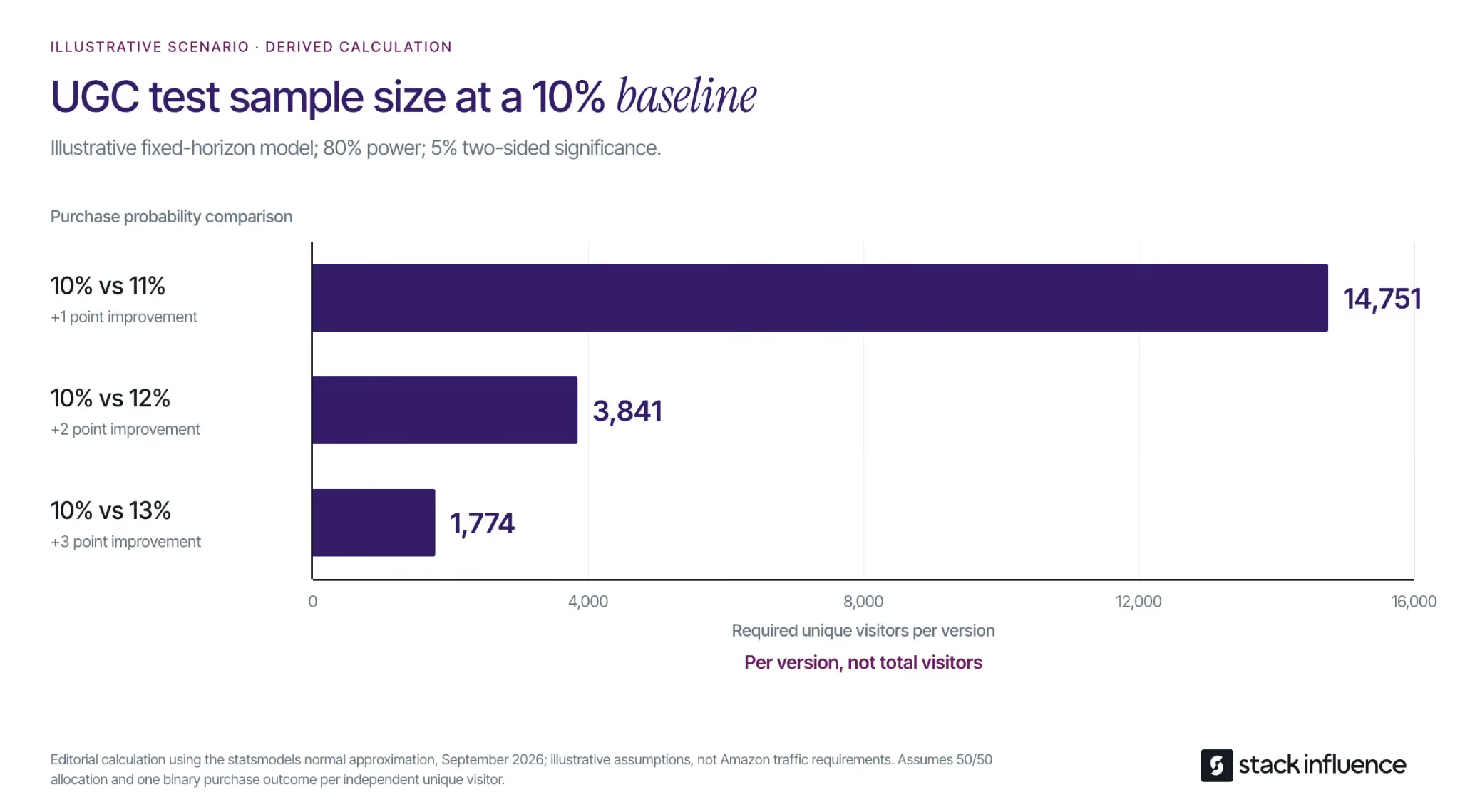
The traffic requirement depends on baseline performance, the improvement you need to detect, and the statistical method. A small worthwhile improvement may require substantially more visitors than a large one, so ASIN eligibility alone does not establish whether your desired decision will be practical.
Consider an illustrative fixed-horizon experiment with a 10% baseline purchase probability, equal allocation to two versions, independent unique visitors, and a binary outcome of purchase or no purchase. Assume a two-sided 5% significance level and 80% statistical power.
Using the statsmodels two-proportion sample-size method, the approximate requirements, rounded upward, are:
- 10% Versus 11%: 14,751 unique visitors per version.
- 10% Versus 12%: 3,841 unique visitors per version.
- 10% Versus 13%: 1,774 unique visitors per version.
These are planning calculations, not Amazon traffic minimums, marketplace benchmarks, or a description of Amazon's internal statistical engine. They model one purchase decision per visitor, not units ordered per session.
An increase from 10% to 11% is one percentage point, or 10% relative lift. The distinction matters when a creative brief promises to detect a “1% improvement.”
Use this exercise before buying numerous minor variations. When available traffic cannot resolve the improvement that matters financially, choose a more meaningful contrast, extend the feasible research horizon, or use qualitative feedback without presenting it as conversion-lift evidence.
Choose the Placement Before Commissioning UGC
An asset can be publishable on Amazon without being independently split-testable in the placement you want. Confirm the available experiment type and content controls in your own account before contracting for a particular deliverable.
Amazon's A+ Content overview distinguishes Basic A+ image-and-text modules from Premium A+ options that include video and interactive content. For the laundry-basket example, an image module provides a straightforward place to compare the same product explanation with different visual evidence.
Use the Amazon A+ Content planning guide to identify the buying question the module should answer. Do not redesign the entire page merely to accommodate a creator's existing social post.
Can You Split-Test Any UGC Video on Amazon?
There is no blanket video-testing capability established by Amazon's public experiment overview. It lists images and A+ Content, but does not establish a separate, universally available gallery-video experiment.
Premium A+ video support is a publishing capability, not proof that a particular video module can be isolated in your account's testing workflow. Verify that workflow before buying two video versions; otherwise, use an eligible image comparison or describe a video rollout as observational.
Keep main-image compliance separate as well. Amazon's product image guide specifies a pure-white background for main images; a creator's household scene should not be treated as a compliant main image by default. Confirm category-specific requirements for the actual placement.
Brief Creators for a Matched Comparison
Select creators for the demonstration your hypothesis needs. For a listing asset, inspect their ability to show product scale, handling, and details; when the assignment also includes social distribution, assess audience relevance separately.
A useful brief for the basket would request the correct variant, a clear folded-product view, and an unobstructed demonstration of storage. Specify an image crop that preserves the relevant detail at the intended module size, rather than selecting a visually attractive frame that hides the feature being tested.
Micro influencers and nano influencers can enter the same qualification process. The guide to finding influencers for an Amazon product helps structure creator research, but the experiment brief must still define the asset itself.
Ask for the necessary still photographs explicitly. A UGC video order does not automatically give you a sharp, correctly framed listing image, and a delivered edit does not establish that raw files or additional edits are included.
Secure Rights for Testing and Continued Use
Put the intended uses in writing rather than relying on the fact that you paid for production. The U.S. Copyright Office's permission guidance explains that acquiring a copy of a photograph does not, by itself, transfer its copyright.
Record permitted Amazon placements, editing and cropping permissions, any likeness or third-party permissions needed, license start and end dates, and renewal terms. Ensure the term covers validation, the experiment, and the intended post-test rollout.
When evaluating Amazon UGC services, compare equivalent rights and deliverables. A package that includes social posting may still require a separate agreement for additional production work or placements.
Keep Endorsements Truthful and Reviews Separate
The FTC's endorsement guidance requires honest representations and clear disclosure of material connections when viewers would not otherwise understand them. Product gifting and reimbursement can create those connections; assess the final reused endorsement, not just the original social caption.
Do not remove a necessary disclosure to make an asset look less commercial. Do not script a creator's experience or let an edit imply a product result that did not occur.
Amazon's customer-review policy announcement distinguishes its permitted review programs from prohibited incentivized customer reviews. Commission product content, not a customer review in exchange for a gift, payment, or reimbursement.
Launch Without Changing the Question
Set up the experiment around the approved contrast, not whatever footage happens to arrive first. Amazon's A/B testing guide recommends isolating variables, running versions concurrently, collecting enough data, and avoiding premature conclusions.
In Seller Central, open Brands, then Manage Experiments, create an experiment, and select the type and ASIN. Enter your hypothesis and Version B, then review scheduling and publishing settings before submission.
For the A+ comparison, preserve an exact copy of Version A and replace only the agreed image in Version B. Check both previews for matching copy, module order, factual claims, and product variant; a changed headline would turn the test into a different comparison.
Amazon's experiment-duration guidance recommends 8 to 10 weeks when choosing a duration manually. Its default “to significance” mode can sometimes conclude sooner, and default settings include automatic publication of winning content. Inspect those settings against your approval process and license dates.
Keep a change log for price, coupons, advertising, availability, and delivery conditions. These changes do not automatically destroy a randomized comparison, but they affect what period and customer experience the result represents.
Repair factual errors or unavailable offers promptly rather than preserving them for research. When a disruption makes the original question unanswerable, record the reason and restart with a clean contract instead of selecting convenient dates afterward.
Read Listing Lift Separately From Creator Traffic

Judge the tested content using comparable version-level outcomes, not campaign reach or aggregate sales growth. Choose the primary metric before launch, and treat other metrics as supporting evidence rather than searching for whichever result looks strongest.
Amazon's experiment reporting includes conversion and units per unique visitor. Record the exact definitions and denominator shown in the report; do not substitute a units-per-session calculation for a shopper purchase probability.
The distinction is developed in the Amazon conversion rate optimization guide. More units can reflect larger quantities rather than more people deciding to buy, which changes how you interpret the creative.
Do not infer module exposure from assignment to a page version. Without suitable exposure reporting, the experiment does not establish how many shoppers actually examined the changed A+ image, so do not calculate a supposed UGC-viewer conversion rate from its results.
Use a Complete Readout
Evaluate the estimated difference alongside the tool's reported uncertainty and completion status. A positive point estimate is not enough by itself, and an inconclusive result does not establish that the two versions are equivalent.
Record the experiment ID, ASIN, marketplace, dates, exact A and B files, sample sizes, outcome estimates, important disruptions, and adoption decision. Keep completion and approval counts as production indicators; keep conversion, revenue, and contribution economics as commercial outcomes.
For safety checks such as return reasons or misleading expectations, use the reporting actually available. Do not claim a version-level return improvement when your returns data cannot identify which version customers saw.
Keep Attribution in Its Own Role
The official Amazon Attribution guide describes a 14-day, last-touch model for qualifying off-Amazon activity. Use separate tags for creator placements and allow the attribution window to mature before comparing final click cohorts.
Those tags identify marketing touchpoints, not the causal effect of the randomized listing version. Do not add attributed purchases to experiment purchases as though they represent separate orders, or assume an attribution tag forces shoppers into Version B.
Product-seeding purchases need special attention. Complete campaign-funded creator purchases before the experiment when practical, and document any that overlap; those transactions are not evidence of independent shopper demand. The product-seeding costs and tracking guide provides the campaign-side accounting context.
Do not selectively subtract suspected creator orders from one version when the data cannot support an equivalent adjustment in both groups. Treat an unresolvable overlap as a limitation on interpretation.
A creator traffic surge can coexist with valid randomization, yet the observed lift may apply mainly to that campaign's audience mix. Microsoft's research on experiment external validity explains why an effect measured under one set of conditions need not transfer unchanged to another. Recheck performance before treating a launch-period result as an evergreen expectation.
Calculate Payback Within the Remaining License
Statistical evidence and economic usefulness answer different questions. An asset can improve conversion without earning back its incremental production and testing cost during the period you are allowed to use it.
Consider a separate illustrative scenario: $900 in total incremental content and testing costs, 6,000 eligible unique visitors per month after rollout, and $10 contribution per additional purchasing visitor. Assume one purchase per converting visitor, unchanged price and other costs, constant traffic and lift, and no credited contribution during the experiment itself.
The $10 contribution is after variable product, fulfillment, marketplace, and expected return costs. The $900 is an assumed all-in project cost, not a Stack Influence quote; the example excludes additional media spending, renewal charges, and referral bonuses.
Required absolute conversion lift = project cost ÷ (monthly eligible visitors × remaining licensed months × contribution per additional purchaser).
With those inputs, the break-even lift is 1.50 percentage points with one month remaining, 0.75 points with two months, 0.50 points with three months, and 0.25 points with six months.
Count the licensed months available after the experiment ends, not the original contract length. These thresholds are financial requirements, not expected UGC results or evidence that the required improvement can be detected with your traffic.
Record this full-project hurdle in the One-Contrast Contract before commissioning content. Once production spending is sunk, compare expected future contribution with future rollout or renewal costs for the next decision; failure to recover every past dollar is not, by itself, a reason to withhold a beneficial asset that costs nothing more to use.
Make the Next Asset Answer One Question
Amazon listing split testing with UGC works best as a specific comparison, not a general vote for creator content. Define the placement, preserve the comparison, distinguish traffic acquisition from conversion, and check that the remaining usage rights allow a worthwhile return.
Start with one eligible ASIN and one unresolved buying question. Use that brief to scope a Stack Influence creator campaign around the content your next test actually needs, so production creates a measurable decision rather than another unused file.