




A coupon can turn more Amazon visits into orders while leaving less money behind. A larger order can raise your units-per-session metric without persuading another shopper to buy. Neither result, by itself, proves your listing became more convincing.
For ecommerce sellers, Amazon conversion rate optimization means improving the path from product discovery to purchase while checking whether the resulting orders are worth acquiring. The work starts with a precise metric, not a listing makeover.
This guide explains how to diagnose the buying objection, choose the right content or offer change, and measure the result without confusing higher sales with better conversion.
Key Takeaways
- Amazon Unit Session Percentage measures units ordered per session, not the percentage of sessions that produced a purchase.
- Fix availability, delivery, offer competitiveness, and variation problems before spending more to send shoppers to the listing.
- Turn customer objections into specific listing tests rather than changing images, copy, and price simultaneously.
- Judge conversion gains alongside contribution profit, returns, and traffic quality, not as an isolated percentage.
Which Metric Should Guide Amazon Conversion Rate Optimization?
Use a clearly defined purchase-based metric to evaluate purchase likelihood, and track Unit Session Percentage separately as a units-per-session measure. The distinction matters whenever customers buy multiple units or reports use different attribution rules.
Amazon's sales-and-traffic reporting definitions distinguish units, order items, and sessions. Unit Session Percentage is calculated by dividing units ordered by sessions, expressed as a percentage.
Unit Session Percentage = units ordered ÷ sessions × 100.
A purchasing-session conversion rate instead equals sessions containing a purchase ÷ total sessions × 100. This is a conceptual comparison, not a claim that Seller Central exposes that exact field in every report. Orders, purchasers, order items, and units are not interchangeable numerators.
Start With a Comparable Baseline
Amazon's seller dashboard guide directs sellers to Reports, then Business Reports. Review the relevant child-ASIN sales and traffic data, meaning the specific size, color, or other sellable variation, rather than relying only on a catalog-wide average.
As a working baseline, export 28 comparable days for one marketplace. Record sessions, units, sales, price, promotions, availability, and the exact metric definition. This is a planning recommendation, not an Amazon testing requirement; flag unusual sale periods rather than treating them as ordinary demand.
Why More Units Can Look Like Better Conversion
Consider three illustrative 28-day scenarios for one child ASIN. Each has 1,000 sessions and 100 purchasing sessions, with exactly one order per purchasing session.
At 100 units ordered, average order quantity is one unit and Unit Session Percentage is 10%. At 150 units, average quantity is 1.5 and Unit Session Percentage is 15%. At 200 units, average quantity is two and Unit Session Percentage is 20%.
Purchasing-session conversion remains 10% in all three scenarios. Here, units mean sellable units ordered, not the individual items inside a multipack. These are hypothetical calculations, not marketplace benchmarks or client results.
The same discipline applies to case studies. During Stack Influence's three-month Targus campaign, average monthly unit sales moved from 56 to 221. Those approved campaign figures show sales movement, but without matching session data they do not establish a conversion-rate increase.
Before accepting a conversion claim, ask: which event increased, relative to which denominator, over which period?
Build an Objection-to-Test Ledger
Create an Objection-to-Test Ledger that connects a measurable problem to a buying decision. Each entry needs four components:
- Observed Signal: Record the customer question, return reason, or report pattern, including its source and affected ASIN.
- Buying Objection: State the specific uncertainty preventing a confident purchase.
- Controlled Change: Identify one intervention that addresses that uncertainty.
- Decision Rule: Choose the outcome metric, profit and return guardrails, test owner, and review point before launch.
For a drawer organizer, repeated questions about minimum drawer width suggest a compatibility objection. A useful test might replace an ambiguous secondary image with clear collapsed and expanded dimensions. The decision rule should consider purchase performance without accepting a deterioration in size-related returns.
Use Amazon Brand Analytics to inspect available search impressions, clicks, cart additions, and purchases. Its Search Catalog Performance and Search Query Performance dashboards help eligible brands examine product and query behavior, but search purchase share is not the same metric as conversion rate.
Treat the funnel as a diagnostic, not proof of cause. Few impressions suggest a discovery issue; clicks without purchases justify inspecting relevance, the offer, and the page. Stack Influence's guide to fixing Amazon ranking gaps addresses the discovery side separately.
Prioritize objections that recur on products with enough relevant traffic to evaluate a change. When outsourcing to Amazon listing services, scope the work around those objections and test deliverables, not simply a longer title or more images.
Repair the Offer Before Rewriting the Listing
Check that the intended variation is available, the delivered price makes sense, and the customer sees a credible arrival date. A clearer bullet cannot compensate for an unavailable size or an unacceptable delivery promise.
Amazon's Featured Offer guidance identifies competitive total pricing, shipping performance, and inventory availability as important considerations. Amazon FBA is one fulfillment option, but merchant-fulfilled offers can also compete; focus on the actual customer experience rather than the fulfillment label alone.
Inspect the listing from a customer's perspective using a representative delivery location. Check the selected variation, quantity, included accessories, displayed price, and shipping promise against the ad or creator post that sent the visitor there.
Correct factual errors, unavailable offers, and broken variation relationships promptly. These are operational repairs, not issues to preserve for an experiment. Record when the repairs happened so later results are not mistakenly attributed to a simultaneous creative change.
Make the Product Page Resolve Buying Doubts
Assign each content element a decision-making job. The title identifies the product; images establish what it is and whether it fits; supporting copy explains the relevant difference and conditions of use.
Update Titles for the Current Amazon Format
Amazon's July 2026 title and Item Highlights announcement sets a 75-character title limit for non-media categories, with a separate 125-character Item Highlights field. The announcement specifies July 27, 2026, with gradual updates and listings remaining active during the transition.
Build the title around accurate product identification, brand, and essential variation details. Use Item Highlights for concise differentiating information rather than trying to preserve an old keyword-heavy title. Confirm the applicable requirements and available fields for your category before editing.
Show Scale, Compatibility, and Real Use
Design secondary images around the questions a buyer cannot resolve from the main image. Show dimensions, included components, relevant compatibility, and the product performing its intended task, while following the applicable image and category rules.
Baymard Institute's research on in-scale product images describes usability problems when shoppers cannot judge an item's size. That is general ecommerce research, not an Amazon conversion-lift guarantee, but it supports a useful testing hypothesis: make scale understandable instead of expecting customers to infer it.
For the organizer example, a measurement diagram answers whether it fits. A short demonstration answers whether adjustment looks straightforward. A decorative lifestyle image may answer neither.
Use the available A+ Content modules to explain differences that standard listing content leaves unclear. Basic A+ supports enhanced images, text, and comparison content; Premium A+ adds options such as video and interactive modules. Match the evidence to the question rather than filling every available module.
Use Reviews to Diagnose, Not Manufacture, Trust
Separate product failures from expectation failures when reading customer feedback. A missing size explanation may require better content; repeated breakage may require a product or packaging change. Copy cannot responsibly solve the second problem by making stronger promises.
Keep creator gifting separate from compensated Amazon customer reviews. Amazon's policy announcement on incentivized reviews prohibits them outside its stated exceptions, including Amazon Vine. For ordinary product campaigns, do not exchange reimbursements, discounts, or gifts for customer reviews, even when the requested review is described as honest.
Amazon's Vine program provides a separate route for eligible products to receive feedback from invited reviewers. It is not a promise of positive ratings or a substitute for fixing product problems.
Can Creator Content Improve Amazon Conversion?
Creator content can address buying objections and help audiences understand a product before visiting Amazon, but its effect on conversion must be tested. Follower count alone does not establish whether a demonstration will answer the customer's question.
Choose micro influencers and nano influencers who can credibly show the intended use. A creator who demonstrates the organizer inside an actual drawer provides different evidence from someone holding its packaging. Brief the task, required facts, and prohibited claims without scripting a false personal experience.
Separate asset production from audience acquisition. A UGC production workflow can produce demonstrations for permitted brand placements, while influencer marketing also distributes content to a creator's audience. Evaluate the asset's usefulness and the audience's purchase behavior separately.
Stack Influence's automated product-seeding workflow connects gifted-first creator participation, campaign coordination, content completion, and reimbursement. Use that execution layer to obtain specific proof assets, such as setup demonstrations or compatibility explanations, rather than treating completed posts as proof of retail conversion.
Confirm licensing for the intended placement, duration, editing, and paid-media use before repurposing content. Check that a licensed asset is also permitted in the intended Amazon placement. The FTC's disclosure guidance for social media influencers explains that free products can create a material connection requiring clear disclosure.
Run Tests That Can Support a Decision
Use randomized content testing when available, and treat uncontrolled before-and-after comparisons as directional evidence. An increase after a redesign could also reflect a promotion, improved availability, or a different audience.
Amazon's Manage Your Experiments supports tests of eligible listing content, including images, titles, bullet points, descriptions, and A+ Content. Access requires a Professional selling account, the appropriate brand-representative relationship through Brand Registry, and eligible ASINs with sufficient recent traffic.
The tool assigns shoppers to content versions and reports outcomes such as conversion and units per unique visitor. Use its defined experiment metrics to assess the test instead of substituting an unrelated catalog-wide percentage.
Return to the Objection-to-Test Ledger before launching. Save the original content, record the hypothesis, and specify what would count as a commercially useful improvement. Prefer one focused hypothesis; otherwise, a winning package may not reveal which change helped.
Amazon recommends eight to ten weeks for manually selected test durations, while its significance-based option may finish sooner. Let the experiment complete rather than declaring victory after an encouraging early result. These content-testing capabilities should not be assumed to provide randomized price testing.
For an ineligible ASIN, compare matched weekdays and document changes in price, stock, promotions, and traffic. Keep the evidence label honest: a monitored rollout can inform the next decision without proving that the content caused the result. Continue tracking returns after purchase outcomes mature.
When a Higher Conversion Rate Produces Less Profit
Require conversion gains to pass a contribution-profit check, especially when changing price. Contribution here means sales revenue minus the variable costs included in the calculation, not net profit after every business expense.
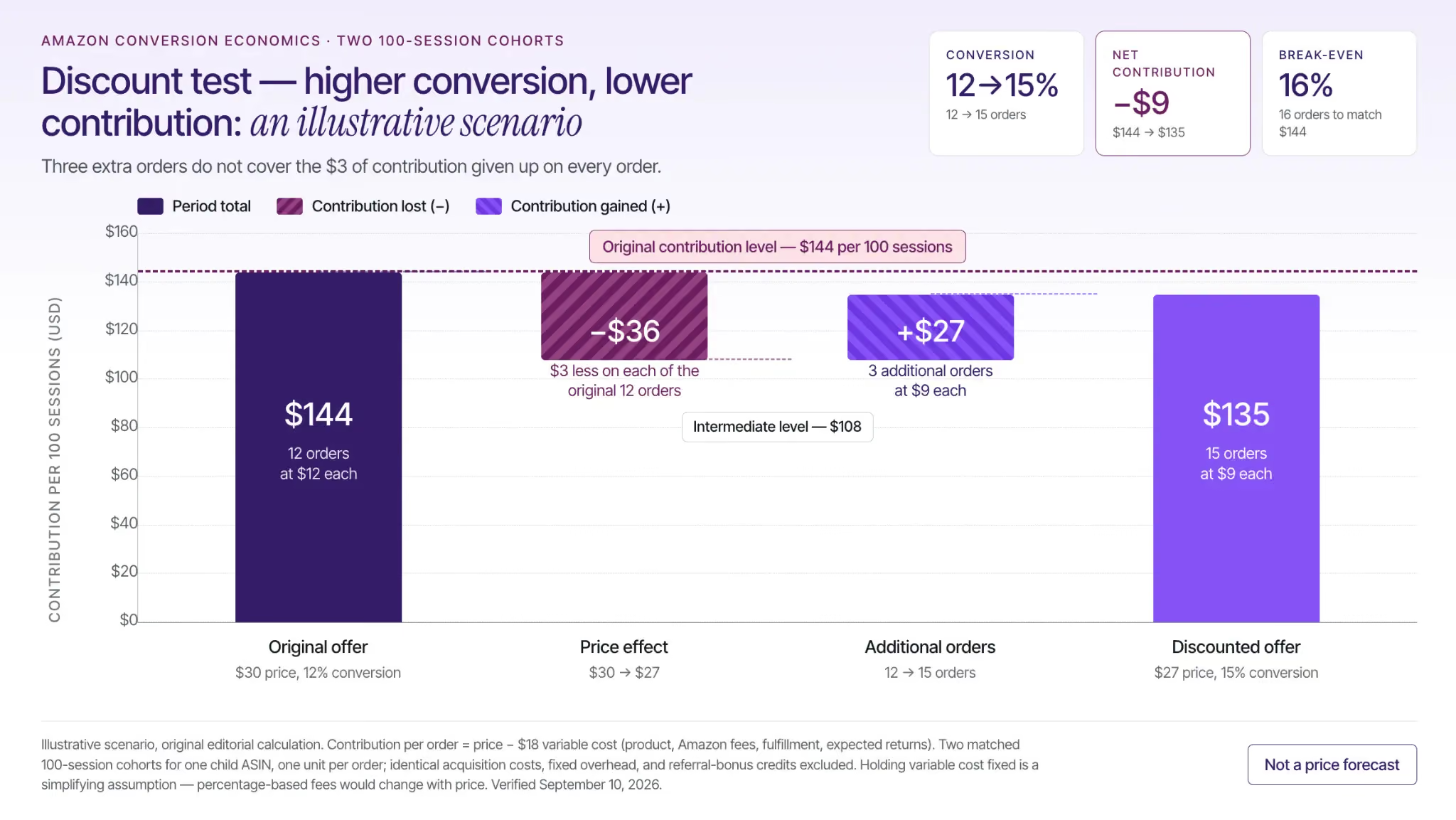
Consider an illustrative comparison of two equivalent 100-session groups for one child ASIN. Assume one unit per order, a $30 original price, and $18 in variable costs per order, including product cost, Amazon fees, fulfillment, and expected return costs. Acquisition costs are identical between groups and excluded, as are fixed overhead and referral-bonus credits.
At a 12% purchase conversion rate, the original offer generates 12 orders. Each contributes $12, producing $144 of contribution per 100 sessions.
Now reduce the price to $27 and suppose conversion reaches 15%, producing 15 orders. Hold variable costs at $18 for this simplified illustration: contribution falls to $9 per order, or $135 per 100 sessions.
The price cut removes $36 from the contribution on the original 12 orders, reducing it to $108. The three additional orders add $27, bringing the total to $135. Conversion increased, but contribution fell by $9.
Under those assumptions, 16 orders at $9 contribution each are required to match the original $144. The break-even conversion rate is therefore 16%, not 15%.
Real pricing decisions must recalculate percentage-based fees, promotion charges, returns, and acquisition costs rather than assuming they stay fixed. Apply the same discipline when evaluating Amazon external traffic profitability: the useful outcome is profitable demand, not an attractive percentage detached from its costs.
Measure Listing Tests and Traffic Campaigns Separately
Keep a listing-test report and a traffic-acquisition report, then reconcile them without pretending they measure the same thing. A new audience can change the overall conversion rate even when the listing itself has not changed.
Review leading signals such as relevant clicks and cart additions alongside outcomes such as purchases, contribution, and returns. Compare the same child ASIN and marketplace, and distinguish branded search, non-branded search, and external campaigns where the reporting supports it. Do not subtract advertising clicks from total sessions and label the remainder organic traffic.
For eligible brands, Amazon Attribution measures shopping activity associated with tagged off-Amazon traffic. Create separate tracking for the channel, creator, or creative distinction you need to evaluate, and test the destination before launch. Stack Influence's Amazon Attribution guide provides a related campaign-planning resource.
Amazon's attribution methodology guide specifies a 14-day, last-touch model. Allow that conversion window and reporting delays before closing the campaign assessment; attributed sales still do not prove that every purchase was incremental.
The same Amazon guide explains that eligible enrolled US brand owners may earn an Amazon Brand Referral Bonus averaging 10% of qualifying sales. Reconcile actual earned credits separately rather than applying a universal 10% uplift to every order in a forecast.
When product seeding includes reimbursed creator purchases, identify those transactions in campaign records where possible. Report them separately from independently acquired retail demand, and include reimbursements in campaign economics. Otherwise, an activation expense can be mistaken for proof that ordinary shoppers converted better.
Choose One Buying Objection to Remove
Effective Amazon conversion rate optimization connects a specific customer doubt to a measurable change and a profitable outcome. Start with one ASIN, one comparable baseline, and one Objection-to-Test Ledger entry.
Repair the offer first, improve the evidence second, and expand traffic only after the economics justify it. When the missing evidence is a credible product demonstration, plan a focused creator-content brief with Stack Influence so the next campaign produces assets you can evaluate against a real buying decision.