




Putting a product on three websites is not the same as launching it on three marketplaces. One offer might be ready to buy while another still needs approval, inventory, or a working fulfillment connection.
For ecommerce sellers planning how to launch a CPG product on multiple marketplaces at once, the practical answer is parallel preparation followed by a coordinated promotional window. Start with one launch product, centralize the operational details, and release each channel only when it can accept, fulfill, and measure orders.
This guide focuses on U.S. launches across Amazon, Walmart Marketplace, and TikTok Shop. Consumer packaged goods, or CPG, include everyday products such as packaged food and household essentials. Shopify can support the owned storefront and management workflow, but it is not another marketplace in this plan.
Key Takeaways
- Prepare marketplaces in parallel, but release promotions only after each product offer passes its own readiness checks.
- Allocate inventory using expected demand and replenishment time, with separate allowances for creator purchases and operational reserves.
- Reuse rights-cleared creator content while adapting the product presentation and purchase destination for each marketplace.
- Evaluate contribution after shared launch costs, and separate brand-funded creator purchases from independent customer demand.
Build a Channel Release Sheet Before Announcing a Date
Use a Channel Release Sheet to decide whether each product-marketplace combination is ready for promotion. This is a working record of evidence and ownership, not a score that lets strong creative compensate for missing inventory.
Create one row for each marketplace and require five checks:
- Product identity: The correct retail pack, product identifier, label information, and supporting documentation are mapped to the listing.
- Buyable offer: Required approvals are complete, the intended offer is live, and the price, quantity, and delivery promise are correct.
- Fulfillable stock: Inventory is available through an approved fulfillment path, with lot, shelf-life, tracking, and returns procedures addressed.
- Channel economics: The team has calculated contribution after variable costs and agreed on a promotional spending ceiling.
- Content and measurement: Approved assets, the correct purchase destination, campaign identifiers, and reporting responsibilities are ready.
Assign an owner to each check and record what proves completion. A blocked requirement should pause that marketplace’s promotional release, rather than disappear inside an overall readiness percentage.
Account Approval Is Not Product Readiness
Seller onboarding and product availability are different checks. Amazon’s product-listing guidance distinguishes the product detail page from the seller’s offer and explains that some products or categories require approval.
For Walmart, confirm the requirements in its Marketplace seller onboarding guidance, including business verification, product identifiers, and a qualifying fulfillment and returns setup. Treat TikTok Shop verification and product eligibility as a separate workstream, not an extension of either approval.
A listing can be prepared before the promotional launch. That gives the team an opportunity to inspect the customer-facing page and resolve errors without spending money to send shoppers there.
Creator acquisition needs the same readiness check. In Stack Influence’s automated product-seeding workflow, creators purchase campaign products and complete social-content requirements before reimbursement. That means the creator’s purchase path and inventory allowance belong on the release sheet alongside the customer’s purchase path.
Allocate Stock by Coverage, Not Equal Shares
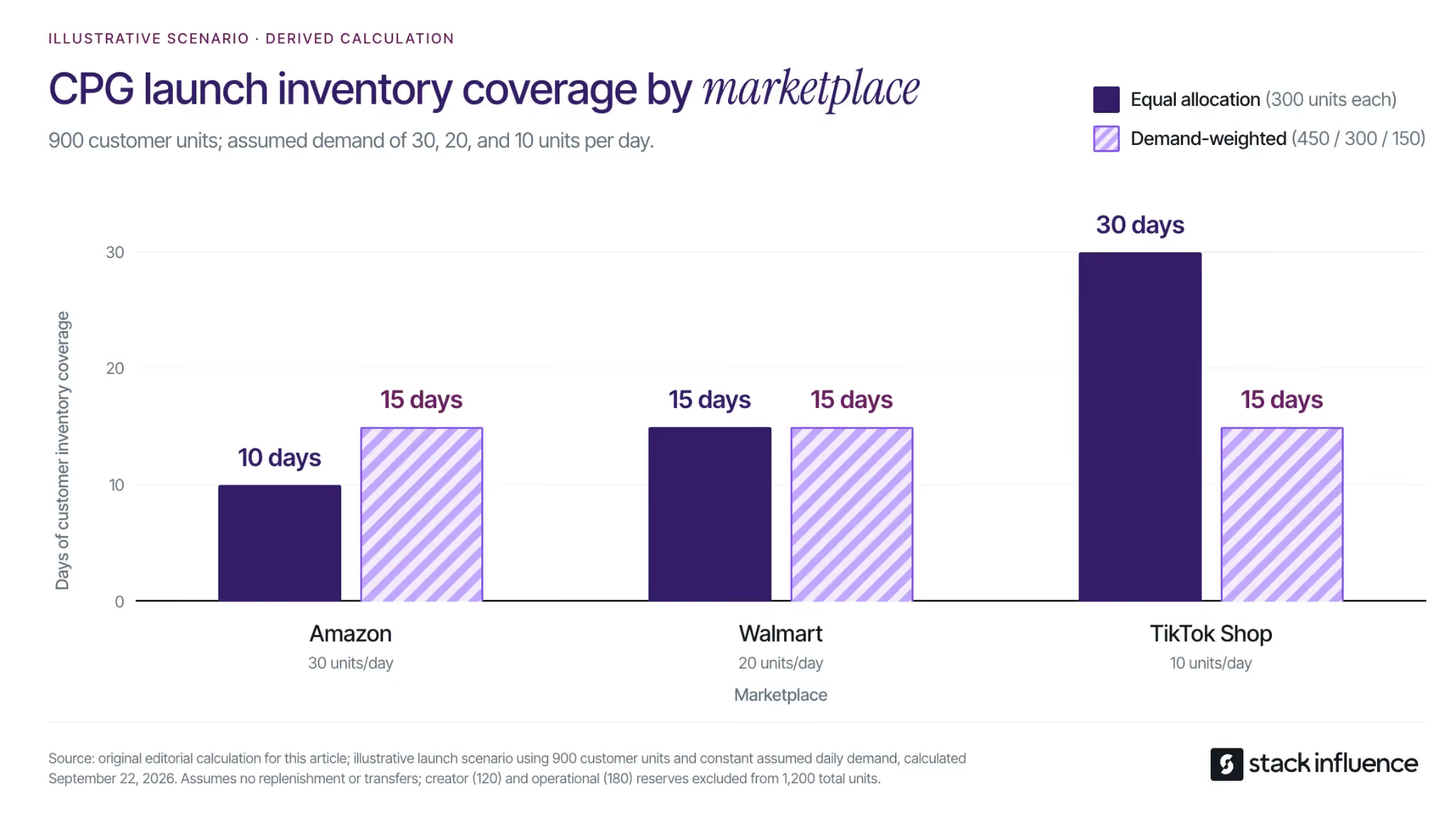
Equal inventory allocations can produce unequal launch readiness. A marketplace with faster demand can run out while another still holds weeks of stock.
Start with inventory that is genuinely usable for the relevant fulfillment arrangements. Exclude damaged stock, units awaiting required clearance, and inventory that has not become available to sell.
Consider an illustrative scenario, not a forecast or industry benchmark:
A brand has 1,200 usable units of the same retail pack. It assigns 120 units to expected creator purchases and holds 180 units as an operational reserve, leaving 900 units for independent customer demand.
Assume daily customer demand of 30 units on Amazon, 20 on Walmart, and 10 on TikTok Shop. These are hypothetical planning inputs.
An equal allocation of 300 units per marketplace provides 10 days of Amazon coverage, 15 days of Walmart coverage, and 30 days of TikTok Shop coverage.
A demand-weighted allocation changes the distribution to 450 units for Amazon, 300 for Walmart, and 150 for TikTok Shop. Each marketplace then has 15 days of coverage.
The calculations are:
Available customer inventory = 1,200 − 120 − 180 = 900 units.
Days of coverage = allocated units ÷ expected daily customer demand.
Demand-weighted allocation = 900 × the marketplace’s share of total expected daily demand.
The example assumes constant demand, no replenishment, no inventory transfers, and no additional losses. It also assumes the allocated units can actually fulfill orders on their assigned channels.
The creator allowance is a planning reserve, not a marketplace feature that restricts checkout access to particular buyers. Update the allocation as campaign purchases occur.
Demand weighting does not create more inventory. It moves the earliest projected stockout from day 10 to day 15 under these assumptions, while reducing excess coverage elsewhere.
Before adopting the allocation, compare coverage with replenishment lead time and a safety buffer. Fifteen days of stock is not enough when replacement inventory cannot become sellable within that period.
Create One Product Record, Then Adapt Each Listing
Maintain one approved product record, but do not assume every marketplace should receive identical listing copy or creative.
The shared record should contain the retail-pack description, internal SKU, product identifier, ingredients or materials, net contents, pack count, dimensions, approved claims, label images, and fulfillment requirements. Map that record to each marketplace’s listing and offer identifiers.
According to GS1 US’s barcode and product-identification guidance, product variations such as different package counts require their own GTINs. Do not reuse a single-pack identifier for a multipack merely because the underlying product is the same.
For food products, use the FDA’s food-labeling resources to review applicable nutrition labeling, allergen information, and claims. Have the relevant category specialist approve the product documentation before distributing it across listings and creator briefs.
Marketplace approval should not substitute for product-compliance review.
Treat Shelf Life as a Fulfillment Constraint
Record lot codes, expiration information where applicable, storage conditions, and minimum acceptable remaining shelf life for each fulfillment destination. Use those details when deciding where inventory should go, rather than allocating solely by sales potential.
The Walmart Fulfillment Services overview describes eligible products as nonperishable items that do not require temperature control. A refrigerated product therefore needs a separately validated fulfillment arrangement rather than an assumed WFS launch path.
For eligible products, plan first-expiring-first-out handling and a process for identifying affected inventory across channels. A product-record error or lot issue should be traceable without searching three disconnected spreadsheets.
Once the facts are approved, adapt how each marketplace presents them. Keep pack size, claims, and product identity consistent while adjusting the page structure, asset selection, and buying questions addressed.
Use the Amazon product launch checklist for the Amazon-specific workstream without treating its requirements as a substitute for Walmart or TikTok Shop setup.
Connect Orders and Inventory Without Assuming One Integration Covers Everything
Choose a system that owns the available-to-sell inventory number, and define how every connected channel updates it. The important question is not simply whether an integration exists, but what happens when two channels receive orders before the next update.
Shopify’s Marketplace Connect documentation lists support for Amazon and Walmart among its marketplace integrations. It can synchronize marketplace listings, orders, and inventory with Shopify.
TikTok Shop uses a separate path. Shopify’s TikTok Shop setup instructions cover store verification, eligibility, warehouse information, and the connection used to synchronize products and orders.
Do not interpret a successful catalog import as proof that fulfillment works.
Before release, validate SKU mapping, stock updates, order ingestion, tracking transmission, cancellations, and refunds using available platform-approved testing methods. Confirm who handles failed syncs and how the team pauses an affected listing.
Also distinguish inventory visibility from fulfillment access. Stock recorded in a central dashboard is not automatically available through every warehouse or marketplace fulfillment program.
Prepare Creator Content Before Scheduling Marketplace Traffic
Separate content readiness from traffic release. Creators can work from an approved brief while the marketplace team finishes operational checks, but publishing dates should depend on the destination being ready.
For micro influencers and nano influencers, make the product experience specific. A useful brief identifies the exact retail pack, intended use, product facts that must remain accurate, prohibited claims, required disclosure, and the intended shopping destination.
Avoid giving every creator a script that merely lists benefits. Request demonstrations that answer a real buying question, such as what comes in the pack, how the product is used, or how it fits into an everyday routine.
Reuse the Demonstration, Not Every Export
Plan a clean master asset and marketplace-specific versions. An organic social post, a product-page video, and a paid advertisement can require different editing, permissions, music rights, and calls to action.
The workflow for repurposing UGC across platforms should begin with written usage permissions, not with downloading a post after it performs well.
Record the permitted placements, duration, editing rights, and paid-media permissions. For Amazon placements, specify the intended use when evaluating Amazon UGC services, rather than treating every completed social video as a ready-to-publish listing asset.
Destination accuracy matters just as much. A brief for Walmart creator campaigns should identify the correct Walmart offer and retail pack, rather than send shoppers to a generic brand homepage.
Keep Disclosures and Reviews Separate
The FTC’s influencer disclosure guidance explains that free products and other material brand relationships can require disclosure. Build disclosure instructions into the brief and review the finished placement, including disclosures within video where needed.
Social-content obligations must remain separate from marketplace reviews. Amazon’s published review-policy guidance prohibits compensation, refunds, discounts, or free products in exchange for reviews.
Do not make an Amazon review a condition of reimbursement or campaign completion. The purpose of creator product seeding here is disclosed content production and product discovery, not purchased ratings.
Calculate Whether the Launch Covers Its Shared Costs
Calculate marketplace contribution separately, then subtract shared launch expenses once.
For each channel, start with net sales and subtract product cost, marketplace and payment fees, fulfillment, allocated variable inbound costs, commissions, direct advertising, and reasonable return or damage allowances. Document the boundary so the same expense does not appear in two places.
The distinction between attributed sales and customer acquisition cost matters because a launch can generate orders without covering the cost of acquiring them.
Consider a separate illustrative first-30-days scenario. It is independent of the inventory example and is not a projected outcome.
Assume 300 independent customer orders on Amazon contribute $6 each after all channel-level variable costs and direct advertising. Amazon contributes $1,800.
Assume 200 Walmart orders contribute $5 each, producing $1,000. Another 150 TikTok Shop orders contribute $4 each, producing $600.
Together, the three marketplaces contribute $3,400 before shared launch expenses.
Now deduct $1,400 for shared content production, licensing, and setup. That leaves $2,000.
Deduct a separate $1,200 net product-seeding and campaign expense. The launch retains $800 in contribution before fixed overhead and tax.
The calculation is:
Launch contribution = (300 × $6) + (200 × $5) + (150 × $4) − $1,400 − $1,200 = $800.
Every order count, cost, and contribution figure is an illustrative assumption. The per-order amounts are not marketplace fee quotes, and the $800 is not net profit or cash on hand.
The scenario excludes brand-funded creator purchases from independent customer orders. Its net seeding expense includes the reconciled cost of the creator program after accounting for relevant product costs, reimbursements, marketplace proceeds, and fees, without counting those amounts again elsewhere.
This is why three positive channel reports do not automatically establish a profitable launch. They must collectively cover the costs that sit outside individual marketplace dashboards.
Build a separate cash schedule as well. Inventory payments and campaign expenses may occur before the related marketplace settlements arrive.
Release in a Controlled Window, Then Adjust the First Month

A coordinated launch should have a shared calendar and separate channel controls. It does not require every promotion to begin at the same minute or every marketplace to receive the same budget.
Use the following operating sequence as a recommended schedule, not a promise about account approvals or fulfillment receiving times.
Before the Promotional Window
Complete the Channel Release Sheet, inspect the customer-facing offers, and validate the order workflow. Confirm available inventory rather than relying on a shipment’s arrival date.
Prepare the creator assets, channel-specific destinations, reporting identifiers, support responses, and pause instructions. Keep an escalation contact for each marketplace and fulfillment connection.
Launch Day Through Day 7
Release a contained first wave only to ready destinations. Check product availability, delivery promises, inventory updates, customer questions, and the quality of incoming traffic.
Pause the affected channel when a listing becomes unavailable, a pack-size mismatch appears, or order processing fails. A shared launch calendar should not prevent a local correction.
Record product questions that recur across marketplaces. Those questions can guide the next content edit or listing improvement.
Days 8 Through 30
Reallocate remaining promotional activity using contribution, inventory coverage, and the quality of customer demand.
Do not shift the whole budget after one strong day. Separate an unusual creator post, a temporary promotion, and a sustained change in customer purchasing before increasing commitments.
Update the next purchase order using observed demand and replenishment constraints. For products with repeat-purchase potential, keep later customer cohorts under observation rather than assuming future reorders will repay current losses.
Measure Orders, Attribution, and Incremental Demand Separately
Use a common order ledger for commercial results and separate attribution reports for marketing interpretation. Attribution is evidence about a shopping path, not automatic proof that marketing created an additional customer.
Use marketplace plus order ID as the transaction key. Record permitted order-level information consistently, including product, quantity, net revenue, refunds, channel costs, and identifiable campaign-funded purchases.
Do not assume that separate marketplaces allow the same customer to be identified across their reports.
Read the Metrics in Sequence
Leading indicators tell you whether the launch is functioning: live offers, available inventory, completed creator posts, usable content, valid destinations, and fulfillment exceptions.
Outcome metrics show what the launch produced: independent customer orders, contribution, return rates, and later repeat purchasing where measurable.
An increase in completed posts is not yet an increase in customer demand. An increase in attributed sales is not yet an increase in contribution.
Eligible brands can use Amazon Attribution to measure qualifying off-Amazon marketing activity. Its 14-day attribution window means recent clicks may still generate reported purchases after an early campaign review.
For TikTok Shop and Walmart, use the sales and marketing reports actually available to the account. Keep untracked external activity labeled as unknown rather than assigning sales to a creator merely because orders followed a post.
The distinction developed in an Amazon external traffic strategy also applies to a multichannel launch: reported attribution, independent demand, and incremental growth are different measurements.
Treat the Amazon Brand Referral Bonus as a qualifying program with its own eligibility and crediting rules, not as a guaranteed discount on every creator-driven purchase. Reconcile confirmed credits into the model once, and distinguish earned credits from cash received.
A simultaneous launch provides no clean before-and-after comparison by itself. Later testing with comparable periods, products, or audiences can strengthen the evidence, but stock changes, promotions, and marketplace conditions still need to be considered.
Launch Together Without Managing Everything as One Channel
Knowing how to launch a CPG product on multiple marketplaces at once means coordinating the work without pretending the channels are interchangeable.
Share the approved product record, inventory plan, content library, and financial definitions. Keep approvals, fulfillment readiness, shopping destinations, and release decisions specific to each marketplace.
Start by completing a Channel Release Sheet for one retail pack. Once the purchase paths and stock are ready, evaluate a managed Stack Influence product-seeding campaign against the content volume and marketplace coverage the launch can actually support. That turns creator activation into a planned part of the launch rather than another deadline competing with it.