



A memorable influencer campaign is not automatically a useful model for your next launch. Ecommerce sellers need to understand what the creators actually did, while content creators need to know what made the partnership valuable and workable.
These influencer marketing campaign examples separate reported results from ideas you can adapt. They cover product seeding, ongoing creator activation, affiliate partnerships, participatory content, coordinated storytelling, and community engagement.
The goal is not to copy the biggest campaign. It is to identify a mechanism that fits your product, your audience, and the resources on both sides of the partnership.
Key Takeaways
- Match the campaign to its main job: product discovery, content creation, audience participation, or measurable shopping activity.
- Compare creator volume against campaign duration before using a case study to plan your workload.
- Treat reported views, attributed orders, and overall sales changes as different kinds of evidence, not interchangeable proof of success.
- Agree on compensation, revisions, content rights, disclosures, and tracking before creators begin production.
Six Influencer Marketing Campaign Examples Worth Studying
An influencer marketing campaign coordinates creator content around a defined audience and an intended action. The examples below show different ways to organize that relationship, rather than six versions of the same sponsored post.
These are company- or platform-reported cases, not a controlled comparison. The suggested adaptations are recommendations for your next campaign, not claims about undisclosed original briefs.
1. Targus: Product Seeding for a New-Product Launch
Targus illustrates how a product launch can involve a coordinated group of creators rather than one headline sponsorship. Stack Influence’s published Targus campaign record describes a three-month campaign with 120 creator promotions. Average monthly unit sales increased from a starting level of 56 to 221 during the campaign.
The practical lesson is to make the product understandable in situations that matter to buyers. For a backpack launch, an adapted brief could ask different creators to demonstrate commuting, organizing work equipment, or packing for a short trip.
That is a proposed application, not a description of Targus’s original creative instructions. Each creator should have a reason to use the product and a specific question their content can answer.
For sellers, the useful output is a collection of relevant demonstrations. For creators, the opportunity is to contribute a recognizable use case rather than recite a feature list. The sales movement is informative, but it does not establish how many additional purchases the campaign alone caused.
2. Magic Spoon: Sustained Hero-Product Activation
Magic Spoon provides a longer-duration example. Stack Influence’s 12-month Magic Spoon campaign record reports 3,448 creator promotions, with average monthly unit sales moving from a starting level of 1,937 to 7,867 during the measured campaign.
The transferable idea is sustained activation around a core product. Instead of spending the entire creative effort on one announcement, a seller can plan successive batches of content addressing different occasions, customer questions, and product uses.
Duration changes the operational interpretation of the numbers. Targus’s 120 promotions across three months equal 40 promotions per month on average. Magic Spoon’s 3,448 promotions across 12 months equal approximately 287.3 per month.
Those figures are calculated campaign-period averages, not observed monthly schedules or counts of unique creators. They help frame coordination volume, but they do not show which campaign was more efficient.
A seller adapting this model should plan product availability, creator communication, and review capacity together. Creators considering recurring partnerships should clarify whether each assignment requires a new concept, a new deliverable, or an extension of an existing agreement.
3. Solgaard: An Affiliate Ambassador Program
Solgaard shows how creator partnerships can connect product experiences with ongoing sales incentives. In Shopify’s Solgaard case study, the travel-goods brand used Shopify Collabs to manage ambassador relationships, product gifting, commissions, referral links, and discount codes.
Shopify reports average month-over-month creator-generated revenue growth exceeding 287% during the last six months of 2022. Separately, the case study reports more than $50,000 in sales since the program’s launch at the time of reporting.
Those are historical program results, not a growth forecast or an industry benchmark.
The useful adaptation is to connect the relationship and the purchase path. A creator can explain how a product fits a real situation, direct interested viewers to a trackable destination, and continue participating through a clearly defined commission arrangement.
For Shopify influencer marketing, decide in advance how discounts, returns, commission eligibility, and reporting will work. Creators should understand when a sale earns compensation and whether content production has a separate fee. Affiliate participation and unlimited content production should not become the same obligation by accident.
4. e.l.f.: A Format Audiences Could Participate In
e.l.f.’s original TikTok campaign demonstrates the difference between watching branded content and joining it. The brand built its #eyeslipsface challenge around original music and a recognizable participation format.
In its October 11, 2019 campaign announcement, e.l.f. reported more than one billion views and more than 400,000 participating videos. Those numbers describe the campaign’s position at that reporting date, not its eventual lifetime total.
The lesson is not that another brand should expect similar reach. It is that an audience needs an understandable way to participate.
An ecommerce adaptation could invite creators to demonstrate an original, repeatable product-use format that other people can interpret in their own way. Keep the participation instructions simple, and use original or appropriately licensed creative materials.
For creators, distinctive interpretation matters more than reproducing another person’s performance. For sellers, participation and views belong in an awareness scorecard; neither number automatically establishes purchase intent.
5. CeraVe: Different Creators Playing Different Storytelling Roles
CeraVe’s Michael Cera campaign illustrates coordinated storytelling rather than a batch of interchangeable endorsements. The brand’s February 2024 campaign announcement describes a three-week campaign involving the actor, digital creators, and dermatologists, culminating in a Super Bowl reveal.
The campaign played with the connection between the actor’s name and the brand while ultimately reinforcing CeraVe’s dermatologist-developed positioning. Its value as an example is the sequencing and division of roles, not a disclosed creator-only sales result.
A smaller seller can adapt that structure without copying the celebrity production or the fictional premise. One creator might introduce a customer problem, another demonstrate the product, and another answer practical questions near launch.
Keep product claims accurate and commercial relationships clear throughout the sequence.
Creators should know which part of the story they own, what information is already public, and what must be coordinated with other posts. A shared launch date is not enough when one piece of content depends on another.
6. Knorr: Creators Inside an Existing Community Activity
Knorr’s #ModTheVeg campaign put creators inside gaming culture rather than treating gaming audiences as a generic advertising segment. The campaign involved streamers and game modifications that gave vegetables a more prominent role in play.
In Unilever’s December 2024 campaign report, the company reported that more than 10,000 people played the modifications and that audiences watched 26,000 hours of streamer content within 48 hours.
Those outcomes describe participation and viewing, not ecommerce orders.
The transferable principle is to contribute to something a community already enjoys doing. A home-organization brand, for example, could collaborate around creators’ existing workspace-reset routines instead of asking for unrelated product shoutouts.
For sellers, start with the activity and identify the product’s useful role within it. For creators, explain why the collaboration belongs in your content. An audience relationship is more specific than a demographic label or follower count.
Use the Borrow-Resize-Verify Method

Choose a campaign example by the action it enables, then adapt its workload and requirements. The Borrow-Resize-Verify Method turns inspiration into a brief without treating a published case study as a promise.
Borrow the Mechanism
Identify what made participation or purchasing easier.
Targus offers a product-demonstration model. Solgaard connects creator relationships with trackable purchasing. e.l.f. supplies a repeatable participation format. CeraVe shows how separate creator contributions can form a sequence.
Choose one primary mechanism for the first test. Combining awareness, affiliate sales, content production, and a community challenge in one brief can make it difficult to determine what the creator is actually responsible for delivering.
For content creators, a useful brand-deal pitch translates the mechanism into a specific contribution: a customer question you can answer, a product use you can demonstrate, or an audience activity you can support.
Resize the Workload
Translate the idea into product quantities, creator assignments, production time, and review capacity.
Budget for the applicable combination of product costs, shipping or reimbursement, creator compensation, campaign management, content usage, and paid distribution. Evaluate micro influencers and nano influencers on product relevance and proposed contribution, not just a smaller version of a celebrity’s reach.
When evaluating influencer marketing platforms or an influencer marketing agency, ask who owns sourcing, product coordination, follow-up, content collection, and reporting.
Stack Influence’s automated product-seeding workflow connects vetted creator activation, product coordination, and completed-post accountability through a gifted-first model. That operational structure is relevant when a seller needs to manage participation through delivery rather than simply collect creator names.
The monthly averages in the Targus and Magic Spoon examples illustrate why workload needs its own planning decision. Do not commit to a campaign volume your team cannot support through completion.
Verify the Agreement Before Production
Write down the deliverable format, publishing location, dates, compensation, revision allowance, tracking destination, and intended reuse.
Define the relevant UGC licensing terms, including channels, duration, and permitted edits. A creator should be able to distinguish an organic post, a commissioned UGC video, and a paid-ad assignment before accepting the brief.
The FTC’s endorsement guidance explains that material connections need clear disclosure, including products supplied for free or reimbursed after purchase. Include disclosure instructions and check the resulting endorsements.
Record paid usage and platform authorization separately. For example, TikTok’s Spark Ads documentation requires authorization to advertise using another creator’s organic post.
A planned UGC advertising workflow should connect the agreed content use, necessary permissions, asset delivery, and media launch. Discovering a missing permission after the video is finished is an avoidable production problem.
The Revision Budget Behind a Campaign
A campaign can look successful publicly while its production process becomes uneconomical for the creator. Revision scope deserves attention before the first draft, not after disagreements arise.
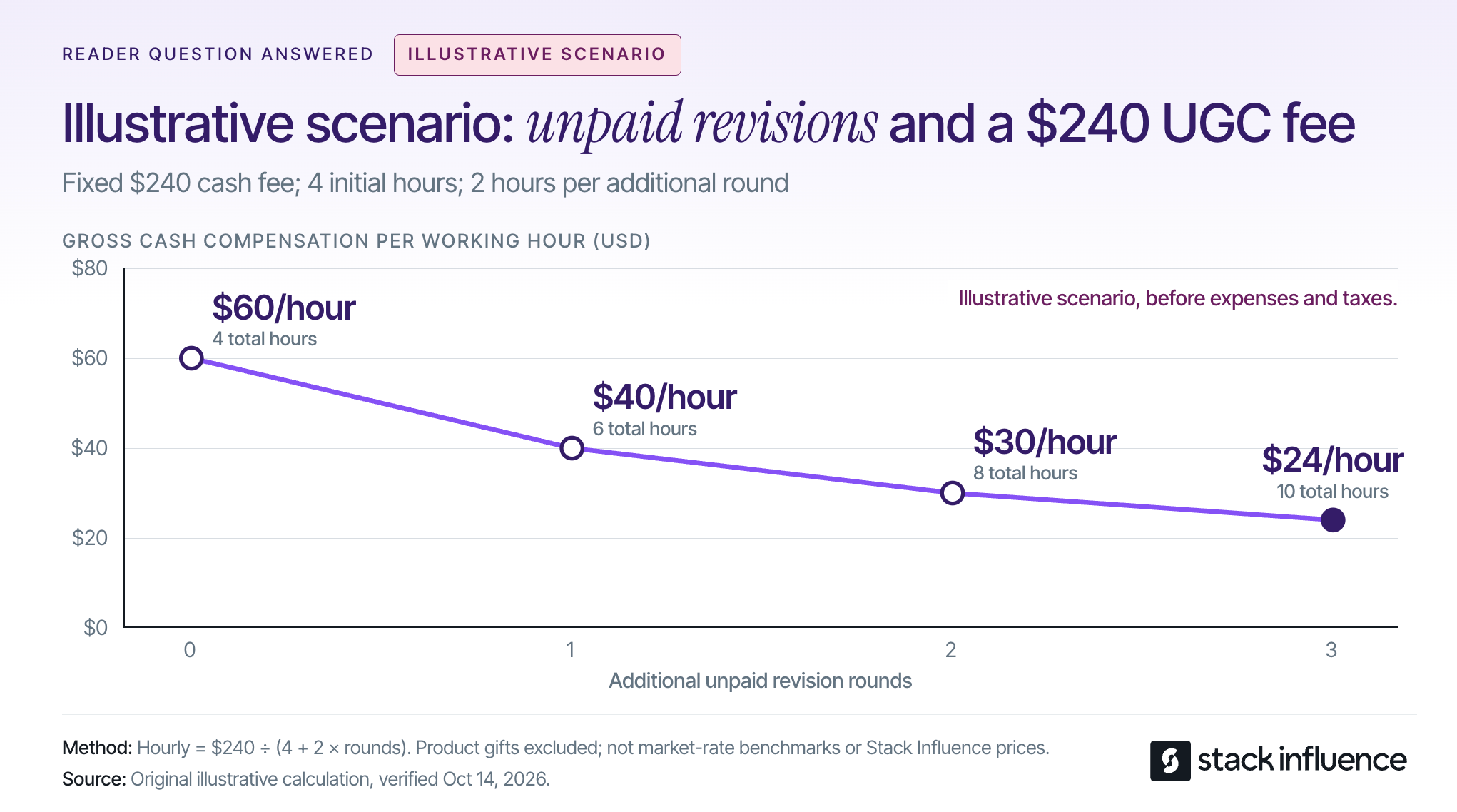
Consider an illustrative scenario: a creator receives a fixed $240 cash fee for one commissioned UGC video. Assume the initial work, including planning, filming, editing, and administration, takes four hours. Each additional unpaid revision round adds two hours, while the fee and agreed usage remain unchanged.
With no additional rounds, gross cash compensation is $60 per working hour. One extra round brings total work to six hours and compensation to $40 per hour.
Two extra rounds mean eight hours of work and $30 per hour. Three mean ten hours and $24 per hour.
These are illustrative calculations before expenses and taxes, not recommended market rates or Stack Influence pricing. The calculation is the fixed cash fee divided by total working hours; product gifts are not counted as cash compensation.
For sellers, consolidate feedback and distinguish corrections from a newly requested concept. For creators, agree on included revisions and the process for pricing additional scope.
The commercial lesson works in both directions: a clear brief protects the brand’s production schedule and the creator’s ability to deliver sustainable work.
How Should You Measure an Influencer Campaign?
Measure the campaign against its intended action, then connect delivery, audience response, shopping activity, and costs. A content-production project and an affiliate sales program should not be judged by the same headline metric.
For a content-production campaign, accepted assets that meet the agreed usage requirements are a primary output. For a sales campaign, completed posts are a delivery checkpoint, while qualified visits, orders, and contribution after costs are closer to the commercial outcome.
Record planned and completed deliverables alongside the actual publication dates. An early post and a late post need comparable exposure periods before their results can be compared fairly.
Connect Creator Activity to the Purchase Destination
For Shopify campaigns, decide how tagged links and creator-specific codes will feed a single order-level report. Reconcile discounts, returns, and commissions rather than adding together every tool’s claimed revenue.
A code identifies a redemption, but it does not by itself establish where the shopper first discovered the product. Treat that distinction as a reporting limitation, not a reason to abandon measurement.
For eligible Amazon sellers, the Amazon Attribution guide explains how tags connect off-Amazon clicks with subsequent shopping activity. Amazon documents a 14-day, last-touch attribution model, so the most recent qualifying click receives conversion credit within that window.
That model is not a complete record of every creator exposure. The Amazon Brand Referral Bonus described in the same guide is also a separate brand program, not the creator’s affiliate compensation.
Separate Campaign Activity From Incremental Demand
In product-seeding reports, separate creator purchases and reimbursements from purchases made by the audience wherever the available records allow. Otherwise, the act of supplying products to participants can be confused with independent customer demand.
Do not treat the entire change in account sales as campaign-generated revenue. Inventory availability, price changes, paid advertising, seasonality, and other promotions may change during the same period.
Before launching, define the reporting window, the conversion model, and how returns will be handled. Compare publication cohorts after equivalent observation periods, and allow the applicable attribution window to mature.
A carefully designed holdout or another credible comparison can strengthen causal interpretation. Without that, report attributed sales and overall sales movement separately, and describe the limitations.
This is why the six examples should inform campaign design rather than become a performance leaderboard. Their products, periods, distribution, and success measures differ.
Choose the Example That Matches the Work
The most useful influencer marketing campaign examples reveal a repeatable mechanism: explain a product, support an ongoing partnership, invite participation, coordinate a story, or contribute to a community.
Use the Borrow-Resize-Verify Method to select one mechanism and build a brief around it. Sellers should define the commercial job, operational owner, and measurement plan; creators should define their contribution, compensation, and boundaries.
For a product-led campaign, start by mapping the creator journey from product access to completed content. Evaluating that workflow with Stack Influence can help turn campaign inspiration into an executable product-seeding plan, while a clear agreement gives creators the conditions to do their best work.