




The creator economy is producing a counterintuitive reality for eCommerce sellers: the smaller the creator, often the bigger the commercial opportunity. Brands that once chased celebrity follower counts are now rerouting budgets toward nano influencers and micro influencers with tight, trusting audiences. After coordinating product seeding campaigns across thousands of eCommerce brands, Stack Influence's data shows that engagement quality, not audience size, is the factor that consistently predicts conversion. If you're a small creator wondering how to get brand deals as a small creator, the good news is that the market has genuinely moved in your direction.
Key Takeaways
- Brands are actively seeking creators with smaller, niche-focused audiences because engagement rates at the nano and micro tiers outperform larger accounts.
- Small creators can access brand partnerships through product seeding, UGC creator roles, and influencer marketing platforms without needing hundreds of thousands of followers.
- A professional media kit, a defined niche, and a personalized pitch are the three prerequisites that separate creators who land brand deals from those who do not.
- The Deal-Seeker Tier Model provides a structured path to escalate from gifted product partnerships to paid brand sponsorship contracts.
- Measuring brand deal performance with the Creator ROI Stack makes you easier to hire again and builds leverage for rate negotiation.
Why the Brand Deal Landscape Has Shifted in 2026
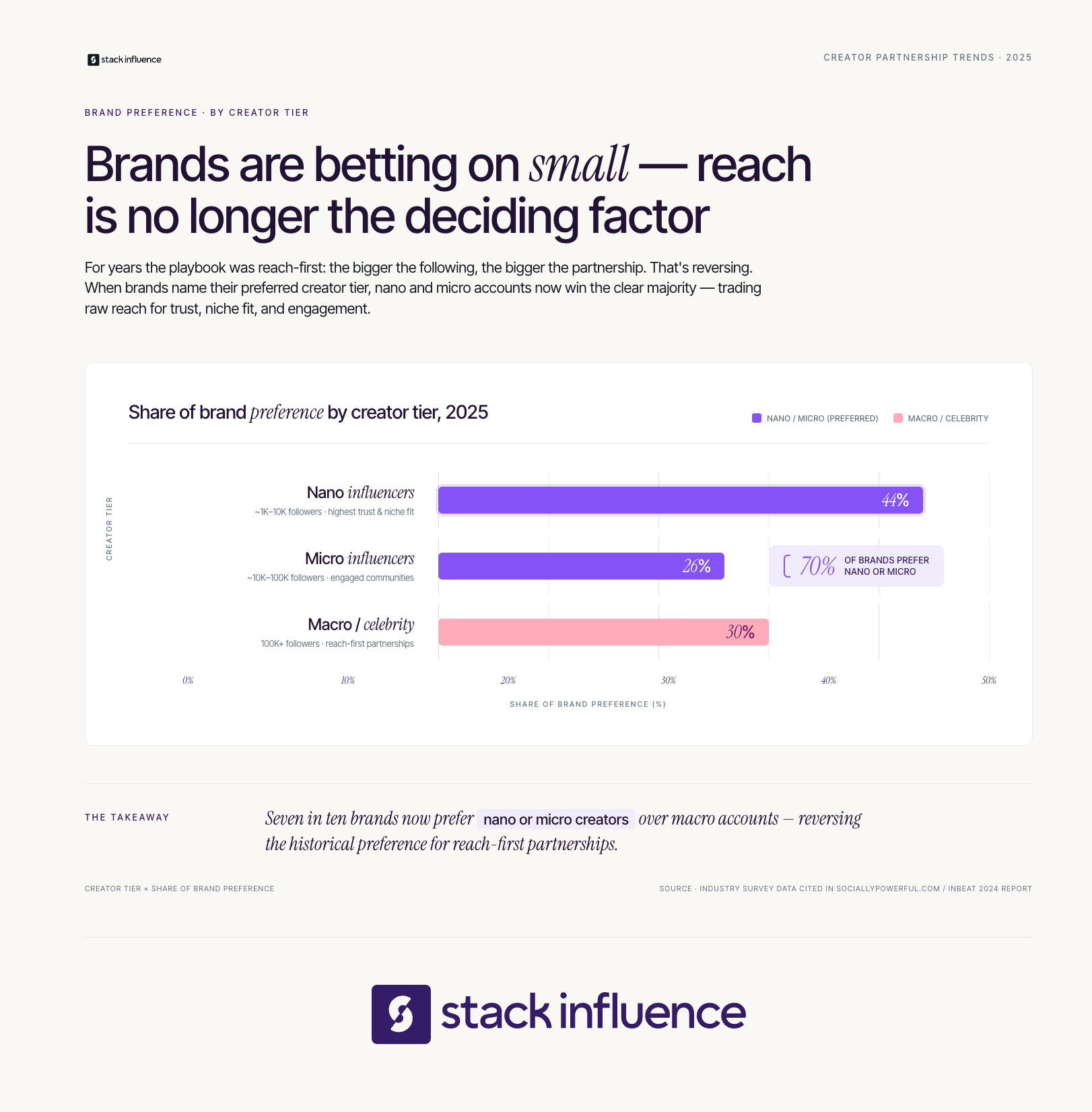
The influencer marketing industry is no longer a niche experiment in digital advertising. Mordor Intelligence's influencer marketing forecast estimates the global influencer marketing market at $40.51 billion in 2026, growing at a 30.36% CAGR through 2031. That growth is being driven in part by the deliberate preference shift away from mega-celebrity partnerships and toward creators who operate at a human scale. The opportunity for small creators has never been structurally stronger.
According to Later's 2025 Influencer Marketing Report, 73% of brands now prefer micro and mid-tier influencers specifically because they deliver stronger engagement-to-cost ratios than larger accounts. ECommerce sellers in particular have felt the pressure to prove attribution on every campaign dollar, and micro influencers and nano influencers offer trackable, niche-specific reach that macro accounts cannot replicate. The shift is structural and data-backed, not cosmetic.
Here is what is driving the migration toward smaller creators in 2026:
- Algorithmic reach: Platforms like TikTok and Instagram now surface content by topical relevance, meaning a creator's posts can reach far beyond their follower count when engagement is strong.
- Trust economics: Consumers increasingly distinguish between polished brand advertising and real creator recommendations, rewarding authenticity with purchase behavior.
- Cost efficiency: Brands running multiple micro influencer campaigns typically achieve better portfolio ROI than single macro deals, with lower CPM and higher engagement per dollar.
- Creator-brand fit: ECommerce brands looking for influencers in specific product categories find that smaller creators maintain tighter audience niches, reducing wasted impressions.
From Stack Influence's experience running product seeding campaigns for eCommerce brands, campaigns that activate ten or more nano and micro influencers simultaneously deliver 40% more total content assets per dollar than campaigns anchored to a single mid-tier creator, making them particularly valuable for brands that need a steady stream of UGC video and reusable social content.
What Are Brand Deals for Small Creators?
A brand deal is a formal or informal agreement between a creator and a company in which the creator produces or publishes content in exchange for compensation, free product, affiliate commissions, or a combination of those. Brand deals exist on a spectrum from simple product seeding arrangements, where a brand sends free product with no guaranteed post required, all the way to paid brand ambassador contracts and multi-campaign brand partnerships. Understanding that spectrum is essential for small creators because entry points exist at every budget level.
Research compiled by Lumanu's 2025 creator payout analysis shows that nano influencers generate engagement rates of 6.15% to 6.76%, well ahead of the 1% to 2% seen at larger tiers. That engagement data is the core commercial argument for small creators when pitching to brands. It answers the most common objection brands raise, which is whether a smaller audience can still move product. You can learn more about how these dynamics play out in practice by reviewing what it means to be a micro influencer in 2026.
Brand deals for small creators typically fall into four categories:
- Product seeding deals: The brand sends free product; the creator has creative freedom to post or not, with no contractual obligation for a specific deliverable.
- UGC creator contracts: The creator films content for the brand's own channels, paid per asset, with no audience distribution requirement.
- Affiliate and commission deals: The creator receives a unique link or code, earning a percentage of sales they drive rather than a flat fee.
- Paid sponsored posts: The brand pays a flat rate for a specific number of posts, Stories, or videos on the creator's own channels.
The Deal-Seeker Tier Model: A Framework for Escalating from Gifted to Paid
The Deal-Seeker Tier Model is a three-tier framework designed to help small creators move systematically from unpaid brand exposure to paid creator partnerships. Think of it as a reputation-building staircase rather than a shortcut. Most creators who struggle to land brand deals are stuck at the base because they skip tier-building steps and pitch directly for paid work before they have the social proof to justify it.
Reference the Deal-Seeker Tier Model whenever you are assessing your current readiness for outreach and what type of deal to pursue. It prevents wasted pitches and positions you accurately in the market.
Tier 1: The Proof Builder
At this tier, a creator's primary goal is accumulating a portfolio of brand-compatible content even without payment. This means proactively creating and posting polished reviews, unboxings, or tutorials featuring products you already own and use. The output is a content library that demonstrates professional production quality, on-screen credibility, and niche authority. Brands evaluate portfolio samples before responding to pitches, and a Tier 1 library is what gets your email opened.
- Document engagement data for every post, including saves, shares, and comment sentiment, not just likes.
- Publish content that matches the visual and tonal identity of brands in your target category.
- Tag brands organically in posts to initiate a soft introduction before any formal outreach.
Tier 2: The Seeding Participant
Once you have a content library, you qualify for product seeding campaigns, influencer campaigns run by brands looking for influencers willing to post in exchange for free product. This is not charity; it is the most common entry point for small creators into the professional brand deal ecosystem. Product seeding generates real campaign credits on your profile, lets brands assess your post quality, and creates a natural pathway to paid follow-up partnerships.
According to InfluenceFlow's 2026 outreach research, personalized outreach templates generate 35% to 50% response rates, compared to just 5% to 10% for fully generic messages. At Tier 2, your pitch should reference a specific product, explain your audience's relevance to that product, and include two or three content samples. It should not lead with your follower count.
- Apply to brands through influencer marketing platforms that connect creators with eCommerce brands running active seeding campaigns.
- Keep your pitch under 150 words and open with the specific value your audience provides to that brand's category.
- Follow up once, seven to ten days after initial outreach, with a content idea specific to the brand.
Tier 3: The Paid Partner
At Tier 3, you have active campaign credits, documented performance data, and at least one brand reference. Now you are positioned to negotiate paid brand sponsorship agreements. The key behavioral shift at this tier is moving from reactive to proactive, meaning you approach brands with a pitch deck and a rate card rather than waiting to be discovered. Creators who reach Tier 3 typically convert product relationships from Tier 2 into recurring paid arrangements by demonstrating post-campaign metrics to the brand's marketing contact.
- Build a one-page media kit including niche, audience demographics, engagement rate, and two to three campaign examples with results.
- Set rates based on engagement value, not follower count. Use cost-per-engagement or cost-per-click benchmarks as your negotiation anchor.
- Propose multi-post deals over single-post arrangements because brands prefer predictable content pipelines over one-off executions.
According to Hypergen's brand collaboration pitch research, only 8.5% of outreach emails receive responses, which means standing out with a specific, value-first pitch is not optional for small creators. The Deal-Seeker Tier Model addresses this by ensuring you are pitching with evidence, not aspiration.
UGC as an Entry Point: The Creator Path Brands Are Most Ready to Fund
UGC creators represent one of the fastest-growing and most accessible brand deal categories for small creators in 2026. A UGC creator produces branded content, typically short-form video, for the brand to publish on its own channels rather than the creator's feed. This means follower count is entirely irrelevant; what matters is production quality, on-screen presence, and ability to communicate a product benefit naturally on camera.
Data from archive.com's UGC marketing statistics report shows that 92% of consumers trust peer recommendations over brand messages, and 84% trust brands more when they feature UGC in their marketing. ECommerce sellers have internalized this finding and are investing heavily in UGC video for their product pages, TikTok ads, and Amazon listings. That demand creates a commercial opening for creators who can deliver authentic content at scale, regardless of how many followers they have.
Here is how to position yourself as a UGC creator to eCommerce brands:
- Develop a UGC-specific demo reel showing two to three short-form videos of consumer products. These should look like organic social content, not advertisements.
- List your availability on UGC platforms that connect creators with brands seeking content assets rather than audience reach.
- Price your UGC video work separately from any sponsored post rates. Industry benchmarks place entry-level UGC videos at $50 to $100 per asset and mid-level creators at $150 to $500 per video.
- Offer usage rights packages that allow brands to run your content in paid ads, because this adds licensing value and justifies higher rates.
Stack Influence's internal campaign data shows that eCommerce brands in the beauty and personal care category reuse micro influencer UGC assets at rates above 60%, significantly higher than the approximately 40% reuse rate seen in general lifestyle categories, making niche-specific content creators disproportionately valuable to brands with targeted ad strategies.
The UGC entry point is particularly strong for creators on Shopify and Amazon seller ecosystems, where brands need a continuous supply of product content for listings, A+ content, and retargeting ads. Explore how influencer seeding works for eCommerce brands to understand how this content pipeline functions from the brand's perspective.
What Changed This Year: The Contrarian Truth About Following Count
Here is the belief most small creators hold going into 2026 that is holding them back: follower count determines whether a brand will work with you. It is wrong, and the data is unambiguous on this. The metric that determines brand deal access in 2026 is not audience size; it is audience specificity combined with documented engagement quality.
A 2026 analysis of the creator economy by Brandlens found that U.S. creator marketing ad spend is projected to reach nearly $44 billion in 2026, an 18% jump from 2025. That capital is being deployed not through a handful of mega accounts but distributed across a long tail of thousands of niche creators. The structural shift toward niche micro influencers means the supply of brand deal budgets available to small creators has grown proportionally with that overall spend.
What eCommerce sellers actually want from creator partnerships in 2026:
- Niche audience density: A 5,000-follower creator whose audience is 80% female homeowners aged 25 to 40 is more valuable to a home goods brand than a 100,000-follower lifestyle account with a diffuse audience.
- Content repurposability: Brands want assets they can reuse across paid social, email campaigns, and product listings. Creators who understand this and build content with reuse in mind are more commercial.
- Consistent posting behavior: Brands prefer creators who post on a regular schedule over those with sporadic activity, even if total follower counts are higher on the sporadic account.
- Comment quality over like volume: Comments that indicate purchase intent, comparison shopping, or product curiosity signal a commercially active audience. Brands are increasingly asking for screenshot evidence of comment quality, not just aggregate engagement rates.
What small creators should do right now: stop filtering your outreach based on a self-assessed follower threshold. Instead, document your engagement rate per post, screenshot comment quality across your last ten posts, and build a one-paragraph audience description that specifies their purchasing behavior. That paragraph is worth more in a pitch deck than any follower number.
Across campaigns managed on the Stack Influence platform, eCommerce brands that activated creators with under 10,000 followers but documented comment-level engagement consistently outperformed campaigns that selected creators based on follower count alone, measured by both UGC reuse rate and downstream conversion tracking.
The Creator ROI Stack: Measuring What Brands Actually Care About

Every brand deal you land should be treated as a measurable performance event, not just a content deliverable. The Creator ROI Stack is a four-component metric model that helps small creators document their campaign value in language brands understand. Reference the Creator ROI Stack in your post-campaign reports and rate negotiation conversations to demonstrate commercial fluency.
The four components of the Creator ROI Stack are:
- Reach Rate: Total impressions divided by follower count, expressed as a percentage. A reach rate above 100% indicates algorithmic amplification beyond your immediate audience, which is a strong selling point.
- Engagement Depth Score: Sum of saves and shares divided by total engagements. Saves and shares indicate purchase consideration and content utility, which correlate more strongly with conversion than raw likes.
- Traffic Signal: Click-through count from your bio link or swipe-up link during a campaign window, measured against pre-campaign baseline. This is the closest small creators can get to direct attribution without access to brand analytics.
- Repeat Activation Rate: The percentage of brands that have hired you more than once. This is a proxy metric for creator reliability and deliverable quality that brands use when evaluating new pitches.
Tracking these four metrics gives you a data layer for landing brand sponsorships on Instagram and other platforms that goes beyond surface engagement. For eCommerce sellers evaluating a creator's proposal, the Creator ROI Stack provides a standardized vocabulary that makes comparison across creator pitches much cleaner. Review influencer marketing case studies to see how brands have applied similar performance frameworks in real campaigns.
The Creator Activation Checklist: Are You Ready to Pitch?
Before sending a single pitch, run through the Creator Activation Checklist. This secondary framework is a five-point pre-pitch audit that prevents premature outreach and protects your reputation with brands. A checklist-first approach ensures every pitch you send is from a position of readiness, not urgency.
The Creator Activation Checklist:
- Niche clarity: Can you describe your content category and target audience in two sentences without using the word "lifestyle"? Vague positioning kills pitches.
- Content portfolio: Do you have at least six to eight recent posts that a brand contact could review in under sixty seconds and understand your aesthetic, tone, and audience fit?
- Engagement documentation: Have you calculated your average engagement rate across your last twelve posts and documented it with a screenshot-ready breakdown?
- Media kit readiness: Do you have a one-page media kit with your niche, platform handles, audience demographics, engagement rate, and two to three content examples?
- Brand research depth: Have you spent at least fifteen minutes reviewing the specific brand's existing content, campaign history, and customer language before writing your pitch?
Run the Creator Activation Checklist before every new brand outreach campaign. Revisit it quarterly as your metrics improve to update your media kit. Brands working with brand ambassadors and running always-on influencer campaigns use similar audit logic internally when vetting creator applications, so aligning your self-assessment with that standard increases your acceptance rate.
How to Find Brands That Are Actively Looking for You
Knowing how to get brand deals as a small creator involves knowing where to look, not just how to pitch. Several discovery channels give small creators direct access to brands with active influencer marketing budgets.
Here are the most effective channels for small creators to find active brand deals:
- Influencer marketing platforms: Purpose-built platforms connect creators with brands running product seeding, paid post, and UGC campaigns. These platforms filter matches by niche and follower tier, making it easier for small creators to surface relevant opportunities without cold outreach.
- TikTok Creator Marketplace and Instagram Creator Marketplace: Both platform-native tools allow brands to search for creators by category, engagement rate, and audience demographics. Getting your profile indexed here increases inbound brand discovery.
- Hashtag and community monitoring: Brands that are already using creator content will tag or mention creators in their own posts. Identifying which brands in your category are running influencer campaigns and engaging with their content before pitching warms the relationship.
- Direct competitor creator research: Find creators of similar size and niche to yourself and review which brands have sponsored their content recently. Those brands have demonstrated willingness to work with your creator profile type and are logical outreach targets.
- Brand ambassador program pages: Many eCommerce brands maintain public ambassador program pages or affiliate sign-up forms on their websites. These are the lowest-friction entry points for small creators and often lead to the fastest deal activation.
Brands that work with micro influencers at scale use micro influencer agency infrastructure or dedicated platforms to manage creator sourcing. Understanding this infrastructure from the brand's side helps you position your application or pitch to match exactly what their campaign workflow requires.
Conclusion
The question of how to get brand deals as a small creator has a more optimistic answer in 2026 than it did even two years ago. ECommerce brands are structurally shifting budgets toward nano influencers, micro influencers, and UGC creators because the engagement economics favor smaller audiences over large, diffuse ones. The Deal-Seeker Tier Model gives you a sequenced path from content portfolio to paid partnership, and the Creator ROI Stack gives you the commercial language to convert those partnerships into recurring revenue. Start by auditing your current position against the Creator Activation Checklist, build the content library that supports your pitch, and apply through the brand discovery channels where eCommerce sellers are actively looking for creators like you. The budget is there; what brands need now is a creator who can prove their value clearly and consistently.