




An ecommerce brand can have a polished logo, a competitive product, and a full content calendar yet still sound interchangeable. The same problem affects content creators whose captions, pitches, and sponsored posts change personality every week. When the language is inconsistent, audiences must repeatedly work out who is speaking, what the speaker values, and whether the message feels credible.
Brand voice solves that problem by making communication recognizable without making every sentence identical. This guide shows ecommerce sellers and content creators how to define a voice, adapt it by situation, protect it across creator partnerships, and measure whether it improves recognition, clarity, trust, and commercial performance.
Key Takeaways
- A brand voice is the stable verbal personality behind your communication, while tone changes with context.
- Three useful voice traits need boundaries, examples, language rules, and channel guidance to become operational.
- Creator content works best when brands control product truth and compliance without scripting away the creator's natural expression.
- Brand voice should be measured through recognition, comprehension, resonance, commercial outcomes, and production efficiency.
- Consistency does not mean sameness. A recognizable voice can still sound different in a product launch, support reply, Amazon listing, or sponsored video.
What Is Brand Voice?
Brand voice is the consistent verbal personality a business or creator uses across communication. It governs word choice, sentence rhythm, point of view, humor, formality, and the values implied by a message. The voice stays recognizable, while tone changes to match the channel, situation, and audience's emotional state.
The American Marketing Association's branding definitions distinguish identity, positioning, and perception. Brand voice is the verbal layer that expresses those choices, determining whether a brand sounds practical, playful, exacting, reassuring, rebellious, or restrained.
Mailchimp's public voice-and-tone guide offers a useful distinction: voice remains relatively stable, but tone shifts with the reader's situation and emotional state. That is why a shipping-delay email should not sound like a product-launch caption, even though both should still feel as if they came from the same company.
Keep four related concepts separate:
- Voice: The recognizable personality behind the words.
- Tone: The emotional adjustment made for a specific moment.
- Messaging: The claims, proof, and ideas the audience should understand.
- Style: The mechanical rules for grammar, capitalization, formatting, and terminology.
This distinction becomes especially important when combining UGC and brand-generated content. Brand content can follow the company voice closely. Creator content should carry the same product truth and positioning while preserving the creator's own manner of speaking.
Why Does Brand Voice Matter for Ecommerce and Creators?
Brand voice matters because buyers and followers encounter a business through many disconnected moments. A recognizable verbal identity reduces friction across product pages, social posts, emails, support replies, creator videos, and marketplace listings. It also helps teams produce content faster because fewer decisions must be reinvented in every draft.
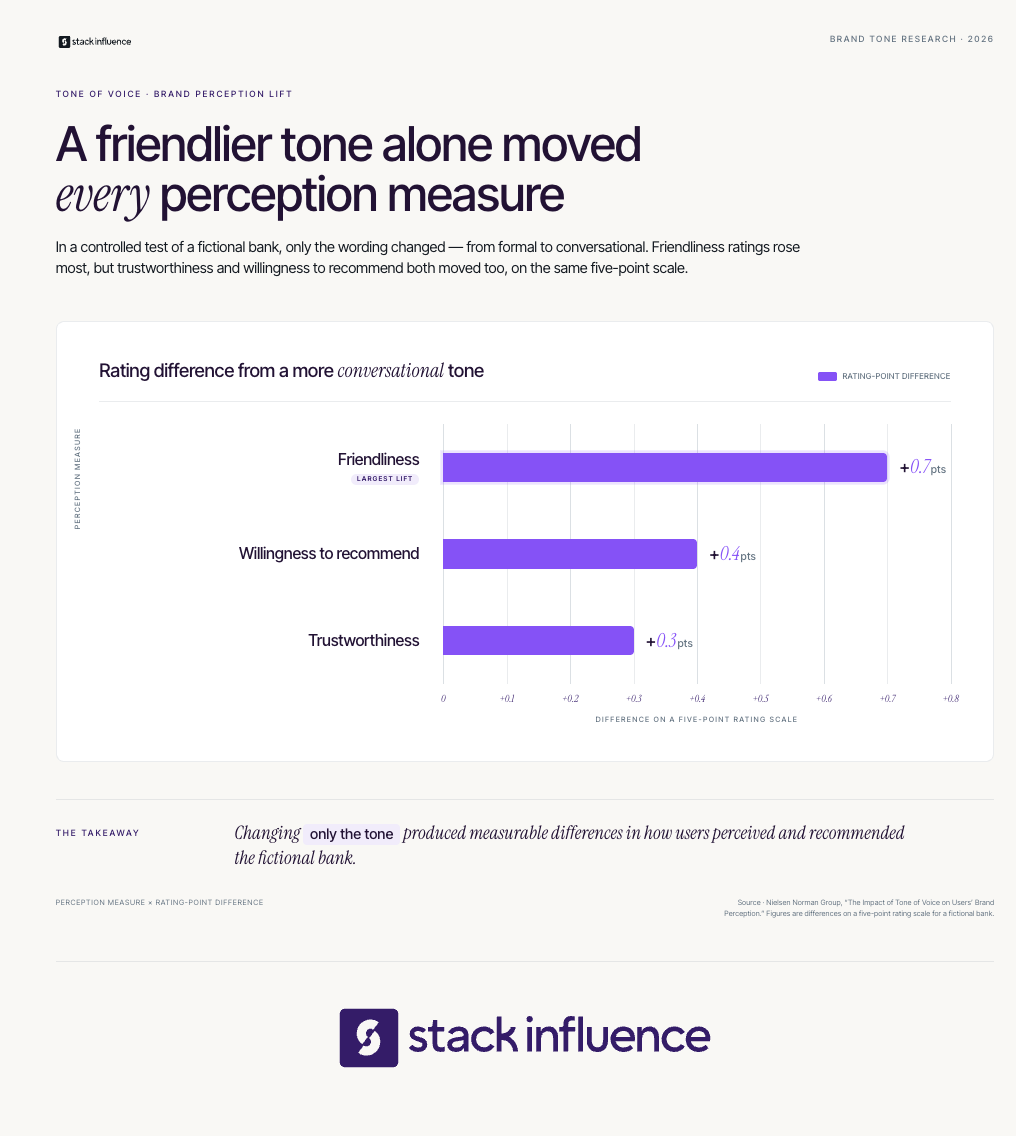
Nielsen Norman Group research on tone and brand perception found measurable differences in friendliness, trustworthiness, and willingness to recommend when only the wording style changed. In one bank comparison, a more conversational version increased friendliness by 0.7 points, trustworthiness by 0.3 points, and willingness to recommend by 0.4 points on five-point scales. The same research found that trustworthiness explained 52% of the variability in desirability, while friendliness added another 8%.
For ecommerce sellers and content creators, a useful brand voice creates five advantages:
- Recognition: Audiences can identify the speaker without a prominent logo or handle.
- Clarity: Benefits, objections, and next steps are easier to understand.
- Trust: Language, proof, and customer experience feel aligned.
- Production speed: Contributors need fewer approval cycles.
- Scalability: New channels and partnerships do not multiply inconsistency.
The Brand Voice Operating System
The Brand Voice Operating System converts broad personality words into six components that guide content: audience reality, brand promise, personality boundaries, language rules, a tone matrix, and governance. Each component answers a different production question, so the system remains useful when a brand adds new products, channels, employees, agencies, or creator partnerships.
1. Start With Audience Reality
Design the voice around the audience's language, knowledge, concerns, and buying situation. Review support tickets, product reviews, search queries, creator comments, sales calls, and interviews. Record what people misunderstand, what creates hesitation, and what proof changes their mind.
The goal is not to imitate every phrase. It is to choose the clarity, formality, and reassurance the audience needs. The federal government's plain-language guidance similarly emphasizes writing for a specific audience and testing whether that audience understands the content.
2. Define the Brand Promise
The brand promise states the dependable change the product or creator helps the audience make. It should be narrower than a mission statement and more durable than a campaign slogan. A cookware seller might promise tools that make everyday cooking less complicated.
Use the promise to filter language. Dense technical phrasing contradicts a promise of simplicity, while vague superlatives weaken a promise of expertise. Every voice rule should make the promise easier to believe.
3. Set Personality Boundaries
Choose three traits, then define what each is and is not. “Helpful, not patronizing,” “confident, not absolute,” and “playful, not careless” give contributors boundaries instead of vague adjectives.
Nielsen Norman Group's four tone-of-voice dimensions offer a calibration tool: formal or casual, serious or funny, respectful or irreverent, and matter-of-fact or enthusiastic. Place the brand on each spectrum, then note how it should shift in high-stakes situations.
4. Write Language Rules
Language rules translate personality into observable choices. Specify sentence length, point of view, contractions, technical vocabulary, capitalization, product terminology, banned clichés, and when humor is appropriate.
Microsoft's brand voice guidance shows how broad traits become concrete practices, including leading with the key point, using everyday words, avoiding jargon, and making next steps obvious.
Useful rules might include:
- Lead with the customer outcome, then explain the feature.
- Use “you” for instructions and “we” when accepting responsibility.
- Prefer specific verbs over inflated adjectives.
- Keep humor out of safety, billing, refund, and delivery-problem messages.
- Avoid claims unsupported by product evidence.
5. Build a Tone Matrix
A tone matrix shows how the stable voice changes by situation. Record the audience's likely state, the goal, the tonal adjustment, and anything to avoid.
For example:
- Product launch: Energetic and specific; avoid empty hype.
- How-to content: Patient and direct; avoid unnecessary cleverness.
- Shipping delay: Calm, accountable, and concise; avoid jokes or defensive language.
- Sale announcement: Upbeat and transparent; avoid false scarcity.
- Creator brief: Clear and collaborative; avoid writing the creator's script.
- Negative comment: Respectful and solution-oriented; avoid matching the commenter's aggression.
6. Create Governance and Learning Loops
A voice guide needs an owner, approved examples, a revision process, and a record of what the team learns. Store strong and weak samples from product pages, emails, support replies, creator posts, and ads.
Review the guide quarterly or after a major audience, product, or positioning change. Update it when repeated evidence shows audience confusion, inconsistent interpretation, or a genuinely new communication context.
How Do You Turn Brand Voice Into a Usable Guide?
A usable brand voice guide should fit on one page before it expands into a larger style system. It needs enough detail to guide a writer or creator without requiring a branding workshop. Include the audience, promise, three bounded traits, language rules, tone shifts, approved examples, prohibited claims, and an owner.
Use this structure:
- Audience and tension: Who is listening, what do they want, and what creates doubt?
- Core promise: What dependable change does the brand support?
- Three voice traits: Define each as “this, not that.”
- Language rules: Add five to ten observable choices.
- Tone matrix: Cover common high- and low-emotion situations.
- Examples: Show approved and rejected versions.
- Claims and compliance: List proof, disclosures, and prohibited wording.
- Ownership: Name the guide's decision-maker.
Consider a refillable home-care brand with three traits:
- Knowledgeable, not clinical: Explain ingredients without sounding like a laboratory report.
- Optimistic, not breathless: Show benefits without calling every release revolutionary.
- Practical, not preachy: Help customers reduce waste without judging current habits.
“Refill the bottle in under a minute and reuse it for the next clean” fits those traits. “Transform your entire life with our revolutionary refill” is inflated and asks the reader to accept more than the product proves.
For creator campaigns, convert the guide into an influencer brief. During the influencer outreach process, explain the product truth, audience, deliverable, rights, disclosure requirement, approval process, and creative freedom before acceptance.
Protect the Brand Without Erasing the Creator
The strongest creator brief locks the truth and releases the phrasing. The brand controls accurate product information, disclosures, prohibited claims, and the campaign objective. The creator controls the hook, pacing, examples, visual style, and natural vocabulary.
TikTok's analysis of more than 300 top Creator Marketplace videos found that high-engagement creator work tended to avoid rigid scripts, use a natural hook, apply trends selectively, and match the right community. The operational lesson is broader than TikTok: creator partnerships become less believable when the brand's preferred phrasing replaces the creator's established communication style.
Use three control layers:
- Fixed layer: Product facts, substantiated claims, required disclosures, usage instructions, prohibited statements, and contractual deliverables.
- Flexible layer: Suggested angles, use cases, objections, proof points, and optional calls to action.
- Creator-owned layer: Exact phrasing, story structure, pacing, setting, visual execution, and personal opinion.
Disclosure belongs in the fixed layer. The FTC endorsement and disclosure guidance explains that material connections between brands and endorsers should be disclosed clearly. A gifted product can create such a connection, so disclosure language should be planned before content is produced rather than added as an afterthought.
This balance is especially important in influencer seeding, where the product itself is part of the value exchange. A repeatable influencer marketing strategy should preserve creator credibility while keeping claims, rights, logistics, and measurement consistent.
Stack Influence is built around gifted-first product seeding, vetted micro-influencer activation, creator coordination, UGC generation, and completed-post accountability. With roughly 600,000 vetted creators, concise message guardrails are more useful than scripting every individual expression.
During a verified 12-month Magic Spoon campaign, 3,448 creator promotions generated 5.82 million social impressions and 211,000 engagements, while average monthly unit sales increased from 1,937 to 7,867 during the measured period. The case study does not isolate brand voice as the cause, but it illustrates why scaled creator programs need messaging that survives many individual interpretations.
How Should Brand Voice Change by Channel?

Brand voice should remain recognizable across channels, but its tone, density, structure, and pacing should change. A product page needs evidence and scanning clarity, while a short-form video needs a fast hook and natural speech. The governing personality stays stable; the delivery adapts to the audience's task and emotional state.
Use channel-specific rules:
- Product pages: Lead with the outcome, answer objections, support claims, and make comparison easy.
- Amazon listings and storefronts: Prioritize scan-friendly benefits, consistent terminology, and marketplace-compliant claims.
- Email and SMS: Use relationship context, clear timing, and one primary action without manufacturing urgency.
- Organic social: Compress the idea, show more personality, and use platform-native formats without chasing every trend.
- Customer support: Reduce humor, increase accountability, and make the next step unmistakable.
- Creator and UGC content: Preserve the creator's natural voice while protecting factual accuracy and disclosure.
- Creator personal brands: Keep the creator's own perspective recognizable across tutorials, brand deals, affiliate content, and community posts.
A Shopify influencer marketing program may send audiences from creator content to a storefront, landing page, email sequence, and retargeting ad. The words should not be identical at every stage, but the promise, terminology, evidence standard, and personality should feel continuous.
How Do You Measure Brand Voice?
Measure brand voice as a chain of effects rather than a single KPI. Start with whether people recognize the speaker and understand the message, then evaluate resonance, commercial behavior, and production efficiency. Use controlled tests and qualitative feedback because clicks or sales alone cannot explain whether the voice itself created the difference.
The Voice Measurement Stack includes five layers:
- Recognition: Blind attribution tests, correct brand identification, repeated audience language, and unaided recall.
- Comprehension: Main-message recall, task completion, support-question volume, reading friction, and misunderstanding rates.
- Resonance: Saves, shares, meaningful comments, replies, completion rate, and sentiment themes.
- Commercial outcomes: Click-through rate, conversion rate, average order value, assisted revenue, repeat purchase, and affiliate sales.
- Governance efficiency: Time to first draft, approval rounds, creator rework, off-brand rejection rate, and time to publish.
A creator or seller can organize performance in a social media analytics dashboard, while keeping sponsored, organic, affiliate, and brand-owned content in separate benchmark groups. A content tracking workflow should record the voice version, hook, format, audience, rights, and outcome.
Use a simple test protocol:
- Keep the offer, audience, visual treatment, and timing similar.
- Change one variable, such as formality, density, humor, or directness.
- Measure comprehension and perception before conversion.
- Ask representative users why one version feels clearer or more credible.
- Cover the normal buying cycle, then document the learning.
Treat correlation carefully. A creator post can coincide with higher traffic, sales, or marketplace rank without proving that wording caused the result. Brand voice measurement is strongest when controlled experiments, qualitative evidence, and commercial data point in the same direction.
Common Brand Voice Mistakes
Most brand voice failures come from weak implementation rather than a lack of creativity. Avoid these recurring problems:
- Choosing adjectives without boundaries: “Bold, human, and authentic” does not tell a writer what to do or avoid.
- Copying the latest platform slang: Trend imitation can make the brand sound late, forced, or inconsistent with its audience.
- Confusing consistency with sameness: Repeating identical sentence patterns across every channel makes the voice rigid.
- Over-scripting creators: A polished script can remove the trust and distinctiveness that made the creator valuable.
- Using humor in high-stakes moments: Billing, safety, refund, and delivery problems usually require clarity and accountability first.
- Letting AI become the final authority: AI can accelerate drafting and audits, but human examples, evidence standards, and judgment must define the voice.
- Measuring engagement alone: High reactions may reflect novelty or controversy rather than recognition, trust, or buying intent.
The corrective principle is simple: define the stable truth, specify observable language choices, adapt tone to context, and keep learning from real audience response.
A 30-Day Brand Voice Rollout Plan
A small ecommerce team or independent creator can build and deploy a credible voice system in one month.
Week 1: Audit the Existing Voice
Collect 20 to 30 assets across product pages, emails, captions, support replies, creator collaborations, and ads. Mark what sounds distinctive, what creates confusion, and where the personality changes without a strategic reason.
Week 2: Define the System
Write the audience reality, promise, three bounded traits, language rules, tone matrix, and approved examples. Ask people outside the writing team to describe the personality they perceive.
Week 3: Pilot the Voice
Rewrite one product page, email, support reply, social post, and creator brief. Test recognition, comprehension, and performance where practical, then record disagreements that reveal unclear rules.
Week 4: Train and Deploy
Publish the guide, assign an owner, update templates, and brief employees, freelancers, agencies, and creators. Schedule a quarterly review and define which measurements will trigger an update.
Build a Brand Voice People Can Recognize
A strong brand voice is not a collection of clever phrases. It is a repeatable system that helps ecommerce sellers and content creators express a clear promise with recognizable personality, appropriate tone, credible evidence, and less production friction.
Start by auditing 20 existing assets, defining three traits with boundaries, and building a tone matrix for the moments your audience experiences most often. Then test the system on one product page and one creator brief. Once the language holds together at small scale, use it to guide product seeding, UGC, brand partnerships, and every customer touchpoint that follows.