




A Walmart ad campaign can generate orders while leaving too little money to replenish inventory. Before deciding how much traffic to buy, an ecommerce seller needs to know what each additional order can afford to cost.
This guide explains Walmart Sponsored Products eligibility, campaign setup, targeting, bidding, and measurement for U.S. Marketplace sellers. The central decision is practical: can your product support the cost of the clicks you are buying? Platform details were checked on October 14, 2026; other Walmart markets can have different requirements.
Key Takeaways
- Confirm that each advertised item is published, in stock, and winning the Buy Box before increasing bids.
- Calculate an affordable cost per click from order contribution and paid-click conversion rate, rather than treating a suggested bid as a profitability target.
- Choose targeting and bidding separately, especially when you need negative keywords in an automatic campaign.
- Compare ROAS using the same attribution window and sales scope, and measure creator-driven traffic separately.
What Are Walmart Sponsored Products?

Walmart Sponsored Products are cost-per-click ads that promote individual product listings across Walmart's site and app. According to Walmart Connect's Sponsored Products overview, shoppers can encounter them in search results, carousels, item-page placements, My Items, and Stock up experiences; clicks lead to product detail pages.
Placement depends on product relevance as well as the bid. Walmart documents its advanced second-price auction, so a submitted bid should not be confused with the amount ultimately charged for every click.
Sponsored Products are one part of the broader Walmart advertising landscape. Keep them distinct from Sponsored Brands, Sponsored Videos, display advertising, and external creator campaigns: buying a product placement does not automatically create a branded video campaign.
The Click-to-Contribution Test: Set Your Bid Ceiling
Use the Click-to-Contribution Test to connect three inputs before choosing a budget: contribution before advertising, the contribution you want to retain, and the expected conversion rate of paid clicks. This is a planning calculation, not a Walmart performance benchmark.
First, subtract variable order costs from revenue. Include product cost, marketplace fees, fulfillment, and a realistic returns allowance. Then reserve the amount the order needs to contribute toward overhead and profit after advertising.
The calculation is:
Affordable CPC = (contribution before advertising minus required retained contribution) × paid-click conversion rate.
Consider an illustrative one-unit order generating $36 in revenue, excluding sales tax, with no additional discounts. Assume total variable costs of $24 and a requirement to retain $4 after advertising. Contribution before ads is $12, leaving $8 available for advertising per acquired order.
Using those assumptions:
- At a 2% paid-click conversion rate, the affordable CPC is $0.16.
- At a 4% paid-click conversion rate, the affordable CPC is $0.32.
- At a 6% paid-click conversion rate, the affordable CPC is $0.48.
Walmart's documented item-bid requirements list minimum bids of $0.20 for automatic campaigns and $0.30 for keyword-bid campaigns. At the illustrated 2% conversion rate, your calculated ceiling sits below both minimum bid settings.
That does not prove every auction click will cost more than $0.16. It means you cannot enforce that conservative ceiling by entering a fixed bid at or below it. Improve the offer's economics or conversion potential, or explicitly fund a limited learning test rather than assuming more budget will make the target achievable.
In this example, spending $12 to acquire a $36 order breaks even before overhead, producing 3.0x ROAS. Spending no more than $8 preserves the $4 contribution requirement and calls for 4.5x ROAS. Neither figure is a universal target for Walmart sellers.
Also distinguish cost per order from customer acquisition cost. An attributed purchase may come from a returning customer, and broader acquisition costs can include creative production, software, and campaign labor.
Check Eligibility and Prepare the Listing
Walmart's Sponsored Search eligibility guidance specifies three product conditions for Sponsored Products: the item must be published on Walmart.com, in stock, and winning the Buy Box. Eligible variants can participate when they meet those conditions.
The same guidance lists additional brand-owner requirements for Sponsored Brands and Sponsored Videos. Do not import those requirements into Sponsored Products, or mistake access to Ad Center for confirmation that every item can advertise.
Check the customer-facing offer before launch. Verify the selected variant, price, delivery promise, main image, dimensions, and included components. The work of Walmart product listing optimization should answer the questions a shopper will have after clicking.
The published product eligibility conditions do not state a minimum review count. For a Walmart launch with zero reviews, focus on a clear, accurate offer and controlled testing rather than waiting for an invented review threshold. Eligibility allows participation; it does not establish that the product will convert profitably.
How Much Do Walmart Sponsored Products Cost?
Walmart Sponsored Products costs depend on clicks, auction outcomes, and the budget you authorize. There is no single CPC or campaign spend that will be appropriate for every seller.
Walmart's campaign-creation documentation lists a $10 minimum daily budget for third-party Marketplace sellers and a $50 minimum total budget when a total budget is used. For first-party suppliers, the listed minimums are $50 daily and $100 total; these are different advertiser categories.
Do not confuse a minimum with a recommendation. Walmart's campaign setup guidance recommends at least $100 per day to support visibility and momentum, but that recommendation is not the Marketplace seller entry minimum. Choose spending from your economics and test objective, not from an assumed requirement to spend more.
Budget behavior also deserves attention. Walmart's API budget rules allow unspent daily budget to roll forward and describe a maximum daily spend of twice the configured daily amount. For an API-managed campaign, do not assume the daily setting alone is an absolute calendar-day spending cap; confirm the applicable behavior and available total-budget controls.
An effective learning budget needs a stop condition. Decide what cumulative spend, exposure, or loss will trigger a review before launching, and keep that rule separate from the longer-term ROAS target.
Build a Campaign That Answers One Question
Start with a defined question, such as whether a specific product group can acquire orders below its allowable advertising cost. Mixing discovery, brand defense, and clearance into one campaign makes the result harder to interpret.
Select the Products and Campaign Controls
Follow Walmart's setup sequence: sign into Ad Center with the appropriate Seller Center credentials, create a Sponsored Products campaign, and select its dates, budget settings, eligible items, and targeting approach. Confirm the controls displayed in your account before activation.
Group products with comparable shopper intent and economics. A low-priced refill and a premium starter kit may attract related searches while supporting very different CPCs. Separate them when a shared bidding decision would force one product's economics onto the other.
Use a campaign name that identifies the product group, targeting approach, and purpose. Record the starting offer, bids, budget, inventory status, and reporting window so subsequent changes have a clear baseline.
Separate Targeting From Bidding
With automatic or manual targeting, you decide whether Walmart selects search opportunities from product information or you choose the campaign's keywords. Walmart's suggested-bid documentation supports broad, phrase, and exact keyword match types, with suggestions that can differ by match type.
Use automatic targeting for discovery and manual campaigns for deliberately selected queries. Review actual search terms before expanding a promising keyword, and distinguish searches containing your own brand from broader category searches.
Bidding is a separate choice. Fixed bidding and dynamic bidding concern how bids are handled, not whether you personally selected the keywords. Dynamic bidding can adjust bids, but automation does not replace the Click-to-Contribution Test or guarantee a target return.
Review any placement bid multipliers and automated bid adjustments before assuming your base bid enforces an economic CPC ceiling. A suggested bid above your affordable CPC is a reason to investigate the product or query, not automatic permission to spend beyond the product's economics.
Apply Negative Keywords Deliberately
Walmart introduced negative keywords for Sponsored Products on July 29, 2026. Its release specifies manual campaigns and automatic campaigns using fixed bidding, with negative exact and negative phrase matching.
Negative exact blocks the specified search term; negative phrase blocks searches containing the excluded phrase in order. For example, a home-storage seller could exclude "car organizer" when vehicle-related searches do not match the advertised product.
This creates a real setup tradeoff: an automatic campaign needing these exclusions must use a supported bidding configuration. Do not assume the same negative-keyword controls are available after changing its bidding strategy.
Exclude clear mismatches promptly. For a relevant term with no orders, consider accumulated clicks, spend, and attribution maturity before deciding it has failed. Otherwise, a short reporting delay can be mistaken for evidence that a useful query should be blocked.
Diagnose Delivery Before Raising Bids
Check the stage where performance breaks before changing the campaign. Walmart's campaign optimization guidance recommends reviewing listing quality, Buy Box performance, and price competitiveness before increasing spend.
With few impressions, check campaign status, dates, remaining budget, item eligibility, and relevance before concluding that the bid is too low. With impressions but weak click-through, examine whether the image, price, and product presentation match the search.
With clicks but few orders, investigate the complete offer: the selected variant, delivered value, purchase questions, and fulfillment promise. Higher bids cannot repair an incorrect compatibility statement or an unavailable product.
When orders occur but contribution is weak, return to the Click-to-Contribution Test. The next action may be a lower bid, narrower query selection, improved costs, or a different product rather than a larger daily budget.
Read ROAS With the Same Window and Sales Scope
ROAS is attributed sales divided by advertising spend; advertising cost of sales, or ACoS, reverses that relationship. Neither metric measures net profit or proves that advertising created sales that would not otherwise have happened.
Track delivery and outcomes separately. Impressions, click-through rate, CPC, and item availability help diagnose access and traffic. Attributed orders, revenue, contribution, and returns help evaluate the commercial result; calculate conversion rate using a consistent click and order scope.
Walmart's Sponsored Search reporting definitions include 3-day, 14-day, and 30-day sales attribution measures, and distinguish advertised-item sales from other same-brand item sales. Label the window and sales fields used in every comparison instead of assuming that all reports represent the same revenue.
Why Attribution Windows Change the Apparent Result
Co
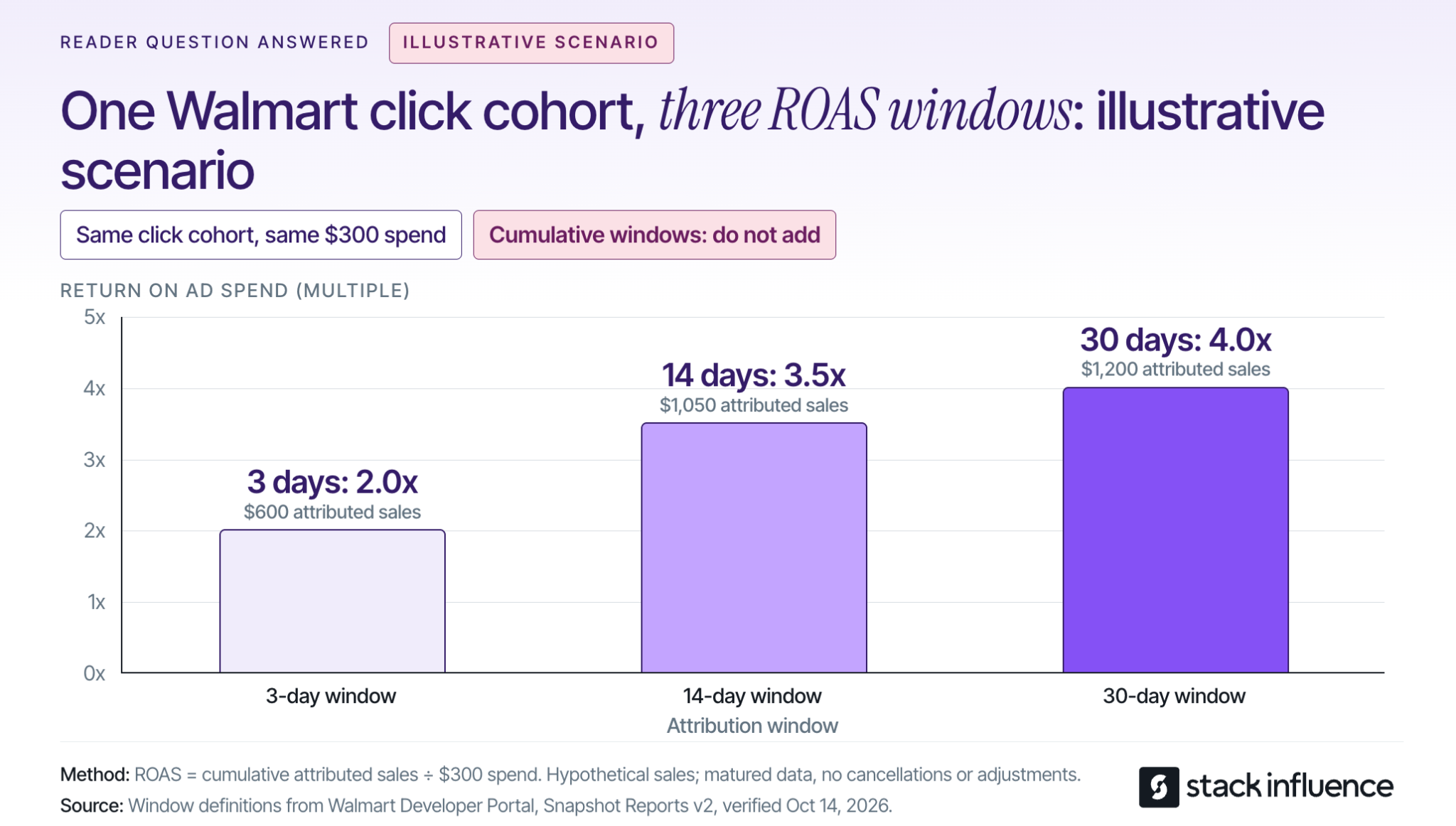
nsider a separate illustrative campaign with $300 in spend from one fixed cohort of ad clicks. Assume the same advertised-item online sales scope, fully matured reporting through 30 days, and no subsequent cancellations or reporting adjustments.
Suppose cumulative attributed sales are $600 within three days of each click, $1,050 within 14 days, and $1,200 within 30 days. The corresponding ROAS values are 2.0x, 3.5x, and 4.0x: each revenue amount divided by the same $300 spend.
These are illustrative inputs, not observed Walmart results. The campaign did not become twice as efficient because someone selected a longer window; more purchases qualified for attribution under that definition. The windows are nested, so do not add their sales together.
Compare equivalent click-date periods using the same window, and allow the latest clicks time to mature. A reporting extract can be current while its most recent conversion data remains incomplete.
Check Contribution and Incrementality Separately
Reconcile attributed revenue with the products sold and their margins. Other-item revenue can have different economics from the item that earned the click. Refunds, fulfillment costs, marketplace fees, and creator-production expenses can also change the business result without changing a headline ROAS ratio in the same way.
Review campaign delivery daily during launch and search-term decisions on a regular schedule, such as weekly. Make larger allocation decisions using sufficiently mature conversion data and an explicit test budget; this is a recommended operating cadence, not a promise that a fixed number of days will produce statistical certainty.
Finally, compare total channel sales and contribution with advertising spend while recording price, promotions, inventory, and other marketing changes. A before-and-after increase is useful context, but it does not isolate the causal effect of Sponsored Products.
Give Creator Content a Separate Job
Use creator content to answer the product questions that paid placements expose. For a storage product, the useful demonstration might show its capacity, assembly, or actual dimensions rather than simply repeat that the product is available at Walmart.
Stack Influence's Walmart creator-campaign workflow supports micro-influencer activation, product seeding, coordination, and social content. Its gifted-first, completions-only model makes the completed creator post the operational deliverable, not a guaranteed Walmart order or a guaranteed advertising result.
When working with micro influencers, nano influencers, or UGC creators, specify the demonstration, posting deliverable, and intended reuse. Check permissions before repurposing UGC across platforms, especially when footage will be used in advertising rather than only in an organic social post.
The FTC's influencer disclosure guidance explains that free or discounted products can create a material connection requiring disclosure. Product reimbursement should not be treated as a reason to hide the commercial relationship.
For eligible external campaigns, Walmart's Sales Rewards and Attribution program provides tracking URLs for qualifying items. Keep those results separate from Sponsored Products reporting, and distinguish brand-funded creator purchases from independently acquired customer orders.
Make the Next Campaign Decision at the Item Level
Walmart Sponsored Products work best as a measurable purchase of relevant traffic, not as a substitute for a competitive offer. Start with eligible items, establish an affordable CPC, select compatible targeting and bidding controls, and judge the result using consistent attribution and contribution calculations.
Before launching, write down the item group, spending limit, expected conversion assumptions, and the evidence that will justify expansion. When product education is the missing piece, plan a focused Stack Influence creator campaign around the unanswered buying questions, with content delivery and sales measurement kept distinct.