




A new Walmart listing asks shoppers to make a decision without much customer feedback. Your launch needs to answer their questions before the review section can.
For ecommerce sellers learning how to launch a product on Walmart with zero reviews, the practical approach is to build a buyable offer, demonstrate the product clearly, test relevant traffic, and use the review programs your item actually qualifies for. Creator content can help explain the product, but it should not become a disguised assignment to post Walmart reviews.
This guide covers an online U.S. Walmart Marketplace launch, not placement in Walmart stores.
Key Takeaways
- Launch readiness depends on your seller account, product listing, inventory, and fulfillment, not simply the number of product reviews.
- Choose review collection based on your starting position: existing website reviews, eligible product sampling, or qualifying customer purchases.
- Use micro influencers for disclosed product demonstrations and relevant traffic, not required Walmart review submissions.
- Measure audience purchases separately from brand-funded creator purchases, and do not diagnose a launch from a handful of clicks.
How to Launch a Product on Walmart With Zero Reviews: Four Launch Gates

Move through four launch gates before increasing traffic: make the offer buyable, the product demonstrable, the campaign measurable, and review collection compliant.
Begin with the account prerequisites. Walmart’s Marketplace onboarding requirements include business verification, ecommerce experience, product identification requirements, and fulfillment through Walmart Fulfillment Services or another qualifying U.S. business-to-consumer warehouse with returns capability.
Once your account and item are approved, use these gates to organize the launch:
- Buyable: The correct item is published, in stock, correctly priced, and available with an accurate delivery promise.
- Demonstrable: Images, specifications, and product demonstrations answer the questions a shopper would otherwise bring to the review section.
- Measurable: Campaign links, costs, reporting categories, and spending limits are established before traffic arrives.
- Review-compliant: Any organized review collection follows Walmart’s approved programs and item eligibility requirements.
Passing a gate requires evidence. For the buyable gate, inspect the live customer-facing offer rather than relying only on an inventory upload confirmation. For the demonstrable gate, ask someone unfamiliar with the product to explain what arrives, how it works, and whom it suits.
The campaign gate also requires a clear deliverable. Stack Influence’s Walmart creator-campaign workflow supports product selection, creator briefs, coordination, and content tracking. A completed creator post is a content deliverable, not proof that an audience member purchased or a Walmart review appeared.
Run these workstreams together. You can improve the listing, prepare creator content, and check review-program eligibility without waiting for a predetermined star count.
Which Review Route Matches Your Starting Position?
The appropriate review route depends on whether your product already has eligible website reviews, qualifies for Walmart sampling, or has begun generating customer orders.
First, establish the boundary. Walmart’s Review Accelerator guidance, updated August 14, 2026, prohibits directly soliciting reviews outside its Review Accelerator programs. Do not add Walmart review requests to creator briefs, reimbursement conditions, package inserts, or private customer outreach.
Existing Website Reviews: Check Review Syndication
An item with zero Walmart reviews may already have customer feedback elsewhere.
Walmart’s Review Syndication Program accepts eligible organic reviews collected, moderated, and displayed on your own website. Its published requirements exclude reviews collected on other marketplaces, so an Amazon review history is not an interchangeable import source.
For DTC brands, start by checking whether the reviewed product matches the Walmart item. Confirm the product version, size, quantity, and identifiers before applying. Participation requires approval, and the program is not a reason to copy review text or screenshots into a listing yourself.
No or Few Reviews: Check Recognized Reviewer
Walmart’s Recognized Reviewer program provides eligible products to selected reviewers through an authorized sampling workflow.
Eligibility includes fewer than 10 reviews, new condition, a content quality score of at least 70%, and an item that is published, transactable, in stock, and sold online. Category restrictions and Walmart’s eligibility decisions still apply.
The Recognized Reviewer enrollment guide specifies enrollment of 5–30 sample units per item group. Sellers cover the samples, shipping, and applicable program fees, with charges triggered when a reviewer claims a unit.
That billing trigger matters: a claimed sample is not a guaranteed published review. Reserve the full sampling budget before enrolling, and distinguish units enrolled, units claimed, and reviews published in your reporting.
Existing Orders: Check Post-Purchase Reviews
Post-Purchase Reviews is designed for items that generate purchases but need more customer feedback.
Walmart’s Post-Purchase eligibility criteria require fewer than 15 reviews or no reviews in the previous 90 days, at least one sale during the previous 90 days, and an item meeting its proprietary demand score. The item must also be published, transactable, in stock, and in an eligible category.
The practical distinction is important: zero reviews and zero sales are different problems. Post-Purchase Reviews does not create the initial customer order needed for eligibility.
To enroll an eligible item, open Seller Center, navigate to Growth, select Review Accelerator, and choose Post-Purchase Reviews. Set the target and incentive only after checking the total cost.
Budget for the Service Fee, Not Just the Incentive
Walmart’s Post-Purchase Reviews pricing includes a $5 service fee plus the customer incentive for each qualifying review. The minimum incentive is $5, and the maximum is the lower of $25 or 25% of the item’s current price.
Consider an illustrative eligible product priced at $40. Choosing a $5 incentive produces a $10 total charge per qualifying published review:
- 5 reviews: $25 in customer incentives plus $25 in service fees, totaling $50.
- 10 reviews: $50 in customer incentives plus $50 in service fees, totaling $100.
- 20 reviews: $100 in customer incentives plus $100 in service fees, totaling $200.
These calculations exclude advertising, creator campaigns, product costs, fulfillment, and any applicable taxes. They assume the selected review target is reached and do not predict timing or ratings.
Unlike the sampling program’s claim-based trigger, Walmart’s Post-Purchase Reviews enrollment guide states that charges occur after a review is submitted, moderated, and published. Treat the two programs as different purchasing commitments, not equivalent prices for guaranteed reviews.
Make the Offer Understandable Before Buying Traffic
A zero-review listing should leave fewer unanswered product questions, not compensate with louder promotional language.
Use Walmart’s Listing Quality guidance to review product content, discoverability, offer quality, and ratings and reviews. Start with the category and attributes because a polished description cannot correct a misclassified item.
For a kitchen organizer, show the dimensions, included pieces, installation method, and surfaces it fits. Identify relevant limitations as clearly as the benefits. A shopper should not have to infer the product’s size from a photograph without a reference point.
Next, inspect the actual offer on mobile. Check the selected variant, quantity, price, stock availability, and delivery estimate for a representative customer location. Confirm that campaign creative shows the same product configuration the shopper will reach.
Walmart Connect’s retail-readiness guidance emphasizes listing quality, Buy Box readiness, and delivery performance before advertising. These are operational checks, not evidence that a certain review count guarantees conversion.
Creator assets should fill specific evidence gaps. A UGC production workflow can organize demonstrations, close-ups, and usage footage, but the brief should identify the unanswered buying question before requesting more content.
Keep product demonstrations distinct from customer ratings. Do not design a promotional graphic to look like a Walmart review or imply that a gifted endorsement is an independent purchaser’s feedback.
Give Micro Influencers Buying Questions, Not Review Assignments
Use micro influencers and nano influencers to demonstrate the product for a relevant audience. Select creators based on the situations they understand and the content they can produce, rather than assuming a larger following will resolve a weak offer.
For the organizer example, a creator who regularly explains small-kitchen storage has a clear demonstration opportunity. The assignment could show how the product fits a particular cabinet, what it holds, and what a buyer should measure first.
A useful brief specifies the exact item, the buying question to answer, the requested content format, the destination link, disclosure requirements, and permitted claims. It should also establish whether the brand receives original files and permission to reuse them.
Stack Influence’s automated product-seeding workflow connects gifted-first creator participation with campaign coordination and completed-post accountability. Keep that accountability attached to the agreed social-content deliverable, separate from Walmart review collection.
Make Disclosures and Content Rights Part of the Brief
A gifted product creates a relationship that viewers need to understand. The FTC’s Disclosures 101 for Social Media Influencers explains that free products and other material connections should be disclosed clearly with the endorsement.
For video, make the disclosure visible in the content rather than relying on a profile description or text hidden after an expansion button. Creators should describe their actual experience and avoid unsupported product claims.
Usage permission is a separate requirement. Confirm whether the agreement covers organic brand posts, paid advertising, marketplace placements, editing, and the intended usage period.
When planning to repurpose UGC across platforms, retain a record of the source file, approved use, disclosure, and destination. Permission to publish a creator’s Instagram post does not automatically settle every later advertising or marketplace use.
Start With a Bounded Traffic Test
Use the first campaign to learn whether a specific audience responds to a specific offer. Do not launch every creator post, advertising campaign, and promotion simultaneously if doing so makes the results impossible to interpret.
Walmart Connect’s Sponsored Products are cost-per-click ads appearing across relevant search, browse, and item-page placements. Check current item eligibility in Ad Center rather than assuming a listing is ready because the advertising account is accessible.
Begin with a small, clearly defined item group and a spending ceiling you can afford to lose. Keep creator-driven traffic distinguishable from Walmart advertising so weak performance in one channel does not disappear inside a blended number.
Your advertising ceiling should follow unit economics:
Break-even acquisition spending per order = selling price minus product cost, marketplace fees, fulfillment, and other variable order costs.
That amount is an upper limit before profit, not an automatic spending target. A launch may deliberately invest beyond immediate break-even, but the learning budget should be explicit.
For licensed creator footage used in offsite UGC ads, test one meaningful difference at a time, such as the opening demonstration or buying question. Avoid changing the price, listing, audience, and creative together and then attributing the result to one change.
Measure Audience Demand Separately From Campaign Activity
A completed post, a product-page visit, a funded creator purchase, and an independent customer order answer different questions. Keep them separate from the beginning.
Walmart’s Sales Rewards and Attribution program provides tracking URLs for eligible items promoted through non-Walmart channels. Its published terms describe rewards of up to 10% on qualifying sales, a 14-day purchase window, and exclusions affecting eligibility.
Do not assume every external sale earns a reward. For example, the documentation describes exclusions when a customer returns through another affiliate or Walmart-driven campaign. Treat rewards as conditional until confirmed, rather than using them to make an otherwise unprofitable campaign appear viable.
Follow Walmart’s referral-link creation instructions to label campaigns and destinations consistently. Give each creator or content test a distinguishable link, and verify that it opens the intended item or variant before publication.
Track Four Different Kinds of Evidence
Operational readiness is a leading indicator: stock availability, a functioning offer, and approved content show that the campaign can run. They do not establish customer demand.
Traffic evidence includes tagged clicks and available product-page reporting. Commerce evidence includes attributed audience orders, revenue, contribution after variable costs, and returns. Review evidence includes authorized reviews published, their content, and actual program charges.
Exclude brand-funded creator purchases from any claim about independently acquired customers. Include their economic cost in the campaign budget without counting the same expense twice.
Also distinguish order acquisition from customer acquisition cost. Without reliable new-customer identification, report cost per attributed audience order rather than labeling every purchaser a new customer.
What Does Zero Sales After 50 Visits Actually Tell You?
Zero sales after 50 visits is not enough, by itself, to prove that missing reviews caused the problem. The interpretation depends on traffic quality, tracking, the purchase window, and the conversion rate you reasonably expected.
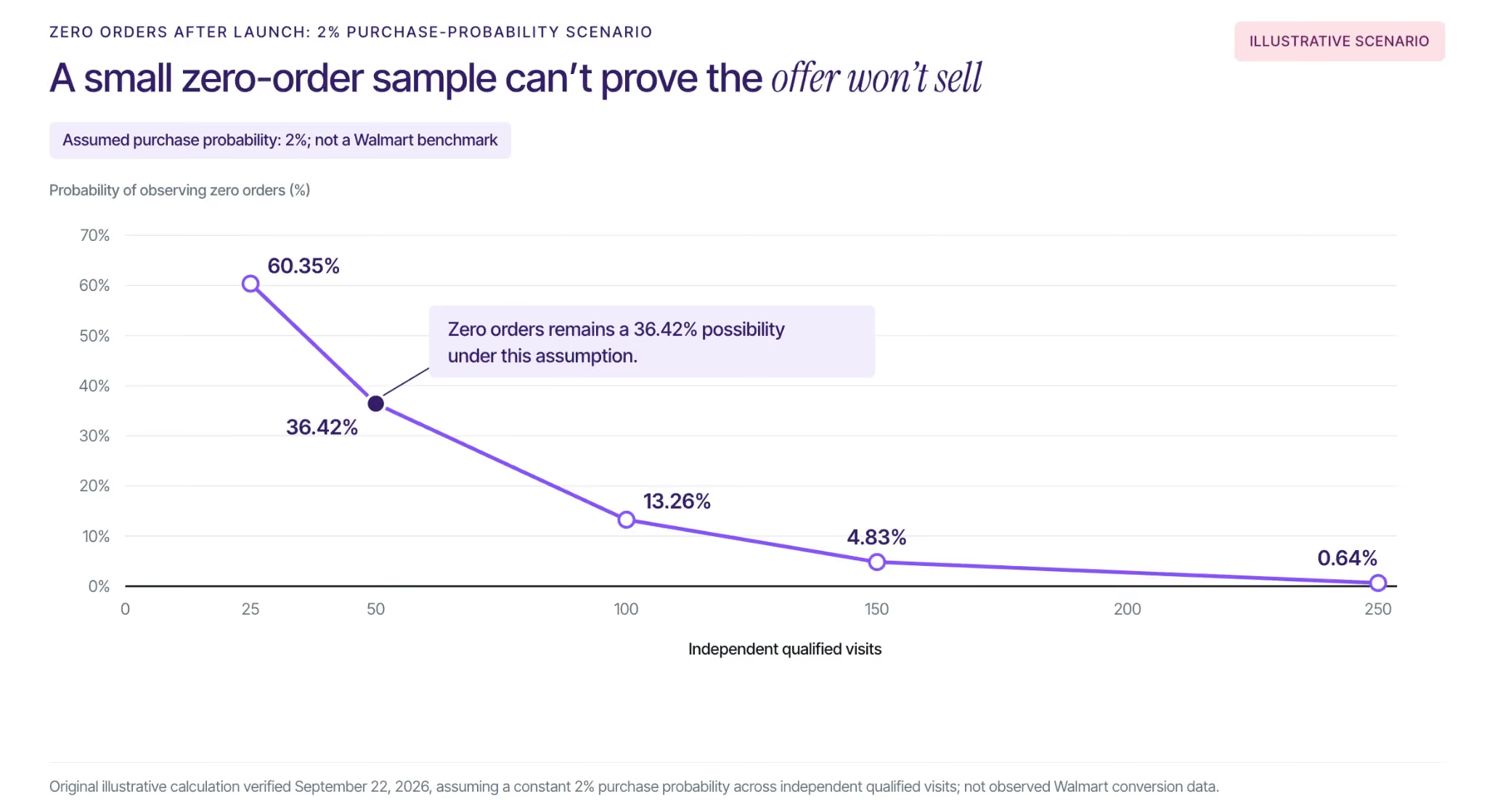
Consider an illustrative scenario, not a Walmart benchmark. Assume each qualified visit independently has a 2% purchase probability, tracking is accurate, and enough time has passed for purchases to occur.
Under those assumptions, the probability of seeing zero orders is 60.35% after 25 visits, 36.42% after 50, 13.26% after 100, 4.83% after 150, and 0.64% after 250.
The calculation is:
Probability of zero orders = (1 − purchase probability) raised to the number of independent visits.
This does not mean you should keep buying traffic until reaching 250 visits. Spending limits still apply, and real traffic may include repeat visitors, different purchase probabilities, and attribution gaps.
The lesson is narrower: a small sample cannot identify the cause of poor sales. Investigate the offer and audience before concluding that reviews are the only missing ingredient.
Decide What to Fix Before Expanding
Review the launch weekly, but allow reporting windows and purchase delays to mature before making final comparisons.
If traffic is scarce, investigate discovery, advertising eligibility, and audience relevance. If shoppers click but do not purchase, inspect price, delivery, product fit, and the relationship between the creative promise and the listing.
If purchases arrive alongside repeated returns or the same customer complaint, fix the product or its explanation before expanding distribution. More traffic should not magnify a preventable mismatch.
Advance the Four Launch Gates again before increasing spend. A campaign can lose readiness when inventory falls, a variant changes, content rights expire, or a previously accurate delivery promise becomes unreliable.
Attributed orders are useful evidence, but they are not a controlled estimate of incremental sales. When practical, stagger campaign batches or use a suitable comparison period while documenting other changes that could affect results.
Launch the Offer, Then Earn the Evidence
Understanding how to launch a product on Walmart with zero reviews means separating the work you control from the feedback you cannot promise.
You control listing clarity, inventory, delivery, creator briefs, campaign links, and spending limits. Walmart controls program eligibility and review moderation, while shoppers decide whether the offer meets their needs.
Start with one product whose offer is ready, one creator brief built around a genuine buying question, and one measurable traffic test. For teams using Stack Influence, make that first product-seeding campaign a source of useful demonstrations and audience learning, while keeping review collection within Walmart’s approved workflows.