




Before approving a launch discount, calculate what you can afford to spend on the resulting order. Before scheduling another promotional wave, check whether inventory can last until replenishment arrives.
Those decisions belong beside the familiar tasks of uploading images and turning on ads. For ecommerce sellers, an Amazon product launch checklist should connect product readiness, listing accuracy, fulfillment, creator content, and measurement rather than treating them as separate projects.
Use this checklist to prepare one product, release a controlled campaign, and evaluate the first 30 days. The guidance focuses on the U.S. Amazon store; requirements and program availability can differ elsewhere.
Key Takeaways
- Separate listing release, traffic release, and scale approval so unfinished work does not automatically trigger more spending.
- Calculate acquisition headroom after discounts and variable costs, not from the undiscounted selling price.
- Keep creator content, independent customer reviews, and genuine customer purchases separate in both campaign agreements and reporting.
- Increase promotion only when contribution economics, available inventory, and sufficiently mature performance data support it.
Your Amazon Product Launch Checklist: Three Release Dates
An Amazon product launch checklist is an ordered set of checks covering the product, selling permissions, detail page, inventory, promotion, and post-launch decisions. Organize yours around three release dates, each with a specific approval record.
- Listing release: The product identity, required approvals, claims, images, offer, and fulfillment setup are ready for shoppers. Save the approved listing and product documentation.
- Traffic release: The intended variation is buyable, stock is available, the acquisition budget is approved, and campaign links, creator deliverables, disclosures, and rights are ready. Save the launch brief and tested destinations.
- Scale approval: Early customer demand, campaign costs, content delivery, and replenishment have been reconciled. Record whether to expand, revise, or pause the next wave.
These dates do not have to coincide. A detail page may need to exist before promotional activity, while a larger advertising commitment should wait until the team has useful evidence.
The schedule also needs room for creator work beyond announcement day. Stack Influence's verified three-month Targus new-product campaign included 120 creator promotions, while average monthly unit sales moved from 56 to 221 during the measured campaign period. These observations do not isolate creator activity as the cause of the sales change or establish a required campaign pace.
When planning an Amazon product-launch campaign, track the content schedule separately from the sales target. A completed post and an independent customer order answer different questions.
How Much Can You Spend to Acquire a Launch Order?
Your starting acquisition ceiling is the contribution left after the customer's actual purchase price covers product costs, marketplace fees, fulfillment, and other variable expenses. Spending that entire amount on acquisition leaves nothing for fixed costs or profit, so the operating target should normally be lower.
Begin with demand validation, not a discount percentage. The SBA's market-research guidance recommends examining demand, market saturation, alternatives, and pricing; translate that research into a specific buyer, use case, competitive gap, and realistic price range.
Before approving the launch budget:
- Document why the product is meaningfully different from the alternatives a shopper can already buy.
- Use Amazon's fee-estimation tools with the correct product dimensions, weight, category, selling price, and fulfillment method.
- Separate one-time setup costs, inventory cash requirements, creator costs, advertising tests, and a replenishment reserve.
Include photography, compliance work, packaging, samples, content licensing, and campaign-management costs where applicable. Do not assume the entire launch budget can be recovered from the first month's contribution.
An Illustrative Discount Stress Test
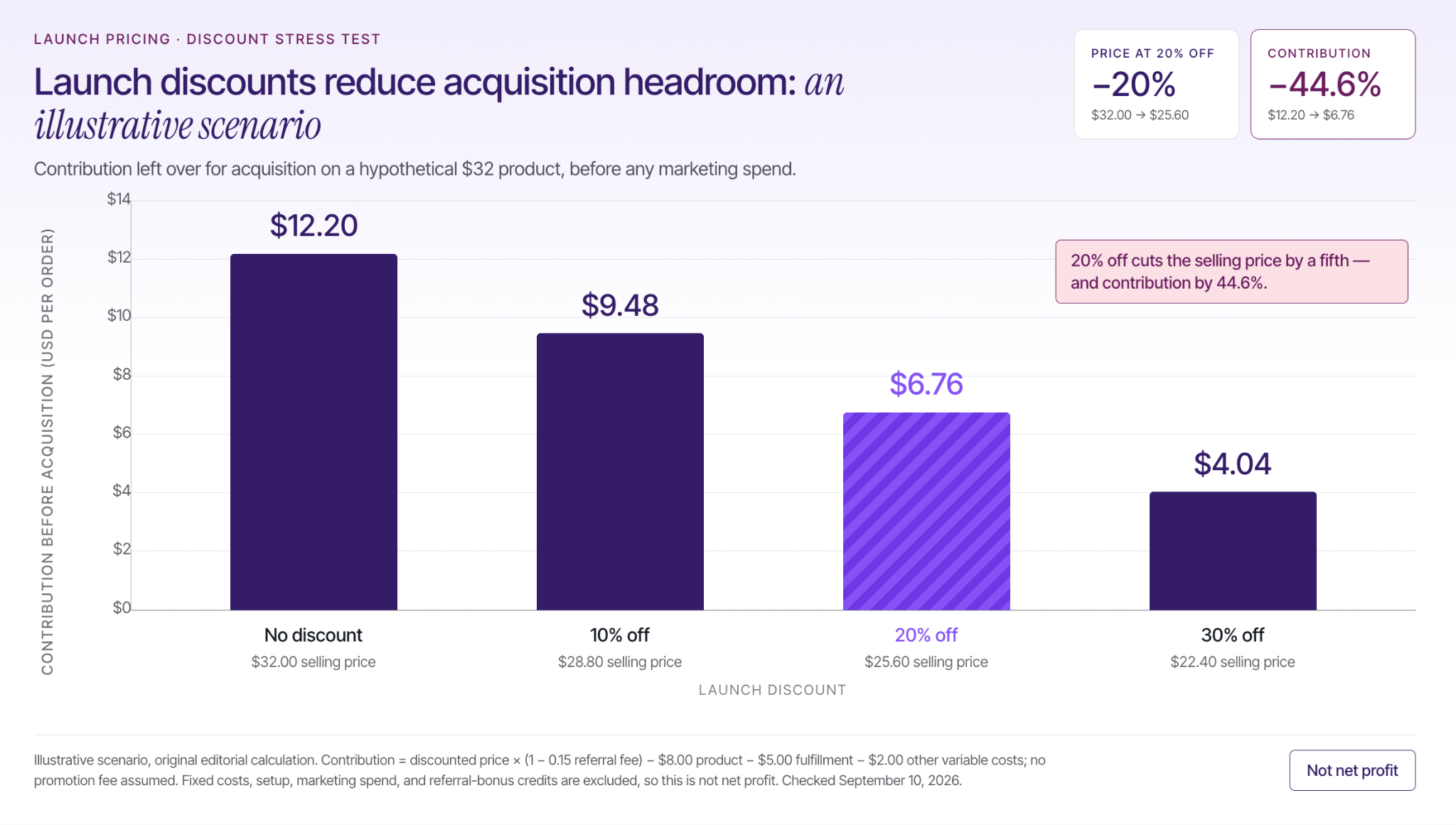
Consider a hypothetical product with a $32 undiscounted price, a referral fee assumed to equal 15% of the selling price, an $8 landed product cost, a $5 fulfillment cost, and $2 in other variable costs per unit. The $2 allowance covers inbound, storage, and expected return costs for this simplified example; no additional promotion fee is assumed.
Contribution before acquisition equals selling price × 0.85 − $15.
At no discount, the customer pays $32 and contribution is $12.20. At a 10% discount, the customer pays $28.80 and contribution is $9.48. At 20% off, the figures become $25.60 and $6.76. At 30% off, they become $22.40 and $4.04.
A 20% price reduction therefore removes approximately 44.6% of the original contribution available before acquisition. The discount may still be worth testing, but increased order volume must compensate for materially thinner economics.
These figures are illustrative, not Amazon fee quotes or performance benchmarks. Replace every assumption with ASIN-level estimates, add applicable coupon or deal fees, and exclude unconfirmed referral bonuses from the base case.
Before Listing Release: Validate the Product and Build the Page
Approve the product's identity and selling requirements before polishing the copy. An attractive page does not resolve an incorrect identifier, an unsupported claim, or a missing approval.
Confirm Identity, Permissions, and Documentation
- Complete seller verification and required account information, then confirm any product, category, or brand approval needed for the intended listing.
- Search the existing catalog before creating an ASIN, Amazon's product identifier; use the appropriate existing detail page when the exact product is already listed.
- Confirm the GTIN, brand name, variation structure, packaging, and applicable safety documentation agree with the physical product.
Amazon's product-listing instructions distinguish creating a new detail page from matching an offer to an existing one and explain that some products require approval. Keep approval records attached to the exact product and marketplace.
For identifiers, GS1 US's Amazon barcode guidance explains how GTINs identify products and why mismatched brand information can create listing problems. Use a valid identifier or an approved exemption rather than borrowing another product's barcode.
Begin eligible Amazon Brand Registry enrollment early when brand tools are part of the plan. Its trademark and branding requirements are separate from simply creating a seller account.
Identify the regulator and requirements relevant to your category. For products within its jurisdiction, the CPSC's business resources provide routes to testing, certification, labeling, and product guidance; a supplier's generic assurance is not a substitute for the documents your product needs.
Prepare the Detail Page for Current Requirements
- Build a keyword map around accurate product names, features, compatibility, and use cases, including relevant backend search terms.
- Prepare a compliant main image and supporting images that explain dimensions, included components, operation, and important limitations.
- Write clear bullets and complete structured attributes; prepare A+ Content and a Brand Store where eligible and useful.
- Inspect every intended child variation on mobile, including its images, price, availability, and delivery information.
Do not build a new U.S. listing around outdated title-length advice. Under Amazon's July 27, 2026 title update, non-media titles move to 75 characters or fewer, with another 125 characters available for Item Highlights. Amazon describes a gradual update process for existing longer titles, with listings remaining active during the transition.
Keep the brand, product identity, and essential variation information understandable before adding secondary features. Review the published result rather than assuming an accepted upload displays exactly as intended.
When outside help is needed, scope Amazon listing services around specific deliverables such as catalog corrections, copy, photography, or implementation. Do not use a ranking promise as the acceptance criterion.
Before Traffic Release: Make the Offer and Campaigns Operational
Release promotion only after the buying experience and campaign obligations are ready together. A shipped carton, a draft advertisement, or an accepted creator invitation is not the same as a completed launch requirement.
Verify Fulfillment and the Live Offer
- For Amazon FBA, verify shipment preparation, labeling, receiving status, and inventory actually available for customers; do not treat a carrier's delivery confirmation as the final readiness check.
- For merchant fulfillment, verify shipping settings, handling capacity, tracking, customer support, and the returns process.
- Inspect the live offer from a customer's perspective, including the intended variation, purchase options, discount display, and delivery promise.
- Reserve inventory for creator samples and any planned review-program participation before committing the remaining stock to promotion.
Write down the condition that will pause promotion. Examples include an unavailable variation, an incorrect price, a broken destination, or insufficient stock to cover the next campaign wave.
Keep Reviews and Creator Content in Separate Workflows
Plan eligible review-program participation before the public launch rather than assuming it must wait until afterward. Amazon Vine's current guidance allows eligible prelaunch FBA products and recommends enrollment with inventory available in its fulfillment network at least three weeks before the planned launch. Check the current account, product, and offer requirements before allocating units.
Outside Vine, use Amazon-approved customer-review request options without incentives or positive-review conditions.
Creator product seeding has a different purpose: producing useful social content, demonstrations, and audience exposure. Amazon's customer-review policy explanation prohibits compensation, free products, refunds, and other incentives in exchange for reviews, so do not make an Amazon customer review part of a compensated creator brief.
When finding Amazon influencers, evaluate audience relevance and the ability to demonstrate the product honestly. Micro influencers and nano influencers should receive a clear use case, accurate claims, sufficient product-testing time, and a defined deliverable.
Record posting windows, revisions, permitted placements, usage duration, editing rights, and paid-ad permissions before work begins. The FTC's influencer disclosure guidance requires material relationships, including gifted products, to be made clear when creators recommend products. Put the disclosure with the endorsement, not only in a profile or somewhere viewers must search to find it.
Stack Influence's gifted-first product-seeding workflow connects vetted creator activation, coordination, and completed-post accountability. Its completions-only model concerns the agreed creator deliverable, not guaranteed customer purchases, reviews, or rankings.
Plan reusable ecommerce UGC around buyer questions the listing needs to answer. Keep sample and reimbursement expenses identifiable in campaign accounting, and never treat reimbursed creator purchases as proof of independent customer demand or use them as a ranking tactic.
Prepare Ads and Tracking Before Publishing Links
Build a small, interpretable PPC test instead of activating every campaign type simultaneously. Amazon's Sponsored Products targeting guide explains automatic, manual, and negative targeting; choose the setup that addresses the uncertainty you need to resolve.
Set an approved spending limit, select relevant targets, and name the person who will review customer search terms. Record which terms produce purchases and which attract irrelevant clicks before expanding the campaign.
For eligible external campaigns, create tracking before distributing links. The Amazon Attribution setup guide provides supporting context for separating sources and interpreting Amazon shopping activity.
Assign distinct tags to meaningful creator groups, emails, or paid-social tests. Check that each link reaches the intended product or relevant Amazon storefront destination, including from the actual mobile placement.

Launch Day: Release Demand in a Controlled Wave
Treat launch day as a monitored release, not permission to spend the remaining budget. Capture the starting conditions so later results can be interpreted against what customers actually saw.
- Save the live price, offer, inventory position, listing version, and campaign settings before the first promotional wave.
- Verify the first published links, creator disclosures, ad delivery, and customer-facing destination.
- Monitor order flow, stock, customer questions, and listing issues; pause the affected channel when its buying path breaks.
Avoid changing the price, main image, targeting, and creator message together unless an urgent correction requires it. Otherwise, a better result will not reveal which change helped.
Days 1 to 30: Let Stock and Evidence Set the Pace
The next launch decision should depend on both available supply and customer response. A campaign can generate orders successfully and still require less promotion because replenishment cannot keep up.
How Much Stock Can the Launch Safely Use?
Calculate promotional stock cover after removing samples, planned review-program units, and the safety reserve from usable inventory. Then compare that cover with the full replenishment interval, including the time until replacement units become sellable.
Consider a separate illustrative scenario: 720 usable units, 45 reserved for creator samples, 15 for Vine, and a 60-unit safety reserve. That leaves 600 units available for planned customer demand, assuming the relevant stock is correctly positioned for fulfillment.
At 12 customer units per day, those 600 units provide 50 days of cover. At 18 per day, they provide approximately 33.3 days. At 24 per day, they provide 25 days.
Assume replacement inventory becomes sellable in 28 days and demand remains constant within each scenario. The 24-unit pace would consume the promotional allocation three days before replenishment, requiring use of the safety reserve unless the team changes the plan.
The calculation is promotional stock cover = available promotional units ÷ expected daily customer units. Under these assumptions, the maximum average pace that preserves the reserve is approximately 21.4 units per day, calculated as 600 ÷ 28.
This is a planning example, not an inventory recommendation for every seller. Recalculate with actual demand and receiving estimates, and consider bringing replenishment forward or slowing promotion before exhausting the reserve.
How Do You Measure the Launch Without Counting Sales Twice?
Use one reconciled total for customer sales, then use channel reports to explain portions of that activity rather than adding every attributed total together. Creator delivery, tagged purchases, marketplace sales, and profit should remain separate measurements.
During the first week, inspect availability, campaign spend, clicks, customer questions, content completion, and emerging return reasons. These early signals help identify broken execution, but small purchase counts are not enough to establish stable conversion performance.
Amazon's official Amazon Attribution documentation describes a 14-day attribution window and metrics including detail-page views, cart additions, purchases, units, and sales. A report pulled on day 30 therefore does not fully mature the results of traffic sent on day 29.
Review performance weekly by traffic source and product variation. Compare customer acquisition cost with contribution per order, record sample and creator costs separately, and do not add Sponsored Products-attributed sales to external attributed sales as though they were necessarily unique orders.
For eligible enrolled U.S. brands, the Amazon Brand Referral Bonus averages 10% of qualifying sales, varies with factors including category and price, and offsets referral fees through credits. Reconcile actual credits once, rather than treating the average rate as guaranteed cash available to fund launch day.
At the 30-day review, approve one of three actions: expand a promising and adequately supplied campaign, revise a specific weak assumption, or pause additional spend while fixing the buying experience or economics. Low-volume products may need a longer observation period.
Use Amazon external traffic strategies to plan the next channel test, but keep the scale decision tied to customer demand and contribution. Sales or rank changes occurring during a launch do not prove that a single campaign caused them.
Make the Next Commitment With Evidence
A useful Amazon product launch checklist tells you what must be finished before the next commitment, not merely what should eventually be done. Approve the listing, release measurable traffic, and expand only when the economics, inventory, and customer response support it.
Start by assigning an owner and an approval record to your three release dates. When creator content is part of the plan, evaluate a Stack Influence product-seeding campaign around the buyer questions, completed assets, and reporting you need, so the launch leaves you with useful content and a better-informed next decision.