




A shopper asks for a dishwasher-safe lunch container that fits a small work bag. Your product might meet those requirements, but can a shopper verify that from your listing, select the right size, and buy from your store?
That is the practical challenge behind ChatGPT shopping. For ecommerce sellers, the work is not simply getting a brand name mentioned. It is connecting accurate product information with a relevant recommendation, a purchasable merchant offer, and a measurable order.
Start by separating those outcomes before investing in another integration or content campaign.
Key Takeaways
- Treat product recommendations, your store's offer, and completed orders as separate outcomes.
- Check catalog eligibility and your integration route before building a direct product feed.
- Keep variant identity, price, availability, and landing-page information consistent.
- Use creator content to answer real product questions, not as a guaranteed ChatGPT ranking tactic.
What Is ChatGPT Shopping, and What Has Changed?
ChatGPT shopping is a product-discovery experience that lets people describe their needs, compare products, and follow merchant purchase options. OpenAI's product-discovery announcement describes visual browsing, image-based discovery, and side-by-side comparisons supported by the Agentic Commerce Protocol, or ACP.
The more detailed shopping research experience asks follow-up questions, examines merchant and public product information, and builds a buyer's guide around the shopper's constraints. For a seller, a precise compatibility detail can therefore be more useful to a buyer than another broad claim that a product is premium.
Checkout requires a separate distinction. On March 24, 2026, OpenAI announced its emphasis on product discovery and merchant-owned checkout, rather than making its initial Instant Checkout experience the universal purchase path.
As checked on October 14, 2026, OpenAI's shopping help page still describes Instant Checkout for some eligible products and merchants. Do not assume every account has the same purchase options, or build a seller plan around universal in-chat checkout.
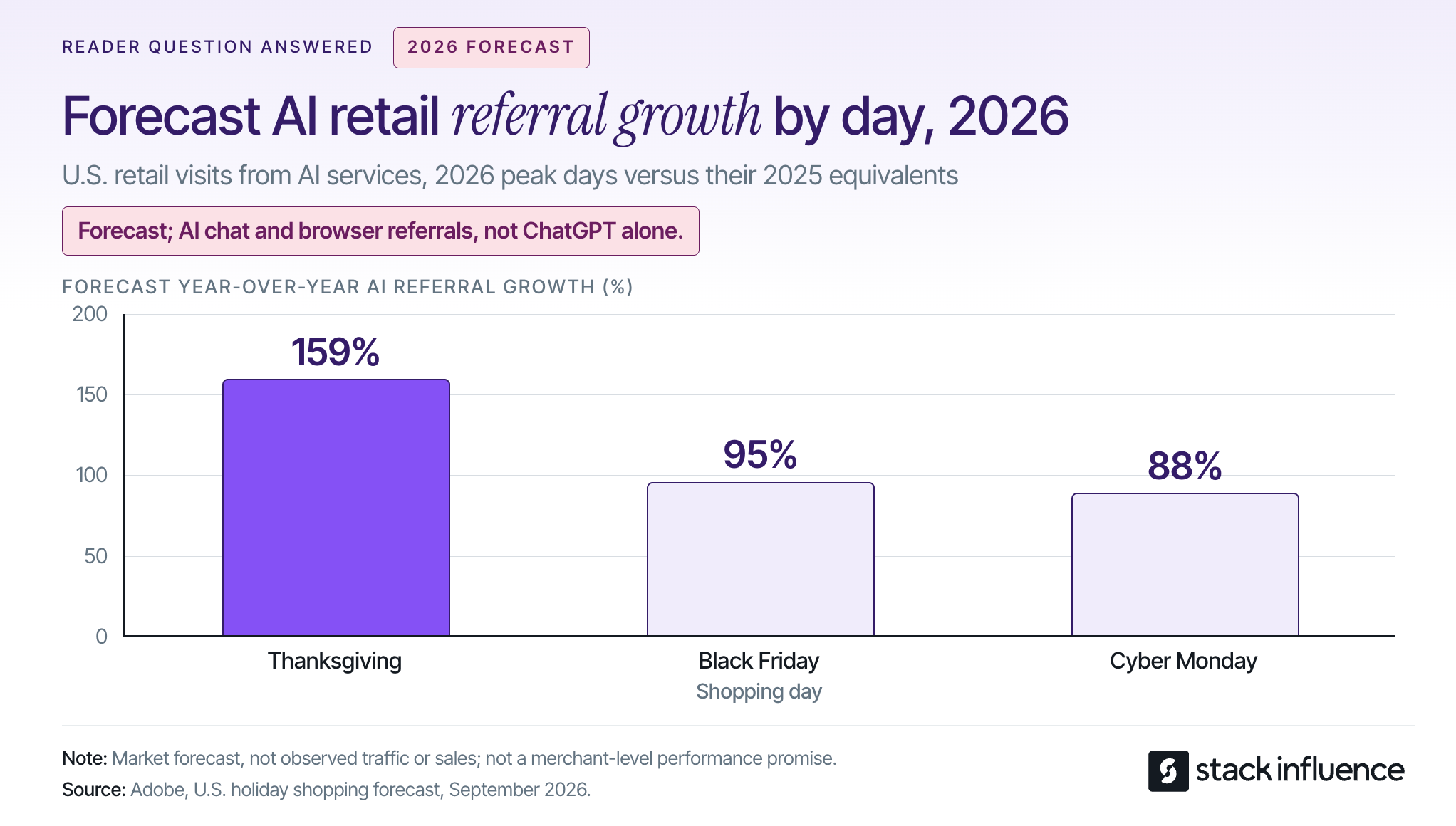
There is a reason to establish a baseline now. In its September 28 forecast, Adobe projected AI-referred retail traffic growth of 159% on Thanksgiving, 95% on Black Friday, and 88% on Cyber Monday in 2026, compared with the corresponding 2025 days. Those are forecasts across AI chat and browser services, not observed ChatGPT sales or ChatGPT's market share.
Use that outlook to prioritize measurement, not to assume your store will receive the same growth.
Keep organic discovery separate from paid campaigns: OpenAI's advertising guidance states that ads do not let advertisers influence or rank its answers.
Use the Product, Offer, Order Test
The Product, Offer, Order Test is a practical diagnostic framework for this guide, not a description of OpenAI's internal ranking system. It asks three different questions so that a visibility report does not get mistaken for a revenue report.
Product: Is the Recommendation Actually Relevant?
Check whether the recommended item meets the shopper's stated requirements. Matching a brand name is insufficient when the shopper needs a particular capacity, material, compatibility, or maintenance method.
Build product explanations around questions that can be answered with evidence. The same discipline used to develop social proof for an ecommerce brand applies here: identify the uncertainty, then provide the relevant demonstration or verified specification.
Offer: Can the Shopper Choose Your Store?
A product appearing does not mean your store is the purchase destination. OpenAI's explanation of merchant selection says a product can have multiple merchant options, with factors including availability, price, quality, and whether a merchant is the maker or primary seller.
Record the destination domain and selected variant, not just the brand mentioned. A manufacturer, authorized retailer, and marketplace seller can all care about the same product while receiving different commercial outcomes.
Order: Did the Visit Produce a Viable Sale?
Use your actual order records to establish whether referred visitors purchased, what they purchased, and what happened afterward. Include refunds and fulfillment costs in the commercial assessment.
The framework's decision rule is simple: repair the earliest verified failure. More content will not fix an unavailable variant, and more product appearances will not prove that your store captured the purchase.
How Do You Get Products Into ChatGPT Shopping?
Start with the product-data route your commerce platform supports, then check eligibility and the quality of the information being distributed. Submitting a feed, enabling a channel, and being recommended for a particular shopping request are different events.
Shopify Stores: Check Eligibility Before Building Anything
According to Shopify's Selling on ChatGPT documentation, discovery is active by default for eligible stores. Requirements include selling to U.S. customers, eligible Shopify Catalog products, acceptance of the agentic storefront terms, and completed store policies.
Review Sales channels > Agentic in Shopify admin. ChatGPT purchases use the store's online checkout, in an in-app browser or a new browser tab, rather than a ChatGPT direct-checkout switch.
For your operating plan, assign catalog maintenance separately from Shopify influencer marketing. Creator partnerships can produce useful demonstrations, but publishing a social post is not the same task as maintaining product data.
Etsy and Other Commerce Platforms: Confirm the Available Route
OpenAI's merchant onboarding page says Shopify and Etsy catalogs are already integrated without an additional merchant application. Other merchants can apply to share product feeds; the page still describes a waitlist and a planned self-service portal, not immediate onboarding for everyone.
Check your platform or feed provider before commissioning custom development. Ask which supported integration it uses, who handles rejected records, and how corrections reach the destination.
For Amazon sellers and other marketplace-only businesses, begin with the listing information you control and the merchant destinations that actually appear in tests. Do not confuse a product's marketplace visibility with evidence that your own seller offer has been selected.
Make Product Data Match the Item a Shopper Can Buy
A useful starting point is a small group of commercially important products with stable inventory. Compare each product's feed record, visible page, images, and checkout selection before expanding the catalog review.
Preserve Product and Variant Identity
OpenAI's stable product-feed specification calls for one row per purchasable item or variant. Its native discovery format requires nine fields: item_id, title, description, url, brand, seller_name, image_url, availability, and price.
Use the supported Stable schema, not the Draft schema. Preserve identifiers as strings, provide accessible product and image URLs, and follow the relevant variant grouping rules; an existing platform integration may use a different supported mapping.
Consider a lunch container sold in two sizes. If a small-size price leads to a page with the large size selected, a technically populated record still creates a confusing purchase path.
Your acceptance test should open the submitted URL, confirm the intended variant, and compare the price and stock status with the record. Give one person responsibility for checking discrepancies after promotions, stock changes, or a product-page redesign.
Answer Constraints in Visible Product Information
Replace vague statements with facts buyers can check. For the lunch container, publish dimensions, capacity, materials, included pieces, care instructions, and any relevant limitations, using only information you can substantiate.
Keep important details in visible text rather than only inside an image or video. When repurposing user-generated content (UGC) across platforms, identify the demonstrated variant and add an accurate written explanation so the evidence remains understandable outside the original social post.
Do not let one creator's experience become a universal product specification. A video showing that a container fits one bag does not establish compatibility with every bag described as compact.
Separate Search Access From Training Controls
OpenAI's crawler documentation distinguishes OAI-SearchBot, which supports search visibility, from GPTBot, which concerns model-training crawling. A site can allow the former while disallowing the latter.
Ask your technical team to inspect robots.txt, relevant firewall rules, and whether important pages can be fetched. Avoid blanket changes that disable site protection; validate the permitted crawler configuration instead.
For the Google side of your SEO program, Google's AI-feature guidance emphasizes ordinary eligibility, visible content, and structured data that matches the page, without requiring special AI files or schema. That is Google's guidance, not a published ChatGPT ranking formula.
Can Creator Content Help ChatGPT Shopping Visibility?
Creator content can supply concrete product demonstrations, but OpenAI's published guidance does not establish that purchasing UGC or running influencer campaigns causes ChatGPT recommendations. Treat creator content as useful buyer information rather than a guaranteed placement mechanism.
Give micro influencers and nano influencers a real question to investigate. For the lunch container, a useful brief might ask the creator to demonstrate packing, closing, carrying, and cleaning the exact model supplied, while describing limitations honestly.
Stack Influence's automated product-seeding workflow connects creator participation, product purchases, communication, post verification, and payment. In that gifted-first workflow, payment follows completed social posts, giving the brand a defined content deliverable rather than a promise of AI visibility.
Evaluate that deliverable on its own terms. Does the content answer the intended question, identify the correct product, and have permission for the planned reuse?
Keep the commercial relationship visible. The FTC's endorsement guidance explains that free products supplied with an expectation of promotion create a relationship that needs appropriate disclosure, and that brands have responsibilities for monitoring endorsements.
Do not relabel a gifted creator endorsement as an independent customer review. A transparent demonstration can be useful without pretending to be something it is not.
Measure Product Visibility, Seller Selection, and Orders Separately

Apply the Product, Offer, Order Test with a diagnostic record and a separate commercial report. The first identifies information problems; the second measures actual customer activity.
Build a Repeatable Diagnostic Sample
Create a fixed set of realistic shopping requests covering use cases, budget constraints, product comparisons, and practical limitations. Record the date, region, relevant account settings, prompt wording, product shown, merchant offered, and landing-page accuracy.
Here is an illustrative audit, not observed campaign data. Suppose you run 20 prompts twice under documented conditions, producing 40 responses: the intended product appears in 24, your merchant offer appears within 12 of those, and nine of those offers accurately match the purchasable variant, price, and availability.
The cumulative results are 60% product presence, 30% merchant presence, and 22.5% accurate purchasable-offer presence across the 40 responses. Conditional merchant capture is 12 divided by 24, or 50% of responses containing the intended product.
These nested checks are not independent conversion stages or consumer market shares. No visits or orders occurred merely because the tests were run, and repeated prompts are not a representative sample of all shoppers.
The useful finding is the gap between product presence and a correct offer from your store. Inspect the failing responses before deciding whether the next task belongs to merchandising, catalog maintenance, or content production.
Follow Actual Customers and Costs
Shopify's agentic storefront documentation says AI-channel orders appear in admin with channel or referrer attribution. Use the attribution actually present in your store and analytics, rather than assuming every AI-influenced order carries an identifiable source.
Keep a report of identifiable ChatGPT referrals, resulting orders, net sales after refunds, and contribution after product, fulfillment, and payment costs. Track catalog and content work separately so you can distinguish an acquisition expense from an asset reused across several channels.
When calculating customer acquisition cost, use a consistent new-customer definition and avoid crediting both an influencer campaign and ChatGPT with the full value of the same purchase.
Treat the resulting numbers as attributed activity, not automatic proof of incremental sales. For example, a shopper who discovers a product in ChatGPT but later types your store's address creates a different attribution problem from someone who follows a merchant link and purchases immediately.
Review diagnostic failures weekly and commercial outcomes over a longer, consistent window. Use a prior 30-day baseline when reliable tracking exists, then compare a consistent 30-day period after changes. Extend the observation period when orders are sparse, and annotate promotions, stockouts, and other changes.
A 30-Day Pilot for Ecommerce Sellers
Use the first month to establish reliable records and repair obvious failures, not to promise a ranking deadline. Start with ten priority products so the work remains inspectable.
During the first week, confirm the integration route, eligibility, search access, and baseline test results. In the second week, reconcile product identities, variants, prices, stock information, and destination URLs.
Use the third week to address missing buyer answers and prepare demonstrations where they would genuinely help. A Shopify product-seeding pilot can organize the creator work, but its production schedule should remain separate from catalog fixes.
In the fourth week, repeat the diagnostic sample and reconcile identifiable referrals with order records. Continue the sales observation period beyond the first month when needed; the planning schedule is not an OpenAI onboarding, indexing, or recommendation guarantee.
Make the Store as Clear as the Recommendation
ChatGPT shopping deserves a seller strategy built around product relevance, accurate merchant offers, and actual customer outcomes. A mention is useful information, but it is not the finish line.
Choose ten products, apply the Product, Offer, Order Test, and fix the first observable gap. Where buyers still need to see the product in use, plan a focused creator brief that produces an honest, reusable demonstration and makes the purchase decision easier.