




A product page can have glowing testimonials and still leave shoppers unsure whether the product fits their needs. More praise does not necessarily answer the question holding up the purchase.
Learning how to build social proof for an ecommerce brand starts with collecting genuine experiences that resolve specific uncertainties. Ask customers for honest feedback, work with relevant creators on disclosed demonstrations, and put that evidence beside the buying decision it supports. This guide explains how to build that system, keep customer reviews separate from promotional content, and measure something more useful than the number of posts collected.
Key Takeaways
- Match social proof to unresolved buying questions rather than collecting interchangeable praise.
- Keep customer reviews, gifted creator endorsements, and brand-produced demonstrations clearly distinguishable.
- Publish relevant, permission-cleared evidence where shoppers evaluate the product, not only on social media.
- Track evidence coverage and commercial outcomes separately; content volume and attributed sales do not establish causation.
How to Build Social Proof for an Ecommerce Brand: Start With Coverage
Build social proof by identifying what buyers need to verify, collecting credible evidence from real people, and making that evidence easy to evaluate. Start with one product whose page receives meaningful traffic but leaves important questions unanswered.
Social proof is evidence of other people's experiences, choices, or judgments that helps someone evaluate a purchase. For ecommerce brands, it can include customer reviews, customer photos, creator endorsements, independent coverage, and truthful indicators of product popularity. A return policy provides reassurance, but it is not evidence that another customer liked the product.
Use a Proof Coverage Ledger to organize the work. Create one row per important buying question, with five fields:
- Buyer uncertainty: The specific concern, such as whether a backpack holds a laptop and lunch container together.
- Existing evidence: The review, photo, demonstration, or other source that addresses that concern.
- Source relationship: Whether the contributor is an ordinary customer, gifted creator, paid partner, employee, or another identifiable source.
- Applicable scope: The product version, use conditions, experience period, and permitted reuse.
- Unfilled gap: What remains unanswered, who will collect it, and where the resulting evidence should appear.
This is a planning framework, not a validated trust score. A row is not complete merely because it contains a positive quotation. The evidence must address the actual concern without implying more than the contributor experienced.
Stack Influence's product-seeding workflow coordinates creator participation and completed promotional content. In the ledger, that is a route for obtaining disclosed creator evidence, not a substitute for independent customer reviews.
Prioritize products with weak evidence and meaningful purchase uncertainty. Northwestern's Medill Spiegel Research Center recommends focusing review collection on low-review and higher-consideration products, based on research first published in 2017. Treat that as a prioritization principle, not a promise of the same conversion improvement for every store.
Choose Evidence That Explains the Product

Customer photos and videos should answer practical questions, not simply repeat the brand's enthusiasm.
PowerReviews' 2024 visual-content survey surveyed 15,870 U.S. consumers in December 2023. Its analysis of why shoppers value customer visuals found that 89% selected seeing real-life appearance, 72% selected understanding size or sizing, and 70% selected understanding quality or performance.
Respondents could choose multiple reasons. The sample was predominantly female and millennial, and the findings describe stated preferences, not measured conversion lifts or a representative forecast for every audience.
For a backpack, translate those concerns into everyday appearance, usable capacity, device compatibility, cleaning, and wear over time. A first-day unboxing can show appearance and compartments. It cannot establish months of durability.
Build Separate Collection Paths for Customers and Creators
Use customer outreach to collect voluntary experiences and creator partnerships to commission clearly defined content. Keep the records and public presentation of those two sources distinct.
Make Honest Customer Reviews Easy
Ask after customers have had a reasonable opportunity to use the product. Choose timing around delivery and the experience you are asking about, rather than sending every request immediately after checkout.
A neutral request could say: “How has the product worked for you? Share what you used it for, what worked well, and anything another buyer should know.” Make a photo optional, keep the submission process short, and do not provide a prewritten endorsement.
Invite feedback consistently from eligible customers. Do not use a satisfaction survey to route only happy buyers to a public review form while sending dissatisfied buyers somewhere private. Resolve complaints without making a refund or replacement depend on changing the customer's account of what happened.
For U.S. businesses, the FTC's consumer-review rule guidance explains that incentives cannot depend, explicitly or implicitly, on a review expressing a particular sentiment. The rule does not ban every sentiment-neutral incentive, but disclosure requirements and stricter platform policies still apply. Starting without review incentives avoids that additional layer of complexity.
Keep the original submission, product identifier, date, and any purchase-verification record your review system supports. Apply consistent moderation criteria for spam, private information, and irrelevant material, rather than removing criticism because it is inconvenient.
Ask separately for permission when turning a review into an advertisement, email testimonial, or other new use. A customer agreeing to submit feedback is not the same as signing a broad creator-content license.
Commission Demonstrations, Not Scripted Praise
Work with micro influencers, nano influencers, and UGC creators whose real use of the product matches a gap in your ledger. Specify the demonstration and factual boundaries, then leave room for their genuine assessment.
An appropriate brief might ask a creator to pack the correct backpack model with their usual work items and show how the compartments function. It should not require them to claim universal compatibility or long-term performance they have not tested.
Distinguish an unconditional gift from a product-for-content agreement. For an agreed campaign, document the deliverable, product logistics, compensation or reimbursement, publication timing, revisions, usage rights, and what happens when a creator encounters a genuine product problem.
In the published Targus campaign example, Stack Influence recorded 120 creator promotions during a three-month new-product campaign. That illustrates the coordination involved in a multi-creator program. It does not establish that every promotion answered a different buying question or delivered the same commercial value.
When comparing influencer marketing platforms or an agency workflow, ask who owns that coordination and how completed content reaches your team. Evaluate the proposed deliverables against the gaps you need to fill, not the largest projected post count.
The FTC's influencer disclosure guidance treats free products and other material relationships as connections that require clear disclosure when endorsing a product. For video endorsements, place the disclosure in the video, not only in its description. Preserve appropriate disclosure when republishing the content.
Put Each Type of Proof Where It Belongs
Place evidence close to the uncertainty it resolves. A large testimonial gallery is less useful when the relevant detail is difficult to find.
Product Pages and Owned Channels
On a product page, show the rating and review count together, then provide access to the underlying reviews. Put customer photos near the relevant product information and place specific experiences beside the feature or concern they explain.
Shopify's social-proof guidance recommends displaying reviews and ratings on product and collection pages and adding customer photos where possible. Confirm what your theme and review integration support before designing the layout.
Give each channel a defined job. A homepage testimonial can establish confidence in the business. A product-page review should help evaluate that product. An email can answer a recurring objection, while a social post can introduce a real-use demonstration to a new audience.
Preserve context when repurposing UGC across platforms. A comment about one size or product version should not appear beside another without clarification. Do not shorten a quotation in a way that reverses or exaggerates its meaning.
Use independent press mentions and awards accurately. Identify what was covered or awarded, and distinguish editorial coverage from paid placements. Show customer or purchase totals only when the count, product scope, and period are supportable; never invent a live purchase notification.
Keep a record of the applicable UGC usage rights, including channels, advertising use, editing, duration, and relevant third-party permissions. Creator permission alone should not be treated as permission to reuse every piece of music or other material embedded in a clip.
Amazon Reviews and Influencer Content
Amazon customer reviews and promotional creator content require different workflows. A disclosed endorsement on social media does not authorize a compensated Amazon customer review.
Amazon's seller-facing review-policy reminder prohibits incentives such as free products, discounts, and refunds in exchange for customer reviews. It also identifies the Seller Central Request a Review button as an approved way to request feedback. Keep review completion outside your creator compensation agreement.
For eligible products, Amazon Vine is a separately administered program through which invited reviewers receive products and share honest opinions. Check current account and product eligibility; Vine participation is not a purchase of positive ratings.
The Amazon Influencer Program's video guidance describes creator storefront uploads and the conditions under which approved videos may appear on relevant product pages. An influencer storefront video is not a customer star review, and a creator cannot promise a placement controlled by Amazon.
Before commissioning Amazon content, name the intended publishing surface and responsible account. Do not assume that a social post, a delivered video file, and an Amazon storefront upload are interchangeable deliverables.
Audit Missing Evidence Before Ordering More Content
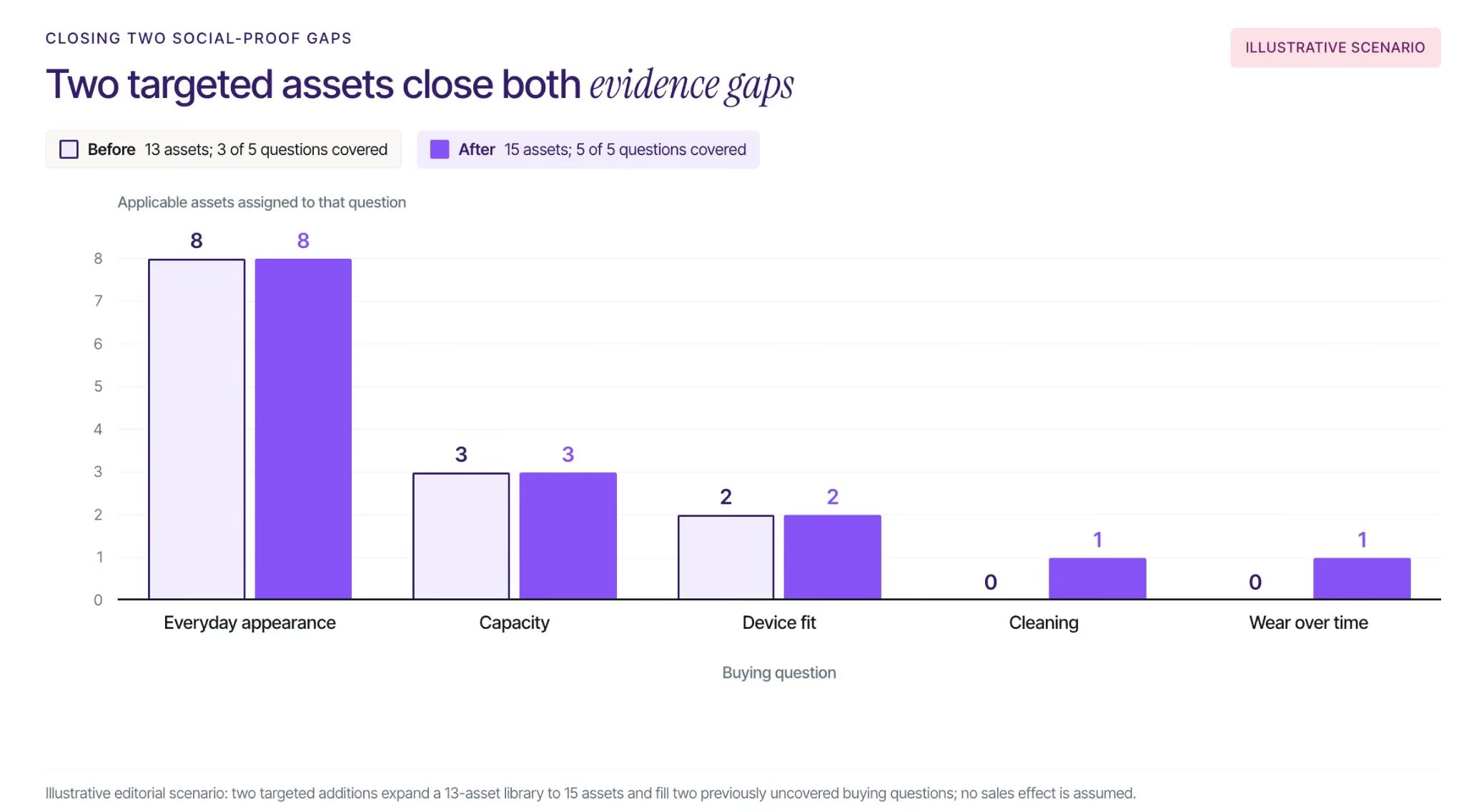
A growing content library can conceal the same unanswered questions. Review the distribution of evidence, not just the total number of assets.
Consider an illustrative backpack audit with five predefined questions. Assume 13 current, permission-cleared assets, each assigned to one primary question: eight show everyday appearance, three show capacity, two address device fit, and none address cleaning or wear over time.
For this planning exercise, count a question as covered when at least one applicable asset directly addresses it. Three of five questions are covered, so question coverage is 60%, despite the library containing 13 assets.
Now assume you obtain two additional applicable assets: one showing cleaning and one documenting wear over a clearly stated period. The counts become eight, three, two, one, and one, respectively. The library grows to 15 assets, while coverage rises to five of five questions, or 100%.
These are hypothetical inputs, not Stack Influence results or industry benchmarks. The calculation is covered questions divided by predefined questions, multiplied by 100. Full coverage in this limited checklist does not mean complete proof of quality, sufficient corroboration, or guaranteed sales.
The practical lesson is to fill the blank rows in the Proof Coverage Ledger before commissioning more of what is already abundant. Change the questions when support requests, returns, or product changes reveal a concern your original checklist missed.
Refresh the Claim, Not Just the License
An asset can remain licensed while becoming misleading. A material change, redesigned closure, altered capacity, or different included accessory may make an old demonstration irrelevant to the current product.
Assign a refresh trigger to each important claim. Review affected content when the product changes, not only when the rights expire. A long-term customer update can address wear, but its stated experience period and tested version should remain visible.
Also distinguish unique contributors from repeated distribution. One person's testimonial appearing on a homepage, in an email, and in an ad remains one person's experience, not three independent endorsements.
How Do You Measure Whether Social Proof Is Working?
Measure evidence delivery, actual exposure, and commercial outcomes separately. Content completion tells you whether the workflow ran; a suitable comparison is needed to judge whether showing that content improved purchasing behavior.
Track Coverage Before Conversion
Review the ledger weekly during collection. Record which questions have applicable evidence, which contributors and relationships are represented, which assets have usable permissions, and which placements are live.
Then check whether shoppers can actually encounter the proof. A licensed video in a folder provides no on-page exposure, and an embedded testimonial below an unvisited section may receive little attention. Keep publication and exposure distinct from the number of files received.
Test Exposure, Not Self-Selection
For a store that supports randomized testing, compare the existing product page with a version containing the new proof module. Keep price, offer, traffic allocation, and other material page elements stable, and define the purchase metric before launch.
Use the same denominator in both groups, such as purchasing visitors divided by all assigned eligible visitors. Do not compare only people who clicked a review with people who did not; those groups selected their own behavior and may differ in purchase intent.
Set the sample requirement and test duration around your baseline conversion rate and the smallest improvement worth detecting. Include normal weekly variation and allow the purchase window to mature. When traffic is insufficient or randomization is unavailable, label the result directional rather than declaring a proven lift.
Check returns, cancellations, and contribution after relevant costs as well as initial orders. The customer acquisition cost guide provides a broader framework for keeping creative and campaign spending in the commercial calculation. Do not assign an invented cash value to social impressions and add it to revenue.
Separate Creator Traffic From On-Page Persuasion
For eligible off-Amazon campaigns, Amazon Attribution provides free measurement of non-Amazon marketing and reports shopping actions within a 14-day attribution window. Use distinct tags for the creator or placement distinctions that matter, where the agreed linking arrangement supports them.
That reporting does not isolate the persuasive effect of a testimonial on a product page. It assigns credit to qualifying marketing activity. Keep campaign-funded creator purchases separate from independently generated demand wherever your records allow, and do not add overlapping reports as though they represent different orders.
Eligible, enrolled sellers can also account for confirmed Amazon Brand Referral Bonus credits when assessing campaign economics. The credits are a separate financial benefit, not a measure of customer trust or evidence that creator content caused additional sales.
A Practical First-Month Plan
Use the first month to establish a repeatable collection and publishing process, not to promise a particular review count or statistically conclusive result.
- Week One: Choose one product, identify recurring buying questions, audit existing evidence, and record baseline performance.
- Week Two: Activate neutral customer feedback requests and brief creator demonstrations around uncovered questions. Confirm permissions, disclosure, and publication responsibilities.
- Week Three: Publish available, suitable evidence and check the complete mobile experience, including review access and video captions.
- Week Four: Audit coverage, inspect early exposure and purchase data, and decide what needs more collection or more observation.
Delivery, product-use periods, and long-term claims may extend beyond that schedule. Do not accelerate a durability testimonial merely to meet a content deadline.
Build Proof a Buyer Can Check
Knowing how to build social proof for an ecommerce brand means knowing which uncertainty to resolve next. Honest reviews, relevant customer visuals, and disclosed creator demonstrations serve different roles, and their value depends on accurate context and useful placement.
Start with one product's Proof Coverage Ledger. Improve the missing evidence before multiplying similar posts, then test whether shoppers respond. When those gaps call for coordinated creator participation, evaluate a Stack Influence product-seeding campaign around the specific demonstrations your buyers need, so the campaign builds a more useful evidence library rather than simply a larger one.