




A campaign can send shoppers to Amazon and still leave you unsure whether it created demand, redirected existing customers, or primarily paid for content. Those are different outcomes, even when a report puts them under one sales total.
An effective Amazon external traffic strategy helps ecommerce sellers distinguish those outcomes before increasing spend. Start with a purchase-ready product, choose a channel that matches the customer's buying question, and connect campaign costs to customer purchases and reusable content. This guide shows you how to build that plan, track it, and decide what deserves a larger budget.
Key Takeaways
- Choose traffic sources by the demand they can address, not by the cheapest clicks or largest audience.
- Track campaign costs, customer purchases, and reusable creator content separately so one result does not disguise another.
- Install attribution before launch, then evaluate mature reporting periods rather than treating credited sales as proof of added demand.
- Scale against contribution economics, content usefulness, and operational readiness, not impressions or revenue alone.
Build Your Amazon External Traffic Strategy With the Three-Ledger Plan
An Amazon external traffic strategy is a plan for bringing shoppers from channels outside Amazon to an Amazon product page or Brand Store. The Three-Ledger Plan organizes that activity around three questions: what did you spend, what did customers buy, and what usable content remains?
Keep these records separate even when one partner manages the entire campaign:
- Campaign costs: Record media, creator and platform fees, net product-seeding costs, production, licensing, and commissions.
- Customer purchases: Track attributed customer sales, refunds, and contribution after product and marketplace costs, separating any documented campaign-funded purchases.
- Reusable content: Record completed assets, approved uses, licensing deadlines, and whether each asset has actually been deployed.
Stack Influence's automated product-seeding workflow illustrates why this distinction matters: creator activation and completed social posts are operational deliverables. The gifted-first, completions-only model makes completed content accountable, but a completed post is not itself evidence of an audience purchase.
Consider an illustrative campaign report containing 150 one-unit orders at $40 each, or $6,000. Assume campaign records establish that 30 of those orders were creator purchases funded through reimbursement, totaling $1,200. The remaining 120 orders represent $4,800 in non-funded customer revenue, not $6,000.
This example assumes no discounts, returns, or tax adjustments and does not calculate profit. It is a marketing-analysis reconciliation, not a forecast or an instruction to generate reimbursed orders. Where funded purchases cannot be matched reliably, disclose the uncertainty rather than subtracting an invented estimate.
When calculating net seeding cost, reconcile reimbursements with the related marketplace settlements and product costs. Do not exclude funded sales from the customer ledger and then accidentally count the same funding twice as an expense. Content production can have legitimate value without being labeled customer acquisition.
Which Traffic Sources Should You Start With?
Start with the channel that matches your immediate constraint: creators for product explanation, search for an existing buying question, and owned audiences for a relevant purchase reminder. Select a focused pilot rather than launching every channel at once.
Creators for Demonstration and Discovery
Choose micro influencers or nano influencers whose content can demonstrate the product in a recognizable situation. For a travel organizer, that might mean packing a carry-on; for refillable soap, it might mean showing the refill process. The useful question is what a viewer understands after watching, not simply how many followers the creator has.
An evidence-first approach to finding Amazon influencers helps structure that assessment around product relevance and credible content. Ask for the posting destination, audience geography where available, a working purchase path, and examples of comparable demonstrations.
Distinguish distribution from production in the agreement. A user-generated content (UGC) creator delivering a video file has not necessarily agreed to publish it to an audience. Likewise, an influencer posting organically has not necessarily granted permission for paid advertising.
Search for an Existing Buying Question
Use search when you can name the question that should bring someone to the product. Google's Search campaign documentation explains how keywords, ad groups, and negative keywords connect ads with relevant searches.
For a pilot, separate searches containing your brand name from non-brand product or problem searches. A branded campaign and a category-discovery campaign answer different questions, so combining their results can hide which activity is finding demand versus capturing existing interest.
Owned comparison pages, tutorials, and publisher partnerships can serve the research stage. Give each page a useful purpose before adding an Amazon link. For affiliate arrangements, confirm who controls the link, how commissions work, and what reporting the publisher can actually provide.
Paid Social for Testing Proven Creative
Use paid amplification to test a specific product explanation against a defined audience. Change one major variable at a time, such as the opening demonstration or the shopper use case, so the result leads to an actionable next test.
TikTok's Spark Ads documentation explains that advertisers can promote their own organic posts or another creator's posts with authorization. Treat that authorization and the underlying content license as separate checks rather than assuming product gifting includes unlimited advertising rights.
Before extending a video into paid distribution, document the channels, duration, edits, and usage permissions covered by your UGC licensing agreement. A high-performing post is only a reusable advertising asset when the required permissions are in place.
Email and Communities for Relevant Reminders
Use an opted-in audience when there is a concrete reason to send shoppers to Amazon, such as a product launch, relevant availability, or a buying preference they have expressed. Match the message to the audience segment rather than broadcasting every promotion to everyone.
For DTC brands, decide whether Amazon is the intended purchase destination or an alternative to the brand's own store. Moving an existing customer from Shopify to Amazon is not automatically an additional sale. In communities, participate within the community's promotional rules instead of dropping links without context.
Match the Landing Page to the Remaining Buying Question
Send a shopper to the page that resolves the next decision with the least unnecessary navigation. A demonstration of one specific product generally calls for that product's detail page, including the correct size, pack, or variation.
A collection or comparison message may justify an Amazon Brand Store, which lets a brand present its catalog and supporting content. Avoid sending someone who clicked for one clearly identified item to a broad homepage where they must search again.
An educational page on your own site can make sense when the product requires explanation before purchase. However, judge the entire path from the original click through the Amazon order. A higher Amazon conversion rate after filtering visitors through another page does not establish that the extra step produced more orders overall.
Before traffic begins, check inventory, delivery promises, the purchasable offer, mobile readability, product images, and message accuracy. Resolve the listing problems identified in your Amazon sales-readiness assessment before paying to expose them to more shoppers.
How Do You Set Up Amazon Attribution?

Set up Amazon Attribution before distributing campaign links, with separate tags for the placements you need to compare. Amazon's Attribution product overview describes a free measurement solution available to eligible Professional sellers enrolled in Brand Registry, vendors, and other supported users.
Amazon's official Attribution setup guide explains the campaign and ad-group structure and its 14-day, last-touch model. A qualifying conversion must occur within 14 days of the click, and credit goes to the most recent qualifying click.
- Define the comparison: Choose the promoted products and distinguish channels, creators, or creative concepts that require separate decisions.
- Generate the links: Create the campaign and relevant ad groups, select the Amazon destination, and retain the generated tag for each placement.
- Maintain a link register: Store the publisher, creator or ad identifier, destination, launch date, and responsible team member alongside each link.
- Test the customer journey: Open the final published link on mobile and desktop, confirm the intended product, and verify that reporting starts collecting activity before expanding distribution.
Do not use one shared link for several creators and later expect creator-level conclusions. Equally, avoid creating so many tiny reporting groups that each contains too little activity to guide a decision. Stack Influence's Amazon Attribution guide provides additional context for connecting external campaigns with marketplace measurement.
Treat your naming convention as a control document, not a cosmetic detail. For example, record the product, channel, creative concept, and launch batch consistently. Confirm separately what purchase signals your advertising platform receives; an attribution link should not be assumed to provide every signal its bidding system needs.
Keep Creator Content Separate From Customer Reviews
Write the creator brief around a genuine demonstration, an agreed social deliverable, a clear purchase path, and accurate disclosure. A campaign designed to produce useful content should not require a positive opinion or promise marketplace rankings.
The FTC's influencer disclosure guidance treats free products and other benefits as material connections that need clear disclosure when the creator endorses the product. Put the disclosure where viewers encounter the endorsement, not only in a profile or buried after the message.
Amazon customer reviews are a different activity from social content. Amazon's customer-review policy reminder prohibits incentives, including refunds and free products, in exchange for a review. Do not make an Amazon review a requirement for receiving campaign compensation or reimbursement.
Ask any influencer marketing platform or agency to specify the deliverable, completion evidence, rights, reporting boundaries, and policy safeguards. Those details are more useful for campaign planning than an unsupported promise of sales, reviews, or rank improvement.
How Much Can You Spend Before Scaling?
Set a pilot budget from contribution margin and the amount you can risk while learning, not from a universal spend recommendation. Calculate the amount left per customer order after product costs, Amazon referral fees, Amazon FBA or other fulfillment expenses, and a realistic allowance for returns.
Then include the full external campaign cost. Media-only reporting can make a campaign look efficient while excluding creator coordination, licensing, production, or net seeding expenses. Full campaign cost divided by attributed, non-funded purchases gives cost per attributed purchase, not necessarily customer acquisition cost: those buyers may include existing customers.
Budget the Referral Bonus as a Delayed Credit
Amazon's Brand Referral Bonus explanation describes a bonus averaging 10% of qualifying sales, with the actual amount varying by factors including category and sales price. Eligible US Professional sellers enrolled in Brand Registry must enroll in the program and use qualifying Amazon Attribution links.
The benefit offsets future referral fees rather than arriving as immediate advertising cash. Amazon describes a general two-month waiting period, with cancellations and returns affecting the amount. Keep expected credits separate from available cash and use the applicable rate, not an automatic 10% assumption on every order.
Why a Fivefold Revenue Return Can Still Disappoint
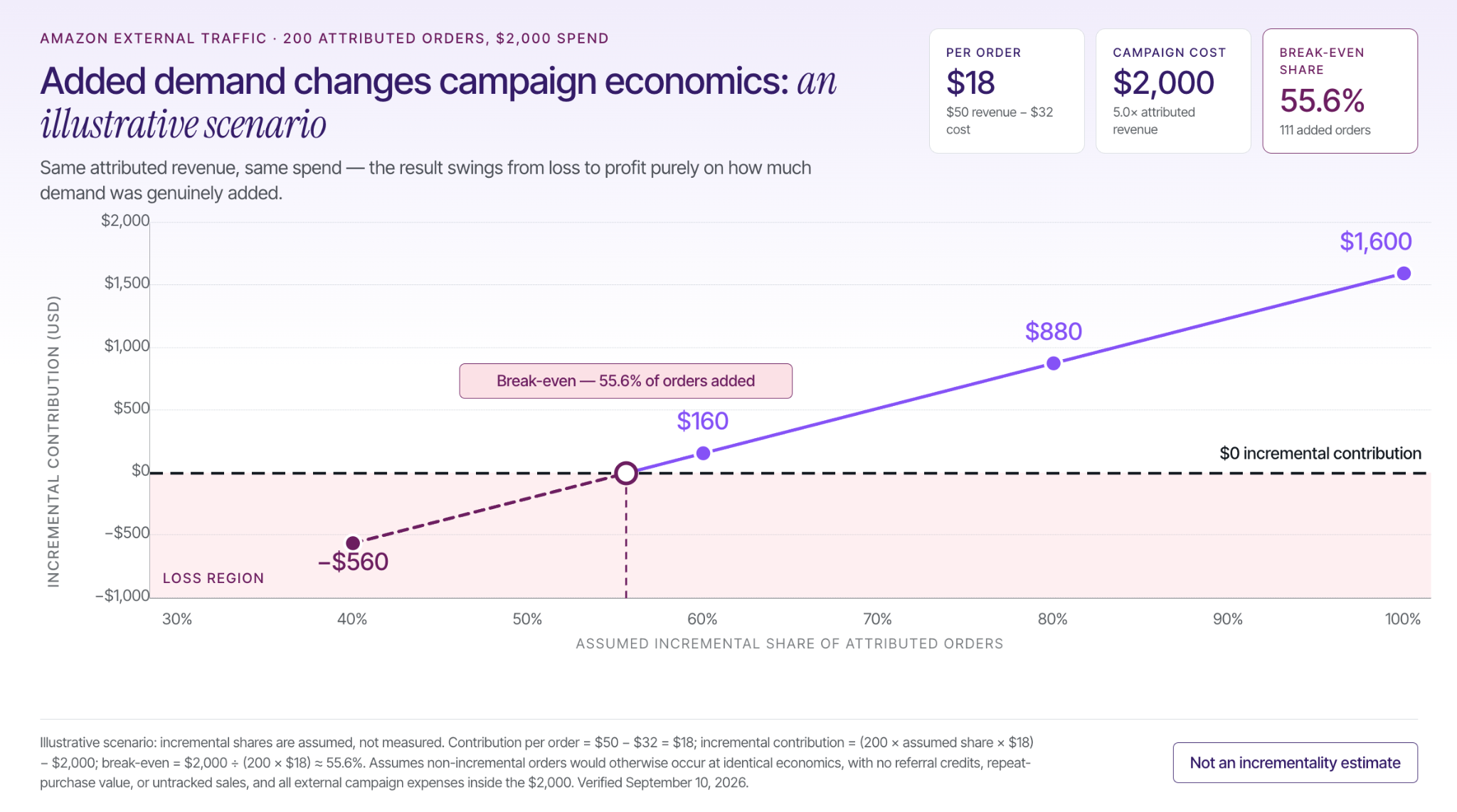
Consider a separate illustrative scenario: 200 attributed, non-compensated customer orders at $50 each produce $10,000 in attributed revenue. Assume $32 per order in product, Amazon, fulfillment, and return-related costs, leaving $18 in contribution before external marketing. The complete external campaign costs $2,000, including media and all supporting campaign expenses.
Attributed revenue divided by the full campaign cost is 5.0, a fivefold revenue return on the all-in budget. This differs from a media-only return on ad spend (ROAS) calculation. The additional contribution still depends on how many orders would not have happened without the campaign.
Assume the remaining orders would otherwise have occurred on Amazon at the same economics. Also assume no referral credits, future repeat-purchase value, or additional untracked sales. At incremental shares of 40%, 60%, 80%, and 100%, the campaign adds 80, 120, 160, or 200 orders, respectively.
Multiplying those additional orders by $18 and subtracting $2,000 produces incremental contribution after campaign costs of negative $560, positive $160, positive $880, and positive $1,600. The break-even incremental share is approximately 55.6%, calculated as $2,000 / (200 x $18).
These are sensitivity calculations, not observed results or benchmark expectations. Amazon Attribution does not tell you which of those incremental shares is correct. The example shows why a persuasive attributed-revenue figure still needs an economic and measurement context.
Measure Added Demand Without Overclaiming Causation
Use Amazon Attribution to connect tagged activity with shopping outcomes, then use additional evidence to assess whether demand increased. Amazon's Attribution reporting overview includes clicks, detail-page views, add-to-cart activity, purchases, and product sales.
Read those metrics as a sequence of diagnostic questions. When paid clicks fail to become useful product visits, inspect the link and audience; when product visits do not progress toward purchases, inspect message fit, the offer, and the listing. These are investigation priorities, not automatic diagnoses.
Compare groups of clicks from the same launch period only after allowing time for purchases. For an illustrative traffic test running for 14 days, the last day's clicks need another 14 days to complete Amazon's stated conversion window, plus any reporting delay. That schedule does not guarantee an adequate sample size or statistical significance.
Separate sales of the promoted product from any other brand-product sales included in your report. Also keep new-to-brand reporting distinct from incrementality: a shopper can be new to the brand without the campaign being the reason they purchased.
For DTC brands, reconcile marketplace results with the brand's other checkout channels. Shopify's marketing-report documentation explains that attribution models distribute credit differently and that its any-click model can allocate full credit to multiple channels. Do not add incompatible dashboard totals together and call the result unique revenue.
Where you can observe purchases consistently in both groups, a properly designed test with an unexposed comparison group is more informative about added demand than a before-and-after screenshot. When that is impractical, compare similar periods, record changes in price, stock, promotions, and Amazon advertising, and describe the result as directional. Do not imply Amazon Attribution itself supplies a randomized holdout.
Stack Influence's three-month Snow campaign recorded 90 creator promotions and 168,510 social impressions; average monthly unit sales moved from 34 at the starting point to 215 during the campaign. Those figures document campaign activity and an accompanying sales change, not the number of additional customer orders caused by creator traffic. Results depend on product, pricing, category, and execution.
Return to the Three-Ledger Plan when reviewing the campaign. A creator-campaign measurement workflow should leave you with identifiable costs, a qualified assessment of customer purchases, and a usable content inventory, rather than one blended success number. Report actual content reuse and its allocated cost separately; do not add a hypothetical media-value estimate to customer revenue.
Run a Pilot That Ends With a Decision
Write the decision you need before approving the launch. For example: can demonstrations of one use case attract enough qualified buyers to justify another creator cohort, or does non-brand search reveal a stronger route to purchase?
Assign an owner to the product listing, the link register, creator completion, and financial reconciliation. Keep the initial product and offer stable enough to interpret the results. Set a spending cap and pause conditions for broken links, unavailable stock, or an offer that no longer matches the creative.
For creator-led pilots, Stack Influence's Amazon campaign workflow connects product seeding, creator participation, and content production. Specify separately how audience sales and content reuse will be evaluated, so completion accountability and commercial performance remain visible.
Expand a campaign when the evidence supports its intended job and the economics withstand reasonable assumptions. Revise the message when attention fails to become buying interest, and extend measurement when the data is immature. A valid pilot can conclude that the next action is to fix the listing rather than buy more traffic.
Make the Next Campaign Easier to Judge
The strongest Amazon external traffic strategy connects the buying question, the traffic source, and the destination while keeping spending, customer demand, and content value separate. Attribution helps you see a purchase path; disciplined testing and reconciliation help you decide whether to repeat it.
Start with one purchase-ready product, one clear use case, and a measurement plan written before launch. For a creator-led approach, evaluate a Stack Influence product-seeding campaign against those requirements so your next investment produces both usable content and a clearer growth decision.