




Most eCommerce sellers budget for paid search, meta ads, and influencer campaigns before they ever consider affiliate marketing. That sequencing leaves a proven, performance-based channel sitting idle while acquisition costs on every other channel keep climbing. Understanding the full benefits of affiliate marketing means looking beyond the basic commission model and examining how it compounds with creator content, Amazon Attribution, and product seeding to build a growth engine that pays for itself.
Key Takeaways
- Affiliate marketing is a performance-only channel, meaning budget flows to results rather than reach, which structurally reduces wasted spend for eCommerce sellers.
- The Amazon Brand Referral Bonus and Amazon Attribution together create a double incentive for sellers who recruit affiliates to drive external traffic.
- Micro-influencers and nano influencers are the fastest-growing affiliate segment because their conversion rates often outpace those of larger creators despite smaller audience sizes.
- The 5-Step Affiliate Activation Sequence gives sellers a structured process for moving from zero to an active, converting affiliate channel in one quarter.
- Measuring affiliate ROI requires a layered metric stack, not a single click-attribution number, especially when creator content generates organic halo lift alongside tracked conversions.
Why Affiliate Marketing Outperforms Other Paid Channels on Risk-Adjusted ROI
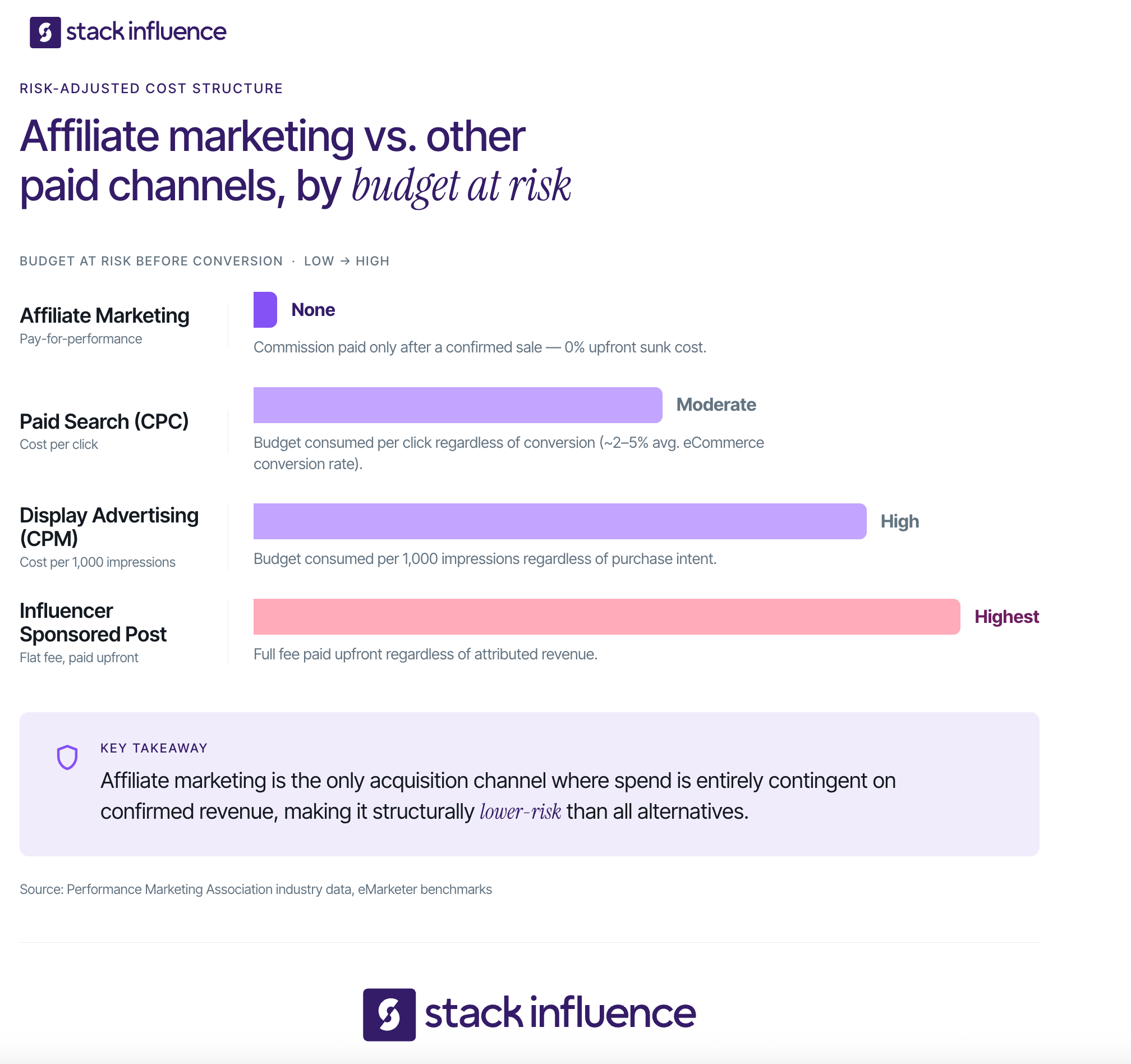
Affiliate marketing outperforms most paid acquisition channels on a risk-adjusted basis because payment is tied directly to verified outcomes. Unlike CPM or CPC advertising, where budget drains regardless of conversion, a commission model means every dollar spent corresponds to a sale that already happened. For eCommerce sellers managing tight contribution margins, this structural difference is not a minor advantage; it is a fundamental shift in how acquisition risk is allocated.
The broader performance marketing landscape confirms this dynamic. According to the Performance Marketing Association's industry data, the affiliate channel drives a return on ad spend that consistently competes with paid search, often at a fraction of the brand management overhead. That efficiency is especially relevant for Amazon FBA sellers and Shopify brands that cannot afford to scale a channel that doesn't show immediate payback.
Key risk-adjusted advantages of affiliate marketing for eCommerce sellers include:
- Pay-for-performance structure: Commissions are owed only after a confirmed sale, so there is no sunk cost from impressions, clicks, or failed campaigns.
- Diversified traffic sources: A healthy affiliate program pulls visitors from blogs, social platforms, email newsletters, and review sites simultaneously, reducing dependence on any single algorithm.
- Scalable without a proportional headcount increase: Adding 50 more affiliates does not require 50 more team members the way a paid media expansion would.
- Compounding content library: Affiliates produce evergreen content, product reviews, and comparison articles that continue generating conversions long after the initial post date.
The compounding nature of affiliate content is one of the channel's most underappreciated financial benefits. A well-placed product review ranking on page one of Google can deliver consistent referral traffic for 18 to 36 months, making its effective cost per acquisition drop with every passing week.
What Is Affiliate Marketing for eCommerce Brands?
Affiliate marketing for eCommerce brands is a revenue-sharing model in which independent promoters (affiliates) earn a commission each time they drive a qualifying action, usually a purchase, through a unique tracking link or code. The brand sets the commission rate and terms; the affiliate handles the promotion. Neither party pays the other upfront.
For Amazon sellers, this model has a specific structural advantage in the form of the Amazon Brand Referral Bonus, which credits sellers with an average bonus of 10% of sales driven by external traffic sources. That bonus stacks on top of any organic ranking lift that external traffic signals generate, creating a double incentive for investing in an affiliate channel. Shopify brands access a parallel system through native affiliate app integrations and third-party networks.
The affiliate ecosystem spans a wide spectrum of promoter types:
- Content creators and bloggers who publish long-form reviews and comparison posts
- Micro-influencers (10,000 to 100,000 followers) who embed affiliate links in social posts, Reels, and TikTok videos
- Nano influencers (under 10,000 followers) who drive outsized conversion in tight, high-trust niche communities
- Email newsletter operators who recommend products to curated subscriber lists
- Amazon Influencers who build storefronts and Idea Lists that link directly to product pages
Understanding the full promoter landscape matters because different affiliate types serve different stages of the buyer journey, and the most effective programs deliberately combine them.
The 5-Step Affiliate Activation Sequence
The 5-Step Affiliate Activation Sequence is the structured process eCommerce sellers can use to build an affiliate channel from scratch within a single quarter without letting program management consume the entire marketing team's bandwidth. Reference this sequence when scoping the channel, onboarding creators, and optimizing for conversion.
Most brands stall on affiliate marketing not because the model is flawed, but because they launch it without a repeatable process. The Affiliate Activation Sequence solves that by breaking setup into five executable steps, each with a clear output that feeds the next.
Step 1: Define the Commission Economics Set a commission rate that is sustainable at your gross margin while competitive enough to attract quality affiliates. For physical products, 5% to 15% is the typical functional range depending on product price point and category margin. Calculate your maximum allowable customer acquisition cost first, then work backward to a commission that fits inside that ceiling.
Step 2: Build a Minimum Viable Affiliate Kit Create a simple brief that includes approved product images, key claims, a unique discount or landing page URL for tracking, and any platform-specific posting guidelines. Affiliates who receive clear creative direction convert at higher rates than those left to interpret the product on their own.
Step 3: Source and Vet Affiliates Before You Invite Them Recruit affiliates from three pools: organic applicants who find your program through a directory listing, outbound recruitment from your existing customer base, and creator outreach to micro-influencers already talking about your category. According to Influencer Marketing Hub's 2024 benchmark report, micro-influencers generate engagement rates three to five times higher than macro-influencers, making them a cost-efficient affiliate recruitment target.
Step 4: Seed the Product Before Asking for Promotion Gifting the product before the affiliate promotes it is not optional if authentic content is the goal. Creators who have genuinely used a product write better reviews, record more convincing demos, and produce content that performs longer. This is where a product-seeding model overlaps with affiliate marketing: when affiliates become brand advocates because they experienced the product firsthand, their conversion rates reflect it.
Step 5: Optimize on a 30-Day Rolling Basis Review performance data every 30 days. Identify the top 20% of affiliates driving 80% of conversions and deepen the relationship through higher commission tiers, early access to new SKUs, or co-created content opportunities. Cut or pause affiliates who have been active for 60 days without a qualifying conversion. The Affiliate Activation Sequence only compounds if the optimization loop runs consistently.
Reference the Affiliate Activation Sequence when planning quarterly budget reviews, because the output of Step 5 directly informs the commission economics decision in the next cycle's Step 1.
Do Micro-Influencers Make Better Affiliate Partners Than Macro-Influencers?
Micro-influencers typically make stronger affiliate partners for eCommerce sellers than macro-influencers because their audiences are smaller, more trusting, and more purchase-ready. A creator with 25,000 highly engaged followers in a specific niche often drives more tracked conversions per post than a creator with 500,000 generalist followers, because niche audiences follow recommendations from creators they trust as category experts. The math almost always favors depth over breadth for direct-response affiliate outcomes.
This dynamic is especially visible in categories like beauty, health, and home goods, where purchase decisions are heavily influenced by social proof and product demonstration. A study published by Nielsen found that 88% of consumers trust recommendations from people they know over any other form of advertising, and micro-influencers function as "people they know" within niche communities in a way that celebrity creators cannot replicate.
Why micro and nano influencers outperform at the affiliate level:
- Higher trust density: Smaller audiences mean the creator personally engages with more of their followers, creating a parasocial relationship closer to peer recommendation than advertising.
- Category specificity: A fitness creator with 20,000 followers who posts exclusively about nutrition is pre-qualifying their audience as buyers in your category before a single affiliate link is shared.
- Lower minimum thresholds: Micro-influencers are accessible through micro-influencer platforms and direct outreach without the six-figure brand deals that macro-influencers command.
- Authentic UGC output: Micro-affiliates naturally generate user-generated content that brands can repurpose for paid ads, Amazon listings, and email campaigns, compounding the value of a single creator relationship.
Stack Influence's network includes roughly 600,000 vetted creators, approximately 78% of whom are female, spanning beauty, health, grocery, and home categories where affiliate conversion is strongest. That depth of pre-vetted creator supply means eCommerce sellers can move from affiliate program launch to active creator promotions without spending months on manual outreach.
The Affiliate Marketing ROI Stack: How to Measure What Actually Matters

Measuring affiliate marketing ROI requires more than last-click attribution, especially for eCommerce sellers running simultaneous organic, paid, and creator channels. A single-number measurement approach will both undercount and misattribute affiliate value, leading sellers to either over-invest in low-quality affiliates or cut high-value ones prematurely. The Affiliate ROI Stack is the layered measurement model that captures the full picture.
The Affiliate ROI Stack
This secondary decision tool organizes affiliate metrics into three tiers: surface metrics, conversion metrics, and compounding value metrics. Evaluate all three tiers before making budget or commission decisions.
- Tier 1: Surface Metrics. Click-through rate, impressions, and content reach. These indicate program visibility and affiliate effort but are not performance signals by themselves. Use them to identify which affiliates are active and which are dormant.
- Tier 2: Conversion Metrics. Attributed sales, conversion rate by affiliate, revenue per click, and commission-to-revenue ratio. These are the core performance signals. Any affiliate active for 60 days without Tier 2 output should be reviewed or removed.
- Tier 3: Compounding Value Metrics. New keyword rankings driven by affiliate content, organic review volume correlated with affiliate campaign periods, repeat purchase rate from affiliate-referred customers, and Amazon Best Seller Rank movement during high-affiliate-activity months. Tier 3 metrics are rarely tracked but often represent the largest long-term return.
For Amazon sellers specifically, Amazon Attribution links give precise Tier 2 data for off-platform traffic, while the Amazon Brand Referral Bonus converts that attribution into a direct cash offset on referral fees. Pairing Amazon Attribution with affiliate tracking creates a closed-loop measurement system that captures both the immediate commission cost and the downstream referral fee rebate.
A verified Stack Influence case study for Blueland, a plastic-free home essentials brand, illustrates what Tier 3 metrics can look like at scale. During a 3-month campaign, average monthly unit sales increased 4.7x from 542 to 2,562, while the brand began ranking for 927 new keywords and reached page one for "foaming hand soap," a keyword with 26K monthly searches. The campaign generated 13x ROI. While that campaign used a product-seeding model rather than a traditional affiliate commission structure, the compounding keyword and ranking outcomes it produced are exactly the Tier 3 signals that most affiliate programs fail to track.
For Shopify brands, affiliate attribution apps such as TripleWhale, Northbeam, or platform-native tools allow multi-touch attribution that correctly credits affiliates who appear earlier in a longer purchase journey rather than only last-click.
The Case Against Running Affiliate Marketing as a Passive Channel
The most damaging assumption in affiliate marketing is that the program runs itself once it is set up. It does not. Programs treated as passive channels plateau quickly, attract low-quality coupon and loyalty affiliates who cannibalize existing revenue rather than generate new customers, and produce no compounding content value because no one is actively managing creator quality. This contrarian reality is one the most widely shared affiliate marketing guides consistently skip.
The passive-channel failure mode plays out in a predictable pattern. A brand launches a program, lists it in a few affiliate directories, and waits for signups. The early applicants are often cashback and coupon sites that target customers already in the checkout flow on the brand's own site. Those affiliates generate attributed conversions, so the program looks productive on paper. But net new customer acquisition is flat or negative because the commissions are being paid on purchases that would have happened anyway, with the affiliate simply inserting itself into the final click.
Preventing this requires active program management at every step of the Affiliate Activation Sequence. Specifically:
- Audit affiliate type monthly: Separate content-driven affiliates (bloggers, creators, newsletter authors) from transaction-layer affiliates (coupon sites, cashback networks) in your reporting. Evaluate them against different benchmarks.
- Set new-customer rate as a primary KPI: A healthy affiliate program should drive at least 60% to 70% new-to-brand customers. If your affiliate new-customer rate is below 50%, the program is likely paying for existing demand, not creating it.
- Invest in the top performers: The affiliates generating real new customers should be treated as brand ambassadors and given preferential access, higher tiers, and relationship investment. They will not stay active in a program they feel is purely transactional.
The brands that generate consistent, compounding affiliate ROI are those that treat the channel as an active content and creator partnership strategy rather than a commission-tracking spreadsheet. That is the operational shift most guides in this space fail to make explicit.
How Does Affiliate Marketing Integrate with Product Seeding and UGC Campaigns?
Affiliate marketing integrates with product seeding and UGC campaigns most effectively when gifting comes first and commission tracking follows. Sending a product to a creator before asking them to become an affiliate removes the content quality problem: creators who have genuinely used and formed an opinion about a product produce more specific, more credible, and higher-converting content than those working from brand talking points alone.
This integration is particularly powerful for Amazon sellers because the Amazon Influencer Program allows creators to build storefronts that function as evergreen affiliate hubs. A creator who receives a product through a seeding campaign, creates authentic UGC around it, and then adds it to their Amazon storefront generates three simultaneous value streams: organic social content, a shoppable affiliate link, and a user-generated asset the brand can license for ads. According to eMarketer's analysis of creator commerce trends, shoppable content tied to authentic creator recommendation significantly outperforms standard display ad formats for purchase intent.
The practical integration workflow looks like this:
- Seed the product through a structured product seeding campaign to generate authentic UGC and creator familiarity.
- Identify creators whose content performed above average on engagement and conversion signal metrics.
- Invite those top performers into a formal affiliate or brand partnership arrangement with tracked links and a commission structure.
- Repurpose the UGC created during the seeding phase for paid media, email, and Amazon listing imagery, so the seeding investment extends beyond the initial creator post.
This sequence converts one-time creator interactions into ongoing affiliate relationships and ensures the content quality standard stays high throughout the program lifecycle.
Scaling Affiliate Programs Without Adding Headcount
Scaling an affiliate program past 100 active affiliates without a proportional increase in program management headcount requires deliberate automation and tiering. The most common scaling bottleneck is manual onboarding, approval workflows, and payment processing, none of which require human judgment at every step. Automating these frees the program manager to focus on the high-value work: identifying top performers, deepening key creator relationships, and designing the next tier incentive.
Rakuten Advertising's research on affiliate program management shows that brands using tiered commission structures retain top-performing affiliates at significantly higher rates than flat-rate programs, because incremental earners see a clear path to higher rewards without requiring individual negotiation.
Practical scaling tools and tactics:
- Use an affiliate management platform (Impact, ShareASale, or PartnerStack for SaaS) to automate application review, tracking link generation, and monthly payouts.
- Build a tiered commission structure with at minimum a base tier and a performance tier that kicks in after a defined monthly sales threshold.
- Create a self-serve affiliate resource hub with approved copy, creative assets, and FAQ documentation so onboarded affiliates can activate without a one-on-one call.
- Schedule quarterly performance reviews instead of continuous monitoring, and use automated alerts only for anomalies (sudden drops in click volume or conversion rate) rather than reviewing every affiliate individually.
For DTC brands running simultaneously on Shopify and Amazon, a cross-channel affiliate structure that includes both an Amazon Influencer storefront option and a direct-to-site tracking link gives affiliates flexibility to promote through whatever channel best fits their content format, which increases program participation rates without increasing program complexity.
Conclusion
The benefits of affiliate marketing for eCommerce sellers compound over time in ways that few other acquisition channels can match: risk-adjusted spend, evergreen content production, keyword ranking lift, and creator relationships that convert from one-time promotions into long-term brand partnerships. Executing that potential requires moving through the 5-Step Affiliate Activation Sequence deliberately, measuring performance across the full Affiliate ROI Stack rather than surface click data, and treating affiliate management as an active creator strategy rather than a passive directory listing.
If you are ready to build a creator-affiliate channel with vetted micro-influencers who generate authentic UGC and drive measurable sales, explore Stack Influence's product-seeding and creator-sourcing capabilities to see how gifting-first campaigns turn into high-converting affiliate relationships.