


The moment a brand asks for a Spark authorization code, your TikTok has entered paid media. The video may still look like an ordinary post, but an advertiser can now put budget behind it, target new audiences, and measure actions beyond the reach you earned organically.
For content creators, answering “what are TikTok ads?” requires more than naming ad formats. You need to know whether you are buying reach yourself, lending your identity to a Spark Ad, or supplying user-generated content (UGC) that a brand will publish from its own account. Those paths create different responsibilities, rights, fees, and reporting needs.
This guide explains how TikTok advertising works, which options matter to creators, how to protect your content rights, and how to judge whether paid distribution actually increased your value.
Key Takeaways
- TikTok ads are paid distribution, not a particular video style. Organic-looking creator content can still be an advertisement when money is used to expand its reach.
- Promote is TikTok’s simpler in-app boosting tool, while Ads Manager provides campaign objectives, targeting, budgets, optimization, and detailed reporting.
- Spark Ads retain the creator’s identity and original post, while Non-Spark ads are delivered through an advertiser identity using separately uploaded creative.
- A Spark authorization code is a technical permission, not a complete contract covering ownership, edits, other channels, exclusivity, or compensation.
- Creators should evaluate ad performance across attention, action, business outcomes, and creator value rather than treating views as the final result.
What Are TikTok Ads?
TikTok ads are paid messages distributed through TikTok’s advertising systems to reach selected audiences or pursue goals such as video views, traffic, leads, app activity, and sales. An ad may use newly uploaded creative, a brand’s existing post, a creator-authorized Spark post, or commerce content connected to TikTok Shop.
TikTok Ads Manager organizes advertising into three levels. A campaign contains the main objective and certain budget decisions. An ad group controls elements such as audience, placement, schedule, bidding, and optimization. The individual ad contains the creative, identity, copy, call to action, and destination.
TikTok currently groups objectives into awareness, consideration, and conversion. Its official objective guide lists Reach under awareness; Traffic, Video Views, Community Interaction, and Branded Mission under consideration; and App Promotion, Lead Generation, and Sales under conversion. Creators do not need to memorize every objective, but they should ask which one a brand is using because “successful creative” means something different in a reach campaign than in a sales campaign.
A paid ad is also different from a sponsored organic post. A sponsored post is content created because of a commercial relationship, such as payment, free product, or another benefit. It becomes paid media when someone buys additional distribution through Promote, Ads Manager, or another TikTok advertising product. One video can be both a disclosed sponsored post and a paid Spark Ad.
For creators who want the brand-side mechanics, Stack Influence’s TikTok Ads Manager guide explains campaign structure, creative testing, and attribution from an ecommerce advertiser’s perspective. This article focuses on the creator’s role inside that system.
How Do TikTok Ads Work?
TikTok ads work by matching an advertiser’s objective, audience settings, budget, bid strategy, and creative with available ad opportunities. The platform then delivers ads, records eligible interactions, and optimizes toward the selected event. Creators influence performance mainly through the message, identity, proof, pacing, and call to action contained in the creative.
A practical campaign workflow has five parts:
- Choose the outcome: The advertiser selects reach, views, traffic, leads, sales, or another available objective.
- Define delivery: The ad group sets the audience, placements, schedule, optimization event, and bidding controls.
- Set the budget: The advertiser chooses daily or lifetime spending limits.
- Select the identity and creative: The ad can use an advertiser account, a linked account, or an authorized Spark post.
- Measure and refine: Reporting shows delivery, viewing, engagement, traffic, and conversion signals so the advertiser can adjust creative or campaign settings.
TikTok’s current budget documentation states that campaign-level daily and lifetime budgets must exceed $50, while an ad group’s daily budget must exceed $20. For a lifetime ad group budget, the documented minimum is $20 multiplied by the number of scheduled days. That produces minimum calculations of $140 for seven days, $280 for 14 days, and $600 for 30 days. These are platform delivery thresholds, not recommended test budgets or promises of meaningful results.
The distinction matters for creators because a brand’s media budget is separate from the creator’s compensation. A $600 ad budget does not tell you what the content, organic post, Spark authorization, raw footage, or renewal rights are worth. It only describes money available for TikTok to distribute the ad.

The Three Creator Roles Inside TikTok Advertising
Creators can participate in TikTok advertising as advertisers, ad identities, or creative suppliers. Separating these roles clarifies who controls delivery, where the video appears, and what the creator is selling.
Creator as Advertiser: Promote
Promote is TikTok’s in-app tool for putting paid reach behind your own eligible video or LIVE. TikTok says available goals can include views, followers, profile activity, messages, leads, website visits, and sales. It also states that users must be at least 18 years old to use Promote.
Promote offers a simpler entry point than a full Ads Manager campaign, but the creator should still define the intended outcome. More views do not automatically become engaged followers, brand inquiries, affiliate sales, or repeat viewers. Stack Influence’s creator guide to TikTok marketing provides context for combining organic publishing, UGC, partnerships, and paid reach.
Creator as Ad Identity: Spark Ads
Spark Ads let an advertiser use an existing organic post from its own account or an authorized creator account. TikTok’s official Spark Ads documentation says engagement generated during promotion is attributed to the original post. The creator’s account identity and public social proof therefore remain part of the paid experience.
Creator as Production Partner: Non-Spark UGC
A creator can instead produce a video that a brand uploads under an advertiser identity. The asset may never appear on the creator’s profile. In this content-only workflow, the brand is buying production and agreed usage rights rather than organic distribution through the creator’s audience.
This content-only path is accessible to UGC creators, micro influencers, and nano influencers whose production skill may matter more than follower count. The distinction is central to UGC marketing for content creators: influencer work sells some combination of content and distribution, while UGC work can sell production alone. A creator can offer both, but the deliverables should be itemized.
Spark Ads Turn Organic Posts Into Paid Media
Spark Ads matter to creators because the post, account identity, and commercial permission remain connected. An advertiser needs an approved authorization path before using another creator’s public video in this format.
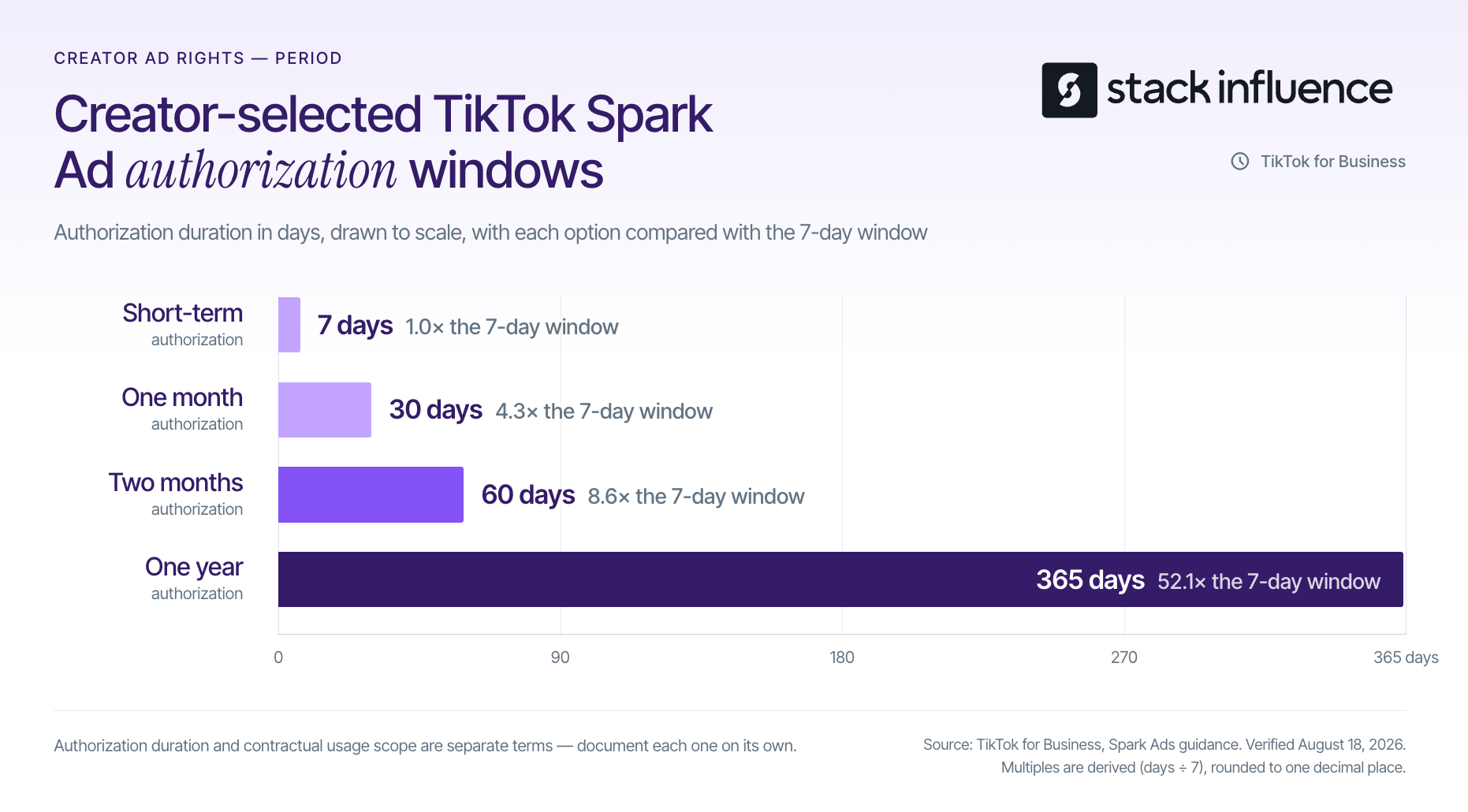
TikTok’s current process lets a creator enable ad authorization for a selected post, choose a duration, generate a code, and provide it to the advertiser. The standard duration options are 7, 30, 60, or 365 days. TikTok also notes that the caption cannot be edited after authorization, and a private video may become public when used unless the relevant private delivery option applies.
Before sharing a code:
- Finalize the caption, disclosure, tags, spoken claims, and product details.
- Record the post, code, start date, expiration date, advertiser, and campaign.
- Confirm whether cutdowns, overlays, new calls to action, or raw footage are included.
- Do not assume TikTok authorization covers Meta ads, websites, product pages, email, or other channels.
- Define the renewal process before the original period ends.
The Stack Influence Spark Ads guide explains authorization basics, while its TikTok Spark Ads campaign workflow connects creator recruitment, UGC generation, code collection, and campaign execution for ecommerce brands.
Across creator campaigns, the overlooked work is often the handoff. The approved post, authorization code, usage period, advertiser identity, and reporting plan must align before organic content can move cleanly into paid media.
The Four P Creator Ad-Rights Check
The Four P Creator Ad-Rights Check separates a code request into four decisions: Post, Placement, Period, and Payment. Use it before sending an authorization code, raw file, or ad-ready edit so the permission is clear without making the collaboration unnecessarily complicated.
1. Post
Identify exactly what the advertiser may use. Name the public post, final file, caption, voiceover, music, raw footage, alternate hooks, still frames, and cutdowns included in the deal.
A Spark authorization normally points to a specific post. A broader UGC agreement may include source files and permission to create derivatives. Those are different assets and should not be bundled silently as “content.”
2. Placement
Define every approved location, such as a Spark Ad, brand-account TikTok ad, TikTok Shop, website, marketplace listing, Meta ad, email, or retail media.
Under U.S. copyright law, copyright generally begins with the author once an original work is fixed, although work-made-for-hire rules and written transfers can change ownership. The U.S. Copyright Office’s copyright overview distinguishes ownership from permission to authorize particular uses.
Material terms should be written, with professional advice used when a deal carries significant legal or financial consequences.
Stack Influence’s guide to UGC licensing rights makes the operational distinction clear: a platform authorization path and a commercial license solve related, but separate, permission problems.
3. Period
Specify the first and last day of paid use. TikTok currently offers Spark authorization windows of 7, 30, 60, or 365 days. Relative to seven days, those periods are 1.0, 4.3, 8.6, and 52.1 times as long.
The technical authorization period and contractual license period should be recorded separately, with a defined renewal process. A one-year code should not become perpetual or cross-channel permission by assumption.
4. Payment
Separate the purchased services. A deal can include production, organic posting, paid-media usage, exclusivity, renewal, affiliate commission, or a performance bonus.
Creator ad-rights deals do not have one universal rate. SAG-AFTRA’s Influencer Agreement fact sheet says compensation under its agreement is freely bargained and does not use set rates. The broader lesson is useful: payment should reflect the actual bundle of labor, distribution, identity, rights, duration, and restrictions.
Before approving a deal, check that every P can be answered in one sentence. A vague answer usually means the scope is unfinished.
An Ad-Ready Workflow for Content Creators
Ad-ready content begins before filming. The creator should understand the objective, approved claims, commercial restrictions, deliverables, and reporting plan before choosing the hook or soundtrack.
- Define the job: Is the video meant to earn attention, clicks, leads, sales, or product-page proof?
- Separate deliverables: List the post, UGC file, alternate hooks, raw footage, revisions, Spark code, and paid use individually.
- Build proof into the script: Demonstrate the relevant use case, support claims responsibly, and give one clear next action.
- Clear commercial elements: Check music, disclosures, logos, claims, and third-party footage.
- Apply the Four P check: Confirm Post, Placement, Period, and Payment before delivering access.
- Capture a baseline: Save organic views, engagement, profile activity, and follower count before paid delivery.
- Request reporting: Ask for campaign dates, objective, spend, impressions, clicks, video metrics, conversions, and attribution settings.
TikTok recommends its Commercial Music Library for promotional content because its music is pre-cleared for commercial use. A sound available for ordinary posting is not automatically cleared for advertising.
Product seeding can feed this creative pipeline. A creator gains product experience, produces an agreed post or asset, and separately authorizes paid use when appropriate. Stack Influence’s resources on influencer seeding and creator opportunities show how product-based collaborations can build portfolio proof without making every usage right automatic.
How Should Creators Measure TikTok Ad Performance?
Creators should measure TikTok ad performance through four layers: attention, action, business outcomes, and creator value. The best metric depends on the campaign objective, and no single number explains the result. Views show delivery, while deeper metrics reveal whether people watched, acted, converted, or created durable value for the creator.
Layer 1: Attention
Track impressions, reach, two-second views, six-second views, average play time, and completion rate. TikTok defines a six-second focused view as at least six seconds watched, a full view of a shorter video, or an eligible early interaction for supported focused-view products.
High impressions with weak six-second retention usually point to a hook, audience-match, or first-frame problem.
Layer 2: Action
Track clicks, click-through rate, profile visits, follows, comments, shares, and other actions relevant to the objective. For Spark Ads, save the organic baseline because public engagement can grow while paid delivery is active.
Stack Influence’s reach versus impressions guide helps distinguish unique exposure from repeated delivery. Neither number proves conversion by itself.
Layer 3: Business Outcome
For conversion campaigns, review purchases, leads, cost per acquisition, conversion rate, revenue, return on ad spend, or affiliate commission. Always request the attribution window.
Google Analytics explains that UTM parameters, including utm_source, utm_medium, and utm_campaign, help identify campaigns that referred clicked website traffic. They do not capture every view-through, cross-device, or offline outcome, so use them with platform reporting.
Layer 4: Creator Value
Measure follower growth, profile visits, organic engagement added to the Spark post, inbound brand inquiries, renewal requests, affiliate earnings, and requests for new variations.
A campaign may miss a sales target while revealing that a creator earns strong attention or efficient clicks. It may also produce sales without giving the creator durable value. Compare the paid period with a reasonable baseline, preserve the settings and dates, and avoid claiming that every later follower, sale, or partnership came from one ad.
Five Mistakes That Weaken Creator Ad Deals
The most expensive creator mistakes usually come from unclear permissions, not weak camera work. Each mistake below can reduce the value of a deal or create avoidable compliance and reporting problems.
- Sharing the code before agreeing on scope: Technical authorization should follow the Four P decision, not replace it.
- Treating free product as unlimited paid rights: Product, posting, ad usage, raw footage, exclusivity, and renewals are different forms of value.
- Using music that is not cleared for advertising: Commercial use can require a different license from ordinary organic posting.
- Hiding the commercial relationship: The Federal Trade Commission says creators should clearly disclose material connections, including payment and free or discounted products. The disclosure should be hard to miss and appear with the endorsement itself.
- Reporting views without context: A useful report identifies the objective, paid dates, spend, audience, attribution setting, and the difference between organic and paid results.
Clear disclosure protects audience trust and makes a post easier for brands to reuse through compliant advertising workflows.
Creators preparing for paid collaborations can use Stack Influence’s guide to getting brand deals on TikTok and Instagram to strengthen their portfolio, positioning, outreach, and partnership process before negotiating ad rights.
Turn Paid Reach Into a Defined Creator Service
The question “what are TikTok ads?” leads to a more valuable creator question: what exactly is the advertiser buying from me? The answer may include production, organic distribution, creator identity, paid-media permission, derivatives, exclusivity, or performance. Treating those elements as one vague deliverable makes both pricing and measurement harder.
A stronger creator offer names the ad path, applies the Four P check, preserves baseline data, and requests a useful performance report. Start by turning one strong product demonstration into an ad-ready portfolio example with clearly defined rights. That gives brands a cleaner buying decision and gives you a more defensible creator service.