



A popular Reel can leave your follower count almost unchanged. Someone enjoyed the post, but did not see a reason to keep hearing from you.
Learning how to get more followers on Instagram means improving both discovery and the decision to follow. For content creators, that starts with a recognizable subject, useful original work, and a profile that makes the next post worth anticipating. This guide explains what to change, how to choose a sustainable posting pace, and which numbers reveal whether your audience is actually growing.
Key Takeaways
- Make your posts and profile communicate the same clear reason to follow.
- Measure attributed follows alongside reach, then check account-level unfollows to understand net growth.
- Test a posting cadence you can maintain; research averages do not predict your account’s results.
- Use relevant collaborations and repeatable content series to attract people who will want your next post.
How to Get More Followers on Instagram Organically

Grow organically by publishing original content for a specific audience, helping that audience discover it, and showing what they can expect after following. Before increasing output, identify where your recent posts are falling short.
Use the Next-Post Decision to choose an action from four situations. Compare similar posts from your own account at the same age; “high” and “low” mean relative to your usual results, not an industry threshold.
If your account is new, start with three posts addressing one audience problem. Use early results to form questions, not to declare a winning strategy.
- Low reach, stronger follow response: Keep the subject and improve distribution through a clearer opening, a relevant collaboration, or another presentation of the idea.
- Stronger reach, weak follow response: Check whether the post’s topic, profile, and recent content give the same reason to follow.
- Low reach and weak follow response: Rework the audience problem and the content itself before producing more versions.
- Stronger reach and follow response: Develop a related series, preserving the useful premise while answering a new question each time.
For this comparison, follow response means attributed follows relative to accounts reached, where those metrics are available. It is a diagnostic measure, not proof that a particular creative choice caused growth.
Check distribution eligibility, too. Instagram’s ranking explanation, reproduced by WebWire, directs creators to Account Status to review recommendation eligibility and available appeal options. Review any issues it identifies before assuming a weak post needs a different hashtag.
If you are still configuring your account, Stack Influence’s Instagram setup guide for creators provides the broader starting point. Use a public profile when discovery is your objective and review what personal information you make visible.
Choose a Posting Pace You Can Sustain
Start with enough regular output to learn what works without lowering the quality of each post. Three feed posts per week is a practical initial experiment for a solo creator, not an Instagram requirement.
Buffer’s Instagram posting-frequency research reports the following estimated differences in weekly follower-growth rates compared with weeks without feed posts:
- One to two posts: plus 0.12 percentage points.
- Three to five posts: plus 0.26 percentage points.
- Six to nine posts: plus 0.44 percentage points.
- Ten or more posts: plus 0.66 percentage points.
The underlying analysis by Buffer’s Julian Winternheimer compared the same accounts over time. Its final model used 1,880,815 account-week observations from 84,848 accounts and was published in July 2025. The analysis selected a trailing year of data; exact collection dates were not disclosed.
These are observed-data estimates relative to no-post weeks, not absolute growth forecasts or proof that frequency caused the difference. Feed photos, carousels, and Reels were pooled, so the figures do not establish an ideal Reels-only schedule.
Try two Reels and one carousel if that mix suits your subject. Batch the research and filming, leave time to answer comments, and increase output only when you can maintain the work.
Instagram’s Best Practices guidance in the Professional Dashboard includes personalized advice on creation, engagement, and reach. Combine that guidance with your results instead of adopting someone else’s publishing quota.
Make Your Profile Finish the Post’s Promise
Your profile should help a new visitor recognize what following you would add to their feed. Check the name, bio, pinned posts, and recent work together.
State Who the Content Helps
Describe a specific audience and recurring benefit. “Small-space cooking for people who hate washing dishes” gives a visitor more information than “Food lover sharing my journey.”
Use recognizable subject words naturally in your name field, bio, and captions. Name the actual recipe, technique, location, or problem rather than relying on vague motivational language or a pile of hashtags.
You can have several interests, but give them a common thread. A creator covering travel, photography, and budgeting could organize all three around affordable weekend trips.
Pin Evidence of the Promise
Choose pinned posts that answer three visitor questions: what do you make, why should I trust it, and what should I watch next?
A cooking creator might pin a useful recipe, a technique demonstration, and the introduction to a recurring dinner series. The posts should represent what the account will continue publishing.
Check the follow request inside the content as well. “Follow for one-pan dinners you can make after work” gives a relevant expectation, provided the account actually delivers it.
Create Posts With a Reason to Follow
Build each post around a complete useful experience, then connect it to a subject you can explore repeatedly. The viewer should receive value immediately and understand why another post from you could also be useful.
Originality matters here. In its January 2026 platform update, Meta reported that original posts accounted for 75% of Instagram recommendations in the United States in Q4 2025. That platform-wide figure does not predict any individual post’s reach.
Show the Useful Part Early in Reels
Open with the problem, result, demonstration, or observation that makes the video worth watching. Then provide the promised explanation without an unrelated introduction.
For a home creator, “This drawer keeps jamming because the organizer is too tall” creates a clear question and a visible demonstration. A long introduction about deciding to reorganize the kitchen postpones the useful part.
Use clear audio, readable captions, and framing that makes the demonstration easy to follow. Remove material that repeats a point without adding evidence or personality.
Meta’s Reels Insights announcement explains how watch-time feedback can help creators improve their openings. Review the watch-time measures and follows available in your account, then use Stack Influence’s Instagram Reels content ideas to turn the strongest subject into another useful video.
Use Carousels When the Idea Needs Steps
A carousel can suit a comparison, checklist, annotated example, or explanation that readers may want to revisit. Give the first slide a specific promise and make each subsequent slide advance the answer.
For example, a photography creator could explain how to improve window-light portraits using a sequence of original examples. The follow-up series could address different rooms, weather conditions, and common mistakes.
Stack Influence’s Instagram post ideas for creators can help expand a theme beyond one format. Choose the format that explains the idea clearly rather than turning every subject into a video.
Test a New Angle With Trial Reels
According to Meta’s Trial Reels guide, trials initially show a Reel to non-followers and provide initial engagement metrics after approximately 24 hours. Creators can subsequently share the Reel with everyone.
If the Trial option is available in your account, use it to explore a different opening or a nearby audience question. Keep the experiment relevant to content you would be willing to make again.
A trial is not a controlled experiment with identical audiences. Treat its results as a useful signal, then look for the pattern to recur before rebuilding your entire content plan.
Reach Relevant People Through Collaboration
Collaborate with creators whose audiences have a reason to care about your work. The useful overlap may be a shared problem rather than an identical niche.
A small-space cooking creator and a budget meal-planning creator could jointly demonstrate a compact weekly preparation routine. Each contributes something the other audience can use.
Meta’s Instagram Collabs announcement explains that accepted co-authored posts can appear on each collaborator’s profile and reach their audiences. That creates a distribution opportunity; it does not guarantee that viewers will follow both creators.
Before filming, agree on:
- The audience question the post will answer.
- What each creator will contribute.
- Which account will publish and invite the collaborator.
- When the content will appear and how you will review its results.
Stack Influence’s social media collaboration tips provide additional planning considerations.
You can also introduce an existing TikTok, YouTube, or newsletter audience to your Instagram work. Explain what they will find there, such as annotated examples or a weekly question session, instead of repeatedly posting a bare follow request.
Avoid unrelated giveaways, follow-for-follow exchanges, and purchased audiences. Those tactics make it harder to tell whether people want the content you intend to keep creating.
Give New Followers Something Familiar to Return To
Plan the posts that come after a successful piece of content. If a Reel attracts people interested in beginner photography, the next posts should help those beginners continue.
Build recognizable series around an audience need: one lighting correction, one affordable recipe, or one outfit adjustment per installment. Repeat the subject and the usefulness while changing the example.
Use Stories to extend the conversation with questions, behind-the-scenes decisions, or responses to confusion. A reply can become the starting point for a future public post, with permission if you identify the person.
Answer substantive comments and participate thoughtfully in related creators’ discussions. Explain your experience or add a useful distinction; generic promotional comments give people little reason to investigate your account.
Keep the audience promise visible when accepting brand partnerships, too. A product demonstration should still answer a question your followers would recognize.
Measure Follow Gains, Then Check Unfollows
Measure which content earns follows and whether those gains survive at the account level. Reach, attributed follows, and net follower growth answer different questions.
Use available Insights to record each post’s topic, format, publication date, accounts reached, and attributed follows. Add watch-time measures for Reels and label paid distribution separately.
Compare posts at a consistent age, such as seven days after publication, and separate different formats. Stack Influence’s creator analytics dashboard guide explains how to keep those comparisons organized.
Compare Volume and Follow Efficiency
Use this descriptive calculation where Instagram supplies the necessary metrics:
Follows per 1,000 accounts reached = attributed follows ÷ accounts reached × 1,000.
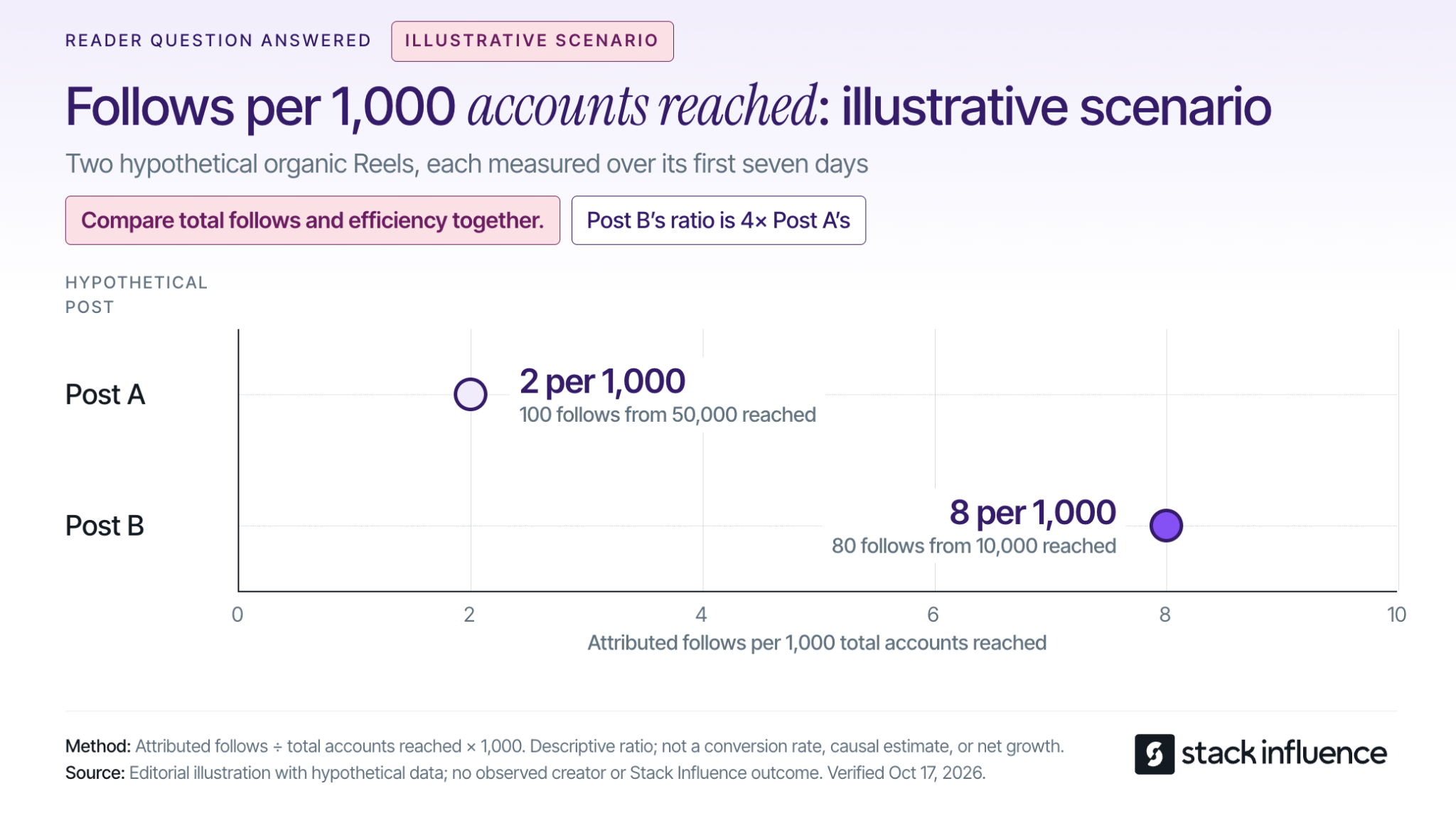
Consider an illustrative scenario using two hypothetical organic Reels, each measured over its first seven days:
- Post A reaches 50,000 accounts and records 100 attributed follows: 2 follows per 1,000 accounts reached.
- Post B reaches 10,000 accounts and records 80 attributed follows: 8 follows per 1,000 accounts reached.
Post A brings in more total follows. Post B produces four times as many follows relative to its reach.
The Next-Post Decision suggests exploring how to distribute Post B’s useful premise more widely while investigating what made Post A travel. Neither number alone establishes an overall winner.
These invented values demonstrate the calculation; they are not Instagram benchmarks or Stack Influence campaign results. Accounts reached includes followers and non-followers, so this ratio is not a non-follower conversion rate.
If post-level follows are unavailable, review available post metrics alongside account-level growth. Do not assign every new follower in a week to one Reel.
Check Whether Gains Remain
Net follower change equals follows minus unfollows over the same period. Percentage net growth equals net follower change divided by the starting follower count, multiplied by 100.
Review those account-level numbers weekly and look for patterns across several weeks. Also read the comments and questions: are you attracting the audience your content is intended to help?
Unfollows can have several causes, so one disappointing week does not identify a faulty post. Likewise, account-wide unfollows do not reveal exactly how many people recruited by a particular Reel later left.
Use the numbers to choose the next question to test. Change one major creative variable at a time where practical, such as the opening or audience problem, and repeat the comparison before drawing a firm conclusion.
Build Brand Readiness While Your Audience Is Small
Creators can work on content quality, reliability, and audience relevance while their following grows. A clear niche also makes it easier to explain what you could contribute to a brand partnership.
For a concrete example, Stack Influence’s creator FAQ says creators with at least 200 Instagram followers and original content can apply. Application eligibility does not guarantee campaign selection.
Stack Influence’s creator campaign process connects product selection, purchase, approved social content, and reimbursement. This gifted-first product-seeding workflow gives creators a way to explore product collaborations, with campaign requirements to review before participating.
For nano influencers, micro influencers, and UGC creators, the practical task is to demonstrate that you can explain a relevant product clearly and complete the agreed work. A portfolio of thoughtful demonstrations can develop alongside the audience.
When a product relationship is involved, disclose it clearly. The FTC’s social media disclosure guidance explains that free products can create a material connection and that disclosures should accompany the endorsement.
Choose Your Next Three Posts
Knowing how to get more followers on Instagram becomes useful when it changes what you publish next. Choose one audience problem, make the profile’s promise clear, and plan three posts that explore that problem from different angles.
After each has had the same time to circulate, compare reach, attributed follows, and the account’s net growth. Use the Next-Post Decision to choose what to expand, clarify, or replace, so your next followers have a reason to stay.