




TikTok Ads Manager is one of the most underutilized paid channels for eCommerce sellers who have already optimized their Meta and Google campaigns and are looking for the next scalable acquisition channel. The platform offers lower CPMs than Meta in most product categories, a native commerce infrastructure through TikTok Shop, and an algorithm that actively rewards content resembling organic creator posts over polished brand advertising. For DTC brands, Amazon sellers, and Shopify merchants, understanding how to set up, structure, and optimize campaigns inside TikTok Ads Manager is now a legitimate competitive advantage rather than an experimental addition to the media mix. This guide covers the complete TikTok Ads Manager workflow, the creative strategy that actually converts, and the attribution setup that connects TikTok ad spend to real revenue across every sales channel you operate.
Key Takeaways
- TikTok Ads Manager is TikTok's self-serve advertising platform, accessible at ads.tiktok.com, where eCommerce sellers create and manage In-Feed Ads, TopView, Spark Ads, and TikTok Shopping campaigns.
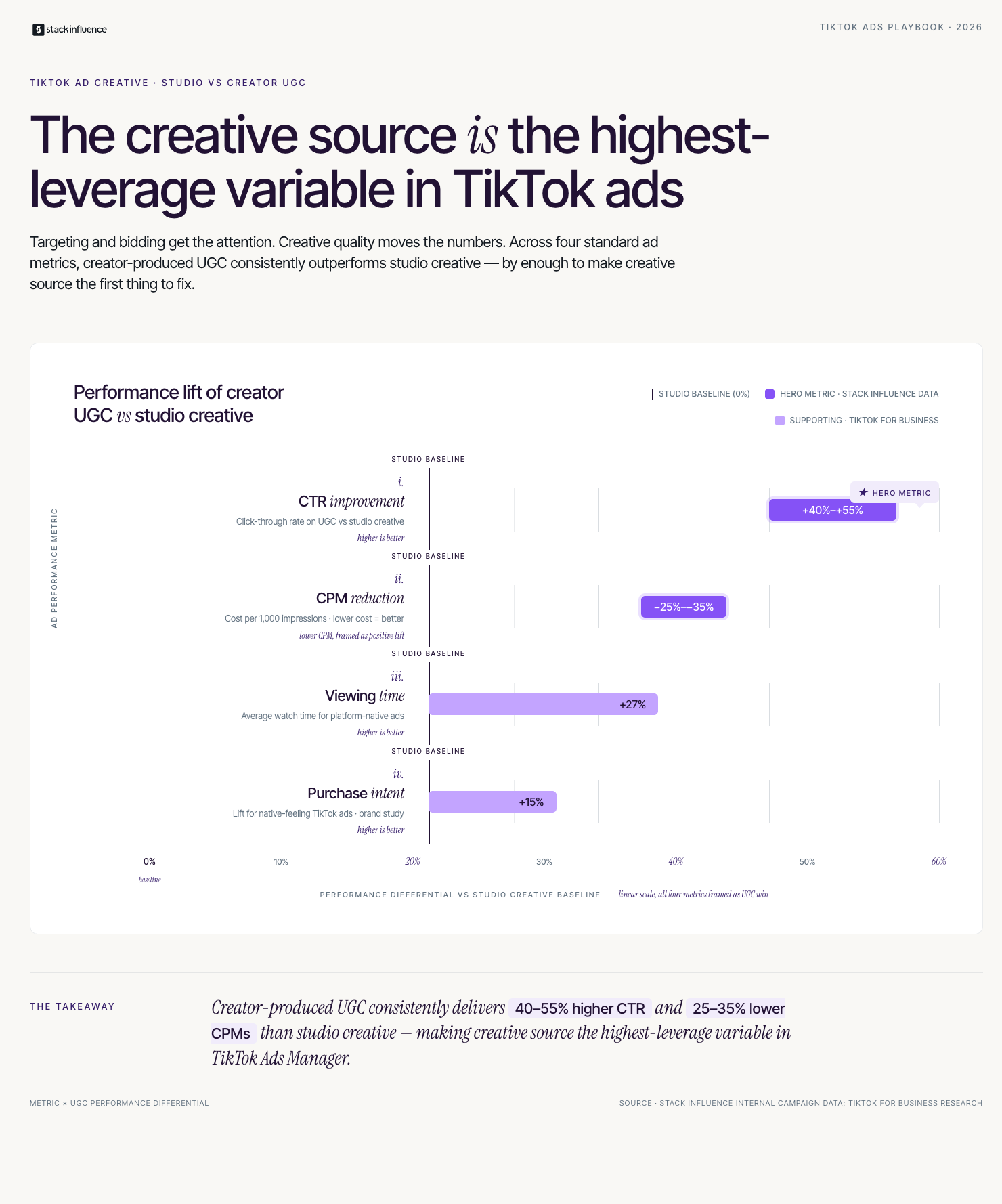
- Creator-produced UGC content used as TikTok ad creative consistently outperforms brand-produced studio creative, generating lower CPMs and higher click-through rates because TikTok's delivery algorithm favors content that resembles native posts.
- TikTok's average CPM runs 20 to 40% below Meta's equivalent formats in most eCommerce categories, creating a cost-efficiency window for brands willing to invest in platform-native creative.
- Spark Ads, which boost existing organic creator posts as paid ads, are the highest-quality ad format available for eCommerce brands because they carry the original post's social proof alongside the paid distribution.
- For Amazon sellers running TikTok ads to Amazon listings, proper attribution setup and the Brand Referral Bonus program together reduce the effective CAC of TikTok-sourced conversions by 8 to 12% of the sale price.
What Is TikTok Ads Manager and How Does It Work?
TikTok Ads Manager is TikTok's centralized self-serve advertising interface, where brands and agencies create campaigns, manage budgets, upload creative, define audiences, and measure performance across TikTok's full advertising inventory. It operates on a structure that will be familiar to Meta Ads Manager users: campaigns sit at the top level containing objective and budget settings, ad groups contain targeting and placement parameters, and individual ads contain the creative assets and destination links.
Access requires creating a TikTok Business Account, which is separate from a personal TikTok account. After account creation, you connect a payment method, install the TikTok Pixel on your website or Shopify store, and configure your conversion events before launching any campaigns. The pixel installation step is non-negotiable: campaigns optimizing for purchase conversions without a properly firing pixel are targeting on incomplete data from day one, which degrades audience quality over time.
The six core ad formats available in TikTok Ads Manager:
- In-Feed Ads: The standard ad format. Appears in the For You Page feed between organic videos. Supports video and image carousel formats. Available for all campaign objectives including traffic, conversions, and app installs.
- Spark Ads: Boosts an existing organic post, either from your own brand account or from a creator who has authorized the boost through the Spark Ads authorization system. The ad retains the original post's likes, comments, and shares, which improves social proof and typically produces stronger engagement rates than standard In-Feed Ads.
- TopView: Full-screen video that appears as the first video a user sees upon opening TikTok. High-impact and high-CPM. Best for brand awareness campaigns rather than direct conversion objectives at most eCommerce budget levels.
- Shopping Ads: Product-specific ad formats tied to your TikTok Shop or a synced product catalog. Includes Video Shopping Ads, LIVE Shopping Ads, and Product Shopping Ads. The most direct path from TikTok ad impression to purchase for eCommerce sellers with TikTok Shop integration.
- Branded Hashtag Challenges: Sponsored hashtag campaigns that invite user participation and content creation around a brand prompt. Primarily a brand-awareness vehicle appropriate for larger brands with significant campaign budgets.
- Branded Effects: Custom AR filters and effects available for use in creator content. Brand-building format at higher investment levels.
For most eCommerce sellers starting with TikTok Ads Manager, In-Feed Ads and Spark Ads are the correct entry formats because they offer the most flexible targeting, the most accessible budget floors, and the strongest direct-response performance data.
How Do You Set Up Your First TikTok Ads Manager Campaign?
Campaign structure in TikTok Ads Manager follows a three-tier hierarchy that determines how your budget is controlled, how your audience is defined, and how your creative is tested. Getting the structure right before spending a dollar prevents the measurement problems that make it impossible to diagnose underperformance later.
The TikTok Campaign Launch Sequence is a five-step framework for eCommerce sellers building their first campaign architecture. Following the sequence in order prevents the three most common setup errors: wrong objective selection, under-segmented audiences, and single-creative campaigns that cannot optimize because the algorithm has no variation to learn from.
The five steps of the TikTok Campaign Launch Sequence are:
- Objective selection: Choose your campaign objective based on your actual conversion goal. For eCommerce sellers with a Shopify store, use Web Conversions with Purchase as the optimization event. For sellers driving traffic to Amazon listings, use Traffic with Landing Page View as the objective, since Amazon's cart does not fire the TikTok Pixel purchase event.
- Audience architecture: Build three audience types before your first campaign launches. A cold audience using interest and behavior targeting for new customer acquisition. A warm retargeting audience of website visitors and TikTok video viewers from the past 30 days. A lookalike audience built from your customer email list or highest-value purchaser segment.
- Ad group segmentation: Separate cold and warm audiences into distinct ad groups within the same campaign. Combined targeting allows the algorithm to serve budget toward the cheapest clicks rather than the most valuable prospects.
- Creative loading: Upload at least three to five creative variations per ad group. Include at least one creator-produced UGC video, one Spark Ad boosting a high-performing organic post, and one static image or carousel variation. The algorithm identifies the best performer within the first 500 impressions per creative.
- Pixel and event verification: Before activating any campaign, confirm your pixel is firing a Purchase event on your thank-you or order confirmation page. Use TikTok's Pixel Helper browser extension to verify event firing in real time.
The TikTok Campaign Launch Sequence is most effective when it is treated as a standing checklist rather than a one-time setup guide. Running through it for every new campaign prevents the structural drift that accumulates in accounts where individual ad groups and audiences are added reactively rather than architecturally.
Why Creator Content Outperforms Brand Ads in TikTok Ads Manager
The single most impactful creative decision eCommerce sellers make in TikTok Ads Manager is the source of their ad creative. Polished brand studio videos with logo intros, professional lighting rigs, and scripted product demonstrations consistently underperform against authentic creator-produced content in TikTok's ad delivery algorithm. Understanding why this happens structurally prevents brands from wasting budget on expensive studio creative that the platform actively penalizes.
TikTok's ad delivery system scores creative quality partly by measuring how similar ad content looks and feels to organic content in the same format. Content that patterns as advertising, because of visual polish cues, branded intros, or unnatural scripting, generates stronger "scroll past" behavior from viewers, which the algorithm reads as low quality and penalizes with higher CPMs. Creator-produced content filmed in real homes, with real people, using natural lighting and authentic reactions, generates engagement signals that suppress CPM and extend distribution.
According to TikTok for Business research, ads that feel native to the platform generate 27% more viewing time and 15% higher purchase intent compared to content that feels like traditional advertising. For eCommerce brands spending $5,000 or more per month on TikTok ads, the difference between a 2% CTR with studio creative and a 3.5% CTR with creator content represents a 75% increase in qualified traffic volume at the same budget.
Three specific creator content types that consistently perform well as TikTok paid ads:
- Organic-feeling product demonstrations: A creator filming themselves using a product in their real kitchen, bathroom, or workout space, with natural light and genuine reaction, outperforms scripted demonstrations in virtually every product category. The authenticity is not a style preference. It is a delivery mechanism that the algorithm rewards.
- Spark Ads from high-performing creator posts: When a creator produces an organic post about your product that generates strong engagement, boosting it as a Spark Ad carries that social proof into paid distribution. Viewers seeing a post with 12,000 likes and 400 comments have a fundamentally different trust response than viewers seeing a standard In-Feed Ad with zero engagement displayed.
- Problem-solution UGC structure: Creator content that opens with a specific problem the viewer recognizes, demonstrates the product as the solution, and ends with a specific outcome generates the strongest hook rate and completion rate of any TikTok ad format. The three-part structure maps naturally to TikTok's content consumption patterns.
Stack Influence's internal campaign data shows that eCommerce brands using creator-produced [UGC video](INTERNAL: UGC video ad creative for TikTok) from product seeding campaigns as their primary TikTok ad creative achieve CPMs 25 to 35% lower than the same brands running studio creative, with click-through rates 40 to 55% higher. The creative source is the variable producing the performance gap, not targeting or budget.
Should You Use TikTok Shop Ads or Drive Traffic Off-Platform?
For eCommerce sellers with a presence on both TikTok Shop and an external storefront such as Shopify or Amazon, TikTok Ads Manager offers two distinct traffic destination models with meaningfully different economics. Choosing the right destination for each campaign type has a direct impact on ROAS and customer acquisition cost.
TikTok Shopping Ads keep the purchase journey within TikTok's native ecosystem, which reduces friction and typically improves conversion rates for impulse-purchase and lower-ticket items. The native checkout experience removes the step of redirecting shoppers to an external site, which is where a significant percentage of mobile traffic drops off. For product categories where familiarity with the brand is low and the purchase decision is quick, TikTok Shop destination ads often produce the strongest direct ROAS.
Off-platform traffic to Shopify or Amazon makes more sense for sellers who need to build customer data ownership, who have higher-ticket products requiring more consideration, or who want to qualify for Amazon's Brand Referral Bonus program on conversion revenue. Key considerations for each model:
- TikTok Shop destination: Higher native conversion rate, no pixel dependency for attribution, qualifies for TikTok Shop commission structures if creator-affiliate content is involved, but limits customer data ownership and email list building.
- Shopify destination: Full pixel-based attribution, email capture capability, complete brand experience control, and the ability to run loyalty and retention programs. Requires a higher-quality landing page and typically a longer consideration cycle for conversion.
- Amazon listing destination: Best for [Amazon sellers](INTERNAL: Amazon seller TikTok ad strategy) who want to leverage the platform's trust signals and Prime delivery expectations. Requires Amazon Attribution link setup before any TikTok traffic is sent to qualify for the Amazon Brand Referral Bonus, which returns 8 to 10% of the sale price as a referral fee credit for qualifying external traffic.
Based on Stack Influence's work with eCommerce brands, Amazon sellers who run TikTok Ads Manager campaigns to Attribution-tagged Amazon listings recover an average of 9% of their referral fees through the Brand Referral Bonus program over a 90-day campaign period, which materially reduces the effective CAC on TikTok-sourced Amazon conversions and improves the platform's net ROAS by a meaningful margin.
Measuring TikTok Ads Manager Performance: The TikTok Revenue Attribution Stack
Most eCommerce sellers evaluate TikTok Ads Manager performance by checking the in-platform ROAS figure and comparing it to their Meta equivalent. That comparison is useful but incomplete, because TikTok's 7-day attribution window, the platform's own conversion tracking limitations, and the different role TikTok plays in a shopper's decision journey mean that in-platform reported ROAS typically understates TikTok's true contribution to revenue.
Use the TikTok Revenue Attribution Stack to evaluate campaign performance at three tiers:
- Tier 1: In-platform metrics. Review CPM, CTR, cost per click, cost per add-to-cart, and reported cost per purchase within TikTok Ads Manager weekly. Use these to diagnose creative efficiency and audience fit. A CPM above $12 in most eCommerce categories suggests a creative or audience relevance problem. A CTR below 1% indicates a hook problem in the first two seconds of your video.
- Tier 2: Off-platform validation. Compare your TikTok ad spend periods to your Shopify or Amazon backend revenue using a pre/post or holdout comparison. Look for revenue lifts that exceed what TikTok's pixel is attributing, because TikTok-driven brand search, direct navigation, and cross-device conversions all appear as organic revenue in your backend but were influenced by TikTok impressions.
- Tier 3: Cross-channel attribution. For sellers running [micro influencer campaigns](INTERNAL: micro influencer TikTok paid amplification guide) alongside their paid TikTok ads, tag all creator content links with UTM parameters and Amazon Attribution tags where applicable. Compare the conversion rates of paid TikTok ad traffic versus organic creator content traffic to the same product page. This comparison reveals whether paid amplification of creator content is more efficient than entirely new ad creative.
According to Hootsuite's social media advertising benchmarks, TikTok's average CTR for In-Feed Ads across industries is approximately 1 to 3%, with eCommerce categories performing at the higher end of that range when creative is optimized. Understanding where your campaigns sit relative to that benchmark gives you a calibrated starting point for creative improvement decisions.
Across campaigns managed on the Stack Influence platform, [brands that work with micro influencers](INTERNAL: brands that work with micro influencers TikTok ads guide) and boost those creators' organic posts as Spark Ads through TikTok Ads Manager see an average ROAS improvement of 30 to 40% compared to running entirely new ad creative, because the pre-existing social proof on the organic post significantly improves the paid ad's engagement quality signal.
What Most TikTok Ads Manager Guides Get Wrong for eCommerce Sellers

Most TikTok Ads Manager guides focus on the mechanical setup: how to create an account, how to install the pixel, how to structure a campaign. That information is necessary but misses the strategic insight that actually determines whether a TikTok advertising investment is profitable for an eCommerce brand: the creative pipeline.
The sustainable TikTok advertising model for eCommerce sellers is not one where the brand's marketing team produces ads. It is one where the brand runs a systematic [product seeding](INTERNAL: product seeding for TikTok ad creative pipeline) operation that continuously generates fresh creator content, that content is tested as organic and Spark Ad creative simultaneously, and the best-performing content informs both future creative briefs and future product development. That model treats TikTok advertising and influencer marketing as a single integrated system rather than two separate budget line items.
Three things most TikTok Ads Manager guides leave out:
- Creative fatigue timelines are faster on TikTok than on Meta: A winning TikTok creative typically peaks and fatigues within three to six weeks, compared to six to twelve weeks on Meta. Sellers who do not have a systematic creative refresh process in place will see CPMs rise and ROAS collapse faster than they can react. A rolling creator seeding program that generates five to ten new content assets per month is the only sustainable solution.
- [Influencer campaigns](INTERNAL: influencer campaign TikTok paid media integration guide) and TikTok Ads Manager work better together than separately: Brands that identify top-performing creator content through organic seeding before investing paid budget behind it are consistently more efficient than brands that create paid ads from scratch. Organic performance data de-risks the paid investment by identifying which content and which product messaging already resonates before money amplifies it.
- The TikTok Shop affiliate and paid ads intersection is underused: For brands selling through TikTok Shop, running paid ads to creator content that also has affiliate links attached means the same video generates both paid traffic conversion and organic affiliate commission attribution simultaneously. Structuring this dual-channel approach requires coordination between the paid and organic campaign managers but produces significantly better blended economics than either channel operated in isolation.
Conclusion
TikTok Ads Manager is a mature, capable paid acquisition channel for eCommerce sellers who are willing to invest in platform-native creative and build a measurement framework that captures TikTok's true contribution to revenue. The TikTok Campaign Launch Sequence gives you the structural foundation. The TikTok Revenue Attribution Stack gives you the measurement discipline to evaluate performance accurately across every sales channel you operate. And the integration of creator content into your paid creative pipeline, through product seeding, Spark Ads, and systematic creative testing, gives you the compounding efficiency advantage that separates brands scaling profitably on TikTok from those stuck in a cycle of expensive studio creative and declining ROAS.
If you are ready to build the creator content pipeline that powers your TikTok Ads Manager campaigns, Stack Influence connects eCommerce brands with micro influencers for product seeding campaigns that generate the authentic ad creative TikTok's algorithm rewards.