



Most guides about TikTok marketing still lead with follower counts and viral trends. That is the wrong starting point in 2026. The creators building consistent income on the platform are treating it as a structured commercial channel, not a lottery. Whether you are posting product reviews, UGC video, or lifestyle content, understanding the mechanics of TikTok marketing is the difference between random engagement and repeatable brand deals. This guide breaks down what TikTok marketing actually is, how to build a strategy around it, and the underrated tactics most creators ignore.
Key Takeaways
- TikTok marketing is a commercial strategy that uses the platform's algorithm, content formats, and creator ecosystem to drive discovery, engagement, and sales.
- Micro influencers and nano influencers on TikTok consistently outperform larger accounts in engagement and conversion rate, making them the preferred tier for most brand partnerships.
- UGC video created for TikTok functions as both organic content and paid ad fuel, giving content creators multiple revenue streams from a single deliverable.
- A structured measurement model beats vanity metrics: track completion rate, click-to-conversion rate, and earned media value rather than just views and likes.
- Product seeding, brand ambassadors programs, and TikTok Spark Ads are the three most scalable formats for creators entering paid brand partnerships.
What Is TikTok Marketing?
TikTok marketing is the practice of using TikTok's short-form video platform to promote products, build audiences, and generate revenue through organic content, paid advertising, and creator partnerships. For content creators, it means understanding how to align what you make with what brands need and what the algorithm rewards. The platform operates as both a discovery engine and a commerce channel, which is a combination no other social platform has perfected to the same degree.
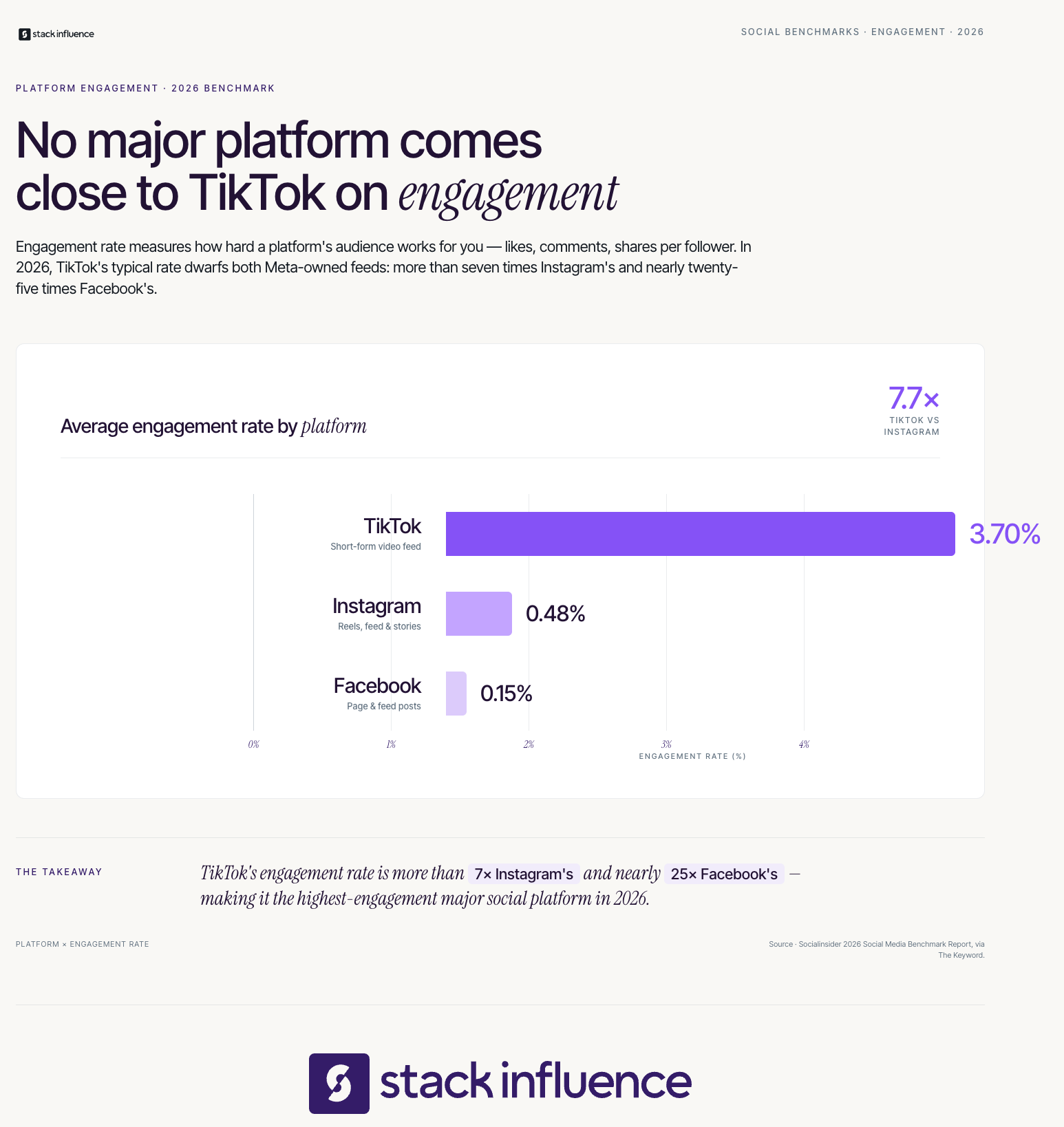
According to Socialinsider's 2026 Social Media Benchmark Report, TikTok's average engagement rate surged 49% year-over-year to 3.70%, more than seven times Instagram's 0.48% and nearly 25 times Facebook's 0.15%. That gap is the single most important number for any creator negotiating a brand deal in 2026. Higher engagement means more eyeballs per post, more signal for the algorithm to distribute your content, and more commercial value per impression delivered to a brand partner.
TikTok marketing covers several distinct activities that creators need to understand separately:
- Organic content strategy: Creating videos optimized for the For You Page (FYP) algorithm to build reach and community without paid spend.
- Brand partnerships and sponsorships: Negotiating with brands for sponsored posts, brand ambassadors deals, and influencer campaigns.
- UGC creation: Producing user-generated content video assets for brands to use in their own paid advertising, particularly TikTok Spark Ads.
- TikTok Shop affiliate marketing: Earning commissions on product sales by tagging products directly in videos or live streams.
- Product seeding: Receiving free products from brands in exchange for honest, organic-style content reviews.
These five categories are not mutually exclusive. Most successful creators layer two or three of them simultaneously, which is exactly how the creator economy has matured in 2026.
Only 26% of marketers currently run TikTok campaigns, creating a major opportunity for brands willing to invest early in educational content, creator partnerships, search-friendly videos, and TikTok Shop. For creators, that gap is a green light. The brands that are early movers on TikTok are actively searching for legitimate creator partnerships, which means now is the right moment to get your strategy in place.
The Creator's TikTok Marketing Playbook (The SPARK Sequence)
Every creator needs a systematic approach to TikTok marketing, not just a collection of tips. The SPARK Sequence is a five-step primary framework for content creators who want to build a sustainable TikTok marketing strategy from the ground up. Reference this sequence when evaluating where your current approach breaks down.
The SPARK Sequence works in this order:
- Signal your niche clearly in your profile, bio, and first three videos. Brands searching for influencer campaigns need to identify your category instantly. A mixed-niche profile creates confusion for both the algorithm and brand discovery tools.
- Produce consistently, not constantly. Intentional posting beats high frequency. Brands on TikTok post a record eight times per week, but those posting fewer than six times per week see 93% higher engagement. Applying this to creator accounts means fewer, better videos outperform a daily posting grind.
- Align your content with commerce signals. This means featuring real products in authentic contexts, linking your TikTok Shop, and using captions that describe genuine problems your content solves. Commerce-signal-heavy content gets prioritized in the algorithm and makes you more discoverable to brands looking for influencers.
- Reach out with data, not just creativity. When pitching brand deals, present your engagement rate, average completion rate, and any click-through or conversion data from prior brand posts. Brands selecting creators in 2026 filter on performance metrics, not aesthetics alone.
- Keep your content rights organized. UGC platforms and brands that work with micro influencers will often want usage rights to your content for paid amplification. Know your licensing terms before signing any deal so your pricing reflects the actual commercial value being extracted.
TikTok Shop crossed $15.1 billion in US sales in 2025, up 68% year-over-year, and global GMV hit $66 billion. By the end of 2026, that number is projected to surpass $112 billion. For creators building a TikTok marketing strategy, this growth is the commercial backdrop that makes every brand deal more valuable. Research from SocialPilot confirms that TikTok Shop is projected to surpass $112 billion in global GMV by the end of 2026, driven by creator-led product discovery at massive scale. Brands that are not yet on TikTok Shop are watching this number and accelerating their creator partnership timelines. That urgency benefits every creator who has the SPARK Sequence in place right now.
The SPARK Sequence is also your audit tool. If your brand deals are stalling or your organic reach has plateaued, run back through each step and identify which one is breaking down. Most creators who plateau are failing at step three: their content does not carry enough commerce signals to attract brand partnerships, even when their engagement rate is solid.
Why Micro and Nano Influencers Win on TikTok
One of the most consequential misunderstandings in TikTok marketing is that bigger accounts get better brand deals. The data does not support this at all in 2026. Brands that work with micro influencers and nano influencers are consistently reporting stronger ROI than campaigns built around larger creators, and the engagement numbers explain why.
Data compiled by Emplicit shows that micro-influencers with fewer than 100K followers on TikTok achieve a 7.50% average engagement rate, more than double the rate of mega-accounts with over 10 million followers. Nano-influencers with 1,000 to 10,000 followers on TikTok have an average engagement rate of 10.3%, according to Influencer Marketing Hub. This is extremely high compared to larger tiers. The high engagement comes from smaller creators having a more direct and personal connection with their audience, which leads to more interactions per follower.
According to WebFX's 2026 TikTok marketing benchmarks, accounts with under 5,000 followers often achieve engagement rates around 4.2%, because TikTok's algorithm favors authentic conversations and niche audiences over large, diluted follower bases. This structural advantage is not going away. The TikTok For You Page algorithm distributes content based on signal quality, not follower count, so a nano influencer in a specific niche can regularly outperform a macro creator in raw reach per post.
From Stack Influence's experience running micro influencer campaigns for eCommerce brands, TikTok campaigns that prioritize nano and micro creators in tightly defined product categories see measurably higher content authenticity scores and lower cost-per-engaged-viewer than campaigns built around larger, generalist creators.
Here is what brands looking for influencers are actually prioritizing in 2026:
- Engagement rate over follower count: A creator with 12,000 followers and a 9% engagement rate is more valuable per impression than one with 200,000 followers at 1.5%.
- Niche authority: Brands in beauty, food, fitness, and personal care want creators who are genuinely embedded in those communities, not general lifestyle pages.
- Content completion rate: Completion rate and average watch time are critical. Videos keeping viewers past the 40 to 60% completion mark gain sustained FYP exposure, while strong retention past 60 seconds drives higher comment rates and algorithmic promotion regardless of video length.
- Track record with brands: Even one or two well-executed product seeding posts in your niche add credibility to your media kit.
Two-thirds of TikTok users appreciate when brands collaborate with a variety of creators, and micro-influencers with 2,000 to 100,000 followers boast conversion rates 22.2 times higher than traditional celebrities. That conversion rate differential is exactly why the influencer marketing platform landscape has shifted toward micro and nano tiers as the default first choice for most eCommerce brand campaigns.
The TikTok Content Signal Stack (Your Measurement Model)
Most creators track the wrong metrics. Views and follower growth feel good but tell brands almost nothing about commercial performance. The TikTok Content Signal Stack is a named measurement model with four defined components that creators should track on every piece of content. Reference this model when building your media kit and when reporting results to a brand after a campaign.
The four components of the TikTok Content Signal Stack are:
- Completion Rate: The percentage of viewers who watch your video to the end. This is the algorithm's primary quality signal. A completion rate above 40% on a video longer than 30 seconds indicates strong content-audience fit and is worth featuring in brand pitches.
- Click-to-Conversion Rate: For affiliate links, TikTok Shop product tags, or promo codes, this is the share of viewers who click and then complete a purchase. This is the metric that separates brands looking for awareness from brands looking for direct sales, and it determines your rate for performance-based brand deals.
- Earned Media Value (EMV): The estimated monetary value of your organic reach if it were purchased through paid advertising. Calculate it by comparing your video's impressions against TikTok's average CPM rates. EMV contextualizes the value of your content in a language brand marketing teams understand immediately.
- Rewatch Rate: The percentage of viewers who play your video more than once. A rewatch rate above 15% is a strong indicator that your content hooks are working. Brands running TikTok Spark Ads specifically look for this signal because it predicts paid performance before they commit budget.
According to Sprout Social's 2025 Influencer Marketing Report, 86% of consumers make at least one influencer-inspired purchase per year, underscoring how creator recommendations translate directly into buying decisions. Tracking the TikTok Content Signal Stack gives you the data infrastructure to prove your role in those purchases to a brand partner. Sprout Pulse Survey data shows 64% of people are more willing to buy when a brand partners with a favorite influencer, highlighting how creator collaborations translate directly into conversion potential.
Across campaigns managed on the Stack Influence platform, creators who presented completion rate and click-to-conversion data alongside standard engagement metrics consistently secured higher per-post rates in follow-up brand negotiations, compared to creators who presented only follower count and total views. The TikTok Content Signal Stack gives your commercial conversation a foundation that most creators never build.
The Underrated Tactic: UGC Video as Your Commercial Engine

Here is the angle most TikTok marketing guides skip entirely: the most scalable income opportunity for creators on TikTok in 2026 is not sponsored posts. It is UGC video creation sold directly to brands as paid ad creative, completely independent of your follower count.
UGC creators are content creators who produce authentic, native-style video assets that brands use in their own TikTok advertising without ever posting through the creator's personal account. A study cited by Influee found that consumers exposed to TikTok UGC creator videos are 97% more likely to buy, and videos using UGC-style content get 28% more interactions than branded content. This is why brands running TikTok Spark Ads are buying UGC video at scale: it performs better than studio-produced creative and costs a fraction of traditional ad production.
A 2023 study of over 1,000 UGC creators found that TikTok was the most popular social media platform, with 54% of UGC creators using it as their main platform, followed by Instagram at 42%. The UGC creator economy has grown dramatically because the demand side (brands) and the supply side (creators with smartphones) finally have platforms connecting them efficiently.
Here is why UGC video is the underrated tactic for creators at every follower tier:
- No minimum follower requirement. Brands paying for UGC deliverables care about video quality and authenticity, not your audience size. A creator with 800 followers can earn the same UGC rate as one with 80,000.
- Multiple revenue streams from one video. A single UGC video can generate a base creation fee, a usage rights fee, and a Spark Ads licensing fee, all from the same 30-second clip.
- Your organic TikTok feed becomes your portfolio. UGC video performance on TikTok is increasingly used by brands as a creative brief signal, meaning your organic content directly influences your eligibility for paid influencer campaigns.
- Product seeding pipelines feed UGC work naturally. When you receive free products through influencer seeding arrangements, the content you create positions you for paid UGC deals with the same brand or in adjacent categories. You can explore how this influencer seeding pipeline works for eCommerce in more depth.
Data from Stack Influence's micro influencer campaigns suggests that creators who actively promote their UGC availability alongside their standard influencer rates increase their total monthly brand revenue by reducing the dead periods between sponsored posts. UGC fills the calendar gaps that performance-based sponsored posts leave open.
As of 2025, 93% of marketers who used UGC said it outperformed traditional branded content. That number is not a coincidence. It reflects a structural shift in how brands think about paid creative: authentic, smartphone-shot video created by real people outperforms expensive production across nearly every performance metric, and TikTok's algorithm specifically rewards content that looks native to the platform.
To access the full landscape of UGC platforms and positioning advice for creators, the top UGC platforms guide is a useful starting point for understanding where to list your services and how to price them correctly.
The Creator Partnership Readiness Audit
Beyond the SPARK Sequence, every creator needs a second framework to self-assess before pitching a brand deal. The Creator Partnership Readiness Audit (CPRA) is a six-item checklist that functions as your pre-pitch diagnostic tool. Run through it before you send any outreach to brands, influencer marketing platforms, or micro influencer agency contacts.
The CPRA checklist:
- Content consistency check: Have you posted at least 12 videos in your chosen niche in the last 60 days? Brands reviewing creator profiles want to see an established pattern, not a burst of activity triggered by their category.
- Engagement baseline confirmed: Do you have documented evidence of at least 3% average engagement across your last 20 posts? Pull this from TikTok Analytics before any pitch, not from memory.
- Disclosure compliance reviewed: Are you familiar with FTC guidelines on sponsored content disclosure for TikTok? Brands are increasingly requiring pre-briefing on disclosure standards before activating creators.
- Rate card prepared: Do you have a one-page document listing your rates for sponsored posts, UGC video with usage rights, and TikTok Spark Ads licensing? Brands that move fast want answers to pricing questions in the first email exchange.
- Content rights position defined: Have you decided whether you will offer six-month, twelve-month, or unlimited usage rights, and at what premium over your base rate? This question comes up in almost every brand negotiation.
- Analytics screenshot ready: Can you provide a screenshot of your TikTok Analytics dashboard covering the last 28 days, including reach, profile visits, and top content? Brands using an influencer marketing agency intermediary will request this as standard documentation.
The CPRA functions as your readiness filter. If you cannot check off all six items, you have a clear action list before your next pitch. That is why 74% of brands are moving budget into creator programs in 2026. The brands are ready and funded. The creators who close deals fastest are the ones who come prepared with data and documentation, not just creative energy.
For creators interested in understanding the broader ecosystem of brand ambassadors programs and affiliate structures, those two formats are increasingly blended in 2026 into long-term performance partnerships that pay better than one-off posts.
How Do You Measure TikTok Marketing Success as a Creator?
Measurement is where most creators leave money on the table. Brands are investing in data-literate creator partners in 2026, and the creators who can speak fluently about their performance metrics are the ones closing retainer deals and long-term brand sponsorships.
Here are the key measurement principles every creator should apply:
- Replace views with Revenue Per Post: Calculate the total affiliate commission, usage fee, or sponsored payment earned per piece of content and divide by the reach that content delivered. This is your creator CPM equivalent and your strongest negotiating data point.
- Track click-through rate on every affiliate or Spark Ads activation: Use UTM parameters in every bio link and TikTok Shop product tag. Even a small dataset of three to five campaigns gives you conversion benchmarks that most of your competitor creators cannot produce.
- Benchmark against platform averages: TikTok's 3.70% engagement rate is more than 7 times Instagram's 0.48% and nearly 25 times Facebook's 0.15%, per Socialinsider's 2026 data. Knowing where you sit relative to platform averages is essential for framing your value to a brand that runs multi-platform campaigns.
- Measure brand halo effects: After a sponsored post goes live, track whether your profile visit rate increases in the 72 hours following publication. An increase confirms that your content drove brand curiosity, not just impressions.
42% of Gen Z consumers turn to TikTok for product discovery. If your content is positioned in a category those consumers actively search, your measurement story extends beyond campaign metrics into the brand's customer acquisition funnel. That narrative repositions you from a content vendor to a customer acquisition partner, which is a fundamentally different pricing conversation.
For creators working with Amazon-selling brands, TikTok marketing measurement also intersects with the Amazon Brand Referral Bonus program, where brands earn a credit on sales driven by external traffic sources including creator referral links. Understanding how that attribution works lets you frame your TikTok content as part of a brand's full-funnel Amazon strategy, making you significantly more valuable than a creator who only speaks in engagement metrics. Brands running TikTok Spark Ads will also want to see completion rate and rewatch rate data from your organic posts before committing to amplification spend.
Should You Work With an Influencer Marketing Platform or Agency?
For creators entering the paid brand partnership space, one of the most practical decisions is whether to source deals independently or through a structured intermediary. Both paths have legitimate use cases, and they are not mutually exclusive.
Going direct to brands works best when you already have an established niche, a documented engagement rate, and a network contact inside the brand's marketing team. Direct relationships offer higher per-post rates and more creative control. The trade-off is that sourcing, negotiating, and managing multiple brand deals is a time-consuming business operation that many creators underestimate.
Influencer marketing platforms and influencer marketing agencies exist to solve the sourcing problem at scale. They match niche micro influencers with brands running active campaigns, handle contract logistics, and often provide brief templates and payment processing. For creators who want consistent deal flow without building a full sales function, platforms are the faster path to predictable income.
A few practical considerations when evaluating platforms:
- Look for platforms that offer UGC placement, not just standard sponsored posts. UGC creators operate under different rate structures and usage rights models, and not all platforms support both content types.
- Prioritize platforms with transparent payment timelines. Ask specifically: how long after content approval does payment process? Industry standard is 30 to 45 days, but some platforms are faster.
- Assess whether the platform supports product seeding campaigns. Product seeding campaigns are an excellent entry point for creators building their portfolio, and automated product seeding workflows can make the logistics seamless for both brand and creator.
Brands achieve an average return of $5.78 for every dollar spent on influencer marketing, with top-performing campaigns reaching $11 to $18 ROI per dollar. That ROI range is why brands are scaling their creator programs aggressively, and why the demand for reliable, data-literate creators on established platforms continues to increase. Creators who position themselves correctly within the influencer marketing platform ecosystem capture a disproportionate share of that brand spend.
Conclusion: TikTok Marketing Is a Skill Set, Not a Shortcut
Understanding what TikTok marketing is marks the starting point, not the finish line. The creators building durable income on the platform are treating TikTok marketing as a structured commercial skill that combines content craft, performance measurement, and brand partnership management. The SPARK Sequence gives you a repeatable system. The Creator Partnership Readiness Audit gives you a pre-pitch quality check. The TikTok Content Signal Stack gives you a measurement language that brand partners actually respect.
The opportunity for content creators in 2026 is genuinely significant. TikTok marketing is still early enough that execution quality matters more than audience size, and the data consistently shows that micro and nano creators at their best outperform larger accounts in every metric that brands care about. Build your system, document your performance, and approach brand partnerships as a data-informed business, not a creative gamble.