



The creator economy trends shaping 2026 are changing what brands buy and how creators earn. Shopping integrations, content licensing, AI tools, and more demanding measurement are expanding the work surrounding a social post. The practical question is which opportunities justify your time and help you build dependable income.
For content creators, the priority is to understand the full deal: what you must produce, where the content can appear, how payment works, and what results you can reasonably influence. Ecommerce sellers benefit from the same clarity because it makes partnerships easier to brief, evaluate, and renew.
These six shifts explain what to watch and how to respond, followed by a worked example for comparing two creator offers.
Key Takeaways
- Growing creator advertising budgets do not guarantee growing income for every creator. Evaluate your own costs, payment terms, and repeat opportunities.
- Shopping content should help someone make a purchase decision. Match the format to the product question your audience needs answered.
- Content production, audience distribution, and advertising permissions are distinct parts of a partnership. Define each before agreeing on compensation.
- Use AI where it improves your workflow, preserve honest product experience, and measure both commercial results and the time required to produce them.
1. Advertising Investment Is Growing, but Earnings Remain Uneven

The opportunity is expanding, but market size is a poor substitute for a personal business plan. In its April 2026 advertising market update, IAB reported that US creator advertising spending reached $37 billion in 2025 and projected $44 billion for 2026. The latter remains a forecast, and both figures measure advertising investment rather than all creator income.
CreatorIQ's State of Creator Compensation report shows why that distinction matters. Its analysis of 2025 direct payments, covering approximately 14,400 creators, reported this distribution:
- The highest-paid 1% received 21% of payment volume.
- The next 9% received 41%.
- The remaining 90% received 38%.
Together, the top 10% received 62%. This describes CreatorIQ's payment dataset, not every creator's earnings or the entire US market.
For a creator, a more useful starting point is your own recent work. Review what you earned, how many hours each assignment required, which expenses you covered, and whether the relationship produced another opportunity. A campaign with an attractive headline payment can become less appealing after extensive revisions or an unexpectedly broad usage request.
For sellers, separate the job you need done from the audience size you want to reach. A product demonstration, a sponsored post, and permission to run advertising are different purchases. Define the work first so creators can quote against the same expectations.
2. Shopping Content Is Becoming a Larger Commercial Opportunity
Creators increasingly have ways to connect product recommendations with shopping. In YouTube's September 2026 Shopping update, the company reported more than 1.3 million affiliate participants and 13 times the Shopping gross merchandise volume of two years earlier. Those are program-level figures; merchandise sales are not creator commissions or profit.
Live demonstrations are another format to consider. In its October 2026 TikTok Shop update, TikTok reported that US LIVE Shopping sales more than doubled in the first half of 2026 compared with the first half of 2025. That aggregate growth does not establish what a particular livestream will earn.
The useful response is to make purchase decisions easier. Start with the question someone needs answered before buying:
- A kitchen creator can show capacity, storage, and cleanup during an actual cooking task.
- A clothing creator can explain fit, movement, and styling using the item they received.
- A home creator can demonstrate installation and identify the space or setup required.
Choose the format around that question. A short video can answer one objection; a longer demonstration can explain several tradeoffs; a livestream can make room for follow-up questions. Treat those as creative options to test, not a universal ranking of formats.
Before accepting an affiliate offer, check the eligible products, commission basis, attribution window, cancellations, and payment timing. Before a seller recruits creators, check stock, product information, and the destination page. Content cannot resolve an unavailable product or an unclear offer.
3. Creator Content Is Being Bought for Use Beyond the Original Post
A brand may want your video for its advertising, website, or other channels as well as your audience. CreatorIQ's State of Creator Marketing 2026-2027 found that 99% of surveyed brands repurposed creator content. The July-August 2026 study surveyed 2,000 decision makers across nine countries, including 1,036 brand respondents, so this is a survey finding rather than a census of ecommerce sellers.
Paid distribution can also use a creator's identity. Meta's explanation of Instagram Partnership Ads describes advertising that amplifies content using a creator's or another partner's handle.
That creates a practical distinction between making the content, publishing it, and authorizing its further use. Before production, record:
- Deliverables: The videos, photos, versions, and revisions included.
- Destinations: The specific advertising and owned channels permitted.
- Duration and territory: Where the permission applies and when it ends.
- Edits and identity: Whether the brand can change the footage or advertise using your account identity.
- Renewal: How either side requests additional use and agrees on compensation.
A creator can present these as separate parts of an offer without pretending there is one universal licensing rate. A seller can request the uses the campaign actually needs and budget for them before production starts.
For example, an organic product demonstration and a package containing that demonstration plus paid advertising permission should have visibly different scopes, even if the parties ultimately agree on one combined price. Stack Influence's guide to UGC licensing rights provides a deeper checklist for that discussion.
4. AI Is Becoming Part of Production, With Judgment Still Required
AI adoption is already visible in creator workflows. In CreatorIQ and Influencers.club's 2026 State of Creators survey, 72% of respondents said they had used AI tools to support their work. The survey included 5,095 creators across 100 countries and was fielded from May 29 to June 29, 2026.
Adoption alone does not tell you which tools improve your work. Choose a repetitive task, such as organizing notes, drafting caption alternatives, or preparing an edit outline. Compare the time saved with the time spent correcting the output, then keep the tool only if the complete process improves.
Preserve the evidence behind product claims. An AI-generated script should not introduce a feature you have not verified, invent your experience, or turn a modest observation into a promised result. For a seller, provide accurate product information and identify claims requiring approval before the creator drafts.
Platform disclosure rules also distinguish types of AI use. YouTube's guidance on disclosing GenAI content lists outlines and captions among examples of production assistance that do not require its AI disclosure, while realistic generated or altered scenes can require disclosure. Check the actual content against the platform's guidance rather than assuming every use of AI is treated alike.
For collaborations, agree in advance on synthetic voices, altered likenesses, and generated demonstrations. The creator and seller should both know what viewers will actually see.
5. Income Stability Is a Central Partnership Question
The need for consistent work remains clear. The same 2026 creator research identified a lack of consistent brand deals as the leading reported barrier to growing a creator business. That supports taking repeat opportunities seriously; it does not establish that every creator should pursue a retainer.
Start with a follow-up that serves the audience. After an initial product demonstration, propose content addressing actual questions, showing a different use case, or revisiting the product after more experience. Give the seller a specific reason for another collaboration and a clear description of the additional work.
Renewal should remain a decision. Review communication, production effort, audience response, payment reliability, and whether the product still belongs in your content. Repeating an unsuitable partnership simply repeats its costs.
It can also help to develop income sources with different dependencies. A creator might combine commissioned content with selected affiliate offers, an audience-supported resource, or a service. Choose an addition that fits demonstrated audience demand and your available time; launching several unfamiliar offers at once creates more work before it creates revenue.
An opt-in email list or another direct communication channel can support those relationships. Give people a specific reason to subscribe, such as useful category guidance, and maintain a schedule you can sustain.
For ecommerce sellers, continuity starts with a credible next assignment. Share what the first campaign taught you, explain the next objective, and give the creator room to propose how to achieve it.
6. Measurement Is Following Content Into Commerce and Paid Media
The expansion of creator work makes a single success metric less useful. In CreatorIQ's 2026 brand and agency findings, brands ranked revenue or sales attribution as the most effective way to demonstrate business impact, while agencies ranked affiliate or social commerce tracking first.
Use that as a reason to agree on the report before starting, rather than assuming every partnership should be paid only on sales. Record three things:
- The promised work: What must be delivered, published, and approved, including deadlines and revisions.
- The intended outcome: Audience response, usable creative, eligible orders, or another specific objective.
- The evidence: Where results come from, the measurement window, the attribution rules, and who supplies the information.
For sales activity, distinguish orders placed from orders that remain commission-eligible after cancellations or returns. For advertising, distinguish results achieved through paid distribution from organic response. For a content-production assignment, evaluate whether the assets meet the agreed use, even when the creator does not control the advertising budget or landing page.
Attributed sales show which activity received credit under a tracking system. They do not, by themselves, establish how many purchases would have happened without it. Sellers should avoid presenting attributed revenue as incremental profit, and creators should describe exactly what their screenshots measure.
Close each assignment with a short record of the content, results, costs, working time, and unanswered questions. That gives both sides a more useful basis for renewal than a collection of disconnected reach and revenue numbers.
Compare the Economics Before Accepting a Creator Offer
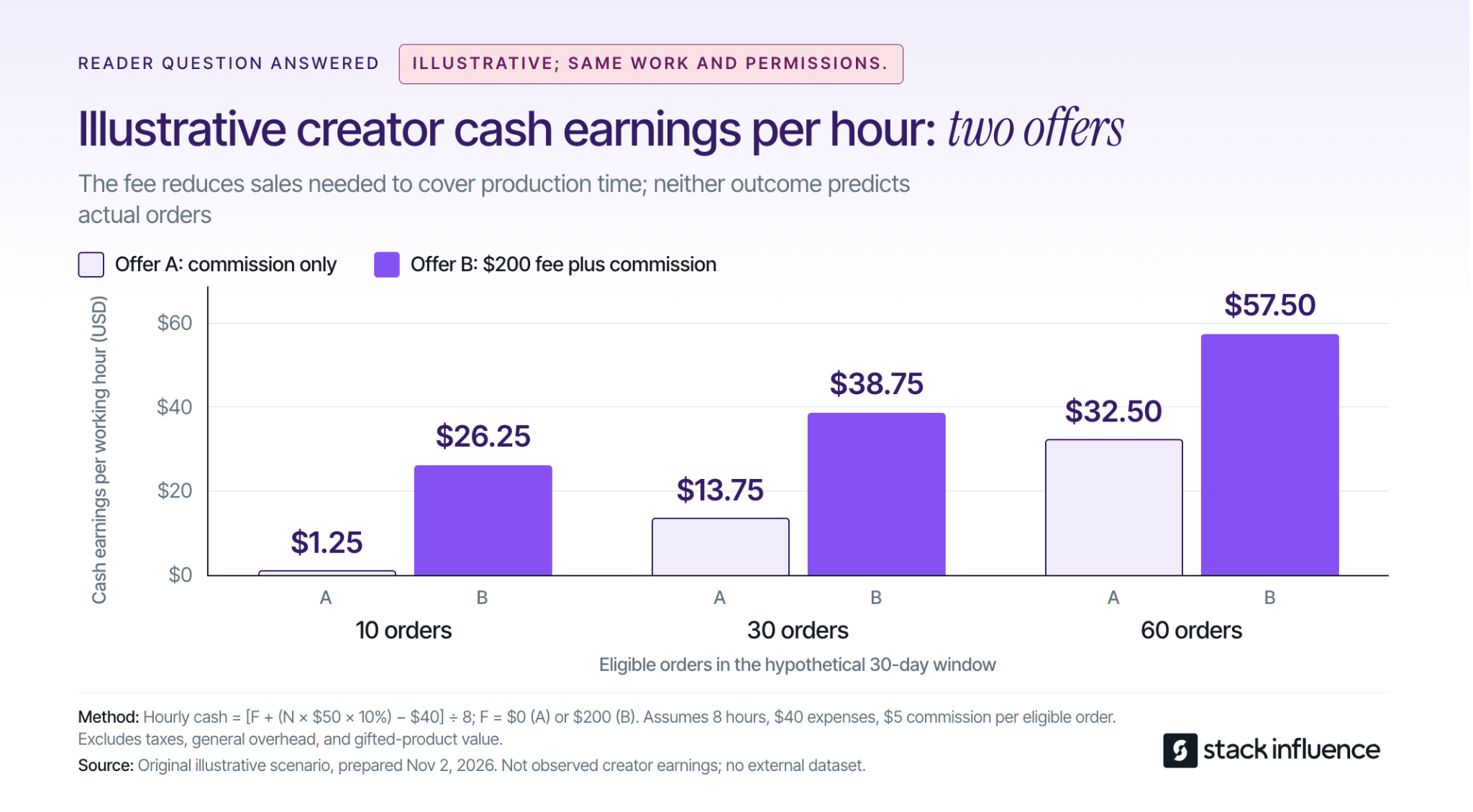
These trends become useful when they change a real decision. Consider two hypothetical offers for the same video and the same usage permissions. This is an illustrative calculation, not a rate recommendation, platform benchmark, or Stack Influence campaign result.
Assume the assignment takes eight hours, including planning, production, revisions, and reporting, with $40 in unreimbursed production expenses. Each eligible order contains $50 of commissionable product sales, excluding tax and shipping, and pays a 10% commission, or $5. Compare 10, 30, and 60 eligible orders within the same 30-day measurement window, after cancellations and returns.
Offer A pays commission only. Offer B adds a guaranteed $200 production fee to the same commission. Assume all agreed payments are collected, there are no additional platform or payment fees, and the work requires no other cash expenses. The calculation excludes income taxes, general business overhead, and the personal value of any gifted product.
Cash earnings per working hour equal: (fixed fee + eligible orders × $5 - $40) ÷ eight hours.
- At 10 eligible orders, Offer A produces $1.25 per hour and Offer B produces $26.25 per hour.
- At 30 eligible orders, Offer A produces $13.75 per hour and Offer B produces $38.75 per hour.
- At 60 eligible orders, Offer A produces $32.50 per hour and Offer B produces $57.50 per hour.
For example, 30 orders generate $150 in commissions. After the $40 expense, Offer A leaves $110; adding the $200 fee leaves $310 under Offer B. Dividing each by eight hours produces the hourly figures above.
Under these assumptions, reaching a $25 hourly target requires 48 eligible orders with Offer A or eight with Offer B. The agreed fee makes less of the compensation depend on sales performance. This is cash remaining after the specified expense, not take-home pay or fully costed business profit.
A real comparison must also account for scope. If the higher fee brings extra revisions, longer exclusivity, or broader advertising rights, update the hours, expenses, and terms before deciding. For sellers, evaluate the fee and commission against product margins and campaign objectives; the creator's earnings calculation does not establish seller profitability.
Put the Trends to Work Over the Next 30 Days
Choose one improvement that addresses a weakness in your current work. A creator who already receives offers may benefit most from clearer permissions or better economics. Someone building a portfolio may need a stronger demonstration of product understanding.
During the first week, review recent assignments or sample content. Identify the audience question you answer well, the time the work requires, and the commercial role it could serve.
During the second week, prepare one clearly scoped offer. State the content, publication expectations, permissions, revisions, payment structure, and reporting responsibilities. Sellers can use the same exercise to improve a campaign brief.
During the remaining weeks, test the offer on a manageable scale and record what happens. Continue based on the quality of the work and the economics, not solely on a jump in views.
Where Product Seeding Fits
Product seeding can provide product experience and portfolio material when the item and assignment fit your interests. Stack Influence's guide to influencer seeding explains why an unsolicited gift and a defined product-for-content arrangement involve different expectations.
Through Stack Influence's creator program, creators can explore product collaborations with a purchase-and-post workflow. Its automated product-seeding process describes post verification and reimbursement. Review the individual campaign's requirements, expenses, and permissions before accepting, and distinguish reimbursement from an additional cash fee for your work.
Disclosure still matters when compensation includes a product. The FTC's guidance for social media influencers explains that free or discounted products can create a material connection that should be disclosed clearly with the endorsement. A social content assignment should also remain distinct from any marketplace customer review.
Choose the Opportunity You Can Deliver Well
The most useful response to the creator economy in 2026 is a more deliberate working model. Choose relevant products, define what the brand is buying, preserve honest experience, and measure the cash and time involved. Then use the results to decide which formats, income sources, and relationships deserve another investment.