



A DTC brand marketing strategy connects three decisions: why someone should buy, how you will reach that person, and how much you can spend to win their business. Start with a specific customer problem and an offer that can support its acquisition costs. Then connect discovery, product education, checkout, and follow-up around the same promise.
For ecommerce sellers, the practical goal is a repeatable way to attract suitable customers and serve them well. The plan below shows how to build that system, evaluate offers, and sequence the first 90 days.
Key Takeaways
- Choose a customer problem and a reason to buy directly before selecting marketing channels.
- Calculate acquisition capacity after discounts and variable costs. A small price reduction can remove a much larger share of that capacity.
- Give creator content a specific job, such as demonstrating use or answering a purchase objection, and match the landing page to that job.
- Evaluate repeat purchases using equally aged customer groups. Recovering acquisition costs does not necessarily leave enough contribution for overhead and profit.
Start With a Customer Problem and a Reason to Buy Direct
Define the buying situation you want to serve. A description such as “health-conscious adults” gives a creative team little direction. “Office workers who want a convenient afternoon snack without keeping several bulky packages at their desk” identifies a situation, an alternative, and a possible reason to choose your product.
Shopify's marketing-plan guidance recommends defining your message, understanding customers, choosing suitable tactics, and setting measurable goals. Put that sequence into practice by reviewing customer questions, purchase feedback, support conversations, and the alternatives shoppers consider.
For a new brand, interview prospective buyers and treat your initial positioning as a hypothesis. For an established store, compare what repeat customers value with the reasons first-time buyers hesitate.
Write down five decisions:
- Customer: Who experiences the problem, and when does it arise?
- Product: Which product or bundle addresses that situation?
- Promise: What useful outcome can you substantiate?
- Proof: What demonstration, specification, or genuine customer experience supports it?
- Reason to buy direct: Why should someone buy from your website?
That last answer might be a useful bundle, customization, product guidance, or replenishment convenience. Choose something your operations can deliver consistently.
For example, a hypothetical refillable-cleaning brand could target apartment dwellers with limited storage. Its initial offer could combine a reusable bottle with compact refills, while its content demonstrates mixing and storage. “Less cupboard clutter” becomes a concrete message to test, without claiming that every shopper values sustainability or that every refill product performs identically.
Check What Your Offer Leaves for Customer Acquisition
Set an acquisition limit before committing to a promotional offer. For this plan, first-order contribution before acquisition means product revenue after discounts, less the variable costs of fulfilling that order and the expected cost of refunds and returns.
Customer acquisition cost, or CAC, divides acquisition spending by new paying customers. Decide which costs you include, such as media, creator campaigns, production, and acquisition staff time, and use that scope consistently. Stack Influence's guide to calculating customer acquisition cost explains those cost and customer boundaries in more detail.
What a 10% Discount Does to the Acquisition Budget
Consider an illustrative first order with $80 in product revenue, excluding sales tax and customer shipping payments. Assume these variable costs:
- Product cost: $24.
- Fulfillment: $7.
- Delivery expense after customer shipping payments: $6.
- Payment processing: $3.
- Net expected refund and return allowance: $4.
The costs total $44, leaving $36 before acquisition. The refund allowance is deducted once; the starting revenue has not already been reduced by that allowance.
Suppose you want to retain $8 per first order after acquisition to help cover fixed overhead and profit. Your allowable acquisition cost is $80 − $44 − $8 = $28.
Now apply a 10% discount. Revenue falls to $72. Holding the same $44 in costs constant, allowable acquisition cost becomes $72 − $44 − $8 = $20.
The offer comparison is:
- Full price: $80 revenue, $36 contribution before acquisition, and a $28 acquisition ceiling.
- With 10% off: $72 revenue, $28 contribution before acquisition, and a $20 acquisition ceiling.
A 10% price discount therefore reduces acquisition capacity by $8, or approximately 28.6%. These are hypothetical amounts, not ecommerce benchmarks; processing and return costs are deliberately held constant to isolate the discount's effect.
A discount could still work if it changes conversion, actual CAC, or subsequent purchasing enough to compensate. Evaluate those outcomes against the revised ceiling. If your dashboard reports media-only CAC, leave room within the ceiling for the other acquisition expenses.
Also model bundles, shipping incentives, and added services using their actual costs. A higher order value is useful only when the contribution and buying experience justify the change.
Choose Channels According to the Buying Task
Give each channel a specific responsibility, then select a manageable initial combination. For a small team, one principal acquisition test, a matching landing page, and a relevant email follow-up sequence provide a focused starting point.
Capture Existing Demand
Prioritize search when customers already describe the problem or product category clearly. Build product pages and supporting content around the questions that determine a purchase, such as compatibility, ingredients, dimensions, setup, or comparisons with alternatives.
For eligible products, Google's free-listing guidance explains how product information can appear across Google. Participation does not guarantee display, and product data, shipping information, return policies, and applicable requirements need attention.
Paid search can become a controlled test of specific buying queries. Separate branded searches from broader category searches when interpreting performance, because the customer starting points differ.
Demonstrate a Product People Need to See
Consider social content and creator partnerships when showing the product resolves a question more effectively than describing it. The cleaning-brand example could test a mixing demonstration, a storage comparison, and a realistic cleaning routine.
Choose the placement based on where relevant customers engage and what your team can produce consistently. Set the audience, creative question, destination, and spending limit before launch.
Support the Next Decision
Use permission-based email to continue a useful conversation: explain product selection, answer a common objection, help someone use their purchase, or offer replenishment at an appropriate time.
Budget for content production, creator participation, product costs, tracking, and follow-up alongside media. Record an owner and a success measure for each activity so an attractive channel does not become an unsupported commitment.
Turn Creator Content Into Specific Buying Evidence
Write creator briefs around the questions shoppers need answered. For the hypothetical cleaning product, “show how the refill dissolves and where you store the remaining packs” gives the creator a useful task. A request to “make an authentic viral video” gives little direction.
Select micro influencers or nano influencers whose content and product use fit the situation. Follower count alone does not establish that fit.
A practical brief should identify:
- The real use case and the question the content should answer.
- Product instructions and claims the brand can substantiate.
- Agreed deliverables, timing, compensation, and disclosure expectations.
- Proposed reuse placements, duration, editing permissions, and advertising permissions.
Keep genuine experience central. The FTC's disclosure guidance for social media influencers explains that free or discounted products can create a relationship that needs disclosure. It also says disclosures should accompany the endorsement and be difficult to miss.
Stack Influence's automated product-seeding workflow supports campaigns in which creators purchase products and receive reimbursement after verified social posts. The platform supports creator sourcing, coordination, and completed-post accountability. Confirm campaign costs, product requirements, and content permissions when planning your specific program.
Track completed content and customer acquisition separately. Exclude reimbursed creator purchases from the new customers you count when evaluating audience acquisition.
For implementation details, the Shopify creator-seeding pilot guide covers inventory, agreements, content permissions, and measurement. Use the resulting content where it answers a buying question and where the agreed permissions allow.
Make the Store Continue the Same Promise
Send visitors to a page that develops the message they just saw. A demonstration about compact storage should lead to clear information about pack dimensions, included components, preparation, and the space the product occupies.
Review the purchase path on a phone. A prospective customer should be able to understand what they receive, the total expected cost, delivery information, and important limitations before committing.
Use a short diagnostic sequence:
- Weak engagement: Revisit the audience, opening message, and demonstration.
- Visits without meaningful product interaction: Check the match between the promotion and destination.
- Product interest without purchase: Investigate unanswered questions, total cost, delivery, usability, and payment friction.
- Purchases followed by avoidable returns: Review product expectations, instructions, and fulfillment.
These are investigative starting points, not proof of a particular cause. Customer feedback and direct inspection should determine the next change.
When traffic permits, test one substantial change at a time. If you change the price, page, audience, and creative simultaneously, it becomes difficult to understand which change affected the result.
Build Retention Around Use, Then Test the Economics
Plan what happens after delivery before increasing acquisition spend. Help customers get the intended value from the product, resolve problems, and identify the next purchase only when it makes sense.
For a consumable, that could mean setup instructions followed by a replenishment message based on actual usage. For a durable product, useful follow-up might involve care, accessories, or referrals. A subscription or recurring discount should solve a real customer need.
Compare Customers at the Same Age
Group customers by when they first purchased and follow their subsequent orders. Shopify's customer cohort analysis documentation describes grouping customers by first-order date and examining repeat purchasing over later intervals.
Compare cohorts at the same elapsed time after acquisition. Add order costs and acquisition costs separately to evaluate contribution; customer spending alone is not profit.
For each cohort, track new customers, first-order contribution, acquisition spending, repeat-order contribution, and refunds. Define a 90-day repeat-purchaser rate as the share of the original customers who make at least one additional purchase within 90 days of their first order.
Distinguish Cost Recovery From Your Contribution Target
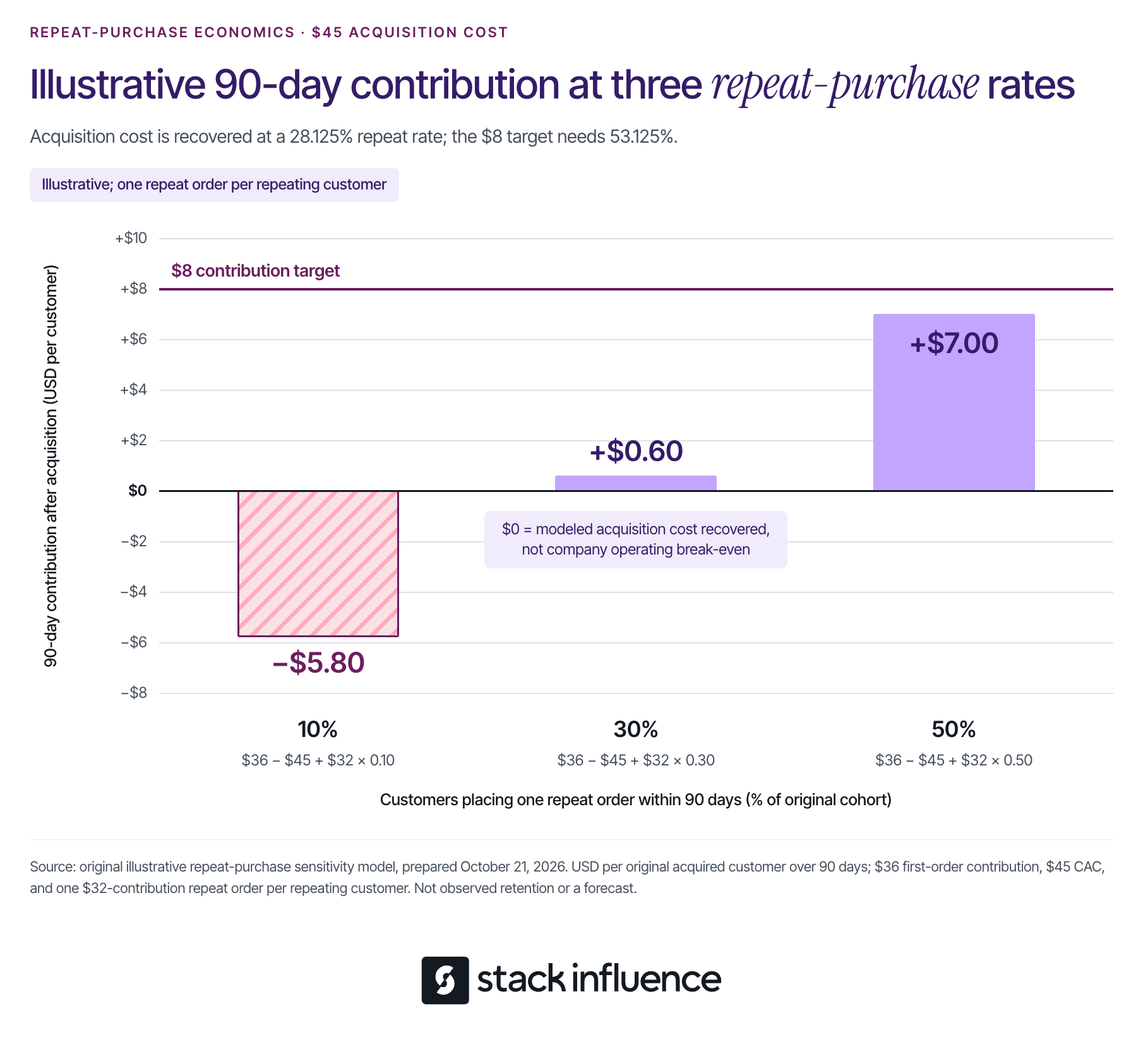
Return to the full-price example, but suppose a separate acquisition test costs $45 per new customer. First-order contribution is still $36, so acquisition initially exceeds that contribution by $9.
For this illustrative sensitivity analysis, assume every repeating customer places exactly one additional order within 90 days. That order contributes $32 after its variable costs, discounts, and incremental retention expenses; customers who do not repeat contribute no additional amount.
Average 90-day contribution after acquisition per original customer equals $36 − 45+(32 × repeat-purchaser rate).
The outcomes are:
- At a 10% repeat-purchaser rate: −$5.80 per acquired customer.
- At a 30% rate: $0.60 per acquired customer.
- At a 50% rate: $7.00 per acquired customer.
The model recovers acquisition costs at a 28.125% repeat-purchaser rate. Retaining the earlier 8contributiontargetrequires53.125%,because(45 + $8 − $36) ÷ $32 = 53.125%.
Even the 50% scenario misses that target. Positive contribution after acquisition can still be insufficient to cover fixed overhead and the desired profit.
These scenarios are neither forecasts nor industry targets. Replace them with completed cohort observations, account for additional orders and costs, and check the cash needed while waiting for repeat purchases.
Put the Strategy Into a 90-Day Operating Plan
Use the following schedule as an implementation sequence. It is not a deadline for proving profitability or observing every customer's full purchase cycle.
Days 1–14: Define the Offer and Prepare the Journey
Choose the customer problem, hero product, reason to buy direct, and initial message. Calculate the contribution target and acquisition ceiling, set a maximum test budget, and protect the inventory and cash required for existing commitments.
Prepare the landing page, creator brief where relevant, and post-purchase instructions. Agree on campaign naming and customer definitions, and verify that purchase tracking works.
Days 15–45: Run a Contained Test
Launch the principal acquisition test and review the complete journey. Document the creative, audience, offer, costs, customer count, and observation window.
Use an explicit decision rule: continue when the evidence supports the economics; revise when a specific problem is identifiable; pause when the agreed loss limit is reached. A few purchases are a reason to keep learning, not sufficient evidence for a major expansion.

Days 46–90: Improve and Decide What to Expand
Resolve the most important buying or product-experience problem, then assess the revised offer. Review available customer cohorts at equal ages and retain the same cost definitions.
Shopify's marketing attribution documentation explains that its any-click model can allocate more credit than the number of orders received. Reconcile actual store orders and costs instead of adding overlapping attributed results together.
Customers acquired during this plan will not all have 90 days of history by day 90. Mark incomplete cohorts clearly and continue observing them before using long-term contribution to justify a higher acquisition ceiling.
Choose the Next Action From the Evidence
A useful DTC brand marketing strategy produces a clear next decision. Improve an offer that cannot support acquisition, strengthen content that leaves the buying question unanswered, or repair an experience that discourages customers from returning.
Begin with one complete customer journey. Expand the parts that show credible progress toward your contribution and customer-experience goals, with enough cash and operational capacity to support the next test.