




Choose product sampling companies by the result you need: published creator content, customer reviews on an eligible destination, product trial, or structured feedback. The useful starting point is a partner whose recruitment, product delivery, and follow-up process match that result.
For ecommerce sellers, this guide compares six options and explains how to evaluate completion, costs, and measurement. Content creators can use the participation guidance to understand the work, expenses, and permissions attached to an offer.
Key Takeaways
- Match the provider to your main output: social posts, permitted customer reviews, consumer trial, or product research.
- Confirm how products reach participants, who pays initially, and what counts as a completed deliverable.
- Track invitations, product receipt, completed feedback, and later purchases separately. Each answers a different question.
- Agree on honest feedback, disclosure, content permissions, and destination-specific review rules before launching or accepting a campaign.
Six Product Sampling Companies to Compare
Stack Influence publishes this guide and appears first because of that relationship. This is a comparison of public product and help documentation, with no independent scoring or hands-on testing.
The shortlist covers documented workflows relevant to U.S. ecommerce brands, including brands that also sell through physical retailers. Selection focuses on the intended output, product-delivery process, participant task, and requirements to confirm. Event-staffing agencies and general creator-search databases fall outside this comparison's scope.
Stack Influence
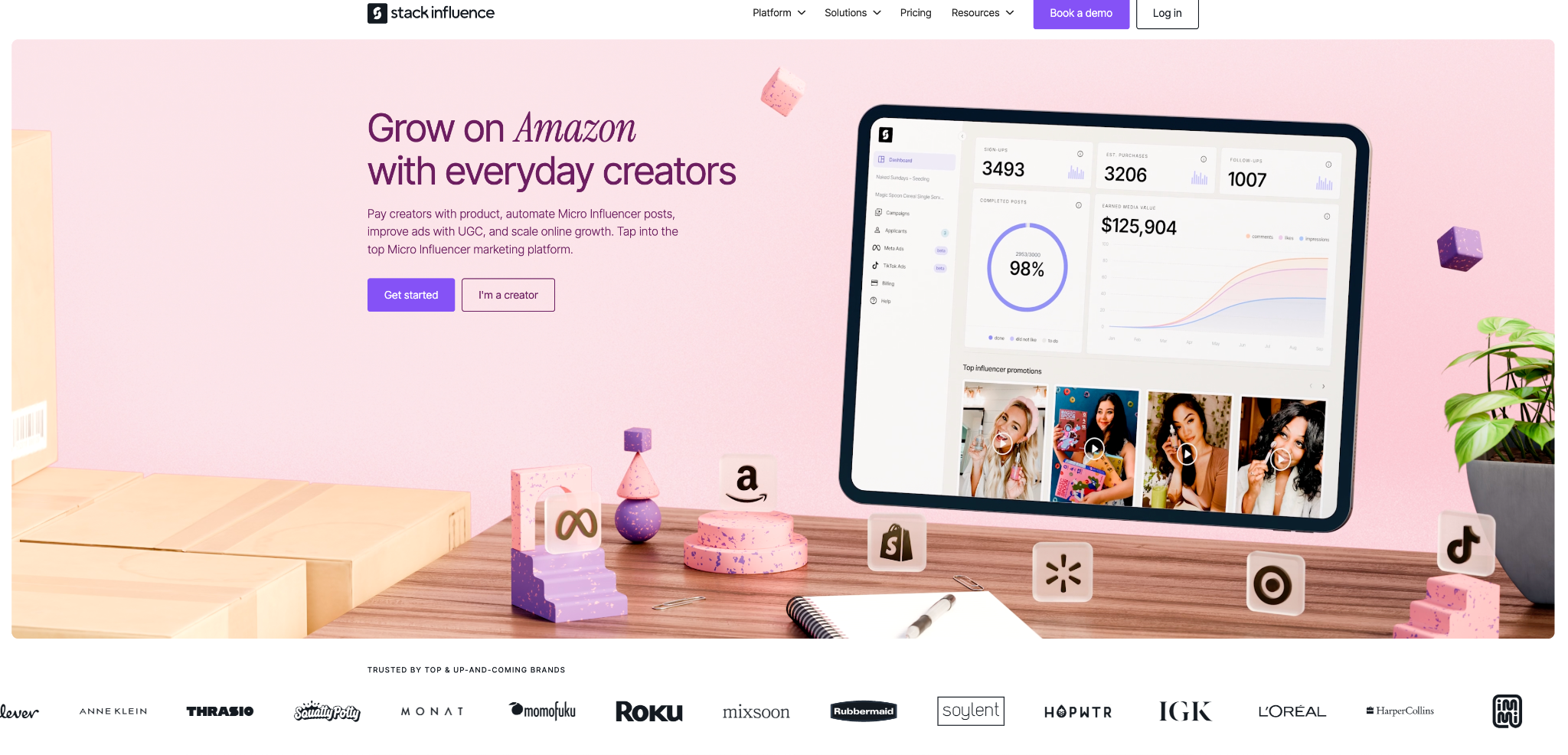
Stack Influence coordinates creator sourcing, product seeding, campaign communication, and social-post completion through its automated product seeding service. Its published product reimbursement process has creators purchase a product, complete their social promotion, and receive reimbursement after the submitted post is approved.
- Primary use: Ecommerce brands seeking managed creator participation and published social content.
- What to know: The creator initially funds the purchase. Confirm the required post, approval process, reimbursable expenses, service charges, and content permissions in the campaign terms. Post-completion accountability does not mean every campaign expense is charged only after a post.
Evaluate this workflow when coordinating product experience and creator publishing is the work you want managed. Define any reusable content or advertising permissions explicitly.
Bazaarvoice
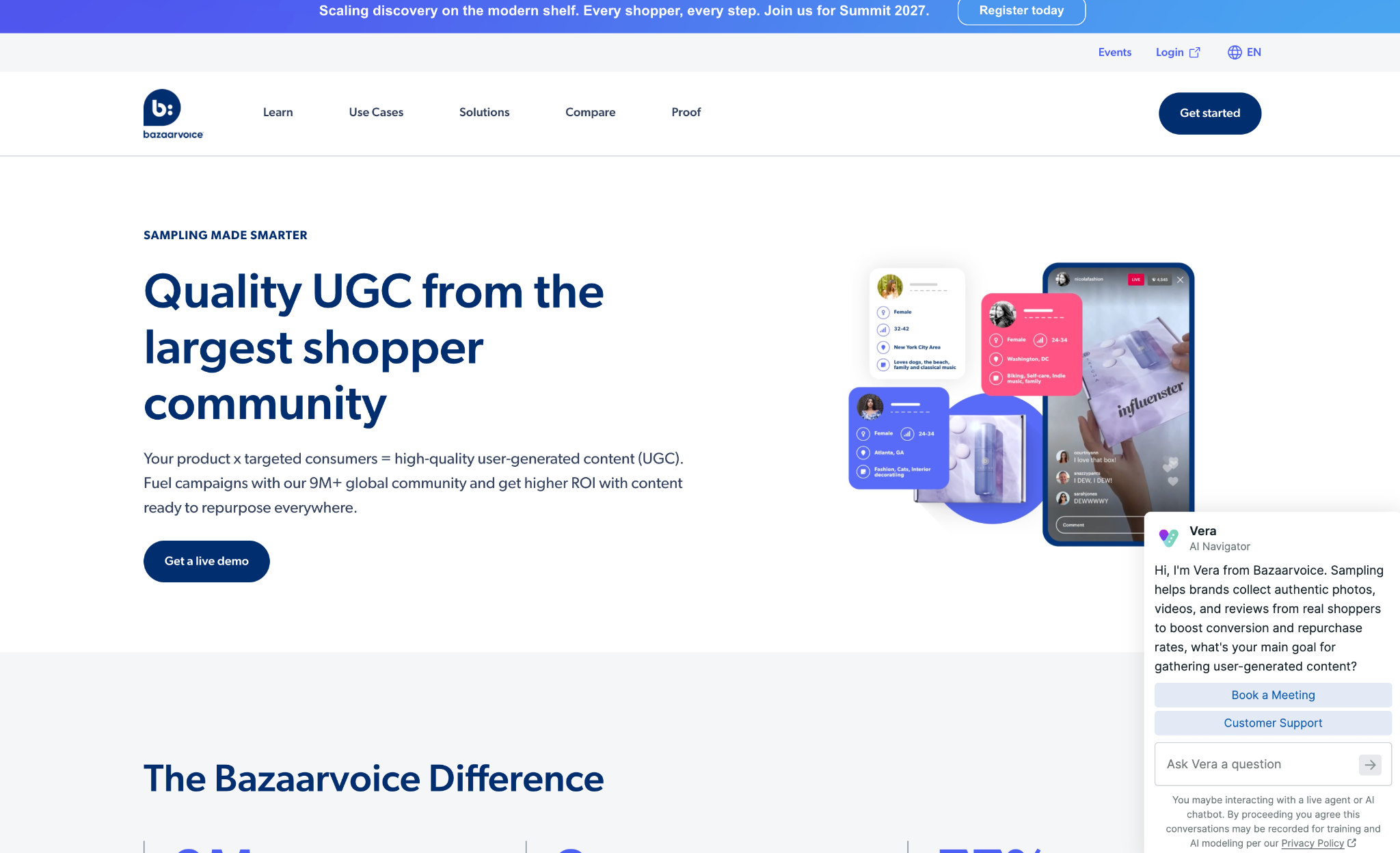
Bazaarvoice Sampling connects brands with its Influenster community to collect reviews, photos, videos, and social content. Its sampling documentation describes both brand-managed shipping and purchasable fulfillment services, along with review distribution to supported destinations.
- Primary use: Brands building product-page review coverage or collecting consumer content for specified channels.
- What to know: Identify the exact review destinations, required product identifiers, content tasks, and fulfillment owner. Retail syndication depends on product matching and other publishing requirements; it should not be treated as universal marketplace coverage.
This is worth evaluating when the destination of the review matters as much as obtaining it. Ask the team to demonstrate the path from a participant's submission to your specific product page.
PowerReviews and BzzAgent
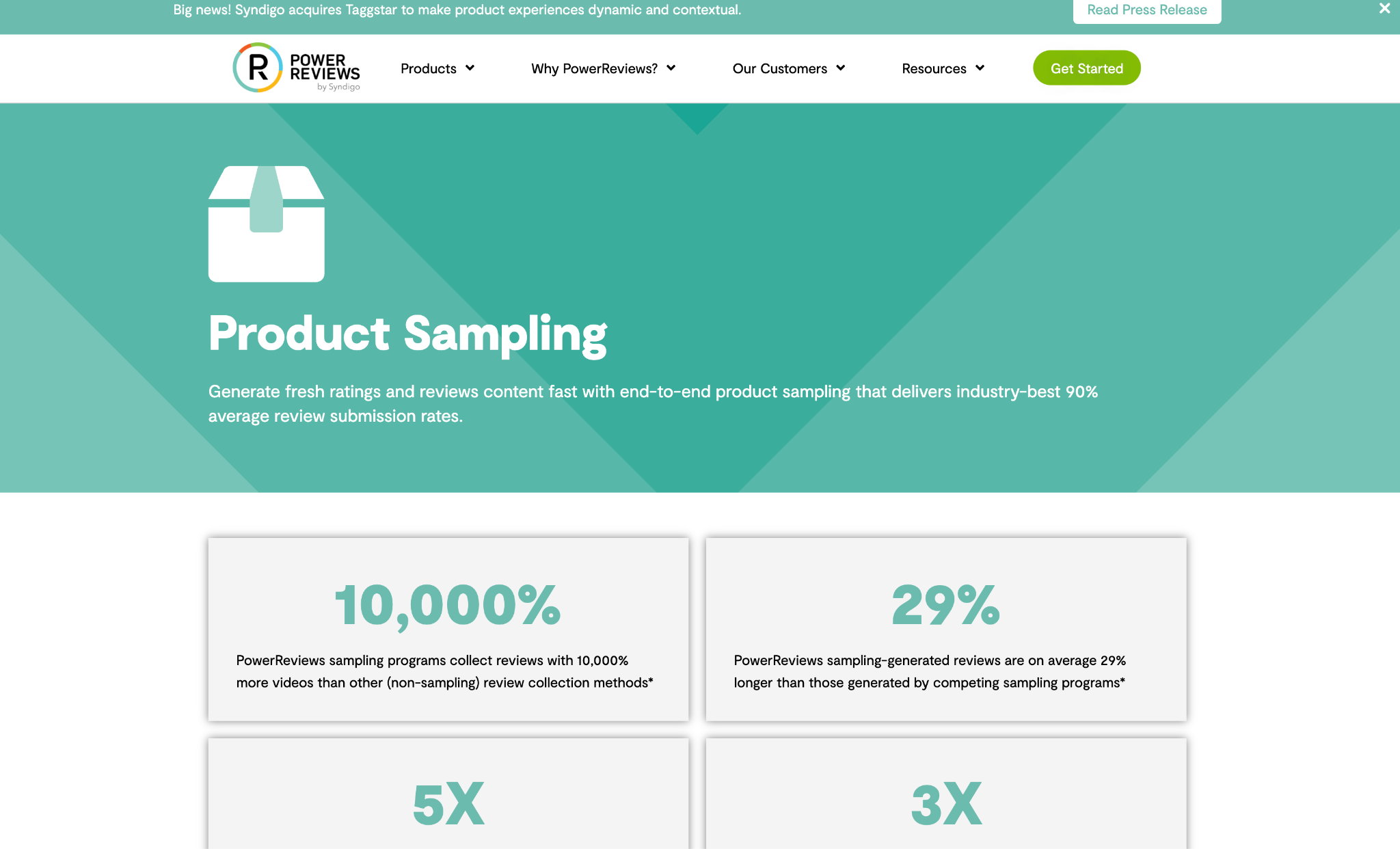
PowerReviews Product Sampling uses its BzzAgent consumer community for managed sampling. The documented service includes audience development, shipment coordination, participant follow-up, and reporting on reviews and visual content.
- Primary use: Brands seeking a managed process for collecting product ratings, written reviews, and supporting photos or videos.
- What to know: Specify where content must appear and which formats, fulfillment services, and permissions the proposal covers. BzzAgent is the participant community associated with this service, so do not count it as a separate unrelated vendor.
Ask for a sample campaign report that distinguishes reviews collected, content approved, and content actually displayed at your intended destinations. Those are useful procurement questions, not assumptions about what every package includes.
SoPost
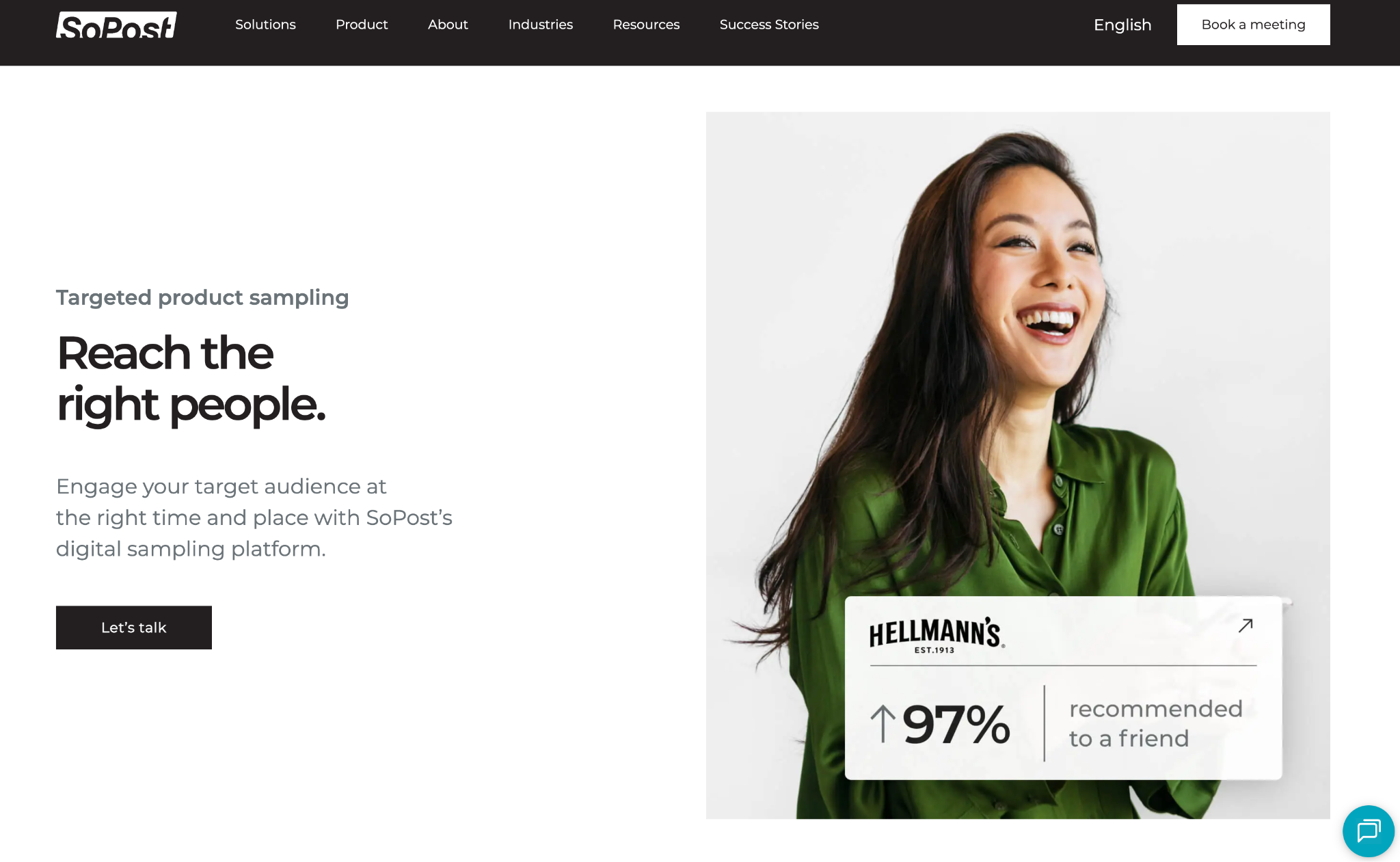
SoPost's targeted product sampling supports qualified sample requests through digital experiences, including social, retailer, and publisher channels. Its sample fulfillment service provides physical distribution infrastructure, including U.S. coverage.
- Primary use: Brands connecting digital audience activity with physical product trial.
- What to know: Confirm the audience source, qualification questions, sample format, shipping responsibility, and campaign reporting. Ask which follow-up responses and permission-based contact records your team can access.
Consider this route when you want someone responding to a digital campaign to receive and try a product. If public creator posts are essential, make those a specific contracted requirement rather than assuming a sample request includes them.
Social Nature
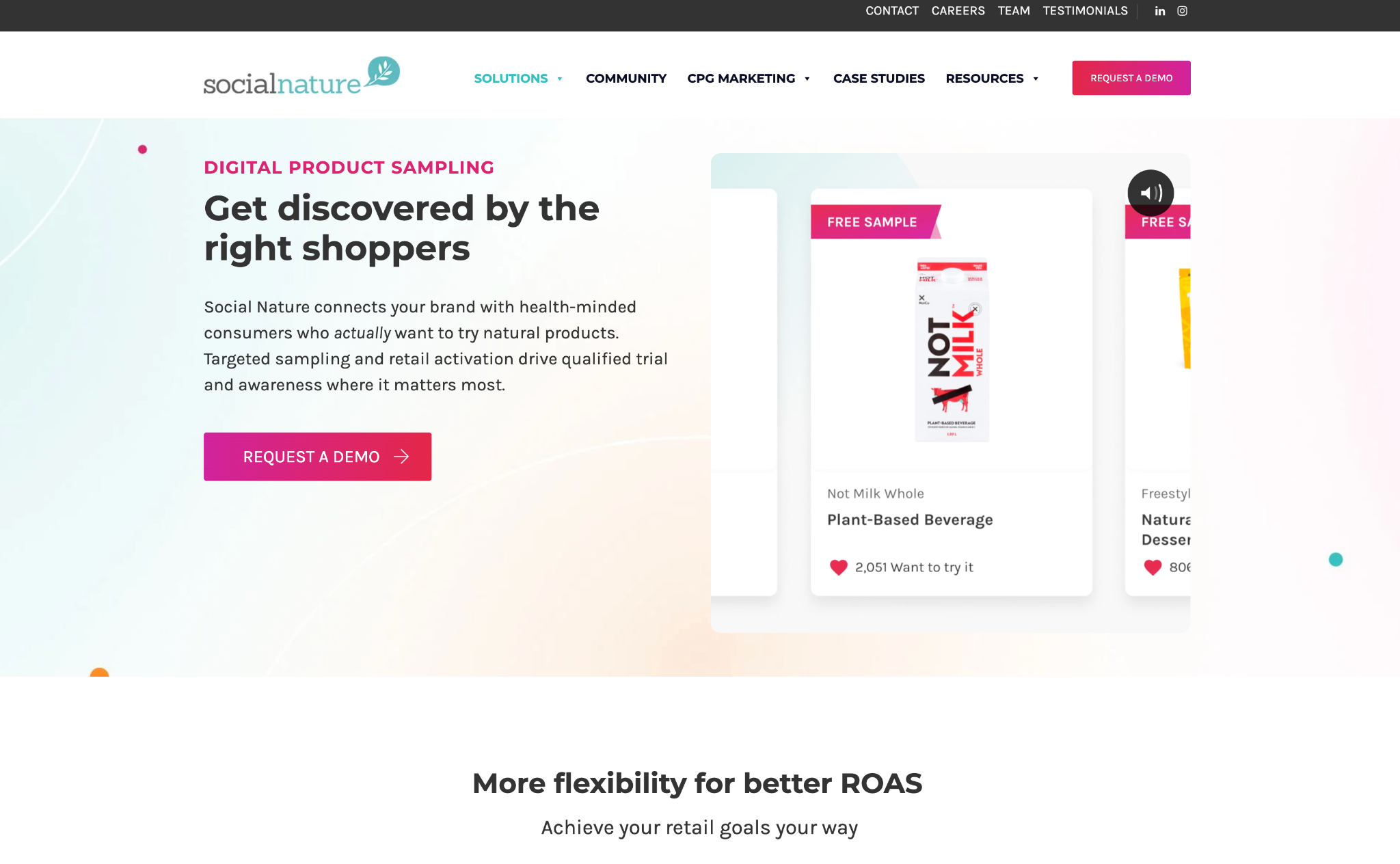
Social Nature's digital sampling service focuses on natural products and retail trial. Shoppers discover an offer, purchase an eligible product at a participating store, and submit proof of purchase for cash back.
- Primary use: Ecommerce brands with physical retail distribution that want trial at relevant stores or accounts.
- What to know: Match the offer to the stores carrying your product. Social Nature's consumer FAQ says only eligible in-store purchases qualify for cash back; online purchases do not. A product review is not required to receive cash back.
For this workflow, verify receipt redemptions and review submissions separately. A completed rebate establishes a qualifying purchase, while a review is a separate participant action.
Highlight
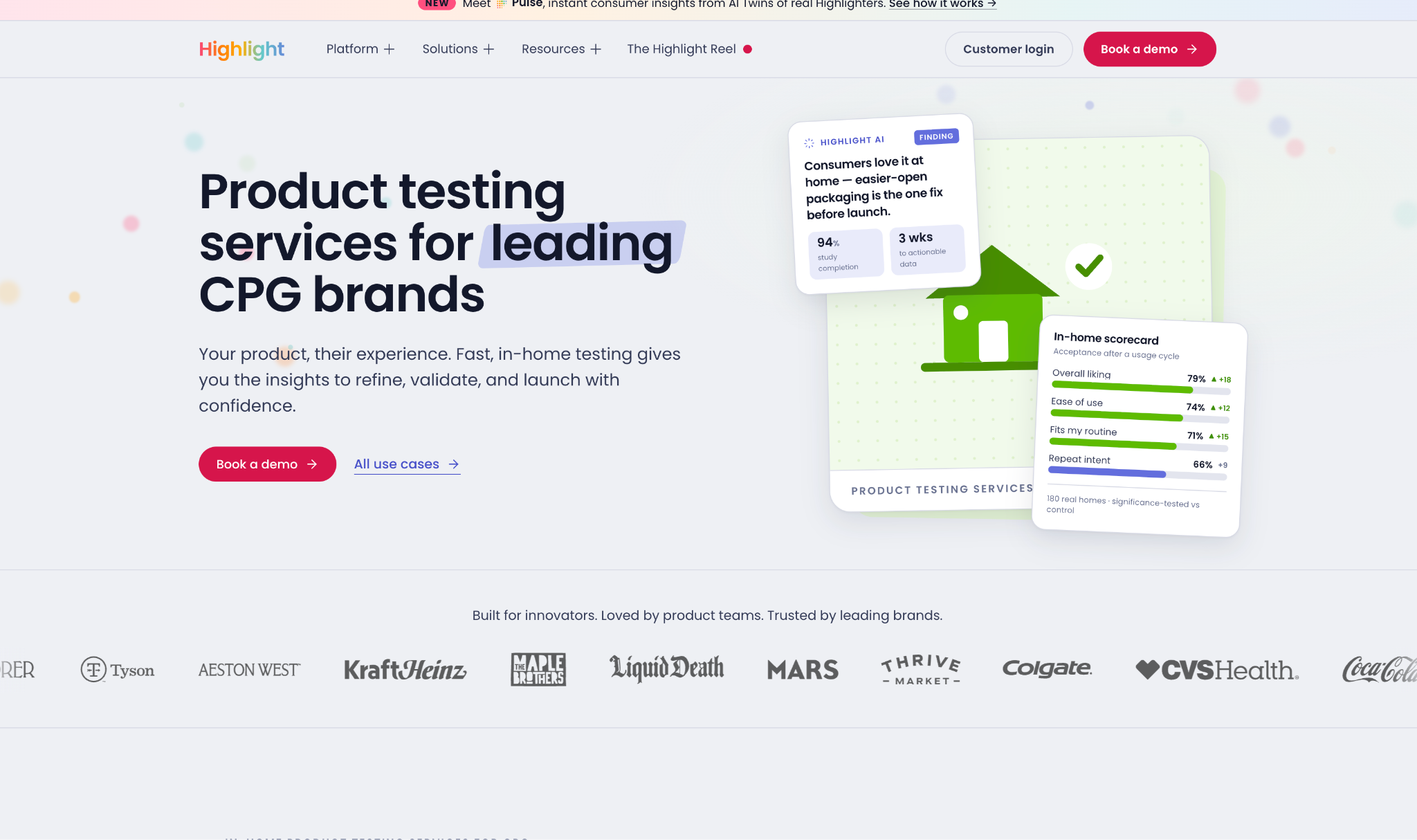
Highlight's in-home product testing service combines tester recruitment, product distribution, surveys, and research reporting. Brands define the objectives and tester criteria before participants evaluate products in their own environments.
- Primary use: Sellers seeking evidence to refine a formulation, packaging, usability, or another aspect of the product experience.
- What to know: Define the research question, target users, usage period, and required responses. Specify public content or advertising rights separately if you need them alongside the study.
Evaluate this option when the result you need is a product decision. For example, a seller could use a properly designed test to investigate whether customers can open and dispense a new package comfortably.
Define What Counts as a Completed Sample
Ask every shortlisted company to finish this sentence: "A completed unit in our proposal means..." The answer might be an accepted claim, a delivered product, a validated receipt, a completed survey, an approved review, or a published social post.
Those units describe different work. Stack's guide to influencer seeding arrangements explains the distinction between a gift without a posting obligation and an agreed content deliverable. Apply the same care when evaluating consumer sampling: receiving a product and submitting feedback are separate milestones.
Consider an illustrative feedback campaign measured at its agreed reporting cutoff. These are editorial assumptions, not provider benchmarks:
- Eligible people invited: 500.
- People claiming a sample: 400, assuming 80% of invitees claim.
- People receiving a sample: 360, assuming delivery to 90% of claimants.
- People submitting a valid, completed survey: 216, assuming 60% of recipients respond.
Each person can contribute one claim and one survey, and each stage contains people from the preceding stage. A valid survey means complete, nonduplicate feedback about the product experience, whether positive or negative.
In this illustration, 216 divided by 500 equals 43.2% of invitees producing completed feedback. The 60% response rate uses delivered recipients as its denominator. Both calculations are correct, but they answer different questions.
Require the proposal and report to identify their denominators. If your goal is completed feedback, agree on its definition and reporting cutoff before treating an invitation or shipment target as success. Also ask what happens when products are unavailable, deliveries fail, or participants do not complete their tasks.
Compare the Full Cost and Product-Delivery Plan
Request an itemized proposal against the same product, audience, deliverable, and deadline. Comparable all-in campaign prices were not verified across these six providers, so this comparison does not assign a cheapest option.
Have each provider identify the costs that apply:
- Service: Setup, software, campaign management, recruitment, and reporting.
- Product and delivery: Inventory, packing, shipping, retailer purchases, reimbursements, and applicable processing costs.
- Content: Production, revisions, licensing, and any creator-account advertising permissions.
- Distribution and support: Paid media, follow-up, replacement shipments, and your team's required work.
For shipped samples, establish where inventory must be sent, who packs individual parcels, and who handles damaged or missing deliveries. For purchase-and-reimbursement campaigns, establish who advances the money, which checkout expenses qualify, what triggers reimbursement, and when the brand is billed.
Check the product itself before committing. A trial-size cosmetic, a refrigerated drink, and a bulky household item create different fulfillment questions. Ask about storage, shelf life, shipping restrictions, and whether the provider can support the actual product format and delivery locations.
Keep the payment schedule separate from the completion promise. A service fee, inventory commitment, or advertising budget can become payable before feedback or content arrives. Ask which charges are fixed, which depend on activity, and how unused units or interrupted campaigns are handled.
Check Reviews, Disclosure, and Content Permissions
Confirm Where Reviews May Be Published
Name the destination before requesting reviews. A brand website, a participating retailer, and Amazon can have different requirements for incentivized feedback.
Amazon's Community Guidelines prohibit reviews exchanged for compensation, including refunds, discounts, and free products. Keep social-content reimbursement independent of Amazon customer reviews, and do not treat disclosure as permission to bypass that policy.
If Amazon reviews are the objective, examine the separate Amazon Vine program and its current eligibility requirements. Do not assume a sampling company's retail syndication agreement includes Amazon or authorizes compensated Amazon reviews.
Make the Product Relationship Clear
The FTC's influencer disclosure guidance explains that free or discounted products can create a material connection requiring disclosure when someone endorses the product. Place an understandable disclosure with the endorsement; a video endorsement needs disclosure in the video itself.
Give participants room to describe their actual experience. Approval can check the agreed deliverable and factual claims, but it should not pressure someone to misrepresent how the product performed. Establish a support process for problems before products are distributed.
Define the Permissions You Need
Ask the proposal to distinguish the creator's published post, delivery of the underlying file, permission to reuse that file, and authorization to run advertising through the creator's account. List the intended channels, duration, territory, editing rights, and any additional fees.
For consumer feedback, also ask which data your team receives and what permission allows subsequent marketing contact. Having a shipping address for fulfillment should not be treated as evidence of permission for every future use.
Measure Later Purchases Separately From Trial Activity
A reimbursed trial transaction documents campaign activity. It does not, by itself, show that an independent customer chose to buy after experiencing the product. Keep sample-related purchases separate from subsequent purchases when assessing demand.
Ask what the provider can actually observe: submitted receipts, completed feedback, tracked later purchases, or stated purchase intent. A survey answer about intention is useful feedback, but it is a different measure from a recorded purchase.
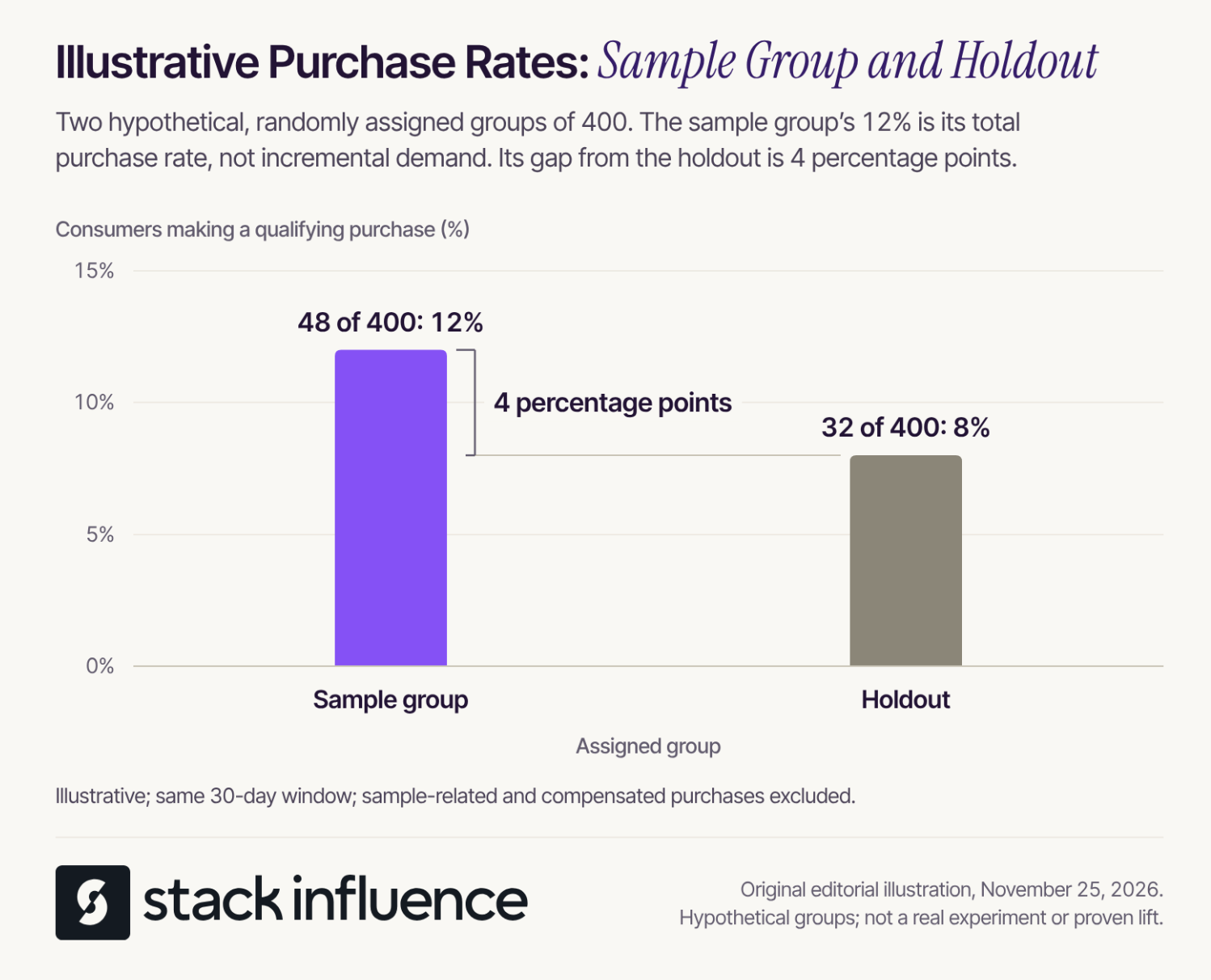
For a separate, purely illustrative measurement example, suppose eligible consumers are randomly assigned before fulfillment to a sample group and a holdout that receives no sample. Use the same 30-day window after assignment and count each qualifying buyer once:
- Sample group: 400 assigned consumers, with 48 making a qualifying later purchase, or 12%.
- Holdout group: 400 assigned consumers, with 32 making a qualifying purchase, or 8%.
- Difference between assigned groups: 4 percentage points.
Here, qualifying purchases exclude the initial sampling transaction, reimbursements, and other compensated purchases. All assigned consumers remain in their group's denominator, including those who never receive or use the sample.
The sample group's 12% purchase rate is not a 12-percentage-point incremental gain. The hypothetical difference from the holdout is 4 percentage points. This arithmetic illustrates the comparison; it supplies no real experiment, uncertainty analysis, or proof of sales lift.
For an actual campaign, ask whether a holdout and reliable purchase tracking are feasible. If they are not, report the observed trial, content, feedback, and purchase measures with their limits. Choose the reporting period around the product's buying cycle; the example's 30 days is an assumption, not a recommended window for every category.
What Content Creators Should Check Before Participating
Read the participant task before applying. A product-testing assignment may require private feedback, a review program may require an honest review at a specified destination, and a creator campaign may require a public social post.
BzzAgent's participation guide illustrates an invitation-based process: maintain a profile, receive an invitation, apply, and wait for selection. Registration alone does not secure a sample. Selected participants must try the product and follow the campaign's review instructions.
Before accepting an offer, confirm the product, required work, deadline, any initial purchase, reimbursement conditions, and content permissions. Check whether compensation is the product itself or includes a separate cash fee. Make sure the time and expense commitments work for you.
Use the official campaign support process if the product arrives damaged, cannot be used, or does not match the offer. Never invent a positive experience to complete an assignment. Stack's guide to finding legitimate product collaborations provides a fuller application and offer-evaluation walkthrough.
Creators interested in agreed social-content campaigns can review Stack Influence's creator program and the terms of the specific offer before purchasing a product.
Send a Brief That Makes Proposals Comparable
Give shortlisted providers the same practical brief. Name the product and variations, where it is sold, who should experience it, and the single primary output you need.
Then specify the completion definition, product-delivery route, content or feedback requirements, destination, permissions, budget boundary, and reporting cutoff. Ask the provider to identify any requirement it cannot confirm in writing.
For example, a skincare seller seeking creator demonstrations should ask for the content format, publication requirement, and reuse permissions. A food brand supporting a retail launch should identify the participating stores and receipt requirements. A seller investigating packaging should define the usage task and feedback needed to make the redesign decision.
Where published creator content is the priority, bring that brief to a conversation with Stack Influence about managed product seeding. Where the primary task is review collection, retail trial, or research, use the corresponding workflow above to build the shortlist.
Choose the Company That Can Deliver Your Required Result
Start with one output, then verify the participant task, delivery process, full cost, and evidence of completion. That turns a broad list of product sampling companies into a decision you can make against your actual needs.
For sellers, the next step is a comparable written proposal. For creators, it is an offer whose work, expenses, and permissions you understand before accepting.