
The latest info on influencer marketing trends, micro influencer news, and the world of social media

An Amazon creator can recommend your product and earn a commission without becoming your employee or joining a brand-funded sponsorship campaign. That distinction matters when you are deciding what to pay for, what a creator should deliver, and how to measure the result.
For ecommerce sellers asking “how does Amazon affiliate work,” the useful answer goes beyond getting a tracking link. You need to understand who pays the commission, which purchases qualify, and how affiliate referrals differ from product seeding and reusable creator content.
This guide covers the U.S. Amazon.com program, with policy details checked on October 3, 2026. Other marketplaces and account-specific offers can have different terms.

Amazon affiliate marketing works through Amazon Associates: a publisher shares a tagged Amazon link, a shopper follows it, and Amazon pays the publisher when a qualifying purchase or eligible action occurs. The publisher might be a blogger, a product educator, or a social media creator.
The basic sequence is straightforward. A participant creates a link associated with their account, places it in eligible content, and directs shoppers to Amazon. Amazon then determines whether the resulting activity qualifies for commission under the program’s rules.
The Amazon Associates program is therefore a referral-income system, not a guarantee of payment for posting content. A creator can publish an excellent product demonstration and earn nothing when the referred traffic does not produce qualifying activity.
For a seller, joining Associates yourself is also different from recruiting creators to recommend your products. In the standard arrangement, Amazon sets and pays the affiliate commission. Any additional payment you negotiate with the creator belongs in a separate campaign budget.
An Amazon affiliate versus influencer comparison also helps distinguish external referral links from creator content that may appear within Amazon’s own shopping experience. Do not assume those placements use identical eligibility or commission rules.
Stack Influence’s gifted-first product-seeding workflow illustrates a different commitment: vetted creator activation, campaign coordination, UGC generation, and completed-post accountability. Its completions-only campaign model connects platform payment to completed creator posts rather than a promised number of affiliate purchases.
That distinction should shape the brief. When buying content, define the content. When funding sales incentives, define the qualifying sale. When combining the two, keep both commitments visible instead of treating “an influencer campaign” as one undifferentiated purchase.
Amazon pays standard product commissions as a percentage of qualifying revenue, with the percentage determined by product category. There is no single commission rate that applies to every Amazon product.
Amazon’s current U.S. standard commission schedule lists Grocery at 1%, Home at 3%, Kitchen at 4.5%, and Luxury Beauty at 10%. These are selected standard rates, not a complete rate card or a promise that every item marketed with those descriptions receives that classification.
The basic calculation is:
Commission = qualifying revenue × applicable commission rate.
For an illustrative purchase producing exactly $40 in qualifying revenue, the corresponding commissions would be $0.40 for Grocery, $1.20 for Home, $1.80 for Kitchen, and $4.00 for Luxury Beauty. The purchase value stays constant; only the category rate changes.
Amazon’s qualifying-revenue definition excludes charges such as shipping and taxes. A tax-inclusive checkout total is therefore not necessarily the amount used to calculate commission.
For sellers, the practical implication is that the same product price can create very different affiliate incentives. Before asking a creator to produce a detailed demonstration purely for commission, consider the actual earning opportunity rather than the product’s retail price alone.
Amazon generally pays approximately 60 days after the end of the month in which commissions were earned, subject to payment requirements. Its payment guidance also requires the relevant tax information and payment setup.
The U.S. payment terms specify minimum balances of $10 for direct deposit or Amazon gift card and $100 for payment by check.
This delay matters when discussing creator expectations. A shopper placing an order, a commission appearing in a report, and money reaching the creator are different events.
The familiar “24-hour cookie” description leaves out important conditions. Amazon’s referral-session guidance explains that the session can close before 24 hours when the shopper places an order or follows another Associate’s link; the full policy distinguishes non-digital orders for this purpose.
An eligible cart purchase can follow a longer timetable. Under Amazon’s cart and fulfillment rules, a physical product added during the qualifying session can qualify if ordered no later than 89 days after the initial click. The product must also be shipped and paid for within 180 days of purchase.
These are different deadlines, not interchangeable descriptions of one attribution window. The cart provision concerns qualifying items added during the session; it does not mean every future purchase by that shopper belongs to the original creator.
Cancellations, returns, and refunds can also disqualify purchases. Treat an order report as an intermediate signal rather than final commission income.
For campaign planning, separate the click date, order date, shipment status, and eventual earnings. That prevents a common reporting mistake: declaring a creator ineffective before eligible orders mature, or declaring the campaign profitable before reversals are accounted for.
Joining Amazon Associates requires an eligible content property, an accurate application, and compliance with Amazon’s program conditions. Registration is free, but creating an account does not guarantee final approval.
Amazon’s application review process requires at least three qualifying sales within the first 180 days before the application review. Personal orders do not count, and the submitted properties must contain substantive original content that is publicly accessible.
Applicants must also be legally able to enter contracts under the Associates Operating Agreement. A business plan should not depend on bypassing eligibility requirements.
Start by listing the exact websites or social profiles that will carry the links. Complete the account, tax, and payment information, and keep the list of publishing properties accurate.
Amazon’s SiteStripe link-creation tool lets an Associate create tagged links while browsing Amazon through the account associated with their membership. Check the product variant and selected tracking ID before copying the link.
Then test the customer-facing destination without placing a personal order to generate commission. For social placements, the published experience matters as much as the copied URL; the workflow for adding an Amazon link to an Instagram Story should include checking the live link after publication.
Amazon’s Influencer Program eligibility rules add qualification conditions and separate requirements for onsite commission income. A creator’s account features should match the placement being discussed.
For example, a commitment to publish an external social post is not the same as a commitment involving content displayed on Amazon. Use the Amazon Influencer Program approval guide to frame qualification questions, then confirm the creator’s actual access before promising a placement.
Before activating a creator partnership, write down three things: which link will be used, who pays each cost, and what the creator must deliver. This Link-Payer-Deliverable Check prevents the affiliate arrangement from becoming confused with the content agreement.
An Associate’s link is designed to support that Associate’s qualifying referral income. A brand’s measurement link serves a different reporting purpose.
According to Amazon’s Attribution guide, Amazon Attribution uses a 14-day, last-touch model. Eligible conversions must occur within that window, and credit goes to the most recent qualifying click. That is not the same rule as an Associates referral session.
The Amazon Brand Referral Bonus is another distinct mechanism. Eligible U.S. brands can receive a credit averaging 10% of qualifying sales attributed to their external marketing, subject to the program’s conditions; it is not a universal cash commission.
Amazon’s rules against combining attribution links prohibit manipulating tags to claim commissions across programs using the same traffic. Do not combine an Associates tag with an Attribution link in an attempt to collect both affiliate commission and a Brand Referral Bonus.
Agree on the supported tracking arrangement before publication. Do not silently replace a creator’s earning link with a different link after negotiating the partnership.
The standard Associates commission is paid by Amazon. Your campaign may separately include product costs, shipping, creator fees, content production, or a brand-funded sales incentive.
For eligible brand campaigns, Amazon Creator Connections provides a way to select products, set a commission rate, and define a campaign period. Confirm the account-specific eligibility, budget requirements, and settlement conditions before treating an offer as available.
Keep these amounts separate in your campaign estimate. Otherwise, you can accidentally deduct Amazon’s standard affiliate commission as though it were an additional invoice to your brand, or forget a genuine brand-funded incentive that reduces your margin.
A commission opportunity does not define a posting deadline, video length, content license, or reporting obligation. Put those expectations into the creator brief rather than assuming they follow from an affiliate link.
When finding influencers for an Amazon product, evaluate whether the creator can demonstrate the product’s actual use. Micro influencers and nano influencers should be assessed on relevance, communication, and the proposed content, not follower count alone.
For UGC creators, specify the required files, editing permissions, channels, and usage period. A brief for Amazon UGC services should distinguish a social post from a reusable video asset.
The Link-Payer-Deliverable Check gives both sides a concrete agreement: one defined tracking arrangement, an understandable cost structure, and a deliverable that can be verified.
Start with delivery and traffic, then move to commercial outcomes. Completed posts and functioning links show that the campaign launched; clicks show activity; qualifying purchases and contribution margin help determine economic value.
Amazon’s Associates reporting documentation distinguishes metrics such as clicks, ordered items, shipped items, and commission income. A seller should also isolate the promoted product’s results instead of interpreting an affiliate’s total earnings as sales of the seller’s own catalog.
Keep reimbursed creator purchases separate from independent customer demand. A purchase made to obtain a campaign sample belongs in the campaign-cost assessment, not automatically in the count of customers acquired through the creator’s recommendation.
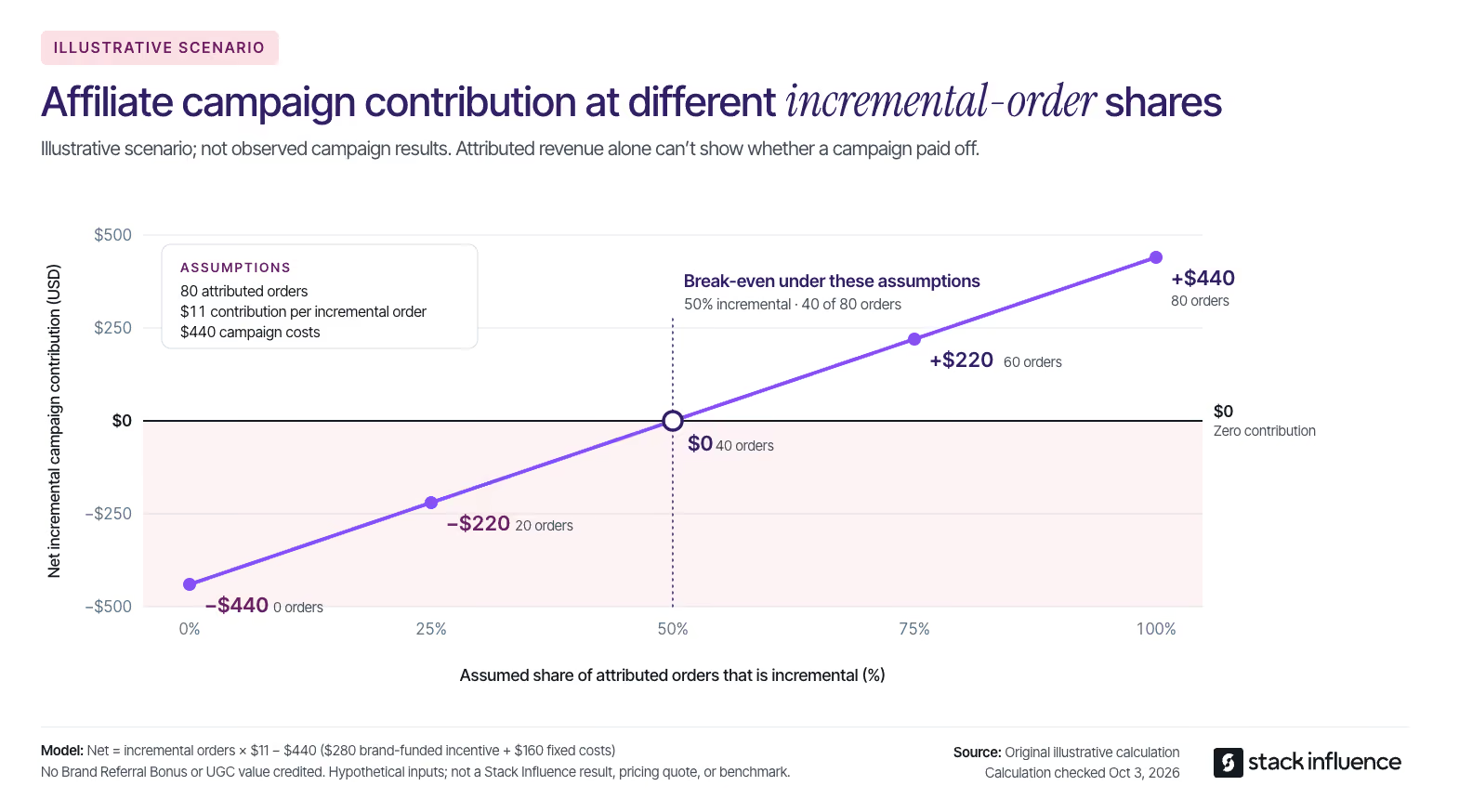
Consider a hypothetical brand-funded affiliate pilot with 80 attributed orders from independent customers at $35 per order. Attributed sales total $2,800. Assume each order contributes $11 after product costs, ordinary selling and fulfillment charges, and a return allowance, but before campaign costs.
The brand also pays an assumed 10% incentive on all 80 attributed orders, costing $280, plus $160 in combined fixed campaign costs. Total campaign cost is therefore $440. These figures are illustrative assumptions, not Stack Influence pricing, Creator Connections minimums, or observed campaign results.
Assume no Brand Referral Bonus credit and assign no financial value to later UGC reuse. The remaining question is how many of those attributed orders were genuinely additional purchases that would not have happened without the campaign.
The calculation is:
Net incremental contribution = incremental orders × $11 − $440.
At incremental-order shares of 0%, 25%, 50%, 75%, and 100%, the campaign adds 0, 20, 40, 60, and 80 orders respectively. The corresponding net incremental contributions are −440,-220, $0, $220, and $440.
Under these assumptions, the campaign breaks even when 40 of the 80 attributed orders are incremental, a 50% share. That threshold changes when margins, incentives, or fixed costs change; it is not an industry benchmark.
For an Amazon Attribution campaign, allow the relevant conversion window to mature before comparing complete reporting cohorts. For affiliate income, distinguish orders from shipped and ultimately payable activity.
Attribution assigns credit according to rules. It does not prove that every credited customer would have stayed away without the creator’s content.
Where feasible, use a credible holdout or comparison design to estimate additional demand. A simple before-and-after sales increase can also reflect pricing, seasonality, advertising, or stock availability.
The practical reporting goal is not one impressive revenue number. It is a defensible explanation of what was delivered, what was credited, what it cost, and what additional contribution the campaign plausibly created.
Disclose the commercial relationship where the recommendation appears. The FTC’s Disclosures 101 for Social Media Influencers explains that material connections include free or discounted products, not just cash payments, and that disclosures should be clear and difficult to miss.
Amazon’s Associate-identification guidance also requires clear affiliate-link disclosure and the statement: “As an Amazon Associate I earn from qualifying purchases.” Do not assume a profile statement alone explains every individual endorsement.
Paid distribution requires another check. Amazon’s April 14, 2026 policy update expanded disqualified purchases to include referrals through paid or boosted advertisements linking to Amazon, with limited exceptions. Verify an applicable exception before funding that distribution, even when you have permission to reuse the creator’s UGC.
Finally, keep promotional content separate from marketplace customer reviews. Amazon’s customer-review policy explanation describes its restriction on incentivized reviews outside authorized arrangements. Do not make an Amazon customer review a condition of product reimbursement.
How does Amazon affiliate work? Amazon connects eligible referral activity to commission income through tagged links, qualification rules, and a payment schedule. For sellers, the additional task is deciding whether that referral arrangement supports a profitable, well-defined creator partnership.
Apply the Link-Payer-Deliverable Check to one product before expanding the campaign. Confirm the tracking route, calculate the costs you actually fund, and distinguish completed content from incremental customer orders.
When your immediate goal is product demonstrations and reusable UGC, evaluate a Stack Influence product-seeding campaign around a defined content brief and completed-post accountability. Build the sales measurement alongside that workflow so the next campaign decision rests on usable content and understandable economics.
Consider an office manager buying supplies for twelve workstations. The lowest unit price may not be the easiest purchase to approve, store, receive, or repeat.
For ecommerce sellers, an Amazon B2B ecommerce strategy should solve that entire buying problem. Business pricing is one part of the offer, not the strategy itself.
This guide explains how to select business-use products, design quantity tiers, remove purchasing friction, protect delivery reliability, and measure whether larger baskets are becoming a durable business channel. The platform details below focus on the U.S. marketplace.
An Amazon B2B ecommerce strategy is a plan for selling products to organizations through Amazon Business. It differs from buying wholesale inventory to resell on Amazon: the focus here is the business customer purchasing your offer.
Start with a Reorder-Ready Offer, a five-part planning framework:
A product that fails one of these checks is not automatically a bad business product. It needs a specific repair before you pay to generate more demand.
According to Amazon’s Business seller documentation, sellers access B2B tools through a Professional selling account, currently $39.99 per month plus selling fees in the U.S. Existing Professional sellers can open B2B, then B2B Central, in Seller Central.
Amazon also provides B2B Product Opportunities and Case Pack Product Opportunities for assortment research. Use these as inputs to a shortlist, not as substitutes for checking sourcing costs and supply reliability.
Begin with products already attracting business purchases or with an obvious organizational use. A replacement supply with a clear specification offers a more testable starting point than a broad claim that an entire consumer catalog is suitable for businesses.
A larger quantity discount can reduce the price per unit while increasing the amount the buyer must authorize and store. Design offers around practical purchasing quantities, not the assumption that every business wants the largest case.
Purchasing controls are real, although they vary by organization. For example, Iowa State University’s Amazon purchasing guidance requires Amazon purchases to pass through cyBUY and procurement review before submission. That is one institution’s policy, not a universal Amazon requirement.
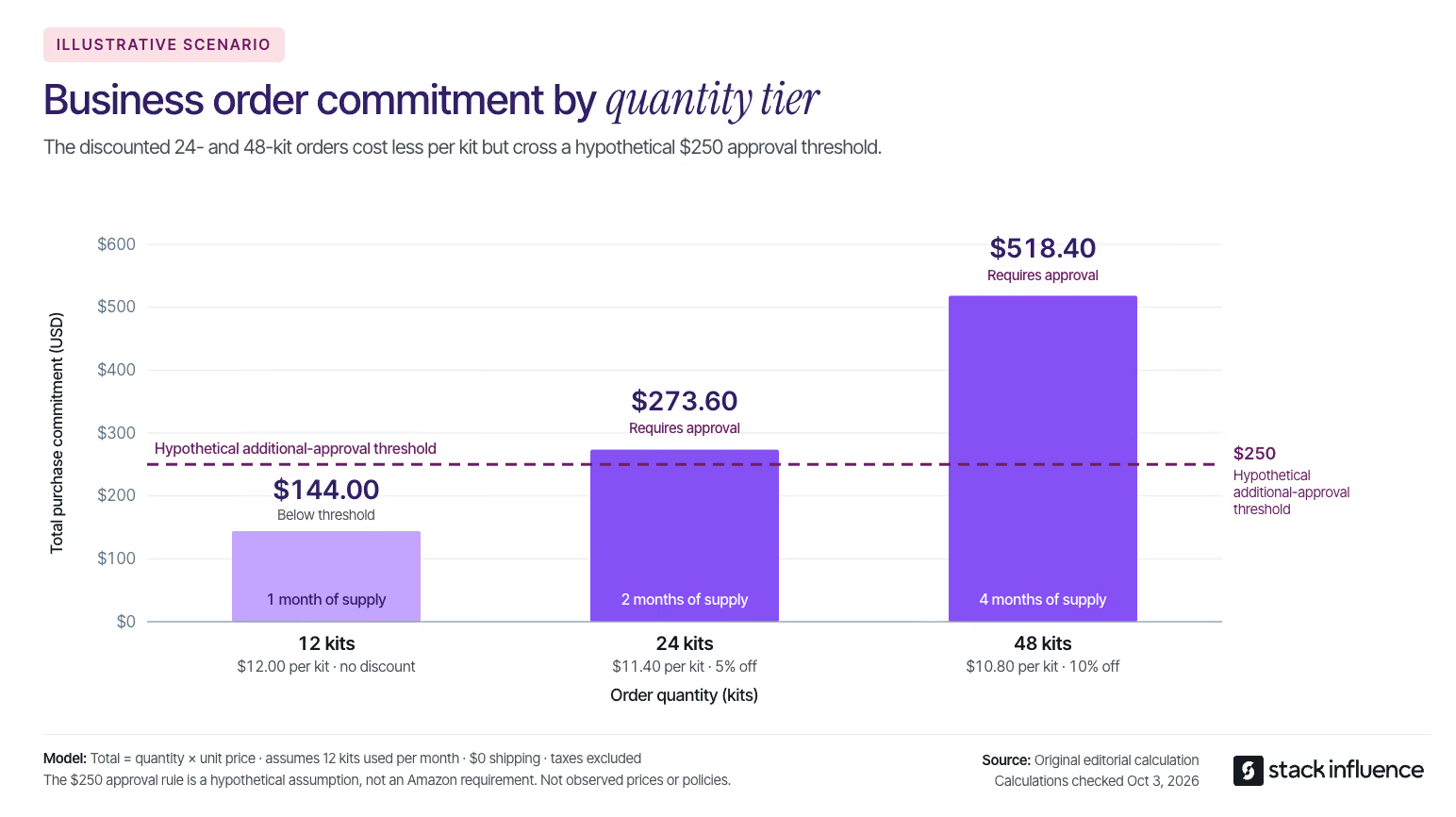
Consider an illustrative office-supply offer. Assume a buyer consumes 12 identical kits per month, the undiscounted price is $12 per kit, shipping is free, and taxes are excluded from the model. Suppose this buyer’s internal policy requires additional approval for purchases above $250.
Three possible order quantities produce different commitments:
Order commitment equals quantity multiplied by unit price. Months of supply equal quantity divided by monthly consumption.
The larger orders cross the hypothetical approval threshold even though each kit costs less. These figures are planning assumptions, not Amazon rules, industry benchmarks, or results from a Stack Influence campaign.
The practical response is to preserve a genuinely useful smaller purchase option alongside bulk tiers, provided its economics work. Do not encourage buyers to split transactions to evade purchasing controls; make each offer appropriate for a legitimate replenishment need.
Set quantity discounts only after calculating the economics of the completed order. A discount that increases revenue can still reduce the money available to cover overhead.
Use this operating calculation:
Order contribution = product revenue after discounts − product cost − marketplace fees − fulfillment and packaging − allocated inbound and storage costs − expected returns and concessions − variable acquisition costs.
Keep taxes collected for remittance outside revenue. Include buyer-paid shipping and its associated costs consistently, and use actual category and fulfillment fees rather than a universal percentage.
Amazon’s B2B pricing guide describes business prices and quantity discounts, including percentage-off and fixed-price tiers. Choose thresholds that match how customers actually buy, then check the effective price during other promotions and automated price changes.
Amazon’s Business Discount Insights documentation provides suggested pricing opportunities and describes conditional fulfillment and referral-fee discounts. Treat recommendations as candidates for testing, and verify eligibility before including any savings in your cost model.
Evaluate at least the smallest qualifying order at each tier and the largest order your current stock can support. For seller-fulfilled products, price the actual carton and shipping service; do not assume shipping costs rise evenly with unit count.
Use margin-aware Amazon repricing controls when business prices interact with automated rules. A profitable manual offer can become unprofitable when another promotion changes its effective price.
Keep contribution separate from cash availability. Inventory may need to be purchased and delivered before the marketplace proceeds become available, so an attractive order can still create a funding gap.
Give the person authorizing the purchase enough information to evaluate the product without reconstructing the offer from photographs.
For a workplace accessory, specify dimensions, compatibility, included components, and the exact quantity received. For replenishment products, make the unit of measure and pack count unmistakable. Describe what is included rather than relying on a label such as “commercial quality.”
Amazon supports package hierarchies for units, case packs, and pallets. Distinguish ordering several units of an existing offer from creating a different packaged product; the listing structure must accurately represent what is delivered.
Apply the same discipline to images. One image can show the complete pack contents, while another demonstrates scale or compatibility. The principles in the Amazon product listing optimization guide are useful here, but the questions should come from a business purchasing decision.
Maintain accurate seller-profile information and substantiate any certifications you claim. Assign responsibility for incoming quote requests, product questions, and invoice-related issues rather than leaving them between sales and operations.
Set a response workflow for quotes: confirm the requested quantity, available stock, delivered cost, and acceptable contribution before responding through the available Amazon tools. A quote should be an executable offer, not a discount invented before fulfillment checks.
A persuasive demonstration cannot replace a missing specification. Return to the approval-evidence component of the Reorder-Ready Offer whenever a buyer asks a question that the listing should already answer.
Choose fulfillment by the product’s economics and the receiving conditions it must satisfy. Compare Amazon FBA and seller fulfillment for storage, handling, delivery reliability, and the quantities business buyers are likely to order.
For U.S. seller-fulfilled Amazon Business shipments, Amazon’s business-hour delivery requirement took effect on September 30, 2026. It requires a Business Hour Delivery Rate of at least 90%, measured over a rolling 14-day period.
Amazon’s announcement says sellers below the threshold will receive notification and recommendations. If performance has not improved by October 30, 2026, affected seller-fulfilled offers may be deactivated for Amazon Business customers; FBA and retail-offer eligibility are not affected by that action.
Review the metric in Account Health and investigate carrier and shipping-setting issues before increasing order volume. A delivery arriving by its promised date and a delivery arriving while the business is open are different operational questions.
Plan stock for business and consumer demand together. Use a cross-marketplace inventory plan when the same supply also supports Shopify or other marketplaces, and account separately for campaign inventory commitments.
Do not size the replenishment buffer from average order quantity alone. A small number of legitimate bulk orders can consume stock that normally covers many consumer purchases, so test the largest plausible order against available inventory before promoting the offer.
Promote the offer only after the purchasing and fulfillment requirements are workable. Separate advertising intended to reach business buyers from content intended to explain the product.
Eligible advertisers can use Amazon Business exclusive Sponsored Products campaigns to advertise only on Amazon Business. These campaigns support their own budgets, selected products, keywords, and bidding settings.
Start with a narrow product group and purchase-relevant search terms. A seller of desk organizers might test terms tied to office supplies, workstation organization, and the actual pack size rather than adding “wholesale” to every keyword.
Keep the test budget and success criterion explicit. Business-only placement identifies the advertising environment; it does not establish that every resulting order is incremental or profitable.
Creator content is most useful when it resolves a concrete product question. Ask a relevant creator to demonstrate assembly, show the full pack, or explain compatibility accurately rather than simply calling the product suitable for businesses.
When finding influencers for an Amazon product, examine evidence of relevant content and audiences. Micro influencers and nano influencers may be candidates, but follower count alone does not establish access to purchasing decision-makers.
Through Stack Influence’s automated product-seeding workflow, sellers can coordinate gifted-first campaigns and track completed creator posts. A business-use assignment should make its acceptance criteria specific: visible pack quantities, a truthful setup demonstration, and delivery of any contracted content files. Keep that production record separate from Amazon Business sales reporting.
Distinguish the social-post deliverable from the licensed UGC file. Specify permitted placements, edits, duration, and any separate advertising permissions before repurposing content.
The FTC’s influencer disclosure guidance explains that free products and other benefits can create a relationship that requires disclosure. Commission an honest product demonstration, not a customer review in exchange for a benefit.

Use a B2B-specific readout rather than treating overall Amazon sales growth as business-channel growth.
Amazon’s business reporting guide describes B2B and non-B2B comparisons, customer-segment views, quantity-discount reporting, and B2B traffic and sales metrics. Record the exact report, period, product level, and metric definition before comparing results.
Organize the readout around three questions: are qualified shoppers reaching the offer, what orders are they placing, and what contribution remains? Page visits and Featured Offer visibility are leading indicators; fulfilled orders and contribution are commercial outcomes.
More units per session can reflect larger baskets rather than more shoppers buying. Pair quantity metrics with actual order counts, units per order, and contribution per order.
Do not assume every report’s “order items” field represents distinct customer orders. Likewise, recurring sales of an item do not establish that the same customers are returning.
Evaluate repeat buying only after customers have had enough time to make the repeat purchase being measured.
Consider a separate illustrative dataset of 100 first-time business customers. Assume reliable, permitted customer-level records, no cancellations or returns, and a 60-day repeat-purchase window measured from each customer’s first order.
At the reporting cutoff, 40 customers have at least 60 days of follow-up, 35 have 30 to 59 days, and 25 have fewer than 30 days. Twelve of the fully observed customers reordered within their first 60 days, and they are the only customers with any repeat order by the cutoff.
Dividing 12 by all 100 customers gives a 12% mixed-age, observed-to-date repeat share. Dividing those 12 by the 40 with complete follow-up gives a 30% 60-day repeat rate for the fully observed cohort.
Both calculations are reproducible, but they answer different questions. Labeling the 12% figure a 60-day repeat rate treats customers who have not completed the window as though they have.
This is an illustrative measurement example, not a retention benchmark. The older cohort’s 30% result does not predict the newer cohorts, and 60 days is an assumed evaluation window, not a suitable reorder cycle for every product.
Use this calculation only where authorized data supports customer-level analysis. Where it does not, report recurring product-level demand as a proxy and state the limitation.
The official Amazon Attribution methodology uses a 14-day, last-touch model for qualifying off-Amazon activity. Apply tags before launch, but do not assume a tagged purchase proves the buyer was a business customer.
Use the external-traffic measurement guide to keep campaign reporting separate from incremental-demand claims. Do not add attributed sales to Seller Central sales as though they were additional transactions.
Where eligible, Amazon Brand Referral Bonus can provide referral-fee credits for qualifying external traffic. Include earned credits appropriately in the financial readout rather than assuming every B2B order receives a bonus.
A short advertising attribution window and a longer replenishment cycle serve different purposes. Maintain both views without assuming they can be joined into a complete customer journey.
Start with a small group of products rather than adding discounts across the entire catalog.
During the first month, complete the Reorder-Ready Offer checks, preserve the existing prices and baseline performance, and assign ownership of stock, questions, and delivery exceptions.
During the next month, test a defined quantity offer or business advertising campaign while keeping unrelated changes limited. Compare similar periods and record stockouts, promotions, and changes in delivery performance.
Use subsequent replenishment windows to evaluate recurring demand and contribution. A before-and-after improvement is useful evidence for the next decision, but it does not isolate causation when several conditions changed.
Expand only when the offer works operationally and the financial result supports it. A larger initial basket is not enough reason to roll the same discount across unrelated products.
A durable Amazon B2B ecommerce strategy gives customers an offer they can understand, approve, receive, and buy again without unnecessary work.
The strongest next step is not a bigger campaign. Put one repeat-use product through the Reorder-Ready Offer checks, repair the weakest part, and test whether business demand produces contribution worth repeating.
A wholesale buyer needs to reorder a case of products at a negotiated price, send the purchase for approval, and charge it to an existing account. A storefront that handles consumer checkout beautifully might still need additional configuration to complete that order correctly.
For ecommerce sellers comparing B2B ecommerce platforms, the important question is not which platform has the longest feature list. It is which system can handle your actual customers, commercial terms, and fulfillment rules without creating avoidable work.
This guide compares seven options, explains their pricing models and constraints, and provides a practical test for choosing between them.
Shopify, BigCommerce, WooCommerce, Adobe Commerce, OroCommerce, Sana Commerce, and Salesforce B2B Commerce provide seven distinct starting points for evaluation. Consider Shopify, BigCommerce, and WooCommerce when extending an existing retail operation into wholesale; investigate Adobe Commerce and OroCommerce for more elaborate purchasing workflows; examine Sana Commerce and Salesforce when the systems already managing your business should strongly influence the choice.
A B2B ecommerce platform supports online transactions between businesses, with capabilities such as company accounts, negotiated pricing, purchasing controls, and payment terms. For example, Shopify’s B2B documentation describes company-based purchasing and personalized buying experiences rather than treating every visitor as an unrelated retail customer.
This is a different decision from launching products across multiple marketplaces. Here, you are selecting the infrastructure for your own wholesale ordering experience, including the rules that govern who can buy, what they pay, and how orders reach your operational systems.
Evaluate the handoff between self-service ordering and human assistance, not just the checkout screen.
In McKinsey’s 2024 B2B Pulse research, among respondents likely to switch suppliers, 54% cited poor digital customer experiences, 51% cited missing customer tracking across channels, and 51% cited difficulty reaching the right person for help. These are stated concerns from a 2024 survey, not observed churn rates or 2026 benchmarks.
A useful demonstration should therefore include a buyer starting an order online, requesting help, and resuming without losing the agreed price or order context.
For consumer brands expanding into wholesale, product evidence and ecommerce social proof can help explain an assortment. Keep that evidence alongside, rather than in place of, the commercial details a retailer needs to place an order.
The following reviews use official product and pricing information checked on October 2, 2026. They are documentation-based evaluations, not hands-on performance benchmarks or a universal ranking.
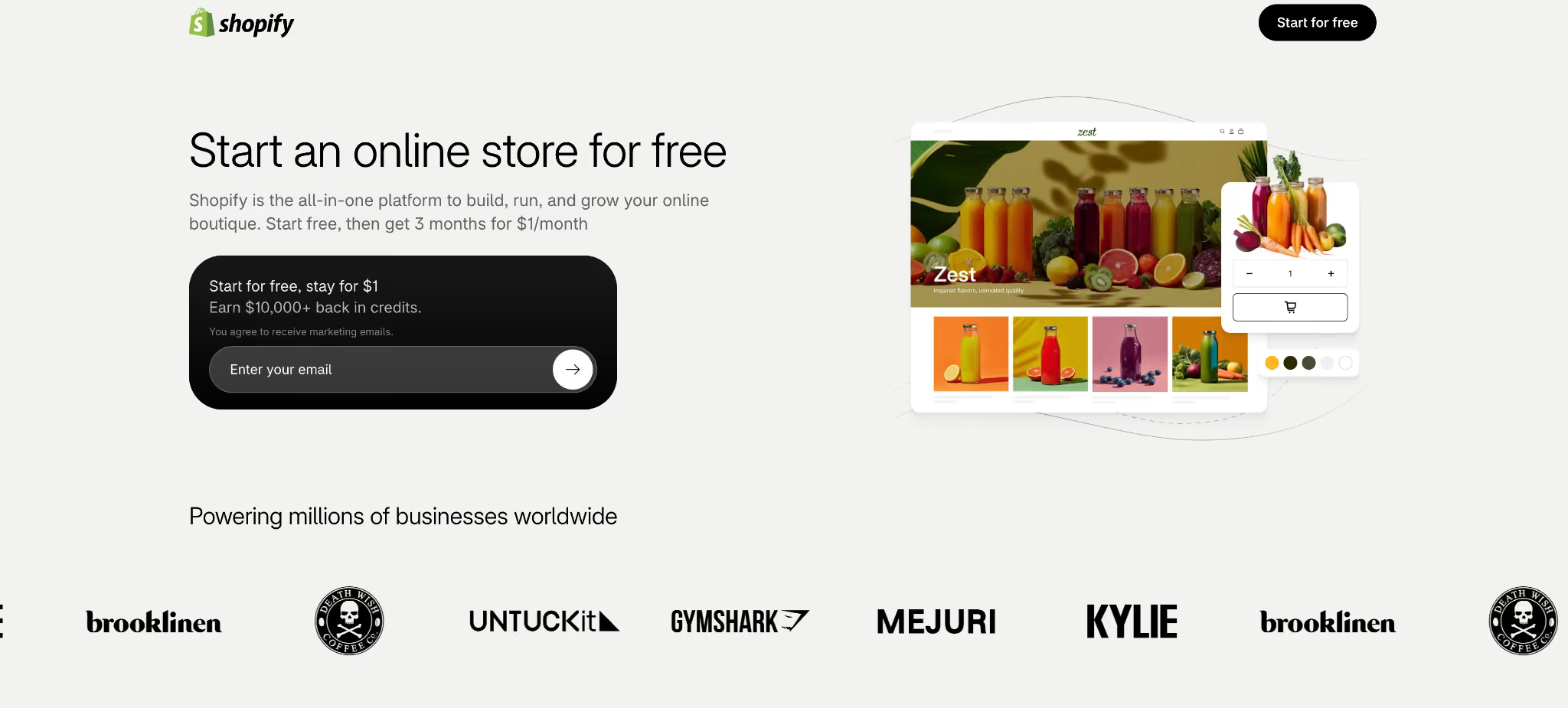
Shopify is worth examining when a brand wants to connect direct-to-consumer and wholesale selling. Its current B2B features-by-plan documentation lists B2B availability on Basic, Grow, Advanced, and Plus, so the old assumption that every wholesale store requires Plus is outdated. Basic, Grow, and Advanced support up to three active catalog assignments across all B2B markets and require the new Shopify Markets for those catalog features.
The important constraint is customer-level pricing: assigning catalogs directly to individual companies or company locations requires Plus, which also supports unlimited B2B market catalogs. That distinction matters when comparing a few wholesale price groups with individually negotiated customer agreements.
For standard setups, Shopify Plus pricing starts at $2,300 USD per month on a three-year term or $2,500 per month on a one-year term; more complex businesses may use variable platform fees. Those are Plus prices, not the minimum cost of accessing Shopify B2B. Scope apps, custom development, and integrations separately.
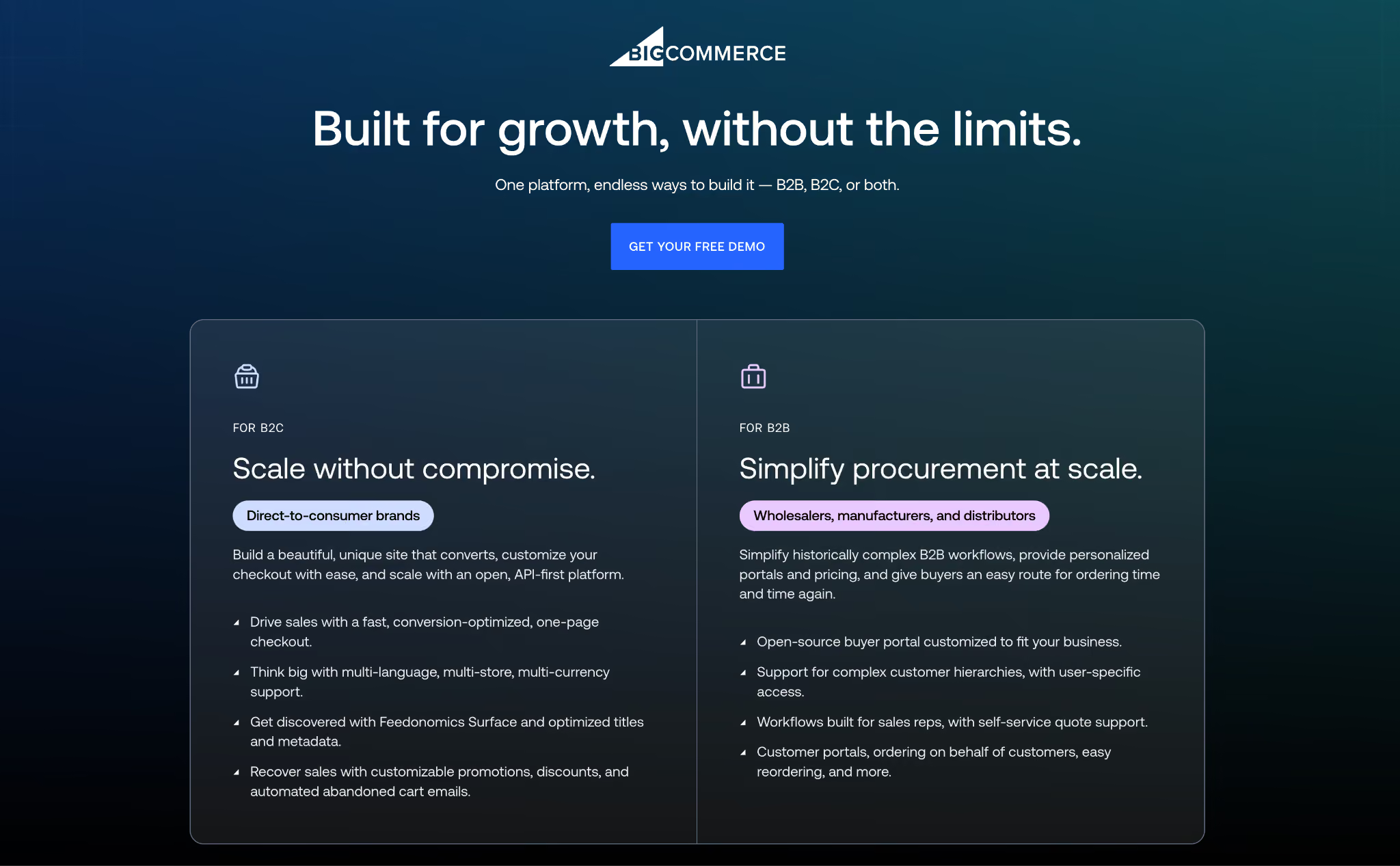
BigCommerce’s B2B offering combines buyer portals, account pricing, quoting, purchasing roles, and self-service ordering with the ability to manage B2B and B2C commerce. Its appeal is the combination of a hosted commerce platform and integration options for businesses that need wholesale functionality without treating their consumer and business operations as entirely separate systems.
The public BigCommerce pricing page lists Performance plans starting at $1,499 USD per month, billed annually. That starting figure should not be read as an all-inclusive quote for your B2B implementation. Request written confirmation of the B2B capabilities, storefronts, integrations, payment arrangements, and services included.
For a distributor, the decisive demonstration is whether the buyer’s account price and permissions survive the entire ordering process and arrive correctly in the back office. Ask which parts of that connection the vendor, an implementation partner, and your team will maintain.
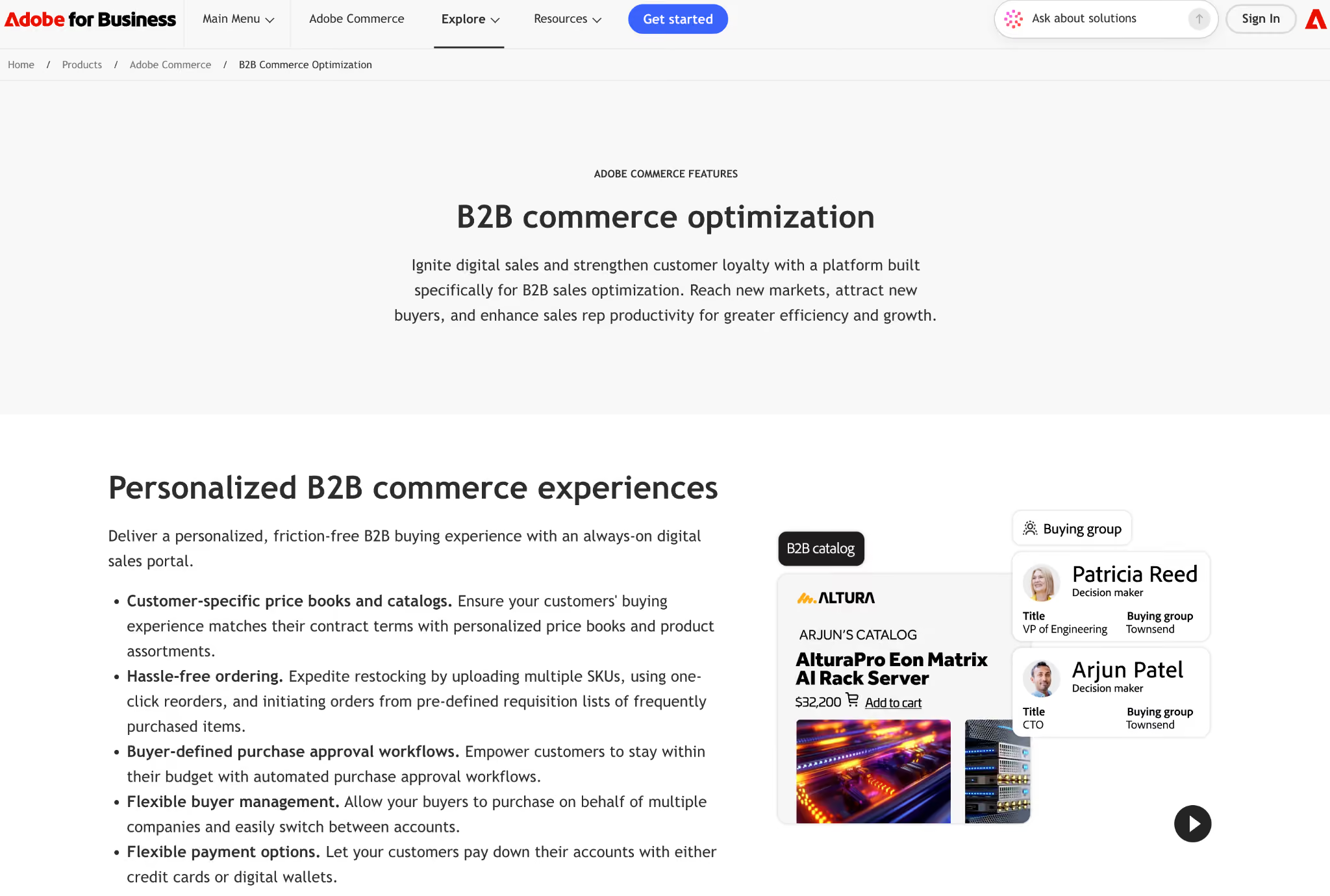
Adobe Commerce’s B2B capabilities include company-specific catalogs, negotiated quotes, purchasing approvals, requisition lists, and ordering through product-code uploads. These capabilities make it worth evaluating when wholesale buyers have structured procurement processes rather than a simple discount applied at checkout.
Be precise about the product being quoted. Adobe’s commerce packages and pricing distinguish Adobe Commerce as a Cloud Service, a multi-tenant software-as-a-service offering, from Adobe Commerce on Cloud, which uses dedicated cloud infrastructure. Adobe Commerce Optimizer is a storefront, catalog, and merchandising product that works with an existing transaction engine, not a like-for-like replacement for the complete commerce system.
Pricing requires a quote. The practical tradeoff is implementation scope: identify the deployment model, included B2B capabilities, integrations, and responsibility for custom workflows before comparing Adobe’s proposal with a simpler hosted-store subscription.
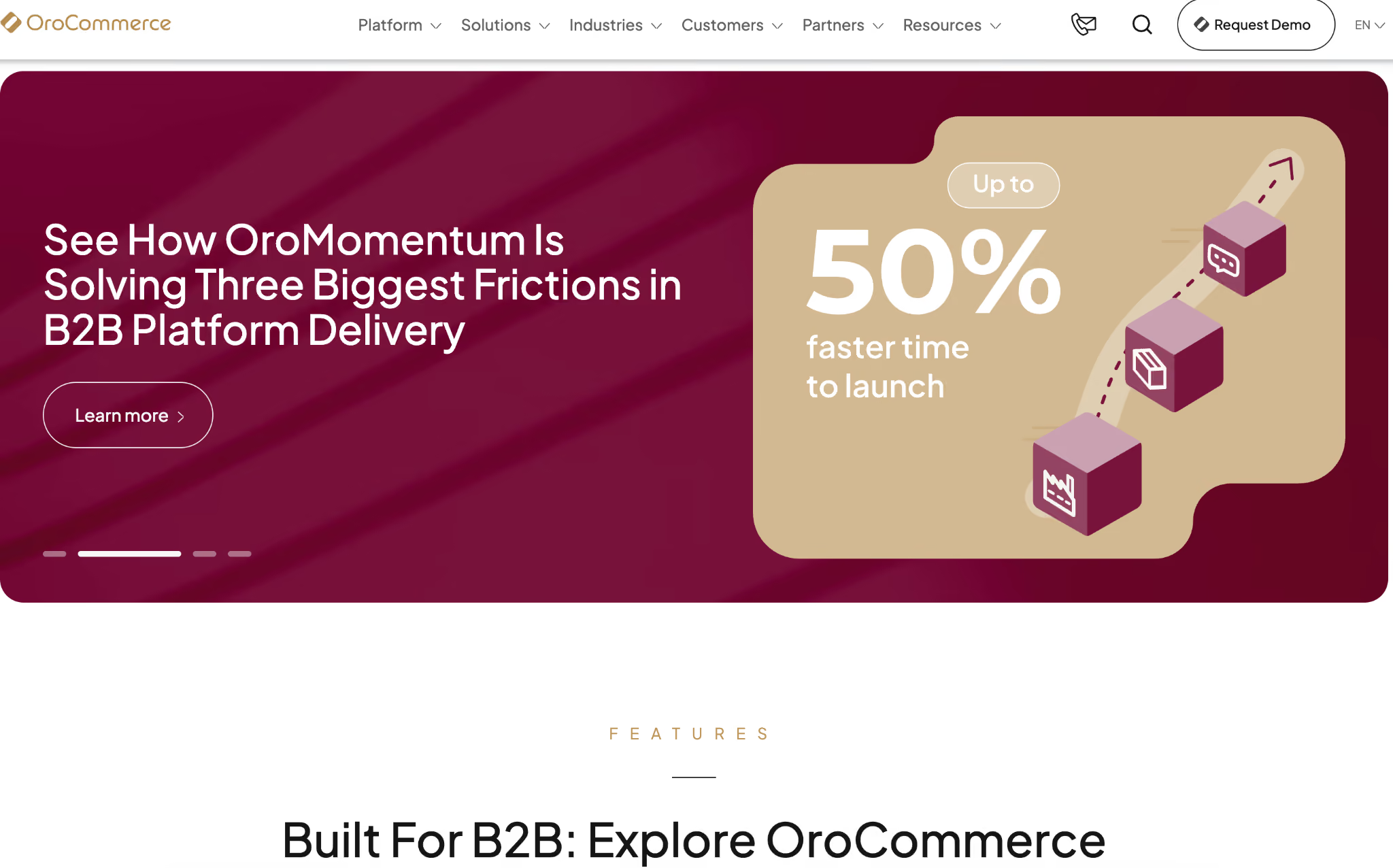
OroCommerce is built around B2B workflows for manufacturers, distributors, and wholesalers. Its documented capabilities include a visual workflow engine, customer-specific and tiered pricing, units and order minimums, quote management, and a built-in customer relationship management system.
The workflow engine is the distinctive evaluation point. A business with different approval rules by customer, role, or order condition should ask Oro to demonstrate those rules using representative accounts rather than a generic storefront.
Oro bases pricing on factors including deployment type, gross merchandise value, and administrator count, with a quote required. Its flexibility still needs an owner: determine who will maintain the business rules, test changes, and resolve integration exceptions after launch. A configurable workflow does not remove the need to decide how that workflow should operate.
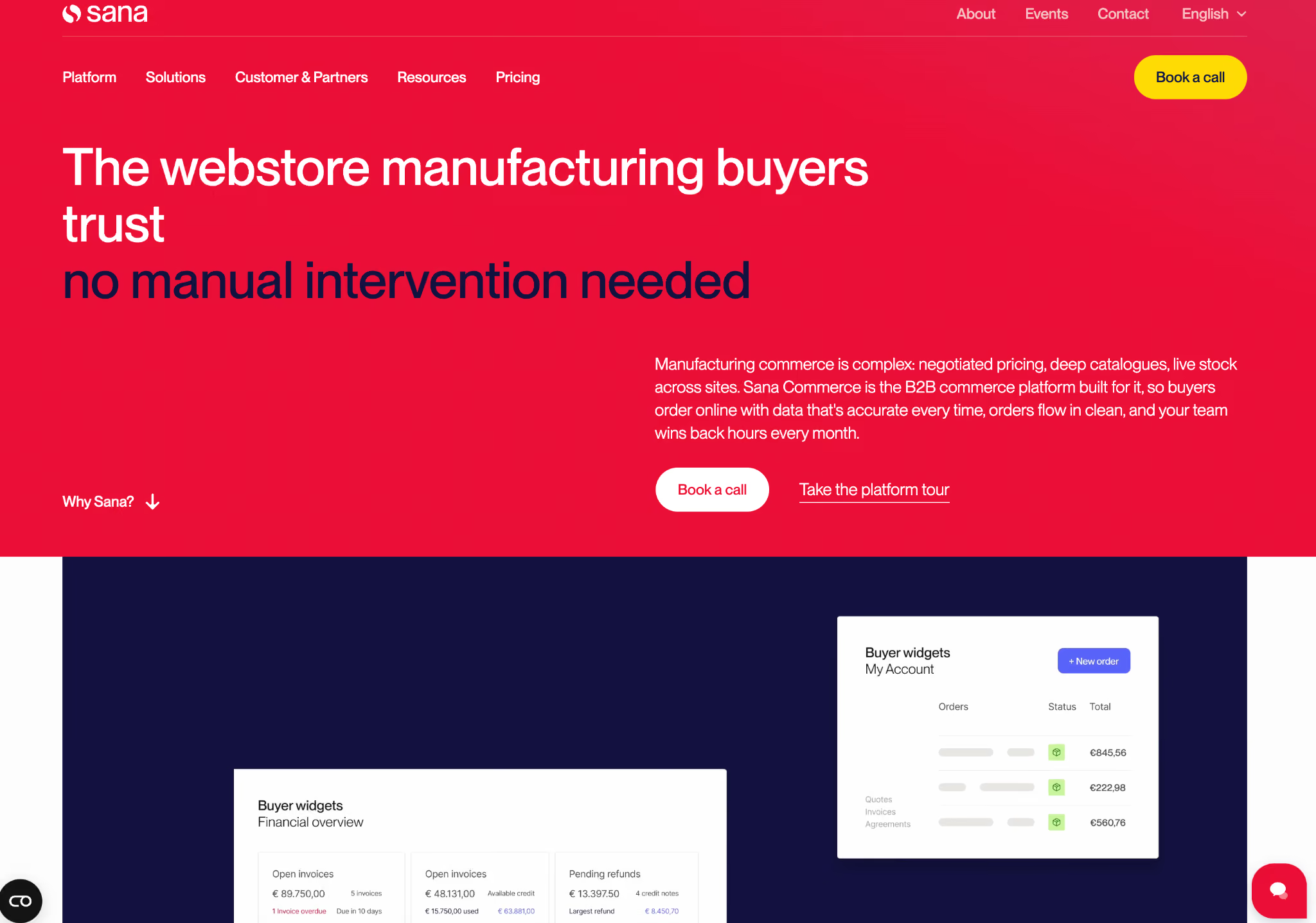
Sana Commerce centers its offering on integration with supported SAP and Microsoft Dynamics enterprise resource planning systems. ERP software manages operational records such as inventory, customer terms, and orders; Sana’s approach uses that existing business logic to power the buying experience.
That makes Sana a particularly relevant evaluation candidate when the ERP already contains the prices and customer rules the storefront must respect. The demonstration should show your actual ERP configuration supplying those values, including an account with unusual terms.
Sana’s pricing and package information uses Essential, Pro, and Advanced plans with pricing available by request. Supported ERP options and capabilities vary by package. Confirm the exact ERP version, customizations, and required functions before assuming that an ERP-centered architecture will fit your current environment without additional work.
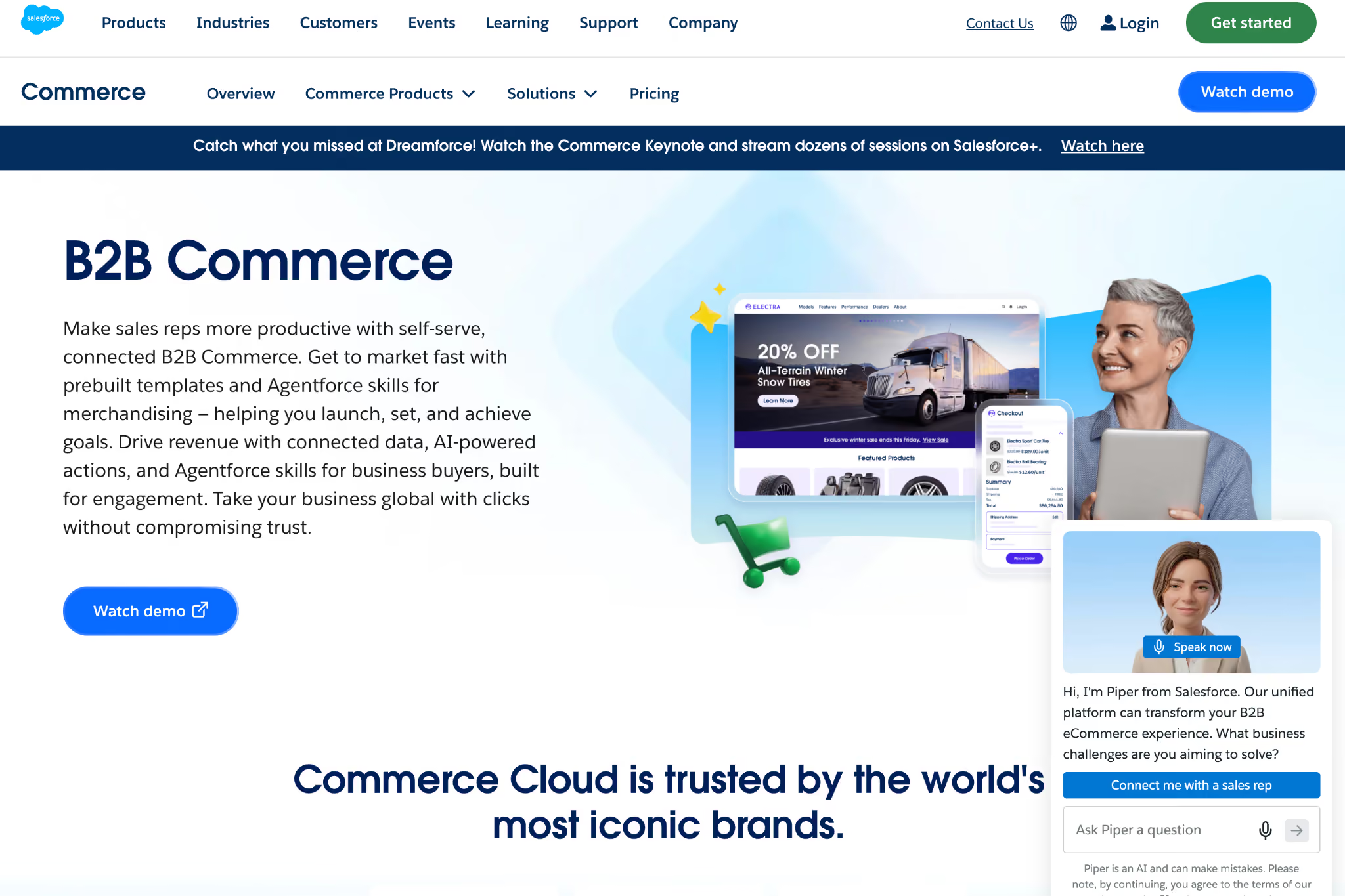
Salesforce B2B Commerce is worth considering when customer relationship management, sales assistance, and service interactions already revolve around Salesforce. Its documented buying capabilities include account-based product access, negotiated prices, purchasing for business locations, and splitting large orders into shipments.
The central question is whether connecting commerce to those existing customer records will remove meaningful handoffs. Ask the demonstration team to show how a sales-assisted order, a customer service request, and a buyer’s self-service activity remain connected.
The current Salesforce B2B pricing page lists Growth and Advanced editions with pricing by request and describes a gross-merchandise-value-based commercial model. Growth includes Order Management Lite, while Advanced includes full Order Management. Confirm edition entitlements, additional products, implementation services, and volume-based charges rather than assuming an existing Salesforce subscription already covers commerce.

WooCommerce provides an open-source, WordPress-based commerce foundation with control over the storefront, code, and extensions. It warrants consideration when a seller already works in WordPress and wants to assemble a wholesale setup around specific requirements. Evaluate the complete configuration, however, rather than assuming the core platform includes every B2B purchasing function.
One documented option is B2B for WooCommerce by Addify, listed at $179 for a one-year plan. The extension includes capabilities such as registration approval, customer or role-based pricing, quotation requests, and quantity controls. That price is an extension license, not the cost of hosting, implementation, maintenance, or a fully managed wholesale operation.
The tradeoff is ownership of the combined setup. Include compatibility testing, updates, backups, and support responsibility in the budget, especially when several extensions affect pricing or checkout.
Use the Five-Order Acceptance Test as a demonstration brief for your finalists. Instead of asking whether a platform “supports wholesale,” require it to complete five representative orders from start to finish.
Replace any irrelevant scenario with one of your own recurring exceptions. The point is representative coverage, not forcing unnecessary complexity.
For every test, record whether the solution is native, configuration-based, extension-based, or custom-built. Ask for the implementation cost, ongoing owner, and evidence of the completed transaction. A requirement that depends on unpriced custom work is not equivalent to a demonstrated included feature.
The useful comparison is the cost of running your required workflows, not the advertised software fee alone.
Separate implementation, migration, integrations, recurring licenses, hosting where applicable, maintenance, payment-related charges, and internal processing work. Ask how costs change with sales volume and payment arrangements; BigCommerce’s current pricing terms, for example, distinguish payment-provider fees by plan and provider category.
Then examine manual correction work. Without measured vendor-specific exception rates, the following illustrative scenario shows how to calculate that component without pretending it is an industry benchmark.
Assume Configuration A costs $400 per month in software and requires manual correction on 20% of orders. Configuration B costs $1,200 per month and requires correction on 4%. Each exception takes 15 minutes, with fully loaded labor valued at $36 per hour.
These are hypothetical inputs, not vendor prices, measured platform performance, or Stack Influence results.
Under those assumptions, exception labor costs $1.80 per order for A and $0.36 for B. At N monthly orders, modeled monthly software-plus-exception costs are $400 + $1.80 × N for A and $1,200 + $0.36 × N for B.
At 200 orders per month, A costs $760 and B costs $1,272. At 500 orders, A costs $1,300 and B costs $1,380.
At 1,000 orders, A costs $2,200 and B costs $1,560. At 2,000 orders, A costs $4,000 and B costs $1,920.
The two configurations cross at approximately 555.56 monthly orders, making B less expensive on these modeled costs at 556 whole orders or more. That conclusion depends entirely on the assumed correction rates, handling time, labor value, and fixed fees.
This is not a total-cost-of-ownership calculation. It excludes implementation, other operating expenses, payment processing, taxes, fulfillment, and ordinary order handling. Reduced correction work creates capacity; it does not automatically reduce payroll or produce additional sales.
Assign an authoritative system to each important record before migration. Decide where customer prices, company permissions, available inventory, product identifiers, and invoice status are maintained, then document how other systems receive changes.
Pay particular attention to the difference between individual units and cases. A successful checkout is not a successful integration if the warehouse receives the wrong unit of measure.
Run the Five-Order Acceptance Test again with migrated data, not just demonstration records. Include customers with unusual terms, products with pack-size restrictions, and orders that require assistance.
During the pilot, define a fallback for missing or stale information. A price lookup failure should trigger an agreed exception process rather than silently substituting a public retail price.
Also assign responsibility for failed updates, duplicate messages, and order reconciliation. Launch approval should depend on the end-to-end result and recovery process, not simply whether the storefront is online.
Measure whether buying companies can complete useful work, not just whether employees create logins. Start with a stable company identifier, consistent with the company-based account structure described in Shopify’s B2B documentation.
Use three connected measurement layers:
Review failures daily during the initial pilot. Use the first 30 days to identify stability and adoption problems, then examine 90-day cohorts where that window covers a meaningful reorder cycle. Extend the window for less frequent purchasers.
For acquisition reporting, connect campaign identifiers to the company record and completed order wherever possible. Preserve sales-assisted interactions rather than assigning all credit to the final website visit.
Compare results with a documented baseline and account mix. Changes in pricing, assortment, customer demand, or sales activity can affect outcomes, so improved results after migration do not establish that the platform alone caused them.
For DTC brands selling through retail partners, the wholesale portal and the consumer marketing program should have different objectives. The portal supports purchasing and account service; a Shopify influencer marketing program should be planned around consumer discovery, content, traffic, and attributable customer actions.
Stack Influence’s automated product-seeding workflow supports the campaign side through creator coordination, product purchase and reimbursement workflows, and verification of completed social posts. Treat that as complementary to the commerce infrastructure, with a separate campaign budget and performance review.
A useful operating step is to coordinate inventory before activating creators while preserving stock allocated to wholesale commitments. Also specify where creator assets will be used; the planning considerations in a UGC advertising brief help separate content production from the permissions and deliverables needed for later campaigns.
The right B2B ecommerce platforms to evaluate are the ones that match your customer agreements, purchasing processes, and existing systems. The final choice should rest on demonstrated order handling and a complete commercial proposal, not a polished storefront or an attractive starting fee.
Use the Five-Order Acceptance Test to narrow the shortlist, replace illustrative cost assumptions with your own measurements, and verify that every important integration has an owner.
Send your finalists the same test orders and ask them to demonstrate, price, and document each workflow before you commit. That makes the comparison more useful and the implementation easier to hold accountable.
A product costs $12 from a supplier and sells for $32 on Amazon. That looks like a strong opportunity, until fulfillment, selling fees, returns, and a lower selling price consume the difference.
Amazon reselling starts with finding products, but the buying decision needs more than a price comparison. For ecommerce sellers, the practical questions are whether the inventory is eligible, whether the numbers survive competition, and how much stock your own offer can realistically sell.
This guide focuses on the U.S. Amazon marketplace, with a worked margin calculation, current sourcing and labeling requirements, and a method for limiting each purchase.
Amazon reselling means sourcing existing products and offering them for sale through an Amazon selling account. Rather than manufacturing a new product, a reseller typically purchases inventory from another business and earns the difference between sales revenue and the costs of acquiring and selling it.
Amazon’s guide to reselling describes a process of sourcing products, listing offers, fulfilling orders, and managing the business. Where an exact product already exists in the catalog, sellers can generally match an offer to that product page, subject to applicable approvals.
The product identifier, or ASIN, stands for Amazon Standard Identification Number. A product page describes the item; your offer adds seller-specific details such as price, condition, availability, and delivery.
That distinction should shape your buying decisions. Demand for a product is not a commitment to purchase from your business, and buying inventory does not mean you own the brand or its product page.
A resale purchase can remain profitable after a price reduction only if the remaining revenue still covers its costs. Start with unit contribution, then account separately for fixed overhead and taxes before calling the result net profit.
Unit contribution equals selling price minus acquisition cost, referral fees, fulfillment, preparation and inbound costs, expected storage and return losses, and any other variable selling expenses.
Consider an illustrative Home and Kitchen product. Amazon’s U.S. selling-fee schedule lists a 15% referral fee for that category, subject to its minimum fee; other categories can have different rates and thresholds.
For this example, assume a $12 acquisition cost, $1.50 for preparation and inbound costs including any allocated placement expense, $5 for fulfillment, and $1.50 for expected storage and return losses. Those non-referral costs total $20 per unit.
The $5 fulfillment figure and both $1.50 allowances are assumptions, not Amazon fee quotes or observed averages. Assume the Professional plan and no advertising, separately charged shipping, gift wrapping, discounts, or referral-bonus credits. The monthly plan charge, owner labor, overhead, and income tax are excluded.
With those assumptions, contribution equals selling price multiplied by 85%, minus $20:
The break-even price is approximately $23.53. To retain at least $3 in contribution, the selling price needs to be approximately $27.06 or higher under the same assumptions.
This is the practical difference between a markup and a buying decision. The gap between $12 and $32 looks generous, but it does not establish how far you can reduce the price safely.
Calculate a maximum acquisition cost as well as a minimum selling price. At a conservative $26 selling price, the same $8 in non-acquisition costs and a $3 contribution target leave a maximum purchase price of $11.10: $26 × 85% − $8 − $3.
A supplier asking $12 has not necessarily offered a bad product. The offer simply misses this particular purchasing threshold.
Use the Amazon selling-cost breakdown as a checklist for expenses, then replace every illustrative allowance with current product-specific estimates. Repeat the calculation whenever size, weight, sourcing costs, or fulfillment arrangements change.
Choose suppliers based on authenticity, usable documentation, replenishment terms, and economics together. A low purchase price cannot compensate for an inventory source you cannot substantiate.
Wholesale can support repeat purchasing when the supplier has reliable stock and terms that permit your intended sales channel. Before accepting a minimum order, establish who supplies the goods, what documentation will accompany them, and whether the brand or Amazon requires authorization for your proposed activity.
Ask about lead times, damaged goods, shortages, and returns before paying. Those terms belong in the buying calculation because an attractive unit price can require an uncomfortable amount of inventory or leave little recourse for problems.
Retail arbitrage involves buying products from retail stores for resale; online arbitrage uses online retailers as the purchasing channel. Amazon’s reselling guidance on retail arbitrage allows for this model within its requirements and notes that additional documentation may be needed.
Do not assume a checkout receipt will satisfy a particular approval request. Check what your account is being asked to provide before purchasing, and retain the original records rather than treating documentation as something to reconstruct later.
Used inventory requires a separate condition assessment, not merely a lower price. Amazon’s condition guidelines distinguish condition grades and include category-specific requirements, including separate guidance for books.
Inspect each unit rather than assigning one grade to an entire batch. An item that looks unused is not automatically eligible to be listed as New, and a familiar brand name does not establish authenticity or completeness.
Check the exact product through your own selling account before placing an order. Under Amazon’s branded-product listing process, sellers search through Catalog, select Add Products, choose the condition, and follow an Apply to sell prompt when approval is required.
For brand approval, Amazon says the application can require a manufacturer or distributor invoice, or a brand authorization letter. Follow the actual request for your account rather than relying on a universal invoice-age, quantity, or documentation rule from a third-party checklist.
Keep the supplier’s identity, transaction records, product identifiers, and quantities together. A document should describe the inventory you actually purchased, not simply establish that you have bought something from the supplier before.
Next, match the physical item to the intended ASIN: brand, model, size, color, pack count, edition, and included accessories. A two-pack is not interchangeable with a single unit, even when the product photographs look similar.
Use the product-listing accuracy checks to review how the item is represented, but distinguish checking a shared page from having permission to create or change one. Amazon’s approval to match an offer does not automatically confer brand-owner privileges.
Safety checks also belong before purchase. The U.S. Consumer Product Safety Commission’s reseller guidance advises inspecting inventory for safety and compliance and checking recalled products before taking them into inventory or selling them.
Prepare the selling account and fulfillment process before committing to a large shipment. Amazon’s seller registration guide explains the business, identity, banking, and verification information involved in setting up an account.
The current selling-plan comparison lists the Individual plan at $0.99 per item sold and the Professional plan at $39.99 per month, with additional selling fees under both. Choose based on required features and expected activity, not the subscription fee alone.
With Fulfillment by Amazon, Amazon handles storage, picking, packing, shipping, customer service, and returns for enrolled inventory. Fulfilled by Merchant means you retain responsibility for fulfillment, either directly or through a service provider.
Use the Revenue Calculator on Amazon’s pricing page to compare the same product under both arrangements. Include storage, packaging, shipping, preparation, and the work involved in handling returns rather than comparing an FBA estimate with postage alone.
FBA is a fulfillment service, not product approval or a sales guarantee. You still need an eligible, accurately described product and economics that work after its actual fees.
Amazon’s announcement ending commingling introduced new requirements for inventory shipped on or after March 31, 2026. Resellers without the Brand Representative selling role in Amazon Brand Registry must use Amazon barcode stickers even when products already carry manufacturer barcodes.
Qualifying brand owners with that role can use manufacturer barcodes for eligible products. Products without a manufacturer barcode require Amazon barcode stickers under the announcement.
Do not equate a supplier’s authorization letter with the specific Brand Registry role. Confirm the barcode requirements for the inventory before arranging preparation and shipment.
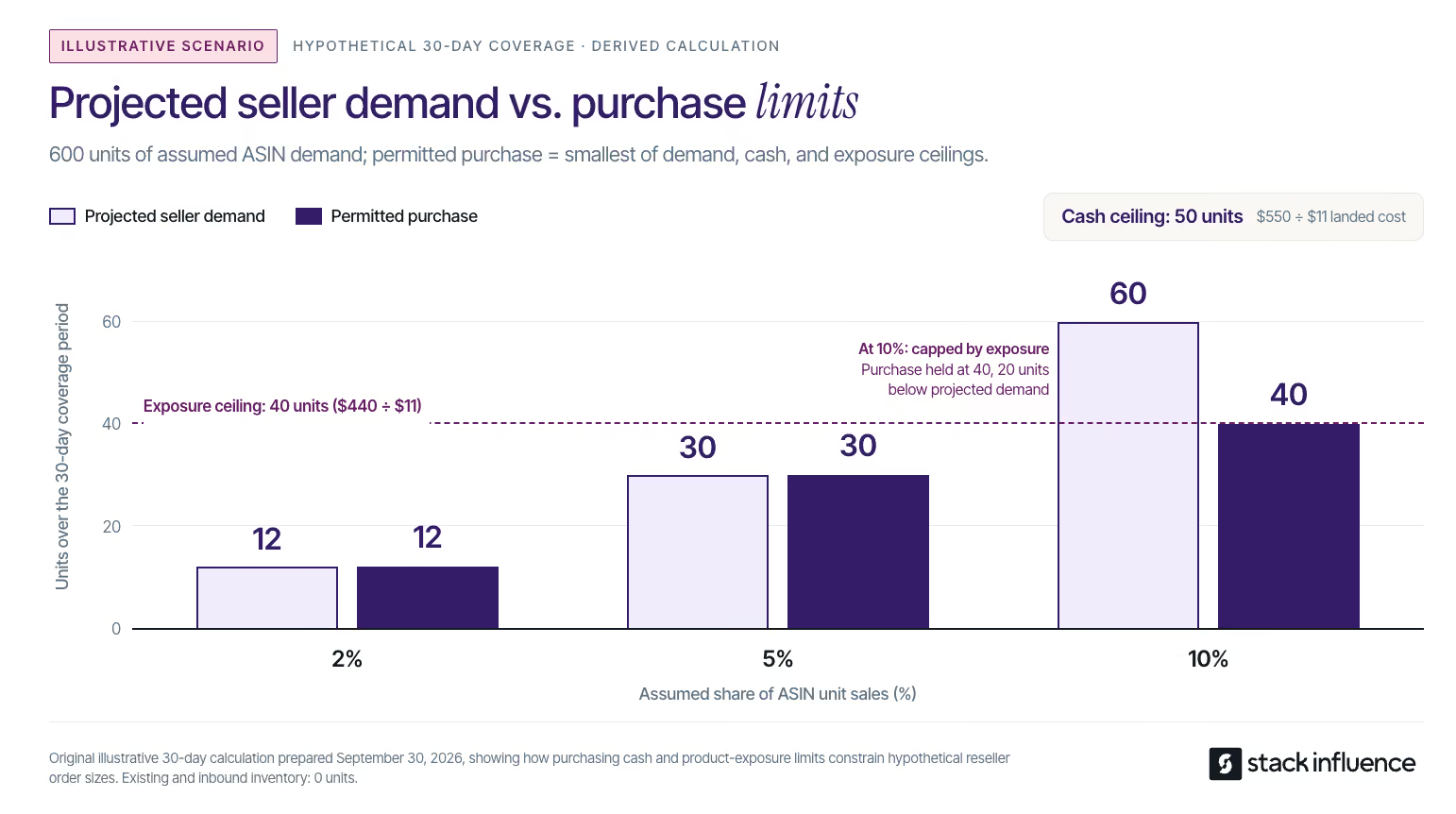
Limit each order to the smallest of three quantities: what your offer can reasonably sell, what your available cash can fund, and how much capital you are willing to expose to one product. This proposed buying rule turns a promising product into a bounded inventory decision.
Eligibility, authenticity, and acceptable unit economics come first. A product that fails those checks should not become eligible merely because you can afford it.
Estimate your own sales during the coverage period, then subtract sellable inventory and confirmed inbound stock. Use a period that reflects the supplier’s replenishment lead time and your planned reorder cycle.
Amazon’s Featured Offer guidance now describes an Offer Display containing one or more Featured Offers. Price, delivery, customer experience, and stock availability matter; total product-page demand should not be treated as your forecast.
Start with your actual sales where available. Do not divide estimated ASIN sales equally by the number of sellers or assume a Featured Offer visibility percentage is identical to an order-share percentage.
Divide cash available for this purchase by its landed unit cost, rounding down to whole units. First reserve money for expected charges, returns, operating expenses, and existing commitments.
Define landed cost consistently. Include acquisition and the upfront costs required to make the unit ready for sale, while separately reserving cash for later expenses.
Set a maximum amount of inventory capital you are prepared to have tied up in this product. Subtract existing exposure, then divide the remainder by the same landed unit cost.
The smallest ceiling controls the order. Round down further for case-pack requirements; when a supplier’s minimum exceeds your limit, negotiate the order rather than quietly removing the limit.
For a separate example, assume a product sells 600 units across all sellers in 30 days. Your hypothetical sales shares of 2%, 5%, and 10% would represent 12, 30, and 60 units respectively.
Assume a 30-day coverage period, no existing or inbound inventory, and an $11 landed unit cost. A $550 purchasing budget after reserves creates a 50-unit cash ceiling, while a $440 product-exposure limit creates a 40-unit exposure ceiling.
The permitted purchases are therefore 12 units at the 2% share assumption, 30 units at 5%, and 40 units at 10%. The last scenario is capped below its 60-unit demand estimate because the exposure limit is tighter.
These are illustrative assumptions, not observed Amazon sales or recommended market-share benchmarks. Without your own demand evidence, use a smaller test and replace the assumptions with actual order data before expanding.
Measure the first purchase as an inventory batch, not simply as part of a growing revenue total. Record when cash leaves, when units become available, what sells, and what remains unsold.
Review availability, competitive delivered price, and delivery performance weekly as early indicators. Track your own units sold after returns, realized contribution, inventory capital still tied up, and cash received as outcome measures.
Reconcile the batch after 30, 60, and 90 days as a suggested operating cadence, extending the review where returns or inventory remain unresolved. Replace estimated return and storage allowances with actual costs as information matures; do not deduct both the full allowance and the same realized cost.
Reorder when the evidence supports another purchase under the Three-Ceiling Buying Rule. Revenue growth alone does not show that the inventory is producing acceptable returns on the cash and work it requires.
Creator marketing becomes worth testing when the reseller has reliable supply, appropriate brand and content permissions, and enough contribution to fund customer acquisition. It should not be used to rescue a purchase that only works at an unrealistic selling price.
A further complication follows from Amazon’s shared product pages: generating interest in an ASIN does not guarantee that every resulting order goes to your offer. Account for that possibility when deciding how much to spend on external traffic.
For brand-supported campaigns, Stack Influence’s automated product-seeding workflow coordinates gifted-first creator participation and content completion. The operational output is completed creator content; evaluate sales outcomes separately rather than treating posts as proof of profitable demand.
According to Amazon Attribution’s eligibility documentation, eligible users include Professional sellers enrolled in Amazon Brand Registry. An ordinary resale account should not assume it has access merely because it sells on Amazon.
The Amazon Brand Referral Bonus also has enrollment requirements and provides credits against future referral fees on qualifying sales. Do not build an assumed bonus into every resale unit’s margin; use the bonus rates and credit-reconciliation guide to separate potential credits from applied credits.
Measure tagged purchases alongside your own orders, campaign costs, and inventory movement. Separate any reimbursed creator transactions from non-incentivized customer demand, and avoid treating a sales increase during a campaign as proof that the campaign caused it.
For DTC brands combining resale with an owned storefront, Shopify influencer marketing involves a different checkout and measurement environment. Keep the channels’ economics separate, and confirm content usage rights before reusing creator assets.
The FTC’s influencer disclosure guidance explains that free products and other material connections can require clear disclosure. Product gifting does not remove that responsibility.
Amazon reselling works as a repeatable business only when sourcing, eligibility, unit economics, and inventory decisions hold together. A discounted product is a lead to investigate, not a completed business case.
Before the next purchase, document the supplier, verify the exact offer, calculate the lowest acceptable selling price, and set a maximum order quantity. Use the first batch to test those assumptions, then expand only when actual sales and costs support the decision.
Build that buying record for one product before increasing your inventory budget. The benefit is not just avoiding a weak purchase; it is knowing why a sound purchase deserves more capital.
A price change can produce more orders and less money to run your business. The mistake is treating the selling price as the decision, instead of calculating what remains after the order is fulfilled.
For ecommerce sellers, repricing on Amazon should start with a permitted range of economically acceptable prices, not a rule that follows every competitor downward. This guide explains how to calculate that range, choose an automation approach, avoid fee thresholds that undermine your margin, and judge whether the resulting sales are worth having.
Repricing means adjusting an offer’s selling price manually or automatically as pricing conditions change. The useful question is not how often the price moves, but which movements your economics can support.
Build a Permitted-Price Map for each SKU, your stock-keeping unit, before connecting it to an automated rule. Give the map four controls:
This is a planning framework, not a claim that every repricing tool supports each control directly. Translate the map into available settings and retain manual approval where necessary.
Start with current product and fulfillment costs. Amazon’s Revenue Calculator and fee-estimation tools help estimate selling and fulfillment costs, including comparisons between Amazon FBA and merchant fulfillment; add business-specific costs the estimate does not capture.
For a simplified situation with one percentage-based referral fee and otherwise constant per-unit costs:
Minimum price = (other per-unit costs + required contribution) ÷ (1 − referral fee rate).
Consider an illustrative scenario with $18 in other per-unit costs, including product, fulfillment, expected returns, and a marketing allowance. Assume a flat 15% referral fee, no separate buyer-paid shipping or gift wrapping, no discounts or credits, and no taxes in revenue; fixed overhead is excluded. The 15% rate is an assumption for this example, not a universal Amazon fee.
Contribution per unit therefore equals price × 0.85 − $18. A $30 price leaves $7.50; $29 leaves $6.65; $28 leaves $5.80; and $27 leaves $4.95.
To retain at least 5perunit,thecalculatedflooris(18 + $5) ÷ 0.85 = $27.0588, rounded upward to $27.06. Rounding downward would miss the stated target.
The 30-to-28 reduction cuts price by 6.7% but contribution per unit by 22.7%. Maintaining the original total contribution would require 29.3% more units, calculated as $7.50 ÷ $5.80 − 1, assuming the same per-unit costs.
That is the hurdle a discount must clear in this scenario. Higher sales are not sufficient evidence that the change worked.
Keep an order-level marketing allowance distinct from customer acquisition cost, which measures spending against genuinely new customers. Recalculate the floor when fulfillment costs, promotional spending, or return expectations change, rather than assuming yesterday’s allowance remains accurate.
Compare the total delivered price of genuinely comparable offers, not the lowest number anywhere on the site. Amazon’s Featured Offer guidance explains that the Offer Display, often called the Buy Box, can contain one or more Featured Offers and that price, delivery, order experience, and stock availability matter.
Start with the same product and condition. A used item, different pack size, or slower delivery promise should not automatically become the reference for a new, promptly delivered offer.
Do not assume Amazon FBA alone resolves the comparison. Amazon’s guidance also recognizes merchant fulfillment as a viable route to Featured Offer placement; evaluate the actual customer offer rather than treating the fulfillment label as a guaranteed advantage.
For a reseller sharing an Amazon Standard Identification Number, or ASIN, the immediate decision concerns competing offers on the same product detail page. A rule might respond to a comparable offer while staying inside the Permitted-Price Map.
For a private brand, automatically copying a different product’s price can erase differences in quantity, materials, warranty, or positioning. Treat comparable products as context for a deliberate price test, not as interchangeable offers.
Separate a pricing problem from a communication problem. Review Amazon product listing optimization before assuming a discount is the only way to address unanswered questions about fit, use, or product value.
Choose manual repricing while the catalog and frequency of decisions remain manageable. It keeps unusual pricing decisions visible, although the seller must perform the monitoring and updates.
A rule-based approach suits explicit instructions, such as matching a defined reference subject to a floor. An algorithmic approach delegates more of the price selection, making the quality of cost inputs and safeguards especially important.
Amazon’s Automate Pricing tool is included without an additional tool charge for Professional sellers with active offers. It supports competitive and sales-based rules, including pricing above, at, or below a reference price.
Specialist products expose different controls. BQool’s repricing features include rule-based and AI approaches with inventory-related conditional strategies, while Repricer’s strategy options include cost-based limits and rules differentiated by fulfillment type.
Treat those as feature examples, not a tested ranking. Confirm which subscription includes the controls you need, how costs are updated, and whether price histories and exceptions can be exported.
The purchasing test is practical: can the tool reproduce your Permitted-Price Map without silently relaxing it? A faster repricer does not solve an incorrect cost model, and a profit-protection label does not establish that every business expense has been entered.
Start with a small group of products whose costs, inventory, and recent sales you understand. Keep launch products, clearance inventory, and stable replenishment products in separate groups because they have different objectives.
Amazon’s native setup instructions direct sellers to Seller Central → Pricing → Automate Pricing, then to choose a rule, select SKUs, set a minimum and optional maximum, and start repricing.
The settings are only part of the launch. Preserve the current price, rule, cost assumptions, and permitted boundaries before activation so you can reconstruct what changed.
Designate one system to control a SKU’s active price. Before activation, inspect other repricers, inventory integrations, scheduled uploads, and manual routines that could overwrite the same field.
Assign a named person to exceptions. That person should be able to pause the rule, inspect the live offer, and restore an approved price when appropriate; pausing alone is not evidence that the displayed price has returned to its previous value.
Check the actual customer-facing offer after changes. A saved setting and a verified live price are different checkpoints.
Calculate what the customer pays and what the seller retains when a coupon, business discount, or other eligible promotion overlaps with repricing. Do not assume the repricer’s minimum automatically protects the final promotional transaction.
Use a realistic maximum supported by your commercial offer and pricing history. Amazon’s pricing-policy explanation describes potential action against misleading or unfair pricing, including excessive shipping charges; a software ceiling is not permission to ignore marketplace requirements.
Hold the approved floor when the competing price falls below it. Investigate whether the gap comes from different costs, liquidation, a different offer, or your own incorrect inputs before authorizing a loss.
Set stop conditions for missing cost data, unexpected fee changes, overlapping discounts, and inventory discrepancies. A deliberate clearance decision can use different economics, but it should have an explicit budget and end condition rather than emerge accidentally from a competitive rule.
When an offer loses visibility, inspect Pricing Health and your Amazon sales-readiness checks before repeatedly lowering the price. Repricing should respond to a diagnosed problem, not substitute for diagnosis.
A higher selling price can leave less money after referral fees when it crosses a category threshold. This is why a minimum and maximum may not adequately describe your permitted prices.
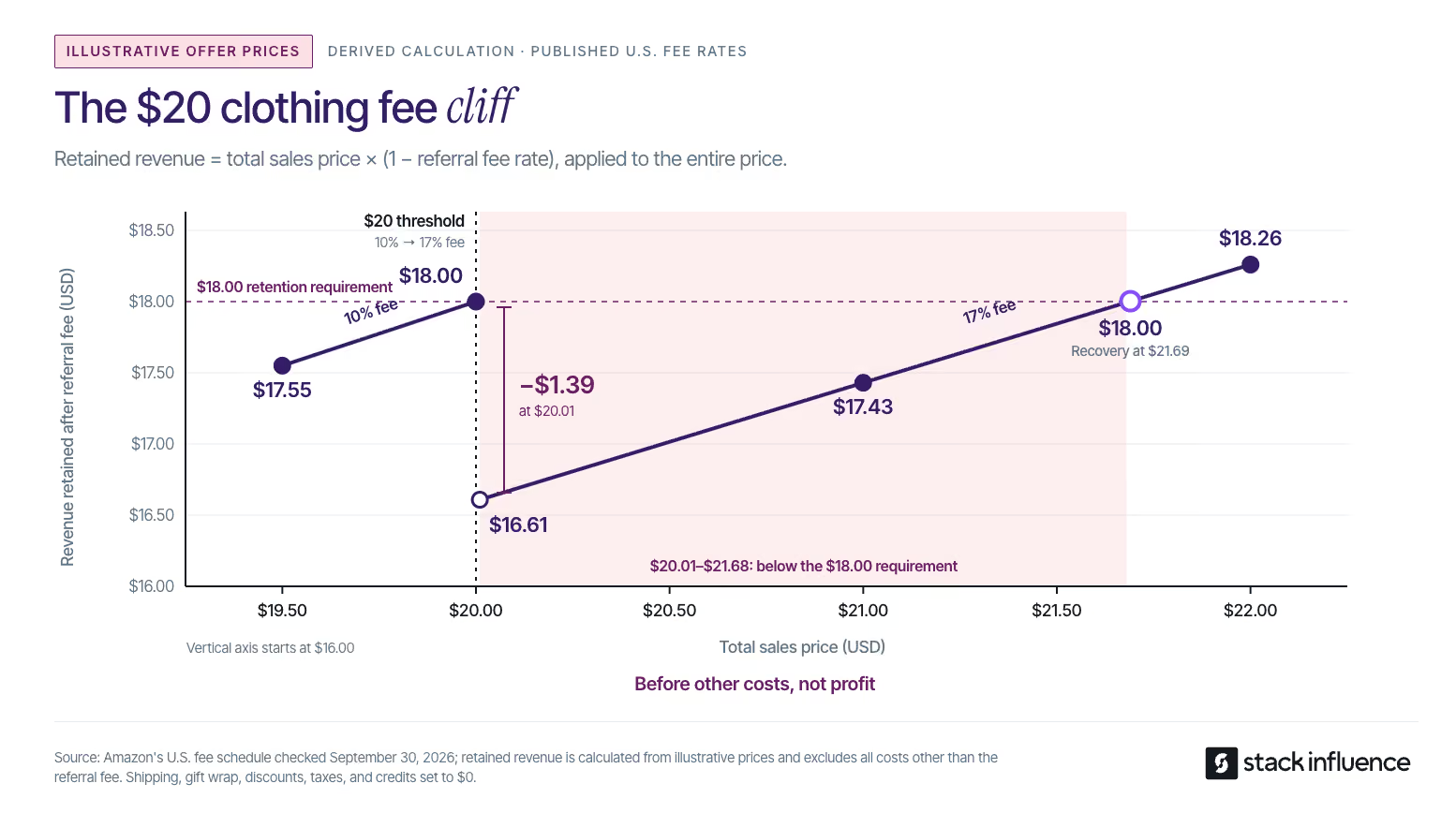
Amazon’s U.S. referral-fee schedule, checked September 30, 2026, lists Clothing and Accessories at 10% for total sales prices above $15 and up to $20, and 17% above $20. The higher rate applies to the total sales price, not just the amount exceeding the threshold.
Here is a derived example using illustrative offer prices and those published rates. Assume no buyer-paid shipping, gift wrapping, discounts, or taxes in the price; exclude all other costs and credits so the calculation isolates the referral fee.
At $19.50, the amount retained after the referral fee is $17.55. At $20.00, it is $18.00; at $20.01, it falls to $16.61; and at $21.00, it is $17.43.
A $21.69 offer retains approximately $18.00, while $22.00 retains $18.26. These amounts are revenue after the referral fee, not profit.
The one-cent increase from $20.00 to $20.01 therefore reduces the retained amount by approximately $1.39. To recover the $18 retained at a $20 price, solve $18 ÷ 0.83 = $21.6867 and round upward to $21.69.
For a policy requiring at least $18 after referral fees, the prices from $20.01 through $21.68 would fail that requirement. They are not universally wrong prices, but they do not satisfy this particular policy.
Evaluate candidate prices within each applicable fee band, then exclude those that miss your contribution target. Where a tool cannot represent excluded bands, constrain the automated range and require approval for crossing the threshold.
Check the product’s assigned fee category and current estimates before applying this example. Do not transplant clothing economics into another category, marketplace, or promotional situation.

Repricing is working when it improves the financial outcome you chose without violating your operating constraints. For a replenishment product, contribution over the whole period is a more useful primary measure than revenue or Featured Offer percentage alone.
Calculate contribution from revenue excluding taxes and adjusted for discounts and refunds, less the associated product, fulfillment, platform, and marketing costs. Reconcile credits and return-related adjustments consistently, and avoid subtracting the same cost twice through both an allowance and an actual expense.
Use three layers of measurement:
A possible operating comparison is a 14-day baseline followed by a 14-day pilot, provided sales volume is sufficient to make the comparison useful. That captures repeated weekdays, but it is not a guarantee of statistical reliability or a randomized experiment.
Keep stockouts in the whole-period financial result, while also examining in-stock performance to diagnose the cause. Removing unprofitable days from one period would make the comparison misleading.
Record changes in advertising, promotions, delivery promises, and competitor availability alongside the price history. The same discipline used to compare Amazon PPC and external traffic applies here: evaluate the money retained, not merely sales attributed to an activity.
Return to the original economic hurdle. In the 30-to-28 scenario, an order increase below 29.3% would not preserve total contribution under the stated assumptions, even if the sales dashboard looked busier.
Do not launch a new content campaign and a price experiment simultaneously, then attribute the entire sales change to the repricer. Separate their timing when feasible, or clearly record that the result combines multiple changes.
For brands using micro influencers or nano influencers, record creator posting dates and campaign costs. Stack Influence’s gifted-first product-seeding workflow coordinates creator participation and completed content; those campaign activities need their own records alongside the pricing test.
Where campaign records identify funded creator purchases, keep them separate from independent customer demand in the evaluation. Gifted or reimbursed endorsements also need clear disclosure under the FTC’s influencer disclosure guidance.
Treat Amazon listing split testing with UGC as a separate way to investigate product communication. A UGC video test and a selling-price test answer different questions.
Eligible brands can use Amazon Attribution to measure tagged off-Amazon activity; its reports use a 14-day attribution window. Allow comparable conversion windows to mature, and remember that attribution does not isolate the causal effect of a price change.
Keep conditional incentives separate as well. The Amazon Brand Referral Bonus provides referral-fee credits on qualifying activity, so do not lower an entire SKU’s price floor as though every future order will earn that credit.
Effective repricing on Amazon is a controlled economic decision, not a competition to move prices fastest. Define the contribution target, compare the right offers, inspect fee thresholds, and preserve a way to stop or reverse the rule.
Begin with one product whose costs you can reconcile. Build its Permitted-Price Map and write down the contribution result that would justify keeping the new rule, so the next price change has to earn its place in your business.
Before adding more keywords or increasing your advertising budget, identify where a shopper's journey breaks. Is your listing unavailable, poorly matched to the search, overlooked in the results, or unconvincing after the click?
For ecommerce sellers, useful Amazon keyword ranking tips should connect a search term to a specific action, not another round of keyword stuffing. This guide shows how to choose relevant queries, improve the listing that serves them, use advertising and creator content deliberately, and measure progress without confusing visibility with sales.
Audit one product and a defined group of search terms before changing the listing. The Query-to-Order Audit is a practical decision sequence, not a description of Amazon's algorithm or a formula for guaranteed rankings.
Amazon keyword ranking means a product's position for a particular search query. Organic position excludes sponsored placements, while Best Sellers Rank measures category sales performance; Amazon's explanation of BSR versus search ranking makes clear that one does not guarantee the other.
Work through five checkpoints:
Address the earliest unresolved checkpoint first. Rewriting a title is not a remedy for unavailable inventory, and more impressions do not resolve an unclear product offer.
Also distinguish keyword breadth from keyword position. Stack Influence's four-month Happy Viking case study recorded 171 new ranking keywords and 222 creator promotions. Those figures describe expanded keyword coverage and campaign activity, not a uniform position improvement across every search term or proof that creator activity alone caused the changes.
That distinction matters when a campaign report looks impressive but your highest-priority query has barely moved.
Prioritize queries that accurately describe your product and show evidence of relevant customer demand. Use search volume to estimate the size of an opportunity, then examine whether the shoppers behind that query want what you sell.
Start with customer language, not an exported list of every imaginable variation. Amazon's keyword research guide identifies autocomplete suggestions, competing listings, and customer feedback as useful research inputs. Review the products appearing for each candidate term and note the expected material, size, pack quantity, use case, and price range.
For a compartmented lunch container, “bento lunch box” might describe the product accurately, while “insulated lunch bag” would describe a different purchase. A high-volume mismatch does not become a sensible target simply because it offers more potential impressions.
Keep branded queries separate from non-branded product queries. Within the non-branded group, distinguish broad category terms from specific feature or use-case terms. This makes it easier to decide whether you are defending existing demand, expanding discovery, or improving a narrowly defined match.
For additional demand research, Product Opportunity Explorer provides Amazon customer-search and product-demand insights. Treat research estimates and autocomplete suggestions as inputs to validate, not promises of traffic.
Compare your share of impressions, clicks, and purchases for the same query and reporting period. Amazon Brand Analytics requires a Professional selling account and the Brand Representative role for an enrolled brand; eligible sellers can use its search dashboards to investigate customer behavior.
Amazon's Search Query Performance metric definitions distinguish total query counts from an individual ASIN's counts and shares. An ASIN is Amazon's product identifier. Use the ASIN-level view when diagnosing a particular product rather than substituting an entire brand's results.
Consider an illustrative weekly query dataset, not an Amazon benchmark or client result. Across all products, assume 10,000 impressions, 1,000 clicks, and 100 purchases; your ASIN receives 1,200 impressions, 80 clicks, and four purchases.
Your impression share is 12%, click share is 8%, and purchase share is 4%. Each share equals your ASIN's count divided by the corresponding total query count, multiplied by 100.
That pattern warrants investigating both selection and conversion before simply increasing reach. It does not prove that the title, imagery, or price caused the difference, and four purchases are too few to support a confident performance verdict by themselves.
Importantly, 4% purchase share means four of the query's 100 purchases. It does not mean that 4% of visitors to your listing purchased. Never substitute a share metric for a conversion rate or an organic position.
Give each important query a clear product fact behind it. The phrase should help a customer understand the offer, not merely occupy a field.
For the hypothetical lunch container, a shopper searching for compartments needs to understand the internal layout. A shopper searching for a work lunch container may need capacity, external dimensions, and cleaning instructions. Translate the query into the information required to make a purchase decision.
Build the title around the real brand, recognizable product type, and the few attributes that distinguish the specific item. Move supporting details into the appropriate attributes, bullets, and description instead of repeating several near-identical phrases in the title.
For example, “Bento Lunch Box, 3 Compartments, 1.2 L” illustrates a product description, not a complete category-approved title template. Add the actual brand and any required category information, and use those dimensions only for a product that truly has them.
Check the current marketplace and product-type requirements in Seller Central before publishing. Treat the allowed title length as a limit, not a goal, and verify the customer-facing result after saving.
Make important attributes consistent across the listing. A capacity stated one way in the title and another way in an image creates uncertainty; adding another keyword cannot resolve that contradiction.
Use backend search terms for accurate synonyms, abbreviations, and alternative names that are not already covered naturally. Amazon's SEO guidance describes editing the Generic keyword field under Product details and advises avoiding redundant or irrelevant terms.
Use spaces between terms and respect the field's current limits. Do not assume repeating a word across every available field gives it extra ranking weight. Keep a record of the previous version so you can identify what changed if the edit produces an unexpected result.
The objective is broader accurate coverage, not maximum keyword density.
Inspect the listing as a buyer comparing several alternatives. Can someone understand the quantity, dimensions, compatibility, and included accessories without guessing? Is the delivery promise acceptable for the intended use?
For the lunch-container example, an overhead secondary image could show the compartments, while a properly licensed demonstration could explain the closure and cleaning process. Use assets only in placements that permit them, and never claim properties such as leak resistance without substantiation.
A+ Content and UGC video should clarify the product. Do not treat additional content modules as substitutes for accurate catalog information or assume that adding them guarantees indexing or higher rankings.
PPC buys advertising exposure, not a guaranteed organic position. Amazon's Sponsored Products documentation describes cost-per-click ads that can appear within shopping results and direct customers to product detail pages, so sponsored visibility must be measured separately from organic ranking.
Use advertising to investigate which customer searches produce economically useful orders. A campaign's target keyword is not necessarily the phrase a shopper typed; Amazon's targeting guide distinguishes customer shopping queries from advertiser-selected keywords and explains automatic, manual, and negative targeting.
Start with a bounded discovery test. Review actual search terms, identify relevant queries that generate purchases, and test those terms in a more focused campaign. Exclude clearly mismatched searches rather than trying to make the listing fit them.
Exact match narrows targeting, but Amazon also includes plural forms. Inspect the resulting search-term data rather than assuming a match-type label isolates one literal string.
Set spending limits using the product's economics. Record advertising costs alongside product cost, marketplace fees, fulfillment, and promotions; an improved rank screenshot does not establish that an advertising test was profitable.
Test a clear hypothesis, such as whether explaining compartment capacity reduces buyer uncertainty. Manage Your Experiments supports randomized tests of eligible listing content, including titles, images, bullets, descriptions, and A+ Content, and requires sufficient product traffic.
Amazon recommends eight to ten weeks when sellers choose their own experiment duration, while its significance-based setting runs until sufficient evidence is available. That is guidance for content experiments, not a promised timetable for keyword ranking improvement.
Use the experiment's sales and conversion results to evaluate the content. Monitor organic positions separately, and avoid attributing every subsequent ranking change to the winning version.
Use micro influencers and nano influencers to demonstrate relevant product use and reach potential customers, while treating organic ranking as a separate outcome to observe. For a keyword-focused plan, creator content should answer the same practical questions that appear in the search-term research.
A lunch-container demonstration could show what fits inside, how the compartments work, and what a customer receives. The useful connection is between the searcher's need and the demonstrated product, not between follower count and a promised ranking increase.
Stack Influence supports this execution layer through gifted-first product seeding, creator sourcing, campaign coordination, UGC generation, and completed-post accountability. Define the content deliverables and usage rights before activation, then evaluate completed content separately from customer purchases and keyword movement.
Keep social-content compensation separate from Amazon customer reviews. Do not use fabricated orders, scripted searches, or reimbursements intended to manufacture rank. The FTC's influencer disclosure guidance also explains that free or discounted products can create a material connection that should be disclosed clearly.
Create distinct tracking links for the creator or campaign groups you need to evaluate. Amazon Attribution measures eligible non-Amazon marketing activity using metrics such as detail-page views, cart additions, purchases, and product sales.
Amazon's attribution methodology uses a 14-day, last-touch model. An attributed purchase is therefore a purchase credited under that measurement rule, not proof that the campaign created an incremental order or caused a particular organic ranking change.
Some exposure will not produce a measurable tagged click. Keep content delivery, tracked customer activity, and marketplace outcomes in separate reporting categories, and do not add overlapping attribution totals together as though every reported sale were unique.

Freeze a priority keyword cohort before making changes. Record the ASIN, marketplace, query, observed organic position, delivery location, device, and observation time, keeping the comparison conditions as consistent as practical.
Maintain separate groups for branded terms, broad non-branded terms, and specific non-branded terms. A newly discovered keyword belongs in an expansion report until you deliberately revise the baseline, not silently in the original comparison.
Consider a second illustrative scenario using four priority non-branded keywords. Their organic positions are 12, 18, 24, and 30 at both the baseline check and the follow-up check, giving the unchanged cohort an average position of 21 at both checks.
At follow-up, suppose the tracker adds four branded queries occupying positions 1, 2, 3, and 4. The expanded eight-query average becomes 11.75, calculated as (12 + 18 + 24 + 30 + 1 + 2 + 3 + 4) divided by eight.
The dashboard appears to improve from 21 to 11.75 even though none of the original priority keywords improved. This is a measurement example, not an observed campaign result or a recommendation to average unlike keywords.
Compare the same terms, inspect individual positions, and explain changes to the tracking universe. Otherwise, broader keyword discovery can be mistaken for stronger performance on existing targets.
Track availability and search engagement as diagnostic signals, then evaluate purchases and product economics as business outcomes. Keep organic positions alongside those measures rather than using rank as the sole success criterion.
For each priority query, review position, impressions, clicks, purchases, and the relevant shares. At the product level, review revenue, advertising spend, returns, and contribution after variable costs. For creator campaigns, separately review completed deliverables and tagged customer activity.
Use complete reporting periods. As a practical starting point, collect two full weeks of baseline data for an active listing and extend the baseline for low-volume or seasonal products; this is a planning recommendation, not an Amazon requirement.
Maintain a dated change log covering listing edits, prices, promotions, inventory interruptions, advertising changes, and creator launches. Compare subsequent complete periods, and remember that a before-and-after comparison cannot isolate causation when several factors change together.
Start by determining whether the decline affects one query, a group of similar queries, or most tracked queries. That pattern helps decide whether to investigate a query-specific problem or a broader product and measurement issue.
For a widespread decline, check listing status, buyable inventory, delivery promises, product-variant changes, and the tracking setup before rewriting the copy. For a narrower decline, inspect the live search results, competing offers, and recent edits affecting the relevant product attributes.
Treat “not found within the monitored results” as an observation with a search-depth limit, not conclusive proof that Amazon has stopped indexing the product. Record the limit and investigate rather than assigning an invented exact position.
Correct a known factual error immediately. For uncertain optimization ideas, avoid changing the title, images, price, and advertising structure simultaneously unless you are deliberately testing a combined package.
The most useful Amazon keyword ranking tips connect a specific customer query to a measurable improvement. Establish availability, confirm relevance, improve the purchase decision, and keep the measurement consistent.
Start with one product and a fixed group of priority terms. Use the Query-to-Order Audit to identify the next unresolved problem, document the change, and evaluate the evidence before expanding the test.
When product demonstration is the missing piece, plan a focused creator-content brief and assess a managed product-seeding workflow such as Stack Influence to turn that brief into completed, usable content.
A Walmart listing can make sales and still have almost no useful product feedback. For ecommerce sellers, learning how to get more product reviews on Walmart starts with choosing an approved collection route, not sending a stronger follow-up message.
This guide covers U.S. Walmart Marketplace programs, their different eligibility and billing rules, and a method for measuring review growth without confusing older imported feedback with newly written reviews.

Start by identifying whether your product needs feedback from existing purchasers, an approved sampling opportunity, or distribution of reviews your brand already owns. These are different problems, and they require different workflows.
Walmart's Review Accelerator overview prohibits directly soliciting reviews outside its Review Accelerator programs. Do not build your plan around seller-written review emails, review-request package inserts, or private reimbursement offers that bypass those programs.
Use this Three-Route Review Plan to choose the next action:
Product reviews also differ from seller reviews. Walmart's seller-review guidance distinguishes seller-service feedback and explains that Walmart sends customers invitations for seller and item reviews after purchase. Improving shipping performance matters, but a new seller rating is not a new product review.
Before enrolling anything, record the Walmart item ID, UPC, review count, recent review dates, available inventory, and recent sales. Add the recurring product complaints you need to address. This becomes the baseline against which you judge both program eligibility and actual progress.
Make Walmart product listing optimization part of that baseline work: check dimensions, included components, compatibility, instructions, and photographs against the product customers receive. Paying to collect more feedback before correcting an inaccurate description risks gathering more evidence of the same unresolved problem.
Keep creator activity in a separate column. Stack Influence's gifted-first product-seeding workflow supports creator participation and completed social content. A completed creator post is a campaign deliverable, not evidence that a Walmart product review was submitted or published.
Post-Purchase Reviews is the route to examine when an item has sales but too little recent feedback. The current eligibility criteria include fewer than 15 reviews or no reviews in the past 90 days, at least one sale during that period, and a published, transactable, in-stock item.
The current eligibility requirements also include Walmart's internal demand assessment and category restrictions. Meeting the visible criteria does not guarantee admission, so the eligible-item list in Seller Center is your practical starting point.
Follow Walmart's Post-Purchase Reviews enrollment guide: open Growth, select Review Accelerator, choose Enroll items, and select Post-Purchase Reviews. Pick eligible items, set the review target and incentive, then review and submit the enrollment.
Only one seller can enroll an item at a time. An absent item might already be enrolled by another seller, rather than being permanently ineligible.
Charges occur after a review is submitted, moderated, and published, with billing capped at the selected target. That makes published reviews the appropriate output to reconcile against charges, rather than invitations, purchases, or pending submissions.
Walmart's published Post-Purchase Reviews pricing lists a target of 5 to 20 reviews, a $5 service fee per review, and a customer incentive starting at $5. The maximum incentive is the lower of $25 or 25% of the item's current price. Walmart labels program reviews as incentivized and discloses the reward to customers only after purchase.
Your planned program charge is:
Target published reviews × (customer incentive + $5 service fee).
Consider an illustrative eligible item priced at $40. The incentive ceiling is $10 because 25% of $40 equals $10; a $5 incentive creates a $10 total cost per published review, while a $10 incentive creates a $15 total cost.
For targets of 5, 10, and 20 published reviews, the corresponding budgets are $50, $100, and $200 with the $5 incentive. With the $10 incentive, the same targets cost $75, $150, and $300.
These are calculated examples, not campaign results or a promise that the target will be reached. They assume every target review is published and exclude credits, taxes, and any other applicable charges; confirm the actual enrollment summary before committing.
Choose a target that answers a business question. A modest test might show whether customers consistently misunderstand setup or package contents, while a larger target should have a clear reason beyond making the review count look better.
Do not assume the higher incentive buys faster feedback or better ratings. The arithmetic establishes a larger budget, not a verified improvement in response speed or customer sentiment.
Consider Recognized Reviewer when an eligible product has few reviews and you need Walmart's approved sampling route rather than a program built around existing customer purchases. The Recognized Reviewer eligibility criteria include fewer than 10 reviews, new condition, online availability, and a content quality score of at least 70%, alongside stock, listing, and category requirements.
The Recognized Reviewer enrollment guide describes enrolling 5 to 30 sample units per item group. Sellers provide the product and cover shipping and applicable program costs; confirm the charges shown for your enrollment rather than importing another program's per-review price.
The crucial distinction is that charges are triggered when a reviewer claims a unit, not when a review is published. A claimed sample does not guarantee a published review, and a Completed enrollment status means all enrolled units have been claimed.
Plan the inventory and cash commitment around that distinction. Track samples claimed, samples delivered, and reviews published as separate stages; otherwise, a dashboard can look finished while your intended customer-feedback outcome remains incomplete.
The sampling orders appear as $0 orders. Keep them separate from ordinary paid customer demand when assessing whether the product is gaining sales traction.
Before submitting, assign responsibility for sample fulfillment and exception handling. A review initiative should not become an unmanaged shipping queue, particularly when your regular customers and sample recipients depend on the same inventory.
Yes, qualifying customer reviews collected on your own website can appear on Walmart for the same item through an authorized syndication route. Syndication distributes existing feedback; it does not necessarily mean a new Walmart purchaser has written a new review.
Walmart's review syndication guidance describes a free Walmart service for sellers who own their reviews and are not already using another syndication service. It also lists authorized providers and specifies that sellers may use only one authorized syndication partner.
Start with catalog matching. Confirm that the item ID and UPC are present in the relevant catalogs and that product-family and variant relationships identify the same product. Investigate mapping problems before interpreting missing reviews as a content-collection failure.
An existing reviews platform does not automatically establish a direct Walmart syndication relationship. Ask who transmits the content, which agreement authorizes the connection, and how the provider reports accepted and rejected records.
PowerReviews' Walmart offering includes standalone syndication as well as its broader reviews platform. That distinction matters when your existing collection system works and you only need an authorized distribution connection.
Bazaarvoice's Walmart program information describes distributing existing review content collected through other providers. Compare that route with collecting entirely new reviews before assuming a technology migration is necessary.
Meanwhile, Yotpo's Walmart syndication documentation describes a connection through a third-party integration partner. Confirm the authorized partner and matching requirements rather than assuming the name of your Shopify reviews app tells you how Walmart receives the feed.
Preserve an audit trail showing each review's original date, product association, and syndication status. Do not report an older review's first appearance on Walmart as a newly written review, and do not copy reviews from another retailer as a substitute for an authorized feed.
Build creator partnerships around product education and social content, while keeping Walmart review collection inside approved routes. Micro influencers and nano influencers can demonstrate a product without being recruited to leave a retailer star rating.
For example, brief a creator to show whether a storage organizer fits the advertised space, what arrives in the package, and how it assembles. Those demonstrations address buying questions. Requiring the creator to submit a Walmart review in order to receive reimbursement would introduce a different, restricted activity.
The FTC's consumer-review rule guidance prohibits incentives conditioned on positive or negative review sentiment. Calling a payment an incentive for an “honest review” does not override Walmart's separate solicitation restrictions, and disclosing a payment does not make a required five-star review acceptable.
Stack Influence's Walmart creator-campaign workflow supports creator coordination, product seeding, and social content. Its completions-only campaign model concerns completed creator posts, not guaranteed Walmart reviews or a particular star rating.
Use a separate content brief and review-program tracker. The creator brief should identify the product demonstration, disclosure, posting deliverable, and agreed content rights; the review tracker should identify the authorized Walmart program and its actual published outputs.
Gifted products and reimbursements can create material connections that require clear disclosure under the FTC's influencer disclosure guidance. When repurposing UGC across platforms, verify the permitted channels and advertising rights instead of assuming a social post can be reused everywhere.
Use the resulting content to improve product understanding in the marketing placements your agreements and platform rules permit. Do not present commissioned creator content as independent customer feedback in a retailer's reviews section.
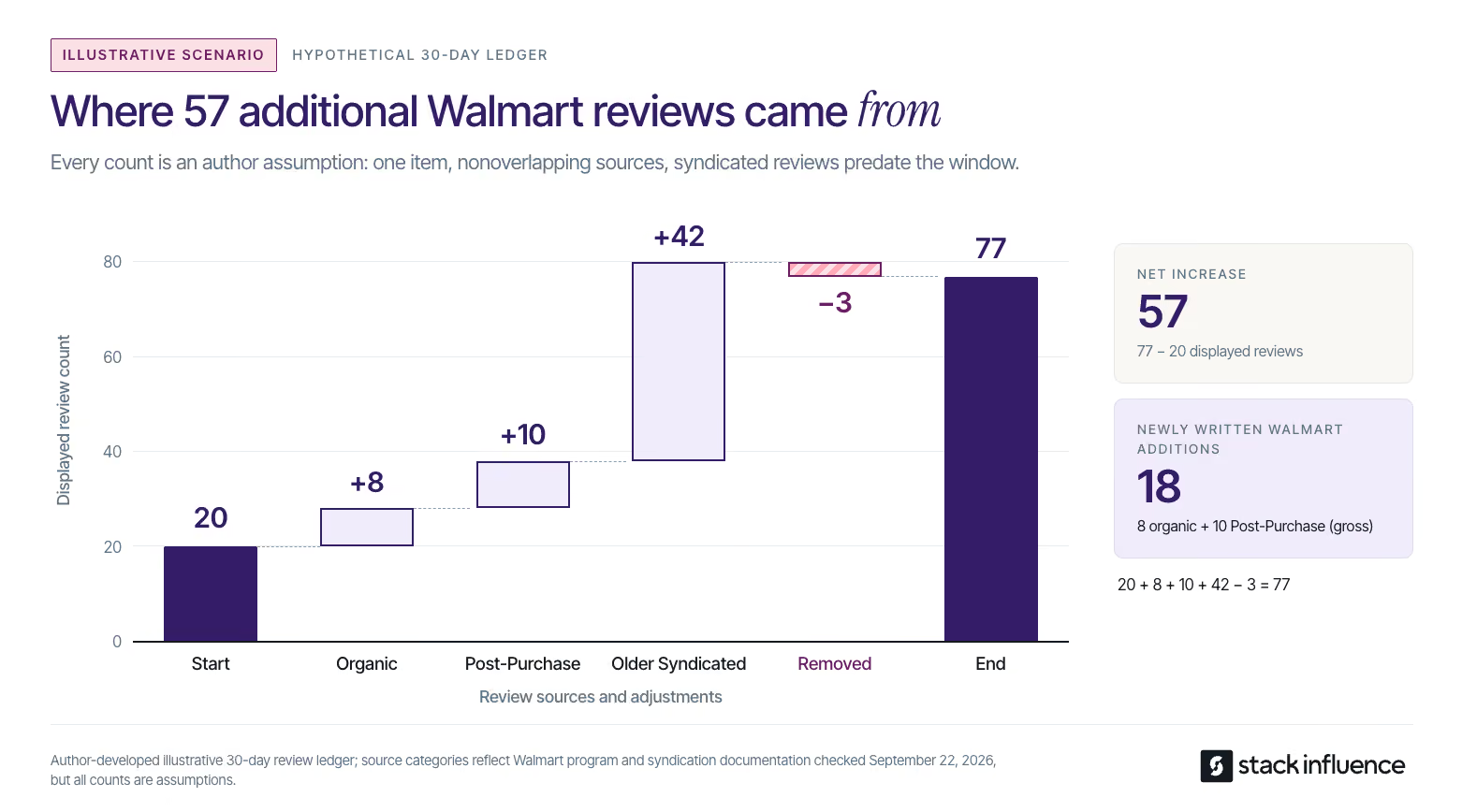
Use a Published-Review Ledger to distinguish feedback creation from feedback distribution. For each item, reconcile the starting count, identifiable additions by source, removals, and ending count before calculating campaign performance.
Review the operational pipeline weekly and assess published outcomes over a consistent reporting window, such as 30 days. This is a recommended reporting cadence, not a Walmart publication deadline; allow additional time for delivery, product use, and moderation when comparing cohorts.
Consider an illustrative 30-day period for one Walmart item with unchanged variant mapping. It starts with 20 displayed reviews, gains 8 newly written organic Walmart reviews, 10 newly published Post-Purchase Reviews, and 42 older syndicated reviews, then loses 3 reviews through removal.
The ending count is 77: 20 + 8 + 10 + 42 - 3. The visible count increased by 57, but only 18 newly written Walmart reviews were added, and only 8 of those were organic.
All counts in this example are assumptions, not Stack Influence results or Walmart benchmarks. The lesson is to distinguish newly written feedback from older feedback that has become newly visible on Walmart.
This prevents a common reporting error: dividing every increase in the displayed review count by your own orders and calling the result a customer review-conversion rate. That denominator is inappropriate when the numerator includes syndicated reviews, program samples, or activity associated with other sellers.
Walmart's item-level review rules explain that reviews belong to the item rather than an individual seller or offer. Record the item and variant scope, and label unexplained count changes as unattributed instead of forcing them into your campaign totals.
Calculate cost per published program review using actual attributable program costs divided by the corresponding published reviews. For sampling, include the products, fulfillment, and applicable fees, not just a service charge; where nothing has published, report the spend and zero output rather than a misleading $0 cost per review.
Keep delivery metrics and outcome metrics distinct. Claims and deliveries help diagnose the pipeline, while published reviews, substantive customer feedback, and product corrections show what the initiative actually produced.
Evaluate customer acquisition separately from review accumulation. A customer acquisition cost analysis uses customer outcomes, not review counts, and should include the costs assigned to the acquisition effort without counting the same expense twice.
When running Walmart advertising campaigns alongside a review initiative, record changes in spend, price, availability, and listing content. Higher sales during the same period do not establish that additional reviews caused the increase.
The practical answer to how to get more product reviews on Walmart is to choose the right approved route, fix the product experience, and measure published feedback accurately. More visible reviews and more newly written customer feedback are useful but different outcomes.
Start with one item: document its baseline, confirm eligibility, select the appropriate route, and set a budget and reporting owner. Where product understanding is the obstacle, pair that work with a clearly disclosed creator-content plan so future customers can make better-informed purchases.
Before asking a micro influencer to promise Amazon placements, an ecommerce seller should establish what “approved” actually means. A creator’s application, storefront, individual videos, and onsite earnings do not all share one approval status.
Learning how to get approved for the Amazon Influencer Program as a micro influencer starts with a credible social account and a complete application, not a follower-count shortcut. This guide explains what creators should prepare, how to submit, what to do when an application stalls, and which evidence sellers should request before planning a campaign.
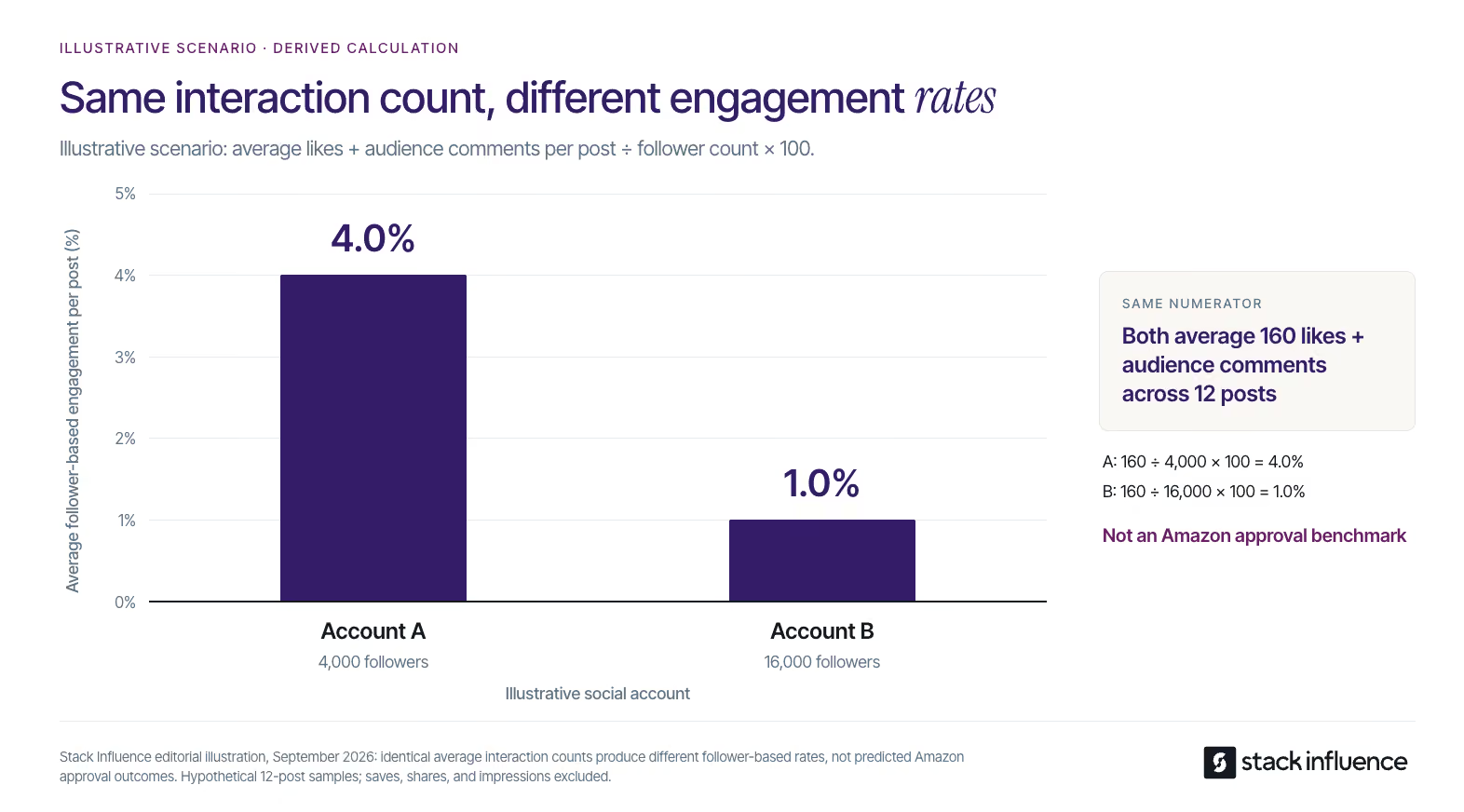
To pursue approval, establish an eligible social presence, prepare original content and genuine audience evidence, connect the correct account, and complete Amazon’s application. Amazon’s Influencer Program Policy requires qualitative and quantitative thresholds, registration, and policy compliance, but does not disclose a universal acceptance formula.
The program gives qualifying creators an Amazon recommendation storefront where they can curate products and earn commissions on qualifying purchases. It is a creator program, not a substitute for a seller’s inventory or fulfillment setup.
Use the Five-Part Application Check below as an editorial preparation tool, not an Amazon scoring system. Its five parts are eligibility, audience evidence, content evidence, submission accuracy, and status verification.
Start with the account requirements before changing your content strategy. Amazon’s Influencer signup materials name YouTube, Instagram, Facebook, and TikTok; the signup FAQ requires a business account when applying through Instagram or Facebook. Follow the supported options and account instructions presented in your live application.
This guide follows Amazon.com documentation checked on September 22, 2026. Other marketplaces can have different availability and account requirements, so use the application for the marketplace you intend to serve.
The applicant must also be legally able to enter the agreement. Amazon’s Operating Agreement specifically excludes minors and people otherwise unable to contract.
Verify ownership, the exact profile URL, public visibility, and access to the account’s settings. A seller helping a creator prepare should never need the creator’s password or authentication codes.
Compare the accounts you actually maintain rather than automatically submitting the largest one. Review recent original posts, the consistency of audience responses, and whether commenters ask relevant questions or describe using the information.
For a practical self-audit, examine 12 recent, comparable posts from each candidate account. Twelve is an editorial sample for this exercise, not an Amazon requirement; avoid mixing a giveaway, a paid promotion, and an ordinary tutorial as though they were equivalent observations.
Consider an illustrative scenario in which two accounts each average 160 likes plus audience comments per post across that sample. Account A has 4,000 followers, giving it a follower-based engagement rate of 4%; Account B has 16,000 followers, giving it a rate of 1%.
The calculation is average likes plus audience comments per post, divided by followers, multiplied by 100. These invented inputs demonstrate the denominator effect only: neither rate is an Amazon benchmark, and the comparison cannot predict which applicant Amazon would approve.
Also inspect the underlying interactions. Repeated generic comments are not equivalent to specific questions, and follower-based engagement is not the percentage of viewers who responded. Use several pieces of evidence rather than replacing a follower-count shortcut with an engagement-rate shortcut.
Sellers building an evidence-first creator shortlist should maintain a separate field for campaign suitability. Stack Influence, a micro-influencer marketing platform, uses a gifted-first product-seeding workflow that coordinates vetted creator participation, purchases, completed social posts, and reimbursement after verification. Those campaign checks serve a different purpose from Amazon’s enrollment decision.
Prepare a profile that demonstrates useful judgment rather than a collection of product advertisements. Choose a subject you genuinely understand and make the practical value visible in the content itself.
For example, a travel creator could demonstrate how a packing cube handles a bulky sweater, show the zipper under normal use, and explain which items fit together. A second post could compare packing methods, while another answers a real audience question about carrying delicate clothing.
Each example should show something the creator actually tested or observed. Use your own footage, explain relevant limitations, and avoid copying a manufacturer’s description into a supposedly personal recommendation.
Do not manufacture a narrow niche because someone claims that Amazon approves it more easily. A coherent body of work is useful preparation, but the cited Influencer policy does not promise preferential acceptance for a particular product category.
Before applying, review the profile as a first-time visitor. Can someone identify what you cover, find recent original work, and understand why people follow you without reading a separate pitch?
Open the official application, sign in to the Amazon account you intend to use, select an available social provider, and authenticate the correct social profile. Check the displayed handle carefully when you manage multiple accounts.
Complete the requested information and social-data authorization. Do not treat a connection error as a content rejection; first confirm that the correct account was selected and that the requested permissions were granted.
Keep a simple application record containing the date, marketplace, connected profile, and exact status message. Save the information privately so a later support request can describe the actual problem rather than “my account did not work.”
Avoid buying followers, arranging artificial engagement, or borrowing someone else’s account to present a stronger application. Those tactics do not establish the genuine audience or ownership your creator business needs.
Record what Amazon has actually confirmed. An application submission is not an acceptance notice, and access to a storefront does not mean that every uploaded video has passed moderation.
For a seller collaboration, verify the live storefront URL and the specific status relevant to the proposed work. Ask the creator to share only the necessary confirmation, with payment, tax, and unrelated account information removed.
The Five-Part Application Check ends with verified access, not a promise of future reach. That distinction should carry into the campaign brief and publishing schedule.
Start with the exact message and the stage it concerns. A pending application, an account-connection failure, a rejected application, and a declined video require different responses.
For an access problem, check the selected account, visibility, account type, and authorization. For an explicit content or policy notice, address the named issue rather than deleting unrelated posts or switching niches at random.
When Amazon provides no detailed reason, use the Five-Part Application Check to identify weaknesses you can substantiate. Improve original content, make the account easier to evaluate, and document what changed; do not claim to have reverse-engineered a hidden score.
Reapply only when the current application flow permits it and there is a meaningful reason to submit again. The official material reviewed for this guide does not establish one universal waiting period or turnaround time for every Influencer applicant.
Keep broader Associates account review separate from initial Influencer screening. Amazon’s Associates application review guidance describes at least three qualifying sales within the first 180 days and excludes personal orders. That is not a three-video rule or a guarantee of Influencer acceptance.
For launch planning, give the creator work that matches confirmed access while another status remains unresolved. A product demonstration for the brand’s own channels can be scoped separately from creator-published Amazon content.
An active Influencer storefront enables creators to upload content, but video moderation and onsite commission enrollment remain separate. Amazon’s current storefront video guidance says product-page discovery may become available after 10 videos have been approved by moderation and onsite signup is complete; placement is not guaranteed.
The same guidance directs creators to Creator Hub, accessible from the storefront owner view through “Add to your storefront” and then “Videos.” Follow the current instructions and any account-specific notices rather than assuming an older tutorial still describes the process.
Consider an illustrative account with 12 uploaded videos: eight moderation-approved, two pending, and two declined. It has eight approved videos, not 12, and remains two approved videos short of the documented 10-video milestone; pending and declined uploads do not close that gap.
These counts are an invented planning example, not an observed approval rate. The example isolates moderation status and does not assume that onsite signup is complete or that any video will receive a product-page placement.
Amazon’s onsite commissions explanation also describes a separate onsite Store ID, which may begin with “onamz,” and tax and payment information needed for that ID. Maintain the distinction between commissions from traffic the creator sends to Amazon and earnings from content Amazon selects for onsite discovery.
For sellers, a storefront link answers only part of the qualification question. Verify the status needed for the proposed placement, and avoid converting an eligibility milestone into a contractual promise of distribution.

Build disclosure habits into the content workflow before publishing affiliate promotions. Amazon’s affiliate disclosure requirements call for a compliant disclosure with affiliate links and the account-level statement: “As an Amazon Associate I earn from qualifying purchases.”
The account statement does not replace disclosure near an individual affiliate recommendation. Readers should be able to understand the commercial relationship without searching a profile or expanding a long caption.
Product gifting creates another disclosure consideration. The FTC’s guidance for social media influencers covers material connections such as payment and free products, and says video disclosures belong in the video rather than only in its description.
Make the relationship visible, preserve the creator’s genuine opinion, and avoid requiring a positive endorsement in a product-seeding brief. A useful demonstration should remain accurate even when it includes a product limitation.
Use approval status to match a creator to a specific deliverable, not as a universal quality rating. A social post, licensed UGC video, creator storefront recommendation, and possible onsite placement are different campaign outputs.
When finding influencers for an Amazon product, start by naming the output you need. A brief for a creator’s social audience should emphasize audience relevance, content quality, disclosure, and completion; a brief requiring an Influencer storefront also needs confirmed program access.
For brand-owned marketing, document the content license and intended publishing destination. Stack Influence’s UGC production workflow supports collecting creator photos and videos for ecommerce marketing, while Amazon enrollment governs access to Amazon’s creator-specific features.
Before repurposing UGC across platforms, confirm the agreed channels, usage period, editing permissions, and any separate advertising authorization. An Amazon acceptance notice is not a substitute for those permissions.
A practical contingency is to separate the content deadline from any unresolved Amazon-access milestone. Agree on what can be delivered through existing channels, what depends on a later status, and how the scope changes when that status is not achieved.
For an Amazon-focused creator campaign, this prevents a completed social post from being reported as an Amazon placement. It also lets sellers work with relevant micro influencers and nano influencers without pretending every collaboration needs identical credentials.
Track application readiness, publishing progress, and commercial outcomes in separate records. A creator can complete the application correctly without receiving a positive decision, and an approved creator can publish content without generating sales.
For preparation, review the account and content sample before submission, then update the record when a real status change occurs. For a seller campaign, review completed deliverables and usable assets weekly; a 30-day initial reporting period can be a practical planning choice, not a universal performance benchmark.
For eligible off-Amazon campaigns, Amazon Attribution reports clicks, detail-page views, add-to-carts, purchases, and sales, with a 14-day attribution window. Agree on the tracking setup before publication and allow the relevant conversion window to mature before comparing results.
Keep creator affiliate reporting, onsite earnings, and seller attribution reports distinct. Do not overwrite a creator’s tracking arrangements without agreement or add potentially overlapping conversion totals together as though they represent different purchases.
Separate reimbursement-funded creator orders from other customer orders when assessing demand. Likewise, record any qualifying Amazon Brand Referral Bonus credits in the seller’s economics rather than describing them as the creator’s commission.
Attributed sales show how a reporting model assigns credit. They do not, by themselves, prove that program acceptance or a creator campaign caused incremental sales.
Understanding how to get approved for the Amazon Influencer Program as a micro influencer means separating preparation from prediction. Build a credible public presence, submit the correct account, address actual notices, and verify what Amazon has enabled.
For ecommerce sellers, the next step is to qualify the deliverable rather than rely on the label “Amazon influencer.” Review the creator’s work, confirm the required access, and put content, rights, tracking, and contingencies into the brief so the campaign can proceed without depending on an unconfirmed placement.
A creator accepting your product is not the same as a creator agreeing to publish. A package marked delivered is not the same as usable content. And an order placed to obtain a reimbursed sample is not evidence that a new customer discovered your store.
Micro influencer seeding for Shopify brands works best when those distinctions are settled before inventory leaves the warehouse. This guide explains how to organize a controlled pilot, protect customer-facing stock, coordinate creators, and evaluate content and sales without overstating the results.
Start with one product, one primary objective, and a batch your team can fulfill and follow through to completion. Expand only after the pilot reveals whether the product, creator agreement, and measurement setup work together.
Micro influencer seeding means providing products to smaller, relevant content creators to encourage product experience, social content, and potential customer discovery. In Shopify's explanation of product seeding, traditional seeding carries no obligation to publish. Product-exchange campaigns are different: the creator accepts specified deliverables in return for the agreed product or reimbursement.
Shopify describes micro influencers as creators with roughly 10,000 to 100,000 followers and nano influencers as those with roughly 1,000 to 10,000. Those labels help organize discovery, but neither establishes product fit or willingness to accept your offer.
Use five release gates to decide when each creator can move forward:
A failed gate means hold or resolve the issue, not automatically send another parcel.
Stack Influence's automated product-seeding workflow illustrates the agreement distinction: creators purchase products, and reimbursement follows verified social posts. Its gifted-first, completions-only model connects compensation to completed participation rather than treating every product shipment as an earned post. Completed content still does not guarantee customer sales.
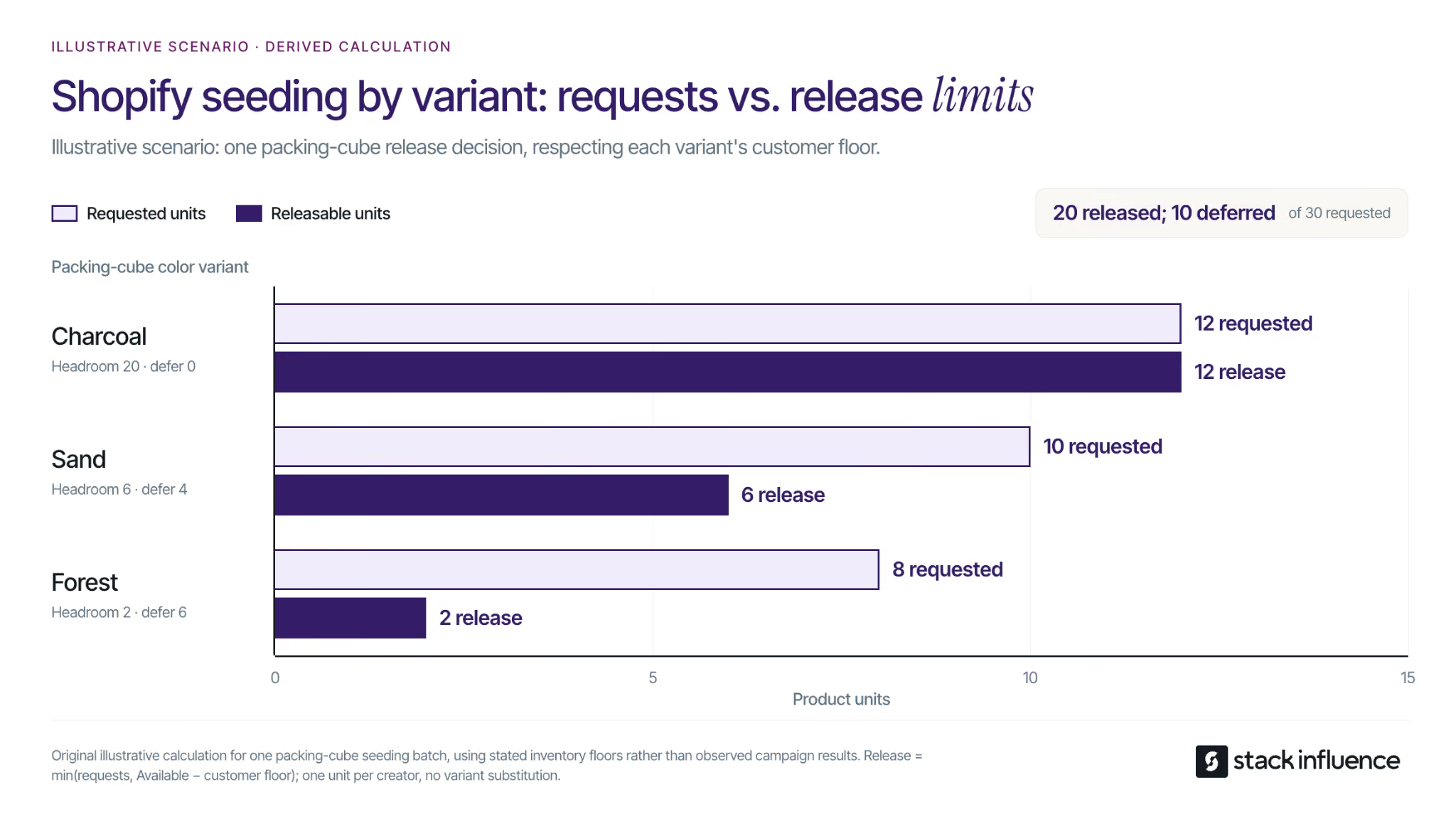
Release products that creators can genuinely use and that customers will still be able to buy when the content appears. Check the exact variant and fulfillment location before approving a gift or purchase instruction.
Shopify's inventory-state documentation distinguishes Available inventory from Committed, Unavailable, and Incoming inventory. On-hand stock is therefore not automatically available for a new seeding batch.
Then apply your own customer inventory floor. This is a planning buffer for expected customer demand, not another deduction for units Shopify has already marked unavailable or committed.
Consider an illustrative packing-cube pilot with one unit per creator, no replenishment during the release decision, and three colors. The following floors are planning assumptions within Available inventory, not quantities already removed from it:
Release quantity equals the smaller of creator requests and available units above the floor, with a minimum of zero. The batch releases 20 of 30 requested units and defers 10.
Unused charcoal capacity does not automatically solve the other shortages. Ask whether affected creators genuinely want that color before substituting it. These are illustrative allocation calculations, not a Shopify rule or a campaign benchmark.
Choose the floor using your own demand, replenishment, and launch commitments. Recheck stock before each release instead of assuming yesterday's allocation still holds.
Recruit around a customer situation, not an arbitrary follower target. For packing cubes, a creator who regularly demonstrates compact packing may offer a clearer product story than a larger account that mainly posts destination photographs.
Start with customers who already publish relevant content, people who tag your brand, and creators discussing the problem your product solves. A structured approach to finding micro influencers can widen that shortlist through topic searches and manual profile research.
Review recent demonstrations, substantive audience questions, and the creator's consistency. Ask for relevant audience information rather than inferring audience location from the creator's address. Also confirm that viewers in the intended market can purchase from your Shopify store.
A useful outreach message explains why the product is relevant, what the creator receives, and whether anything is required in return.
For a voluntary gift, an original example is: “Your carry-on packing demonstrations caught our attention. We would like to send you our packing cubes to try, with no posting requirement. Would you like to see the available colors?”
For a product exchange, disclose the proposed deliverable and compensation before asking for acceptance. State whether the request includes an original file, a public post, a tracked link, or paid advertising rights. Let the creator decline or propose a different arrangement.
Follow up respectfully, but do not turn an unanswered gift invitation into an assumed commitment. Ask for delivery information through your approved fulfillment process only after the creator accepts.
Give every participant a campaign identifier that connects the creator, selected variant, agreement, order, delivery date, and final content. Keep a delivery record separate from a posting record so a fulfilled order cannot be mistaken for a finished collaboration.
According to Shopify's Collabs gifting instructions, gifts go to creator connections. In Shopify admin, open Apps > Collabs > Programs > Gifts, create a product gift, and specify the product, quantity, and permitted variant options.
You can allow creators to choose a variant, but first restrict the offer to stock you can release. Send the gift to the intended connections; after a creator claims it, an order appears in Shopify admin for fulfillment. Shopify applies free shipping to Collabs gifts, so include the seller's shipping expense in the campaign budget.
The gift setup does not replace a deliverable agreement. A claim, a shipment, and a completed post remain different events.
For managed execution, Stack Influence's Shopify creator campaign workflow coordinates sourcing, product seeding, post verification, and creator-content collection. Confirm which team owns storefront order identification, delivery exceptions, and the final reporting reconciliation.
Send viewers to the product or collection that matches the demonstration. Test the mobile page, variant availability, shipping information, discount behavior, and checkout path before distributing links.
Google Analytics' campaign URL guidance explains how UTM parameters identify referral campaigns. One working convention is utm_source=instagram, utm_medium=organic_social, utm_campaign=packing_cube_seed_pilot, and utm_content=creator017_demo. Apply the same naming rules throughout the batch and verify that redirects preserve the parameters.
Keep the creator's private gift-redemption route separate from any customer-facing discount or affiliate code. Record gift and reimbursed creator order IDs so they can be excluded from the campaign's genuine customer-acquisition analysis.
Specify the buyer question the content should answer, then leave room for the creator's actual experience. “Show how the cubes fit inside your usual carry-on” is a useful demonstration brief; a required claim that the product is perfect is not.
For endorsements reaching U.S. consumers, the FTC's influencer disclosure guidance treats free or discounted products as material connections. Disclosures should accompany the endorsement, and video disclosures belong in the video rather than only in its description. The creator must not describe experience they have not had or make unsupported product claims.
Document whether permission covers your Shopify product pages, email, organic social, paid advertising, editing, and the intended usage period. The U.S. Copyright Office's permission guidance explains how to seek authorization from the copyright owner. Receiving a product does not transfer ownership of the creator's work to your brand.
Ask for a clean original file when it is included in the agreement. A practical UGC repurposing workflow should carry the relevant permissions into every new placement, rather than relying on a screenshot of an informal approval.
Music needs its own check. TikTok's Commercial Music Library guidance addresses music cleared for commercial TikTok activity; do not assume that clearance extends to your Shopify website or another advertising platform. Obtain suitable rights or use an appropriately cleared replacement track.
Budget the complete economic cost of the pilot, then compare it with the outcome you actually intended to buy. Product retail value, creator fees, and total campaign cost are not interchangeable.
For direct gifts, include landed product cost, packaging, fulfillment, shipping, replacements, creator cash compensation, licensing, software, and internal work. For purchase-and-reimbursement campaigns, reconcile the incoming creator payment and outgoing reimbursement before calculating net campaign cost; do not count the reimbursement and the same product expense twice without accounting for the purchase receipt.
As an illustrative direct-gifting budget, suppose 20 parcels each require $12 of product cost, $3 of packing and fulfillment, and $6 of shipping. Add $240 of coordination work and a $120 allowance for replacement handling. Total planned cost is $780: 20 × $21 + $240 + $120.
With an assumed 12 usable, licensed assets, that is $65 per usable asset. With an assumed eight genuine new customers, allocating the entire pilot cost to acquisition produces a $97.50 customer acquisition cost. These are planning assumptions, not observed results or Stack Influence prices, and the two calculations are alternative views of the same spend.
Use the customer acquisition cost guide to distinguish attributed purchases from new customers. Evaluate customer-order contribution after discounts, refunds, product costs, fulfillment, payment fees, and commissions, without subtracting any expense twice.
Do not call hypothetical asset replacement value sales revenue. A content-focused pilot can be useful without immediate acquisition payback, but that objective and spending limit should be agreed in advance.

Evaluate execution from usable product delivery and evaluate customer response from the live post. These are different clocks: warehouse delays should not make a creator look late, and a newly published post should not be compared with one that has collected traffic for weeks.
For a product-exchange campaign, define the agreed due date relative to usable delivery and document any extensions. For voluntary gifts, use a consistent observation window rather than calling an unposted gift an overdue deliverable.
A newer batch can appear to have a lower posting rate simply because its creators have had less time. Compare cumulative posting at equal days after delivery before changing the creator selection process.
Consider a separate illustrative measurement example with two batches of 20 creators each. Every creator receives one usable product, nobody leaves either group, and a creator counts once when their first qualifying post appears.
Batch A produces 6 posts by day 7, 12 by day 14, and 16 by day 21: cumulative posting rates of 30%, 60%, and 80%. Batch B produces 8, 12, and 16 posts at the same ages: 40%, 60%, and 80%.
Suppose Batch B was delivered 14 days after Batch A. On one calendar reporting date, Batch A is 21 days old and shows 80%, while Batch B is only seven days old and shows 40%. That comparison suggests a gap that disappears by equal day-21 follow-up in this scenario.
The numbers are illustrative, not expected campaign performance. In a live report, leave future observations pending rather than filling them with assumed outcomes. Compare only creators who have reached the selected observation age, and report delivery failures separately.
Use three separate decision measures:
Shopify's marketing-report documentation distinguishes attribution models including first click, last click, and any click. Any-click reporting can assign credit to multiple channels for the same order, so those channel totals must not be added together as unique sales.
Reconcile links and codes against order IDs, customer history, refunds, and campaign costs. Review a consistent post-publication window, such as 30 days for an initial read, then revisit after the relevant return period. Choose the final window for your purchase cycle rather than treating 30 days as universal.
Attributed sales show credited interactions, not proof that every purchase was caused by seeding. For stronger causal evidence, plan a suitable controlled test; a small before-and-after pilot is primarily a learning exercise.
Change the bottleneck the evidence identifies. Low acceptance points toward the offer or creator fit; unclaimed gifts suggest friction after acceptance; delivery problems require a fulfillment fix. Strong posting with weak usable-content yield calls for a clearer brief or permission scope.
When posts produce visits but little purchasing, inspect the actual product page, price, stock, and shipping proposition before replacing the creators. When an asset explains the product well but generates few direct orders, test its licensed storefront use separately rather than declaring the entire relationship unsuccessful.
Return to the Five Release Gates before increasing volume. Broader Shopify influencer marketing planning can then connect reliable seeding participants with affiliate or ambassador relationships. Continued participation should be mutually agreed, not assumed because someone accepted an earlier gift.
Micro influencer seeding for Shopify brands should produce more than a list of delivered parcels. A useful pilot reveals which products creators want, which agreements produce the intended content, and whether customer response justifies continued spending.
Choose one product, set its variant-level inventory floors, and define the evidence required before approving the next batch. When coordinating those handoffs becomes the constraint, evaluate a managed product-seeding workflow with Stack Influence so your team can focus on the content and customer decisions that follow.

Beauty, home organization, everyday carry, kitchen routines, pet accessories, fashion, recreational fitness, and hands-on hobbies offer useful starting points for ecommerce creator partnerships. The strongest match is the creator who can demonstrate why your particular product belongs in a buyer's life, not whichever broad category attracts the most attention.
For ecommerce sellers researching the best niches for micro influencers to get brand deals in 2026, the practical question is where a credible creator, a useful product, and a commercially workable brief meet. This guide connects eight niches with specific campaign ideas, compensation choices, and a method for identifying partnerships worth renewing.
Start with niches where creators can answer a real buying question using the product. These eight choices are an editorial shortlist for physical-product sellers, not a measured ranking of creator earnings.
A niche combines a recurring subject, a recognizable audience, and a reason that audience might buy. Niche micro influencers concentrate on particular interests; micro and nano describe approximate audience size, not the subject someone covers.
Collabstr's 2026 Influencer Marketing Report reports year-over-year niche-search growth of 108% for Athlete & Sports, 103% for Skilled Trades, 76% for Health & Fitness, 67% for Adventure & Outdoors, and 54% for Family & Children. These figures concern searches on one marketplace in its 2025 lookback, not micro-influencer earnings or completed-deal growth.
Use that distinction when prospecting: rising category interest is a reason to investigate, not a reason to ignore product fit.
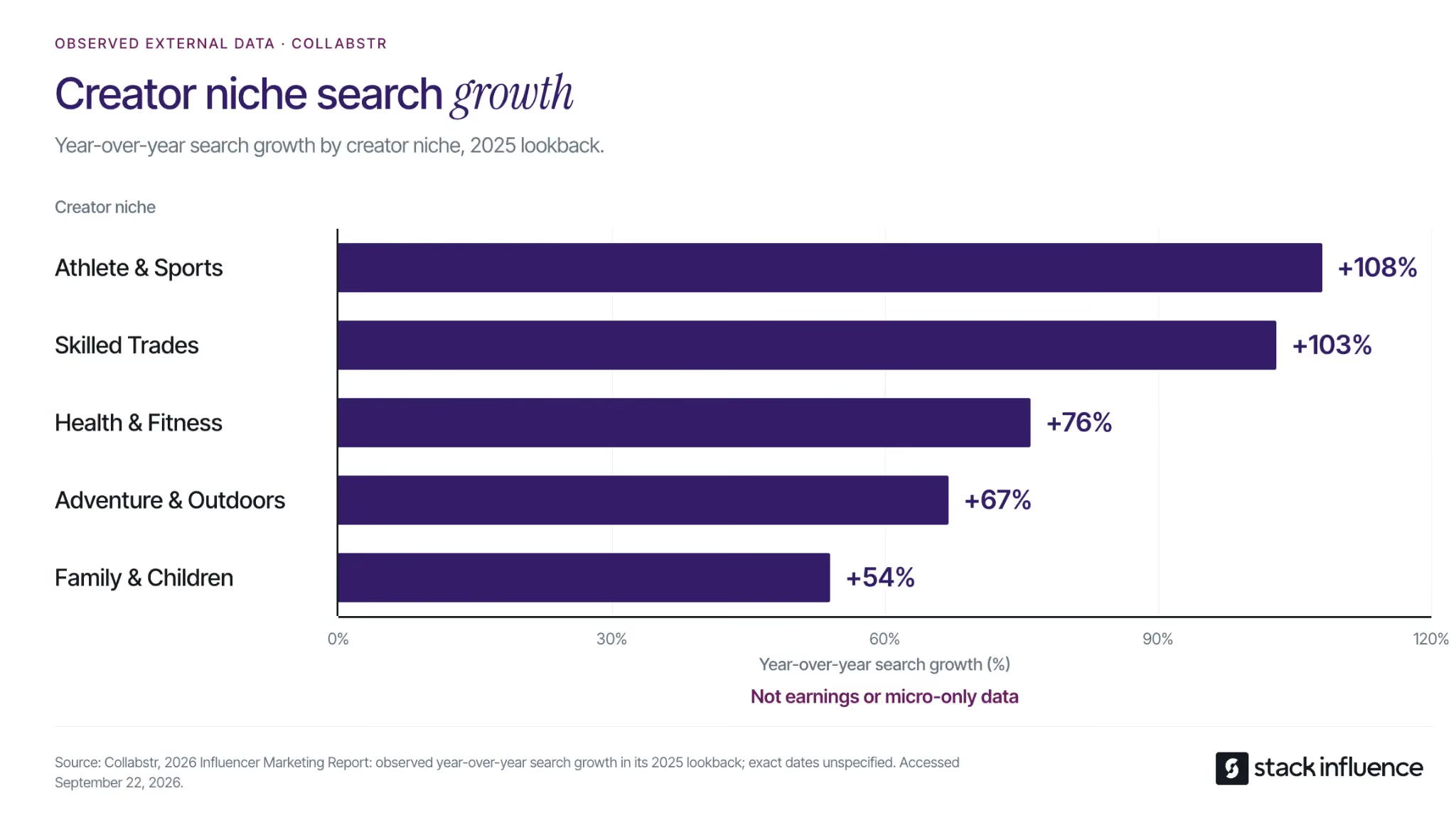
Choose beauty creators whose existing routines give your product a clear role. Useful subniches include hair-care organization, everyday personal-care routines, and travel-friendly beauty essentials.
A strong brief might ask a creator to demonstrate packaging, texture, application steps, or how a product fits into an established routine. That provides more decision-making information than a general endorsement delivered beside unopened packaging.
For sellers, product-based collaborations can introduce the item, while separately commissioned UGC video can answer recurring shopper questions. A follow-up assignment might address storage, refill instructions, or a different use occasion. Keep claims tied to substantiated product information and the creator's genuine experience, without appearance pressure or promises of treatment results.
Home organization is worth considering when a product solves a visible space or storage problem. Narrow the brief to an actual setting, such as a compact pantry, shared bathroom, entryway, or small workspace.
Ask creators to show dimensions, capacity, setup, and what fits. A useful second brief can revisit the same product after regular use, rather than repeating the original unboxing.
Refillable essentials offer another concrete demonstration opportunity, but a refill mechanism does not substantiate every environmental claim. The FTC's Green Guides summary cautions against broad, unqualified environmental-benefit claims. Show the specific refill system and supported benefits instead of asking creators to call a product universally eco-friendly.
Everyday carry connects bags, pouches, organizers, and compatible accessories with recognizable routines. Focus on a specific audience, such as commuters, students, or people moving between home and shared workspaces.
Stack Influence's three-month Targus new-product campaign included 120 creator promotions. That provides a concrete example of creator activation in a durable-goods category, not evidence of what individual creators earned.
A useful brief might show what fits inside a bag, how compartments separate items, or how an organizer handles a real daily setup. Confirm dimensions and device compatibility before sending products. For repeat work, change the buying question: daily packing, organization after regular use, or preparing the same bag for a different ordinary occasion.
Food and kitchen creators are useful prospects when your product can become part of a repeatable task. Consider lunch-packing routines, pantry organization, home baking, or practical kitchen storage rather than a broad food-and-lifestyle label.
Commission a demonstration with a clear purpose: show portion-container capacity, compare storage configurations, or incorporate an ingredient into a clearly explained recipe. A follow-up brief should add another useful application, not simply repeat the brand name.
For grocery sellers, resolve delivery conditions, shelf life, ingredient information, and the creator's willingness to use the product before committing. For kitchen accessories, show actual dimensions and ordinary use. Keep recipe enjoyment and convenience separate from unsupported nutritional or medical promises.
Pet partnerships should connect an owner's routine with an appropriate product, not rely on an animal's popularity alone. Possible subniches include pet-supply organization, everyday walking accessories, and washable household accessories for pet-owning homes.
The American Pet Products Association's industry statistics report 95 million U.S. pet-owning households from the 2025 National Pet Owners Survey cited in its 2026 industry report. That establishes a broad customer context, not the effectiveness of a particular creator campaign.
For your brief, specify the relevant animal size, product dimensions, and intended use. Show the product without manufacturing distress or forcing an interaction. Repeat collaborations should answer another owner question, such as cleaning, storage, or everyday convenience.
Fashion partnerships become more specific when the creator serves a recurring occasion: repeat-wear work outfits, practical layering, functional accessories, or clothing care. That gives sellers a clearer brief than asking someone to make a product look desirable.
Ask for accurate garment measurements, fabric details, pocket demonstrations, care information, or several ways to use an accessory. Focus on comfort, self-expression, and usefulness rather than body comparisons.
Plan size confirmation and exchanges before shipping. A creator who cannot comfortably use the supplied item cannot demonstrate it credibly. Follow-up work might explore another occasion or styling combination, but exclusivity should be scoped carefully so a small assignment does not unnecessarily restrict the creator's wider work.
For physical-product sellers, narrow fitness and outdoor content to ordinary routines and useful gear. Walking communities, casual recreation, and community-sports organization can provide clear settings for bottles, towels, bags, and storage accessories.
A suitable brief might demonstrate how a bag organizes everyday equipment or how a bottle fits into an existing carrying setup. The commercial value lies in showing practical details, not promising changes to someone's body or athletic performance.
Choose creators who already participate in the relevant activity. Do not ask them to perform risky challenges or make health claims to dramatize an otherwise straightforward product. A second brief should solve another practical equipment or organization question.
Hands-on hobbies are worth shortlisting when product knowledge improves the demonstration. Consider book journaling, paper crafts, crochet-project organization, or stationery reviews with a recognizable audience and repeatable content format.
A useful assignment can show what a kit contains, how materials are organized, or how an item supports an ongoing project. The creator's explanation should make the product easier to evaluate without turning the content into a scripted sales pitch.
Budget for preparation and production time, not just the value of the materials. An inexpensive craft product can still require substantial creative labor. Repeat briefs might cover project storage, replenishment, or another application, provided the new assignment adds information rather than reproducing the first tutorial.
Choose a niche you can brief twice without repeating yourself. The Second-Brief Test is an editorial decision tool for checking whether a partnership has substance beyond an initial product introduction.
Evaluate four components:
For example, a desk-organizer seller could commission a compact-workspace setup first and an after-use organization update second. Those are different buying questions within one coherent niche.
Failure on a component tells you what to change. An unclear buyer occasion requires a narrower audience; weak demonstration access requires a different creator or brief; insufficient economic room requires a revised budget or scope. No credible renewal reason suggests a one-off asset rather than an ongoing ambassador relationship.
Choose the deal format according to what the seller is buying: a product experience, finished content, audience distribution, or qualifying sales. A promising niche does not make those deliverables interchangeable.
With product seeding, distinguish a no-obligation gift from an agreed product-for-content collaboration. State any posting requirements and compensation conditions before participation; product reimbursement is not an additional creative fee.
For paid posting, define the content and its publication on the creator's account. For creator-produced UGC, define the assets the brand receives and the permitted uses, whether or not the creator also publishes them. Production and audience distribution can be purchased together, but they remain separate parts of the scope.
Affiliate arrangements compensate qualifying sales under agreed terms. Shopify Collabs for merchants supports creator invitations, gifts or discount codes, affiliate-sales tracking, and creator payments. Treat an affiliate offer as a commission opportunity, not a guaranteed substitute for a content-production fee.
The niche with the most visually impressive product does not necessarily leave the most room for creator compensation. Compare the complete campaign budget before deciding which partnerships you can responsibly commission.
Consider an illustrative scenario, not market pricing or Stack Influence campaign data. Assume a $200 budget per partnership and $30 for coordination and editing, with no paid-media spend, affiliate commission, exclusivity, additional usage-rights charge, or tax included.
Assume product and fulfillment cost $20 for a kitchen accessory, $60 for a craft kit, and $120 for a bulky home organizer. The resulting cash available for the creator fee is $150, $110, and $50, respectively.
The calculation is total budget minus product and fulfillment costs minus coordination and editing. Those remaining amounts are budget ceilings, not recommended rates or evidence of fair compensation; additional expenses would reduce them further.
When a creator's quote exceeds the available budget, change the scope, increase the budget, or reconsider the proposed assignment. Do not present a product's retail value as cash payment. A clear approach to negotiating brand deals should separate the fee, expenses, deliverables, revision allowance, and usage permissions.

Start with a focused comparison rather than a large, mixed-category launch. For example, an organizer seller could test compact-workspace creators against home-entryway creators using the same product, offer, deliverable requirements, and measurement period.
Request recent, relevant work and audience information through an influencer media kit. Review several comparable posts rather than one viral result, and ask for platform analytics where audience location or viewing patterns matter. A small pilot can identify execution problems, but it cannot establish a reliable niche-wide conversion benchmark.
Your invitation should explain why the creator's existing work matches the product, the buying question to address, the deliverable, the schedule, and the compensation. Agree on revisions and permissions before production; repurposing UGC across platforms requires a plan for the actual uses you intend to make.
For U.S.-facing campaigns, the FTC's endorsement guidance explains when gifts, payments, and other material connections require clear disclosure. Put required video disclosures in the video itself, using visual and audible disclosure when the endorsement is both visual and audible. The endorsement must reflect genuine experience rather than a required positive opinion.
Stack Influence's automated product-seeding workflow connects gifted-first campaigns with vetted creator participation, coordination, UGC generation, and completed-post accountability. For sellers, the practical use is turning a focused product brief into a managed campaign without treating every creator interaction as a separate project. Completed-post accountability concerns delivery, not guaranteed sales or creator earnings.
Compare niches using completed deliverables, qualified shopper response, and campaign economics within the same defined period. Views can indicate exposure, but they do not show whether the content was usable or the resulting orders were profitable.
Track three connected layers:
For eligible Amazon sellers, Amazon Attribution measures non-Amazon marketing activity and reports metrics including clicks, detail-page views, purchases, and sales within a 14-day attribution window. Use distinct tags for the creator or tactic you need to compare, and allow the reporting window to mature before judging results.
For Shopify influencer marketing, assign creator-specific links or codes and reconcile affiliate reporting with store orders. Document the attribution rules rather than assuming different systems credit the same purchase in the same way. Avoid adding overlapping platform reports together as though every credited order were unique.
Keep creator purchases funded or reimbursed by the brand separate from independent audience purchases. The former are campaign participation, not evidence that unrelated shoppers were persuaded to buy. Include their net economic cost in a clearly defined customer acquisition cost calculation when evaluating the acquisition program.
Review delivery as content arrives, evaluate sales after the applicable attribution window, and revisit returns and repeat purchasing when those outcomes have had time to develop. Report product-seeding costs, content-production value, and shopper acquisition separately where they answer different questions. A before-and-after increase is not proof of causation, especially when pricing, promotions, inventory, or advertising changed at the same time.
The best niches for micro influencers to get brand deals in 2026 connect a recognizable buying situation with a creator who can demonstrate the product credibly. Broad popularity is useful context, but it cannot replace a relevant audience, workable compensation, or a second useful assignment.
Apply the Second-Brief Test to one product and two adjacent creator communities. Explore a focused Stack Influence product-seeding campaign to turn that shortlist into completed content, then use delivery quality and independent shopper response to decide where to expand.
A creator demonstrates your product, you add the content to Amazon, and sales rise. The missing answer is whether the new listing content persuaded more shoppers or the campaign simply brought more shoppers to the page.
Amazon listing split testing with UGC separates those questions. For ecommerce sellers, the goal is to compare a specific creator-made asset against existing content under controlled conditions, then decide whether the improvement justifies production costs and usage rights.
This guide explains which Amazon placements to check, how to commission a testable alternative, how much evidence a decision can require, and how to calculate the lift needed before a content license expires.
Amazon listing split testing with UGC compares two versions of listing content, with creator-produced material forming the alternative. Here, UGC means licensed creator-made photos or videos, not a paid Amazon customer review.
Amazon's Manage Your Experiments randomly assigns shoppers to content versions. Sellers need a Professional account, Brand Representative status for a brand enrolled in Brand Registry, and a traffic-eligible ASIN. A+ tests require published A+ content.
For an eligible product, a practical starting point is an A+ experiment that changes one image while preserving the surrounding module. That makes the production assignment manageable and the comparison interpretable.
Write four decisions before commissioning the asset:
Consider an illustrative collapsible laundry basket. Version A shows a studio photograph of the folded basket; Version B shows a creator placing the same basket in a household storage gap. Both versions retain identical dimension information, surrounding copy, and module position.
The hypothesis is that showing storage in context reduces uncertainty about practical fit. A favorable result would support that specific replacement, not prove that every creator photo outperforms studio photography.
Stack Influence's managed product-seeding workflow connects gifted-first creator participation with coordination and completed-post accountability. For listing research, attach the One-Contrast Contract to the campaign brief: a completed social post and an approved experimental asset are separate acceptance decisions.
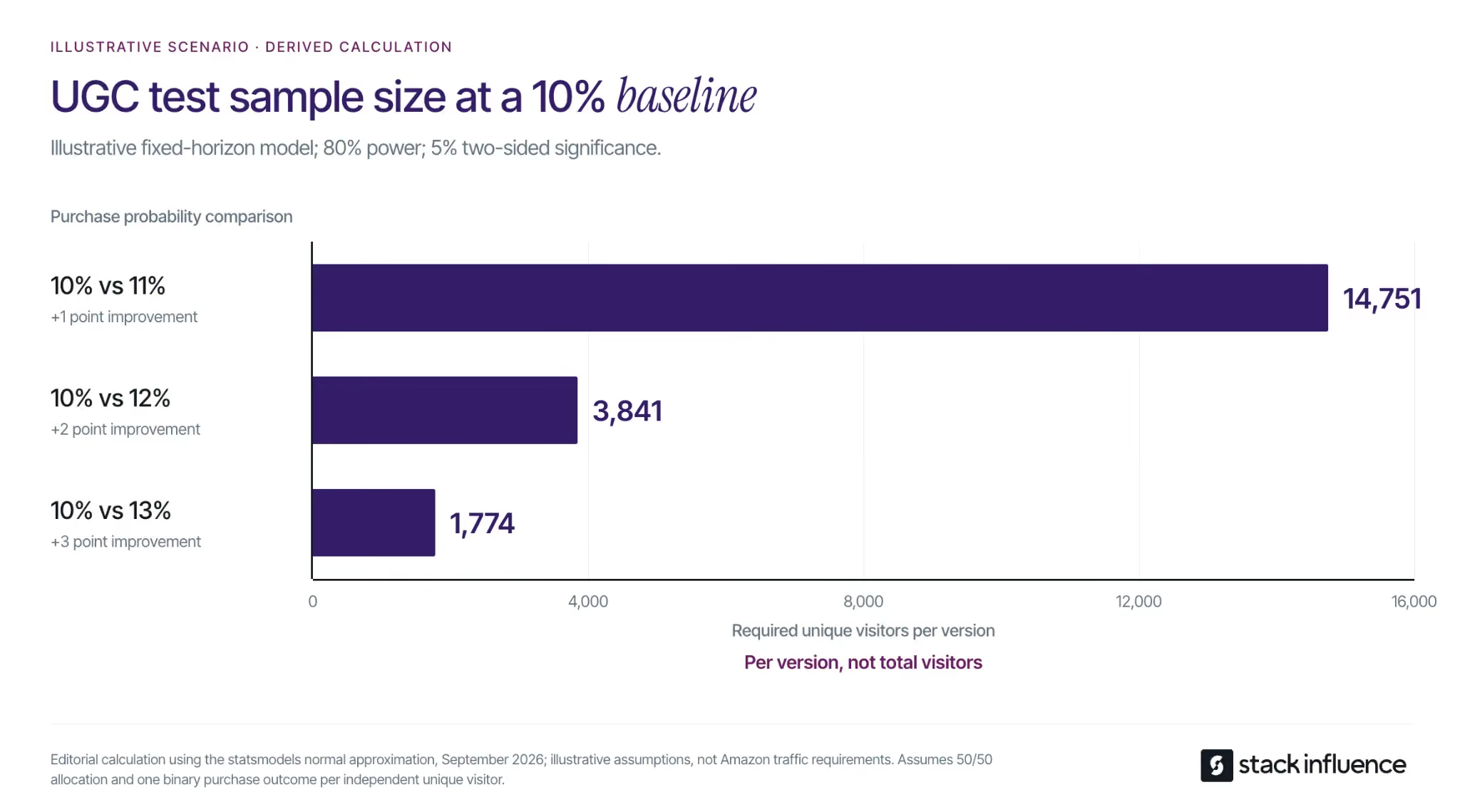
The traffic requirement depends on baseline performance, the improvement you need to detect, and the statistical method. A small worthwhile improvement may require substantially more visitors than a large one, so ASIN eligibility alone does not establish whether your desired decision will be practical.
Consider an illustrative fixed-horizon experiment with a 10% baseline purchase probability, equal allocation to two versions, independent unique visitors, and a binary outcome of purchase or no purchase. Assume a two-sided 5% significance level and 80% statistical power.
Using the statsmodels two-proportion sample-size method, the approximate requirements, rounded upward, are:
These are planning calculations, not Amazon traffic minimums, marketplace benchmarks, or a description of Amazon's internal statistical engine. They model one purchase decision per visitor, not units ordered per session.
An increase from 10% to 11% is one percentage point, or 10% relative lift. The distinction matters when a creative brief promises to detect a “1% improvement.”
Use this exercise before buying numerous minor variations. When available traffic cannot resolve the improvement that matters financially, choose a more meaningful contrast, extend the feasible research horizon, or use qualitative feedback without presenting it as conversion-lift evidence.
An asset can be publishable on Amazon without being independently split-testable in the placement you want. Confirm the available experiment type and content controls in your own account before contracting for a particular deliverable.
Amazon's A+ Content overview distinguishes Basic A+ image-and-text modules from Premium A+ options that include video and interactive content. For the laundry-basket example, an image module provides a straightforward place to compare the same product explanation with different visual evidence.
Use the Amazon A+ Content planning guide to identify the buying question the module should answer. Do not redesign the entire page merely to accommodate a creator's existing social post.
There is no blanket video-testing capability established by Amazon's public experiment overview. It lists images and A+ Content, but does not establish a separate, universally available gallery-video experiment.
Premium A+ video support is a publishing capability, not proof that a particular video module can be isolated in your account's testing workflow. Verify that workflow before buying two video versions; otherwise, use an eligible image comparison or describe a video rollout as observational.
Keep main-image compliance separate as well. Amazon's product image guide specifies a pure-white background for main images; a creator's household scene should not be treated as a compliant main image by default. Confirm category-specific requirements for the actual placement.
Select creators for the demonstration your hypothesis needs. For a listing asset, inspect their ability to show product scale, handling, and details; when the assignment also includes social distribution, assess audience relevance separately.
A useful brief for the basket would request the correct variant, a clear folded-product view, and an unobstructed demonstration of storage. Specify an image crop that preserves the relevant detail at the intended module size, rather than selecting a visually attractive frame that hides the feature being tested.
Micro influencers and nano influencers can enter the same qualification process. The guide to finding influencers for an Amazon product helps structure creator research, but the experiment brief must still define the asset itself.
Ask for the necessary still photographs explicitly. A UGC video order does not automatically give you a sharp, correctly framed listing image, and a delivered edit does not establish that raw files or additional edits are included.
Put the intended uses in writing rather than relying on the fact that you paid for production. The U.S. Copyright Office's permission guidance explains that acquiring a copy of a photograph does not, by itself, transfer its copyright.
Record permitted Amazon placements, editing and cropping permissions, any likeness or third-party permissions needed, license start and end dates, and renewal terms. Ensure the term covers validation, the experiment, and the intended post-test rollout.
When evaluating Amazon UGC services, compare equivalent rights and deliverables. A package that includes social posting may still require a separate agreement for additional production work or placements.
The FTC's endorsement guidance requires honest representations and clear disclosure of material connections when viewers would not otherwise understand them. Product gifting and reimbursement can create those connections; assess the final reused endorsement, not just the original social caption.
Do not remove a necessary disclosure to make an asset look less commercial. Do not script a creator's experience or let an edit imply a product result that did not occur.
Amazon's customer-review policy announcement distinguishes its permitted review programs from prohibited incentivized customer reviews. Commission product content, not a customer review in exchange for a gift, payment, or reimbursement.
Set up the experiment around the approved contrast, not whatever footage happens to arrive first. Amazon's A/B testing guide recommends isolating variables, running versions concurrently, collecting enough data, and avoiding premature conclusions.
In Seller Central, open Brands, then Manage Experiments, create an experiment, and select the type and ASIN. Enter your hypothesis and Version B, then review scheduling and publishing settings before submission.
For the A+ comparison, preserve an exact copy of Version A and replace only the agreed image in Version B. Check both previews for matching copy, module order, factual claims, and product variant; a changed headline would turn the test into a different comparison.
Amazon's experiment-duration guidance recommends 8 to 10 weeks when choosing a duration manually. Its default “to significance” mode can sometimes conclude sooner, and default settings include automatic publication of winning content. Inspect those settings against your approval process and license dates.
Keep a change log for price, coupons, advertising, availability, and delivery conditions. These changes do not automatically destroy a randomized comparison, but they affect what period and customer experience the result represents.
Repair factual errors or unavailable offers promptly rather than preserving them for research. When a disruption makes the original question unanswerable, record the reason and restart with a clean contract instead of selecting convenient dates afterward.

Judge the tested content using comparable version-level outcomes, not campaign reach or aggregate sales growth. Choose the primary metric before launch, and treat other metrics as supporting evidence rather than searching for whichever result looks strongest.
Amazon's experiment reporting includes conversion and units per unique visitor. Record the exact definitions and denominator shown in the report; do not substitute a units-per-session calculation for a shopper purchase probability.
The distinction is developed in the Amazon conversion rate optimization guide. More units can reflect larger quantities rather than more people deciding to buy, which changes how you interpret the creative.
Do not infer module exposure from assignment to a page version. Without suitable exposure reporting, the experiment does not establish how many shoppers actually examined the changed A+ image, so do not calculate a supposed UGC-viewer conversion rate from its results.
Evaluate the estimated difference alongside the tool's reported uncertainty and completion status. A positive point estimate is not enough by itself, and an inconclusive result does not establish that the two versions are equivalent.
Record the experiment ID, ASIN, marketplace, dates, exact A and B files, sample sizes, outcome estimates, important disruptions, and adoption decision. Keep completion and approval counts as production indicators; keep conversion, revenue, and contribution economics as commercial outcomes.
For safety checks such as return reasons or misleading expectations, use the reporting actually available. Do not claim a version-level return improvement when your returns data cannot identify which version customers saw.
The official Amazon Attribution guide describes a 14-day, last-touch model for qualifying off-Amazon activity. Use separate tags for creator placements and allow the attribution window to mature before comparing final click cohorts.
Those tags identify marketing touchpoints, not the causal effect of the randomized listing version. Do not add attributed purchases to experiment purchases as though they represent separate orders, or assume an attribution tag forces shoppers into Version B.
Product-seeding purchases need special attention. Complete campaign-funded creator purchases before the experiment when practical, and document any that overlap; those transactions are not evidence of independent shopper demand. The product-seeding costs and tracking guide provides the campaign-side accounting context.
Do not selectively subtract suspected creator orders from one version when the data cannot support an equivalent adjustment in both groups. Treat an unresolvable overlap as a limitation on interpretation.
A creator traffic surge can coexist with valid randomization, yet the observed lift may apply mainly to that campaign's audience mix. Microsoft's research on experiment external validity explains why an effect measured under one set of conditions need not transfer unchanged to another. Recheck performance before treating a launch-period result as an evergreen expectation.
Statistical evidence and economic usefulness answer different questions. An asset can improve conversion without earning back its incremental production and testing cost during the period you are allowed to use it.
Consider a separate illustrative scenario: $900 in total incremental content and testing costs, 6,000 eligible unique visitors per month after rollout, and $10 contribution per additional purchasing visitor. Assume one purchase per converting visitor, unchanged price and other costs, constant traffic and lift, and no credited contribution during the experiment itself.
The $10 contribution is after variable product, fulfillment, marketplace, and expected return costs. The $900 is an assumed all-in project cost, not a Stack Influence quote; the example excludes additional media spending, renewal charges, and referral bonuses.
Required absolute conversion lift = project cost ÷ (monthly eligible visitors × remaining licensed months × contribution per additional purchaser).
With those inputs, the break-even lift is 1.50 percentage points with one month remaining, 0.75 points with two months, 0.50 points with three months, and 0.25 points with six months.
Count the licensed months available after the experiment ends, not the original contract length. These thresholds are financial requirements, not expected UGC results or evidence that the required improvement can be detected with your traffic.
Record this full-project hurdle in the One-Contrast Contract before commissioning content. Once production spending is sunk, compare expected future contribution with future rollout or renewal costs for the next decision; failure to recover every past dollar is not, by itself, a reason to withhold a beneficial asset that costs nothing more to use.
Amazon listing split testing with UGC works best as a specific comparison, not a general vote for creator content. Define the placement, preserve the comparison, distinguish traffic acquisition from conversion, and check that the remaining usage rights allow a worthwhile return.
Start with one eligible ASIN and one unresolved buying question. Use that brief to scope a Stack Influence creator campaign around the content your next test actually needs, so production creates a measurable decision rather than another unused file.
Putting a product on three websites is not the same as launching it on three marketplaces. One offer might be ready to buy while another still needs approval, inventory, or a working fulfillment connection.
For ecommerce sellers planning how to launch a CPG product on multiple marketplaces at once, the practical answer is parallel preparation followed by a coordinated promotional window. Start with one launch product, centralize the operational details, and release each channel only when it can accept, fulfill, and measure orders.
This guide focuses on U.S. launches across Amazon, Walmart Marketplace, and TikTok Shop. Consumer packaged goods, or CPG, include everyday products such as packaged food and household essentials. Shopify can support the owned storefront and management workflow, but it is not another marketplace in this plan.
Use a Channel Release Sheet to decide whether each product-marketplace combination is ready for promotion. This is a working record of evidence and ownership, not a score that lets strong creative compensate for missing inventory.
Create one row for each marketplace and require five checks:
Assign an owner to each check and record what proves completion. A blocked requirement should pause that marketplace’s promotional release, rather than disappear inside an overall readiness percentage.
Seller onboarding and product availability are different checks. Amazon’s product-listing guidance distinguishes the product detail page from the seller’s offer and explains that some products or categories require approval.
For Walmart, confirm the requirements in its Marketplace seller onboarding guidance, including business verification, product identifiers, and a qualifying fulfillment and returns setup. Treat TikTok Shop verification and product eligibility as a separate workstream, not an extension of either approval.
A listing can be prepared before the promotional launch. That gives the team an opportunity to inspect the customer-facing page and resolve errors without spending money to send shoppers there.
Creator acquisition needs the same readiness check. In Stack Influence’s automated product-seeding workflow, creators purchase campaign products and complete social-content requirements before reimbursement. That means the creator’s purchase path and inventory allowance belong on the release sheet alongside the customer’s purchase path.
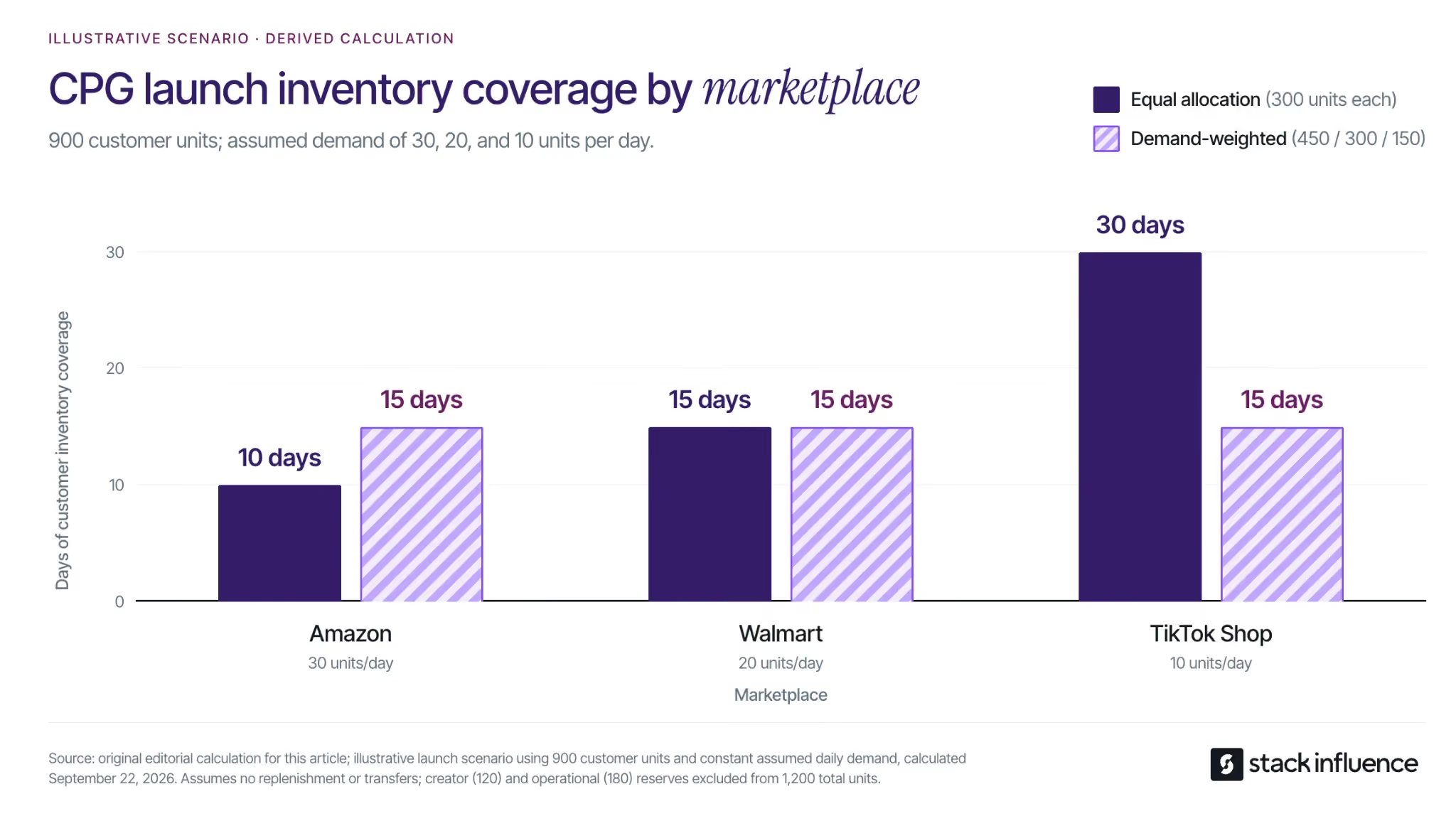
Equal inventory allocations can produce unequal launch readiness. A marketplace with faster demand can run out while another still holds weeks of stock.
Start with inventory that is genuinely usable for the relevant fulfillment arrangements. Exclude damaged stock, units awaiting required clearance, and inventory that has not become available to sell.
Consider an illustrative scenario, not a forecast or industry benchmark:
A brand has 1,200 usable units of the same retail pack. It assigns 120 units to expected creator purchases and holds 180 units as an operational reserve, leaving 900 units for independent customer demand.
Assume daily customer demand of 30 units on Amazon, 20 on Walmart, and 10 on TikTok Shop. These are hypothetical planning inputs.
An equal allocation of 300 units per marketplace provides 10 days of Amazon coverage, 15 days of Walmart coverage, and 30 days of TikTok Shop coverage.
A demand-weighted allocation changes the distribution to 450 units for Amazon, 300 for Walmart, and 150 for TikTok Shop. Each marketplace then has 15 days of coverage.
The calculations are:
Available customer inventory = 1,200 − 120 − 180 = 900 units.
Days of coverage = allocated units ÷ expected daily customer demand.
Demand-weighted allocation = 900 × the marketplace’s share of total expected daily demand.
The example assumes constant demand, no replenishment, no inventory transfers, and no additional losses. It also assumes the allocated units can actually fulfill orders on their assigned channels.
The creator allowance is a planning reserve, not a marketplace feature that restricts checkout access to particular buyers. Update the allocation as campaign purchases occur.
Demand weighting does not create more inventory. It moves the earliest projected stockout from day 10 to day 15 under these assumptions, while reducing excess coverage elsewhere.
Before adopting the allocation, compare coverage with replenishment lead time and a safety buffer. Fifteen days of stock is not enough when replacement inventory cannot become sellable within that period.
Maintain one approved product record, but do not assume every marketplace should receive identical listing copy or creative.
The shared record should contain the retail-pack description, internal SKU, product identifier, ingredients or materials, net contents, pack count, dimensions, approved claims, label images, and fulfillment requirements. Map that record to each marketplace’s listing and offer identifiers.
According to GS1 US’s barcode and product-identification guidance, product variations such as different package counts require their own GTINs. Do not reuse a single-pack identifier for a multipack merely because the underlying product is the same.
For food products, use the FDA’s food-labeling resources to review applicable nutrition labeling, allergen information, and claims. Have the relevant category specialist approve the product documentation before distributing it across listings and creator briefs.
Marketplace approval should not substitute for product-compliance review.
Record lot codes, expiration information where applicable, storage conditions, and minimum acceptable remaining shelf life for each fulfillment destination. Use those details when deciding where inventory should go, rather than allocating solely by sales potential.
The Walmart Fulfillment Services overview describes eligible products as nonperishable items that do not require temperature control. A refrigerated product therefore needs a separately validated fulfillment arrangement rather than an assumed WFS launch path.
For eligible products, plan first-expiring-first-out handling and a process for identifying affected inventory across channels. A product-record error or lot issue should be traceable without searching three disconnected spreadsheets.
Once the facts are approved, adapt how each marketplace presents them. Keep pack size, claims, and product identity consistent while adjusting the page structure, asset selection, and buying questions addressed.
Use the Amazon product launch checklist for the Amazon-specific workstream without treating its requirements as a substitute for Walmart or TikTok Shop setup.
Choose a system that owns the available-to-sell inventory number, and define how every connected channel updates it. The important question is not simply whether an integration exists, but what happens when two channels receive orders before the next update.
Shopify’s Marketplace Connect documentation lists support for Amazon and Walmart among its marketplace integrations. It can synchronize marketplace listings, orders, and inventory with Shopify.
TikTok Shop uses a separate path. Shopify’s TikTok Shop setup instructions cover store verification, eligibility, warehouse information, and the connection used to synchronize products and orders.
Do not interpret a successful catalog import as proof that fulfillment works.
Before release, validate SKU mapping, stock updates, order ingestion, tracking transmission, cancellations, and refunds using available platform-approved testing methods. Confirm who handles failed syncs and how the team pauses an affected listing.
Also distinguish inventory visibility from fulfillment access. Stock recorded in a central dashboard is not automatically available through every warehouse or marketplace fulfillment program.
Separate content readiness from traffic release. Creators can work from an approved brief while the marketplace team finishes operational checks, but publishing dates should depend on the destination being ready.
For micro influencers and nano influencers, make the product experience specific. A useful brief identifies the exact retail pack, intended use, product facts that must remain accurate, prohibited claims, required disclosure, and the intended shopping destination.
Avoid giving every creator a script that merely lists benefits. Request demonstrations that answer a real buying question, such as what comes in the pack, how the product is used, or how it fits into an everyday routine.
Plan a clean master asset and marketplace-specific versions. An organic social post, a product-page video, and a paid advertisement can require different editing, permissions, music rights, and calls to action.
The workflow for repurposing UGC across platforms should begin with written usage permissions, not with downloading a post after it performs well.
Record the permitted placements, duration, editing rights, and paid-media permissions. For Amazon placements, specify the intended use when evaluating Amazon UGC services, rather than treating every completed social video as a ready-to-publish listing asset.
Destination accuracy matters just as much. A brief for Walmart creator campaigns should identify the correct Walmart offer and retail pack, rather than send shoppers to a generic brand homepage.
The FTC’s influencer disclosure guidance explains that free products and other material brand relationships can require disclosure. Build disclosure instructions into the brief and review the finished placement, including disclosures within video where needed.
Social-content obligations must remain separate from marketplace reviews. Amazon’s published review-policy guidance prohibits compensation, refunds, discounts, or free products in exchange for reviews.
Do not make an Amazon review a condition of reimbursement or campaign completion. The purpose of creator product seeding here is disclosed content production and product discovery, not purchased ratings.
Calculate marketplace contribution separately, then subtract shared launch expenses once.
For each channel, start with net sales and subtract product cost, marketplace and payment fees, fulfillment, allocated variable inbound costs, commissions, direct advertising, and reasonable return or damage allowances. Document the boundary so the same expense does not appear in two places.
The distinction between attributed sales and customer acquisition cost matters because a launch can generate orders without covering the cost of acquiring them.
Consider a separate illustrative first-30-days scenario. It is independent of the inventory example and is not a projected outcome.
Assume 300 independent customer orders on Amazon contribute $6 each after all channel-level variable costs and direct advertising. Amazon contributes $1,800.
Assume 200 Walmart orders contribute $5 each, producing $1,000. Another 150 TikTok Shop orders contribute $4 each, producing $600.
Together, the three marketplaces contribute $3,400 before shared launch expenses.
Now deduct $1,400 for shared content production, licensing, and setup. That leaves $2,000.
Deduct a separate $1,200 net product-seeding and campaign expense. The launch retains $800 in contribution before fixed overhead and tax.
The calculation is:
Launch contribution = (300 × $6) + (200 × $5) + (150 × $4) − $1,400 − $1,200 = $800.
Every order count, cost, and contribution figure is an illustrative assumption. The per-order amounts are not marketplace fee quotes, and the $800 is not net profit or cash on hand.
The scenario excludes brand-funded creator purchases from independent customer orders. Its net seeding expense includes the reconciled cost of the creator program after accounting for relevant product costs, reimbursements, marketplace proceeds, and fees, without counting those amounts again elsewhere.
This is why three positive channel reports do not automatically establish a profitable launch. They must collectively cover the costs that sit outside individual marketplace dashboards.
Build a separate cash schedule as well. Inventory payments and campaign expenses may occur before the related marketplace settlements arrive.

A coordinated launch should have a shared calendar and separate channel controls. It does not require every promotion to begin at the same minute or every marketplace to receive the same budget.
Use the following operating sequence as a recommended schedule, not a promise about account approvals or fulfillment receiving times.
Complete the Channel Release Sheet, inspect the customer-facing offers, and validate the order workflow. Confirm available inventory rather than relying on a shipment’s arrival date.
Prepare the creator assets, channel-specific destinations, reporting identifiers, support responses, and pause instructions. Keep an escalation contact for each marketplace and fulfillment connection.
Release a contained first wave only to ready destinations. Check product availability, delivery promises, inventory updates, customer questions, and the quality of incoming traffic.
Pause the affected channel when a listing becomes unavailable, a pack-size mismatch appears, or order processing fails. A shared launch calendar should not prevent a local correction.
Record product questions that recur across marketplaces. Those questions can guide the next content edit or listing improvement.
Reallocate remaining promotional activity using contribution, inventory coverage, and the quality of customer demand.
Do not shift the whole budget after one strong day. Separate an unusual creator post, a temporary promotion, and a sustained change in customer purchasing before increasing commitments.
Update the next purchase order using observed demand and replenishment constraints. For products with repeat-purchase potential, keep later customer cohorts under observation rather than assuming future reorders will repay current losses.
Use a common order ledger for commercial results and separate attribution reports for marketing interpretation. Attribution is evidence about a shopping path, not automatic proof that marketing created an additional customer.
Use marketplace plus order ID as the transaction key. Record permitted order-level information consistently, including product, quantity, net revenue, refunds, channel costs, and identifiable campaign-funded purchases.
Do not assume that separate marketplaces allow the same customer to be identified across their reports.
Leading indicators tell you whether the launch is functioning: live offers, available inventory, completed creator posts, usable content, valid destinations, and fulfillment exceptions.
Outcome metrics show what the launch produced: independent customer orders, contribution, return rates, and later repeat purchasing where measurable.
An increase in completed posts is not yet an increase in customer demand. An increase in attributed sales is not yet an increase in contribution.
Eligible brands can use Amazon Attribution to measure qualifying off-Amazon marketing activity. Its 14-day attribution window means recent clicks may still generate reported purchases after an early campaign review.
For TikTok Shop and Walmart, use the sales and marketing reports actually available to the account. Keep untracked external activity labeled as unknown rather than assigning sales to a creator merely because orders followed a post.
The distinction developed in an Amazon external traffic strategy also applies to a multichannel launch: reported attribution, independent demand, and incremental growth are different measurements.
Treat the Amazon Brand Referral Bonus as a qualifying program with its own eligibility and crediting rules, not as a guaranteed discount on every creator-driven purchase. Reconcile confirmed credits into the model once, and distinguish earned credits from cash received.
A simultaneous launch provides no clean before-and-after comparison by itself. Later testing with comparable periods, products, or audiences can strengthen the evidence, but stock changes, promotions, and marketplace conditions still need to be considered.
Knowing how to launch a CPG product on multiple marketplaces at once means coordinating the work without pretending the channels are interchangeable.
Share the approved product record, inventory plan, content library, and financial definitions. Keep approvals, fulfillment readiness, shopping destinations, and release decisions specific to each marketplace.
Start by completing a Channel Release Sheet for one retail pack. Once the purchase paths and stock are ready, evaluate a managed Stack Influence product-seeding campaign against the content volume and marketplace coverage the launch can actually support. That turns creator activation into a planned part of the launch rather than another deadline competing with it.