




The first purchase order is only half the decision. A private label Amazon business also needs enough margin to acquire customers and enough cash to replenish inventory before those customers disappear into an out-of-stock listing.
For ecommerce sellers, the useful question is not simply, “Can I put my brand on this product?” It is, “Can I sell, support, and reorder this product on terms that still work?” This guide connects product research, supplier verification, launch spending, and replenishment so you can answer that question before committing inventory capital.
Key Takeaways
- Private label means selling a manufacturer-made product under your own brand; differentiation should solve a customer problem, not stop at a logo.
- Calculate contribution after landed costs, marketplace fees, fulfillment, and expected losses before setting a marketing budget.
- Verify samples, brand identity, product requirements, and replenishment terms before approving production.
- Keep creator campaigns separate from Amazon customer reviews, and measure campaign activity alongside contribution and available inventory.
What Is a Private Label Amazon Business?
A private label Amazon business sells products made by another manufacturer under the seller’s own brand. As Amazon’s private-label overview explains, the seller can work with a manufacturer on branding and product specifications rather than build a factory. This refers to your brand selling on Amazon, not Amazon’s own retail brands.
The distinction from wholesale is ownership of the brand proposition. A wholesale seller resells an established brand’s products; a private-label seller develops the identity, positioning, packaging, and customer promise around its own offer.
Suppliers sometimes use “white label” for a standard product offered to multiple brands and “private label” for a more customized arrangement. Do not assume either label guarantees exclusivity: ask what is actually exclusive, in which markets, and for how long.
Amazon FBA is a separate fulfillment choice, not a business model. You can compare FBA and merchant fulfillment after deciding what to sell and who will buy it.
For example, a hypothetical desk-organizer brand might differentiate through compartments that fit a specific workspace and clearer assembly instructions. A new logo on an otherwise identical organizer gives shoppers less reason to choose it at a higher price.
How Much Does It Cost to Start?

Startup cost depends on the product, order quantity, testing, freight, branding, and launch plan; there is no universal private-label budget. Build the estimate from actual supplier and service quotes, then separate money you expect to spend from cash you need to keep available for replenishment.
For the U.S. store, Amazon’s selling-fee schedule lists the Professional plan at $39.99 per month and the Individual plan at $0.99 per item sold, with referral fees and applicable additional costs separate. These account fees are only one part of a launch budget.
A hypothetical cash allocation could include $5,000 for 500 units landed at $10 each, $1,500 for prelaunch samples, testing, branding, and administration, $2,000 for launch marketing, and $3,000 held for replenishment. That totals $11,500, but it is an illustrative planning envelope, not a minimum, a market average, or assurance that every product’s costs are covered. The replenishment reserve remains cash until spent and may not fund the entire next order.
Work Backward From Contribution Per Order
Consider an illustrative U.S. sale containing one unit at $32, with no shipping charge or discount. Assume $10 in landed product cost, a 15% referral fee, $4.50 in fulfillment cost, and a $1.20 allowance for inbound placement, storage, and expected return losses.
Here, landed cost includes manufacturing, packaging, freight, and duties to the preparation location; the separate allowance covers the modeled Amazon-side inbound and holding costs. The numbers are assumptions, not quoted Amazon fees for a particular product.
The calculation is $32.00 minus $10.00 minus $4.80 minus $4.50 minus $1.20, leaving $11.50 before marketing, fixed overhead, and tax. Spending $6.00 to acquire that order leaves $5.50 before overhead and tax, not $5.50 in net profit.
To retain $3.50 per order for overhead and profit, the modeled acquisition-cost ceiling is $8.00: $11.50 minus $3.50. Replace every assumption with your product’s actual category, packaged dimensions, fulfillment estimate, and return experience before using that ceiling.
Product seeding belongs in this calculation too. Stack Influence’s product-seeding workflow links creator participation to completed social posts, but completion-based campaign spending does not make the product, reimbursement, or fulfillment free. Budget the full campaign cost rather than treating gifted inventory as having no economic value.
The Two-Order Test for Product Selection and Sourcing
The Two-Order Test is a five-check decision tool: establish a customer reason to buy, a reproducible product, a cleared brand and compliance path, a purchase-ready offer, and a funded replenishment plan. The first order tests the offer; the second should be a deliberate decision based on evidence, not an emergency caused by missing stock.
1. Find a Customer Problem You Can Actually Fix
Start with a specific use case rather than a broad category. “Storage products” is too vague; an organizer designed for a shallow desk drawer gives you dimensions, competing options, and customer frustrations to investigate.
Use Amazon’s Product Opportunity Explorer to investigate customer demand, search behavior, competition, and product feedback. Compare demand across time rather than treating a brief spike as a dependable sales forecast.
Read competing listings and reviews for recurring, fixable complaints: unclear sizing, awkward setup, missing accessories, weak instructions, or packaging damage. Record the complaint, your proposed change, its cost, and how a shopper could verify the improvement before buying.
Reject an idea when the only answer is “sell the same item more cheaply” and the lower price removes your acquisition budget. A large market is not enough if you cannot explain why a customer should choose your offer.
2. Turn Supplier Promises Into a Testable Specification
Use manufacturer directories, trade-show exhibitor lists, and supplier referrals to identify candidates. Stack Influence’s guide to sourcing products for Amazon provides context on sourcing routes, but a directory listing is a starting point rather than proof of manufacturing capability.
Send the same written specification to several candidates. Request material details, tolerances, packaged dimensions and weight, minimum order quantity, sample cost, production lead time, payment milestones, inspection access, and defect remedies.
Ask whether you are dealing with the factory or a trading company and who controls production changes. Compare quotes on the same delivery basis so a low factory price is not mistaken for a low landed cost.
Approve a physical reference sample, then document how production will be checked against it before shipment. Put packaging, labels, instructions, and any agreed exclusivity into the order documents; do not rely on a chat message saying the product will be “premium.”
3. Resolve Brand Identity and Product Requirements
Check the brand name before printing packaging. The USPTO’s guidance on similar trademarks explains why searching only for an exact name is insufficient: similar marks can create conflicts. Obtain qualified advice where trademark, design, or patent questions remain unresolved.
Confirm which product rules apply before choosing a supplier. For regulated general-use consumer products, the CPSC’s testing and certification guidance explains manufacturer and importer certification responsibilities; it also flags July 8, 2026, as the start of mandatory certificate eFiling for importers of most regulated consumer products. That does not mean every private-label product has identical testing or filing requirements.
Ask a qualified laboratory or compliance specialist to identify the requirements for your exact product, intended users, and destination market. Obtain documentation that matches the product and manufacturer, rather than accepting an unrelated test report as sufficient.
Keep the brand name consistent across packaging, catalog information, and product identifiers. GS1 US’s Amazon barcode guidance is useful when establishing legitimate UPCs or GTINs associated with your business and products.
4. Build a Purchase-Ready Offer
Set up your seller account and confirm any product or category approval requirements before the bulk order becomes irreversible. Align the brand name, product identifier, model, and variation details before creating the catalog offer.
Amazon Brand Registry generally requires an eligible pending or registered trademark and branding permanently affixed to the product or packaging. The trademark information must match the application; enrollment and approval to sell a product are different questions.
Prepare images and copy that demonstrate the promised improvement. Show dimensions, included components, setup, intended use, and important limitations, then ensure the physical sample supports every claim.
Choose fulfillment using the finished package, not the supplier’s estimate for an unpackaged unit. Confirm sellable inventory, shipping expectations, listing availability, and customer-support ownership with an Amazon product launch checklist before sending paid traffic.
5. Fund the Reorder Before Increasing Demand
Record when a replacement order must be placed and when its deposit, balance, freight, and other charges become payable. Compare those dates with cash that will actually be available, not just sales appearing in a dashboard.
Preserve room to change the product after the first batch. An unusually large minimum order can tie up the money needed to fix a packaging problem, improve the specification, or order a better version.
The Two-Order Test does not require immediate scale. It requires a credible path to another order once customer response, product quality, and contribution justify it.
How Should a New Private-Label Product Get Its First Customers?
Start with a purchase-ready listing and a bounded marketing test that explains a specific reason to buy. Combine relevant Amazon advertising with creator demonstrations where those demonstrations help shoppers understand the product; do not compensate for an unclear offer by buying more traffic.
For advertising, set a spending limit from contribution rather than competitor activity. Review which search terms produce orders and whether those orders still meet your cost assumptions before expanding the test.
Give Creators a Product Question to Answer
A useful creator brief describes the intended customer, the real task the product performs, claims that can be supported, the agreed deliverable, and the destination link. Give creators enough time to use the product and preserve room for an honest opinion.
When finding influencers for an Amazon product, prioritize relevant demonstrations and audience needs rather than follower count alone. Brands that work with micro influencers should also agree on content reuse, editing, paid-ad permissions, and duration instead of assuming a social post includes unrestricted rights.
Stack Influence’s gifted-first model brings vetted creator participation, product seeding, coordination, and completed-post accountability into one campaign workflow. Its practical role here is organizing content delivery, not guaranteeing sales from each creator.
The published Stack Influence launch examples include a three-month Snow campaign with 90 creator promotions, during which average monthly unit sales moved from 34 to 215. This is a campaign-period observation, not a typical private-label result or proof that creator activity alone caused the change.
Use a first campaign to identify useful product explanations and audience response. Longer-term brand partnerships or brand ambassador arrangements should follow that evidence rather than precede it.
Separate Social Content From Customer Reviews
The FTC’s endorsement guidance explains that free products and other material brand relationships can require clear disclosure. Include disclosure requirements in the brief and check the published content rather than assuming creators will handle them consistently.
Amazon’s customer product review policies prohibit compensation, free products, and reimbursement in exchange for customer reviews. Do not make an Amazon review a campaign deliverable, ask for a positive rating, or treat a reimbursed social-content campaign as a customer-review program.
For eligible products, Amazon Vine provides a separate Amazon-run route to reviews. Check its current seller and product requirements, and do not expect favorable feedback simply because a product was enrolled.
Measure Contribution, Not Just Attributed Revenue
Review launch performance weekly, separating activity, customer response, and economics. Completed creator posts and usable licensed assets show delivery; visits and add-to-cart activity show response; customer orders, returns, contribution, and available cash determine whether to continue.
For eligible brands, Amazon Attribution is a free tool for measuring qualifying off-Amazon marketing and reports a 14-day attribution window. Create distinct tags for the campaigns or placements you need to compare before distributing links, and allow that conversion window to mature before treating a cohort as complete.
A reported attributed sale is not proof that the campaign created a sale that would never otherwise have happened. Compare comparable periods, record price and inventory changes, and avoid adding reports together as though every dashboard contains a separate set of customers.
Track seeded or reimbursed creator purchases separately from independent customer demand. Reconcile the campaign’s reimbursements and product costs so the same cost is not counted twice, and do not assign speculative resale value to unused creator assets to make the launch look profitable.
Eligible enrolled U.S. brands may earn the Amazon Brand Referral Bonus, which Amazon describes as averaging 10% of qualifying sales. The amount varies, offsets future referral fees, and generally has a two-month waiting period; it is not an immediate cash payment on every external order.
Apply confirmed credits when reconciling results. A disciplined Amazon external-traffic strategy should distinguish delivery, attributed revenue, and business outcomes rather than collapse them into one return figure.
Plan Replenishment Before Launch Stock Runs Low
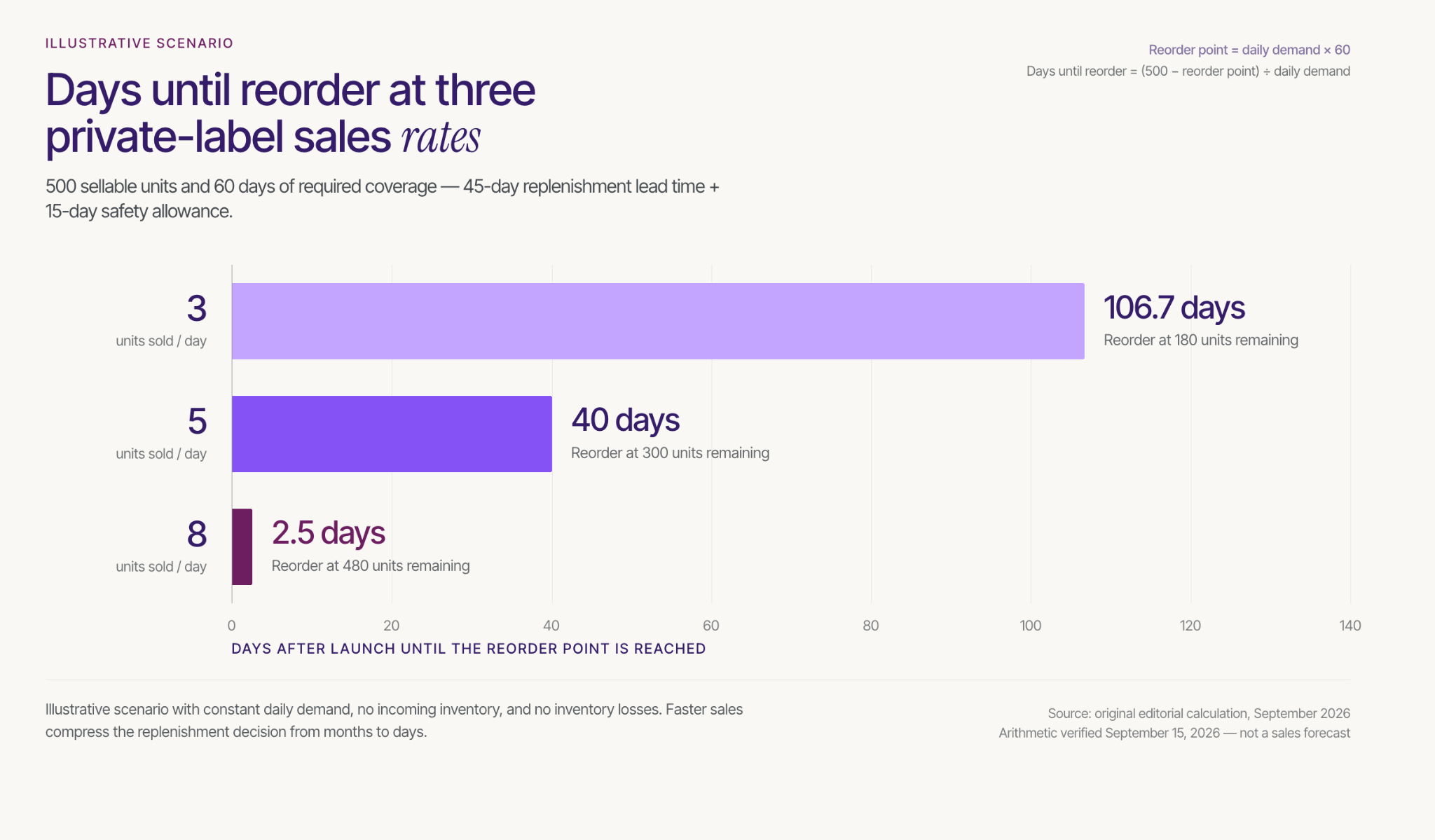
Faster sales can shorten your decision window more than you expect. Treat the final check in the Two-Order Test as an inventory calculation, not a reminder to order again when the warehouse looks empty.
Consider a separate illustrative scenario with 500 sellable units after any sample allocation, no incoming inventory or backorders, and constant daily customer demand. Assume replenishment takes 45 days from placing the order until units are sellable, plus a 15-day safety allowance.
The reorder point is daily demand multiplied by 60 days of coverage. Days until that point equal starting inventory minus the reorder point, divided by daily demand:
- At 3 units per day, reorder at 180 units remaining, approximately 106.7 days after launch.
- At 5 units per day, reorder at 300 units remaining, 40 days after launch.
- At 8 units per day, reorder at 480 units remaining, just 2.5 days after launch.
These are planning scenarios, not sales forecasts. The model assumes no inventory losses or changes in demand, and its fixed safety allowance is not a statistical safety-stock calculation.
The implication is practical: the fastest scenario requires a replenishment commitment almost immediately, before a new seller has much customer evidence. Adjust the first order, supplier terms, lead time, or launch pace before that situation forces an expensive decision.
Build Beyond the First Purchase Order
A private label Amazon business becomes more defensible when the product solves a clear problem, the supplier can reproduce it, and the economics support both customer acquisition and replenishment.
Use the Two-Order Test on one candidate product before expanding the range. For a launch-ready item, evaluate a focused Stack Influence product-seeding campaign within a defined budget, so creator content helps explain the offer while you learn whether real demand supports the next order.