




A launch date is not a strategy. It is the moment every weak link becomes visible: an unclear promise, an untested checkout, creator content that arrives late, missing attribution, or inventory that cannot support demand.
A brand launch campaign solves that coordination problem. For ecommerce sellers and content creators, the work is not simply generating attention on one day. It is building enough market proof before launch, directing that proof into a reliable buying path, and learning fast enough to improve the campaign after the first wave.
This guide provides a launch framework, practical calendar, creator roles, channel sequence, attribution model, and go or no-go audit.
Key Takeaways
- A launch should prove six links: audience, offer, commerce, proof inventory, distribution, and learning.
- Work backward from the customer decision, not forward from a promotional task list.
- Give each creator a proof job, such as demonstration, objection handling, audience translation, or reusable UGC.
- Readiness and response lead; purchases, contribution, retention, and reusable assets reveal durable value.
- When a handoff breaks, reduce the affected wave instead of sending traffic into an unresolved problem.
What Is a Brand Launch Campaign?
A brand launch campaign is a coordinated program that introduces a new brand, presents a materially changed brand identity, or brings a brand into a new market. It aligns positioning, ecommerce operations, creator and customer proof, channel distribution, and measurement across prelaunch, launch, and postlaunch activity.
A brand launch is broader than a product announcement. Aha!’s marketing launch planning guide notes that brand launches often require longer-term planning because the company is committing to a new strategy, goals, values, and identity. (Aha!)
Common versions include:
- New-company launch: Establish the category, promise, identity, and reasons to trust an unfamiliar seller.
- Rebrand: Explain what changed, what remained true, and why the new identity matters.
- Market-entry launch: Localize the proof and buying path for a new country, retailer, marketplace, or audience.
- Creator-led brand launch: Convert audience trust into a business that can stand beyond the creator’s familiarity.
- Portfolio launch: Give a new brand or collection a clear position within an established company.
A product can sit inside any of these campaigns, but the central question is larger: what should buyers believe about the brand, and what evidence makes that belief reasonable? Stack Influence’s creator-led product launch strategy addresses the narrower product and creator layer.
The Launch Proof Chain
The Launch Proof Chain treats a launch as six connected proofs rather than a pile of tactics. A campaign is only as reliable as its weakest link because attention magnifies whatever the customer encounters next.
1. Audience Proof
Audience proof shows that a specific buyer recognizes the problem, language, and buying context. A broad demographic label is not enough to guide a launch message.
Document three things before creative production begins:
- Trigger: What makes the buyer seek a solution now?
- Objection: Why might the buyer distrust or reject an unfamiliar brand?
- Credible messenger: Who can explain the product naturally?
Use interviews, support conversations, category reviews, search language, creator comments, landing-page behavior, and small message tests. The goal is to find a defined group with a recognizable reason to care.
2. Offer Proof
Offer proof turns positioning into a testable purchase decision. One short brief should state the buyer, problem, promised outcome, differentiator, evidence, and offer.
A complete launch offer answers:
- What does the product help the buyer do?
- Why should the buyer believe the claim?
- Why choose this brand over the current alternative?
- What is included, what does it cost, and what happens after purchase?
- Is there a genuine reason to act during launch?
An incentive can reduce first-purchase friction, but it cannot repair weak positioning. The offer still needs a reason to matter after the promotion ends.
3. Commerce Proof
Commerce proof confirms that interest can turn into a completed, supportable order. For Shopify brands, that means checking the mobile product page, successful and failed payments, refunds, cancellations, fulfillment, contact details, policies, and shipping rates before traffic arrives. Shopify’s official checklist for testing and launching a store includes these operational checks before go-live. (Shopify Help Center)
Amazon sellers need the same discipline in marketplace form: an active offer, accurate listing content, usable variation structure, in-stock inventory, compliant claims, and a destination that matches the creator’s promise. Stack Influence’s Amazon brand-building guide expands on the listing, storefront, traffic, and measurement layers.
Run a complete mobile test order. Name the owner for checkout alerts, support questions, and the inventory threshold that pauses amplification.
4. Proof Inventory
Proof inventory is the set of demonstrations, explanations, comparisons, FAQs, and creator assets that make the offer easier to believe. One hero video rarely answers every objection.
Plan a mix of proof jobs:
- Realistic product demonstration
- Problem and use-case explanation
- Setup, fit, texture, size, or routine clarification
- Objection handling
- Founder or origin story
- Honest creator reaction
- Short UGC clips for approved reuse
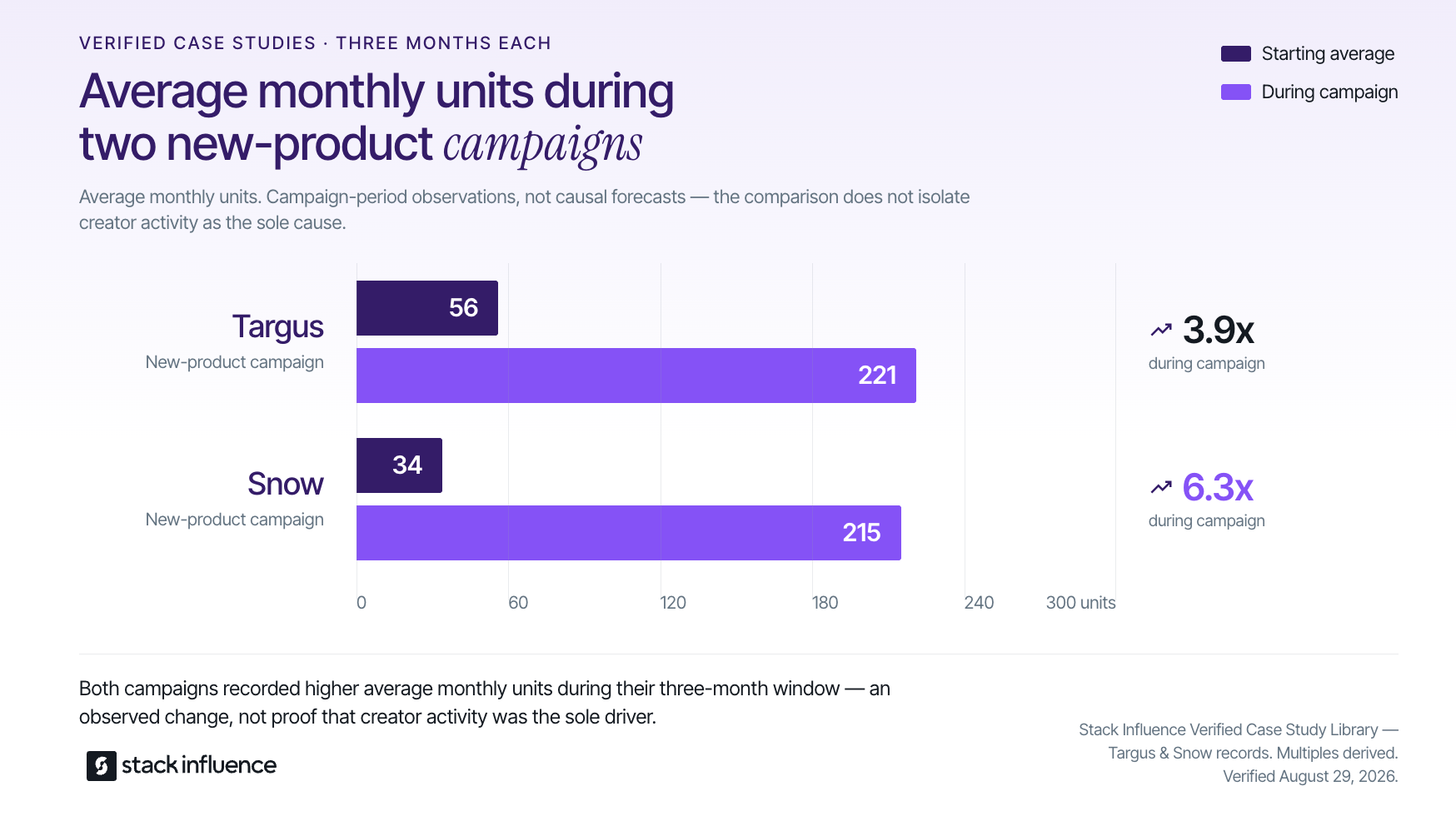
Two verified Stack Influence launch case studies show why proof delivery and commerce outcomes should be reported together. During a three-month new-product campaign for Targus, 120 creator promotions coincided with average monthly unit sales increasing from 56 to 221, about 3.9 times, while Amazon Best Seller Rank moved from #151,547 to #47,811. During a three-month Snow new-product launch, 90 promotions coincided with average monthly units moving from 34 to 215, about 6.3 times, while Best Seller Rank moved from #177,297 to #57,682. These campaign-period observations do not isolate creator activity as the sole cause.
The lesson is not to forecast the same movement. It is to report content delivery, marketplace activity, and business outcomes as different parts of one campaign record.
5. Distribution Proof
Distribution proof shows that each channel can deliver the right evidence at the intended moment. Specify the channel’s job, asset, audience, destination, owner, and measurement convention.
Creator posts may introduce lived experience, email may explain the offer, paid media may amplify validated creative, and the product page may resolve final objections. Stack Influence’s product launch ideas for ecommerce teams can help populate tactics after those jobs are clear.
Creators must also receive products early enough to use them honestly, while links, codes, and destinations must work before publishing.
6. Learning Proof
Learning proof exists when the team knows what will be measured, who owns the data, and what decision follows each result. Configure baselines, campaign names, creator tags, dashboards, and reporting windows before launch.
Write decision rules in plain language:
- Traffic without add-to-cart activity suggests message-to-page misalignment.
- Add-to-cart activity without purchases points to checkout, shipping, price, or offer friction.
- Saves and useful comments without clicks call for a stronger action or destination.
- Useful UGC plus qualified traffic supports a similar brief in the next wave.
Teams can develop several links in parallel, but more distribution should not hide uncertainty in the audience, offer, or commerce path.
How Long Should a Brand Launch Campaign Run?
A brand launch campaign should run long enough to build proof before the public announcement and observe behavior after it. For an ecommerce brand with finished positioning, stable supply, and a working storefront, a 10 to 14-week operating window is practical. More complex rebrands, regulated categories, retail rollouts, and unfinished products often need several additional months.
Atlassian’s product launch timeline guide recommends beginning full product-launch planning at least four to six months before the target date. The shorter operating calendar below assumes product development, supply planning, legal review, and core brand decisions are already sufficiently advanced. (Atlassian)
- 10 to 8 weeks before launch: Lock the target buyer, buying trigger, launch promise, proof requirements, inventory assumptions, baseline metrics, and decision owner.
- 7 to 5 weeks before launch: Finalize the storefront, tracking conventions, support process, returns flow, content rights, and creator offer. Begin recruitment through a documented influencer outreach system.
- 4 to 2 weeks before launch: Seed products, collect early feedback, produce launch assets, build the waitlist, test the message, and resolve common questions. A practical influencer-seeding guide helps separate unconditional gifting from a defined product-for-content campaign.
- Launch week: Release proof in waves, verify every destination, monitor inventory and support, and give high-intent audiences a clear next step. Avoid publishing every asset at the same hour.
- 1 to 4 weeks after launch: Amplify the strongest proof, retarget engaged visitors, update product pages, survey buyers, assess cohort quality, and decide which creator, message, and channel combinations deserve another test.
Content creators should build a production buffer for product experience, scripting, filming, revisions, disclosure, file delivery, and post authorization.
Creators Turn an Unknown Brand Into Visible Proof
Creators are most valuable in a brand launch campaign when each partnership has a defined proof job, not merely a posting slot. The creator’s role is to translate an unfamiliar offer into a credible experience the audience can understand.
Four useful creator roles are:
- Audience translator: Connect the product to a problem, routine, or community language.
- Demonstrator: Show setup, texture, fit, scale, or workflow without overstating results.
- Objection resolver: Address concerns such as complexity, compatibility, value, delivery, or use context.
- Asset producer and distributor: Create reusable UGC while generating early audience response.
A strong influencer brief should identify the proof job, factual product information, claims that cannot be made, format, due date, disclosure, call to action, review process, content rights, and any paid-use authorization. Creative freedom works best inside clear factual and operational boundaries.
For U.S.-facing campaigns, the Federal Trade Commission’s Disclosures 101 guide says creators should disclose financial, employment, personal, or family relationships and should treat free or discounted products as material connections. The disclosure should be easy to notice and appear with the endorsement. (Federal Trade Commission)
Content creators should use the product long enough to form an honest view, separate personal experience from supplied claims, and clarify usage rights before recording.
Stack Influence supports this activation layer through automated product seeding. Its gifted-first workflow connects ecommerce brands with roughly 600,000 vetted creators and supports creator sourcing, coordination, UGC collection, and completed-post accountability rather than treating every outreach attempt as a completed result.
Best-Fit Workflow: The model is especially practical when a seller wants to turn launch inventory into distributed creator proof without manually managing every creator follow-up.
Channel Roles Matter More Than Channel Count

A launch channel needs one primary job and one measurable handoff. More channels do not help when each repeats the same announcement or sends people to the wrong destination.
Assign roles such as:
- Owned site and email: Teach the brand story, capture demand, explain the offer, and follow up.
- Creator content: Translate the product into lived experience, generate proof, and reach relevant communities.
- Paid media: Accelerate validated messages and assets after the commerce path is stable.
- Marketplace or storefront: Convert intent, answer final questions, and complete the transaction.
- Partners and communities: Transfer trust through a relevant association or recommendation.
Sequence those roles deliberately. Publish the owned explanation, release creator proof in waves, identify messages producing qualified response, then amplify the strongest assets. Retarget engaged visitors with a different proof angle.
TikTok’s official Spark Ads documentation says brands can use organic creator posts with the creator’s authorization, and engagement generated by the promotion remains attributed to the original post. That makes authorization scope and timing part of launch planning, not an afterthought. (TikTok For Business)
A broader content syndication workflow can extend approved creator assets across paid social, email, product pages, and marketplace content. The agreement must match the actual channels, term, editing permissions, and creator-handle use.
How Do You Measure a Brand Launch Campaign?
Measure a brand launch campaign as a chain of readiness, response, commerce, and durable-asset signals. Set baselines before launch, tag every meaningful route, and compare cohorts and periods consistently. Reach, revenue, marketplace rank, and creator activity should be interpreted together because a launch changes several variables at once.
Use the Four-Layer Launch Ledger:
- Readiness: Inventory available, product pages approved, checkout tests passed, links verified, creators shipped, content received, rights documented, and support prepared.
- Response: Waitlist growth, email engagement, creator completion, qualified comments, saves, shares, video completion, product-page visits, and link clicks.
- Commerce: Add-to-cart activity, checkout initiation, conversion rate, orders, units, revenue, contribution margin, customer acquisition cost, refunds, and marketplace movement.
- Compounding value: Reusable UGC, rights coverage, branded search, repeat purchase, affiliate or ambassador progression, customer language captured, and winning creative concepts.
Readiness and response are leading indicators. Commerce and retention are outcomes. Compounding value shows what remains after the launch budget stops.
Google Analytics’ URL builder guidance explains that UTM parameters identify the campaigns referring traffic in Traffic acquisition reporting. Use consistent source, medium, campaign, and content values for each creator, wave, email, and paid variation. (Google Help)
Amazon sellers can use Amazon Attribution for eligible off-Amazon activity. Amazon says its reports use a 14-day attribution window and can include clicks, detail page views, add-to-cart activity, purchases, units sold, product sales, and new-to-brand metrics. (Amazon Ads)
Attribution still has limits. Dark social, device switching, marketplace search, delayed purchases, reused content, and simultaneous campaigns can obscure the path. Compare tagged performance with the prelaunch baseline, but describe correlation unless the design supports a stronger causal claim.
An influencer marketing strategy should also separate creator delivery from audience response and commerce. A creator can produce a valuable launch asset even when the post is not the campaign’s largest traffic source.
The Hidden Risk Is Operational Desynchronization
Many launch failures are handoff failures disguised as marketing problems. The message, creator, destination, inventory, rights, and measurement system may each work alone while arriving in the wrong order.
Watch for these failure modes:
- A creator receives the product after the useful testing window.
- Content publishes before the product page, offer, code, or attribution link is ready.
- Paid amplification begins before usage rights or post authorization are documented.
- Support staff cannot answer questions raised by launch content.
- Inventory drops below the level needed to fulfill the next creator or media wave.
- The dashboard reports traffic but cannot separate creators, assets, or campaign phases.
- The team changes the offer mid-launch without preserving a comparable baseline.
A 72-Hour Go or No-Go Audit
Run a binary audit against the six Launch Proof Chain links 72 hours before the affected launch wave. Mark each link verified with a value of 1 or unresolved with a value of 0.
In an illustrative campaign, Audience, Offer, Commerce, and Distribution are verified at 1 each. Proof Inventory and Learning remain unresolved at 0 each. The campaign therefore has 4 verified links out of 6, or 66.7% proof coverage.
That percentage is not an industry benchmark. It creates decision visibility. Because the unresolved links affect usable evidence and measurement, the team should delay the affected creator wave or narrow launch scope until both are fixed.
Treat order fulfillment and measurement ownership as hard gates. When timing slips, reduce channel count, geography, creator volume, or product range before lowering claim accuracy, disclosure, checkout, rights, or measurement standards.
Build a Launch That Can Keep Learning
A strong brand launch campaign does not try to make every channel loud at once. It proves the buyer, offer, commerce path, content, distribution, and learning system, then creates enough feedback to improve after launch day.
Ecommerce sellers should audit one launch against the six links and fix the first unresolved handoff. Content creators should define the proof job they can perform credibly and the asset they will deliver.
Teams that want creator sourcing, gifted-first product seeding, campaign coordination, UGC collection, and completed-post accountability managed together can evaluate Stack Influence as the execution layer. The goal is not a louder announcement. It is a launch that leaves the brand with customers, usable content, and a repeatable learning system.