




An expensive Amazon click can point to different problems: the wrong shopper clicked, the product page left a buying question unanswered, or the offer could not support the acquisition cost. Hiring creators only helps when their work addresses the problem you actually have.
For ecommerce sellers, learning how to use micro influencers to reduce Amazon PPC cost means connecting creator content and audience referrals to a measurable change in advertising economics. Start by separating cheaper clicks, cheaper orders, and a smaller advertising bill. They are not the same outcome.
Key Takeaways
- Use creator demonstrations to test lower cost per order, rather than assuming influencer activity will lower Amazon's auction prices.
- Include product seeding, platform fees, content rights, editing, and campaign labor when evaluating savings.
- Measure creator-referred shopping separately from PPC performance and campaign-funded creator purchases.
- Reduce advertising in stages only when the resulting contribution, not just the PPC bill, supports the change.
What Can Micro Influencers Actually Reduce?
Micro influencers can help reduce acquisition costs by introducing relevant shoppers and producing demonstrations that improve product understanding. Whether those activities reduce cost per click, cost per order, or total marketing expense must be tested separately.
Here, micro-influencer marketing means working with smaller, topic-focused content creators through an agreed product or payment exchange. Nano influencers can participate too; a smaller audience is not automatically a more relevant audience.
Amazon's Sponsored Products documentation describes cost-per-click advertising with advertiser-controlled bids, budgets, and targeting. A creator collaboration is therefore not a guaranteed discount on the auction.
Cost per click, or CPC, equals ad spend divided by clicks. PPC cost per order equals ad spend divided by attributed purchases. Advertising cost of sales, or ACOS, divides ad spend by ad-attributed sales instead.
Those definitions reveal the opportunity. Better conversion can lower cost per order even when CPC stays unchanged. Creator referrals may also support sales outside your existing PPC acquisition path, but moving spending into an influencer budget does not automatically create a saving.
Choose one primary objective before recruiting: improve PPC purchase efficiency, generate independently profitable referral demand, or maintain contribution while reducing PPC expenditure.
Set the Creator Budget's Conversion Hurdle
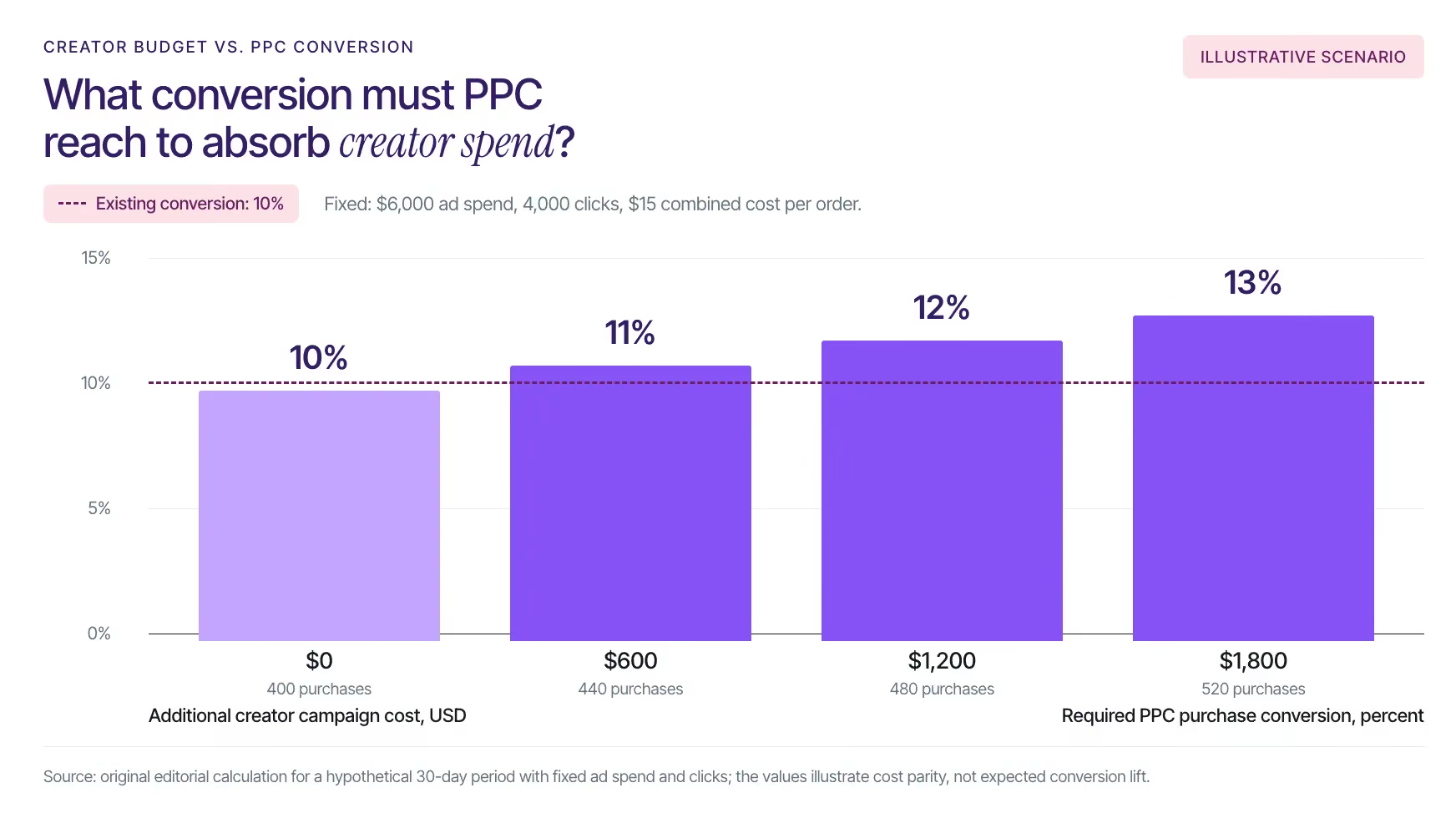
Calculate how much additional conversion your creator investment must produce before calling the campaign more efficient. A lower media-only cost per order can disappear once production and product costs are included.
Consider an illustrative 30-day scenario with $6,000 in Amazon ad spend, 4,000 clicks, and 400 attributed purchases. CPC is $1.50, purchase conversion is 10%, and media cost per order is $15.
Assume the same clicks and media spend, unchanged order economics, and no referral credits, external-order contribution, or future content value. Charge the entire additional creator campaign cost to this period.
To keep combined advertising and creator cost at $15 per PPC order:
- $0 creator cost: 400 purchases are required, equivalent to 10% conversion.
- $600 creator cost: 440 purchases are required, equivalent to 11% conversion.
- $1,200 creator cost: 480 purchases are required, equivalent to 12% conversion.
- $1,800 creator cost: 520 purchases are required, equivalent to 13% conversion.
The formula is:
Required purchase conversion = baseline purchase conversion × (1 + additional creator cost ÷ baseline ad spend).
These are acquisition-cost parity thresholds, not profit break-even points or expected campaign results. Moving from 10% to 12% conversion requires a 20% relative improvement, not a two-percent improvement.
Budget against the actual deliverable. Stack Influence's automated product-seeding workflow connects gifted-first creator participation with post verification and completion-based payment. Define ad-ready file delivery, permitted reuse, and placement requirements separately in the agreement; completed posts and customer orders remain distinct outcomes.
Include platform charges, net product or reimbursement costs, fulfillment, editing, rights, and labor. For reimbursed marketplace purchases, reconcile reimbursement with seller proceeds and product costs so the same expense is not counted twice.
Run the Five-Step Proof-to-PPC Test
The Proof-to-PPC Test connects one advertising problem to one creator assignment and one spending decision: diagnose, recruit, brief, deploy, and track. Keep those stages connected so the campaign produces evidence your advertising team can use.
1. Diagnose One ASIN and One Advertising Problem
Choose one sellable product variation with dependable availability and enough relevant traffic to evaluate a change. Export a comparable baseline covering clicks, spend, purchases, sales, price, promotions, and inventory interruptions.
Separate branded searches from nonbranded searches, and review material placement differences. A shift toward shoppers already searching for your brand can improve aggregate results without improving the acquisition of unfamiliar shoppers.
Decide whether the problem is irrelevant traffic, weak product explanation, or an uncompetitive offer. Use an Amazon conversion rate optimization review to distinguish a content problem from price, availability, compatibility, or fulfillment problems.
For a lunch-container brand, the hypothesis might be that shoppers cannot judge compartment capacity or understand the lid mechanism. Creator footage can address those questions; it cannot repair a faulty latch.
2. Recruit for Demonstration Fit, Not Follower Count
Look for creators who already show the relevant activity, such as packing lunches or testing kitchen products. Evaluate whether they can make the product's important details visible and explain its limitations accurately.
Separate production fit from distribution fit. A creator may produce excellent footage for your ads without having the right audience for direct sales. A relevant audience may still receive a weak demonstration.
When finding influencers for your Amazon product, check recent comparable work, audience geography, language, and the proposed publishing surface. An Amazon storefront or Amazon Influencer Program presence is not a substitute for that evaluation.
Group the pilot around distinct buyer questions rather than commissioning interchangeable endorsements. Determine the batch size from your cost ceiling and the number of useful concepts you need, not an arbitrary follower or creator minimum.
3. Brief the Social Post and Reusable Assets Separately
Specify the product variation, demonstration, prohibited claims, delivery dates, publishing placement, and acceptance criteria. Ask for clean source files and agreed editing permissions when your plan depends on reusing footage.
A social post, an editable UGC video, and permission to advertise with a creator's identity are different deliverables. The creator-content production workflow should identify which are included and who owns the handoff to the advertising team.
For the lunch container, request clear views of the compartments, loading process, and lid closure. Do not require the creator to make unsupported durability or leak-prevention claims.
The FTC's influencer disclosure guidance treats free products and other material connections as relationships that need clear disclosure with the endorsement. Build that requirement into the brief.
Keep Amazon customer reviews outside the compensated assignment. Amazon's customer-review policy reminder prohibits exchanging gifts, refunds, or other incentives for reviews, including reviews described as honest.
4. Deploy Creator Proof Where PPC Shoppers Can See It
Turn the most useful demonstrations into placement-specific assets rather than uploading an unchanged social post everywhere. The goal is to improve the shopping decision, not merely add a creator's face.
Amazon's Sponsored Products video announcement describes uploading one to five product-feature videos per product within existing campaigns. The documentation identifies U.S. availability for sellers and vendors; confirm access and current requirements in your account.
This creates a direct route for appropriately licensed creator demonstrations inside Amazon advertising. Start with feature-focused edits and preserve comparable targeting and bidding conditions while evaluating the creative. A simultaneous video-placement bid increase would make the cost comparison harder to interpret.
Licensed photographs and demonstrations can also support eligible listing placements and Amazon A+ Content. Match the asset to the format your account supports, and retain responsibility for product accuracy and submission approval.
Use a documented UGC repurposing process to track source files, edits, permissions, and expiration dates. For separate paid social amplification, TikTok's Spark Ads documentation requires authorization to advertise using another creator's organic post. That authorization is not a substitute for permission to reuse the file on Amazon.
5. Tag Creator Traffic Before Publication
Use separate tracking for the audience-distribution part of the campaign. Amazon Attribution provides free measurement of qualifying non-Amazon marketing for eligible advertisers, including Professional sellers enrolled in Brand Registry.
Create distinct tags for the creator and placement differences you will actually evaluate. Keep an organic creator post separate from paid amplification, and maintain a record connecting the tag, post, asset, product variation, and publication date.
Test the complete mobile journey before launch. The demonstrated product, destination variation, displayed offer, and delivery availability should match. Confirm that the agreed social placement provides a usable link rather than assuming every post format does.
Keep campaign-funded product acquisition separate from audience traffic wherever your records allow. Reimbursed creator purchases are campaign inputs, not evidence that independent shoppers were persuaded to buy.
Recognize Referral Credits Without Calling Them PPC Savings
The Amazon Brand Referral Bonus can improve eligible external-campaign economics, but it is not a reduction in your Amazon advertising invoice.
Amazon's Brand Referral Bonus explanation describes credits averaging 10% of qualifying sales, with actual amounts varying. U.S. sellers need the relevant Professional selling account, Brand Registry enrollment, program enrollment, and Amazon Attribution tracking.
The credits offset referral fees and generally involve a two-month waiting period. Amazon advertising itself is not eligible.
Maintain separate fields for expected and confirmed credits. Count a credit once: either as lower referral-fee expense or as a separately identified contribution adjustment, never both.
A qualifying attributed purchase can earn a credit without proving that the purchase was incremental. Keep eligibility, attribution, and additional demand as separate questions.
How Much PPC Can You Safely Remove?

Remove only the spending whose reduction preserves an acceptable level of contribution after creator costs and any lost orders. A smaller advertising bill is not enough to establish that the change worked.
Start with clearly irrelevant traffic and expensive segments that fail your margin requirements. Change a defined segment at a time, keep a change log, and avoid making a broad budget cut on the day creator posts appear.
The Amazon PPC versus external traffic comparison addresses channel allocation more broadly. For a savings decision, calculate the narrower question: how many orders could the proposed cut afford to lose?
Consider a separate illustrative 30-day campaign, evaluated after reporting and credits have matured. PPC spending falls by $1,800 relative to a comparable baseline, the all-in creator campaign costs $1,600, and $120 in qualifying referral credits is assumed confirmed. Contribution before marketing is $16 per retained shopper order, after product costs, Amazon fees, fulfillment, discounts, and expected returns.
Assume no additional shopper orders, no assigned content value, and no other cost changes. The credit relates to qualifying attributed purchases, not an assumption of incremental purchases.
Net contribution change = $1,800 + $120 − 1,600-(16 × lost orders).
The results are:
- 0 lost orders: Contribution increases by $320.
- 10 lost orders: Contribution increases by $160.
- 20 lost orders: Contribution is unchanged.
- 30 lost orders: Contribution decreases by $160.
- 40 lost orders: Contribution decreases by $320.
In this scenario, the campaign can lose no more than 20 orders before the combined change becomes contribution-negative. The example is a sensitivity calculation, not a client result or permission to sacrifice that many orders automatically.
Estimate lost orders against a credible comparison, not simply the previous calendar month. Document seasonality, promotions, inventory, and other changes. When the estimate is uncertain, test a range rather than reporting false precision.
Measure Savings With Three Separate Records
Maintain a campaign-delivery record, an advertising-performance record, and a contribution record. Connecting them prevents completed content, attributed revenue, and profit from being mistaken for the same result.
The delivery record contains agreed posts, accepted files, usable rights, live placements, and tracking checks. These are leading indicators: they show whether the test was executed, not whether it paid back.
The advertising record contains spend, CPC, purchase conversion, cost per order, and ACOS for comparable segments. Keep the purchase definition consistent; do not substitute units sold for orders or combine reports with different attribution rules.
Amazon's Attribution setup and measurement guide describes a 14-day, last-touch model. Allow the final click cohort that window to mature before closing the referral analysis. A shopper who sees content but never clicks a tagged link will not establish a tagged-click result merely by later purchasing.
Do not add sales reported by different marketing systems without checking overlap. Attribution assigns credit under a model; it does not establish what would have happened without the campaign.
For eligible listing-content changes, Manage Your Experiments randomly divides shoppers between content versions. Amazon recommends eight to ten weeks for seller-selected durations; its to-significance setting can sometimes conclude sooner. Let the experiment finish, and do not assume a listing experiment separately proves PPC-only performance.
The contribution record reconciles shopper revenue, returns, variable costs, Amazon advertising, external media, creator expenses, and confirmed credits. Keep funded creator purchases identifiable, and include only documented savings from content that genuinely replaced another planned expense.
Case-study interpretation requires the same discipline. Stack Influence's three-month Remilia campaign record includes 115 creator promotions and average monthly unit sales moving from 141 to 306. Those figures describe campaign activity and sales movement, but the supplied record does not establish a PPC-cost reduction.
Stack Influence's Amazon creator-campaign workflow can coordinate sourcing, product seeding, communication, and completed content. The seller's advertising and financial records still determine whether the Proof-to-PPC Test earns another investment.
Make the Next Creator Brief Earn Its Budget
Learning how to use micro influencers to reduce Amazon PPC cost starts with a specific cost problem, not a promise that outside traffic will make Amazon ads cheaper.
Choose one product, calculate the creator budget's conversion hurdle, commission the demonstrations buyers need, and track the deployment. Reduce PPC only after the combined economics support the change.
Build a focused Stack Influence product-seeding brief around that test so your next creator campaign produces usable evidence for a spending decision, not just another folder of content.