




A useful video does not automatically create something you can invoice. You might be helping viewers choose a product, teaching a skill, or building a loyal community while relying on a platform to decide what those views are worth.
Creator fund alternatives give content creators other ways to connect that work with compensation. The right route depends on what someone is buying: your production skills, access to your audience, a product recommendation, or something you sell directly. This guide compares seven platforms, explains where direct brand deals belong, and shows how to judge an opportunity by its payment conditions rather than its headline earnings.
Key Takeaways
- Choose a revenue model before choosing a platform: content fees, sponsorships, commissions, memberships, and product sales reward different work.
- Product gifting and purchase reimbursement provide a different benefit from an additional cash fee.
- Check eligibility, approval requirements, fees, usage rights, and payout timing before committing to an opportunity.
- Diversification means reducing dependence on one payer or distribution channel, not simply opening more accounts.
Start With the Payment-Trigger Test
Creator fund alternatives are ways to earn from creative work, recommendations, and audience relationships without depending entirely on a platform reward program. Paid UGC and sponsorships involve a buyer commissioning work; affiliate programs require qualifying purchases; memberships and digital products require customers willing to pay directly.
Keep historical fund advice separate from current programs. TikTok's Creator Rewards Program rules describe eligibility based on factors including an eligible personal account, at least 10,000 followers, and 100,000 video views in the preceding 30 days. Qualifying content and age requirements also apply, so an old Creator Fund payout example is not a current earnings forecast.
Apply the Payment-Trigger Test to each opportunity:
- Payer: Identify the brand, platform, shopper, or supporter providing the money.
- Trigger: Identify what must happen before payment is earned, such as content approval, a qualifying sale, or a successful subscription charge.
- Usable Cash: Separate the fee from reimbursements, expenses, deductions, and the date funds become available.
- Repeatability: Ask whether another payment requires another assignment, another purchase, a renewal, or continued distribution by the same platform.
For a creator with strong production samples but limited reach, content-only assignments are worth investigating. For someone whose viewers already ask buying questions, affiliate programs may fit the existing content. A community repeatedly requesting tutorials or resources gives you a reason to test a paid product or membership, rather than launching one simply because the software exists.
Brand Spending Is Not an Earnings Forecast
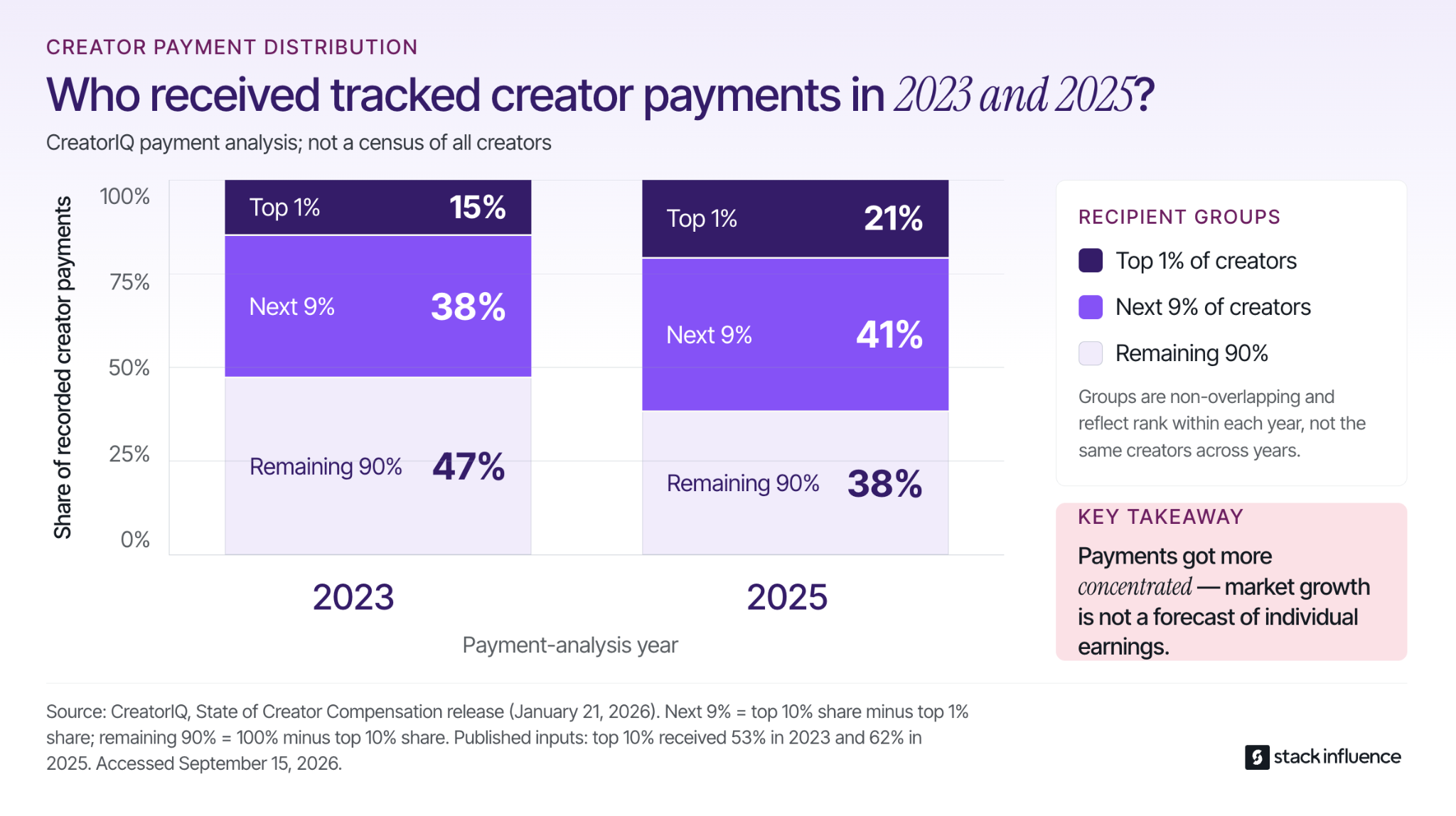
CreatorIQ's creator-compensation analysis reports that the top 10% of creators received 53% of tracked payments in 2023 and 62% in 2025; the top 1% received 15% and 21%, respectively. By subtraction, the next 9% received 38% and 41%, while the remaining 90% received 47% and 38%.
Those figures describe the company's payment analysis, not every creator's income. The lesson is to plan around offers you can secure and payments you can collect, not assume that growth in brand spending produces a predictable personal payout.
Seven Creator Fund Alternatives to Compare
The options below cover different compensation models, not a highest-paying-to-lowest-paying ranking. This guide is published by Stack Influence, which appears first as the product-seeding option. Platform information was checked on September 15, 2026; availability and individual campaign terms can vary.
Stack Influence
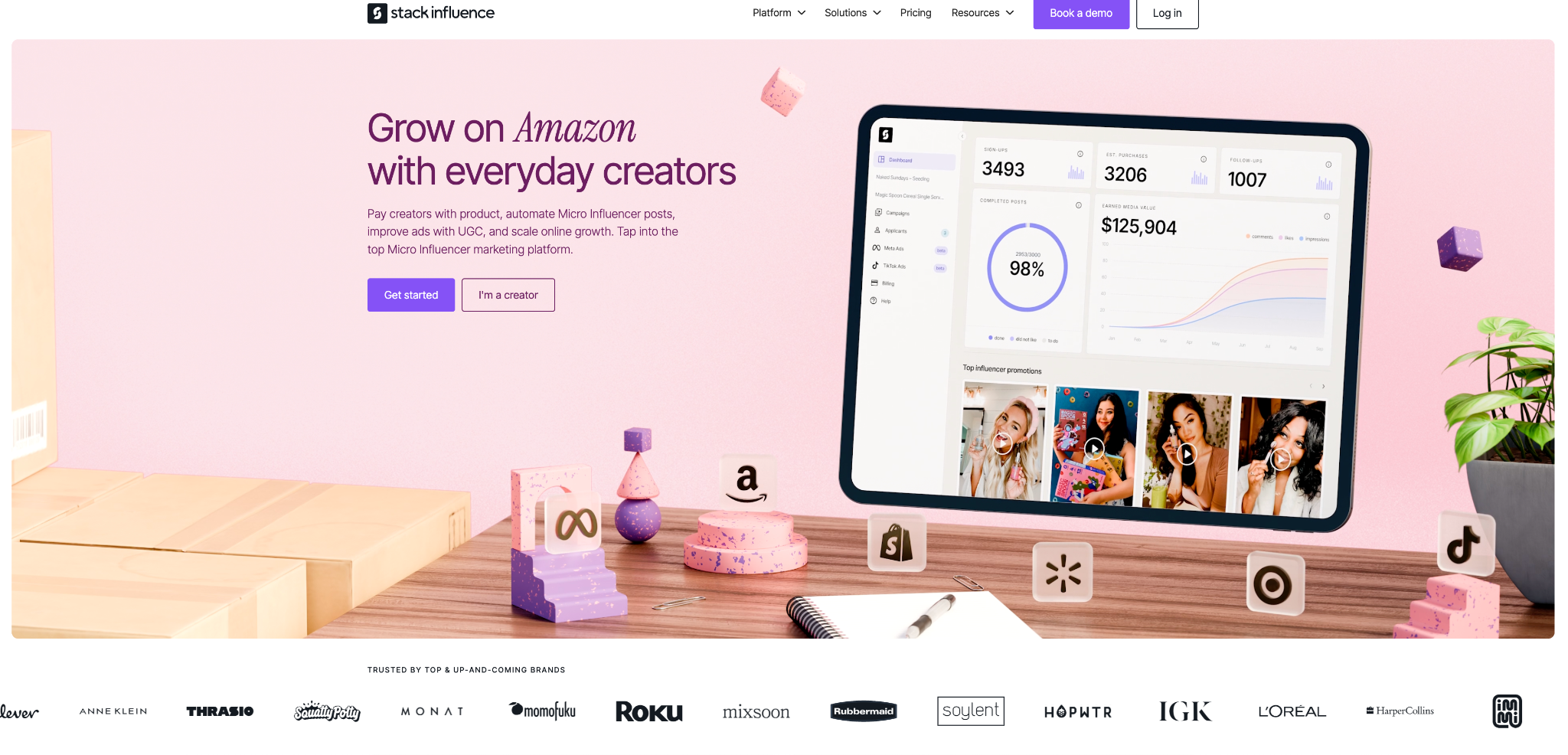
Stack Influence is a micro-influencer marketing platform built around gifted-first product seeding for ecommerce brands. Its creator program connects product participation with content creation and campaign completion, giving creators a structured way to work with brands rather than arranging every detail through separate messages. The workflow supports vetted creator participation, coordination, UGC generation, and accountability for completed posts.
For micro influencers and nano influencers, the practical opportunity is product-focused campaign experience. A useful submission demonstrates the product clearly, follows the agreed brief, and represents the creator's genuine experience. A desk organizer demonstration, for example, can show the product solving a recognizable problem rather than merely appearing beside its packaging.
The creator FAQ says applicants need at least 200 Instagram followers and original content. It also explains that campaigns provide products, with additional monetary compensation offered occasionally. The creator agreement requires participants to be at least 18, and meeting basic eligibility does not guarantee a particular campaign.
What to know: evaluate the specific product arrangement, posting requirements, approval process, and any separately stated cash compensation before accepting. Where participation involves purchasing a product and receiving reimbursement, that repayment covers the purchase rather than automatically becoming an additional production fee. Keep the product benefit and any cash fee separate when applying the Payment-Trigger Test.
This workflow is useful for creators seeking coordinated ecommerce product collaborations and experience delivering agreed content. Choose products you can meaningfully discuss, retain the campaign terms, and contact support when your genuine experience does not match what a brief appears to request.
Billo
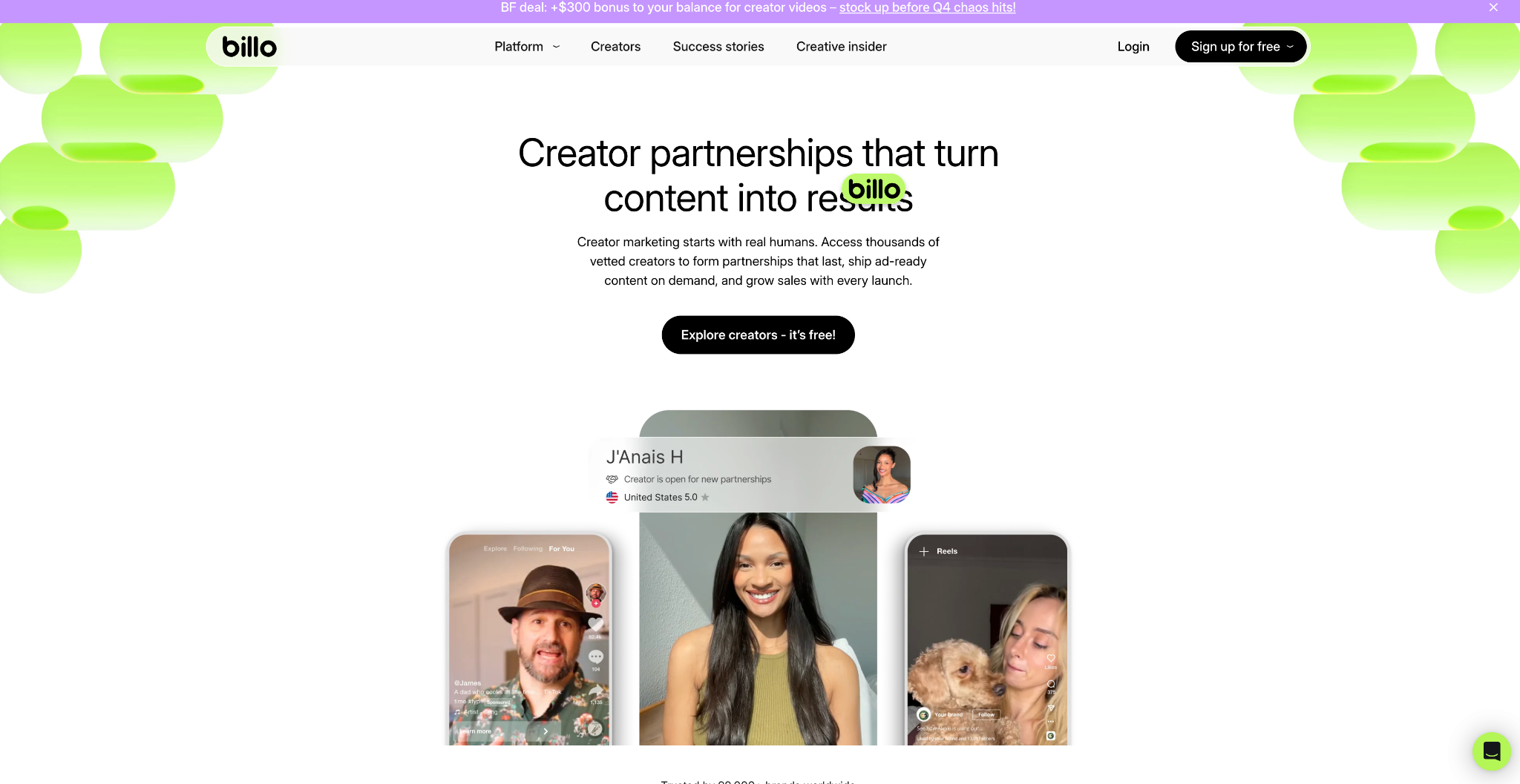
Billo provides content-production assignments where the brand is buying an asset rather than necessarily buying access to your followers. Billo's creator guidance says a standard assignment requires uploading the video through its app; posting to your own social account is an optional add-on. Creators must be at least 18 and live in the United States, Canada, United Kingdom, or Australia.
The payment trigger is approval: earnings are credited after the video is approved, with PayPal payments made twice monthly. No social following is required for standard work, but applications and approval still stand between registration and payment. Compare the offer with the filming, editing, revisions, and permissions involved rather than assuming that an available assignment is worthwhile at any price.
For UGC creators, a portfolio that demonstrates clear explanations and competent editing is more useful here than an unsupported promise of viral reach. Start with a sample matching the kind of assignment you can reliably deliver.
TikTok Shop
TikTok Shop connects product-focused content with commerce. Its affiliate collaboration documentation distinguishes open collaborations from seller invitations to specific creators, with commissions attached to promoted products. Unlike view-based rewards, affiliate earnings depend on qualifying sales under the offer's terms.
The current U.S. creator eligibility policy requires affiliate applicants to be at least 18, based in the United States, and have at least 1,000 followers, alongside verification and compliance requirements. Affiliate creators below 5,000 followers enter a pilot program with restrictions. Other account types have different rules, so a shop-bound account's requirements should not be presented as the general affiliate threshold.
This route suits content that answers real buying questions, but it remains dependent on TikTok distribution and shoppers purchasing. Compare the product, commission, sample conditions, and cancellation rules before committing. Keep sales commissions separate from TikTok pay-per-view earnings when reviewing results.
Amazon Influencer Program
The Amazon Influencer Program provides a storefront for product recommendations and an opportunity for eligible content to generate commissions. Amazon's onsite earnings guidance distinguishes commissions from traffic you send to Amazon from earnings when Amazon selects eligible content for shoppers already browsing its site. These use separate reporting identifiers.
Selection is not guaranteed. Amazon's current video-upload guidance says that after 10 videos are approved by moderation and onsite commission signup is completed, videos may also appear on relevant product detail pages. Uploading a video does not guarantee placement, a purchase, or ongoing monthly income.
Use this option when you can create specific, useful product explanations rather than a large collection of interchangeable recommendations. Measure qualifying commissions and keep externally referred activity separate from onsite activity. An old video may continue to contribute, but an uploaded library is not a contractual promise of passive income.
Patreon
Patreon supports direct audience payments through memberships and one-time purchases. Its creator fee overview lists a standard 10% platform fee for creator pages published after August 4, 2025, with payment processing and other applicable charges separate. Qualifying continuously published legacy pages can retain different pricing.
The practical question is what a supporter receives repeatedly. A creator teaching digital illustration might offer a monthly exercise and commentary on the process, provided that schedule is sustainable. Define a benefit you can deliver before adding multiple membership tiers.
The tradeoff is an ongoing commitment to subscribers, not merely a setup task. Gross membership revenue is not the amount available after fees, and attracting supporters still requires a relationship with an audience. Test whether people will pay for the proposed benefit rather than treating follower count as a subscription forecast.
Gumroad
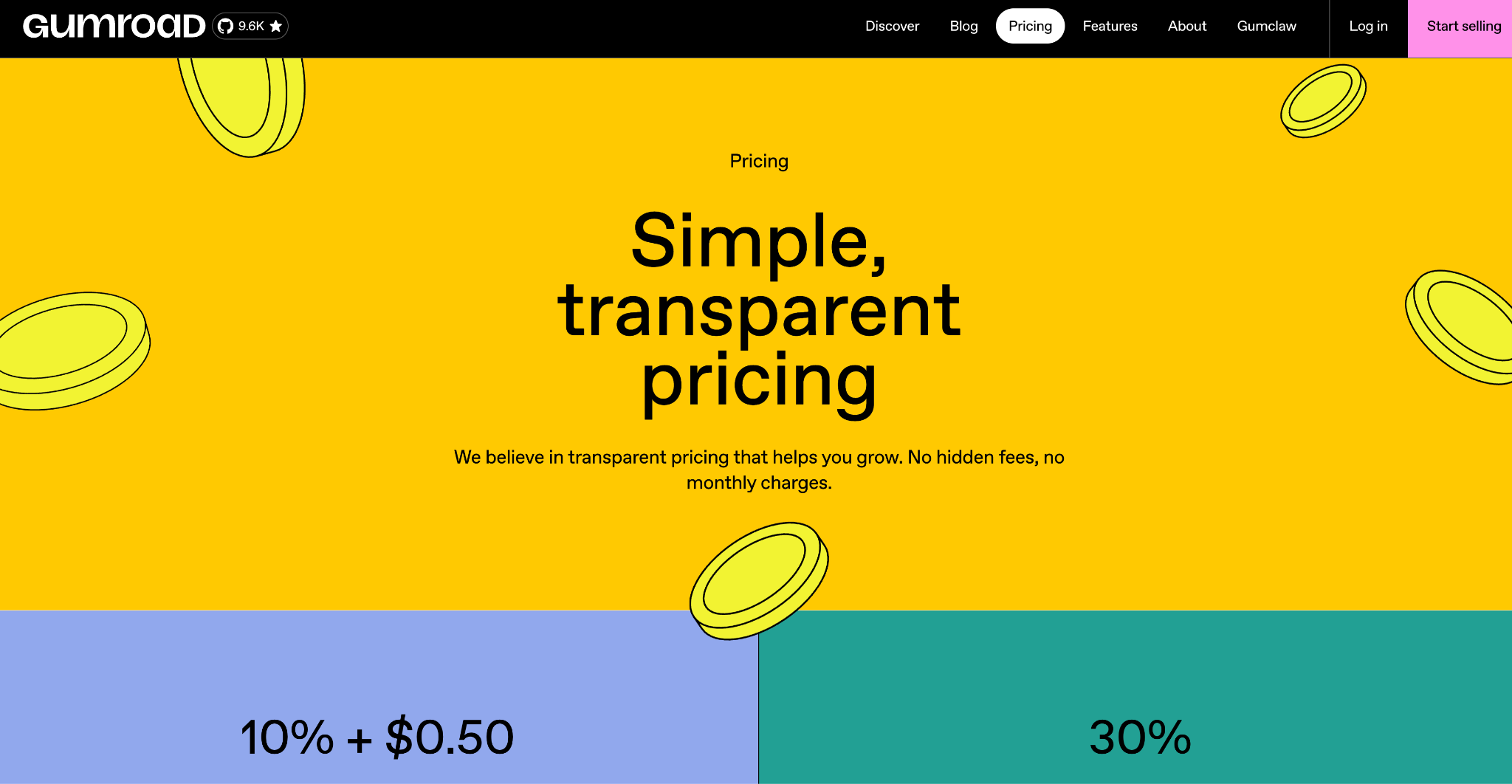
Gumroad lets creators sell digital products such as tutorials, templates, and educational resources. Its published pricing lists a charge of 10% plus $0.50 for sales through a profile or direct links, and 30% for purchases originating through its Discover marketplace. It does not charge a monthly platform fee.
This model gives you a product to sell beyond an individual sponsorship. Start with a narrow resource that solves a question your audience already asks, such as an original shot-planning template for product videos. Confirm that you own the material and have permission to include any third-party assets.
The constraint is demand: a storefront does not prove that buyers exist. You also need to account for product development, updates, support, and the applicable transaction conditions. A small paid test can provide better evidence than spending weeks building a large course before anyone has expressed purchase intent.
YouTube Partner Program
YouTube offers advertising and audience-payment options rather than one uniform creator fund. Its Partner Program eligibility documentation separates early access to selected features from advertising revenue sharing. For the advertising tier, the audience thresholds are 1,000 subscribers plus either 4,000 qualified public watch hours in 12 months or 10 million qualified public Shorts views in 90 days, alongside the other program requirements.
In eligible countries, earlier access to certain fan-funding and Shopping features starts at 500 subscribers, three valid public uploads in 90 days, and either 3,000 qualified watch hours in 12 months or 3 million qualified Shorts views in 90 days. Meeting a threshold does not bypass application review or feature-specific requirements.
The YouTube earnings overview specifies 55% of net Watch Page advertising revenue and 45% of the revenue allocated to a creator through the Shorts Creator Pool. These percentages have different calculation bases and are not directly comparable earnings per view. YouTube can add another distribution channel, but it still requires audience development and does not guarantee payment amounts.
Choose According to the Work You Can Deliver
- Stack Influence: Coordinated product-seeding campaigns and ecommerce content experience, with compensation evaluated offer by offer.
- Billo: Content-production assignments where standard work does not require social posting.
- TikTok Shop: Shoppable content with commissions tied to qualifying product sales.
- Amazon Influencer Program: Product recommendations, referral commissions, and potential onsite content earnings.
- Patreon: Recurring audience benefits and direct supporter relationships.
- Gumroad: A defined digital product sold to buyers.
- YouTube Partner Program: Advertising and audience-payment features for eligible channels.
How Do You Turn Content Skills Into Direct Brand Deals?
Turn content skills into direct brand deals by proposing a specific deliverable to a relevant buyer, showing a matching example, and agreeing on compensation before production. You do not need creator fund membership to sell a UGC video; you need a buyer who agrees to a specific paid brief.
Separate production from influence. A content-only assignment purchases files for the brand's use; a sponsored post also purchases publishing to your audience. Micro influencers and nano influencers can offer either, but a production sample and an audience-performance report answer different buying questions.
Research a small set of brands whose products you understand, then identify one useful content concept for each. A stationery creator could propose a demonstration showing how a notebook handles project planning, supported by a relevant sample. The process for finding UGC clients should lead toward a confirmed brief and buyer, not just a growing list of brand names.
An influencer marketing agency or micro influencer agency can also be a potential buyer or coordinator. Ask who commissions the assignment, who approves it, and who pays the invoice. A label such as brand ambassador or brand partner does not establish whether the arrangement contains a fee, products, commission, or a combination.
Separate the Deliverable From the Rights
Write down the asset count, length, revision allowance, publishing requirement, permitted uses, and payment schedule. A practical approach to pricing UGC content starts with the complete assignment rather than a universal per-video rate.
Paid advertising through a creator's identity deserves a separate conversation from ordinary reposting. The Meta partnership ads guide explains the distinction between commercial usage rights and platform permissions. Ask about the advertising period, permitted edits, and whether category exclusivity prevents other work.
Disclosure remains necessary when a material brand relationship accompanies an endorsement. The FTC's influencer disclosure guidance includes payment and free products, and says disclosures should accompany the endorsement where people will notice them. For video endorsements, the disclosure should be in the video, not only its description.
Measure Cash Arrival, Not Just Approved Earnings
Measure each alternative from work started to money available, not only from content posted to a dashboard total. Track the amount agreed, approval status, deductions, payment due date, actual receipt date, and all time spent producing and administering the work.
Keep reimbursements matched to the expenses they repay rather than adding both to a production-income total. Record product benefits separately from spendable cash. For commissions, distinguish estimated activity from finalized earnings and money received; for direct projects, an accepted quote and an unpaid invoice are not collected fees.
The Same Fee Can Create a Different Cash Position
Consider an illustrative $600 UGC project with $60 of direct expenses paid on day 7 and content accepted on day 14. Assume no transaction fees, refunds, taxes, or other cash costs, and that every scheduled payment arrives. This example compares negotiated payment schedules, not any platform's standard terms.
Under an upfront-plus-balance schedule, the creator receives $300 on day 0 and $300 on day 30. Cumulative project cash is therefore $300 on day 0, $240 on day 7, $240 on day 14, $540 on day 30, and $540 on day 60.
Under a later lump-sum schedule, the creator receives the entire $600 on day 60. Cumulative project cash is $0 on day 0, negative $60 on days 7, 14, and 30, and $540 on day 60.
Both schedules finish with the same $540 cash surplus before labor, overhead, and taxes. On day 30, however, their cash positions differ by $600. The payment terms change the money available during production even when the final fee and expenses are identical.
Before accepting direct work, ask when the payment clock starts: booking, delivery, approval, publication, or invoice receipt. An advance can reduce the cash you must supply, but its scope, refund conditions, and delivery obligations still need agreement.
Review Earnings and Dependence Together
For a completed group of projects, divide collected fees minus related cash costs by all associated hours, including pitching, administration, and revisions. Match the revenue and work to the same projects; dividing this month's receipts by this month's filming hours can mix unrelated periods. The result is a project-level cash return per hour, not a guarantee of a sustainable wage.
For affiliate work, use distinct tracking identifiers where supported and compare finalized commissions from the same content period. A tracked purchase establishes program attribution, not proof that the creator caused an additional sale. Do not add overlapping reports together as though each represents unique earnings.
Finally, record your largest payer's share of receipts and which channels bring you customers. TikTok rewards, TikTok Shop commissions, and sponsorship leads generated entirely through TikTok can still share one distribution dependency. A different payment label does not automatically create a different source of demand.
Build a Focused First-Month Experiment
Choose one monetization question you can actually test, such as whether a specific production offer attracts a cash-paid brief or whether viewers will buy a narrow digital resource. Keep using existing reward programs where appropriate, but do not make eligibility growth the only commercial objective.
During the first week, assemble relevant samples, check account and country requirements, and define the offer. Use a creator-focused platform comparison to assess campaign models, not to create accounts everywhere. Verify invitations through official channels before sharing payment or identity information.
Use the remaining weeks to approach relevant buyers or publish the offer to an existing audience. Record the objections, work required, payment conditions, and evidence of demand. A product-only offer may support a portfolio objective, but it should not be recorded as a successful test of demand for cash-paid production.
At the end of the month, apply the Payment-Trigger Test again. Continue when the offer produces credible demand and workable economics, adjust it when the scope or buyer is wrong, and allow agreed payout periods to finish before judging collection. One month is a learning window, not a promise of income replacement.
Give Your Content More Than One Way to Earn
Creator fund alternatives are most useful when they connect something you can deliver with a clear buyer and understandable payment terms. A production fee, a qualifying commission, a membership renewal, and a product reimbursement should not disappear into one undifferentiated earnings total.
Choose one offer to test, define what earns payment, and track when the money actually arrives. For eligible creators exploring ecommerce product collaborations, evaluate Stack Influence's campaign workflow against those same questions so the next opportunity builds useful experience without obscuring its compensation.