



.avif)
A brand replying “we would love to collaborate” is encouraging. It still does not tell you whether the offer includes a production fee, a free product, or an affiliate link that pays only when someone buys.
Learning how to find UGC clients means moving beyond collecting brand names. You need to identify a content need, show relevant work, reach the person responsible, and confirm what the business will pay for. This guide gives content creators a practical way to move from prospect research to a paid brief, without confusing a busy inbox with a growing client business.
Key Takeaways
- Find a specific content need before pitching a brand, then connect that need to one relevant example of your work.
- Separate content-production fees, social-posting fees, product compensation, and affiliate commissions when evaluating opportunities.
- Confirm the deliverable, decision-maker, and cash budget before investing in a detailed proposal.
- Track paid briefs, collected fees, and acquisition time rather than treating every reply as a potential paying client.
How to Find UGC Clients With the Paid-Brief Filter
Find UGC clients by researching relevant brands, applying to published briefs, contacting agencies, and asking for introductions, then qualifying each opportunity before proposing work. Use the Paid-Brief Filter to decide what deserves your next hour, not simply what deserves a place on a spreadsheet.
In this context, a UGC client commissions creator-made photos or videos for an agreed use. The buyer is purchasing content production; posting to your own audience may be a separate deliverable. Commissioned UGC is therefore different from an unsolicited customer post, even when the finished content has an informal style.
The filter has four checks:
- Need: Identify the product, customer question, and proposed content use. “A packing demonstration for this lunch container” is actionable; “your brand needs UGC” is not.
- Proof: Choose a sample showing that you can execute the requested format, demonstration, or explanation.
- Buyer: Find the person who can approve the brief, or someone who can introduce you to that person.
- Budget: Confirm whether the business has a cash production budget, a product-only offer, affiliate compensation, or a combination.
Research the first three checks before contacting a brand; resolve the fourth in the conversation. A prospect becomes ready for a proposal when the buyer confirms a paid brief, not when you discover an active advertisement.
Stack Influence illustrates why compensation categories matter. Its gifted-first model connects creators with ecommerce product campaigns, and its creator FAQ explains that participants receive products, with additional monetary compensation offered on some campaigns. Evaluate the specific offer rather than automatically counting a product collaboration as paid production work.
Consider an illustrative 30-day outreach scenario: 40 delivered pitches receive 10 replies. Assume three replies confirm cash-paid briefs, four offer products only, two offer affiliate commissions only, and one remains unresolved; the other 30 pitches receive no reply during the window.
The overall reply rate is 25%, but the confirmed paid-brief rate is 7.5%. Those three briefs are not yet three clients. These invented inputs illustrate a tracking distinction, not an industry benchmark or a Stack Influence result.
Where Should You Look for UGC Clients?

Look for clients through brand research, creator-platform briefs, agency contacts, and warm introductions. Start with one channel you can research directly and one channel where buyers publish opportunities, rather than trying to maintain a profile everywhere.
Brands With a Demonstrable Content Need
Start with products you understand and can credibly demonstrate. Inspect the brand’s product pages, social posts, and customer questions, then write down one explanation that a short video could make clearer.
Use Meta’s Ad Library to research advertisements running across Meta technologies. TikTok’s Creative Center also provides ad examples and creative resources, including Top Ads. Treat both as research tools, not directories of companies currently hiring creators.
For example, a stationery brand might show attractive desk setups without demonstrating how its planner handles a changing schedule. Your proposed video could show a real rescheduling task. That gives the buyer a concrete concept to assess without claiming that its existing advertising is failing.
Record the page you reviewed, the date, the content idea, and the likely contact. An active ad does not establish the brand’s budget, profitability, or willingness to hire you; those remain questions to resolve.
Creator Platforms and Published Briefs
Choose platforms by their campaign model and eligibility requirements, not by the number of opportunities advertised. Product campaigns, content-only assignments, and audience-based influencer campaigns can ask for different work and compensate it differently.
Stack Influence’s creator campaign process connects product selection, social content, and approval through a coordinated workflow. It is a practical route for micro influencers and nano influencers exploring ecommerce product collaborations. Read the campaign requirements and reimbursement conditions before committing, and keep any separate production fee visible in your records.
For content-production assignments, Billo’s creator guidance says standard jobs require video delivery rather than social posting. Its current eligibility rules require creators to be at least 18 and live in the United States, Canada, United Kingdom, or Australia. No social media presence is required, but acceptance and available work are not guaranteed.
The JoinBrands getting-started guide distinguishes Content Only, Content + Posting, and other job types. It also describes certification and application steps. Review the individual brief, fees, product-delivery method, and rights before deciding whether the work is worthwhile.
Do not assume every familiar platform has open registration. As checked on September 14, 2026, Shopify Collabs for creators says it is not accepting new creator signups, while merchants can continue direct invitations and accept creator applications. Confirm the available route before building an outreach plan around it.
Agencies, Local Businesses, and Warm Introductions
Research agencies that show relevant product-video work, then look for a producer, creative strategist, or person responsible for creator projects. An influencer marketing agency may manage audience-based sponsorships, content production, or both, so ask which service it is buying before sending rates.
A useful opening question is: “Do you commission creator-made product videos for client accounts, and who handles those briefs?” For local businesses, propose a manageable demonstration tied to a real service or product rather than promising to transform their entire social presence.
Ask existing professional contacts for specific introductions. A photographer, editor, or social media manager can understand “a creator who films hands-only kitchen demonstrations” more easily than “someone available for any brand deal.” Agree on permissions before sharing a contact’s details, and do not approach an agency’s clients in ways that violate your agreement.
Build Proof That Matches the Work You Want
Create a small, relevant portfolio before spending heavily on outreach. Three strong samples can be a manageable starting point: a clear product demonstration, an answer to a buying question, and a short narrative showing a product in use. This is a suggested starter set, not an eligibility standard.
Use products you already own when possible. Label unpaid examples as concept or sample work, and never imply that a featured brand commissioned them. Show how you communicate an observable benefit without inventing personal experience or performance results.
Your UGC portfolio should make the buyer’s next decision easy. Put the most relevant sample first, explain what you produced, name the services you offer, and provide a business contact method. Share your general service region when useful, not your home address or private schedule.
For a production-only pitch, lead with execution rather than follower count. When a brief also purchases audience distribution, include accurate audience information separately. Someone buying a video file and someone buying access to your followers are evaluating different deliverables.
Publish selected samples on your own profiles with descriptions of the work: product demonstration, hands-only tutorial, or short-form video editing. Creators still developing those skills can use the beginner UGC creation guide before expanding their outreach list. A clear offer is more useful than repeatedly announcing that you are “open to collaborations.”
Send a Pitch a Buyer Can Act On
Write a pitch around an observed need, a proposed deliverable, and relevant proof. You are asking the buyer to consider a specific production assignment, not to invent a role for you.
For an imaginary lunch-container brand called Cedar Lane, a pitch could read:
Subject: A packing demonstration for Cedar Lane’s lunch container
Hi Cedar Lane team,
I create hands-only kitchen videos. Your product page explains the container’s compartments, and I have an idea for showing how a complete lunch fits inside them.
I would propose a 25-second packing demonstration with two alternative openings for your team to test. I have included a comparable sample from my portfolio so you can assess the filming and editing style.
Are you commissioning paid UGC for this product, and who handles the creative brief and budget?
Replace the imaginary details with research you actually performed, and link directly to the relevant sample. Do not claim that a concept will increase conversions, or attach a fabricated performance report to make the proposal sound stronger.
When a direct message is the available route, use it to find the right contact rather than sending a full contract discussion immediately. The broader influencer outreach guide explains how contact, qualification, and campaign coordination fit together.
As a starting routine, send one useful follow-up after about five business days. Add a clarification or a second relevant example, not a guilt-inducing reminder. Respect a refusal or request to stop, and close an unanswered conversation rather than pursuing the recipient across multiple channels.
When replies consistently offer products instead of fees, review your positioning. Make “paid content production” explicit and show production examples, rather than framing every message as a request to join a brand’s ambassador program.
Confirm Scope, Payment, and Permission Before Filming
Turn an interested reply into a written agreement before creating custom client work. Confirm who is buying the content, who approves it, who pays the invoice, and what happens if the project changes or is canceled. For an agency assignment, the brand appearing in the video may not be the business responsible for paying you.
Define the number of videos or photos, duration, formats, alternative openings, raw footage, delivery date, and included revision rounds. Distinguish correcting work that missed the agreed brief from producing a new concept after the brief changes. Put payment timing and any deposit or milestone arrangement in writing.
Ask where the content will appear and for how long. Organic reposting, paid advertising, editing permissions, account-based advertising permissions, exclusivity, and portfolio display should not be left to assumptions. The buyer-side guide to purchasing usable UGC shows why production, publishing responsibility, and content rights need separate decisions.
Offer a small paid pilot when the buyer wants to test the relationship. Existing samples can demonstrate your ability; you do not need to provide a complete custom campaign for free. For complex rights or exclusivity terms, obtain qualified advice before signing.
Verify the Buyer and Keep Endorsements Honest
Verify unexpected offers through a company contact you locate independently. The FTC’s warning about fake brand ambassador managers describes impersonators who use apparent brand relationships to obtain money or personal information. Do not send passwords, login codes, banking credentials, or identity documents through an unverified message thread.
A legitimate platform’s documented purchase-and-reimbursement workflow is different from an unknown sender demanding money to unlock a job. Check the platform independently, understand the conditions, and confirm the offer before making a purchase. Follow account age requirements rather than using someone else’s identity to get access.
For endorsements, the FTC’s Disclosures 101 guidance explains that payment and free products can create relationships that need clear disclosure. It also says endorsements must reflect genuine experience. Do not agree to pretend you used a product, invent a result, or conceal a commercial relationship.
Measure Your Client Pipeline Without Fooling Yourself
Track each prospect from first contact through payment, using a consistent record. Include the discovery source, relevant sample, contact date, reply category, brief status, quoted scope, agreement status, payment due date, cash collected, and time spent. Product reimbursements and product value should remain separate from earned production fees. AI sales enablement can also help teams use pipeline data to prioritize follow-ups and keep prospect communication aligned with each opportunity’s stage.
Review activity weekly and group outreach by the month it began. Paid briefs and requested proposals are leading indicators; signed projects, collected fees, and repeat bookings are outcomes. Keep unanswered or pending opportunities open long enough to reflect the buyer’s actual timeline, rather than counting them as wins or losses prematurely.
Use the Paid-Brief Filter to diagnose the bottleneck. No replies suggest testing the contact, relevance, or message; replies without cash budgets suggest reviewing the offer category; proposals without agreements suggest checking scope, proof, and commercial terms. These are diagnostic hypotheses, not proof that one specific factor caused the result.
Record both where you first found a lead and how the client says they discovered you. A buyer might see your work on social media and later answer an email, so the final message is not necessarily the only meaningful touchpoint. Compare similar outreach groups, and avoid declaring one channel superior after a handful of conversations.
Give Good Clients a Reason to Return
Make the first project easy to extend without quietly expanding its scope. Deliver clearly named files, identify the approved versions, summarize the permitted uses, and confirm whether the buyer needs another product, a new customer question, or a different opening tested next.
Ask for permission before using client work, testimonials, or campaign results in your portfolio. When results are shared, record the dates, placements, and relevant context; do not claim that your video alone caused a sales increase. A specific next-project proposal is more useful than a generic request for “ongoing collaboration.”
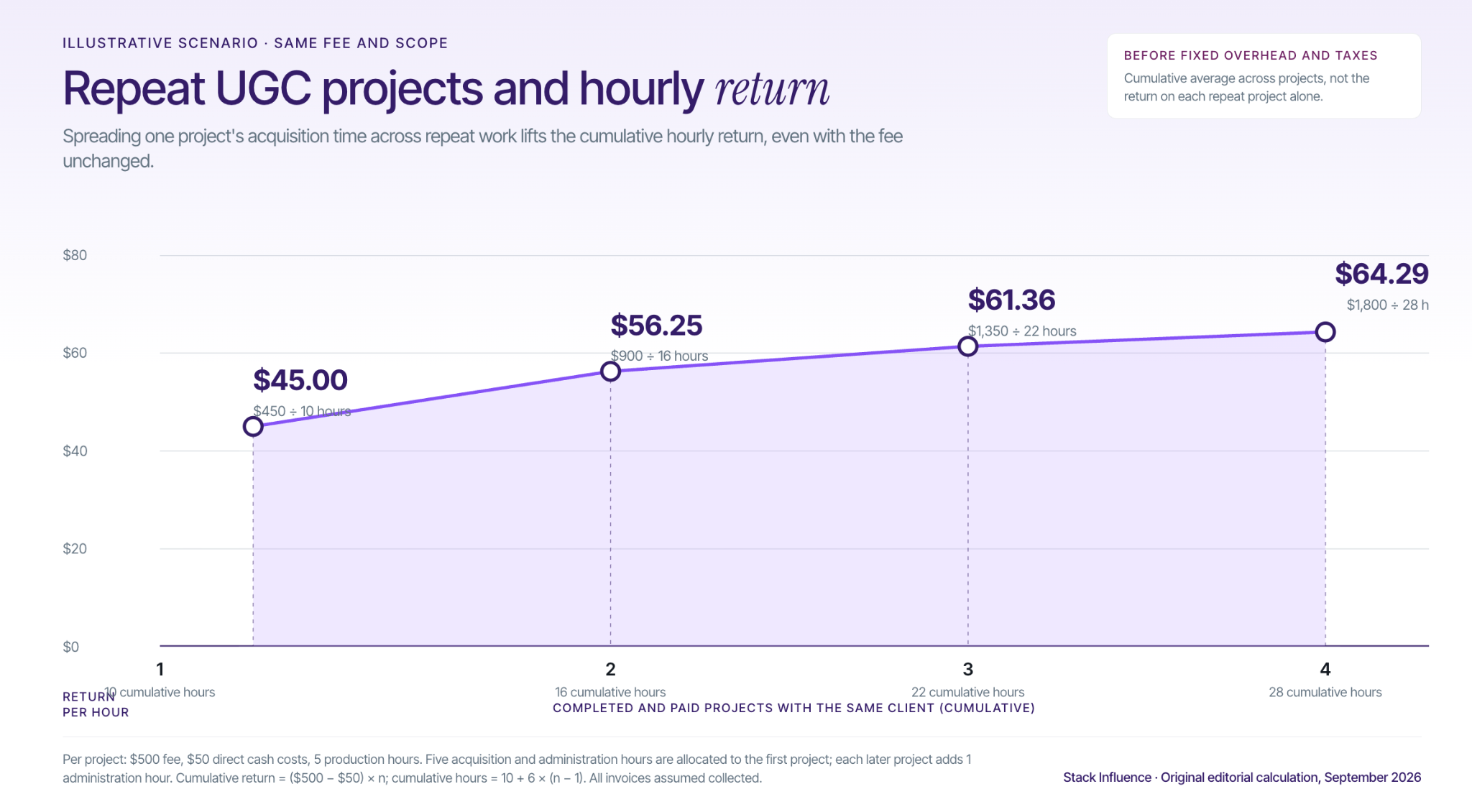
Repeat work can reduce the acquisition time allocated to each project. Consider a separate illustrative scenario: each identical project pays $500 and incurs $50 in direct cash costs, including any project-specific platform or payment fees. Assume every invoice is paid, production takes five hours per project, and the fee, rights, and scope stay unchanged.
Allocate five hours of acquisition and administration to the first project, including unsuccessful outreach, and one hour of administration to each repeat project. Excluding fixed overhead and taxes, cumulative return after direct costs is $45.00 per hour after one project, $56.25 after two, $61.36 after three, and $64.29 after four.
The calculation is cumulative collected fees minus direct costs, divided by cumulative acquisition, administration, and production hours. Total hours are 10, 16, 22, and 28; the corresponding amounts after direct costs are $450, $900, $1,350, and $1,800. These are hypothetical inputs, not suggested rates, promised earnings, or observed creator results.
The lesson is to account for the time required to win the work. A project’s headline fee does not tell you what the relationship earns once prospecting, administration, and delivery are included.
Your Next Client Starts With a Specific Need
The practical answer to how to find UGC clients is to connect a real content need with relevant proof and a clearly paid brief. Platforms and outreach can introduce you to buyers, but qualification, scope, and dependable delivery determine what the opportunity becomes.
Start with one service you can demonstrate, a small shortlist of relevant businesses, and one sample matched to each pitch. Ask who owns the brief and whether there is a cash production budget, then track the conversation through payment. That gives you a client-acquisition process you can improve, rather than a longer list of brands you hope will reply.