
The latest info on influencer marketing trends, micro influencer news, and the world of social media

TikTok might be a video-first platform, but don’t underestimate the power of a good caption. A well-crafted caption can stop viewers mid-scroll, add context to your video, showcase your personality and even improve your content’s discoverability on TikTok. In fact, TikTok now allows captions up to 4,000 characters long—a huge jump from the old limits—showing that creators have more room than ever to experiment with longer descriptions. Whether you’re a micro-influencer sharing daily vlogs, an e-commerce Amazon seller promoting products, or any content creator in between, the right caption can boost your engagement and reach.
In this comprehensive guide, we’ll explore why TikTok captions matter, best practices for writing them, and plenty of creative caption ideas. You’ll also find tips tailored for micro influencers, UGC creators and brands alike (with a nod to platforms like Stack Influence that connect micro-influencers with e-commerce brands). Let’s dive in!
An example of a TikTok video with a caption (highlighted at the bottom). TikTok captions appear on the lower part of the screen and can include text, hashtags, emojis, and @mentions.
A TikTok caption is the text description you write to accompany your video. It appears at the bottom of your post, as shown in the example above, and can provide context, add humor or deliver extra information beyond the visuals. Captions can include plain text, emojis, hashtags, and even tag other accounts. By default, only a snippet of the caption is visible in the feed (users have to tap “...more” to read longer captions), so that first line needs to grab attention. While many TikTok captions tend to be short and snappy, you aren’t limited to one-liners – the platform now allows up to 4,000 characters per caption. This expanded length means you can experiment with storytelling or keyword-rich captions, but remember to front-load the most important text since not all viewers will expand the full caption.
TikTok captions might seem secondary to the video, but they can actually make a big difference in your content’s performance. Here are a few key reasons why captions matter on TikTok:
In short, a strong caption complements your video by grabbing attention, boosting engagement, and improving your content’s visibility on TikTok.
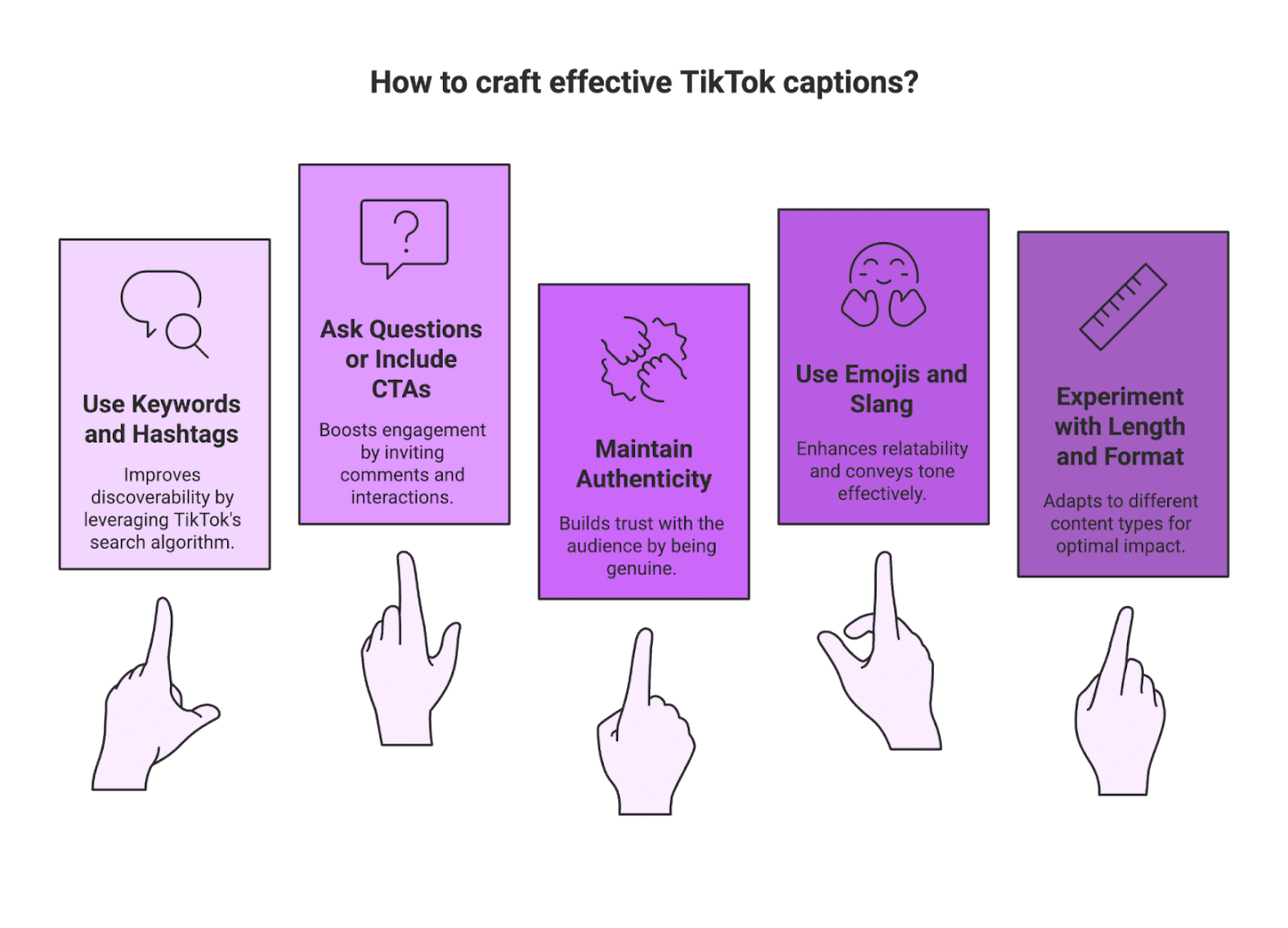
Not sure how to start crafting that perfect caption? Here are some best practices and tips to help you write attention-grabbing TikTok captions:
Popular TikTok caption strategies among creators. Many creators frequently use questions, trendy references, and emojis in captions to boost engagement. Asking a direct question is one of the top tactics – it invites viewers to participate by commenting and sharing their thoughts. Close behind are short & witty phrases (often using slang like “mood” or “IYKYK”), which work well given TikTok’s fast-paced scrolling culture. A majority of creators also rely on hashtags to increase reach, and tap into trending memes or challenges by referencing them in their caption text. Even a simple emoji or two can set the tone of a caption and make it more inviting. Don’t hesitate to mix and match these elements to find the magic formula that resonates with your audience.
Finally, don’t forget you can use tools for inspiration. If you’re really stuck, some social media management platforms and AI writing tools (even TikTok’s own “suggested captions” or third-party apps) can generate caption ideas for you. These can be helpful to kick-start your creativity – just be sure to tweak any AI-generated text to fit your voice and to ensure it’s accurate.
Now that we’ve covered the strategy, let’s look at some actual caption ideas. Below is a list of creative TikTok caption examples to inspire you. We’ve grouped them by style/purpose – from funny one-liners to engaging questions to product-focused captions. Feel free to adapt these to your own niche, and remember to keep them authentic!
When you want to make your audience laugh or nod in agreement, a funny or relatable caption is the way to go. These captions tap into memes, trending phrases and everyday humor that TikTok users love:
These kinds of captions help you appear trendy and relatable, as if you’re sharing a wink with those in the know. Just ensure the humor aligns with your personality or brand – authenticity wins even in comedy.
If your goal is to spark a conversation, ask a question in your caption. Questions naturally prompt viewers to respond, driving up your comment count and engagement. Here are some go-to question-style captions:
When using question captions, be prepared to engage back! If people reply with their thoughts, like or reply to their comments to keep the momentum. This not only boosts your video in the algorithm (TikTok loves active comment sections) but also helps build community with your audience.
Many e-commerce brands, Amazon sellers, and UGC creators use TikTok to showcase products in an organic way. The key in product-focused captions is to keep it authentic and conversational – it should feel like a friend excitedly sharing a find, rather than a sales pitch. Here are some caption ideas for product demos, reviews, or unboxings:
Remember, even when promoting products, maintain a casual tone. Phrases like “I’m obsessed with this”, “Not gonna lie, this slaps” or “I wasn’t sure about this at first...” can make the caption feel like a genuine personal story or recommendation. Authenticity is crucial in social commerce – TikTok users embrace user-generated content (UGC) because it feels real. In fact, seeing everyday people or micro-influencers show off products often drives others to check them out (we’ve all fallen down the #TikTokMadeMeBuyIt rabbit hole!). Leverage that UGC vibe in your captions to build trust with potential customers.
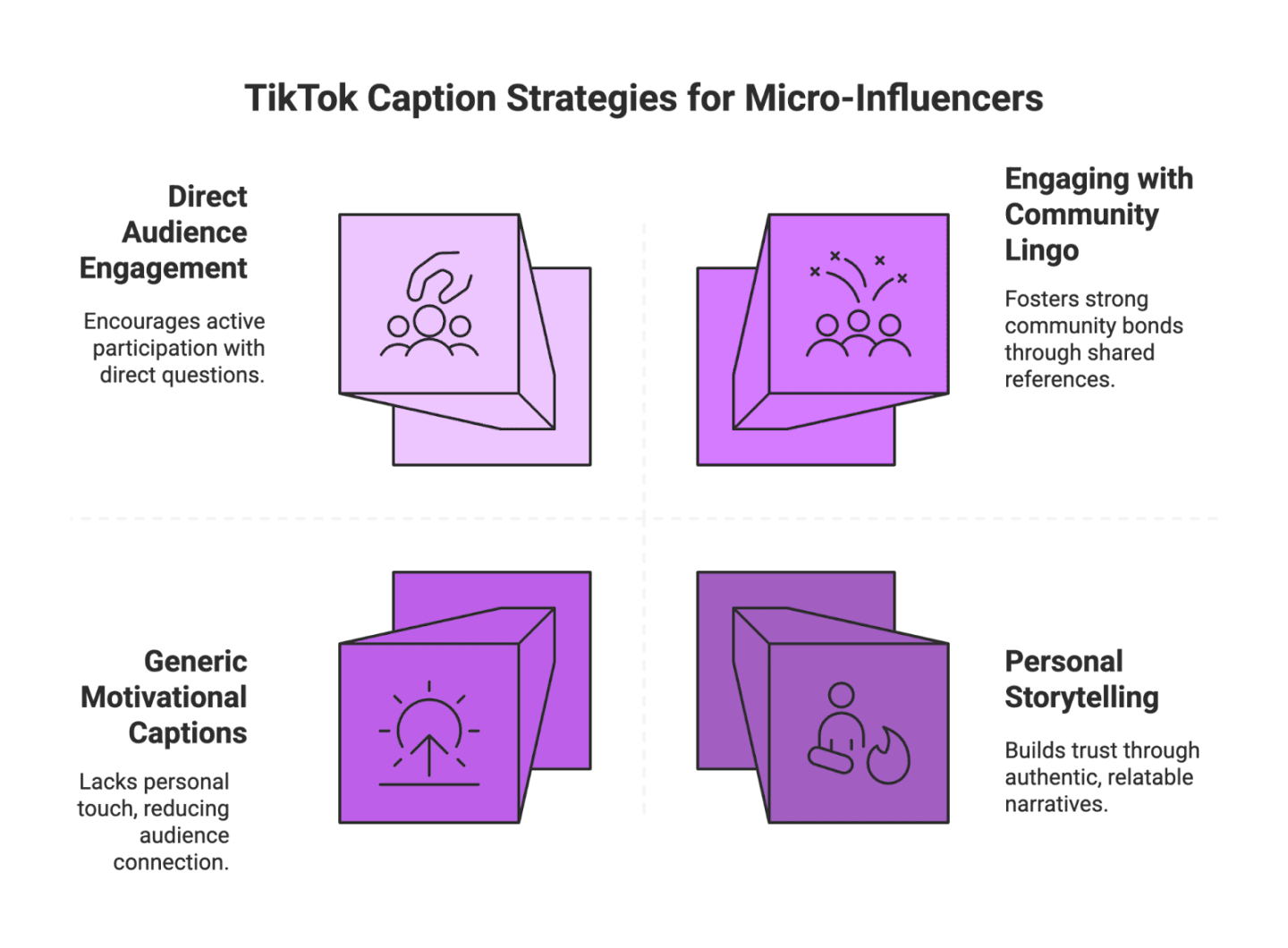
Micro-influencers and independent content creators have a special edge on TikTok: a closer relationship with their audience. If you’re a creator with a tight-knit community, your caption strategy should capitalize on that authenticity and connection:
Above all, micro-creators should remember that captions are an extension of your content and personality. Use them to reinforce what makes you unique. The more your captions sound like a real person (and specifically you), the more you’ll stand out in a sea of generic content.
For brands, online sellers, and agencies promoting products on TikTok, caption strategy involves a delicate balance: you want to drive action (like clicks or sales) but also blend in with TikTok’s casual, entertainment-driven atmosphere. Here are some tips tailored for e-commerce brands and Amazon sellers using TikTok:
In summary, brands on TikTok should aim to sound like passionate users of their own product. Blending into the TikTok culture is key. By crafting captions that could just as easily come from a satisfied customer or enthusiastic fan, you increase the chances that TikTok viewers will trust your message and take interest in what you’re selling.
TikTok may be dominated by catchy sounds and eye-catching visuals, but never sleep on the caption – it’s the secret sauce that can elevate a good video to great. A thoughtfully written caption enriches your content by adding context, personality, and a layer of engagement. From a micro-influencer keeping it real with their followers, to an Amazon seller riding the #TikTokMadeMeBuyIt wave, everyone on TikTok stands to gain by leveling up their caption game.
The examples and tips above provide a starting point, but the best TikTok captions are those that feel true to you or your brand. Pay attention to how your audience responds: do they comment more when you ask a question? Do certain jokes in captions get a lot of shares? Use those insights to refine your approach. And remember, the TikTok landscape is always evolving – new slang emerges, trending hashtags come and go – so keep experimenting and stay tuned into the platform’s culture.
In the fast-moving world of TikTok, a great caption can be the difference between someone scrolling past or engaging with your post. So next time you’re about to hit “Post”, take an extra minute to craft a caption that complements your video and invites viewers in. Combine a compelling caption with a strategic posting time (when your audience is most active) and you’ll set yourself up to maximize your reach and impact. Happy captioning, and may your TikToks be ever in your audience’s favor!
Aspiring content creators often wonder if the hustle of being a micro-influencer is worth the effort. In today’s e-commerce driven world – from Amazon sellers seeking reviews to brands looking for relatable content creators – micro-influencers have carved out a unique niche. This comprehensive guide breaks down the pros and cons, backed by stats and tips, to help you decide if becoming a micro-influencer is the right move.
A micro-influencer is generally a content creator on social media with a modest following (often around 5,000 to 50,000 followers). They aren’t mega-celebrities, but they have a highly engaged audience in a specific niche. Whether it’s a skincare guru with 8k Instagram followers or a tech reviewer on TikTok with 20k fans, micro-influencers focus on relatable, niche content. Their smaller scale is actually their strength – they interact closely with followers, building trust and community.
User-generated content isn’t just for big brands – micro influencers can harness UGC too. Create a unique hashtag for your community and encourage followers to post their own photos or stories related to your niche or a specific prompt. Then, reshare the best submissions in a carousel post, Reel, or Story shout-out (with permission and credit). For example, if you’re a fitness micro influencer, you might use #GetFitWithYourName and ask followers to share their workout snapshots. Featuring follower content not only provides you with fresh posts but also makes your community feel valued and seen. It’s authentic social proof that you have an engaged tribe, and those featured will likely promote your post too (extending your reach).
When running a UGC initiative, give it a fun twist or theme. You could do a monthly “fan of the month” feature or a challenge like “share your shelfie” if you review books. The key is to celebrate your followers. This deepens the connection and loyalty within your community while generating free, relatable content for your feed.
If you’re wondering whether being a micro-influencer is worth it, consider this: brands are increasingly eager to work with micro-influencers. In fact, marketers in 2025 are shifting more budgets toward micro and even nano influencers for a variety of reasons. Here are some of the big benefits that small creators bring to the table:
Micro-influencers often enjoy significantly higher engagement on their posts than big influencers. Their audiences are small but loyal, meaning followers are more likely to like, comment, and share. One study found Instagram creators with ~10k–100k followers average about 3.8% engagement per post, far above the ~1% (or less) typical for accounts with hundreds of thousands or millions of followers. In other words, micro creators generate more buzz per follower – gold for brands looking to spark conversation and get their message heard.
Because micro-influencers are viewed as real people (not unreachable celebrities), their recommendations feel like advice from a friend. They tend to only promote products they genuinely like or use, and that authenticity builds trust. Followers know a micro-influencer isn’t just doing it for a paycheck – they often see their true enthusiasm. This trust translates into higher credibility for any brand shout-out. For a follower, seeing their favorite DIY crafter rave about a product carries more weight than a scripted celebrity ad.
From a brand’s perspective, micros are budget-friendly compared to macro-influencers or stars. Many micro-influencers will collaborate in exchange for free products or a modest fee, especially when starting out. For the cost of one $50,000 celebrity post, a company could hire dozens of micro-influencers and saturate social media with content. The result? Better ROI: more content, more total engagement, and often more conversions per dollar spent. In fact, one analysis showed micro-influencer campaigns cost around $0.20 per engagement, versus about $0.33 for macro influencers – roughly a 40% lower cost-per-engagement for micros. That efficiency adds up to stronger returns on marketing spend.
Micro-influencers double as talented content creators, producing high-quality user-generated content (UGC) that brands can repurpose. Their authentic photos, videos (unboxings, reviews, tutorials, etc.) become valuable marketing assets. An army of micros posting about a product generates a trove of real-life testimonials and visuals that a brand can reuse on its website, ads, or social media. This is especially useful for e-commerce and Amazon sellers looking to build up genuine customer content – a few Instagram Reels or TikTok videos from micros can drive traffic to an Amazon product listing and even boost those crucial reviews and ratings. In short, micro-influencers provide both promotion and content creation in one package.
Bottom line: Micro-influencers might be “micro” in follower count, but their impact is anything but micro. They pack a punch in engagement, trust, and creative content – all of which brands highly value. This trend isn’t slowing down; it’s accelerating. Now, how does all this translate to you as an aspiring micro-influencer? Let’s look at what you stand to gain (and what to watch out for) by taking on this role.
A post shared by Stack Influence (@stackinfluence)
If you’re thinking of becoming a micro-influencer, here are some of the benefits and opportunities that make it worthwhile:
Unlike becoming a mega-celebrity, starting as a micro-influencer has a low barrier to entry. You don’t need millions of followers – even a few thousand can get you started. Social platforms are free, and if you consistently post quality content, you can gradually grow your audience. Many influencers who now have huge followings started micro. It’s a stepping stone; you build experience and skills on a smaller stage first.
One of the fun perks is getting free products from brands. Companies often send micro-influencers products to test or feature (this is common with Amazon sellers launching new items, beauty brands, etc.). It’s exciting to receive merchandise you love – and it can offset personal expenses. While free stuff doesn’t pay the bills, it’s a nice side benefit (and a way to try new things). As you grow, sponsored deals might also include event invites, travel opportunities, or other experiences.
Yes, micro-influencers can earn money too! Typically, micros with 10k–50k followers might charge anywhere from $100 to $500 per sponsored post on platforms like Instagram. You can also make money through affiliate links (earning a commission on sales), YouTube ad revenue, TikTok creator funds, or even by creating content for brands as a UGC creator. While the average micro-influencer’s earnings might start around $80–$100 a month in the early stages (often just enough for coffee money), some dedicated micros scale up to hundreds or thousands per month as they take on more collaborations. It likely won’t replace a full-time salary immediately – many treat it as a side hustle until they “make it big” – but it’s still rewarding to get paid for content you love creating.
Every collab you do and every piece of content you create contributes to your personal brand. Over time, you’ll develop a portfolio of partnerships – essentially an “influencer résumé” – that can help you land bigger deals. For example, doing a series of product reviews for small e-commerce brands shows future sponsors that you’re experienced and reliable. Some influencer marketing platforms even let you connect easily with companies to get these early collaborations under your belt, helping you build your influencer resume while enjoying products from favorite brands. This experience can open doors to larger campaigns down the line. (Plus, it’s pretty cool to say “I’ve worked with XYZ brand” as a micro creator!)
Before you quit your day job to become the next micro star, let’s balance the scales. Here are some challenges and downsides to be aware of – the reasons being a micro-influencer might not be for everyone:
As noted, the money for micro-influencers starts small. Many micros (especially those under ~10k followers) might initially get paid in just free products or token fees. Even with 50k followers, you’re not guaranteed a living wage from influencing alone. It takes time to scale up your earnings. If you’re looking for quick cash or a full-time income immediately, you might be disappointed. Most micro-influencers keep a day job or other income source while growing their platform.
Creating content regularly can feel like a second job. To keep your audience engaged (and attract brands), you need to post frequently and maintain quality – whether it’s daily Instagram stories, weekly YouTube videos, or TikTok trends. You also have to engage back with your followers (replying to comments, messages) to nurture that community. Burnout is a risk if you’re not prepared. Remember, those beautiful photos or viral videos often take a lot of behind-the-scenes effort – planning, shooting, editing, writing captions, etc. It’s enjoyable but time-consuming work.
The popularity of micro-influencing means lots of people are trying it. Whatever your niche, there may be hundreds of other creators vying for the same brand deals or audience attention. Standing out requires finding your unique voice or angle. It also means as a micro-influencer you might face slow growth at times, especially if algorithms aren’t in your favor. Patience is key; you might spend months at a plateau before hitting a growth spurt. The space isn’t as empty as it was 5 years ago, so you’ll need to bring something special or genuine to the table.
When you do get collaboration offers, they can vary wildly. Some brands might offer very low compensation for a lot of work, or expect you to post positive reviews regardless of your honest opinion. Negotiation and setting boundaries become important skills. As a newcomer, it’s easy to undervalue yourself. Additionally, not every product you receive will be something you love – you might have to politely decline offers that don’t fit your brand (which is the right thing to do to maintain authenticity). Learning to read contracts or usage rights is another aspect; some brands might want to reuse your content in ads, which is fine if agreed upon, but you should know your worth if your content will be repurposed elsewhere.
Despite these challenges, many creators find that the benefits outweigh the downsides, especially if they genuinely enjoy creating content and interacting with their community. It’s crucial, however, to approach micro-influencing with realistic expectations. You’re building a micro-business around your personal brand, and most businesses aren’t overnight successes. Think of it as growing a garden: you plant seeds (content), nurture your soil (audience relationships), and give it time to blossom.
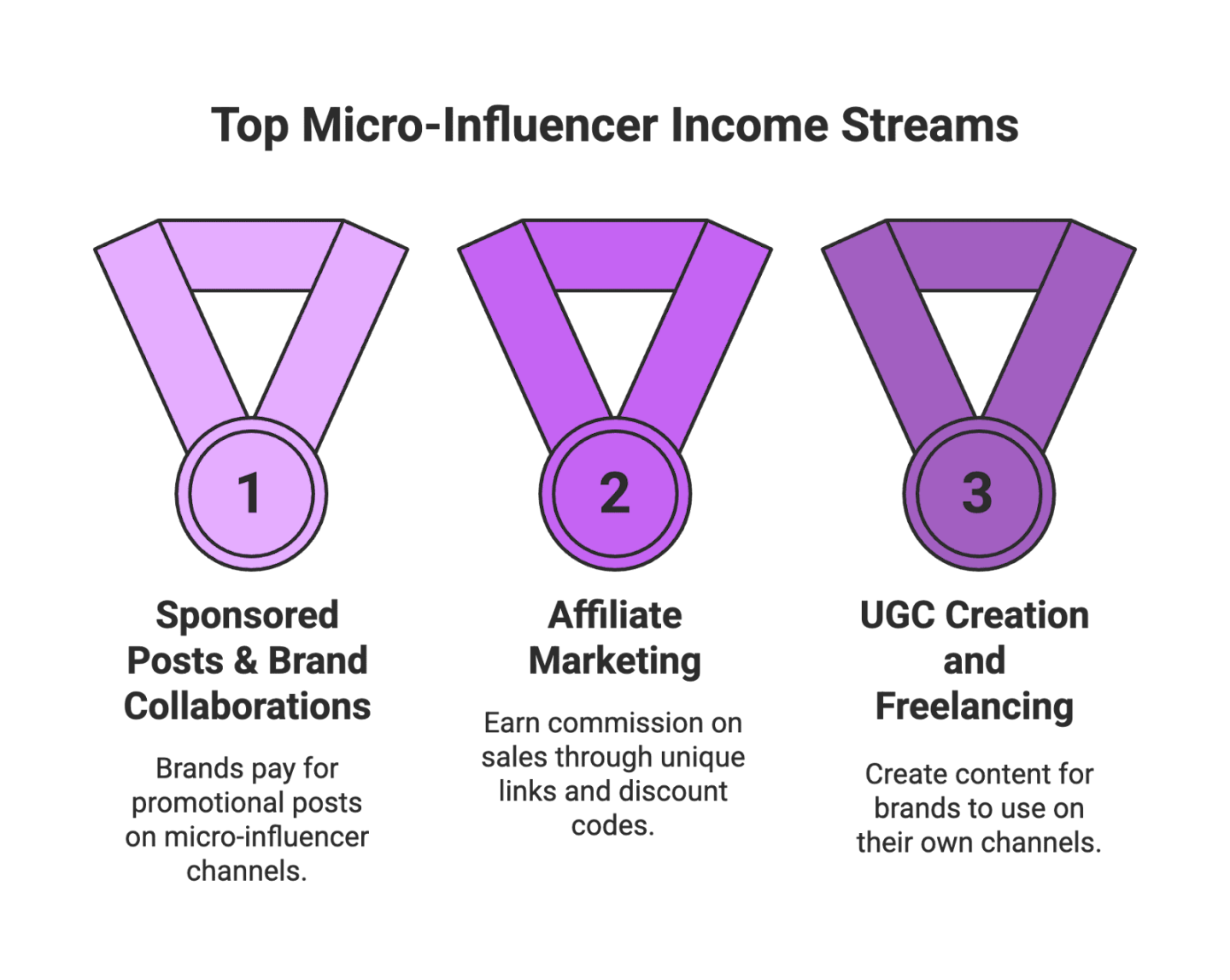
One big aspect of “worth it” is financial. So, how do micro-influencers actually earn money, and can it become significant? Here are several income streams a micro-influencer can tap into:
This is the most obvious route – a brand pays you (or gives free product) in exchange for a promotional post featuring their product/service. Micro-influencers, as mentioned, might earn a few hundred dollars per Instagram post or a TikTok video depending on their follower count and niche. For example, a micro fashion influencer might charge $200 for an outfit post, while a tech gadget micro-influencer could get $300 for reviewing a new accessory. As your following grows, these rates can increase. Pro tip: when starting, don’t be afraid to do a few product-for-post deals to build your portfolio – just make sure it’s a product you actually like so your content stays authentic.
Many micro-influencers join affiliate programs (Amazon Associates, LIKEtoKNOW.it, etc.) where you get a commission for sales generated through your unique links or discount codes. For instance, you mention a skincare product and share your link – if followers buy it, you might earn, say, 5-10% of the sale. This can be great passive income if your recommendations resonate. Amazon’s Influencer Program even allows you to have a storefront of recommended products; as an Amazon-associated micro-influencer, you earn when people shop your picks. Over time, affiliate earnings can stack up, especially during holiday seasons or big sale events.
UGC (User-Generated Content) isn’t just a boon for brands – it’s a gig opportunity for you. Some content creators focus on creating photos/videos for brands to use on the brand’s own channels, rather than posting on the creator’s channel. In this model, you’re like a freelance content creator. For example, an Amazon seller might pay you to shoot a demo video of their product that they can use in their Amazon listing or ads, but you don’t necessarily post it to your personal feed. This is a way to monetize your content skills without needing a huge audience – your value is in producing relatable, quality content. Many micro-influencers do this behind the scenes for extra income.
If you’re on platforms like YouTube (which share ad revenue) or TikTok (which has a Creator Fund or bonuses), you can earn money based on views. A micro-influencer YouTuber, for example, might earn a modest amount per video from ads – not a ton with a small audience, but as views increase it grows. Some micro-influencers with, say, 20k YouTube subscribers can earn a few hundred dollars a month just from ads if their videos get consistent views. It’s not huge, but it’s another piece of the pie.
Important: Most micro-influencers use a mix of these monetization methods. No single post or link is likely to make you rich overnight, but over time, the combination of sponsored content, affiliate commissions, and other earnings can become very worthwhile. Think of it as diversifying your “influencer income portfolio.”
Also, as you prove your value (high engagement, quality content, conversions on your links), you can negotiate better deals. Brands are willing to pay when they see results. And remember, brands are actively looking for micro-influencers because of the great ROI we discussed. Many companies realize $1 spent on micro-influencer marketing can bring back multiple dollars in revenue due to the trust and targeted reach micros provide. That demand means opportunity for you.
If you decide to take the plunge (or if you’re already in the game), here are some tips to maximize your success and enjoyment as a micro-influencer:
Don’t try to be everything to everyone. Be a specialist. Maybe you’re the thrift-fashion guru, the vegan home baker, or a DIY tech modder. Embrace that niche fully and let your personality shine through it. A clear focus makes you memorable and tells new followers (and brands) what you’re all about instantly. It also makes it easier to create content because you have a guiding theme. (Tip: Write a one-sentence mission for your content – e.g., “I help busy moms stay fit with 15-minute workouts” or “I review affordable gadgets for budget tech lovers” – and let that guide your posts.)
Remember, your engagement is your currency as a micro-influencer. Always prioritize building a relationship with your existing followers over just gaining new ones. Reply to comments, ask your audience questions, respond to DMs (within reason) – make your community feel valued. High engagement not only keeps your current followers around, but it also signals to brands that your audience is tuned-in. In fact, micro influencers often have 3-4× the engagement rate of bigger influencers, which is exactly what brands want to see. So show off that vibrant community! Consider doing interactive content like Instagram Stories polls, Q&As, or TikTok Lives to strengthen that connection.
It’s been said a million times, but it’s crucial: be yourself. Followers can tell if you’re faking enthusiasm or shilling products you don’t actually like. Only partner with brands that make sense for your image and that you truly appreciate. Turning down an offer can be hard, but your trust with your audience is worth more in the long run. Share snippets of your real life (the bloopers, the behind scenes, your honest opinions). Micro-influencers are loved for being “just like us,” so lean into that relatability. Authenticity not only maintains your engagement, it also makes brand partnerships more effective (because your audience knows it’s real).
Collaborate with fellow creators, join micro-influencer groups, or sign up on influencer marketplaces that connect creators with brands. For example, Stack Influence (a leading micro-influencer platform) links everyday creators with e-commerce brands looking for promotion. Being on such platforms can expose you to sponsorship opportunities that you might not find on your own. It’s also a great way to build your portfolio by working with multiple brands. Networking with peers (even just via Instagram or TikTok) can lead to shoutout exchanges, collabs, or simply moral support – all of which help you grow. Remember, the influencer space isn’t just competition; it’s also a community of creators who can uplift each other.
By following these steps and tips, you’ll not only make the most of being a micro-influencer, but you’ll also enjoy the journey a lot more. The path of a creator is full of experimentation and growth, and that’s part of what makes it rewarding.
Yes – for many people, it is worth it, but it depends on your goals and expectations. If you’re an aspiring creator who loves making content, engaging with a community, and you’re happy with a gradual build-up of perks and income, micro-influencing can be incredibly rewarding. You get to express your creativity, connect with others who share your interests, and potentially turn your social media presence into a side hustle (or eventually a full hustle). The non-monetary rewards – like personal growth, new skills in content creation, confidence on camera, friendships in creator circles, and the thrill of influencing purchase decisions – are often cited by micro-influencers as reasons they love doing it, even when the money is small at the start.
However, if you’re purely chasing dollars or overnight fame, the micro-influencer route might frustrate you. It typically requires consistency, patience, and authenticity. Overnight success is rare. But steady success? That’s attainable. You might not become the next celebrity with one viral video, but you could build a reliable brand of your own over a year or two of dedicated effort.
Consider this: brands see micro-influencers as a “secret weapon” in digital marketing now. That means as a micro-influencer, you’re in a valued position. Companies want to work with people like you because you offer something unique – a trusted voice in a noisy market. That demand is likely to keep growing, which translates to more opportunities for paid collaborations and creative projects for micro creators.
Finally, being a micro-influencer can also be a gateway. Many creators use it as a launching pad for other ventures: maybe it leads you to start your own e-commerce store (now that you understand social commerce), maybe you become a content strategist with the experience you’ve gained, or perhaps you do level up to become a macro-influencer over time.
In essence, being a micro-influencer is worth it if you approach it as a journey. Enjoy the process of creating and connecting. Treat your personal brand like a fun project. Leverage the fact that you don’t need millions of followers to start – you can begin with what you have right now. And as opportunities come, you’ll be ready to seize them.
Micro-influencers occupy a sweet spot in the social media world – small but mighty. They prove that you don’t need to be famous to have influence. Brands recognize their value, and audiences love their authenticity. If you’re an aspiring content creator pondering this path, know that it can be very much worth it both personally and professionally. Just step in with your eyes open: be ready to work, to learn, and to stay true to yourself along the way.
In the end, “worth it” is also about passion. If you’re passionate about your niche and enjoy engaging with others about it, then being a micro-influencer is practically worth it by default – you’re getting to do what you love on a larger stage. The freebies, the side income, the possible career growth are icing on the cake.
So go ahead and give it a shot. Start that creator account, join that micro-influencer community, create content, and see where the journey takes you. Who knows – that “micro” label might just turn into “macro” success in due time, and you’ll have a blast (and maybe some cash) getting there.
Now, time to create your first post and influence away! 🚀
Bigger isn’t always better in influencer marketing. Enter the micro influencers – content creators with smaller but super-engaged followings – and the specialized agencies that connect these creators with brands. Micro influencer agencies have become a go-to solution for e-commerce companies (from D2C startups to Amazon sellers) looking to generate authentic buzz through relatable creators and user-generated content (UGC). The industry itself is booming (global influencer marketing spend hit $32+ billion in 2025 amid a shift toward ROI-focused, micro-scale campaigns), and 73% of brands now prefer working with micro or mid-tier influencers due to their strong engagement-to-cost ratio. In this blog, we’ll break down what micro influencer agencies are, how they work, and why they’re so valuable for modern brands and content creators.
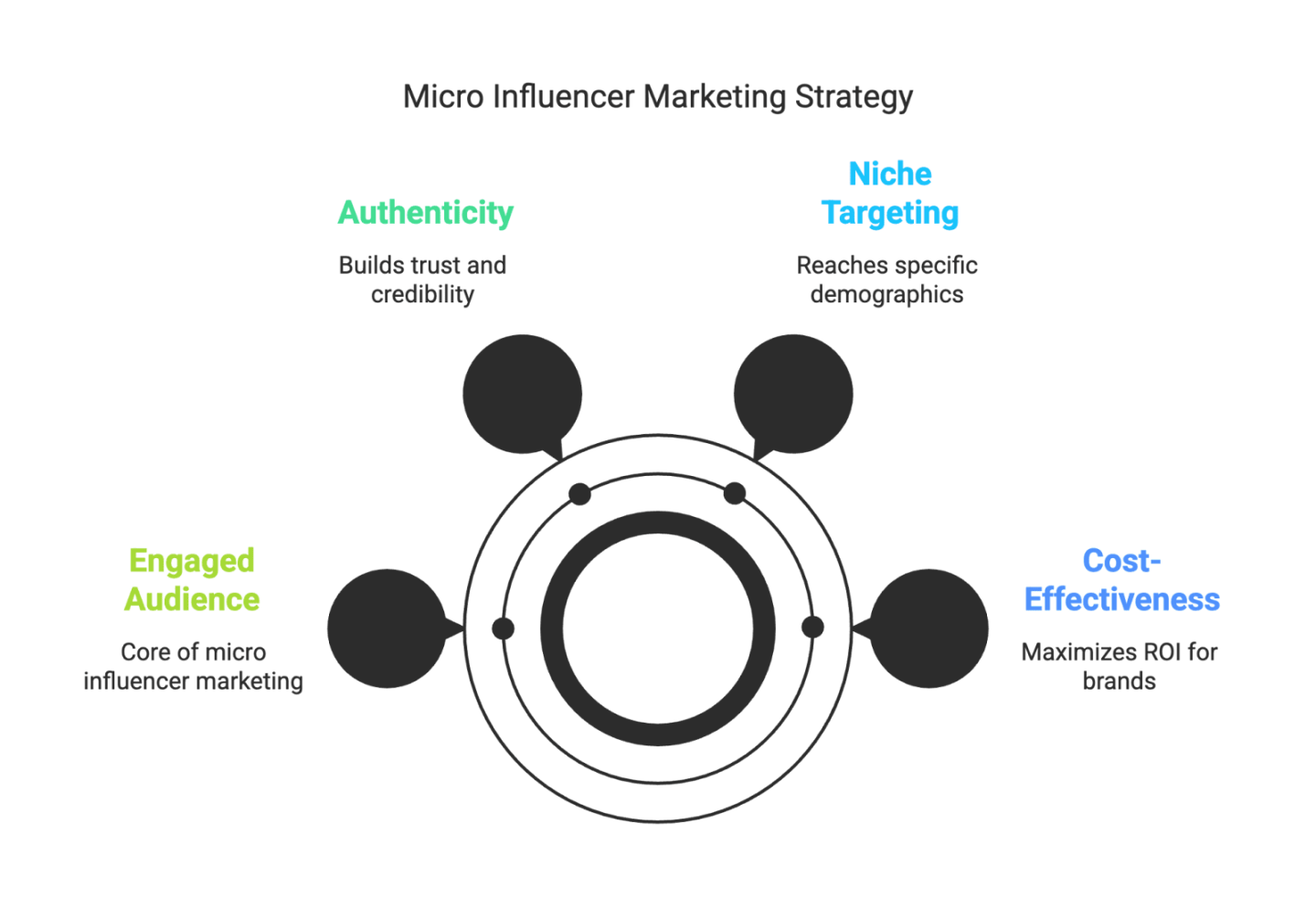
Micro influencers are social media personalities with a relatively small but highly engaged audience – typically in the few thousand up to around 100,000 followers range. Unlike celebrity or “macro” influencers who reach millions, micro influencers operate in specific niches and often feel like everyday peers to their followers. They might be passionate hobbyists, bloggers, or local experts, and their recommendations come off as genuine advice rather than overt ads. This authenticity and relatability give micro influencers an outsized impact on purchasing decisions.
Some key advantages of micro influencers include:
In sum, a micro influencer may lack a giant follower count, but they excel at sparking genuine conversations and trust. Their followers often view them as friends with expertise, which means recommendations feel more like advice than advertising. This is exactly why brands are increasingly eager to leverage micro influencers in their marketing strategies.
A micro-influencer agency is a specialized type of influencer marketing agency that focuses on these smaller, high-engagement creators. In simple terms, it’s a company that connects brands with micro influencers (typically those with ~1K–100K followers) and manages the collaboration process. These agencies handle everything from finding the right niche creators to managing campaigns and measuring results. In essence, they act as matchmakers and project managers between brands and a network of micro influencers.
What services does a micro influencer agency provide? Typically, they offer end-to-end campaign support. For example, a full-service agency will assist with influencer discovery, crafting a campaign strategy, coordinating content creation, handling campaign management, and tracking analytics & ROI. The agency’s role is to simplify the process so that brands don’t have to individually vet and negotiate with dozens of small creators – the agency already has a vetted network and a system to execute campaigns efficiently. They ensure the influencers are a good fit for the brand, help set up the collaboration (often including shipping products to influencers, setting content guidelines, etc.), and then oversee the content postings and results.
In fact, entire platforms now exist solely for micro influencer campaigns. Stack Influence, for example, is an industry-leading micro influencer marketing platform geared toward e-commerce brands. It describes itself as a team of experienced e-commerce sellers turned marketers, and it leverages proprietary AI technology to source “consumer influencers” (everyday content creators), guarantee 100% social post completion, and manage campaigns from A to Z. Agencies like this have streamlined the process of micro influencer marketing – allowing a brand to tap into a large pool of vetted micro creators without the usual headaches of outreach, coordination, and follow-up. The agency model means even a small brand can launch a campaign with, say, 50 micro influencers receiving free products, rather than the brand trying to orchestrate all those relationships one by one.
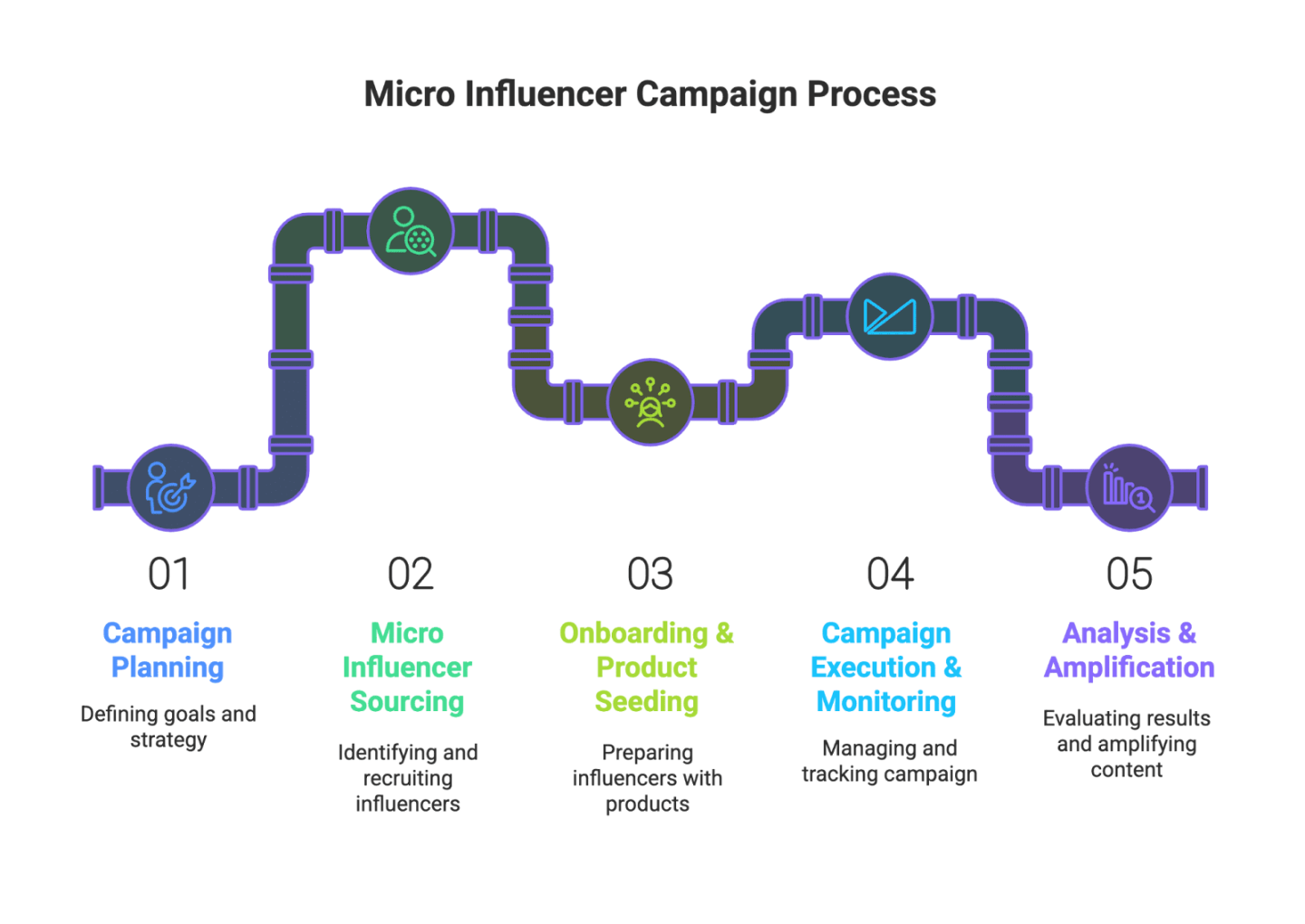
If you’re wondering what it actually looks like when a brand works with a micro influencer agency, let’s walk through a typical campaign process. While exact steps can vary by agency, the overall flow is pretty standard. Here’s an example of how a micro influencer campaign might be executed, step by step:
This managed process illustrates why brands find value in micro influencer agencies. The agency handles all the heavy lifting – planning, recruiting, negotiating, coordinating, and analyzing – so that the brand can reap the benefits of a word-of-mouth style campaign without needing an in-house team to manage it all.
It’s no coincidence that e-commerce brands are leading the charge in micro influencer marketing. For online sellers – whether you’re running your own web store or selling on a marketplace like Amazon – trust and social proof are everything. Micro influencer agencies provide a way to generate that trust at scale by harnessing real people to talk about your product.
Think about the typical Amazon shopper: before buying, they might look for authentic reviews, unboxing videos, or testimonials from “people like me.” Micro influencers excel at creating exactly this kind of content. They produce relatable posts and reviews that build consumer confidence in a way traditional ads often can’t. An enthusiastic Instagram post or TikTok demo from a niche creator can serve as both a recommendation and a piece of content that educates customers about the product. In one survey, 82% of consumers said they are highly likely to follow a micro influencer’s recommendation – which shows how persuasive these peer-level voices can be in driving purchase decisions. When a micro influencer raves about a kitchen gadget or models a new fashion item, their followers trust that opinion more than if it came from a glossy brand advertisement.
For Amazon sellers, micro influencer campaigns can be a game changer in launching or boosting products. Influencer-driven social posts don’t just create buzz – they can drive direct traffic to your Amazon product listings, which in turn boosts your sales rank and even leads to more reviews. Essentially, micro influencers become an army of small-scale brand ambassadors who spread the word and funnel interested buyers to your online storefront. This is especially valuable when you’re relatively unknown in a crowded market. A handful of passionate micro influencers talking about your product in their circles can ignite that crucial word-of-mouth spark.
Another big benefit for e-commerce is the content itself. The photos, videos, and stories generated by micro influencers are authentic UGC that the brand can leverage elsewhere. Brands often repurpose influencer content on their own social media, in email marketing, or even on product pages (for example, using influencer lifestyle shots in a gallery or quoting their testimonial in the description). This adds social proof throughout the customer journey. As an added plus, working with micro influencers is relatively low risk for new brands – you’re usually only giving away some free product or a modest fee, so even if one post doesn’t explode, you haven’t broken the bank. Compare that to spending $50k on a single celebrity post that might fall flat. It’s clear why small and medium e-commerce businesses, in particular, love the micro influencer approach.
Micro influencer agencies streamline all of this for e-commerce brands. They often handle product seeding at scale – sending out products to dozens of influencers – and ensure that each influencer’s post is an “authentic reflection of a genuine product experience,” not a scripted ad. In other words, the agency helps facilitate real people using and talking about the product, which generates that word-of-mouth marketing at scale. The end result for the brand is increased trust, more organic conversations about the product, and typically a boost in traffic and sales that can be directly attributed to these influencer activations.
It’s worth noting that many micro influencer agencies (including Stack Influence) were founded by experienced e-commerce sellers who saw the need for this type of service. They understand the pain points of launching products online – getting initial reviews, building social presence, generating content – and they built solutions to make influencer marketing scalable for sellers. As Stack Influence’s team put it, sourcing influencers, managing collaborations, and ensuring everyone follows through can be hard for a seller to do alone, and that’s exactly the problem the agency model solves.
In the age of authenticity, micro influencer agencies sit at the intersection of social media and commerce, turning everyday creators into powerful brand allies. By connecting niche influencers with e-commerce brands, these agencies enable marketing that feels more like genuine conversation than advertising. The result is a win-win: brands get affordable yet highly effective promotion, and micro influencers (the creators) get opportunities to monetize their passions and gain exposure, often with perks like free products and paid collaborations.
For marketers, the takeaway is that bigger isn’t always better – a targeted campaign with 50 micro influencers can often outperform one splashy post from a single mega-celebrity. It’s no surprise that marketers are increasingly shifting budgets toward micro influencer strategies and relying on agencies to handle the logistics. As of 2025, influencer marketing has evolved from experimental to essential, and brands are getting savvier about focusing on measurable ROI. Micro influencers, with their tight-knit communities, are perfectly positioned to deliver those tangible results.
Looking ahead, expect micro influencer agencies to continue growing in importance. Many are investing in AI-driven platforms to streamline everything from influencer discovery to performance forecasting. This could make micro campaigns even more efficient and data-driven. But at its core, the appeal of micro influencer marketing is unlikely to change: it’s effective because it leverages human-scale connections – the trust and engagement that come from real, relatable voices.
Whether you’re an Amazon seller launching your first product or a global e-commerce brand seeking authentic content, tapping into micro influencer agencies could be your secret weapon. They bring the “people” element back into marketing, at scale. And in a digital world saturated with ads, that genuine touch is exactly what makes customers hit the “buy” button.
In today’s ultra-competitive e-commerce arena, brands – from Shopify startups to Amazon sellers – are increasingly turning to micro-influencers to gain an edge. Micro-influencers are everyday content creators with dedicated niche followings, and their personal, authentic style of promotion can build consumer trust in ways traditional ads often cannot. A micro-influencer’s shout-out feels like a recommendation from a friend, making their endorsements highly credible to followers. But what exactly is a micro-influencer marketing campaign, and how can e-commerce sellers leverage it? In this blog, we’ll break down the concept, benefits, and steps to run a successful micro-influencer campaign, with plenty of tips for Amazon sellers and small brand owners along the way.
A post shared by Stack Influence (@stackinfluence)
A micro-influencer is a social media influencer with a modest but highly engaged follower base. While definitions vary, micro-influencers typically have on the order of 5,000 to 100,000 followers (often broken down further into nano-influencers at the lower end and macro-influencers above 100k). They are not celebrities or household names – they’re usually everyday people such as passionate hobbyists, niche experts, or budding content creators who have earned trust and credibility within a specific community. For example, a food-loving mom with 8,000 Instagram followers or a tech gadget reviewer with 50,000 YouTube subscribers would fall into this category. What sets micro-influencers apart isn’t sheer follower count, but the strong connection and engagement they maintain with their audience. In fact, micro-influencers often see much higher engagement rates on their posts than bigger influencers do – one study found around 6% engagement for micro-influencers vs. ~2% for mega-influencers on Instagram. Their followers actively like, comment, and share their content, indicating a loyal and interactive community.
Because micro-influencers speak to a focused niche, their audiences tend to be highly relevant for certain products. A vegan recipe blogger’s followers are probably fellow vegan foodies; a DIY craft TikToker’s fans are likely craft enthusiasts. This niche targeting means if your product fits that micro-influencer’s theme, you’re instantly getting in front of exactly the kind of consumers most likely to be interested. Moreover, micro-influencers are perceived as authentic peers rather than distant celebrities. They often personally interact with followers in comments and DMs, enhancing that sense of friendship and trust. All these traits make micro-influencers extremely valuable partners for marketing campaigns, especially for small brands that need word-of-mouth buzz on a budget.
A micro-influencer marketing campaign is a promotional strategy where a brand partners with one or (often) many micro-influencers to promote its product or service. Instead of spending your entire budget on a single big-name influencer, this approach involves collaborating with multiple micro-influencers who each speak to a targeted, engaged audience. These campaigns can take various forms, but common elements include:
In essence, a micro-influencer marketing campaign leverages the power of peer influence at scale. By tapping into numerous niche audiences with authentic content, brands can achieve broad exposure and trust without the hefty price tag of mainstream influencer campaigns. This makes the strategy particularly well-suited for e-commerce sellers, Amazon marketplace vendors, and emerging brands that need cost-effective ways to boost awareness and sales.
Micro-influencer campaigns have exploded in popularity among savvy marketers, and for good reason. They offer a potent combination of authenticity, targeted reach, and high return on investment – especially valuable for e-commerce and Amazon sellers working with limited marketing budgets. Let’s break down the key benefits of micro-influencers for small brands:
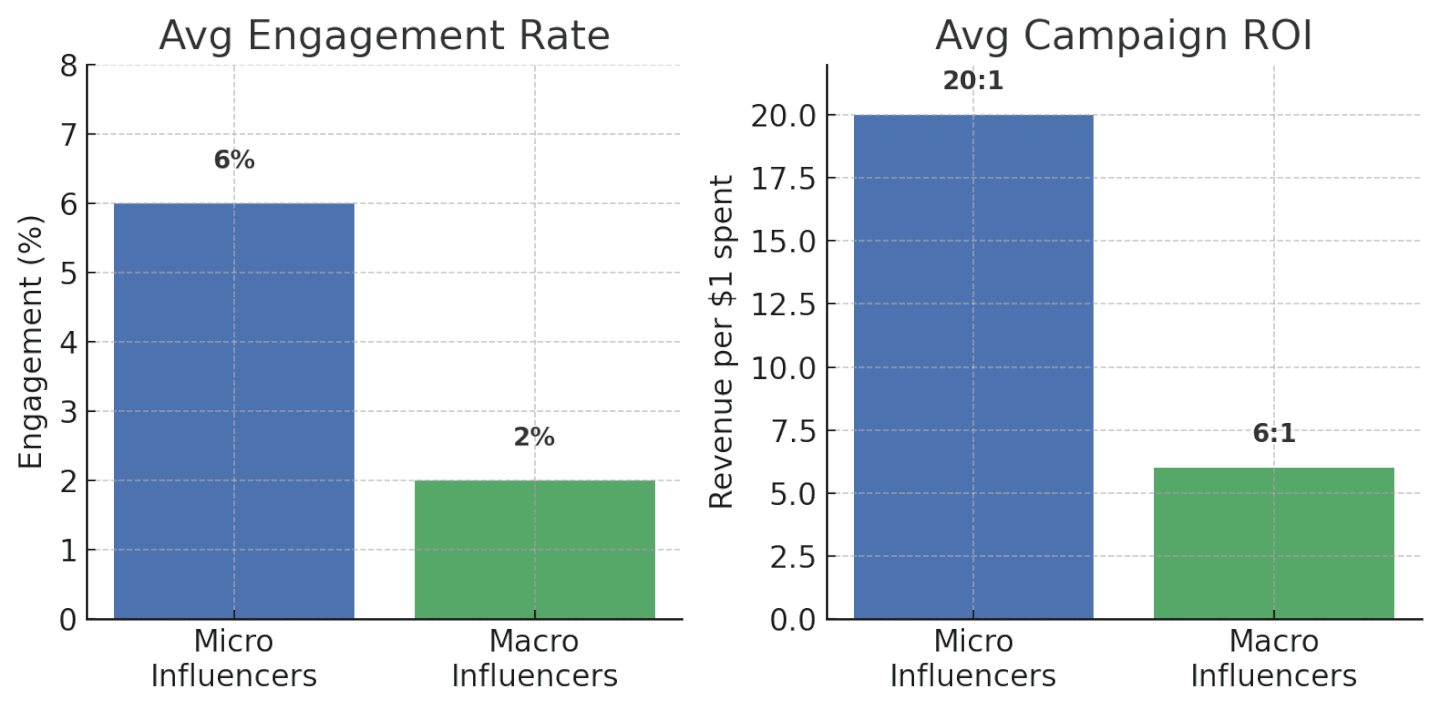
Average engagement rate (left) and campaign ROI (right) for micro-influencers vs. macro-influencers. Micro-level creators often see engagement rates around 5–10%, far higher than the ~2% typical for macro/celebrity influencers. Their campaigns also yield much better ROI due to lower costs and more receptive audiences – studies have found a ~$20 return per $1 spent with micro-influencers, compared to ~$6 per $1 with large influencers.
All in all, micro-influencer marketing campaigns pack a powerful one-two punch of targeted reach and authentic influence. You get the credibility of peer recommendations, the engagement of tight-knit communities, and a flood of user-generated content – without breaking the bank. It’s easy to see why this strategy has become a go-to for e-commerce marketers looking to build brand awareness and trust quickly.
Ready to harness the power of micro-influencers for your own brand? Here is a step-by-step game plan for planning and executing a micro-influencer marketing campaign. Whether you’re an Amazon seller or a small e-commerce brand, these steps will help you maximize your chances of success:
1. Define Your Goals and Target Audience: Start by clearly identifying what you want to achieve and whom you want to reach. Is your goal to increase product sales on Amazon? Boost your brand’s Instagram following? Gather a vault of UGC for future ads? Nail down the primary objective. At the same time, define your target customer profile: demographics, interests, platforms they frequent, etc. Having specific goals and audience insights will guide all your decisions. For example, a small organic skincare brand might set a goal of getting 100 new Amazon reviews and increasing Amazon sales by 20% in a quarter, targeting women aged 25–40 who are interested in clean beauty. With this in mind, you’d seek micro-influencers in the natural beauty niche whose followers match that profile.
2. Discover Relevant Micro-Influencers: Once you know your niche and audience, it’s time to find the right creators to partner with. Start by searching social media platforms that matter for your product. Instagram and TikTok are popular for consumer products, YouTube is great for longer reviews/tutorials, and don’t overlook Facebook groups or Pinterest if relevant. Use hashtags and keywords to scout for potential influencers – for instance, an Amazon gadget seller might search tags like #AmazonFinds, #Unboxing, or niche tags like #HomeOfficeHacks to find creators who frequently feature products. If you sell in a particular category, search those category hashtags (e.g. #mommylife, #skincarejunkie, #gardeningtips) to spot active micro-influencers. Amazon sellers should also be aware of Amazon’s own Influencer Program: some micro-influencers have their Amazon storefronts where they list favorite products and earn commissions.
Partnering with such influencers can be doubly effective, as they will promote your item on social media and list it on Amazon for their followers to buy. You can find these influencers via social media or the Amazon Influencer storefront directory. Additionally, consider using influencer marketing platforms or databases (like searching by niche on CreatorIQ, Influence.co, or others) to streamline discovery. Pro tip: Look for signs of genuine influence when discovering candidates – consistent content quality, an engaging personality, and audience comments that indicate real interest. Build a shortlist of potential micro-influencers who align well with your brand values and target customers.
3. Vet for Authenticity and Engagement: Not all influencers are created equal, and follower count alone can be misleading. Before you reach out, evaluate the quality of each prospective partner’s profile. Check their engagement ratio – how many likes/comments do they get relative to their follower count? A micro-influencer with 8,000 followers averaging 800 likes (10% engagement) is typically more impactful than one with 30,000 followers but only 300 likes (1% engagement) per post. Scroll through their content: Do they get meaningful comments (questions, discussions) or just generic ones? Does the influencer actively reply to comments from followers? Also watch out for any red flags like sudden spikes in followers (could indicate fakes) or a feed that is overloaded with sponsored posts. You want someone whose audience still sees them as authentic and relatable, not as a nonstop salesperson. Finally, ensure their style and values fit your brand – if you sell family-friendly products, an influencer known for edgy pranks might not be a great fit. Taking the time to vet influencers will save you headaches later and ensure your campaign feels genuine and on-brand.
4. Reach Out with a Win-Win Proposal: Now it’s time to contact the influencers on your shortlist. Craft a friendly, personalized message (email or DM) that introduces your brand and why you thought of them. Be clear about what you’re offering – typically a free product sample, and possibly payment or commission – and exactly what you’d like them to do. For example, you might say: “We’d love to send you our new organic coffee sampler. In return, would you be open to creating one Instagram post and one TikTok video reviewing it? We can offer a $100 honorarium, an affiliate link for you to earn commissions, and we’ll feature your content on our page for extra exposure.” Highlight the benefits to the influencer: free product to try, potential to earn, content ideas, shout-outs from your brand, etc. Keep the ask reasonable (micro-influencers are often happy to post in exchange for just product if it genuinely interests them, but adding a small payment or commission can sweeten the deal). If you have any specific requirements – e.g. key points to mention, a campaign hashtag, or FTC disclosure (#ad) – mention those upfront. However, also express that you value their creative freedom and honest voice. The best content comes when creators are free to be themselves, so let them know you’re not looking for a scripted ad, just an authentic share of their experience with your product. Once an influencer agrees, be ready to send out the product promptly along with any necessary info (product instructions, discount codes to share, etc.). Clear communication and a professional approach here set the tone for a smooth collaboration.
5. Allow Creative Freedom (Within Guidelines): When the influencers start creating content, remember that authenticity is key. You chose these micro-influencers because their audience connects with their unique voice and style – so let that shine. Provide any must-know facts about your product and the do’s and don’ts (for example, “Do mention the new summer sale; Don’t make any false health claims; Please use #MyBrandPartner in the caption”), but avoid micromanaging the actual content creation. If one influencer does hilarious skits, encourage them to incorporate your product in a funny way; if another is known for honest, detailed reviews, let them do a deep-dive. By trusting the creator’s expertise about their audience, you’ll get content that feels organic and engaging, rather than a stiff ad. It’s wise to ask if they can show you the post/video before publishing (to double-check brand safety and accuracy), but give primarily big-picture feedback. Minor imperfections or the influencer’s personal quirks make the content more relatable. Remember, one reason micro-influencer campaigns resonate is because the content comes off as peer-to-peer sharing, not corporate advertising. So embrace the creativity and authenticity of your influencers – it will result in posts that their followers actually enjoy and respond to.
6. Monitor Results and Build Relationships: As your micro-influencers start posting, keep a close eye on the impact. Track whatever metrics tie back to your goals – for example, if you provided unique discount codes or affiliate links to each influencer, monitor how many sales or clicks each code generates. Watch your website traffic or Amazon listing visits for spikes on days when posts go live. Also, observe engagement and feedback on the posts themselves: Are people tagging friends? Asking where to buy? This qualitative feedback is gold, as it can inform your future marketing (you might discover new selling points or customer pain points from the comments). Collect all the content pieces your campaign yielded – these are valuable assets. (Be sure to save the videos/photos or request permission if you plan to repost their content on your own channels.) After the campaign, analyze which influencers performed best in terms of both content quality and actual results. This will help you refine your strategy for next time. Crucially, don’t treat the influencers as one-and-done transactions. Thank them for their work, share their posts on your brand’s social media (which also flatters them with extra exposure), and consider keeping in touch for future collaborations. By building a relationship, you might turn a happy influencer into a long-term brand ambassador. Many brands cultivate an “always-on” micro-influencer team – a pool of trusted creators who consistently get new products and keep the buzz going year-round. Nurturing these relationships is how you turn a single campaign into sustained word-of-mouth momentum for your brand.
Efficiency Tip: Managing dozens of influencer relationships can get time-consuming for a small business. This is where tools and agencies come in. For example, micro-influencer marketing platforms like Stack Influence specialize in automating product seeding campaigns and handling the end-to-end coordination of working with large numbers of micro-influencers. A platform like this can help you find and vet creators, ship products, track posts, and ensure each influencer delivers on their agreement – all while you only pay for confirmed results. Leveraging such a service can turn what might be a logistical headache into a streamlined process, allowing even a one-person brand to run a scaled micro-influencer campaign without being overwhelmed. Whether you go DIY or use a platform, the key is to stay organized: keep a spreadsheet or dashboard of who’s posting when, note their results, and follow up accordingly.
If you’re selling on Amazon, micro-influencer campaigns can provide a powerful double benefit – driving sales and boosting your product’s visibility within Amazon’s marketplace. Amazon’s dominance means that any external traffic and sales you generate have ripple effects. Here’s how micro-influencers can specifically help Amazon sellers:
In short, micro-influencers can be the secret weapon for Amazon marketplace success – driving qualified traffic, generating UGC and reviews, and amplifying your product’s popularity both on and off Amazon.
A micro-influencer marketing campaign is all about leveraging the power of small, passionate creators at scale. By tapping into numerous niche communities, e-commerce entrepreneurs can spark authentic conversations about their products and build real trust with consumers. For Amazon sellers and small brand owners, this strategy can level the playing field against bigger competitors, providing a cost-effective way to get your product in front of the right eyes and generate tons of user-driven content and feedback.
As we’ve discussed, the keys to success include choosing the right influencers (those whose audience truly fits your niche), fostering genuine partnerships (built on authenticity and creative freedom), and having a clear plan to track results and repurpose content. When done right, a micro-influencer campaign can create a ripple effect of awareness – turning a handful of product seeding gifts into an ongoing stream of social proof, engagement, and sales.
If you haven’t tried it yet, consider incorporating micro-influencers into your marketing mix. Start small, learn what works for your brand, and scale up. You might be surprised at how much impact these “micro” partners can have on your macro success! And remember, whether you manage it yourself or get a helping hand from services like Stack Influence, what matters most is keeping the content authentic and the relationships mutually beneficial. In the age of content creators and UGC, micro-influencer marketing is one of the most exciting and effective ways to grow your e-commerce brand – happy influencing!
Aspiring micro influencers and content creators know that consistently posting fresh, engaging content is key to growing on Instagram. The good news is you don’t need millions of followers to make an impact – micro influencers (generally 10k–100k followers) are marketing gold for brands, especially e-commerce businesses and Amazon sellers, thanks to their authenticity and loyal audiences. In fact, micro influencers often enjoy far higher engagement rates than big celebrities. They feel like a trusted friend rather than an ad, which is exactly what today’s audiences and brands crave in the era of user-generated content (UGC) and social commerce.
But coming up with new Instagram post ideas can be a challenge when you’re juggling content creation, community engagement, and (for many) an outside job or studies. The Instagram algorithm also rewards creators who use all its features – Reels, Stories, and feed posts – in tandem. Recent data shows that while Stories make up 72% of all Instagram posts by brands, they only account for about 3% of reach, whereas Reels (short videos) make up just 11% of posts but drive 37% of reach. In other words, short-form video is huge for discovery, Stories are ideal for quick interactions, and classic feed posts (photos or carousels) serve as your evergreen portfolio. As a micro influencer, leveraging a variety of post types will help you maximize both engagement and growth.
Below are 20 creative Instagram post ideas tailored for micro influencers (including UGC creators, Amazon affiliates and small biz owners). These ideas will keep your followers engaged, attract new ones, and even catch the eye of brands for collaborations. Let’s dive in!
Nothing builds a personal connection like a “Ask Me Anything” (AMA) or Q&A session. Use the Questions sticker in Stories or go Live and invite followers to send in questions about your niche, products you recommend, or even about you personally. Answering candidly not only provides value to your audience but also humanizes you as a creator. For example, a beauty micro influencer might do a Story AMA about skincare routines, or an Amazon tech reviewer could host a live Q&A about the best budget gadgets. This kind of session positions you as a friendly expert and encourages tons of replies and discussion (which Instagram’s algorithm loves). It’s a win-win: followers feel heard and you get a boost in engagement.
Tip: Promote the Q&A ahead of time (via a post or countdown sticker) so more people show up with questions. During the AMA, be genuine and address followers by name if possible – this makes the interaction more personal and memorable.
User-generated content isn’t just for big brands – micro influencers can harness UGC too. Create a unique hashtag for your community and encourage followers to post their own photos or stories related to your niche or a specific prompt. Then, reshare the best submissions in a carousel post, Reel, or Story shout-out (with permission and credit). For example, if you’re a fitness micro influencer, you might use #GetFitWithYourName and ask followers to share their workout snapshots. Featuring follower content not only provides you with fresh posts but also makes your community feel valued and seen. It’s authentic social proof that you have an engaged tribe, and those featured will likely promote your post too (extending your reach).
When running a UGC initiative, give it a fun twist or theme. You could do a monthly “fan of the month” feature or a challenge like “share your shelfie” if you review books. The key is to celebrate your followers. This deepens the connection and loyalty within your community while generating free, relatable content for your feed.
One advantage of being a micro influencer is you can be more relatable and personal. Followers love to see the real person behind the curated posts. Try sharing a “day in the life” glimpse of your routine. For instance, you could do an Instagram Story takeover of your own account for a day – from your morning coffee and content planning to behind-the-scenes of a photoshoot or your evening relaxation. This kind of behind-the-scenes content humanizes you and builds trust, because you’re pulling back the curtain on your life. It’s also a great way to showcase your workflow as a content creator: how you set up your lighting, how you edit photos, or how you balance a 9-5 job with influencer tasks.
If you collaborate with others, you could even let a fellow creator or a friend take over your Story for a day (with guidelines in place). But even solo, a day-in-the-life series of short video clips or photos can be really engaging. Add captions or voiceover to narrate what you’re doing. Followers might pick up tips (like how you organize your day or your go-to tools) and they’ll feel closer to you after virtually “spending a day” with you.
A post shared by Stack Influence (@stackinfluence)
Data can be surprisingly engaging when presented creatively. Try sharing an interesting statistic or fact from your niche as a simple infographic or chart. For example, a micro influencer in eco-friendly living might post “Only 9% of plastic is actually recycled globally” with a graphic of a pie chart, followed by a caption about easy recycling tips. If you’re in tech, maybe a chart of smartphone market shares; if in fashion, a stat about sustainable clothing. Transforming a nugget of data into a visual is eye-catching and highly shareable, positioning you as a knowledgeable source.
You don’t need fancy design skills – even using Instagram’s text and drawing tools on a plain background can do the trick, or you can use free apps to create infographics. The key is to keep it simple: one powerful stat or a few data points at most. Be sure to explain why the data matters in your caption or subsequent slides. This not only educates your followers but also gives them content they might repost (spreading your reach). Plus, brands love to see influencers who rely on facts and insights, as it adds credibility to your profile.
Nothing sparks engagement like a contest or giveaway. A simple idea is to post an interesting or funny photo and ask followers to “Caption this” in the comments – the funniest or most creative caption wins a shout-out, small prize, or free product. Contests like this can explode your comment count, since people love to participate for a chance to win. In fact, Instagram contests get 3.5× more likes and 64× more comments on average than regular posts – and 91% of posts that garner over 1,000 comments are giveaway posts. This surge of interaction not only boosts your visibility (thanks to the algorithm) but also creates a fun vibe on your page.
There are many types of mini-contests you can try:
Make sure to clearly state the rules and duration (e.g. “winner announced in 48 hours”). The prize need not be expensive – it could be a gift card, a free e-book, a product you love, or just a special shout-out. Even a small incentive works because people enjoy the game and recognition. Contests not only increase engagement but can also attract new followers (as your post may get shared or appear on Explore due to high activity).
Educational content is a big draw on social media. Think about something you can teach or demonstrate in your niche, and turn it into a quick tutorial. As a micro influencer, you likely have specific knowledge or skills that your followers admire – whether it’s how you edit photos, a recipe, a DIY craft, a makeup look, or workout routine. Reels (short 15–90 second videos) are perfect for tutorials because they have wide reach and viewers love quick, actionable tips. For instance, a micro influencer in food might do a “30-second recipe” Reel, while a fashion creator might show “3 ways to style a denim jacket” as a Reel with quick transitions.
Short how-to videos tend to get saved and shared a lot, since people want to refer back to them. Structure your tutorial clearly: state what you’re making or the problem you’re solving at the start (to hook viewers), then show the steps in a snappy way. Use text overlays or captions to highlight key points because many watch without sound. Even if you’re doing a longer IGTV or Live tutorial, you can later cut highlights into a Reel. By regularly posting helpful how-tos, you establish yourself as a go-to content creator for valuable tips, which keeps your audience coming back for more.
Everyone loves a good transformation. If your content can include a before-and-after element, definitely leverage that for a post or series. This works great for niches like fitness (before vs. after a 30-day challenge results), home decor (a room makeover), beauty (makeup or skincare transformations), art (stepwise progress from blank canvas to finished piece), or even business (growth in numbers). You can create a carousel post with the before image as the first slide and the stunning “after” as the second – prompting people to swipe and see the result. Before/after posts are inherently intriguing because they tell a story of progress at a glance.
Make sure to add some context in your caption: explain the work that went in, or a personal story behind the transformation. This personal touch will inspire and engage your followers. For example, a micro influencer in weightlifting might share how they improved over 6 months of training, including the struggles and mindset shifts. Not only do such posts showcase your expertise or journey, they also encourage followers in their own journeys. They’re highly shareable too – people might tag friends who are on a similar path (“look what’s possible!”). It’s authentic and motivational content that can spark a lot of conversation.
Misinformation and myths abound in every industry. Position yourself as a knowledgeable voice by myth-busting in a post. Take a common misconception that your followers might have heard and clearly debunk it with facts or your personal experience. For instance, a skincare micro influencer could address the myth “oily skin doesn’t need moisturizer” – explaining why that’s false and what the truth is. A finance micro influencer might bust a myth like “you need to be rich to start investing”. Structure the post as “Myth vs. Fact” or just call it out in your caption: “Myth: X. Reality: Y.”
This type of content sparks engagement because it might surprise your audience and prompt them to discuss their own experiences or other myths they’ve heard. It also establishes you as a trusted resource who stays informed. To make it more interesting visually, you could do a carousel: first slide big text “Myth: ”, second slide “Fact: ” with some explanation. Or even a Reel where you state the myth and then cut to you explaining the truth (maybe with a humorous twist). Don’t forget to invite followers to share other myths they want busted or drop a question if they’re unsure about something – this can give you ideas for future content too.
A post shared by Stack Influence (@stackinfluence)
Being a micro influencer is all about the community you build. A great way to strengthen that community is to shine the spotlight on someone else once in a while. You can dedicate a post or story to appreciate a loyal follower (maybe someone who always comments thoughtfully), or to collaborate with another micro influencer in your niche. For example, you might interview a follower who achieved something inspiring (perhaps a follower of your fitness page ran their first 5K using your tips), or do a joint live chat with a fellow content creator where you each answer questions or discuss a topic. This not only creates engaging content, but it shows you genuinely care about others – not just self-promotion.
If it’s a feed post spotlighting someone, tag them and explain why you’re featuring them. It could be “Follower of the Month” or “Creator Spotlight: @theirhandle” where you share what you admire about them or something they taught you. Such posts encourage positivity and often that person (and their friends) will reshare your shout-out, which can gently expand your network. On Stories, you could do a quick Q&A with the person or share a series of their posts with your commentary. Collaboration over competition is the ethos here – by lifting someone else up, you also elevate your own brand as a supportive, community-driven micro influencer.
Many micro influencers partner with e-commerce brands or act as Amazon affiliates – but whether sponsored or not, sharing authentic product recommendations is a great content angle. If there’s a product or service you genuinely love and that fits your niche, create a post about it. For instance, a home decor micro influencer might post “My favorite budget-friendly houseplants from Amazon” with a carousel of images and mini-reviews on each slide. A beauty content creator could share an honest review of a new skincare product (highlighting pros and cons). These kinds of posts provide value to your followers who trust your opinions, and they subtly establish you as an authority who stays on top of trends.
Be transparent if it’s sponsored or if you have an affiliate link (audiences appreciate honesty). Focus on why you recommend the product and how it helps solve a problem or improves your life. If you can tie it to a story (e.g. “I struggled with lighting for my photos until I found this affordable ring light...”), all the better. Posts that are essentially mini-reviews or favorites lists can attract saves (“I’ll check this out later”) and even clicks to your link in bio. If you’re working with brands, you might have a discount code to share – which can be a bonus incentive for your followers. Just be sure to keep it genuinely useful and not too salesy. Remember, micro influencers thrive on trust: recommend only what you truly stand by, and your audience will reward you with loyalty (and likely some purchases using your links).
Side note: Many Amazon sellers and small e-commerce brands actively seek micro influencers for product reviews and UGC because of the credibility factor. Platforms like Stack Influence even connect micro influencers with such brands to facilitate honest reviews and product seeding. By doing occasional product spotlights that resonate with your audience, you make yourself more visible to these potential collaboration opportunities.
Being a successful micro influencer on Instagram is all about staying true to your voice while keeping your content fresh. The ideas above are meant to spark inspiration, but don’t feel you must do all 20 all the time. Pick a few that resonate with you and your audience, and give them a try. Watch how your followers respond and iterate from there. The beauty of the micro influencer journey is that you can experiment and engage closely with your community to see what makes them tick – and you have the agility to pivot when needed.
Also, mix up those formats: share Reels for discoverability, Stories for everyday connection, and feed posts for those hallmark moments and valuable insights. A well-rounded approach will ensure you’re tapping into each segment of Instagram’s audience. Remember, as one expert put it, a strong Instagram strategy doesn’t choose between Reels, Stories, or Posts – it uses them in concert, since each serves a different purpose (broad reach vs. interactive engagement vs. profile-building). By diversifying your content, you’ll keep the algorithm happy and, more importantly, keep your followers interested.
In summary, stay creative, stay genuine, and have fun with it! Implementing these Instagram post ideas will not only help you grow your follower count and boost engagement, but also deepen the loyalty of the audience you already have. And in the micro influencer world, an engaged community means more than any raw numbers. Good luck, and happy posting!
Micro-influencers are the hidden gems of the social media world. These are content creators with relatively small followings (often in the thousands to low tens of thousands) who have outsized influence in their niches. They might not be celebrities, but they’re passionate, relatable, and highly trusted by their communities. For small e-commerce brands and Amazon sellers, partnering with micro-influencers can be a game-changer: it’s like tapping into word-of-mouth marketing at scale, powered by genuine user-generated content (UGC). In fact, over 72% of teenagers follow influencers and trust their product recommendations, highlighting how much sway these creators have in shaping buying habits.
Unlike mega influencers with millions of followers, micro-influencers typically have anywhere from 1,000 up to 100,000 followers on a platform. What makes them special is their tight-knit bond with their audience – they interact with followers, focus on specific niches, and come across more like a knowledgeable friend than an advertisement. This means their posts often get a much higher engagement rate (sometimes 5%–8% of their audience engages, versus the ~1–2% typical for macro-influencers). And more engagement isn’t just a vanity metric; it translates to real conversations, trust, and often better sales conversion rates from their recommendations. No wonder brands are flocking to micro-influencer campaigns – on average, businesses are seeing around $5.78 in earned media value for every $1 spent on influencer marketing. That’s an impressive ROI that even small budgets can get behind.
In this comprehensive guide, we’ll walk through why micro-influencers matter for small businesses and then get into how to actually find micro-influencers who can boost your brand. We’ll cover everything from social media hashtag sleuthing to specialized influencer platforms (including why Stack Influence is one of the best ways to find micro influencers). Whether you’re an Amazon seller looking for content creators to feature your product, or an e-commerce startup seeking authentic UGC to build trust, we’ve got you covered.
A post shared by Stack Influence (@stackinfluence)
Micro-influencers may be “micro” in audience size, but they can have a macro impact on your marketing. Here are some key reasons small e-commerce brands and Amazon sellers should care about micro-influencers:
Micro-creators often come off as regular people and genuine fans of the niches they discuss. Their endorsements feel authentic, like advice from a friend, which consumers trust more than traditional ads. For example, 50% of millennials trust product recommendations from influencers, vs only 38% who trust celebrity endorsements. This trust factor translates into real results – micro-influencers bring ~60% more trust to a brand and drive 20% higher conversion rates compared to macro-influencers. In short, a shout-out from a micro-influencer can carry serious credibility with potential customers.
When micro-influencers post, their followers respond. Studies show micro-influencers (tens of thousands of followers) often see 3–8% engagement on their posts, far above the meager ~1% engagement typical for big influencers. More likes, comments, and shares mean the audience is truly paying attention. An engaged audience is more likely to click through, learn about your product, and ultimately become a customer. (Ever notice how a micro-influencer’s comment section feels like a community discussion? That’s the kind of engagement big names struggle to achieve.)
For small businesses, budget is a big concern – and here micros shine. Micro-influencers are much more affordable to work with than major influencers. Many will collaborate in exchange for a free product sample or a modest fee, especially if they genuinely like your product. You won’t have to shell out tens of thousands on a single post. This means you can engage multiple micro-influencers for the price of one macro-influencer, spreading your reach and diversifying content. Because their audiences trust them more, you often get more bang for your buck (in terms of engagement and conversions) with a micro-influencer campaign.
When a micro-influencer posts about your product, you’re not only getting exposure – you’re also getting user-generated content (UGC) that you can reuse in your own marketing. Think unboxing videos, how-to demos, before-and-after photos, stylish shots of your product in real life, etc. This authentic content resonates with consumers and builds social proof for your brand. You can repurpose UGC in your social media, on your product pages, or even in ads to add that real-customer vibe. It’s like hiring a content creator and brand ambassador in one. (Fun fact: short-form videos from micro-influencers on TikTok/Instagram are in high demand by brands to repurpose as ads!)
Average engagement rate on Instagram: Micro-influencers (~10k–100k followers) see about 3.9% engagement per post, whereas macro-influencers (100k+ followers) only get roughly 1.2%. Micro influencers’ close-knit communities interact with their content at a much higher rate, indicating stronger influence and interest.
Survey of marketers on ROI: 56% reported better ROI with micro/nano-influencer campaigns, versus 44% who saw better results with macro or celebrity influencers. The majority lean towards micro-influencers as the more cost-effective and impactful choice for marketing ROI.
Now that we’ve covered why micro-influencers are such a powerful asset – delivering authentic recommendations, higher engagement, and great content on a budget – let’s get into the real question: how do you find these micro-influencers for your own brand? Below, we’ll outline step-by-step strategies to discover and connect with the right creators for your niche.
A post shared by Stack Influence (@stackinfluence)
Finding the right micro-influencers takes a bit of detective work, but it’s not as hard as it may seem. Small businesses and Amazon sellers can use a mix of social media sleuthing, online tools, and creative thinking to uncover great micro-influencer partners. Here are some proven methods:
Before you start searching, get clear on who you’re looking for. What niche or industry does your product fall into, and who is your target audience? The best micro-influencer for your brand is someone who talks about topics aligned with your product and appeals to the customers you want to reach. Once you know your niche, consider which social media platforms are most popular in that space. For example:
Choosing the right platform helps focus your search. If you sell a photogenic home décor product, Instagram and Pinterest are obvious choices. A cool new gadget might shine on TikTok or YouTube. Go where your audience hangs out and where people naturally share content about products in your category.
One of the most straightforward ways to find micro-influencers is by searching social media for content in your niche. Start with Instagram and TikTok, as these are fertile ground for product recommendations and trendsetters:
By actively searching and scrolling, you can uncover countless micro-influencers organically. It’s a bit manual, but it’s free and highly targeted – you’re finding people who are already talking about your niche. As you gather a list, be sure to check that their follower count roughly fits the “micro” range (there’s no hard rule, but 5k to 50k is a good ballpark for many industries) and that their engagement looks healthy (if they have 10k followers but only 5 likes on a post, that’s a red flag – their audience might be fake or unengaged).
Don’t overlook longer-form content platforms like YouTube, and even blogs or Pinterest, depending on your niche. Many micro-influencers expand beyond just Instagram. For example, a tech gadget micro-influencer might run a YouTube channel with “Top 5 Amazon Gadgets” videos, or a DIY craft influencer might have a blog that showcases projects and products.
If manual searching feels like finding a needle in a haystack, don’t worry – there are tools that make finding micro-influencers much easier. Influencer marketing platforms are online services that connect brands with thousands of influencers. They often let you search by niche, follower count, engagement rate, audience demographics, keywords, etc., making it simple to filter out the big celebrities and zero in on micro-influencers who fit your exact criteria.
One standout example is Stack Influence, an influencer marketing platform focused on micro-influencers for e-commerce brands. Stack Influence (built by experienced Amazon sellers) provides an AI-vetted network of micro and nano influencers specializing in all sorts of niches. Using a platform like this can be a huge time-saver – instead of hunting on Instagram for hours, you can input your niche (say “fitness” or “handmade crafts”), desired follower range, engagement level, etc., and get a list of matching micro-influencers in seconds. Many platforms also show you valuable data that’s hard to gather on your own, like each influencer’s average engagement rate, audience demographics, past collaboration history, and more. This helps you vet candidates and make sure they’re the right fit.
Another big advantage of specialized platforms is that they often handle the campaign logistics for you. For instance, Stack Influence has a policy where you only pay for completed influencer posts – meaning if an influencer doesn’t follow through, you’re not out of pocket. They also manage the end-to-end workflow: you can send out a campaign brief, have influencers sign up to participate, ship products for review, and track all their posts in one dashboard. It’s basically like having a matchmaking and project management service for your micro-influencer campaigns. This is especially useful if you want to work with a bunch of micro-influencers at once (say 20, 50, or even 100 of them) to really scale up your reach – the platform helps keep everything organized and guarantees you get what you pay for.
Besides Stack Influence, there are other influencer databases and tools out there (Upfluence, Grin, Tribe, to name a few). Many of these have free trials or search functions you can experiment with. When using any platform, make sure to use filters effectively – e.g., filter by location if you need local influencers, or by platform (Instagram vs. TikTok) depending on where you want the content. Some tools even let you search for Amazon influencers specifically (by filtering for those who have Amazon storefront links or are part of the Amazon Associates program). This can be handy for Amazon sellers who want influencers that will drive traffic directly to Amazon. Overall, while these platforms might charge a subscription or per-campaign fee, they can pay off by saving you tons of time and helping you discover high-quality micro-influencers that perfectly match your brand.
Finding micro-influencers might take a bit of effort up front, but it’s well worth it for the authentic marketing boost they provide. To recap, start by identifying where and how to look: comb through social media hashtags, search for niche content on YouTube/blogs, leverage your own customer base, and consider using dedicated platforms like Stack Influence to streamline the hunt. You’ll likely end up with a diverse list of potential partners – from an enthusiastic TikToker with 5,000 followers who loves discovering new Amazon gadgets, to an Instagrammer with 20,000 followers who posts gorgeous photos in your niche.
The beauty of micro-influencers is that you don’t have to choose just one. You can work with several micro-influencers at once to amplify your reach while still keeping that personal, genuine touch in each collaboration. Many brands find that a “small army” of micro-influencers can outperform a single big influencer, both in cost and in content quality. Each micro-influencer speaks to a slightly different pocket of your target audience, but collectively they create a wave of buzz around your product.
In the fast-moving world of e-commerce, micro-influencers offer something invaluable: authentic voices that cut through the noise and resonate with everyday shoppers. By following the steps in this guide, even the smallest business or Amazon seller can tap into the power of micro-influencers and build a marketing strategy that’s budget-friendly, relatable, and effective. Happy influencer hunting – your brand’s next big advocate might just be a “micro” creator
The influencer marketing boom shows no signs of slowing – and it's not just mega-celebrities cashing in. Brands of all sizes, from trendy startups to retail giants, are actively looking for influencers (especially micro-influencers) to promote their products. In fact, the global influencer marketing industry is projected to reach $32.5 billion by 2026 (up from $24 billion in 2024). An astounding 86% of U.S. marketers plan to partner with influencers in 2026, highlighting how mainstream this strategy has become for brand growth.
Why the rush to collaborate with micro-influencers, content creators, Amazon sellers, and UGC producers? Simply put, micro-influencers (those with tens of thousands of followers or less) offer authenticity and engagement that big names often can't match. Surveys show 82% of consumers are highly likely to follow a micro-influencer’s recommendation, and nearly 90% say authenticity is important when deciding which brands to support. User-generated content (UGC) from these everyday creators feels more genuine than polished ads, building trust with audiences. It helps explain why micro-influencers boast engagement rates as high as 5–20%, while macro influencers (huge followings) see only about 1–3% engagement. Higher engagement means a loyal community more likely to act on recommendations. This engagement, coupled with the cost-effectiveness of working with smaller creators, leads to impressive returns. One study found micro/nano-influencer campaigns can deliver ~20:1 ROI (each $1 yielding $20 in revenue) versus roughly 6:1 for macro-influencers. In other words, brands get more bang for their buck collaborating with many niche creators than blowing a budget on one celebrity.
Average engagement rates and ROI for micro- vs. macro-influencer campaigns. Micro-influencers tend to have far higher engagement (~10% vs ~2%) and more than triple the ROI of campaigns with big influencers.
Given these advantages, it's no wonder e-commerce companies, Amazon sellers, and even household-name brands are ramping up micro-influencer collaborations in 2026. Below, we spotlight 10 notable brands looking for influencers – spanning fashion, beauty, lifestyle, and tech – and how they’re partnering with creators for mutual success. Whether you’re a content creator seeking collabs or a brand curious about influencer strategies, these examples show the power of the right partnership.
A post shared by LaCroix Sparkling Water (@lacroixwater)
Retail (Department Store)
The sparkling water brand La Croix is proof that you don’t need a million followers to get a brand deal. La Croix actively works with micro-influencers – even those under 1,000 followers – to showcase their colorful cans on social media. Instead of heavy traditional advertising, La Croix teamed up with niche wellness communities (like the Whole30 program) and everyday fans, encouraging them to post using hashtags like #LaCroixLove and #LiveLaCroix. The brand even sends free product vouchers to micro-influencers to spur content creation. By featuring user posts in a “Live LaCroix” gallery on its site, La Croix turns UGC into authentic marketing. Takeaway: Branded hashtags and free samples have helped La Croix build a grassroots army of brand advocates online.
A post shared by Daniel Wellington (@danielwellington)
Fashion Accessories (Watches)
Iconic watchmaker Daniel Wellington practically wrote the playbook on micro-influencer marketing. The company grew explosively by offering free watches or perks to influencers in exchange for social posts featuring its minimalist timepieces. It runs daily content contests (e.g. the #DWPickoftheDay challenge) to encourage creative posts, with winners getting featured on the official account. This strategy turned thousands of fashion-conscious micro-influencers into brand ambassadors showing off DW watches. The result? A huge social media presence that felt organic. Takeaway: Product seeding and repost contests can mobilize micro-creators to promote a lifestyle brand widely, at minimal cost.
Beauty (Cosmetics Retail)
Beauty retail giant Sephora understands the value of everyday creators. Their famous #SephoraSquad campaign (with over 58,000 posts to date) was launched to turn fans into brand ambassadors. Each year, Sephora opens applications for influencers (often micro- and mid-tier) to join the Sephora Squad, granting those accepted early access to new products to test and review. In exchange, these influencers share honest reviews and looks on Instagram, YouTube, and blogs – generating buzz among real beauty enthusiasts. Sephora’s continual stream of UGC via Squad members keeps its marketing authentic and community-driven. Takeaway: Formal ambassador programs (with application portals and perks) can help brands like Sephora foster a loyal micro-influencer community who create consistent content.
A post shared by Sephora (@sephora)
Beauty (Skincare & Makeup)
Glossier, a direct-to-consumer beauty brand, has built its cult following largely through micro-influencers who are actually its customers. Glossier’s approach is to make everyone who loves their products feel like an influencer. They offer small perks like product discounts or freebies for posts, and have an “army of 500+ ambassadors” – real users who share makeup looks and skincare tips featuring Glossier. These ambassadors create a constant stream of relatable content, from unboxing videos to everyday makeup routines. As Glossier puts it, “Our customers are our #1 mouthpieces”. By empowering regular people to speak for the brand, Glossier achieved massive reach and trust without traditional ads. Takeaway: User-generated content from genuine fans can be more persuasive than any ad campaign – and brands can scale this by nurturing a large network of micro-influencers.
A post shared by Starbucks (@starbucks)
Food & Beverage (Coffee)
Even corporate giants like Starbucks have embraced micro-influencers to keep their brand buzz brewing. Starbucks collaborates with a range of creators – from small lifestyle bloggers to famous TikTokers – to feature its drinks in authentic, fun ways. Think vibrant Frappuccino selfies, vloggers taste-testing seasonal lattes, and Instagrammers posting their latte art. These relatable posts seamlessly integrate Starbucks products into everyday content, building a sense of community around the brand. Starbucks also often reposts user content and runs hashtag campaigns (like #PumpkinSpiceLatte season) to encourage sharing. By leveraging both nano-influencers and social media stars (e.g. partnering with TikTok phenom Charli D’Amelio for Dunkin’ shows the trend, though Dunkin’ is a competitor), coffee chains demonstrate how influencer content can humanize even the biggest brands. Takeaway: Micro-influencer campaigns help legacy brands stay culturally relevant and engage younger, social-savvy audiences in ways traditional marketing might miss.
A post shared by HelloFresh US (@hellofresh)
E-Commerce (Meal Kits)
HelloFresh, the popular meal-kit service, attributes a portion of its rapid growth to strategic influencer collaborations. Food and lifestyle micro-influencers on Instagram and YouTube regularly show off HelloFresh meal prep, unbox recipe kits, and share referral codes for discounts. By partnering with creators in different regions (US, Canada, Europe, etc.), HelloFresh localizes its reach and taps into the trust those home chefs have with followers. The brand frequently runs sponsored posts and Stories where influencers cook HelloFresh meals, effectively turning their content into engaging ads. According to the company, these collaborations have been key to expanding its global customer base. Takeaway: For e-commerce services, influencer demos and reviews provide social proof – seeing a real person enjoy the product makes new customers more willing to try it.
A post shared by Audible (@audible)
Tech (Audiobooks/Subscription)
Amazon’s audiobook powerhouse Audible recognizes that influencer partnerships can amplify its social media presence. Audible works with a spectrum of influencers – from bookish micro-influencers on Instagram to YouTubers who do audiobook reviews – to share personal stories of how they use and love Audible. These collaborators, often with dedicated niche followings (e.g. thriller novel fans, self-improvement gurus), create content that connects with listeners on a personal level. Audible benefits from this authentic word-of-mouth, as influencers’ enthusiasm for a great audiobook or exclusive Audible original can drive sign-ups. By tapping the engagement of micro influencers, Audible markets its vast library through credible voices, not just ads. Takeaway: Even tech brands benefit from the trust and relatability micro-influencers bring, translating into genuine interest and loyalty among target audiences.
A post shared by MEJURI (@mejuri)
Fashion (Jewelry)
Canadian-born jewelry brand Mejuri has become a favorite among millennials and Gen Z – thanks in large part to influencer buzz. Mejuri is an affordable luxury jewelry company that actively courts micro-influencers, especially on Instagram. The brand is often cited as one of the best brands working with micro-influencers, and it’s easy to see why. Mejuri invites style bloggers and everyday fashionistas to showcase its delicate earrings, necklaces, and rings in their outfit posts. In return, influencers get perks like being featured on Mejuri’s Instagram (1M+ followers) and sometimes free jewelry or commission. Mejuri even accepts direct applications from influencers to join their ambassador program. By collaborating with many small creators, Mejuri continually exposes new audiences to its jewelry in an organic, authentic way. Takeaway: Niche DTC brands can scale up by turning passionate customers into brand advocates – Mejuri’s widespread social media presence was built one influencer collab at a time.
A post shared by Coca-Cola (@cocacola)
Beverage (Soft Drinks)
It’s not just newer brands – even global icons like Coca-Cola have tapped micro-influencers to reach specific communities. Coca-Cola’s #CokeAmbassador initiative, for example, recruited everyday Instagrammers in Belgium (each with <100K followers) to share their moments enjoying Coke. By partnering with fashion, travel, and lifestyle influencers in a small market, Coke was able to connect with Belgian consumers in a personal, localized way. The micro-influencers’ content (selfies with a Coke in hand, etc.) still carried Coca-Cola’s branding, but felt more like friends sharing a drink than advertising. The campaign’s success showed that even a company as large as Coca-Cola benefits from the credibility and relatability of micro-influencers. Takeaway: Regional micro-influencer campaigns can humanize a big brand and drive engagement in specific target markets, all while staying cost-effective.
A post shared by Target (@target)
Retail (Department Store)
Target has long leveraged influencer partnerships to keep its brand culturally relevant. Back in 2017, Target launched a new swimwear line and enlisted influencers to model the suits on Instagram using hashtags like #TargetStyle and #TargetSwim. That campaign not only created a splash that season – those hashtags are still in use by shoppers today, a testament to the enduring impact of Target’s influencer campaigns. Target continues to work with influencers (from budget fashion bloggers to even athletes) for various product lines, often featuring them in social media posts to showcase real people wearing Target items. While Target doesn’t have an open “ambassador program” per se, it does invite collaborations and even allows influencers to apply on its website for certain partnerships. Takeaway: A well-executed influencer hashtag campaign can turn into a long-term community, as customers and creators keep the conversation going well beyond the initial promotion.
As the examples above show, many brands – from small e-commerce sellers to global companies – are eager to collaborate with influencers. But how can creators and brands actually connect with each other for these partnerships? Here are a few strategies:
Dedicated influencer marketing platforms make it easy to find collaboration opportunities. For example, Stack Influence (a platform focused on micro-influencers in e-commerce) helps connect brands with thousands of vetted micro-influencers and streamlines campaign management. Such platforms let brands filter influencers by niche, audience demographics, follower count, etc., and often handle outreach, shipping product samples, and payments. Some even offer guarantees – Stack Influence, for instance, only charges brands for completed posts, so you don’t pay for influencers who ghost the campaign. If you’re crafting outreach emails or influencer briefs, tools like an AI humanizer can help make AI-generated copy sound more natural and engaging — ensuring your messages connect authentically with creators and audiences alike. Using a marketplace or platform can save tons of time for both brands and creators by serving as a matchmaking service. (In addition to Stack Influence, other marketplaces like Afluencer, AspireIQ, and TikTok Creator Marketplace are popular for finding collabs.)
Many brands run their own ambassador or affiliate programs (as seen with Sephora, Nike, Fitbit, etc.). Keep an eye on brand websites and social profiles for “collab” or "ambassador" pages. For instance, Sephora announces applications for #SephoraSquad on its site, and other brands (like Mejuri or HelloFresh) have sign-up forms for interested influencers. If you’re a creator, applying to these programs can put you on the radar for campaigns and free products. If you’re a brand, consider setting up a simple application or affiliate signup to attract enthusiastic micro-influencers who already love your products.
Sometimes, the simplest approach works: start creating content about brands you love, and tag them. Brands often notice when people tag or mention them in posts and may reach out if they see you as a good fit. Use relevant hashtags (e.g. a clothing brand’s official hashtag) so that the brand’s social team sees your content. This is how La Croix and Coca-Cola find many of their micro-collaborators – by spotting fans who are already posting organically. For influencers, this means showcasing your genuine enthusiasm for a brand can lead to a collab offer. For brands, it means monitoring your tags and hashtags to identify potential advocate influencers is a smart move.
If there’s a brand you really want to work with, don’t be afraid to send a polite email or DM. Approach the brand with a brief proposal of how you’d represent them, include your media kit or stats, and explain the mutual benefit. If you need a starting point, an AI proposal generator can help you create a polished proposal that you can then customize for the specific brand and campaign. Many brands have PR or influencer marketing contacts listed on their website. For example, Starbucks invites emails to their partnerships address, and Dunkin’ has a web form for creators. As an influencer, a well-crafted pitch (tailored to the brand’s style and audience) can open doors – even if they don’t have a public program. As a brand, being open to direct influencer inquiries and having a process to handle them (even as simple as an email alias for influencer collaborations) can help you discover passionate creators who love your product.
In summary, 2026 is a golden age of brand-influencer collaboration. From micro influencers fueling e-commerce sales with authentic UGC, to big brands humanizing themselves through relatable creator content, the opportunities are richer than ever. Brands looking for influencers have a plethora of platforms and tactics to find the perfect partners, and content creators have more pathways to brand deals than at any time before. The key is for both sides to focus on authentic alignment – when a brand’s values mesh with a creator’s voice, the collaboration resonates best with audiences. Whether you're an Amazon seller aiming to boost your listings or an aspiring influencer trying to land your first brand deal, remember that real connections and genuine content drive success in influencer marketing.
By learning from the examples above and utilizing the right tools (like influencer marketplaces and social media networking), you can tap into this powerful trend. The era of micro-influencers and content creators has transformed marketing – and those brands who embrace these partnerships (and creators who stay authentic) are poised to thrive. Here’s to more brand + influencer wins ahead! 🚀
Instagram has become a marketing powerhouse for e-commerce businesses, from Shopify store owners to Amazon sellers. One of the most effective ways to reach customers on this platform is through Instagram ads – particularly Instagram Stories ads, which are full-screen vertical ads appearing between user Stories. These short, immersive ads can dramatically boost brand awareness, engagement, and sales when executed correctly. In this comprehensive guide, we’ll walk you through everything you need to know about running Instagram ads in 2026, with a special focus on leveraging micro-influencers, content creators, and user-generated content (UGC) to maximize your returns.
We’ll cover: what Instagram Story ads are and why they matter, how to set up and launch your ad campaigns step by step, pro tips and best practices (from targeting to creatives to tracking), and how micro‑influencer content and UGC can turbocharge your Instagram ad performance. Whether you’re an Amazon seller looking to drive external traffic to your listings or a DTC brand owner seeking to scale up on Shopify, this guide will help you create scroll-stopping Instagram ads that convert. Let’s dive in!

Instagram Story ads are short photo or video ads (up to 15 seconds long) that appear in the Stories feed (the content at the top of the Instagram app that disappears after 24 hours). They are labeled “Sponsored” and can be targeted to specific audiences. Story ads take over the entire mobile screen in a vertical 9:16 format, creating an immersive, distraction-free experience for the viewer. With over 500 million people viewing Instagram Stories daily, this ad placement offers a huge opportunity to get your brand in front of a large and active audience.
Stories are especially popular among younger demographics – around 61% of Instagram’s users are 18–34 years old, a key consumer group for many brands. These ads appear at the very top of the app when users tap through Stories, making them highly visible. Their ephemeral nature (vanishing after 24 hours) also creates a FOMO-like sense of urgency that encourages users to pay attention before the content disappears. In other words, Story ads sit in prime real estate and tap into user psychology to grab attention.
Another reason Stories matter is their interactive features. Instagram offers stickers, polls, quizzes, question boxes and other interactive elements in Stories, which brands can leverage in ads to boost engagement. For example, you might include a poll sticker in your Story ad to get viewers involved (e.g. “Which style do you prefer? A or B?”). This not only makes the ad more engaging but also provides feedback or market insights. Because Stories are short (max 15 seconds) and often feel more “raw” or casual, viewers tend to watch them in full more frequently than they would a longer video – meaning your message is more likely to be seen to the end.
Finally, Instagram Story ads are highly actionable. They can include swipe-up links or link stickers that let viewers visit a website or product page directly from the Story. For businesses, this is a game-changer: you can drive traffic straight to your e-commerce store, Amazon listing, or app download page from an ad. (In fact, Instagram now allows even small accounts to use the link sticker, whereas previously the swipe-up CTA was only for accounts with 10k+ followers.) A viewer interested in your ad can swipe up to shop or learn more, making it seamless to convert interest into action. There’s also a “Shop Now” button integration for brands with Instagram Shopping, allowing in-app product purchases – great for Shopify sellers with a catalog. All these factors make Story ads exceptionally useful for increasing brand awareness, engagement, website traffic, and sales.
Why should e-commerce brands and Amazon sellers invest in Instagram ads? Let’s highlight the key benefits, especially in the context of online product businesses:
In summary, Instagram ads provide a potent mix of reach, targeting, engagement, and action-driving features – all of which are perfectly suited for e-commerce marketing. Next, let’s explore how partnering with micro-influencers and integrating UGC can take these benefits to the next level, giving small brands an edge over big-budget advertisers.
One major difference-maker in 2026 is the rise of micro-influencer marketing and the use of user-generated content in advertising. Micro-influencers are social media creators with smaller followings (usually in the 5,000 to 100,000 follower range) who have highly engaged audiences in specific niches. For example, a foodie Instagrammer with 20k followers or a tech reviewer with 50k followers – these “everyday” creators may not be celebrities, but their content resonates strongly with their followers. When it comes to Instagram ads, collaborating with micro-influencers can dramatically improve authenticity and results. Here’s why:
Micro-influencers (those with tens of thousands of followers) typically boast significantly higher engagement rates and ROI than macro-influencers with massive follower counts. For example, a micro-influencer’s audience might engage with their content at a rate of ~10%, whereas a celebrity with millions of followers might only see ~2% engagement on a post. Similarly, campaigns leveraging a network of micro/nano influencers have achieved ROI in the range of 20:1 (20× return), compared to roughly 6:1 for campaigns using only mega-influencers. This means that working with a group of smaller creators can often yield more conversions per dollar spent than paying one big name – a powerful advantage for emerging brands with limited budgets.
In short, integrating micro-influencers and UGC into your Instagram ad strategy can significantly boost performance. You build trust and engagement with authentic content, while still leveraging the precision and scale of paid advertising. Now, with these advantages in mind, let’s walk through how to actually create and run an Instagram ad campaign step by step.
Running Instagram ads might sound intimidating if you’re new to it, but it’s quite straightforward using Meta’s advertising tools. Here’s a step-by-step guide to setting up your first ad, from planning to publishing:
1. Switch to a Business Account & Connect to Meta Business Suite: If you haven’t already, convert your Instagram account to a Business or Creator account (this unlocks the ability to run ads and view insights). Also make sure you have a Facebook Page for your brand, since Instagram ads are managed through Facebook’s Ads Manager. Link your Instagram to a Facebook Business Page and set up a Meta Business Manager account. This is the hub where you’ll create and manage campaigns.
2. Choose Your Campaign Objective: In Meta Ads Manager, start by creating a new campaign and selecting an advertising objective. Instagram ads can be optimized for various goals such as Brand Awareness, Reach, Traffic, Engagement, Video Views, App Installs, Lead Generation, or Conversions. Pick the objective that best matches your desired outcome. For example, an Amazon seller might choose “Traffic” or “Conversions” to send people to their Amazon product page (Conversions can track sales if you have the proper tracking in place, such as Amazon Attribution links). A Shopify store might use “Conversions” to drive purchases on their site, or “Engagement” if focusing on getting more people to interact with a post. Choosing the right objective helps Instagram know what to optimize for (clicks, views, adds-to-cart, purchases, etc.).
3. Define Your Target Audience: Next, set up the audience for your ads. This step is crucial – effective targeting ensures your ads show to the right people. You can define your audience based on location, age, gender, language, interests, behaviors, and more. For instance, if you sell eco-friendly yoga mats on Shopify, you might target women ages 20–40 in the US who are interested in yoga, wellness, or fitness. If you’re advertising a new kitchen gadget on Amazon, you could target both men and women 25–55 in English-speaking countries who have shown interest in cooking or follow foodie influencers. You can also use Custom Audiences (like retargeting people who visited your website or engaged with your Instagram content) and Lookalike Audiences (people similar to your customers). Instagram (via Facebook) provides very granular targeting tools, so take advantage of them to reach your ideal shoppers. A pro-tip: if working with micro-influencers, you can target the ad to their follower lookalikes or use geographic targeting if the influencer’s audience is region-specific – this way you amplify the content to people similar to those who already liked it.
4. Select Ad Placements (Stories, Feed, etc.): When setting up the ad, you’ll choose where your ads will appear. By default, Meta might select “Automatic Placements,” which spreads your ads across Instagram and Facebook properties (Feed, Stories, Reels, Messenger, etc.) for best optimization. However, if your focus is specifically on Instagram Stories ads, you can manually select just the Instagram Stories placement (and possibly the Facebook Stories placement for cross-posting). Many advertisers opt to include multiple placements (Feed and Stories together, for example) to maximize reach – the same ad creative can often work in both feeds and stories, or you can tailor separate creatives for each. Ensure you specify Instagram if you want to be sure your budget goes there. You can also run Instagram Reels ads similarly, which are another high-engagement format in 2026. As a beginner, you might try automatic placements to let Facebook allocate budget to wherever performance is best, but if you have vertical Story content ready, definitely include Stories as a placement.
5. Set Your Budget and Schedule: Decide how much you want to spend and over what timeframe. You can choose a daily budget (e.g. $20 per day) or a lifetime budget for the campaign (e.g. $500 for a month-long campaign). You’ll also set the schedule – you can run ads continuously starting now, or set a start and end date. If you’re promoting a limited-time offer or product launch, schedule accordingly. For always-on strategies, you might run ads continuously but watch them closely to adjust budget based on results. Start with a budget you’re comfortable testing with; even a few dollars a day can generate useful data. The Ads Manager will provide estimates of how many people you might reach or how many clicks you might get for your budget, which is helpful for planning.
6. Design Your Ad Creative: Now for the fun part – creating the ad itself. First, choose the format: Story ads can be a single image, a video, or a carousel of multiple images/videos. For Stories, vertical 9:16 aspect ratio creatives are ideal (Instagram recommends 1080×1920 pixels for Story ads to perfectly fit the screen). Make sure your image or video is high-resolution, visually appealing, and aligned with your brand style. Since Stories only last seconds, you want to capture attention in the first 1-2 seconds – consider bold visuals, big text overlays, or an engaging opening scene in a video. Keep text minimal on images (Instagram ads can be rejected if there’s too much text, plus it’s hard to read on a story). If using video, ensure it’s compressed for quick loading and includes sound or captions to grab users (many view stories with sound on, but captions help in silent mode).
Crucially, include your value proposition early – e.g. “50% Off Today” or “Try Our Best-Seller” – so even those who tap quickly get the gist. If you have UGC or influencer content, this is the time to use it: for example, an influencer’s unboxing clip or a customer testimonial snippet can make for a compelling Story ad. The authenticity of UGC can really make your ad stand out in the Story feed. You can use Instagram’s built-in Story ad templates or graphic tools if you’re not a designer – there are many apps and even Canva templates for Instagram Story ads that you can customize with your branding (colors, logos, etc.), making it easy to create professional-looking Stories fast. (Tip: Test your creative on a smartphone before finalizing – make sure text isn’t cut off and is readable on smaller screens.
7. Write a Clear Call-to-Action (CTA): While Story ads don’t have a typical caption (since they’re fullscreen), you can still add text within the story and, importantly, include a CTA link or button. Common CTAs include “Swipe Up to Shop,” “Learn More,” “Sign Up,” or “Download Now,” depending on your goal. If your account is eligible, use the Swipe Up link (or link sticker) to direct users to your desired URL (product page, landing page, etc.). Make sure that once they swipe up, the landing page is mobile-optimized and matches the ad (for example, if the ad was about a specific product or offer, they should not be taken to a generic homepage). Within your ad creative, you might include a text overlay like “Swipe ↑ to get 20% off!” or an arrow pointing to the top to remind people to take action. Instagram also often displays a “Sponsored > Learn More” tag at the bottom by default for Story ads – you can customize that CTA text when setting up the ad. Be explicit about what you want the viewer to do, and give them a reason: e.g. “Swipe up to claim your discount” (a compelling offer can improve conversion). Remember, users only have a brief moment to act before the Story advances, so a strong, punchy CTA is key to driving clicks.
8. Preview and Publish: Before launching, use the preview function to see how your ad will look on an actual Instagram screen. Check that everything appears correctly – no important visuals or text near the edges (they might get covered by the interface or cropped on some devices). Ensure the swipe-up link works properly. Once satisfied, hit that Publish button! Your ad will go through a review process (usually within an hour or two, but sometimes up to 24 hours) where Instagram/Meta checks it against ad policies. Assuming it’s approved, it will start running as per your schedule.
Congratulations, your Instagram ad is now live! But your work doesn’t end here – in fact, now the real learning begins. In the next section, we’ll discuss how to monitor your ad’s performance and optimize it, as well as additional best practices to keep in mind for ongoing success.

Setting up an ad is one thing; making it successful is another. Here are some best practices and pro tips to help you get the most out of your Instagram ads, especially when using Story ads and collaborating with creators:
Even the best ad creative will fall flat if shown to the wrong audience. Refine your targeting based on who is most likely to be interested in your product. Take advantage of Instagram’s targeting filters like location, demographics, interests, and behaviors. If you’re selling a niche product (e.g. vegan skincare), target people interested in related topics (veganism, cruelty-free beauty, organic skincare, etc.). Use Lookalike Audiences built from your customer list or website visitors – these often convert well because they mirror your existing buyers. And don’t forget to exclude groups that aren’t relevant (for example, exclude “already purchased” customers if you don’t want to waste ad dollars on them, or exclude very broad categories that aren’t your market). Periodically review your audience performance in Ads Manager – you might find certain age groups or regions perform better, and you can then adjust your targeting to focus on those segments. The more dialed-in your targeting, the higher your conversion rates will be.
On Instagram, visuals are everything. Your ad is competing with friends’ stories, influencer posts, and a lot of visual noise. So make it count. Use high-quality images or videos with vibrant colors or striking imagery that stops the tap-through. Incorporate movement if possible (videos or even animated text) to grab attention – a quick motion in the first second can prevent someone from skipping your Story. Ensure your design fits the vertical format (9:16) without awkward cropping; important elements should be centered, since the top and bottom might get slightly cut on some screens.
Keep any text large, concise, and on-screen long enough to be read. If you’re highlighting a product, show it in action: for example, a clothing brand might show a model twirling in a dress to see it flow, or a gadget might be shown being used in a real scenario. Always maintain brand consistency – use your brand colors, fonts, and tone so that people recognize you. And if you’re using influencer content, make sure it still aligns with your branding (you can add your logo or a tagline to UGC content, just do it subtly). Remember, Instagram users scroll fast – you have a split second to communicate what you’re offering. Test multiple creatives if you can (Instagram allows you to create different ad variations); you might be surprised which style resonates best.
A beautiful ad is great, but without a clear call-to-action (CTA), you might lose conversions. Always guide the viewer on what to do next. Whether it’s “Swipe up to shop,” “Sign up for free,” “Use code INSTAGRAM for 10% off,” or “Learn More,” make sure it’s crystal clear. In Story ads, utilize the swipe-up link or CTA button that Instagram provides – and also reinforce it with text or graphic elements in the Story itself (like an arrow or an animation pointing to “Swipe Up”). Consider the offer or incentive too: people are more likely to swipe if they feel they’re getting something valuable.
For instance, mention a discount, a free trial, or a limited-time deal in your ad if applicable. Place your CTA text in a prominent position (but not so low or high that it gets cut off). Many successful Story ads literally spell out the action (“Swipe Up”) with a little graphic for emphasis. The viewer should never be left guessing what to do – tell them clearly and give them a reason to do it. And one more thing: ensure the landing page you send them to fulfills the promise of the ad. If the ad says “50% off all shoes, swipe up,” the swipe-up link should not land them on a full-price catalog page – it should show those discounted shoes or have a banner about the sale. Consistency builds trust and makes conversion easy.
We’ve discussed the power of micro-influencers and their content – now let’s apply it as a best practice. Instead of trying to create all ad content in-house, consider partnering with content creators in your niche to generate authentic visuals and videos for your ads. Not only can this save you time (you get a stream of ready-made content), but it also provides social proof. For example, a small cosmetics brand could collaborate with 10 beauty micro-influencers to each make a short Instagram Story reviewing or using a product. You can then take the best of those Stories (with permission and proper arrangements, of course) and run them as ads targeted to similar audiences. Many brands also use Instagram’s Branded Content Ads feature, which allows you to run ads from the influencer’s own Instagram handle (it will say “Paid partnership with ”). This way, the ad looks like it’s coming from the influencer, adding credibility. Always choose creators whose persona and audience align with your brand – their endorsement should feel genuine. And provide them with a creative brief so they know the key points or features to highlight. (The content should still be in their voice/style, but you might ask them to mention your brand name or demonstrate a certain benefit.)
By working with content creators, you essentially crowdsource relatable ad content and tap into the influencers’ storytelling skills. As a bonus, the creators might share the ads or posts on their own, giving you extra organic exposure. If managing dozens of influencer relationships sounds daunting, there are platforms to help – for instance, Stack Influence connects e-commerce brands with hundreds of micro-influencers and automates the process of product seeding and content collection. The bottom line: incorporate real people into your Instagram ads strategy. It’s like getting word-of-mouth recommendations at scale, which can significantly boost your campaign’s effectiveness.
Instagram advertising in 2026 offers incredible opportunities for micro brands, Amazon sellers, and e-commerce entrepreneurs to reach customers and drive sales. By focusing on highly engaging formats like Stories, leveraging the power of micro-influencers and UGC for authenticity, and following a data-driven approach to campaign optimization, you can achieve outsized results even without a Fortune 500 budget. Remember that at its core, Instagram is a visual and social platform – people come here to be inspired, entertained, and connected. If your ads align with those desires (through eye-catching visuals, relatable content creators, and interactive elements), they won’t feel like “ads” at all – they’ll feel like interesting stories worth watching, sharing, and acting on.
Now it’s your turn: take these tips and start crafting your own Instagram ad campaign. With consistency and creativity, you might be the next success story we hear about on our Instagram feeds! Good luck, and happy advertising. 🚀
Influencer marketing isn’t just for trendy consumer brands anymore – B2B companies are now fully embracing influencers as a core part of their marketing strategy. In fact, the entire influencer marketing industry has seen explosive growth going into 2026, proving this once-niche tactic is now mainstream. Marketers have realized that partnering with the right content creators can humanize their brand, build trust with audiences, and even drive direct sales. Below, we break down the top B2B influencer marketing trends to watch in 2026 – from the rise of micro-influencers and UGC to AI and social commerce integration – to help e-commerce brands and Amazon sellers stay ahead of the curve.
Global influencer marketing spend has skyrocketed in recent years. As shown above, the industry’s global market size jumped from about $9.7 billion in 2020 to over $32.5 billion in 2026, reflecting a 35%+ annual surge in investment. Over three-quarters of marketers now dedicate part of their budget to influencer campaigns, solidifying influencer collaborations as an essential marketing channel rather than an optional experiment.
Just a few years ago, influencer marketing was often considered a B2C play, but 2026 marks the year it becomes table stakes in B2B. Recent surveys show 81% of B2B marketers now have dedicated influencer marketing budgets, and more than half plan to increase those budgets further. An additional 9% of B2B firms are launching influencer programs for the first time in 2026. This surge in adoption means nearly every B2B brand – from software companies to manufacturers – is exploring influencer partnerships to complement their traditional marketing.
Why the growing commitment? B2B decision-makers, like consumers, are active on social platforms and increasingly trust industry experts and creators over direct brand messaging. Partnering with respected voices in your niche can build credibility faster than corporate ads. Key benefits of B2B influencer marketing include:
B2B brands are shifting from one-off sponsorships to more integrated, long-term influencer strategies. Rather than a single paid post, companies co-create webinars, whitepapers, podcasts, or video series with influencers who are subject-matter experts. This long-term, relationship-driven approach pays off: brands investing in ongoing influencer partnerships see higher ROI and stronger buyer trust. In short, influencer marketing has matured into a reliable B2B marketing channel, not a gimmick – and ignoring it is no longer an option if you want to remain competitive.
Bigger isn’t always better when it comes to influence. In 2026, micro-influencers (creators with tens of thousands of followers or less) and even nano-influencers (a few thousand followers) are emerging as the real power players – especially for e-commerce brands and Amazon sellers looking to maximize impact on a budget. These smaller-scale creators may have fewer followers, but their audiences are highly engaged and trust them like a friend.
Studies show that micro and nano influencers often deliver far stronger engagement rates and conversion rates than macro influencers with huge followings. For example, one analysis found Instagram nano-influencers (under 5k followers) average about a 2.5% engagement rate, compared to roughly 1% for micro-influencers over 10k followers. In practical terms, this means a smaller creator’s audience is more “dialed in” – more of their followers actively like, comment, and click, which can translate into more leads or sales per impression. Their content also feels more authentic and relatable, which builds trust. No wonder brands are eagerly tapping armies of micro-creators to promote products in niche communities.
For Amazon sellers and e-commerce brands, micro-influencers have become secret weapons to drive product sales. These creators excel at producing authentic reviews, unboxing videos, and how-tos that build consumer confidence in a product. They’ll often work in exchange for a free product or a modest fee – an incredibly cost-effective proposition compared to pricey Instagram celebrities. In fact, instead of paying one big influencer $20,000 for a single post, a brand could hire dozens of micro-influencers for the same budget and generate far more total content and engagement, often yielding a higher overall ROI. One study found micro/nano influencer campaigns can deliver around a 20:1 ROI (i.e. $20 in revenue per $1 spent), versus roughly 6:1 ROI for macro-influencer campaigns. That’s a huge difference in marketing efficiency. As Stack Influence (a micro-influencer marketing platform for e-commerce) notes, nano-influencers can even achieve 42% lower cost-per-click than micro-influencers, albeit with more effort to manage many small partners. It’s the classic quality-vs-quantity tradeoff – micros reach more people per post, but nanos deliver ultra-engaged niches at rock-bottom cost.
Bottom line: partnering with a network of micro-influencers is often more impactful than a single big name, especially for brands targeting specific interests or local markets. Their relatable content and close-knit follower relationships “punch above their weight” in driving real results. Expect to see even more brands in 2026 building out micro- and nano-influencer programs to amplify their message in an authentic way.
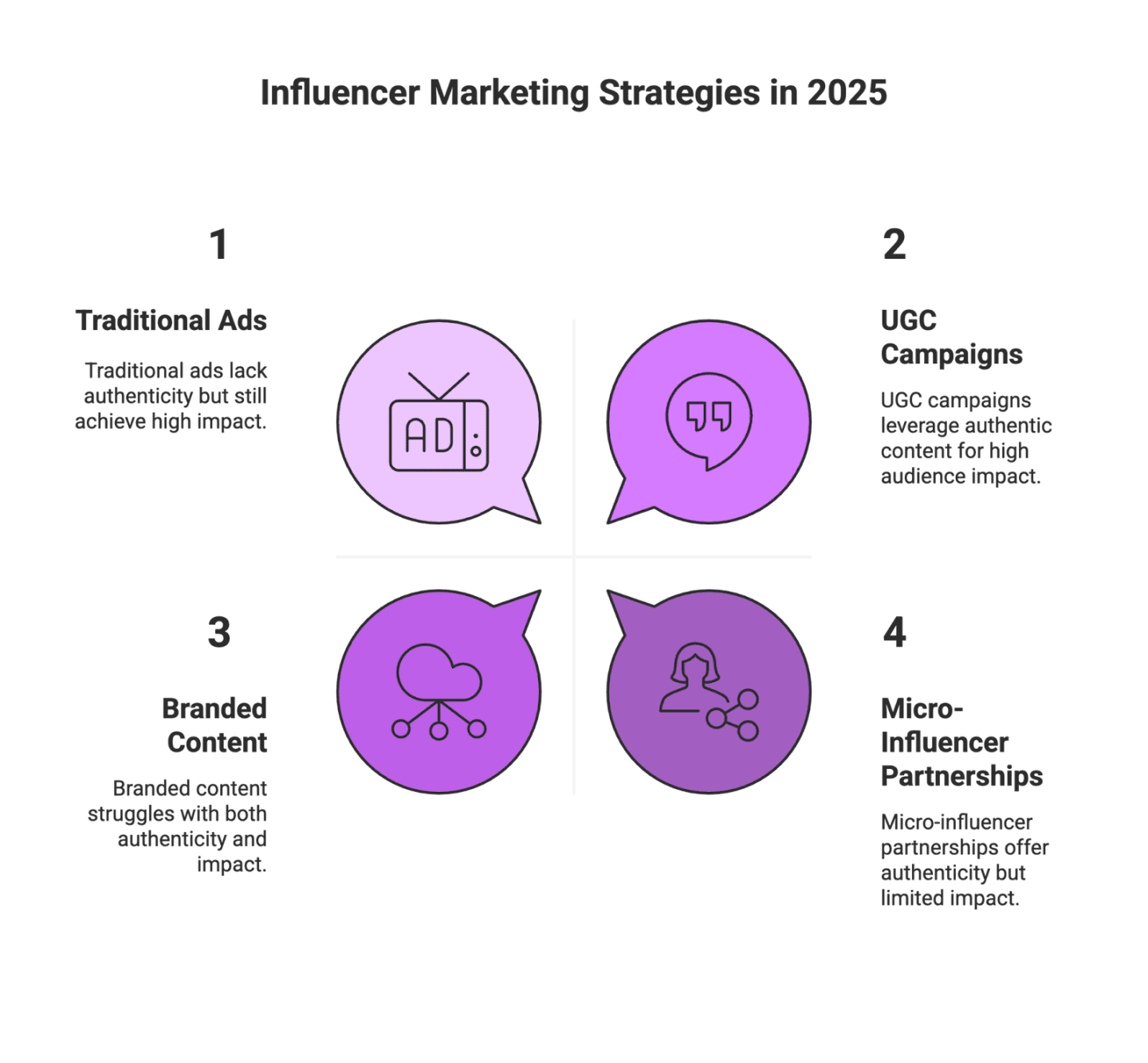
In 2026, successful influencer marketing isn’t about glossy, perfectly edited ads – it’s about authentic, relatable content. Both B2B and B2C audiences have grown ad-weary and skeptical of overt sponsorship. They crave real voices and unpolished, human content. This is why user-generated content (UGC) has become marketing gold. Brands are increasingly turning to everyday customers, employees, and micro-creators to generate UGC that feels genuine and trustworthy.
Surveys underscore how crucial authenticity is: 90% of consumers say authenticity is important when deciding which brands to support. And UGC is seen as the most authentic form of content, far more trusted than traditional ads. In fact, 79% of people say UGC highly impacts their purchase decisions, significantly more than branded content. Simply put, what other people post about your product carries more weight than what you post yourself.
B2B brands are taking this lesson to heart by encouraging customers and partners to share testimonials, reviews, case studies, and stories – effectively turning their community into content creators. Likewise, savvy e-commerce brands seed products with micro-influencers not just for immediate sales, but to stockpile authentic UGC (photos, videos, reviews) that can be repurposed in ads, on product pages, and across social media. This kind of content serves as powerful social proof. For example, a casual TikTok demo or an engineer’s LinkedIn post about using your B2B software can feel far more credible than a slick corporate promo.
Another big trend is blending UGC with influencer campaigns for scale. Rather than paying one influencer to create one piece of content, brands launch UGC campaigns where dozens of nano- and micro-creators produce content that performs just as well – if not better – than traditional influencer posts. This approach emphasizes content quality over follower quantity and yields a high volume of diverse assets at lower cost. Those assets can then be amplified through paid ads or used across multiple channels. As one marketing strategist explained, brands are leveraging small creators who “specialize in content tailored to convert audiences,” using engaging hooks, demos, and strong calls-to-action that drive real results.
Crucially, this wave of authentic content is ongoing, not one-and-done. A good piece of influencer-generated content can continue to attract views, comments, and shares for weeks or even months after it’s posted, essentially delivering free impressions long after the initial campaign. With UGC, brands also often get a “two-for-one” benefit: immediate promotion to the influencer’s followers, and enduring social proof that can live on your own channels. It’s a one-two punch that’s hard to beat.
To capitalize on this trend, brands in 2026 are loosening the creative reins – giving influencers and customers more freedom to speak in their own voice. The polished perfection of yesterday’s Instagram aesthetic is giving way to TikTok-style real talk. We’re seeing more smartphone-shot videos, behind-the-scenes glimpses, candid testimonials, and honest, unfiltered storytelling. Brands still provide guidance to ensure messaging is on-point, but the tone is conversational and the content feels organic. This shift not only resonates more with audiences, it also aligns with platform algorithms that reward authenticity. As one expert put it, “Gone are the days of overly polished content; audiences want creators to speak directly to the camera as if FaceTiming a friend”.
The dominance of authenticity and UGC is a trend that transcends B2B vs. B2C. Whether you’re marketing enterprise software or the latest gadget on Amazon, real voices and community-driven content are key to winning hearts (and wallets) in 2026.
As influencer marketing budgets grow, so does scrutiny on results. 2026 is seeing a major shift toward performance-driven influencer partnerships, where brands prioritize measurable ROI over vanity metrics. In the early days, influencer marketing success was often gauged by likes, views, and “buzz.” Now, especially in B2B and e-commerce, companies are increasingly asking: Did this partnership drive leads, conversions, or sales?
One big trend is the move from flat fee payments to hybrid or performance-based compensation models. Instead of paying an influencer solely a fixed sum for a post, brands are structuring deals to include commissions, affiliate links, or bonus incentives if certain targets are met. You can use a sales engagement platform to structure deals and automate commissions, affiliate links, or bonus incentives. For instance, a B2B software company might give an influencer a unique referral link and pay a percentage for every demo or sign-up that comes through it. An e-commerce brand might offer influencers a small base fee plus a tiered bonus for hitting 100, 500, 1000 units sold via their referral code. This aligns the influencer’s rewards with the brand’s business outcomes – essentially treating creators more like marketing partners than one-off ad channels.
The appeal of performance-driven partnerships is clear: they tie spending directly to results, easing marketers’ concerns about ROI. As two marketing executives observed, brands under pressure to prove ROI are transitioning to performance models so that “every dollar spent is linked to measurable results”. This doesn’t mean awareness and reach are ignored, but it means campaigns are designed with conversion in mind from the start. Influencers are being selected not just for their reach or fame, but for their ability to drive action in a target audience – whether that’s filling out a lead form, downloading an e-book, or clicking “Buy Now.”
To support this shift, there’s a rise in affiliate-influencer hybrid strategies. Brands are increasingly equipping influencers with affiliate tracking tech so they can monitor sales, and some are even merging their affiliate marketing and influencer marketing teams. This convergence creates a full-funnel approach: influencers create the engaging content up top, and the affiliate links ensure trackable, lower-funnel performance like a traditional digital ad campaign. Case studies show this combo can be potent. For example, a DTC mattress brand named Resident used creators to generate lots of UGC content and tied it to their affiliate program; the result was doubling the value of each social post and significant sales growth. When influencers essentially become commission-based sales partners, it aligns everyone’s incentives toward efficiency.
Of course, measuring what matters requires the right tools. In 2026, brands are investing in more sophisticated influencer analytics and tracking platforms. These tools use unique URLs, coupon codes, or even pixel tracking to attribute traffic and sales to specific influencers. Marketers are looking beyond surface metrics to track things like conversion rate per influencer, cost per acquisition, and customer lifetime value from influencer-referred leads. By optimizing for downstream metrics, companies can identify which creators truly drive ROI and double down on those relationships (while cutting spend on underperformers).
The performance mindset is ultimately making influencer marketing more accountable and budget-friendly. Especially in B2B, where sales cycles are longer and deal values higher, this rigorous approach helps justify growing influencer budgets to the C-suite. Expect to see more influencer engagements framed as “partnerships” with shared goals, KPIs, and performance dashboards – a trend that professionalizes the space and makes influencer marketing feel as ROI-driven as PPC or email marketing.
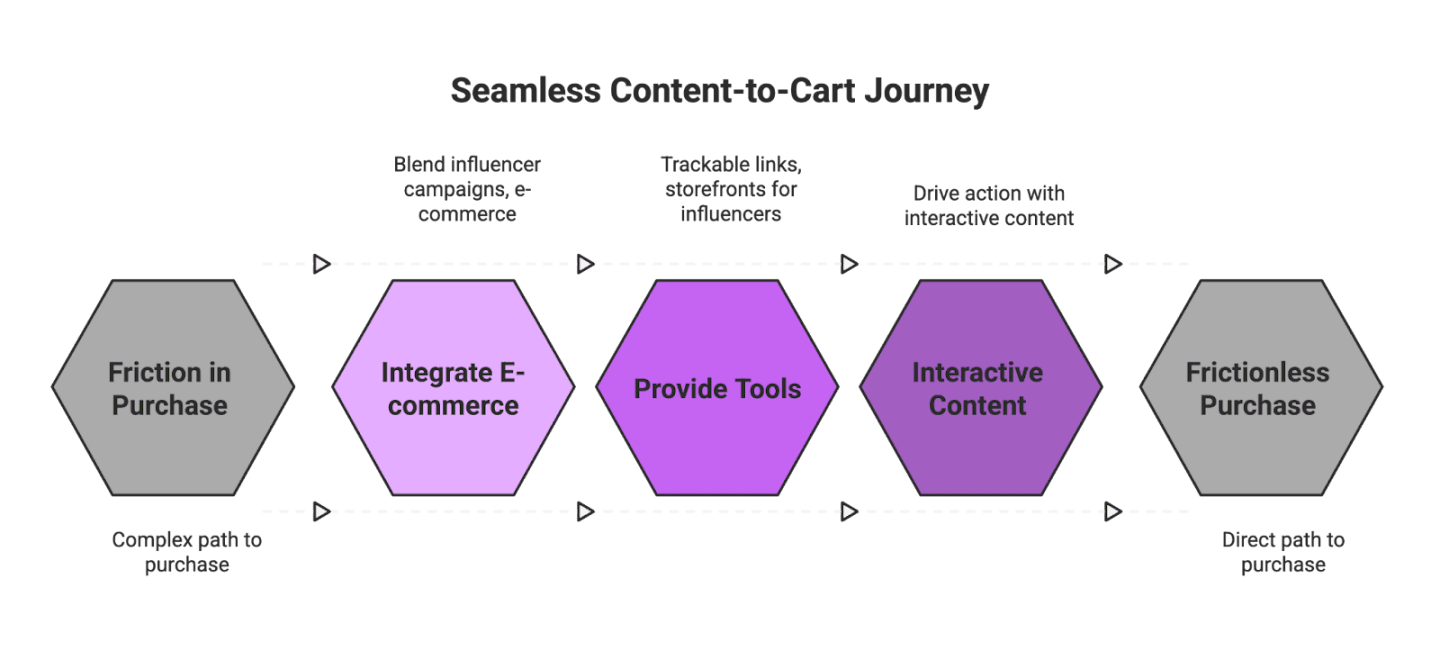
As the lines between social media and e-commerce blur, influencer marketing in 2026 is increasingly tied to social commerce. This trend is all about making content instantly shoppable – turning influencer-driven inspiration into a frictionless path to purchase. For B2B companies, that could mean driving a prospect from a LinkedIn post to a demo signup; for consumer brands and Amazon sellers, it often means driving viewers from a TikTok or Instagram post directly to a product page to buy. Influencers are effectively becoming a direct sales channel for brands, not just a source of awareness.
On the consumer side, platforms have been rolling out features to support this. Instagram has product tagging in posts and Reels, TikTok launched in-app shopping and the viral #TikTokMadeMeBuyIt phenomenon, YouTube integrates merch shelves and link cards, and Pinterest is leaning into buyable pins. In China, the fusion of influencers and e-commerce (think live shopping) is already massive, and that wave is hitting Western markets now. In 2026 we’ll see more live stream shopping events hosted by influencers, more affiliate storefronts, and generally more ways to purchase seamlessly from influencer content. In fact, many creators are now curating their own branded storefronts on platforms like Amazon to showcase products they recommend. Amazon’s Influencer Program, for example, lets creators set up a custom page of their favorite products and earn commissions on sales – effectively turning them into micro shopkeepers. When an influencer shares a link to their Amazon storefront and says “shop my faves,” their followers can check out in one click on Amazon, merging content and commerce effortlessly. This kind of content-to-cart journey is incredibly powerful. It not only drives immediate sales, but for Amazon sellers it also boosts product rankings due to the surge in external traffic and conversions. It’s a win-win for the influencer (who earns commission) and the seller (who gains sales and visibility).
Even in B2B, the concept of shoppable content is emerging in a different way – think interactive content that drives action. For instance, a LinkedIn influencer might share a post with a call-to-action button for a whitepaper download or a conference signup, reducing friction for the audience to engage with the brand’s offerings. We’re also seeing the rise of affiliate partnerships in B2B (software referral links, etc.), similar to consumer affiliate links, but for business products.
The key trend is that influencers are no longer just talking about products; they’re directly facilitating transactions. Brands are encouraging this by equipping influencers with customized links, discount codes, and storefront pages. Some are even providing training or templates to help influencers incorporate calls-to-action without feeling too “salesy.” Done right, the shopping aspect can feel like a natural extension of the content (“I’m showing you this cool product, and here’s where you can get it”).
Additionally, social platforms and e-commerce platforms are integrating: Shopify, for example, has partnerships to enable in-app purchases on TikTok and Instagram. Facebook/Meta and TikTok are investing in live commerce. And for Amazon sellers, working with influencers on Amazon Live (the QVC-like live shopping platform) is becoming a popular tactic. Influencers host live demos of products on Amazon, and viewers can buy in real-time. In 2026, expect these kinds of interactive, shoppable experiences to become more commonplace – merging entertainment, social proof, and instant buying.
For brands, the takeaway is to make it easy for an interested viewer to become a customer. That means integrating your influencer campaigns with your e-commerce strategy. Provide influencers with trackable links or storefronts, feature influencer content on your product pages (many brands now embed influencer video reviews on their site), and explore emerging formats like live shopping. By treating influencers as a genuine sales funnel, you’ll not only get the benefits of their content’s reach, but also a direct boost to your bottom line.
Influencer marketing in 2026 is a far cry from its early Instagram-centric days. For B2B marketers, Amazon sellers, and e-commerce brands alike, the landscape has evolved into a sophisticated ecosystem where micro-influencers, authentic content, and data-driven strategy rule. The overarching theme is authenticity meets accountability – campaigns need to feel genuine to resonate with savvy audiences, but they also need to drive real business outcomes. That’s why we see trends like micro-influencers and UGC (for authenticity) going hand-in-hand with performance tracking and AI optimization (for accountability and scale).
As you plan your 2026 marketing initiatives, keep these trends in mind. Consider how your brand can build relationships with niche creators who truly connect with your target customers. Brainstorm ways to encourage and utilize UGC so your marketing feels more like word-of-mouth than advertising. Infuse a performance mindset – set clear objectives and measure influencer efforts just as you would any other channel. And don’t be afraid to experiment with new platforms (hello, LinkedIn and live commerce) or technologies (AI-driven tools) to amplify your efforts.
Consumer packaged goods (CPG) brands are at a crossroads in 2026. Traditional advertising is getting pricier and less impactful, while digital shoppers scroll past polished brand ads without a second glance. Enter influencer marketing – once a novel experiment, now a powerhouse strategy driving serious ROI for everything from indie Amazon sellers to Fortune 500 food and beverage companies. In fact, influencer collaborations have shifted from “nice-to-have” to an essential ingredient in CPG marketing. Consider that global influencer marketing spend is projected to hit $32.5 billion in 2026, up from just $6.5 billion in 2019. That explosive growth underscores a simple truth: if CPG brands want to stay relevant, they need to embrace the creator economy.
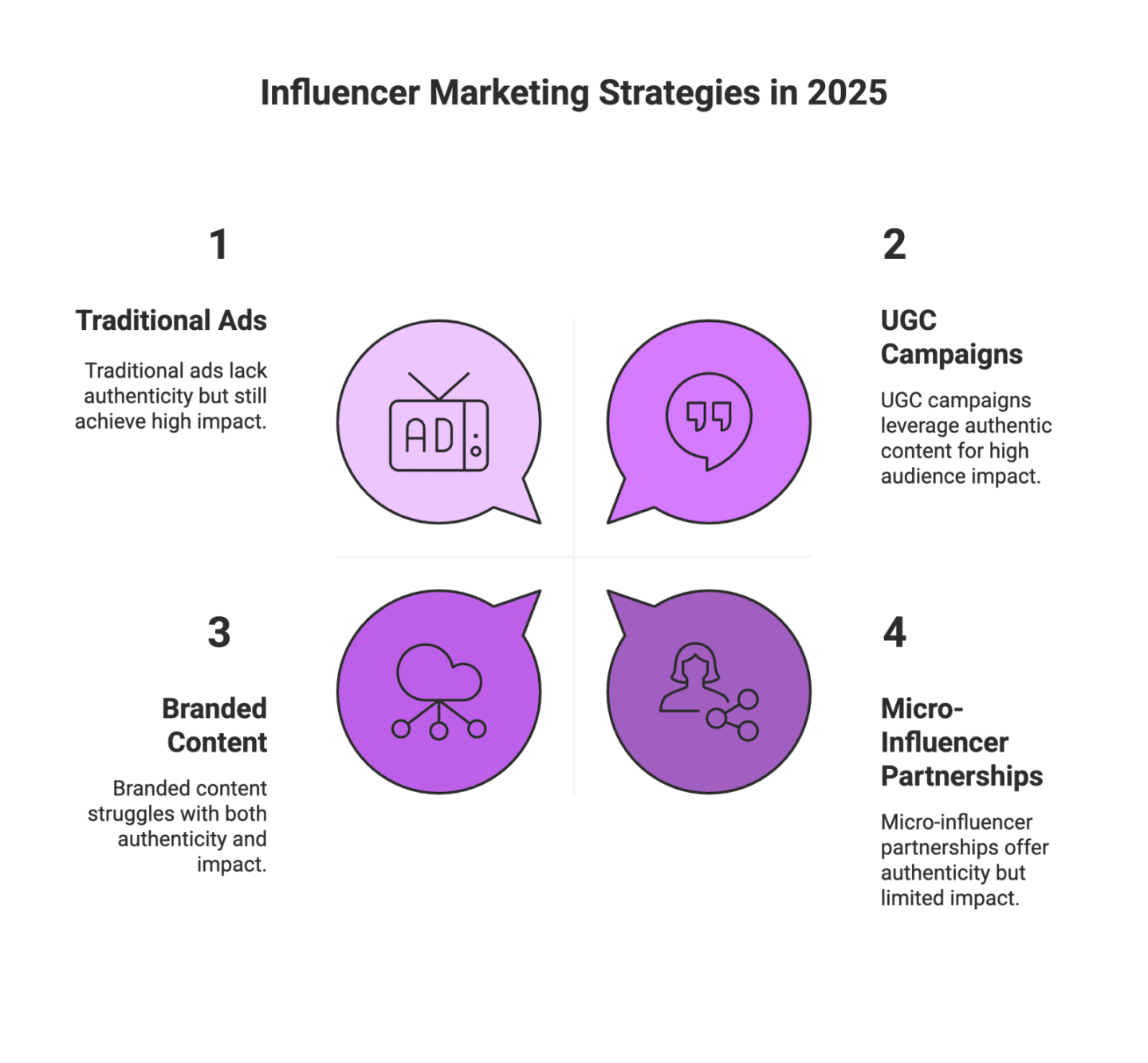
Figure: Global Influencer Marketing Industry Growth (estimated market size). The influencer marketing industry has soared from under $10 billion in 2019 to over $30 billion in 2026, reflecting how brands now view influencer campaigns as a core marketing channel rather than a fringe experiment. CPG brands are among the many jumping on this trend, as social media becomes the new “main street” for engaging shoppers.
So, why exactly do CPG brands need influencer marketing in 2026? Let’s break down the key reasons – from the unparalleled trust influencers command, to the surge in e-commerce and Amazon-focused strategies, to the treasure trove of user-generated content (UGC) they create. Along the way, we’ll see how tapping micro influencers and content creators can give CPG marketers an edge. (Spoiler: It’s not just about chasing likes – it’s about driving real product sales and brand love.)
Today’s consumers, especially Gen Z and millennials, trust influencers more than traditional ads. CPG shoppers want authenticity – real people showing real-life uses of a product – not just a glossy TV commercial. Influencers provide that relatable voice. In fact, 69% of consumers trust influencer recommendations (even if they don’t know the influencer personally) and younger generations increasingly turn to creators for product advice. CPG brands are relying on influencer marketing to boost awareness and sales because it meets the buying preferences of these digital-native shoppers. When a favorite fitness YouTuber raves about a new protein snack or a TikTok mom shows off a fun kids’ cereal, followers pay attention in a way they simply don’t with banner ads.
Influencer marketing is essentially digital word-of-mouth, and few things are more powerful in driving purchase decisions. A recommendation from a trusted creator feels like advice from a friend. As Barbara Mugica of Colgate-Palmolive put it, “Influencers can do a job no other marketing touchpoint can deliver.” That kind of credibility is gold for CPG brands fighting for shelf space (virtual or physical). Especially in an era when 34% of shoppers make online purchases at least once a week, a steady drumbeat of positive chatter from influencers can keep a brand top-of-mind. It’s no surprise a recent study found 49% of social commerce shoppers are swayed by influencer recommendations – proof that an authentic TikTok or Instagram post can directly translate into sales.
Another big reason CPG companies are doubling down on influencers: it delivers bang for the buck. Traditional ads (TV spots, glossy magazine spreads) are expensive and scattershot. Influencer campaigns, on the other hand, can be highly targeted and cost-effective – particularly when working with micro and nano influencers. These are smaller-scale content creators (anywhere from a few thousand to ~100K followers) who often focus on specific niches. They may not be celebrities, but **micro influencers and nano influencers typically have outsized engagement and conversion rates relative to their size. Because their audiences trust them as genuine peers, a recommendation from a micro influencer can spur more action than a generic ad blast to millions.
Critically, partnering with micro/nano influencers can yield a higher ROI without breaking the bank. Many of these creators are affordable – sometimes they’ll promote a product for just a free sample or a modest fee – yet they drive real results. Surveys show over 70% of brands are now working with smaller creators and reporting strong outcomes. It makes sense: brands get $4+ in earned media value for every $1 spent on influencer marketing on average, and that number can be even higher with a savvy micro-influencer strategy (since smaller creators often charge less but engage more). In 2026, 73% of companies prefer to work with micro and mid-tier influencers for their superior engagement-to-cost ratio. Simply put, it’s a marketer’s dream: spend less, get more.

Figure: Smaller influencers (nano- and micro-influencers) tend to have higher average engagement rates on social media compared to macro- and mega-influencers. For example, a nano influencer with under 10k followers might see ~2–3% of their followers engage with a post, roughly double the engagement rate of a typical macro influencer with hundreds of thousands of followers.
These higher engagement rates mean that when a micro influencer posts about a new snack or skincare item, a larger share of their tight-knit community actually likes, comments, and clicks. And higher engagement often leads to higher conversion – if 2–3% of a nano influencer’s audience is motivated enough to interact, that’s a lot of potential buyers relative to a mega-star influencer whose audience might scroll past. No wonder brands report that nano influencers can even yield higher aggregate ROI when you crunch the numbers, thanks to their low costs and loyal followings. One data point: recent campaigns found nano-influencer promotions delivered a cost-per-click ~42% lower than micro-influencer campaigns – meaning cheaper traffic and more eyeballs for the same spend. The only catch? Managing dozens of small influencers can be labor-intensive (we’ll get to solutions for that later). But in terms of ROI, the math is compelling for CPG marketers.
In 2026, content is king – especially authentic, user-generated content (UGC) that brands can repurpose across their marketing. Influencer campaigns conveniently double as continuous content engines. Each creator delivers photos, videos, unboxings, tutorials, you name it, featuring your product in real-life use. For CPG brands hungry for social media posts, product demo videos, and customer testimonials, this is a windfall. Instead of staging expensive photoshoots, you can quickly amass a library of influencer-generated content to fuel your Instagram, TikTok, YouTube, and even Amazon product listings.
This matters because UGC is incredibly effective at driving conversions. People want to see real customer experiences – it’s social proof. According to a Bazaarvoice report, 84% of consumers trust a brand’s marketing more if it features UGC. And when UGC is included along the online purchase path, conversions can increase by about 10% on average. Even paid ads perform better with UGC: ads featuring real user content get 4x higher click-through rates and a 50% lower cost-per-click compared to traditional ads. That’s huge for CPG brands operating on slim margins – your ad dollars simply work harder when the creative is a genuine customer-style post rather than a polished studio shot.
Influencers essentially act as both brand ambassadors and content creators. Let’s say you send free samples of a new protein bar to 50 micro influencers on Instagram. In return, you might get 50 unique pieces of content: reviews, recipe videos, lifestyle pics of people enjoying the bars on a hike, etc. Now you have a trove of material to share on your own channels or even use in e-commerce. Many brands will take the best influencer photos and add them to their product pages or Amazon listings as a form of visual review. This not only looks great but builds trust with shoppers browsing online. In a real-world example, one Amazon-focused brand’s nano-influencer campaign yielded 50+ posts and a wave of new product ratings and Q&A on their Amazon listing, all from a one-time product seeding effort. The brand ended up with “a trove of user-generated content and authentic testimonials to leverage in future marketing”. For a CPG marketer, that’s hitting the jackpot – you’ve turned a marketing campaign into long-lasting digital assets.
Speaking of Amazon – influencer marketing has become a secret weapon for Amazon sellers and D2C e-commerce brands. CPG products (think supplements, snacks, beauty creams, home cleaners, etc.) are hugely popular on marketplaces like Amazon. But competition is fierce, and getting your product discovered and well-reviewed is a major hurdle. Influencers can help crack that code. By driving their followers to your Amazon product page via referral links or promo codes, an influencer can boost your sales rank and visibility within Amazon’s algorithm, creating a virtuous cycle of more sales and reviews. Unlike traditional Amazon PPC ads (which have been getting costly), influencer traffic often comes at a lower CPC and with the bonus of built-in endorsement. Brands have found that an army of micro influencers talking up a product can lead to a steady flow of highly qualified buyers clicking “Add to Cart” – many of whom also leave positive reviews after purchase, further strengthening your product’s standing.
Influencers also shine in the realm of social commerce, which exploded recently with features like Instagram Shopping and TikTok Shop. Platforms now let users buy products directly through in-app links during an influencer’s post or livestream. CPG brands are leaning into this: one reason in-app purchases have skyrocketed on TikTok Shop is that it pairs perfectly with influencer content. For example, a beauty influencer’s livestream demoing a new face cream can feature a one-click purchase pop-up – blending content and commerce seamlessly. If your CPG brand isn’t leveraging creators in these social shopping environments, you risk missing out on a fast-growing sales channel.
And let’s not forget emerging programs like the Amazon Influencer Program, where influencers curate their own Amazon storefronts and livestreams featuring products they recommend. It’s yet another avenue where CPG brands can gain exposure through creator partnerships, effectively tapping into the influencer’s following as a pre-warmed audience. The bottom line is that in 2026, social media and e-commerce have merged – shoppers see a product on their feed and expect to buy it in a few clicks. Influencers are the linchpin driving that discovery-to-purchase journey. CPG brands need them to ensure their product is the one trending on TikTok or featured in that YouTuber’s “favorites” video, instead of gathering dust in a warehouse.
Finally, let’s zoom out: why do CPG brands need influencer marketing, rather than just “could benefit from” it? Because in 2026, if you’re not visible on social media feeds, you practically don’t exist to a huge segment of consumers. Brands that stick solely to old-school marketing are losing ground to more agile, culturally tuned-in competitors who show up in the influencer space. Being part of the social conversation via creators keeps a CPG brand relevant and top-of-mind. Whether it’s a viral TikTok challenge featuring your product (remember the 2021 Ocean Spray juice skateboarder meme?) or a slew of Instagram reels showing recipes with your new sauce – those social moments drive real-world sales spikes and brand heat.
Influencer marketing also allows CPG brands to tap into micro-trends and niche communities in a way mass advertising can’t. For example, a gluten-free snack company can partner with dozens of gluten-free lifestyle micro influencers, instantly plugging into a passionate community of consumers. Or a local craft beverage brand can work with regional foodie influencers to build hype in specific cities. This kind of targeted cultural connection is incredibly hard to achieve with traditional media buys. In short, influencers give CPG marketers agility and specificity – you can be hyper-relevant to each audience segment by choosing creators that genuinely get that group.
It’s also worth noting that influencer content often sparks two-way engagement (comments, shares, duets) that deepens brand loyalty. It’s not just broadcasting a message, it’s starting a conversation. For CPG brands aiming to build communities around their products (think fandoms for certain snacks or cult followings for beauty items), influencers are the community leaders who rally the fans. By 2026, many leading CPG companies see creators as extensions of their marketing team – the on-the-ground storytellers who make the brand feel human and approachable.
By now, the “why” of CPG influencer marketing should be clear. The next question is “how” – especially for brands that might not have a dedicated influencer manager or the budget to hire an agency. The good news is that with influencer marketing booming, a whole ecosystem of tools and platforms has emerged to connect brands with creators and streamline campaigns. In fact, over 60% of brands use third-party platforms or tools to assist with influencer marketing. These range from marketplaces where you can browse and contact influencers, to full-service platforms that handle everything from outreach to payments.
For example, Stack Influence is a platform specifically geared toward scalable micro- and nano-influencer campaigns. Stack Influence “automates product seeding campaigns” and manages the end-to-end process of working with a large number of small creators. You provide your product and goals, and the platform finds suitable influencers (often on Instagram or TikTok), invites them, ships out products, tracks their posts, and compiles the results. Tools like this help manage the recruitment, tracking deliverables, and results in one dashboard, so a lean marketing team can coordinate dozens – even hundreds – of influencer collaborations with minimal headache. As noted earlier, services like Stack Influence exist “precisely so that small brands can scale up campaigns without scaling up headcount.” In other words, even a one-person CPG marketing team can run an influencer program that rivals big brands, by leveraging the right tech and process.
Of course, brands can also take a more DIY approach: start small, work with a handful of local influencers, and build relationships organically. The key is to set clear objectives and track results – whether that’s using unique coupon codes, Amazon Associates links, or simply monitoring for sales lifts during the campaign period. Thanks to modern analytics, it’s easier than ever to see the impact (e.g. use Google Analytics UTM links for D2C site traffic, or Amazon’s attribution for external traffic). Most brands find that once they execute a couple of influencer activations and see the needle move – be it a spike in sales, a jump in web traffic, or a flood of positive reviews – they quickly ramp up budget for this channel. In fact, 80% of brands maintained or increased their influencer marketing budgets in 2026, with nearly half increasing spend by over 10%. The investment flows to where the returns are.
Influencer marketing isn’t just a trend for CPG brands – it’s a paradigm shift in how consumers discover and decide on products. In 2026, micro influencers, content creators, and everyday customers wield more power over brand fortunes than million-dollar ad campaigns. They bring authenticity, trusted recommendations, and creative content that today’s shoppers crave. From bolstering your Amazon sales rank, to filling your social feeds with engaging UGC, to making your brand a part of cultural conversations, influencers truly tick all the boxes. And with so many tools and platforms (like Stack Influence and others) available to simplify campaign management, even resource-strapped brands can jump in and reap the benefits.
The CPG landscape is ultra-competitive, but partnering with influencers – big or small – is like hitting the turbo boost on your marketing. It’s word-of-mouth on steroids, it’s content creation crowdsourced, and it’s a direct line into the lifestyles of your target audience. Brands that embrace influencer marketing now are building the customer relationships and loyalty that will carry them through the next decade. Those that ignore it? They risk becoming irrelevant as consumers flock to the products they do see and hear about in their social streams.
At the end of the day, CPG brands need influencer marketing in 2026 because it delivers what traditional marketing increasingly can’t: authenticity at scale. When a foodie TikToker’s favorite hot sauce happens to be yours, or a skincare guru’s morning routine stars your face wash, that’s not just an ad – it’s a genuine endorsement money can’t buy (even though yes, you paid for it, but the audience doesn’t mind because it feels real!). So don’t sit on the sidelines. Identify the micro influencers in your niche, equip them with your awesome product, and let them work their magic. Your future customers are out there scrolling, and an influencer might be the one to introduce them to their next favorite CPG brand – make sure it’s yours.
TikTok has exploded to over a billion active users worldwide, transforming from a fun video app into a serious marketing channel. This makes it a goldmine for affiliate marketing – a strategy where content creators (often micro-influencers) partner with brands to promote products and earn commissions on any resulting sales. In this comprehensive guide, we’ll break down what TikTok affiliate marketing is, why it’s so powerful for both e-commerce brands (like Amazon sellers) and creators, and how to get started step-by-step. We’ll also cover pro tips, common mistakes to avoid, and how authentic UGC (user-generated content) on TikTok can drive real results. Let’s dive in!
A TikTok affiliate is an individual creator or influencer who promotes a brand’s products on TikTok using special trackable links or promo codes, earning a commission for each sale generated. In practice, it works like this:
In a nutshell, TikTok affiliate marketing lets creators monetize their creativity, while brands get authentic word-of-mouth promotion. It’s a win-win: creators earn passive income for recommendations, and brands reach new customers through relatable content. Even micro-influencers (those with a few thousand followers) can be effective affiliates – their niche audiences trust their suggestions, which can drive surprisingly strong sales.
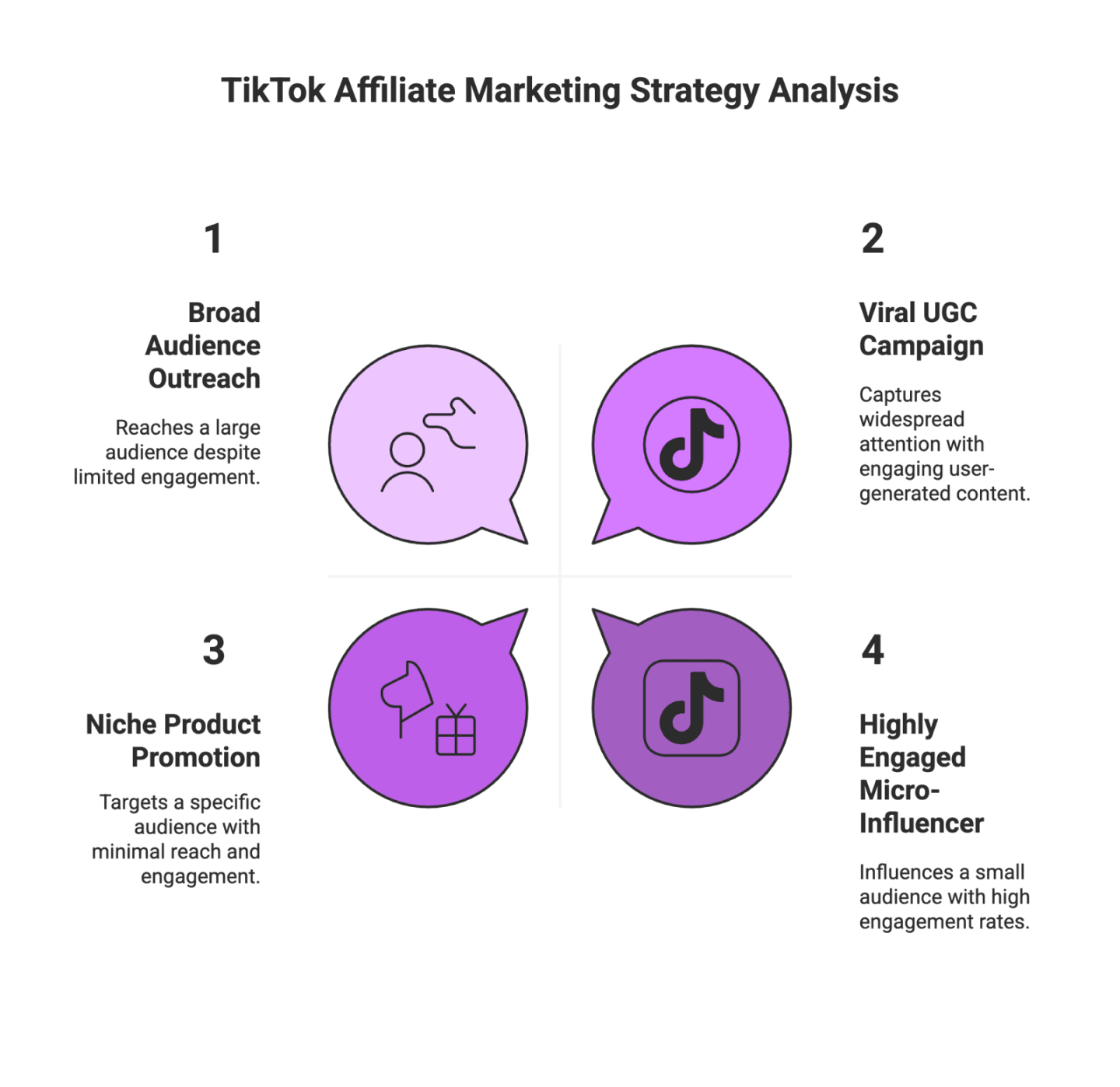
TikTok isn’t just another social network – it’s a viral content engine. Several key factors make TikTok an ideal platform for affiliate marketing in 2025:
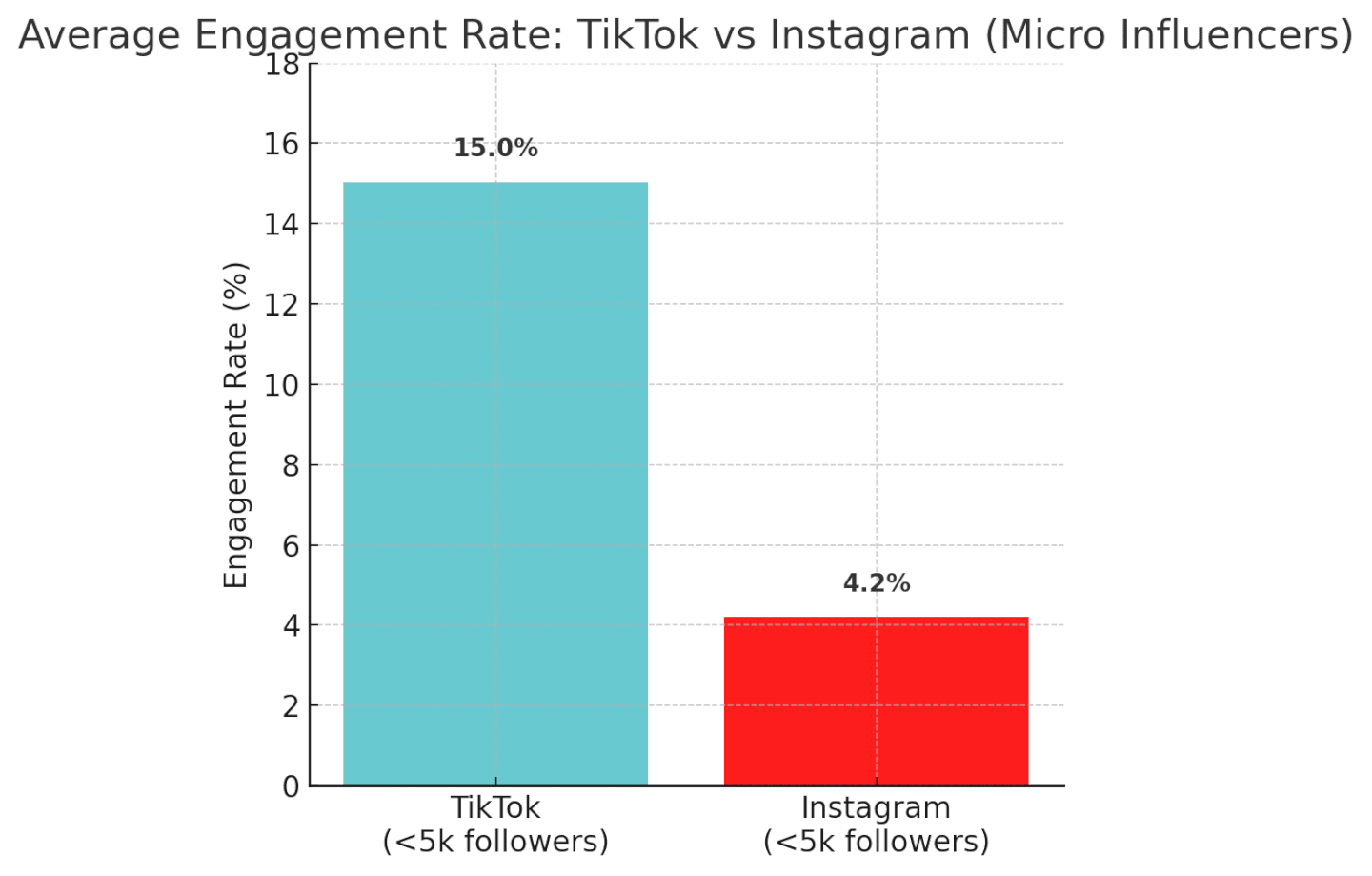
TikTok’s micro-influencers enjoy far higher engagement (around 15%) than their Instagram counterparts (~4%), meaning TikTok content often reaches and influences more people. Higher engagement = more eyes on your affiliate promos, which can translate to more sales.
In short, TikTok offers a potent mix of scale, engagement, and content creativity that affiliate marketers dream of. But before you jump in, let’s weigh some pros and cons.
Why should creators and brands consider TikTok for affiliate marketing? Here are some advantages and a few challenges to keep in mind:
Despite the challenges, the rewards can be huge if you crack the TikTok code. Next, we’ll get into exactly how you can become a TikTok affiliate and build a successful strategy from scratch.
Ready to start earning with TikTok affiliate marketing? Whether you’re a budding creator or a brand planning to leverage creators, follow these steps to set yourself up for success:
Successful affiliate marketing starts with a clear niche. With TikTok’s massive user base, you’ll do better by targeting a specific category or interest area that you’re familiar with. Ask yourself: What topics am I passionate or knowledgeable about? What kind of products would my content naturally feature?If you already create TikTok content, analyze your profile – what themes get the most engagement? Align your affiliate promotions to those themes. For example, a fitness enthusiast on TikTok could focus on gym gear, supplements, or wellness products. A tech reviewer might stick to gadgets or gaming accessories. Picking a niche helps you build a consistent audience who trusts your expertise in that area, which in turn boosts conversion rates for related products.Also consider your audience’s demographics and interests. TikTok skews younger, but has plenty of older users too. Tailor your product choices and content style to what resonates with your viewers. A deep understanding of your audience’s pain points and desires will let you select affiliate products that truly solve problems or bring joy to them – making a sale much more likely.Pro Tip: If you’re starting from zero followers, spend some time growing your presence before pushing products. Post purely entertaining or valuable content in your niche to build up an audience. Only once you have engagement, sprinkle in affiliate promotions. TikTok users can sniff out an account that’s just there to sell stuff – don’t be that person. Lead with value and authenticity, then monetize gradually.
To leverage all the features for affiliates, you’ll want to use a TikTok Business Account (which is free to switch on in settings). Business accounts (or Creator accounts, for those who qualify) unlock the ability to add a link in your bio – a crucial tool for affiliate marketing. Without a clickable bio link, it’s much harder to direct TikTok viewers to a product page. So, convert your personal account to a business account early on.Next, optimize your profile to build credibility and funnel visitors to your links:
Clearly state who you are and what you do. If you’re focused on a niche, mention it. For instance: “Tech geek 🔌 | Gadget reviews & deals 🔥 | 💬 DM for collabs”. A concise bio helps users instantly get why they should follow you. You can also hint that you share product recommendations. However, avoid sounding too salesy – the goal is to come across as a relatable creator, not a storefront.
Add your affiliate landing page or Linktree here. This could be a single shopping link (maybe to your own website or a primary affiliate offer) or a link aggregator that lists multiple product links/codes. Many TikTok affiliates use services like Linktree or Shopify’s Linkpop to create a mobile-friendly page with buttons for each product they’re promoting. Make sure the link works and test it on mobile. Also, consider using URL shorteners or custom domain links for tracking clicks. Some affiliate programs (like Amazon Associates) provide tracking links you can monitor for clicks and sales.
Use a clear, friendly profile photo (or a logo if you’re a brand) and consider including your niche or persona in your display name. E.g., “Jane | Fitness Finds” or “TechDeals Tom”. This isn’t mandatory, but it can reinforce your branding.
Now for the core of it: getting your affiliate links. There are two main routes on TikTok:
Option A: TikTok’s Native Affiliate Program (TikTok Shop). TikTok Shop has an affiliate marketplace that connects creators and products inside the app. Here’s how it works in a nutshell:
To become a TikTok Shop affiliate, you typically need at least 5,000 followers (this is the threshold to join as a creator in many regions). Creators with fewer followers can sometimes join via special programs or by registering as a “seller” on TikTok Shop (even if you don’t have your own product to sell). The basic steps to get started with TikTok Shop affiliate are:
You might sign up through the TikTok app’s Creator Tools section under “TikTok Shop” (if you see it available) or via TikTok’s website. In some cases you register as a TikTok Shop seller (don’t worry, you won’t actually need to sell your own products, but this gives you access to the affiliate Product Marketplace).
Once in, you can search a catalog of products that brands have made available for affiliate promotion. It’s like an online shop where you choose what you’d like to promote. You’ll see details like commission rate offered on each product. Pick products that align with your niche and that you genuinely think your audience will like. You can often request a free sample of the product through the platform, so you can create more authentic, hands-on content.
TikTok will provide a way to tag these products in your video. When you make a TikTok video, you can add the product from the TikTok Shop inventory you selected. This creates a special link or pop-up on your video that viewers can click to see the item and purchase in-app. TikTok tracks all this automatically.
TikTok Shop will show you stats on clicks and sales your content generated. Commissions vary but can be quite attractive (some products might offer 5%, some 20%+ of the sale price, depending on the brand’s offer). TikTok handles the payout of those commissions to you (usually through a linked bank account) after a certain period.
The beauty of the TikTok Shop affiliate route is the seamlessness – viewers can go from watching your video to buying within TikTok, which hugely reduces drop-off. It’s great for impulse buys. If you qualify for this program, absolutely take advantage of it, as it’s built for TikTok’s ecosystem.
Option B: External Affiliate Programs and Networks. Not every creator has access to TikTok Shop, and not every product is listed there. Many TikTok affiliates use traditional affiliate programs and just leverage TikTok as their traffic source. Some popular choices:
When choosing an affiliate program, prioritize relevance and legitimacy. Only promote products you genuinely like or that fit your persona. Also, ensure the programs are reputable (they track sales accurately and pay on time). It’s fine to mix and match – you might use TikTok Shop for some products, and external links for others that aren’t available in TikTok. Just keep track of all your links!
Now the fun part: making TikToks that showcase your chosen products. To succeed here, remember that TikTok is an entertainment platform first. Your videos need to grab attention, provide value or enjoyment, and then slip in the product promotion naturally. Here are some content tips for affiliate TikToks:
The first 2-3 seconds of your video determine whether someone scrolls past or not. Start with an intriguing question, a bold statement, or an eye-catching scene. For example: “I tried the viral blender bottle so you don’t have to – here’s what happened” or a quick demo of the product in action right as the video starts. This helps pique curiosity.
Rather than a dry “review,” frame your product feature as a mini story or a solution. E.g., “I always struggled with back pain until I found this gadget...” and then show the product (like a posture corrector) and how it helped. Storytelling keeps people engaged and emotionally invested, which can drive them to check out the item.
If possible, demonstrate the product. If it’s makeup, show a before/after or a quick tutorial. If it’s a kitchen gadget, film yourself actually using it to make a recipe. Visual proof speaks louder than words. Also, try to highlight benefits more than features – show outcomes (e.g., a tidy desk after using a cable organizer you promote, or a tasty meal from an air fryer).
Share your genuine thoughts or reactions. If something surprised you about the product, let that show. TikTok viewers respond well to authenticity – even if it’s a sponsored/affiliate post, they appreciate honesty. If there are minor downsides to the product, you can mention one (“Wish I discovered this pan sooner, the only thing I’d change is the handle gets a bit hot, but overall it’s awesome”). Counterintuitive as it sounds, admitting a small flaw builds trust that you’re not just saying “It’s perfect!!!” to get sales. Obviously, only promote things you do like overall.
Toward the end of the video or in the caption, prompt viewers on what to do next: “Check my bio for the link” or “Use my code JANE20 for 20% off – it’s in the comments!” On TikTok, people often respond well to a subtle CTA. You can say in the video, “I’ll put the link in my bio if you want to snag one.” Don’t sound too desperate; make it casual. In your caption, you might write something like “Link in bio 🔗 if you’re curious! #amazonfinds”. TikTok also recently enabled a sticker you can add to videos for “Link in Bio” to nudge viewers.
Remember, the goal is to blend the product into content that’s enjoyable in its own right. If your TikTok video can stand on its own (even if someone isn’t interested in buying), you’re doing it right. That way it can get shares, likes, and broad reach – some of those viewers will be interested in the product and convert.
Finally, consistency is key. Plan a content schedule that you can stick to – whether that’s posting 3 times a week or daily. The more quality content you put out, the greater your chances of hitting a viral success that brings in affiliate revenue.

To grow as an affiliate, you want to constantly expand your viewership. TikTok provides built-in tools to help you reach more people – make sure to use them:
Use relevant hashtags on your posts, especially ones that are trending or niche-specific to your product. For example, if you’re promoting a DIY gadget, you might use #DIY, #LifeHacks, or a current trending tag like #AmazonFinds if it fits. Don’t go overboard – 3-5 well-chosen hashtags are better than 20 random ones. The algorithm will categorize your content based on those tags and show it to interested users.
These are unique TikTok features where you can respond to or build on someone else’s video. You might stitch a video of someone complaining about a problem and then showcase your affiliate product as the solution. Or duet a video of someone using a product (if it’s a general video) and add your commentary. This not only leverages existing popular content but can get that content’s viewers to see your take.
Once you have enough followers (typically 1,000), you can do TikTok LIVE videos. Live streaming is powerful for selling – you could host a live Q&A about products you recommend, do real-time demos, or unbox new goodies. TikTok even allows adding product links in live streams if you’re in the affiliate program. Lives send notifications to followers and can appear on the For You page, helping you gain new followers too. If you have a big promotion or sale (like an affiliate product that’s discounted for a day), doing a quick live stream to hype it up can drive immediate sales. And viewers can ask questions, which you can answer on the spot – great for building trust and convincing fence-sitters.Staying current with TikTok trends ensures you’re never stale. What worked last month might not work next if TikTok’s fads move on. So, spend a bit of time regularly just consuming TikTok content in your niche – see what songs, jokes, or editing styles are trending, and adapt your strategy accordingly. It keeps your content fresh and algorithm-friendly.
Creating awesome content is half the battle – you also need to convert viewers into clickers and buyers. TikTok’s not as link-friendly as some platforms, but there are ways to drive traffic effectively:
We’ve mentioned it several times because it’s vital. Always assume many viewers don’t know how to find your link, so occasionally remind or show them. Some creators even include a quick screen recording in their video showing “Tap my profile and then the link” with an arrow – but this can be overkill in every video. Instead, you might say in the caption “➡️ Product link in my bio” or as a text overlay “(link in bio)” when you mention the product. Make it as easy as possible for an interested viewer to go from video to checkout.
A smart trick is to post your own video and immediately leave a comment from your account with the call-to-action, then pin that comment. For example: “Get yours here 👉 (use code JANE20 for 20% off)”. While TikTok doesn’t allow clickable links in comments either, you can write a simplified URL or instruct them to copy-paste (not ideal, but sometimes necessary). Or just say “Link in bio” in the comment too. Pinning this comment will keep it at the top where everyone can see it without digging.
If you’re more on the brand side or you have a budget, you can consider boosting your best content with TikTok’s paid ads (like Spark Ads, which promote your organic post). TikTok’s ad platform allows precise targeting, but it can be pricey for small creators (often minimum budgets of $50–$100+ per day). Generally, individual affiliates might not buy ads for their videos, because it eats into your commission profits. However, sometimes brands will run your post as an ad (with your permission), which can greatly amplify reach – and if you have an affiliate deal, you’ll still earn commissions on those broader sales. This tends to happen if you’re working closely with a brand (more like a hybrid influencer-affiliate partner). For starting out, focus on organic tactics, as TikTok offers so much free reach if you nail the content.
At the end of the day, never assume people will seek out your link without prompting. Always include a clear path for the viewer: they’ve watched your cool video – now what? Tell them! Something as simple as a persuasive “Trust me, you’ll want to try this. ” can significantly bump up your click-through rate.
Affiliate marketing is an ongoing game of optimization. As you start putting out content and sharing links, be sure to track how everything is doing. Most affiliate programs provide analytics – clicks, conversion rates, sales, etc. TikTok’s own analytics (available on Business accounts) will show you video views, watch time, and engagement. Use these data points to double-down on what works:
Look at which of your TikTok videos got the most views or engagement. Is there a pattern? Maybe your audience loves unboxing videos more than comedic skits, or vice versa. The content that works and aligns with product pushes – do more of that. Similarly, if certain videos got tons of comments like “where can I buy this?”, that’s a sign you hit a need. Consider making follow-ups or similar product features.
It’s possible a video gets 1000 clicks on your link but only 5 sales. Or another gets 100 clicks but 20 sales. Conversion rate matters. Try to figure out why one converted better – was the targeting more on-point? Was the product more impulse-friendly? Use link shorteners or separate tracking IDs for each platform if you want to get granular (e.g., one Amazon Associates ID for TikTok bio, another for your YouTube link, etc., to see which platform drives more sales).
If you’ve done a few promos, assess which products actually sold. You might find that, say, you pushed a $5 trinket and got many sales, but the commission was tiny – whereas a $50 item with fewer buyers made you more money. It could be more lucrative to promote higher-priced items that your audience is willing to buy. Or maybe a certain category (beauty products, for example) just doesn’t resonate as much as you thought, but tech gadgets do – then shift focus. Listen to audience feedback too: read the comments and DMs. If people ask “Do you have a recommendation for X type of product?”, that might be your cue for the next affiliate post.
Continuous improvement is the name of the game. The TikTok landscape can change quickly – new features roll out, trends shift, audience preferences evolve. By keeping an eye on your performance metrics, you can adapt your strategy and stay ahead of the curve. The great thing is you’ll get better at predicting what works over time, turning affiliate marketing on TikTok into a more steady (and potentially significant) income stream.
Even with the best strategy, there are pitfalls that can undermine your efforts. Learn from others’ mistakes and steer clear of these missteps:
One of the quickest ways to lose follower trust (and interest) is by pushing products that have nothing to do with your usual content or your audience’s needs. If you run a vegan cooking TikTok and suddenly promote a random tech gadget just because it has a high commission, people will see right through it. Stay in your lane and only recommend products that truly fit your niche and audience. Consistency builds a reputation as a curator rather than a salesperson.
TikTok users hate feeling like they’re watching an ad. If your content comes off as a blatant sales pitch or you’re overly polished and scripted, it will flop. Avoid infomercial-style language (“But wait, there’s more!”) or anything that feels spammy. Instead, focus on honest, personal takes. Share genuine enthusiasm or criticism. Authenticity is your superpower – don’t trade it for a quick buck. Also, never promote a product you don’t believe in; if people buy something on your recommendation and it’s junk, that backlash will hurt your credibility long-term.
Posting as if TikTok were Facebook or a blog – e.g., using static images, long boring monologues, or ignoring current trends – will limit your reach. TikTok has a unique culture, and you need to speak that language. Use music, use effects, follow trends (when appropriate). Failing to adapt content to the platform is a common newbie mistake. It can make your videos invisible on the algorithm-driven For You page.
TikTok can be unpredictable. You might post 10 videos and none of them gain traction – it’s easy to get discouraged. But often it’s the 11th video that suddenly goes viral. Many successful TikTokers went through a slow start. The key is to keep experimenting and improving. Don’t quit because you didn’t make affiliate millions in your first month. Evaluate what might be going wrong (content quality? product fit? posting times?) and adjust. Persistence is vital; each video is a new lottery ticket in the virality lottery (with skill improving your odds).
By being mindful of these common pitfalls, you can save yourself a lot of headache and keep your affiliate journey on the right track.
TikTok affiliate marketing offers an exciting opportunity for micro-influencers, content creators, and brands alike to ride the wave of social commerce. With its enormous user base, engaging format, and evolving shopping features, TikTok blurs the line between entertainment and e-commerce like never before. By mastering the art of authentic content and smart promotion, even a small creator can generate significant income, and even a small business can generate big sales.
To recap, start by choosing the right niche and products, leverage TikTok’s unique tools (trends, hashtags, TikTok Shop), and always prioritize genuine engagement with your audience. It’s this authenticity and creativity that turns casual viewers into loyal followers – and loyal followers into paying customers of the products you recommend.
Both creators and brands should view TikTok affiliate partnerships as a way to build real connections with the community. For creators, it’s about sharing cool finds and making recommendations that genuinely help or delight your followers (with the bonus of earning on the side). For brands (including many Amazon sellers out there), it’s about empowering passionate fans to spread the word, effectively letting your customers and micro-influencers do the marketing via relatable UGC content.
In the fast-moving world of TikTok, keep experimenting, stay updated on trends, and most importantly, have fun with it! Some of the best affiliate success stories come from creators who started with a hobby or a passion for making videos – the monetization followed naturally. If you maintain that mindset of delivering value and enjoyment first, the commissions will follow.
Now that you’re armed with this knowledge, it’s time to take action. Brainstorm some product ideas that you love, fire up the TikTok app, and start creating. Who knows – your next TikTok might just go viral and kickstart your journey as a successful TikTok affiliate.
Happy TikToking and happy earning! 🚀
Micro-influencer marketing can be a game-changer for e-commerce businesses and Amazon sellers, offering authentic content and niche audience reach. However, diving into influencer campaigns without a solid plan can lead to wasted budget and disappointment. In fact, research in 2025 found 53% of influencer campaigns fail to meet their goals due to common pitfalls. To help your online store avoid these missteps, we’ve compiled five key micro-influencer marketing mistakes that brands should steer clear of – and how to do it right. From selecting the perfect content creators to leveraging user-generated content (UGC) effectively, keep these tips in mind to make the most of your micro-influencer partnerships.
One of the biggest rookie mistakes in influencer marketing is launching a campaign without clear goals or KPIs. If you don’t define what success looks like – whether it’s increasing brand awareness, driving traffic, or boosting product sales – you’ll have no way to measure performance. Going in without specific objectives is like spending money with no roadmap. Not only does this make it impossible to gauge ROI, it also leaves influencers guessing what you expect. They can’t hit a target if you haven’t set one.
Why this is a problem: Without clear goals, you might end up focusing on vanity metrics (like a temporary spike in likes or follows) rather than metrics that matter to your business (like conversions or revenue). Many brands are now realizing the importance of setting defined targets for campaigns – 63% of businesses include ROI-focused targets in influencer contracts as of 2025. If you skip this step, you risk falling behind more strategic competitors.
How to avoid it: Define specific, measurable goals for each micro-influencer campaign. For example, decide whether your aim is to increase website traffic by 20%, generate 200 new email leads, or boost Amazon product sales by 15% during the campaign. Identify the key performance indicators (KPIs) that align with that goal (e.g. referral traffic, conversion rate, engagement rate, promo code redemptions) and track them closely. Setting SMART goals (Specific, Measurable, Achievable, Relevant, Time-bound) provides a clear success benchmark. This way, if you’re an Amazon seller sending out freebies to influencers, you’ll know if those mentions led to more product page views or reviews. The bottom line: a clear goal turns your campaign from a shot in the dark into a focused marketing strategy.
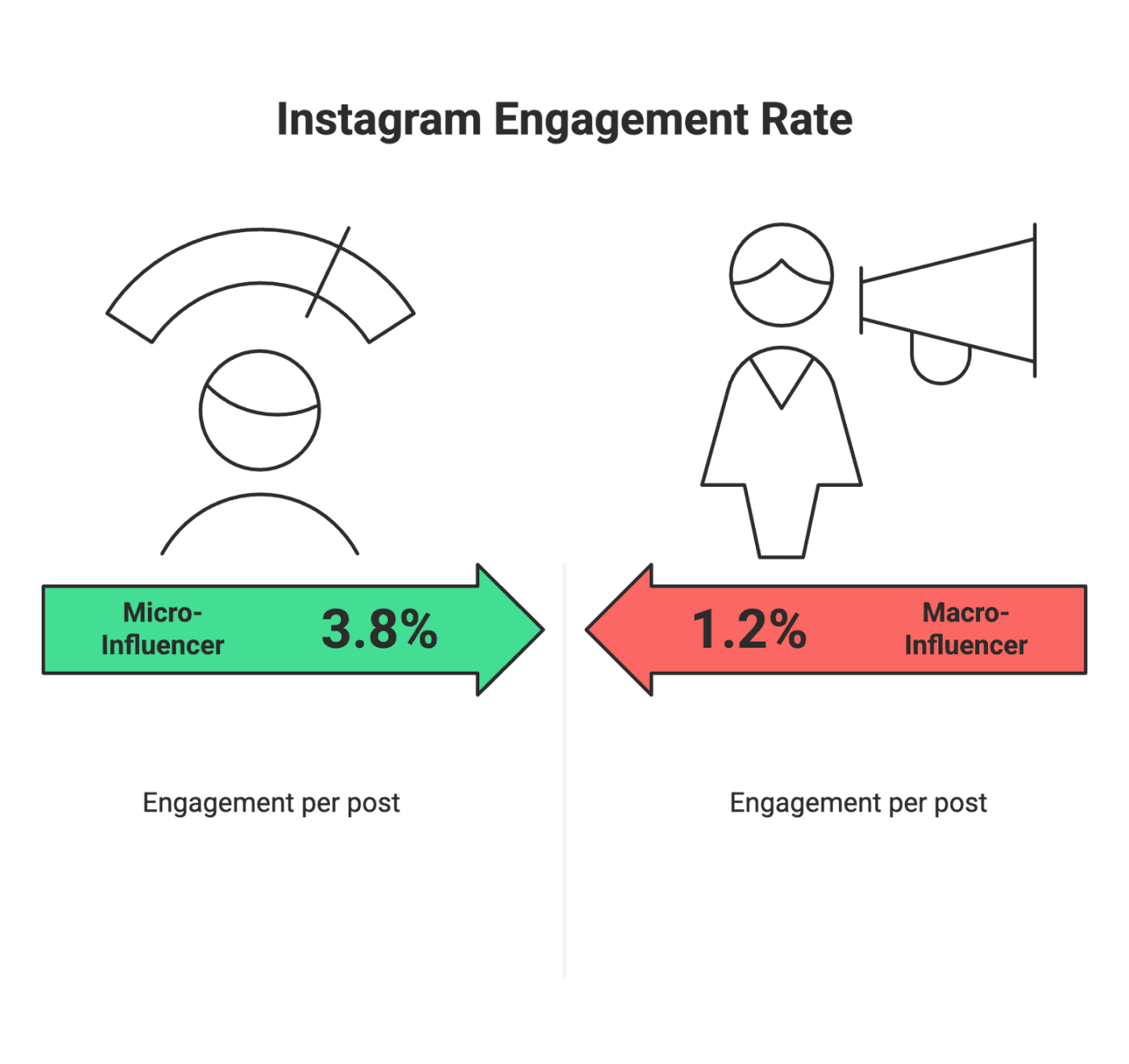
When scouting for influencers, it’s easy to be seduced by big follower numbers. Many e-commerce brands make the mistake of equating follower count with influence. Partnering with an Instagram creator just because they have 100k+ followers may seem like a ticket to quick reach – but chasing vanity metrics can backfire. A large following doesn’t guarantee engagement or sales. In reality, an influencer with 500,000 followers might have a very low engagement rate or an audience that isn’t relevant to your niche. For instance, a beauty brand won’t benefit from an influencer whose massive following is mostly interested in gaming or politics.
Why this is a problem: Focusing on quantity over quality can burn your marketing budget on the wrong audience. It’s well documented that as follower counts go up, engagement rates tend to drop. Mega influencers and celebrities often see very little interaction from their broad audience – and some accounts inflate their follower counts with bots or fake followers. What really drives conversions is trust and engagement, which smaller creators often have in abundance. A micro-influencer with 5,000 highly engaged followers in your niche can generate more interest (and actual sales) than a macro-influencer with 500k indifferent followers.
Average engagement rates on Instagram: micro-influencers (~10k–100k followers) see around 3.8% engagement per post on average, versus roughly 1.2% for macro-influencers. Smaller creators often spark more likes, comments, and shares relative to their audience size.
The chart above illustrates this disparity – a micro-influencer’s post typically gets a much higher percentage of their followers interacting than a macro-influencer’s post. In practical terms, if you partner with several micro-influencers (each with a tight-knit, loyal audience), you’re likely to get more total engagement and genuine interest than one shout-out from a single “big name” who isn’t closely connected to their followers. Moreover, micro-influencers and content creators often operate in specific niches (fashion, fitness, gadgets, etc.), meaning their followers are precisely the consumers most likely to care about your product. For an e-commerce seller, relevance beats sheer reach every time.
How to avoid it: Prioritize influencer fit and engagement over follower count. When evaluating micro-influencers, check their engagement rate (ratio of likes/comments to followers) and the quality of interactions. A good rule of thumb: an engagement rate around 2–5% is strong for micro-influencers, whereas macro influencers might only have ~1% engagement. Look at who their followers are – do they match your target customer profile in terms of demographics and interests? Also review the content itself: Is the influencer’s niche aligned with your product category? For example, if you sell organic snacks, a micro-influencer who posts about healthy living and has an audience of fitness enthusiasts is a far better fit than a random celebrity account. By doing this research, you ensure you’re choosing quality over quantity – an influencer who can actually move the needle for your brand, not just one who looks popular on paper.
Not all that glitters in influencer-land is gold. Another common mistake is taking an influencer’s stats at face value without vetting for authenticity. In the rush to collaborate, some brands don’t scrutinize whether an influencer’s following and engagement are real. This can be a costly oversight: influencer fraud (buying fake followers or using bots for engagement) is a known issue, and it can siphon off your marketing dollars with no real return. Brands lost an estimated $1.3 billion in 2019 to fake influencer fraud – roughly 15% of total spending on influencers that year. As an e-commerce business, especially if you’re giving away products or paying fees, the last thing you want is to invest in a creator who’s padding their numbers or won’t deliver genuine exposure.
Why this is a problem: Collaborating with unvetted influencers can lead to paying for “phantom” audience members. If half of an influencer’s followers are bots or inactive accounts, your sponsored post might be reaching far fewer real people than promised. Similarly, some micro-influencers join engagement pods or leave spammy comments to boost their stats artificially. Partnering with these types of accounts means your campaign results (clicks, sales, or brand lift) will likely fall flat. For Amazon marketplace sellers, it could also mean sending free products to people who don’t have real influence – essentially giving away inventory for nothing. Beyond wasted budget, there’s a reputational risk too: you don’t want your brand associated with shady practices or fake-looking engagement.
How to avoid it: Do your due diligence before signing any influencer. Vetting a micro-influencer can be straightforward with a few checks:
By thoroughly vetting potential micro-influencers, you ensure you’re partnering with authentic content creators who can truly influence their audience. It might take a bit of extra time up front, but it will protect your brand from fraud and maximize the chances that your investment leads to real results (like genuine clicks and conversions).
On the flip side of not guiding at all, some brands err by overly micromanaging their influencers’ content. It usually comes from good intentions – you want your brand represented “just right” – but handing a creator a rigid script and a long list of do’s and don’ts can backfire badly. Remember, micro-influencers built their following through their unique style, voice, and personality. If you, as a brand, dictate every word and creative detail, the content will likely feel forced and inauthentic. Audiences are quick to sense when a post reads like a bland advertisement rather than the influencer’s genuine voice.
Why this is a problem: When brands impose overly strict creative control, influencer content loses its authenticity – the very quality that makes influencer marketing effective. The post ends up sounding like a scripted ad, which not only bores the audience but can also erode trust. As one report noted, when an influencer’s content is obviously over-scripted by a brand, followers tend to tune out or even feel alienated. No one likes to see their favorite creator suddenly talking like a corporate commercial. If the micro-influencer’s enthusiasm and originality are muzzled, the campaign won’t resonate with viewers, leading to poor engagement and wasted effort. Essentially, you might get a perfectly “on-brand” post, but if it comes off as fake, it won’t drive results.
How to avoid it: Find a balance between providing guidance and giving creative freedom. Instead of dictating every word, give influencers a clear brief with your must-have key points and let them take it from there. Here are a few tips to keep in mind:
In short, give your micro-influencers “freedom within a framework.” You ensure brand alignment by setting the guardrails (important facts, messaging priorities, legal requirements like FTC disclosures), but within those guardrails, let the creator’s personality shine. The content will come out much more authentic and engaging, which ultimately delivers better results for your campaign. After all, you partnered with this influencer for their creativity and connection with their audience – so let those qualities work in your favor.
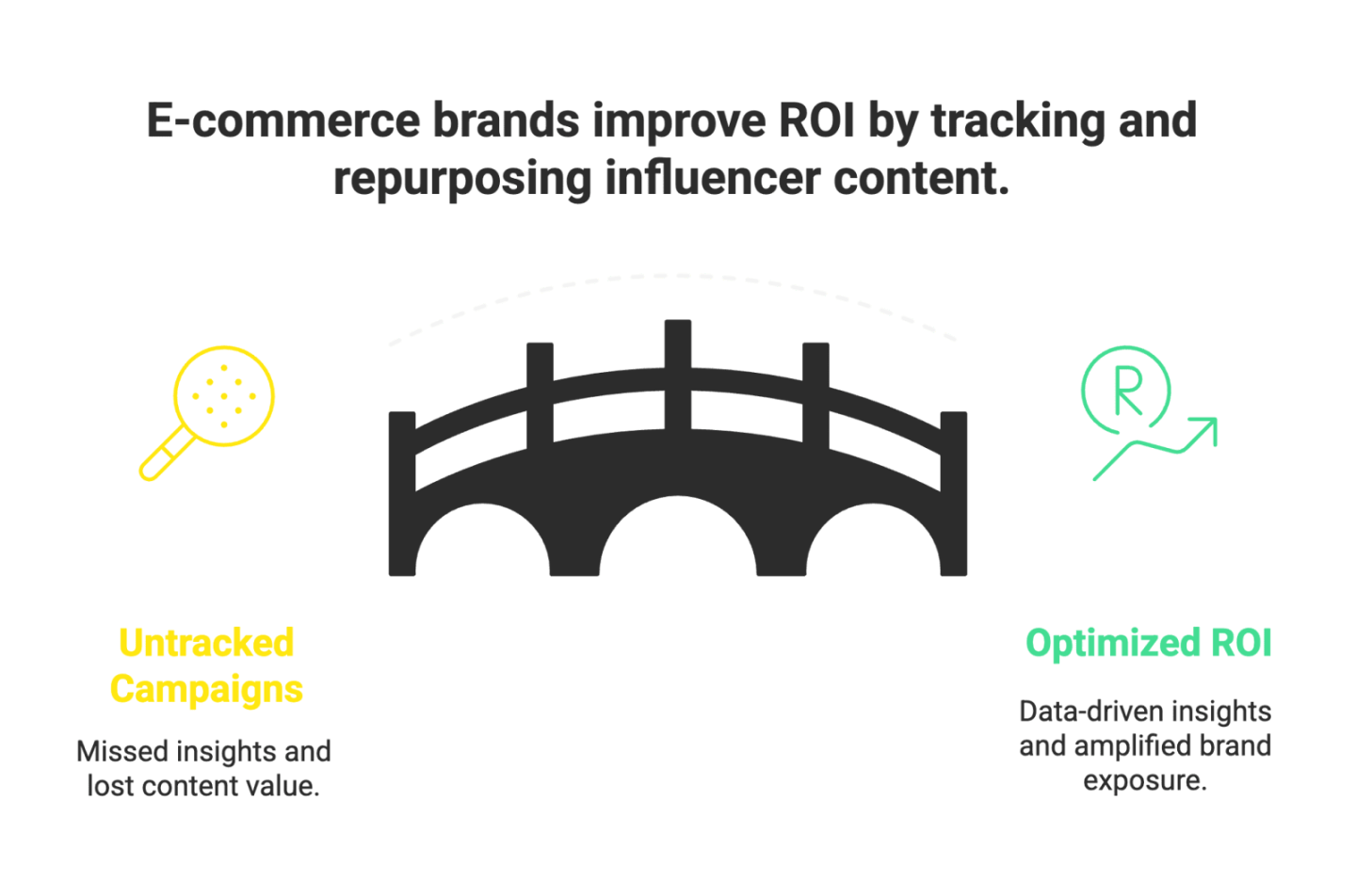
The campaign is over, products were posted… now what? A major mistake many e-commerce brands make is failing to track the results of influencer campaigns and not repurposing the content created. Micro-influencers often produce fantastic photos, videos, and reviews about your product – a goldmine of user-generated content – but if you don’t save and reuse those assets, you’re leaving value on the table. Likewise, if you don’t analyze how each influencer’s post performed, you miss insights that could improve future campaigns. Influencer marketing isn’t a “launch and forget” tactic; the follow-through is just as important.
Why this is a problem: Not tracking results means you have no idea which influencers or content pieces actually drove sales, traffic, or engagement. This makes it impossible to calculate ROI or learn what worked best. For example, if you gave 10 micro-influencers discount codes but never checked how many sales each code generated, you wouldn’t know who was most effective. Without that data, you might repeat mistakes like investing in an influencer who actually didn’t deliver results. Additionally, failing to record what content was posted and securing rights to it means you can’t legally or logistically reuse those great photos or videos elsewhere. You paid (or gave product) for that content – using it only once on the influencer’s social feed severely limits the return. Considering that influencer-generated content often resonates well with consumers, not repurposing it is a lost opportunity for extra brand exposure and credibility.
Over half of marketers (52%) repurpose influencer content across three or more marketing channels. That means the best practice is to take the authentic posts your micro-influencers create and reuse them – on your website, product pages, social media, emails, or ads – to amplify their impact.
As the statistic above shows, most savvy marketers extend the life of influencer content. For instance, if a micro-influencer made a glowing video review of your gadget, you could embed that on your product page or feature a clip in an Amazon listing video. If they took a great lifestyle photo with your fashion item, that image could be republished in your Instagram feed, included in an email newsletter, or even used as part of a Facebook ad campaign (with proper permissions). Brands that do this see concrete benefits – one study noted a 20% higher click-through rate when using UGC content in email campaigns. The trust and relatability of a real user’s content can outperform traditional studio shots or ad copy. By not repurposing, you miss out on these extra conversions and brand trust signals.
How to avoid it: Implement a system to track performance and organize content from every influencer collaboration. Here’s how:
Finally, make sure you’re allowed to reuse content by having proper agreements in place. It’s wise to specify content usage rights in your influencer contract (e.g. you can repost their content on your own socials, or use images in ads for 6 months, etc.). That way, you won’t run into legal issues when you repurpose their work.
By diligently tracking outcomes and reusing influencer-generated content, you maximize the ROI of your micro-influencer campaigns. Instead of a one-time boost, each collaboration becomes a lasting asset: you gain both valuable performance data and quality marketing content. For brands that find this process overwhelming, using an influencer marketing platform can help. For example, Stack Influence – a micro-influencer marketing platform – automates much of this workflow, from finding the right creators and sending out products to managing posts and tracking results. Leveraging such tools ensures no post slips through the cracks and every piece of UGC can be captured and utilized. Whether you do it manually or with software, the key is to treat influencer content and data as strategic resources, not afterthoughts.
Micro-influencers and content creators offer e-commerce and Amazon sellers a powerful way to reach customers through authentic, relatable content. By avoiding these common mistakes – from poor planning and misguided influencer selection to lack of follow-through – your brand can fully capitalize on the benefits of micro-influencer marketing. Remember that successful campaigns are built on strategy, genuine partnerships, and smart execution. Define your goals, choose your collaborators wisely, foster authenticity, and make data-driven decisions. When done right, micro-influencer marketing can drive not just likes but clicks, conversions, and loyal customers who trust your brand. It’s one of the modern growth hacks for online sellers – so learn from these pitfalls, adapt your approach, and watch your e-commerce business thrive with a little help from the right influencers. Good luck, and happy collaborating!