




If you're an eCommerce seller trying to figure out how many followers on TikTok to get paid, the short answer is: it depends on which payment path you're targeting. The platform now runs five separate monetization programs, and each one has a different follower threshold, payout model, and strategic fit for brands looking to partner with creators. Getting this distinction wrong costs sellers real money, either by chasing the wrong creators or by overlooking the paths with the highest commercial return.
Key Takeaways
- The Creator Rewards Program requires 10,000 followers and 100,000 views in the last 30 days, but it is not the highest-earning path for most creators.
- TikTok Shop affiliate access starts at just 1,000 followers, making it the lowest-barrier entry point for eCommerce-aligned creators.
- Brand deals and sponsored content generate significantly more income than platform payouts at most follower tiers, with nano and micro influencers commanding growing rates in 2026.
- Engagement rate, niche, and content quality matter more than follower count when DTC brands are selecting creator partners.
- The 5-Path TikTok Revenue Sequence gives eCommerce sellers and content creators a structured way to evaluate which program to prioritize first.
Why TikTok Is the Platform to Watch for eCommerce Revenue
TikTok is the clear focal point for influencer investment heading into 2026. In this year's survey, 31% of respondents included TikTok in their influencer plans, making it the most frequently selected platform for investment intent. That concentration of brand budget is meaningful for eCommerce sellers, because where brands invest is where creators get paid. Understanding this dynamic is the first step to building a realistic monetization plan on the platform.
According to Influencer Marketing Hub's 2026 Benchmark Report, TikTok is the most frequently selected platform for investment intent, with 31% of brands including it in their influencer plans. TikTok Shop's gross merchandise value exceeded $20 billion in 2024, demonstrating the platform's ecommerce potential. For DTC brands and eCommerce sellers, this creates a compounding opportunity: the same platform driving brand reach is also generating billions in direct sales.
Here is what separates TikTok's monetization landscape from what it was three years ago:
- The original Creator Fund has been fully replaced by the Creator Rewards Program, which pays significantly more per qualified view.
- TikTok Shop now functions as a standalone commerce channel with its own affiliate program, accessible at a lower follower threshold than the rewards program.
- Brand deals, ambassador programs, and creator partnerships have expanded into the nano and micro influencer tiers as DTC brands seek authentic product integration over vanity reach.
- LIVE Gifts represent a real-time income stream with a low follower barrier that many creators overlook entirely.
TikTok monetization in 2026 runs on four separate programs: Creator Rewards, Shop, LIVE gifts, and brand deals, each with its own rules. The fifth path, the TikTok Pulse ad revenue share, rounds out the full picture for top-tier creators. Sellers need to understand all five to know which creator relationships deliver the best commercial return.
What Is TikTok Monetization in 2026?
TikTok monetization refers to the collection of programs that allow content creators to earn income directly from TikTok or through the brands and advertisers who operate on the platform. It is not a single payout pool. Each program has its own application process, eligibility gate, and earning model. The question of how many followers on TikTok to get paid is therefore not a single number but a series of thresholds tied to which income stream you are pursuing.
The old Creator Fund, which paid $0.02 to $0.05 per 1,000 views, is being fully replaced by the Creator Rewards Program, which pays 10 to 25 times more per view. This transition changed the economic calculus for every creator and every brand that partners with them. Sellers evaluating influencer marketing platforms now need to understand the new earning landscape to set realistic expectations for creator partnerships.
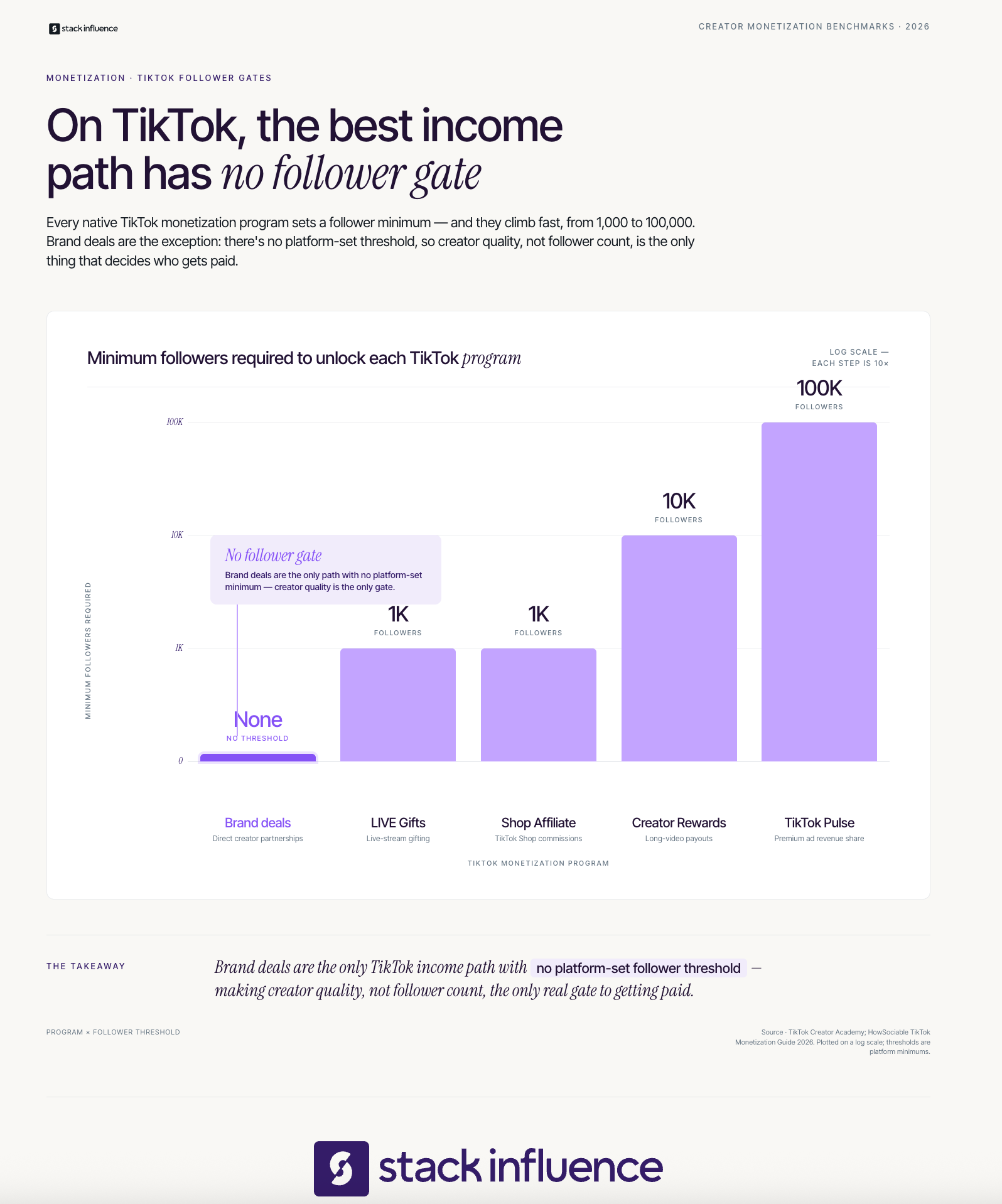
The table below summarizes the five core paths:
- Creator Rewards Program: 10,000 followers + 100,000 views in 30 days, earns on a per-view RPM model
- TikTok Shop Affiliate: 1,000 followers minimum, earns commissions on product sales
- LIVE Gifts: 1,000 followers minimum, earns through virtual gifts from live stream viewers
- Brand Deals and Sponsorships: No platform follower threshold, negotiated directly with brands or via influencer marketing platforms
- TikTok Pulse: 100,000 followers minimum, earns a 50/50 ad revenue split for top-4% content
Each path serves a different creator profile, and for eCommerce sellers evaluating creator partnerships, knowing which paths your creators can access tells you a great deal about their audience quality and content maturity.
The 5-Path TikTok Revenue Sequence
The 5-Path TikTok Revenue Sequence is a structured way to think about TikTok creator earnings as a progression rather than a menu. Creators typically unlock these paths in order, and eCommerce sellers who understand the sequence can identify which stage a creator is at and which campaign structures make sense for that stage. The framework applies equally to sellers building their own TikTok presence and to brands evaluating creator partnerships.
Step 1: TikTok Shop and LIVE Gifts (1,000 followers)
The minimum for TikTok Shop affiliate and LIVE access is 1,000 followers. This is the most accessible entry point in the 5-Path TikTok Revenue Sequence and the most commercially relevant for eCommerce sellers. A creator at this threshold can already tag products in videos, earn commissions, and participate in product seeding campaigns. Requirements for LIVE Gifts include having at least 1,000 followers to go live. Many brands overlook these nano-level creators entirely, which is a strategic miss when product alignment is strong.
Step 2: Creator Rewards Program (10,000 followers)
According to TikTok's Creator Academy, creators need at least 10,000 followers and 100,000 video views in the last 30 days to qualify for the Creator Rewards Program. This is the program most people think of when asking how many followers on TikTok to get paid. The RPM model rewards originality, watch time, and search value rather than raw view counts. Your RPM fluctuates based on four factors: originality, how unique your content is; play duration, how long viewers watch before leaving; audience engagement, including comments, shares, saves, and interactions; and search value, whether your video answers queries people are actively searching for on TikTok.
Step 3: Brand Deals and Sponsored Content (no platform threshold)
Brand deals are not gated by TikTok's algorithms at all. They are negotiated between creators and brands or facilitated through an influencer marketing agency or influencer marketing platform. Brand deals are often the highest-earning monetization channel for TikTok creators, surpassing ad revenue from Creator Rewards at most follower levels. For eCommerce sellers building creator partnerships, this is where most of the commercial opportunity lives.
Step 4: TikTok Shop Brand Partnerships and UGC
Brands that work with creators through TikTok Shop can structure deals that combine product seeding with affiliate commissions, reducing upfront cost while aligning creator incentives with sales performance. Influencers generated $5.4 billion in GMV through videos and live streams in the U.S. alone in 2024, accounting for 60% of total TikTok Shop GMV. UGC creators and brand ambassadors at the micro level drive a meaningful portion of this volume through consistent, niche-specific content rather than one-off viral moments.
Step 5: TikTok Pulse (100,000 followers)
TikTok Pulse is the platform's premium ad revenue-sharing program, unlike Creator Rewards which is available to mid-tier creators; Pulse targets top-performing accounts and offers a 50/50 revenue split between creator and TikTok. This is the final gate in the 5-Path TikTok Revenue Sequence and the one with the most demanding content requirement. For eCommerce sellers evaluating mega-influencers or established content creators, Pulse eligibility is a useful signal that a creator's content consistently ranks in the platform's top tier.
From Stack Influence's experience running product seeding campaigns across eCommerce categories, brands that activate creators at Steps 1 and 2 of the 5-Path TikTok Revenue Sequence before scaling to macro tiers see stronger per-unit cost efficiency because nano and micro creators at those stages are more responsive to campaign briefs and generate UGC with higher reuse rates in paid amplification.
The 5-Path TikTok Revenue Sequence matters to eCommerce sellers not just as creator guidance but as a campaign planning tool. Knowing where a creator sits in the sequence tells you their content maturity, their audience trust level, and the commercial structures they are most likely to accept.
What Do Creators Actually Earn at Each Follower Tier?
Payout rates across the five paths vary substantially, and follower count is only one variable. For sellers evaluating influencer campaigns, realistic earnings benchmarks help set appropriate partnership expectations and negotiate fair rates.
For the Creator Rewards Program, the range is wide. In 2026, most creators report RPMs between $0.40 and $1.00 per 1,000 qualifying views. High-quality, long-form, high-completion content occasionally cracks $2.00 RPM in the U.S. A creator with 50,000 followers producing search-optimized long-form content in a commercial niche can earn significantly more than a creator with 200,000 followers posting generic short clips.
Here is a realistic earnings snapshot by tier within the Creator Rewards Program:
- 10K to 50K followers (micro influencers): $0.40 to $0.80 RPM, heavily dependent on niche and video length
- 50K to 500K followers (mid-tier): $0.60 to $1.50 RPM, improved by strong search value content
- 500K+ followers (macro): $1.00 to $2.50+ RPM in high-commercial-intent niches like finance and beauty
For brand deals and sponsorships, the ceiling is far higher. The 2025 Influencer Marketing Report indicates that half of influencers charge between $250 and $1,000 per post, but 71% offer discounts for longer-term partnerships. For eCommerce sellers, this means structuring brand ambassador programs rather than one-off brand sponsorships delivers more content volume at a lower effective CPM. According to Lumanu payment data, the average TikTok creator payment was $2,049 in early 2025, a 23% increase from the previous year.
Stack Influence's internal campaign data shows that for eCommerce brands running TikTok creator partnerships across the nano and micro tiers, campaigns structured around product seeding plus commission rather than flat fees generate 35 to 45% more content pieces per dollar of campaign budget compared to flat-fee-only contracts, because creators at these tiers are motivated by product alignment over payout size.
The Creator Monetization Readiness Checklist
The Creator Monetization Readiness Checklist is the secondary framework in this guide. It is designed for eCommerce sellers vetting potential creator partners before committing campaign budget. Run every prospective creator through these seven checkpoints before approving them for influencer campaigns, brand deals, or product seeding activations.
- Follower threshold met: Does the creator meet the minimum threshold for the monetization path relevant to your campaign? (1K for Shop/LIVE, 10K for CRP, 100K for Pulse)
- Views-to-follower ratio healthy: Does the creator regularly earn 3 to 10 times their follower count in views per video? If not, their content is not breaking out of their existing audience.
- Content originality verified: Is the creator posting original video content longer than 60 seconds? Short-form reposts do not qualify for Creator Rewards Program revenue and signal low content investment.
- Niche alignment confirmed: Does the creator's content category match your product? Niche alignment predicts both engagement quality and affiliate conversion rate.
- Engagement rate above platform average: TikTok nano influencers made up 87.68% of all creators and averaged a much higher 10.3% engagement rate, making them highly cost-effective for targeted brand collaborations. Any creator falling below 3% engagement in your target niche warrants extra scrutiny.
- Account standing confirmed: Does the creator have a clean community guidelines record in the last 30 days? Accounts with violations cannot participate in the Creator Rewards Program and risk lower organic distribution.
- Content usage rights negotiated: Has the creator agreed to allow reuse of their UGC video content in paid amplification, such as TikTok Spark Ads? Repurposing creator content significantly extends campaign value.
Run this Creator Monetization Readiness Checklist at the beginning of every influencer outreach process. It applies whether you are sourcing creators through a micro influencer agency, a self-serve influencer marketing platform, or direct outreach.
The checklist works alongside the 5-Path TikTok Revenue Sequence because it tells you not just which paths are open to a creator but whether that creator is operating at the standard required to deliver results on your campaign. A creator at Step 2 of the sequence who fails three items on the checklist is a worse partner than a creator at Step 1 who passes all seven.
The Common Mistakes Brands Make When Asking About TikTok Follower Counts

This is where most guides about how many followers on TikTok to get paid go wrong, and it costs eCommerce sellers budget they cannot recover. The common mistake is treating follower count as a proxy for commercial value. It is not. Follower count measures historical reach accumulation. It tells you almost nothing about current content distribution, audience trust, or conversion potential.
The first mistake is filtering out creators below 10,000 followers entirely. As shown in the 5-Path TikTok Revenue Sequence, TikTok Shop affiliate access begins at 1,000 followers. A creator with 5,000 highly engaged followers in the beauty or personal care niche who produces original product review content can drive measurable TikTok Shop commission revenue without ever qualifying for the Creator Rewards Program. The influencer seeding model is specifically designed to activate creators at this tier.
According to Sprout Social's 2025 Influencer Marketing Report, 86% of consumers make at least one influencer-inspired purchase per year. That purchasing behavior is distributed across the entire creator ecosystem, not concentrated in mega influencer accounts. A nano creator with authentic product enthusiasm often converts at a higher rate than a macro creator with a diluted audience and generic endorsement style.
The second mistake is using follower count to negotiate creator rates without accounting for average video views. A creator with 80,000 followers who averages 500,000 views per video is reaching a mostly non-follower audience every time they post. Pricing that creator based on follower count produces a systematically wrong number. Pricing based on 90-day average views produces the right number. For sellers running influencer campaigns, CPV-based pricing is the more accurate model.
The third mistake is conflating the Creator Rewards Program with brand deal income. Many successful creators combine multiple streams of income, including brand deals, affiliate marketing, live gifts, and merchandise sales, instead of relying solely on TikTok payouts. For eCommerce sellers looking for brands that work with micro influencers, this means the most commercially effective creators are rarely the ones maximizing CRP earnings. They are the ones building diverse income stacks where brand sponsorships, TikTok Shop affiliate commissions, and UGC deals all contribute.
Here is what to track instead of follower count when evaluating creator partners:
- Average video views over the last 90 days
- View-to-engagement ratio (comments, shares, and saves versus views)
- Affiliate conversion rate if prior TikTok Shop data is available
- Content category depth, how many videos in your product niche, not just general lifestyle content
- Audience geography: creators with U.S.-dominant audiences generate higher brand CPMs and better CRP RPMs
Data from Stack Influence's micro influencer campaigns suggests that eCommerce brands filtering creator rosters by 90-day average video views rather than follower count see a 25 to 40% improvement in campaign engagement rates, because view-based filtering naturally surfaces creators whose content is currently in active algorithmic distribution rather than those coasting on an older audience base.
Where the Creator Economy Is Heading for eCommerce Sellers
The creator economy is no longer a peripheral channel for DTC brands. The global influencer marketing industry is expected to reach $32.55 billion by the end of 2025, up from $24 billion in 2024 and just $1.4 billion in 2014. That trajectory reflects a structural shift in how consumers discover and purchase products, and TikTok is at the center of it.
For eCommerce sellers, the actionable implication of this growth is that the creator partnerships you build today create compound value. A creator you activate through automated product seeding at 3,000 followers may reach 30,000 followers within eighteen months, at which point their CRP eligibility, their brand deal rates, and their TikTok Shop affiliate conversion data all become more valuable. Brands that build long-term creator partnerships rather than transactional one-off campaigns benefit from this compounding directly.
Research shows that in 2025, 39% of brands chose nano-influencers as their most likely partners. That preference for nano and micro influencers reflects a broader understanding among sophisticated DTC brands that authentic product integration in a niche audience outperforms broad reach in a diluted one. The creator economy, in other words, is moving toward depth over scale, and TikTok's algorithm rewards that same quality-first orientation.
Across campaigns managed on the Stack Influence platform, brands in the health, beauty, and home goods categories that activate both TikTok Shop affiliate structures and UGC content agreements simultaneously see 50% higher content output per campaign and stronger post-campaign attribution through promo code tracking compared to brands using either structure in isolation.
For sellers new to influencer marketing for CPG and consumer goods, TikTok offers a uniquely accessible entry point because the platform's algorithm surfaces content based on relevance rather than follower authority. A well-briefed creator with 2,000 followers and genuine product enthusiasm can generate more qualified traffic to a TikTok seller page than a macro influencer with a disengaged audience posting generic unboxing content.
How to Measure Creator Campaign Performance: The TikTok Commerce Metric Stack
Tracking the right metrics separates eCommerce sellers who grow through creator partnerships from those who cycle through campaigns without learning. The TikTok Commerce Metric Stack is a named four-component measurement model designed specifically for sellers running creator campaigns on TikTok in 2026.
Component 1: Qualified View Rate (QVR)
The percentage of total video views that meet TikTok's monetization criteria, meaning at least five seconds of watch time from a real, non-bot account. A high QVR signals that a creator's audience is genuinely engaged and that the content is holding attention rather than generating passive scrolling impressions. This metric also predicts CRP earnings potential more accurately than total views.
Component 2: Affiliate Conversion Rate (ACR)
For TikTok Shop-linked content, the ACR is the ratio of product page visits to completed purchases. Conversion rates within TikTok Shop range from 3 to 8%, significantly exceeding link-in-bio conversion rates on Instagram which average 0.5 to 2%. An eCommerce seller benchmarking creator performance should use 3% as the floor for TikTok Shop-linked campaigns and investigate any creator delivering below that threshold.
Component 3: Earned Media Value per Post (EMVP)
The estimated media value generated by a creator's post compared to the cost of producing or commissioning it. This metric contextualizes brand deal spend against organic reach outcomes and helps sellers compare creator partnerships against paid alternatives like TikTok Spark Ads. Spark Ads, where a brand amplifies a creator's organic post as a paid in-feed ad while preserving the creator's handle, comments, and social proof signals, consistently outperform standard in-feed ads with 20 to 40% higher view completion rates and 30 to 60% higher click-through rates.
Component 4: Cost Per Acquired Customer from Creator Channel (CPACC)
The total campaign cost divided by the number of new customers directly attributed to creator content during the campaign window. This is the most commercially direct metric in the TikTok Commerce Metric Stack and the one DTC brands should use as their primary optimization signal. Using UTM parameters, TikTok Shop affiliate tracking, and promo code redemption data together provides a reliable attribution picture.
Reference the TikTok Commerce Metric Stack at every campaign review cycle. If QVR is high but ACR is low, the creator is generating interest but the product page or offer is failing the conversion. If EMVP is strong but CPACC is high, the campaign is generating brand awareness but not efficiently converting it to revenue. The model gives sellers a diagnostic lens, not just a performance scorecard.
Conclusion
The question of how many followers on TikTok to get paid has a more useful answer in 2026 than it ever has before. The platform's five monetization paths create a structured progression from 1,000-follower TikTok Shop access all the way to Pulse-level ad revenue sharing at 100,000 followers and above. For eCommerce sellers, the real opportunity is not in the follower numbers themselves but in the commercial structures those thresholds unlock. A 2,000-follower creator with genuine niche authority and TikTok Shop affiliate access can drive more revenue for a DTC brand than a 200,000-follower creator with a fragmented audience and no product fit. Use the 5-Path TikTok Revenue Sequence to map creator potential, apply the Creator Monetization Readiness Checklist before committing campaign budget, and track performance through the TikTok Commerce Metric Stack. The brands building durable creator programs in 2026 are the ones treating influencer marketing as a compounding channel, not a one-time activation.