




Why LinkedIn Has Become a Discovery Engine for eCommerce Brands
Most eCommerce sellers treat LinkedIn as a résumé platform or B2B afterthought. That assumption is leaving real traffic on the table. With over 1.2 billion members, 310 million monthly active users, and 80% of all B2B social leads flowing through it, LinkedIn has become the go-to platform for professional networking, content marketing, and lead generation in 2026. For brands selling on Amazon or running DTC operations, that audience includes retail buyers, wholesale partners, and a growing pool of category-curious consumers.
Blog LinkedIn SEO refers to the practice of optimizing both your LinkedIn-published content and your broader content ecosystem so that both LinkedIn's internal search and Google's organic results surface your brand in front of the right people. Done correctly, it operates as a second search engine layer on top of your existing blog strategy. This guide breaks down exactly how eCommerce sellers can use it.
Key Takeaways
- LinkedIn's internal search and Google's indexing work together, meaning one well-optimized LinkedIn article can generate traffic from two distinct sources simultaneously.
- The LinkedIn Blog Authority Sequence gives eCommerce sellers a repeatable five-step system for turning blog content into LinkedIn SEO assets.
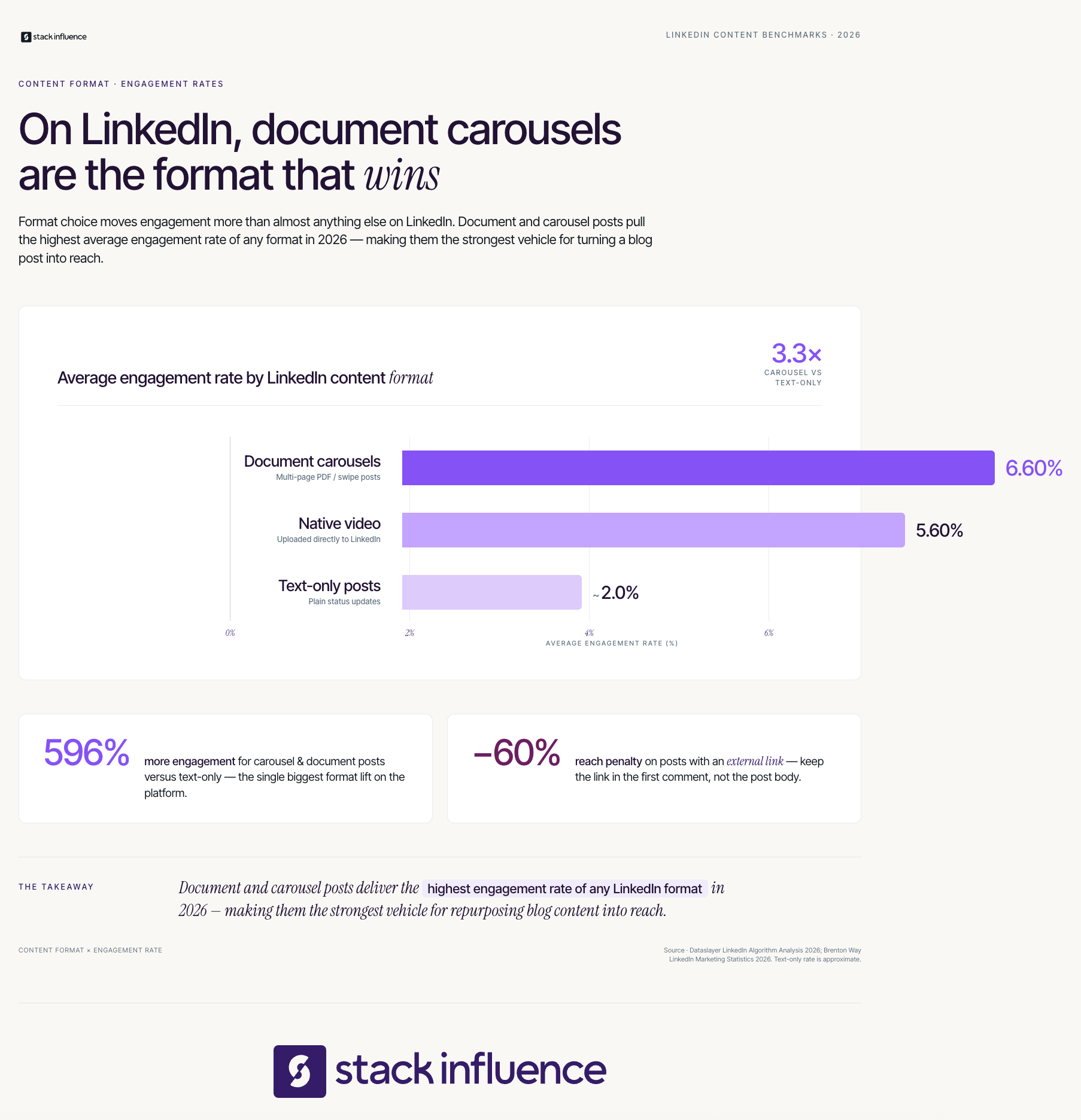
- Carousel and document posts are the highest-engagement format on LinkedIn in 2026, making them the strongest vehicle for repurposing blog content.
- LinkedIn newsletters bypass the feed algorithm entirely and create indexed, static URLs that compound over time.
- Measuring blog LinkedIn SEO requires a named metric model, not just vanity metrics like impressions or reactions.
- eCommerce brands that integrate creator partnerships and UGC content into their LinkedIn content pipeline build authority faster than those relying on brand-page posts alone.
What Is LinkedIn SEO for Blogs, and Why Does It Matter for eCommerce?
Blog LinkedIn SEO combines two overlapping systems: LinkedIn's own relevance-based search algorithm and Google's external indexing of LinkedIn's public pages. The LinkedIn SEO strategy in 2026 is no longer just about getting found inside LinkedIn -- it is about showing up in Google and being cited by AI tools like ChatGPT and Perplexity, and building real authority in your field. For an eCommerce seller, that dual-surface visibility means a single piece of content can drive both platform-native engagement and organic search traffic from prospective buyers who never had a LinkedIn account.
Well-optimized LinkedIn profiles and business pages can rank on Google's first page for relevant queries, driving external traffic. Google treats LinkedIn as a high-authority domain, so profiles with optimized public URLs and rich keyword content stand a strong chance of ranking well. This is particularly relevant for Amazon sellers who want brand search visibility beyond the marketplace itself.
Native LinkedIn articles between 500 and 2,000 words get indexed by Google within 24 to 48 hours, making them function like standalone blog posts. That means every long-form article you publish on LinkedIn is simultaneously competing in Google's search results without requiring a separate domain or hosting arrangement.
According to Sprout Social's 2026 LinkedIn statistics report, LinkedIn Pages with complete information get 30% more weekly views than incomplete ones. For eCommerce brands building authority through influencer marketing and product education, profile completeness is the foundation everything else is built on.
Key distinctions to understand before applying any strategy:
- LinkedIn articles vs. LinkedIn posts: Articles are long-form, publicly indexed by Google, and create permanent URLs. Posts live in the feed, are not reliably indexed by Google, and have a typical distribution window of 24 to 48 hours.
- Company page vs. personal profile: Personal profiles get 8x more engagement than company pages posting identical content. For most eCommerce sellers, the founder or operator profile should lead content distribution.
- Blog repurposing vs. original creation: Adapting existing blog content into LinkedIn-native formats is usually faster and more efficient than writing from scratch for the platform.
The LinkedIn Blog Authority Sequence: A 5-Step Framework for eCommerce Sellers
The LinkedIn Blog Authority Sequence is a repeatable five-step workflow designed to turn your existing blog content into compounding LinkedIn SEO assets. Unlike one-off posting, this sequence treats each piece of content as a building block in a cumulative authority structure. Reference this sequence when planning any new blog-to-LinkedIn publishing cycle.
Here are the five steps in the LinkedIn Blog Authority Sequence:
- Keyword-map your blog to LinkedIn search intent. Before publishing anything, identify which buyer or partner search phrases your blog post already targets. LinkedIn's internal search operates on job title, industry, and professional interest signals, so your blog keywords may need slight reframing. A post titled "Best skincare products for sensitive skin" maps better to LinkedIn as "What eCommerce brands get wrong about sensitive skin product positioning."
- Publish a long-form LinkedIn article with an SEO title and meta description. LinkedIn now allows authors to add custom SEO titles and meta descriptions to articles. Use this feature on every article. Place your primary keyword in the first 60 characters of the title. Google indexes LinkedIn articles as organic search results, expanding their reach beyond the platform's users, and optimizing LinkedIn articles with SEO-friendly titles and descriptions increases their visibility in search results.
- Convert the same article into a document carousel for the feed. Data from ContentIn's 2026 LinkedIn content statistics shows that only 1% of LinkedIn's monthly active users post content weekly, yet they generate 9 billion impressions per week. Carousels are the mechanism that separates that 1% from the rest.
- Engage actively in the first 60 minutes after publishing. LinkedIn tests new posts with 2 to 5% of your network initially. Responding to every comment within that window signals engagement quality to the algorithm and accelerates broader distribution. For eCommerce brands using creator partnerships as content amplifiers, tagging relevant content creators in the comments is a low-cost way to extend first-hour reach.
- Cross-link back to your brand's main website or product pages. Add the full blog post URL in the article body (not just the comments), and include at least one contextual link to a related landing page. This creates referral traffic pathways that compound over time, even if LinkedIn's nofollow attribute limits direct link equity transfer.
According to Brenton Way's 2026 LinkedIn marketing statistics, carousel posts generate 596% more engagement than text-only posts. Running Step 3 of the LinkedIn Blog Authority Sequence consistently is the single highest-leverage action available to eCommerce brands on the platform. Brands managing product seeding campaigns can use the UGC generated from those campaigns as the visual content inside each carousel slide, reducing production friction significantly.
Stack Influence's internal campaign data shows that eCommerce brands repurposing UGC from micro influencer campaigns into LinkedIn document carousels see above-average engagement rates compared to brands using only polished brand photography, particularly in the beauty, health, and home categories where authentic imagery drives higher dwell time.
Where LinkedIn Newsletters Fit Into Your Blog SEO Strategy
The LinkedIn newsletter feature is one of the most underused tools in the eCommerce brand playbook, and understanding why changes how you think about the entire blog LinkedIn SEO ecosystem. LinkedIn newsletters grew 150% year over year and now reach subscribers at scale, with the top 1% of newsletters exceeding 100,000 subscribers. For a DTC brand or Amazon seller building long-term authority, that subscriber base represents an owned-media audience inside a platform you do not control.
LinkedIn newsletter statistics compiled by Scott Aaron show that unlike regular posts, newsletter editions create static URLs that rank in search engines, giving publishers two separate traffic sources simultaneously. That dual-indexing effect is the core reason newsletters belong inside a blog LinkedIn SEO strategy rather than being treated as a separate initiative.
LinkedIn newsletter open rates average 40 to 50%, compared to the 21% average for standard email marketing. For eCommerce sellers trying to build a warm audience of retail buyers, wholesale contacts, or high-value consumers, that open rate differential is material. The content that performs best in LinkedIn newsletters mirrors the structure of a well-optimized blog post: a keyword-relevant headline, a specific problem framed in the first two sentences, and actionable insight supported by real data.
From Stack Influence's experience running product seeding campaigns for eCommerce brands, sellers who repurpose post-campaign creator content summaries into LinkedIn newsletter editions see measurable subscriber growth of 15 to 25% over a 90-day period, driven primarily by the algorithm surfacing newsletter content to second-degree connections who match the original subscriber's professional profile.
Key newsletter tactics for eCommerce sellers applying blog LinkedIn SEO:
- Use your most-searched blog topics as newsletter themes. If your blog ranks for "Amazon product photography tips," that keyword cluster belongs in your newsletter positioning.
- Publish on a consistent schedule. Weekly publishing correlates with higher success rates, and nearly 60% of top-performing newsletters publish on a weekly cadence.
- Embed links to your site within the newsletter body. Newsletter links are less penalized by the algorithm than feed post links, making them a cleaner traffic pathway for DTC brands.
- Treat each newsletter edition as a blog SEO asset. Optimize the subject line as you would a meta title: specific, keyword-anchored, and under 60 characters.
The LinkedIn SEO Audit Checklist: Seven Signals That Drive Organic Visibility
The LinkedIn SEO Audit Checklist is a seven-point review process you can run on any LinkedIn profile, company page, or article before publishing or after a traffic plateau. Unlike the LinkedIn Blog Authority Sequence, which governs your publishing workflow, the LinkedIn SEO Audit Checklist is applied retrospectively to diagnose performance gaps. Reference this checklist quarterly or whenever organic reach drops unexpectedly.
Seven signals to audit across your LinkedIn presence:
- Profile headline keyword placement: Is your primary keyword or category phrase in the first 60 characters of your headline? This is the highest-weighted indexable field on LinkedIn.
- Company page completeness: Is every section of your company page filled in, including specialties, tagline, and custom button? Incomplete pages suppress both LinkedIn and Google visibility.
- Article SEO title and description: Does every published article have a custom SEO title and meta description? LinkedIn now surfaces this setting natively in the article editor.
- Content topic consistency: Are your last 10 posts thematically consistent? The LinkedIn algorithm no longer relies on hashtags to classify content -- it reads your full post copy, your engagement history, and your Topic Authority instead. Inconsistent topic clusters dilute your authority score.
- Engagement-to-distribution ratio: Are your posts generating comments (not just reactions)? Comments are LinkedIn's strongest engagement signal, and comment threads trigger aggressive reach expansion across second and third-degree connections.
- Newsletter static URL indexing: Are your newsletter editions producing static URLs that you can share externally? Check that your newsletter is set to "visible to anyone" to enable Google indexing.
- Personal profile vs. company page distribution balance: Are you routing high-priority content through a personal profile rather than only the brand page? Given the 8x engagement gap, your personal profile should be your primary publishing vehicle for any content meant to drive reach.
For eCommerce brands exploring UGC platforms and brand ambassador programs, the LinkedIn SEO Audit Checklist is also useful for evaluating whether content creators and brand ambassadors representing your brand on LinkedIn are optimized for the same keyword clusters your main profile targets.
Across campaigns managed on the Stack Influence platform, eCommerce brands that brief their content creators to include category-relevant keywords in their own LinkedIn profile headlines see an average 20 to 30% improvement in branded keyword search visibility on LinkedIn within 60 days, compared to brands that provide no LinkedIn-specific guidance to their creator network.
What Changed This Year: How the 2026 LinkedIn Algorithm Reshaped Blog SEO
The most important shift in blog LinkedIn SEO in 2026 is not a content format change. It is a fundamental reclassification of how LinkedIn measures content value. The 2026 algorithm changes represent the most significant shift in how B2B content gets distributed since the platform embraced its creator economy ambitions in 2023, with the core message being that LinkedIn is done rewarding surface-level engagement and is now measuring whether content actually delivers value.
For eCommerce sellers, this means that the playbook of posting a link to a blog post and waiting for traffic is effectively dead. Posts with external links see approximately 60% less reach than posts without them, which means sharing your blog post URL in the post body actively suppresses distribution. The implication is significant: you need the LinkedIn Blog Authority Sequence to decouple your blog post link from your organic reach mechanism.
According to Dataslayer's LinkedIn algorithm analysis, posts with external links see approximately 60% less reach than posts without them. The practical solution is to post the insight or excerpt natively, generate the engagement, and move the link to the first comment or the article body where it does not trigger the same penalty.
The new algorithm system prioritizes "knowledge and advice" content over personal updates and promotional posts, and analysis of over 10,000 posts in Q1 2026 found that educational content gets 3 to 5x more reach than other post types. For eCommerce sellers publishing influencer marketing case studies or brand category guides, this is a structural advantage: educational content built around real product experience outperforms promotional posts even on a smaller follower base.
In late 2025, LinkedIn added Saves and Sends to post analytics, which is LinkedIn communicating what it values: content people keep, share privately, and talk about. For blog LinkedIn SEO, this means your highest-value content should be designed to be saved as a reference, not just scrolled past. Practical guides, numbered frameworks, and data-backed breakdowns consistently generate saves at higher rates than opinion posts.
Additional algorithm changes eCommerce sellers need to build around in 2026:
- Topic Authority over follower count. The LinkedIn algorithm shift from a Relationship Graph to an Interest Graph changed distribution, and Topic Authority now matters more than follower count. Publishing consistently on one category topic builds more reach than sporadic posting across unrelated subjects.
- Dwell time as a primary signal. How long users spend reading or viewing before scrolling away is now a core ranking input, with posts exceeding 61 seconds of dwell time averaging notably higher engagement rates than posts with under 3 seconds of dwell.
- Document posts for maximum native reach. For eCommerce brands leveraging influencer campaigns and campaign reporting, packaging that data into a document carousel maximizes dwell time and distribution simultaneously.
How Should eCommerce Sellers Measure LinkedIn Blog SEO?
Most eCommerce brands measure LinkedIn performance with the wrong metrics. Impressions and follower count are visibility proxies, not business outcomes. The right measurement structure for blog LinkedIn SEO is what we call The LinkedIn Blog Visibility Stack, a four-component model that maps each metric to a specific stage of the content-to-conversion journey.
The LinkedIn Blog Visibility Stack:
- Component 1: Article Index Rate. Are your LinkedIn articles appearing in Google search for your target keyword phrases? Check this by searching your article title in quotes on Google and verifying the LinkedIn URL appears in organic results. This is the foundational health metric for blog LinkedIn SEO.
- Component 2: Profile Search Appearance Rate. How many times per week is your LinkedIn profile appearing in search results? LinkedIn provides this natively in profile analytics. For eCommerce brands, a rising search appearance rate correlates with increasing category authority on the platform.
- Component 3: Content Save Rate. What percentage of people who see your post save it? This is now surfaced in LinkedIn post analytics and functions as a leading indicator of content quality. A save rate above 2% on any given post signals the algorithm to expand distribution.
- Component 4: Referral Traffic from LinkedIn. How much traffic is your website receiving from LinkedIn each month? Track this in Google Analytics 4 under Acquisition > Traffic Acquisition, filtering by "linkedin.com." For Amazon sellers running Amazon attribution campaigns, match LinkedIn referral traffic spikes against Attribution tag click data to understand the full contribution of LinkedIn content to purchase intent.
SocialPilot's LinkedIn statistics research reports that thought leadership posts on LinkedIn receive 3x more shares than standard brand updates. For eCommerce brands, this means that the Content Save Rate and share velocity of educational posts will consistently outperform promotional product announcements in every component of the LinkedIn Blog Visibility Stack.
Use the LinkedIn Blog Visibility Stack in monthly reporting alongside your standard eCommerce metrics. Reference the Stack when evaluating whether to double down on LinkedIn articles, shift toward a newsletter strategy, or increase the frequency of document carousels. Data from Stack Influence's micro influencer campaigns suggests that eCommerce brands using all four components of the LinkedIn Blog Visibility Stack in their monthly reporting make channel investment decisions 40% faster than brands relying on impressions and likes alone, because each metric maps directly to a decision point in the content distribution workflow.
Turning Blog SEO and LinkedIn Into a Single Growth Channel

Blog LinkedIn SEO is most powerful when treated as a closed-loop system: your blog informs your LinkedIn content, your LinkedIn engagement builds brand authority, and that authority feeds back into your Google search rankings over time. The LinkedIn Blog Authority Sequence governs your publishing cadence, and the LinkedIn SEO Audit Checklist keeps your infrastructure aligned with 2026's algorithm priorities.
For eCommerce sellers on Amazon or running DTC brands, this matters because both Google and LinkedIn are rewarding the same behavior: publishing specific, educational content with genuine depth and original perspective. Applying influencer marketing thinking to your LinkedIn content strategy means treating every post as an asset with a defined audience, a measurable outcome, and a compounding shelf life rather than a one-time broadcast.
Blog LinkedIn SEO is not a shortcut. It is a compounding investment that rewards brands willing to build consistently over six to twelve months. Use the LinkedIn Blog Visibility Stack to track your progress, apply the LinkedIn Blog Authority Sequence to every new content cycle, and let the evidence accumulate.