
The latest info on influencer marketing trends, micro influencer news, and the world of social media

Optimizing your Amazon product listing is one of the most impactful things you can do as an Amazon seller. Studies show that Amazon is where a majority of shoppers begin their product searches – 63% of consumers start searching on Amazon, and 70% of Amazon shoppers never go past the first page of results. In other words, if your listing isn’t ranking on page one and compelling shoppers to click, you’re losing sales to competitors. It’s no wonder that nearly 80% of Amazon sellers say listing optimization with relevant keywords is a top priority.
But how exactly do you optimize an Amazon listing? This comprehensive guide will walk you through the key steps to optimize your Amazon product listing – from keyword research and crafting the perfect title to improving images and gathering reviews. We’ll also cover the latest Amazon policy updates (as of 2024–2025) that you need to know. By the end, you’ll have an actionable roadmap to improve your listing’s visibility and conversion rate. Let’s dive in!
Amazon listing optimization means enhancing all the elements of your product detail page – title, images, bullet points, description, backend keywords, etc. – to improve its visibility in search and its appeal to shoppers. Essentially, you’re tailoring your listing to Amazon’s A9 search algorithm and to human customers. This process increases the chances that your product appears in relevant searches and converts those clicks into purchases.
Why is this so important? Amazon’s algorithm heavily rewards relevance and performance. When deciding which products rank higher, Amazon looks at factors like:
Are the search terms shoppers use present in your title, bullets, or backend fields? Amazon relies on keywords to understand what your product is and match it to searches.
Products with strong sales history tend to rank higher (after all, more sales mean Amazon earns more).
If a lot of people click your listing but don’t buy, Amazon will consider it less relevant. A high conversion rate signals that your listing satisfies shoppers’ needs.
In short, a well-optimized listing tells Amazon “this product is exactly what the customer is searching for,” and it convinces shoppers to hit the Buy button. Even if you drive traffic to your listing through ads or external marketing, it won’t translate into sales without an optimized listing. (For example, Stack Influence, an influencer marketing platform, notes that many e-commerce brands and Amazon sellers now partner with micro-influencers – niche content creators – to generate authentic UGC and build consumer trust off-Amazon. But once that traffic lands on Amazon, a high-quality listing is what converts those visits into purchases.) In the ultra-competitive world of Amazon e-commerce, your product listing quality can make or break your success.
Now that we know why it matters, let’s go through seven key steps to optimize your Amazon product listing.
Every great Amazon listing optimization strategy starts with keyword research. Keywords are the bridge between customer searches and your product – including the right keywords will make your listing relevant in Amazon’s eyes and help shoppers find you.
Brainstorm and research what terms customers would use to search for your product. Put yourself in the buyer’s shoes: What words or phrases describe your item and its use? Begin with a few obvious “seed” keywords (e.g. “yoga mat” if you sell yoga mats) and then expand from there. Here are some effective methods and tools for Amazon keyword research:
Start typing your product name or category into Amazon’s search bar and note the autocomplete suggestions. These suggestions are popular search queries by real shoppers, which makes them great keywords to target. For example, typing “yoga mat” might suggest “yoga mat thick”, “yoga mat non-slip”, etc. – valuable long-tail keywords.
Look at top-ranking competitor listings in your category. What keywords do they include in their titles and bullet points? You can also use Amazon’s Product Opportunity Explorer or third-party tools to discover which search terms drive traffic to competing products.
Leverage tools designed for Amazon SEO. For instance, Jungle Scout’s Keyword Scout or Helium 10’s Magnet can show search volume for keywords and even recommend related terms. These tools often allow reverse-ASIN lookup – input a competitor’s ASIN to see what keywords they rank for. The goal is to build a comprehensive list of relevant, high-volume keywords.
Don’t forget that Amazon listings can also rank on Google. Research if there are any high-traffic Google search terms related to your product that you could incorporate (e.g. using SEO tools like Semrush).
As you gather keywords, think beyond just single words – include useful long-tail phrases that indicate buyer intent (e.g. “yoga mat for bad knees” or “eco-friendly yoga mat”). Long-tail keywords may have lower search volume but often convert better because they’re specific.
Pro Tip: Keep a list of your target keywords handy. Amazon’s algorithm only needs a keyword mentioned once to index it, so there’s no need for heavy repetition or “keyword stuffing.” Focus on relevancy over sheer keyword count. In the next steps, we’ll strategically place these keywords into your title, bullets, and other fields.
Your product title is the most critical searchable text on your listing. Amazon places heavy weight on title keywords for indexing and ranking. It’s also the first thing shoppers see in search results, so a well-crafted title can boost your click-through rate. An optimized Amazon title should clearly describe the product, include top keywords, and follow Amazon’s formatting guidelines.
Follow Amazon’s title requirements: As of 2025, Amazon updated its title rules for most categories. Titles must not exceed 200 characters (including spaces), and you cannot use certain special characters (like !, $, or ? unless they’re part of a brand name). You also shouldn’t repeat any word more than twice in the title – Amazon wants to discourage keyword stuffing and overly long, confusing titles. In fact, Amazon itself advises sellers to keep titles under 60 characters for clarity, even though the hard limit is 200. The ideal length is long enough to include key information, but not so long that it’s cumbersome or gets cut off on mobile.
Here are best practices for writing a great Amazon title:
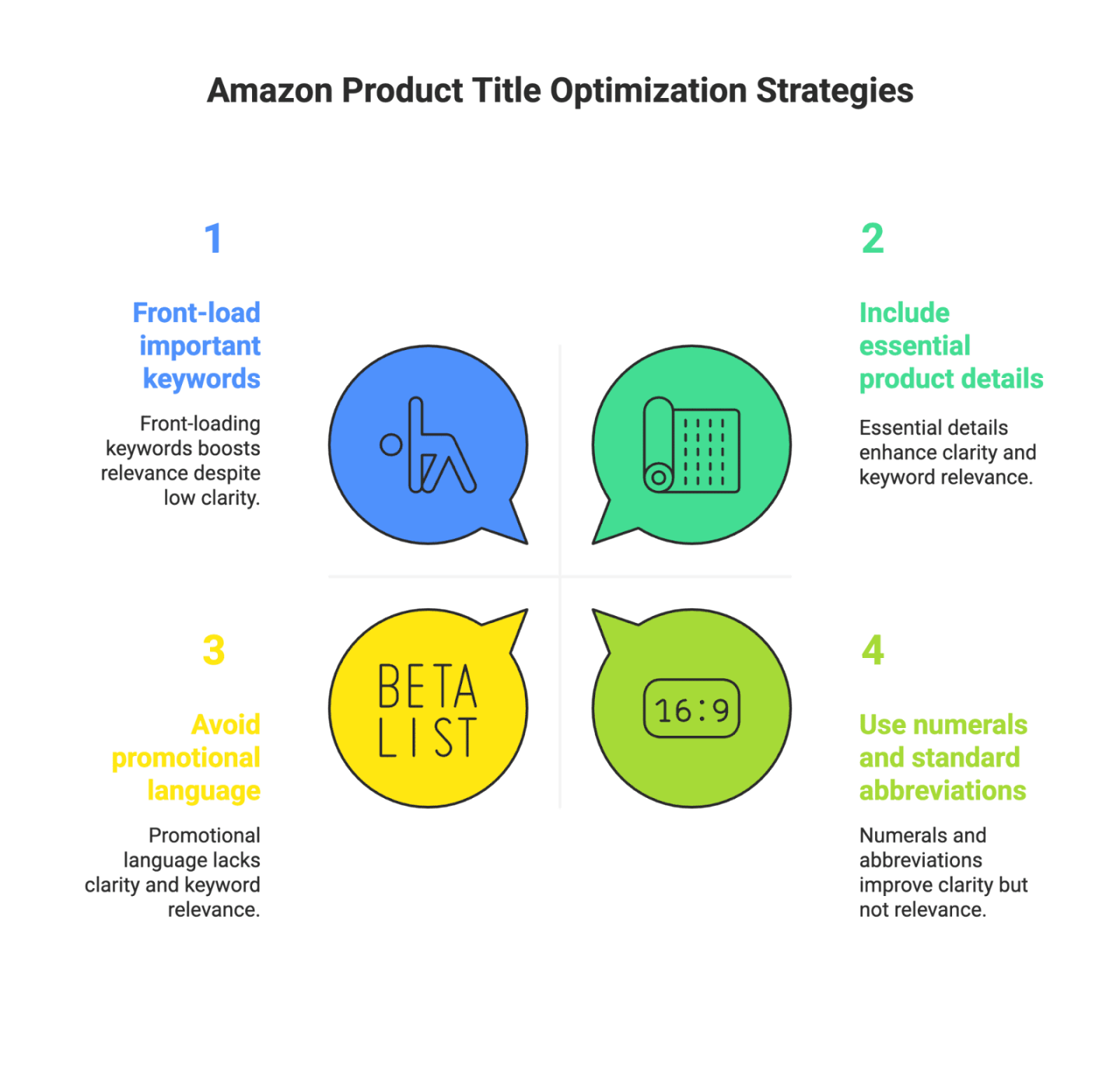
Finally, make sure your title complies with any category-specific rules on Amazon Seller Central. Some categories have shorter length limits or required info (for example, Apparel titles often must include gender and product type). Keeping your title within Amazon’s rules ensures you don’t get penalized or have your listing suppressed.
Amazon recently implemented a rule that titles may not contain the same word more than twice, so if your product is “100% organic cotton”, you shouldn’t repeat “cotton” multiple times in the title. One mention suffices.
Crafting an effective title might take a few drafts – it’s worth the effort. A good title is clear, keyword-rich, and easy for humans to read, striking a balance between SEO and marketing. If you get the title right, you’ve set a strong foundation for your listing’s SEO.
Your product description appears further down the page, but it’s still an important part of your Amazon listing optimization. This is a space to tell the story of your product and brand in more detail and include any information that didn’t fit in the title or bullets. Amazon gives you up to 2,000 characters for the description field, so make it count!
If you are enrolled in Brand Registry, you have an even better option: A+ Content (also known as Enhanced Brand Content). A+ Content lets you replace the standard description with a richer content section that can include formatted text, images, comparison charts, videos, and more. This appears in the “From the Brand” section and can make your listing look far more professional and engaging. Amazon reports that adding basic A+ Content can increase sales by up to 5–8%, and using Premium A+ with videos and interactive modules can boost sales by up to 20%. That’s a significant conversion lift for most products.
Tips for A+ Content: Use A+ modules to visually highlight your product’s features (through infographics or lifestyle images with overlay text), tell your brand story, and compare your product line if you have multiple related products. For example, you might include a comparison chart showing how this model differs from your other models, or a lifestyle image with callout text pointing to unique features. A+ allows for much more creativity – but the text in A+ is not indexed for search by Amazon (at least as of now). So, you should still make sure important keywords are in your title, bullets, and backend fields. A+ content’s value is in increasing conversion rates by giving shoppers richer information and trust in your brand.
Whether you use basic text or A+ Content, a well-optimized description will reinforce your product’s value proposition and answer any lingering questions the customer might have. This can be the section that convinces a hesitant buyer to finally click “Add to Cart.” If you have the ability to add A+ Content, take advantage of it to stand out from competitors who might not have enhanced content. Just ensure your A+ content is also following guidelines (no forbidden claims, no external links, etc.) and that it complements the rest of your listing.
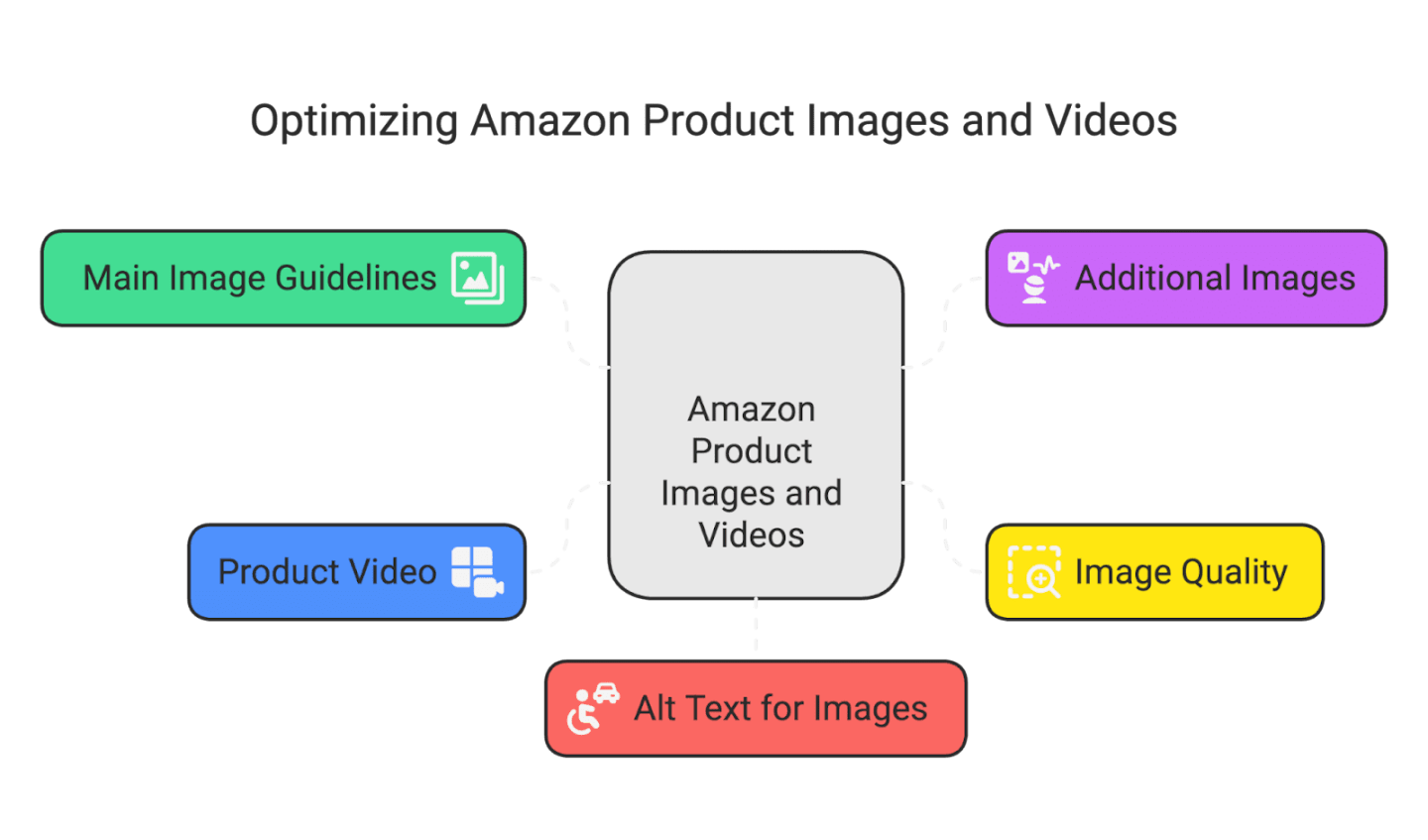
On Amazon, images are critically important. Unlike a physical store, online shoppers can’t touch or try your product – they rely on photos to judge its appearance, size, and quality. In fact, your main image largely determines whether shoppers click your listing at all. And once they’re on the page, a great set of images can seal the deal by giving a 360° understanding of the product. Optimizing your Amazon listing therefore means investing in high-quality product photography and multimedia.
High-quality images not only help convert customers but also can reduce returns (because customers know what they’re getting). They are a direct window into your product’s quality. Many shoppers will make a purchase decision just from scanning images and bullets, without reading the full description, so never skimp on image optimization in your Amazon listing.
In addition to the customer-facing content, Amazon provides a hidden field for additional keywords, often referred to as “backend search terms” or generic keywords. These are keywords that aren’t visible on the product page, but are indexed by Amazon’s search algorithm to help your product surface in relevant searches. Optimizing your backend keywords is a crucial step to ensure you’re capturing all possible search queries without cluttering your title or bullets.
By fully utilizing the backend search terms, you can capture long-tail searches and niche queries that your main listing copy might not cover. This can bring in extra traffic. It’s essentially free extra SEO juice. Just remember, backend keywords should augment your listing’s discoverability without misleading shoppers. When a customer types in one of those terms, your product should indeed be a relevant result for that term. If you sell a yoga mat and add “yoga blocks” to backend keywords, that’s not really relevant – a customer looking for yoga blocks won’t be happy landing on your mat listing.
After adding backend search terms, give Amazon 24-48 hours to index them and then test some of those terms to see if your product shows up in search. This can confirm you’ve done it right. All in all, optimizing the hidden keywords is a quick win to ensure you’ve left no stone unturned in terms of SEO.
Once your content (title, images, etc.) is optimized and you start getting traffic, one of the biggest factors in conversion – and even in sustaining your search rank – is your product’s reviews and ratings. Shoppers heavily rely on social proof. A listing with a good number of positive reviews will convert much higher than one with few or poor reviews. Moreover, early sales and reviews can boost your product’s momentum and organic ranking on Amazon.
Optimizing your Amazon listing isn’t just about the content you create, but also about managing customer feedback. Here’s how to set yourself up for success in the reviews department:
This might sound obvious, but the best way to get positive reviews is to meet or exceed customer expectations with your product. If your product has design flaws or quality issues, no amount of listing optimization can save you from negative reviews. Before you even launch, ensure your product quality is on point and that you’ve addressed any known issues that similar products have. Fixing a competitor’s pain points can turn their disgruntled customers into your happy ones.
Amazon’s policy is strict about not manipulating reviews, but they provide legitimate tools to request reviews from buyers. After a purchase, Amazon automatically sends a standard review request email. In addition, you can use the “Request a Review” button in Seller Central for each order to send a polite review request email (Amazon generates it for you). This is allowed once per order. If doing it manually for each sale is too tedious, consider using software or browser extensions that automate the process (for example, some seller tools have a one-click bulk “Request Reviews” feature). Be sure any tool you use complies with Amazon’s Communication Guidelines.
Outside of Amazon, encourage users to share their experiences – e.g. on social media, unboxing videos, etc. While these won’t directly show up as Amazon reviews, they create buzz and trust around your product. For instance, micro-influencers posting about your product can indirectly lead to some of their followers purchasing and leaving reviews. Just never pay for reviews or incentivize positive reviews, as that’s against Amazon policy. You can, however, include a nice insert in your product packaging that thanks the customer and politely asks for a review if they’re enjoying the product (just don’t offer a reward for it, and don’t specifically say “5-star review” – keep it neutral).
Having a solid strategy to grow positive reviews will pay off massively. Listings with a higher average rating and a good volume of reviews not only convert more shoppers but also tend to get a better Best Seller Rank and even higher search rankings over time. Amazon’s algorithm sees that customers are happy with the product (good reviews, good conversion rate), which reinforces that it should show the product to more shoppers.
If you implement a review request strategy, you might be surprised by how many more reviews you get. For example, Jungle Scout noted that by using an automated Review Request tool, a product got over 400 reviews in less than a year. While not every buyer will leave a review, many more will if asked (in the appropriate way) than if not prompted at all.
Finally, displaying social proof prominently: When your listing has some great reviews, make sure the best ones (the ones mentioning your key features or excellent service) are marked as “Helpful” (you can upvote your own reviews to an extent) so they show up near the top. Also consider adding Q&A content: answer customer questions in the Q&A section promptly. This also builds trust for shoppers who might have similar questions.
In summary: product listing optimization gets people in the door, and positive reviews help close the sale. Both aspects work together to drive your Amazon success.
Amazon listing optimization is not a one-and-done task. The marketplace and consumer trends are always evolving, so the best sellers treat optimization as an ongoing process. To maintain and improve your rankings, you’ll want to regularly monitor your listing’s performance and make adjustments as needed.
Think of listing optimization as continuous improvement. You want to keep testing and learning. Maybe adding a new image or rearranging bullet points could bump conversions by a few percentage points – which at scale is a big revenue increase. Also, watch for seasonal trends: adjust your keywords or imagery to capitalize on holiday shopping, if relevant (e.g. adding “Gift” keywords during Q4, or updating images to have a holiday theme if appropriate).
Lastly, remember to also optimize off-page factors over time: ensure you keep Prime eligibility (fast shipping is a factor in conversion), keep your pricing competitive, and maintain good inventory health (avoid stockouts, which can kill your ranking momentum).
By regularly auditing and refining your Amazon listing, you’ll stay ahead of the competition. The Amazon marketplace rewards those who are vigilant and adaptive. As Jungle Scout’s experts put it, “Listings will make us or break us as Amazon sellers,” so it’s worth investing the time to make it the best it can be.
In summary, optimizing your Amazon product listing is absolutely essential for succeeding as an Amazon seller in 2025 and beyond. A well-optimized listing improves your search visibility (so more shoppers find your product) and your conversion rate (so more of those shoppers buy from you instead of clicking away). It’s about working smarter on the digital shelf to outshine your competition.
By implementing these optimization strategies, you’ll position your product to rank higher in Amazon’s search results and appeal strongly to potential buyers who land on your page. The result? More visibility, more clicks, and ultimately more sales.
Keep in mind that Amazon’s platform is always changing. Stay informed about new features, algorithm updates, and consumer trends. What works today might need tweaking tomorrow. The good news is that by following the fundamentals outlined in this guide, you have a solid framework that you can continually refine.
Now, it’s time to take action: apply these tips to your own Amazon listings. Even making a few improvements in your title, images, or keywords can lead to a noticeable uptick in performance. Monitor your results, keep optimizing, and you’ll be on your way to outranking the competition – maybe even achieving that coveted #1 Best Seller spot in your category!
Good luck, and happy selling on Amazon! Remember, an optimized listing is an investment that keeps paying off through better rankings, happier customers, and a healthier bottom line. 🚀
In today’s social media-driven marketplace, e-commerce brands and Amazon sellers are partnering with micro-influencers to generate authentic user-generated content (UGC) and drive up engagement. A high engagement rate on content – as shown conceptually above – can translate into more trust, traffic, and sales for online businesses.
Engagement rate is a metric that measures how actively your audience interacts with your content. In simple terms, it’s the percentage of people who engage with a piece of content out of those who saw it or follow you. Engagements include actions like likes, comments, shares, saves, retweets, clicks, and other meaningful interactions – basically anything beyond just viewing the content. A higher engagement rate means a larger portion of your audience is responding to your posts, which is often a sign that your content resonates with them.
How to calculate it: The most common formula is:
Engagement Rate = (Total engagements / Total followers) × 100
For example, if you have 10,000 followers and a post gets 300 combined likes, comments, and shares, that post’s engagement rate is 300/10,000 × 100 = 3%. (Some marketers calculate by post impressions or reach instead of follower count, but the goal is the same – to find what percentage of your audience is interacting with your content.) Generally, views alone are not counted as engagement; it’s the active responses that matter.
Engagement rate isn’t just a vanity metric – it’s a core indicator of content performance and audience connection:
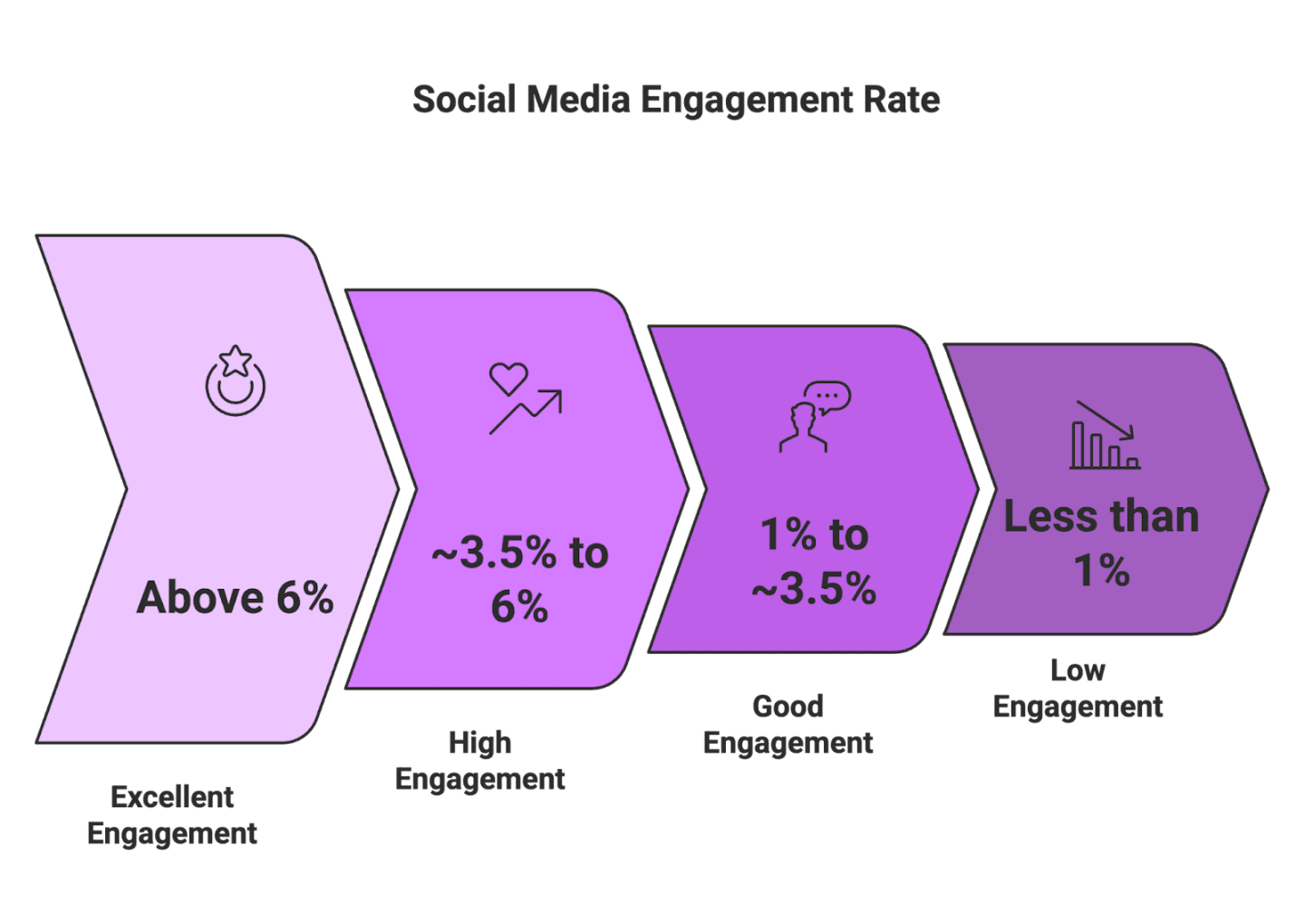
Determining a “good” engagement rate depends on a few key factors – platform, industry, and audience size – but there are some general benchmarks we can use as a rule of thumb. Broadly, social media experts often consider an engagement rate between about 1% and 5% to be good or average. Here’s a common breakdown used in the industry:
Keep in mind, these are ballpark figures. What’s “good” can vary by platform and niche. For instance, a 3% engagement rate on Instagram might be normal, but 3% on Twitter (now X) would be extraordinarily high. Always compare yourself to relevant peers – for example, other beauty brands on Instagram, or other tech YouTubers – rather than to a blanket number across all of social media.
Also, note that engagement rates tend to decline as follower counts rise. It’s simply harder to keep a huge, diverse audience as engaged percentage-wise as it is to engage a small, tight-knit community. In fact, smaller accounts often have more focused and passionate followers, so their engagement ratio is higher. Don’t be discouraged if a mega-celebrity has “only” a 1% engagement rate while a niche micro-influencer gets 5% – that’s a normal dynamic. We’ll explore this more in the Micro vs. Macro section below.
Not all social networks are created equal when it comes to engagement. A “good” engagement rate on one platform might be average on another. For example, Instagram and TikTok posts generally garner a lot more interaction than Twitter posts. LinkedIn’s engagement is a different ballgame as well, often involving longer comments and shares rather than quick likes. It’s important to understand the typical engagement norms on each platform you use.
To put things in perspective, let’s look at average engagement rates by platform (across all industries and account sizes):
Average engagement rate by platform (all industries, Q4 2024 data). Instagram and TikTok see around a 2% average engagement on posts, whereas Facebook and Twitter (X) generally see under 2%. Professional-networking content on LinkedIn tends to have slightly higher average engagement (~2.8%).
As the chart above shows, Instagram posts have roughly a 2% average engagement rate, and TikTok is similar around 2% on average, although top-performing TikToks can go much higher. Facebook and Twitter (X) typically see lower engagement (often 1-2% or even below 1% for Twitter) since these platforms are more about quick scrolling and link sharing. LinkedIn, interestingly, can see higher averages (~2-3%) because the content is often niche and the audience smaller (e.g. a post in a specific industry group may get a high percentage of that group interacting). On LinkedIn people tend to either engage thoughtfully or not at all, so engagement is less frequent but can be proportionally high when it happens.
Why the differences? Content format and user behavior vary by platform. Instagram is visual and encourages quick double-taps and comments, while TikTok’s addictive video feed can drive rapid engagement (shares, comments) especially when content goes viral. Twitter’s fast-paced text feed results in lower engagement ratios – people might read a tweet and move on without interacting, leading to tiny percentages (an engagement rate above 0.1% on Twitter can actually be decent in many cases). On the other hand, TikTok is currently known for its high engagement levels – TikTok’s average engagement rate is generally higher than Instagram’s at the moment, thanks to its algorithm that pushes content to the “For You” page beyond one’s followers. The key takeaway is to always benchmark against the same platform. Don’t panic if your brand’s 3% Instagram engagement looks “lower” than someone’s 5% on TikTok – that could actually be normal given platform trends.
Lastly, industry and content niche affect engagement too. Fun, visual topics (like fashion, food, or pets) often see higher engagement rates than technical or corporate topics (like finance or B2B software). A quirky meme account might regularly hit 5-10% engagement, while a government or banking industry account might celebrate hitting 1-2%. Always compare apples to apples: look at engagement norms in your specific field.
Another crucial factor in engagement rate is the size of the audience. Generally, the smaller the follower count, the higher the engagement rate (in percentage terms). This is why micro-influencers (those with tens of thousands or fewer followers) often boast better engagement than mega-influencers with millions of followers. Their audiences are more niche, loyal, and attentive. By contrast, big celebrities have huge followings that include many casual viewers who don’t interact as much.
For example, one analysis of Instagram found that micro-influencers (say 10k–100k followers) had an average engagement rate around 3.8%, whereas macro-influencers (500k+ followers) averaged only about 1%. In other words, the smaller creators were getting 3-4 times higher engagement relative to their audience size. This trend holds across platforms and studies: another report noted micro-influencers typically achieve roughly 60% higher engagement rates than macro-influencers on average. Smaller creators tend to have a close-knit community feel – followers see them as genuine peers or friends, not distant celebrities, which leads to more interaction.
Example of engagement rates for micro-influencers (from an influencer platform dashboard). Smaller creators often have very high engagement percentages – as shown above, an account with only ~1,400 followers can see an engagement rate of 47%! These unusually high rates reflect highly invested niche communities, and they typically decrease to more “normal” percentages as an influencer’s follower count grows.
The flip side is that as influencers grow, their engagement rate % usually dips. A nano-influencer with 800 followers might get 100 likes (a 12.5% rate), but if they grow to 80,000 followers, they are unlikely to still get 12.5% engagement on each post – that would be 10,000 likes per post, which only the most exceptional content achieves. Instead, they might get say 1,600 likes (2%), which is still strong at that scale. This phenomenon is natural and comes from audience dilution and platform algorithms. The key point: don’t compare a big influencer’s 2% to a tiny creator’s 10% and assume the big one is underperforming. Different scale, different expectations.
For brands, this is why micro- and nano-influencers are so attractive – collectively, a group of smaller influencers can generate higher engagement and authenticity than one or two big names. In fact, many marketers now prioritize micro-influencers because of their high engagement and cost-effectiveness. (Why pay a celebrity for a lukewarm audience response when a few passionate micro-creators can spark real conversations about your product?)
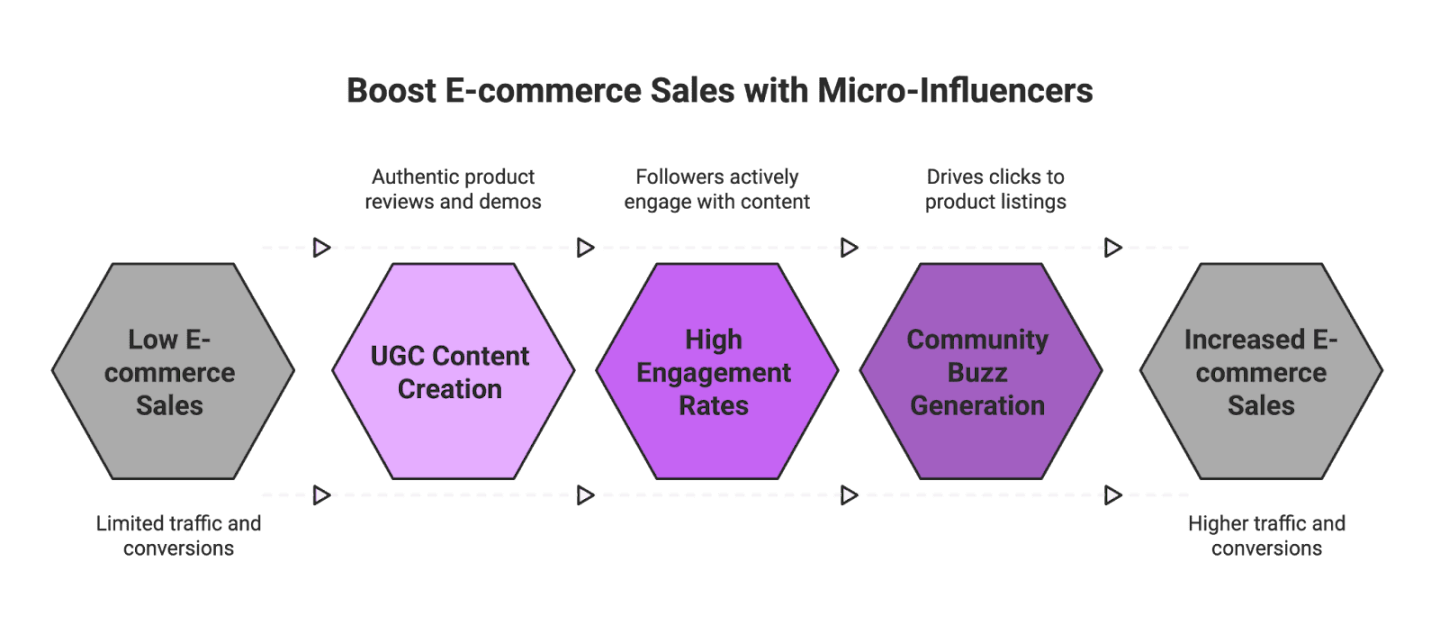
Speaking of brands and influencers – if you’re an e-commerce business or Amazon seller, engagement rate is especially crucial. High engagement on influencer posts can lead directly to more traffic and sales for your online store. This is where micro-influencers and UGC content shine. For instance, Stack Influence – an influencer platform focused on micro-influencers for Amazon – notes that working with many small creators generates valuable UGC and drives high-quality traffic for e-commerce sellers. In the ultra-competitive world of online retail, brands are increasingly turning to armies of micro-influencers and content creators to gain an edge.
Why is this strategy effective? Micro-influencers not only have higher engagement rates, but the content they produce is often more authentic and relatable. They create user-generated content (like real-life product photos, unboxing videos, reviews, demos) that doesn’t feel like traditional ads. Consumers trust this kind of content far more than polished brand advertising – indeed, UGC is viewed as the most authentic form of content by consumers, and authenticity heavily influences purchase decisions. If an everyday person genuinely loves a product and engages with their audience about it, that generates trust and “social proof” that can directly boost sales.
For example, an Amazon seller might send free products to a group of micro-influencers in exchange for honest posts and reviews. Each of those posts might get strong engagement (comments, questions from followers, etc.), which not only spreads awareness but also creates a trove of content that the brand can re-use. Those engaged posts serve as testimonials and can drive followers to check out the product listing. Many brands will repurpose influencer UGC – sharing it on their own social channels or featuring it on product pages – because it adds credibility and often outperforms the brand’s own content. In short, a good engagement rate on influencer content can translate to real ROI for e-commerce. It’s a signal that the audience is paying attention and potentially interested in buying. Marketers have found that micro-influencer campaigns, with their stronger engagement, often yield a higher return on investment (ROI) than campaigns with macro-influencers or big celebs.
Finally, engagement rate for e-commerce efforts isn’t just about social media vanity – it correlates with conversion. If a micro-influencer’s followers are actively engaging (asking questions about the product, sharing their own experiences, etc.), they’re showing intent and interest. This community buzz can drive more people to click through to your Amazon listing or website, and more of those clicks convert because trust has been built. High engagement is essentially the digital version of word-of-mouth – and we know word-of-mouth is gold for sales. All of this is why savvy online sellers focus on building real engagement, not just eyeballs.
Improving your engagement rate takes time and consistent effort, but here are some tried-and-true tactics to get you started:
By implementing the above tactics, you should start to see improvements in your engagement over time. Remember, building genuine engagement is a marathon, not a sprint – it grows as you consistently deliver value and interact with your community.
Engagement rate is one of the most important social media metrics for a reason: it encapsulates how well you’re connecting with your audience. A “good” engagement rate means your content is resonating, your audience cares about what you’re sharing, and you’re fostering a community rather than just broadcasting into the void. For influencers and content creators, it’s a key measure that brands look at when deciding on partnerships. For brands and sellers, it’s a sign of customer interest and a predictor of marketing success.
That said, engagement rate isn’t the only metric that matters, and it shouldn’t be viewed in isolation. Context is everything. Consider the platform norms, your industry benchmarks, and your follower demographics when evaluating your rates. And pair engagement data with other indicators of success – for example, click-throughs, conversions, or revenue – depending on your goals. An account might have a modest 2% engagement but be driving tons of sales, while another has 6% engagement but it’s mostly from non-buying users – the full picture matters.
In the end, the goal is to cultivate a truly engaged audience. If you focus on understanding your audience, delivering valuable content, and building relationships, your engagement rate will reflect that effort. Rather than chasing a specific number, aim for continuous improvement – if you were at 1% last quarter and now you’re at 2%, that’s real progress. Keep fine-tuning your strategy, stay authentic, and the engagement (and success) will follow. Here’s to creating content that not only reaches people, but involves them – because that’s the real metric of impact in today’s social media landscape.
In the ultra-competitive world of e-commerce, understanding your website’s user flow is crucial for converting visitors into customers. Whether you’re an Amazon seller or a brand leveraging micro-influencers, content creators, and user-generated content (UGC) for marketing, mapping out the e-commerce user flow can dramatically improve your results. From the first click (often driven by social media buzz or influencer recommendations) to the final checkout, every step of the customer’s journey needs to be smooth and optimized. In this comprehensive guide, we’ll break down what e-commerce user flow means, why it matters, and how to optimize it – including tips for beginners and advanced marketers alike, plus insights on integrating micro-influencer and UGC strategies (with a nod to platforms like Stack Influence that help brands scale these efforts).
User flow refers to the path or sequence of steps that a user takes to complete a goal on your website. In an e-commerce context, this typically means the journey from first arriving on your site (or product page) all the way through to making a purchase (and beyond). In simple terms, an e-commerce user flow is “the steps a user takes through your website to complete a particular task,” such as discovering a product or buying an item. It’s essentially a map of the customer’s journey on your online store.
Critically, e-commerce user flows are tied to the stages of the customer lifecycle – from initial awareness to final decision. If you can’t guide users from landing page to purchase, then all the traffic in the world won’t boost your sales. A well-designed user flow ensures that at each stage (browsing, product viewing, adding to cart, checkout, etc.), the user’s experience is intuitive and free of friction. The result? More people complete their purchase instead of dropping off halfway.
Key point: E-commerce user flows differ from, say, a content blog’s user flow because they’re transaction-focused – the goal is to smoothly lead a customer toward buying something. Every extra click, confusing page, or distraction in the flow is an opportunity for the user to abandon the process. In fact, industry research shows that on average around 70% of online shopping carts are abandoned without purchase. That means the majority of shoppers start the buying process but don’t finish it – often due to obstacles or hesitation during the user flow. This is why optimizing each step of the funnel is so important for e-commerce success.

While user flows can vary depending on the business and product, most e-commerce customer journeys include similar core steps. Below is a breakdown of a typical user flow for an online store, from the visitor’s entry point through conversion and beyond:
Example of an e-commerce user flow from initial awareness to post-purchase stages. The flow starts with a user discovering the site (often via search, social media, or an influencer’s link), then browsing and viewing a product, adding it to the cart, proceeding through checkout, and finally completing the purchase. Post-purchase actions (like leaving a review or sharing UGC on social platforms) feed back into the cycle by influencing future shoppers.
Optimizing your e-commerce user flow is directly tied to higher conversion rates and a better user experience (UX). Each stage of the flow is a potential drop-off point, so smoothing out the journey can yield significant gains. Let’s consider a hypothetical funnel of 100 visitors entering an online store:
Example of an e-commerce conversion funnel, illustrating the percentage of users remaining at each stage (hypothetical data). Out of 100 visitors to the site, a fraction view a product, an even smaller fraction add an item to the cart, and ultimately only a percentage complete the purchase. Many users drop off at each step, which is why optimizing the flow at every stage is crucial.
In the example funnel above, only 10% of visitors ended up purchasing (a number not far from reality for many sites). This drop-off happens for various reasons: some visitors aren’t ready to buy, but many could have purchased if their experience was better. Common pain points include unclear navigation, slow-loading pages, lack of trust, or a complicated checkout process. By identifying and fixing these issues, you reduce friction. Even modest improvements at each step can add up to a big increase in overall conversion. For instance, simplifying the checkout form or adding more payment options might reduce cart abandonment. (It’s worth noting again that roughly 70% of shoppers abandon carts before completing checkout – a metric that good UX design aims to improve upon.) For brands that want to take their optimization efforts further, it can also help to hire UX designers from Toptal who specialize in crafting seamless e-commerce experiences.
Moreover, optimizing user flow isn’t just about preventing negatives (drops or abandons); it’s also about encouraging positives – guiding and persuading the user onward. This is where elements like design, copywriting, and social proof intersect with user flow. If a user is on the fence about a product, seeing a high star rating and some glowing reviews or UGC images can nudge them to click “Add to Cart.” In fact, 81% of consumers have considered purchasing a product after seeing friends, family, or influencers post about it on social media. If you have a healthcare website, partnering with a healthcare design agency helps translate these same persuasion principles into compliant, patient-centered flows that build trust and improve conversions. That’s a powerful reminder that purchase decisions are often influenced by content and community, not just the product page itself.
Here are a few best practices and tips to optimize key parts of your e-commerce user flow (from first impression to finish):
By focusing on these areas, you address both the qualitative aspect (user satisfaction) and the quantitative aspect (higher conversion percentages) of an effective user flow. The end result is a win-win: shoppers enjoy a seamless experience, and you enjoy more sales.
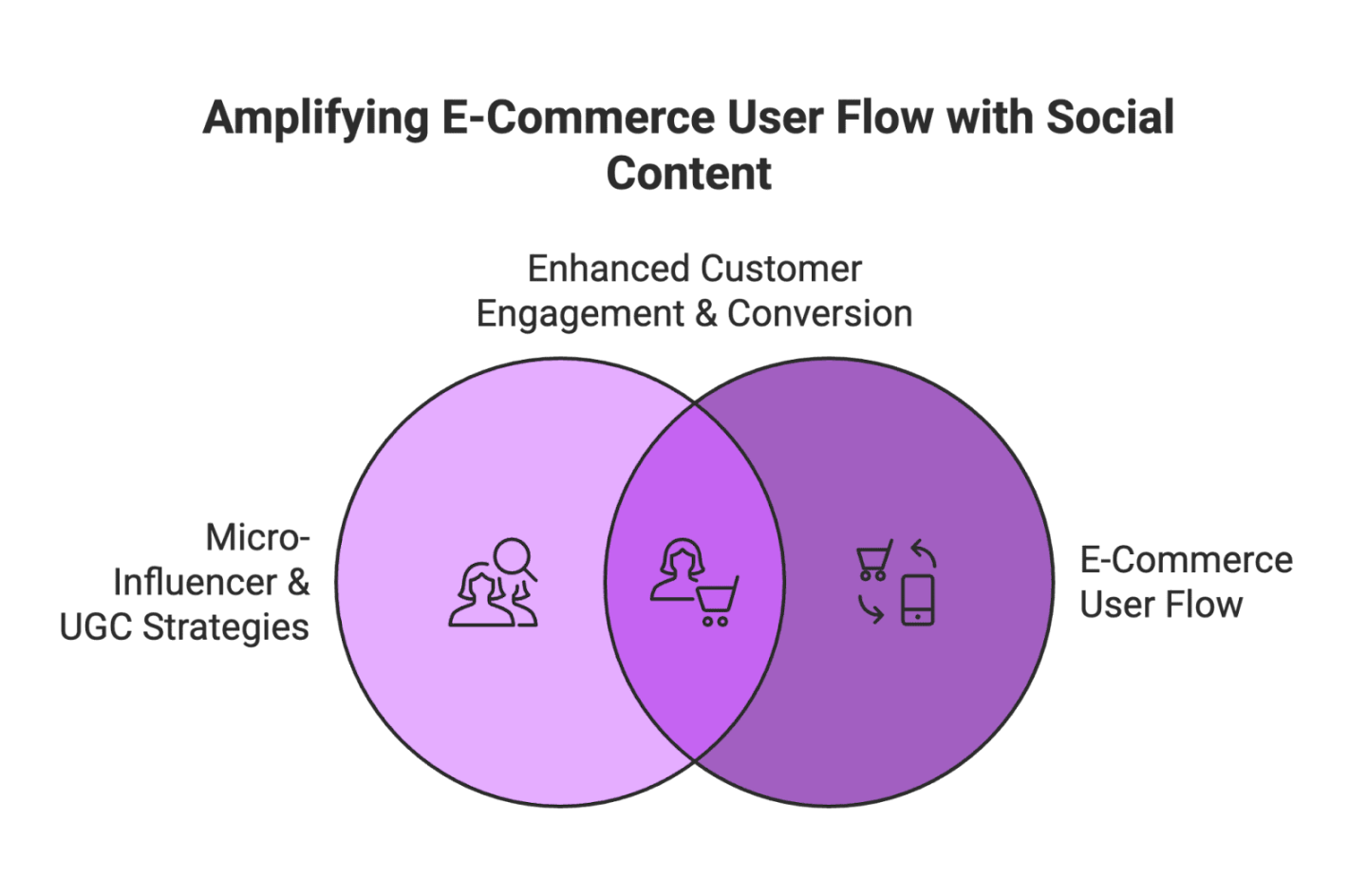
Now, let’s talk about those special keywords: micro-influencers, UGC, content creators, and how they intersect with e-commerce user flow. At first glance, you might think influencer marketing and UX design are separate topics – one is about driving traffic and social buzz, while the other is about on-site navigation and conversion. In reality, they work hand-in-hand. Influencer and user-generated content strategies can turbocharge each stage of the user flow by enhancing awareness, trust, and engagement.
Here’s how micro-influencers and UGC fit into the e-commerce user journey:
To summarize the impact, here are some key benefits and outcomes when you effectively weave micro-influencer marketing and UGC into your e-commerce strategy:
Incorporating micro-influencer and UGC strategies doesn’t replace good UX design and solid fundamentals – rather, it enhances them. Think of it this way: a great website user flow removes barriers and smooths the path, while influencer and UGC content adds fuel to the journey, motivating and reassuring users as they move along. Brands that master both are positioning themselves for maximum conversion potential.
Understanding what e-commerce user flow is and why it matters is the first step toward optimizing your online business for more sales. It’s all about seeing your website through the eyes of your customer: from the moment they discover you (perhaps via a micro-influencer’s Instagram post or a Google search) to the moment they complete a purchase (and even beyond, as they ideally become repeat buyers or advocates). By carefully designing each step of this journey – and continuously refining it through data and user feedback – you ensure that fewer customers slip through the cracks.
Remember that modern e-commerce is not just about a slick website in isolation; it’s about the ecosystem of influence and experience. Leveraging micro-influencers, content creators, and UGC can significantly amplify the effectiveness of your user flow. These elements build the trust and authenticity that keep users engaged and confident as they move toward checkout. As we’ve seen, shoppers crave authenticity and social proof – and integrating those into your funnel can yield tangible lifts in conversion rates and customer loyalty.
For beginners, start with mapping out your current user flow. Identify the pages and steps a typical customer goes through and note where you might be losing them. Tackle obvious pain points first (slow pages, confusing layout, etc.). For more advanced marketers, delve into analytics and experiment with incorporating UGC or influencer content at various touchpoints. You might A/B test showing a testimonial video on the product page, or adding an influencer quote on your landing page, to see if it boosts engagement. Continually iterate on both the UX side (flow, design) and the content side (UGC, social proof).
In summary, e-commerce user flow is the backbone of your online sales process. When optimized in tandem with savvy marketing (like micro-influencer campaigns and UGC integration), it creates a powerful synergy – more people find you, more of them trust you, and more end up clicking that “Purchase” button. By investing in a smoother user experience and authentic content, you set your brand up not only for higher conversions but also for long-term customer satisfaction and word-of-mouth growth. And as platforms like Stack Influence demonstrate, scaling up these micro-influencer and UGC efforts has never been more accessible for brands of all sizes. Here’s to creating user flows that not only convert better but also delight your customers at every step of the journey!
Every aspiring content creator on YouTube has wondered, "How much money do YouTubers actually make?" Particularly when a channel grows to 1 million subscribers, it's tempting to imagine a life of luxury funded by vlogging. In reality, YouTube income depends on many factors – not just subscriber count. In this comprehensive 2025 guide, we'll break down how YouTube monetization works, what a creator with one million subscribers can roughly earn, and why even micro-influencers (with far fewer subscribers) can still turn a profit. We'll also explore key terms like CPM, sponsorships, e-commerce partnerships, and UGC (user-generated content) so you get the full picture of the YouTube money-making landscape.
Estimated YouTube Earnings (Monthly Ad Revenue)
Before diving into numbers, it's important to understand how YouTubers earn revenue. Successful content creators diversify their income through multiple streams, including:
The most common income source is advertising. Once eligible for monetization (currently requires at least 1,000 subscribers and other criteria), creators earn a share of the ad revenue from their videos. YouTube typically takes a 45% cut of ad earnings, leaving 55% to the creator. The rate you earn per view (known as CPM, cost per thousand views) can range from as low as $1–$2 to upwards of $10+, depending on your niche and audience.
Companies pay YouTubers to mention or promote products in videos. These deals can be extremely lucrative – sometimes bringing in more than ad revenue – especially for channels with dedicated, engaged audiences. For example, a tech gadget company or an Amazon seller might pay a tech YouTuber to review a new device, or a skincare brand might sponsor a beauty vlogger's content.
Established creators often launch their own merchandise (t-shirts, courses, apps, etc.) or even full-fledged e-commerce businesses. With a loyal subscriber base, selling products directly can significantly boost a YouTuber's income. It's not unheard of for creators to turn their personal brand into product lines on Shopify or Amazon.
Platforms like Patreon, YouTube Channel Memberships, or live-streaming features (Super Chat, etc.) allow fans to directly support their favorite creators. While these might not apply to every channel, they can be a steady source of monthly income, especially for creators who have a strong community or offer exclusive content.
These avenues mean that subscriber count alone doesn't tell the whole story of a YouTuber's earnings – but it does correlate with potential view counts, which drive ad revenue and attract sponsorships. Now, let's get specific about that magic number: one million subscribers.
The phrase "pay for 1 million subscribers" is a bit misleading – YouTube doesn't cut a check just because you hit a subscriber milestone. Instead, income comes from the views and engagement those subscribers generate. So, the real question is: with one million subscribers, how many views do you get and how much money can that translate into?
Let's break it down with a hypothetical scenario for a channel with 1,000,000 subs:
The key takeaway: 1 million subscribers might roughly translate to five figures of ad revenue per month, but there's a big depends attached to that number. To visualize this, the chart below compares estimated monthly ad earnings for channels at three different subscriber levels under two ad rate scenarios (a low $2 CPM vs. a higher $5 CPM):
An important factor in YouTube earnings is the type of content you make – in other words, your niche. Advertisers pay different rates depending on the audience they're trying to reach. For example, an entertainment vlog may get lots of views but advertisers might only pay a few dollars per thousand views, whereas a finance or enterprise tech channel could command much higher ad rates because the viewers are more valuable to advertisers (they might be prospective buyers of high-value products or financial services).
You might be thinking, "Well, I don't have anywhere near a million subscribers – can I still make money on YouTube?" Absolutely. In fact, many micro-influencers (let's say channels in the 10k–100k subscriber range) are monetizing their content quite successfully, though their strategies might differ a bit from the biggest YouTubers.
For smaller channels, ad revenue is modest (for example, a 50,000-subscriber channel might get on the order of 50k–150k views a month, which at maybe $3–$5 CPM only brings a few hundred dollars). The real advantage micro-influencers often have is a tight-knit, engaged community and a specific niche. This makes them attractive to brands for sponsorships and collaborations. A company would sometimes rather work with 20 micro-influencers who each have 50k highly engaged followers than one mega influencer with a million passive followers.
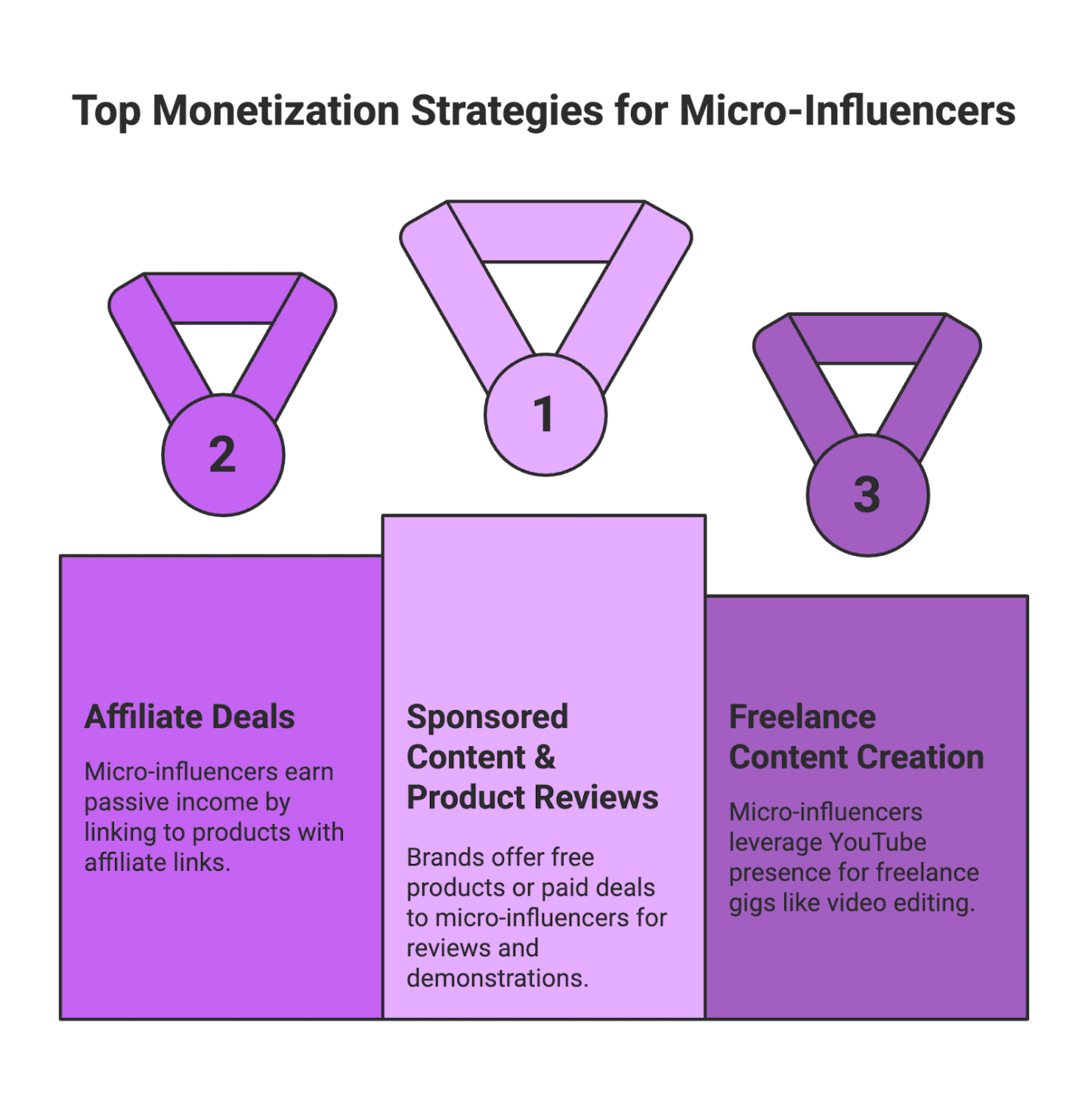
Micro-influencers can monetize by:
Even with a few thousand subs, you can start getting free products or paid deals from brands in your niche. For instance, an outdoor gear company might send a camping YouTuber (say 20k subs) some free equipment to review, or a small beauty startup might pay a micro-influencer to demonstrate a new skincare line. These partnerships often come through networking or specialized platforms.
Smaller creators can leverage affiliate marketing just like big channels. If you have a focused niche (e.g., photography tutorials), linking to your gear on Amazon with affiliate links can generate a trickle of passive income that adds up.
Some micro-influencers leverage their YouTube presence to get freelance gigs – for example, video editing, photography, or social media consulting. Your YouTube channel acts as a portfolio showcasing your skills and personality.
In the context of brand partnerships, user-generated content and authenticity are key. Brands (including many e-commerce companies and Amazon sellers) are eager to get real people talking about their products. This is where micro-influencers shine – they produce relatable, trustworthy UGC that audiences love. Platforms like Stack Influence, for example, connect micro-influencers with e-commerce brands for campaigns, making it easier for up-and-coming creators to land sponsorships even with a smaller follower count. In many cases, a micro-influencer can earn more from a single well-negotiated brand deal or free product haul than from months of YouTube ad revenue.
There's no fixed pay rate for a million views on YouTube – it varies. On average, a YouTube video reaching 1,000,000 views can earn roughly $2,000 to $5,000 USD from AdSense. This assumes a typical range of $2–$5 CPM (cost per 1,000 views). However, the actual payout could be lower or higher. For example, if those million views are on a personal finance video (high CPM niche) watched mostly by viewers in the US with ads enabled, the earnings could exceed $5,000. On the other hand, a million views on a comedy vlog with a younger international audience (lower ad rates or more ad-block usage) might fetch well below $2,000. The range is huge because it all comes down to ad rates and viewer specifics.
No, YouTube does not pay per subscriber. YouTube pays creators for ad views (and some other engagement metrics like YouTube Premium watch time), not for subscriber count. Subscribers are valuable because they tend to correlate with more views and a loyal audience base – which in turn leads to more opportunities to earn money through ads and other means. Think of subscribers as potential recurring viewers. Hitting milestones like 100k or 1M subscribers can attract sponsor interest and prestige, but YouTube itself only pays you when those subscribers (and other viewers) actually watch your videos (and the ads on them). There is one indirect way subscribers matter: you need at least 1,000 subscribers (along with 4,000 hours of watch time in the past year, or other criteria for Shorts) to join the YouTube Partner Program and start earning ad revenue at all.
To officially start earning money through YouTube's built-in monetization, you need to join the YouTube Partner Program (YPP). As of 2025, the requirements to join YPP are:
Once you meet these thresholds and get approved, you can start earning from ads. However, you don't need to wait for 1,000 subs to monetize in other ways. Even with a smaller channel, you can make money through methods like sponsorships, affiliate links, or merchandise sales outside of YouTube. Many creators start these income streams well before hitting the official YPP requirements.
Having 1 million subscribers is a huge accomplishment and can certainly unlock a substantial income on YouTube – often in the six-figures annually if the audience is leveraged well. But as we've seen, the money a YouTuber makes is not a simple flat rate per subscriber. Factors like content niche, viewer demographics, engagement, and diversification of income streams (from UGC sponsorships to e-commerce ventures) all play significant roles in determining earnings.
For aspiring YouTubers and content creators, the key lessons are: focus on building an engaged community, understand who your viewers are, and explore multiple monetization paths (ads, brand deals, products, etc.). Micro-influencers should take heart that you don't need a million subs to start earning – even a lean, passionate audience can be monetized with the right approach, authenticity, and partnerships.
In the ever-growing creator economy, there's room for channels of all sizes to thrive. Whether you're reviewing gadgets, vlogging your daily life, or teaching DIY crafts, you can find ways to make your passion profitable. Success on YouTube isn't overnight or guaranteed, but with consistency and creativity, you can grow both your subscriber count and your bank account.
In the world of e-commerce, Amazon sellers often face a crucial decision: whether to use Fulfillment by Amazon (FBA) or Fulfilled by Merchant (FBM) for their products. Both FBA and FBM have their own advantages and drawbacks, and the best choice depends on your business model, product type, and resources. This comprehensive guide breaks down FBA vs FBM in a neutral, fact-based manner – covering definitions, pros and cons, key factors to consider, and even some real-world data insights – to help Amazon sellers (from solo entrepreneurs to major brands) make an informed decision. We’ll also touch on how this choice can impact other aspects of your business, such as the time you have for marketing (think working with micro influencers and content creators to generate UGC) and overall customer experience.
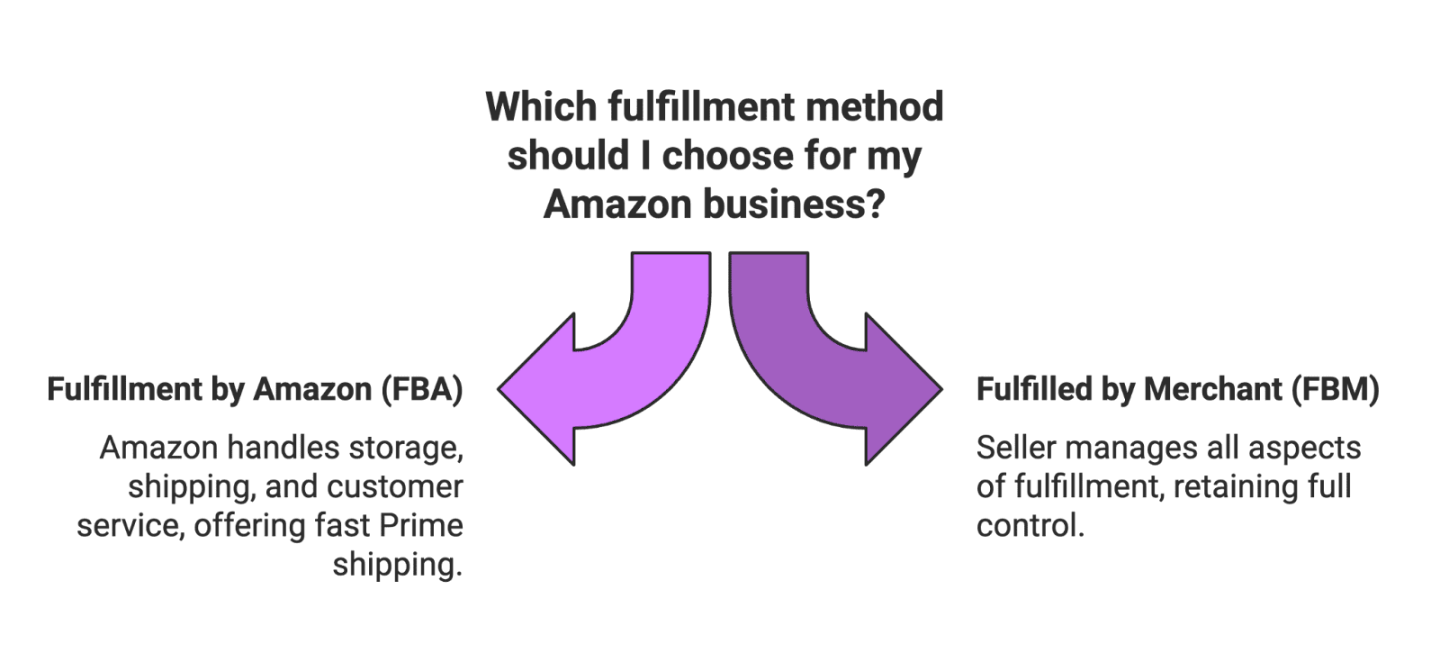
Before diving into comparisons, let’s clarify what each fulfillment method means:
In simpler terms, FBA is Amazon’s fulfillment on autopilot, while FBM is a DIY approach to fulfillment. Neither is inherently “better” in all cases; many Amazon sellers use one or the other, or even a combination of both. In fact, nearly all Amazon sellers use FBA in some form, but a significant portion also fulfill orders themselves via FBM.
Fulfilled by Merchant (FBM) can be the better option for certain sellers and situations. You might lean toward FBM in the following cases:
In summary, FBM is ideal for Amazon sellers who have the capability to fulfill efficiently on their own and desire greater control over the fulfillment process and customer interaction. It’s often favored by more experienced sellers or those with unique products that don’t fit Amazon’s FBA cost structure. By handling fulfillment, you keep more of the process (and potentially profit) in-house – but you also take on the responsibility for timely delivery and customer satisfaction.
Fulfillment by Amazon (FBA) is extremely popular for good reason – it streamlines operations for sellers. Consider using FBA in the following scenarios:
In short, FBA is often the go-to choice for sellers who prioritize convenience, Prime eligibility, and the ability to scale without investing in logistics infrastructure. By paying Amazon’s fees, you essentially hire a world-class fulfillment service. This can be a game-changer for small businesses and content creators looking to monetize products, as it lowers the operational barriers to selling nationwide (or globally) on Amazon. Of course, the trade-off is giving up some control – and a slice of your revenue – to Amazon in exchange for that convenience.
Choosing between FBA and FBM isn’t one-size-fits-all. You should evaluate several key factors in the context of your business. Below are seven of the most important considerations:
By weighing these factors, you can gauge which fulfillment method aligns with your business needs and customer expectations. Often, newer Amazon sellers start with FBA to take advantage of Amazon’s logistics while they learn the ropes, whereas more seasoned sellers may mix and match methods as they optimize for cost and control. Remember that the “best” choice can vary even between products in your catalog – don’t be afraid to use a hybrid strategy if appropriate.
It’s worth looking at some data on how FBA and FBM sellers perform, on average, in terms of sales and profits. This gives insight into the outcomes other sellers are experiencing with each model:
Figure: A comparison of seller performance metrics between FBA and FBM, based on a 2023 survey of Amazon sellers. The left pair of bars shows the percentage of sellers earning over $25,000 per month in revenue, and the right pair shows the percentage of sellers reporting profit margins above 20%. Notably, 28% of FBM sellers reported earning more than $25k per month, compared to only 12% of FBA sellers. And while healthy profit margins are common in both groups, slightly more FBM sellers (38%) achieved over 20% profit margins than FBA sellers (35%).
According to Jungle Scout’s 2023 State of the Seller report, FBM sellers were more likely to be high-revenue earners and have very high margins, despite FBA being the more widely used method. This might seem surprising at first, but there are a few possible explanations:
It’s important not to misconstrue this data as “FBM is more profitable than FBA” universally. Rather, it tells us that both models can lead to success, and that there are thriving sellers in each camp. FBA’s benefits in scaling and conversion can drive huge sales, and FBM’s cost savings can boost margins – it all comes down to how you leverage each model for your particular business. Some of the most successful Amazon businesses actually use a combination: for instance, utilizing FBA for most products but switching to FBM for certain high-cost or niche items, or during stockouts.
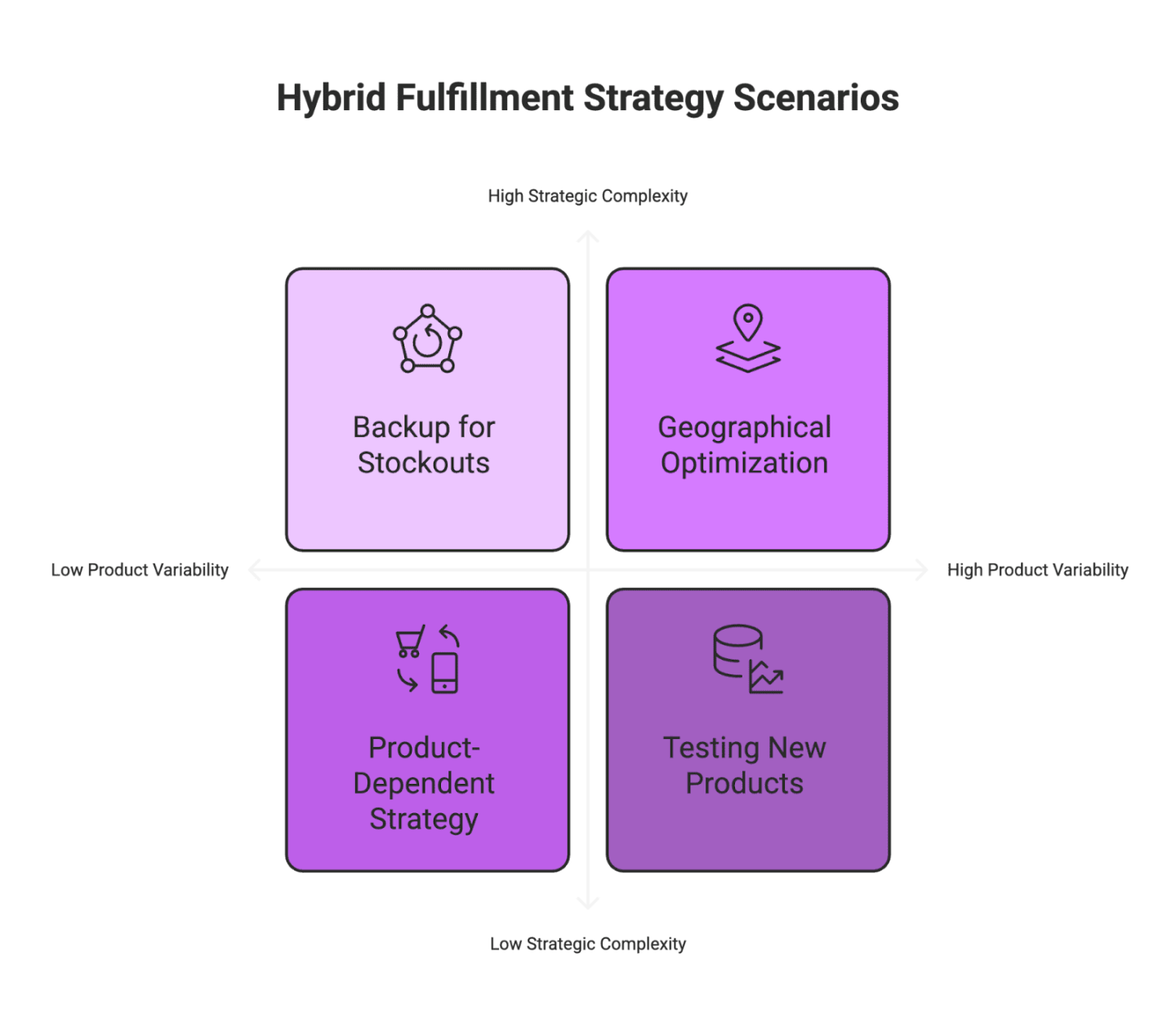
You don’t necessarily have to choose only one fulfillment method. In fact, a number of sellers embrace a hybrid strategy, leveraging both FBA and FBM to optimize results. Roughly 1 in 7 Amazon sellers use a mix of FBA and FBM for their business, and Amazon fully allows this flexibility. Here are a few scenarios where using both makes sense:
Using both FBA and FBM requires more management – you’ll be handling some self-fulfillment while also sending stock to Amazon – but it offers tremendous flexibility. Essentially, you can capitalize on FBA’s strengths where they matter and use FBM to mitigate FBA’s weaknesses. Many advanced Amazon sellers find that this balanced approach maximizes their overall business performance. Just be sure to keep a close eye on inventory levels in both channels and stay organized, so you don’t confuse orders or oversell a product.
In the FBA vs FBM debate, there is no one-size-fits-all winner – the “better” option depends on your unique business priorities. FBA offers unparalleled convenience, access to Prime customers, and scalability, making it incredibly powerful for many Amazon sellers (especially those who value a hands-off approach and fast growth). FBM, on the other hand, grants you greater control, potentially lower costs for certain products, and a more personal touch in fulfillment, which can be advantageous for specific situations and more experienced sellers.
When deciding between FBA and FBM, weigh the factors we discussed: your product type, sales velocity, resources, desire for control, and cost structure. It may help to calculate the numbers (use Amazon’s revenue calculator or spreadsheets) to see profitability under each model. Also, consider starting with one method and adding the other as you scale – flexibility is key, and Amazon allows you to change your fulfillment strategy as you learn.
Keep in mind, whichever fulfillment route you choose, success on Amazon also depends on driving traffic and creating a great customer experience. This is where your time saved (especially if using FBA) can be reinvested into marketing and brand building. Many thriving Amazon brands focus on building their brand presence through micro-influencers, content creators, and UGC (user-generated content) to complement their fulfillment strategy. For instance, using FBA might free up time to collaborate with micro influencers who can promote your product on social media, creating buzz and authentic content that draws shoppers to your listing. In summary, both FBA and FBM can be paths to success on Amazon – it’s all about aligning the fulfillment method with your business’s needs and goals. Stay neutral and open-minded: you can even use both and adjust as your business evolves. By thoughtfully managing your fulfillment, and simultaneously focusing on product quality and marketing (perhaps via influencer-driven campaigns and excellent customer service), you’ll put your Amazon business on track to grow and thrive, no matter which fulfillment model you deploy.
Brand advocacy marketing is all about turning your happiest customers, employees, and fans into outspoken champions for your brand. In simple terms, it’s a strategy to inspire real people – not just your marketing team – to spread positive word-of-mouth about your products or services. These enthusiastic supporters (often called brand advocates or brand ambassadors) promote your brand because they genuinely love it, not because they’re paid to. In the world of micro-influencer marketing and e-commerce (think Amazon sellers and direct-to-consumer brands), leveraging brand advocacy can be a game-changer. It helps build trust through authentic content, like customer reviews, social media posts, and other user-generated content (UGC), which today’s shoppers crave. Let’s dive into what brand advocacy marketing entails, why it’s so powerful, and how you can harness it – with some tips for working with micro influencers, content creators, and even platforms like Stack Influence along the way.

Brand advocacy marketing is a strategy in which companies encourage and empower individuals who love their brand to actively promote it to others. Those individuals – your brand advocates – might be loyal customers, satisfied product users, content creators, micro-influencers, or even your own employees. What makes brand advocacy special is that it’s driven by genuine enthusiasm and firsthand experience. Unlike a typical influencer marketing campaign (where a social media influencer is paid or given freebies to promote a product), a brand advocacy approach relies on more organic, voluntary endorsements. In other words, the advocate supports your brand not just for compensation but because they believe in it and have had positive experiences.
An advocate’s activities can include writing glowing reviews, referring friends, creating unboxing videos or how-to content featuring your product, sharing photos or testimonials on social media – basically any positive buzz about your brand. This is essentially modern-day word-of-mouth marketing, amplified by social networks and communities. The key difference from traditional advertising is authenticity: brand advocates speak as happy customers or knowledgeable insiders, so their endorsements feel trustworthy and relatable to other consumers. For example, a content creator on Instagram who genuinely loves a skincare product might rave about it to their followers without being prompted – that’s brand advocacy in action. Even employees can be powerful brand advocates; take Starbucks, which calls its employees “partners” and encourages them to share their coffee passion and company values with customers, building trust and loyalty through personal interaction.
It’s worth noting that influencers can also become brand advocates – especially micro-influencers who often have a closer, friend-like rapport with their audience. The key is developing a long-term relationship with influencers so that they truly understand and enjoy your product, blurring the line between a paid promotion and genuine advocacy. When a micro-influencer authentically loves your brand, their followers perceive their recommendations as real and credible endorsements, not just ads. This is incredibly valuable for e-commerce brands in niche markets; a micro-influencer’s heartfelt recommendation can carry more weight than a generic celebrity ad because it feels like advice from a peer.
Why invest time in cultivating brand advocates? The short answer: people trust other people more than they trust advertising – and trust drives sales. Brand advocacy marketing offers several compelling benefits for companies, particularly those in the e-commerce space. Here are the key advantages:
Recommendations from real customers or peers come across as far more credible than brand-generated content. In fact, 92% of individuals trust word-of-mouth recommendations from friends and family, making it one of the most trusted forms of marketing. Similarly, 88% of people trust online reviews from other consumers as much as personal recommendations. This means that when your advocates talk up your product – whether through a five-star review, a YouTube unboxing, or an Instagram post – consumers are inclined to believe it. In contrast, traditional ads and branded social media posts are met with more skepticism. Authentic advocacy bridges that trust gap, helping new customers feel confident in choosing your brand over others.
Brand advocacy can be a very cost-effective marketing approach. Since advocates share their love for your product voluntarily (or for small perks, not large fees), you’re essentially getting free promotion. You’re not paying for prime-time TV spots or extravagant ad campaigns – yet your message still spreads. This organic promotion can significantly cut marketing costs while still driving results. A happy customer telling ten friends about you costs you nothing, but could be more effective than a paid ad. Plus, consider that digital advertising costs keep rising every year, and many consumers use ad blockers or ignore ads. Advocacy marketing circumvents those hurdles. (Tesla famously spends $0 on traditional advertising and instead relies on customer advocacy and referrals – showing how powerful and cost-efficient word-of-mouth can be.)
Every time an advocate talks about your brand, they expose it to their network, effectively expanding your reach. One person’s tweet or TikTok video about your product can be seen by hundreds or thousands of others, many of whom may be outside your usual target demographics. Advocates help you tap into new customer segments through peer-to-peer sharing. For example, if you sell niche eco-friendly pet products on your e-commerce store, a devoted customer posting about it in a pet owner Facebook group could introduce your brand to an entire community you couldn’t easily reach with direct ads. Ten brand advocates each sharing content might reach thousands of people collectively – and those people are more likely to pay attention. (One study found that content shared by everyday advocates can drive 4× the brand lift of paid advertising!) In essence, your advocates are like a marketing megaphone, broadcasting your brand to circles you might never access otherwise.
Because brand advocates are often your most engaged customers, they can provide valuable feedback and insights. Their conversations and reviews can alert you to what you’re doing right and what could be improved. By listening to advocates, you get a window into the consumer’s perspective that can inform product development, customer support, and marketing strategy. In many cases, advocates won’t hesitate to tell you (and others) what they love about your product and where you might have gaps. This honest feedback is gold – it can help you innovate and stay responsive to market needs. In fact, involving loyal customers in beta tests or asking for their ideas can even turn them into co-creators of your brand’s success.
Building a strong brand advocacy program takes planning and consistent effort – but it’s very achievable, even for small businesses and e-commerce sellers. Here are four key steps to get you started in creating your own army of brand advocates:
Start by pinpointing who your enthusiastic fans are. These could be loyal customers who repeatedly purchase or leave positive reviews, engaged followers on social media who often comment or share your posts, micro-influencers or content creators in your niche who already use your product, and even your employees or business partners who believe in your mission. Dig into your customer data and online community: who’s giving you shout-outs or high ratings? Who refers others to you or tags your brand in their content? Those are your prime advocate candidates. For example, a fashion retailer might notice a group of customers frequently sharing outfits on Instagram – those customers could be invited to a formal advocacy or ambassador program to deepen their involvement. Don’t overlook everyday consumers with small followings; a lot of Amazon sellers find that nano- or micro-influencers (with under 10k followers) who love their product can be hugely effective advocates precisely because they come off as “normal” satisfied customers.
Once you’ve identified potential advocates, reach out and build a relationship. Thank them for their support and let them know you value their voice. You can create a simple advocacy program or insiders club – offer these folks exclusive perks like early access to new products, sneak peeks, discount codes, or invite-only events. The idea is to make them feel like VIPs in your brand community. Also, equip them with resources to make advocating easier. This could mean providing shareable content (images, videos, share buttons), clear brand messaging or product information, and maybe a dedicated contact person at your company for support. For instance, if you have a new product launch, you might send your advocates a free sample or a glossy info sheet so they’re “in the know” and excited to talk about it. The easier and more rewarding you make it for advocates to share your brand, the more they’ll do it. (Remember, advocacy is voluntary – so nurture those relationships genuinely. Often, just a personal email or a shout-out thanking a customer for a great review can turn a happy customer into an advocate for life.)
To keep advocates motivated, show appreciation for their efforts. Recognize them publicly when appropriate – for example, feature a customer testimonial on your website or highlight an “Advocate of the Month” on social media. This not only delights the advocate, but also signals to others that you truly value your community. Additionally, consider rewards that fit your brand and budget. These don’t have to be lavish; they could be loyalty points, small gifts, exclusive discounts, or early access to sales. Some brands set up formal referral or affiliate programs so that advocates get a little something (like a $10 credit or a freebie) for every new customer they bring in. For example, many e-commerce companies use referral codes – if an advocate shares a code that gives their friends a discount, the advocate might earn rewards or commissions on any resulting sales. The key is to incentivize advocacy without making it feel transactional. You want to reward genuine enthusiasm, not turn it into solely a money-making scheme. Done right, rewards are a “thank you” that encourages even more advocacy. A great case in point is the Glossier Ambassador program, which rewards passionate customers for sharing their experiences – by giving them perks and a sense of insider status, Glossier turned tons of regular customers into vocal brand ambassadors who often act like micro-influencers for the brand.
Like any marketing initiative, you’ll want to keep an eye on how your advocacy efforts are performing and be ready to adapt. Set some key performance indicators (KPIs) up front – for example, the number of referral sales per month, social media engagement rates, or increase in customer reviews/testimonials. Track these metrics over time. Is your brand being mentioned more online? Are you seeing upticks in website traffic from user referrals? Perhaps you gave advocates a unique hashtag or discount code – monitor how often it’s used. We’ll discuss specific ways to measure impact in the next section, but the takeaway here is to close the feedback loop. If certain types of content or certain advocates drive a lot of engagement or sales, take note and focus your efforts there. If something isn’t working (e.g. nobody is using that special hashtag), be ready to tweak your approach. An advocacy program isn’t a “set and forget” tactic – it’s an ongoing relationship that you nurture and refine. The most successful brands treat their advocate community with care, listen to their feedback, and continuously find ways to make the program more fun, easy, and valuable for those involved.
Tip: As your advocate community grows, managing it can become time-consuming. This is where technology can help. Consider using an influencer relationship management or brand advocacy platform to streamline the process. For example, Stack Influence is a platform that connects e-commerce brands (including Amazon sellers) with a network of micro-influencers and helps automate campaigns. Tools like this can make it easier to find the right micro-influencers, coordinate sending out products or promo codes, and track the UGC they create. By leveraging such platforms, you can scale up your brand advocacy efforts without losing personal touch – ensuring your advocates stay engaged and your campaign results are organized in one place.
So you’ve got some brand advocates spreading the word – fantastic! But how do you know if it’s actually moving the needle for your business? Measuring brand advocacy’s impact can be a bit tricky since it often works through word-of-mouth and indirect influence. However, there are several concrete metrics and methods you can use to gauge success. Here are some important areas to monitor:
One of the first places to look is your social media metrics. Are you seeing a boost in engagement thanks to your advocates’ activity? For example, track metrics like shares, comments, mentions, and tagged posts. If you’ve launched a campaign encouraging customers to post with a specific hashtag or to share their stories, how much traction is it getting? An uptick in user-generated posts or brand mentions is a strong sign your advocacy program is generating buzz. You can use social listening tools to quantify this “buzz” – measuring the volume of mentions and the sentiment (positive/negative tone) of what people are saying about your brand.
Also pay attention to who is engaging. Are your advocates’ posts bringing new followers to your accounts or more traffic to your site? If a micro-influencer advocate on TikTok makes a video about your product and it goes mildly viral, you might see a spike in your TikTok profile views or a jump in traffic from TikTok that week. These are indicators that advocacy is extending your reach. Many brands create custom campaign hashtags to help track this kind of activity. For instance, if your brand is Bella’s Beauty Boxes, you might ask advocates to use #BellasBeautyUnboxed in their posts – then you can easily search that hashtag to see how many people posted, the engagement on those posts, and estimate combined reach.
Lastly, ensure the quality of engagement aligns with your target. It’s not just about volume; it’s about reaching the right audience. Check if your advocates’ followers (or the people interacting with the advocacy content) match your customer profile. If not, you might need to adjust who your advocates are or what platforms you focus on. The more aligned an advocate’s audience is with your brand’s ideal customer, the more impactful their recommendations will be. For example, a tech gadget brand will benefit more from advocacy on a tech forum or YouTube channel than from random Twitter mentions that reach uninterested folks. In summary: track your social media numbers and growth trends, and attribute any positive changes to your advocacy efforts when you can.
Because brand advocacy often manifests as customers sharing their experiences, reviews and ratings are a crucial part of the picture – especially for e-commerce and Amazon sellers. Keep a close eye on your product reviews, testimonials, and customer feedback across all channels. Are you getting more (and hopefully positive) reviews on your website or Amazon listing after initiating an advocacy program? What are customers saying in those reviews – do they mention referrals, community, or seeing someone else talk about the product? Analyzing review content can provide qualitative insight into the ripple effect of advocacy.
It’s a good practice to actively solicit feedback as part of your advocacy strategy. For instance, after a purchase, you might send a follow-up email asking the customer to rate the product or share their thoughts. Advocates often respond to these requests since they’re already engaged. If you run a loyalty or ambassador program, you could periodically survey members about their satisfaction and whether they’ve recommended the brand to others. One popular metric that ties into advocacy is the Net Promoter Score (NPS) – basically asking customers “How likely are you to recommend us to a friend?” If your NPS rises over time, that’s a strong indicator that you’re creating more potential advocates (since a high NPS means more customers willing to advocate for you).
Also, consider tracking mentions on external review sites or forums. For example, if you sell software or electronics, you might see advocates recommending you on Reddit or in Facebook groups. If you’re a local business or a seller on a platform like Etsy, check if folks are singing your praises in community forums. Set up Google Alerts or use brand monitoring tools to catch these less obvious instances of advocacy. The goal is to gather both quantitative data (number of new reviews, average rating improvements, NPS score, etc.) and qualitative data (the actual content of comments and feedback) to get a full picture of how customer sentiment is trending. If you notice more positive buzz and recurring themes like “heard about this from…” or “I tell everyone about this product,” your advocacy marketing is on the right track.
At the end of the day, a key question is: Are your advocates helping drive sales or other valuable actions? To answer this, look at your website analytics and sales data for evidence of referral influence. If you run a referral program (where advocates have unique links or codes), this part is straightforward – you can directly see how many clicks and purchases came from those referrals. Even if you don’t have formal referral tracking, there are ways to infer advocacy-driven sales. For instance, you can check your analytics for traffic sources: Are you seeing more visitors coming from social media or personal blogs where an advocate posted? Did a particular YouTube review video send a bunch of people to your site? Many e-commerce sites will track the “referrer” of web traffic, so you might literally see “youtube.com” or a specific blog URL show up in your analytics – clues that an advocate mentioned you.
Beyond traffic, look at conversion metrics during the period of your advocacy campaigns. Has your conversion rate improved? Are overall sales trending upward? Ideally, you might compare the periods before and after implementing an advocacy initiative. For example, say you started an ambassador program in Q1 – by Q2/Q3, did your sales or sign-ups increase more than usual? If you have a promo code that advocates share, track how many times it’s redeemed. Some brands give each advocate a personalized code (like MARIA10 for 10% off) to share; this not only rewards the advocate but also lets you count the exact number of conversions each advocate drives. Over time, you can identify your top-performing advocates this way (perhaps one micro-influencer brought 50 new customers – time to maybe deepen that partnership!).
Another important metric is Customer Acquisition Cost (CAC) and Lifetime Value (LTV). Advocacy tends to lower your CAC (because referrals are relatively low-cost) and potentially increase LTV (because referred customers often stay loyal). If you have the ability, compare the LTV of customers acquired through referrals or word-of-mouth to those acquired through paid ads. You might find the former group spends more or sticks around longer – a sign that advocacy marketing brings in high-quality customers. One stat that illustrates advocacy’s impact is that when a friend or family member makes a recommendation, it is 50× more likely to lead to a purchase than a non-personal recommendation. And in some industries, referrals and advocate-driven sales account for over half of new customer acquisition. Keep these kinds of outcomes in focus: the ultimate measure of success is that your community building and advocacy efforts help your business grow in a cost-efficient way.

Once you have the basics in place, you’ll want to continuously nurture and amplify your brand advocacy. Here are some tips and best practices to get even more impact from your advocates:
Remember that every customer or follower could become an advocate if you engage them right. Make your customers feel seen and heard. This can be as simple as responding promptly to comments and messages, or creating community forums/groups for your brand. When people feel a personal connection – like your brand isn’t a faceless store but a group of friendly humans – they’re more likely to speak positively about you. Share behind-the-scenes stories, introduce your team (employee spotlights), and communicate your brand’s values openly. Showing the human side of your business builds emotional loyalty and trust.
Proactively invite your customers and fans to create content. Come up with fun campaigns or challenges that inspire UGC. A classic example is Apple’s #ShotOniPhone campaign, which encouraged users to share their iPhone photos and ended up as a huge showcase of customer creativity. You can do something similar on a smaller scale: maybe a photo contest featuring your product, or a hashtag that fans can use to show off how they use your item in everyday life. (For instance, a kitchenware brand could prompt users to post their beautiful home-cooked meal photos using a specific hashtag.) Recognize or even reward the best submissions to fuel participation. UGC not only provides you with tons of authentic content to republish, but it also turns customers into advocates by giving them a voice. When people proudly share content related to your brand, they are effectively endorsing you to all their friends.
If you haven’t already, consider running a micro-influencer campaign to jumpstart advocacy in key communities. Micro-influencers (typically 1k–100k followers) often have highly engaged, niche audiences – exactly the kind of tight-knit circles where peer recommendations carry a lot of weight. Partner with micro-influencers who genuinely align with your brand’s niche and values (it’s important they truly like your product). Instead of a one-off sponsored post, approach it as a relationship: send them your product to try, ask for their honest feedback, and if they love it, welcome them into your advocate program for a long-term collaboration. Their content will feel more like authentic storytelling than advertising, which benefits you both. Also look at communities like subreddits, Facebook Groups, or forums relevant to your product – these are gold mines for advocacy. If you can get respected members of a community (maybe a moderator or a veteran contributor) to speak positively about your brand (again, only if it genuinely fits their interests), it can spark many word-of-mouth referrals. Always approach community advocacy with authenticity and transparency – blatant marketing ploys can backfire. But if an influential community member becomes a true fan, their endorsement is priceless.
Finally, remember that brand advocacy is a long-term play. Don’t be discouraged if it starts small. It takes time to cultivate genuine advocates and build that community. The key is to remain consistent – keep delivering great products and great customer experiences, keep engaging with your audience, and keep recognizing your advocates. Over time, the effect of advocacy compounds. One person tells two, those two tell two more, and so on. Stay patient and authentic in your approach. Rather than pushing too hard or trying to manufacture fake advocacy, focus on earning it through quality and sincerity. If you remain customer-centric and make people feel good about supporting you, your advocacy program will naturally gain momentum. In the long run, you’ll have built an invaluable asset: a brand reputation bolstered by hundreds or thousands of voices besides your own.
In today’s hyper-competitive market – whether you’re running a new DTC startup, hustling as an Amazon seller, or marketing an established e-commerce brand – brand advocacy marketing should be in your toolkit. At its core, it’s about harnessing the goodwill you create through great products and experiences, and letting that goodwill echo far and wide through authentic voices. People trust people, and that’s why turning customers, micro-influencers, and employees into brand advocates is so powerful. It injects trust, credibility, and relatability into your marketing in ways traditional tactics can’t match.
By understanding what motivates your advocates, nurturing those relationships, and giving them platforms to share, you create a win-win dynamic: your biggest fans get recognition and a sense of community, while your brand gains amplified reach and trust in the marketplace. Remember the key principles – keep it genuine, provide value (don’t just take), and think long-term. Over time, your focus on advocacy can yield a loyal customer base that not only sticks with you but actively brings others along.
So, start small if you need to: reach out to one happy customer or one passionate micro-influencer and build from there. Celebrate each positive review and each customer post as a step toward a thriving advocacy engine. With consistency and care, you’ll find that brand advocacy marketing can elevate your business to new heights, powered by the very people who believe in you the most. And ultimately, there’s no marketing force more potent than customers who genuinely love you – they are your brand’s strongest voice. Embrace that, and watch the ripple effect transform your growth story.
In this blog, we’ll explore what UGC contests are, why they’re so powerful for e-commerce brands (from Amazon sellers to DTC startups), and how to run a successful UGC contest of your own. We’ll also look at real-world examples of UGC contests – different ones than you’ve seen elsewhere – to inspire your next campaign. Let’s dive in!
A UGC contest is a brand-run competition that encourages customers or followers to create and share their own content (like photos, videos, or social posts) featuring the brand’s product or message. Typically, the brand defines a theme or challenge and a unique hashtag, and participants enter by posting their content with that hashtag (often tagging the brand). In return, entrants get a chance to win a prize – anything from free products or gift cards to a bigger reward like cash or a feature in the brand’s marketing.
For example, a fashion retailer might ask customers to post a selfie wearing one of the brand’s outfits with a hashtag, with the best entry winning a $500 shopping spree. Or an Amazon seller could run a contest for the most creative unboxing video of their product. The key is that customers become content creators, producing authentic posts that promote the brand in a fun, engaging way. UGC contests effectively “outsource” content creation to your community – tapping into their creativity and enthusiasm. And because people love to share their experiences (and love winning prizes), these contests can generate a ton of buzz for your brand.
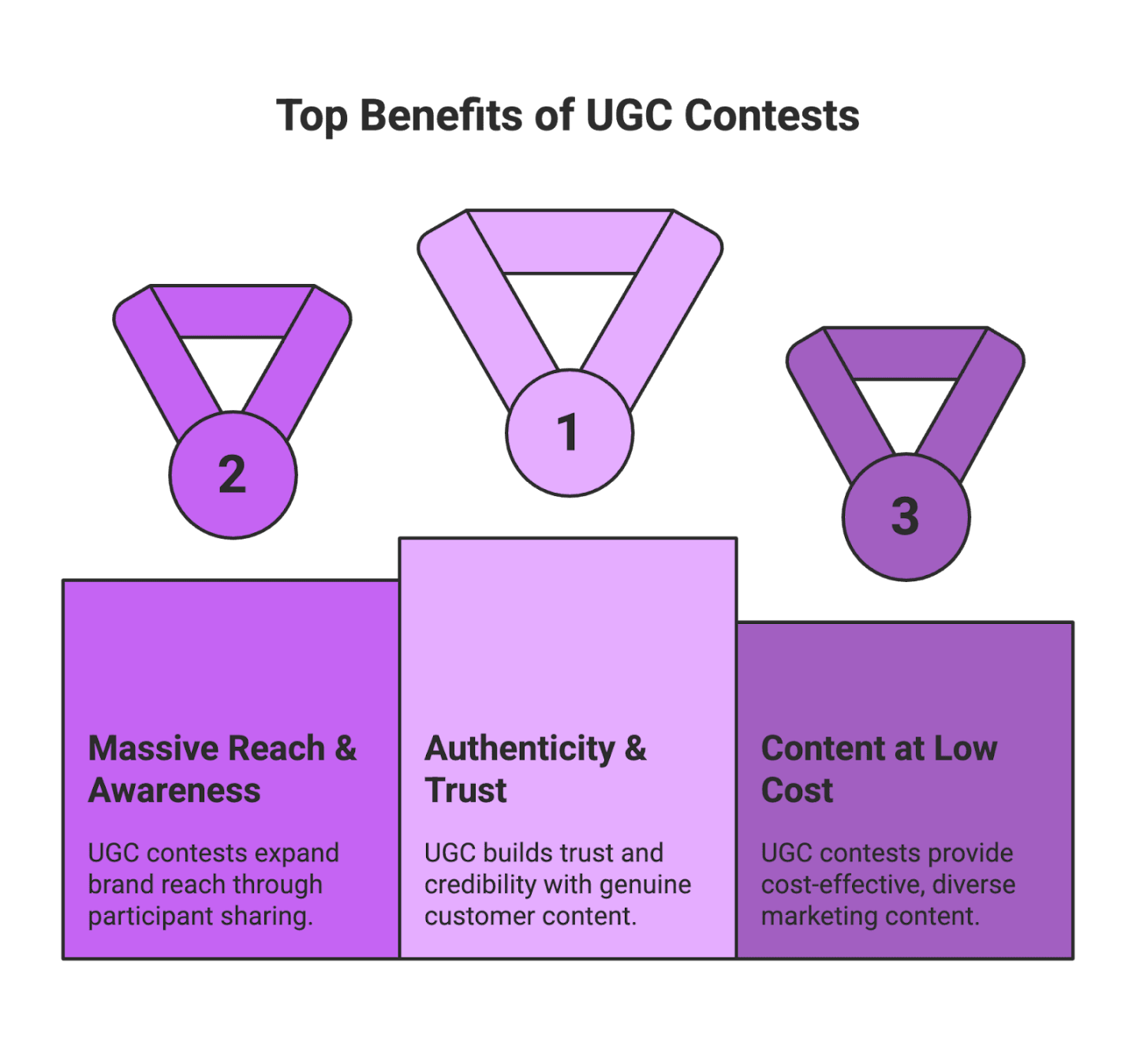
UGC contests aren’t just a gimmick – they deliver real value for brands, especially in the e-commerce space. Here are some of the biggest benefits of running a UGC contest:
When participants share contest entries on their own social profiles, your brand gets exposed to all of their followers. This built-in virality dramatically expands your reach without extra ad spend. Even a few dozen people posting about your product can potentially reach thousands of new eyes. In essence, each contestant becomes a micro–influencer spreading the word. This organic amplification is invaluable for brand awareness.
Producing high-quality marketing content in-house can be time-consuming and expensive. UGC contests flip the script by crowdsourcing content from your customers – essentially free marketing materials. You’ll collect a variety of photos, videos, and stories that you can repurpose in social media, on product pages, or in ads (with permission). Compared to hiring a creative agency, UGC is a bargain. In fact, 73% of marketers say UGC performs significantly better than branded content. You also get fresh perspectives: your fans might showcase your product in ways you hadn’t imagined, sparking new marketing ideas for you.
Today’s consumers are skeptical of polished brand ads. Content that comes from real users is perceived as far more genuine. Surveys show that 60% of consumers see UGC as the most authentic form of marketing. People trust the experiences of customers like themselves more than they trust the brand’s own messaging. By sharing customer-created content, you lend credibility to your brand. This trust translates directly into influence on purchase behavior – UGC can highly impact buying decisions for nearly 80% of people. Simply put, when your customers do the talking, other consumers listen.
UGC is a proven engagement booster on social media. Posts featuring UGC get 50% more engagement on platforms like Instagram and Facebook. All that liking, commenting, and sharing increases your visibility in the algorithm, attracting even more eyeballs. It’s a virtuous cycle: as engagement rises, so does brand recall and click-through. There’s also a clear link to sales: 82% of consumers are more likely to buy from a brand that incorporates UGC in its marketing. UGC contest campaigns often coincide with spikes in web traffic and conversions, as the buzz drives shoppers to check out your products. And if you sell on marketplaces – for example, Amazon – having a library of UGC (images, videos, reviews) can improve your product listings and boost your conversion rates.
If you’re an Amazon seller or e-commerce entrepreneur, UGC contests can bolster your social proof, which is crucial for conversion. For instance, a contest that generates authentic customer photos can provide you with a gallery of images to use in your Amazon listings or on your site. It can also encourage more reviews (since participants are engaging deeply with the product). From an SEO perspective, UGC contest pages or hashtags can drive user-generated content that improves your brand’s visibility on search engines and even on AI-driven search results, thanks to relevant keywords and genuine engagement. All of this can contribute to higher rankings and discoverability.
To sum it up: UGC contests offer a win-win. Your customers have fun and earn rewards or recognition, while your brand earns trust, exposure, and a trove of content that can fuel your marketing for months to come.
Nothing illustrates the impact of UGC contests better than real examples. Here are seven successful UGC contest campaigns (different from the usual lists) that show how various brands – from global giants to niche players – tapped into user-generated content to drive results. As you read these, think about how similar ideas could be adapted for your own brand’s contests.
When it comes to iconic UGC contests, Doritos’ “Crash the Super Bowl” is legendary. This annual contest (which ran for a decade) invited fans to create their own 30-second Doritos commercials. The best fan-made ad would air during the Super Bowl – one of the most coveted (and expensive) advertising slots in the world – and the winning creators earned a $1 million prize plus other perks. The campaign was a massive hit: it routinely attracted thousands of submissions from Doritos lovers vying for the top spot. Finalists’ videos racked up votes from the public, generating huge engagement on social media. The buzz culminated on game day when the fan-made ad was broadcast to hundreds of millions of viewers, effectively turning ordinary customers into Super Bowl ad stars. Not only did Doritos save on production costs for an ad, but the contest itself became a PR story each year. Key takeaway: A big, bold prize (like $1M and Super Bowl fame) can skyrocket participation. Even if your brand can’t offer something quite that extravagant, Doritos shows the power of making customers the hero of your biggest marketing moment. The contest transformed fans into creators and evangelists, driving enormous brand awareness and engagement. It’s an extreme example, but any brand can emulate the spirit by featuring customer content in high-profile ways.
Coca-Cola’s Share a Coke campaign is a masterclass in encouraging UGC through personalization. This campaign wasn’t a traditional contest with a single winner; instead, Coke printed people’s first names on bottles and challenged customers to find a Coke with their name and share a photo with the hashtag #ShareaCoke. It sparked a viral sensation across social media. Consumers loved searching for their names (or their friends’ names) and posting pictures holding the personalized bottles. Coke effectively turned a simple act – drinking a soda – into a shareable moment. The results were staggering: over the course of the campaign, hundreds of thousands of #ShareaCoke photos flooded Instagram, Facebook, and Twitter. On Instagram alone, the hashtag engaged over 645,000 customers by early counts, and that number only grew as the campaign expanded globally. Coca-Cola gained tons of authentic content showing happy customers with its product. More importantly, it strengthened consumers’ emotional connection to the brand (“Hey, it’s my name on that bottle!”). Key takeaway: Make it personal. When you empower users to insert themselves into your brand story (literally putting their name on the product), you spark genuine excitement that people naturally want to share. Even as a smaller brand, you can imitate this by personalizing products or experiences for your audience (think custom messages, unique styles, etc.) and prompting them to share. It doesn’t have to be names on bottles – any element that makes a customer think “this is about me” will boost their desire to show it off on social media.
Starbucks is known for its iconic cups, and in 2014 they turned that into an ingenious UGC contest. The #WhiteCupContest invited customers to doodle artwork on Starbucks’ blank white cups and submit photos of their designs on social media. The prize? The winning doodle would be produced as a limited-edition Starbucks reusable cup available in stores (plus a gift card prize). In just three weeks, the contest drew nearly 4,000 entries from Starbucks fans eager to see their cup design come to life. People got incredibly creative with their cup art – from intricate patterns to cute cartoons – and proudly shared their entries online. Starbucks received a trove of unique, artsy UGC, all featuring its product at the center. The buzz brought positive attention to the brand’s creative side. Starbucks even showcased many submissions, not just the winner, on their social channels, celebrating their customers’ talent. The eventual winner (a 20-year-old art student) saw her cup design printed and sold in Starbucks stores nationwide, which further drove customers to the stores to get a piece of that UGC history. Key takeaway: Give your audience a canvas for creativity. Starbucks literally did this with their cups. Think about how your product or marketing could serve as a blank canvas that customers decorate or customize. When users actively create something related to your product, they feel more invested in your brand. Also, offering a tangible, one-of-a-kind prize (like having the design produced) can really motivate participation – it’s not just a reward, it’s leaving a legacy with the brand. This contest also shows that you don’t always need a cash prize; the recognition and cool factor of winning can be just as enticing.
Apple’s long-running #ShotOniPhone campaign blurs the line between advertising and UGC contest. Apple encouraged iPhone users to share their best photos taken with an iPhone, using the hashtag for a chance to be featured by Apple. This began as a social/PR campaign, and in 2019 Apple turned it into a formal Shot on iPhone Challenge: users worldwide could submit their photos, and Apple’s panel of expert judges would select 10 winners. The reward? The winning photos got featured on billboards in major cities, in Apple stores, and Apple’s online platforms (and after some uproar, Apple also gave winners a licensing fee for use of their photos). The campaign generated an enormous response. From stunning landscapes to candid moments, millions of #ShotOniPhone images have been shared on Instagram and beyond. For the contest edition, Apple received submissions from thousands of photographers across many countries, highlighting the global community of iPhone users and promoting the quality of the iPhone camera. The genius of this contest is that the marketing message (“iPhone takes great photos”) was delivered organically by users themselves. Seeing real people’s amazing shots creates a fear of missing out – it makes others think “I want my photo up on that billboard, and I can only do it if I have an iPhone.” Key takeaway: Feature your customers as the stars. Apple tapped into consumers’ pride and aspiration – the chance to be showcased by a world-class brand. Even if you don’t have billboards, you can feature contest winners on your website homepage, in an email newsletter, or as a profile picture/header on your social accounts. Give your audience a stage, and they will bring out their best performances (and content) for your brand. Also, a little competition judged by experts or by the community can spur higher-quality submissions, which in turn reflect even better on your product.
GoPro, the action camera company, has built its brand around user-generated action footage. Through the GoPro Awards and the flagship Million Dollar Challenge, they’ve turned content creation into an extreme sport of its own. Each year, GoPro invites users to submit their most epic video clips shot on the latest GoPro cameras. GoPro’s team then compiles a highlight reel of the top clips, and the creators of those clips collectively split a million-dollar prize (each winner gets an equal share of the $1,000,000). The scale of participation is mind-blowing: the 2020 Million Dollar Challenge drew over 29,000 video submissions from 125 countries, all from everyday GoPro users capturing adventures. From surfing big waves to leaping out of planes, the resulting footage is as good as any professional ad – except it’s real customers doing amazing things. The contest not only provides GoPro with a virtually endless supply of jaw-dropping content, but it also builds a hardcore community of brand evangelists. Participants share their clips on social media, proudly tag #GoPro, and rally their friends to watch and like. Even those who don’t make the final cut are essentially promoting GoPro by posting their attempts. For the winners, beyond the money, the bragging rights are huge – they get featured in GoPro’s official video viewed by millions of fans. Key takeaway: UGC contests can double as product demos. GoPro’s contest inherently shows off what their cameras can do in the field, with authenticity that no staged commercial can match. Think about how your customers use your product and what impressive or interesting results that usage leads to – those results can be the centerpiece of a contest. Also, consider a compilation or showcase approach: you don’t always have to pick one “grand prize” winner. Sometimes highlighting many great entries (and rewarding them all, in GoPro’s case) encourages more people to take part because there are more chances to be recognized. GoPro’s method turns customers into contributors to the brand’s story (and marketing), which deepens loyalty tremendously.
When Calvin Klein launched its #MyCalvins campaign, it combined celebrity star power with a grassroots UGC movement. The campaign started by featuring influencers and celebrities (like Justin Bieber, Kendall Jenner, and hundreds of fashion bloggers) posting photos in their Calvin Klein underwear with the tagline “I _____ in #MyCalvins.” These edgy, intimate posts exploded across Instagram, and soon everyday fans started imitating them – sharing their own #MyCalvins photos to join the trend. Sensing an opportunity, Calvin Klein turned it into a sort of ongoing contest/challenge: if you posted with the hashtag, you might get noticed and reposted by the brand or even featured in Calvin Klein’s marketing. In the first year, the hashtag had over 179,000 Instagram photos and quickly grew into the hundreds of thousands. Within four months, the campaign had generated 4.5 million interactions (likes, comments, shares) on social media between all the user and influencer content. The beauty of #MyCalvins was that it merged paid influencers with organic UGC. The aspirational images from celebs set the tone, but the sheer volume of regular people participating gave it authenticity. It created a social media frenzy where seeing friends or influencers in their Calvins made others want to post their own. Calvin Klein effectively crowdsourced a global lookbook of consumers modeling their products. Key takeaway: Blend influencer marketing with UGC. Calvin Klein kickstarted a UGC trend by seeding it with influencers (including micro-influencers and mega-celebrities alike) to make it cool, then amplifying real customer posts that followed. For your brand, you can run a contest or campaign where you partner with a few micro-influencers to create example entries, then encourage all your customers to join in with their own entries. The initial influencer content builds momentum and gives people a creative template to follow. Just be sure to also engage with and spotlight the genuine fan submissions – that’s what keeps it authentic and keeps the loop going. As #MyCalvins showed, when done right, your hashtag can take on a life of its own, boosting your brand culture and sales (Calvin Klein saw a notable uptick in underwear sales during this period, thanks in part to the buzz).
Not all UGC contests happen on social media. LEGO Ideas is a unique platform where LEGO invites fans to design their own original LEGO set and share it with the community. It works like an ongoing contest: users submit their creations (along with images and descriptions), and the community votes on their favorites. Any submission that earns 10,000 votes qualifies for review by LEGO, and LEGO will select some to actually produce as official products. The fan designer gets credited and receives royalties from the sales of their set! Over the years, LEGO Ideas has led to the release of hit sets like the NASA Mars Rover, Sitcom-themed sets (Friends Central Perk), and even a Grand Piano – all originally dreamed up by fans. Thousands of ideas are submitted, fueling constant engagement among LEGO’s most passionate customers. While this is a bit different from a short-term hashtag contest, it’s a powerful example of harnessing UGC for product innovation. LEGO essentially turned its hardcore users into a crowdsourced R&D department. Fans campaign for votes on their projects, sharing them on forums and social channels, which spreads LEGO’s presence to new audiences. When a design wins, the whole community celebrates it, and fans line up to buy a product created by one of their own. Key takeaway: Empower your community to contribute ideas, not just content. This deep level of participation can yield incredible loyalty. Of course, not every brand can turn a fan idea directly into a product, but you can emulate aspects of this. For instance, a kitchen appliance brand could run a contest for the most creative recipe using their product, and the winner’s recipe gets featured in the product manual or website (with credit to the creator). A cosmetics brand might ask fans to invent a new shade or flavor, with the winning concept going into production. People love having a real stake in a brand’s offerings. By inviting your customers to shape your product or marketing (and rewarding them for it), you create a powerful sense of co-ownership. The brand is no longer just yours – it’s theirs too.
These examples span different industries – snacks, beverages, retail, tech, fashion, toys – but all succeeded by celebrating user content. Notice that each contest was aligned with the brand’s identity: Doritos leveraged humor and pop culture (Super Bowl ads), Coca-Cola tapped personal connections, Starbucks focused on creativity and art, Apple highlighted quality and aesthetics, GoPro centered on adrenaline and adventure, Calvin Klein played on style and self-expression, and LEGO championed creativity and community. When planning your contest, make sure the challenge fits naturally with your brand and product. That authenticity will make participation more attractive and the content more relatable.
Now that you’re inspired, let’s go over how you can run your own UGC contest step by step.
Ready to turn your customers into content creators? Running a UGC contest involves more than just posting “Hey, share something and win.” To maximize participation and results, you’ll want to plan things out carefully. Here’s a step-by-step guide to organizing a UGC contest that achieves your goals:
Start with the end in mind. What do you want to achieve with this contest? It could be increasing brand awareness, getting lots of user photos for an upcoming campaign, boosting engagement on your social media, or gathering testimonials/reviews. Defining a clear objective will shape all your contest decisions. For example, if your goal is to get new product photos, you’ll design the contest around photo submissions. If it’s social engagement, you might focus on shares or creative storytelling. Along with goals, decide on the audience and platform. Are you targeting your Instagram followers? TikTok creators? Customers who already bought your product (perhaps via an email invite)? Knowing your target participants will help you choose the right platform(s) and the type of content to ask for.
Next, establish contest guidelines and rules. This includes the basics like contest duration, how to enter, eligibility (age, location, etc.), and any content restrictions. Make sure the rules are clear: specify if participants must use a certain hashtag, if their account needs to be public, whether there’s a limit on number of entries, and what content is or isn’t allowed (e.g., no inappropriate imagery). If you plan to reuse the content, include permission in the terms (e.g., “By entering, you agree that we can share your photo on our website/social media”). Having transparent rules not only protects your brand legally, but also sets participants’ expectations. A well-structured contest with clear guidelines looks professional and builds trust with your audience – they’ll feel more confident that it’s a legit competition and that a real prize will be awarded fairly.
UGC contests can run on a single social platform or across multiple, but it’s usually best to focus on where your audience is most active. Different platforms lend themselves to different types of UGC:
Pick the platform that aligns with your target audience and content format. Many brands go with Instagram because it’s user-friendly for photo/video and has broad appeal. If you have a strong presence on multiple platforms, you can allow entries on all of them (just make sure you monitor all). For instance, you might accept entries on both Instagram and TikTok to maximize reach – just unify them with the same hashtag and prize. One tip: If you sell on Amazon or elsewhere online but don’t have a huge social following yet, consider Instagram as a starting point (it’s highly visual and great for product-centric content) or tap into communities (like relevant subreddits or forums) where your fans hang out and encourage them to join the contest. Ultimately, go where participation will be easiest and most natural for your customers.
The heart of a UGC contest is the creative brief you give your audience. A strong theme or prompt will inspire people and produce more cohesive content. You want something that’s fun, on-brand, and easy to participate in. Here are a few approaches to crafting your contest theme:
Make sure your theme isn’t too complicated. The best prompts are ones that people can understand in a few seconds. Keep it broad enough that you’ll get a lot of participation, but specific enough that it relates to your brand and yields content you can actually use. For example, “share any photo you want” is too broad, but “share a photo of your pet” might be great for a pet brand but not helpful if you sell pet food (instead, “share a photo of your pet waiting for dinner” would tie it to your product context). In our earlier examples: Starbucks’ theme was simply “draw on this cup,” Apple’s was “your best photo,” and Calvin Klein’s was “show off our logo waistband in your style.” All simple, clear, and on-brand.
Finally, communicate the theme clearly when you announce the contest. Provide examples if possible (maybe create your own sample entry to illustrate). If you have multiple content format options (photo or video), mention that. The more people get the idea, the more entries you’ll receive and the higher their quality will be.
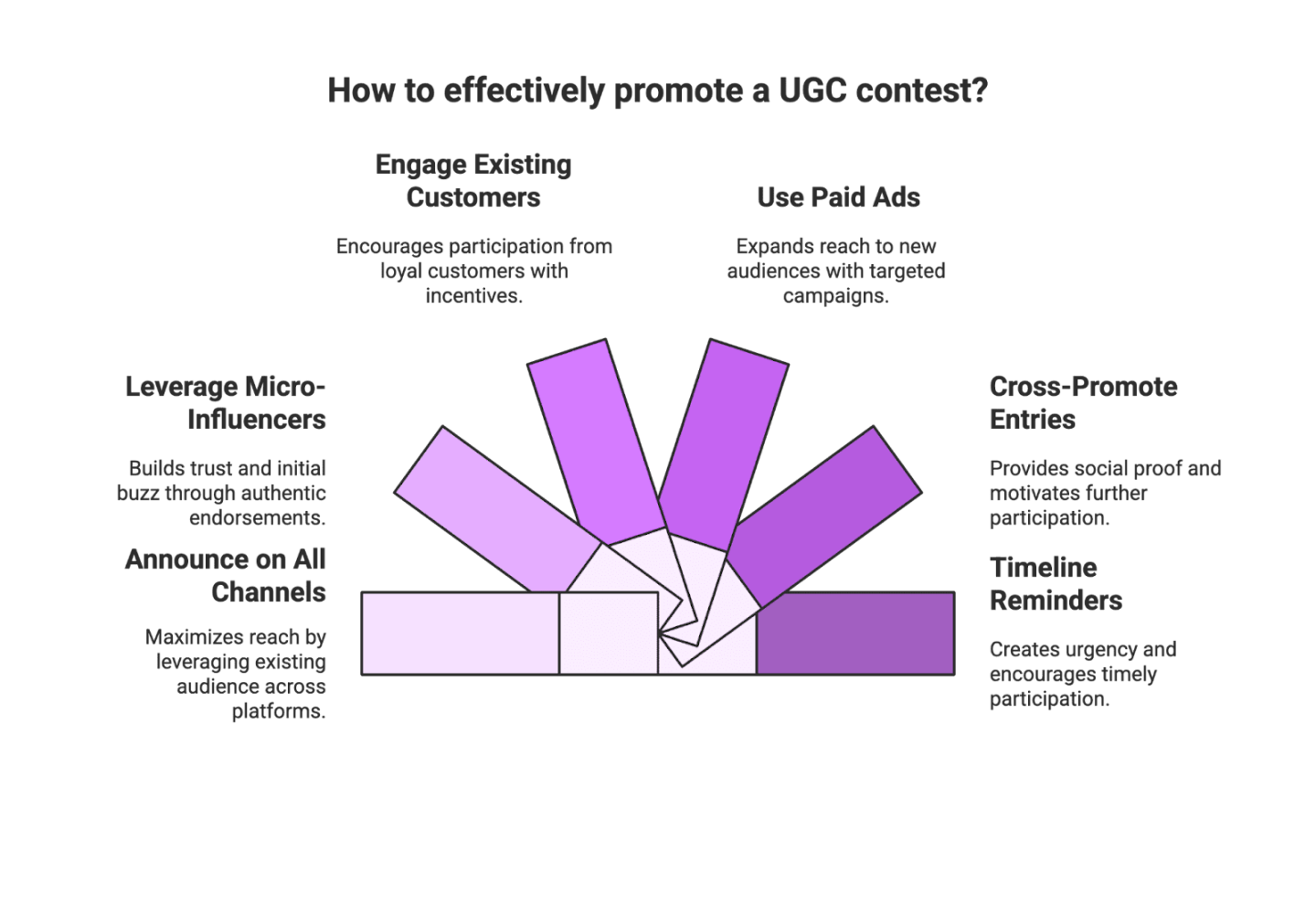
You’ve got everything set up – now you need participants! Promotion is key to get the word out and drive entries, especially beyond your core followers. Here are strategies to promote your UGC contest effectively:
By casting a wide net and leveraging both your owned media and others’ influence, you’ll maximize the reach of your contest. Remember, the more people know about it, the more entries you’ll get, which in turn yields more UGC and more buzz – the virtuous cycle of a well-promoted contest. Even if someone doesn’t enter, just seeing the contest can imprint your brand in their mind or get them following you for future updates.
In the age of social media and endless choices, authentic content is king. UGC contests offer a powerful way to get that authenticity on your side. By inviting your customers and fans to create content, you’re not just running a fun promotion – you’re building a community and library of trusted, relatable brand assets. From the examples of global brands like Doritos, Coca-Cola, and Apple, we see that people love to contribute when given the chance. And you don’t have to be a mega-corporation to harness this; even a small e-commerce brand or Amazon seller can launch a UGC contest with a clever idea and a bit of planning.
Let’s recap some final tips to ensure your UGC contest strategy excels:
Above all, have fun with it and let your brand’s personality shine through. A casual, friendly tone (just like we used in this blog) works great for contest campaigns – it should feel like a community event, not a corporate transaction. If you’re excited and engaged, your audience will be too.
So go ahead – plan that UGC contest, rally your fans, and watch the magic happen. Your next high-converting ad or viral post might just come from a customer’s camera roll. By turning customers into content creators, you’re not only getting authentic marketing assets, you’re forging a deeper bond with the very people who keep your business thriving. In a world where trust and authenticity drive purchasing decisions, that’s a priceless advantage.
Good luck, and we can’t wait to see what you and your community create together! 🚀📸🎉
E-commerce marketing in 2026 is all about authenticity, community, and innovation. Digital consumers are more savvy than ever, and brands must go beyond basic ads to capture their attention. In 2024, successful content strategies included brand storytelling, social commerce integration, user-generated content (UGC), content localization, and augmented reality experiences. Building on these trends, 2026 brings a fresh emphasis on micro-influencer marketing, short-form video, and AI-driven personalization to engage shoppers. Influencer marketing has become almost ubiquitous – an estimated 86% of U.S. marketers will use influencers in 2026 – and it’s evolving rapidly. Whether you’re an indie Amazon seller or a global brand, the playbook is shifting. In this blog, we break down the best e-commerce marketing strategies of 2026 (with real examples and stats) to help your brand thrive in the competitive online marketplace.
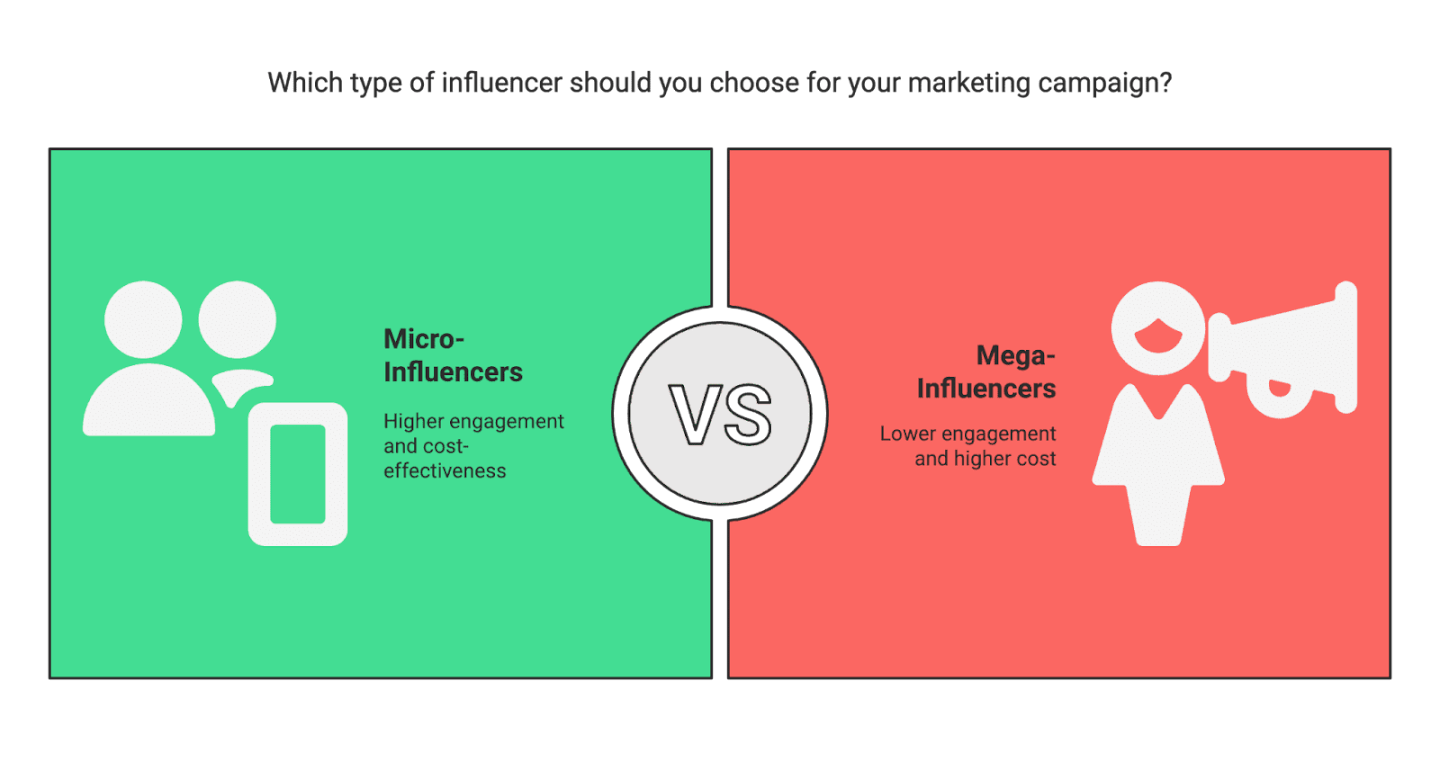
Leverage micro-influencers (everyday content creators) to humanize your brand. Big follower counts don’t always translate to better results – in fact, smaller influencers often have far higher engagement rates. For example, creators with under 1,000 followers see about an 8% engagement rate, whereas mega-influencers over 10 million followers garner only ~1.6% engagement. That means their audiences are much more actively liking, commenting, and trusting their content. Micro-influencers (typically 5k–100k followers) are also more cost-effective – they might charge only a few hundred dollars (or just free product) per post versus thousands for a macro influencer, yet can deliver up to 60% higher engagement on those posts. It’s no surprise brands are working with more micro-influencers than ever – 33% more year-over-year – to fuel their social content and UGC needs.
Crucially, micro-influencers feel like real people and often have niche communities that trust them. 63% of consumers say they’re more likely to buy a product recommended by an influencer they trust, so these “everyday” creators can genuinely move the needle on sales. When those collaborations spark coverage, they can also earn high-trust links that help your store build search authority. For e-commerce businesses (even Amazon sellers on marketplace platforms), partnering with micro-influencers is a powerful way to generate buzz, reviews, and social proof. High-end and small brands alike are catching on – for example, beauty retailer Glossier frequently works with micro-influencers on Instagram to showcase products in use, driving both engagement and direct sales via tagged posts. For businesses looking to scale their own e-commerce efforts, Third-Party Logistics (3PL) services provide tools to streamline orders and improve brand engagement. Leveraging tools to streamline your fulfillment and customer experience can further enhance the impact of influencer partnerships by ensuring timely delivery and customer satisfaction. Stack Influence – a leading micro-influencer marketing platform – notes that both DTC brands and Amazon sellers are using product seeding campaigns to turn happy customers into influencers at scale. By tapping into these relatable creators, you’ll get a stream of authentic content and word-of-mouth style promotion that traditional ads just can’t match.
In 2026, your customers are your best marketers. User-generated content (UGC) – like customer reviews, unboxing videos, testimonials, and social media posts about your products – is pure gold for e-commerce. Related trust signals can come from independent editorial links that cite your brand, earned through PR. Shoppers trust content from fellow consumers far more than polished brand promotions. In fact, studies show people trust UGC nearly 10× more than influencer or branded content because it feels genuine and unscripted. Prospective buyers want to see real-life experiences: how a shirt looks on a regular person, or how a gadget fits into someone’s daily routine. By encouraging your customers to share their experiences, you build a community around your brand and create an ongoing supply of relatable content.
How can you generate more UGC? Run campaigns that invite customers to participate: for example, create a hashtag challenge or a photo contest showcasing your product “in the wild.” Highlight and repost customer photos/videos on your official channels (with permission) – this not only provides you with fresh content but also makes your fans feel seen and valued. For instance, GoPro excels at this by regularly featuring their users’ adventure videos on GoPro’s social feeds. GoPro’s community members are eager to have their footage shared, which motivates even more people to post content – a virtuous cycle of engagement. Remember, 60% of consumers say that UGC is the most authentic and influential content when deciding what to buy. By amplifying real customer voices, you build trust with new shoppers who see ordinary people vouching for your products. And as a bonus, UGC often doubles as ready-made marketing material for ads, product pages, and social posts – saving your team creative resources while boosting credibility.
Social media isn’t just for awareness anymore – it’s now a full-fledged sales channel. In 2026, successful e-commerce brands seamlessly integrate shopping experiences into popular social platforms. This means leveraging social commerce features like Instagram Shop, Facebook Shops, Pinterest Product Pins, TikTok Shop, and more. These tools allow users to browse and buy products without ever leaving the app, collapsing the funnel from discovery to purchase in a matter of clicks. For example, cosmetics brand Glossier made it easy for Instagram users to go from admiring a lip gloss in a post to purchasing it instantly via Instagram Shopping tags. By tagging products in posts and Stories – often on content created by influencers or customers – Glossier creates a frictionless path to buy. The result? An impulse discovery can turn into a sale within seconds, capitalizing on the consumer’s excitement in the moment.
To ride the social commerce wave, ensure your brand’s social profiles are set up for shopping with product catalogs and direct links. Optimize your content for each platform: use high-quality images and short videos that showcase products in action, since visual appeal matters. Don’t forget to pair organic content with strategic paid ads and influencer partnerships on these platforms to broaden your reach. Another tip is to take advantage of platform-specific features – for instance, TikTok’s algorithm can send a product video viral, but you’ll sell the most if you’ve enabled TikTok Shop or linked your products so viewers can buy instantly. Even Amazon is getting more “social” – Amazon Live streams and the Amazon Influencer Program let creators demo products and recommend their Amazon favorites to followers, blending entertainment with commerce. The bottom line: meet your customers where they scroll. If you can make your content shop-able on the social apps people use daily, you remove barriers to purchase and significantly boost conversion rates.
Static content is out; video is king in 2026’s e-commerce marketing. Two formats in particular are driving engagement: short-form videos (think TikTok clips, Instagram Reels, YouTube Shorts) and live-stream shopping events. Short-form videos are those addictive, bite-sized clips often under 60 seconds – and they’ve exploded in popularity for product discovery. Brands are leaning heavily into this trend: nearly 87% of influencer content for brands is now short-form video (with far fewer static image posts being used). These quick videos are perfect for showcasing a product in action, giving a bite-sized demo or testimonial, or hopping on a trending challenge that connects to your product. The viral nature of platforms like TikTok means a single creative video can skyrocket a product’s demand overnight. E-commerce sellers should create and encourage lots of short videos – both produced and user-generated – to keep feeding the social algorithms and capturing eyeballs.
Meanwhile, live commerce brings the old-school home shopping vibe to the digital era, with massively effective results. Live-stream shopping events (on Instagram Live, Facebook Live, TikTok, or dedicated apps) let you demo products in real time, interact with viewers, answer questions, and offer time-sensitive deals to spur purchases. This interactive format is incredibly engaging – viewers feel like they’re part of an event and get to see products “unfiltered” and ask questions before buying. It’s huge in Asia and rapidly growing globally. Brands that host live shopping sessions often see immediate sales spikes and higher engagement rates; one beauty brand reported thousands of viewers and a flurry of orders during a single Instagram Live product demo. Even smaller sellers can partner with influencers or stream themselves to tap into this trend. Live videos can dramatically boost engagement and sales by creating urgency and trust – it’s the next best thing to an in-person experience. To succeed, announce your live events ahead of time, offer exclusive discounts to viewers, and be energetic and responsive on camera. Whether it’s a QVC-style showcase of new arrivals or a casual “founder goes live to chat about products” stream, live commerce humanizes the online shopping experience and can significantly lift conversion rates. Combine that with the always-on power of short-form videos populating users’ feeds, and you have a video strategy that keeps customers hooked and ready to buy.
Storytelling remains one of the most potent marketing strategies for e-commerce brands in 2026. In a crowded digital marketplace, a compelling brand narrative helps you stand out and forge an emotional connection with customers. People don’t just buy what you sell – they buy why you sell it. Make sure your content highlights the story behind your brand: your mission, values, founding journey, the people and passion involved, and the impact you aim to make. Video is one of the most effective ways to share that story. To make this process easy many brands can use AI tools such as Renderforest text to video AI to turn written stories or product updates into short, engaging clips that feel personal and authentic. A strong narrative creates a personality for your brand that customers can relate to and remember. Authenticity is key – share real stories and values that resonate with your target audience’s beliefs or lifestyle. For example, outdoor apparel brand Patagonia is famous for weaving their environmental activism into their marketing. Their content often highlights sustainability efforts like the “Worn Wear” program (which encourages repairing and reusing gear) and profiles of adventurers who share Patagonia’s eco-values. This consistent storytelling around protecting the planet strikes an emotional chord with eco-conscious consumers and builds immense brand loyalty. Customers feel like they’re supporting a cause, not just buying clothes.
Storytelling remains one of the most potent marketing strategies for e-commerce brands in 2026. In a crowded digital marketplace, a compelling brand narrative helps you stand out and forge an emotional connection with customers. People don’t just buy what you sell – they buy why you sell it. Make sure your content highlights the story behind your brand: your mission, values, founding journey, the people and passion involved, and the impact you aim to make. A strong narrative creates a personality for your brand that customers can relate to and remember. Authenticity is key – share real stories and values that resonate with your target audience’s beliefs or lifestyle. For example, outdoor apparel brand Patagonia is famous for weaving their environmental activism into their marketing. Their content often highlights sustainability efforts like the “Worn Wear” program (which encourages repairing and reusing gear) and profiles of adventurers who share Patagonia’s eco-values. This consistent storytelling around protecting the planet strikes an emotional chord with eco-conscious consumers and builds immense brand loyalty. Customers feel like they’re supporting a cause, not just buying clothes.
Every e-commerce brand can leverage storytelling in their content marketing. If you’re a small business, tell the origin story of how your product came to be. If you emphasize quality craftsmanship or ethical sourcing, take customers behind the scenes to see that process. Share customer success stories and testimonials as part of your narrative – for instance, how your fitness gear helped someone get in shape, or how your gadget simplifies a working mom’s day. These real-world stories not only provide social proof, they let potential buyers imagine the positive impact of your products in their lives. Consistency is important too: carry your brand narrative across all channels (your website, social media, emails, packaging) so that each touchpoint reinforces the same message. A good story makes your brand memorable and meaningful. In 2026’s marketplace, where new competitors pop up daily, a strong brand narrative anchored in authenticity and purpose can turn casual shoppers into devoted fans.
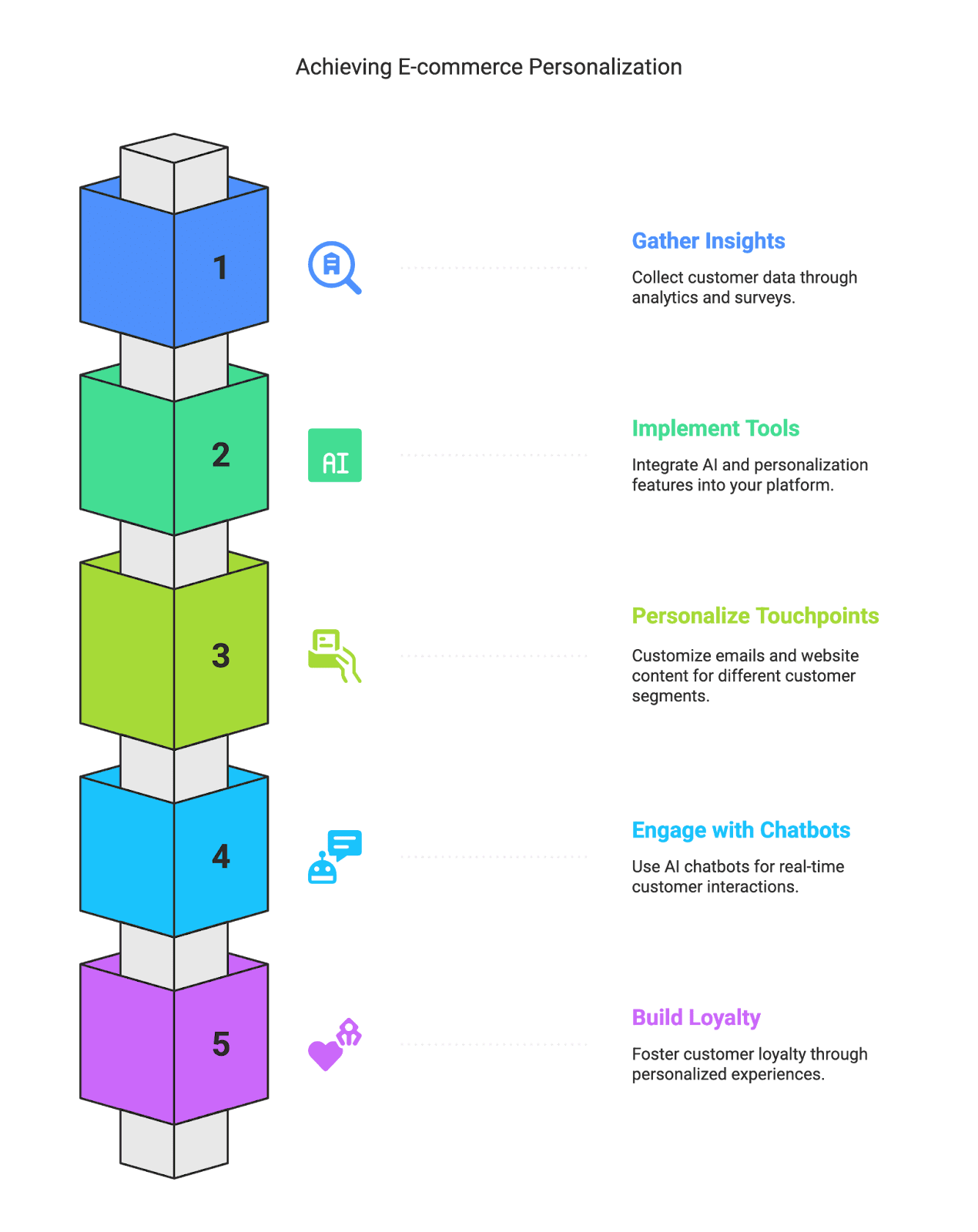
One size does not fit all in e-commerce. Reliable website performance is key as brands adopt AI and data-driven tools. Many e-commerce businesses use VPS USA hosting to ensure fast load times, security, and smooth personalization experiences, especially when serving US audience. Customers are also using VPNs when shopping online to make their shopping experience more secure and safe online.
Shoppers have come to expect personalized experiences – and thanks to advances in AI and data analytics, even small brands can deliver tailored content at scale. Personalization means using customer data (browsing behavior, past purchases, demographics, etc.) to present the most relevant products, content, and offers to each user. Done right, it makes shopping feel convenient and curated rather than like a generic catalog. The results can be game-changing: A survey found that 49% of customers ended up buying a product they hadn’t intended to, after receiving a personalized recommendation. Amazon pioneered this with those “Customers who bought X also bought Y” suggestions, and it’s incredibly effective – roughly 35% of all sales on Amazon are driven by their recommendation engine! The good news is you don’t have to be Amazon to use personalization. Plenty of e-commerce platforms and plugins (powered by machine learning) can automatically recommend products or content based on each visitor’s behavior.
Beyond product recommendations on-site, think about personalizing your marketing touchpoints. This could be personalized email campaigns (“Hey Alex, we thought you’d like these new shoes since you bought running gear last month”) or dynamic website content that changes based on user segments (first-time visitor vs. returning customer). AI chatbots are another 2025 must-have – modern chatbots can engage customers in real-time conversations, guiding them to products or answering questions 24/7 in a very personalized way. Many shoppers actually prefer a quick chat interaction to find what they need. In fact, e-commerce transactions via chatbots are projected to reach $142 billion in 2025, as more consumers turn to messaging for shopping assistance. Whether it’s a virtual stylist suggesting outfits or a chatbot helping pick the perfect gift, these AI-driven tools can mimic the attentiveness of an in-store sales rep.
To implement personalization, start by gathering customer insights (web analytics, purchase history, surveys). Then utilize tools or platforms that can crunch that data – this might involve integrating an AI recommendation engine, autonomous AI systems or using built-in personalization features of your e-commerce system. Even simple steps help: segment your email list by customer interests, retarget visitors with ads showing the exact items they viewed, or use geo-targeting to display local currency and shipping info. Consumers in 2025 will gravitate toward brands that “get them.” By showing you understand their needs and preferences – and streamlining their path to find the right products – you’ll not only increase conversion rates but also foster loyalty. Just be sure to handle data respectfully and transparently (personalization should feel helpful, not creepy). When done ethically, personalization and AI can make every customer feel like your store was built just for them.
The internet gives even the smallest seller a global reach – but succeeding in different regions requires more than just offering international shipping. To truly connect with customers in diverse markets, e-commerce brands must localize their content in 2025. This goes beyond simply translating product descriptions (though translation is a starting point). Content localization means tailoring your marketing to the language, culture, and preferences of each target market. The technical side of managing translations across multiple markets and using the right localization tools can remove repetitive developer tasks and free up your team to focus on what actually moves the needle, the cultural nuance, the right tone, and the local references that make shoppers feel at home.
Shoppers are far more likely to buy when the experience feels native to them. That means if you’re expanding to Latin America, for example, your website and ads should be in Spanish or Portuguese (in local dialects), prices in local currency, and references or imagery that fit the local culture. It also means being mindful of local holidays, seasons, and trends – promoting what’s relevant in each region at the right time.
Brands that invest in localization reap huge rewards. A great example is Nike’s approach in China: Nike doesn’t just translate English ads into Chinese; they create entirely unique campaigns around Chinese cultural moments. During Chinese New Year, Nike releases special edition products and runs festive campaigns tailored to that celebration. The content, visuals, and messaging all resonate with Chinese traditions and values, making local consumers feel understood and valued. This level of localization has helped Nike build a strong connection with customers in that market. Even smaller e-commerce merchants can take cues from this – for instance, if you notice a lot of orders from Canada or the UK, consider creating versions of your site and social content specifically for those audiences (with the correct spelling, slang, measurements, etc. for that region). Localization = personalization at scale by geography. It shows respect for your customers’ identities and lowers the barriers that might prevent a sale (like confusion over language or sizing).
Keep in mind that effective localization sometimes means tweaking your entire strategy per region. Different cultures have different social media habits, payment preferences, and marketing response patterns. Do the research (or leverage local partners) to learn what works in each market – maybe influencers are key in one country, while in another, email newsletters or messaging apps drive commerce. By speaking your customer’s language – literally and figuratively – you’ll significantly broaden your reach. In a world where global e-commerce is thriving, brands that localize will outpace those who assume one message fits all.
Thanks to technology, the gap between online shopping and a real in-store experience is closing. Augmented reality (AR) and virtual try-ons have gone from a novelty to a game-changing e-commerce strategy in 2026. AR lets customers visualize products in their own environment or on themselves using just a smartphone – it’s the “try before you buy” concept brought to the digital world. Implementing AR can seriously boost customer confidence and engagement. For example, a furniture shopper can use AR to see how a couch would look in their actual living room, or a sneakerhead can point their phone at their feet to virtually “try on” a new pair of shoes. This not only wows customers, it alleviates doubts like “Will this fit or match my style?” – leading to more conversions and fewer returns. In fact, data shows that products featuring 3D/AR content have on average 94% higher conversion rates than those without. Shoppers feel more sure about their purchase if they’ve virtually experienced the product. And because they’re getting what they expected, brands using AR have seen product return rates drop by up to 40%, saving money on returns logistics.
Major retailers are rapidly adopting AR for these reasons – Gartner predicts 80% of retailers will deploy AR as part of the customer experience by 2026. But you don’t have to be a retail giant to get in the game. There are turnkey AR solutions now for e-commerce (Shopify, for instance, supports 3D models in product pages). Even simple implementations like 360-degree product images or “View in Room” AR widgets on your site can make a difference. A famous success story is IKEA’s AR app called IKEA Place, which allows users to superimpose true-to-scale 3D furniture models into their homes through their phone camera. Shoppers can virtually position that bookshelf or sofa in their space to see exactly how it fits and looks before ordering. This not only improves the buying experience (no more guessing if the color or size is right) but dramatically increases buyer confidence and satisfaction. Other brands use AR for virtual fitting rooms (beauty brands have AR filters to test different makeup shades on your face, eyewear retailers let you try glasses virtually, etc.). As AR technology continues to evolve and become more accessible via web and social media (e.g. Snapchat/Instagram AR try-on filters), consumers will come to expect this interactive experience. Early adopters are already reaping the benefits – those interactive AR filters and try-ons on social media have driven high engagement and direct sales for brands in fashion and beauty. In summary, integrating AR into your e-commerce strategy – whether on your own app/website or through social platforms – can significantly boost conversion rates, reduce returns, and delight customers in 2026’s competitive market.
The world of e-commerce marketing is more dynamic than ever, but the core theme is clear: put the customer at the center. The strategies above – from leveraging micro-influencers and UGC to embracing social commerce, video, storytelling, personalization, localization, and AR – all focus on creating a more authentic, engaging experience for shoppers. As one industry review summed up, brands need to adapt to these trends and use the full arsenal of new tools to stay ahead. The good news is that even small businesses can implement many of these tactics with the right partners and platforms. By experimenting with these 2026 strategies, you can drive more traffic, deepen customer engagement, and boost conversions for your online store.
By combining these approaches, e-commerce brands can offer an experience that feels!
In 2026, e-commerce businesses and marketers have more options than ever to promote their products. Two of the most powerful digital strategies are affiliate marketing and influencer marketing – but they work in different ways. Understanding the strengths of each (and how they overlap) is key to maximizing ROI. In simple terms, affiliate marketing is a performance-based channel where partners earn commissions for driving sales, while influencer marketing focuses on partnering with content creators to boost brand awareness and trust. Both approaches have evolved significantly, with trends like micro-influencers, user-generated content (UGC), and even AI shaping how brands leverage these tactics. This article breaks down affiliate vs. influencer marketing in 2026, their differences, where they converge, and how e-commerce brands (from independent sellers to Amazon marketplace vendors) can use both effectively. Let’s dive in!
Affiliate marketing is a pay-for-performance strategy where businesses reward external partners (affiliates) for bringing in customers or sales. These affiliates can be bloggers, comparison sites, coupon portals, or even influencers who share a unique referral link or code. Whenever someone clicks that link or uses the code and makes a purchase, the affiliate earns a commission. This model means you only pay for results, making it a low-risk, conversion-focused approach which is why platforms like ReferralCandy are a popular way for ecommerce brands to run affiliate and referral programs on a pay-per-sale basis.For example, Amazon’s Associates program (one of the world’s largest affiliate networks) lets content creators earn when they refer sales on Amazon – a huge benefit for Amazon sellers seeking more visibility. In fact, Amazon Associates holds nearly 46.5% of the global affiliate network share, highlighting how dominant it is in e-commerce affiliate marketing.
Affiliate marketing in 2026 continues to grow as a core sales driver for online businesses. It’s forecasted to reach about $12 billion in global value by 2026, accounting for roughly 16% of all e-commerce sales. Over 90% of e-commerce businesses are expected to adopt affiliate programs by 2026, making it nearly ubiquitous in the online retail space. The reason? Affiliates bring social proof and trusted recommendations from their audiences. Shoppers today are skeptical of traditional ads and instead look for authentic content and reviews. A well-run affiliate program taps into this by partnering with content creators whose values align with the brand and who have credibility with the target audience. Essentially, affiliates act as extensions of your marketing team, creating content (blog posts, videos, social media mentions) that subtly promote your product and drive traffic to your site or listing.
Pros of affiliate marketing: It’s cost-effective and low risk – you pay commissions only on actual sales or leads. This performance-based model ensures a positive ROI by design. Affiliate campaigns can also scale quickly by recruiting many partners, extending your reach to new audiences. Importantly for small businesses, affiliate marketing doesn’t require huge upfront spend; even a lean budget can attract affiliates if the product and commission are attractive. Also, affiliate efforts often generate evergreen content (like review articles) that keep driving traffic long-term.
Challenges: On the flip side, managing an affiliate program in 2026 means handling tracking and attribution in a privacy-conscious world (with cookies on the decline). Brands must use reliable referral link technology or coupon codes to attribute sales to affiliates, especially as ad blockers and privacy regulations can complicate tracking. Additionally, maintaining quality is key – not every affiliate’s content is high-quality, so vetting partners is crucial to ensure they align with your brand and don’t engage in spammy tactics. Despite these challenges, affiliate marketing remains a critical channel for e-commerce growth because it’s scalable, measurable, and aligns cost with performance.
Influencer marketing involves partnering with content creators (influencers) who have an engaged following on social platforms to promote your products. Typically, brands provide free product samples, pay a flat fee per post, or offer other incentives to the influencer, who in turn creates content (a post, story, video, etc.) showcasing the product. The goal is to leverage the influencer’s reach and trust with their audience to build your brand awareness, rather than to drive immediate sales (though sales often follow). In essence, influencer marketing pays for exposure and credibility – you’re investing in the influencer’s ability to sway their followers.
Influencer marketing has exploded into a multi-billion dollar industry. By the end of 2026, the global influencer marketing market is projected to reach $32.5 billion, up from just $1.4B a decade earlier. Over 80% of marketers now consider influencer campaigns highly effective, and about 63.8% of brands plan to partner with influencers in 2026. The rise of platforms like Instagram, YouTube, and TikTok has made it easier for everyday people to become influential creators in specific niches – from beauty and fashion to tech and gaming. These content creators produce authentic, relatable content that audiences often find more credible than traditional ads. For example, an influencer might post a video using a kitchen gadget in a recipe, casually showing how it works. Followers see the product in a real-life context, which builds trust and interest in a way a banner ad can’t.
A big trend in 2026 is the dominance of micro-influencers and nano-influencers (creators with anywhere from a few thousand up to ~100K followers). While mega-celebrities have huge reach, brands are increasingly turning to smaller creators for stronger engagement and authenticity. Micro-influencers often have a tight-knit audience who trust their recommendations deeply. They might not reach millions, but their followers are more likely to act on their suggestions. Plus, micros are more cost-effective; many will collaborate in exchange for free products or modest fees, and some even work on an affiliate basis (hybrid model). Influencer marketing isn’t limited to Instagram selfies anymore – it spans TikTok challenges, YouTube reviews, livestream shopping events, podcasts, and more. And it’s not just for flashy consumer products; even traditionally “boring” industries like insurance and B2B have found creative ways to use influencers for education and brand lift.
Pros of influencer marketing: It’s superb for brand building and social proof. Influencers excel at creating engaging content that doesn’t feel like an ad, helping new or unknown brands get on consumers’ radar. A single viral post from the right influencer can dramatically boost traffic and sales overnight. Influencer content also doubles as UGC – brands can reshare it, adding authenticity to their own channels. Another benefit: influencers can produce a stream of creative assets (photos, videos, reviews) that the brand might never have the time or ingenuity to make in-house. This is particularly valuable for Amazon sellers or small e-commerce brands that need lifestyle photos or demo videos of their product – partnering with influencers essentially outsources content creation to talented creators. Furthermore, ongoing influencer partnerships can foster a sense of community and loyalty around your brand, as the influencer’s audience starts to form a relationship with your product over time.
Challenges: The biggest challenge with influencer marketing is measuring ROI and attribution. Unlike affiliate links that directly tie a click to a sale, an influencer’s impact can be more indirect and long-term. If an influencer’s Instagram post leads a follower to Google your brand a week later and then purchase, it’s hard to track that path. Thus, marketers sometimes struggle to quantify results beyond metrics like reach and engagement. However, savvy brands in 2026 are mitigating this by providing influencers with affiliate links or discount codes to capture sales data, essentially blending the two strategies. Another challenge is finding the right influencers and ensuring they align with your brand values. An influencer who doesn’t genuinely like or understand your product can come off as inauthentic, which audiences will sense. Lastly, managing multiple influencer relationships and campaigns can be time-consuming – negotiating rates, guiding content, ensuring posts go live on schedule – but new tools and platforms are emerging to streamline this process.

While these strategies often overlap, affiliate and influencer marketing have distinct strengths. Here are six key differences between them:
Affiliate marketing is transactional – its main goal is to drive immediate sales or conversions. Influencer marketing is more relational, aiming to build brand awareness, trust, and credibility that can lead to sales down the line.
In affiliate programs, compensation is commission-based – affiliates only get paid when their promotion results in a sale (or desired action). This could be a percentage of the sale or a flat bounty per conversion. In influencer marketing, payment is usually up-front (e.g. a fixed fee per post or free products), not contingent on immediate sales. Some influencers also get performance bonuses or commissions, but generally, brands pay for the content exposure regardless of outcome.
Affiliate marketing presents low risk to the brand – if the affiliate doesn’t generate results, you don’t spend much (perhaps just some setup or management cost). Influencer marketing requires a higher upfront investment, so there’s a risk if a campaign doesn’t resonate. You’re essentially betting on the influencer’s content to be effective, and paying them even if sales don’t materialize immediately.
Affiliate content varies widely. Some affiliates are review websites with fairly dry comparison content; others are passionate bloggers or YouTubers whose content is engaging. Influencer content is typically more personal and authentic, since it’s coming from an individual sharing their own experience. Followers often perceive influencer posts as recommendations from a friend, especially when the creator’s style is genuine. This doesn’t mean affiliate content lacks authenticity – in fact, many influencers are affiliates – but pure influencer marketing puts authenticity at the forefront.
In summary, affiliate = pay for outcomes, influencer = pay for influence. One is about immediate conversions, the other about cultivating brand love that drives conversions over time. Neither is “better” universally – they serve different purposes. Your choice depends on priorities: Do you need sales now, or is building brand equity and awareness more critical? Let’s explore how to choose.
Both strategies can yield great results, but the right choice depends on your goals and situation. Here are some guidelines:
This could be an Instagram post, a TikTok video, etc., featuring your product or brand message (as agreed upon in your collaboration). Make sure it feels authentic and aligns with the influencer’s usual style – authenticity is key here.
This is the “whitelisting” step: the creator formally authorizes your brand to run ads using their identity or post. (How this is done varies by platform – we’ll explain Facebook/Instagram, TikTok, etc. shortly.)
In the ad platform (Facebook Ads Manager, TikTok Ads, etc.), you’ll create a campaign as usual – but select the influencer’s page or post as the source. You can adjust targeting, duration, and add a CTA link (e.g. to your online store or Amazon page). Pro tip: treat this like any paid ad – use conversion tracking software and define your goals (traffic, sales, etc.).
The brand can see full performance metrics in the ad dashboard. The influencer typically can see basic insights too (and certainly will notice new followers or engagement coming their way). A whitelisted campaign often results in the influencer gaining new followers while the brand gains new customers – a win-win outcome.
Keep in mind, this isn’t an either/or choice for many brands. The most successful e-commerce companies use both, in complementary ways. For instance, a new Amazon seller might send free product to a group of micro-influencers to spark initial buzz (influencer marketing), and simultaneously enroll in an affiliate network so that bloggers and deal sites can promote their Amazon listing for commission (affiliate marketing). One strategy builds demand, the other captures it with conversion-focused channels. The next section looks at how these strategies can be integrated.

One of the biggest trends in 2026 is the rise of micro-influencers and the emphasis on user-generated content (UGC) in marketing. Micro-influencers (often defined as creators with ~5,000 to 100,000 followers) have become a sweet spot for many brands. Why? They offer the best of both worlds: authentic content and high engagement, at a fraction of the cost of big influencers. In fact, many brands are shifting budgets toward micro and even nano-influencers in search of stronger engagement and ROI. These smaller creators typically have very loyal, niche audiences. When they post about a product, it comes off as a genuine recommendation from a peer, not a celebrity endorsement.
Moreover, micro-influencers often double as affiliates or content creators in their own right. They might run a YouTube channel or blog where they use affiliate links for extra income. For example, a micro-influencer on Instagram might share a fashion try-on video featuring a boutique clothing brand, and include an affiliate link in their bio or swipe-up story. In doing so, they’re acting as an “affiliate influencer,” blending authenticity with trackable sales. Most successful creators nowadays operate with this hybrid approach, adjusting their methods based on the partnership. They might do some purely sponsored content for a flat fee, and other content where they use affiliate links to earn commissions – it’s all about diversifying revenue for the creator, and it benefits brands by driving both awareness and conversions.
UGC is a goldmine generated by these collaborations. User-generated content refers to any content about your brand created by real people (not the brand itself). Influencer posts, customer reviews, unboxing videos, tagged photos – all of these are UGC. In 2026, UGC has proven to significantly boost trust and sales. For instance, shoppers who engage with UGC experience on average a 28% higher conversion rate than those who don’t. This is because seeing real people (whether influencers or everyday consumers) using a product provides social proof that heavily influences purchase decisions. Many e-commerce brands now actively encourage UGC – some run hashtags for customers to share photos, others repurpose influencer content in ads or on product pages. Amazon itself features influencer-created videos and photos on product listings through its Amazon Influencer Program, blurring the line between influencer marketing and traditional reviews.
To harness this, companies are leveraging platforms and agencies that specialize in micro-influencer campaigns. (Enter Stack Influence!) Stack Influence is one example of a micro-influencer marketing platform geared toward Amazon and e-commerce sellers. According to G2, Stack Influence focuses on the Amazon marketplace and uses a network of vetted micro-influencers (powered by AI tools) to run campaigns that generate tons of UGC and traffic for online sellers. Such services handle everything from sourcing influencers, managing the campaign, ensuring posts go live, to delivering the content rights and analytics. The beauty of micro-influencer campaigns is that often the only “payment” needed is free product – many micro-influencers are happy to receive a product gift in exchange for posting, which greatly minimizes cash outlay. This is particularly attractive to smaller Amazon vendors who might not have large marketing budgets; they effectively pay with product and still get the benefits of word-of-mouth marketing. The result is authentic UGC at scale – photos, testimonials, demonstration videos – that not only drive immediate sales from the influencer’s audience but can also be repurposed on the brand’s site, social media, or ads. It’s like fueling your marketing with a constant stream of real-life endorsements.
In summary, 2026’s focus on micro-creators and UGC means even modest-sized brands can punch above their weight. A handful of happy customers or micro-influencers posting about your product can snowball into a social proof engine. If you’re an e-commerce marketer, nurturing a community of micro-influencers and encouraging customers to share content should be a top priority. Not only do micro-influencers often have higher engagement rates (nano-influencers on TikTok, for example, see far higher engagement than mega accounts), but their content feels real. And real is what converts. As one report put it: the age of mega-influencers isn’t over, but brands are increasingly backing micro- and nano-influencers for more authentic content and stronger conversions. The trust these creators build translates directly into sales, especially when combined with the measurable tactics of affiliate links and referral codes.
It’s not a question of affiliate versus influencer marketing so much as how to use both together. In fact, the lines between the two have increasingly converged. Influencer marketing used to be strictly an upper-funnel tactic (create buzz, hope it leads to sales later), and affiliate marketing a lower-funnel tactic (drive the final purchase decision). But in 2026, that distinction is fading: “Affiliates can also generate awareness, and influencers can drive sales” as one expert noted. The real power comes when you combine these strategies to engage consumers at every point in the funnel.
Here are some ways to integrate affiliate and influencer marketing for maximum impact:
This turns influencer campaigns into measurable, performance-driven efforts. When you partner with an influencer, provide them a unique promo code (for a percentage off) or an affiliate link to include in their content. This way, any sales they generate can be tracked back to them, marrying the reach of influencer content with the accountability of affiliate marketing. Many creators appreciate this because it gives them an ongoing income stream if their content keeps driving sales. Brands like to see direct ROI from influencer collaborations – a win-win. It’s common now for “influencer affiliates” to earn both an upfront fee and commissions on sales.
Think beyond the traditional coupon sites and bloggers; your influencers are also content-creating affiliates. For example, a tech YouTuber might be in your affiliate program, earning commissions from product review videos, while also being someone you sponsor for new product launches. Treat your best content creators like partners. Provide them with early access to products, exclusive deals, or higher commission tiers to incentivize them. Since 31% of content creators consider affiliate marketing a top revenue stream, many will be enthusiastic to join your affiliate program if the product fits their niche.
Tracking performance across both strategies is crucial. Affiliate platforms (for tracking links and payouts) and influencer relationship tools should work hand in hand. For instance, some marketing platforms (like Sprout Social’s influencer solution or others) allow you to manage influencer outreach and content approvals, while integrating with your affiliate tracking system. This lets you monitor engagement metrics and conversion metrics in one place. By analyzing data collectively, you might discover that, say, an influencer’s TikTok video drove a lot of awareness, and a week later your affiliates saw a spike in conversions for that product – indicating the TikTok created demand that the affiliates captured. Understanding these synergies helps optimize budget allocation.
The content produced by influencers can aid your affiliate efforts. For example, snippets of an influencer’s review video could be used on your product landing pages (increasing trust and aiding conversion, which helps all affiliates). Conversely, data from affiliate performance can inform influencer strategy – if affiliates report that a certain product benefit or coupon angle converts well, have influencers highlight that in their content. The goal is a consistent message across both: influencers drum up interest highlighting key selling points, and affiliates close the sale reinforcing those points.
To illustrate convergence: imagine a micro-influencer posts a TikTok about a kitchen gadget, showing how it simplifies cooking (creating desire). She includes her affiliate link in the caption. A viewer sees the video, is impressed (awareness built!), and a day later clicks that link to purchase – earning the influencer a commission. The brand gains a sale they can attribute, plus a piece of compelling UGC content. Now multiply that by 100 micro-influencers doing the same, and you have a powerful engine for growth. This is exactly the kind of campaign platforms like Stack Influence facilitate, automating the process of recruiting many micro-influencers and tracking their results. The affiliate and influencer worlds are merging into one “creator-driven” marketing ecosystem, where content creators are at once storytellers and sales drivers.
Estimated global market size in 2026: Influencer marketing vs. affiliate marketing (in USD billions). Influencer marketing’s industry is expected to reach about $32.5 billion in 2026, far outpacing affiliate marketing’s ~$12 billion.
As the chart above suggests, brands are pouring money into influencer marketing (reflecting its top-of-funnel power), but affiliate marketing remains a significant and growing piece of the pie. Rather than viewing one as replacing the other, smart marketers see them as complementary. Influencers create demand and content, affiliates provide distribution and conversion. In fact, influencer collaborations can boost affiliate performance by up to 46% in sales according to some studies – presumably because influencers drive more people into the purchasing pipeline that affiliates then capture. And many affiliate networks now include influencers as partners, blurring the budget lines (some companies class influencer spending under “affiliate” or “social” budgets interchangeably).
Adoption of affiliate and influencer marketing among businesses. Nearly all online retailers are leveraging affiliate marketing (around 90% by 2026), while a strong majority are now incorporating influencer marketing (roughly 64% of brands plan influencer campaigns in 2026).
The takeaway is clear: most businesses will use both strategies in 2026 and beyond. If you’re not, chances are your competitors are – and they’re reaping the rewards on both the awareness and conversion fronts. The integration of affiliate and influencer efforts can seem complex, but even simple steps (like giving an influencer a discount code to share, or inviting a high-performing affiliate to also do a sponsored Instagram takeover) can yield outsized results. Monitor the data across both and stay agile. For instance, if you see a particular influencer’s content is generating lots of traffic but not sales, maybe the offer needs tweaking – or you introduce a commission to motivate them to push harder. Conversely, if an affiliate blogger is driving sales but has small reach, consider boosting their content via an influencer or paid social.
In the affiliate vs. influencer marketing debate, the winner in 2026 is – both, working together. Affiliate marketing remains a cornerstone for e-commerce: it’s cost-efficient, scalable, and directly tied to performance. Influencer marketing has matured into a powerhouse of persuasion, creating authentic connections between brands and consumers. For e-commerce marketers, the optimal strategy isn’t choosing one over the other, but understanding when and how to deploy each. Need a quick sales boost or a way to market on a tight budget? Spin up or expand an affiliate program. Want to put your brand on the map or refresh your content? Engage influencers to tell your story.
Crucially, look for the intersections – the micro-influencer who can also be an affiliate, the affiliate whose content you can amplify via influencers. By aligning both strategies, you cover the full customer journey from awareness to conversion. The metrics bear this out: brands combining affiliate and influencer tactics report stronger ROI and more resilient marketing performance. You get the immediate revenue from affiliates and the long-term brand growth from influencers. And with the rise of micro-influencers, even smaller brands can afford influencer marketing, often just by sending free product, and then reap the benefits of the content and sales generated.
As you plan your marketing playbook for the coming years, keep these key points in mind: authenticity and trust drive purchases. Whether through a blogger’s honest review or an Instagrammer’s personal story, consumers respond to real voices. User-generated content is king – leverage it in every form. Track what you can (use affiliate links, UTM codes, and analytics) but also accept that some influencer impact is qualitative. And finally, build relationships – with your affiliates, with influencers, and with the communities they speak to. In an era of AI-driven recommendations and skeptical consumers, human recommendations carry enormous weight. By harnessing both affiliate partners and influencer creators, you create a marketing engine that is both efficient and inspiring – driving sales while growing brand love. In 2026 and beyond, that combination is hard to beat.
Social media has transformed how e-commerce sellers reach customers, and one of the most exciting new strategies is Meta partnership ads. Formerly known as branded content ads or influencer whitelisting, these ads blend the power of influencer marketing with Meta’s massive reach. In simple terms, a partnership ad lets you leverage a content creator’s authentic post and run it as a paid ad on Facebook or Instagram. For e-commerce brands and Amazon sellers, this opens up a world of opportunity – you get the trusted voice of a creator combined with the targeting and scale of Meta’s advertising platform. The result? Better engagement, higher trust, and more sales.
In this article, we’ll break down what partnership ads are, why they’re so effective (especially when working with micro-influencers and UGC content), and how you can use them in your marketing strategy. Whether you’re a growing Amazon seller or an established online store owner, understanding partnership ads can help take your social media advertising to the next level. Let’s dive in!
At its core, a partnership ad is a collaboration between a brand and a content creator (influencer) within Meta’s ad system. Instead of a regular ad that comes solely from your brand’s Facebook or Instagram page, a partnership ad is run through the creator’s account – with their permission – to promote your product or service. You’re essentially turning a creator’s post into an ad. Meta displays both the creator’s name and your brand as sponsors at the top of the post, so it looks like a genuine recommendation rather than a traditional ad. This format was previously called branded content ads and is sometimes nicknamed Influencer Whitelisting, but Meta now calls them Partnership Ads.
Imagine you’ve partnered with a popular micro-influencer in the beauty niche. They post an Instagram Reel using your skincare product. With a partnership ad, you can take that exact Reel (with the creator’s authentic commentary) and promote it to a wider audience through Meta Ads Manager. The post will appear as coming from the influencer “in paid partnership with” your brand, reaching both the influencer’s followers and the specific audience you target. Because it carries the influencer’s identity and endorsement, it feels like organic content in the feed, not a blatant advertisement – and that’s exactly why it’s so powerful.
Some key characteristics of Meta partnership ads include:
You’re using real posts by content creators (also known as user-generated content or UGC) as the creative for your ad. This could be an Instagram photo, a Facebook video, a Reel, etc., that the influencer made. The content retains the creator’s style and voice.
Both the creator’s name/handle and your brand are shown. For example, it might say “JaneDoe with – Sponsored” at the top of the post. This dual branding signals an endorsed partnership, which tends to feel more trustworthy to viewers.
Unlike a normal influencer post that only goes to their followers, a partnership ad is backed by your ad spend. You can target specific demographics or lookalike audiences, ensuring the content reaches far beyond the creator’s organic following.
By maintaining the look and feel of an influencer’s post while injecting the targeting and scale of paid media, partnership ads really offer the “best of both worlds” for marketers.
If you’ve run standard Facebook or Instagram ads before, you know it can be challenging to make them feel personal. This is where partnership ads shine. They come off as a trusted friend’s recommendation rather than a sales pitch, which drastically improves how audiences respond. In fact, in almost every key metric, partnership ads tend to beat traditional ads. The content is more relatable, the trust factor is higher, and people are more inclined to engage. Here are a few impressive examples of what brands have achieved:
One fashion brand found that a whopping 47% of its total Instagram engagement came from partnership ads, greatly boosting their overall engagement numbers. This shows how much more audience interaction creator-driven posts can spark.
An apparel retailer saw their cost per acquisition drop by 50% and their return on ad spend jump to 2.1× when they ran partnership ads alongside standard ads. In other words, partnership ads cut customer acquisition costs in half while doubling ROAS – a huge win for efficiency.
A Meta study reported that partnership ads led to a +7.7 point increase in ad recall, a +3.7 point lift in brand awareness, and a +3.2 point boost in purchase intent for a media company’s campaign. People exposed to the ads not only remembered them, but also felt more aware of and interested in the brand, thanks to the creator’s influence.
As another example, one fashion e-commerce brand running partnership ads saw a 296% increase in engagement compared to their normal ads. The same campaign achieved a 35% higher ROAS, proving that these ads don’t just get likes – they drive real sales too. Numbers like these underscore why partnership ads have become such a hot strategy, especially for e-commerce marketers who need both performance and authenticity.
So, what makes partnership ads so effective? Let’s break down the key benefits and how they directly impact your engagement and sales.
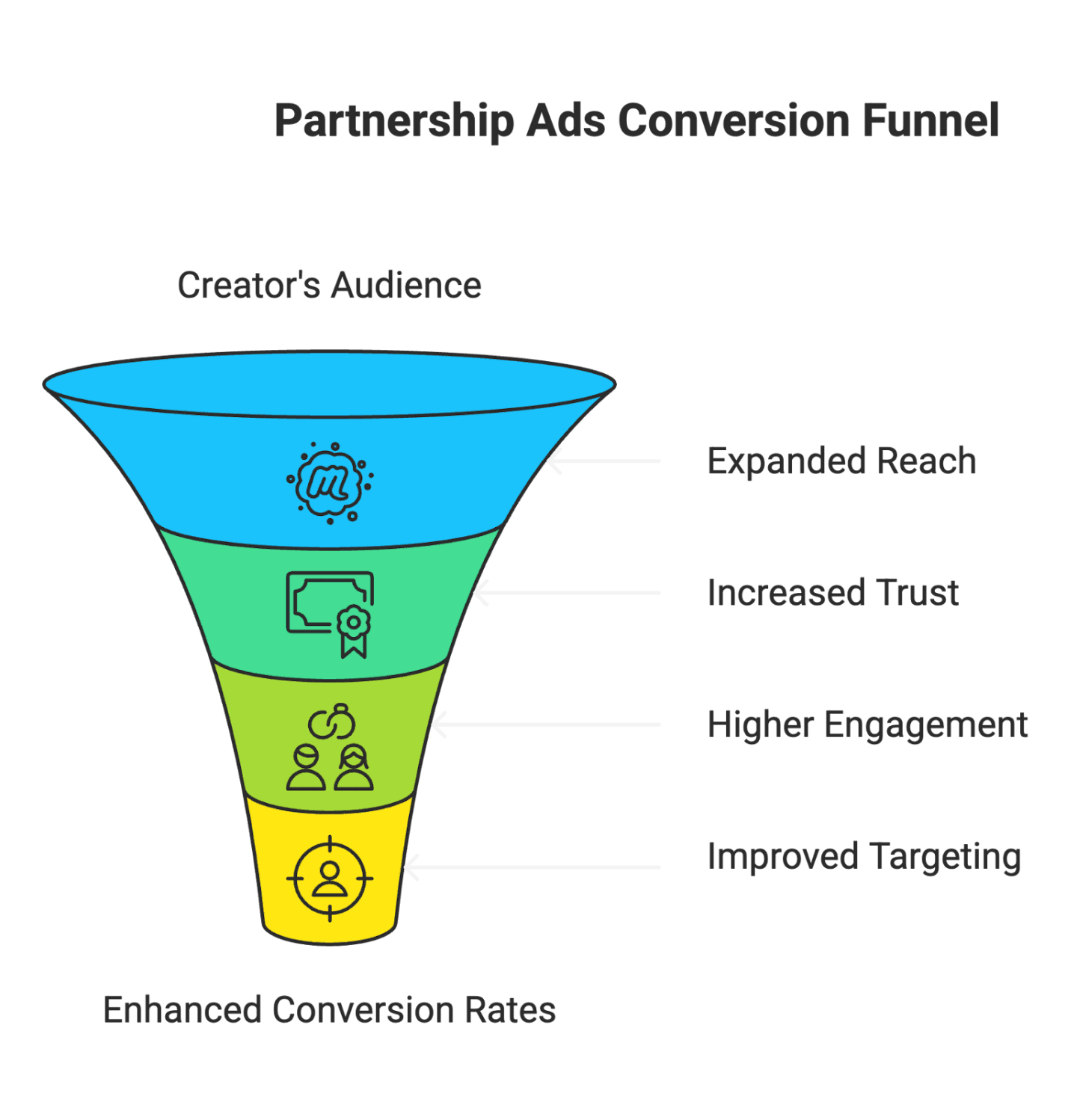
One standout advantage of partnership ads is the expanded reach they offer. When you run an ad through a creator’s account, you’re not limited to your brand’s follower base anymore. You get to reach two audiences at once: the creator’s followers and whatever targeting group you choose in Ads Manager. Essentially, you’re borrowing the influencer’s existing audience trust and adding your own targeting on top.
This means you can expose your product to new demographics that might have never seen your brand otherwise. For example, let’s say you sell eco-friendly gym gear and mostly target fitness enthusiasts. By partnering with a yoga micro-influencer, your ads can also reach her followers who are into wellness and sustainable living – an adjacent niche you might not capture with standard targeting alone. Many of these people will be more receptive because they already trust the creator. Brands using creator audiences often see higher conversion rates from these new users since the introduction comes via a person they follow and admire.
For Amazon sellers in particular, this broader reach can translate into external traffic hitting your Amazon listing, which is gold for boosting your product’s rank and reviews. Influencer-driven posts and ads can drive a surge of visitors to your Amazon page, giving you a head start in sales velocity and accumulating social proof on the listing. Meta partnership ads essentially let you funnel social media interest directly into your Amazon or e-commerce store sales funnel. It’s a potent way to cast a wider net and attract new customers who are primed to trust your brand.
Trust is everything in marketing, especially when you’re trying to get someone to make a purchase. Consumers are savvy; they scroll past anything that feels too promotional or impersonal. Partnership ads solve this by injecting a huge dose of authenticity. When people see an ad that features a creator they follow, it comes across as a genuine endorsement rather than an ad barrage. The post looks and feels like the content that influencer normally shares, so users are more likely to stop and pay attention.
Crucially, consumers tend to trust creators more than brands. In fact, a whopping 92% of consumers trust recommendations from individuals (like influencers) over brand advertisements. That’s a striking statistic. We’re more inclined to believe “people like us” or personalities we admire, rather than a faceless company message. By featuring both the creator’s name and your brand in the ad, partnership ads signal that the creator is vouching for you. This peer-like recommendation builds credibility fast. Viewers might think, “Hey, if my favorite creator uses this product, it must be legit,” which boosts their purchase intent.
Additionally, the content in partnership ads often feels more informal and relatable. It might be a selfie video review or a fun tutorial created by the influencer, as opposed to a slick studio-shot commercial. This user-generated style content (UGC) resonates because it’s storytelling, not selling. The tone is more “here’s something I love” rather than “buy this now.” For e-commerce brands, especially newer ones, this credibility can make a huge difference in convincing skeptical customers to give your product a try. The trust built through authenticity ultimately leads to higher conversion rates because people feel more confident in the recommendation.
It’s no secret that influencers (especially micro-influencers) are experts at creating content that sparks engagement. They spend years fine-tuning what their audience likes – whether it’s engaging stories, trendy visuals, or down-to-earth product demos. When you integrate this kind of creator-made content into your ads, the effect on engagement can be dramatic. We’re talking more likes, comments, shares, and click-throughs than you’d typically see on a standard brand ad.
Why the big boost? One reason is the personal connection. A micro-influencer’s followers often see them as a friend or credible expert in a niche. So, when that creator’s post appears as an ad, fans engage with it similarly to how they would any of the creator’s organic posts. The content doesn’t feel like an ad interrupting their feed – it feels like content they want to interact with. This often translates to significantly higher click-through rates (CTR) and more people visiting your site or product page.
Another reason is the sheer quality of engagement that micro and niche creators get. Micro-influencers typically have much higher engagement rates than big celebrities. For example, on Instagram, a creator with 10k–100k followers might average around a 3.8% engagement rate per post, far outperforming macro influencers (100k+ followers) who only see ~1% engagement or less. In one benchmark, micro-influencers got about 3.86% engagement vs. 1.21% for macro and 0.98% for mega influencers. This means their audiences are actively tuned in. When you tap into that via partnership ads, you’re leveraging content that you already know people find interesting.
Ultimately, higher engagement on your ads often leads to better conversion efficiency. Think of it this way: if more people click your ad and engage with it, Meta’s algorithm also notices and could favor your ad (lowering your costs). Plus, those users who engage are entering your sales funnel with a positive impression. Many brands report lower cost per click (CPC) and cost per acquisition (CPA) when using influencer partnership ads versus business-as-usual ads. In one case, a fashion brand’s partnership ads drove 296% more engagements and a substantially higher return on ad spend, as mentioned earlier. Higher engagement isn’t just a vanity metric; it directly correlates with more efficient spending and more sales for the budget you put in.
Beyond engagement, partnership ads also unlock some cool targeting advantages. Meta allows you to create custom and lookalike audiences based on the people who engage with the creator’s content. That means after running partnership ads, you can tell Facebook, “Hey, find me more people like those who liked/commented on this influencer’s post.” This lookalike audience can significantly broaden your reach with relevant users. Meta’s platform can analyze the creator’s audience and help you find new potential customers who have similar interests – even if they haven’t heard of your brand yet.
Another major benefit is how well partnership ads work across the marketing funnel. At the top of the funnel (TOFU), partnership ads are excellent for prospecting new customers. You’re introducing your brand through a creator that the audience already trusts, which makes people more receptive from the first touchpoint. It’s like a warm introduction rather than a cold call. This can lead to more people engaging with the ad, following your page, or clicking to learn more because the first impression is positive.
In the middle of the funnel (MOFU), you can use partnership ads to retarget those who have seen your content or visited your site but haven’t converted yet. Since the ad comes via the influencer’s persona, it’s a subtle nudge that feels less like “brand stalking” and more like a friendly reminder. The credibility of the creator can help push on-the-fence shoppers closer to purchase. We often see higher click-through and conversion rates in retargeting when using influencer content, because it re-ignites interest in a more authentic way.
And don’t forget bottom-funnel or even post-purchase: partnership ads can also be used to show new content (like how to use a product, or community highlights) to recent customers, leveraging the creator’s content to improve retention and loyalty. This isn’t a traditional use-case, but it highlights that influencer content can humanize your brand at every stage of the customer journey.
Finally, remember that Meta partnership ads require a bit of setup – the influencer has to grant your business permission to advertise with their content (done through Meta’s tools like Business Manager/Creator Studio). Both you and the creator need to have appropriate business or creator accounts. Once set up, though, the doors open to precision targeting using all of Meta’s data, now supercharged with an influencer’s touch. It’s a powerful combination of human touch and algorithmic targeting.
Seeing the potential of partnership ads is one thing – executing them well is another. Below are best practices and tips to help e-commerce brands (especially smaller teams and Amazon sellers) get the most out of these campaigns:
When adding partnership ads to your mix, it’s wise to segregate them into their own campaign in your Meta Ads Manager. This way you can allocate a specific budget and track their performance separately from your standard ads. By isolating partnership ads, you’ll clearly see which sales or leads are coming from creator-driven content versus your normal creative. This data is invaluable – if partnership ads are knocking it out of the park, you might shift more budget their way!
That said, don’t abandon your regular ads entirely. The best approach is a balanced one. Standard ads are great for consistent, controlled messaging (like announcing a sitewide sale or a very specific product benefit) and ensuring broad coverage. Partnership ads bring the authenticity and engagement. Running both in parallel gives your audience a mix of content: some direct brand communication and some creator-driven stories. This one-two punch can reinforce your message – for instance, a user might see a standard ad first to get basic product info, then later see a creator’s ad raving about the product, which together push them to convert. Brands that layer these formats tend to capture attention more effectively and drive conversions at all stages of the funnel.
If you do balance both, monitor how they influence each other. You might find, for example, that partnership ads drive lots of traffic, and your retargeting standard ads then seal the deal with a discount offer. Or vice versa. Use the data to adjust budget split. The key is to not put all your eggs in one basket – leverage the credibility of creators and the consistency of your own ads for optimal results.
Successful partnership ads rely on a good relationship with your influencer partners. Since the ads use the creator’s content and identity, you’ll want to coordinate closely on the creative and messaging before launching. Remember, once a partnership ad is live, you cannot edit the content (the post is “as-is” from the creator). So, invest time upfront to align on things like the key message, any must-show product features, and the general style/tone.
It’s important the content feels authentic to the creator’s style – that’s the whole point, after all. Give them creative freedom to express your product in their own voice, but also provide clear guidelines on your objectives. For example, communicate if you need a certain hashtag or a call-to-action in the caption, or if there are any brand dos and don’ts. Many creators appreciate having those expectations set clearly. Open communication also helps avoid any missteps like an accidental competitor mention or a missing disclosure.
Also, discuss timing and campaign schedules with your influencers. Decide together when the original post should go live (if it hasn’t yet) and when you’ll start the ad promotion. Coordinating this ensures the influencer isn’t, say, posting another sponsored item for a different brand the very next day – which could dilute attention. It also helps manage the flow of content to their followers. A well-timed campaign can maximize impact (for instance, launching a partnership ad right after an influencer’s initial post gets a lot of organic traction can capitalize on the buzz).
By treating creators as true partners – looping them in on strategy and valuing their input – you set the stage for smoother campaigns. It also builds a long-term relationship; if the partnership ads perform well, you’ll likely want to work with that influencer again. Many micro-influencers are open to long-term brand partnerships, which can further benefit your marketing consistency.
One thing to watch out for in any ad campaign is creative fatigue – when people see the same ad too many times and start tuning it out (or worse, find it annoying). Even with awesome influencer content, this can happen if you overplay a single post. To avoid this, plan for multiple pieces of creator content to promote. A good rule of thumb is to have 4–6 partnership ads in rotation if budget allows, rather than pouring all your spend on one ad. This way, audiences will get a variety of posts and perspectives, keeping things fresh.
If you only have one creator to work with, consider using a mix of their content: maybe one video, one carousel of images, one Story promo (converted to an ad) if possible. If you’re working with several micro-influencers at once, you’ve got more options – you could rotate each influencer’s ad, or even run them simultaneously and let Facebook’s algorithm optimize for the best performer. Having multiple creatives also lets you test which influencer’s style or which message resonates best with your target audience.
Monitor frequency in your ad reports (how many times each person has seen the ad on average). If it starts creeping high, it’s time to refresh content. The beauty of partnership ads is you can always reach out to your creator network for new UGC. In fact, one fringe benefit of these campaigns is you’ll accumulate a library of influencer-generated photos/videos about your product. You can repurpose that content not only in ads but across your marketing (with permission, of course).
One challenge with scaling influencer-based ads is managing all the moving parts – finding the right creators, sending products, tracking posts, gathering permissions, etc. If you’re a small team or an Amazon seller doing this solo, it can feel overwhelming. This is where using an influencer marketing platform or agency can help. For example, Stack Influence is a platform geared toward micro- and nano-influencer campaigns that automates product seeding and manages the end-to-end process of working with lots of small creators. Essentially, you provide your product and goals, and the platform finds suitable influencers, handles outreach, ships out products, and even tracks the content and results in one dashboard.
Leveraging such tools means you can run a partnership ad campaign with, say, 20 micro-influencers contributing content, without personally coordinating every little detail with each one. The platform or agency does the heavy lifting of recruitment and management. This is highly beneficial for e-commerce brands that want to scale up influencer collaborations (and thus have plenty of UGC for partnership ads) but don’t have a large team to do it manually. In fact, surveys show about 60% of brands use third-party tools to assist with influencer marketing – it’s a common practice to save time and streamline campaigns.
If a platform like that is not in your budget, you can still streamline things by being organized: use spreadsheets or an influencer CRM to track contacts and content, create a standard “influencer kit” (with campaign guidelines, promo codes, tracking links, etc.), and batch your communications. The goal is to make working with 10+ creators as efficient as possible so that the content engine for your partnership ads keeps humming without burning you out.
Meta partnership ads represent a powerful fusion of authenticity and advertising. They allow e-commerce entrepreneurs – from Shopify store owners to Amazon FBA sellers – to tap into the voices of content creators and micro-influencers, and scale those voices to reach thousands or even millions of potential customers. By doing so, brands can achieve what every marketer dreams of: ads that people actually enjoy and trust, leading to more engagement and higher sales.
To recap, partnership ads on Meta offer a way to boost your visibility through wider influencer audiences, build credibility through trusted recommendations, and drive efficient conversions thanks to highly engaging content. We’ve seen how they outperform traditional ads in many cases, and how they can be used strategically across the marketing funnel. When executed thoughtfully – with the right partners, proper coordination, and ongoing optimization – these ads can become a game-changer for your growth.
As you plan your next campaigns, consider adding a dose of influencer-powered content. Start small: maybe collaborate with one or two micro-influencers who really resonate with your brand’s niche. Turn their best content into partnership ads and watch the results. Pay attention to the data, refine your approach, and scale up the strategy if it’s delivering value. Keep in mind the tips on balancing with your other ads, keeping content fresh, and leveraging tools like Stack Influence (or similar platforms) to manage the workflow.
In the evolving landscape of social media and e-commerce, those who innovate in how they connect with audiences will stay ahead. Partnership ads are one such innovation – essentially blending word-of-mouth marketing with paid amplification. It’s a chance to let your customers hear about your product from relatable voices and then use Meta’s targeting to amplify that message to the moon. Brands that jump on this opportunity and master the art of partnership ads will likely be the ones reaping the rewards in engagement, loyalty, and sales in the years to come.
So, go ahead and reach out to those content creators, craft a campaign that combines authenticity with advertising savvy, and turn on those partnership ads. Your future customers are out there scrolling – let them discover your brand through someone they trust. The results might just exceed your expectations, and you’ll wonder how you ever ran social ads without a little help from your influencer friends!
Instagram Partnership Ads – branded content posts promoted in collaboration with influencers – have become a go-to strategy for brands looking to supercharge their social campaigns. By leveraging popular creators’ authentic content and voices, marketers are achieving unprecedented reach, engagement, and ROI. Below, we spotlight five outstanding brand-influencer partnership ads (primarily on Instagram, with some spanning Facebook) that set the bar in 2024–2026. These examples showcase creative collaboration, smart targeting, viral appeal, and measurable results – providing inspiration for marketers and brand managers alike on how to maximize this powerful ad format.
A post shared by Stack Influence (@stackinfluence)
Kicking off our list is a stellar example from Stack Influence, a micro-influencer marketing platform. Stack Influence partnered with eco-friendly brand Blueland to run a massive Instagram micro-influencer campaign that delivered jaw-dropping results. Over a 3-month period, 211 Instagram creators were activated to post authentic content about Blueland’s products, each post labeled as a paid partnership. The campaign’s scale and authenticity paid off big time – achieving a 13:1 return on investment (1300% ROI). In concrete terms, every $1 spent returned $13 in revenue, with the micro-influencers driving about $129,280 in sales from roughly $9,917 in costs.
Not only did this partnership ad campaign boost sales, it also generated significant social traction. The 211 influencers’ posts amassed around 247,000 impressions and 11,400 engagements, averaging an excellent ~4.6% engagement rate. By tapping into Stack Influence’s network of niche creators, Blueland reached highly relevant audiences with content that felt genuine – followers saw real people demonstrating the products in everyday use. This led to a 4.7× jump in monthly sales on Amazon for Blueland during the campaign. The success showcases how micro-influencer partnership ads can flood Instagram with relatable posts, creating huge collective reach and conversion power. Key takeaway: leveraging hundreds of micro-creators via a platform like Stack Influence can yield outsized ROI, outperforming a single big celebrity ad by combining authenticity at scale.
A post shared by rhode skin (@rhode)
When Hailey Bieber’s skincare brand Rhode launched a limited-edition line of phone cases (yes, phone cases!), they turned to TikTok/Instagram creator Alexandra Saint Mieux to generate buzz. This unconventional cross-category collab proved to be an Instagram hit. Alexandra, known for her glamorous and aspirational style, showcased Rhode’s vibrant bubblegum-colored phone cases paired with the brand’s popular peptide lip tints – seamlessly blending tech accessory and beauty content. The partnership ad post exploded on Instagram, ranking among Rhode’s top-performing content ever. In a single post, Alexandra earned 247,000 likes, 3,600 comments, and an estimated 9+ million reach, with roughly 10 million impressions overall. Equally impressive, the engagement rate hit 8.95%, indicating the campaign resonated strongly with Rhode’s audience.
Such massive engagement clearly translated to brand momentum. Fans loved the visually striking imagery of Alexandra’s chic aesthetic matched to Rhode’s colorful product – it felt like an organic extension of the brand. By co-creating a product-focused story with an influencer whose personal brand oozes luxury and trendiness, Rhode managed to captivate both beauty lovers and lifestyle gadget fans. The “limited-edition” nature of the phone cases (which matched Rhode’s lip tint colors) added exclusivity that drove urgency among followers. This example shows how a creative partnership ad, especially one aligning with a viral creator’s rise, can yield sky-high Instagram engagement and reach. The Rhode x Alexandra collab earned significant media coverage and stands as one of 2024’s most successful influencer campaigns in terms of social traction. Brands can learn from this by pairing product launches with influencers in innovative ways – and by leaning into creators’ aesthetic to craft highly shareable content.
A post shared by Crumbl (@crumbl)
Even a cookie company can go viral with the right influencer partnership. Gourmet bakery chain Crumbl Cookies has run several buzzy collabs, and their recent partnership ad with the Jonas Brothers was a standout. In this campaign, the Jonas Brothers (yes, the famous pop band) teamed up with Crumbl for an Instagram and Facebook content series that took fans behind the scenes. The brothers visited a Crumbl production facility, got hands-on baking their own cookie creations, and shared playful taste-test videos – all presented as sponsored “paid partnership” posts that felt more like a fun reality show than ads. The result? A flood of engagement and a top-performing post for Crumbl’s socials, with over 2 million impressions and an engagement rate around 1.22% (high given the huge reach). In fact, the Jonas Brothers collab post quickly climbed into Crumbl’s most-engaged social posts of the year.
Why did it work so well? Crumbl smartly combined celebrity star power with an immersive, relatable concept. Seeing global music stars don aprons, joke around in a test kitchen, and genuinely enjoy the product made the brand incredibly approachable. The partnership had broad appeal – engaging both die-hard Jonas Brothers fans and dessert lovers – which amplified sharing and discussion. It also generated earned media: entertainment and food news outlets picked up the story, further expanding reach. This campaign is a perfect example of how a well-crafted Instagram partnership ad can double as viral content. By focusing on experience and storytelling (rather than a typical product plug), Crumbl benefited from organic buzz and increased brand warmth. For marketers, it underscores that even big-name endorsements perform best when creators are integrated into creative content. As the data shows, this immersive collab significantly amplified Crumbl’s reach and impact – and likely had fans lining up at their nearest store!
Beauty brands have long embraced influencer partnerships, but Redken’s collaboration with pop star Sabrina Carpenter has been a masterclass in leveraging the right creator at the right time. Sabrina, a singer-actress with a surging fanbase (thanks to her hit music and social media virality), became a global ambassador for Redken and started appearing in the haircare brand’s Instagram content throughout 2024. The alignment was spot-on: Sabrina’s vibrant, trendy persona meshed perfectly with Redken’s youthful image, and her credibility with Gen Z audiences gave Redken an instant boost. Over a series of sponsored posts (marked with the “Paid Partnership” tag) featuring Sabrina using and touting Redken products, the brand saw consistently higher performance than their average posts. In fact, in one quarter, posts with Sabrina outperformed all others, with a single Instagram partnership ad generating 83,000 impressions – making it one of Redken’s top posts of the campaign.
These results highlight how a well-chosen influencer can amplify a brand’s reach and engagement. Sabrina’s followers trust her beauty recommendations, and that translated into tangible social metrics for Redken. Beyond impressions, fans actively engaged – liking, commenting, and sharing her Redken content – showing that her endorsement made Redken more compelling to a younger audience. Redken smartly capitalized on Sabrina’s viral rise and authentic love for the products, strengthening the brand’s appeal and social presence. Not every partnership ad needs a direct sales ROI to be a success; in this case, the payoff was in brand awareness and affinity. By the numbers, Sabrina’s collab posts drove a noticeable uptick in Redken’s social reach, while qualitatively they injected fresh energy into the brand’s marketing. The key lesson: aligning with an influencer who genuinely fits your brand (and is on a trajectory of growing popularity) can yield outsized benefits in social engagement and cultural relevance.
A post shared by Amelia Dimoldenberg (@ameliadimz)
Rounding out our top five is a partnership that exemplifies smart targeting and narrative-driven advertising: Bumble’s 2026 campaign with Amelia Dimoldenberg. Amelia – famed as the creator of the hit YouTube/Instagram series “Chicken Shop Date” – became the face of Bumble in a year-long series of Instagram partnership ads and content pieces. This collaboration is a perfect match: Amelia’s humorously awkward yet charming take on dating made her an ideal ambassador for Bumble’s women-centric dating app. In the campaign, Bumble and Amelia delivered comedic yet insightful clips like “Amelia’s Golden Rules of Dating,” which were shared as sponsored posts on Instagram (and across Facebook/Interview Magazine channels). Her very first Bumble video on Instagram garnered around 170,000 likes and hundreds of comments, indicating tremendous engagement from the audience.
Why it stood out: Bumble tapped a relevant influencer whose personal brand story aligns with their own. Amelia’s decade-long journey from a small comedic dating column to a viral content creator mirrors the realities of modern dating – quirky, authentic, and filled with trial and error. Her Bumble ads didn’t feel like ads at all; they felt like extensions of her beloved content, filled with witty dating advice and self-deprecating charm. This authenticity struck a chord with Bumble’s target users. According to industry observers, Amelia’s involvement helped Bumble foster “unfiltered conversations on contemporary dating” and made singles feel seen and understood. It’s a textbook example of leveraging an influencer to humanize a brand message. Rather than a typical product-pitch, Bumble’s partnership ads focused on storytelling – showing that the app embraces real dating experiences. The campaign not only drove social engagement, but also reinforced Bumble’s positioning in a crowded dating app market by differentiating via culture and content. Marketers can take note: authenticity and alignment are everything. A partnership ad that entertains or inspires can build enormous goodwill (and indirectly, user growth) even if it’s not pushing a hard sale.
The above examples demonstrate that Instagram partnership ads – when executed thoughtfully – are delivering major wins for brands across industries. From micro-influencer armies generating 13× ROI, to superstar collaborations racking up millions of impressions, the formula is consistent: authentic content + the right creator + smart campaign strategy = success. Whether the goal is direct sales (as with Stack Influence’s Blueland campaign) or viral brand buzz (Crumbl’s celebrity factory tour), partnership ads allow brands to tap into the creativity and credibility of influencers. By blending the influencer’s voice with the brand message, these ads feel more like native content that audiences want to engage with, rather than disruptive promos.
Key trends from our top 5 cases include leveraging exclusivity and limited launches to spark urgency (e.g. Rhode’s limited collab driving 10M impressions), using experiential storytelling (Crumbl turning an ad into an entertaining behind-the-scenes experience), and focusing on cultural alignment (Bumble choosing an influencer who embodies their brand values). Many campaigns also repurpose influencer posts as paid ads across Facebook and Instagram, extending reach beyond the creator’s followers. According to Meta, this can dramatically lower customer acquisition costs and boost ROI when compared to standard brand-produced ads, as seen in multiple Meta case studies (e.g. partnership ads yielding 20–50% lower cost-per-purchase for brands like Clinique and Vuori).
For marketers planning their next campaign, the takeaway is clear: influencer partnership ads are a game-changer for social marketing. By choosing influencers who truly connect with your target audience and giving them creative freedom to showcase your product, you can produce ads that not only perform well but also enhance your brand’s credibility. The five campaigns highlighted here prove that when brands and creators team up, marketing magic happens – in the form of higher engagement, greater reach, and real business results. It’s no wonder 86% of marketers are working with micro and macro influencers in 2026, increasingly favoring these collaborations over traditional ads. To stay ahead, start thinking of your ads less like ads and more like influencer-driven content pieces. The next “top partnership ad” success story could be yours.
Influencer marketing continues to evolve, and one of the hottest strategies today is influencer whitelisting (also known as allowlisting). For e-commerce brands and Amazon sellers, this tactic can supercharge your ads by combining the authenticity of creator content with the targeting power of paid advertising. In fact, research shows influencer whitelisting campaigns often outperform regular brand ads by 20–50%. This guide will explain what influencer whitelisting is, why it’s so valuable (especially for micro-influencers and user-generated content), and how to set it up across major platforms in a casual, step-by-step manner.
Influencer whitelisting is the process of an influencer (or content creator) granting a brand permission to run ads through the influencer’s social media account or content. In other words, the brand can pay to promote a post under the influencer’s handle, rather than from the brand’s own account. This typically involves using the platform’s business tools (like Facebook’s Business Manager or TikTok’s Spark Ads) to give the brand advertising access. When a whitelisted ad runs, it appears to viewers as if it’s coming from the influencer they follow, not directly from the brand.
This approach offers a unique win-win dynamic:
You get to leverage the influencer’s name, trusted voice, and already-engaged audience while still controlling targeting, budget, and even tweaking the content or call-to-action on the ad. The result is ads that feel more authentic and often perform better in terms of engagement and conversions.
You gain extra exposure to new audiences (because the brand can target people beyond your followers) and potentially extra compensation for the whitelisting rights. Many creators see a growth in their own following as their content is shown as sponsored posts to like-minded users who might not have discovered them otherwise.
In essence, influencer whitelisting blends the credibility of organic influencer content with the scale and precision of paid advertising. It’s a strategy that has become popular on platforms like Instagram, Facebook, and TikTok, and if done right, it builds trust and drives results for both parties.
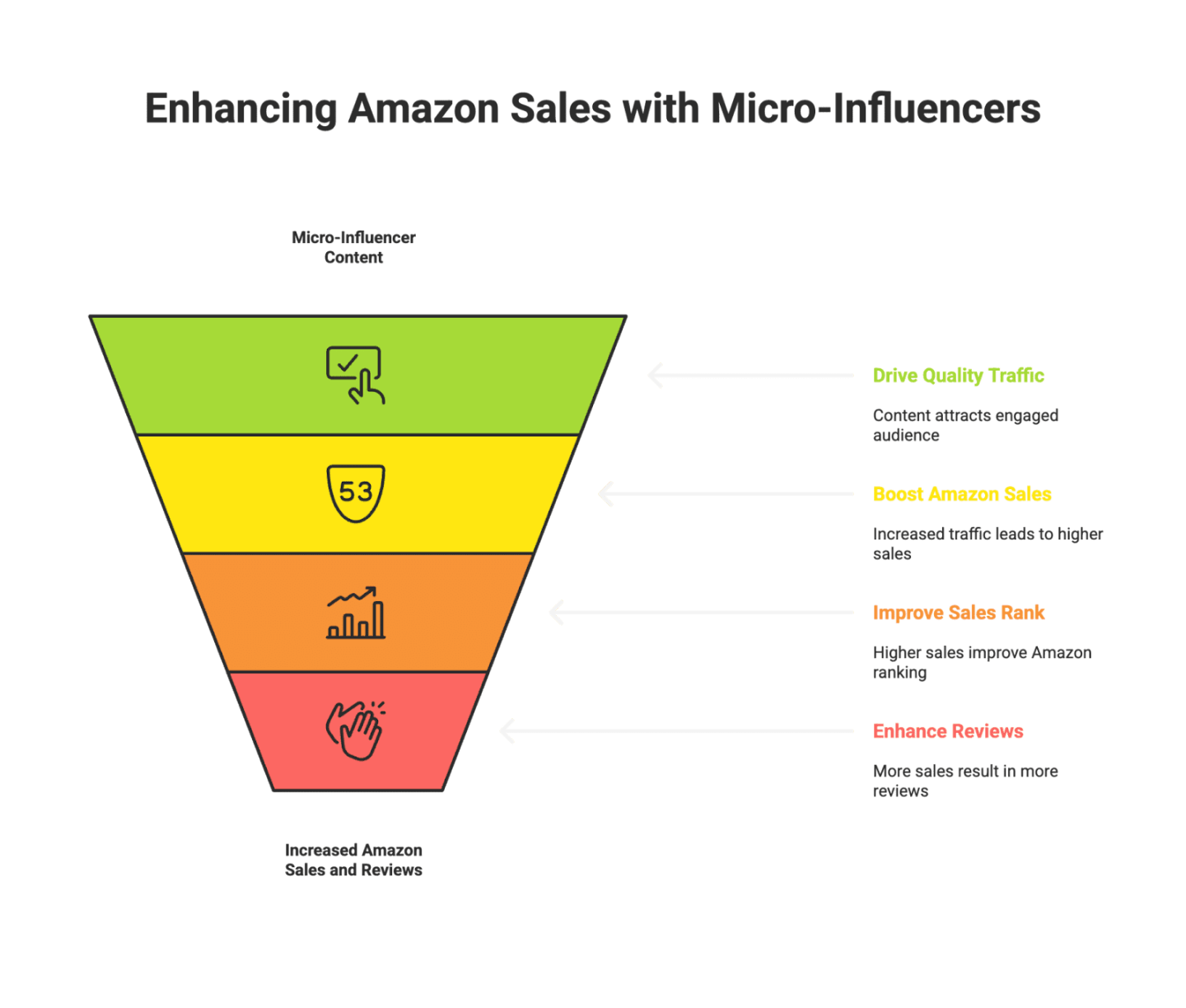
For e-commerce marketers – from DTC brands to Amazon sellers – influencer whitelisting can be a game changer. Here are a few key benefits and reasons to consider it:
Influencer posts generally earn higher engagement than brand posts. People are more likely to stop and listen to content that comes from a relatable creator’s handle rather than a company page. By whitelisting an influencer’s post, you’re putting user-generated content (UGC) front and center. This kind of content feels organic in the feed and can significantly boost click-through rates and conversions. One study even found that whitelisted influencer ads can improve Return on Ad Spend (ROAS) by 1.5–2× compared to typical brand-run ads – meaning you get more sales per advertising dollar.
When an influencer permits you to run ads through their account, you gain access to valuable audience targeting options. For example, on Facebook/Instagram, you can target lookalike audiences based on the influencer’s followers, or reach people beyond the influencer’s organic reach who fit your customer profile. Instead of being limited to whoever saw the original post, you can amplify that content to precisely the customers you want to reach. This is incredibly useful for e-commerce brands looking to find new buyers. (Imagine taking a popular Instagram post by a micro-influencer raving about your product, and then targeting that post via ads to thousands of potential customers who share similar traits to the influencer’s followers.)
With whitelisting, brands can extend the life of an influencer’s content. A normal influencer Story might vanish in 24 hours, but with whitelisting you could keep it running as an ad for weeks. You also have the ability to tweak elements of the post when turning it into an ad – for example, adding a “Shop Now” button, editing the caption, or using only a portion of a video. This means you can A/B test different headlines or calls-to-action on an influencer’s post to see what drives the best results. Essentially, you get the best of both worlds: the influencer’s engaging content and your marketing team’s optimization skills.
Micro-influencers (those with smaller, highly engaged followings) are often ideal for whitelisting. Their content feels very authentic and targeted to a niche, which can drive quality traffic to your product pages. According to Stack Influence’s data, micro accounts frequently see engagement rates of 5–20%, versus only ~1–3% for macro influencers. That means their audiences pay attention and trust their recommendations. If you’re an Amazon seller, imagine running a whitelisted ad featuring a micro-influencer’s review of your product – you benefit from their credibility and can send shoppers straight to your Amazon listing. The combination of micro-influencer UGC and precise ad targeting can seriously boost your Amazon sales rank and reviews (by driving external traffic that converts). Plus, micro-influencers are cost-effective to work with, so even adding a 20% whitelisting fee on top won’t break the bank (many brands offer an extra 20–30% of the collaboration fee as payment for whitelisting rights).
Bottom line: Influencer whitelisting allows e-commerce brands (big or small) to turn trusted creator content into high-performing ads. You get the relatability of a creator’s voice alongside the levers of digital marketing (targeting, budget scaling, analytics). Now, let’s dive into how you can set this up step by step.
Before we get into the platform specifics, it helps to understand the overall flow of setting up a whitelisted ad. Here’s a simplified overview of the process:
A simple overview of the influencer whitelisting process, from content creation to running the ad. In whitelisting, brands promote an influencer’s post through the influencer’s own social handle – making it feel native to viewers.
This could be an Instagram post, a TikTok video, etc., featuring your product or brand message (as agreed upon in your collaboration). Make sure it feels authentic and aligns with the influencer’s usual style – authenticity is key here.
This is the “whitelisting” step: the creator formally authorizes your brand to run ads using their identity or post. (How this is done varies by platform – we’ll explain Facebook/Instagram, TikTok, etc. shortly.)
In the ad platform (Facebook Ads Manager, TikTok Ads, etc.), you’ll create a campaign as usual – but select the influencer’s page or post as the source. You can adjust targeting, duration, and add a CTA link (e.g. to your online store or Amazon page). Pro tip: treat this like any paid ad – use conversion tracking and define your goals (traffic, sales, etc.).
The brand can see full performance metrics in the ad dashboard. The influencer typically can see basic insights too (and certainly will notice new followers or engagement coming their way). A whitelisted campaign often results in the influencer gaining new followers while the brand gains new customers – a win-win outcome.
Now that you see the big picture, let’s get into the nuts and bolts of setting up whitelisting on each major platform. The process and tools differ a bit for Meta (Instagram/Facebook) vs. TikTok vs. others, so we’ll break those down next.
Each social platform has its own mechanism (and terminology) for influencer whitelisting. Below, we’ll cover the most common ones – Instagram/Facebook (Meta), TikTok, and a note on YouTube/other platforms – with step-by-step guidance:
Facebook and Instagram (both under Meta) use the same system for whitelisting, often called Branded Content Allowlisting. It all happens through Facebook’s Business Manager (now part of Meta Business Suite):
Meta whitelisting benefits: You can run highly targeted Facebook/IG ads using the influencer’s proven content. You have freedom to edit creatives, create multiple ad variants, and utilize all of Facebook’s optimization tools – all while appearing native in the social feed. Many brands have lowered their CAC and improved ROAS using this method.
TikTok’s version of whitelisting is known as Spark Ads. TikTok essentially allows brands to amplify organic posts from creators. The process is a bit different from Meta, relying on authorization codes:
TikTok whitelisting highlights: TikTok Spark Ads are powerful because TikTok is a creator-driven platform where authenticity rules. By boosting a creator’s TikTok, you’re maintaining that native, entertaining vibe in people’s For You Page. Brands have seen great success – for example, Isle of Paradise ran Spark Ads via influencers and achieved a 500% ROI with millions of views. Just remember that on TikTok, trending-style content works best, so allow your influencers creative freedom, then put ad dollars behind the winners.
What about whitelisting on YouTube, Twitter, or other channels? This is a bit trickier:
In summary, Meta (IG/Facebook) and TikTok are the primary places where influencer whitelisting is straightforward and built-in. Now that you know how to technically set up whitelisting, let’s cover a few best practices to ensure these campaigns succeed.
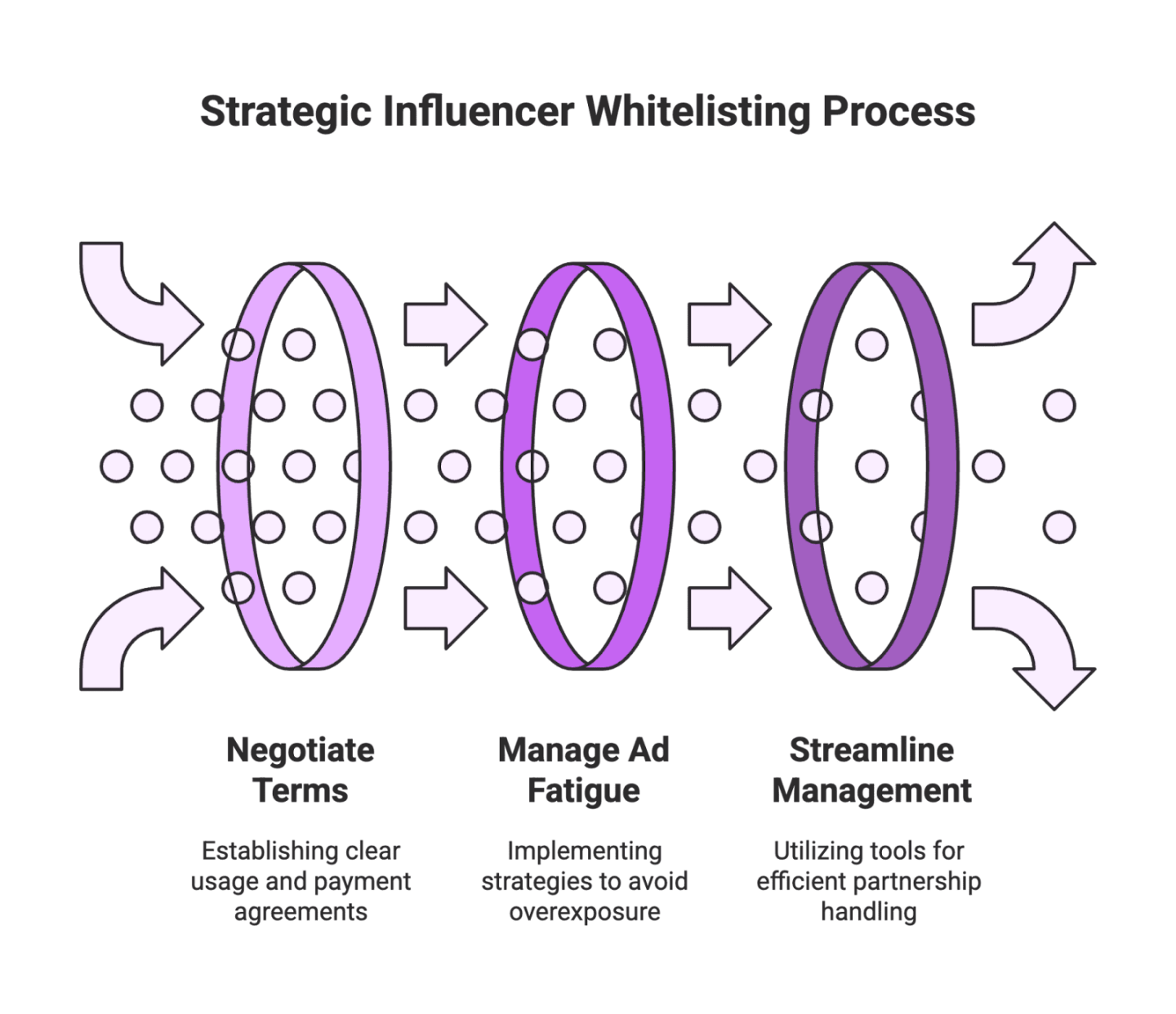
Setting up the ad is only half the battle – to truly get great results, you should approach influencer whitelisting strategically. Here are some tips and best practices:
Not every influencer will be a good fit for whitelisting. Look for creators who produce high-quality, engaging content that aligns with your brand. The content should feel authentic and not overly scripted. Ideally, the influencer has an audience that overlaps with your target customers. Micro-influencers can be fantastic here, because their niche followers trust them and engage heavily. If your brand sells, say, eco-friendly kitchenware, a micro-influencer known for sustainable living tips might have a small but highly responsive audience – perfect to amplify via ads. Also, do your due diligence on the influencer’s audience stats (age, location, interests) to ensure their followers match your target demographic for lookalike targeting. Whitelisting works best when the influencer’s audience and your desired audience are in sync.
Since whitelisting goes beyond a standard post, be upfront with influencers in your agreement. Typically, brands will pay an extra fee for whitelisted ad rights – commonly ~20% of the original collaboration fee (though some negotiate a flat rate or a per-day fee). Specify how long you intend to run the ads, and in which platforms/markets. Also clarify what content will be used and if you plan to make any edits (e.g. adding text or logos). All of this should be in a written agreement. This avoids confusion later and ensures the creator feels comfortable with how their likeness will be used. Tip: Also discuss creative control – let the influencer know if you plan to A/B test different captions or if you might tweak their video into shorter clips for ads, etc., so they aren’t caught off guard. Having everything in writing also protects you in terms of usage rights (e.g. you have permission to use the content in ads for X months).
One pitfall to watch for is running the same influencer’s ad for too long or too frequently. If the audience sees the same sponsored post too many times, it could lose its charm (or worse, annoy people). Mitigate this by setting proper frequency caps in your ad settings and refreshing creative periodically. You could alternate between a couple of influencers or rotate in new UGC assets every few weeks. Also consider format variation – for instance, repurpose an influencer’s content into an Instagram Story ad or a Reel if it was originally a feed post, to keep things fresh. The goal is to keep the authentic vibe without burning out the content.
Managing multiple whitelisted partnerships can get complex. Thankfully, there are tools and platforms that simplify the process of getting permissions and handling many creators. For example, Stack Influence (an influencer marketing platform geared towards micro-influencer campaigns for e-commerce) can help brands scout and coordinate with a large number of creators efficiently – which is useful if you want to scale up whitelisted ads from dozens of everyday influencers. Other popular tools include Lumanu (which specifically focuses on facilitating secure access to influencers’ accounts for whitelisting) and full-suite platforms like CreatorIQ or Aspire that include whitelisting modules. These platforms can automate the permission requests, track all your influencer content usage rights, and even consolidate reporting. While you can certainly do whitelisting manually, if you plan to do it regularly, it’s worth exploring these tools to save time and ensure nothing falls through the cracks.
Influencer whitelisting is more than just a trend – it’s a powerful strategy at the intersection of social proof and performance marketing. By partnering with content creators and amplifying their voice through paid ads, e-commerce brands can humanize their marketing and drive more efficient results. Whether you’re a Shopify store owner or an Amazon seller, leveraging micro-influencers and their UGC in this way can help lower your customer acquisition costs and build brand trust simultaneously.
Getting started might seem technical, but platforms like Instagram, Facebook, and TikTok have made the process relatively easy with the right guidance (and hopefully this article gave you exactly that!). Begin by identifying a few creators who truly resonate with your brand. Offer them a collaboration that includes whitelisted ad usage, and follow the steps to set up the campaign. Monitor the impact – you’ll likely be amazed at how an ad that looks like a regular post from a beloved creator can outperform your polished branded ad creatives.
In 2025 and beyond, as consumers continue to value authenticity, strategies like influencer whitelisting will play a crucial role in digital marketing. Brands that master this approach – combining the creativity of influencers with the data-driven approach of marketers – will stand out in the crowded social feed. So, don’t be afraid to give it a try. You might find that the key to scaling your e-commerce business is partnering with a tribe of passionate micro-influencers and letting them lend their voice to your ads. As the leading micro-influencer platform Stack Influence puts it, smaller creators often deliver outsized engagement and ROI – exactly what a savvy online seller needs to grow.
By following the guidance in this tutorial, you’ll be well on your way to setting up influencer whitelisting campaigns that drive sales, build community, and create a truly authentic brand presence across social media. Happy whitelisting, and here’s to seeing your influencer-powered ads convert like crazy! 🚀