
The latest info on influencer marketing trends, micro influencer news, and the world of social media

Finding Amazon influencers is easy if success means collecting handles. It is much harder if you need creators who can explain your product credibly, reach likely buyers, publish reliably, and send measurable traffic to Amazon.
For ecommerce sellers, the real task is not discovery alone. It is building an evidence trail from a creator's existing content and Amazon presence to a campaign your team can activate, track, and improve. This guide explains where to search, how to vet candidates, what to include in the first collaboration, and how to turn a promising creator into a repeatable partner.
An Amazon influencer is a content creator approved for the Amazon Influencer Program, an extension of Amazon Associates that gives qualifying creators a customizable Amazon presence and a vanity URL for curated recommendations. Sellers should distinguish these creators from ordinary affiliates, UGC creators, and social influencers who may promote Amazon products without operating an influencer storefront.
Amazon's storefront is a creator-owned recommendation page, not the same thing as a seller's Amazon Brand Store. The creator may organize products into Idea Lists and support recommendations with photos, videos, or livestreams, while earning commissions on qualifying purchases.
Stack Influence's Amazon Influencer Program guide explains the program from the creator and seller perspectives. The current definition should still be verified against Amazon's official Influencer Program documentation, because eligibility, tools, and regional availability can change.
For seller planning, separate four creator types:
One person can occupy all four roles. The important question is which role your campaign actually needs.
Ecommerce sellers can find Amazon influencers through Amazon Creator Connections, Amazon Live, influencer storefronts, social search, native creator marketplaces, existing customers, and managed influencer marketing platforms. The strongest process uses several sources, then verifies the same creator across Amazon, social content, audience behavior, and campaign communication before outreach begins.
Discovery is a genuine industry bottleneck. In IAB's 2025 Creator Economy Ad Spend & Strategy Report, one-third of brands identified finding the right creators as their biggest hurdle. Creator reputation was cited by 58% of brands and audience alignment by 56% as leading selection criteria, which is why a large list without evidence creates more work rather than better matches.
Amazon's help documentation dated July 21, 2026 describes Amazon Creator Connections as a marketplace service connecting brands with Amazon Creators. Brands can offer bonus commissions for qualifying sales generated by creator content, and the portal provides aggregate campaign performance data. Check your advertising console for current account access and campaign options.
Creator Connections is useful when the seller wants an Amazon-native path from campaign offer to tracked sales. It should still be treated as one sourcing pool, because acceptance inside a marketplace does not remove the need to review category relevance, content quality, reputation, and offer fit.
Amazon Live surfaces creators who already demonstrate products in shoppable video. Sellers can watch how a creator explains features, handles questions, compares options, and moves viewers toward a buying decision. Amazon says its Live experiences can feature relevant talent and shoppable content across several Amazon surfaces.
Use Stack Influence's guide to finding Amazon Live influencers as a research companion. Record the creator's category, recurring formats, storefront URL, posting recency, audience questions, and whether similar products already dominate the creator's content.
Search by buying situation rather than by the phrase "Amazon influencer." A seller of compact kitchen storage should test queries such as "small apartment pantry organization," "renter kitchen makeover," and "Amazon kitchen organization" across TikTok, Instagram, and YouTube.
Native tools can shorten the search. TikTok Creator Marketplace is TikTok's official brand-creator collaboration platform, Instagram Creator Marketplace provides creator recommendations through Meta's first-party data, and YouTube Creator Partnerships enables brands to discover eligible YouTube Partner Program creators for brand deals. Availability and features vary by account and region.
Existing customers can reveal creators who already understand the product category. Review tagged posts, customer survey responses, brand mentions, affiliate applications, newsletter subscribers, and repeat purchasers who publish useful content.
Influencer marketing platforms solve different parts of the workflow. A searchable database helps with manual list building, while a managed platform can connect discovery to creator activation, product seeding, coordination, UGC collection, and completion tracking.

The Storefront-to-Sale Method is a five-stage workflow for moving from scattered creator discovery to a measurable Amazon campaign. It prevents sellers from confusing a visible profile with a qualified partner and gives the team a repeatable way to source, test, and retain creators.
Define the exact decision the content should help a shopper make. "Promote our listing" is too vague; "show parents how the leakproof lid works in a school-lunch routine" gives the creator a real content problem to solve.
Write down:
This step determines which creators, platforms, and formats deserve attention.
Build queries around the product's job, customer vocabulary, and content format. Combine category phrases with words such as review, comparison, routine, tutorial, haul, setup, favorites, before and after, and mistakes.
A creator who ranks or repeatedly publishes around the buying problem may be more relevant than someone whose bio contains "Amazon finds." Search results should produce evidence of expertise, not merely a self-assigned title.
Verify the storefront or affiliate path, posting recency, product categories, disclosure habits, and link behavior. Then check whether the creator can send shoppers to the intended ASIN or Brand Store with the tracking setup your campaign requires.
Amazon readiness also includes operational details. Confirm marketplace, shipping location, product eligibility, variant selection, expected publishing date, and whether the creator can follow the brief without reading from a script.
Start with a cohort large enough to compare patterns but small enough to supervise. Use one product, one buying moment, a consistent brief, and a defined measurement window so differences between creators remain interpretable.
The first activation should test:
Do not call the first cohort a failure merely because one post did not drive immediate sales. Its job is to identify repeatable creator-product combinations.
Promote creators into repeat collaborations when they produce useful content, credible audience response, reliable delivery, and measurable commerce signals. The next step may be another seeded product, an affiliate relationship, a brand ambassador program, a paid UGC package, or licensed creative for ads.
Record why each creator advances, pauses, or exits. Over time, the Storefront-to-Sale Method turns a one-time search into a brand-owned creator partnership system.
Vet an Amazon influencer by checking product relevance, content skill, audience behavior, Amazon activity, operational reliability, disclosure practices, and content rights. Follower count is only a scale indicator. A smaller creator with repeated category proof and strong buyer questions can be more useful than a larger account with broad, passive reach.
Use a Creator Evidence Card for every serious candidate.
Stack Influence's guide on how to collaborate with Amazon influencers covers goal setting and partnership structure, while its practical influencer outreach guide provides a broader mutual-fit test for brands and creators.
Red flags deserve context rather than automatic rejection. A sudden follower spike, repetitive comments, mismatched audience geography, long inactivity, undisclosed promotions, or dozens of competing products in one week should trigger deeper review.

An Amazon storefront proves that a creator has an Amazon recommendation surface. It does not prove that the creator is active, reaches your buyers, converts traffic, delivers brand work reliably, or grants reusable content rights.
This distinction corrects a common weakness in guides about finding Amazon influencers. Many workflows stop once the seller locates an amazon.com/shop/handle URL, even though the storefront is only the beginning of qualification.
Check the creator's most recent social posts and storefront updates side by side. Look for continuity between what the creator discusses publicly, what they curate on Amazon, and what their audience asks about.
Also check product saturation. A creator can be highly active yet provide little value if every post promotes a different competing item with no clear point of view. Category depth, believable use, and selective recommendations usually create stronger evidence than sheer posting volume.
Sellers should send a short, personalized outreach message that names the product fit, proposed content outcome, compensation model, timeline, disclosure requirement, and next step. The first activation should clearly separate no-obligation gifting from an agreed product-for-content collaboration, because the two models create different expectations and completion risk.
A useful message contains five parts:
The offer may use gifted product, a flat fee, affiliate commission, a hybrid arrangement, or a longer ambassador relationship. Amazon Creator Connections supports bonus commissions tied to qualifying sales, while a direct collaboration can include product, cash, usage rights, or another agreed exchange.
Review the distinction between open-ended gifting and defined deliverables in Stack Influence's product-seeding guide. Whatever model you choose, confirm the product variant, deadline, posting surface, required disclosures, approval boundaries, content files, usage term, and reporting responsibilities before fulfillment.
A gifted product, payment, commission, or other material connection generally requires clear disclosure. The FTC's Endorsement Guides also make clear that advertisers should not assume a platform tool alone always communicates the relationship adequately.
Stack Influence is designed for ecommerce brands that want discovery to lead directly into vetted micro-influencer activation, gifted-first product seeding, creator coordination, UGC generation, and completed-post accountability. The platform works with roughly 600,000 vetted creators, approximately 78% of whom are female, and its completions-only workflow is intended to reduce budget loss from unfinished collaborations.
That workflow is explained on the automated product-seeding page. It is particularly practical when the seller needs a repeatable campaign process rather than another spreadsheet of creator profiles.
Measure creator value in four layers: delivery, content, traffic, and commerce. A creator can be valuable without winning every layer, but the campaign should identify which job each creator performed. The correct evaluation window and metric mix depend on whether the goal was UGC, awareness, consideration, external traffic, or Amazon sales.
Use the Amazon Creator Evidence Stack:
Amazon Attribution is a free measurement solution for eligible sellers, vendors, registered brand owners, and other supported advertisers. Amazon says its reports use a 14-day attribution window and can include clicks, detailed page views, add-to-cart activity, purchases, units sold, product sales, and new-to-brand metrics.
Create separate tags by creator or tactic before content goes live. Stack Influence's Amazon Attribution guide provides a seller-focused walkthrough, while its guide to measuring ROI for micro-influencer campaigns explains how to combine traffic, content, and commerce measures.
Attribution is not perfect proof of causation. A 14-day window can miss delayed purchases, shoppers who later search organically, cross-device behavior, and content value that appears through reused assets. Compare creator-level tags with listing conversion, rank movement, sales trends, content output, and a pre-campaign baseline.
Eligible U.S. brand owners should also account for Amazon's Brand Referral Bonus, which Amazon says credits brands an average of 10% of qualifying sales from traffic they drive to Amazon. Eligibility, rates, and terms should be checked in Seller Central before building the bonus into campaign economics.
Impressions also need context. In verified Stack Influence customer stories, Targus recorded 4,323 engagements across 275,560 impressions during a three-month campaign, equal to 15.7 engagements per 1,000 impressions. Snow recorded 6,596 engagements across 168,510 impressions during a three-month launch, equal to 39.1 per 1,000, about 2.5 times the Targus ratio.
These are campaign-level observations, not category benchmarks or forecasts. The comparison shows why sellers should not rank creators or cohorts by impressions alone; content context, audience response, category, product, and execution can change the value of each thousand views.
Finding Amazon influencers becomes more reliable when every step produces evidence. Start with the buying moment, search across Amazon and social platforms, verify creator readiness, activate a controlled cohort, and retain the partners who deliver useful content, credible audience response, and measurable commerce signals.
The next practical step is to build a shortlist around one product and one shopper problem, then decide whether your team will manage the workflow manually or use a managed product-seeding process. Either route should end with a repeatable creator system, not a one-time collection of storefront links.
A Facebook login can protect far more than a personal profile. For content creators, it may control a Page, audience history, Messenger conversations, linked Instagram assets, advertising permissions, and active brand partnerships. Losing access can therefore interrupt publishing while exposing collaborators, followers, and campaign information.
This guide explains how to change Facebook password settings on iPhone, Android, and desktop. It also covers forgotten-password recovery, suspected account takeovers, and a creator-specific security process for protecting everything connected to the account.
The central lesson is simple: changing the password is the first step, not the entire security fix.
The correct Facebook password workflow depends on what access you still have. Before tapping through settings, identify which of these three situations applies:
When you are already signed in, Meta’s current password instructions direct you through Accounts Center, Password and security, and Change password. The same help flow also explains how to start a reset when the current password is unknown.
Use this quick decision test:
A “yes” to all three usually means a normal password change is appropriate. A missing password points to reset. An unexpected login, changed recovery method, unauthorized post, or lockout points to account recovery.
This distinction matters for anyone using Facebook professionally. A creator may have Professional Mode, a Facebook Page, linked Instagram assets, or brand communications connected to the underlying profile. The guide to becoming a digital creator on Facebook explains how those creator features build on the account itself.
A replacement password should be long, unique, and unrelated to information followers or brand contacts can discover. Avoid recycling a password used for Instagram, email, editing software, affiliate dashboards, UGC platforms, or another social account.
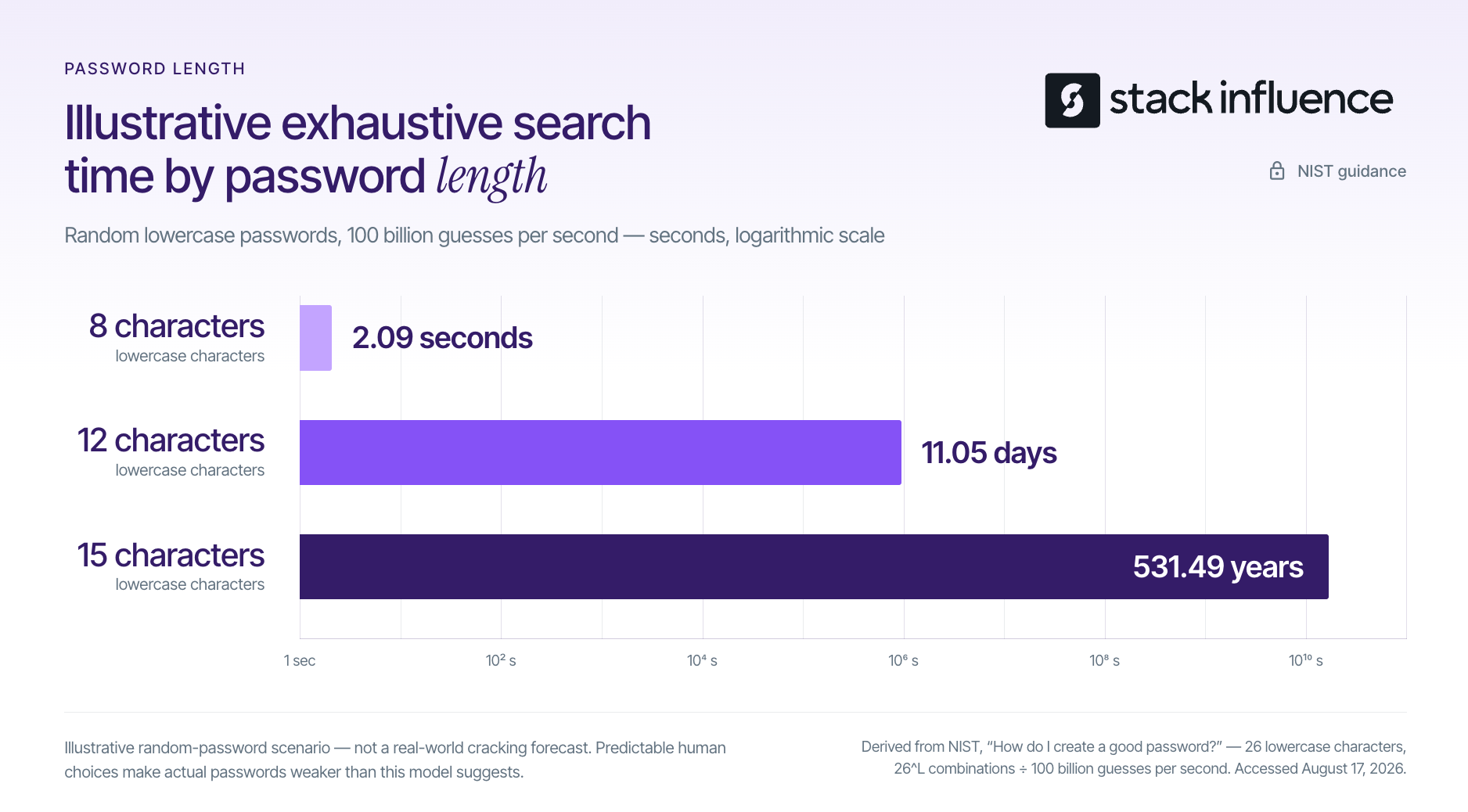
The National Institute of Standards and Technology’s password guidance recommends using multifactor authentication, a password manager, and passwords of at least 15 characters when passwords are required. NIST emphasizes length because each additional character expands the number of possible combinations.
The effect is exponential. Using NIST’s illustrative assumption of 26 randomly selected lowercase letters and 100 billion guesses per second, an exhaustive search would take approximately:
These figures are a mathematical illustration, not a real-world prediction. Human-created passwords often contain names, phrases, dates, or predictable patterns that attackers test before random combinations. Online login systems can also limit attempts, while stolen password databases create a different attack environment.
Use these practical rules when creating the new password:
Creators managing several profiles also need separate credentials. The guide to managing multiple Instagram accounts covers the related challenge of keeping account access organized without reusing passwords.
To change your Facebook password in the mobile app, open Menu, choose Settings and privacy, select Settings, open Accounts Center, and tap Password and security. Choose Change password, select the correct Facebook account, enter the current password and new password, then save the change. Menu placement can vary by device and app version.
Follow these steps:
On some versions of the app, Accounts Center appears near the top of Settings. On others, Facebook may show Password and security more prominently. Follow the visible security path rather than assuming every screen will match an older tutorial exactly.
Confirm that you selected the Facebook account, especially when Facebook and Instagram appear together in Accounts Center. Connected accounts can make the screen look unified even though you are changing a credential for a specific account.
If you manage a Facebook Page, secure the personal profile that has access to it. The Page itself is managed through assigned Facebook access rather than a separate public-facing Page password. Creators establishing a new presence can review the full Facebook business Page setup process.
To change your Facebook password on a computer, select your profile picture, open Settings and privacy, choose Settings, and enter Accounts Center. Select Password and security, click Change password, choose the correct Facebook account, and enter the existing and replacement passwords. Save the update after checking that the intended account is selected.
The desktop process is:
Do not let a password manager overwrite the wrong saved credential when several Meta accounts appear in the browser. Confirm the username associated with the saved entry before accepting an automatic update.
Creators who connect Meta properties should also understand which assets are linked. The guide to linking Instagram to Facebook explains how account connections support cross-platform publishing and management.
To reset a forgotten Facebook password, start at the Facebook login screen and select Forgot password. Search using the email address, phone number, full name, or username associated with the account. Choose the correct account, receive a recovery code through an available method, and create a new password after Facebook verifies access.
Use this sequence:
Use a device and network you have previously used for Facebook when possible. Familiar login signals may help Facebook recognize the recovery attempt.
Never send the verification code to a person claiming to be Meta support, a brand representative, a manager, or a recovery specialist. A code that proves account ownership should be entered only into the official Facebook recovery flow.
Losing access to the listed email address or phone number moves the problem from a normal reset to account recovery. Meta recommends opening its recovery process for unavailable contact information from a device or browser previously used with the account.
Facebook may ask you to identify the account, confirm previous information, or provide another reachable contact method. Follow the prompts shown for the specific account rather than using unofficial recovery services.
When a code or reset email does not arrive:
According to Meta’s password-reset troubleshooting guidance, users who reach the daily reset-request limit may need to wait 24 hours before trying again.
The 5R Creator Account Security Reset turns a password update into a complete security review. The five actions are Replace, Revoke, Recover, Reinforce, and Review. Complete them after a routine password change and immediately after any suspicious activity.
Create a password that is long, unique, and stored safely. Do not make a minor variation of the previous password, such as adding a new number or changing one symbol.
A reused password creates a chain reaction. If a separate app, email service, or creator tool exposes the same credential, an attacker can test it against Facebook and other services.
A changed password should not be treated as proof that every existing session has disappeared. Review the account’s device history and explicitly remove sessions you do not recognize or no longer need.
Meta places this control under Accounts Center, Password and security, and Where you’re logged in. Its session-management instructions explain how to select an account, inspect active sessions, and log out individual or multiple devices.
Review:
An unfamiliar location does not always prove an intrusion because internet routing can affect location estimates. An unfamiliar device combined with unknown messages, changed details, or new Page access deserves immediate investigation.
Confirm that the email address and phone number attached to Facebook belong to you and remain accessible. Remove unfamiliar contact information and replace old school, work, agency, or temporary addresses before they become a lockout problem.
Secure the recovery email account with its own unique password and two-factor authentication. Anyone who controls that inbox may be able to request password resets for Facebook and other creator tools.
Creators should also document which private email address owns the account. A brand partnership inbox can receive business inquiries, but the core recovery address should remain under the creator’s control.
Enable two-factor authentication so a password alone is not enough to sign in. Facebook’s two-factor authentication settings are available through Accounts Center, Password and security, and Two-factor authentication. Available methods can include an authentication app, text-message codes, or a security key.
The evidence for adding a second factor is strong, although it should not be misrepresented as Facebook-specific research. A Microsoft Research study of commercial accounts found that MFA was associated with a 99.22% reduction in compromise risk across the measured population and a 98.56% reduction among accounts with leaked credentials. The overall population covered suspicious activity reviewed from April 22 through September 22, 2022.
Dedicated authentication apps outperformed SMS in the Microsoft study, but both methods provided substantially more protection than using no MFA. The Cybersecurity and Infrastructure Security Agency’s MFA guidance also recommends enabling MFA on social media, email, and other important accounts.
Store any recovery codes somewhere separate from the Facebook account and primary phone. A password manager or another secured offline location is more useful than an unprotected screenshot in the same device’s photo library.
Inspect everything the Facebook profile can control, not only the profile timeline. A compromised creator account can affect Pages, advertising access, linked Instagram accounts, messages, saved payment methods, and brand communications.
Review:
Third-party apps deserve particular attention. The Stack Influence guide to Instagram unfollower apps explains why creators should avoid services that request a social-platform password instead of using an official authorization method.
The 5R sequence corrects a common mistake: treating the password as the whole account. The password protects one entrance, while sessions, recovery channels, permissions, and connected assets determine whether the creator has actually regained control.

If you suspect a Facebook account takeover, use Facebook’s hacked-account recovery flow from a familiar device, secure the connected email account, change the password, revoke unknown sessions, restore recovery information, and enable two-factor authentication. Then inspect Pages, ads, posts, messages, and linked accounts for unauthorized activity. A password change alone may leave altered permissions behind. For additional cybersecurity guidance, Cybernews offers practical resources covering account security, online privacy, and common digital threats, which can help creators strengthen their broader security practices.
Start with Facebook’s hacked-account process, not a link sent through an unexpected email, direct message, or comment. Type the address yourself or navigate through Facebook’s official Help Center.
Then complete this containment sequence:
The Federal Trade Commission’s hacked social-account guidance similarly recommends changing the password, signing out other devices, enabling two-factor authentication, checking recovery information, reviewing unauthorized activity, and notifying contacts.
Be cautious with anyone promising guaranteed account recovery for an upfront payment. Do not share passwords, authentication codes, identity documents, or remote device access through an unsolicited message.
Role-based access lets creators collaborate without turning one password into a team credential. Managers, editors, agencies, and brand partners should receive only the permissions needed for their work, with access removed when the assignment ends.
Facebook Pages are managed through people who have Facebook access or task access. Meta’s Page access documentation explains that different access levels can permit content management, messages, ads, insights, or full Page control.
Use these operating rules:
The same principle applies to influencer marketing permissions. Influencer whitelisting on Instagram and Facebook and Meta Partnership Ads use controlled permissions and platform workflows rather than informal password sharing.
Brands should document these rules in a broader social media policy. That policy can define who owns accounts, who may approve access, how credentials are stored, and how incidents are escalated.
For content creators participating in brand deals, UGC production, ambassador programs, or product seeding, secure access protects both creative work and campaign continuity. Stack Influence’s creator campaign workflow connects creators with gifted-first product-seeding opportunities, making reliable account access and communication part of completing creator partnerships professionally.
Learning how to change Facebook password settings takes only a few minutes when you still know the current credential. The more important work begins immediately afterward: remove old sessions, confirm recovery information, enable two-factor authentication, and review every Page or connected asset the profile controls.
For content creators, account security is part of protecting the business behind the content. Complete the 5R Creator Account Security Reset now, document who has access, and return to publishing with fewer hidden risks around your audience, brand deals, and creator partnerships.
The moment a brand asks for a Spark authorization code, your TikTok has entered paid media. The video may still look like an ordinary post, but an advertiser can now put budget behind it, target new audiences, and measure actions beyond the reach you earned organically.
For content creators, answering “what are TikTok ads?” requires more than naming ad formats. You need to know whether you are buying reach yourself, lending your identity to a Spark Ad, or supplying user-generated content (UGC) that a brand will publish from its own account. Those paths create different responsibilities, rights, fees, and reporting needs.
This guide explains how TikTok advertising works, which options matter to creators, how to protect your content rights, and how to judge whether paid distribution actually increased your value.
TikTok ads are paid messages distributed through TikTok’s advertising systems to reach selected audiences or pursue goals such as video views, traffic, leads, app activity, and sales. An ad may use newly uploaded creative, a brand’s existing post, a creator-authorized Spark post, or commerce content connected to TikTok Shop.
TikTok Ads Manager organizes advertising into three levels. A campaign contains the main objective and certain budget decisions. An ad group controls elements such as audience, placement, schedule, bidding, and optimization. The individual ad contains the creative, identity, copy, call to action, and destination.
TikTok currently groups objectives into awareness, consideration, and conversion. Its official objective guide lists Reach under awareness; Traffic, Video Views, Community Interaction, and Branded Mission under consideration; and App Promotion, Lead Generation, and Sales under conversion. Creators do not need to memorize every objective, but they should ask which one a brand is using because “successful creative” means something different in a reach campaign than in a sales campaign.
A paid ad is also different from a sponsored organic post. A sponsored post is content created because of a commercial relationship, such as payment, free product, or another benefit. It becomes paid media when someone buys additional distribution through Promote, Ads Manager, or another TikTok advertising product. One video can be both a disclosed sponsored post and a paid Spark Ad.
For creators who want the brand-side mechanics, Stack Influence’s TikTok Ads Manager guide explains campaign structure, creative testing, and attribution from an ecommerce advertiser’s perspective. This article focuses on the creator’s role inside that system.
TikTok ads work by matching an advertiser’s objective, audience settings, budget, bid strategy, and creative with available ad opportunities. The platform then delivers ads, records eligible interactions, and optimizes toward the selected event. Creators influence performance mainly through the message, identity, proof, pacing, and call to action contained in the creative.
A practical campaign workflow has five parts:
TikTok’s current budget documentation states that campaign-level daily and lifetime budgets must exceed $50, while an ad group’s daily budget must exceed $20. For a lifetime ad group budget, the documented minimum is $20 multiplied by the number of scheduled days. That produces minimum calculations of $140 for seven days, $280 for 14 days, and $600 for 30 days. These are platform delivery thresholds, not recommended test budgets or promises of meaningful results.
The distinction matters for creators because a brand’s media budget is separate from the creator’s compensation. A $600 ad budget does not tell you what the content, organic post, Spark authorization, raw footage, or renewal rights are worth. It only describes money available for TikTok to distribute the ad.

Creators can participate in TikTok advertising as advertisers, ad identities, or creative suppliers. Separating these roles clarifies who controls delivery, where the video appears, and what the creator is selling.
Promote is TikTok’s in-app tool for putting paid reach behind your own eligible video or LIVE. TikTok says available goals can include views, followers, profile activity, messages, leads, website visits, and sales. It also states that users must be at least 18 years old to use Promote.
Promote offers a simpler entry point than a full Ads Manager campaign, but the creator should still define the intended outcome. More views do not automatically become engaged followers, brand inquiries, affiliate sales, or repeat viewers. Stack Influence’s creator guide to TikTok marketing provides context for combining organic publishing, UGC, partnerships, and paid reach.
Spark Ads let an advertiser use an existing organic post from its own account or an authorized creator account. TikTok’s official Spark Ads documentation says engagement generated during promotion is attributed to the original post. The creator’s account identity and public social proof therefore remain part of the paid experience.
A creator can instead produce a video that a brand uploads under an advertiser identity. The asset may never appear on the creator’s profile. In this content-only workflow, the brand is buying production and agreed usage rights rather than organic distribution through the creator’s audience.
This content-only path is accessible to UGC creators, micro influencers, and nano influencers whose production skill may matter more than follower count. The distinction is central to UGC marketing for content creators: influencer work sells some combination of content and distribution, while UGC work can sell production alone. A creator can offer both, but the deliverables should be itemized.
Spark Ads matter to creators because the post, account identity, and commercial permission remain connected. An advertiser needs an approved authorization path before using another creator’s public video in this format.
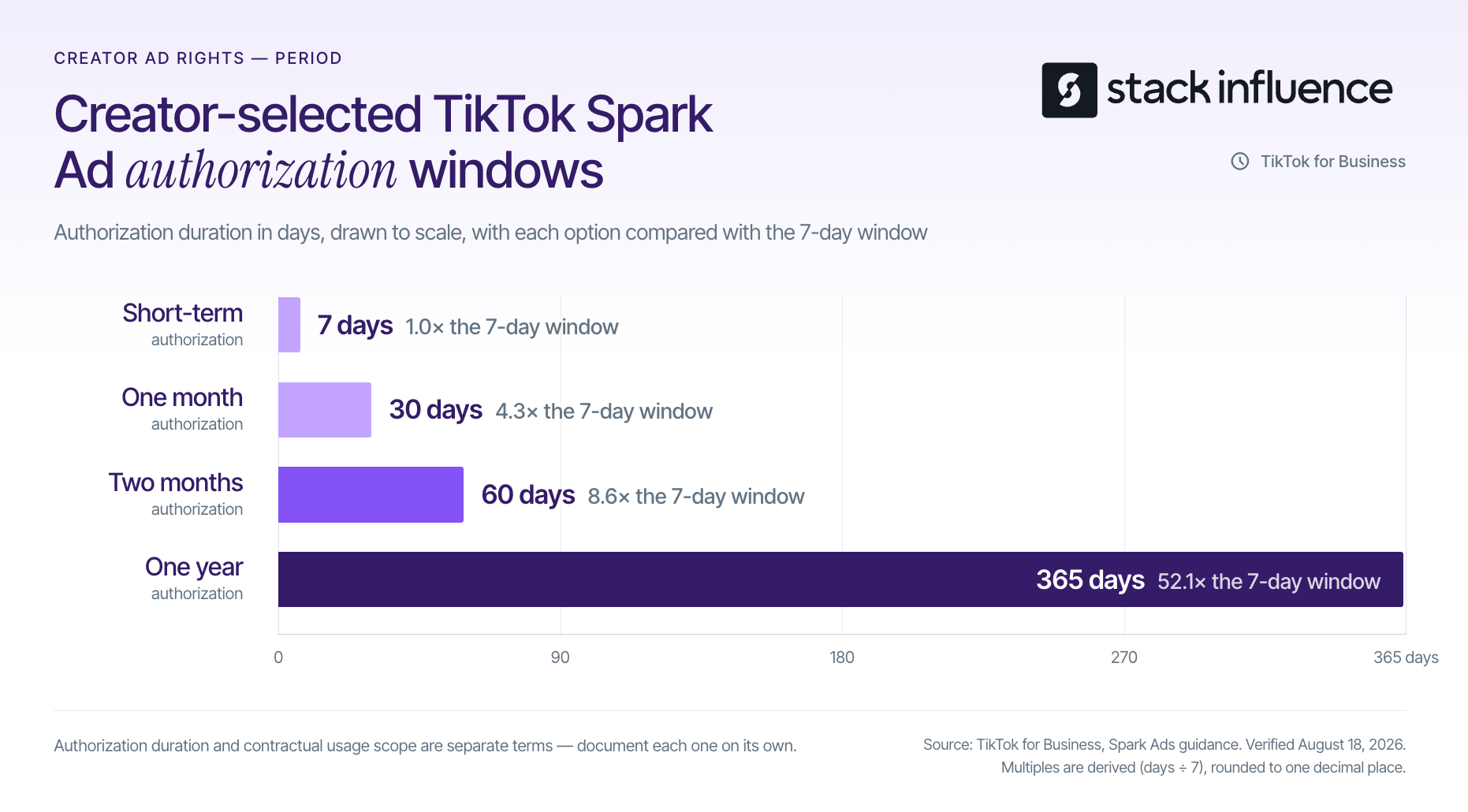
TikTok’s current process lets a creator enable ad authorization for a selected post, choose a duration, generate a code, and provide it to the advertiser. The standard duration options are 7, 30, 60, or 365 days. TikTok also notes that the caption cannot be edited after authorization, and a private video may become public when used unless the relevant private delivery option applies.
Before sharing a code:
The Stack Influence Spark Ads guide explains authorization basics, while its TikTok Spark Ads campaign workflow connects creator recruitment, UGC generation, code collection, and campaign execution for ecommerce brands.
Across creator campaigns, the overlooked work is often the handoff. The approved post, authorization code, usage period, advertiser identity, and reporting plan must align before organic content can move cleanly into paid media.
The Four P Creator Ad-Rights Check separates a code request into four decisions: Post, Placement, Period, and Payment. Use it before sending an authorization code, raw file, or ad-ready edit so the permission is clear without making the collaboration unnecessarily complicated.
Identify exactly what the advertiser may use. Name the public post, final file, caption, voiceover, music, raw footage, alternate hooks, still frames, and cutdowns included in the deal.
A Spark authorization normally points to a specific post. A broader UGC agreement may include source files and permission to create derivatives. Those are different assets and should not be bundled silently as “content.”
Define every approved location, such as a Spark Ad, brand-account TikTok ad, TikTok Shop, website, marketplace listing, Meta ad, email, or retail media.
Under U.S. copyright law, copyright generally begins with the author once an original work is fixed, although work-made-for-hire rules and written transfers can change ownership. The U.S. Copyright Office’s copyright overview distinguishes ownership from permission to authorize particular uses.
Material terms should be written, with professional advice used when a deal carries significant legal or financial consequences.
Stack Influence’s guide to UGC licensing rights makes the operational distinction clear: a platform authorization path and a commercial license solve related, but separate, permission problems.
Specify the first and last day of paid use. TikTok currently offers Spark authorization windows of 7, 30, 60, or 365 days. Relative to seven days, those periods are 1.0, 4.3, 8.6, and 52.1 times as long.
The technical authorization period and contractual license period should be recorded separately, with a defined renewal process. A one-year code should not become perpetual or cross-channel permission by assumption.
Separate the purchased services. A deal can include production, organic posting, paid-media usage, exclusivity, renewal, affiliate commission, or a performance bonus.
Creator ad-rights deals do not have one universal rate. SAG-AFTRA’s Influencer Agreement fact sheet says compensation under its agreement is freely bargained and does not use set rates. The broader lesson is useful: payment should reflect the actual bundle of labor, distribution, identity, rights, duration, and restrictions.
Before approving a deal, check that every P can be answered in one sentence. A vague answer usually means the scope is unfinished.
Ad-ready content begins before filming. The creator should understand the objective, approved claims, commercial restrictions, deliverables, and reporting plan before choosing the hook or soundtrack.
TikTok recommends its Commercial Music Library for promotional content because its music is pre-cleared for commercial use. A sound available for ordinary posting is not automatically cleared for advertising.
Product seeding can feed this creative pipeline. A creator gains product experience, produces an agreed post or asset, and separately authorizes paid use when appropriate. Stack Influence’s resources on influencer seeding and creator opportunities show how product-based collaborations can build portfolio proof without making every usage right automatic.
Creators should measure TikTok ad performance through four layers: attention, action, business outcomes, and creator value. The best metric depends on the campaign objective, and no single number explains the result. Views show delivery, while deeper metrics reveal whether people watched, acted, converted, or created durable value for the creator.
Track impressions, reach, two-second views, six-second views, average play time, and completion rate. TikTok defines a six-second focused view as at least six seconds watched, a full view of a shorter video, or an eligible early interaction for supported focused-view products.
High impressions with weak six-second retention usually point to a hook, audience-match, or first-frame problem.
Track clicks, click-through rate, profile visits, follows, comments, shares, and other actions relevant to the objective. For Spark Ads, save the organic baseline because public engagement can grow while paid delivery is active.
Stack Influence’s reach versus impressions guide helps distinguish unique exposure from repeated delivery. Neither number proves conversion by itself.
For conversion campaigns, review purchases, leads, cost per acquisition, conversion rate, revenue, return on ad spend, or affiliate commission. Always request the attribution window.
Google Analytics explains that UTM parameters, including utm_source, utm_medium, and utm_campaign, help identify campaigns that referred clicked website traffic. They do not capture every view-through, cross-device, or offline outcome, so use them with platform reporting.
Measure follower growth, profile visits, organic engagement added to the Spark post, inbound brand inquiries, renewal requests, affiliate earnings, and requests for new variations.
A campaign may miss a sales target while revealing that a creator earns strong attention or efficient clicks. It may also produce sales without giving the creator durable value. Compare the paid period with a reasonable baseline, preserve the settings and dates, and avoid claiming that every later follower, sale, or partnership came from one ad.
The most expensive creator mistakes usually come from unclear permissions, not weak camera work. Each mistake below can reduce the value of a deal or create avoidable compliance and reporting problems.
Clear disclosure protects audience trust and makes a post easier for brands to reuse through compliant advertising workflows.
Creators preparing for paid collaborations can use Stack Influence’s guide to getting brand deals on TikTok and Instagram to strengthen their portfolio, positioning, outreach, and partnership process before negotiating ad rights.
The question “what are TikTok ads?” leads to a more valuable creator question: what exactly is the advertiser buying from me? The answer may include production, organic distribution, creator identity, paid-media permission, derivatives, exclusivity, or performance. Treating those elements as one vague deliverable makes both pricing and measurement harder.
A stronger creator offer names the ad path, applies the Four P check, preserves baseline data, and requests a useful performance report. Start by turning one strong product demonstration into an ad-ready portfolio example with clearly defined rights. That gives brands a cleaner buying decision and gives you a more defensible creator service.
Instagram is easy to open but hard to use with purpose. A content creator is not merely posting. The real job is to build a recognizable profile, publish work people remember, turn attention into relationships, and learn which ideas deserve another version.
This guide explains how to use Instagram as a creator. It covers setup, formats, audience growth, analytics, partnerships, disclosure, and security. The goal is a repeatable system in which every post teaches you something.
Instagram gives content creators a connected set of publishing, discovery, communication, measurement, and partnership tools. Creators can use Reels and Explore for discovery, feed posts for a portfolio, Stories and DMs for relationships, and Insights to learn what earns attention or action.
The main surfaces serve different purposes:
A strong creator connects these surfaces. Reels can introduce the work, carousels can earn saves, Stories can build familiarity, and DMs can turn interest into collaboration.
Set up Instagram as a creator by making the account easy to recognize, understand, trust, and contact. Use a clear username, a recognizable profile image, a public-facing niche statement, a professional Creator account, one useful link destination, and strong account security before you begin publishing consistently.
Start with these decisions:
Instagram’s professional account setup gives creators access to tools for growth, monetization, advertising, and performance analysis. For an individual, the Creator option is usually the clearest starting point because the account represents a person and their work.
A bio becomes easier to write after the niche is defined. The creator niche selection guide explains how to connect subject expertise, audience demand, and repeatable content instead of choosing a category that is either too broad or too restrictive.
Secure the account before it becomes valuable. The Cybersecurity and Infrastructure Security Agency recommends multifactor authentication because it adds another identity check beyond a password. Turn it on, store recovery codes safely, and avoid reusing the password connected to your creator email.
A content plan becomes clearer when it starts with a specific audience problem, desire, or identity. “Lifestyle content” describes almost anything. “Fast vegetarian lunches for college students” gives a creator a subject, viewer, constraint, and reason to return.
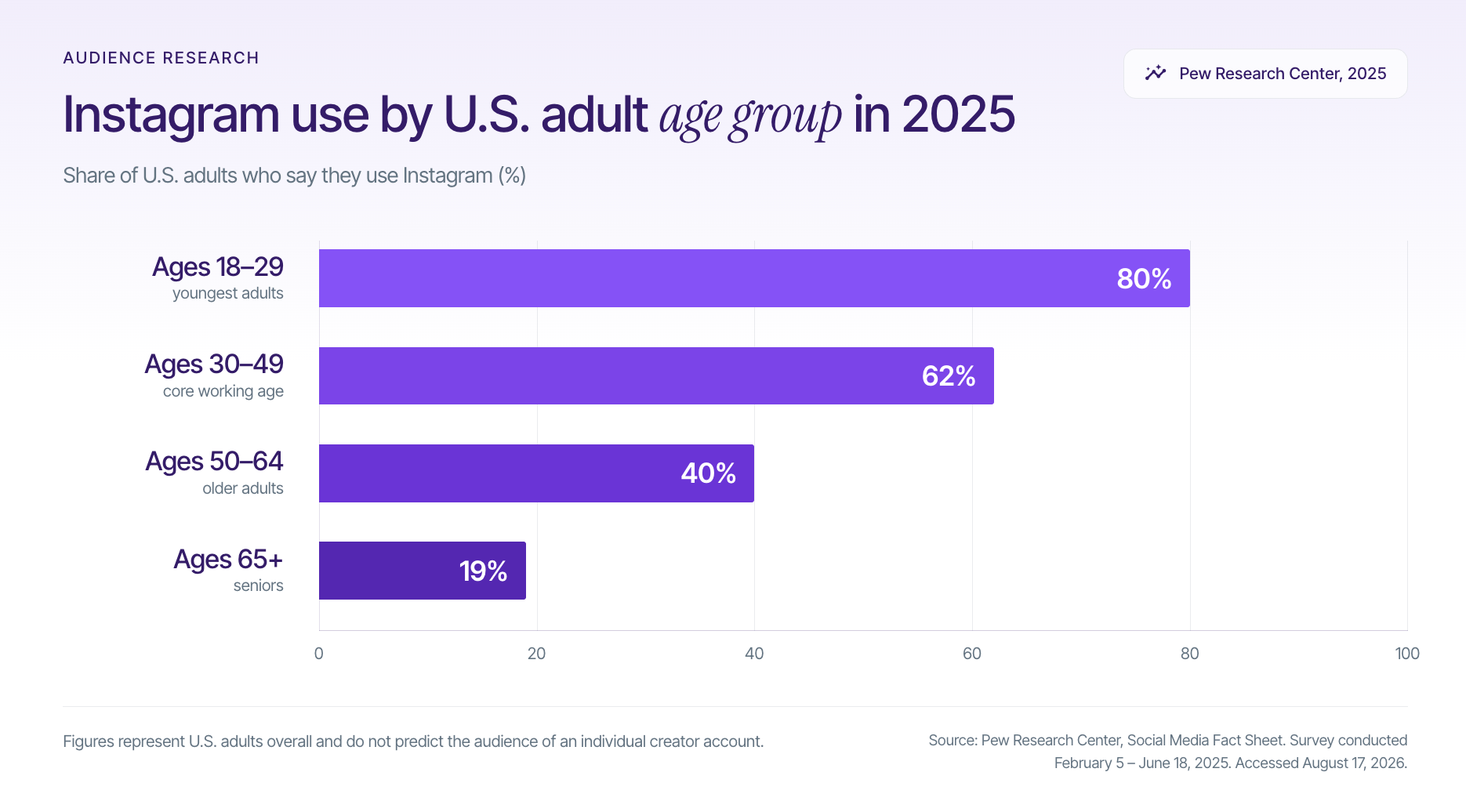
Audience selection should use evidence without turning people into stereotypes. The Pew Research Center Social Media Fact Sheet found that Instagram use varied substantially by age: 80% of adults ages 18 to 29 used Instagram, compared with 62% of adults ages 30 to 49, 40% of adults ages 50 to 64, and 19% of adults ages 65 and older. These are U.S. adoption figures, not a guarantee about the audience for any individual account.
Translate the audience choice into three content pillars:
Three pillars create consistency without forcing every post into one format. The Instagram post ideas guide can help turn each pillar into recurring series rather than disconnected concepts.
The Instagram Creator Loop is a five-stage operating system: Promise, Publish, Participate, Parse, and Progress. It prevents creators from confusing activity with improvement because every publishing cycle begins with a clear audience promise and ends with a decision about what to repeat, revise, or stop.
Define the recurring value of the account in one sentence. A useful promise contains an audience, a subject, and an outcome or experience.
For example, “I help first-time apartment renters make small spaces feel intentional” is stronger than “home and lifestyle creator.” It naturally supports tutorials, demonstrations, room breakdowns, budget challenges, and partnership ideas.
Give every post one primary job. A Reel might introduce the account to non-followers, a carousel might explain a method, and a Story might collect questions.
Trying to maximize reach, comments, saves, clicks, follows, and sales in one post usually weakens the creative. One primary job creates a cleaner hook and call to action.
Instagram growth is not only a broadcasting task. Reply to substantive comments, use Stories to ask focused questions, and send thoughtful messages when a conversation genuinely belongs in private.
Comments and DMs also reveal objections, follow-up questions, and language for future hooks.
Review results by topic, format, hook, and intended job. Instagram’s Insights documentation explains that professional accounts can examine performance for posts, Stories, Reels, and Live content. Look for patterns across comparable posts rather than treating one spike as a permanent rule.
Turn a strong idea into a series, not a victory lap. Change one meaningful variable at a time, such as the opening, example, format, or level of detail, so the next result teaches you something.
The loop restarts with a sharper promise, creating a recognizable body of work and a personal dataset more useful than a generic posting rule.
Creators do not need to choose one permanent winning format. They need to match the format to the communication job and then test how their own audience responds.
Originality matters across formats. Instagram’s original content guidelines define original work as content a creator made or content that reflects a unique perspective. In April 2026, Instagram reported that original creators were receiving greater recommendation priority, with 75% of U.S. recommendations coming from original posts, reinforcing the value of creating rather than merely aggregating.
Use the Instagram Reels hashtag guide to categorize content without making hashtags the strategy. The Instagram image size guide can help prevent avoidable cropping and readability problems when preparing feed and vertical assets.
Publish an Instagram post or Reel by selecting the creation control, choosing the format, adding media, editing the asset, writing the caption, adding relevant tags or collaborators, reviewing accessibility and disclosure, and publishing or scheduling. Interface labels can change, but the creator decision sequence remains stable.
Use this pre-publish sequence:
Batching can reduce production friction without replacing real-time participation. The Instagram scheduling guide explains scheduling options, while the desktop posting guide is useful for creators who edit captions and assets on a computer.

Reach matters only when it leads to a useful next behavior. A high-view Reel that attracts the wrong audience, creates no profile curiosity, and does not strengthen the creator’s positioning may be less valuable than a smaller post that earns saves, follows, qualified DMs, or repeat viewers.
Think of the journey as four connected transitions:
Recommendation eligibility is a prerequisite, not a growth guarantee. Instagram says professional accounts can review recommendation eligibility in Account Status, which can show whether content may be recommended to non-followers. Check it when distribution changes sharply, but continue evaluating the creative and audience fit rather than blaming every weak result on the algorithm.
The Creator Decision Ladder separates leading indicators from business outcomes. Review the ladder every four weeks and compare groups of similar posts, preferably at least three executions of an idea, before making a major strategy change.
Track reach, views or plays, and the share of attention coming from non-followers when that metric is available. Delivery shows whether Instagram distributed the content, not whether the content created value.
Track watch time, completion patterns, saves, shares, meaningful comments, and Story interactions. Choose the metric that matches the post’s job rather than adding every interaction into one score.
Track profile activity, follows, link taps, email sign-ups, and qualified DMs. Divide the desired action by the relevant exposure metric when possible, such as follows divided by profile visits, so account size does not hide improvement.
Track collaboration inquiries, accepted brand deals, affiliate actions, portfolio assets created, repeat partners, and content licensing opportunities. A creator economy business needs evidence that attention can produce useful outcomes, not only larger public counts.
Attribution breaks down when several posts, Stories, search results, recommendations, and outside channels influence the same person. Use tagged links, campaign-specific codes, saved inquiry notes, and consistent reporting windows, but describe a post as associated with an outcome rather than automatically causing it.
Creators get brand deals by building a clear niche, publishing repeatable proof of their creative ability, making contact information visible, presenting useful performance evidence, and approaching brands with a specific collaboration idea. Follower count can matter, but relevance, content quality, audience response, reliability, and usage rights also shape the opportunity.
Prepare four assets before outreach:
The Instagram sponsorship guide, creator media kit guide, and influencer outreach guide cover those steps in greater depth.
Eligible professional accounts can also explore Meta’s Creator Marketplace onboarding, which connects Instagram creators and brands through platform partnership tools. Availability and eligibility vary, so treat it as one relationship channel rather than the only route to work.
Stack Influence supports a different but complementary workflow built around gifted-first product seeding, vetted micro-influencer activation, creator coordination, UGC generation, and completed-post accountability. Creators can explore the Stack Influence creator community when they are ready to build campaign experience with ecommerce products.
Disclose every material brand connection clearly. The Federal Trade Commission’s Disclosures 101 guidance says free or discounted products count as a material connection, disclosures should be hard to miss and placed with the endorsement, and video disclosures should appear in the video rather than only in the caption. The FTC also cautions creators not to assume that a platform disclosure tool is sufficient by itself.
A longitudinal study of more than one million posts from 400 Instagram creators across four countries found major differences in use of Instagram’s paid partnership feature among disclosed posts: 31% in Brazil, 27% in the Netherlands, 10% in the United States, and 3% in Germany. The dataset covered 2010 to 2022, so it is historical rather than a current adoption benchmark, but it illustrates why creators should use clear disclosure language instead of assuming one platform label is understood or used consistently everywhere.
A creator account becomes a business asset as it accumulates content, contacts, trust, and partnership history. Build security and verification habits early.
Use a simple protection routine:
Learning how to use Instagram as a content creator is less about mastering every button and more about connecting the right decisions. Set up a trustworthy profile, choose a specific audience, give each format a job, publish through the Instagram Creator Loop, and use the Creator Decision Ladder to improve from evidence.
The next step is practical: define one audience promise, choose three content pillars, and publish one useful idea in two different formats. That small cycle will teach you more than waiting for a perfect strategy. Once the profile contains clear proof of your work, you can begin evaluating creator partnerships and product-seeding opportunities that match the audience you are building.
Social platforms rewrite their rules almost weekly, and for creators those changes land directly on reach, monetization, and what actually performs. Knowing about a feature or a policy shift before your peers do is a real edge.
This guide is updated every week with the latest social media news, feature releases, and creator economy trends, pulled from primary sources and verified before anything goes live. Think of it as a running log you can bookmark and check back on.
Want it earlier? Our Creator Chronicle newsletter delivers the same creator economy news and influencer marketing news to your inbox every Thursday, before it hits this page. Subscribe here.
Social platforms rewrite their rules almost weekly, and for creators those changes land directly on reach, monetization, and what actually performs. Knowing about a feature or a policy shift before your peers do is a real edge.
This guide is updated every week with the latest social media news, feature releases, and creator economy trends, pulled from primary sources and verified before anything goes live. Think of it as a running log you can bookmark and check back on.
Want it earlier? Our Creator Chronicle newsletter delivers the same creator economy news and influencer marketing news to your inbox every Thursday, before it hits this page. Subscribe here.
Social media news moves fast, and this page is refreshed every Thursday with the newest platform updates, algorithm changes, and creator economy trends. Bookmark it and check back weekly so you are never the last to know.
If part of your creator workflow is landing brand partnerships, Stack Influence matches creators with brands through gifted product campaigns. It is a gifted, product-seeding model, so creators receive products rather than cash payments. 🎁
Want these updates before they hit the page?
Shopify stores rarely have a single conversion problem. A low purchase rate can come from weak traffic intent, a confusing product page, slow mobile performance, unexpected costs, limited payment options, or a mismatch between the promise in an ad and the page a shopper reaches.
For ecommerce founders and marketing teams, learning how to increase conversion rate on Shopify means finding the exact stage where buyer confidence breaks down, then fixing that stage without damaging margin or attracting lower-quality orders. This guide provides a diagnostic framework, eleven practical improvements, a measurement model, and a 30-day implementation plan.
A Shopify conversion rate is the percentage of online-store sessions that result in a completed purchase. Shopify calculates the metric from sessions, not unique customers, so one shopper can create multiple sessions. The basic formula is completed-purchase sessions divided by total online-store sessions, multiplied by 100.
Shopify’s conversion-rate reporting documentation separates sessions into cart additions, checkout reaches, and completed checkouts. That breakdown is more actionable than the headline percentage because it shows whether the problem begins before the cart, inside the cart, or during checkout.
A universal target is misleading. Shopify’s current ecommerce conversion-rate guide explains that category, price point, device mix, purchase type, and traffic source can produce very different baselines. A premium furniture store with mostly new mobile visitors should not expect the same rate as a replenishable consumer product sold to returning email subscribers.
Use external benchmarks only for orientation. Your real benchmark is the store’s own rate for comparable traffic, products, devices, offers, and periods. Sellers who need a broader foundation can review how Shopify works for ecommerce sellers.
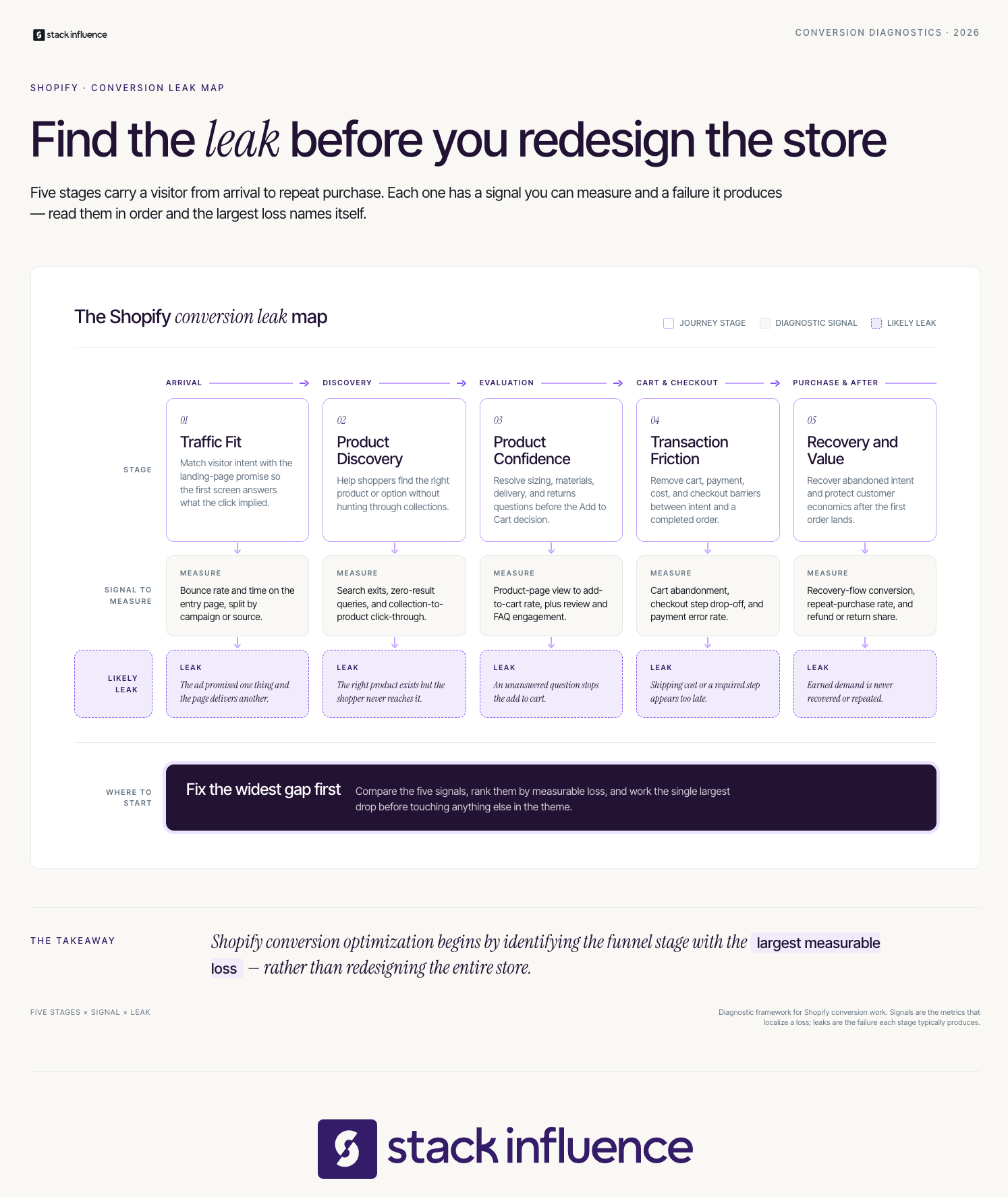
The fastest way to improve Shopify conversion is to locate the largest measurable drop-off, identify the buyer question behind it, and make the smallest change capable of answering that question. The Shopify Conversion Leak Map connects each funnel stage to a likely cause, diagnostic evidence, and appropriate fix.
The map has five layers:
A practical ecommerce user-flow map connects off-site discovery, product evaluation, checkout, and post-purchase behavior. Do not redesign the theme until the data shows which layer is failing.
A visitor should immediately see continuity between the message that earned the click and the page that receives it. Carry the same product, benefit, creator, offer, imagery, and audience language from the ad, email, search result, or social post into the landing page.
For paid and creator campaigns, route traffic to the relevant product or collection, preserve campaign context with UTM parameters, and answer the objections raised by that creative. Stack Influence’s Shopify influencer marketing playbook connects creator selection, offers, tracking, content rights, and contribution margin.
A product page should help the shopper decide. Lead with the primary outcome, identify who the product is for, explain why it differs, show it in use, simplify variant selection, and place essential purchase information near the call to action.
Baymard Institute’s 2026 product-page UX benchmark found that only 48% of leading desktop ecommerce sites, 38% of mobile sites, and 36% of apps achieved a decent or good product-page experience. The research suggests that accumulated usability problems, not one dramatic defect, often push shoppers away.
Audit the page for six decision questions:
Add demonstrations, dimensions, ingredients, compatibility details, comparison images, FAQs, and return terms where relevant. When the product page is the leak, a focused custom website development pass on the product template often surfaces structural wins faster than copy edits can. Remove brand language that does not help the shopper choose.
Do not make shoppers begin checkout to discover the real cost or delivery timeline. Put shipping thresholds, estimated delivery ranges, return windows, subscription terms, and major exclusions on the product page or cart.
Baymard’s cart-abandonment research reports that 40% of surveyed abandonments involved extra costs being too high, while 20% involved slow delivery and 12% involved an inability to calculate the total cost in advance. Those findings make cost transparency a product-page issue, not merely a checkout issue.
Before defaulting to free shipping, test an attainable, clearly stated threshold. Measure conversion, average order value, shipping expense, margin, and carts just below the threshold.
Generic praise is weak social proof. Strong proof shows a believable customer or creator using the product in the situation the buyer cares about, then addresses a concrete concern such as fit, setup, taste, texture, durability, sizing, or results.
Useful proof formats include:
A UGC creator produces customer-style photos or videos that brands can use across product pages, ads, email, and social channels when the necessary rights are secured. Stack Influence’s UGC workflow for ecommerce is built around vetted creator activation, content collection, rights management, and reuse.
Stack Influence works with roughly 600,000 vetted creators through a gifted-first product-seeding model. Its completions-only workflow connects creator participation with finished content. From Stack Influence’s campaign experience, the most reusable product-page assets demonstrate the product and answer a buyer question, rather than simply show attractive packaging.
Keep endorsements truthful and disclose material brand relationships. The Federal Trade Commission’s endorsement guidance for influencers and reviews explains the disclosure and truth-in-advertising principles brands and creators should follow.
A feature that slows or destabilizes the product page can cost more conversions than it creates. Audit heavy scripts, oversized media, duplicate tracking, app embeds, pop-ups, review widgets, personalization tools, and theme code before installing another conversion app.
Shopify’s Web Performance reports measure loading speed, responsiveness, and visual stability by device, page type, and URL. Google’s Core Web Vitals thresholds define good performance as LCP at 2.5 seconds or less, INP at 200 milliseconds or less, and CLS at 0.1 or less at the 75th percentile.
Prioritize high-traffic commercial pages. Compress media, reserve space for images and widgets, remove unused apps, delay nonessential scripts, and retest after theme or app changes.
Stores with several products, variants, or use cases need navigation that reflects how customers shop. Organize collections around meaningful needs, use plain category labels, expose relevant filters, improve search synonyms, and prevent out-of-stock items from dominating results.
Use search terms to find weak relevance, missing synonyms, unclear naming, and assortment gaps. Related or complementary recommendations should help shoppers complete a task, not distract from a strong purchase decision.
A good offer reduces decision difficulty while preserving perceived value. Bundles, subscriptions, samples, guarantees, free-shipping thresholds, and first-order incentives can improve conversion when they solve a real buying concern.
Avoid stacking countdowns, welcome discounts, spin wheels, bundle popups, and exit offers. Test one offer architecture at a time, then compare conversion, discount rate, order value, margin, returns, and repeat purchases.
The cart should confirm the shopper’s decision and make the next step obvious. Show selected variants, quantities, item prices, discounts, delivery expectations, and total costs as early as possible. Remove unrelated navigation or upsells that compete with checkout.
Shopify describes Shop Pay as an accelerated checkout that saves customer contact, payment, shipping, and billing information. Also review Apple Pay, Google Pay, local payment methods, guest checkout behavior, address entry, error messages, and mobile keyboard types.
Baymard’s abandonment findings show that 19% of surveyed abandonments involved distrust about sharing credit-card information, 18% involved required account creation, 17% involved a long or complicated checkout, 17% involved errors or crashes, and 9% involved insufficient payment methods. Test the complete purchase journey on common phones, browsers, locations, discount conditions, and product combinations.
Not every abandonment is a rejection. Shoppers compare products, switch devices, wait for payday, look for a delivery answer, or become distracted. Recovery works best when it restores context instead of immediately increasing the discount.
Shopify’s abandoned-checkout automation can send a customer back to the saved cart. Build the sequence around the likely obstacle:
Separate browse, cart, and checkout abandonment because each stage represents a different level of intent.
Trust is created by consistency across the store. Use a recognizable domain, clear contact information, accurate inventory, visible policies, realistic delivery language, secure payment options, and product claims that the evidence supports.
Check for broken links, inconsistent pricing, outdated banners, missing variant images, poor media, contradictory return terms, and hard-to-find support pages. Preserve creator context and never present compensated content as an independent customer review.
A useful CRO test connects a customer problem, a proposed change, a funnel metric, and a business outcome. “Change the button color” is not a strategy. “Make delivery timing visible beside Add to Cart to reduce shipping uncertainty and improve add-to-cart rate” is a testable hypothesis.
Use quantitative data to find where the leak occurs, then qualitative evidence to understand why. Microsoft Clarity’s Shopify funnel guidance explains how heatmaps and session replays can expose hesitation, missed elements, and drop-offs across the customer journey.
Document the audience, page, evidence, hypothesis, primary metric, guardrails, dates, concurrent changes, result, and next action. Do not run several major changes together and assign the result to one. Low-traffic stores should prioritize high-confidence usability fixes and customer research before small split tests.
Conversion rate is an outcome metric, not a complete operating system. The Shopify CRO Metric Stack connects acquisition quality, funnel behavior, purchase outcomes, unit economics, and retention so a local improvement does not hide a broader business problem.
Track sessions by source, campaign, landing page, device, location, and new versus returning visitor. These dimensions explain who entered the funnel and what promise brought them there.
A source can add orders while lowering the blended rate. That can still be healthy when revenue per session, acquisition cost, contribution margin, and new-customer volume remain strong. Shopify similarly recommends evaluating conversion by device, traffic source, visitor type, product, and category instead of relying only on a blended rate.
Track product views, collection-to-product clicks, onsite searches, zero-result searches, add-to-cart rate, cart-to-checkout rate, and checkout completion. Shopify’s funnel reporting lets sellers compare cart additions, reached checkouts, and completed checkouts over time.
A product-page improvement may first raise add-to-cart rate while a separate checkout problem limits purchases.
Measure purchase conversion rate, orders, units per order, average order value, revenue per session, payment failures, and discount usage. Compare the result by product and customer segment rather than relying only on a storewide average.
Revenue per session is a useful companion. A lower conversion rate with a higher order value can produce more revenue, while an aggressive discount may raise conversion and reduce profit.
Track gross margin, shipping cost, payment fees, discount cost, returns, refunds, customer acquisition cost, and contribution margin. A test fails commercially when it produces more low-margin orders, more returns, or customers who never buy again.
For creator campaigns, Stack Influence’s Shopify campaign workflow connects creator status, content assets, social metrics, and store-side measurement. Evaluate traffic by campaign, landing page, first-order margin, and customer quality.
Track repeat purchase rate, time to second order, subscription continuation, lifetime value, and post-purchase performance. CRO should acquire customers the brand wants to keep.
Use one source of truth and comparable windows. Monitor weekly for breakage, review monthly for optimization, and assess strategic changes over longer periods that account for promotions, seasonality, inventory, and campaign mix. Shopify’s conversion guidance recommends frequent monitoring for major anomalies and a regular optimization cadence for deeper changes.
A falling conversion rate does not always mean the store became worse. Shopify notes that traffic source, device mix, price point, category, and purchase type change the expected rate. Expanding from loyal email subscribers into colder paid, organic, or creator audiences can reduce the blended percentage while still adding profitable customers.
This is why sitewide conversion should never be the only score for a campaign. Segment creator, paid social, search, email, and direct traffic. Compare each source’s landing-page match, add-to-cart rate, checkout completion, average order value, new-customer share, contribution margin, and assisted conversions.
Creator traffic needs context because shoppers may discover through a post and purchase later through search or another device. Use consistent UTMs, creator-specific pages or codes, campaign comparisons, and customer surveys without claiming perfect attribution.
Product seeding can support both acquisition and onsite conversion when the resulting assets are reused strategically. The guide to influencer product-seeding strategies covers creator activation, while the resource on micro-influencers and UGC in ecommerce explains how creator content can become reusable social proof.

A focused month should produce a diagnosis, several low-risk fixes, and one controlled test, not a rushed redesign.
Learning how to increase conversion rate on Shopify is not about collecting tricks. It is about matching traffic to the right page, making the product easier to understand and trust, removing transaction friction, and measuring whether the resulting orders are economically valuable.
Start with the Shopify Conversion Leak Map, fix the largest evidence-backed problem, and protect margin with the Shopify CRO Metric Stack. When the missing ingredient is credible product demonstration, evaluate a managed product-seeding workflow that can supply reusable creator content for product pages, ads, and retention campaigns.
Choosing between wholesale and retail changes far more than the price printed on an invoice. It determines who buys from you, how much they purchase, when you get paid, who creates consumer demand, and how much control you retain over the customer experience.
For ecommerce sellers, the wholesale vs retail decision is rarely as simple as “volume or margin.” A retail channel with a high selling price can become unprofitable after acquisition costs and returns. A wholesale channel with a lower unit price can produce attractive economics when orders are large, predictable, and operationally efficient.
This guide explains the differences, introduces a practical framework for choosing a model, and shows how Amazon sellers, Shopify brands, and DTC brands can operate wholesale and retail together.
Wholesale and retail are distinguished primarily by the buyer’s role in the distribution chain. The U.S. Census Bureau’s Wholesale Trade definition covers establishments that wholesale merchandise, while its Retail Trade definition describes retail as the final distribution step, generally involving sales in smaller quantities to the public.
The practical differences are:
A company’s position can also change from one transaction to another. A brand may buy packaging wholesale, sell cases to retail stores, and sell individual products through its own ecommerce site.
Retail does not mean physical storefront, and wholesale does not mean offline sales. Both models can operate through ecommerce sites, marketplaces, sales representatives, electronic purchase orders, or physical locations.
The Census Bureau’s 2022 NAICS update removed the previous distinction between online and brick-and-mortar retail classification. Retail businesses are now classified according to the products they sell rather than whether customers order online or in a store.
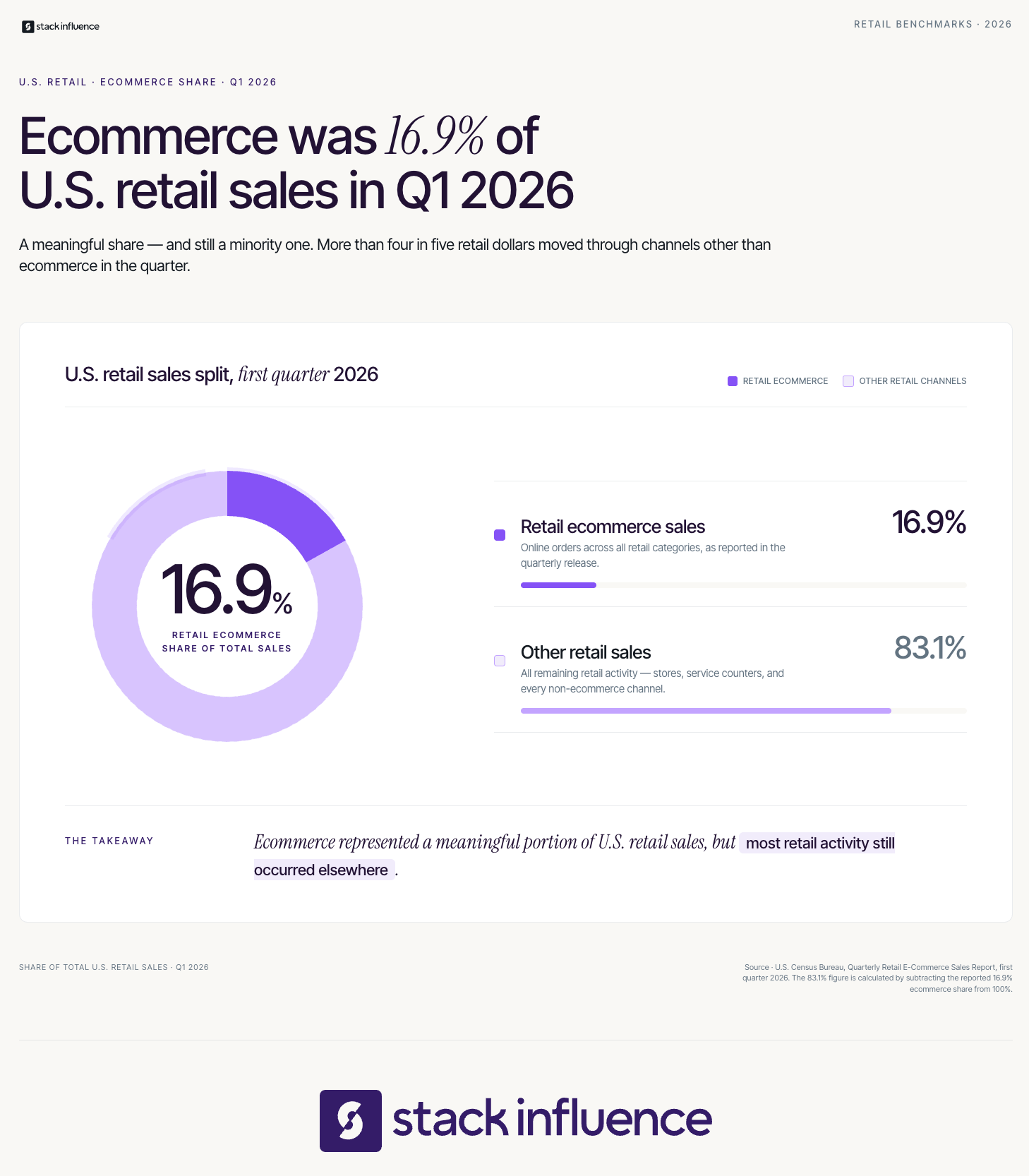
Online retail nevertheless represents a substantial market. According to the Census Bureau’s first-quarter 2026 ecommerce report, seasonally adjusted U.S. retail ecommerce sales totaled $326.7 billion, or 16.9% of total retail sales. By subtraction, the remaining 83.1% came through other retail channels.
This creates three distinct ecommerce configurations:
Brands still building their overall channel strategy can use this broader ecommerce business guide to connect the model decision with sourcing, storefront selection, marketing, and fulfillment.
The 5C framework evaluates Customer, Cart, Cash, Control, and Capacity. Looking at all five prevents a brand from selecting a model based only on selling price or projected revenue.
Wholesale and retail serve customers with different purchase motives.
A consumer usually buys a product to use it. A wholesale buyer purchases because the product can be resold, distributed, incorporated into another offering, or used by an organization. The wholesale buyer therefore evaluates more than consumer appeal.
Wholesale buyers may examine:
Retail customers are more likely to focus on the product’s utility, price, reviews, availability, brand credibility, and purchase experience. A useful starting point for understanding direct retail relationships is the distinction between traditional distribution and the direct-to-consumer business model.
Wholesale generally concentrates more units into fewer transactions. Retail spreads units across many smaller carts.
That difference affects nearly every operating cost. One 100-unit wholesale order may require one sales conversation, one invoice, and several cartons. One hundred retail units may require dozens of individual checkouts, payment authorizations, packages, tracking messages, and customer-service interactions.
Wholesale sellers commonly use:
Retail sellers commonly use bundles, free-shipping thresholds, subscriptions, and upsells to increase average order value without turning the purchase into a business procurement process.
Retail customers normally pay when they order. Wholesale accounts may request time to pay, which creates accounts receivable and credit risk.
The Shopify B2B payment-term documentation, for example, supports immediate payment, deposits, due-on-fulfillment arrangements, and net payment periods. The presence of these options reflects a central wholesale reality: a booked sale and collected cash can occur on different dates.
Evaluate cash through three questions:
A wholesale order can look excellent on an income statement while creating a cash shortage. Retail can collect faster, but advertising, marketplace reserves, returns, and fulfillment may consume the cash just as quickly.
Retail provides greater control over pricing, presentation, customer data, merchandising, and post-purchase communication. Wholesale exchanges some of that control for distribution through another company’s audience or locations.
A DTC brand can test landing pages, bundles, subscriptions, and email campaigns directly. A wholesale brand may rely on a retailer to decide where a product appears, which adjacent products are displayed, and when promotions run.
The control tradeoff is not automatically negative. A capable retailer contributes local demand, merchandising, existing customer traffic, and category expertise. The relevant question is whether the retailer’s distribution value compensates for the margin and control being shared.
The best model is the one the company can execute consistently.
Wholesale requires account prospecting, buyer follow-up, catalogs, purchase orders, case-level fulfillment, invoicing, compliance documents, and account service. Retail requires consumer marketing, conversion optimization, individual fulfillment, returns, customer support, and continuous creative production.
Before expanding, identify the current bottleneck:
Neither wholesale nor retail is inherently more profitable. Retail usually captures more revenue per unit, while wholesale can concentrate more units into each order and reduce the number of customer transactions required. The winning model is the one that produces stronger contribution profit, inventory turns, and cash conversion after every variable cost.
Gross margin is only the starting point. The IRS explains in its small-business tax guide that gross profit begins with net receipts minus cost of goods sold, with inventory, purchases, returns, and allowances affecting that calculation. Channel decisions require going further by subtracting the other costs that change when an order is placed.
Use this calculation:
Contribution profit per order equals net sales minus product cost, fulfillment, channel fees, returns and allowances, and variable sales or acquisition costs.
For wholesale, include:
For retail, include:
Consider a simplified hypothetical product with a $10 unit cost. A retail order at $35 might incur $6 fulfillment, $9 customer acquisition, and $4 in fees and return reserves, leaving $6 in contribution profit. A wholesale order at $18 with $2 in variable selling and fulfillment costs also leaves $6 per unit, but a 100-unit order produces $600 from one transaction.
The example does not prove wholesale is better. It shows why the retail price alone does not answer the profitability question.
Wholesale and retail can share technology, inventory, and even the same storefront, but each buyer type needs the correct pricing, ordering, payment, and fulfillment experience.
A standard Shopify storefront is commonly used for individual consumer orders. The platform supports product pages, checkout, payments, discounts, and integrations that help brands manage a DTC retail operation, as explained in this guide to how Shopify works for ecommerce sellers.
Shopify also supports B2B catalogs that determine which products and prices business customers can access. Its official B2B catalog documentation describes customer-specific product availability, quantity rules, and volume pricing. These functions let one commerce system present different buying conditions to retail and wholesale customers.
A blended Shopify setup should separate:
The phrase “Amazon wholesale” is frequently used for three different business arrangements. Confusing them can lead to incorrect sourcing, pricing, and measurement decisions.
Wholesale sourcing for retail resale: An Amazon seller buys branded inventory from a wholesaler or distributor, then resells individual units to consumers in the Amazon store. The sourcing transaction is wholesale, but the customer transaction is retail. Amazon FBA is only the fulfillment method. This Amazon product-sourcing guide explains how wholesale sourcing differs from private label and other inventory models.
B2B selling through Amazon Business: Sellers offer products to organizational buyers. Amazon’s B2B selling program supports business prices, quantity discounts, case packs, pallets, quote requests, and other procurement-oriented features. An Amazon seller can use the same underlying inventory for retail and eligible B2B orders.
Selling inventory directly to Amazon: Under a vendor relationship, Amazon purchases products from the supplier and resells them. The supplier records a wholesale transaction, while Amazon handles the final retail sale. The operational and margin implications are covered in this Amazon Vendor Central guide.
These arrangements can coexist, but they should not be combined into one undifferentiated “Amazon wholesale” line in a financial model.
The most important wholesale vs retail tradeoff may be who is responsible for creating demand.
Retailers provide distribution, but a wholesale purchase is not the same as consumer sell-through. If products remain on shelves, the account may not reorder. Brands therefore need to support retail partners with product education, content, merchandising assets, and demand-generation campaigns.
Retail brands own the customer-facing demand problem directly. Shopify influencer marketing, Amazon influencers, paid advertising, email, organic search, and product seeding can help create discovery, but the brand carries the execution cost.
Stack Influence supports this demand layer through gifted-first product seeding, creator coordination, UGC generation, and completed-post accountability. Its practical influencer-seeding guide explains the workflow from creator activation through content completion.
A verified Stack Influence case study recorded 3,448 creator promotions during a 12-month Magic Spoon campaign. Average monthly unit sales increased from 1,937 to 7,867 during the measured period, while Amazon Best Seller Rank moved from #828 to #181. The campaign results are a specific example, not a forecast or proof that one marketing activity caused every observed change.
Wholesale distribution and retail demand creation should therefore be treated as connected systems. More doors do not automatically create sell-through, and a strong consumer channel does not automatically produce profitable wholesale terms.

A hybrid model works when wholesale and retail reinforce each other without presenting buyers with contradictory prices, unavailable inventory, or competing offers.
Use six operating guardrails:
Brands combining a Shopify store with an Amazon storefront can also use this Shopify versus Amazon comparison to assign a clearer role to each channel.
A useful measurement system connects operating activity to contribution profit, inventory, and cash. Revenue alone cannot show whether wholesale or retail is creating a healthier business.
Track wholesale leading indicators such as:
Track retail leading indicators such as:
Then compare outcome metrics:
Attribution must match the selling environment. Shopify brands can connect traffic and orders within their storefront, while retailers and distributors may need to provide sell-through reports. Reorders are informative, but they do not reveal every consumer interaction that produced the demand.
For Amazon sellers, Amazon Attribution measures how eligible non-Amazon channels, including search, social, email, video, and influencer campaigns, contribute to activity in the Amazon store. The Amazon Brand Referral Bonus can provide eligible enrolled brands with a bonus averaging 10% of qualifying sales attributed to non-Amazon marketing, although the amount varies by category and transaction.
Use three review cadences:
Do not treat a simultaneous increase in sales and marketing activity as proof of causation. Seasonality, promotions, distribution gains, marketplace conditions, pricing, and organic demand can move at the same time.
A wholesale-first expansion is more credible when:
A retail-first expansion is more credible when:
A hybrid model is more credible when the company has clean channel reporting, differentiated packs or catalogs, enough inventory visibility, and a price structure that supports both business buyers and final consumers.
The wholesale vs retail decision should be based on contribution profit, cash timing, demand ownership, operational capacity, and strategic control. Retail is not automatically more profitable because its prices are higher, and wholesale is not automatically more scalable because its orders are larger.
Model both channels at the order level, run a controlled pilot, and review the Channel Profitability Scorecard over at least one meaningful buying and reorder cycle. Where retail demand is the constraint, a structured creator activation and product-seeding workflow can help produce the content and product discovery needed to support direct sales and wholesale sell-through.
Starting an ecommerce business from scratch is technically easier than it was a decade ago, but building one that survives is still difficult. The hard work is proving that customers want the product, each order leaves enough margin, and inventory, fulfillment, content, and customer acquisition can work together.
This guide is for first-time founders, Amazon sellers, Shopify merchants, and emerging DTC brands. It provides a practical path from idea to measured launch without confusing a polished website, early revenue, or social engagement with a viable business.
Starting an ecommerce business from scratch requires six connected proofs: a real customer problem, a compelling offer, workable unit economics, a suitable sales channel, reliable operations, and repeatable demand. Business registration and store software matter, but neither can compensate for a product people do not want or an order that loses money.
The opportunity is substantial, but growth also attracts more products, ads, and competitors. The U.S. Census Bureau’s quarterly ecommerce report estimated that ecommerce represented 16.9% of total U.S. retail sales in the first quarter of 2026, while ecommerce sales grew 9.8% year over year compared with 3.9% for total retail sales.
An ecommerce business sells through digital channels such as an owned website, marketplace, social platform, or app. It may hold inventory, manufacture products, use a third-party supplier, sell digital goods, or combine models. A broader ecommerce business guide can help compare those options, but the launch sequence remains the same: prove before scaling.
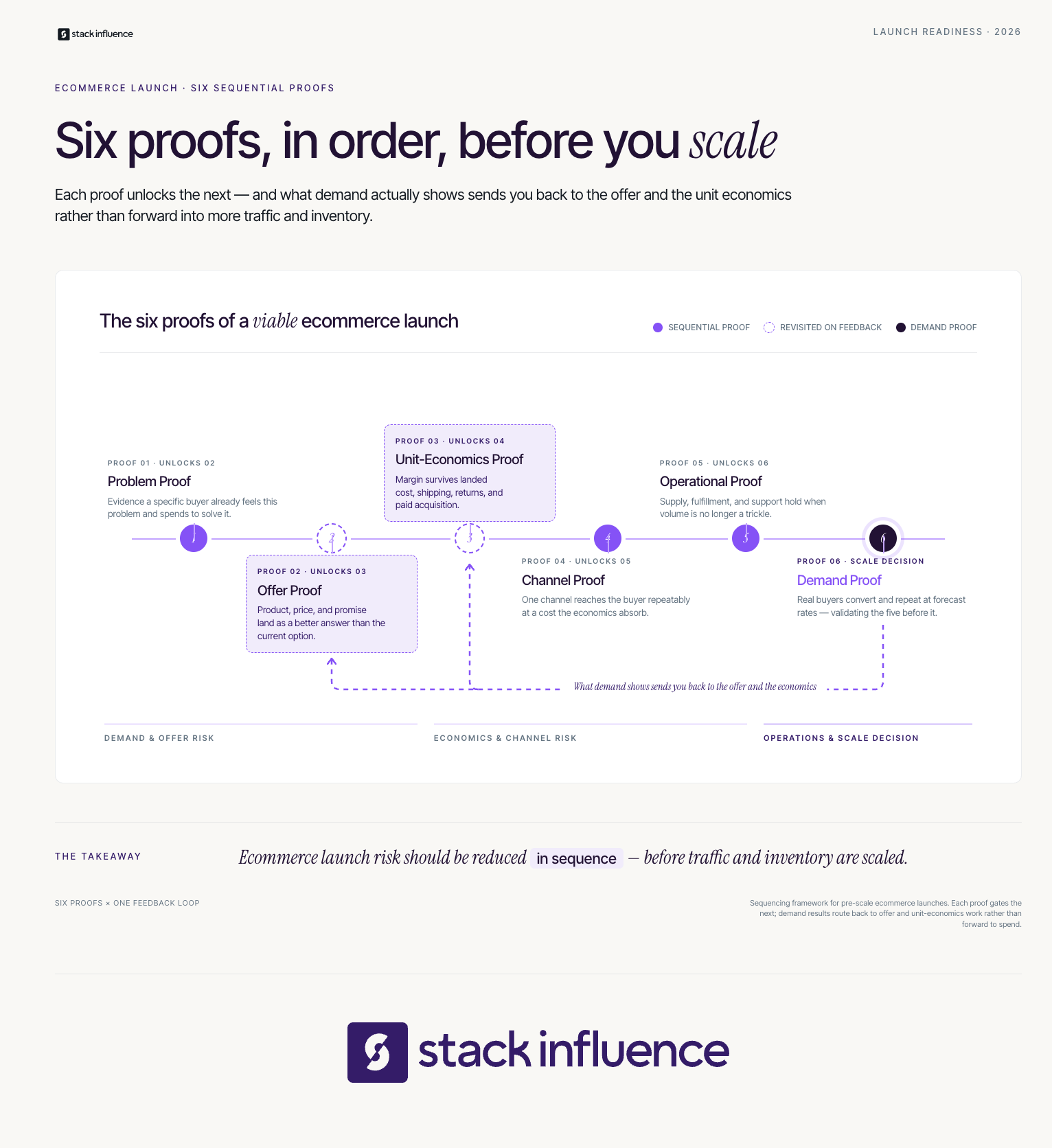
The Proof-to-Scale Framework organizes a new ecommerce business around six questions. Each removes a different risk, and the sequence matters because later mistakes cost more. Do not scale traffic before proving the offer or place a large purchase order before proving the economics.
Problem proof establishes that a defined group of customers experiences a frequent, expensive, emotional, or inconvenient problem. “People who like skincare” is a market description. “Travelers who need leak-resistant, carry-on-size skincare storage” is a problem hypothesis that can be tested.
Interview potential buyers, analyze competitor reviews, study marketplace questions, and record the words customers use. The U.S. Small Business Administration’s market-research guidance recommends evaluating demand, market size, location, saturation, and existing prices. Look for evidence that customers already spend time or money solving the problem.
Use a simple validation file with four columns:
Offer proof determines whether customers understand and value the product. Test with samples, prototypes, small batches, landing pages, waitlists, or buyer interviews before committing to a large inventory order.
A useful offer statement identifies the customer, problem, mechanism, proof, price, and purchasing risk. “A washable, leak-resistant travel organizer designed to separate carry-on liquids in under one minute” is easier to test than “premium organizer.”
Preorders can provide stronger evidence than email signups, but they create real fulfillment obligations. Under the FTC’s Mail, Internet, or Telephone Order Merchandise Rule, sellers need a reasonable basis for the promised shipping time. When no shipping time is stated, the rule generally requires shipment within 30 days, or the seller must obtain consent for a delay or issue a refund.
Unit-economics proof shows whether one additional order creates cash or consumes it. Gross revenue is not the answer. Calculate contribution margin before marketing:
Selling price
minus landed product cost
minus payment or marketplace fees
minus pick, pack, and outbound shipping
minus discounts
minus an expected return, refund, and damage reserve
equals contribution margin before marketing
Break-even customer acquisition cost is the contribution margin available before marketing. If a $50 order leaves $14 after variable costs, spending more than $14 to acquire it creates a first-order loss unless repeat purchasing is proven and included deliberately.
Landed cost should include product, freight, duties, inspection, prep, packaging, and transportation into fulfillment. Founders considering Fulfillment by Amazon (Amazon FBA) can use this margin-first product sourcing guide to pressure-test quotes. Shopify founders should separate the subscription from payment processing, apps, domains, creative, fulfillment, and marketing, as explained in this 2026 Shopify cost guide.
Channel proof identifies where the customer already shops and which channel supports the product’s economics. Shopify gives direct-to-consumer (DTC) brands control over merchandising, email capture, bundles, customer data, and retention. Amazon offers marketplace demand and familiar checkout, but Amazon sellers must account for fees, fulfillment costs, and marketplace rules.
Amazon currently charges $0.99 per item sold on the Individual plan or $39.99 per month on the Professional plan, plus applicable selling fees. Amazon says FBA costs depend on the product and services used. This Amazon beginner selling guide compares FBA with merchant fulfillment.
Use one primary channel at launch:
The Amazon Influencer Program is a creator affiliate program, not a seller-account type. Eligible creators can curate an Amazon presence and earn on qualifying purchases. Founders should separate creator storefront traffic from their own marketplace operations before designing an Amazon influencer campaign.
Operational proof confirms that the business can accept, fulfill, support, and reconcile real orders. Place test orders through expected devices and payment methods. Confirm taxes, shipping rates, inventory deductions, emails, tracking, returns, refunds, and customer-service ownership.
For physical products, define:
The right fulfillment setup depends on SKU size, fragility, order volume, sales channels, and return requirements. This ecommerce fulfillment guide provides a structured way to evaluate FBA, third-party logistics providers, and other fulfillment workflows.
Demand proof shows that the business can repeatedly attract qualified prospects and convert some of them without one lucky post or discounted launch. Start with one acquisition loop, such as search to email to purchase, creator content to product page, or marketplace search to listing to sale.
New brands need evidence, not just reach. Demonstrations, comparisons, customer questions, founder explanations, and user-generated content (UGC) can reduce purchasing uncertainty. A controlled ecommerce social media marketing system should connect each asset to an audience, destination, and measurable next action.
Creator campaigns are one way to generate both distribution and reusable proof. During a three-month Stack Influence new-product campaign for Targus, the case study recorded 120 creator promotions while average monthly unit sales increased from 56 to 221 and Amazon Best Seller Rank moved from #151,547 to #47,811. The result is a specific campaign example, not a forecast for a new brand, and performance varies by product, category, price, marketplace conditions, creative quality, and execution.
There is no universal startup cost for an ecommerce business. Required cash depends on the product model, inventory commitment, formation fees, software, fulfillment, creative, and marketing tests. Build the budget from the actual launch sequence plus a working-capital reserve, not a generic online estimate.
Build a startup cost stack with these categories:
The SBA’s launch guidance notes that structure, registration, taxes, licenses, permits, insurance, and location-specific requirements can vary. Founders should verify state, local, category, and tax obligations with qualified professionals.
Platform fees are only one line. Recheck current terms at launch, then model the cash conversion cycle: when inventory is paid for, when it becomes sellable, when platforms pay out, and when the next purchase order is due.
A 12-week plan provides structure without pretending every product follows the same schedule. Custom manufacturing, regulated categories, international sourcing, and complex software can take longer. Treat the timeline as a decision sequence, not a promise.
Complete at least ten substantive customer conversations, examine competing offers, and document triggers, alternatives, objections, and pricing expectations. Select one problem and customer. Reject ideas that receive polite interest but no evidence of urgency.
Obtain samples or build a prototype. Create the promise, price hypothesis, core images, and a simple landing page. Ask prospects to join a product-specific waitlist, request a sample, place a compliant preorder, or agree to a purchase interview.
Calculate landed cost, contribution margin, break-even acquisition cost, reorder point, and working-capital needs. Compare fulfillment options, test packaging, choose the legal structure, register where required, arrange banking and bookkeeping, and confirm category obligations.
Create one complete product page, not a large unfinished catalog. Add shipping, returns, privacy, contact, and support information. Configure analytics, campaign names, conversion events, marketplace tags, and reporting before traffic arrives.
Sell to a limited but relevant audience. Watch questions, checkout abandonment, delivery problems, product use, refunds, and support tickets. Improve the offer and operations before increasing traffic.
Increase volume only through the channel with the clearest combination of qualified traffic, conversion, contribution margin, and operational reliability. Keep the test narrow. Adding products, platforms, countries, ads, and creators at once obscures what worked.
A new ecommerce business should measure demand, conversion, unit economics, operations, and retention as one connected system. Traffic and revenue are useful, but neither proves viability alone. The central question is whether the business can acquire and serve a customer while preserving enough contribution margin and cash to fulfill, support, and replenish inventory.
Use the Launch Measurement Stack:
Google Analytics 4 ecommerce metrics report website or app purchases. For Amazon sellers, Amazon Attribution measures how eligible non-Amazon channels such as social, search, email, video, and influencer campaigns contribute to shopping activity on Amazon.
Eligible U.S. brand owners enrolled in the program may also receive an Amazon Brand Referral Bonus averaging 10% of qualifying attributed sales. Treat the bonus as part of contribution analysis, not as gross sales. Attribution still has limits because buyers may encounter several touchpoints, switch devices, purchase later, or be influenced by untracked word of mouth.
The First 30 Orders Scorecard is a practical checkpoint, not an industry rule. After 30 fulfilled orders, assess contribution margin before founder labor, return patterns, delivery consistency, repeated customer language, and whether one acquisition source can be tested again. Thirty orders do not prove product-market fit, but they reveal more than impressions or a launch-day revenue screenshot.
Many ecommerce startups look healthy because dashboards emphasize gross sales, traffic, followers, and return on ad spend while hiding inventory risk, refunds, discounts, labor, and cash timing. Revenue can grow while financial stability declines.
Watch for five false positives:
The corrective is sequencing. Keep the line narrow, document assumptions, test one growth lever at a time, and review contribution margin and cash weekly. Expand inventory after evidence improves, not merely to secure a lower quote.
Add influencer marketing after the product can be shipped reliably, the product page explains the offer, the economics can absorb product and campaign costs, and attribution is configured. Creators can accelerate discovery and generate useful content, but sending traffic to an unproven offer or unstable fulfillment process usually magnifies existing weaknesses.
For Shopify influencer marketing, give each creator a trackable link, code, landing page, or campaign identifier and define content reuse in advance. This Shopify influencer marketing playbook connects product seeding, affiliate relationships, UGC, and measurement.
For Amazon influencers, distinguish affiliate storefront activity from brand-managed campaigns. Use Amazon Attribution where eligible, direct traffic to the correct listing or Amazon storefront, and evaluate content quality, attributed shopping activity, contribution margin, and reuse value separately.
Stack Influence is a micro-influencer platform built around gifted-first product seeding, vetted creator activation, campaign coordination, UGC, and completed-post accountability. Its workflow is designed for ecommerce brands that want sourcing and execution managed as one campaign. The influencer seeding guide explains gifting, product-for-content arrangements, and paid sponsorships.
When creators receive free, discounted, or reimbursed products, the material relationship should be disclosed clearly. The FTC’s social media disclosure guidance states that free or discounted products can create a material connection that must be disclosed. Brands should set expectations, monitor compliance, and preserve creators’ ability to express honest opinions.
Starting an ecommerce business from scratch is not primarily a website project. It is a sequence of proofs that turns an uncertain idea into a product, an order, a fulfilled promise, and eventually a repeatable operating system.
Start with one customer problem, one offer, one contribution-margin model, one primary channel, and one acquisition loop. Once the business can deliver those pieces reliably, the next step is to increase volume carefully and evaluate whether creator content, product seeding, marketplace expansion, or paid acquisition can compound what is already working.
A Shopify theme determines how an online store presents products, organizes navigation, handles mobile interactions, and gives marketers reusable page sections. For ecommerce brands, choosing one is less about finding the prettiest demo and more about matching the storefront to the catalog, conversion journey, content pipeline, and technical constraints.
This guide explains what a Shopify theme controls, how free, paid, and custom routes differ, how to test candidates with real products, and how to measure performance after launch. It is written for founders and ecommerce teams that want a theme they can operate and improve, not merely admire on launch day.
A Shopify theme is the presentation and interaction layer of a Shopify Online Store. It controls templates, typography, colors, navigation, product layouts, collection pages, and reusable content modules. It does not replace Shopify’s commerce backend, product data, inventory, payments, or the apps that add specialized business functions.
Shopify themes use Liquid, templates, sections, blocks, CSS, JavaScript, and configuration files to turn store data into customer-facing pages. Shopify’s theme section documentation explains that sections are reusable modules, while blocks let merchants add, remove, and reorder content inside them. JSON templates and section groups can contain up to 25 sections, with up to 50 blocks in each section, although those limits should not be treated as design targets.
A theme also stays separate from much of the store’s underlying content. Shopify’s theme-switching guidance confirms that products, collections, menus, pages, and blog posts remain when a merchant switches themes, while section settings, global styles, templates, wording, and code customizations can be theme-specific. The broader guide to how Shopify works for ecommerce sellers explains where the storefront fits within the full commerce system.
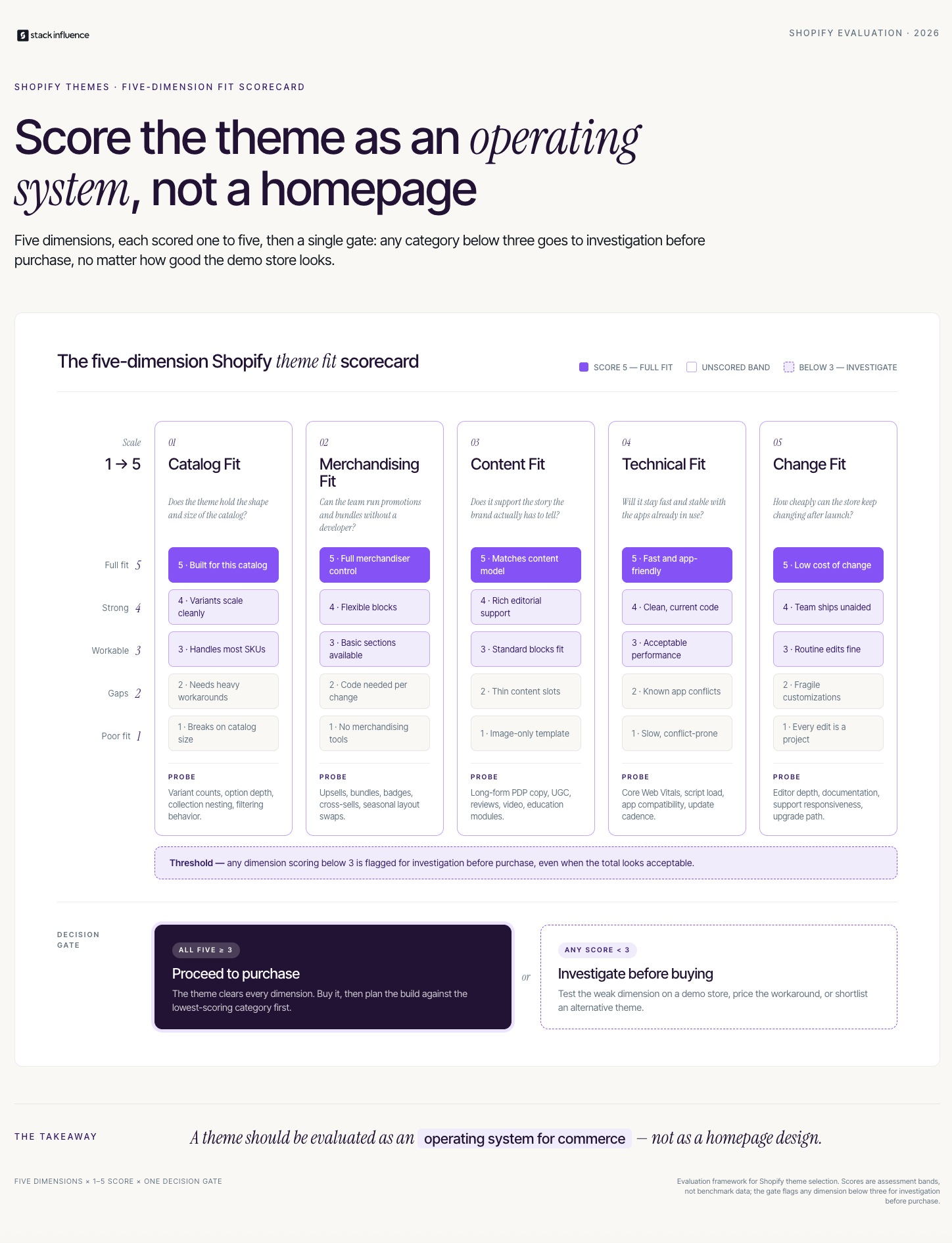
The Theme Fit Scorecard turns theme selection into a business decision. Score each candidate from one to five across five dimensions, then investigate any category below three before committing. One critical workflow gap can make a visually impressive theme more expensive than a simpler theme that supports the store’s actual selling process.
The Shopify Theme Store offers hundreds of designs with filters for industry, catalog size, price, and features. Use those filters only after documenting store requirements.
Catalog fit measures whether shoppers can understand and narrow the assortment. Test the largest collection and most complex product across search, filters, sorting, menus, swatches, related items, variants, and sold-out states.
Merchandising fit measures how clearly the theme explains value and supports purchase. Review media, pricing, bundles, subscriptions, shipping details, size guides, comparisons, recommendations, and add-to-cart controls. Nielsen Norman Group’s ecommerce product-page guidance emphasizes product details, availability, price, supporting media, and a clear purchase path.
Content fit measures whether marketers can publish recurring formats such as landing pages, FAQs, comparisons, customer photos, creator videos, testimonials, and buying guides. Map the next 90 days of planned content and identify where social proof, vertical video, and demonstrations will appear.
Technical fit covers mobile behavior, performance, accessibility, app blocks, analytics, translations, structured data, and integrations. Confirm app support, then test the exact combination in a draft theme because several compatible apps can still conflict when used together.
Change fit measures how safely the store can evolve. Review update history, support, release notes, editor flexibility, and the custom code required for routine work. A theme that needs a developer for every landing page can become an operational bottleneck.
Free themes suit stores that can express their brand and selling model through standard Shopify sections, while paid themes can justify their cost through specialized layouts and built-in merchandising features. Custom development is appropriate when a differentiated customer journey creates real business value that available themes and apps cannot deliver cleanly.
Shopify-developed free themes provide a credible starting point for new stores, redesigns, and brands validating requirements. Shopify’s current Horizon theme collection includes 10 free themes built on one system, with expanded design flexibility and AI-assisted editing. A free theme can remain a long-term choice when it supports the catalog, content, apps, and brand system without extensive workarounds.
Paid themes are developed by third-party theme developers and often package category-specific layouts or commerce features into the theme. Shopify lets merchants preview and customize up to 19 paid themes at once before purchase. Trial themes cannot be code-edited, and purchases from the Theme Store are licensed to the store where they were bought.
Evaluate total ownership cost, not purchase price alone. Built-in swatches, quick views, promotional blocks, or advanced navigation may reduce app and development costs.
Custom development is most defensible when the storefront itself is part of the product advantage. Examples include product builders, unusual bundles, specialized B2B journeys, interactive education, or editorial commerce that general-purpose themes cannot deliver cleanly.
A disciplined custom approach can start with a maintained theme, preserve native Shopify patterns, and add only high-value sections, templates, or app extensions.
Test a Shopify theme by loading it with representative products, content, apps, and edge cases, then reviewing complete shopping journeys on real mobile and desktop devices. The goal is to expose operational friction before purchase, not simply confirm that the homepage can resemble the theme demo.
Shopify saves theme-editor customizations made during a paid-theme trial if the theme is later purchased. Use that trial environment to build a realistic prototype rather than changing only the logo and colors.
Run a content-first sandbox test:
Brands planning creator acquisition should test content formats before campaigns begin. Stack Influence’s Shopify influencer marketing playbook connects product seeding, content, traffic, and measurement, while the guide to top UGC formats identifies common photos, videos, tutorials, and testimonials.
A theme’s technical quality should be evaluated before customization and again after real apps, fonts, scripts, images, and videos are installed. Theme demos and benchmark shops are controlled environments, while production stores accumulate third-party code and media.
Shopify’s Theme Store requirements set a minimum average Lighthouse performance score of 60 and accessibility score of 90 across home, product, and collection pages on desktop and mobile. Those thresholds are useful screening criteria, but they are an acceptance floor rather than proof that a finished store will remain fast and accessible.
Google’s Core Web Vitals guidance defines good field performance as Largest Contentful Paint within 2.5 seconds, Interaction to Next Paint of 200 milliseconds or less, and Cumulative Layout Shift of 0.1 or less at the 75th percentile. Test by page type and device because a fast homepage can hide a slow product template.
Image handling deserves particular attention. The HTTP Archive’s 2025 Web Almanac performance chapter found that 62% of mobile pages and 65% of desktop pages failed to set explicit dimensions on at least one image, down from 66% and 69% in 2024. Missing dimensions can make surrounding content shift as images load.
Accessibility also requires human review. The World Wide Web Consortium’s WCAG overview organizes accessibility around perceivable, operable, understandable, and robust experiences. Check keyboard navigation, focus, form labels, contrast, text resizing, image alternatives, and recoverable errors.
Use a prelaunch technical checklist:
A storefront should be designed for the traffic it expects to receive. Search visitors, returning email subscribers, paid-social prospects, and creator-referred shoppers arrive with different context, so the theme needs reusable modules that continue the promise made by each channel.
The guide to getting Shopify traffic covers search, creators, social media, email, advertising, and referrals. Translate those channels into destination requirements such as editorial pages, landing templates, mobile media, comparisons, offers, and product-level proof.
Creator traffic makes this especially visible. A shopper clicking from a demonstration should land on a page that repeats the product, use case, offer, and proof. The guide to UGC versus brand-generated content helps assign page roles to each asset type.
From Stack Influence’s experience with ecommerce brands, creator assets can remain unused when teams have no defined storefront modules for them. The Stack Influence micro-influencer platform supports vetted creator activation, gifted-first product seeding, campaign coordination, UGC generation, and completed-post accountability, while the theme turns approved assets into a coherent shopping experience.
Prepare a content deployment map before choosing the theme:
The operational guide to influencer seeding helps ecommerce teams plan how products become creator relationships and reusable content. Theme selection should happen with that lifecycle in mind, not after assets accumulate.
Theme debt is the future cost created when quick fixes make a store harder to update, test, or operate. The safest customization path moves from native settings to modular extensions, then uses custom code only when the business value is clear and the change can be maintained.
Use this order of operations:
This sequence keeps routine merchandising inside the theme editor and reserves development for differentiated features. It also helps identify whether the store has a theme gap, content gap, or app gap before code is added.
Shopify’s theme update guidance says editor-based settings, layouts, templates, and app-extension configurations can be carried into an updated theme. Code edits are included only when they do not conflict with the update; otherwise, merchants must move them manually. Save custom code, document its purpose, and review every updated draft before publishing.

Measure a Shopify theme through a connected stack of delivery, behavior, conversion, economic, and operational metrics. A redesign should improve the complete shopping system, but theme changes rarely happen in isolation, so teams should separate observed movement from proven causation and segment results by device, channel, page type, and customer group.
Use the Theme Performance Stack:
Establish a baseline and annotate promotions, pricing, inventory problems, media shifts, email sends, and creator campaigns. Compare like-for-like periods with enough traffic to reduce noise, and do not treat simultaneous movement as proof of causation.
Investigate the chain between metrics. Faster pages matter when engagement or exits improve, while higher add-to-cart rates can still be unprofitable if discounts, returns, or acquisition costs rise. Measurement should reveal the next constraint.
Most theme regret comes from evaluating the demo rather than the operating system behind it. Avoid these recurring mistakes:
A good Shopify theme makes common decisions easy, uncommon decisions possible, and technical risk visible.
A strong Shopify theme makes the store easier to shop, easier to market, and easier to improve. Choose it through catalog fit, merchandising fit, content fit, technical fit, and change fit; test it with real products and edge cases; then measure the full system after launch.
The practical next step is to write a one-page requirements brief, score three realistic themes, and build the same product and campaign page in each. Once the storefront is prepared to receive creator traffic, ecommerce teams can evaluate a managed product-seeding workflow through Stack Influence to build the content pipeline that feeds those pages.
This article was last updated on August 12th, 2026.
Marketplace rules and platform features move fast, and a fee revision, a title-length cap, or a new fulfillment threshold can quietly reshape your margin and your search ranking before you notice it happened. Staying current is one of the cheapest forms of protection a seller has.
This guide is updated every week with the latest eCommerce news and seller-relevant platform changes across Amazon, Shopify, Walmart, eBay, and TikTok Shop, newest items first.
Want these updates before they hit this page? Subscribe to The Merchant Memo and get the week's biggest seller news in your inbox first.
Also worth bookmarking:
This page grows every week, so the deeper into the year we get, the more useful it becomes as a single scan of the amazon seller news, tiktok shop updates, and broader ecommerce trends that actually moved margins. Bookmark it and check back after each weekly update lands.
If you're a seller working to fill the gap between organic reach and paid ads, one workflow that touches several trends above, from social platforms becoming commerce channels to agents rewarding clean, authentic listings, is sourcing UGC and creator content at scale: Stack Influence connects Amazon and Shopify brands with everyday creators for gifted-product collaborations that produce exactly that kind of content.
Want every update like this as it breaks, rather than waiting for it to hit this page? Subscribe to The Merchant Memo for the weekly version in your inbox.
Amazon wholesale can look simple: buy recognized products in bulk, list them on Amazon, and keep the spread. For ecommerce sellers, the difficult part is not opening a supplier account. It is proving authorization, surviving price competition, protecting cash, and knowing which parts of the listing and marketing system you can actually control.
This guide explains how Amazon wholesale works in 2026, how to evaluate suppliers and ASINs, how to calculate contribution profit, when to use Amazon FBA, and how authorized sellers and brand partners can create demand beyond repricing.
Amazon wholesale is an ecommerce resale model in which a seller buys established branded products in bulk from a manufacturer, brand, or authorized distributor, then sells individual units through Amazon. The seller usually joins an existing ASIN instead of developing a new product, brand identity, or detail page from scratch.
Amazon’s wholesaler sourcing guidance advises sellers of branded goods to source directly from the brand or one of its direct distributors or wholesalers. A low unit cost does not prove that inventory is authorized, authentic, or supported by acceptable documentation.
The term can also mean selling in bulk to business buyers. Through Amazon Business, eligible sellers can offer case packs, pallets, business pricing, and quantity discounts. That B2B workflow is separate from buying wholesale inventory and reselling single units, although one seller can participate in both.
The main Amazon business models differ in what the seller owns and controls:
Amazon wholesale can be worthwhile when a seller has verifiable supply, stable contribution margins, repeatable replenishment, and enough working capital to withstand price and inventory changes. The model can reduce product-development work, but it replaces that risk with authorization risk, shared-listing competition, supplier dependence, and cash-flow pressure.
The strongest wholesale opportunities usually have several qualities at once:
Wholesale becomes fragile when the business depends on one temporarily discounted purchase order, one dominant seller leaving the listing, or a margin calculation that ignores returns and storage. Established demand is useful, but it is not the same as defensibility.
The Five-Gate Amazon Wholesale Test is a pre-purchase framework for deciding whether an ASIN deserves capital. An opportunity advances only after it clears Authorization, Economics, Competition, Replenishment, and Growth. A failure at an early gate should stop the order before optimistic sales estimates hide a structural problem.
Confirm whether the supplier is the brand, a direct distributor, or another wholesaler; whether Amazon resale is permitted; and whether a letter of authorization is available when required.
For certain approval requests, Amazon says invoices should include supplier details, an itemized list, a date within the previous 180 days, account-matching seller information, manufacturer or distributor details, and at least 10 units in total. The exact request shown by Amazon still controls.
Verify the supplier independently. Amazon and the Better Business Bureau recommend checks such as physical locations, registered-entity records, licenses, insurance, references, ratings, and complaints. For regulated goods, obtain relevant compliance documents. The U.S. Consumer Product Safety Commission notes that certain products require certificates supplied through the manufacturer or importer.
Calculate contribution profit after wholesale cost, inbound freight, prep, referral fees, fulfillment, storage, expected returns, marketing, and financing. Set both a floor selling price and a maximum landed cost. Reject an ASIN that works only at today’s highest price or only if every unit sells immediately.
Record seller count, price history, Amazon’s presence, Featured Offer rotation, fulfillment methods, ratings, and stock patterns. Amazon’s Featured Offer guidance identifies competitive total price, reliable delivery, customer experience, and inventory availability as relevant factors. Merchant-fulfilled offers can compete when delivery and service are strong.
Model minimum order quantity, supplier lead time, inbound receiving, shelf life, seasonality, and the cash needed to reorder before stock runs out. A practical starting formula is average daily unit sales multiplied by total replenishment lead time, plus safety stock. The guide to inventory demand forecasting for ecommerce sellers explains how promotions and seasonality can distort the baseline.
Document what can improve performance beyond price, including inventory availability, fulfillment, catalog content, Amazon Ads, creator content, external traffic, and an Amazon storefront. The available levers depend on whether the account is the brand owner, an authorized reseller, or one offer on a shared ASIN.

Start Amazon wholesale by creating a compliant business foundation, choosing a narrow product category, finding brand-authorized supply, validating Amazon eligibility, testing contribution economics, and placing a controlled first order. The sequence matters because inventory purchased before documentation or listing access is confirmed can become stranded stock.
Set up the entity, tax IDs, bank account, and required licenses. The U.S. Small Business Administration’s business launch checklist covers registration, tax IDs, permits, banking, and insurance, while noting that requirements vary by activity and location. Keep the legal name and address consistent across supplier, banking, tax, and Amazon records.
Choose a category, price band, size profile, minimum contribution target, maximum seller count, and acceptable reorder cycle. The FBA product-sourcing guide provides a broader comparison of manufacturers, distributors, and wholesale channels.
Start with brands that match the thesis, then ask whether they sell direct or through authorized distributors. Trade shows, associations, directories, referrals, and brand websites can generate leads, but a directory listing is not permission to sell on Amazon. Request written marketplace terms and keep authorization, invoices, payment records, shipping documents, and correspondence together.
Confirm product, category, brand, and condition eligibility from the selling account before ordering. Analyze seller count, price history, offer rotation, demand stability, package configuration, and downside profit. Place the smallest practical order that can test approval, receiving, fulfillment, returns, and real offer performance.
For an existing branded product, match the correct ASIN and variation. Confirm model, count, size, color, condition, and barcode. GS1 US says Amazon recommends GTINs from GS1 or the original manufacturer, so resellers should use the correct manufacturer identifier rather than create a duplicate code for the same consumer unit.
The Stack Influence guide on how to become an Amazon seller covers broader registration, listing, and fulfillment steps.
Compare projected economics with actual fees, freight, returns, price changes, and days in stock. Reorder only when current evidence still clears all five gates. Revenue alone is not a reorder signal.
Calculate Amazon wholesale profit at the unit level using the expected selling price minus every variable cost required to acquire, prepare, fulfill, sell, and support that unit. Then test the result against lower prices, slower sell-through, higher returns, and a longer holding period before deciding how much inventory to buy.
Use this operating formula:
Contribution profit per unit = selling price - wholesale cost - inbound freight and prep - Amazon fees - fulfillment - storage reserve - return and damage reserve - variable marketing
For an illustrative product selling at $40, assume $19 wholesale cost, $2 inbound and prep, $10 marketplace and fulfillment costs, a $1 return reserve, and $2 variable marketing. The remaining contribution is $6. These are hypothetical inputs, not current Amazon fee estimates.
Reverse the formula when negotiating:
Maximum wholesale cost = expected selling price - non-product variable costs - target contribution profit
Stress-test a lower price, slower 60-day sell-through, higher freight, and a new competing seller. A purchase order should survive a plausible downside case, not just today’s Featured Offer price.
Wholesale sellers should choose Amazon FBA when Prime-eligible fulfillment, operational scale, and outsourced customer service justify the fees. FBM can be stronger when products are bulky, slow-moving, fragile, or already supported by efficient merchant logistics. Many sellers use both methods across ASINs or as backup capacity.
Amazon’s FBA and FBM comparison recommends evaluating product characteristics, velocity, resources, service, control, and costs rather than assuming one method is always superior.
Fulfillment belongs in both the Competition and Replenishment Gates because delivery quality and in-stock status affect offer performance.
Wholesale sellers often measure demand and margin without measuring control. On a shared branded ASIN, a reseller may not control the title, images, A+ Content, Brand Store, advertising permissions, external attribution, creator brief, or future distribution policy. Those missing rights can limit both growth and risk management.
An Amazon storefront can mean a brand-owned Store or a creator’s Amazon Influencer Program storefront. Neither automatically belongs to a third-party reseller. Sellers planning creator partnerships should distinguish Amazon influencers and their storefronts from the brand’s own catalog and campaign permissions.
Amazon Attribution measures non-Amazon channels such as social, search, email, video, and influencer campaigns. Amazon currently lists professional sellers enrolled in Brand Registry, vendors, KDP authors, and agencies with eligible clients among users who can access it. Resellers should verify their role before including Attribution in a plan.
Amazon also says eligible U.S. brand owners can enroll in the Brand Referral Bonus and earn a bonus averaging 10% of qualifying sales measured through Attribution, with the amount varying by category and transaction. Forecast the credit only after current eligibility is confirmed.
The guide to Amazon Attribution links and the Brand Referral Bonus adds campaign context. Supplier negotiations should also clarify listing control, approved claims, creator-content rights, and data sharing.
Wholesale sellers do not have to treat price as the only growth lever, but demand creation works best when the brand and reseller agree on permissions, inventory, content, and measurement. Authorized partnerships can combine reliable fulfillment with creator content, product education, social proof, and non-Amazon traffic.
Stack Influence is a micro-influencer marketing platform built around gifted-first product seeding, vetted creator activation, campaign coordination, UGC generation, and completed-post accountability. The workflow is practical for ecommerce brands and authorized Amazon sellers that want managed creator participation without coordinating every relationship manually.
A verified Stack Influence Blueland case study recorded average monthly unit sales increasing from 542 to 2,562 during the campaign, while Amazon Best Seller Rank moved from #36,544 to #5,808. The campaign included 211 creator promotions, 247,000 social impressions, and 11,000 engagements. These changes occurred during the campaign and do not prove that creator activity alone caused every marketplace result.
The example shows the purpose of the Growth Gate: supply and offer economics create the foundation, while coordinated demand generation can add content and measurable traffic. Results vary by product, category, price, inventory, competition, creative, and execution.
Brands can review Stack Influence’s Amazon influencer marketing workflow, while internal teams can use this guide to Amazon seller influencer partnerships.
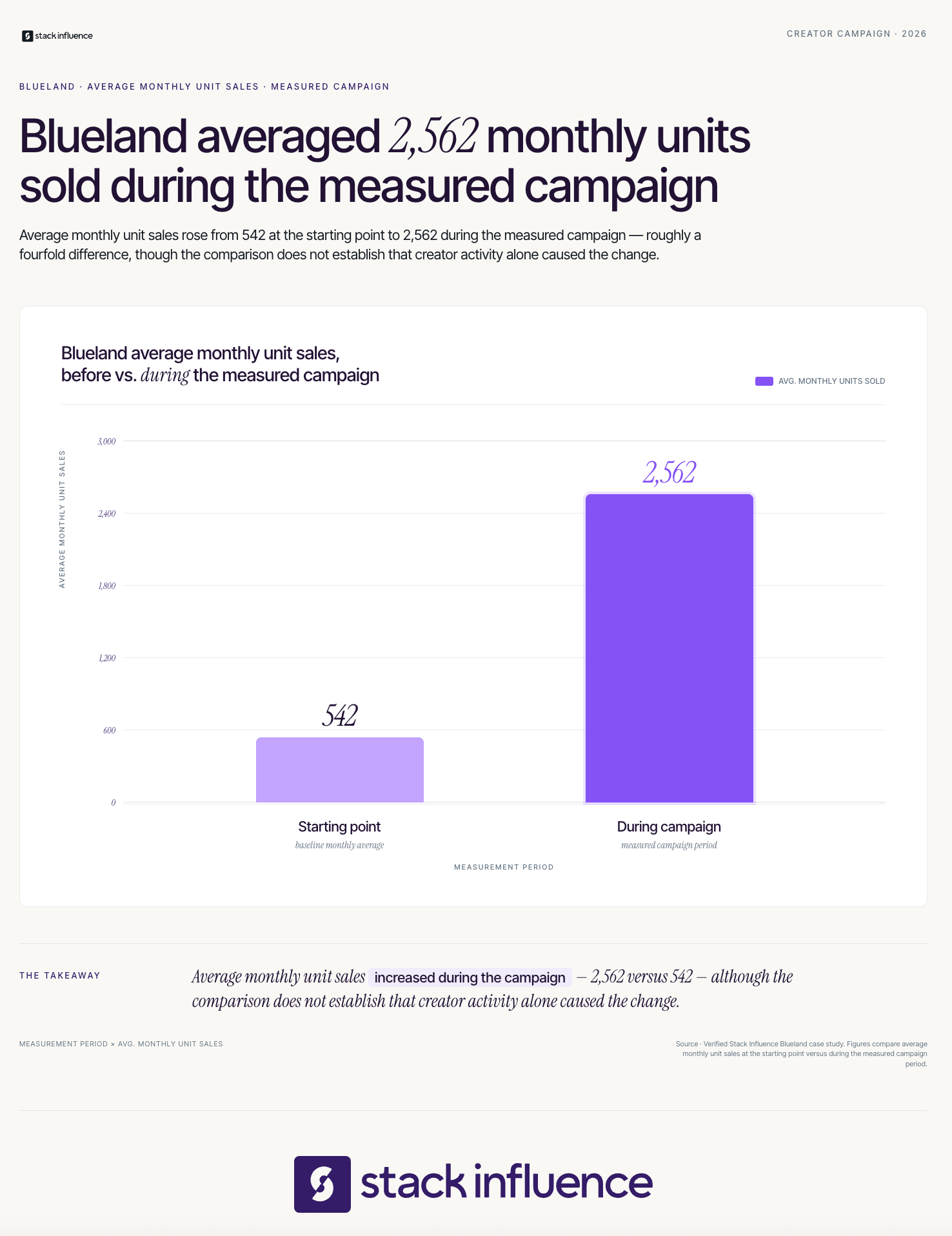
The Wholesale Control Tower is a four-layer measurement model connecting documentation, offer performance, inventory, and financial outcomes. It prevents sellers from treating revenue as the only signal and distinguishes an ASIN growing safely from one consuming cash while authorization, price, or replenishment deteriorates.
Track four layers:
For eligible brand-led campaigns, add Amazon Attribution metrics such as clicks, detail-page views, add-to-cart activity, purchases, units sold, and product sales. Amazon reports a 14-day attribution window, but attribution does not prove that one channel caused every observed change.
Use a weekly operating review for stock, price, offer share, inbound status, and account issues. Use a monthly or 90-day buying review for realized contribution, supplier reliability, sell-through, returns, and whether the next order still clears all Five Gates.
The most expensive Amazon wholesale mistakes occur before inventory reaches a fulfillment center. Sellers protect capital by making documentation, downside economics, listing control, and replenishment purchase requirements rather than problems to solve after ordering.
Avoid these errors:
A durable Amazon wholesale business is built on more than buying recognizable products at a discount. The seller must establish traceable supply, pass the Five-Gate Amazon Wholesale Test, protect contribution margin, choose fulfillment by ASIN, and monitor control as closely as demand.
Start with one narrow category and a test-sized order. Keep documentation audit-ready, reconcile projected and actual economics, and expand only when replenishment and offer performance remain stable. When an authorized brand relationship supports external demand generation, evaluate a managed product-seeding and creator-content workflow that connects available inventory with completed UGC and measurable marketplace traffic.
Buying wholesale sounds simple: purchase more units at a lower price, resell them, and keep the spread. Ecommerce sellers quickly learn that the unit discount is only one part of the decision. Freight, marketplace fees, slow sell-through, returns, compliance gaps, and cash tied up in stock can turn a cheap case pack into expensive inventory.
So, what is a wholesaler? A wholesaler supplies products to other businesses for resale or commercial use. This guide explains how wholesalers work, how they differ from other supply-chain roles, how to evaluate one, and how ecommerce sellers can protect margin while building repeatable supply.
A wholesaler is a business that sells goods primarily to other businesses for resale or commercial use, usually in larger quantities than retail. Merchant wholesalers buy and own inventory before reselling it. Agents and brokers arrange purchases or sales for other parties without owning the merchandise. Both models reduce friction between producers and downstream buyers.
The U.S. Census Bureau’s NAICS definition of wholesale trade distinguishes businesses that sell goods on their own account from agents and brokers that facilitate sales for others. Merchant wholesalers may warehouse, sort, package, label, and distribute goods even when they do not materially transform the product.
Wholesalers commonly perform four functions:
Wholesale is a major economic layer. In the final Annual Wholesale Trade Survey release, the Census Bureau estimated that U.S. merchant wholesalers generated $11.3823 trillion in sales during 2022, up from $9.6934 trillion in 2021. The total excludes manufacturers’ sales branches and offices.
Wholesale ecommerce moves products through a business-to-business transaction before the final consumer sale. A manufacturer or brand supplies a wholesaler, the wholesaler supplies an ecommerce seller or retailer, and that seller markets and fulfills the consumer order. Some companies skip a layer, while hybrid brands sell through wholesale, marketplaces, and direct channels simultaneously.
A typical order follows five steps:
Modern wholesale can run through ecommerce infrastructure rather than phone calls and spreadsheets. Shopify’s B2B catalog documentation shows how brands can assign products and customer-specific prices, establish quantity rules, and offer volume pricing.
Stack Influence’s guide to ecommerce business models places wholesale beside private label, dropshipping, and direct sales. After a supplier is chosen, inventory demand forecasting turns expected channel demand into purchase quantities and reorder timing.
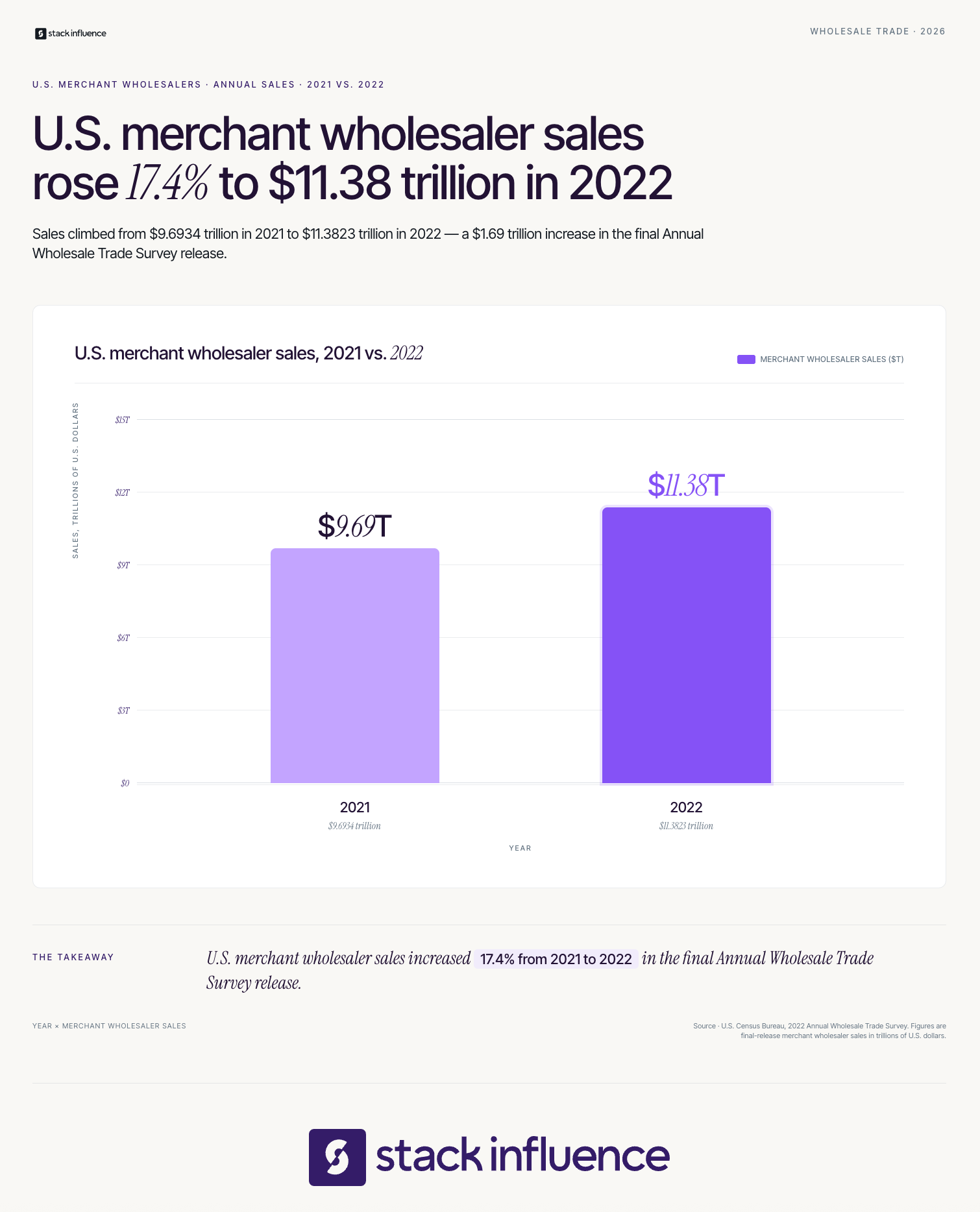
A manufacturer creates the product, a wholesaler resells goods to businesses, and a retailer sells to the final customer. A distributor is often a merchant wholesaler, but the term can imply a closer brand relationship, territory, service obligation, or authorized channel role. Industry usage varies, so the contract matters more than the label.
The practical distinctions are:
Wholesaler and distributor are often used interchangeably. Ask whether the supplier owns the inventory, is authorized by the brand, can issue acceptable invoices, controls a territory, and supports your intended channel.
Amazon illustrates how roles can change. Under a first-party relationship, a brand sells inventory wholesale to Amazon and Amazon becomes the retailer. Amazon Vendor Central explains that structure, while Stack Influence’s ecommerce dropshipping guide covers supplier-to-consumer fulfillment.
Ecommerce sellers use wholesalers to access established products, commercial pricing, replenishable supply, and business documentation without developing every item from scratch. The model can shorten time to market and broaden assortment. Its tradeoff is reduced differentiation, plus working-capital, competition, authorization, and inventory risks that the seller must manage.
Common advantages include:
Common constraints include minimum orders, shared catalog competition, lead-time variability, channel restrictions, discontinued items, and cash exposure when stock moves slowly. A wholesaler’s real product is reduced complexity: the manufacturer avoids servicing every small account, and the retailer gains access to smaller lots and replenishment.
Amazon’s guide to finding wholesalers recommends validating the supplier’s brand relationship, business details, references, location, and reliability rather than treating a price list as proof. Sellers comparing wholesale with less repeatable sourcing can use Stack Influence’s retail arbitrage guide to examine the documentation and replenishment differences.
The Six-Gate Wholesaler Screen prevents a low quote from hiding a weak supplier relationship. A wholesaler should pass all six gates before an ecommerce seller commits meaningful inventory capital.
Confirm the supplier’s legal name, address, warehouse location, references, contact details, and payment entity. Verify product identifiers too. The GS1 Database supports searches by Global Trade Item Number (GTIN), company prefix, company name, Global Location Number (GLN), location, or address, but a barcode match alone does not prove distribution authorization.
Ask for evidence of the supplier’s relationship to the manufacturer or brand, plus the records your channel may require. Amazon’s guidance for selling branded products says an approval process may require a manufacturer or distributor invoice or brand authorization letter.
Product compliance deserves equal attention. The CPSC’s online seller safety guidance notes that marketplaces can impose requirements beyond baseline federal standards and that sellers may need certification information from suppliers or manufacturers. Requirements depend on the category and the seller’s role.
Calculate the cost of placing one sellable unit in the correct fulfillment location. Include product cost, freight, duties, receiving, prep, labeling, storage, expected defects, payment fees, marketplace costs, fulfillment, returns, discounts, and variable marketing.
A discount has no value when the extra units create storage charges, markdowns, or dead stock. Model a base case and a downside case before accepting a larger MOQ.
Validate demand in the exact channel, country, variation, and price band you plan to serve. Review seller count, price stability, seasonality, returns, reviews, and the brand’s own marketplace presence.
Ask about allowed channels, geographic restrictions, marketplace exclusions, advertised-price policies, bundles, listing content, and promotional rules. Authentic inventory can still be restricted from the channel you intend to use.
Measure normal lead time, lead-time variation, fill rate, backorders, case-pack changes, substitutions, and damaged-shipment handling. Confirm that the supplier can provide usable inventory and product data through a portal, spreadsheet, Electronic Data Interchange connection, application programming interface, or scheduled feed.
Stack Influence’s guide to where to source products to sell on Amazon emphasizes total economics and supplier testing. Its Amazon product research tactics show how sellers can work backward from supplier price lists to marketplace opportunities.
Review return windows, restocking fees, defect allowances, recall procedures, expiration rules, discontinued-SKU handling, cancellation terms, deposits, and guarantees. Start with a test order when possible. A controlled purchase reveals order accuracy, packaging, delivery speed, invoice quality, defect handling, and communication before a larger commitment magnifies problems.
To buy from a wholesaler, define your channel and product criteria, prepare the required business and tax records, verify suppliers, request commercial documents, calculate landed contribution margin, place a controlled test order, and measure the first sales and replenishment cycle. Do not scale merely because the initial shipment arrived successfully.
Use this process:
Registration, permits, and tax obligations depend on location and activity. The SBA’s launch-your-business guide advises businesses to register appropriately, obtain tax IDs, and research state, local, and industry licensing requirements.
A resale certificate is not a universal federal pass. The Streamlined Sales Tax exemption guidance explains that state rules differ, some states require specific identification numbers, and purchasers should provide completed documentation to suppliers while retaining records. Confirm the rules with the relevant state or a qualified tax professional.
Wholesale economics should be modeled at both the sellable-unit and purchase-order levels. The first view determines whether each sale contributes profit. The second determines whether the order uses cash efficiently enough to justify its MOQ, lead time, and inventory risk.
Use these formulas:
Margin and markup are not interchangeable. There is also no universal healthy wholesale margin because returns, advertising, storage, velocity, and channel fees differ by category.
For Amazon sellers, Amazon’s margin-calculation guidance points to the Revenue Calculator for estimating selling fees, fulfillment costs, and net proceeds before inventory is sourced. Use base, downside, and reorder scenarios. The lowest quote can produce the worst cash outcome when it requires an oversized order.

On Amazon, a third-party seller can buy authentic inventory from a legitimate wholesaler and resell it, subject to product, brand, category, documentation, safety, and marketplace requirements. On Shopify, a merchant can buy wholesale inventory for retail sale or operate a B2B channel with customer-specific catalogs, prices, quantities, and payment workflows.
Fulfillment by Amazon (FBA) changes fulfillment, not sourcing responsibility. The seller still needs to validate the supplier, preserve invoices, confirm listing eligibility, match the correct product identifiers, and account for fees. Amazon states that wholesale sourcing is permitted and explains that some branded-product approvals may require invoices or authorization.
The reverse relationship also exists. A brand may sell wholesale directly to Amazon through Vendor Central, making Amazon the retail customer. Brands should compare control, purchase-order terms, inventory planning, and channel strategy through the Amazon Vendor Central operating model.
Shopify can support both DTC and wholesale selling. A brand can create B2B catalogs, assign prices and products by customer or location, and set quantity rules or volume pricing. Stack Influence’s guide to how Shopify works for ecommerce sellers provides the broader store and channel context.
Hybrid brands should define which SKUs, packages, territories, prices, promotions, and service levels belong in DTC, Amazon, retail, and wholesale channels. Otherwise, one channel can undercut another or consume inventory committed elsewhere.
A wholesaler can make a product available to more sellers, but availability does not guarantee sell-through. Demand still depends on product-market fit, pricing, positioning, reviews, content, promotion, customer experience, and reliable availability at the point of purchase.
Keep the two jobs separate:
A larger wholesale order should follow evidence of demand, not substitute for it. Product pages may need demonstrations, real-life use cases, creative assets, and third-party proof before deeper inventory becomes sensible.
Stack Influence is a micro-influencer marketing platform built around gifted-first product seeding, vetted creator activation, campaign coordination, user-generated content (UGC) production, and completed-post accountability for ecommerce brands. Its guide to what influencer seeding is explains how product experiences can generate authentic discussion and reusable content after the supply case is proven.
A wholesaler should be measured as a recurring operating partner, not judged only by the first quote or delivery. The Wholesale Relationship Scorecard connects supplier behavior to inventory productivity, unit economics, and channel health.
Track four layers:
Audit every shipment, review early sell-through after a meaningful sales period, evaluate the supplier after one full replenishment cycle, and compare rolling quarterly performance by supplier, SKU, and channel. Reforecast before seasonal events, promotions, creator campaigns, or assortment expansion.
Do not attribute every sales change to the wholesaler. Price, advertising, seasonality, competitor stockouts, creator content, reviews, promotions, and marketplace ranking can all move revenue. Supplier measurement should isolate what the wholesaler controls: availability, cost, documentation, accuracy, quality, and replenishment.
Knowing what is a wholesaler gives ecommerce sellers a useful definition, but the profitable decision comes from evaluating the relationship behind the label. The right supplier can reduce sourcing friction, support reliable replenishment, and provide cleaner documentation. The wrong one can lock cash into products that are restricted, slow, poorly documented, or impossible to reorder.
Apply the Six-Gate Wholesaler Screen to one supplier and one SKU before expanding the relationship. Model landed contribution margin, inspect a test order, and measure the first replenishment cycle. Once reliable supply and real demand are visible, a managed product-seeding workflow can help turn inventory into authentic content and stronger consumer pull.