
The latest info on influencer marketing trends, micro influencer news, and the world of social media

A launch date is not a strategy. It is the moment every weak link becomes visible: an unclear promise, an untested checkout, creator content that arrives late, missing attribution, or inventory that cannot support demand.
A brand launch campaign solves that coordination problem. For ecommerce sellers and content creators, the work is not simply generating attention on one day. It is building enough market proof before launch, directing that proof into a reliable buying path, and learning fast enough to improve the campaign after the first wave.
This guide provides a launch framework, practical calendar, creator roles, channel sequence, attribution model, and go or no-go audit.
A brand launch campaign is a coordinated program that introduces a new brand, presents a materially changed brand identity, or brings a brand into a new market. It aligns positioning, ecommerce operations, creator and customer proof, channel distribution, and measurement across prelaunch, launch, and postlaunch activity.
A brand launch is broader than a product announcement. Aha!’s marketing launch planning guide notes that brand launches often require longer-term planning because the company is committing to a new strategy, goals, values, and identity. (Aha!)
Common versions include:
A product can sit inside any of these campaigns, but the central question is larger: what should buyers believe about the brand, and what evidence makes that belief reasonable? Stack Influence’s creator-led product launch strategy addresses the narrower product and creator layer.
The Launch Proof Chain treats a launch as six connected proofs rather than a pile of tactics. A campaign is only as reliable as its weakest link because attention magnifies whatever the customer encounters next.
Audience proof shows that a specific buyer recognizes the problem, language, and buying context. A broad demographic label is not enough to guide a launch message.
Document three things before creative production begins:
Use interviews, support conversations, category reviews, search language, creator comments, landing-page behavior, and small message tests. The goal is to find a defined group with a recognizable reason to care.
Offer proof turns positioning into a testable purchase decision. One short brief should state the buyer, problem, promised outcome, differentiator, evidence, and offer.
A complete launch offer answers:
An incentive can reduce first-purchase friction, but it cannot repair weak positioning. The offer still needs a reason to matter after the promotion ends.
Commerce proof confirms that interest can turn into a completed, supportable order. For Shopify brands, that means checking the mobile product page, successful and failed payments, refunds, cancellations, fulfillment, contact details, policies, and shipping rates before traffic arrives. Shopify’s official checklist for testing and launching a store includes these operational checks before go-live. (Shopify Help Center)
Amazon sellers need the same discipline in marketplace form: an active offer, accurate listing content, usable variation structure, in-stock inventory, compliant claims, and a destination that matches the creator’s promise. Stack Influence’s Amazon brand-building guide expands on the listing, storefront, traffic, and measurement layers.
Run a complete mobile test order. Name the owner for checkout alerts, support questions, and the inventory threshold that pauses amplification.
Proof inventory is the set of demonstrations, explanations, comparisons, FAQs, and creator assets that make the offer easier to believe. One hero video rarely answers every objection.
Plan a mix of proof jobs:
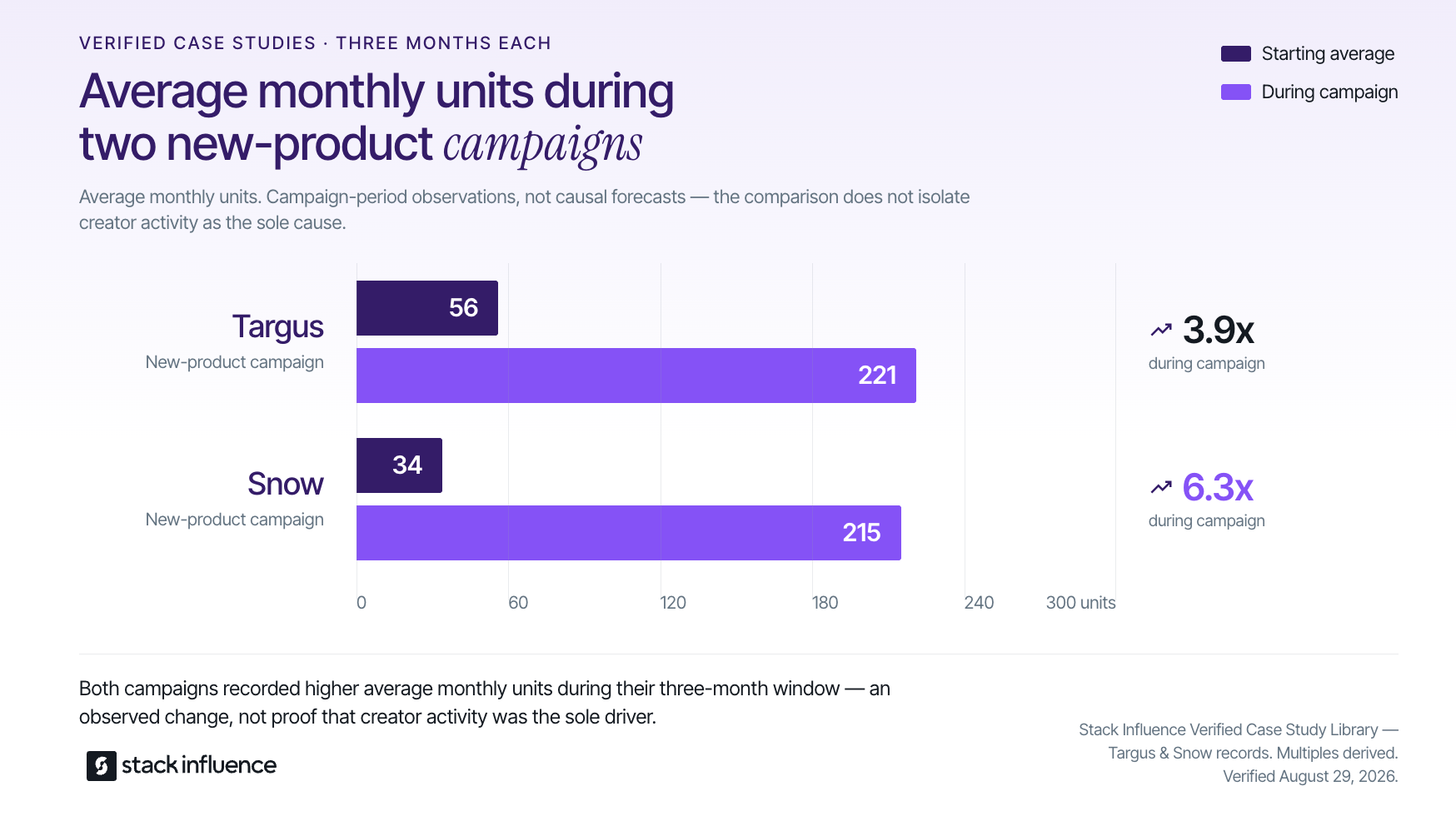
Two verified Stack Influence launch case studies show why proof delivery and commerce outcomes should be reported together. During a three-month new-product campaign for Targus, 120 creator promotions coincided with average monthly unit sales increasing from 56 to 221, about 3.9 times, while Amazon Best Seller Rank moved from #151,547 to #47,811. During a three-month Snow new-product launch, 90 promotions coincided with average monthly units moving from 34 to 215, about 6.3 times, while Best Seller Rank moved from #177,297 to #57,682. These campaign-period observations do not isolate creator activity as the sole cause.
The lesson is not to forecast the same movement. It is to report content delivery, marketplace activity, and business outcomes as different parts of one campaign record.
Distribution proof shows that each channel can deliver the right evidence at the intended moment. Specify the channel’s job, asset, audience, destination, owner, and measurement convention.
Creator posts may introduce lived experience, email may explain the offer, paid media may amplify validated creative, and the product page may resolve final objections. Stack Influence’s product launch ideas for ecommerce teams can help populate tactics after those jobs are clear.
Creators must also receive products early enough to use them honestly, while links, codes, and destinations must work before publishing.
Learning proof exists when the team knows what will be measured, who owns the data, and what decision follows each result. Configure baselines, campaign names, creator tags, dashboards, and reporting windows before launch.
Write decision rules in plain language:
Teams can develop several links in parallel, but more distribution should not hide uncertainty in the audience, offer, or commerce path.
A brand launch campaign should run long enough to build proof before the public announcement and observe behavior after it. For an ecommerce brand with finished positioning, stable supply, and a working storefront, a 10 to 14-week operating window is practical. More complex rebrands, regulated categories, retail rollouts, and unfinished products often need several additional months.
Atlassian’s product launch timeline guide recommends beginning full product-launch planning at least four to six months before the target date. The shorter operating calendar below assumes product development, supply planning, legal review, and core brand decisions are already sufficiently advanced. (Atlassian)
Content creators should build a production buffer for product experience, scripting, filming, revisions, disclosure, file delivery, and post authorization.
Creators are most valuable in a brand launch campaign when each partnership has a defined proof job, not merely a posting slot. The creator’s role is to translate an unfamiliar offer into a credible experience the audience can understand.
Four useful creator roles are:
A strong influencer brief should identify the proof job, factual product information, claims that cannot be made, format, due date, disclosure, call to action, review process, content rights, and any paid-use authorization. Creative freedom works best inside clear factual and operational boundaries.
For U.S.-facing campaigns, the Federal Trade Commission’s Disclosures 101 guide says creators should disclose financial, employment, personal, or family relationships and should treat free or discounted products as material connections. The disclosure should be easy to notice and appear with the endorsement. (Federal Trade Commission)
Content creators should use the product long enough to form an honest view, separate personal experience from supplied claims, and clarify usage rights before recording.
Stack Influence supports this activation layer through automated product seeding. Its gifted-first workflow connects ecommerce brands with roughly 600,000 vetted creators and supports creator sourcing, coordination, UGC collection, and completed-post accountability rather than treating every outreach attempt as a completed result.
Best-Fit Workflow: The model is especially practical when a seller wants to turn launch inventory into distributed creator proof without manually managing every creator follow-up.

A launch channel needs one primary job and one measurable handoff. More channels do not help when each repeats the same announcement or sends people to the wrong destination.
Assign roles such as:
Sequence those roles deliberately. Publish the owned explanation, release creator proof in waves, identify messages producing qualified response, then amplify the strongest assets. Retarget engaged visitors with a different proof angle.
TikTok’s official Spark Ads documentation says brands can use organic creator posts with the creator’s authorization, and engagement generated by the promotion remains attributed to the original post. That makes authorization scope and timing part of launch planning, not an afterthought. (TikTok For Business)
A broader content syndication workflow can extend approved creator assets across paid social, email, product pages, and marketplace content. The agreement must match the actual channels, term, editing permissions, and creator-handle use.
Measure a brand launch campaign as a chain of readiness, response, commerce, and durable-asset signals. Set baselines before launch, tag every meaningful route, and compare cohorts and periods consistently. Reach, revenue, marketplace rank, and creator activity should be interpreted together because a launch changes several variables at once.
Use the Four-Layer Launch Ledger:
Readiness and response are leading indicators. Commerce and retention are outcomes. Compounding value shows what remains after the launch budget stops.
Google Analytics’ URL builder guidance explains that UTM parameters identify the campaigns referring traffic in Traffic acquisition reporting. Use consistent source, medium, campaign, and content values for each creator, wave, email, and paid variation. (Google Help)
Amazon sellers can use Amazon Attribution for eligible off-Amazon activity. Amazon says its reports use a 14-day attribution window and can include clicks, detail page views, add-to-cart activity, purchases, units sold, product sales, and new-to-brand metrics. (Amazon Ads)
Attribution still has limits. Dark social, device switching, marketplace search, delayed purchases, reused content, and simultaneous campaigns can obscure the path. Compare tagged performance with the prelaunch baseline, but describe correlation unless the design supports a stronger causal claim.
An influencer marketing strategy should also separate creator delivery from audience response and commerce. A creator can produce a valuable launch asset even when the post is not the campaign’s largest traffic source.
Many launch failures are handoff failures disguised as marketing problems. The message, creator, destination, inventory, rights, and measurement system may each work alone while arriving in the wrong order.
Watch for these failure modes:
Run a binary audit against the six Launch Proof Chain links 72 hours before the affected launch wave. Mark each link verified with a value of 1 or unresolved with a value of 0.
In an illustrative campaign, Audience, Offer, Commerce, and Distribution are verified at 1 each. Proof Inventory and Learning remain unresolved at 0 each. The campaign therefore has 4 verified links out of 6, or 66.7% proof coverage.
That percentage is not an industry benchmark. It creates decision visibility. Because the unresolved links affect usable evidence and measurement, the team should delay the affected creator wave or narrow launch scope until both are fixed.
Treat order fulfillment and measurement ownership as hard gates. When timing slips, reduce channel count, geography, creator volume, or product range before lowering claim accuracy, disclosure, checkout, rights, or measurement standards.
A strong brand launch campaign does not try to make every channel loud at once. It proves the buyer, offer, commerce path, content, distribution, and learning system, then creates enough feedback to improve after launch day.
Ecommerce sellers should audit one launch against the six links and fix the first unresolved handoff. Content creators should define the proof job they can perform credibly and the asset they will deliver.
Teams that want creator sourcing, gifted-first product seeding, campaign coordination, UGC collection, and completed-post accountability managed together can evaluate Stack Influence as the execution layer. The goal is not a louder announcement. It is a launch that leaves the brand with customers, usable content, and a repeatable learning system.
Amazon storefront creation begins with a distinction that many guides miss: Amazon uses “storefront” to describe two different products. Ecommerce sellers can build a Brand Store for their own catalog, while approved content creators can build an Influencer storefront containing products they recommend.
Those storefronts have different eligibility rules, ownership models, revenue goals, and analytics. This guide explains both paths, then shows sellers and creators how to structure, launch, promote, and measure a storefront that helps shoppers make their next decision.

A seller Brand Store and a creator Influencer storefront may look similar to shoppers, but they perform different jobs. Amazon describes Brand Stores as free, multi-page brand destinations for Brand Registry sellers, vendors, and agencies. The Amazon Influencer Program gives approved creators a customizable page for curating recommendations and earning commissions.
Creators deciding between the last two models can use this Amazon affiliate versus influencer comparison to understand how direct links, storefront curation, and creator commissions fit together.
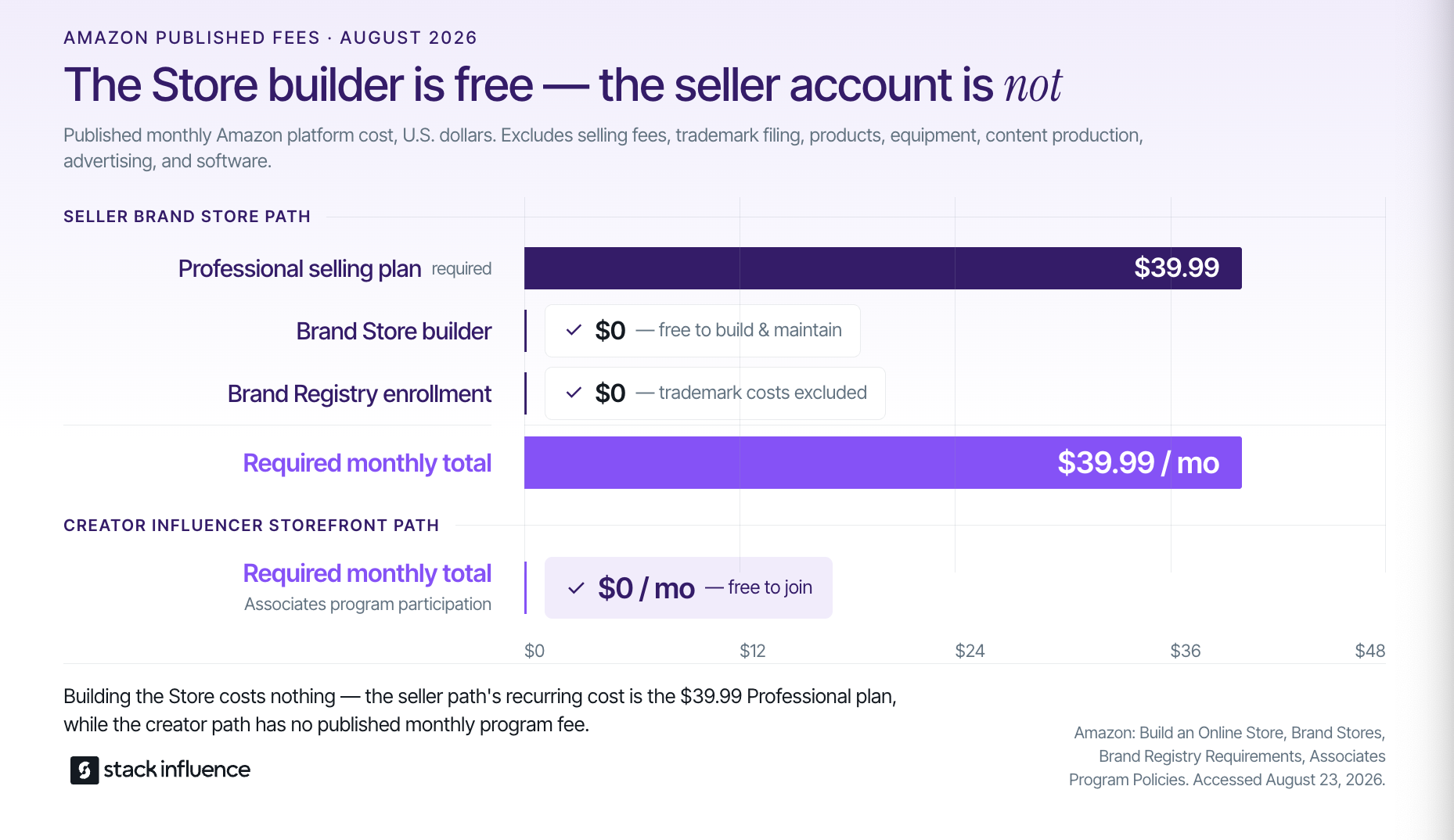
The published recurring platform costs are also different. Amazon currently lists its Professional selling plan at $39.99 per month plus selling fees, while creating and maintaining the Brand Store itself costs $0. Brand Registry is free, although obtaining a trademark can create separate legal and filing costs. Amazon’s Associates policies state that the program is free to join, so the creator storefront path has no published monthly program fee.
Ownership matters after launch. A seller controls its Brand Store, but a creator controls the creator’s Influencer storefront. A brand partnership may secure specific content deliverables or usage rights, but it does not automatically transfer ownership of the creator’s Amazon page, audience, or broader product recommendations.
The Storefront Decision Path is a five-part framework for turning a storefront from a product collection into a usable shopping destination. It applies to both brands and creators, although each storefront uses different content and reporting tools.
For a skincare seller, the path might move from “Sensitive-Skin Essentials” to cleanser, moisturizer, and treatment pages. For a home creator, it might move from “Small-Space Organization” to kitchen, closet, bathroom, and renter-friendly Idea Lists.
The framework prevents a common mistake: treating product quantity as proof of storefront quality. A useful storefront reduces decision effort. A large storefront without orientation can increase it.
Amazon sellers create a Brand Store by using a Professional selling plan, enrolling an eligible brand in Brand Registry, building pages through Amazon’s Store builder, previewing the mobile and desktop experiences, and submitting the finished store for moderation. The builder is no-code, but account, trademark, branding, and catalog requirements come first.
Do not wait until launch day to decide where outside traffic should land. A broad creator campaign may need the homepage, while content focused on one product problem should usually link to the most relevant category page or product detail page.
Content creators build an Influencer storefront by applying to the Amazon Influencer Program with an eligible social account, completing approval, configuring their public page, creating focused Idea Lists, adding useful shoppable content, and promoting tracked recommendations. Approval depends on Amazon’s assessment, not one universally guaranteed follower threshold.
A creator storefront should reflect the creator’s actual editorial point of view. Filling it with unrelated products may create more links, but it weakens the reason a follower would return for the next recommendation.
The strongest storefront designs make products easier to locate, compare, and understand. Large banners and polished UGC can support that goal, but visual production cannot compensate for confusing navigation or an unclear first screen.
For seller Brand Stores, a practical homepage order is:
Amazon recommends giving important categories homepage tiles because mobile navigation collapses into a dropdown. Its purchase-friction guidance also recommends eight products for a homepage product grid, since larger grids can create excessive scrolling on mobile.
For creator storefronts, list names should combine a recognizable product need with useful context. “Travel Tech Under $50,” “Beginner Home-Gym Equipment,” and “Products I Use for Curly Hair” communicate more than “Tech,” “Fitness,” or “Beauty.”
Sellers incorporating creator assets should also confirm usage rights, campaign terms, product accuracy, and Amazon content requirements before placing UGC in a Brand Store. An Amazon-compliant UGC guide can help teams separate content production from the rights and approval work required for reuse.
Seller and creator storefronts work best as connected destinations, not interchangeable assets. The seller’s Brand Store organizes the brand catalog, while creator storefronts curate recommendations through an independent creator voice.
Before activating Amazon influencers, a seller should prepare:
Stack Influence is a micro-influencer marketing platform built around gifted-first product seeding, vetted creator activation, campaign coordination, UGC generation, and completed-post accountability. Its approved company materials state that the platform works with roughly 600,000 vetted creators, helping ecommerce brands manage the execution layer between creator selection, product delivery, content completion, and campaign tracking.
Brands can use this guide to start finding Amazon influencers and their storefronts, then evaluate a managed Amazon creator campaign workflow when creator sourcing, product seeding, communication, and completion tracking need to operate as one process.
The operational sequence matters. Finish the retail destination first, assign the measurement route second, activate creators third, and refresh the Store with approved assets after performance and content quality can be evaluated.
The Storefront Signal Ladder separates early behavior from business outcomes. It prevents sellers and creators from treating one click, one sale, or one short reporting window as a complete performance explanation.
Amazon Brand Store Insights includes visitors, visits, views per visitor, first-time Store visitors, orders, units, and estimated sales generated within 14 days of a visitor’s last Store visit. Source tags can be created for different marketing routes, with no stated quantity limit or expiration.
Amazon Associates reporting surfaces clicks, ordered items, shipped items, conversion rates, earnings, and performance by Tracking ID. Creators should separate recurring channels or campaigns when possible so a high-performing Instagram Story, YouTube description, or email placement does not disappear inside one blended total.
Sellers measuring off-Amazon campaigns can use an Amazon Attribution guide to plan tagged paths beyond Store Insights. Teams using paid Amazon traffic should also connect landing-page decisions to the wider Amazon marketing services workflow.
Amazon currently publishes two related 90-day Store-refresh benchmarks. One official optimization guide reports that Brand Stores updated within 90 days had 11% more repeat visitors and 13% higher attributed sales per visitor, based on Amazon internal 2024 data. Another official purchase-friction guide reports 9% more repeat visitors and 10% higher attributed sales per visitor, based on Amazon internal global data dated October 24, 2024.
The defensible synthesis is a directional range: 9% to 11% more repeat visitors and 10% to 13% higher attributed sales per visitor in Amazon’s reported comparisons. Those figures show an association with recent Store updates, not a guaranteed lift or proof that refreshing alone caused the difference.
Use this review cadence:
Attribution becomes less certain when price changes, ad spend, inventory, reviews, seasonality, creator output, or promotions change simultaneously. Treat the reporting chain as evidence for decisions, not automatic proof of causation.
Most storefront problems begin before the design is submitted. They come from selecting the wrong store type, failing to define the shopper’s next decision, or sending traffic without a measurement plan.
Avoid these mistakes:
A storefront should become easier to use as the catalog grows. If every new product makes navigation harder, the architecture needs revision before more traffic arrives.
Successful Amazon storefront creation is not primarily about filling a template. Sellers need a Brand Store that explains and organizes their catalog, while content creators need an Influencer storefront that turns trusted recommendations into focused shopping paths.
Choose the correct storefront type, build around recognizable buyer needs, connect every traffic source to a measurement convention, and keep the destination current. Sellers planning creator-led traffic can then evaluate whether managed product seeding and campaign coordination would help turn storefront readiness into consistent creator participation and reusable content.
Most brands can collect creator handles. The harder task is identifying people who reach the right shoppers, produce useful content, accept workable terms, and reliably complete the campaign. Finding micro influencers is therefore an evidence problem, not a follower-count exercise.
For ecommerce sellers, that evidence must connect a creator to a specific purchase decision. For content creators, the same system reveals how to make a profile easier for brands to discover, evaluate, and hire. This guide explains how to find micro influencers, build a qualified shortlist, structure outreach, activate creators, and measure the full campaign rather than stopping at likes.
A micro influencer is a creator with a relatively small, topic-focused audience and recurring influence inside a defined community. The IAB's April 2025 taxonomy places micro influencers at 10,000 to 50,000 followers and nano influencers at 1,000 to 10,000, but brands and platforms use different cutoffs. Fit matters more than the label.
The IAB's April 2025 creator taxonomy provides a useful reference point, not a universal campaign rule. A creator with 8,000 highly relevant followers may be more valuable for a niche product than an account with 40,000 followers whose audience rarely discusses the category. Stack Influence's explanation of what a micro influencer is adds practical context on the role these creators can play for ecommerce brands.
Four signals make the label commercially useful:
It also helps to separate creator roles. An influencer contributes audience distribution, while a UGC creator primarily produces content for the brand to use. An affiliate or Amazon influencer focuses more directly on tracked shopping actions. One person can perform all three roles, but a brand should decide which job matters before searching.
The Micro-Influencer Search Grid begins with the customer's buying context and converts it into four families of search queries. This prevents a common mistake: searching only for a broad phrase such as “fitness influencer” or “beauty creator,” then treating whichever large accounts appear first as the market.
Use these four query families:
Add a community modifier when it changes the buying context, such as “meal prep for college” or “high-protein meal prep.” Use modifiers to describe a real product-use condition, not to force an unrelated demographic into the search.
Run the grid through native platform search, captions, video titles, tagged content, search engines, marketplace filters, and creator-network filters. Record the platform, query, discovery source, date, and reason each profile looked promising. A sourcing log makes it possible to compare which searches produce qualified creators instead of merely producing the most names.
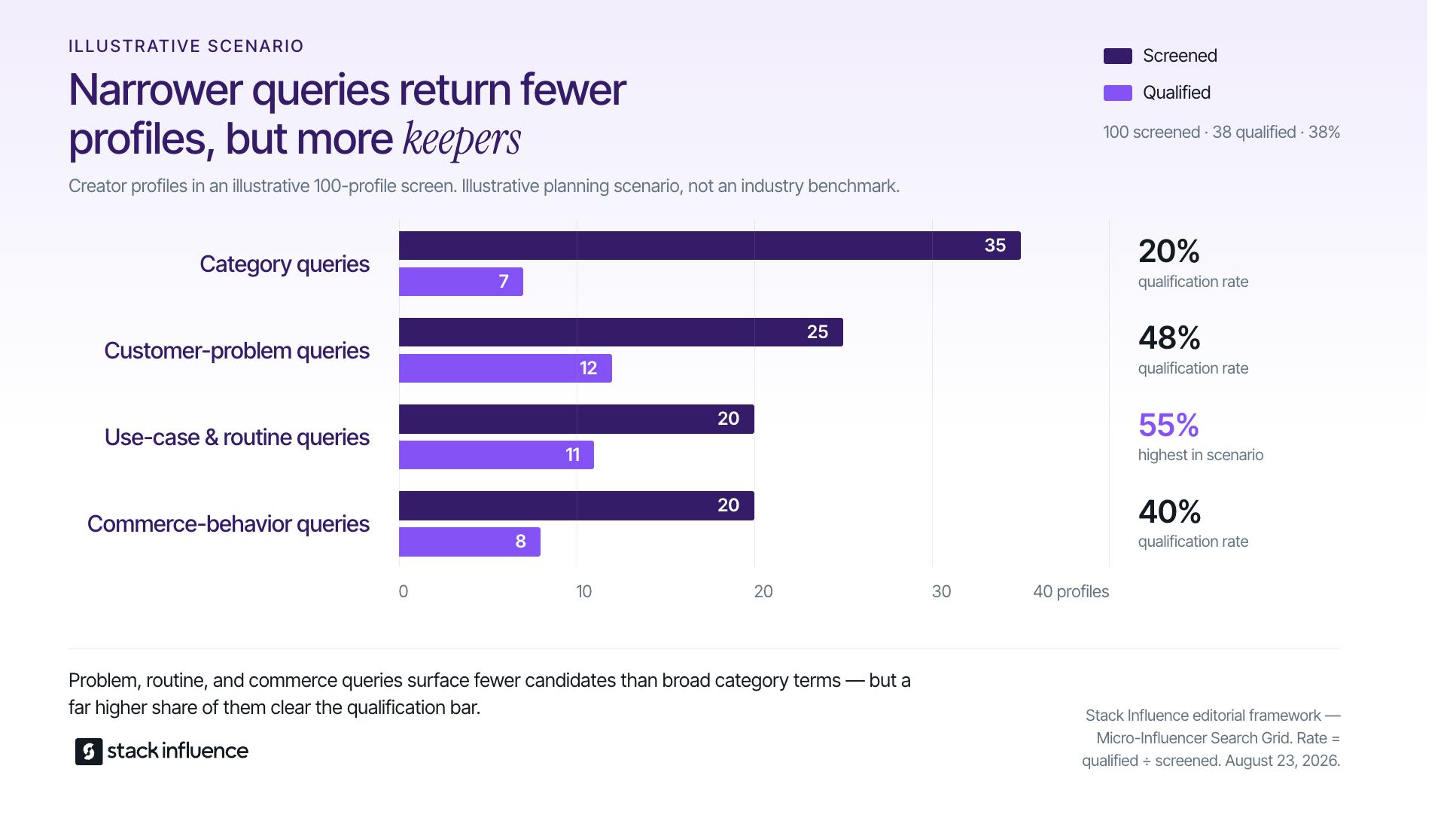
Consider an illustrative 100-profile screen for a home-organization product. This is a planning scenario, not an industry benchmark:
The calculation is qualified profiles divided by screened profiles. The scenario does not prove that routine searches always perform best. It illustrates a useful operating principle: broad terms may maximize volume, while problem and routine queries often reveal more evidence of product relevance before outreach begins.
Content creators can use the Search Grid in reverse. A bio that says “lifestyle creator” is difficult to place. A profile that consistently publishes small-space organization routines, renter-friendly storage tests, and product comparisons gives brands searchable evidence of audience, expertise, format, and commercial role.
Look in four places: native social search, existing customer and brand signals, adjacent category networks, and structured creator platforms. Each source reveals different evidence. Native search shows current content, owned signals reveal natural affinity, adjacent networks map communities, and creator platforms add filters or campaign execution. Use at least two sources before finalizing a shortlist.
Native search is strongest when the query describes content a customer would actually watch. Search posts, captions, video titles, tagged content, collaborative posts, comments, and related accounts. Then expand from one strong creator into the surrounding community instead of returning immediately to a generic hashtag.
On Instagram, Meta's Instagram Creator Marketplace guidance explains that brands can use creator and audience filters to identify potential partners. The guide to finding Instagram influencers who fit your brand provides a channel-specific workflow for expanding native results into a qualified candidate pool.
TikTok One supports username or keyword searches, plus filters related to creator details, audience details, and performance. Use its creator-search documentation alongside the guide to finding TikTok influencers who fit your brand, especially when short-form product demonstrations or TikTok Shop behavior matter.
On YouTube, search for the problem, routine, review format, and product category rather than the word “influencer.” For a promising creator, request the creator's YouTube Media Kit when available so audience and channel information can supplement the public content review.
Start with people who already demonstrate product or category affinity through social tags, brand mentions, creator applications, affiliate applicants, community participation, or customer-created content collected with appropriate permission. Natural affinity reduces one source of uncertainty, but it does not replace audience, content, disclosure, or reliability checks.
Map the category through complementary brands, retailers, educators, events, publications, newsletters, and community accounts. Review collaborators, tagged posts, and recurring commenters, but do not copy a competitor's roster. Check exclusivity, audience fatigue, category conflicts, and whether the creator's relationship with the product area remains credible.
A self-service creator database can support profile research and manual shortlist building. A managed creator platform connects sourcing with activation, product seeding, communication, deliverables, and reporting. Brands can use both, with manual research mapping the category and a managed network supporting execution at larger volume.
Qualify a micro influencer by checking relevance, audience evidence, content usefulness, commercial credibility, and execution readiness before sending an offer. Review recent posts and comment quality, not a single engagement percentage. A creator should pass every critical gate for the campaign job, even when another candidate has a larger following or a stronger-looking headline metric.
Use a five-evidence screen:
Score each gate from 0 to 2, where 0 means the required evidence is missing, 1 means it is partial, and 2 means it is strong. As a practical planning rule, prioritize creators scoring 8 to 10, keep 6 to 7 as a secondary pool, and archive lower scores. A zero in relevance or execution should block outreach until the missing evidence is resolved. This is a decision rubric, not an industry benchmark.
One viral post, giveaway, or polished sponsorship can distort the picture. Look for repeated signals across ordinary posts, partnership posts, comments, and available audience analytics.
Stack Influence's micro-influencer recruitment and vetting guide provides additional checks for brand fit, authenticity, content quality, and campaign readiness. Creators can strengthen their own score by clarifying their niche, keeping contact information current, organizing a media kit, showing audience data, and presenting past brand work with the deliverable and result clearly labeled.
A creator list has no campaign value until qualified people accept the offer, receive the product, understand the deliverable, publish compliant content, grant the agreed rights, and enter the reporting workflow. Many “how to find creators” guides stop precisely where the operational risk begins.
A complete activation sequence includes:
The distinction between no-obligation gifting and an agreed product-for-content campaign matters. A surprise gift does not silently create a posting obligation. Stack Influence's practical guide to influencer seeding explains how expectations, logistics, rights, and measurement change across seeding models.
Stack Influence is designed for ecommerce brands that want vetted creator activation, gifted-first product seeding, coordination, completed-post tracking, and UGC generation connected in one workflow. The platform works with roughly 600,000 vetted creators and uses a completions-only model in which platform charges are tied to completed creator posts. This structure is sometimes called “influencer insurance” because it protects platform budget from incomplete creator participation. The micro-influencer promotions workflow and ecommerce UGC program show how discovery can connect to execution and reusable content.
For creators, reliability becomes part of discoverability. Quick, clear replies, accurate shipping information, realistic timelines, proper disclosure, organized files, and consistent follow-through give a brand evidence that the next collaboration will be easier to execute.
Contact micro influencers with a short, specific message that proves the outreach is relevant and makes the decision easy. Mention one real piece of content, explain why the product fits the creator's audience, state the offer and expected deliverable, disclose the timeline and rights request, and end with one clear next step. Avoid vague compliments and hidden terms.
A practical first message can follow this structure:
Hi [Name], I liked your recent [specific post] because [specific reason]. We make [product] for [customer or use case], and your content about [relevant topic] looks closely aligned. We would like to discuss [product gifting, paid content, affiliate partnership, or hybrid offer] for [deliverable] by [timeframe]. The requested usage would be [rights summary]. Are you open to reviewing the full brief?
The full brief should clarify compensation, product value, shipping region, format, required talking points, creative freedom, due date, approval rules, disclosure, link or code, reporting, and content rights. Use the influencer outreach guide to build follow-up timing and response tracking around the initial message.
The FTC treats free products and other benefits as material connections that may require clear disclosure. Its endorsement disclosure guidance explains that creators should make the relationship difficult to miss, rather than relying on an ambiguous tag or a disclosure hidden after a “more” button. Brands should include disclosure expectations in the brief, while creators remain responsible for truthful statements about their experience.
Creators should also ask what the brand means by “usage rights.” Organic reposting, website use, marketplace use, email, paid social advertising, content edits, and creator-handle advertising are different permissions. The agreement should identify channels, term, geography when relevant, compensation, and approval expectations.
Creator discovery should be measured as a connected test from shortlist quality through business response. An engagement rate cannot reveal whether the right creators accepted, products arrived, content was usable, shoppers clicked, or the brand found repeat partners.
CreatorIQ's State of Creator Marketing 2025-2026 report found that 26% of brand respondents identified difficulty measuring influencer performance as a leading roadblock. Another 21% cited pressure to produce content faster, 20% cited navigating AI-generated content or creators, and 20% cited creator vetting, brand fit, or risk mitigation. These barriers show why search, qualification, workflow, and measurement must be designed together.
Use a four-stage Creator Test Chain:
For Amazon campaigns, Amazon Attribution can measure eligible non-Amazon marketing channels, including influencer and affiliate activity, through attribution tags. Stack Influence's Amazon influencer marketing solutions explain how creator activation can support an Amazon-focused workflow.
For Shopify brands, Shopify Collabs reporting can track creator visits, orders, sales, conversion rate, commission, and gifted value for activity managed through the program. The Shopify influencer marketing playbook provides broader planning context for creator traffic, content, and conversion.
Attribution still has limits. Shoppers may purchase later through branded search, switch devices, visit directly, or buy after the reporting window. Use creator-specific links and codes, consistent windows, cohort comparisons, and marketplace trends, but do not claim that one post caused every observed change.
A verified Stack Influence case study provides an example of why the metric chain matters. During a three-month new-product campaign for Snow, the campaign included 90 creator promotions, 168,510 social impressions, and 6,596 engagements. Average monthly units moved from 34 to 215, while Amazon Best Seller Rank moved from #177,297 to #57,682 during the campaign period. Those outcomes occurred alongside the campaign and do not isolate creator activity as the sole cause.
Most failed shortlists are not caused by a lack of available creators. They are caused by weak search logic, incomplete evidence, or an offer that was never operationally viable.
Avoid these mistakes:
Learning how to find micro influencers begins with a simple shift: search for evidence that a creator influences a specific purchase decision, not merely for an account inside a follower range. Define the campaign job, run category, problem, routine, and commerce queries, qualify every candidate against the same evidence gates, and preserve the discovery source so the next shortlist improves.
Ecommerce brands should then connect discovery to an executable offer, product logistics, completion tracking, content rights, disclosure, and attribution. Content creators can improve their chances by making niche expertise, audience evidence, brand-collaboration information, and reliability visible before a brand ever sends a message.
Begin with one product, one customer problem, and a controlled creator pilot. Brands that want sourcing, gifted-first product seeding, creator coordination, completed-post accountability, and UGC connected in one campaign can evaluate a managed micro-influencer workflow against the same qualification and measurement standards described here.
TikTok Shop creation is no longer a single signup task. U.S. sellers must verify the business, configure tax and fulfillment, publish compliant products, and connect a content account. Content creators follow a different path through TikTok Shop for Creator. This guide separates those workflows and shows how to prepare the catalog, creator program, and unit economics before traffic arrives.
TikTok Shop creation includes building the commerce account, proving who owns it, setting tax and payout information, configuring fulfillment and returns, creating compliant product listings, and connecting the TikTok account that will publish shoppable content. For creators, it means gaining product-promotion access rather than opening a seller storefront.
TikTok's current U.S. shop setup guide organizes seller onboarding around business verification, warehouse setup, products, tax information, and an Official TikTok Account. Products remain unavailable for sale until required tax information is complete and listings pass review.
That distinction matters because a verified shop is only the commerce foundation. A scalable launch also needs inventory controls, content supply, creator coordination, customer service, and margin tracking. The TikTok Shop seller revenue playbook covers channel operations after setup.
Choose the TikTok Shop role before uploading products. The correct role prevents sellers from opening unnecessary creator accounts and creators from attempting to register as merchants.
A Seller Account owns the shop, publishes products, receives orders, manages fulfillment and returns, and pays platform or creator-related costs. Registration may use an individual or business identity.
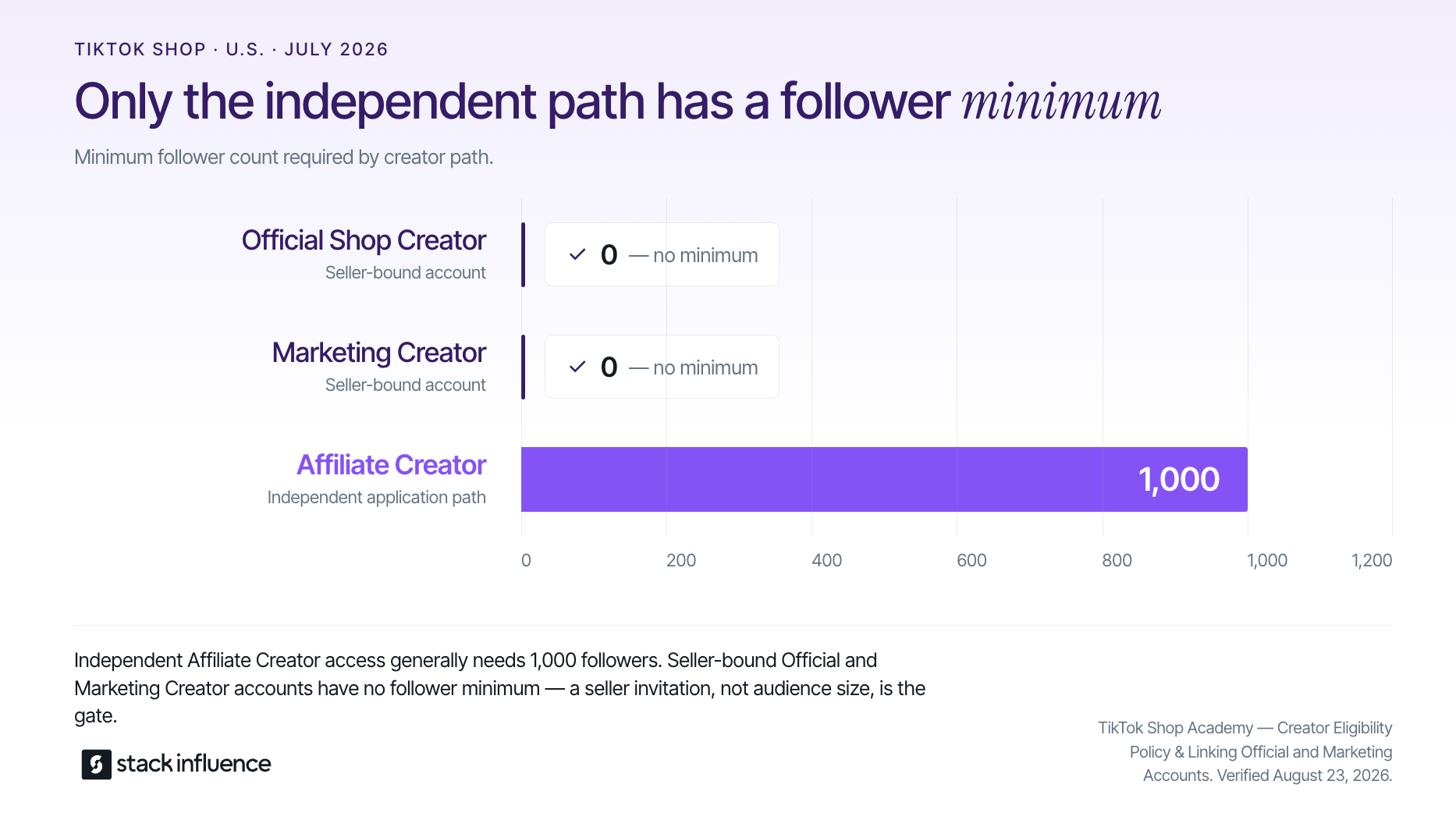
An Official Shop Creator is the account formally linked to the store. It receives an automatic Showcase and can promote only that shop's products. Current U.S. rules allow one Official Account per shop with no follower minimum.
A Marketing Creator is another account linked to promote the shop. A shop can currently connect up to four Marketing Accounts, and each can add products to its Showcase. The account region must match the shop region.
An Affiliate Creator independently applies to find and promote products from the TikTok Shop marketplace. Under the TikTok Shop Creator Eligibility Policy, U.S. Affiliate Creators must generally be at least 18, be based in the United States, maintain an account in good standing, pass applicable identity or risk checks, and have at least 1,000 followers.
Minimum follower thresholds are:
Creators who want commissions from multiple sellers usually follow the Affiliate Creator path. Sellers can use linked staff, founder, or brand accounts without waiting for 1,000 followers. The TikTok affiliate program guide explains the independent workflow.
U.S. sellers need a qualifying legal identity or business, matching registration records, an eligible phone number and email address, tax information, a bank account, and valid pickup and return addresses. Branded or restricted products may require additional authorization, certifications, or category approval before a listing can be sold.
Prepare four evidence groups before opening Seller Center:
Branded sellers can use the USPTO trademark search to confirm public registration details, but a search result does not replace authorization or documentation TikTok requests.
TikTok's individual seller registration requirements emphasize that uploaded documents must be valid, legible, and consistent with the information entered during registration. TikTok's setup flow also requires a W-9, and the IRS Form W-9 guidance explains the taxpayer information that the form supplies to a payer.
Create one master record containing the exact legal name, address, entity type, taxpayer details, representative, bank owner, and supporting documents. Copy from that record throughout onboarding.

The Seven-Step Seller Activation Sequence orders setup around dependencies, reducing the risk of building listings or creator plans before the shop can receive payouts and fulfill orders.
Amazon sellers should also decide whether TikTok Shop will use separate inventory, a shared inventory system, or an eligible multichannel fulfillment arrangement. The TikTok Shop and Amazon strategy guide explains why the two marketplaces need coordinated stock and separate channel-level margin reporting.
Content creators apply inside the TikTok app rather than opening a seller storefront. In the United States, an independent Affiliate Creator generally needs to be at least 18, have at least 1,000 followers, reside in the country, maintain an account in good standing, and complete TikTok's identity and risk-review steps.
The current application path is TikTok Studio, Monetization, TikTok Shop for Creator, then Join now. TikTok's creator application guide notes that new creators may enter a 30-day pilot with posting limits, and some features may have higher follower requirements.
After approval, complete four setup tasks:
The FTC's disclosure guidance for social media influencers treats free or discounted products as material connections that may require disclosure. The relationship should be immediately understandable to viewers.
The UGC marketing guide for content creators helps creators separate polished brand assets from conversion-oriented demonstrations. A shoppable video should still help the viewer decide.
A TikTok Shop should be operationally boring before it becomes visible. The product page, inventory, shipping promise, return path, and support process must work without manual rescue.
Before publishing launch content, confirm:
TikTok Shipping is the default shipping method for new U.S. sellers under the current TikTok Shipping setup guide. Sellers still need correct pickup and return warehouses, package data, inventory, and handling processes before sending traffic.
The overlooked risk is promotion outrunning operations. A strong creator post can expose inaccurate stock, weak packaging, slow support, or an unprofitable offer faster than a low-traffic launch would.
Creator access becomes valuable when sellers can repeatedly move from product selection to creator activation, completed content, and measurable orders. A product-seeding system creates a controlled learning loop.
TikTok's Affiliate Collaboration guide gives sellers two main routes. Open Collaboration makes selected products available to a broader creator pool, while Target Collaboration lets the seller invite specific creators and set the terms for those relationships.
Use this operating sequence:
The practical guide to influencer seeding explains why relevance and follow-through matter more than indiscriminate gifting. Sellers can also use a structured process to find TikTok influencers who fit the product before sending invitations.
Stack Influence supports this execution layer through gifted-first product seeding, vetted creator activation, campaign coordination, UGC generation, and completed-post accountability. The platform works with roughly 600,000 vetted creators and is designed to help ecommerce brands move from creator sourcing to completed content through one managed workflow.
For brands building a larger TikTok creator program, the TikTok marketplace solutions workflow connects product seeding with campaign execution rather than treating creator discovery as the finish line. Results still vary by product, pricing, creative quality, inventory, creator participation, and marketplace conditions.
TikTok Shop creation costs extend beyond account registration. Sellers should model category referral fees, discounts, affiliate commissions, samples, product cost, fulfillment, returns, advertising, and operating labor. The correct question is not whether opening the account is inexpensive, but whether each fulfilled order leaves enough contribution margin to support growth.
As of August 23, 2026, TikTok's U.S. referral fee policy lists a 6% referral fee for most categories and 5% for several categories. TikTok calculates the fee from the applicable customer payment and platform-discount basis defined in the policy, so sellers should confirm the current category rate before publishing a forecast.
Consider an illustrative $40 product launch:
TikTok's settlement report guide describes affiliate commission as the commission rate multiplied by the product price excluding tax and seller discounts. The 15% rate, $10 cost of goods, and $5 fulfillment cost above are assumptions, not platform benchmarks or Stack Influence performance data.
A commission can look affordable while discounts, fulfillment, and returns consume the remaining margin.
The Activation-to-Margin Stack separates leading indicators from business outcomes. It prevents sellers from mistaking account approval, creator views, or gross sales for a healthy TikTok Shop.
Track five layers:
TikTok's Affiliate analytics guide lets sellers review creator and product performance across selectable periods, including data extending up to six months. Use consistent comparison windows and annotate stockouts, price changes, promotions, and major creator activations so the numbers retain context.
Read the measurement chain from left to right. Content can create traffic, traffic can create orders, and orders can create contribution, but each step has separate failure conditions. Because viewers may buy later through another channel, interpret platform reporting alongside inventory, web analytics, marketplace sales, and creator-level evidence rather than as complete proof of causation.
The broader influencer marketing strategy guide explains how campaign goals, creator selection, content rights, and attribution should connect before spend scales.
Approval proves that TikTok accepted the account and listing information. It does not prove that the product, offer, creative, or margin model will work. Sellers should treat the first 30 days as a controlled validation period rather than a victory lap.
The most expensive setup mistakes are usually operational:
The Seven-Step Seller Activation Sequence solves these problems by delaying traffic until verification, catalog ownership, fulfillment, content access, and unit economics are connected. Creation is complete only when commerce can process the attention content generates.
Successful TikTok Shop creation starts with the right role, consistent verification records, one controlled product, reliable fulfillment, and a creator plan grounded in margin. Sellers should validate the complete order and content loop before expanding the catalog. Creators should choose products they can explain credibly and disclose material relationships clearly.
The next practical step is to map one launch product from verification through listing, fulfillment, creator activation, measurement, and contribution margin. Ecommerce teams that want creator sourcing, product seeding, coordination, and completed content managed together can evaluate a structured micro-influencer workflow around that launch.
Amazon external traffic strategies work only when a seller can answer three questions: who is arriving, why did they click, and does the resulting order leave contribution profit? Search ads, creators, paid social, email, affiliates, and owned content can diversify demand beyond Amazon PPC. They can also waste money when every audience receives the same message and destination.
This guide gives ecommerce sellers a practical system for choosing channels, routing shoppers, setting break-even limits, using Amazon Attribution, and evaluating the Brand Referral Bonus without overstating its value. The goal is not more traffic. The goal is qualified, measurable demand that the business can afford to repeat.
Amazon external traffic strategies are coordinated methods for sending shoppers from outside Amazon to a product detail page or Brand Store. Common sources include Google Search, social media, creators, email, affiliates, publishers, and brand-owned content. A complete strategy also defines the audience, message, destination, tracking structure, and profit threshold for each source.
As of August 2026, Amazon describes Amazon Attribution as a free measurement solution for non-Amazon search, social, display, video, email, and affiliate or influencer campaigns. Its reports use a 14-day attribution window and include clicks, detail page views, add-to-carts, purchases, units sold, product sales, and new-to-brand metrics.
That measurement layer separates external traffic from ordinary Amazon PPC reporting. Sellers can use the data to compare off-platform sources, while the supporting Amazon Attribution guide explains the setup in a seller-focused context.
External traffic does not mean sending the largest possible audience to an ASIN. It means acquiring or activating demand outside Amazon, routing it to the right retail experience, and measuring whether the traffic produced useful shopping behavior and profitable orders.
The External Traffic Control Loop is a five-part framework for turning scattered campaigns into a manageable acquisition system. Every channel must pass through the same five controls before budget increases.
The loop prevents a common mistake: choosing a channel because it is popular, then trying to make its traffic fit the product. A better approach starts with the shopper’s intent and works backward to the channel, creative, and destination.
Use the same control loop after launch. If clicks are cheap but detail page views are weak, inspect the link and destination. If detail page views are healthy but add-to-carts are low, inspect the offer and product page. If purchases are strong but profit is weak, inspect media cost, promotions, fees, and returns.
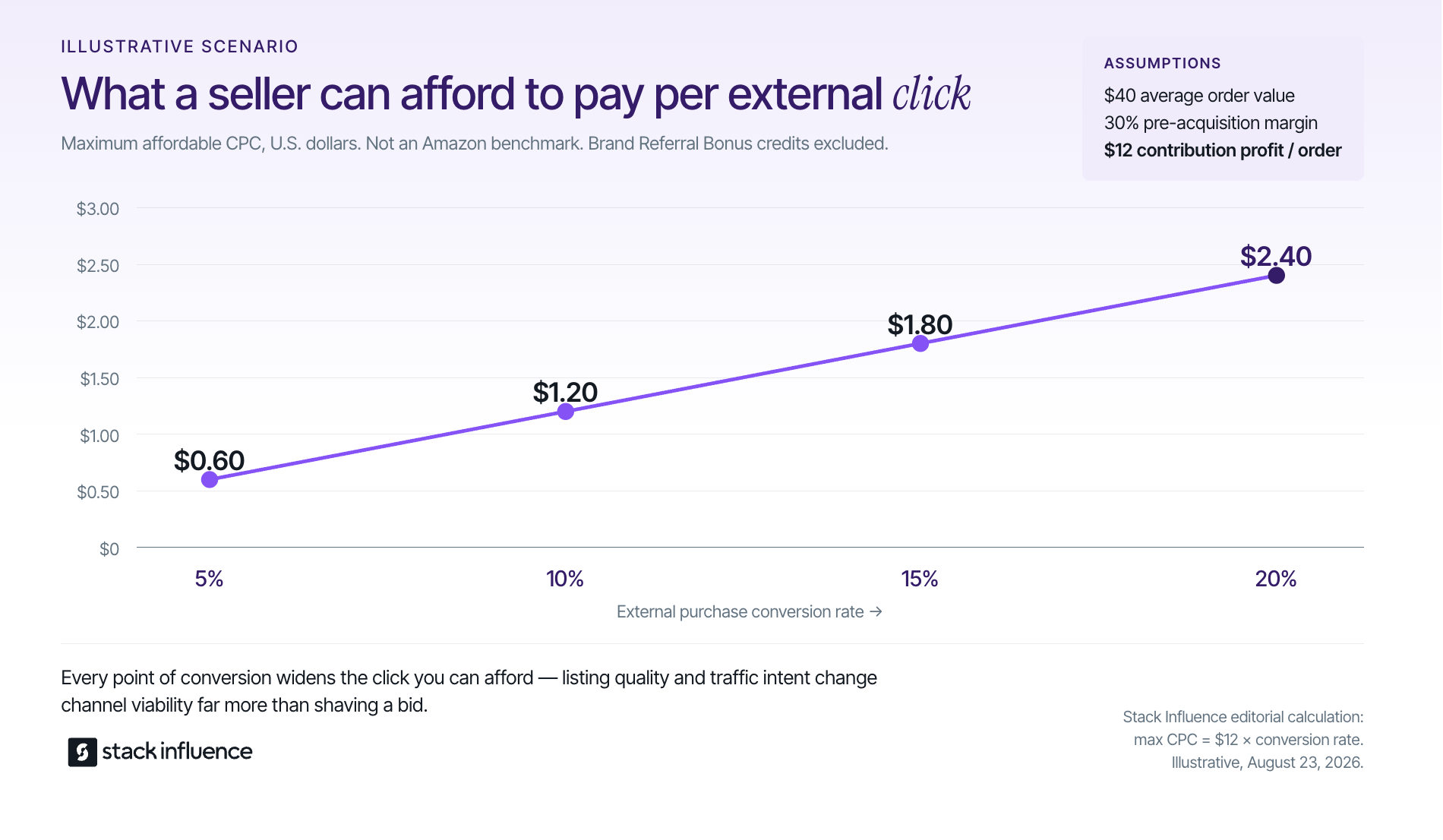
A seller should know the maximum affordable external cost per click before opening an ad account or negotiating a publisher placement. The basic formula is:
Maximum affordable CPC = contribution profit per order before external acquisition cost × expected external conversion rate.
Consider an illustrative product with a $40 average order value and a 30% contribution margin after product costs and Amazon fees, but before external acquisition. That leaves $12 per order for traffic. At conversion rates of 5%, 10%, 15%, and 20%, the maximum break-even CPC is $0.60, $1.20, $1.80, and $2.40 respectively.
These figures are not Amazon benchmarks. They show how strongly conversion rate changes channel economics. If the market CPC is $1.50, the illustrative product needs a 12.5% purchase rate to break even before Brand Referral Bonus credits. Improving the listing or choosing warmer traffic can therefore be more valuable than negotiating a slightly cheaper click.
The same logic applies to creators, affiliates, and sponsorships. Convert every cost into an expected cost per attributed order, then compare that number with contribution profit. The guide to how much Amazon ads cost provides a related framework for separating visible media cost from the retail and margin costs behind it.
The strongest Amazon traffic mix combines channels that capture existing intent, build trust, activate known audiences, and create future demand. Each source should have one primary job, one matching destination, and one reporting unit.
Google Search is strongest when shoppers are already expressing a problem, product, feature, or brand need. Google’s Search campaign documentation describes the format as a way to reach people actively searching for specific products and services.
Start with branded queries, precise category terms, and problem-solution searches that closely match the ASIN. Separate keyword groups with distinct Amazon Attribution tags. Broad informational traffic may require a pre-sell page, while branded and product-specific searches can often go directly to the product detail page.
Creator traffic is useful when a product benefits from demonstration, personal context, or social proof. Micro influencers and nano influencers can explain use cases that a static ad cannot, while product seeding can produce both off-platform demand and reusable content.
Build the creator shortlist around category relevance, content quality, audience fit, and reliability rather than follower count alone. The evidence-first guide to finding Amazon influencers shows how to evaluate creators across delivery, content, traffic, and commerce.
Give each creator or tightly defined cohort a trackable link when practical. Also require clear disclosure of gifted products or paid relationships. The FTC’s endorsement guidance states that material connections between advertisers and endorsers should be disclosed.
Paid social works best after organic creator content has revealed a strong hook, demonstration, or objection answer. The seller is no longer guessing what people will watch. The seller is amplifying evidence that already earned attention.
Meta says partnership ads allow advertisers to run ads with creators, brands, and other partners. TikTok’s Spark Ads playbook similarly describes promoting native creator-originated content. Use separate tags for platform, creator, asset, audience, and destination when those distinctions will change budget decisions.
Do not scale every high-engagement post. A useful ad candidate should also communicate the product clearly, attract the intended shopper, and preserve message match after the click.
Email and SMS are usually the warmest controllable traffic sources because recipients already know the brand. Use them for launches, replenishment reminders, seasonal offers, bundles, or a product that has gained new proof since the last promotion.
Segment by prior purchase, category interest, or engagement instead of sending the entire list to one ASIN. Create separate tags for broadcasts, automated flows, and major audience groups. A high click rate from an existing customer segment can still be unprofitable if the promotion is too deep or the message sends shoppers to the wrong variation.
Affiliate and publisher traffic can capture shoppers who are comparing products, reading reviews, or searching for a best-of recommendation. The Performance Marketing Association’s 2025 industry study reported that U.S. affiliate marketing investment reached $13.62 billion in 2024 and generated $113 billion in ecommerce sales.
Amazon’s Influencer Program gives approved creators a storefront and affiliate linking tools. Sellers should document whether the placement is being evaluated through the creator’s affiliate economics, the brand’s Amazon Attribution reporting, or a coordinated method approved by the parties involved.
For paid publisher placements, compare cost per attributed order rather than subscriber count or page views. The Stack Influence guide to newsletter sponsorship provides a deeper selection and measurement process for this channel.
Organic social is a low-media-cost testing environment for hooks, demonstrations, FAQs, comparisons, and customer use cases. Its main strategic value is learning which messages deserve paid amplification and which content formats can be reused elsewhere.
Track the Amazon link separately from the profile’s ordinary website traffic. Measure attention metrics as leading indicators, but use detail page views, purchases, and contribution profit as outcome metrics. Before reusing creator assets in ads, emails, listings, or Brand Stores, confirm the required UGC licensing rights.
Brand-owned guides, comparison pages, tutorials, and use-case content can create a durable route from search discovery to Amazon. This channel is most useful when the product requires education or when shoppers repeatedly ask the same pre-purchase questions.
Build content around genuine buyer decisions, not thin pages created only to pass authority to an Amazon link. Use UTMs for the owned site and an Amazon Attribution tag on the outbound Amazon call to action. Review which topics produce retail actions, then use those insights to improve product copy, creator briefs, and paid search messaging.
Send high-intent shoppers to a product detail page, discovery-oriented shoppers to a Brand Store, and education-heavy traffic to a pre-sell page that leads to Amazon. The correct destination is the shortest path that answers the shopper’s remaining questions without adding unnecessary friction. Product complexity, audience temperature, and catalog breadth should determine the route.
Use a product detail page for branded search, replenishment emails, creator recommendations focused on one product, and ads with a precise product promise. The page should match the promoted variation, price, use case, and imagery.
Use a Brand Store when the shopper needs category choice, brand education, bundles, or several related products. Amazon states that Brand Stores are free for eligible brand owners, can receive external traffic, and provide insights for visits, page views, sales, and traffic sources.
Use a pre-sell page when the audience needs a tutorial, comparison, quiz, detailed claim context, or a clearer bridge from the external creative to the product. Place the Amazon Attribution link on the outbound Amazon button, keep claims consistent with the listing, and remove distractions that do not help the buyer decide.
Track Amazon external traffic at the smallest level that supports a real decision. Use separate Amazon Attribution tags for meaningful channels, publishers, creators, keyword groups, or creative variants, then connect those retail metrics with each channel’s cost data. The result should explain both what shoppers did on Amazon and whether the campaign created contribution profit.
A practical tag hierarchy is:
Use a four-layer measurement stack:
The internal guide on how to track influencer marketing explains why delivery, traffic, content, and commerce should remain separate reporting layers.
As of August 2026, eligible U.S. sellers can use the Brand Referral Bonus to improve external traffic economics, but the program should not be treated as instant cash or a universal 10% rate. Amazon’s Brand Referral Bonus guide says bonuses average 10% of qualifying sales, vary by category and sales price, offset future referral fees, and can be affected by returns or cancellations. Amazon also describes a waiting period before the full credit is applied.
Consider an illustrative $100 in attributed sales and a 10% bonus assumption. If gross external acquisition cost is $20, $30, or $40, the $10 credit reduces net external cost to $10, $20, or $30. That changes the effective external cost ratio from 20%, 30%, and 40% to 10%, 20%, and 30%.
The lesson is not that every campaign becomes profitable. The lesson is that sellers should compare gross and net economics using the actual category rate and the actual credit received. A strong bonus cannot rescue weak conversion, excessive discounts, or poor contribution margin.

A creator program is most valuable when traffic generation, content production, and campaign completion are managed as one workflow. Stack Influence is built around gifted-first product seeding with vetted micro-influencers, creator coordination, UGC generation, and completed-post accountability for ecommerce brands.
The platform works with roughly 600,000 vetted creators, approximately 78% of whom are female. Its completions-only structure is designed to protect platform budget from creator drop-off by tying charges to completed posts rather than outreach alone.
A practical creator-to-Amazon workflow includes:
During a three-month Stack Influence new-product campaign for Targus, 120 creator promotions generated 275,560 social impressions and 4,323 engagements. Average monthly unit sales increased from 56 to 221 during the campaign, while Amazon Best Seller Rank moved from #151,547 to #47,811. These outcomes occurred during the campaign and do not establish that creator traffic alone caused the changes.
The Amazon influencer marketing workflow is designed for brands that want creator sourcing, product seeding, campaign coordination, and completed content connected through one operating system. Sellers can use the Amazon influencer budgeting guide to model creator cost alongside traffic, content, and margin value.
Amazon does not publish a rule that an external click automatically improves organic rank. Its public Attribution documentation focuses on measuring shopping actions and sales, not on guaranteeing placement gains. The responsible inference is that sellers should optimize external traffic for qualified purchases and profit, then monitor rank as a secondary marketplace outcome rather than the campaign’s promised result.
This distinction changes execution. Buying cheap, low-intent clicks for a theoretical algorithm signal can reduce profit and provide little useful learning. Qualified traffic that converts gives the seller revenue, customer insight, creative feedback, and a stronger basis for reinvestment.
Common failure patterns include:
The broader guide to how to rank on Amazon can help sellers place external traffic inside a more complete retail strategy.
A 30-day launch should produce a reliable decision, not chase immediate scale. Limit the first cycle to one ASIN, one primary audience, two traffic sources, and a small number of creative hypotheses.
Confirm inventory, pricing, variation selection, images, copy, reviews, offer clarity, and mobile presentation. Calculate contribution profit per order and maximum acquisition cost. Enroll in the relevant Amazon measurement and bonus programs before links are distributed.
Create separate tags for the two chosen sources and the few variables that could change a decision. Prepare creative that matches the same product promise on Amazon. Decide whether each source should land on the product detail page, Brand Store, or pre-sell page.
Release traffic in measured cohorts. Check link function, detail page views, add-to-carts, inventory, and message match before increasing spend. Do not optimize only to platform clicks or video views.
Scale when purchase rate and net acquisition cost meet the product’s margin threshold, inventory is stable, and the creative can support more volume. Hold when retail engagement is promising but the 14-day conversion window is incomplete. Stop or rebuild when the audience, message, destination, or economics fail the External Traffic Control Loop.
Document the decision and the reason. The learning from a disciplined failed test is more valuable than a larger campaign whose traffic cannot be explained.
The best Amazon external traffic strategies are not channel lists. They are controlled systems that match intent, message, destination, measurement, and margin. Search may capture demand, creators may create trust, email may activate customers, and affiliates may compound comparison traffic, but every source must earn its place in the portfolio.
Start with one ASIN and calculate the economic gate. Install clean Attribution tags, choose two channels with different jobs, and judge them through retail actions and contribution profit. Sellers that build this discipline can diversify beyond Amazon PPC while creating content, insights, and demand that improve the next campaign.
Searching for an explanation of the Amazon algorithm often leads sellers into a maze of A9 theories, A10 checklists, secret ranking factors, and unsupported weighting formulas.
That is the wrong operating model.
Amazon sellers do not need to guess a hidden score. They need to understand how Amazon connects a shopper’s intent with an eligible product, observes what happens next, and continually adjusts discovery across search results, recommendations, offers, advertising, and AI-assisted shopping.
This guide explains the parts of that system ecommerce sellers can influence, the signals Amazon publicly discusses, the metrics that reveal where visibility is breaking down, and the algorithm myths that waste the most time.
The Amazon algorithm is best understood as a collection of systems that retrieve products, judge query relevance, order search results, select offers, personalize recommendations, and predict what each shopper may prefer. Amazon does not publish a seller-facing A10 formula or exact factor weights, so sellers should optimize observable inputs and outcomes instead of reverse-engineering a secret score.
In the current public guidance reviewed for this article, Amazon explains discovery through its search box, filters, results pages, Best Sellers Rank, advertising, listing quality, and account health. Its seller-facing documentation does not present a named A10 release, changelog, or weighting table. Terms such as “A9” and “A10” are therefore more useful as industry shorthand than as official technical specifications. Amazon’s current SEO guidance focuses on practical levers such as keywords, titles, descriptions, backend search terms, images, and pricing.
Amazon search should also be distinguished from several adjacent systems:
Sellers looking for tactical improvements can use the broader guide to ranking on Amazon. The purpose of this article is different: to explain the system sellers are trying to influence before they select tactics.

The Four-Layer Amazon Visibility Model is an editorial framework, not an official Amazon formula. It organizes the seller-controlled parts of discovery into four connected layers: Catalog Eligibility, Query Relevance, Shopper Choice, and Customer Outcome.
A weakness near the top of the model limits every layer below it. Better conversion cannot help a product that is not properly indexed for a relevant query, while perfect keyword coverage cannot rescue an offer that shoppers consistently reject.
Catalog Eligibility determines whether Amazon has enough accurate information to consider an ASIN for a relevant shopping situation.
Important inputs include:
Amazon’s SEO guidance recommends researching keywords and using them naturally across titles, descriptions, bullet points, and backend search terms. It also identifies product imagery and pricing as optimization levers. Sellers should treat the catalog as structured product data, not merely a page of persuasive copy.
Begin by resolving missing attributes, suppressed listings, incorrect categories, variation errors, and indexing gaps. The Amazon product listing optimization guide provides a more detailed content audit.
Query Relevance measures how well a product matches what the shopper is trying to accomplish, including meanings that are not expressed through an exact keyword match.
Amazon Science research on semantic product search explains why purely lexical matching is insufficient. Exact-word systems can struggle with synonyms, spelling errors, morphological differences, broader categories, and related meanings. Amazon research also describes classifying query-product relationships as exact matches, substitutes, complements, or irrelevant results.
For sellers, this expands keyword research into buyer-mission research. A listing should clearly communicate:
Context can also change with time. An Amazon Science study on seasonal relevance found that 39% of the queries in its analysis were highly seasonally relevant, leaving a derived 61% outside that classification. The same words can therefore imply different product preferences depending on when a shopper searches.
The practical lesson is not to stuff seasonal phrases into every listing. Compare query performance against seasonally appropriate periods and build content around real use cases that change with weather, holidays, school calendars, travel, gifting, or recurring events.
The Amazon keyword ranking guide explains how to map priority queries to individual listing elements without repeating the same phrase unnaturally.
Shopper Choice begins after a product becomes eligible to appear. Amazon must decide whether the result deserves visibility, and shoppers must decide whether it deserves a click, cart addition, and purchase.
The search result card creates the first decision. Its effectiveness can be affected by:
After the click, the detail page must confirm the promise made in search. Images, bullets, descriptions, A+ Content, reviews, variations, price, and delivery expectations all contribute to that decision.
Amazon Science has described clicks, add-to-cart actions, and purchases as crucial engagement information in search-relevance work. Amazon’s Search Query Performance dashboard similarly organizes seller reporting around impressions, clicks, cart additions, and purchases. These sources do not reveal a public ranking equation, but they show why sellers should diagnose the entire shopping sequence rather than optimize keywords in isolation.
Customer Outcome captures what happens after the initial purchase decision. A competitive product must remain available, ship reliably, match its description, satisfy customers, and avoid preventable returns or account-health problems.
Amazon’s current Featured Offer guidance identifies competitive total price, fast and free shipping, delivery certainty, order experience, and inventory availability as important offer considerations. It also states that direct fulfillment can be as effective as Amazon’s fulfillment network for increasing Featured Offer potential, provided the seller delivers a competitive experience.
This means Amazon FBA can support visibility through reliable fulfillment and delivery promises, but FBA should not be treated as an automatic organic-ranking switch. The customer-facing outcome matters more than the fulfillment acronym alone.
Amazon sellers can influence catalog completeness, keyword and semantic relevance, search-result appeal, detail-page conversion, price, shipping promise, inventory, Featured Offer eligibility, customer experience, and the quality of traffic they send. Sellers cannot directly control competitor actions, seasonal demand, individual personalization, or Amazon’s undisclosed model weights.
Focus on six groups of controllable inputs.
Professional sellers enrolled in Brand Registry can use Manage Your Experiments to compare titles, images, bullet points, descriptions, and A+ Content. Amazon reports results such as conversion and sales, allowing sellers to replace preference-based debates with controlled evidence.
The Amazon listing optimization tools guide can help sellers choose supporting software, but tools should remain subordinate to a clear diagnosis.
Amazon’s AI-assisted shopping experiences make structured product clarity and real-world use cases more important, not less important.
On May 13, 2026, Amazon combined Rufus and Alexa+ under the name Alexa for Shopping. The assistant can answer questions in the primary search bar, create personalized shopping guidance, compare products, surface AI overviews, reference previous shopping context, and assist with price tracking or recurring purchases. Amazon’s Alexa for Shopping announcement says the experience is available to U.S. shoppers across the Amazon Shopping app, website, and Echo Show.
Amazon has not published a special seller optimization formula for Alexa for Shopping. The reasonable operational inference is that listings should make important facts easy for Amazon and shoppers to interpret.
That includes:
The shift is from optimizing only for “what words did the shopper type?” to also supporting “what is this shopper trying to decide?”
No. Amazon does not publicly document a special organic-ranking bonus for an off-Amazon click or an Attribution tag. External traffic can still matter because qualified visitors may click, view product pages, add products to carts, and purchase, but the strategy is valuable when the audience-product match and economics work, not because the traffic source is inherently favored.
Amazon Attribution is a free measurement solution for eligible advertisers that tracks how non-Amazon channels such as search, social, display, video, email, affiliate, and influencer campaigns contribute to Amazon activity. Available metrics include clicks, detail-page views, cart additions, purchases, units sold, product sales, and new-to-brand outcomes.
Eligible U.S. brands can also earn an Amazon Brand Referral Bonus averaging 10% of qualifying sales generated through eligible non-Amazon marketing measured with Attribution tags. The percentage varies by category and transaction details, and returns or cancellations can affect the final credit.
For creator campaigns, separate the creator role from the destination:
The guide to finding Amazon influencers explains these distinctions. Sellers can then use the Stack Influence Amazon Attribution guide and Brand Referral Bonus guide to structure measurement.
Stack Influence is designed for the execution layer. Its automated product-seeding workflow connects gifted-first creator activation, campaign coordination, content completion, and UGC collection. Verified company data reports roughly 600,000 vetted creators and a completions-only campaign model, meaning platform charges are tied to completed creator posts.
A verified Stack Influence case study provides one example of how creator activity and marketplace performance can be assessed together. During a four-month campaign for Happy Viking, the campaign included 222 creator promotions, 439,000 social impressions, and 14,800 engagements. Over the campaign period, average monthly unit sales increased from 180 to 440, Best Sellers Rank moved from #46,481 to #28,694, and the product gained 171 ranking keywords. These observed results do not establish a universal causal effect, and outcomes vary by product, category, offer, creative quality, competition, and execution.
Sellers exploring this workflow can review the company’s Amazon campaign solutions. The objective should be measurable demand and reusable content, not an assumed algorithm loophole.
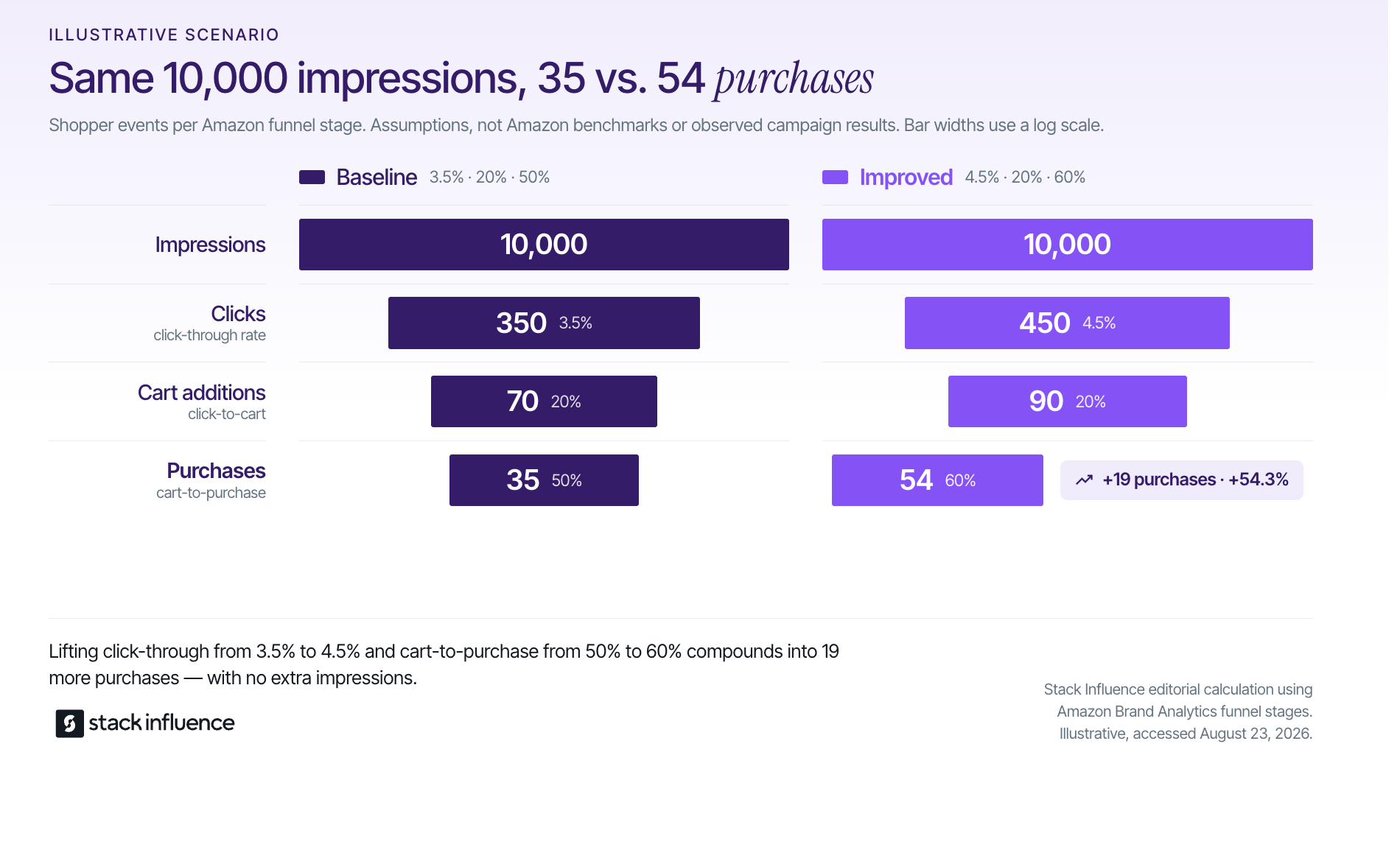
The Search Funnel Diagnostic replaces vague ranking complaints with a stage-by-stage investigation. It uses the same broad shopping sequence shown in Amazon Brand Analytics: impressions, clicks, cart additions, and purchases.
Amazon’s Brand Analytics guide explains that Search Catalog Performance reports impressions, clicks, click rates, median prices, cart additions, purchases, and conversion rates. Search Query Performance adds query-level data and a brand’s share of impressions, clicks, cart additions, and purchases relative to overall query activity.
Use the funnel to identify the likely constraint:
Metrics should be separated by their role:
Consider a clearly illustrative funnel, not an Amazon benchmark. At 10,000 impressions, a 3.5% click-through rate produces 350 clicks; a 20% click-to-cart rate produces 70 cart additions; and a 50% cart-to-purchase rate produces 35 purchases. If click-through rate improves to 4.5%, click-to-cart remains 20%, and cart-to-purchase improves to 60%, the same 10,000 impressions produce 450 clicks, 90 cart additions, and 54 purchases, a 54.3% increase.
The scenario demonstrates why several modest improvements can compound. It does not predict what any ASIN should achieve.
Use three reporting clocks as an operating recommendation, not an Amazon rule:
Do not change the title, main image, price, advertising, coupon, and creator traffic simultaneously, then attribute the result to one action. Keep a change log so every major event has an owner, date, hypothesis, and expected funnel effect.
The most expensive Amazon algorithm myths turn uncertain theories into confident operating rules.
Sellers can improve Amazon visibility by diagnosing one ASIN across catalog eligibility, query relevance, shopper choice, and customer outcome, then testing the smallest change capable of fixing the identified constraint. The goal is not to make every metric rise simultaneously. It is to locate the first weak stage and improve it without damaging margin or customer fit.
Use this implementation sequence:
The Amazon algorithm remains partly opaque, but seller decision-making does not have to be. Build a repeatable evidence loop around what Amazon shows, what shoppers do, and what each change costs.
The Amazon algorithm is not a single lever that rewards one keyword, traffic source, fulfillment method, or advertising tactic. Sustainable visibility comes from aligning a complete catalog, meaningful query relevance, a competitive shopper experience, and reliable customer outcomes.
Choose one ASIN, find the first broken stage in its search funnel, and run one measurable improvement. For sellers adding off-Amazon demand, a managed product-seeding campaign can provide a structured way to activate creators, generate reusable content, and connect campaign activity with marketplace reporting.
Black Friday falls on November 27, 2026, followed by Cyber Monday on November 30. For ecommerce sellers and content creators, that makes the real campaign deadline much earlier than the sale itself. Products must arrive, content must be approved, links must work, and audiences must recognize the offer before purchase intent peaks.
A strong black friday influencer marketing 2026 campaign is therefore not a single sponsored post. It is a coordinated system that connects creator selection, product seeding, offer design, content rights, tracking, inventory, and multiple publishing waves. This guide provides a practical 90-day plan for building that system without turning every creator into the same discount script.
Cyber Week demand is spread across several distinct shopping moments. In 2025, Adobe measured U.S. online spending of $6.4 billion on Thanksgiving, $11.8 billion on Black Friday, and $14.25 billion on Cyber Monday. Total Cyber Week spending reached $44.2 billion. Those figures support separate creator waves for discovery, offer launch, weekend reminders, and the final Cyber Monday push rather than concentrating every post on Friday.
Shopping behavior also differs by day and device. The National Retail Federation’s 2025 holiday-weekend survey counted 85.7 million online shoppers on Black Friday and 75.9 million on Cyber Monday, including 46.9 million who shopped on mobile that Monday. Creator landing pages, Amazon listings, discount-code instructions, and checkout flows must therefore work cleanly on a phone.
The opportunity extends beyond one storefront. Shopify reported approximately $14.6 billion in global merchant sales during its 2025 Black Friday Cyber Monday weekend, while TikTok Shop reported more than $500 million in four-day U.S. sales and nearly 10 million creator-affiliate shoppable videos during its campaign. Sellers should design a channel-specific path from content to checkout instead of copying one link and caption everywhere.
Black Friday influencer marketing is a coordinated creator campaign that helps shoppers discover, evaluate, and purchase promoted products around Black Friday and Cyber Monday. It may combine product seeding, sponsored content, affiliate links, live shopping, UGC licensing, brand ambassadors, and paid amplification. The strongest programs connect each creator deliverable to a defined buyer decision.
The distinction between product seeding and an unconditional gift matters. If a creator must publish specific content, meet a deadline, or grant usage rights, those requirements should be stated as a structured product-for-content agreement. The Stack Influence guide to hiring influencers explains how product seeding, paid sponsorships, affiliate partnerships, UGC-only work, and ambassador arrangements solve different campaign jobs.

The Six-Window Black Friday Creator System starts 90 days before Black Friday and continues through a two-week post-event period. Each window has a separate operational goal, which prevents late shipping, rushed approvals, inactive codes, and duplicate content from colliding during Cyber Week.
Choose the products, discount structure, bundles, inventory limits, target customer, and allowable creator cost before recruiting. A large headline discount is not automatically a strong offer if the product is unfamiliar, the margin disappears after fulfillment, or the promoted SKU is likely to sell out before creator content peaks.
Creators should evaluate the same economics from their side. Before accepting, confirm whether compensation is product-only, flat-fee, affiliate, or blended; whether commission applies before or after discounts; and whether returns, cancellations, or attribution windows affect earnings.
Build a larger qualified pool than the final number of activations because availability, rates, conflicts, and shipping eligibility will remove candidates. The goal is not to collect names. It is to secure creators who can communicate the product credibly, meet the publishing window, and support the required commerce path.
A 2026 Modash survey of 53 influencer marketers found that planning began in late July on average, plans were finalized by mid-August, and almost all creators were hired by the end of September. It also found that 92.6% had been unable to work with a creator they wanted, with 71.1% of that group citing budget. These are survey findings, not universal benchmarks, but they show why October should be an execution month rather than the first outreach month.
Use past partners where evidence supports the relationship. In the same survey, 81% said fewer than half of their Black Friday collaborations were new relationships. Familiar creators already understand the product and workflow, while new creators can be tested through smaller seeding, affiliate, or UGC assignments before receiving a critical Cyber Week slot.
Ship products early enough for genuine use, troubleshooting, and reshoots. A beauty product, food item, household tool, or technical accessory may require different testing time, so the production calendar should begin with the experience needed to make an honest recommendation.
Provide a brief with the buyer problem, proof points, prohibited claims, required disclosure, offer details, landing destination, deliverable, due date, approval process, and usage rights. Keep the creative direction specific enough to prevent errors but open enough for the creator’s normal voice and format.
Brands can use a managed product-seeding workflow when individual outreach, shipping coordination, creator follow-up, and completion tracking become the bottleneck. Stack Influence works with roughly 600,000 vetted creators through a gifted-first model and supports creator activation, product seeding, campaign coordination, UGC generation, and completed-post accountability in one ecommerce workflow.
Complete factual review, disclosure checks, link QA, code testing, captions, subtitles, and alternate assets before the main sales window. Approval should protect accuracy and compliance, not rewrite every creator into the brand’s voice.
Begin publishing non-discount discovery content during this period. Demonstrations, comparisons, routines, gift-recipient ideas, and problem-solution videos give audiences time to understand the product before the price becomes the main message. The broad holiday influencer campaign guide offers additional gift-guide and seasonal content formats that can support this warming stage.
Assign each creator to a defined wave instead of asking everyone to publish the same message. A practical sequence is:
TikTok creators can add live demonstrations or shoppable content where the product and account are eligible. Instagram creators can combine Reels, Stories, link stickers, codes, and commerce-oriented captions. The TikTok influencer qualification guide and Instagram influencer qualification guide explain how to assess product communication, audience evidence, commercial readiness, and reliability on each channel.
The campaign is not finished when the discount ends. Collect source files, post URLs, performance screenshots, usage permissions, audience questions, top comments, code data, and creator feedback while the information is still easy to retrieve.
Reuse only the content and placements covered by the agreement. The UGC licensing and usage-rights guide explains why organic reposting, paid advertising, editing, duration, territory, and creator-identity permissions should be treated as separate rights.
The most useful Black Friday creator is the one who can move a relevant audience from product problem to purchase decision without creating operational risk. Nano influencers and micro influencers can be particularly practical when the product serves a concentrated interest, needs explanation, benefits from multiple creative variations, or can be seeded economically.
Score creators across five dimensions:
Do not rank every candidate with one blended score. A creator who makes excellent UGC may not have the strongest distribution, while a commerce creator may convert well but offer less visual variety. Assign a role first, then compare creators against the evidence required for that role.
For Amazon sellers, distinguish general social creators from Amazon influencers with storefront or affiliate capabilities. For DTC brands, look for creators who can send shoppers to a focused Shopify landing page rather than a crowded home page. The Shopify influencer marketing playbook provides a broader workflow for codes, creator content, and store-level conversion.
Different Black Friday formats answer different shopper questions. A campaign becomes repetitive when every creator receives the same “sale is live” instruction, so select formats according to the stage of the buyer journey.
The campaign should pass a Black Friday Readiness Gate before any creator receives a final go-live date. Five approvals are required:
Material relationships must be disclosed clearly. The Federal Trade Commission’s influencer guidance says creators who recommend brands need a good disclosure of that relationship. A free product, payment, commission, or other material connection should not be hidden behind vague language or placed where shoppers are unlikely to notice it.
Paid reuse requires an additional permission check. Meta’s official documentation explains that partnership ads can run with creators, brands, or other partners when the relevant permissions are in place. Decide before production whether content may be amplified, because paid usage can affect creative requirements, compensation, and the creator’s approval decision.
Brands should measure Black Friday influencer ROI by connecting creator delivery, audience response, shopping intent, net sales, contribution margin, and reusable content. Last-click revenue alone misses creative value and assisted demand, while views alone miss commercial performance. The measurement window and attribution method must be defined before links, codes, or posts go live.
Use the Signal-to-Sale Stack:
Amazon sellers can use Amazon Attribution to measure non-Amazon channels including social, video, email, affiliate, and influencer campaigns. Amazon says the free solution reports clicks, product-detail views, add-to-cart activity, purchases, units, product sales, and new-to-brand metrics within a 14-day attribution window. The Stack Influence Amazon marketing guide provides related implementation context.
Shopify sellers should combine creator-specific UTMs, discount codes, affiliate reporting, landing-page analytics, and order data. TikTok Shop campaigns should reconcile creator and shop reporting with net orders and returns. No method captures every assisted exposure, so treat same-period sales growth as an observed outcome, not automatic proof that one creator caused it.
Margin must sit beside revenue. Consider an illustrative $100 list-price order: a $20 Black Friday discount leaves $80 in net revenue. Subtract $24 in product cost, $10 in fulfillment and payment costs, and $8 in allocated creator compensation or commission, and the contribution margin is $38 before overhead, taxes, and returns. A campaign can show attractive revenue or ROAS while producing weak economics if discounting, returns, or creator costs rise.
Marketplace movement may require a longer window than the promotion itself. During a verified three-month Stack Influence campaign for Targus, the campaign included 120 creator promotions, 275,560 social impressions, and 4,323 engagements. Average monthly unit sales were 56 at the start and 221 during the campaign, while Amazon Best Seller Rank moved from #151,547 to #47,811. The example does not predict Black Friday results, but it shows why campaign reporting can connect creator output, attention, sales, and marketplace indicators rather than reducing performance to one metric.
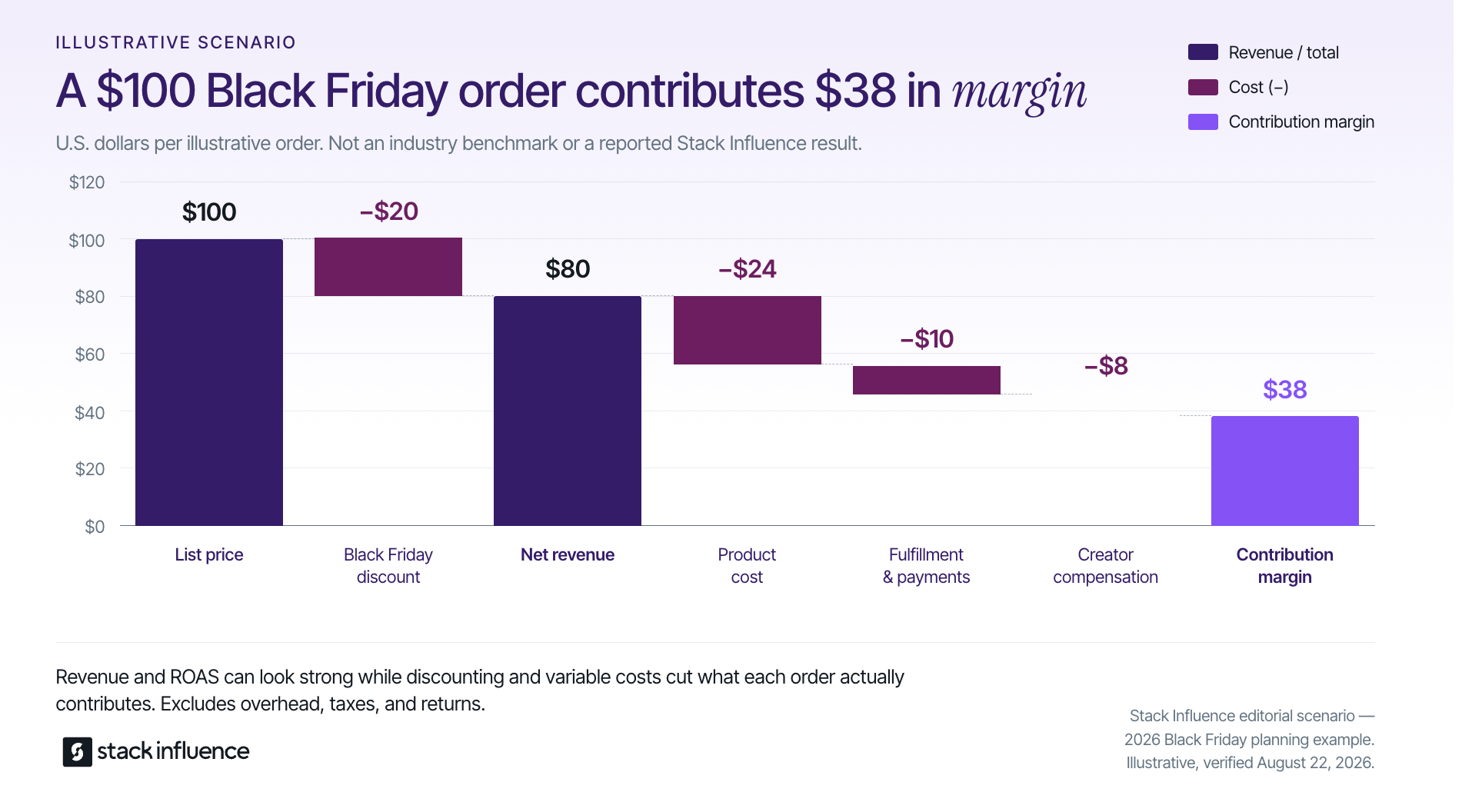
Black Friday influencer campaigns often fail between otherwise competent teams. The creator publishes on time, but the discount starts later. The link reaches the wrong SKU. Inventory disappears after the first wave.
The brand may expect paid usage that was never licensed, while the creator may expect a commission that the tracking setup cannot verify. These are coordination failures, not audience failures.
Prevent these failures with a preflight test 72 hours before each wave:
With four to six weeks remaining:
With fewer than two weeks remaining, product seeding may not leave enough time for genuine use and reliable shipping. Focus on creators who already own the product, existing affiliates, approved UGC, or content that can be produced without pretending to have experience the creator does not have.
Black Friday influencer marketing 2026 will reward teams that create proof before pressure. The discount can accelerate a decision, but the creator still needs to show why the product matters, who it serves, and what makes the offer worth acting on.
For sellers, the next step is to map one hero product through the Six-Window Black Friday Creator System, then confirm creator capacity, inventory, tracking, rights, and contribution margin. For creators, the next step is to evaluate the complete partnership package rather than accepting a deadline and discount code without the operational details.
A managed micro-influencer and product-seeding workflow can help ecommerce teams coordinate creator activation, product logistics, UGC, and completed posts as one campaign. The benefit is not more holiday noise. It is a campaign that reaches Cyber Week with the proof, creative, tracking, and accountability already in place.
Cyber Monday 2026 falls on Monday, November 30. For ecommerce sellers and content creators, the opportunity is not a single discount post. It is a compressed creator-commerce campaign in which product availability, content proof, mobile checkout, links, rights, and timing must work together.
A creator can publish persuasive UGC and still produce weak business results if the offer is unclear or the destination breaks. A seller can offer a strong discount and still miss demand if creators receive products too late. This guide to Cyber Monday influencer marketing 2026 provides a dated execution framework, channel-specific setup for Amazon and Shopify, a creator-ready content brief, and a measurement system that separates attention from profitable commerce.
Cyber Monday influencer marketing is the coordinated use of creators, UGC, product seeding, affiliate links, discount codes, and paid amplification to influence discovery and purchase around Cyber Monday. In 2026, the strategy should cover the weeks before and after November 30, not only the Monday itself, because shopping activity and creator exposure begin earlier.
Cyber Monday falls on Monday, November 30, in 2026. That fixed date gives sellers a clear deadline for inventory, offers, links, content approvals, and creator posting windows. It also gives creators time to avoid conflicting category partnerships and reserve production capacity before Q4 schedules become crowded.
The latest completed event shows why the execution details matter. Adobe reported $14.25 billion in U.S. online spending on Cyber Monday 2025, with mobile devices generating 57.5% of that revenue. Adobe measures transactions across U.S. retail sites, so its figures describe online spending rather than all retail activity.
The National Retail Federation reported 75.9 million Cyber Monday online shoppers, including 46.9 million who shopped online through a mobile device. That means about 61.8% of surveyed online shoppers used mobile, although an individual shopper could also have used another device. NRF survey counts and Adobe transaction data use different methodologies, but both point to the same practical requirement: every creator path must work cleanly on a phone.
Cyber Monday is one part of a larger seasonal system. Brands planning gift guides, Christmas content, or broader promotional themes can coordinate this article with Stack Influence’s guide to holiday influencer marketing campaign ideas, while keeping the Cyber Monday workflow focused on one conversion deadline.
The Cyber Monday Conversion Clock assigns a distinct job to six periods before and after November 30. It prevents a common scheduling mistake: asking creator recruitment, shipping, production, approval, and conversion to happen during the same week.
Choose a hero SKU or tight bundle, calculate contribution margin after the planned discount, confirm inventory, and select the destination. Creators should also reserve production capacity and avoid category conflicts before Q4 schedules become crowded.
Before outreach, answer five questions:
Creator selection should combine audience relevance with operational reliability. Sellers can use a structured influencer hiring system, then adapt platform-specific research for finding TikTok influencers and finding Instagram influencers.
Activate creators in waves so the first group can reveal shipping, brief, claim, or tracking problems before the campaign scales. Agreements should cover deliverables, dates, compensation or reimbursement, revisions, disclosures, exclusivity, links, affiliate terms, content rights, and paid amplification. An automated product-seeding workflow can reduce follow-up when many nano influencers or micro influencers participate.
Stack Influence works with roughly 600,000 vetted creators, making a managed cohort workflow practical when a seller needs to activate creators without handling every outreach and follow-up task separately.
The first creative objective is product proof, not a countdown graphic. Ask creators to capture:
Brands should review factual accuracy, prohibited claims, product presentation, disclosures, and rights without editing every creator into the same spokesperson. Authentic creator voice is part of the value.
Use demonstrations, gift-use cases, comparisons, routines, FAQs, and comment replies to make the product recognizable before deal week. Sellers can distribute approved user-generated content across ecommerce touchpoints, including product pages, email, organic social, and retargeting when rights permit.
Select amplification candidates using qualified signals such as purchase questions, saves, clicks, and add-to-cart activity, not likes alone. Creators should leave enough space in their feeds for the final offer so the Cyber Monday post does not feel repetitive.
Deal-week content should progress from awareness to proof to truthful urgency:
TikTok reported more than $500 million in U.S. TikTok Shop sales during its four-day 2025 Black Friday and Cyber Monday period, while creator affiliates published nearly 10 million shoppable videos across the broader campaign. These figures describe TikTok Shop, not the entire influencer economy, but they show why shoppable content and operations must be ready before the final day.
Sellers can retarget engaged visitors, promote a genuine extension when one exists, shift to shipping or gift messaging, and retain evergreen creator proof. Creators should submit live links, metrics, invoices, raw files, and authorization details according to the agreement.
Reconcile orders, codes, tags, returns, commissions, files, and rights before closing the campaign. Invite strong performers into an ambassador or affiliate program so Cyber Monday can qualify longer creator partnerships.

A creator cannot communicate an offer the seller has not fully defined. Maintain one source of truth for the product, destination, promotion, deadlines, tracking, claims, disclosures, rights, and contacts.
The minimum offer packet should include:
Creators should test the final link and code on a phone before publishing. They should keep the exact offer in writing because an incorrect price or expiration claim can create audience complaints even when the creative is strong.
Amazon sellers should choose one ASIN, deal page, or Amazon storefront that matches the creator’s promise and displays the relevant variation and promotion clearly on mobile.
Amazon Attribution is a free measurement solution for eligible advertisers that measures non-Amazon marketing across social, video, email, search, and other channels. Amazon reports a 14-day attribution window and metrics including clicks, detail-page views, add-to-cart activity, purchases, units, and product sales. Create separate tags by creator or creative group so one shared link does not erase useful differences.
Eligible U.S. Seller Brand Owners can review the Amazon Brand Referral Bonus, which Amazon describes as an average credit of about 10% on qualifying sales measured through Amazon Attribution. Confirm eligibility and current terms inside the seller account before modeling the credit. Stack Influence’s Amazon influencer marketing workflow connects creator activation with marketplace-focused product seeding and UGC execution.
Shopify Campaigns supports custom UTM parameters for individual influencers. Use a naming convention that separates the event, platform, creator, and creative, then lock final links before scheduling because Shopify warns that later edits or deletions can disrupt reporting or create broken paths.
A Shopify shareable discount link can open a selected product or collection and apply an active code when requirements are met. Test it in a private mobile browser, verify discount combinations, and confirm the store time zone. Stack Influence’s Shopify influencer marketing workflow connects product seeding, creator content, and traffic to a brand-owned storefront.
Cyber Monday creative should reduce uncertainty quickly. Give creators four communication jobs while preserving their own language, pacing, and visual style.
One production session can create a discovery cut, an objection-focused retargeting cut, and a concise deal-day cut. Brands should request those functions rather than prescribing every word.
Disclosure belongs inside the creative. The Federal Trade Commission says creators should clearly and conspicuously disclose material connections, including free products or other value received from a brand. Disclosures should be hard to miss, and product claims should reflect the creator’s actual experience and available support.
Rights determine whether a strong post can be amplified. Meta describes Instagram partnership ads as a way to amplify content with a creator’s handle. Secure permission, authorization method, usage period, edit boundaries, channels, and compensation before publication.
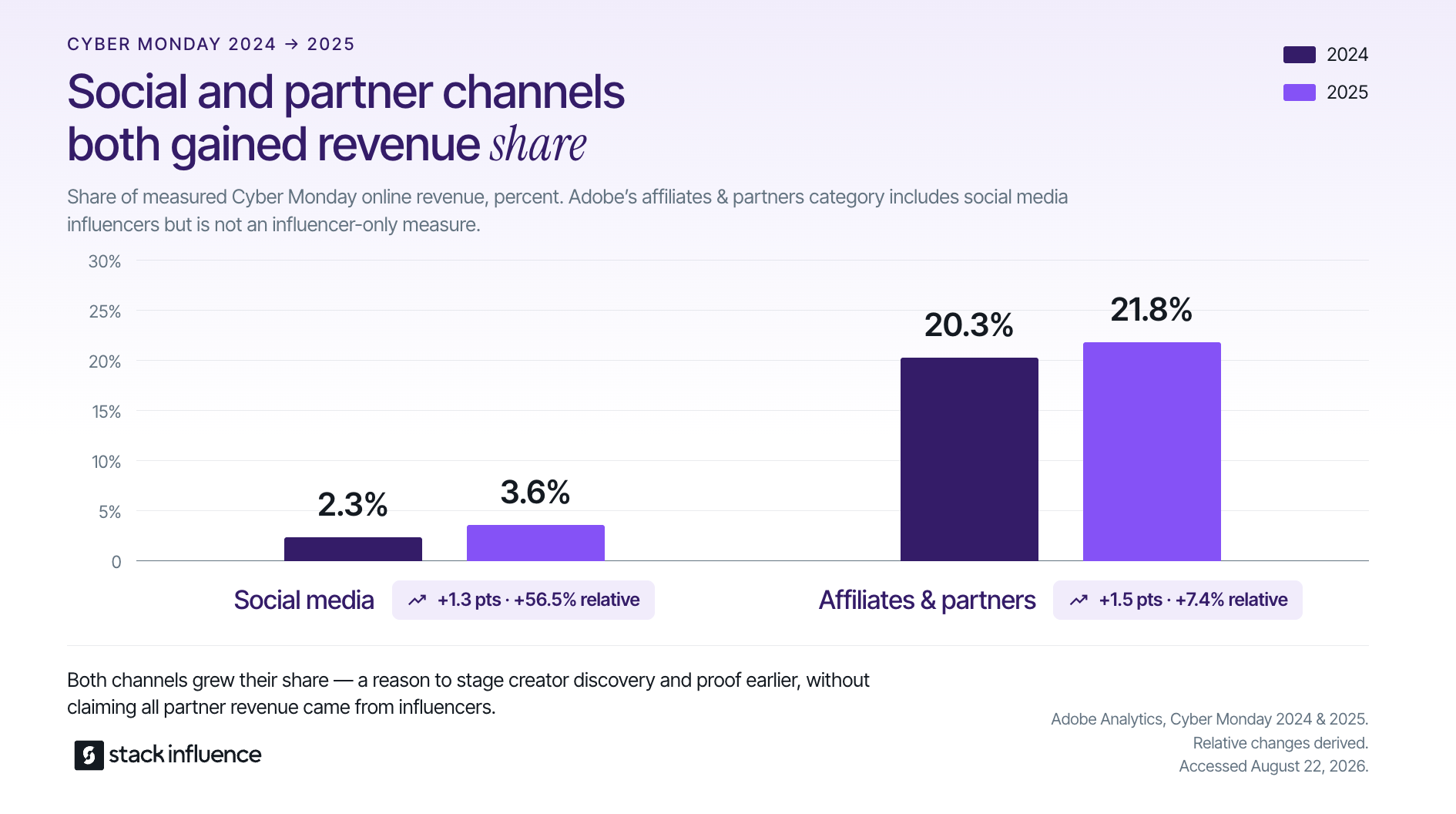
A day-of-only post is usually too late because Cyber Monday shoppers are already comparing products, saving links, and responding to earlier Black Friday offers. Creator content performs a different job at each stage: discovery before deal week, proof during the weekend, and urgency on Monday. Posting only at the end removes the first two jobs.
Adobe measured $44.2 billion in online spending across Cyber Week 2025. Black Friday reached $11.8 billion and grew 9.1% year over year, faster than Cyber Monday’s 7.1% growth, which Adobe linked to earlier deals. Adobe’s Cyber Monday channel analysis supports building familiarity before the final conversion window.
Adobe also reported that social media’s share of Cyber Monday online revenue rose from 2.3% in 2024 to 3.6% in 2025. Its affiliates and partners category increased from 20.3% to 21.8%. Adobe says the latter includes social media influencers but is broader than influencer-only revenue, so 21.8% should not be presented as an influencer sales share.
Use three touches:
Each post then serves one useful purpose instead of repeating the same urgent advertisement.
Measure Cyber Monday creator campaigns across three time windows and five performance layers. The windows separate audience building, deal-period conversion, and residual value. The layers connect creator delivery to attention, traffic, commerce, and reusable content, preventing impressions or one attribution report from becoming the entire verdict.
Use the Three-Window Creator Commerce Scorecard:
Measure five connected layers:
Use consistent formulas. Completion rate equals completed creators divided by activated creators. Contribution profit equals net revenue minus discounts, product cost, fulfillment, returns, creator or affiliate costs, and media. Cost per usable asset equals campaign cost divided by rights-cleared assets that meet the reuse standard.
Attribution remains incomplete because copied links, code leakage, cross-device journeys, branded search, marketplace browsing, and platform windows can separate exposure from the recorded order. Report tracked conversions precisely, then treat broader sales, rank, or search movement as context rather than proof that one post caused the outcome.
Creators should retain live URLs, screenshots, publication times, platform analytics, link results when available, and the agreed invoice or affiliate report. This evidence supports both payment and renewal decisions.
Most Cyber Monday influencer campaign problems are operational and preventable. Correct them before deal week instead of asking creators to compensate with more posts.
Stack Influence is a micro-influencer marketing platform for ecommerce brands built around gifted-first product seeding, vetted creator activation, campaign coordination, UGC generation, and completed-post accountability. The platform moves brands from creator participation to completed content rather than stopping at profile discovery.
Its completion-only structure is sometimes described as influencer insurance because campaign charges are tied to completed posts. For Cyber Monday, that model connects product delivery, follow-up, approvals, live-post tracking, and asset collection through one micro-influencer promotion workflow.
A verified six-month Stack Influence case study for NYK1 recorded 483 creator promotions, 2.15 million social impressions, and 83,471 engagements. During the measured campaign, average monthly unit sales increased from 482 to 2,965, while Amazon Best Seller Rank moved from #9,223 to #743. This is not a Cyber Monday benchmark, and the case study does not isolate creator activity as the sole cause.
The operational lesson is that volume matters when product receipt, deadlines, links, rights, and completion are coordinated. For Cyber Monday 2026, proof assets should be ready by November 8 and creators scheduled before deal week, not recruited on November 30.
Cyber Monday influencer marketing 2026 should connect one defensible offer with a sequenced creator story, a mobile-ready purchase path, creator-specific measurement, and clear content rights. The Conversion Clock gives each task a deadline, while the Three-Window Creator Commerce Scorecard shows whether execution created attention, profitable orders, reusable assets, or all three.
Start by mapping one hero product through the six phases and testing the complete customer path on a phone. When creator sourcing, product seeding, coordination, and completion would otherwise become the bottleneck, evaluate a managed micro-influencer workflow that can turn the campaign plan into finished creator content before the retail deadline.
A creator can look perfect in a feed and still be the wrong commercial hire. Ecommerce sellers often discover that after the product ships: the audience was mismatched, the brief was vague, the rights were missing, or the campaign could not be measured. Content creators experience the same failure from the other side when a brand requests “one quick post” without defining the work.
Learning how to hire influencers means treating the collaboration like a small, creative procurement decision, not a popularity contest. This guide shows brands and creators how to define the role, find candidates, verify fit, structure compensation, negotiate rights, document the agreement, manage delivery, and measure contribution across Amazon, Shopify, and DTC campaigns.
To hire an influencer is to contract a creator for two possible assets: access to an audience and production of content. The agreement may use product seeding, a cash fee, affiliate commission, or a hybrid. Hiring is complete only when scope, compensation, rights, disclosure, delivery, and measurement are documented.
Separate these roles before building a shortlist:

The Five-Part Influencer Hiring Packet moves a collaboration from vague interest to an executable deal. Build it before discovery, update it as evidence arrives, and use the same fields to compare candidates or evaluate an incoming brand deal.
The Role Card states what the creator is being hired to do. Define one primary outcome, target customer, platform, content job, call to action, destination, and proof standard.
A useful Role Card might say: “Demonstrate one customer problem in a short-form video, publish it to the agreed channel, and direct viewers to a trackable product page.” That is easier to source and price than “create buzz.” Use a broader influencer marketing strategy when several channels or creator roles must work together.
The Candidate Proof File contains the evidence required before an offer. Review roughly 20 recent posts, including several commercial posts when available, rather than selecting from one viral example.
Capture audience demographics and location, examples in the required format, meaningful native metrics, sponsored-content frequency, competitor conflicts, deadline history, and disclosure behavior. Request creator-provided analytics screenshots when audience composition materially affects the decision.
For creators, a media kit and portfolio should show who the content serves, which formats you execute well, what commercial actions you can track, and how reliably you deliver.
The Offer Sheet states the product, cash fee, commission, deliverables, timeline, revision allowance, approval process, expenses, and payment trigger. It should also separate the posting fee from content production, raw files, paid-media permission, and exclusivity.
The quoted creator fee is not always the full hiring cost. Consider a clearly illustrative deal with a $500 creator fee, $50 in landed product cost, $15 shipping, a separate $300 license for 90 days of paid usage, and four hours of internal coordination valued at $50 per hour, or $200. The total is $1,065, so the creator fee represents 46.9% of the modeled commitment and the total is 2.13 times the quoted fee. These assumptions are not an industry benchmark, but they show why both sides should price the complete scope.
The Rights Schedule defines what happens to the content after delivery. State whether the brand may repost organically, edit the asset, request raw files, use the creator’s name or likeness, run paid ads, authorize partnership ads, place the content on product pages, or license it to retailers.
Every right needs a duration, territory, channel, and permitted use. “Full rights” is too vague to protect either side. Stack Influence’s guide to UGC licensing rights explains the difference between receiving a post and receiving permission to reuse that post commercially.
The Completion Record defines what counts as finished, such as a live URL, disclosure, approved caption, downloadable file, analytics snapshot, invoice, or affiliate destination.
Define the payment event and cure process before launch. State any required live period, review window, and included revision limit instead of negotiating them after delivery.
Ecommerce brands should source influencers from customers, native social search, platform marketplaces, referrals, creator databases, affiliate programs, and managed campaign platforms. The right source depends on the bottleneck. Manual discovery offers control, databases accelerate research, and managed workflows support activation, product seeding, follow-up, completion tracking, and UGC collection.
Start with people who already know the product. Search customer tags, mentions, affiliate applicants, community discussions, and creator posts about the category. Familiarity can reduce education time, but it does not replace vetting.
Native platform tools can add first-party context. Instagram’s creator marketplace lets eligible brands search creator and audience attributes, review portfolios, send project details, and discuss rates through Meta Business Suite. Meta’s creator marketplace overview describes the current workflow.
Shopify sellers can use customer data, direct outreach, affiliate applications, and Shopify Collabs. Shopify’s current documentation says merchants can send direct invites, accept creator applications, issue gifts or discount codes, track affiliate sales, and send payments. It also says new creator signups are currently paused, so creators without an existing Collabs account should not rely on it as their only route to brand partnerships. Shopify Collabs documentation provides the latest status.
For larger searches, compare creator databases by data freshness, audience analysis, supported platforms, export limits, contact coverage, and brand-safety workflow. Stack Influence’s guide to Instagram influencer database platforms explains how self-service research differs from managed activation.
Vet influencers by testing five kinds of evidence: audience relevance, content capability, engagement quality, commercial readiness, and operational reliability. Do not ask whether a creator is “good” in the abstract. Ask whether the available evidence supports the exact Role Card, channel, product, rights package, and deadline in this campaign.
Use two passes. First remove clear mismatches involving audience, category, disclosure, conflicts, or format. Then compare qualified candidates on the proof that matters for the campaign.
Check these areas:
Follower count estimates potential distribution, but it is not a hiring verdict. Nano influencers and micro influencers can be strong hires when niche relevance, product demonstrations, credible UGC, or creative variety matter.
Compensation should follow the work, risk, distribution, and rights being purchased. Compare the complete package, not the headline fee.
Use the model that matches the Role Card:
A practical influencer seeding guide helps distinguish a gift from a required product-for-content exchange. For paid and blended deals, compare the full range of influencer compensation models before negotiating.

A strong influencer offer makes the commercial decision easy to understand without removing creative judgment. State why the creator fits, what the product is, what must be delivered, where it will appear, when it is due, what compensation is included, which rights are requested, how approval works, and when payment occurs.
Creator input is not a courtesy added after the deal. Sprout Social’s current guide, citing its 2024 Influencer Marketing Report, says 65% of influencers want early involvement in creative or product-development conversations, 61% want to work with brands whose values align with theirs, and 59% want companies to provide clear budgets and payment structures. Sprout Social’s hiring guidance supports a collaborative, transparent offer rather than a rigid last-minute brief.
A complete first offer should include:
Creators should quote the requested package, not only “a post.” Confirm production, publishing, raw files, cutdowns, paid amplification, exclusivity, rush timing, travel, and revisions. Stack Influence’s influencer outreach guide provides a fuller communication workflow.
An influencer contract should cover the parties, deliverables, deadlines, compensation, expenses, content approval, usage rights, exclusivity, disclosure, measurement, cancellation, and remedies. Even a small campaign needs written terms when a post, payment, product reimbursement, license, or specific content output is required. Higher-value or regulated campaigns may require qualified legal review.
At minimum, document:
Disclosure is a shared operating requirement, not a caption afterthought. The FTC says a financial, employment, personal, family, free-product, discounted-product, or other material relationship should be disclosed when the creator endorses the product. FTC disclosure guidance also makes clear that receiving something of value can trigger disclosure even without cash payment.
Platform rules must be checked separately. TikTok’s guidance, last updated in April 2026, says creators posting content that promotes a brand, product, or service must turn on the commercial content disclosure setting. TikTok’s commercial content documentation explains the setting and consequences of missing disclosure.
A reusable influencer contract template can standardize the recurring clauses, while a campaign schedule handles the product, dates, deliverables, and negotiated rights.
Hiring does not end at signature. Operations determine whether the creator becomes a completed post, useful UGC asset, attributable test, and repeatable relationship.
Use a simple completion sequence:
Stack Influence is designed for ecommerce brands that want this execution layer connected in one workflow. The platform works with roughly 600,000 vetted creators and uses a gifted-first product-seeding model that supports sourcing, vetting, creator coordination, UGC generation, and completed-post accountability. Its automated product-seeding workflow is particularly practical when manual shipment tracking and follow-up become the campaign bottleneck.
The Creator Contribution Chain separates hiring quality from content delivery, audience response, commerce, and long-term asset value. This prevents one viral view count or one short sales window from becoming the entire verdict. Each layer answers a different question, and the evidence becomes stronger as it moves closer to a business outcome.
Track five layers:
Configure measurement before outreach. Google Analytics campaign parameters can identify the source, medium, campaign, and creative associated with referral traffic. Amazon sellers can use Amazon Attribution to measure the on-Amazon impact of eligible non-Amazon channels, including social and affiliate or influencer campaigns.
Eligible U.S. Seller Brand Owners enrolled in the program can also review whether the Amazon Brand Referral Bonus changes the economics of qualifying attributed sales. Amazon says the credit averages 10% of qualifying sales, but eligibility and current program terms should be confirmed before budgeting. Stack Influence’s Amazon influencer marketing solutions and guide to influencer marketing KPIs provide additional marketplace and reporting context.
Attribution has blind spots. View-through influence, copied links, cross-device journeys, branded search, and delayed purchases can escape a creator tag. Separate direct attribution from assisted evidence, use a window appropriate to the purchase cycle, and avoid causal claims the campaign design cannot support.
Creators evaluate the brand’s product, audience fit, communication, content quality, payment reliability, and reputation before accepting. Hiring is a two-sided risk decision because a public partnership can affect audience trust and future brand relationships.
Sprout Social reports that 93% of influencers say the quality of a brand’s existing social content affects whether they agree to collaborate. Sprout Social’s relationship research supports a practical conclusion: improve the brand’s own profile, product explanation, landing page, customer experience, and response process before blaming weak acceptance on the creator list.
Brands should make themselves easier to hire:
Creators should perform the same diligence. Confirm the legal entity, product category, expected claims, approval process, rights, payment terms, and contact person before committing audience trust or production time.
The practical answer to how to hire influencers is to define the job, collect proof, price the whole scope, document the deal, manage completion, and measure contribution in layers. The creator with the largest audience is not automatically the strongest hire, and the cheapest quote is not automatically the lowest-cost campaign.
Start with one clearly defined product and one Role Card. Build the Five-Part Influencer Hiring Packet, compare creators against the same evidence, and retain the partners who combine credible content with dependable execution. Ecommerce teams that need to scale can then move from manual coordination to a managed product-seeding workflow without losing the discipline that made the first tests useful.
Finding names on TikTok takes minutes. Finding creators who understand your buyer, can produce convincing product content, and will follow through is the real work. For ecommerce sellers and content creators, learning how to find TikTok influencers should lead to a qualified shortlist, not a spreadsheet full of popular accounts.
This guide shows you how to search TikTok, use TikTok One and TikTok Shop Affiliate, evaluate micro influencers and nano influencers, structure outreach, and connect creator partnerships to sales and reusable UGC. The goal is a discovery system that works for one pilot and can still work when the campaign expands.
An influencer search works only when the campaign job is defined. In this guide, a TikTok influencer is a creator whose content, audience, or commerce activity can affect product discovery, consideration, or purchase. That can include nano influencers, micro influencers, UGC creators, TikTok Shop affiliates, and larger personalities. This broader definition of TikTok influencer marketing keeps the search tied to the outcome rather than a fixed follower tier.
Choose one primary job before building a shortlist:
Turn that job into a one-page creator brief. Include the product, target customer, problem being solved, required format, compensation model, geography, deadline, disclosure expectations, content rights, and measurement method. A skincare seller seeking shoppable demonstrations should search differently from a software brand seeking educational reach.
For content creators, the same exercise improves positioning. “Lifestyle creator” gives a brand little to search for. “Budget meal-prep creator for busy parents” connects a topic, audience, and commercial use case.
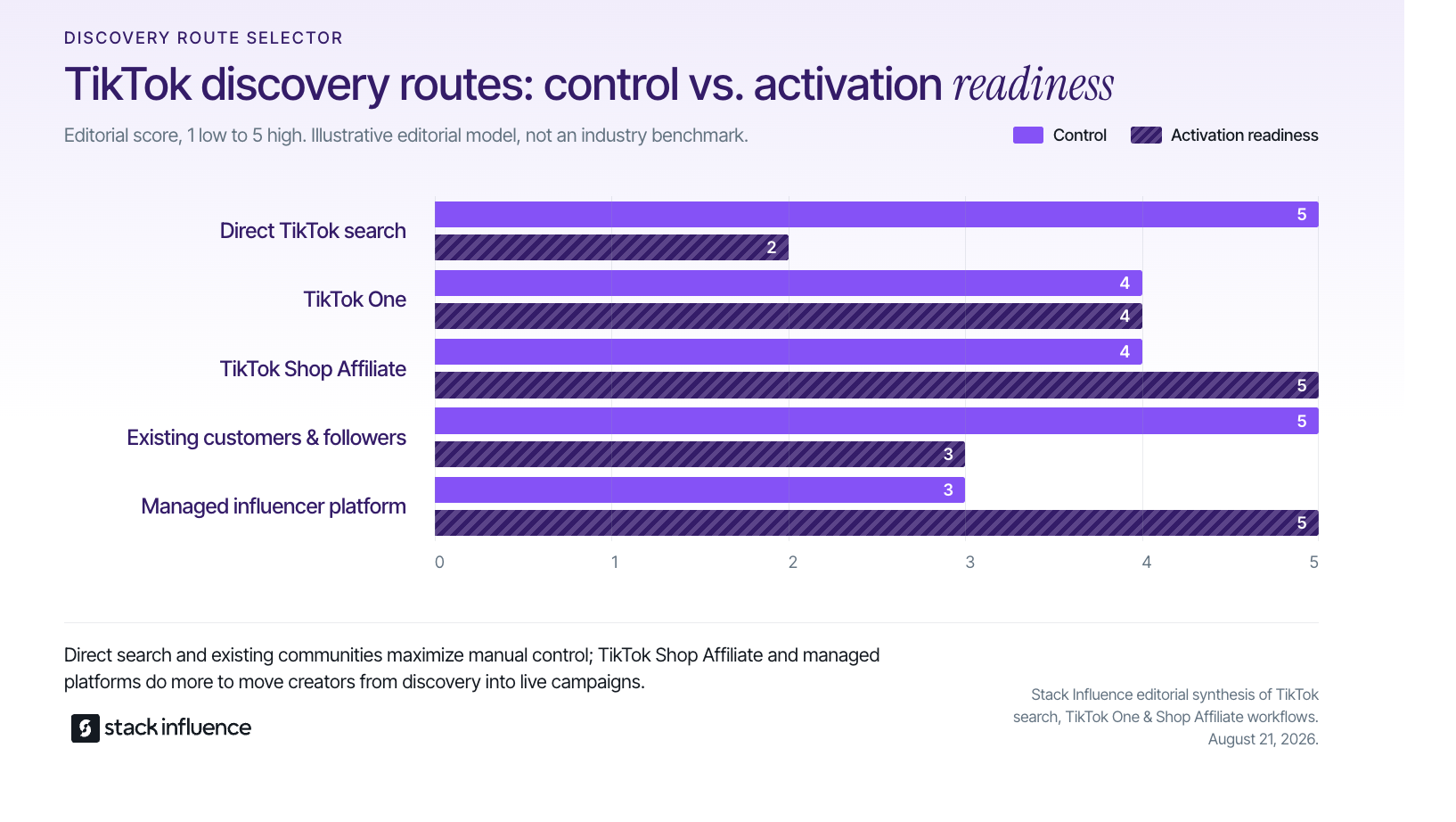
You can find TikTok influencers through direct TikTok search, TikTok One, TikTok Shop Affiliate Center, your existing customer community, and managed influencer marketing platforms. The right route depends on whether you need maximum manual control, commerce-ready creators, faster activation, or end-to-end campaign execution. Most scalable programs combine at least two routes.
Use this editorial 1-to-5 decision model as a planning tool, not an industry benchmark. A higher control score means your team chooses creators more directly. A higher activation-readiness score means the route includes more support for invitations, product collaboration, communication, or completion.
TikTok’s Discover and Search tools can surface creators, videos, hashtags, sounds, and sponsored content. Search for the content your buyer would watch, not only the label an influencer might use. A TikTok user finder workflow can help when you have a partial username, memorable phrase, product clue, or existing video.
Build queries from four layers:
Open promising videos, then inspect the creator’s profile, recurring topics, comment section, tagged brands, linked storefronts, and recent posting pattern. Comments often reveal adjacent creators because niche communities interact with one another. Search competitor product names too, but distinguish genuine category expertise from accounts that post any product offered to them.
TikTok One gives advertisers a structured creator-search workflow. TikTok’s current documentation says brands can search by username or keyword, use AI search when available to selected customers, filter by creator and audience details, and evaluate median video views, engagement, audience demographics, content portfolios, and performance trends. Shortlists can then feed directly into project invitations. TikTok One’s creator discovery documentation is the most reliable place to verify the available filters for your account and region.
TikTok One is practical when a brand needs more evidence than public profile browsing provides. It also reduces the handoff between discovery and invitation, although the final decision should still include a manual content review.
TikTok Shop sellers can use Affiliate Center to find creators and choose between Open Collaboration and Target Collaboration. Open Collaboration makes selected products visible to a broader creator pool, while Target Collaboration lets a seller invite specific creators to promote specific products. TikTok’s affiliate collaboration guide also supports creator filtering, invitations, product selection, samples, and performance tracking.
Use Open Collaboration to discover unexpected creator-product matches, then move proven creators into targeted offers. Use Target Collaboration when the product needs a precise message, launch date, audience, or content style.
Review customers, email subscribers, tagged videos, brand mentions, affiliate applicants, and followers. A smaller creator who already understands the product may require less education and produce more credible content than a larger account with no connection to the category.
Ask customer support and community teams for names. They often know which customers publish tutorials, answer questions, or recommend the brand without being prompted. Existing affinity is not proof of campaign fit, but it is a strong lead source.
A creator database helps a team research profiles. A managed platform supports the work after discovery, including activation, product seeding, communication, content tracking, and completion. Stack Influence’s TikTok influencer solutions are built around vetted creator participation and managed ecommerce campaign execution.
Stack Influence works with roughly 600,000 vetted creators through a gifted-first product-seeding model. Its completions-only structure is designed so brands pay for completed creator posts rather than treating every shipped product as a completed campaign result.
The 12-Post Creator Review is a fast evidence framework for moving a creator from “interesting” to “qualified.” Review the creator’s 12 most recent non-pinned posts so one viral outlier, one sponsored video, or one inactive period does not control the decision. Twelve is an editorial starting point, not a universal platform benchmark.
Evaluate six signals:
The micro-influencer recruitment and vetting guide expands the audience and reliability checks, while the guide to fake engagement on TikTok covers suspicious follower and interaction patterns.
Do not treat follower count as the final score. Followers can indicate potential distribution, but the 12-post evidence shows whether the creator can repeatedly make relevant content, hold attention, discuss products credibly, and support the campaign’s actual job.

Contact a TikTok influencer with a concise offer that explains why the creator fits, what the product is, what content or outcome is requested, how compensation works, and when the project runs. Include product logistics, disclosure rules, usage rights, approval boundaries, and tracking before the creator accepts so both sides can evaluate the same opportunity.
A practical first message contains six elements:
The influencer outreach guide provides a fuller brand-and-creator workflow. For creators pitching brands, the same structure works in reverse: name the audience, propose a concrete video idea, show relevant proof, state the deliverable, and make the reply easy.
Treat influencer seeding as an operational process rather than “send and hope.” TikTok Shop’s current sample rules say sellers should review free-sample requests within 7 days, ship within 7 days after approval, and expect free-sample creators to post within 14 days of delivery. Those platform-defined windows total 28 days, excluding carrier transit.
Disclosures are part of activation, not a cleanup step. The FTC says a free or discounted product is a material connection that should be disclosed, and TikTok requires creators promoting a brand, product, or service to use its commercial content disclosure setting. Review the FTC’s influencer disclosure guidance and TikTok’s commercial content disclosure requirements before publishing.
Separate posting permission from reuse rights. State whether the brand may repost, edit, use the content in paid ads, request raw files, or use the asset on product pages, and define the permitted duration.
Measure influencer discovery from the first profile reviewed through the business outcome. A large creator list is not success if few creators qualify, accept, complete content, or generate useful audience and commerce signals.
Track the chain in six layers:
Match tracking to the storefront. Shopify Collabs can support creator invitations, gifts, discount codes, affiliate links, sales tracking, and payments. Amazon sellers can use Amazon Attribution to measure how non-Amazon channels, including social and influencer campaigns, affect activity on Amazon. DTC teams can add campaign parameters through Google Analytics URL builders so traffic-acquisition reporting distinguishes creators, campaigns, and content.
Attribution still has blind spots. A shopper may watch a creator, search the brand later, switch devices, buy through another link, or purchase after a code expires. Use channel data, storefront movement, content performance, and contribution economics together. Treat correlated improvement as evidence to investigate, not automatic proof that one post caused every sale.
Most guides about how to find TikTok influencers stop when the shortlist is built. That is where the operational work begins. Every candidate needs an owner, contact path, offer, response status, product status, deadline, disclosure check, rights record, tracking method, and completion result.
This distinction explains why creator databases and managed campaign platforms solve different problems. A database expands research and manual choice. A managed workflow connects creator activation, product seeding, communication, UGC generation, and completed-post accountability.
The corrective insight is simple: optimize for qualified completions, not names collected. A smaller list that reliably produces useful content can create more value than a large database export that never reaches an accepted brief.
Content creators become easier for brands to find by making their niche, audience, recent performance, commercial experience, and contact path obvious. TikTok One says advertisers can filter and evaluate creators using details such as country, industry, language, follower count, audience characteristics, median video views, engagement, and recent content. Creators should make those signals consistent and current.
TikTok’s brand-discovery guidance for creators provides a useful view of what advertisers inspect.
Improve findability with five actions:
The guide on how to find your niche as an influencer can help turn a broad creator identity into a searchable content promise.
Learning how to find TikTok influencers means connecting search, evidence, activation, and measurement. Start with one campaign job, search through at least two routes, apply the 12-Post Creator Review, and pilot with creators whose content and operating habits support the same goal.
For ecommerce sellers, the next step is to decide whether the bottleneck is discovery, vetting, outreach, product seeding, or completion. For content creators, the next step is to make your niche and commercial proof easier to evaluate. Stack Influence can support brands that want vetted creator activation, gifted-first product seeding, UGC generation, and completed-post accountability managed through one workflow.
Finding creators is easy. Finding creators who reach the right shoppers, produce useful content, and complete the work is the real challenge.
For ecommerce sellers, how to find Instagram influencers is a sourcing, qualification, logistics, and measurement problem. For content creators, the system works in reverse: clear niche, audience, deliverables, and reliability make profiles easier for brands to select.
This guide shows both sides how to move from discovery to measured Amazon, Shopify, product-seeding, affiliate, and UGC campaigns.

The Five-Lane Creator Search System builds a diversified candidate pool before any outreach begins. Each lane reveals a different type of creator signal, so ecommerce brands are less likely to overvalue whichever profiles happen to appear first in Instagram Search or a software database.
Before searching, turn the campaign goal into a one-page creator brief. Include:
A clear brief prevents a common failure: searching for “good influencers” without defining what good means for the campaign.
Start with people who already know the product or category. Review customer tags, brand mentions, affiliate applicants, email subscribers, repeat purchasers, community members, and authentic UGC already posted without a formal campaign.
This lane can surface natural product affinity. A smaller creator who understands the customer problem may be more credible than a larger account meeting the product for the first time.
Use Instagram Search as a research tool, not just a hashtag lookup. Combine the product category, customer problem, format, location, profession, and use case, then follow strong results through tagged posts, collaborators, similar accounts, and comments.
Instagram's official search explanation describes results across accounts, audio, hashtags, and places. In practice, the strongest searches are usually specific, such as “small apartment organization,” “new mom meal prep,” or “curly hair wash day,” rather than broad labels like “lifestyle influencer.”
Use the guide to finding micro influencers to expand a promising account into a larger niche map. Record each profile's discovery source for later analysis.
Study adjacent brands, category educators, retailers, publications, events, and complementary products. Review tagged content and past collaborations to identify creators who already know how to explain the category.
Do not simply copy a competitor's roster. Check for exclusivity conflicts, repeated sponsorships, audience fatigue, and whether the creator's relationship with the category still feels credible. The goal is to understand the creator ecosystem, then identify underused voices and adjacent communities.
Creator marketplaces make discovery more structured. Meta says brands using Instagram's Creator Marketplace can search and filter creators, review creator portfolios and expressed interests, and send partnership opportunities through a dedicated messaging workflow. Creators join through the professional dashboard and can present preferred interests and portfolio information. Access and eligibility can vary by account and market.
A brand-owned application form can collect profiles, audience geography, content examples, preferred categories, compensation preferences, and turnaround time. Creators should treat marketplace portfolios and application answers as sales assets by showing specific work and reliable execution.
Managed influencer marketing platforms support the execution layer as well as creator sourcing. This is especially practical when an ecommerce team wants product seeding, outreach, creator communication, deliverable tracking, and UGC generation managed as one campaign.
Stack Influence is built around vetted micro-influencer activation and gifted-first product seeding. The platform works with roughly 600,000 vetted creators, approximately 78% of whom are female, and uses a completions-only model in which platform charges are tied to completed creator posts. This model is sometimes described as “influencer insurance” because campaign budget is protected from creator drop-off at the platform-fee level.
Brands can combine manual discovery with automated product-seeding execution. A creator database may help build a shortlist, while a managed workflow helps move from names to accepted offers, shipped products, completed posts, and reusable content.
For planning purposes, consider an illustrative 100-profile discovery sprint: source 25 candidates from existing customers and brand signals, 25 from native Instagram discovery, 20 from competitor and category networks, 15 from creator marketplaces or applications, and 15 from managed creator networks. This is not an industry benchmark. It is a diversification model designed to prevent one discovery channel from determining the entire shortlist.
The right Instagram influencer is a creator whose audience, content behavior, commercial role, and operating reliability match a specific campaign job. Follower count alone cannot establish that fit. Ecommerce brands may need distribution, UGC production, affiliate sales, Amazon storefront traffic, or long-term advocacy, and each job requires a different creator profile.
A useful first distinction is between creator roles:
Nano influencers and micro influencers are commonly grouped by follower range, but definitions vary. The practical choice is between concentrated community relevance and broader distribution, not a universal cutoff. Stack Influence's explanation of micro influencers and their campaign role provides more context.
Amazon sellers should also distinguish a general Instagram creator from a participant in the Amazon Influencer Program. Qualifying Amazon influencers can receive a customizable Amazon presence and vanity URL, which can support storefront-focused content. That feature does not replace creator qualification, but it changes the possible path from Instagram content to Amazon shopping.
Qualify Instagram influencers by reviewing evidence across six areas: audience, content, engagement, commercial behavior, operational readiness, and brand safety. The goal is not to produce a perfect score from public data. It is to identify enough supporting evidence, unresolved questions, and disqualifying risks to decide whether outreach is worth the time.
Use the following Evidence Before Outreach checklist.
Professional accounts can share data from Instagram Insights, including account and content performance. Brands should request screenshots or exports that match the relevant period and verify that the audience data belongs to the account being evaluated. Creators should keep this evidence current so they can answer qualified brand inquiries quickly.
The InfluencerRank study analyzed 18,397 influencers and 2,952,075 posts using behavior, social relationships, and time dynamics. The practical lesson is to evaluate consistency and change over time rather than treating one follower count or engagement rate as a verdict. The InfluencerRank paper explains the methodology.
For a repeatable operational process, connect this evidence review to a documented micro-influencer recruitment and vetting workflow. Record why each creator advanced, paused, or was rejected so future campaigns can improve the qualification criteria.
A qualified shortlist becomes useful when the offer matches the creator's role, product economics, and required predictability. Outreach should state the offer, deliverable, deadline, usage rights, and measurement plan.
Common collaboration structures include:
The practical influencer outreach guide covers message structure and follow-up, while the influencer seeding guide explains why product, deliverables, creator fit, rights, and measurement should be resolved before shipping.
State the format, posting window, approval process, disclosure, usage period, exclusivity, compensation, and cancellation terms plainly before the creator accepts.
The Federal Trade Commission says a material connection can include payment or free products. Its social media disclosure guidance says disclosures should be hard to miss and placed with the endorsement. Meta also requires the Paid Partnership label for branded content, but a platform tool may not satisfy every disclosure obligation.
Creators should make their niche, audience, partnership options, and proof easy to understand. A professional account, clear bio, consistent content pillars, current contact method, portfolio or media kit, audience analytics, and examples of product storytelling reduce the effort a brand must spend determining whether a collaboration is worth pursuing.
Creators do not need to imitate larger accounts. They need a specific audience promise, repeatable execution, and a concise portfolio covering audience geography, formats, selected results, turnaround expectations, rights options, and preferred categories. The Instagram sponsorship guide explains how to turn that evidence into a professional pitch.

Most guides stop when a spreadsheet has enough names. That is only the end of sourcing. Campaign value depends on creator acceptance, product delivery, communication, completed content, disclosure, rights collection, reporting, and follow-up.
This distinction changes the platform decision. A database supports research and list building, while a managed influencer marketing platform or micro influencer agency can support product delivery, creator follow-up, content review, rights collection, and reporting. The workflows can be complementary.
Stack Influence is designed for this activation layer. Its gifted-first workflow combines vetted creator participation, product-seeding coordination, creator communication, UGC generation, and completed-post accountability for ecommerce campaigns. This is particularly practical for Amazon sellers, Shopify brands, and DTC teams seeking repeatable creator activation rather than a one-time list of profiles.
For content creators, reliability is a discovery advantage. Clear responses, accurate disclosure, on-time delivery, and useful reporting make repeat brand partnerships more likely.
Ecommerce sellers should measure Instagram influencer tests as a sequence of delivery, attention, traffic, conversion, content, and relationship outcomes. These layers appear on different timelines and should not be collapsed into one engagement rate. The measurement plan should begin before outreach so every creator receives the right link, code, baseline, and reporting requirement.
Use a six-layer measurement stack:
For Amazon campaigns, Amazon Attribution measures how non-Amazon marketing channels, including social and influencer activity, contribute to shopping actions. Eligible Brand Referral Bonus activity can also include qualifying additional brand purchases for up to 14 days after an attributed click, according to Amazon's Brand Referral Bonus documentation.
For Shopify campaigns, Shopify Collabs creator analytics can report visits, sales, orders, conversion rates, commission, and gifted value by creator. Sellers should still compare those platform signals with store analytics, margin, refund behavior, and new-customer quality.
Use a staged 90-day observation plan. On day 0, confirm the deliverable and tracking setup. During days 1 to 7, evaluate delivery, reach, engagement quality, and creative usefulness.
During days 1 to 14, review attributable Amazon activity and the applicable referral window. During days 15 to 30, examine Shopify traffic, sales, conversion, and code or affiliate behavior. During days 31 to 90, assess content reuse, repeat exposure, marketplace trends, and ambassador or affiliate potential.
This timeline is a decision framework, not a promise that every outcome will appear within 90 days. Dark social, untracked sharing, view-through influence, multi-device journeys, coupon leakage, organic search, and marketplace algorithms can all weaken attribution. Correlation across the campaign period should not be described as proof that a single post caused every change.
A verified Stack Influence Targus case illustrates layered reporting. During a three-month new-product campaign, 120 creator promotions produced 275,560 impressions and 4,323 engagements, while average monthly unit sales moved from 56 to 221 and Amazon Best Seller Rank moved from #151,547 to #47,811. The figures describe outcomes observed during the same period, not proof that creator content alone caused every change.
Use the ecommerce influencer ROI checklist to connect campaign metrics to economics, and the Shopify influencer marketing playbook to plan store-specific tracking and creator workflows.
Most wasted effort comes from searching too early, collecting too little evidence, or failing to design the campaign after the shortlist is built. Avoid these mistakes:
The most reliable way to find Instagram influencers is to connect five activities: define the creator's job, diversify discovery, qualify evidence, structure a workable offer, and measure the campaign on the correct timeline.
Ecommerce sellers can begin with a focused 100-profile sourcing sprint and a small, instrumented campaign. Content creators can use the same framework to make their audience, creative strengths, partnership options, and reliability easier to evaluate.
When campaign volume grows, a managed product-seeding workflow can reduce the operational gap between finding creators and receiving completed content. The next step is to choose one campaign goal, write the creator brief, and build the first diversified shortlist around evidence rather than follower count.
The best micro influencer marketing platforms do more than place your profile in a database. They determine which brands you can reach, how opportunities arrive, what you are expected to create, whether compensation comes through product, fees, commission, or a hybrid, and how much control you retain over your content.
For content creators, that changes the comparison. A platform with the largest network is not automatically the most useful. The right choice is the one that gives your current niche, audience, content skills, and business goals a realistic path to worthwhile creator partnerships. This guide compares eight active platforms from that creator-first perspective and gives you a practical method for choosing your first two.
A micro influencer marketing platform connects smaller content creators with brands, campaign briefs, product seeding opportunities, paid content work, affiliate programs, or UGC assignments. Some platforms act as searchable marketplaces, while others manage activation and delivery. The creator-facing value depends on access, compensation, workflow clarity, rights, and the likelihood of repeat work.
Micro influencer definitions vary, so follower count should be treated as one input rather than a universal rule. Stack Influence's guide to influencer tiers uses 10,000 to 100,000 followers for the micro tier and 1,000 to 10,000 for the nano tier, but individual platforms may accept creators below, within, or above those ranges.
A creator platform also differs from a brand-only influencer database. A database may let marketers search profiles without giving creators an application path. A true creator-facing platform gives you a way to build a profile, receive or find opportunities, review a brief, complete deliverables, and move through approval or payment.
The Creator Opportunity Ledger is a five-part method for evaluating platforms before you invest hours building profiles and sending applications. It replaces vague questions such as “Is this platform popular?” with information that affects your actual creator business.
Record these five fields for every platform:
Network size belongs in the ledger, but it should not control the decision. Public claims verified in August 2026 include 1.1 million or more creators on Collabstr, roughly 600,000 vetted creators in Stack Influence's supplied company data, 200,000 global creators on LTK, more than 100,000 influencers and UGC creators on Insense, and more than 70,000 opt-in creators on TRIBE. Those totals use different definitions and do not reveal how many suitable opportunities a particular creator will see.
This is the corrective insight most platform roundups miss: creators do not earn from network size. They earn from relevant opportunities that survive the full path from invitation or application to approved deliverable and usable compensation. A smaller, tightly matched platform can create more value than a huge marketplace where your niche is crowded or the deal structure does not fit your work.
The same distinction applies to product seeding. A structured campaign with defined requirements is different from no-obligation public relations gifting, as the practical guide to influencer seeding explains. Before accepting, identify whether the product is a gift, compensation for required content, or the first step in a larger paid relationship.

These eight platforms were selected because they maintain an active creator-facing workflow and support at least one meaningful path to product seeding, sponsored content, UGC, affiliate income, or shoppable commerce. The list is not based on a fabricated composite score. Each review uses the Creator Opportunity Ledger and current official platform information available in August 2026.
Stack Influence is a micro influencer marketing platform built around gifted-first product seeding and managed campaign execution for ecommerce brands. The platform coordinates creator activation, product ordering or reimbursement, campaign communication, completed posts, and UGC collection rather than operating only as a searchable profile directory. Its supplied company data describes a network of roughly 600,000 vetted creators.
The current Stack Influence creator FAQ says creators can apply with at least 200 Instagram followers and original content. Standard campaigns compensate participants with free product, while some opportunities may include additional monetary compensation. The FAQ also states that creators should contact campaign support if they do not feel comfortable sharing a product after trying it.
Best-Fit Workflow: Stack Influence is especially useful for micro influencers, nano influencers, UGC creators, and bloggers who want structured ecommerce product experiences, clear campaign checkpoints, and completed-post accountability without managing every brand interaction through scattered direct messages. The model is particularly practical for building product demonstration experience and a credible history of completed brand collaborations.

Collabstr's creator marketplace combines an inbound service storefront with open campaign applications. Creators can list platforms, content types, and rates, then let brands order packages directly. They can also browse active campaigns and apply with their own pricing, which gives creators two distinct ways to generate opportunities.
Collabstr says brands fund orders before work begins, with funds held until delivery and approval. Completed orders and reviews become part of the creator's marketplace record, so a strong operating history can improve future conversion. What to know: the storefront model rewards precise packages, clear revision limits, and explicit usage terms, while a broad marketplace can require frequent profile optimization to remain competitive.

Aspire's creator marketplace lets creators connect social accounts, set categories and rates, browse campaigns, filter by channel or compensation type, and manage agreements, product selection, drafts, and final deliverables through its portal. The platform also offers curated matching, which can supplement self-directed applications.
Aspire states that creators can join, apply, and collaborate for free. Its marketplace includes gifted, ambassador, affiliate, content, and paid opportunities, so it can support a creator who wants to move from one-off campaigns toward recurring partnerships. What to know: marketplace volume does not guarantee selection, and creators still need a current portfolio, tailored applications, and rates that reflect the exact scope and rights requested.

Insense for creators spans influencer posting, product seeding, content-only UGC, affiliate work, Meta partnership ads, TikTok Spark Ads, and TikTok Shop campaigns. Its official page says payment is reserved after a creator is hired and released after approved deliverables, while badges and brand ratings help creators build marketplace credibility.
Insense currently publishes minimum profile signals that include at least 1,000 Instagram followers, at least 500 median TikTok views, and at least a 1 percent engagement rate. What to know: the platform's variety creates different rights obligations. A content-only video, an organic post, and an ad-authorized asset should not share one price without accounting for production, license duration, paid media, and any account authorization.
The impact.com influencer marketplace combines creator campaigns with affiliate links, promo codes, gifts, workflow management, analytics, and multiple compensation structures. Creators can filter campaigns by vertical, location, or compensation type and send proposals rather than waiting only for inbound invitations.
The platform supports flat fees, commissions, and performance-based payouts, which makes it useful for creators who want to connect content with tracked commerce. What to know: commission and performance deals transfer more outcome risk to the creator. Confirm the base fee, attribution window, eligible products, returns treatment, discount-code logic, payment schedule, and access to performance data before treating projected commission as earned income.
Creator.co's creator platform supports brand discovery, applications, direct invitations, collaboration management, payment tracking, portfolio building, and campaign performance records. A creator profile functions as a media kit containing content, audience information, previous collaborations, and performance evidence.
The platform also offers education and a creator community, which can be useful for people formalizing their commercial workflow. What to know: Creator.co states that content made through its campaigns grants usage rights to the partnering brand under its terms. Creators should read the campaign-specific agreement, identify the license duration and media, and price the value of those rights rather than evaluating the production fee alone.
TRIBE's creator platform is built around creator-led campaign participation. Creators choose briefs, develop a pitch or submission, set or review compensation, and use a centralized platform for approvals, legal terms, and payment. TRIBE also supports social posts and licensed content.
The model gives creative quality a visible role in selection and can reward creators who are skilled at developing campaign-specific concepts. What to know: a pitch-first workflow can consume meaningful unpaid ideation time when submissions are not selected. Treat early pitches as controlled concepts, reserve full production for the appropriate approval stage, and include content rights, revisions, and out-of-pocket production expenses in the proposed fee.
LTK's creator program centers on shoppable content, personalized creator storefronts, brand collaborations, product links, distribution tools, and performance data. LTK says applicants should have a public profile, an engaged following, and a consistent record of high-quality shoppable content.
The platform is especially relevant for creators whose audiences regularly ask where to buy fashion, beauty, home, wellness, travel, food, or lifestyle products. What to know: LTK is application-based and expects ongoing commerce-oriented publishing. Creators who treat the storefront as an occasional link archive may capture less value than those who can maintain product curation, consistent distribution, and performance review as a recurring workflow.
Use these labels as a shortlist, not as universal rankings:
The most useful comparison is not “Which platform has everything?” It is “Which platform solves my next constraint?” A new nano influencer may need structured product experience. An experienced UGC creator may need clearer licensing opportunities. A commerce-focused creator may need stronger affiliate tracking, while an established niche influencer may need repeat ambassador work.
The Anchor-and-Expansion method prevents platform overload. Choose one anchor platform whose workflow fits your current strengths, then add one expansion platform that introduces a different opportunity source or compensation model. Do not join six marketplaces and mistake profile creation for business development.
A practical pairing may look like this:
A broader guide to creator apps can help separate partnership platforms from editing, analytics, and monetization tools. The brand-deal guide for TikTok and Instagram creators can then help you improve the portfolio and pitch that those platforms expose to brands.
For an illustrative five-hour weekly platform operating budget, allocate 2 hours to campaign search and applications, 1.25 hours to platform-ready samples and portfolio assets, 0.75 hours to profile and rate-card maintenance, 0.5 hours to follow-up and campaign administration, and 0.5 hours to performance review and post-campaign reporting. That equals 40 percent, 25 percent, 15 percent, 10 percent, and 10 percent of the five-hour budget. This is a planning scenario, not an industry benchmark.
Run the pair for 60 days before adding another platform. Record qualified opportunities, accepted deals, total work hours, compensation, rights, payment speed, and repeat invitations. Keep the pair when it produces commercial value or strong portfolio evidence, and replace the weaker platform when it produces activity without progress.
Content rights can be worth as much as production because the same asset may be used in different places, for different durations, and with different commercial reach. A creator should separate the work of making content from the license that lets a brand publish, advertise, edit, or reuse it.
Clarify these rights before accepting:
This is also where UGC platforms and influencer platforms diverge. The content creator's guide to UGC marketing explains that a UGC deal can pay for the asset even when the creator never distributes it to an audience. An influencer deal usually includes audience access, while a hybrid deal can include both posting and brand reuse.
Disclosure is separate from licensing. The Federal Trade Commission's disclosure guidance says free or discounted products can create a material connection and that the disclosure should be clear, hard to miss, and placed with the endorsement. A platform's built-in label may help, but creators remain responsible for making the relationship understandable to viewers.
Creators should measure a platform as a funnel from qualified access to durable commercial value. Track opportunities, acceptance, delivery, economics, rights, and repeat work separately. The best platform is not necessarily the one with the most invitations. It is the one that turns reasonable effort into worthwhile, well-defined, and repeatable partnerships.
Use six measurement layers:
Calculate net effective hourly value as:
(Cash Received + Realistic Product Value + Earned Commission - Direct Expenses) ÷ Total Hours Worked
Use the price you would reasonably have paid for a product, not an inflated retail number that has no value to you. Keep gifted value, cash income, and commission separate in your records so one strong product does not hide weak cash flow.
A creator-focused analytics dashboard should also separate campaign delivery from audience performance and attributed commerce. Views and engagement explain response, while clicks, codes, affiliate sales, and brand reporting provide outcome evidence. Attribution can miss cross-device purchases, delayed searches, retail sales, and conversions outside the tracked window, so report directly measured outcomes without pretending they capture every influenced purchase.
Compare your numbers after a consistent window, such as 60 days or ten qualified applications, rather than after one rejection. Then compare the platform's effective hourly value with the wider factors described in the guide to how much micro influencers make, including niche, format, audience quality, production effort, and deal structure.
Choose two platforms that match your current proof and create different kinds of upside. One should provide a realistic path to opportunities now, while the other should expand your compensation, distribution, or relationship model. Review both for 60 days using the same ledger and replace activity that does not produce qualified progress.
Use these starting points:
Do not apply to every visible campaign. A qualified application should pass four checks: the product fits your audience, the compensation fits the work, the rights fit the fee, and the timeline fits your production capacity. Relevance improves both acceptance odds and the chance that the resulting content feels believable.
The best micro influencer marketing platforms for creators are not interchangeable directories. Each one creates a different exchange among brand access, creative work, audience distribution, product value, cash compensation, performance upside, licensing, and long-term relationships.
Start with the Creator Opportunity Ledger, choose an Anchor-and-Expansion pair, and measure the full deal rather than the visible fee alone. For creators who want structured ecommerce product seeding and completed campaign workflows, evaluating the current Stack Influence creator opportunities is a logical next step. The goal is not to collect more platform accounts. It is to build a smaller system that produces better work, clearer value, and stronger repeat partnerships.