




Buying wholesale sounds simple: purchase more units at a lower price, resell them, and keep the spread. Ecommerce sellers quickly learn that the unit discount is only one part of the decision. Freight, marketplace fees, slow sell-through, returns, compliance gaps, and cash tied up in stock can turn a cheap case pack into expensive inventory.
So, what is a wholesaler? A wholesaler supplies products to other businesses for resale or commercial use. This guide explains how wholesalers work, how they differ from other supply-chain roles, how to evaluate one, and how ecommerce sellers can protect margin while building repeatable supply.
Key Takeaways
- A wholesaler usually sells products to businesses rather than end consumers, often in case packs, pallets, or other commercial quantities.
- Merchant wholesalers own the inventory they resell, while agents and brokers arrange transactions without taking ownership.
- The best supplier is not necessarily the one with the lowest quote. Documentation, authorization, landed cost, replenishment, and exit risk matter.
- Amazon sellers should preserve traceable invoices and confirm that products are authentic, compliant, eligible for resale, and allowed on the intended marketplace.
- Wholesale expands distribution, but brands still need demand creation, content, pricing discipline, and inventory forecasting to generate sell-through.
What Is a Wholesaler?
A wholesaler is a business that sells goods primarily to other businesses for resale or commercial use, usually in larger quantities than retail. Merchant wholesalers buy and own inventory before reselling it. Agents and brokers arrange purchases or sales for other parties without owning the merchandise. Both models reduce friction between producers and downstream buyers.
The U.S. Census Bureau’s NAICS definition of wholesale trade distinguishes businesses that sell goods on their own account from agents and brokers that facilitate sales for others. Merchant wholesalers may warehouse, sort, package, label, and distribute goods even when they do not materially transform the product.
Wholesalers commonly perform four functions:
- Aggregation: Buying large quantities from manufacturers, importers, or other suppliers.
- Breaking bulk: Dividing production runs into case packs or smaller business orders.
- Assortment: Offering one or several brands through a single purchasing account.
- Operations: Storing, shipping, extending terms, managing returns, and supplying product data.
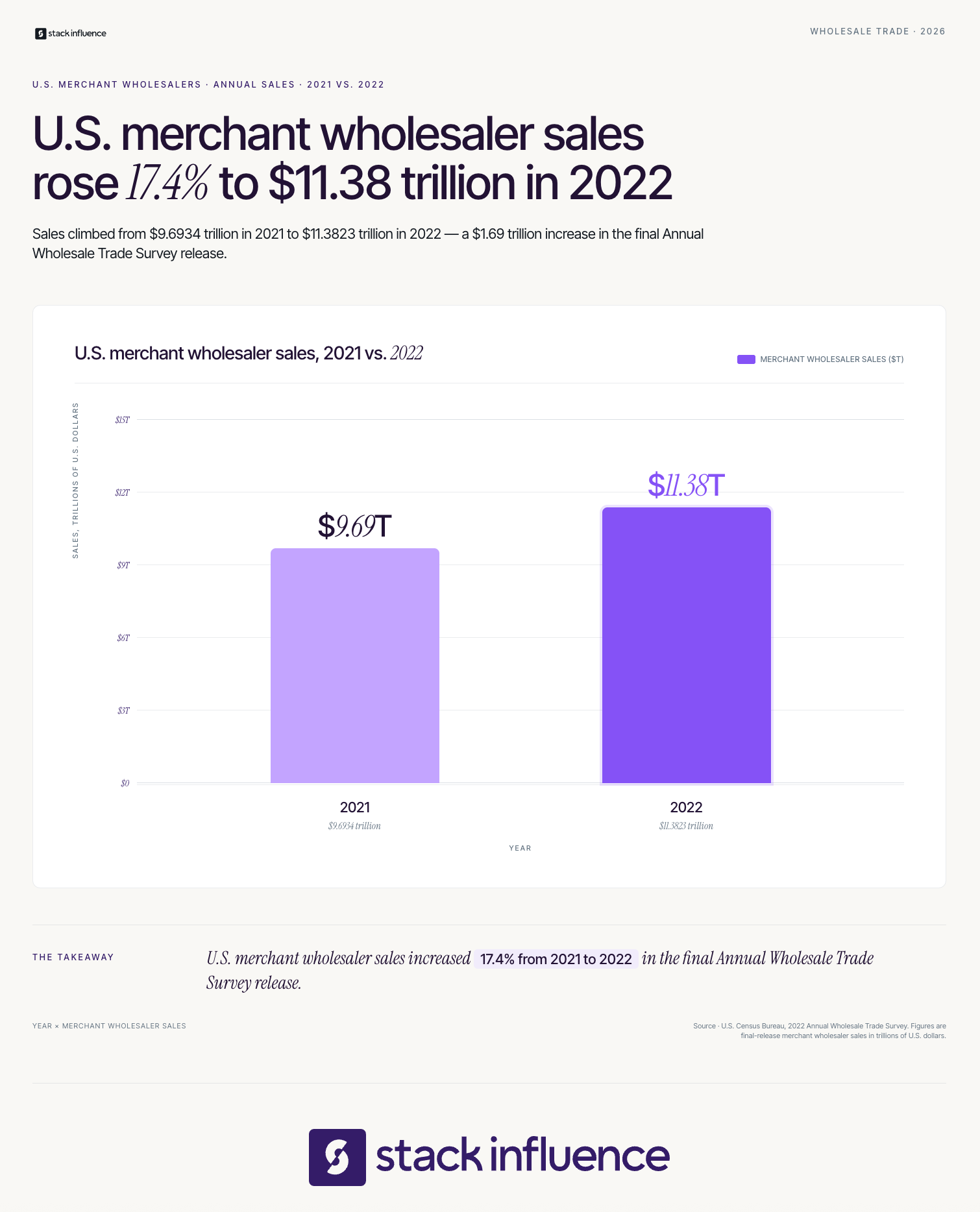
Wholesale is a major economic layer. In the final Annual Wholesale Trade Survey release, the Census Bureau estimated that U.S. merchant wholesalers generated $11.3823 trillion in sales during 2022, up from $9.6934 trillion in 2021. The total excludes manufacturers’ sales branches and offices.
How Does Wholesale Work in Ecommerce?
Wholesale ecommerce moves products through a business-to-business transaction before the final consumer sale. A manufacturer or brand supplies a wholesaler, the wholesaler supplies an ecommerce seller or retailer, and that seller markets and fulfills the consumer order. Some companies skip a layer, while hybrid brands sell through wholesale, marketplaces, and direct channels simultaneously.
A typical order follows five steps:
- The wholesaler publishes an assortment, price list, case-pack structure, and terms.
- The buyer opens a business account and provides requested tax or resale documentation.
- The buyer submits a purchase order that meets the minimum quantity or order value.
- The wholesaler ships to the seller, a third-party logistics provider, or an Amazon fulfillment center.
- The seller lists and promotes the inventory, then reorders from actual sell-through and lead-time data.
Modern wholesale can run through ecommerce infrastructure rather than phone calls and spreadsheets. Shopify’s B2B catalog documentation shows how brands can assign products and customer-specific prices, establish quantity rules, and offer volume pricing.
Stack Influence’s guide to ecommerce business models places wholesale beside private label, dropshipping, and direct sales. After a supplier is chosen, inventory demand forecasting turns expected channel demand into purchase quantities and reorder timing.
How Is a Wholesaler Different From a Distributor, Manufacturer, or Retailer?
A manufacturer creates the product, a wholesaler resells goods to businesses, and a retailer sells to the final customer. A distributor is often a merchant wholesaler, but the term can imply a closer brand relationship, territory, service obligation, or authorized channel role. Industry usage varies, so the contract matters more than the label.
The practical distinctions are:
- Manufacturer: Produces or assembles the goods.
- Wholesaler: Purchases or arranges goods for business buyers, usually without changing the core product.
- Distributor: Resells goods and may hold formal authorization, a territory, or channel-development duties.
- Retailer: Sells to end consumers through stores, marketplaces, social channels, or ecommerce sites.
- Agent or broker: Connects buyers and sellers for a commission without taking title.
- Drop ship supplier: Ships to the retailer’s customer while the retailer owns the customer-facing sale.
Wholesaler and distributor are often used interchangeably. Ask whether the supplier owns the inventory, is authorized by the brand, can issue acceptable invoices, controls a territory, and supports your intended channel.
Amazon illustrates how roles can change. Under a first-party relationship, a brand sells inventory wholesale to Amazon and Amazon becomes the retailer. Amazon Vendor Central explains that structure, while Stack Influence’s ecommerce dropshipping guide covers supplier-to-consumer fulfillment.
Why Do Ecommerce Sellers Use Wholesalers?
Ecommerce sellers use wholesalers to access established products, commercial pricing, replenishable supply, and business documentation without developing every item from scratch. The model can shorten time to market and broaden assortment. Its tradeoff is reduced differentiation, plus working-capital, competition, authorization, and inventory risks that the seller must manage.
Common advantages include:
- Faster access to products with existing demand.
- Lower unit pricing at qualifying volumes.
- Consolidated purchasing across multiple SKUs or brands.
- More repeatable replenishment than one-time clearance sourcing.
- Invoices and account records that may support marketplace documentation.
- Warehousing, case packing, or direct-shipment services.
Common constraints include minimum orders, shared catalog competition, lead-time variability, channel restrictions, discontinued items, and cash exposure when stock moves slowly. A wholesaler’s real product is reduced complexity: the manufacturer avoids servicing every small account, and the retailer gains access to smaller lots and replenishment.
Amazon’s guide to finding wholesalers recommends validating the supplier’s brand relationship, business details, references, location, and reliability rather than treating a price list as proof. Sellers comparing wholesale with less repeatable sourcing can use Stack Influence’s retail arbitrage guide to examine the documentation and replenishment differences.
The Six-Gate Wholesaler Screen
The Six-Gate Wholesaler Screen prevents a low quote from hiding a weak supplier relationship. A wholesaler should pass all six gates before an ecommerce seller commits meaningful inventory capital.
1. Legitimacy and Product Identity
Confirm the supplier’s legal name, address, warehouse location, references, contact details, and payment entity. Verify product identifiers too. The GS1 Database supports searches by Global Trade Item Number (GTIN), company prefix, company name, Global Location Number (GLN), location, or address, but a barcode match alone does not prove distribution authorization.
2. Resale Rights and Documentation
Ask for evidence of the supplier’s relationship to the manufacturer or brand, plus the records your channel may require. Amazon’s guidance for selling branded products says an approval process may require a manufacturer or distributor invoice or brand authorization letter.
Product compliance deserves equal attention. The CPSC’s online seller safety guidance notes that marketplaces can impose requirements beyond baseline federal standards and that sellers may need certification information from suppliers or manufacturers. Requirements depend on the category and the seller’s role.
3. Landed Economics
Calculate the cost of placing one sellable unit in the correct fulfillment location. Include product cost, freight, duties, receiving, prep, labeling, storage, expected defects, payment fees, marketplace costs, fulfillment, returns, discounts, and variable marketing.
A discount has no value when the extra units create storage charges, markdowns, or dead stock. Model a base case and a downside case before accepting a larger MOQ.
4. Demand and Channel Fit
Validate demand in the exact channel, country, variation, and price band you plan to serve. Review seller count, price stability, seasonality, returns, reviews, and the brand’s own marketplace presence.
Ask about allowed channels, geographic restrictions, marketplace exclusions, advertised-price policies, bundles, listing content, and promotional rules. Authentic inventory can still be restricted from the channel you intend to use.
5. Replenishment and Operational Fit
Measure normal lead time, lead-time variation, fill rate, backorders, case-pack changes, substitutions, and damaged-shipment handling. Confirm that the supplier can provide usable inventory and product data through a portal, spreadsheet, Electronic Data Interchange connection, application programming interface, or scheduled feed.
Stack Influence’s guide to where to source products to sell on Amazon emphasizes total economics and supplier testing. Its Amazon product research tactics show how sellers can work backward from supplier price lists to marketplace opportunities.
6. Downside and Exit
Review return windows, restocking fees, defect allowances, recall procedures, expiration rules, discontinued-SKU handling, cancellation terms, deposits, and guarantees. Start with a test order when possible. A controlled purchase reveals order accuracy, packaging, delivery speed, invoice quality, defect handling, and communication before a larger commitment magnifies problems.
How Do You Buy From a Wholesaler?
To buy from a wholesaler, define your channel and product criteria, prepare the required business and tax records, verify suppliers, request commercial documents, calculate landed contribution margin, place a controlled test order, and measure the first sales and replenishment cycle. Do not scale merely because the initial shipment arrived successfully.
Use this process:
- Set the buying brief. Define category, channel, customer, landed-cost ceiling, demand estimate, storage limit, and delivery point.
- Prepare documentation. Gather entity details, tax identification, addresses, licenses, and marketplace account information.
- Build a shortlist. Use manufacturer referrals, trade associations, trade shows, reputable B2B marketplaces, and professional networks.
- Request full terms. Obtain price lists, MOQs, case packs, freight, payment terms, returns, warranty handling, authorization, and samples.
- Run the Six-Gate Screen. Reject suppliers that cannot establish identity, rights, economics, operations, and manageable downside.
- Place and inspect a test order. Check quantities, condition, identifiers, dates, packaging, invoices, and compliance records.
- Reorder from evidence. Use sell-through and lead-time data rather than enthusiasm about the catalog.
Registration, permits, and tax obligations depend on location and activity. The SBA’s launch-your-business guide advises businesses to register appropriately, obtain tax IDs, and research state, local, and industry licensing requirements.
A resale certificate is not a universal federal pass. The Streamlined Sales Tax exemption guidance explains that state rules differ, some states require specific identification numbers, and purchasers should provide completed documentation to suppliers while retaining records. Confirm the rules with the relevant state or a qualified tax professional.
Wholesale Economics: Price Is Only the First Line Item
Wholesale economics should be modeled at both the sellable-unit and purchase-order levels. The first view determines whether each sale contributes profit. The second determines whether the order uses cash efficiently enough to justify its MOQ, lead time, and inventory risk.
Use these formulas:
- Landed unit cost = supplier price + freight + duties + receiving + prep + labeling + expected defect allowance.
- Contribution margin per unit = selling price − landed cost − selling fees − fulfillment − shipping subsidy − expected returns − variable marketing.
- Gross margin percentage = (selling price − cost of goods sold) ÷ selling price.
- Markup percentage = (selling price − cost of goods sold) ÷ cost of goods sold.
- Sell-through rate = units sold during the period ÷ units available during the period.
- Reorder point = expected demand during lead time + safety stock.
Margin and markup are not interchangeable. There is also no universal healthy wholesale margin because returns, advertising, storage, velocity, and channel fees differ by category.
For Amazon sellers, Amazon’s margin-calculation guidance points to the Revenue Calculator for estimating selling fees, fulfillment costs, and net proceeds before inventory is sourced. Use base, downside, and reorder scenarios. The lowest quote can produce the worst cash outcome when it requires an oversized order.
How Does Wholesale Work on Amazon and Shopify?

On Amazon, a third-party seller can buy authentic inventory from a legitimate wholesaler and resell it, subject to product, brand, category, documentation, safety, and marketplace requirements. On Shopify, a merchant can buy wholesale inventory for retail sale or operate a B2B channel with customer-specific catalogs, prices, quantities, and payment workflows.
Fulfillment by Amazon (FBA) changes fulfillment, not sourcing responsibility. The seller still needs to validate the supplier, preserve invoices, confirm listing eligibility, match the correct product identifiers, and account for fees. Amazon states that wholesale sourcing is permitted and explains that some branded-product approvals may require invoices or authorization.
The reverse relationship also exists. A brand may sell wholesale directly to Amazon through Vendor Central, making Amazon the retail customer. Brands should compare control, purchase-order terms, inventory planning, and channel strategy through the Amazon Vendor Central operating model.
Shopify can support both DTC and wholesale selling. A brand can create B2B catalogs, assign prices and products by customer or location, and set quantity rules or volume pricing. Stack Influence’s guide to how Shopify works for ecommerce sellers provides the broader store and channel context.
Hybrid brands should define which SKUs, packages, territories, prices, promotions, and service levels belong in DTC, Amazon, retail, and wholesale channels. Otherwise, one channel can undercut another or consume inventory committed elsewhere.
Distribution Does Not Create Consumer Demand
A wholesaler can make a product available to more sellers, but availability does not guarantee sell-through. Demand still depends on product-market fit, pricing, positioning, reviews, content, promotion, customer experience, and reliable availability at the point of purchase.
Keep the two jobs separate:
- Distribution creates access: Accounts, inventory placement, order flow, replenishment, and physical availability.
- Demand creation produces pull: Awareness, search interest, product understanding, social proof, conversion, and repeat purchase.
A larger wholesale order should follow evidence of demand, not substitute for it. Product pages may need demonstrations, real-life use cases, creative assets, and third-party proof before deeper inventory becomes sensible.
Stack Influence is a micro-influencer marketing platform built around gifted-first product seeding, vetted creator activation, campaign coordination, user-generated content (UGC) production, and completed-post accountability for ecommerce brands. Its guide to what influencer seeding is explains how product experiences can generate authentic discussion and reusable content after the supply case is proven.
The Wholesale Relationship Scorecard
A wholesaler should be measured as a recurring operating partner, not judged only by the first quote or delivery. The Wholesale Relationship Scorecard connects supplier behavior to inventory productivity, unit economics, and channel health.
Track four layers:
- Supplier reliability: Fill rate, order accuracy, defect rate, invoice accuracy, on-time delivery, lead-time variance, and response time.
- Inventory productivity: Sell-through, days of inventory, turnover, stockouts, aged inventory, and forecast error.
- Unit economics: Landed-cost variance, contribution margin, return cost, markdowns, storage, allowance recovery, and cash tied up.
- Channel health: Listing eligibility, return reasons, price stability, brand complaints, content quality, and replenishment continuity.
Audit every shipment, review early sell-through after a meaningful sales period, evaluate the supplier after one full replenishment cycle, and compare rolling quarterly performance by supplier, SKU, and channel. Reforecast before seasonal events, promotions, creator campaigns, or assortment expansion.
Do not attribute every sales change to the wholesaler. Price, advertising, seasonality, competitor stockouts, creator content, reviews, promotions, and marketplace ranking can all move revenue. Supplier measurement should isolate what the wholesaler controls: availability, cost, documentation, accuracy, quality, and replenishment.
Choosing the Right Wholesaler
Knowing what is a wholesaler gives ecommerce sellers a useful definition, but the profitable decision comes from evaluating the relationship behind the label. The right supplier can reduce sourcing friction, support reliable replenishment, and provide cleaner documentation. The wrong one can lock cash into products that are restricted, slow, poorly documented, or impossible to reorder.
Apply the Six-Gate Wholesaler Screen to one supplier and one SKU before expanding the relationship. Model landed contribution margin, inspect a test order, and measure the first replenishment cycle. Once reliable supply and real demand are visible, a managed product-seeding workflow can help turn inventory into authentic content and stronger consumer pull.