



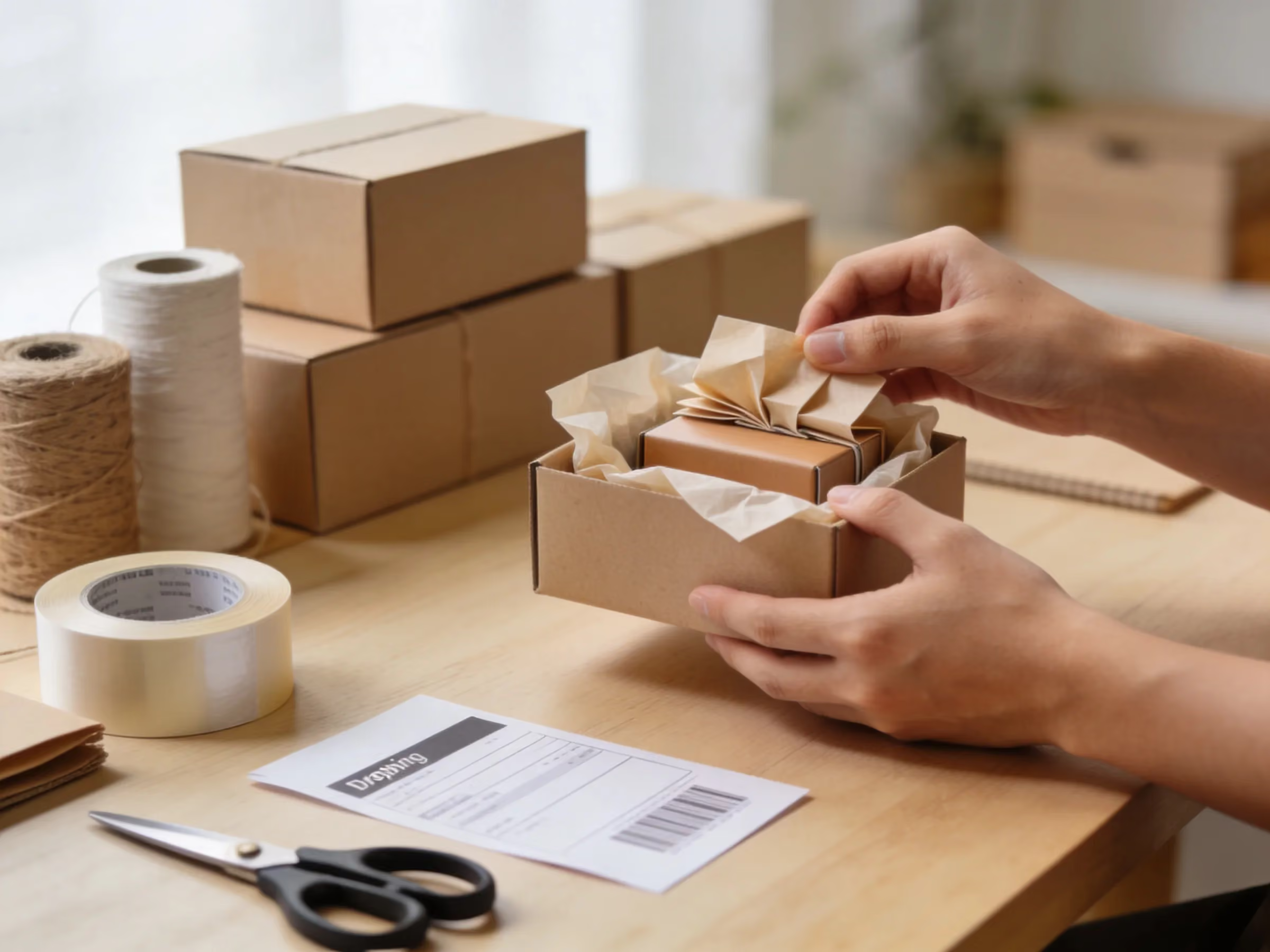
Dropshipping promises a business with no inventory, no warehouse, and no upfront product cost. For eCommerce sellers researching the model, that pitch is genuinely compelling. But the pros and cons of dropshipping look very different once you account for what the glossy overviews leave out: thin margins, supplier dependency, and a customer experience you cannot fully control. This guide cuts through the noise, giving you a structured way to evaluate whether dropshipping fits your specific situation, what the numbers actually look like in 2026, and where complementary strategies like creator-driven traffic can change the math.
Key Takeaways
- Dropshipping eliminates inventory risk but compresses gross margins to 10-30% in most product categories, compared to 40-60% for private label.
- Supplier reliability is the single largest operational risk; a stockout or quality failure lands entirely on your brand reputation.
- The model works best as a low-risk testing vehicle, not a long-term margin strategy for scaling DTC brands.
- Paid traffic costs have risen sharply since 2021, making organic and influencer-driven acquisition increasingly critical for dropshippers to remain profitable.
- Creator-powered traffic strategies, including the Amazon Influencer Program and product seeding, can meaningfully improve the unit economics of dropshipping when layered in early.
The State of Dropshipping in 2026
The dropshipping market is large and still growing. According to Grand View Research, the global dropshipping market was valued at over $350 billion in 2023 and is projected to grow at a compound annual growth rate above 23% through 2030. That scale reflects genuine demand, but it also reflects a market increasingly crowded with sellers running identical products from the same handful of suppliers.
The competitive environment has shifted considerably in the last three years. Rising customer acquisition costs on Meta and Google have eroded the margins that made dropshipping attractive in the 2017-2020 era. Sellers who built businesses on cheap paid traffic are now watching their return on ad spend compress as more competitors bid on the same audiences.
Three structural forces are reshaping the landscape for dropshippers in 2026:
- Rising paid media CPMs: Meta advertising costs have risen significantly, with average CPMs increasing by roughly 20-30% between 2022 and 2024 according to Wordstream benchmark data.
- Platform diversification pressure: Amazon, TikTok Shop, and Shopify have each created distinct fulfillment and discovery ecosystems that reward different operational models.
- Authenticity expectations: Consumers increasingly expect brand identity, social proof, and UGC before purchasing from unfamiliar sellers, raising the cost of trust-building for generic dropship stores.
Understanding these forces is the essential context before evaluating the pros and cons of dropshipping for your specific business stage.
What Is Dropshipping, Exactly?
Dropshipping is a retail fulfillment model in which the seller takes orders from customers but never holds the product. When an order is placed, the seller forwards it to a third-party supplier, who ships directly to the end customer. The seller earns the margin between the retail price they charge and the wholesale cost they pay the supplier.
The model became widely accessible through Shopify integrations with suppliers like AliExpress and later through domestic suppliers available via platforms like Spocket and Zendrop. It requires almost no startup capital because you are not buying inventory in advance. That single characteristic explains why it has attracted millions of first-time eCommerce entrepreneurs.
What dropshipping is not is a passive business. Successful operators actively manage supplier relationships, optimize product listings, run paid or organic traffic campaigns, handle customer service for problems they did not cause, and monitor margin constantly. The "hands-off" framing in most introductory content is one of the more persistent misconceptions in the eCommerce space.
What Are the Real Pros and Cons of Dropshipping?
Most articles on the pros and cons of dropshipping present a balanced two-column list and stop there. The more useful analysis examines which advantages are durable and which are temporary, and which risks are manageable versus existential.
Genuine Advantages Worth Building On
The following benefits are real and defensible, not just marketing copy for the model:
- Low startup capital: You can launch a dropshipping store for under $500, making it the most accessible entry point into product commerce for new sellers.
- Product testing flexibility: You can list dozens of products, identify what converts, and kill what does not without being locked into inventory you cannot return.
- Geographic independence: The model does not require a warehouse, which means you can operate from anywhere with reliable internet.
- Scalability of order volume: Because fulfillment is outsourced, you can handle volume spikes without hiring warehouse staff or renegotiating 3PL contracts.
- Speed to market: A new product can go from sourcing decision to live listing in days rather than the weeks or months required for private label or manufacturing.
According to Oberlo's eCommerce data, roughly 27% of online retailers use dropshipping as their primary fulfillment method, confirming it is a legitimate operating model at scale, not just a beginner experiment.
Structural Disadvantages That Compound Over Time
The cons of dropshipping are not just inconveniences. Several of them become more damaging as your store scales:
- Margin compression: Gross margins on dropshipped goods typically range from 10-30%, far below the 40-60% margins available to private label sellers who control manufacturing costs.
- No differentiation: If you are sourcing from the same supplier as hundreds of competitors, price becomes your only lever. That race ends in single-digit margins or losses.
- Supplier dependency: A supplier stockout, quality failure, or unilateral price increase hits your store immediately. You have no inventory buffer and no negotiating position until your volume is substantial.
- Shipping time vulnerability: Unless you use domestic suppliers, delivery windows of 2-4 weeks are common. In an environment where Amazon Prime has normalized 1-2 day delivery, this is a conversion killer. To bypass long international transit times and preserve margins in high-volume categories, many sellers rely on automated inventory integrations for specialized sectors like outdoor products dropshipping.
- Branding limitations: Most dropship suppliers do not offer custom packaging, inserts, or labeling at small volumes. Your customer's first physical brand touchpoint is a generic poly mailer.
Across campaigns managed on the Stack Influence platform, eCommerce brands that rely exclusively on dropshipping struggle to generate the kind of UGC that converts, because creators receiving a product in unbranded packaging have significantly less to work with visually. Brands that add even minimal branded packaging to their dropship workflow see measurably higher UGC quality and creator enthusiasm.

The Dropship Decision Checklist
Before committing to dropshipping as your primary model, the Dropship Decision Checklist gives you a structured way to test your readiness. Use the checklist to identify which of the five dimensions are working in your favor and which represent live risks.
The Dropship Decision Checklist covers five dimensions:
- Supplier audit: Have you tested product quality with at least three sample orders? Do you have a backup supplier for your top three SKUs?
- Margin floor: Is your gross margin above 25% after advertising, platform fees, and payment processing? Below that threshold, a single refund rate spike can eliminate profit entirely.
- Differentiation plan: Do you have a brand element (photography, copy voice, bundle strategy, niche positioning) that a competitor cannot replicate by copying your supplier?
- Traffic diversification: Are you building at least one organic or owned channel (SEO, email, creator partnerships) alongside paid traffic?
- Exit readiness: Is your store structured so that you could transition top-performing SKUs to a private label or Amazon FBA model once volume justifies it?
Running through the Dropship Decision Checklist honestly takes about 20 minutes and surfaces the one or two items that represent your real constraints. Most failing dropship stores can trace their problems to ignoring two or more of these five dimensions.
The Dropship Decision Checklist is not a pass/fail gate. It is a prioritization tool. If you score weak on traffic diversification, that is where you put your next dollar of time or money, not into testing more SKUs.
How Do You Measure Dropshipping Profitability Accurately?
Profitability measurement is where most dropshippers discover the model is less attractive than they believed. The common mistake is calculating success at the gross margin level and ignoring the full cost stack.
A rigorous measurement framework for dropshipping has three tiers. Call it the Dropship Profit Stack:
- Tier 1: Unit Economics. For every order, calculate: revenue minus product cost, payment processing (typically 2.9% plus $0.30), platform fees (Shopify, Amazon, or other), and return/chargeback reserve. This gives you true contribution margin per order.
- Tier 2: Traffic Cost. Divide your total advertising spend by the number of orders that ad spend generated. Add this customer acquisition cost to the unit economics calculation. Many dropshippers discover their CAC alone exceeds their contribution margin.
- Tier 3: Lifetime Value Adjustment. If your store has repeat purchase data, apply a lifetime value multiplier. Dropshipping stores with strong niche positioning and email lists can justify a higher CAC in Tier 2 because of Tier 3 returns.
For sellers also operating on Amazon, Amazon Attribution is a critical tool for understanding how off-platform traffic drives on-platform conversions. Sellers who drive external traffic to Amazon listings and tag that traffic correctly can also qualify for the Amazon Brand Referral Bonus, which returns a percentage of the sale price as a credit against referral fees.
Stack Influence's internal campaign data shows that dropshipping brands using creator-generated traffic tagged with Amazon Attribution links average a 10-15% bonus credit recovery through the Brand Referral Bonus program, which can meaningfully offset the CAC pressure described in Tier 2.
The Unit Economics Nobody Calculates Before They Start Dropshipping
Most guides to the pros and cons of dropshipping discuss margins in the abstract. They say margins are "thin" without showing you what thin actually costs at operating scale. This section runs the numbers that most introductory content skips.
Take a product that sells for $39.99. A typical dropship scenario looks like this:
- Product cost from supplier: $14.00
- Shopify and payment processing fees: $2.70
- Advertising cost per order (at a modest $15 CAC): $15.00
- Return reserve at a 5% rate: $2.00
- Net margin per order: $6.29, or roughly 15.7%
That 15.7% sounds survivable until you factor in the cost of building the store, producing ad creative, and the time you spend on customer service emails for orders that shipped late from a supplier you do not control. At $6.29 net per order, you need to process nearly 1,600 orders per month to generate $10,000 in take-home income, before taxes.
This is not an argument against dropshipping. It is an argument for going in with clear numbers. Stack Influence has observed that eCommerce brands which layer organic creator content into their dropshipping traffic strategy reduce their effective CAC by 20-35% over a 90-day period compared to brands running paid traffic alone, because creator content continues generating impressions and clicks long after the initial post. That CAC reduction moves the $6.29 net figure substantially.
The strategic implication is straightforward. Dropshipping as a model benefits more than almost any other eCommerce structure from [micro influencer marketing](INTERNAL: micro influencer marketing strategy) and [product seeding](INTERNAL: product seeding for eCommerce) because those tactics generate compounding organic traffic without the per-click cost of paid media. Brands that build creator partnerships early, even while dropshipping, are building the traffic infrastructure that makes the unit economics defensible.
Should You Use Dropshipping as a Stepping Stone to Private Label?
The most profitable use of dropshipping is as a product validation engine rather than a terminal business model. This is the strategic framing that most guides on the pros and cons of dropshipping either miss or bury at the end.
The logic is straightforward. Dropshipping lets you test 20 products cheaply and identify one or two that generate consistent demand and defensible margins. Once you have sales data proving a product works, you have the business case to approach a manufacturer, develop a branded version, and shift to private label or Amazon FBA fulfillment. You are not guessing on a $50,000 inventory run. You are making a data-backed bet on a product with a proven conversion rate and a known customer acquisition cost.

DTC brands that follow this stepping-stone approach tend to move through three phases: a dropship testing phase of 90 to 180 days, a hybrid phase where the proven SKU is transitioned to private label while remaining products stay on dropship, and a brand-building phase where they invest in [UGC creators](INTERNAL: UGC creator strategy) and an Amazon storefront to build sustainable organic traffic.
The stepping-stone model also changes how you think about the [creator economy](INTERNAL: creator economy for eCommerce brands) during the dropship phase. Instead of treating creator partnerships as a growth-stage luxury, smart dropshippers seed products to [nano influencers](INTERNAL: nano influencer marketing) early, generating authentic reviews and UGC that carry over when they launch the private label version. Those assets do not expire when the product SKU changes.
Conclusion
The pros and cons of dropshipping ultimately resolve to a single strategic question: are you using the model to learn, or are you using it to build? As a learning tool, dropshipping is nearly unmatched for capital efficiency and speed. As a standalone long-term business model, the margin and differentiation challenges are real and compounding.
eCommerce sellers who treat dropshipping as phase one of a product strategy, and who invest early in creator-driven traffic through [influencer marketing campaigns](INTERNAL: influencer marketing campaigns for eCommerce) and [brand partnerships](INTERNAL: brand partnership strategy), consistently outperform those who treat it as a set-it-and-forget-it income stream. If you are evaluating the model right now, use the Dropship Decision Checklist to identify your real constraints, run your numbers through the Dropship Profit Stack, and build your traffic infrastructure before you need it.