




Retail arbitrage looks simple from the clearance aisle: buy a product below its marketplace price, list it, and keep the difference. For ecommerce sellers, the harder work begins after the scan. Fees move, competing offers multiply, inventory ages, returns arrive, and Amazon may request stronger sourcing documentation than a basic store receipt provides.
This guide explains how retail arbitrage works in 2026, how to evaluate products before buying them, which risks deserve the most attention, and how to measure real profit instead of attractive revenue.
Key Takeaways
- Retail arbitrage profit is the selling-price spread left after fees, fulfillment, returns, tax, travel, and inventory loss.
- A product should pass five gates before purchase: Permission, Proof, Profit, Pace, and Exit.
- Lawful resale does not automatically satisfy Amazon’s documentation, restriction, condition, safety, or intellectual-property requirements.
- Small test quantities protect cash better than buying deeply from one promising scan.
- Retail arbitrage can teach marketplace fundamentals, but repeatable supply and brand control become more important as a seller scales.
What Is Retail Arbitrage?
Retail arbitrage is the practice of buying discounted products from physical stores and reselling them at a higher price through a marketplace such as Amazon. Profit is the remaining spread after marketplace fees, fulfillment, prep, shipping, returns, taxes, travel, and unsold inventory. It is a sourcing model, not a guaranteed-profit formula.
Amazon’s own reselling guidance describes retail arbitrage as purchasing products from retail stores at lower prices and reselling them for profit. The working process is straightforward: find a discounted item, match the exact listing, confirm selling eligibility, estimate all-in profit, and fulfill the order.
Retail arbitrage differs from three adjacent ecommerce models:
- Online arbitrage: The same price-gap strategy, but products are sourced from online retailers.
- Wholesale: Inventory is purchased from brands or distributors, often with repeatable supply and commercial invoices.
- Private label: The seller develops or sources a product under its own brand and controls its positioning. This Amazon private-label guide explains the longer-term model.
Retail arbitrage lowers the commitment required to test Amazon, but the seller has limited control over replenishment, price, documentation, and the product detail page.
Is Retail Arbitrage Legal and Allowed on Amazon?
Retail arbitrage is generally legal in the United States when a seller lawfully purchases authentic goods and resells them without misrepresentation. Legal resale rights do not override Amazon’s listing rules, brand restrictions, documentation demands, condition standards, safety obligations, or intellectual-property policies. A lawful store purchase can still create marketplace enforcement risk.
For copyrighted goods, the first-sale doctrine provides one legal foundation for resale. In the Supreme Court’s Quality King decision, the Court explained that the lawful owner of a copy may resell it after the first authorized sale. That principle does not protect counterfeit, altered, recalled, restricted, or inaccurately described inventory.
Amazon applies separate marketplace requirements. Its public reselling guide tells sellers to keep purchase orders, invoices, and transaction records, while Amazon’s invoice requirements for policy appeals explain that invoices help verify legitimate sourcing.
The Receipt Problem Most Guides Understate
A retail receipt proves that a purchase occurred, but it may not establish the supply chain Amazon wants to verify during every authenticity, approval, or policy review. The risk is not that every retail-arbitrage listing will fail. The risk is buying inventory before discovering that the requested evidence is unavailable.
Treat documentation as a pre-purchase question. Preserve the full receipt, payment record, store location, purchase date, item photographs, UPC, model or lot information, and a clear mapping from each purchased unit to its ASIN. For brands or categories with stricter requirements, retail sourcing can still leave a proof gap.
Business compliance also varies by location. The U.S. Small Business Administration’s licensing guidance notes that required permits depend on business activity and location, including state, county, and city rules.
The Five-Gate Retail Arbitrage Buy Test
The Five-Gate Retail Arbitrage Buy Test prevents a strong-looking price spread from hiding a fatal weakness. Every product should pass Permission, Proof, Profit, Pace, and Exit before it enters the cart. One failed gate is enough to decline the purchase.
1. Permission
Confirm that your exact seller account can list the exact ASIN in the intended condition and fulfillment channel. Check category, brand, product, hazmat, expiration, and FBA restrictions. Opening a listing in a scanning app does not prove that your account can sell it.
2. Proof
Ask whether you could defend the product’s authenticity, condition, source, and quantity months later. Documentation should connect the purchased unit, listing, and payment record. Higher-risk inventory deserves stronger evidence, not merely a higher projected margin.
3. Profit
Calculate profit after purchase cost, sales tax when applicable, referral fees, fulfillment, inbound shipping, prep, labels, storage, returns, software, travel, and markdown risk. Run the calculation again at a lower selling price so a modest price drop does not turn the unit negative.
4. Pace
Estimate how quickly the inventory can convert back into cash. Review price history, offer count, sales-rank movement, seasonality, stock levels, and likely competition after the clearance deal spreads. A lower return that repeats quickly can be more useful than a larger return that takes a year.
5. Exit
Define the response if the item does not sell as expected. The exit might be a store return, controlled markdown, another marketplace, local sale, or liquidation. Record the return deadline and estimated downside before purchase, not after the listing stalls.
The framework changes the buying question from “Can this item make money?” to “Can I buy, prove, sell, and exit this item without exposing the account or trapping capital?”
How Much Does Retail Arbitrage Cost?
Retail arbitrage has no universal startup cost because inventory, selling plans, supplies, travel, software, and fulfillment choices vary. A seller can begin with a small multi-SKU test, but the budget must also cover fees and a reserve for returns or markdowns. The right starting amount is risk capital, not essential-expense money.
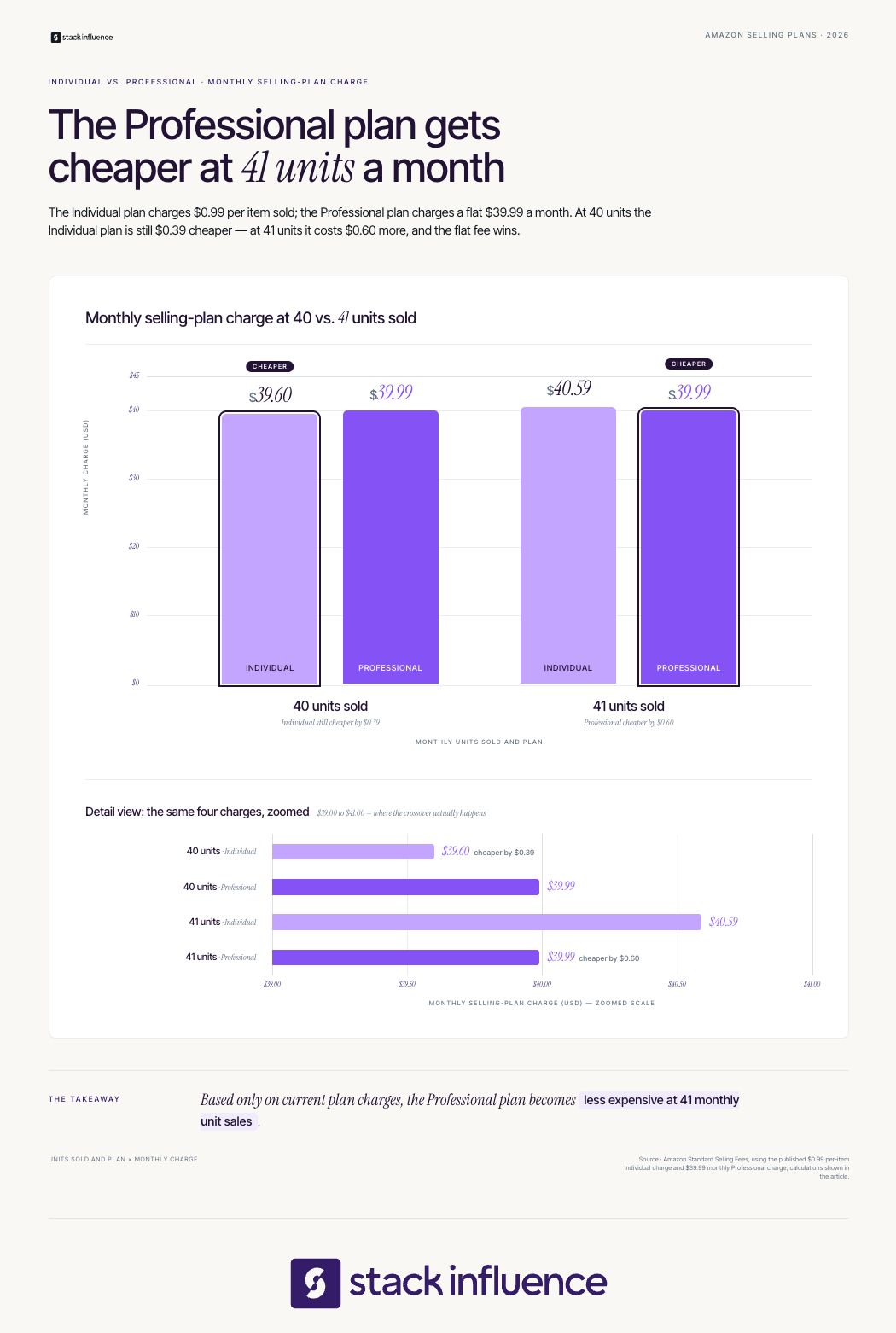
Amazon’s current selling-fee page lists an Individual plan at $0.99 per item sold and a Professional plan at $39.99 per month, before referral and optional service fees. Based only on those charges, 40 Individual-plan sales cost $39.60 and 41 cost $40.59, so Professional becomes cheaper at 41 monthly units.
Use this unit-profit formula:
Selling price minus product cost, nonexempt sales tax, referral fee, fulfillment, inbound freight, prep, labels, storage, return allowance, and allocated overhead equals expected net profit.
For example, a $30 sale with a $10 product cost, $8.50 in marketplace and fulfillment fees, $1.50 in prep and inbound shipping, and a $1 return or markdown reserve produces $9 in expected net profit. That is a 90 percent return on inventory cost and a 30 percent net margin on revenue. Use the live ASIN and fulfillment method for actual estimates.
Also track profit per sourcing hour, profit per route, travel cost, and inventory still unsold after 30, 60, and 90 days. This beginner’s guide to selling on Amazon covers the broader account and fee setup.
How Do You Start Retail Arbitrage on Amazon?
Start retail arbitrage by creating a compliant seller account, setting conservative buying rules, and testing a few units across several products. The first sourcing cycle should validate listing permission, documentation, fee estimates, sell-through, condition handling, and the complete cash-conversion process. Maximum revenue is not the goal of the first trip.
- Set a test budget. Reserve money for inventory, fees, supplies, returns, and markdowns.
- Establish the business basics. Separate business finances, check licenses, and create a recordkeeping system. This Amazon seller setup guide organizes the marketplace sequence.
- Use the official scanning tool. The Amazon Seller app can scan barcodes, locate catalog products, compare offers, create listings, and monitor inventory. Treat the scan as the beginning of research, not the buy decision.
- Run all five gates. Check the exact ASIN, variation, pack count, condition, and fulfillment method.
- Buy shallow quantities. A few units across several SKUs reveal more than one deep, unproven purchase.
- Prep accurately. Preserve packaging, match the listing, label correctly, and document condition.
- Choose FBA or FBM by SKU. Base the choice on dimensions, margin, velocity, storage risk, and handling needs.
- Review after 30 days. Compare expected and actual price, fees, sell-through, returns, and labor before restocking.
The IRS recordkeeping guidance advises businesses to retain supporting documents such as sales slips, bills, invoices, receipts, deposit records, and canceled checks. Keep searchable digital records that connect purchases, inventory, sales, and tax entries.
Sales-tax treatment requires separate attention. The Streamlined Sales Tax Governing Board’s exemption guidance explains that eligibility and registration rules vary by state. A resale certificate affects unit economics only when the seller qualifies and the retailer accepts it, so confirm local requirements with a qualified adviser.
Which Products Are Better Retail Arbitrage Candidates?
Better retail arbitrage candidates are authentic, sealed, easy to match to an exact ASIN, permitted for the seller’s account, supported by defensible records, and profitable at a lower selling-price scenario. They also have understandable demand, manageable competition, low handling risk, and an exit route if the original estimate fails.
Look for six characteristics:
- Exact UPC, model, size, color, quantity, and packaging match
- New, sealed condition with no shelf wear or missing components
- Stable pricing rather than a one-day spike
- Positive margin at a conservative downside price
- Low breakage, leakage, expiration, and return risk
- A test quantity aligned with expected sales velocity
Use extra caution with ingestibles, topical products, batteries, hazmat goods, serial-numbered items, warranties, baby products, short-dated inventory, and listings with frequent counterfeit complaints. A two-pack is not interchangeable with a single unit, and a revised formula or model may require a different ASIN.
FBA or FBM for Retail Arbitrage
Fulfillment choice should follow the exact SKU economics. Through Fulfillment by Amazon, Amazon stores inventory, picks and packs orders, ships products, and handles customer service and returns. Costs vary by product and include fulfillment and storage charges.
FBA can suit standard-size, fast-moving products with enough margin to absorb its fees. Fulfilled by Merchant can preserve control for bulky, fragile, slow, or condition-sensitive inventory. Many sellers use both rather than treating fulfillment as one permanent account-wide choice.
This FBA versus FBM guide explains the operational differences in storage, shipping, control, Prime eligibility, and returns.
The Four-Layer Arbitrage Scorecard
Retail arbitrage should be measured as an inventory and cash-flow system, not as a collection of exciting flips. The Four-Layer Arbitrage Scorecard connects unit profit to capital efficiency, inventory quality, and account safety.
Layer 1: Unit Economics
Track actual net profit per unit, net margin, ROI on inventory cost, fee variance, and minimum safe price. Replace estimates with settlement data after each sale.
Layer 2: Capital Efficiency
Measure 30-day sell-through, average days in inventory, cash-conversion time, profit per sourcing hour, and profit per route. These metrics show whether inventory is funding the next cycle quickly enough.
Layer 3: Inventory Quality
Monitor returns, stranded inventory, aged units, markdown losses, damage, and the share of purchases unsold after 30, 60, and 90 days. Revenue can increase while inventory quality declines.
Layer 4: Account Safety
Track documentation coverage, restricted-listing attempts, authenticity or condition complaints, recall checks, and unresolved account-health issues. A profitable SKU is not valuable when its records cannot support the business.
Review active prices daily, SKU performance weekly, sell-through at 30 days, and category performance every 90 days. Do not treat a price increase, rank change, or Featured Offer win as proof that one action caused a sale because competition, seasonality, stockouts, and fulfillment speed can change together.
Pricing automation helps only when the minimum price includes every real cost. This guide to Amazon repricer tools explains why minimum and maximum boundaries matter.
Why Is Retail Arbitrage Hard to Scale?
Retail arbitrage is difficult to scale because supply is inconsistent, sourcing consumes labor, competition compresses price, and retail documentation may be weaker than commercial invoices. Growth can add stores, buyers, vehicles, prep work, and cash tied in inventory before it creates a repeatable or transferable ecommerce asset.
Four constraints shape the model:
- Supply control: Retailers decide what is stocked, discounted, limited, or discontinued.
- Price control: Other sellers can find the same deal and lower the marketplace price.
- Labor intensity: More revenue often requires more scanning, driving, prep, and exception handling.
- Asset control: The reseller usually does not control the brand, listing, product roadmap, or customer relationship.
Scaling should improve systems rather than simply expand mileage. Standard procedures, buyer training, centralized prep, SKU purchase limits, documentation standards, and category specialization can increase consistency. Sellers should compare that added complexity with authorized wholesale or owned-brand economics.
From Arbitrage Cash Flow to a Defensible Ecommerce Business

Retail arbitrage can teach ASIN matching, fee analysis, fulfillment, inventory discipline, returns, repricing, and marketplace compliance through relatively small tests. The next model should be chosen according to the control the seller wants to gain.
Common progression paths include:
- Building direct relationships with brands or authorized distributors
- Moving proven product knowledge into wholesale purchasing
- Developing an owned product through Amazon private label
- Expanding into a Shopify or DTC channel with more customer control
- Building demand through content, email, affiliates, and creator relationships
Creator marketing becomes more practical when the seller owns the brand or is authorized to market it. An owned-brand team can apply influencer product-seeding strategies and learn how to collaborate with Amazon influencers to support awareness, reusable UGC, and traffic around replenishable inventory.
Stack Influence is a micro-influencer marketing platform built around gifted-first product seeding, vetted creator activation, campaign coordination, UGC generation, and completed-post accountability. The workflow is designed for ecommerce brands moving from product availability to managed creator participation and content production.
Retail Arbitrage Mistakes That Destroy Margin or Account Health
Most retail arbitrage failures begin before purchase. The seller notices the current price gap but ignores the conditions required to collect it.
Avoid these mistakes:
- Buying from the current price without reviewing history or competition
- Assuming listing eligibility guarantees acceptable sourcing documents
- Excluding returns, freight, storage, travel, or markdowns from ROI
- Buying deeply before testing velocity and actual fees
- Matching the wrong variation, model, formula, bundle, or pack count
- Selling shelf-worn merchandise as new
- Ignoring expiration, recall, hazmat, warranty, or condition rules
- Repricing without a cost-based minimum or holding inventory without an exit date
The U.S. Consumer Product Safety Commission’s reseller guidance states that recalled products cannot legally be offered for sale and directs resellers to check its recall database. Marketplace policies also change, so review official notices and reliable monthly ecommerce seller updates instead of relying on a static sourcing checklist.
Retail Arbitrage Can Be a Training Ground, Not a Shortcut
Retail arbitrage can help ecommerce sellers learn research, marketplace fees, fulfillment, inventory control, and cash-flow discipline with smaller commitments than many sourcing models. Its simplicity disappears when documentation, safety, returns, price competition, and unsold stock are ignored.
Evaluate 20 candidate products with the Five-Gate Retail Arbitrage Buy Test, then purchase only small quantities that pass Permission, Proof, Profit, Pace, and Exit. The results will show whether to keep refining arbitrage, move toward wholesale, or use the marketplace knowledge to build an owned brand.