




Most brands can collect creator handles. The harder task is identifying people who reach the right shoppers, produce useful content, accept workable terms, and reliably complete the campaign. Finding micro influencers is therefore an evidence problem, not a follower-count exercise.
For ecommerce sellers, that evidence must connect a creator to a specific purchase decision. For content creators, the same system reveals how to make a profile easier for brands to discover, evaluate, and hire. This guide explains how to find micro influencers, build a qualified shortlist, structure outreach, activate creators, and measure the full campaign rather than stopping at likes.
Key Takeaways
- Search from the buying context: Customer problems, product routines, and commerce behavior reveal stronger candidates than a broad niche label alone.
- Follower count is only a boundary: Audience fit, content utility, commercial credibility, and reliability determine whether a creator belongs on the shortlist.
- Discovery and activation are separate: A list of names does not solve outreach, product delivery, disclosures, content rights, or completed-post tracking.
- Creators can improve their own discoverability: A clear niche, searchable content, visible audience evidence, and reliable brand-collaboration information make selection easier.
- Measure the entire test: Track completion, content value, audience response, commerce outcomes, and repeat-partnership potential on appropriate timelines.
What Counts as a Micro Influencer?
A micro influencer is a creator with a relatively small, topic-focused audience and recurring influence inside a defined community. The IAB's April 2025 taxonomy places micro influencers at 10,000 to 50,000 followers and nano influencers at 1,000 to 10,000, but brands and platforms use different cutoffs. Fit matters more than the label.
The IAB's April 2025 creator taxonomy provides a useful reference point, not a universal campaign rule. A creator with 8,000 highly relevant followers may be more valuable for a niche product than an account with 40,000 followers whose audience rarely discusses the category. Stack Influence's explanation of what a micro influencer is adds practical context on the role these creators can play for ecommerce brands.
Four signals make the label commercially useful:
- Audience concentration: The creator reaches people connected by a recognizable problem, interest, profession, routine, life stage, or shopping behavior.
- Content consistency: Recent posts repeatedly demonstrate knowledge, taste, experience, or access within that community.
- Audience response: Comments, questions, saves, shares, and recurring viewers show that people do more than passively follow.
- Campaign readiness: The creator can understand a brief, communicate clearly, disclose a material connection, meet a timeline, and discuss content rights.
It also helps to separate creator roles. An influencer contributes audience distribution, while a UGC creator primarily produces content for the brand to use. An affiliate or Amazon influencer focuses more directly on tracked shopping actions. One person can perform all three roles, but a brand should decide which job matters before searching.
The Micro-Influencer Search Grid
The Micro-Influencer Search Grid begins with the customer's buying context and converts it into four families of search queries. This prevents a common mistake: searching only for a broad phrase such as “fitness influencer” or “beauty creator,” then treating whichever large accounts appear first as the market.
Use these four query families:
- Category terms: Map the broad creator ecosystem with phrases such as “home organization creator,” “running gear reviewer,” or “clean beauty routine.”
- Customer-problem terms: Search the problem the product addresses, such as “small pantry storage,” “frizzy hair humidity,” or “lunch prep for work.”
- Use-case and routine terms: Search the moment of use, including “Sunday meal prep,” “wash day routine,” “carry-on packing,” or “desk setup.”
- Commerce-behavior terms: Find creators who already explain purchases through phrases such as “Amazon finds,” “product comparison,” “unboxing,” “storefront favorites,” or “budget alternatives.”
Add a community modifier when it changes the buying context, such as “meal prep for college” or “high-protein meal prep.” Use modifiers to describe a real product-use condition, not to force an unrelated demographic into the search.
Run the grid through native platform search, captions, video titles, tagged content, search engines, marketplace filters, and creator-network filters. Record the platform, query, discovery source, date, and reason each profile looked promising. A sourcing log makes it possible to compare which searches produce qualified creators instead of merely producing the most names.
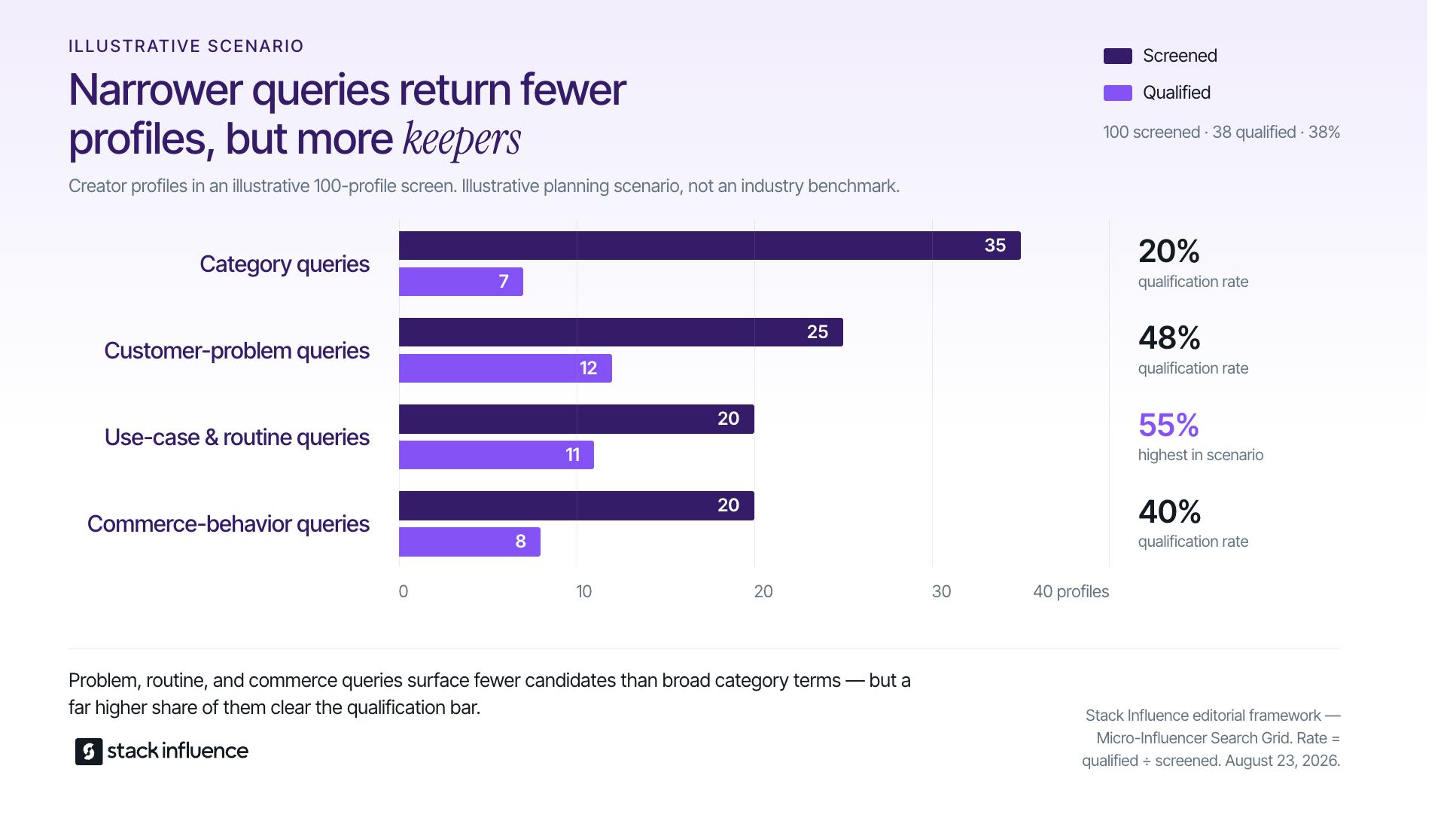
Consider an illustrative 100-profile screen for a home-organization product. This is a planning scenario, not an industry benchmark:
- Category queries surface 35 profiles, with 7 passing the full qualification screen, a 20% yield.
- Customer-problem queries surface 25 profiles, with 12 passing, a 48% yield.
- Use-case and routine queries surface 20 profiles, with 11 passing, a 55% yield.
- Commerce-behavior queries surface 20 profiles, with 8 passing, a 40% yield.
The calculation is qualified profiles divided by screened profiles. The scenario does not prove that routine searches always perform best. It illustrates a useful operating principle: broad terms may maximize volume, while problem and routine queries often reveal more evidence of product relevance before outreach begins.
Content creators can use the Search Grid in reverse. A bio that says “lifestyle creator” is difficult to place. A profile that consistently publishes small-space organization routines, renter-friendly storage tests, and product comparisons gives brands searchable evidence of audience, expertise, format, and commercial role.
Where Should You Look for Micro Influencers?
Look in four places: native social search, existing customer and brand signals, adjacent category networks, and structured creator platforms. Each source reveals different evidence. Native search shows current content, owned signals reveal natural affinity, adjacent networks map communities, and creator platforms add filters or campaign execution. Use at least two sources before finalizing a shortlist.
Native Social Search
Native search is strongest when the query describes content a customer would actually watch. Search posts, captions, video titles, tagged content, collaborative posts, comments, and related accounts. Then expand from one strong creator into the surrounding community instead of returning immediately to a generic hashtag.
On Instagram, Meta's Instagram Creator Marketplace guidance explains that brands can use creator and audience filters to identify potential partners. The guide to finding Instagram influencers who fit your brand provides a channel-specific workflow for expanding native results into a qualified candidate pool.
TikTok One supports username or keyword searches, plus filters related to creator details, audience details, and performance. Use its creator-search documentation alongside the guide to finding TikTok influencers who fit your brand, especially when short-form product demonstrations or TikTok Shop behavior matter.
On YouTube, search for the problem, routine, review format, and product category rather than the word “influencer.” For a promising creator, request the creator's YouTube Media Kit when available so audience and channel information can supplement the public content review.
Existing Customers and Brand Signals
Start with people who already demonstrate product or category affinity through social tags, brand mentions, creator applications, affiliate applicants, community participation, or customer-created content collected with appropriate permission. Natural affinity reduces one source of uncertainty, but it does not replace audience, content, disclosure, or reliability checks.
Adjacent Category Networks
Map the category through complementary brands, retailers, educators, events, publications, newsletters, and community accounts. Review collaborators, tagged posts, and recurring commenters, but do not copy a competitor's roster. Check exclusivity, audience fatigue, category conflicts, and whether the creator's relationship with the product area remains credible.
Structured Creator Networks
A self-service creator database can support profile research and manual shortlist building. A managed creator platform connects sourcing with activation, product seeding, communication, deliverables, and reporting. Brands can use both, with manual research mapping the category and a managed network supporting execution at larger volume.
How Do You Qualify a Micro Influencer Before Outreach?
Qualify a micro influencer by checking relevance, audience evidence, content usefulness, commercial credibility, and execution readiness before sending an offer. Review recent posts and comment quality, not a single engagement percentage. A creator should pass every critical gate for the campaign job, even when another candidate has a larger following or a stronger-looking headline metric.
Use a five-evidence screen:
- Relevance evidence: Does the creator repeatedly discuss the customer's problem, category, routine, or buying context?
- Audience evidence: Do available demographics, recurring commenters, questions, language, and geography support the intended customer profile?
- Content-utility evidence: Can the creator demonstrate, explain, compare, or visually present the product in the required format?
- Commercial-credibility evidence: Do past collaborations feel selective, clearly disclosed, category-appropriate, and understandable to the audience?
- Execution evidence: Is there a working contact method, professional communication, a realistic production cadence, and evidence of completed partnerships?
Score each gate from 0 to 2, where 0 means the required evidence is missing, 1 means it is partial, and 2 means it is strong. As a practical planning rule, prioritize creators scoring 8 to 10, keep 6 to 7 as a secondary pool, and archive lower scores. A zero in relevance or execution should block outreach until the missing evidence is resolved. This is a decision rubric, not an industry benchmark.
One viral post, giveaway, or polished sponsorship can distort the picture. Look for repeated signals across ordinary posts, partnership posts, comments, and available audience analytics.
Stack Influence's micro-influencer recruitment and vetting guide provides additional checks for brand fit, authenticity, content quality, and campaign readiness. Creators can strengthen their own score by clarifying their niche, keeping contact information current, organizing a media kit, showing audience data, and presenting past brand work with the deliverable and result clearly labeled.
Discovery Is Not Activation
A creator list has no campaign value until qualified people accept the offer, receive the product, understand the deliverable, publish compliant content, grant the agreed rights, and enter the reporting workflow. Many “how to find creators” guides stop precisely where the operational risk begins.
A complete activation sequence includes:
- Define the campaign job and success criteria.
- Confirm the offer, compensation, product, deliverables, timeline, and disclosure expectations.
- Collect accurate contact and fulfillment information.
- Track product delivery and creator communication.
- Review completion against the agreed brief.
- Document organic usage rights, paid usage rights, term, channels, and any approval process.
- Capture links, content files, performance data, and the creator's next-step status.
The distinction between no-obligation gifting and an agreed product-for-content campaign matters. A surprise gift does not silently create a posting obligation. Stack Influence's practical guide to influencer seeding explains how expectations, logistics, rights, and measurement change across seeding models.
Stack Influence is designed for ecommerce brands that want vetted creator activation, gifted-first product seeding, coordination, completed-post tracking, and UGC generation connected in one workflow. The platform works with roughly 600,000 vetted creators and uses a completions-only model in which platform charges are tied to completed creator posts. This structure is sometimes called “influencer insurance” because it protects platform budget from incomplete creator participation. The micro-influencer promotions workflow and ecommerce UGC program show how discovery can connect to execution and reusable content.
For creators, reliability becomes part of discoverability. Quick, clear replies, accurate shipping information, realistic timelines, proper disclosure, organized files, and consistent follow-through give a brand evidence that the next collaboration will be easier to execute.
How Should Brands Contact Micro Influencers?
Contact micro influencers with a short, specific message that proves the outreach is relevant and makes the decision easy. Mention one real piece of content, explain why the product fits the creator's audience, state the offer and expected deliverable, disclose the timeline and rights request, and end with one clear next step. Avoid vague compliments and hidden terms.
A practical first message can follow this structure:
Hi [Name], I liked your recent [specific post] because [specific reason]. We make [product] for [customer or use case], and your content about [relevant topic] looks closely aligned. We would like to discuss [product gifting, paid content, affiliate partnership, or hybrid offer] for [deliverable] by [timeframe]. The requested usage would be [rights summary]. Are you open to reviewing the full brief?
The full brief should clarify compensation, product value, shipping region, format, required talking points, creative freedom, due date, approval rules, disclosure, link or code, reporting, and content rights. Use the influencer outreach guide to build follow-up timing and response tracking around the initial message.
The FTC treats free products and other benefits as material connections that may require clear disclosure. Its endorsement disclosure guidance explains that creators should make the relationship difficult to miss, rather than relying on an ambiguous tag or a disclosure hidden after a “more” button. Brands should include disclosure expectations in the brief, while creators remain responsible for truthful statements about their experience.
Creators should also ask what the brand means by “usage rights.” Organic reposting, website use, marketplace use, email, paid social advertising, content edits, and creator-handle advertising are different permissions. The agreement should identify channels, term, geography when relevant, compensation, and approval expectations.
Measure the Full Creator Test, Not Just Engagement
Creator discovery should be measured as a connected test from shortlist quality through business response. An engagement rate cannot reveal whether the right creators accepted, products arrived, content was usable, shoppers clicked, or the brand found repeat partners.
CreatorIQ's State of Creator Marketing 2025-2026 report found that 26% of brand respondents identified difficulty measuring influencer performance as a leading roadblock. Another 21% cited pressure to produce content faster, 20% cited navigating AI-generated content or creators, and 20% cited creator vetting, brand fit, or risk mitigation. These barriers show why search, qualification, workflow, and measurement must be designed together.
Use a four-stage Creator Test Chain:
- Activation health: Qualified outreach, response, acceptance, product delivery, completed deliverables, on-time completion, and exception reasons.
- Content value: Approved assets, formats, hooks, product demonstrations, editing needs, rights coverage, and reuse opportunities.
- Audience response: Reach, views, watch behavior, saves, shares, useful comments, profile activity, and click quality.
- Commerce outcome: Sessions, product-detail-page visits, add-to-cart activity, orders, revenue, affiliate performance, marketplace movement, and repeat-customer signals.
For Amazon campaigns, Amazon Attribution can measure eligible non-Amazon marketing channels, including influencer and affiliate activity, through attribution tags. Stack Influence's Amazon influencer marketing solutions explain how creator activation can support an Amazon-focused workflow.
For Shopify brands, Shopify Collabs reporting can track creator visits, orders, sales, conversion rate, commission, and gifted value for activity managed through the program. The Shopify influencer marketing playbook provides broader planning context for creator traffic, content, and conversion.
Attribution still has limits. Shoppers may purchase later through branded search, switch devices, visit directly, or buy after the reporting window. Use creator-specific links and codes, consistent windows, cohort comparisons, and marketplace trends, but do not claim that one post caused every observed change.
A verified Stack Influence case study provides an example of why the metric chain matters. During a three-month new-product campaign for Snow, the campaign included 90 creator promotions, 168,510 social impressions, and 6,596 engagements. Average monthly units moved from 34 to 215, while Amazon Best Seller Rank moved from #177,297 to #57,682 during the campaign period. Those outcomes occurred alongside the campaign and do not isolate creator activity as the sole cause.
Common Search Mistakes That Waste Time
Most failed shortlists are not caused by a lack of available creators. They are caused by weak search logic, incomplete evidence, or an offer that was never operationally viable.
Avoid these mistakes:
- Searching for “micro influencer” instead of customer language: The best candidates may describe the problem or routine without using an influencer label.
- Using follower range as the selection method: A range filters accounts; it does not prove relevance, audience quality, content skill, or reliability.
- Relying on one average engagement rate: Format, post age, paid distribution, giveaways, and one viral post can distort the number.
- Confusing content value with audience value: A strong UGC creator may produce excellent assets with limited distribution, while a strong influencer contributes both content and reach.
- Ignoring geography, language, and fulfillment: A relevant creator cannot support the campaign if the audience or shipping conditions do not match the offer.
- Leaving rights and disclosure until after acceptance: Late negotiations create delays, unexpected costs, and unusable content.
- Failing to record the discovery source: Without a sourcing log, the next campaign cannot learn which queries, communities, or platforms generated the strongest creators.
- Contacting creators before the brief is ready: Outreach cannot fix an unclear product, offer, deliverable, deadline, or measurement plan.
Find Micro Influencers by Building Evidence, Not a Bigger List
Learning how to find micro influencers begins with a simple shift: search for evidence that a creator influences a specific purchase decision, not merely for an account inside a follower range. Define the campaign job, run category, problem, routine, and commerce queries, qualify every candidate against the same evidence gates, and preserve the discovery source so the next shortlist improves.
Ecommerce brands should then connect discovery to an executable offer, product logistics, completion tracking, content rights, disclosure, and attribution. Content creators can improve their chances by making niche expertise, audience evidence, brand-collaboration information, and reliability visible before a brand ever sends a message.
Begin with one product, one customer problem, and a controlled creator pilot. Brands that want sourcing, gifted-first product seeding, creator coordination, completed-post accountability, and UGC connected in one campaign can evaluate a managed micro-influencer workflow against the same qualification and measurement standards described here.