




Amazon wholesale can look simple: buy recognized products in bulk, list them on Amazon, and keep the spread. For ecommerce sellers, the difficult part is not opening a supplier account. It is proving authorization, surviving price competition, protecting cash, and knowing which parts of the listing and marketing system you can actually control.
This guide explains how Amazon wholesale works in 2026, how to evaluate suppliers and ASINs, how to calculate contribution profit, when to use Amazon FBA, and how authorized sellers and brand partners can create demand beyond repricing.
Key Takeaways
- Amazon wholesale usually means buying branded inventory from a manufacturer or authorized distributor and reselling individual units to consumers on Amazon.
- A profitable-looking ASIN is not order-ready until supplier authorization, invoice quality, selling eligibility, and product compliance are verified.
- Wholesale economics must include Amazon fees, fulfillment, inbound freight, prep, storage, returns, marketing, and the cash tied up during the reorder cycle.
- The Featured Offer is influenced by total price, delivery, order experience, and inventory availability, not price alone.
- Amazon Attribution, the Brand Referral Bonus, Brand Stores, and creator campaigns are growth tools for eligible or authorized accounts, not automatic benefits for every reseller.
What Is Amazon Wholesale?
Amazon wholesale is an ecommerce resale model in which a seller buys established branded products in bulk from a manufacturer, brand, or authorized distributor, then sells individual units through Amazon. The seller usually joins an existing ASIN instead of developing a new product, brand identity, or detail page from scratch.
Amazon’s wholesaler sourcing guidance advises sellers of branded goods to source directly from the brand or one of its direct distributors or wholesalers. A low unit cost does not prove that inventory is authorized, authentic, or supported by acceptable documentation.
The term can also mean selling in bulk to business buyers. Through Amazon Business, eligible sellers can offer case packs, pallets, business pricing, and quantity discounts. That B2B workflow is separate from buying wholesale inventory and reselling single units, although one seller can participate in both.
The main Amazon business models differ in what the seller owns and controls:
- Wholesale resale: Buy branded inventory commercially and compete with other offers on an existing ASIN.
- Private label: Develop or source a product under your own brand and control its positioning and demand creation.
- Retail or online arbitrage: Buy discounted consumer inventory from retail sources. Stack Influence’s Amazon retail arbitrage guide explains the sourcing distinction.
- Dropshipping: Use a third party to fulfill after the sale, subject to Amazon’s seller-of-record requirements.
- Amazon Business bulk selling: Offer cases, pallets, or volume-priced configurations to organizations and other business buyers.
Is Amazon Wholesale Worth It for Ecommerce Sellers?
Amazon wholesale can be worthwhile when a seller has verifiable supply, stable contribution margins, repeatable replenishment, and enough working capital to withstand price and inventory changes. The model can reduce product-development work, but it replaces that risk with authorization risk, shared-listing competition, supplier dependence, and cash-flow pressure.
The strongest wholesale opportunities usually have several qualities at once:
- The brand explicitly permits Amazon resale, or the distributor can document its authorization.
- The ASIN has consistent demand rather than a brief rank spike.
- The delivered unit cost leaves room after every marketplace and operating expense.
- The seller count and price history do not suggest an immediate race to the bottom.
- The minimum order quantity can sell through before storage, expiration, or price erosion becomes costly.
- The supplier can replenish inventory on a predictable lead time.
Wholesale becomes fragile when the business depends on one temporarily discounted purchase order, one dominant seller leaving the listing, or a margin calculation that ignores returns and storage. Established demand is useful, but it is not the same as defensibility.
The Five-Gate Amazon Wholesale Test
The Five-Gate Amazon Wholesale Test is a pre-purchase framework for deciding whether an ASIN deserves capital. An opportunity advances only after it clears Authorization, Economics, Competition, Replenishment, and Growth. A failure at an early gate should stop the order before optimistic sales estimates hide a structural problem.
1. Authorization Gate
Confirm whether the supplier is the brand, a direct distributor, or another wholesaler; whether Amazon resale is permitted; and whether a letter of authorization is available when required.
For certain approval requests, Amazon says invoices should include supplier details, an itemized list, a date within the previous 180 days, account-matching seller information, manufacturer or distributor details, and at least 10 units in total. The exact request shown by Amazon still controls.
Verify the supplier independently. Amazon and the Better Business Bureau recommend checks such as physical locations, registered-entity records, licenses, insurance, references, ratings, and complaints. For regulated goods, obtain relevant compliance documents. The U.S. Consumer Product Safety Commission notes that certain products require certificates supplied through the manufacturer or importer.
2. Economics Gate
Calculate contribution profit after wholesale cost, inbound freight, prep, referral fees, fulfillment, storage, expected returns, marketing, and financing. Set both a floor selling price and a maximum landed cost. Reject an ASIN that works only at today’s highest price or only if every unit sells immediately.
3. Competition Gate
Record seller count, price history, Amazon’s presence, Featured Offer rotation, fulfillment methods, ratings, and stock patterns. Amazon’s Featured Offer guidance identifies competitive total price, reliable delivery, customer experience, and inventory availability as relevant factors. Merchant-fulfilled offers can compete when delivery and service are strong.
4. Replenishment Gate
Model minimum order quantity, supplier lead time, inbound receiving, shelf life, seasonality, and the cash needed to reorder before stock runs out. A practical starting formula is average daily unit sales multiplied by total replenishment lead time, plus safety stock. The guide to inventory demand forecasting for ecommerce sellers explains how promotions and seasonality can distort the baseline.
5. Growth Gate
Document what can improve performance beyond price, including inventory availability, fulfillment, catalog content, Amazon Ads, creator content, external traffic, and an Amazon storefront. The available levers depend on whether the account is the brand owner, an authorized reseller, or one offer on a shared ASIN.
How Do You Start Amazon Wholesale?

Start Amazon wholesale by creating a compliant business foundation, choosing a narrow product category, finding brand-authorized supply, validating Amazon eligibility, testing contribution economics, and placing a controlled first order. The sequence matters because inventory purchased before documentation or listing access is confirmed can become stranded stock.
1. Establish the Business Foundation
Set up the entity, tax IDs, bank account, and required licenses. The U.S. Small Business Administration’s business launch checklist covers registration, tax IDs, permits, banking, and insurance, while noting that requirements vary by activity and location. Keep the legal name and address consistent across supplier, banking, tax, and Amazon records.
2. Define a Sourcing Thesis
Choose a category, price band, size profile, minimum contribution target, maximum seller count, and acceptable reorder cycle. The FBA product-sourcing guide provides a broader comparison of manufacturers, distributors, and wholesale channels.
3. Build and Verify the Supplier Pipeline
Start with brands that match the thesis, then ask whether they sell direct or through authorized distributors. Trade shows, associations, directories, referrals, and brand websites can generate leads, but a directory listing is not permission to sell on Amazon. Request written marketplace terms and keep authorization, invoices, payment records, shipping documents, and correspondence together.
4. Check the Exact ASIN
Confirm product, category, brand, and condition eligibility from the selling account before ordering. Analyze seller count, price history, offer rotation, demand stability, package configuration, and downside profit. Place the smallest practical order that can test approval, receiving, fulfillment, returns, and real offer performance.
5. Match the Correct Listing
For an existing branded product, match the correct ASIN and variation. Confirm model, count, size, color, condition, and barcode. GS1 US says Amazon recommends GTINs from GS1 or the original manufacturer, so resellers should use the correct manufacturer identifier rather than create a duplicate code for the same consumer unit.
The Stack Influence guide on how to become an Amazon seller covers broader registration, listing, and fulfillment steps.
6. Reconcile Before Reordering
Compare projected economics with actual fees, freight, returns, price changes, and days in stock. Reorder only when current evidence still clears all five gates. Revenue alone is not a reorder signal.
How Should You Calculate Amazon Wholesale Profit?
Calculate Amazon wholesale profit at the unit level using the expected selling price minus every variable cost required to acquire, prepare, fulfill, sell, and support that unit. Then test the result against lower prices, slower sell-through, higher returns, and a longer holding period before deciding how much inventory to buy.
Use this operating formula:
Contribution profit per unit = selling price - wholesale cost - inbound freight and prep - Amazon fees - fulfillment - storage reserve - return and damage reserve - variable marketing
For an illustrative product selling at $40, assume $19 wholesale cost, $2 inbound and prep, $10 marketplace and fulfillment costs, a $1 return reserve, and $2 variable marketing. The remaining contribution is $6. These are hypothetical inputs, not current Amazon fee estimates.
Reverse the formula when negotiating:
Maximum wholesale cost = expected selling price - non-product variable costs - target contribution profit
Stress-test a lower price, slower 60-day sell-through, higher freight, and a new competing seller. A purchase order should survive a plausible downside case, not just today’s Featured Offer price.
Should Wholesale Sellers Use Amazon FBA or FBM?
Wholesale sellers should choose Amazon FBA when Prime-eligible fulfillment, operational scale, and outsourced customer service justify the fees. FBM can be stronger when products are bulky, slow-moving, fragile, or already supported by efficient merchant logistics. Many sellers use both methods across ASINs or as backup capacity.
Amazon’s FBA and FBM comparison recommends evaluating product characteristics, velocity, resources, service, control, and costs rather than assuming one method is always superior.
- FBA: Useful for standard-size products with reliable velocity and enough margin for outsourced fulfillment and returns.
- FBM: Useful when a warehouse or 3PL can deliver competitively, or when FBA storage and handling weaken economics.
- Hybrid: FBA can support primary conversion while FBM provides stockout protection or handles oversized and seasonal inventory.
Fulfillment belongs in both the Competition and Replenishment Gates because delivery quality and in-stock status affect offer performance.
The Control Gap Most Wholesale Guides Miss
Wholesale sellers often measure demand and margin without measuring control. On a shared branded ASIN, a reseller may not control the title, images, A+ Content, Brand Store, advertising permissions, external attribution, creator brief, or future distribution policy. Those missing rights can limit both growth and risk management.
An Amazon storefront can mean a brand-owned Store or a creator’s Amazon Influencer Program storefront. Neither automatically belongs to a third-party reseller. Sellers planning creator partnerships should distinguish Amazon influencers and their storefronts from the brand’s own catalog and campaign permissions.
Amazon Attribution measures non-Amazon channels such as social, search, email, video, and influencer campaigns. Amazon currently lists professional sellers enrolled in Brand Registry, vendors, KDP authors, and agencies with eligible clients among users who can access it. Resellers should verify their role before including Attribution in a plan.
Amazon also says eligible U.S. brand owners can enroll in the Brand Referral Bonus and earn a bonus averaging 10% of qualifying sales measured through Attribution, with the amount varying by category and transaction. Forecast the credit only after current eligibility is confirmed.
The guide to Amazon Attribution links and the Brand Referral Bonus adds campaign context. Supplier negotiations should also clarify listing control, approved claims, creator-content rights, and data sharing.
Growing Demand Beyond Repricing
Wholesale sellers do not have to treat price as the only growth lever, but demand creation works best when the brand and reseller agree on permissions, inventory, content, and measurement. Authorized partnerships can combine reliable fulfillment with creator content, product education, social proof, and non-Amazon traffic.
Stack Influence is a micro-influencer marketing platform built around gifted-first product seeding, vetted creator activation, campaign coordination, UGC generation, and completed-post accountability. The workflow is practical for ecommerce brands and authorized Amazon sellers that want managed creator participation without coordinating every relationship manually.
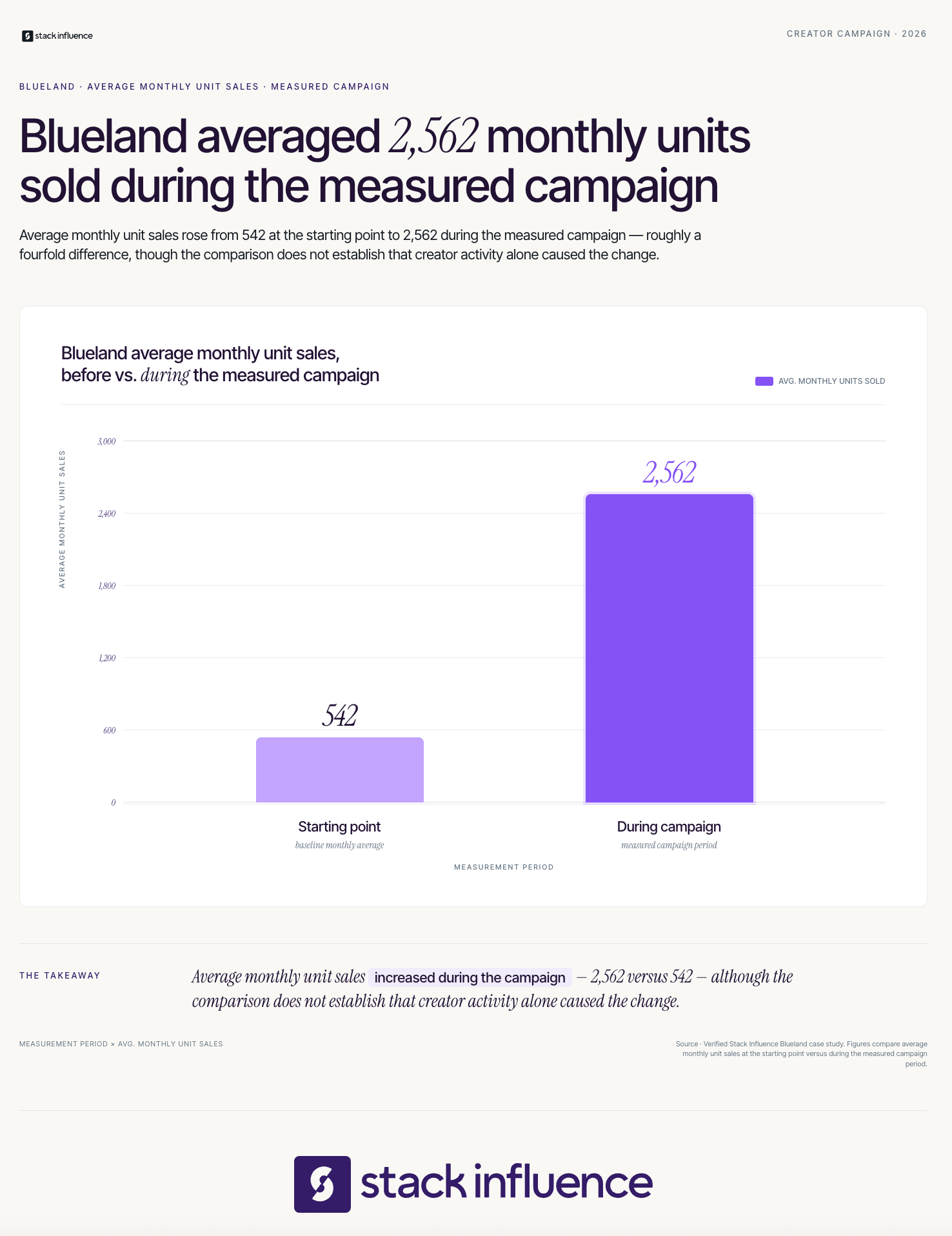
A verified Stack Influence Blueland case study recorded average monthly unit sales increasing from 542 to 2,562 during the campaign, while Amazon Best Seller Rank moved from #36,544 to #5,808. The campaign included 211 creator promotions, 247,000 social impressions, and 11,000 engagements. These changes occurred during the campaign and do not prove that creator activity alone caused every marketplace result.
The example shows the purpose of the Growth Gate: supply and offer economics create the foundation, while coordinated demand generation can add content and measurable traffic. Results vary by product, category, price, inventory, competition, creative, and execution.
Brands can review Stack Influence’s Amazon influencer marketing workflow, while internal teams can use this guide to Amazon seller influencer partnerships.
The Wholesale Control Tower
The Wholesale Control Tower is a four-layer measurement model connecting documentation, offer performance, inventory, and financial outcomes. It prevents sellers from treating revenue as the only signal and distinguishes an ASIN growing safely from one consuming cash while authorization, price, or replenishment deteriorates.
Track four layers:
- Compliance: Eligibility, authorization, invoice readiness, certificates, and account-health notices.
- Offer: Featured Offer percentage, total price, seller count, delivery, in-stock rate, and return reasons.
- Inventory: Units on hand, days of cover, sell-through, lead time, reorder point, and aged stock.
- Financial: Contribution profit, contribution margin, cash conversion, inventory return, refunds, and marketing-adjusted profit.
For eligible brand-led campaigns, add Amazon Attribution metrics such as clicks, detail-page views, add-to-cart activity, purchases, units sold, and product sales. Amazon reports a 14-day attribution window, but attribution does not prove that one channel caused every observed change.
Use a weekly operating review for stock, price, offer share, inbound status, and account issues. Use a monthly or 90-day buying review for realized contribution, supplier reliability, sell-through, returns, and whether the next order still clears all Five Gates.
- Green: Documentation, margin, price stability, inventory turns, and replenishment are healthy.
- Yellow: Demand exists, but price volatility, slower sell-through, or supplier delays justify a smaller order.
- Red: Authorization is unclear, contribution is negative, demand is collapsing, or replenishment is unreliable.
Common Amazon Wholesale Mistakes
The most expensive Amazon wholesale mistakes occur before inventory reaches a fulfillment center. Sellers protect capital by making documentation, downside economics, listing control, and replenishment purchase requirements rather than problems to solve after ordering.
Avoid these errors:
- Buying before approval: Supplier availability does not guarantee Amazon eligibility.
- Confusing invoices with authorization: A transaction document may not prove marketplace permission.
- Using gross margin as profit: Freight, fees, fulfillment, storage, returns, and financing can erase the spread.
- Assuming the lowest price always wins: Delivery, customer experience, stock, and total price also matter.
- Ordering to the supplier’s MOQ: A minimum order is not a demand forecast.
- Ignoring shared-listing control: Another party may change content, distribution, or marketing access.
- Reordering from revenue alone: Sales can rise while contribution and cash efficiency deteriorate.
- Forecasting brand-only benefits: Attribution, Brand Stores, referral bonuses, and creator workflows require current eligibility or authorization.
Build a Defensible Amazon Wholesale Business
A durable Amazon wholesale business is built on more than buying recognizable products at a discount. The seller must establish traceable supply, pass the Five-Gate Amazon Wholesale Test, protect contribution margin, choose fulfillment by ASIN, and monitor control as closely as demand.
Start with one narrow category and a test-sized order. Keep documentation audit-ready, reconcile projected and actual economics, and expand only when replenishment and offer performance remain stable. When an authorized brand relationship supports external demand generation, evaluate a managed product-seeding and creator-content workflow that connects available inventory with completed UGC and measurable marketplace traffic.