



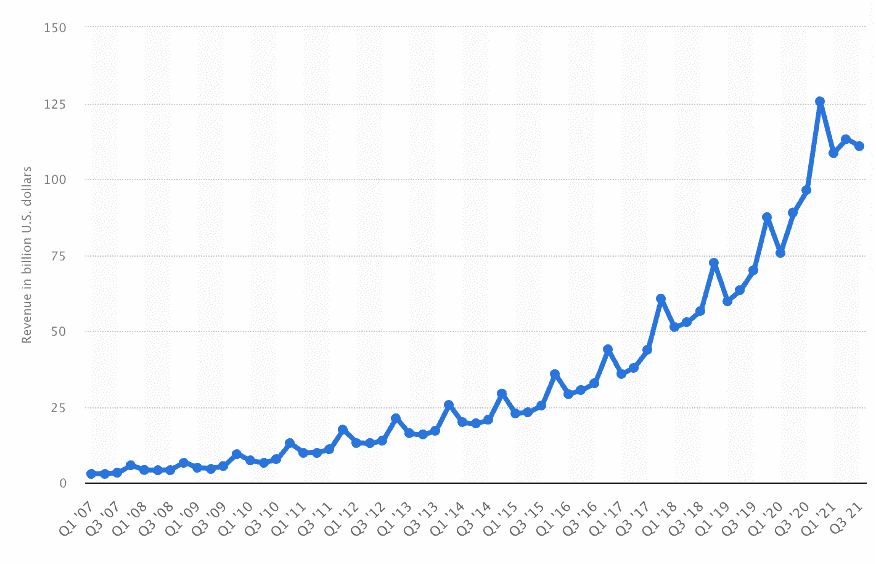
Amazon generated over $110.8 billion in sales in Q3 2021.
And in the near future, this number has been predicted to keep crossing its all-time highs, all thanks to Amazon’s ever-increasing popularity and more and more third-party sellers kickstarting their venture on the platform.
However, it’s crucial to note that not all these sales are driven by Amazon’s organic or paid search. Instead, you’ll be shocked to learn that third-party sellers attract a huge chunk of traffic to their Amazon listings via numerous off-platform sources like organic search, paid ads, referral, social media, etc.
While we don’t have concrete data for the same, we hopped onto SimilarWeb to gain insights into the different traffic sources. And here’s what we found out:
Results:
- Direct – 58.51%
- Referrals – 6.57%
- Search – 27.53%
- Social – 4.56%
- Mail – 2.47%
- Display – 0.37%
NOTE – Not all search or social traffic are driven by sellers advertising their Amazon product listings. But this will help you get an idea.
However, until recently, one of the big problems Amazon sellers faced was tracking and measuring the impact of off-Amazon advertising channels on their sales. This means – they find it really hard to distinguish direct Amazon traffic from off-platform ones.
If you have been facing the same problem, we’ve some good news for you. Now, you can not only track off-platform data with Amazon Attribution links but also tap into Amazon’s Brand Referral Bonus program – which is a brilliant opportunity for brands to earn a bonus by focusing on off-platform Amazon advertising.
In this blog post, we’d love nothing more than to share more information about:
- Amazon Attribution Links
- Amazon Brand Referral Program
Despite Amazon encouraging third-party sellers to drive traffic to their Amazon listings, not many sellers are fully aware of it. That’s the reason we wanted to craft and roll out this blog post.
Let’s dive deeper into both one by one.
What are Amazon Attribution Links?
Let’s say you made 500 sales last month. Out of these 500 let’s assume that about 100 were Amazon-PPC driven. But now, you have 400 sales in your bucket, which will make you think – what percentage of these sales occurred from Amazon search, Google Ads, Social Ads, influencer marketing referral, or other sources.
And until recently, there was no concrete way of determining this. Literally, if you had developed a platform to help us track this data a few months back, we’d have gladly paid you $1,000 for it.
Luckily, Amazon acknowledged this problem and rolled out Amazon Attribution Links – which is Amazon’s in-house, cutting-edge tool that can help businesses (third-party Amazon sellers) gain insights into how off-Amazon channels like social media, search, PPC, referrals, email marketing are impacting their sales on Amazon. And that’s not all.
This tool can even track traffic that was sent to a different website which ultimately converted on Amazon. And the best part is – you don’t have to pay even a single dime to access the tool. It’s completely free.
You can access Amazon Attribution via Amazon’s self-service console or with tools that integrate with Amazon Advertising API. While that’s good news for Amazon sellers, there’s some temporary bad news as well.
This tool is available to:
- Amazon sellers enrolled in Amazon brand registry
- Vendors across Canada, US, UK, Spain, France, Germany, Italy
But that’s subject to change. So, we’d advise you to hold tight.
This tool can help you track various metrics, including total sales, add to cart, purchase rate, detailed page views, impressions, and click-through.
That being said, Amazon itself is encouraging third-party sellers to focus on their off-platform advertising and drive traffic to their Amazon listings from different sources. When I used the word “encouraging,” I really mean it – that’s because Amazon is offering sellers incentives to drive traffic to their Amazon listings from off-platform channels, all thanks to its Amazon Brand Referral program.
What is Amazon Brand Referral Program?
Introducing the most aggressive incentive program rolled out by Amazon to date – Brand Referral Program. This program encourages sellers to drive traffic to their Amazon listings from non-Amazon marketing efforts by giving them a bonus of 10%, on average, for every sale made via an off-Amazon source.
This 10% (on average) bonus is credited on the seller’s referral fee. And right now, Amazon is laser-focused on encouraging sellers to drive traffic to their listings from non-Amazon sources. Maybe, the retail giant has already realized the importance of this move and its long-term benefits.
That’s the reason Amazon Brand Referral Program gives bonuses to sellers even if the customer purchases the same product again for up to 14 days – starting from the day when the buyer was redirected to the listing.
For different products and categories, the Bonus Rate varies, which is why we’re about to present a table that includes different categories with their estimated bonus rates alongside them:
Influencer marketing has predominantly been used by online eCommerce sellers to promote products or services, but recently Amazon sellers have started to use influencer marketing to boost their product listing rankings and to accumulate user-generated content for their brands. If you are an Amazon seller looking to increase your brand presence online, get a stream of initial sales or get user-generated content to utilize in advertising, social media or other marketing initiatives, then you should definitely consider flirting with the idea of an influencer marketing campaign.
Influencers don’t have to be users who have massive followings, either. There have now become different terms for various influencers (i.e. micro-influencers, mega-influencers, etc.). As an Amazon seller, I would personally recommend working with “micro-influencers” – social media users with 1,000 – 10,000 followers who are willing to promote your brand in exchange for a free product instead of getting paid. You could hire a macro-influencer (10k - 100K followers) or a mega-influencer (100K+ followers), but you will end up shelling out hundreds or thousands of dollars for a single post that will most likely be taken down after a day. There are numerous benefits to working with micro-influencers as an Amazon seller which include higher engagement rates, lower expenses and more reusable branded content to name a few.
Influencer marketing has predominantly been used by online eCommerce sellers to promote products or services, but recently Amazon sellers have started to use influencer marketing to boost their product listing rankings and to accumulate user-generated content for their brands. If you are an Amazon seller looking to increase your brand presence online, get a stream of initial sales or get user-generated content to utilize in advertising, social media or other marketing initiatives, then you should definitely consider flirting with the idea of an influencer marketing campaign.
Influencers don’t have to be users who have massive followings, either. There have now become different terms for various influencers (i.e. micro-influencers, mega-influencers, etc.). As an Amazon seller, I would personally recommend working with “micro-influencers” – social media users with 1,000 – 10,000 followers who are willing to promote your brand in exchange for a free product instead of getting paid. You could hire a macro-influencer (10k - 100K followers) or a mega-influencer (100K+ followers), but you will end up shelling out hundreds or thousands of dollars for a single post that will most likely be taken down after a day. There are numerous benefits to working with micro-influencers as an Amazon seller which include higher engagement rates, lower expenses and more reusable branded content to name a few.
Influencer marketing has predominantly been used by online eCommerce sellers to promote products or services, but recently Amazon sellers have started to use influencer marketing to boost their product listing rankings and to accumulate user-generated content for their brands. If you are an Amazon seller looking to increase your brand presence online, get a stream of initial sales or get user-generated content to utilize in advertising, social media or other marketing initiatives, then you should definitely consider flirting with the idea of an influencer marketing campaign.
Influencers don’t have to be users who have massive followings, either. There have now become different terms for various influencers (i.e. micro-influencers, mega-influencers, etc.). As an Amazon seller, I would personally recommend working with “micro-influencers” – social media users with 1,000 – 10,000 followers who are willing to promote your brand in exchange for a free product instead of getting paid. You could hire a macro-influencer (10k - 100K followers) or a mega-influencer (100K+ followers), but you will end up shelling out hundreds or thousands of dollars for a single post that will most likely be taken down after a day. There are numerous benefits to working with micro-influencers as an Amazon seller which include higher engagement rates, lower expenses and more reusable branded content to name a few.
Influencer marketing has predominantly been used by online eCommerce sellers to promote products or services, but recently Amazon sellers have started to use influencer marketing to boost their product listing rankings and to accumulate user-generated content for their brands. If you are an Amazon seller looking to increase your brand presence online, get a stream of initial sales or get user-generated content to utilize in advertising, social media or other marketing initiatives, then you should definitely consider flirting with the idea of an influencer marketing campaign.
Influencers don’t have to be users who have massive followings, either. There have now become different terms for various influencers (i.e. micro-influencers, mega-influencers, etc.). As an Amazon seller, I would personally recommend working with “micro-influencers” – social media users with 1,000 – 10,000 followers who are willing to promote your brand in exchange for a free product instead of getting paid. You could hire a macro-influencer (10k - 100K followers) or a mega-influencer (100K+ followers), but you will end up shelling out hundreds or thousands of dollars for a single post that will most likely be taken down after a day. There are numerous benefits to working with micro-influencers as an Amazon seller which include higher engagement rates, lower expenses and more reusable branded content to name a few.
However, it’s important to note that this program is only applicable for Brand registered sellers. And if you haven’t already registered your brand yet, you can click HERE to do so.
Amazon Brand Referral Program + Amazon Attribution Links –
A Match Made in Heaven
Amazon has finally realized the long-term value of allowing sellers to attract traffic to their listings from non-Amazon marketing channels. And rolling out its brand referral program and launching their Attribution Links is no coincidence.
It’s a match made in heaven. With Amazon’s Attribution Links, you can track the exact number of people you drove to your listing via non-Amazon marketing channels – this means you don’t have to worry about the tech giant not giving you the credits you deserve.
No technical glitches! Nothing! It’s a fair game for Amazon third-party sellers and now Amazon wants you to leverage it.
Amazon Attribution Links also work perfectly with Stack Influence campaigns which drive traffic from social sources to Amazon listings. Now you can get a kick back from Amazon for running marketing campaigns with the Stack Influence platform. Don’t miss out on this incredible opportunity to track Amazon sales with influencer promotions and save money while doing so!
Sign up for a Stack Influence campaign today.