




A creator publishes an excellent product demonstration. The comments look promising. Your Amazon sales move, but so did your advertising spend. Should you commission another batch of posts?
Amazon micro influencer campaigns become easier to manage when that decision is designed before the first product leaves your warehouse. For ecommerce sellers, the goal is not simply to collect mentions. It is to connect relevant creators, useful content, a working purchase path, and evidence strong enough to guide the next commitment.
This guide explains how to structure the campaign, budget in stages, brief creators, protect reuse rights, and evaluate results without confusing completed posts with profitable customer demand.
Key Takeaways
- Commit campaign spending in stages so early delivery problems can be corrected before more creator work is booked.
- Specify social posts, reusable content, and affiliate participation separately because buying one does not automatically secure the others.
- Evaluate completed deliverables, audience purchases, and content reuse separately rather than combining them into one performance claim.
- Keep customer reviews outside creator compensation agreements and give each reporting period enough time to capture later purchases.
The Release-and-Review Plan for Amazon Micro Influencer Campaigns
An Amazon micro influencer campaign is a coordinated partnership with smaller-audience content creators to demonstrate products and direct relevant shoppers toward Amazon. Product seeding, agreed social posts, licensed user-generated content, and affiliate participation can form different parts of the campaign. Define which parts you are actually purchasing before choosing creators.
Do not confuse this arrangement with enrollment in the Amazon Influencer Program, which gives participating creators a curated Amazon presence and a way to earn from qualifying purchases. A creator's Amazon storefront is not the same deliverable as a social video or permission to reuse that video in advertising.
The Release-and-Review Plan connects four decisions:
- Choose the buying question. Select a product, audience, and objection the content should resolve, such as whether a backpack holds a particular laptop and daily accessories.
- Commit a first wave. Agree on creators, deliverables, product access, rights, timing, and the spending you are prepared to commit before seeing results.
- Review delivery and demand separately. Check whether the promised content appeared, then assess the purchase evidence after an appropriate observation period.
- Release the next commitment. Continue, revise the brief, or pause future bookings according to criteria established beforehand.
Stack Influence's Amazon campaign workflow connects gifted-first product seeding with creator coordination and completed-post tracking. Its completions-only model illustrates an important distinction: accountability for an agreed social deliverable is not a guarantee of sales or ranking improvement.
Choose one primary success condition before launch. For a sales-led campaign, that might be customer contribution after campaign costs; for a content-led campaign, it might be usable, properly licensed demonstrations addressing specific purchase objections. The IAB's 2025 creator advertising research found that 32% of surveyed buyers identified online sales or conversions as a creator-campaign goal, underscoring that sales and broader communication objectives should not be treated as interchangeable.
What Should You Budget Before Inviting Creators?
Budget for the complete agreed workflow, not just the advertised creator or platform charge. Include product access, shipping or reimbursement, coordination, any creator cash fees, content permissions, editing, and measurement work; add commissions and paid amplification when those are part of the agreement.
Direct gifting and purchase reimbursement require different accounting. A shipped sample consumes inventory and fulfillment resources, while reimbursement creates a separate cash obligation and may involve marketplace transaction costs. Confirm the applicable platform policies and payment terms rather than assuming every product-access arrangement is equivalent.
When evaluating automated product seeding, ask what triggers each charge, which expenses remain payable after noncompletion, and whether future waves are already contractually committed. A staged calendar provides little budget flexibility when the entire campaign is noncancelable.
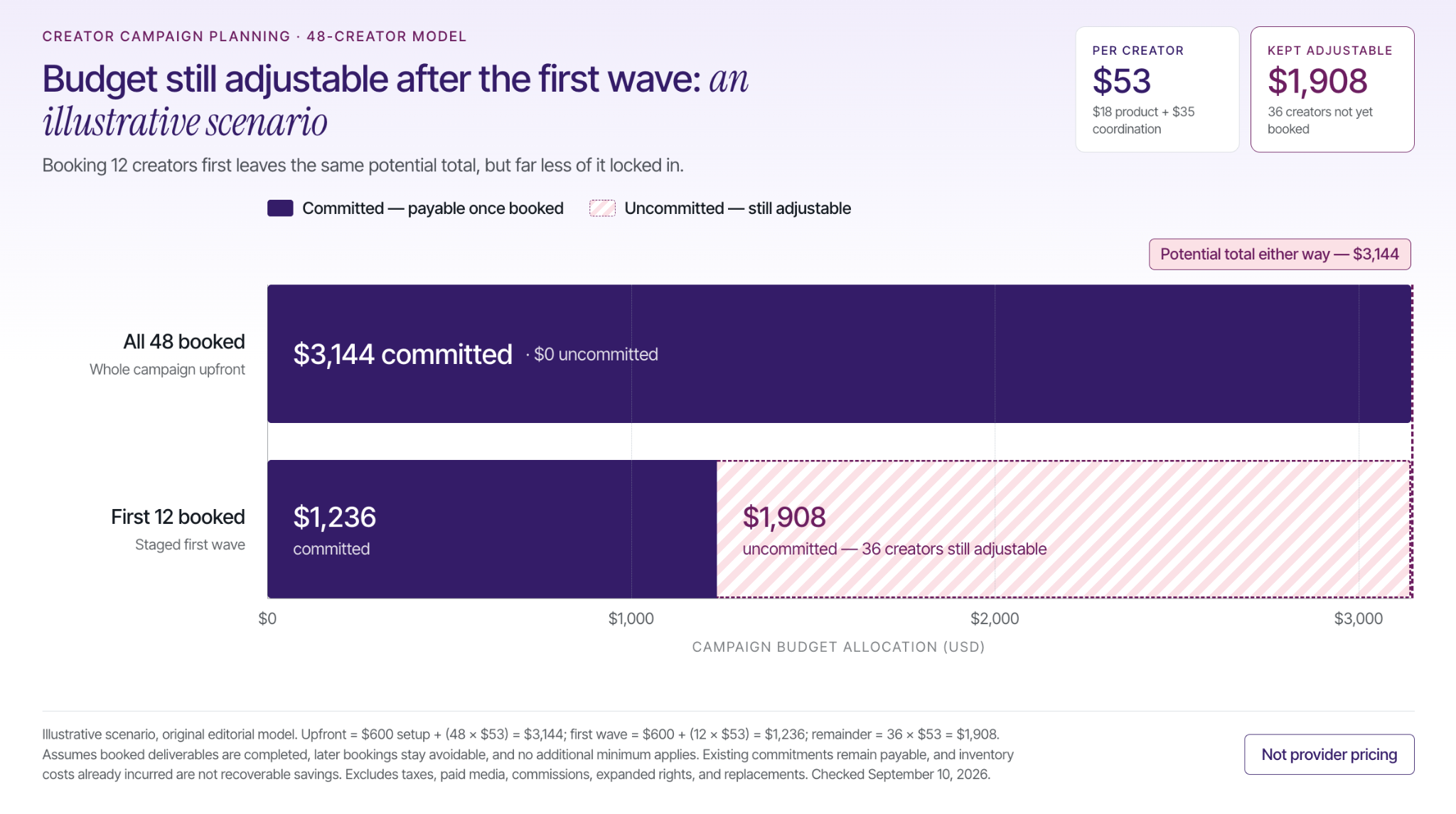
An Illustrative Budget-Commitment Example
Consider a hypothetical direct-gift campaign with 48 planned creators, $600 in fixed setup costs, and $53 in variable cost per creator. The variable amount comprises $18 for product and shipping plus a $35 coordination-and-deliverable allowance. These are illustrative planning assumptions, not Stack Influence prices, market benchmarks, or a recommended minimum.
Booking all 48 creators immediately commits $3,144: $600 + (48 × $53). Booking only a first wave of 12 commits $1,236: $600 + (12 × $53). The remaining 36 creators represent $1,908 that has not yet been committed.
Both approaches have the same $3,144 potential total. The difference is $3,144 committed and $0 adjustable under the upfront approach, versus $1,236 committed and $1,908 adjustable under the staged approach.
The illustration assumes all booked deliverables are completed, later creators and their product costs remain avoidable, and no additional minimum commitment applies. It excludes taxes, paid media, commissions, expanded rights, and replacement costs. Existing inventory expenditure does not become recoverable simply because a later wave is canceled.
Staging is therefore a way to preserve future choices, not a discount or a promise of better returns. Honor every existing agreement and earned deliverable payment regardless of whether the campaign produces the sales you hoped for.
Build the Creator Brief Around a Buying Objection
Select creators for the product explanation they can credibly deliver, not simply their follower count. Micro influencers and nano influencers are useful audience-size descriptions, but neither label proves that a creator reaches your intended Amazon shopper.
Review recent product demonstrations, the audience's likely shopping location, comments about practical use, and whether the creator can show the product in a relevant setting. Compare several recent posts rather than choosing from one unusually successful video. Stack Influence's guide to finding Amazon influencers provides a broader sourcing process for that evaluation.
For a backpack, one creator might demonstrate laptop fit, another might show an everyday packing routine, and another might explain organization during travel. Those are different purchase questions, not three versions of an identical endorsement. Keep the initial product and offer reasonably consistent so changes in the brief remain interpretable.
Write a Deliverable That Can Be Checked
The invitation should identify the product, expected format, publishing destination, value exchange, deadline, revision scope, and required disclosures. The accepted brief should also name the intended Amazon destination and the person responsible for providing and checking the link.
For example, request an original demonstration showing the product in use and answering an agreed practical question. Specify whether the creator must publish it, deliver the original file, or do both. Do not prescribe an opinion the creator must express or claims they cannot substantiate.
A UGC production workflow and a distribution campaign solve different problems. Content-only creators may deliver useful assets without publishing to an audience; a published post may not include the files or permissions your advertising team needs. Put both requirements in the agreement when both matter.
Secure Reuse Rights Before Production
Obtain permissions for the channels and uses you actually plan to test. The U.S. Copyright Office's ownership guidance explains that creators generally own copyright in their original work, subject to exceptions such as qualifying work-made-for-hire arrangements. Product gifting alone should not be treated as permission for unlimited reuse.
Record the license duration, territories, organic and paid uses, Amazon or Shopify placements, editing permissions, and renewal terms. Keep the agreement attached to the delivered file rather than leaving permission scattered across messages. A documented UGC licensing process helps the next person using the asset understand its boundaries.
Check music separately from the creator's own footage. TikTok's commercial music guidance recommends its Commercial Music Library for promotional content. Do not assume permission for music on one platform extends to an Amazon product video or another advertising channel.
Keep Social Endorsements Separate From Customer Reviews

Make disclosure and review restrictions part of the brief, not a correction after publication. The FTC's disclosure guidance treats free products and other material connections as relationships that can require disclosure. Disclosures should be easy to notice with the endorsement; video disclosures belong in the video rather than only in its description.
Ask creators to describe their real experience and review the completed post for required disclosures and unsupported claims. A platform's disclosure tool is useful, but it should not replace checking whether viewers can actually understand the relationship.
An Amazon customer review is a separate activity from a social endorsement. Amazon's product-review policy guidance prohibits offering compensation, refunds, or free products in exchange for customer reviews. Do not make an Amazon review, a particular rating, or review removal a campaign deliverable.
Keep product-access transactions separate in your analysis too. A creator obtaining a reimbursed product is not evidence that an independent shopper chose to buy after seeing the content. Do not describe sampling transactions as customer acquisition or use the campaign to manufacture favorable reviews or ranking signals.
Launch With an Explicit Pause Rule
Before the first post, check the exact ASIN and variation, stock availability, price, delivery promise, and mobile purchase path. Whether orders use Amazon FBA or another fulfillment method, the product shown should match what shoppers can actually purchase. Resolve listing or availability problems before sending additional traffic.
Sequence each wave around product receipt, sufficient time for genuine use, publication, and reporting. A calendar deadline should not pressure creators to claim experience they have not had. Keep one campaign record connecting each creator to the agreed deliverable, live post, final asset, disclosure check, destination link, and payment status.
Use immediate checks for execution failures and later checks for commercial decisions. Pause new bookings when links are wrong, inventory becomes unavailable, required disclosures are missing, or the content repeatedly misses the brief. Those problems do not require waiting for a sales report.
Avoid changing creators, product variations, discounts, and creative instructions simultaneously after a disappointing first wave. Correct the clearest failure first, then document what changed. Otherwise, the next wave may perform differently without teaching you why.
For a small roster, a seller may own these tasks directly. When comparing an influencer marketing agency, micro influencer agency, or platform, ask who performs each task and what evidence the brand receives; the Amazon influencer platform comparison distinguishes different approaches to campaign execution.
Scale also means sustaining coordination over time. During a six-month Stack Influence campaign for NYK1, the brand recorded 483 creator promotions and an increase in average monthly unit sales from 482 to 2,965. Those aggregate results illustrate campaign scope, not a per-creator sales forecast or proof that creator activity alone caused the increase.
How Do You Measure Results Without Overstating Sales?
Measure three things separately: delivery of the agreed work, audience purchasing behavior, and subsequent use of licensed content. Together they inform the next investment decision, but they are not interchangeable evidence of profitability.
For eligible accounts, Amazon Attribution provides free measurement of non-Amazon marketing, with metrics including clicks, detail page views, add-to-carts, purchases, and product sales. Confirm access for your account and marketplace before promising creator-level sales reporting.
Select the promoted products in Attribution, generate separate tags for the creator placements you need to compare, and put the resulting URLs in the agreed clickable destinations. Maintain a creator-to-link register, test the final destination, and distinguish traffic you can measure from exposure you cannot. When affiliate participation is included, confirm an approved link setup that respects both the creator's commission arrangement and the seller's measurement needs. Do not improvise by combining identifiers and assuming both systems will work.
Compare Creator Waves With Comparable Follow-Up
Use the time since relevant clicks, not simply the time since the campaign began, to judge whether a sales report is ready. Amazon's attribution methodology uses a 14-day, last-touch model, so a conversion must occur within 14 days of the credited click. A late campaign wave should not be judged against an older wave with a longer purchasing window.
Consider a separate illustrative reporting example reviewed on campaign day 28. Suppose the final tagged clicks for three creator waves occurred on days 7, 14, and 21, with no later clicks. At the review, those waves have 21, 14, and 7 days of follow-up respectively.
Against a 14-day window, the first two waves have completed the observation period, but the third needs 7 more days, reaching day 35. Additional reporting processing and returns can still affect the eventual figures. This example describes timing, not expected conversions, and completed follow-up does not make a small sample conclusive.
Separate Leading Signals From Business Outcomes
Completed posts, valid links, and usable assets establish whether the campaign was delivered. Relevant comments, clicks, and product-page visits are earlier signals of audience response. Purchases and contribution after costs are later commercial outcomes.
If posts attract attention but little traffic, inspect the call to action and purchase path. If visitors reach Amazon but rarely buy, investigate audience intent, the offer, product information, and availability before assuming that additional creators will solve the problem. The wider Amazon external traffic playbook helps connect those diagnostics with other acquisition channels.
Treat attributed sales as revenue associated with the measured journey, not automatically incremental revenue caused by the campaign. Record concurrent advertising, promotions, stock changes, and seasonality; a comparable baseline or suitable holdout can strengthen interpretation, although neither automatically removes every confounding factor. Best Seller Rank movement alone is not a causal test.
Reconcile Contribution, Credits, and Content Value
Calculate contribution after product costs, marketplace and fulfillment fees, discounts, and returns, then subtract campaign expenses. Report spending on reusable content separately when it serves a different objective. Do not add an invented content valuation to sales and label the sum campaign ROI.
Eligible enrolled sellers can also earn the Amazon Brand Referral Bonus, which Amazon describes as averaging 10% of qualifying sales. The amount varies, and the benefit is a credit against future referral fees rather than an immediate cash payment; Amazon describes a general two-month waiting period. Use confirmed credits in reconciliation rather than assuming every creator-attributed order earns a flat 10%.
Return to the Release-and-Review Plan before authorizing another wave. Was the work delivered, did the reporting period provide a fair comparison, and does the evidence support the next commitment? A campaign can produce useful content without yet justifying a larger customer-acquisition budget.
Make the Next Wave Earn Its Budget
Amazon micro influencer campaigns are easier to improve when product access, creator commitments, content rights, and purchase measurement are designed together. Begin with a specific buying question, preserve flexibility where agreements allow it, and judge each wave using evidence suited to its purpose.
Before expanding, write down what the next group of creators will demonstrate and what would justify continuing. Bring that brief to a Stack Influence campaign discussion to turn a general interest in creator marketing into a defined product-seeding workflow with clear deliverables and reporting expectations.