
The latest info on influencer marketing trends, micro influencer news, and the world of social media

Instagram’s new Edits video-editing app (launched Jan 19, 2025) arrives just as TikTok’s future grows uncertain. We compare Instagram Edits vs. CapCut on features, usability, pricing, and integrations to see if Edits can become the go-to tool for micro-influencers creating branded content.
Instagram just dropped a new video-editing app called Edits, and it might be the thing micro-influencers have been waiting for. The timing isn’t random – with TikTok facing a potential ban in the U.S., content creators are worried about their favorite tools disappearing according to Influencer Marketing Hub. CapCut, TikTok’s sibling editing app, got caught in the crossfire too, even being unlisted from U.S. app stores amid the ban scare. In response, Meta (Instagram’s parent company) swiftly launched “Edits” as a direct alternative to CapCut. Instagram’s head Adam Mosseri announced Edits on January 19, 2025, via an Instagram Reel, positioning it as a comprehensive editing suite for creators. So, with TikTok’s future shaky and CapCut’s fate uncertain, can Instagram Edits replace CapCut for influencers? Let’s dive in.
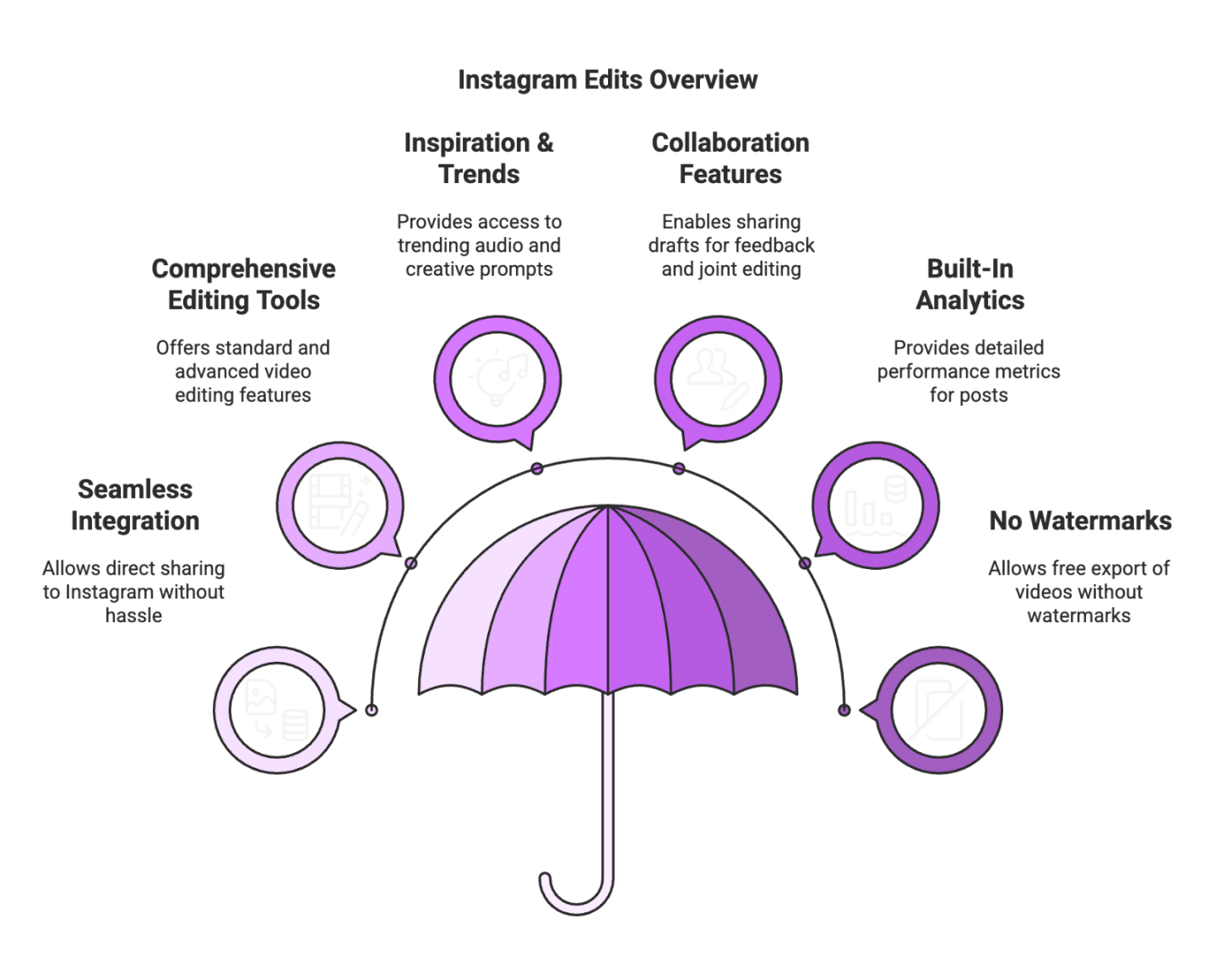
Instagram Edits is a standalone mobile video-editing app by Meta, built to keep creators within the Instagram ecosystem. Think of it as Instagram’s answer to third-party editors like CapCut or InShot – but with tighter integration to IG. Mosseri calls Edits a “full suite of creative tools” for serious mobile creators according to Buffer. Unlike Instagram’s built-in Reel editor, Edits is a separate app you can download and use to create content, then publish to Instagram (or elsewhere). Here are some key things to know about Edits:
Edits officially releases in March 2025 (with early access for some testers) according to Delivered Social. The first version might not have everything (Mosseri hinted it will be “incomplete” initially), but Instagram plans to update it with more features over time. In essence, Edits is Instagram’s power play to keep creators editing within Instagram’s world – especially those who might abandon ship if TikTok (and by extension CapCut) becomes unavailable.
CapCut is a wildly popular mobile video editor developed by ByteDance – the same company behind TikTok. In fact, you can think of CapCut as TikTok’s editing sidekick. It rose to fame by offering powerful, free editing tools that anyone could use to make polished videos, with no watermark and a user-friendly vibe. As of early 2025, CapCut boasts over 200 million monthly active users, making it a go-to app for TikTokers and beyond.
Originally known as “Viamaker” before rebranding, CapCut has a reputation for being feature-rich. Key CapCut highlights include:
CapCut’s close integration with TikTok is a huge draw for TikTok influencers – you can export videos optimized for TikTok and even share directly. But that tight connection to ByteDance is also a weakness in the current climate. If TikTok gets banned or restricted, CapCut could be affected as well (as we saw with the temporary App Store removal in the U.S.). This puts creators in a tough spot, which is why many are eyeing Instagram Edits as a possible replacement.
So how does Instagram Edits stack up against CapCut in practical terms? Below is a direct comparison of the two apps on features, usability, pricing, and integrations:
- Full creative suite with standard editing tools (trim, text, filters) and some advanced extras (AI animations, green screen).
- High-quality camera built-in for shooting up to 1080p/60fps (2K max) video.
- Inspiration hub for trending audios & ideas within IG.
- Draft sharing & collab tools + built-in IG analytics for performance.
- Advanced editor with multi-layer timeline, overlays, transitions, and rich effects library
- AI tools like auto-captions, background removal, and suggested templates.
- Huge template library tuned to TikTok trends (one-tap apply).
- Extensive audio library of music/sound clips, plus effects like beat sync.
- 4K 60fps support for high-res exports (pro-level quality).
- Ease of use: Very beginner-friendly interface for quick edits. Clean layout similar to Instagram’s style.
- Learning curve: Low for IG users; fewer advanced options means it’s simpler overall.
- Workflow: Designed to create Reels/Stories fast and share without leaving app. Great for quick, snackable content.
- Ease of use: Mix of basic and advanced – accessible to beginners, but the abundance of features can be overwhelming.
- Learning curve: Moderate. New users can do simple edits easily, but mastering all the tools (e.g. keyframes, chroma key) takes time.
- Workflow: Optimized for TikTok content creation, but can be used for any platform. Extra steps needed to share to Instagram or others (export, then upload).
- App cost: Free (no watermark on exports, no paywall on features as of launch)
- Monetization: No paid tier yet; future updates could add premium features, but currently all creators have equal access.
- Value: High – offers pro-grade tools and analytics at no cost, making it ideal for budget-conscious micro-influencers.
- App cost: Free for core features no forced watermark on standard exports.
- Premium: Offers CapCut Pro subscription (~$7.99/month) for extras: larger cloud storage, exclusive effects, stock media, etc. (Not mandatory for quality editing, but nice to have for power users.)
- Value: Excellent – even the free version provides nearly all you need for high-quality videos.
- Instagram Integration: Seamless. Edits is essentially part of the IG ecosystem – one-tap posting to Reels/Stories/feed in full quality. Drafts and projects sync with your Instagram account (and possibly cloud) for easy management.
- Other Platforms: Manual export is available (1080p video file without watermark), so you can post to TikTok, YouTube Shorts, etc. However, there’s no direct-share button to competitor apps (understandably). Edits is primarily meant to keep you on IG.
- TikTok Integration: Excellent. CapCut was made for TikTok – you can directly share to TikTok, and many templates and sounds are straight from TikTok trends.
- Cross-Platform: Works across mobile, desktop, and web, making it easy to integrate into different workflows (e.g., edit on PC for YouTube, on phone for TikTok).
- Social Sharing: Supports exporting in various aspect ratios and formats for Instagram, YouTube, etc., but requires you to switch apps and upload manually.
As you can see, Edits excels in Instagram-native features like seamless sharing and built-in analytics, whereas CapCut shines with advanced editing power and TikTok-centric tools. There’s a bit of trade-off: Edits keeps things simple and integrated (great for IG creators), while CapCut offers more complexity and flexibility (great for multi-platform creators or those needing pro features).
How are creators feeling about Instagram Edits? Let’s look at some opinions from the influencer community and real-world scenarios, especially for micro-influencers who often create branded content:
Overall, early reactions show optimism that Edits will slot right into the workflows of Instagram-centric creators. However, some pro editors note that for long-form or very complex projects, CapCut (or desktop software) still has an edge. Edits is mobile-only and tailored to short-form content (Instagram caps Reels at 90 seconds, though Edits allows editing up to 10-minute videos for future flexibility). A YouTuber with a 10-minute vlog might not ditch their PC editor for Edits just yet. But for the bread-and-butter of influencer content – those snappy videos for social media – Edits is poised to shine.
For influencers, using the right keywords in your video captions and descriptions can boost reach. An app like Edits might help by integrating Instagram’s keyword and hashtag suggestions (especially via the inspiration tab that shows trending topics). As TikTok’s fate is debated, keywords like “Instagram Reels”, “Reels trends”, and “TikTok alternative” have spiked in search interest. Influencers may want to sprinkle these into their content strategy.
From this blog’s perspective, we’ve included relevant terms such as Instagram Edits app, CapCut vs Edits, video editing for influencers, and TikTok ban. The meta description at the top of this post is crafted to be rich in those keywords while remaining concise (about 150 characters), helping search engines understand our content. We also used clear headings (like “What is Instagram Edits?”) – which not only improve readability but also SEO, as search algorithms often treat headings as important cues.
Readability is crucial: note how we’ve kept paragraphs short, used bullet points for scanning, and added a comparison table. These elements not only engage readers but also rank well with Google’s emphasis on user experience. Plus, the inclusion of alt text on images (e.g., the screenshot above) can slightly aid image search SEO and accessibility. In a nutshell, whether you’re optimizing a blog or an Instagram caption, it pays to think about structure and keywords – just like we did here.
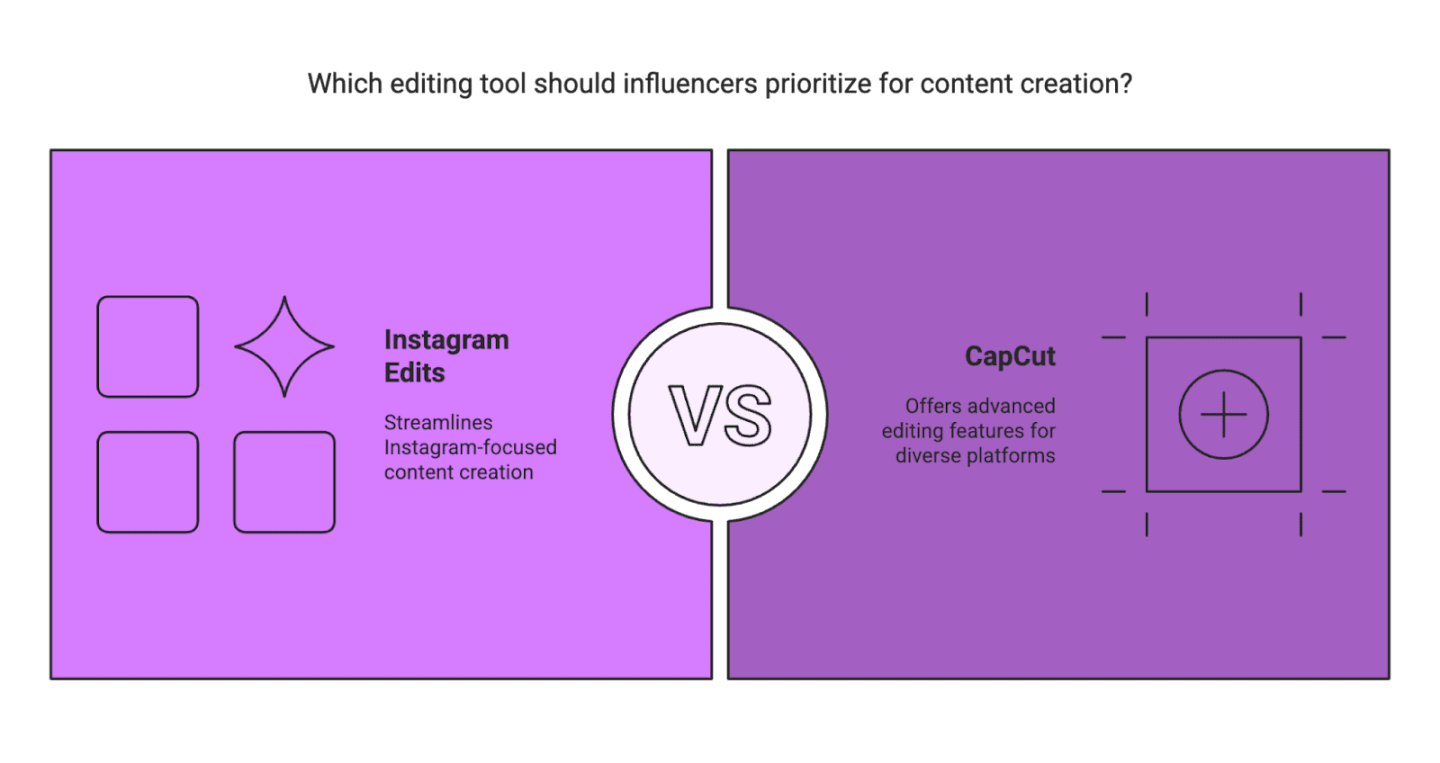
So, can Instagram Edits replace CapCut for influencers? The answer depends on your needs, but for many micro-influencers focused on Instagram, Edits is poised to become the primary tool.
Recommendation: If you’re a micro-influencer producing branded content primarily for Instagram, give Edits a try as your main editing tool. It will simplify your workflow and integrate your creation process with the platform that hosts your audience. Keep CapCut in your toolkit for now, especially for any non-IG projects or if you need something Edits lacks. Over time, you might find yourself opening CapCut less and less as Edits expands its capabilities. On the other hand, if you’re deeply embedded in TikTok culture or need the ultra-polished tricks CapCut offers, you might use both: Edits for quick IG-specific posts, and CapCut for everything else.
In the ever-evolving social media landscape, adaptability is key. Instagram Edits arrives at a perfect moment – offering a safe harbor for creators amid uncertainty. It’s Instagram’s play to become the one-stop-shop for content creation according to Value Your Network. Influencers should take advantage of this new tool and see how it fits their style. Who knows? The next viral Reel might just be edited entirely in Edits, not CapCut. As we move into 2025, one thing is clear: when it comes to mobile video creation, competition is heating up, and creators stand to win. Happy editing! 📱🎬
Influencer marketing in 2026 looks very different from just a few years ago. Meta (the parent company of Facebook and Instagram) has been doubling down on artificial intelligence to make life easier for brands and creators. From smarter ad targeting to AI-generated content, Meta’s platforms are brimming with new features that can supercharge campaigns. In this post, we’ll explore Meta’s latest AI tools for influencers, compare them to earlier versions, and walk through a step-by-step guide on using these tools effectively. The tone is casual yet informative – think of it as chatting with a knowledgeable friend who’s excited about the future of marketing tech. Let’s dive in!
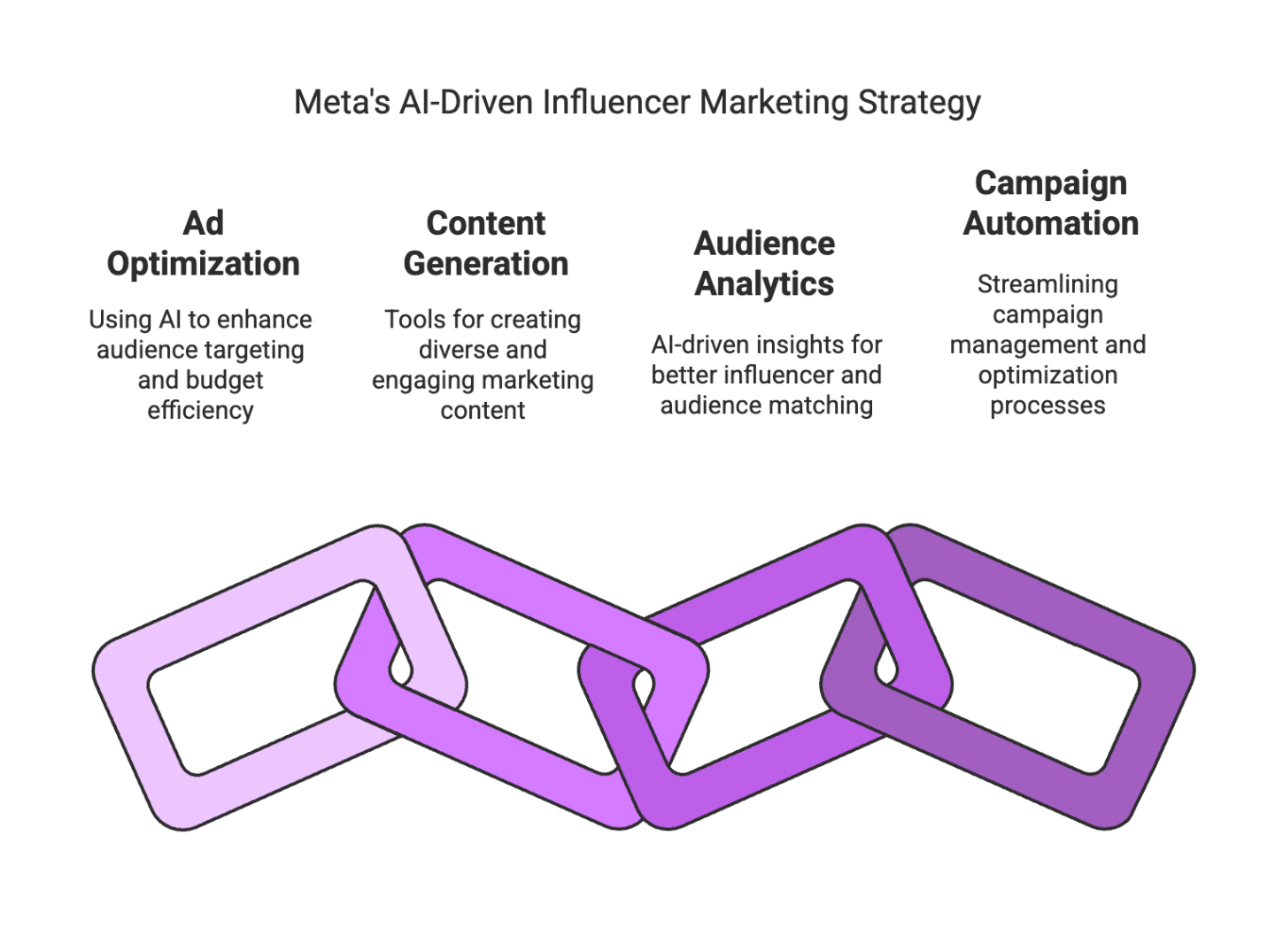
Meta has poured significant investment into AI across all areas of influencer marketing. Here’s a broad overview of how AI is powering influencer campaigns on Meta’s platforms in 2026:
Its generative AI features (like Background Generation, Image Expansion, and Text Variation) allow marketers to create customized visuals and copy in seconds according to Search Engine Land. Meta is “leading the charge with generative AI tools” to make producing dynamic content easier than ever according to House of Marketers. The company is even exploring AI-generated video clips (code-named MovieGen) for the future according to MediaMint. In short, AI is becoming a creative assistant – saving time while scaling up the volume and variety of content.
On the analytics side, Meta’s tools are increasingly using AI to turn raw data into actionable insights. Marketers can leverage predictive analytics to anticipate trends and campaign outcomes. For example, AI models can forecast how an influencer’s post might perform or which segments of your audience are most likely to convert, allowing you to allocate budget more effectively. With 63% of brands planning to use AI in executing influencer campaigns by 2024 according to Content Grip, it’s clear that data-driven influencer strategy is becoming the norm. Meta’s platforms are staying ahead of the curve by baking AI into their analytics and discovery features.
Additionally, Meta introduced an Opportunity Score metric – essentially a campaign quality score out of 100 – that uses AI to evaluate your ad setup and gives real-time suggestions for improvement Campaign Asia. Early testers who followed these AI recommendations saw costs per result drop by about 5%. Beyond ads, AI is simplifying workflows like never before. Routine tasks such as scheduling posts at optimal times or even drafting initial campaign briefs can be assisted by AI. The vision is that AI agents handle sequential tasks (finding influencers, drafting contracts, checking brand safety compliance, etc.), freeing up marketers to focus on big-picture strategy according to Viral Nation. We’re not fully there yet, but 2026 is clearly a turning point where many parts of influencer campaigns are running on autopilot thanks to Meta’s AI.
In short, Meta’s ongoing AI investments touch every part of influencer marketing – making ads more effective, content creation easier, analytics smarter, and campaign management smoother. Next, let’s look at how these 2026 tools stack up against what we had in previous years, and what’s truly new and improved.
We can see that Meta’s focus in recent years has been on simplifying and supercharging the influencer marketing process. What used to take a team of people and lots of time can now often be accomplished with a few clicks and some clever AI in the background. For example, Meta’s head of global business noted that what started as a performance tool for a few advertisers is now being opened up to all advertisers to reap the benefits, thanks to lessons learned and improvements in AI. Practically all marketers on Meta are using at least one AI-powered tool now – a stark change from the early days when these features were optional or experimental. The technology has matured, bringing better results (more engagement, lower costs) and more user-friendly automation than ever before.
Now that we’ve covered the “what” and “how” of Meta’s latest AI capabilities, let’s get into the “how-to.” The next section is a step-by-step guide for brands (and savvy influencers) on leveraging these tools effectively.
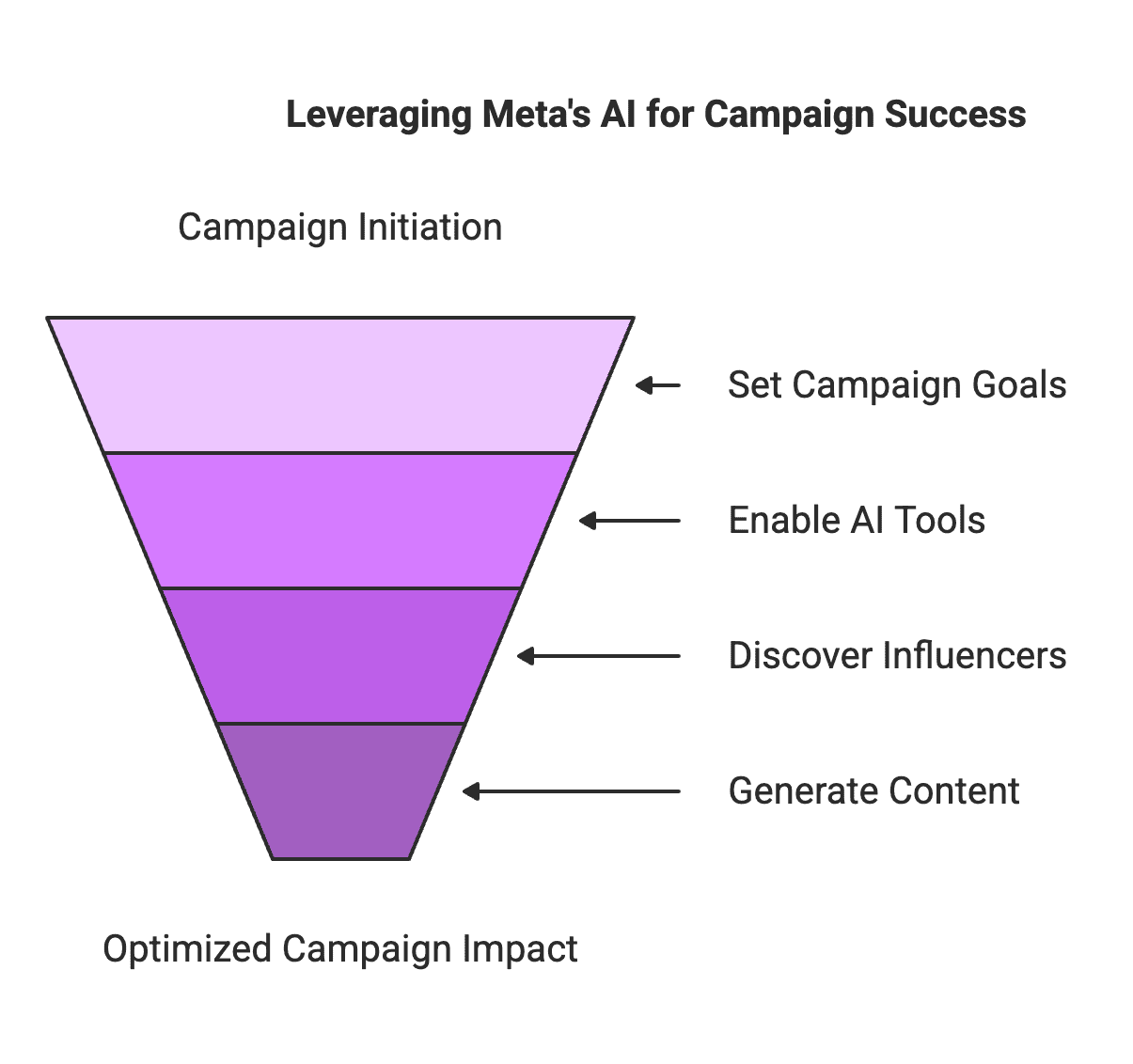
Ready to put these AI tools into action? Whether you’re a brand manager looking to amplify a campaign or an influencer collaborating with brands on sponsored content, here’s a step-by-step guide to using Meta’s latest AI features for maximum impact. Follow these steps to make the most of ad optimization, content generation, analytics, and automation on Meta’s platforms:
1. Set Clear Campaign Goals and KPIs – Start with the basics: Define what you want to achieve. Are you aiming to increase brand awareness, get more clicks to a product page, or drive sales via an influencer’s audience? Having a clear goal (and a Key Performance Indicator to measure it) will help Meta’s AI optimize for the right outcome. For example, if your goal is conversions (sales or sign-ups), you might choose a “Sales” or “Leads” objective in Ads Manager so that the AI optimizes for that event. Clear goals also guide the AI in making content suggestions (e.g. it might recommend a certain format if your goal is engagement). Take a moment to outline success metrics – it will make the AI’s job easier and your results better.
2. Enable Meta’s AI Tools in Business Suite/Ads Manager – Make sure you’re set up on the right platforms. Brands should use Meta Business Suite (formerly Facebook Business Manager) and have their ad account ready. Influencers with professional accounts should ensure they’re connected to the Creator Marketplace if collaborating with brands. When you create a new ad campaign, opt for Meta’s Advantage+ campaign setup (in 2026, this may be the default or only option for certain objectives.) This ensures that AI optimization features are turned ON from the start – you’ll often see an “Advantage+” or similar label indicating the AI is active. In practical terms, this means the system will handle a lot of the heavy lifting (like finding the right audience and placements) automatically. Essentially, you’re telling Meta, “go ahead and do your AI magic on this campaign.” If you’re using the Instagram Creator Marketplace to find influencers, navigate to it via Business Suite and look for the new AI recommendations section (available to eligible brands in various markets).
3. Discover the Right Influencers with AI Assistance – One of the first steps in an influencer campaign is choosing who to partner with. Instead of manually researching for hours, let Meta’s AI give you a head start. In the Instagram Creator Marketplace, use the search and filter tools to outline your ideal creator profile (location, follower count range, topic niche, etc.). Meta will then surface recommended creators who fit your criteria, thanks to its machine-learning matching system. Pay attention to the “Suggested Creators” or “Recommended for Your Brand” section – this is where the AI analyzes your brand’s niche and campaign brief and suggests influencers with a compatible audience . For example, if you’re a fitness apparel brand aiming at teen consumers, the system might recommend a few up-and-coming fitness influencers whose followers are largely teens interested in health. Review the suggested profiles: the AI will typically highlight why it picked them (e.g. similar audience demographics or high engagement in relevant categories). Of course, you should still vet each influencer – check their content quality, brand fit, and authenticity – but this AI-powered shortlisting can save you a ton of time. Pro tip: You can also use influencer marketing platforms backed by AI like Stack Influence.
4. Brainstorm and Generate Content with AI – Once you have your influencer or if you’re an influencer yourself, it’s content planning time! Two heads are better than one – and an AI “head” counts as well. Use Meta’s AI features to brainstorm ideas and create content assets:
5. Set Up an AI-Optimized Ad Campaign – Now for launching the campaign. In Meta’s Ads Manager, start creating your campaign as usual: choose your marketing objective (e.g. Traffic, Conversions, App Installs, etc.). When you reach the ad set and ad level, take advantage of all relevant AI settings:
Before publishing, double-check everything looks good in the preview. You’re basically setting the parameters and giving the AI the green light to execute. Meta’s AI will now automatically serve the right content to the right people, at the right time, to achieve the goal you set. It’s pretty amazing: you’ve configured a highly sophisticated influencer ad campaign in a few simple steps, something that used to take much more manual tweaking.
For brands and influencers seeking to enhance their AI-driven campaigns, platforms like Orbofi provide innovative tools for creating and monetizing AI-generated assets. These autonomous AI agents power a range of applications, from personalized AI companions to voice-powered assistants. Users can leverage this technology to generate text, images, and even code. Businesses can also deploy white label AI agents to maintain brand consistency while offering unique, interactive experiences. By leveraging such tools, marketers can diversify their content strategies and explore new ways of engaging audiences
6. Leverage AI Insights & Recommendations During the Campaign – Once your campaign is live, Meta’s AI doesn’t stop working. It will optimize continuously and also provide you with insights in near real-time. Here’s how to make the most of it:
7. Maintain a Human Touch – Review and Refine – While AI is powerful, don’t go completely on autopilot. Stay engaged and add the human touch where it counts. AI might generate content and select targets, but you, as a marketer or creator, understand your brand’s voice and audience nuances best. Review the AI-generated outputs to ensure they align with your brand values and messaging. For example, if an AI-suggested caption feels a bit off-tone or too “salesy,” tweak it to sound more authentic. It’s important to retain oversight on what’s being published – think of the AI as an assistant that drafts content, but you are the editor.
This ensures the final product is polished and truly “you.” Industry experts emphasize that AI can do the heavy lifting, but a talented marketer should fine-tune the AI-generated content for quality and brand fit. So before an influencer posts that AI-suggested video or before you let an AI-curated campaign run wild, do a sanity check. Make sure the content resonates on a human level – authenticity is still key in influencer marketing. Followers can tell if something is genuine or just auto-generated noise. Use AI to accelerate and enhance your work, but always align it with a coherent story or message that only a human can craft. Balance is the name of the game: in 2026 we have great automation, but marketing is most effective when technology and human creativity go hand in hand.
8. Measure Results and Iterate – At the end (or midway, for that matter) of your campaign, dive into the results which Meta’s analytics provides. Thanks to AI, you might get some smart insights here, not just raw numbers. Look for any AI-driven analysis like “Best time of day for engagement was 7-9pm, likely due to X” or “New audience segment discovered: people who like Y also responded well to your campaign.” These insights can inform your next campaign. Compare performance against the KPIs you set in step 1. Did the AI help you hit those goals? Perhaps you achieved a lower cost per click or higher conversion rate than previous manual campaigns. Note what worked and what didn’t.
Because the landscape is always changing, use each campaign as a learning loop. The good news is AI shortens the feedback cycle – since it optimizes in real-time, you might have already adjusted mid-campaign. Still, a thoughtful review is essential. Gather your team (or just your notes) and outline improvements for next time. Maybe the AI found a new influencer that outperformed the original one – you could plan to partner with them again. Or maybe one type of AI-generated content (like a certain background style) clearly resonated more – double down on that style going forward. In summary, let the data (enhanced by AI analysis) guide your next steps. The more campaigns you run with these AI tools, the smarter your strategies will become, because you’ll accumulate insights on what algorithms and audiences favor.
By following these steps, brands and influencers can fully leverage Meta’s latest AI capabilities. The process from planning to execution becomes more efficient and often more effective than traditional methods. You’ll notice you’re able to do more (more content, more testing, more personalization) with less effort – that’s the beauty of adding AI to your team. And Meta’s platforms are set up so that even non-technical users can benefit from advanced AI under the hood.
Meta’s 2026 suite of AI tools for influencer marketing is indeed impressive. We have AI optimizing our ads, generating our creative assets, finding our ideal collaborators, and automating our campaign workflows. It’s a far cry from the early days of social media marketing! As we’ve discussed, the key improvements this year include a more unified and powerful Advantage+ ad system, widespread use of generative AI for content creation, smarter influencer discovery via machine learning, and automation features that remove friction from campaign management. These innovations build on the foundations of previous years, but introduce new levels of convenience and intelligence in how we execute influencer campaigns.
A casual yet crucial reminder: even with all the fancy AI, successful influencer marketing still hinges on authentic connections. AI can crunch the numbers and spit out recommendations, but creators who maintain a genuine voice and brands that stay true to their story will stand out. The tone of your content, the human relatability of your message – those are things to guard carefully. AI doesn’t replace creative strategy or human authenticity; it enhances and supports them. As one marketing expert noted, 2026’s challenge is to embrace AI while not losing the human touch in marketing.
For brands and influencers ready to leverage Meta’s latest AI tools, the takeaway is exciting: you have more capabilities at your fingertips than ever before. By understanding these tools and following a thoughtful approach (like the steps outlined), you can run campaigns that are not only efficient and data-driven but also engaging and impactful. It’s about working smarter, not harder – letting AI handle the heavy lifting of optimization and analysis, while you focus on creativity, strategy, and building relationships with your audience.
So go ahead – experiment with that AI-generated video, trust Meta’s algorithms to find your next big brand fan, and use the extra time saved to craft even better content or interact with your community. The future of influencer marketing is here, and it’s powered by AI with a human heart. Happy campaigning!
Instagram is continually evolving its features to bridge the gap between brands, creators, and consumers. In February 2025, Instagram announced a new feature that expands its Partnership Ads program with “Testimonials” – allowing creators to add paid endorsements as pinned comments on brand ads according to Media Post. This means an influencer can write a short, sponsored comment endorsing a product, and that comment will be pinned at the very top of the advertisement’s comment section for maximum visibility. For example, a travel vlogger might leave a glowing one-liner about a suitcase on the suitcase brand’s sponsored post, and that endorsement stays front-and-center for all viewers of the ad.
This update is significant for both brands and creators. For brands, it injects authentic voice and social proof directly into their ads, potentially making them more trustworthy and engaging. For creators, it opens up a new stream of income – they can get paid for these text endorsements just as they would for creating a dedicated post or video. Instagram’s motivation is clear: with 40% of people using creator recommendations on Instagram when shopping, leveraging that trust factor in ads could be a game-changer. By pinning a creator’s testimonial on an ad, Instagram aims to make ads feel less like ads and more like genuine recommendations, benefiting everyone involved.
Instagram’s Partnership Ads are a format where brands can promote content in collaboration with a creator (often boosting an influencer’s post or co-creating content). The new Testimonials feature takes this a step further by integrating the creator’s endorsement directly into the ad’s comment section. In practice, this feature works as follows:
Instagram’s objective behind this update is to blend influencer content with paid advertising in a seamless way. By showcasing a creator’s endorsement prominently, the ad instantly gains a dose of credibility and personality. Instagram has stated that this is intended to help creators earn more and reach wider audiences, while helping brands increase conversions through influencer validation. In other words, it brings the creator’s trusted voice directly into the ad, “enhancing social proof” for potential customers who see a first-hand account of the product according to Lindsey Gamble. The platform also built in some safeguards: creators can monitor how their testimonial is used and even withdraw permission if needed, ensuring they maintain control and authenticity according to Mind Share World. Overall, Partnership Ads with Testimonials are designed to make ads feel more like organic recommendations, tapping into the trust that followers have in creators.
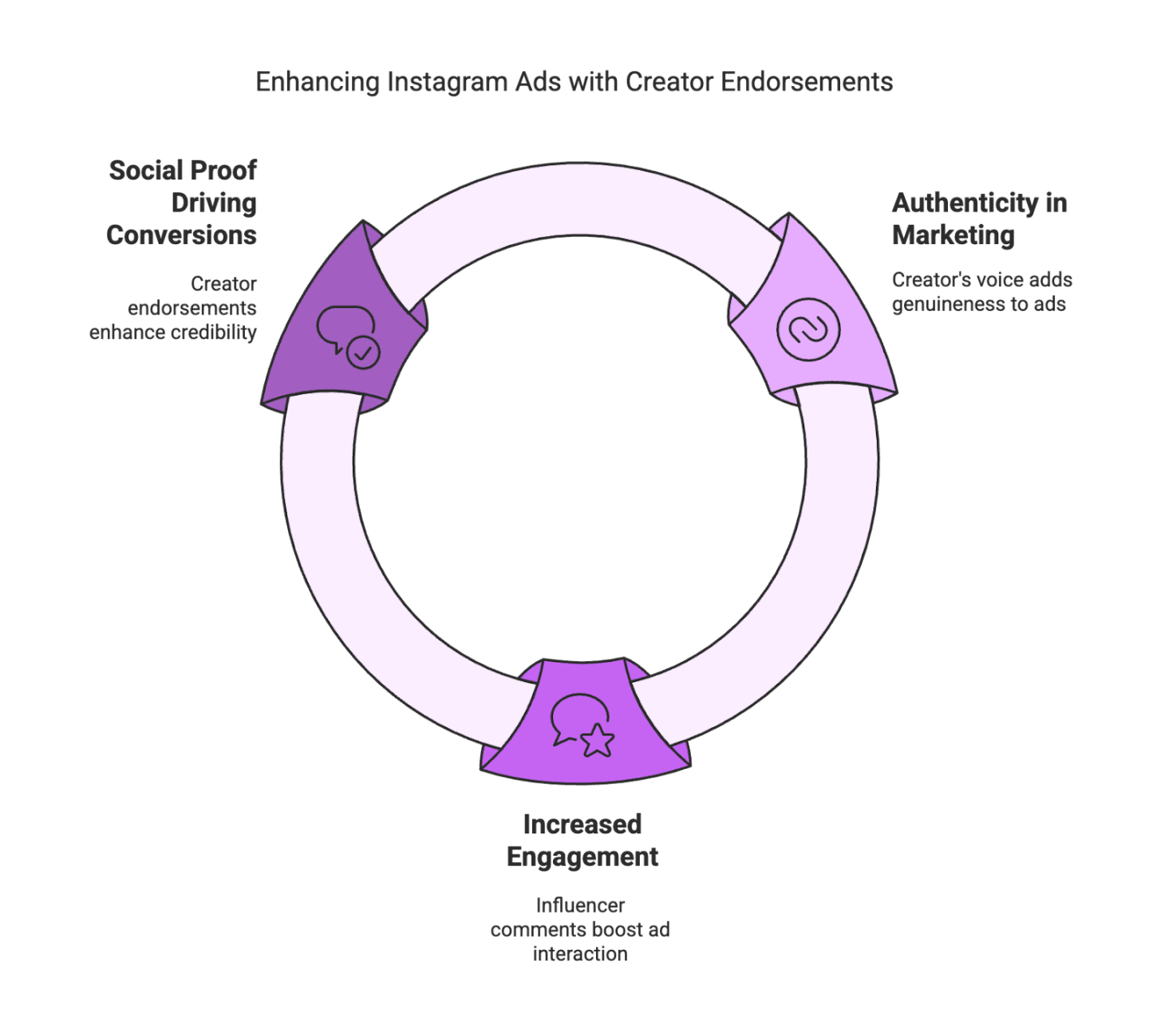
Early thinking is that these testimonial comments can serve as a persuasive nudge – for instance, an influencer’s praise might address a buyer’s hesitation (“This actually works!”) and encourage them to interact. By having an influencer essentially initiate the discussion, the ad feels more like a genuine conversation, potentially leading to more comments and discussions from other users. Higher engagement not only helps with Instagram’s algorithm (which could show the ad to more people if it’s getting interaction) but also creates a more dynamic ad experience for viewers.
This can shorten the buyer’s decision cycle and increase conversion rates for the ad. In fact, leveraging testimonials has been shown to yield significant results in general – for example, adding customer testimonials can increase conversion rates by 34% in marketing campaigns according to TriMark Digital. That’s a huge lift in effectiveness. By integrating influencer testimonials into ads, brands put a form of customer review right into the advertisement itself. Seeing a product recommendation from a relatable figure can be the final push a potential customer needs to click “Shop Now.” It provides immediate reassurance that the product is as good as advertised, translating into higher click-through rates and sales.
In summary, this feature matters because it merges the trust and relatability of influencer content with the reach and amplification of paid ads. It has the potential to make Instagram ads more engaging and persuasive by adding a human touch that consumers resonate with.
Now that we know what testimonial comments are and why they’re powerful, the next question for brands is: How can we make the most of it? Here are four key ways brands can leverage Instagram’s Partnership Ads with Testimonials effectively:
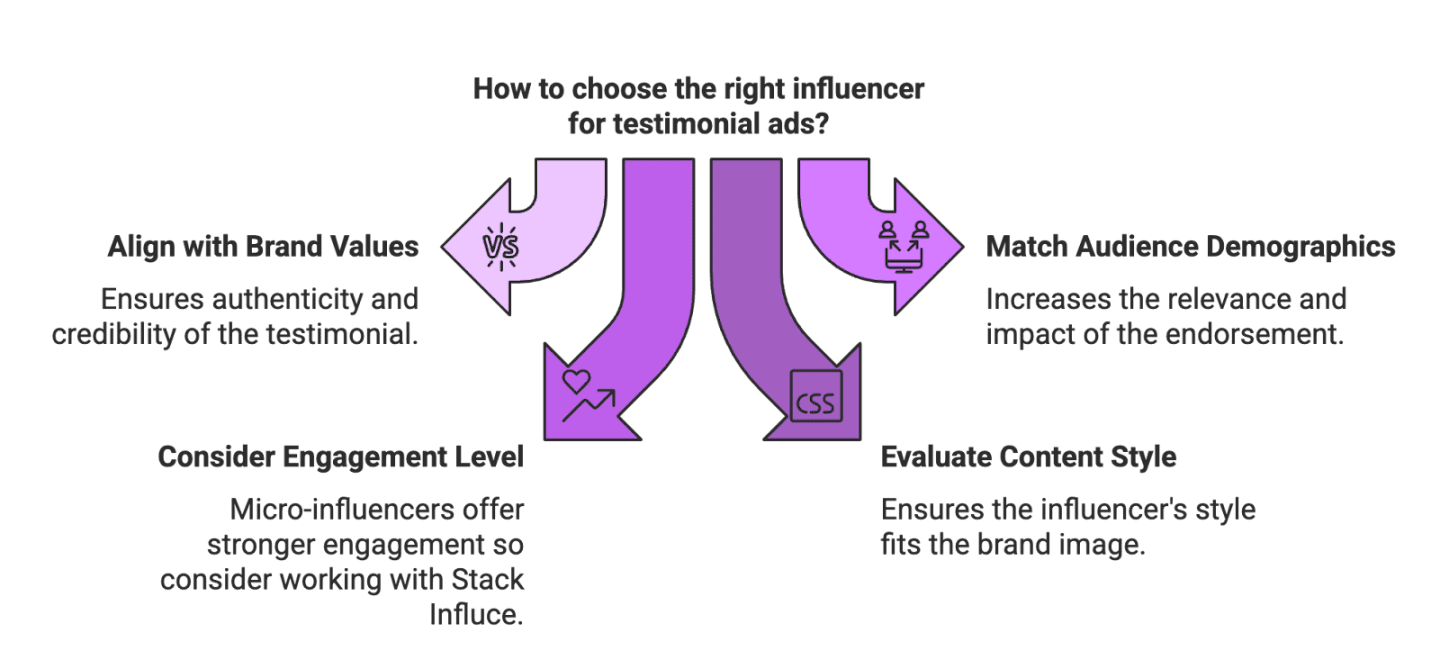
Success with testimonial ads starts with choosing the right influencer partner. Brands should collaborate with creators who truly align with their values, niche, and target audience. The authenticity of the testimonial is paramount – it needs to sound like a genuine personal endorsement. Partner with influencers whose audience matches your target market, and whose persona fits your brand image, for maximum impact. For example, if you’re a sustainable fashion brand, a creator known for eco-friendly living would be a natural fit; their followers are already primed to care about your product’s value. It’s not always about sheer follower count either.
Often, micro-influencers or niche experts can drive stronger engagement and trust than a big celebrity who isn’t closely tied to your product category. The key is that the creator’s endorsement should carry weight with the audience that sees the ad. When the testimonial comment comes from someone whose opinion the viewers respect, it feels organic rather than like an obvious ad. Before partnering, do your research: look at a creator’s content style, their follower demographics, and how their followers interact. Ideally, the creator should have a history of genuine enthusiasm for the kind of product you offer. When a partnership is a good match, the testimonial comment will come off naturally and credibly – which is exactly what you want. If you are interested in using micro influencers to boost your engagement and drive word-of-mouth marketing, consider utizing an AI backed influencer marketing platform like Stack Influence.
With only up to 125 characters to work with, every word in the testimonial counts. Work with your creator partner to craft a comment that is punchy, specific, and impactful. The best testimonial comments feel like a personal recommendation highlighting a key benefit or result of the product. Keep the message simple and authentic – it should sound like something the creator would actually say in real life about why they love the product. It’s a good practice to focus on one strong point: for instance, an outcome (“I ran a marathon in these shoes and my feet felt great afterwards!”) or a standout feature (“This coffee mug keeps my drink hot for 7 hours – game changer”). Including a little anecdote or very specific praise makes it more believable than a generic “I love this!” Also, consider the tone: an emoji or a bit of the creator’s personality (humor, slang, etc.) can make it feel more like a regular comment.
Since the testimonial will be marked as sponsored, honesty is crucial – hyperbolic or salesy language will stick out in the comments and could hurt credibility. Brands should guide creators on messaging, but allow them to use their own voice. For example, if a tech influencer is endorsing a new smartphone, a comment like: “Been using the camera on this phone during my trip – the photos are unreal 📸🔥” comes off as natural and highlights a benefit. In contrast, “This is the best phone ever!!! Buy it now!” would sound fake. The bottom line: concise, genuine, and benefit-driven testimonials perform best. It can be helpful to brainstorm a few variations with the creator and then choose one that feels right. (Tip: Look at actual enthusiastic comments the creator’s followers leave on their posts for inspiration on tone and phrasing.)
Like any new marketing tool, it’s wise to test and learn with testimonial ads. Brands should not simply assume that one approach works best; instead, run experiments. For instance, you might create two versions of an ad: one with a testimonial comment and one without, or two with different testimonial messages or different creators, to see which drives more engagement or conversions. *Run A/B tests with different testimonials to see which resonates best with your audience, trying variations in wording or even different influencer endorsement. Pay close attention to metrics that matter to your campaign goals. These can include: engagement metrics (likes, comments, shares on the ad), click-through rate (CTR on the call-to-action button when the testimonial is present vs. absent), and ultimately conversion metrics (such as add-to-cart or purchase events attributed to the ad). If one testimonial phrasing mentions a specific product benefit and another version highlights a different angle, compare which drove more interest.
Maybe a more enthusiastic comment yields more engagement, but a more informational comment yields higher purchases – these insights are gold for refining your strategy. Also, monitor the sentiment in the comments. Are people tagging friends or replying positively to the influencer’s pinned comment? That qualitative feedback can indicate the testimonial is hitting the right note. Instagram is reportedly building out tools (via its Creator Marketplace) to help identify which creator content performs best as a, so use data to your advantage. In practice, a brand might discover that a testimonial from a niche expert outperforms one from a bigger-name celebrity, or that mentioning a specific product use-case gets more clicks than a generic praise. By testing and iterating, you can optimize the effectiveness of testimonial comments. Remember to share results with your creator partners too – if they see that their testimonial helped boost sales by, say, 20%, it encourages them to craft even better endorsements in the future (and it justifies the investment for both sides).
While this new feature is exciting, it should be seen as one part of a holistic marketing approach. Don’t rely on the testimonial comment alone to do all the heavy lifting. To maximize impact, incorporate testimonial ads into your broader campaign strategy. For example, you can coordinate a campaign where a creator not only provides a pinned comment testimonial on your ad, but also creates a dedicated post or story about your product on their own profile. The combination of seeing the influencer talk about the product in their feed and then seeing their endorsement on the brand’s ad can reinforce the message from multiple angles.
*Use testimonials alongside other formats – combine the creator’s comment with compelling visuals or videos in the ad, and even with traditional influencer posts or other content – for maximum effect. The testimonial should complement your ad creative, not replace it. Ensure your ad’s image or video and caption are strong and clear about the product’s value, so that the testimonial acts as an extra highlight. Many brands might integrate the testimonial comment as part of a themed campaign: for instance, launch a new product with a series of influencer partnerships where each influencer not only posts about it but also lends a testimonial to your ads.
Additionally, extend the life of those testimonials beyond Instagram – the positive quote from the influencer could be reused on your website’s product page as a blurb, or in an email newsletter. Another integration strategy is to engage with users who respond to the testimonial. Since the creator’s comment can spark conversation, be sure to have your social team monitoring and replying to questions or comments that other users leave under the ad. This turns the ad into an interactive experience and shows that both the brand and the creator are actively involved. Finally, align your testimonial strategy with other social proof efforts: if you’re running testimonial ads, you might also ramp up collecting customer reviews or encouraging users to comment their own experiences. It all contributes to a unified message that people genuinely love your product. In short, make testimonial comments one piece of a larger puzzle – when used in concert with other marketing tactics, they can significantly amplify your campaign’s effectiveness.
Instagram’s introduction of Partnership Ads with Testimonials is poised to be a game-changer for brands in the social media marketing landscape. By fusing the persuasive power of word-of-mouth with the reach of paid advertising, this feature helps brands create ads that people actually want to read and engage with. It’s a win-win: audiences get more authentic, relatable content (even in ads), and brands get better-performing campaigns fueled by trust and credibility. Creators, too, benefit from new monetization opportunities and expanded exposure as their name appears on sponsored posts to wider audiences.
The key takeaway for brands is that authenticity and social proof drive modern marketing success. Partnership Ads with Testimonials give you a tool to harness authenticity at scale. However, it’s crucial to implement it thoughtfully – a forced or insincere testimonial could backfire. As long as brands partner with the right creators and keep the endorsements genuine, they can unlock impressive results. Think of it as bringing the testimonial section of your website right into someone’s Instagram feed, but instead of an anonymous review, it’s a familiar face vouching for you.
For brands eager to stay ahead of the curve, now is the time to start incorporating testimonial comments into your Instagram ad strategy. Start small and measure – identify a campaign where an influencer testimonial could make a difference, and give it a try. Collaborate closely with a creator to craft a message that feels real and on-brand. Once your ad is live, monitor how it’s doing, learn from the data, and refine your approach. With each iteration, you’ll get better at leveraging this feature. In a digital world overflowing with content, these influencer-backed testimonials can be the differentiator that makes your ad stand out and resonate.
Instagram’s partnership with creators in this new format underscores a broader trend: consumers crave authenticity, and brands that find creative ways to deliver it will reap the rewards. A well-placed testimonial can turn a static ad into a dynamic recommendation, converting scrollers into engaged potential customers. Brands that embrace this and learn how to use it effectively will likely see boosts in engagement, trust, and sales – and perhaps forge deeper relationships with both their audience and the creators who endorse them. It’s not often we see a truly novel advertising feature that taps into fundamental human psychology (our trust in peer recommendations) so directly. This is one of those features. For forward-thinking brands, the message is clear – don’t be late to the party. Explore Instagram’s testimonial ads, experiment with creative collaborations, and let your happy influencers do the talking for you. In an era where a single comment can influence a buying decision, make sure that comment is working in your favor. Your next successful campaign might just be a pinned testimonial away.
Pinterest might not always steal the social media spotlight, but it’s a goldmine for influencers looking to drive ecommerce. In fact, the number one reason people use Pinterest is to find new products and brands IZEA Worldwide, Inc. With over half a billion monthly users on Pinterest – many of whom have shopping on the brain – this platform offers a unique blend of search engine and social media that can transform an influencer’s affiliate links and product posts into a steady stream of sales. And Pinterest isn’t stuck in 2015; it has rolled out powerful new shopping features through 2025 that make it even easier for creators to monetize content.
In this blog, we’ll dive into how Pinterest has enhanced its shoppable features (especially recent 2025 updates), and why these are a boon for influencers. We’ll also explore strategies to leverage Pinterest for ecommerce traffic, highlight best practices (from SEO to affiliate tips), and look at a case study of success. By the end, you’ll see why Pinterest’s Shoppable Pins are an underutilized jackpot for influencer marketing.
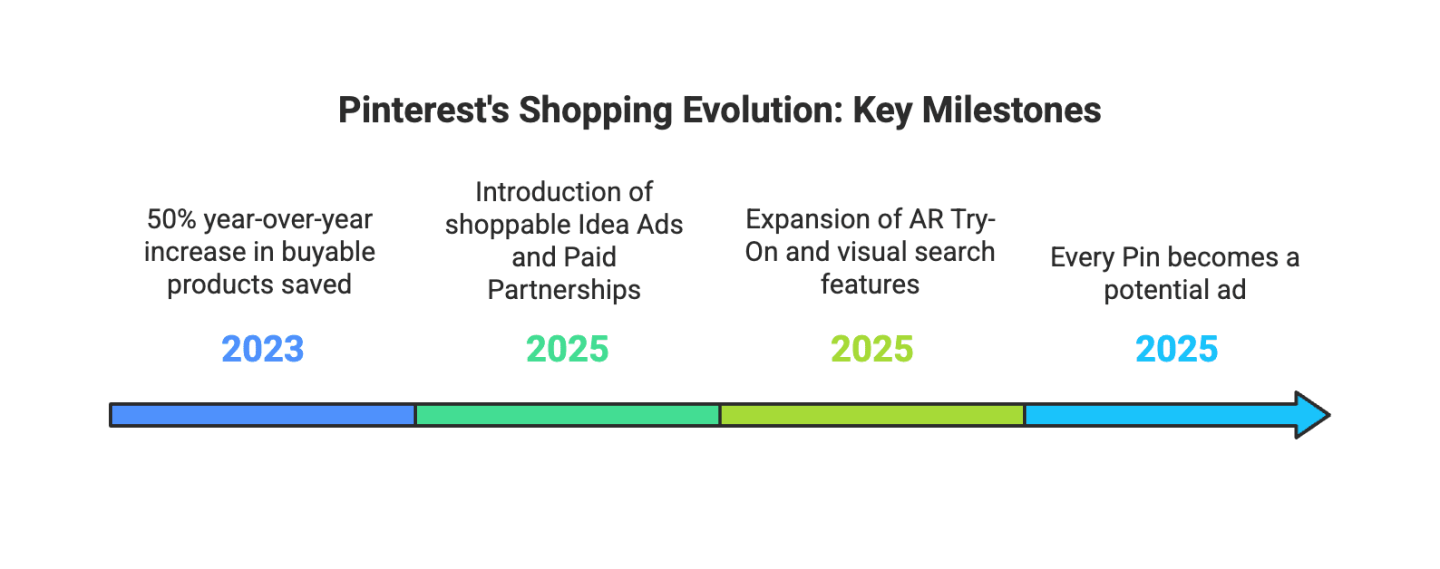
Pinterest has been busy making “every Pin shoppable,” as CEO Bill Ready put it according to Pinterest Newsroom. Over the past couple of years leading into 2025, the platform introduced a slate of updates that supercharge the shopping experience – for users, brands, and influencers. Here are some of the key enhancements:
Pinterest’s Shoppable Pins blur the line between inspiration and shopping. In the example above, a fashion “Metallic silver OOTD” Pin includes a “Shop the look” suggestion carousel (see the pop-up at the bottom). Viewers can click to see similar silver jackets and related products, then hit “Visit” to buy – all without a creator having to manually link every item.
Bottom line: Pinterest in 2025 has matured into a full-funnel shopping platform. It’s not just mood boards and recipes; it’s product discovery, product research, and with one tap, product purchase. For influencers, this evolution means you have an array of tools at your disposal to make content shoppable and to earn income – whether through affiliate commissions, your own product sales, or brand partnerships. And crucially, Pinterest’s audience wants to shop: more than 50% of users now see Pinterest as a place to shop, and the platform saw a 50% year-over-year increase in buyable products saved to boards in 2023. The shopping trend is only growing.
Maybe you’re thinking, “That’s great, Pinterest has shopping features – but do people actually use them? Is it worth my time as an influencer?” The answer is a resounding yes. Let’s look at some numbers and trends that show how effective Pinterest can be for influencer-driven ecommerce:
Pinterest’s Shoppable Pins blur the line between inspiration and shopping. In the example above, a fashion “Metallic silver OOTD” Pin includes a “Shop the look” suggestion carousel (see the pop-up at the bottom). Viewers can click to see similar silver jackets and related products, then hit “Visit” to buy – all without a creator having to manually link every item.
To sum up the data: Pinterest brings together an audience that’s actively looking to shop, has the disposable income to do so, and is likely to click through and spend more per order. And thanks to the way content lives on in the ecosystem, your Pins can keep working for you long after the initial post. All these make Pinterest an influencer’s dream for driving ecommerce traffic.
Now that we know the “why,” let’s get into the “how.” How can you harness this potential?
Using Pinterest effectively requires a slightly different mindset and strategy than Instagram or TikTok. Here are some comprehensive insights and best practices for turning your Pins into profits:
On Pinterest, keywords are king. Think of Pinterest as a visual Google. To get your content discovered by the right people (i.e. those searching for what you offer), load up your profile and Pins with relevant keywords.
The goal is to align your content with what your target audience is already looking for. If your Pins match popular queries, you’ll reach people beyond your follower count, as Pins show up in search results and smart feeds to relevant users.
Pinterest is a visual platform, so aesthetics and clarity matter. To drive traffic or sales, your Pins need to catch eyes and entice clicks. Some tips:
Remember, the more appealing and relevant your Pin, the more saves and clicks it will get. And engagement snowballs on Pinterest – if a few people save your Pin, it then shows up to their followers and in more searches, gaining more exposure.
Boards are how you (and Pinterest’s algorithm) organize your content. They’re also how some users discover you (through following boards or seeing your board name in search).
In short, boards are your storefront departments. Well-labeled boards loaded with great Pins can attract people who are browsing those topics, and once they’re following your board, they might see all your new Pins in their feed.
Pinterest rewards consistent pinners. This doesn’t mean you have to post 20 times a day, but regular activity keeps your content circulating.
Consistency + patience = growth on Pinterest. It might take a couple of months to see a big uptick, but stick with it. Remember, you’re building a library of content that can pay off for years.
Pinterest is more search engine than social network, but there are still social features that can help you build community and momentum:
Engagement isn’t the top factor on Pinterest (many users mainly search and save quietly), but every bit helps in building your presence and making your profile a go-to hub for a certain topic.
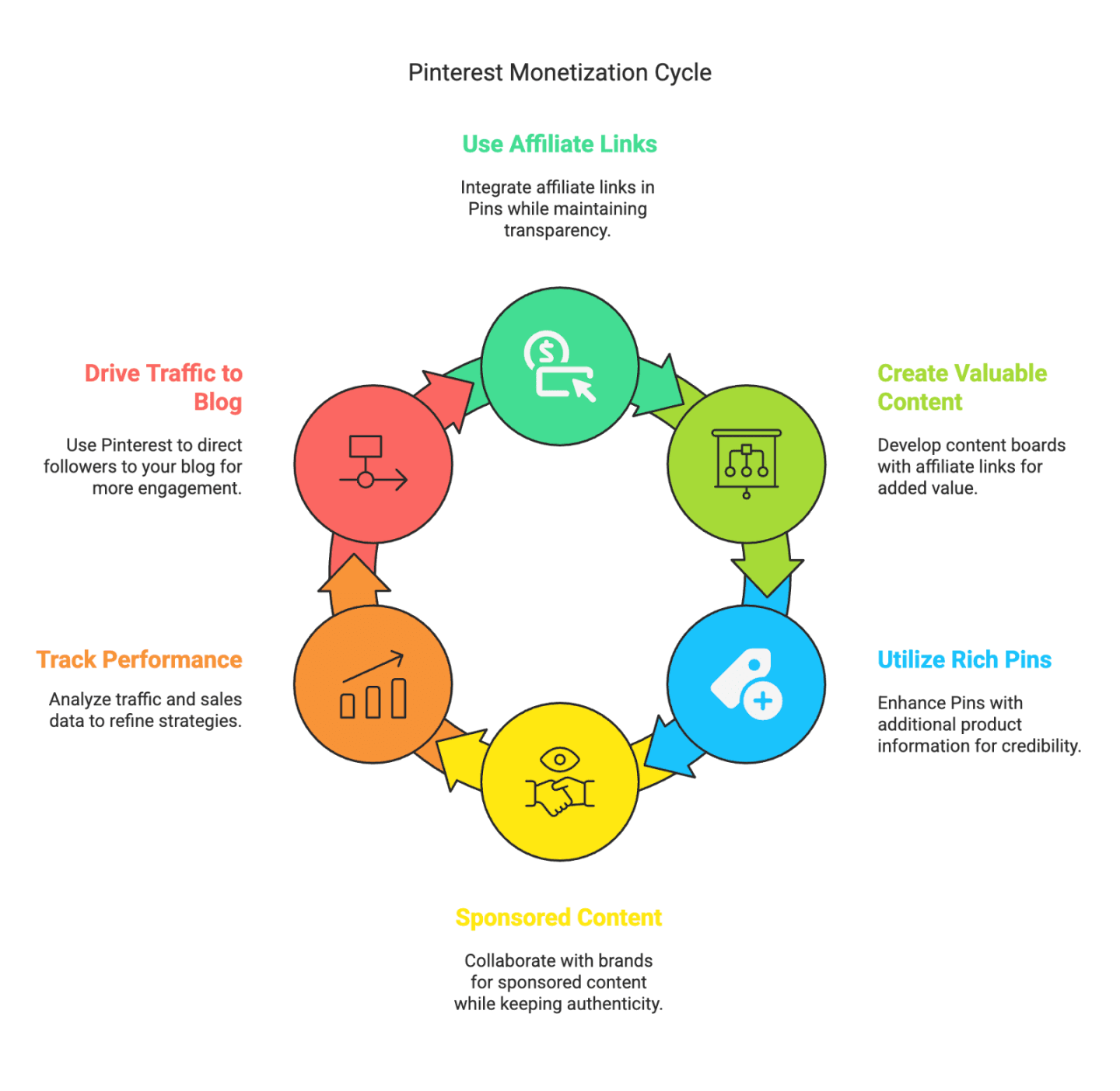
Now onto the money-making part – how to actually earn from those shoppable pins and traffic:
Essentially, Pinterest gives you the tools to shorten the path from inspiration -> discovery -> purchase. By integrating affiliate tags and product links, you can get a piece of the value you’re creating when you inspire someone to try a product. Many influencers leave that value on the table – you shouldn’t!
Balance timely content with evergreen content on Pinterest. Seasonal and trend-based pins can give you spikes of traffic, while evergreen pins give you steady ongoing traffic.
The mix of timely and timeless content ensures you get the best of both worlds – bursts of seasonal traffic and consistent everyday traffic.
Casually browsing Pinterest might feel like window-shopping, but for savvy influencers it’s more like owning a boutique on the busiest street in town. In 2025, Pinterest has positioned itself as a shopping powerhouse, blending the visual inspiration people love with the utility of an e-commerce platform. Influencers who have treated Pinterest as an afterthought may want to rethink that – the data speaks for itself. With 4 out of 5 users discovering new products on the platform and shopping features that make it easier than ever to go from “Oh, I love that!” to “Order placed,” Pinterest is truly an underutilized goldmine.
By enhancing shoppable Pins, introducing creator-friendly updates, and nurturing a high-intent community, Pinterest has handed influencers the keys to success: you just need to drive the car. Optimize your Pins for search, keep your content coming, show off products you believe in, and engage with the audience that’s actively looking for what you share. As we saw, even a one-person blogging operation can see triple-digit percentage jumps in sales by unleashing the power of Pinterest. It’s about working smarter – letting Pins work for you long after you’ve posted them, and leveraging Pinterest’s unique strengths (like longevity and intent).
So, whether you’re a fashionista with an eye for style, a foodie sharing delicious creations, a travel buff, a tech gadget geek, or anything in between – there’s a corner of Pinterest waiting for your expertise. Start treating your Pins not just as pictures, but as gateways for your followers (and millions of strangers) to shop your world.
In a social media landscape often obsessed with fleeting viral moments, Pinterest offers something refreshingly steady and substantive: a chance to build a lasting influence that directly translates to ecommerce rewards. It’s time to tap into that influencer goldmine. Happy pinning, and may your boards be ever in your favor!
LinkedIn isn’t just about text posts and connection requests anymore – it’s entering the short-form video arena in a big way. In early 2024, Forbes reported that LinkedIn began testing a TikTok-style vertical video feed on its app. Picture the familiar feed of Instagram Reels or TikTok’s “For You” page, but populated with career tips and business insights. Fast forward to January 2025, and LinkedIn’s video push appears to be paying off. Short-form video is now the fastest-growing content category on the platform, with total video viewership up 36% year-over-year according to Digiday. This surge signals a pivotal shift for B2B marketers: LinkedIn is no longer just a place for blog links and static updates – it’s becoming an engagement playground for bite-sized video content.

LinkedIn’s move into short-form video might have seemed surprising a few years ago, but today it feels almost inevitable. Users crave interactive, visual content, even in professional contexts. LinkedIn’s new video feed (currently in beta) is all about delivering that experience. Forbes highlighted how the platform’s test feature closely mirrors other social apps: an immersive vertical video stream, complete with a dedicated “Video” tab on the mobile app. In other words, think TikTok, but for thought leadership and business stories. The motivation is clear – LinkedIn sees that “videos are rapidly becoming one of our members’ favorite formats to learn from other professionals and experts,” as one LinkedIn spokesperson told Forbes. By introducing a reels-like feed, LinkedIn aims to keep users engaged longer and offer a fresh way to discover content.
LinkedIn’s dedicated vertical video feed (beta) brings a swipeable stream of short videos to the professional social network, a format popularized by TikTok and Instagram Reels according to The Social Standard. This new feature underscores LinkedIn’s commitment to video content as a driver of engagement.
Early reactions show that LinkedIn’s gamble on video is working. Not only are users watching more videos, they’re also creating more. In fact, LinkedIn shared that members are posting videos at twice the rate of any other type of content, according to Digiday. The appetite for quick, informative clips is there, and LinkedIn is positioning itself to feed it. For B2B marketers, this opens up a new frontier – a chance to capture attention with snappy, relevant videos in a space that’s less saturated with frivolous content than other platforms.
What does LinkedIn’s video push mean for B2B content marketers? In a word: opportunity. Traditionally, B2B marketing on LinkedIn meant long-form articles, whitepapers, and text-heavy posts. Those still have their place, but short videos are injecting new life (and views) into B2B social feeds. LinkedIn has found that videos get far more traction than text updates – by some measures, 5× more engagement than standard posts according to Hootsuite. That’s huge for marketers seeking eyeballs and interaction. More engagement means more visibility in the feed, which can translate to greater brand awareness and lead generation down the line.
Perhaps surprisingly, professional audiences seem just as eager to consume short-form videos as consumers on TikTok or Instagram. As one marketing analyst noted, LinkedIn is proving that its users “are just as eager to consume short-form video as users on TikTok or Instagram” according to Content Grip. The context might be different (think insightful tips or industry trends rather than dance challenges), but the draw of video is universal. People simply find video more dynamic and easier to digest. For B2B brands, this means content like quick how-tos, thought leadership snippets, product demos, or event recaps can perform exceedingly well on LinkedIn – driving not just views, but meaningful comments and shares.
Consider the changing behavior on the platform: LinkedIn reports that weekly “immersive” video views have grown six-fold over the last quarter according to Status Brew. Users are spending more time watching and interacting with videos. This kind of engagement is gold for content marketers. More time spent with your content often leads to deeper awareness and trust. And unlike the passive scrolling of text posts, video encourages people to stop and pay attention – even if just for 30 seconds.
For example, a short video of a CEO sharing a hot industry insight or a quick case study can spark conversations in the comments. That discussion boosts the post in LinkedIn’s algorithm, extending its reach. In B2B marketing, such visibility among a targeted professional audience is invaluable. It’s a chance to position your brand (or your executives) as go-to voices in the market. And thanks to LinkedIn’s video-friendly changes, doing so has never been more rewarding.
With LinkedIn’s video features gaining traction, a new breed of influencers is finding a stage: the B2B micro-influencer. These are professionals or niche experts who might not have millions of followers, but have highly engaged networks in specific industries. B2B brands are starting to realize that partnering with such micro-influencers can dramatically amplify their content on LinkedIn.
In fact, companies have begun ramping up investments in LinkedIn influencers to extend their reach. It’s becoming a key strategy, much like influencer marketing on Instagram or YouTube, but with a B2B twist. The beauty of micro-influencers is that they often come across as authentic peers rather than paid spokespeople. Their content feels more like friendly advice than advertising, which resonates well in the professional community.
So, how can B2B companies use micro-influencers effectively on LinkedIn? Here are a few approaches:
The key is to choose influencers whose audience aligns closely with your target demographic. In B2B, it’s not about reaching everyone, but reaching the right professionals – those who actually care about your topic or product. Micro-influencers, by definition, cater to niches. That might mean 5,000, 20,000, or 50,000 very relevant followers who trust the influencer’s insights on, say, supply chain management or SaaS marketing.
And trust is really the operative word here. In B2B marketing, building credibility is half the battle. Micro-influencers shine in this department. They’re often perceived as fellow practitioners or knowledgeable colleagues. According to industry research, 82% of consumers are more likely to listen to a micro-influencer’s recommendation than one from a more famous influencer according to Embryo.com – and while that stat is consumer-focused, the essence carries into B2B. Professionals are more inclined to trust a peer who’s “been in the trenches” than a celebrity endorsement.
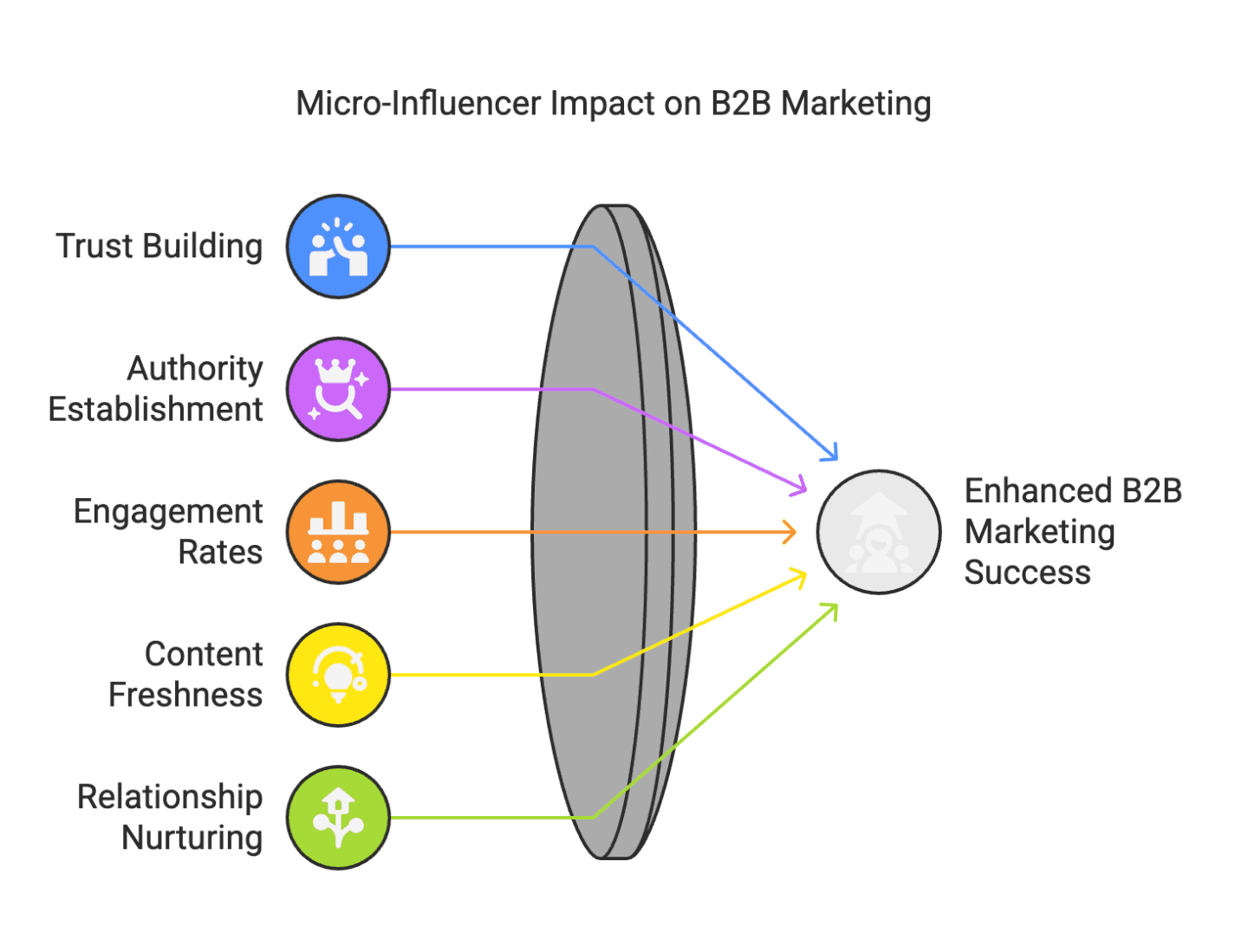
One of the biggest benefits of engaging micro-influencers in B2B is the boost to trust and authority for your brand. When an industry expert talks up your product or shares content on your behalf, it’s like getting a stamp of approval from a peer – it feels earned rather than bought. As Cary Murphy of marketing firm Brandon puts it, “Micro-influencers are the secret weapon for B2B brands… their niche expertise and trusted voices make them invaluable for reaching decision-makers and driving real business impact.”
Micro-influencers tend to have higher engagement rates relative to their follower count. Their audience might be smaller, but it’s laser-focused and attentive. These followers often view the micro-influencer as a thought leader or mentor figure. So when your brand message comes through that trusted voice, it carries extra weight. It’s not just your company saying “we’re great” – it’s a respected community member vouching for you.
This trust translates directly into influence on purchasing and partnerships. In fact, nearly 70% of B2B influencer campaigns have been found more effective at boosting brand performance than campaigns without influencers. That’s a compelling figure. It suggests that adding the voice of a credible influencer can significantly tilt the odds in your favor, whether the goal is to generate leads, get event sign-ups, or drive trials of a product.
Another benefit is the depth of engagement. B2B buying cycles are longer and more complex than B2C, often involving research, demos, and multiple decision-makers. Micro-influencers can help nurture prospects through that cycle by consistently showing up in their LinkedIn feed with valuable content. Over time, this builds a relationship. The prospect starts to associate the influencer (and by extension, the partnered brand) with insight and reliability – laying the groundwork for trust even before a direct sales conversation begins.
From a content perspective, micro-influencers also bring fresh perspectives that can enliven your marketing. They might highlight use cases or pain points you hadn’t thought of, ask provocative questions, or simply add a personal story that makes your message more relatable. All of this helps in building your brand’s authority. When others see that your company is part of conversations led by respected voices, it elevates your standing as well.
In short, micro-influencers can humanize B2B marketing. They inject authenticity and relatability, which are crucial for trust. And trust, in turn, is a catalyst for conversions in the B2B world – whether that conversion is a decision-maker green-lighting a purchase, or a potential client agreeing to that first meeting.
Getting the most out of LinkedIn’s video push isn’t just about posting content; understanding LinkedIn’s algorithm and best practices is equally important. A few key insights for working with the platform’s algorithm:
By following these best practices, B2B brands and influencers can significantly improve their odds of LinkedIn success. Imagine sharing a 45-second video of your CTO delivering a game-changing industry insight, posted natively with a catchy caption and a question to spark discussion. If in that first hour a dozen peers chime in with comments, LinkedIn’s algorithm will amplify it to even more people. Suddenly, that one video could rack up 10,000 views and dozens of comments, connecting your brand with new prospects – all organically. That’s the power of coupling great content with algorithmic know-how on LinkedIn.
To put a face to this trend, let’s look at a couple of examples of influencers thriving on Snapchat:
Nothing illustrates the power of LinkedIn’s video-and-influencer combination better than real-world examples. Here are a couple of campaigns that show what’s possible in this new frontier:
Hootsuite’s B2B Influencer Blitz: Social media management platform Hootsuite recently executed a LinkedIn influencer campaign that turned heads. They partnered with about 8 micro-influencers on LinkedIn – professionals with strong followings among social media managers – to spread the word about Hootsuite’s new industry report. Each influencer created posts (many of them short videos, plus some clever graphics) sharing insights from the report, such as the finding that social media managers largely love their jobs but feel under-resourced. The campaign smartly played into a trending conversation on LinkedIn (social media managers venting about their challenges) and added data to back it up. The result? Huge engagement. By some estimates, the combined campaign content racked up over 1.2 million impressions in the LinkedIn feed, along with hundreds of reshares and comments. In the process, Hootsuite not only got its report in front of the right people, but also positioned itself as an ally to the social media manager community. As one analysis noted, this campaign was a “home run” because it hit the right audience with the right content – regardless of individual influencer follower counts. In other words, even without mega-influencers, the content resonated deeply and went far.
Adobe & Others Testing the Waters: Hootsuite isn’t alone. Enterprise players like Adobe, Zendesk, and Zapier have also started tapping LinkedIn influencers in their B2B marketing according to, The Social Standard. Adobe, for instance, worked with LinkedIn creators in the digital design space to share bite-sized tutorial clips and success stories featuring Adobe’s tools. Seeing a respected designer or marketer demo a cool feature in a 60-second LinkedIn video carries more weight than a typical polished ad – it feels like advice from a colleague. Zendesk similarly engaged customer service thought leaders to post about customer experience trends, subtly weaving in how Zendesk’s solutions fit into the picture. These campaigns are still a relatively new phenomenon, but early indicators show strong engagement and positive feedback. The common thread is that these brands chose influencers who genuinely have clout in their niche, and they gave them creative freedom to present the message in their own voice.
The takeaway from these case studies is that successful LinkedIn influencer campaigns focus on education and value over overt selling. The content stands on its own merit – providing insight, useful info, or at least a relatable story. The brand’s presence is gently embedded, not forced. When done right, the audience doesn’t feel marketed at; they feel like they’re learning or part of an interesting conversation. And that’s exactly the environment where B2B trust and relationships flourish.
A post shared by Stack Influence (@stackinfluence)
By now, the benefits of leveraging micro-influencers on LinkedIn should be clear – you get authentic content, higher engagement, and greater trust. The next question for many brands is how do we manage this at scale? Working with one or two influencers is manageable, but what if you want to run a campaign with dozens of micro-influencers simultaneously, each creating content and engaging with their own networks? This is where automation platforms like Stack Influence come into play.
Stack Influence is a leading micro-influencer marketing platform that essentially automates the whole influencer campaign process according to Ninja Promo. Rather than manually hunting for relevant LinkedIn creators, reaching out to them one by one, sending briefs, and tracking each of their posts, Stack Influence (and similar platforms) provide an end-to-end solution. They maintain vast networks of influencers across industries and use advanced AI-powered matching to connect brands with the ideal micro-creators for their campaign.
Crucially for B2B marketers, such platforms handle the nitty-gritty details – from influencer outreach and onboarding to content approvals, scheduling, and even product seeding – all through automation. This means you can launch a campaign with, say, 50 micro-influencers posting about your upcoming B2B conference or software launch, without having to coordinate with each person individually. The platform streamlines communication and ensures each influencer delivers their promised content. This approach ensures efficiency and accountability – in fact, Stack Influence’s model only charges brands when an influencer’s promotion is successfully completed, making every dollar count.
The role of automation tools is increasingly important as influencer marketing matures. They bring a level of scalability and measurability that gives marketers peace of mind. You can track real-time metrics for each influencer’s post – views, likes, comments, clicks – all in one dashboard, rather than piecing it together from individual posts. Some platforms even use AI to predict which influencers will drive the best engagement for your campaign, taking a lot of the guesswork out of planning.
For a B2B brand, leveraging such a tool can be a game-changer. It allows a small marketing team to punch above its weight in the social media arena. You could be running an always-on ambassador program with dozens of industry micro-influencers continuously talking about your brand in front of thousands of LinkedIn users, with minimal manual effort after setup. That consistency and scale of authentic word-of-mouth would be nearly impossible to achieve alone.
Moreover, automation helps maintain relationships. Top platforms facilitate smooth communication and handle payments or rewards to the influencers seamlessly. This keeps the creators happy and engaged, so they’re willing to continue partnering with your brand. Instead of one-off influencer hits, you can cultivate a long-term network of brand advocates who regularly amplify your message.
In summary, combining micro-influencers with automation platforms is like having fuel and an engine. The influencers provide the authentic voice and creative fuel, and the platform provides the engine to distribute that message widely and efficiently. Brands that leverage both can quickly build a formidable presence on LinkedIn’s burgeoning video stage without an army of marketers.
LinkedIn’s dive into short-form video is redefining B2B social media, turning the platform into a lively venue for creative content and influencer collaborations. It’s a space where a 30-second clip from a subject matter expert can spark a meaningful industry dialogue, and where a handful of passionate micro-influencers can boost a brand’s credibility more than a polished ad ever could. The key takeaway for marketers is to embrace this shift: experiment with LinkedIn videos, engage micro-influencers who align with your brand, and arm yourself with the tools (like Stack Influence) that make scaling these efforts feasible. The playing field on LinkedIn is leveling out – you don’t need to be a Fortune 500 company or have a million-dollar ad budget to make waves. With authentic voices and valuable content, even a lean B2B team can build trust, authority, and a robust pipeline via LinkedIn’s new video frontier. It’s not just about keeping up with the trends; it’s about staying ahead of the B2B marketing curve in a LinkedIn world that’s gone video-first. Now’s the time to hit record and let those insights roll.
LinkedIn’s shift toward short-form video is reshaping the B2B marketing landscape, creating fresh opportunities for brands and professionals to engage audiences in more dynamic ways. As video content gains traction, businesses that embrace this format stand to benefit from increased visibility, stronger engagement, and a more authentic way to build trust with their networks.
The rise of micro-influencers on LinkedIn presents another game-changing strategy. These niche experts foster high engagement and credibility, making them powerful allies for brands looking to drive meaningful conversations. By leveraging LinkedIn’s video capabilities alongside strategic influencer partnerships, companies can amplify their reach and position themselves as thought leaders in their industries.
For brands looking to scale their influencer efforts efficiently, automation tools like Stack Influence offer a streamlined approach. These platforms remove the logistical hurdles of managing multiple influencer relationships, allowing companies to focus on high-impact collaborations that drive measurable results.
The key takeaway? LinkedIn’s video-first approach is here to stay, and those who adapt early will reap the benefits. Whether through in-house content creation or influencer collaborations, businesses that prioritize video will find themselves at the forefront of B2B marketing’s next evolution. Now is the time to experiment, engage, and build a lasting presence in this rapidly growing space.
TikTok’s fate in the U.S. has been on shaky ground lately – from congressional scrutiny to a looming ban that almost took effect in January 2025. In fact, a Supreme Court decision allowed a law to go forward that would remove TikTok from app stores. With TikTok’s future uncertain, many creators aren’t waiting around. Instead, influencers are dusting off their Snapchat accounts in droves, hoping to reconnect with audiences and monetize their content on a platform they once abandoned. Even Forbes noted that TikTok’s rivals (like Instagram, YouTube – and notably Snapchat) were “set to pounce” on dislocated users. This trend hasn’t gone unnoticed on social media either. Posts on X (formerly Twitter) have highlighted how some creators are proudly “back on Snap”, taking advantage of the app’s resurgence. It begs the question: Is Snapchat poised for an influencer comeback as a viable TikTok alternative?
15 Most Popular Social Networks worldwide by active users (October 2024). TikTok’s massive scale (1.69 B MAU) dwarfs Snapchat (850 M MAU), yet Snapchat’s niche remains highly active, according to Status Brew.
A few years ago, Snapchat seemed like yesterday’s news for many influencers – the platform that Instagram Stories and TikTok had overtaken. So why the sudden revival? Several factors are drawing creators back:
The biggest driver is TikTok’s recent challenges. Fears of a U.S. TikTok ban peaked in January 2025, when the app actually went dark for a short time before an executive order gave it a last-minute reprieve, according to Reuters. This roller coaster made creators nervous. Many began seeking a Plan B in case TikTok disappeared overnight. Snapchat – with its established user base – became an attractive refuge. Industry experts pointed out that if TikTok truly went offline, no single app could fully absorb its community, but Snapchat was particularly well-positioned to benefit. Snap’s relatively smaller size means even a slice of TikTok’s usage (say, 10%) would be a huge boost in Snap’s metrics. Sensing an opportunity, Snap started preparing its app to welcome TikTok “refugees.” In late 2024 they announced a “Simple Snapchat” redesign to mimic TikTok’s feed, introducing a unified recommendations stream of short videos (ditching the old Snap Map/Stories tabs), according to Forbes Australia. In short, Snap rolled out the welcome mat for TikTok’s audience.
Beyond geopolitical drama, it often boils down to dollars. Creators follow the money, and Snapchat has quietly become a money-maker for many. Starting in 2022, Snap began sharing ad revenue on content. Influencers noticed they could earn serious cash simply by vlogging their daily lives on Snap. As one commentator put it, Snapchat was literally paying “hundreds of thousands of dollars” to some influencers for frequent posts. Why? Snap inserts ads between Stories, and shares 50% of the revenue with creators. Fans often tap through dozens of Snaps out of curiosity or boredom, inadvertently generating ad views (and income) for the creator. Compared to TikTok’s Creator Fund payouts (often criticized as low), Snapchat’s model can be far more lucrative for those who rack up views. This has led to influencers flooding their Snap Stories with content – from random photos of meals and sunsets to clickbait-y titles – all to boost view counts. The financial incentive is a powerful pull back to Snap.
Snapchat might not have TikTok’s global reach or virality, but it does have a loyal, younger audience that many creators covet. Over 90% of U.S. 13–24 year-olds use Snapchat, and 75% of 13–34 year-olds, according to Snap’s internal data according to Digiday. In many countries, Snapchat remained a staple social app even while influencers focused elsewhere. By returning to Snap, creators can reconnect with followers who never left (think high school and college-age users who use Snap like a second camera roll). Plus, there’s less noise from competing influencers on Snapchat’s Discover page and Stories now – a chance to stand out again. Some millennial creators who originally built followings on Instagram have even joined Snapchat’s official Creator program (Snap Stars) to reach new fans. In short, Snapchat offers a direct line to Gen Z/Gen Alpha that isn’t filtered by TikTok’s ultra-competitive algorithm.
Let’s face it – creating polished TikToks or aesthetic IG posts can be work. Snapping a quick selfie video rant or daily life vlog feels more casual and low-pressure. Influencers have commented that Snapchat allows a more authentic, unfiltered glimpse into their life (something that originally made Snapchat popular). The content doesn’t have to be trend-driven or perfectly edited. This “back to basics” appeal of Snapchat Story vlogging is refreshing for creators burnt out on chasing TikTok dances or Instagram perfection. It’s like hanging out with your core audience versus performing on a stage for the masses.
Of course, an influencer’s platform loyalty often hinges on monetization. So how does Snapchat stack up against its rivals when it comes to paying creators and enabling brand deals? Let’s break it down:
Snapchat’s creator monetization has evolved rapidly. These days, qualifying creators can earn money primarily through ads in their Stories and Spotlight videos. Snap offers a revenue share on those ads – reportedly a 50/50 split for Snap Stars (top creators). In practice, this means if you have a decent following on Snap, you can make money simply by posting content and racking up views (as ads are auto-inserted between your snaps). In the early days, Snap lured creators with its Spotlight Rewards program, paying out $1 million per day to the top viral Spotlight (short-form) videos in 2020. That program paid $250+ million to 12,000 creators within its first year! However, by late 2024, Snap decided to shift to a more traditional ad-share model. Starting Feb 1, 2025, they’re launching a unified Creator Monetization Program that combines Story and Spotlight ad revenue into one payout. To join, creators need to be pretty notable – at least 50,000 followers and either 10M+ Snap story views or 1M Spotlight views in 28 days, among other criteria. In other words, Snapchat is rewarding established creators who drive serious eyeballs. Those who qualify can make significant income. Example: OG Snap influencer YesJulz revealed she earned over $32,000 USD in 5 months in 2024 just from posting Snap Stories. In a similar period in 2023, she made $45k, including a record $15.5k in a single month. She explained that Snap “pays based on views,” via the ads on her stories. Not bad for content that disappears after 24 hours! Snapchat has also introduced features like in-app gifting (fans can send paid gifts to Snap Stars) and is piloting creator subscriptions for exclusive content, according to Logie. And let’s not forget Snap’s unique AR Lens ecosystem – creators who design popular AR filters can land sponsorships or win cash in Lens Challenges. Overall, while Snapchat doesn’t enable monetization for everyone (you need to hit their thresholds), those who do make the cut can see payouts that rival YouTube’s, especially for short-form content, according to Social Media Today.
TikTok famously launched a $1 billion Creator Fund in 2020, but many influencers found the payouts underwhelming (think: a few dollars for thousands of views). In 2023, TikTok introduced the Creativity Program (Beta), which shifted to an ad-revenue share model for longer videos (over 1 minute) according to Tubefilter. This is similar to what Snap is now doing – rewarding creators based on ad performance rather than a static fund. Still, the average TikTok creator earns far less per view than they might on Snap or YouTube. The platform simply hasn’t shared ad revenue at the scale YouTube does. TikTok has other monetization tools: creators can receive gifts and coins from fans during live streams (which can be converted to cash), do brand-sponsored hashtag challenges, or join the TikTok Creator Marketplace to get paired with brands for deals. Top TikTokers also earn via sponsored content (ads disguised as TikToks). But directly through TikTok’s programs, it often takes millions of views to see a substantial check. For instance, TikTok’s new ad-rev program (Creativity Beta) requires longer videos; shorter viral clips still aren’t monetized much. With TikTok’s U.S. future iffy and monetization so-so, it’s no surprise some creators are hedging their bets by moving to Snap, where a viral story could literally pay next month’s rent.
Instagram (and Facebook via Meta) have been trying various creator payouts, but it’s been rocky. They tested a Reels Play Bonus program – paying bonuses for hitting Reel view milestones – but as of 2023 those bonuses were paused or not widely available. Unlike YouTube or Snap, Instagram doesn’t yet share ad revenue on regular posts or Reels with most creators. Instead, IG offers other monetization features: Instagram Subscriptions (fans pay monthly for exclusive lives/stories from a creator), Badges (tips during IG Live streams), affiliate shopping links, and of course, facilitating brand sponsorships. Many influencers primarily monetize Instagram through brand deals (getting paid by companies to post or promote products) rather than through Instagram paying them directly. With TikTok in flux, Meta has openly courted creators – Reels is heavily pushed, and Meta even announced a Creator Marketplace similar to TikTok’s to connect brands with talent. Still, for pure ad revenue dollars, Instagram lags. Creators with an existing IG fanbase often reactivate their Snap as an extra income stream rather than relying on IG’s limited payouts.
YouTube is the veteran in creator monetization (YouTube was sharing ad revenue way back in 2007!). For long-form videos, YouTube’s Partner Program (YPP) is the gold standard – creators get ~55% of ad revenue. But what about Shorts (YouTube’s TikTok-like feature)? In early 2023, YouTube rolled out Shorts ad revenue sharing. They allocate a portion of total ads shown between Shorts to a creator pool, then creators get 45% of that pool split based on their view counts. It’s a bit complex, but effectively YouTube is now paying creators for Shorts views (after subtracting music licensing costs). Many creators reported that Shorts monetization, while not as lucrative as long-form, still beats TikTok’s payouts. For example, if a Short gets, say, 10 million views, it might earn a few hundred dollars or more – whereas 10 million views on TikTok’s fund might’ve been barely $50. YouTube also allows other revenue streams (Channel memberships, Super Chat donations in live streams, etc.), which TikTok and Snap don’t have at scale. So YouTube remains a strong platform to earn. However, YouTube’s Shorts algorithm and culture are still developing, and not every TikTok-style creator has succeeded in pulling their audience over. This is where Snapchat offers something different – a middle ground of casual content with monetization, without needing full YouTube video production.
In summary, Snapchat’s pitch to influencers is “come home and get paid.” TikTok pioneered the short-video craze but hasn’t shared much wealth with the average creator. Instagram has huge reach but minimal direct payout. YouTube pays well, but is saturated and Shorts is competitive. Snapchat, meanwhile, has opened its wallet to attract content – if you can build an audience there, it will cut you in on the ad revenue (and some creators are making tens of thousands per month doing so. It’s a compelling value proposition, especially for mid-tier influencers who might feel lost in the shuffle on TikTok or Instagram.
Monetization aside, how does the experience on Snapchat differ from TikTok, Instagram, and YouTube? The answer: quite a bit. Each platform’s algorithm and audience behavior shape how content performs.
TikTok’s secret sauce is its powerful AI-driven For You Page. It doesn’t matter how many followers you have – if your video is engaging, TikTok’s algorithm will blast it out to millions of strangers. This has turned everyday teens into overnight viral stars. Snapchat historically took a very different approach: it was primarily a social graph platform (friends and mutuals), not an open algorithmic feed. Your Snapchat feed showed Stories from people you added, and Discover content from publishers or Snap Stars you subscribed to. As a result, going “viral” on Snap was tougher; content spread through social circles, not global reach. However, with Spotlight (Snapchat’s TikTok-like feed) and the new “Simple Snapchat” redesign, Snap is inching closer to TikTok’s model. The unified feed means a Snap user might increasingly see Spotlight videos from creators they don’t follow, recommended based on their interests – just like TikTok’s FYP. Still, Snapchat’s algorithmic recommendations are nascent compared to TikTok’s finely-tuned machine. The upside for creators: Snapchat isn’t as algorithmically crowded. Fewer creators are actively posting public content on Snap than on TikTok, so there’s a better chance your content gets noticed by those who do use Spotlight or subscribe to you.
TikTok excels at engagement – it’s literally engineered to keep users scrolling for hours. By one analysis, globally the average user spends a whopping 95 minutes per day on TikTok’s app according to Backlinko. Snapchat usage is high in frequency, but different in nature. The average Snapchat user globally spends around 19 minutes per day in the app (or ~30 minutes for U.S. users), and those minutes are often fragmented into many quick sessions. People fire Snapchat open dozens of times a day (over 30 times daily on average according to Analyzify) to send Snaps, check messages, and watch a few Stories. It’s habitual, but not the lean-back marathon viewing you see on TikTok or YouTube. This means if you’re a creator on Snap, you have a captive audience – users constantly open the app – but you need to grab their attention fast and frequently. They might watch your Story while waiting in line or between classes, rather than bingeing 50 of your videos in one go. Instagram and YouTube fall somewhere in between: Instagram’s feed is a mix of friends and suggested Reels (so some discovery), and YouTube’s algorithm strongly recommends content but YouTube is still often a search or intentional destination platform too.
Snapchat’s user base skews young – a strength for brands seeking Gen Z, but traditionally a knock when comparing total reach. Yet interestingly, there’s a lot of overlap between Snap and TikTok audiences. Snap’s internal data shows 60% of Snapchat users over 18 are also daily TikTok users according to Digiday. So the same person might watch dance videos on TikTok, then later use Snapchat to message friends and catch creator Stories. On the flip side, Snap claims that over 50% of the people who use Snapchat daily aren’t on TikTok at all– suggesting Snap reaches some segment of users that TikTok doesn’t (or who prefer not to use TikTok). These could be users who value Snapchat’s more private, tight-knit experience. In contrast, pretty much all TikTokers use Instagram or YouTube in some capacity, since those platforms are more established. For an influencer, the takeaway is you may find unique viewers on Snapchat that you won’t reach elsewhere. Also, the relationship with fans can feel closer on Snap because of the one-to-one communication aspect (snaps and chats) and smaller community vibe.
TikTok = viral broadcast; Snapchat = intimate sharing. Creators are finding that Snapchat engagement, while smaller in absolute numbers, can be deeper. Fans might feel like they’re on your “close friends” list if they follow your Snaps. Views on Snapchat may not hit the millions unless you’re featured in Spotlight or Discover, but those viewers are likely your core followers who actually care about you. It’s quality vs. quantity. In fact, Snap’s execs say the app is “first and foremost a messaging app” which offers a layer of privacy and connection not found on the more public-facing platforms. From a content strategy perspective, influencers are using Snapchat to show behind-the-scenes, day-in-the-life content and using TikTok/Instagram for more polished posts. This dual approach can funnel casual Snap viewers into becoming fans of your other work, and vice versa.
All that said, Snapchat clearly wants a bit of TikTok’s viral magic. The 2025 redesign and increased emphasis on Spotlight indicate Snap is trying to become an entertainment destination and not just a messaging tool. If they succeed, creators could enjoy the best of both worlds on Snap: viral reach and strong personal connections. But it’s a delicate balance – lean too far into random algorithmic videos and Snapchat could lose its unique close-friends feel. For now, Snap occupies a distinct niche alongside its competitors, and many influencers are happy to exploit that niche.
Snapchat usage and growth stats (2024). The platform had 443 million daily active users in Q3 2024 (9% YoY increase), with total time spent watching content up 25% according to Status Brew. Snapchat’s user base is highly engaged (over 1 billion Snaps shared publicly each month) and growing steadily.
Where influencers go, advertising dollars follow – eventually. So, what about brands? Can Snapchat offer attractive partnership opportunities comparable to Instagram sponsorships or TikTok brand deals? The landscape is evolving, but there are promising signs:
Snapchat has been actively courting brands to work with its top creators. In 2023, Snap launched the Snap Star Collab Studio – essentially an in-house team to connect Snap influencers with brands for partnerships. This means if a brand wants to run a campaign using Snap Stars, Snap’s team can facilitate the introductions and help streamline sponsored content deals. It’s similar to TikTok’s Creator Marketplace or Instagram’s Brand Collabs Manager. By making these connections easier, Snapchat hopes to lure more marketing budgets its way, according to Newsroom.
Snapchat offers unique ad formats that creators can leverage with brands. For instance, Snap’s famous AR Lenses and filters can be branded – many creators who are skilled at AR design get commissioned by companies to create sponsored lenses (think: a Pepsi-branded AR filter that an influencer promotes). Snap also has Sponsored Stories and product links that creators can embed. An influencer might do a “takeover” of a brand’s Snap account or include a brand’s product naturally in their 24-hour Story, similar to Instagram story ads but more organic. The difference is Snapchat’s content is fleeting, which can create urgency. Brands like Priceline and Celsius Energy Drink have worked with Snapchat creators to produce content across the funnel – from fun awareness Snaps to promo codes delivered via Story. Because Snap’s audience skews younger, brands in categories like beauty, fashion, and entertainment (movies, music) frequently partner with Snap influencers to reach that demographic.
Marketers are cautiously optimistic about Snap. On one hand, Snapchat’s user base (and total reach) is smaller than Facebook or Instagram. But on the other, Snapchat users are very engaged and mostly young – a goldmine for brands if tapped correctly. Snap cites that its users are more likely to buy based on influencer recommendations than users on some other platforms. And with features like swipe-up links on Snaps and native e-commerce (Snapchat has tested Shopify integrations), it’s quite possible to drive direct sales through a Snapchat campaign, according to Threads. For example, an influencer might show off a new makeup product on their Story and include a swipe-up to purchase – the experience is seamless inside the app.
Despite these opportunities, some advertisers remain hesitant to shift their budget to Snap. Why? One concern is scale. If a brand can reach, say, 100 million users on TikTok vs. 20 million on Snapchat, they may prioritize TikTok (especially if they’re chasing virality). Another is measurement – Snapchat’s analytics for creator content historically lagged behind the robust tools of Facebook/Instagram. However, Snap has been improving on this, offering more insights to creators and brands on views, reach, and impact of campaigns. There’s also the perception issue: Snapchat is sometimes still seen as that ephemeral sexting app or just a messaging platform, not a place for polished brand storytelling. Snap is actively trying to change this perception by showcasing success stories and boasting about its growth. They revealed that content from creators (not just friend chats) grew 40% year-over-year by Q4 2024, implying that people are watching a lot more public content on Snap than before. And Snap’s ad revenue is following suit, projected to grow by 13% in 2024 even as some rivals’ ad sales stagnate.
In practical terms, we’re seeing more cross-platform campaigns: an influencer might do a TikTok for a brand and also a Snapchat Story for the same brand as part of one deal. The brand gets the polished TikTok reaching millions, and the candid Snap reaching a niche but devoted crowd. As Snapchat continues to invest in creators, we can expect dedicated Snapchat-only brand deals to become more common – especially for campaigns targeting Gen Z. The platform itself is making the case to advertisers that a significant chunk of TikTok’s audience can be reached on Snap, with the added bonus that Snapchat offers more intimacy and authenticity. A sponsored Snap story can feel like a personal recommendation rather than an obvious ad, due to the platform’s casual vibe. That’s an advantage that shouldn’t be overlooked.
Snapchat’s yellow ghost has seemingly come back to life in the influencer world. While it might never again be the trendiest app in pop culture, it has carved out a resilient niche as a platform that understands the importance of paying its creators and connecting them with an audience in an authentic way. The current resurgence — fueled by TikTok’s uncertainties and Snapchat’s own creator-focused pivots — suggests that Snap could serve as a dependable alternative (or supplement) to TikTok for many influencers.
Is Snapchat the new TikTok? Probably not – TikTok’s massive scale and cultural impact are one of a kind. But does Snapchat offer things TikTok doesn’t? Absolutely. From stronger monetization per view, to an audience that opens the app dozens of times a day, to features like AR lenses and intimate messaging, Snapchat gives creators and brands unique angles to play with. And with the platform’s renewed focus on discovery (hello, algorithmic feed) and continued growth in usage, it’s poised to capture any spillover when rivals stumble.
For influencers, marketers, and brands, the takeaway is clear: Don’t count Snapchat out. It may have been born in a different era of social media, but it’s adapting to the short-form video age while retaining what made it special. In a fragmented social media landscape, Snapchat has become a surprising comeback story – one where creators who give it a second chance might just find a loyal audience and a new income stream waiting for them. In the ever-evolving playbook of social media strategy, Snapchat in 2025 has re-earned a chapter of its own.
Snap’s influencer revival is real, and it just might stick around this time – especially if that TikTok ban hammer ever drops for good. For now, savvy creators are saying “snap ya later” to the doubters and enjoying a platform that once again values their presence – both with eyeballs and with cold, hard cash. Snapchat as a TikTok alternative? It’s no longer a crazy question to ask. It might be your next move.
YouTube is turning videos into virtual storefronts – and micro-influencers are cashing in. In late 2024, YouTube supercharged its affiliate marketing program by partnering with Shopify, making it easier for creators to tag products in their content and earn commissions. Now in 2025, these updates are gaining serious traction. This post will break down what’s new with YouTube’s affiliate program (especially the Shopify integration), why it’s a game-changer for micro-influencers, and how you can leverage it. We’ll cover the benefits (hello, new monetization!), a step-by-step guide to get started, best practices to maximize your revenue, and even some real-life examples of micro-influencers already killing it with this program. Grab a coffee and let’s dive into this casual yet informative deep-dive on influencer marketing, YouTube affiliate programs, Shopify partnerships, and e-commerce for creators.
Unboxings, hauls, reviews, you name it. YouTube noticed. Over the past few months, they’ve rolled out updates to make shopping more seamless on the platform. The biggest move came in August 2024, when YouTube expanded its partnership with Shopify to boost its affiliate program. This integration essentially turns YouTube into a shoppable hub: creators can easily tag products in their videos, and viewers can buy those items without friction, according to YouTube. It’s YouTube’s way of blending content and commerce, and it’s setting the stage for a new era of social shopping on the platform.
So, what exactly changed? For Shopify merchants, it became dead-simple to get their products in front of YouTube audiences. Eligible Shopify Plus and Advanced merchants in the U.S. can now sign up for YouTube’s Shopping affiliate program through the “Google & YouTube” app on Shopify, according to Retail TouchPoints. This links their product catalog to YouTube, so creators in the affiliate program can discover and showcase those products in videos. Merchants get a dashboard in Google’s Merchant Center to manage their affiliate campaigns and see analytics on how creators are featuring their items. In short, thousands of retailers – from big brands to indie Shopify shops – opened their inventories to YouTube’s creators in one fell swoop.
On the creator side, the Shopify partnership translates to a smorgasbord of new products to promote. YouTube creators now have access to “thousands of new brands” they can tag in their content, including early partners like BK Beauty, Popflex, and HexClad. Rather than juggling dozens of separate affiliate programs, creators (yes, even micro-influencers) can find a wide range of products right within YouTube’s interface. And it’s truly integrated: when you tag a product in your video, viewers can see it displayed on the video page or in a dedicated shopping section, and if they click through to buy, you earn a commission. YouTube handles the tracking and payout on the backend, making life easier for creators.
To sweeten the deal, YouTube even rolled out a Chrome extension for affiliate creators. This browser tool lets you save products while browsing any brand’s site and quickly see the commission you’d earn if you feature that product in a YouTube video. It’s a nifty shortcut – you could be scrolling a Shopify store, spot a cool product your audience would love, and with a click see, say, “10% commission” and save it to easily tag in your next video. Little conveniences like this show how serious YouTube is about courting creators to its affiliate program.
Fast forward to 2025, and these updates are starting to pay off. More creators are hopping on board as the program expands globally (YouTube recently brought the affiliate program to India with Flipkart and Myntra partnerships, for example). It’s becoming a win-win-win for creators, viewers, and brands: creators get a new income stream, viewers get to shop trusted recommendations seamlessly, and brands tap into YouTubers’ authentic influence. If you’re a micro-influencer, this is all great news – it means more opportunities to monetize your content and participate in the booming world of social commerce on YouTube.

You might be thinking, “Okay, cool update, but I’m not a huge YouTuber – does this really benefit me?” Absolutely yes. In fact, micro-influencers (channels roughly in the 10k–100k subscriber range) may have the most to gain from YouTube’s affiliate boost. Here’s why this Shopify + YouTube combo is a big deal for smaller creators:
In short, the YouTube-Shopify affiliate integration levels the playing field. It gives micro-creators access to monetization and e-commerce tools that were once reserved for bigger players or those with technical know-how. You can now turn your channel into a mini storefront with minimal effort and start earning via affiliate marketing – arguably one of the most accessible forms of influencer marketing for newcomers. If you’ve been looking to diversify your income as a creator, this is your sign to pay attention to YouTube’s affiliate boost.
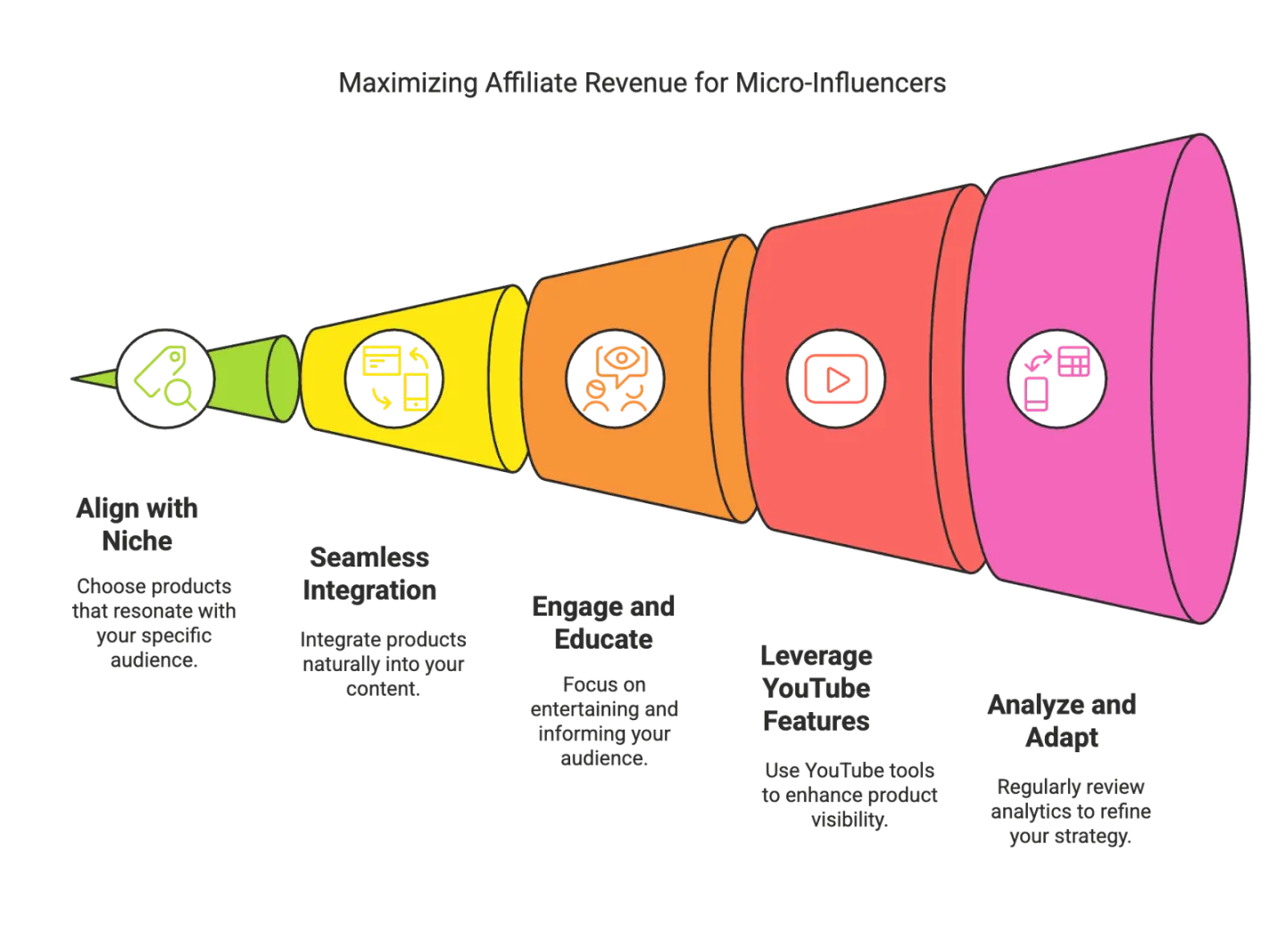
Ready to jump in and start earning? Here’s a step-by-step guide on how micro-influencers can leverage YouTube’s affiliate program and Shopify partnership. We’ll walk through joining the program, tagging products, and getting those commissions rolling in.
As a creator, getting started with YouTube’s affiliate program is straightforward. YouTube provides built-in tools for you to discover affiliate products and see commission offers from various sellers (as illustrated in the example interface above). Essentially, you’ll be browsing a catalog of brands and products right within YouTube and Shopify’s ecosystem. Here’s how to get set up and make the most of it:
1. Check Your Eligibility & Join the Program: First, ensure you meet the basic requirements. You need to be in a region where the YouTube Shopping affiliate program is available (currently the US, India, and several other countries, with more on the way) and have a qualifying channel (YouTube has required channels to have over 10k subscribers for affiliate shopping access in many regions). If you’re eligible, joining is easy. Sign in to YouTube Studio, click on the “Earn” tab in the left menu, and look for the YouTube Shopping Affiliate Program section. Hit “Join Now” and accept the terms. This opt-in will activate the Shopping affiliate features on your channel. (If you also have a Shopify store of your own, you’ll be prompted to link it via the Google & YouTube app on Shopify – but if you’re just affiliating others’ products, no need to have your own store.) After joining, you might need to wait for approval, but many creators report it’s pretty quick if you meet the criteria.
2. Browse and Select Products to Promote: Once you’re in, it’s time to pick the products you want to feature. YouTube’s interface (both on desktop and mobile) will now include a Shopping section where you can search or browse products from the affiliate program. Think of it as a built-in product catalog. You can search by brand or keyword, or navigate categories relevant to your niche. The Shopify partnership means there are thousands of brands and items available for you to choose from, so you’re likely to find products that align with your content – whether it’s tech gadgets, beauty products, fashion items, home decor, or more. When you find something that fits, you can add it to your “tag list” for an upcoming video. Pro tip: Take advantage of the YouTube Shopping Chrome extension during this research phase. If you often find products while surfing the web, the extension lets you quickly check if that item is in YouTube’s affiliate program and what the commission rate is, then save it to your list. It’s like window-shopping with commission info at your fingertips. Keep in mind best practices here: select products you genuinely think your audience will like and that make sense in your content (more on that in the best practices section below).
3. Create Content and Tag the Products: Now for the fun part – making your content. Plan your video or Short as you normally would, but think about how to naturally feature the products you chose. Are you reviewing them? Giving a demo or a try-on? Or simply mentioning them in passing as part of a story or routine? However you include the product, be authentic (your viewers will appreciate honesty over a salesy pitch). When uploading your video (or after it’s published), use YouTube’s product tagging tool to tag the products directly in the video. In YouTube Studio’s video details, there’s a Shopping section where you can add products from your approved list. Tagged products might appear as a small pop-up or shelf during the video, and they’ll be visible in a dedicated “Products” section below the video description too. For example, if you tag a “GlowGadget Ring Light” in your video, viewers might see an interactive card or thumbnail for that product while watching, which they can click for more details. You can tag multiple items in one video (just make sure each is actually mentioned or shown, so it feels relevant). YouTube has made tagging easier for creators with recent updates, so the interface will guide you – often it’s as simple as searching your product list and clicking “Tag” next to each item. Before you hit publish, also consider adding these product links in your video description (YouTube usually auto-generates the affiliate link when you tag, which you can copy to the description or a pinned comment for extra visibility).
4. Publish, Promote, and Engage: With your video live and products tagged, let it do its magic – but don’t just sit back entirely. Make sure to mention the products in your video naturally and encourage viewers to check them out. A call-to-action can be as subtle as, “I’ve linked all the items I used in the description if you’re curious,” or a more direct, “Click the product view to see details on this cool gadget.” You don’t need (or want) to come off like an infomercial; remember, your strength as a micro-influencer is authenticity. But a gentle nudge that the product is accessible can significantly boost clicks. Also, be ready to engage with your audience’s questions or comments. If someone asks, “Hey, where’d you get that?” you can reply and let them know it’s available via the video link. This kind of engagement can drive more traffic to the affiliate link and shows the YouTube algorithm that people are interacting with your content (win-win). If you have other platforms (Instagram, Twitter, etc.), you can even share your YouTube video there with a note like “I tried out XYZ product in my latest video – loved it, see how it works in my review.” This cross-promotion can funnel more viewers (and potential shoppers) to your video.
5. Track Your Earnings and Optimize: Finally, keep an eye on how your affiliate endeavors are performing. YouTube provides analytics for the Shopping affiliate program – you can see metrics like clicks and revenue generated from each tagged product. Use YouTube Analytics to see what products are getting attention. For instance, you might discover that your audience clicks on beauty items far more than fashion items, or that one specific gadget you featured is responsible for a spike in commissions. Micro-influencer and beauty YouTuber Taisha Alicea notes that she checks which product links get the most clicks and views, and then adjusts her content strategy accordingly (if her viewers show more interest in skincare over clothing, she leans into more skincare content). You can do the same: double down on the types of products that resonate with your viewers. If something isn’t getting any traction, try a different item or approach next time.
Over time, this optimization can significantly increase your affiliate revenue. It’s like being your own data scientist – in a casual creator way. Also, keep an eye out for special promotions in the affiliate program. Some brands might offer higher commissions for a period or provide freebies/samples to creators (YouTube’s interface might highlight promotions in the product catalog). Taking advantage of these can give your earnings a nice boost. And of course, ensure you stay compliant: follow FTC guidelines and YouTube’s policies by disclosing that you use affiliate links (usually a simple note in the description like “*Some links are affiliate, meaning I earn a commission if you purchase through them*” suffices). Transparency will keep you in good standing and maintain trust with your audience.
By following these steps, you’ll set up a smooth process to incorporate affiliate marketing into your YouTube workflow. From joining the program to tagging products and analyzing results, the barrier to entry is low – it mostly costs you a bit of time to integrate it into your content routine. For a micro-influencer looking to grow their income, it’s a relatively straightforward path to start earning via influencer marketing on YouTube in partnership with Shopify’s extensive retail network.
Getting started is half the battle – now, how do you make sure you’re maximizing your earnings and not leaving money on the table? Here are some best practices for micro-influencers to turn this YouTube affiliate program into a lucrative endeavor. Keep these tips in mind to elevate your strategy:
By following these best practices, you’ll not only maximize your affiliate earnings but also maintain the integrity and quality of your content. The beauty of the YouTube-Shopify affiliate setup is that it rewards genuine influence and good content. If you keep your audience’s trust at the forefront and align your affiliate efforts with what your viewers value, you can create a sustainable income stream that grows with your channel.
Need some inspiration? Let’s look at a couple of examples of micro-influencers who are already profiting from YouTube’s affiliate tools in partnership with Shopify. These case studies show that you don’t need millions of followers to make this work – smart strategy and genuine content can go a long way.
Taisha Alicea – Beauty & Fashion Micro-Influencer: Taisha is a Latina creator who started her channel to bring more representation to Latin women in beauty and fashion. With a modest but dedicated following, she’s been leveraging the YouTube affiliate program to monetize her makeup tutorials, product hauls, and style videos. Her approach is all about trust and community. “My subscribers share the same interests as me,” Taisha says, so she focuses on sharing her go-to products and new finds organically in her videos, only featuring items she truly uses herself.
This genuine curation has built a strong bond with her viewers. When YouTube’s affiliate program became available, Taisha integrated it by tagging those beloved products directly in her videos and descriptions. The result? Her audience can conveniently shop the exact shade of lipstick or brand of hair tool she’s raving about, and Taisha earns a commission each time. She also uses YouTube’s analytics to refine her strategy: *“I like to see what products are getting the most attention, which helps me create future content,”* she explainsFor instance, if a particular skincare product gets tons of clicks, she knows her viewers are into skincare and might create a follow-up nighttime routine video with more product tags. By listening to her audience’s behavior and staying authentic in her recommendations, Taisha has turned her passion for beauty into a growing revenue stream – all while maintaining that approachable, trustworthy vibe her fans love.
YouTube’s affiliate program integration with Shopify is more than just a new feature – it’s a sign of where influencer marketing is headed in 2025. The lines between content creation and e-commerce are blurring, and for micro-influencers, that’s an exciting development. We’re seeing a shift where creators of all sizes can directly participate in the sales of products they love, effectively becoming key players in the retail chain. It’s a far cry from the old days of either relying on ads or hoping for a sponsorship. Now, even with a smaller channel, you can generate meaningful income by connecting your audience to products that genuinely help or delight them.
As we’ve discussed, the benefits for micro-influencers are plentiful: a new revenue stream that complements your existing ones, an easy-to-use system courtesy of the Shopify partnership, and a way to leverage the trust and engagement you’ve built with your community. By following the steps to join and using best practices to stay authentic and strategic, you can tap into this opportunity right away. The learning curve is relatively gentle, and the potential upside – as demonstrated by early success stories – is encouraging.
In a casual yet very real sense, this is influencer marketing growing up. Platforms like YouTube are recognizing that supporting creators with more monetization options ultimately creates better content and a better user experience. And brands are eager to work with micro-influencers through affiliate partnerships because of the higher engagement and niche audiences involved. It’s a symbiotic ecosystem that is only set to expand.
So, if you’re a micro-influencer looking to boost your income and provide extra value to your followers, YouTube’s affiliate program (with its Shopify boost) is definitely a partnership to watch – and join! Keep creating great content, integrate those product tags thoughtfully, and you might find your YouTube channel not only entertains and informs but also becomes a nice little business. In the ever-evolving world of social media and e-commerce, this is your chance to ride the wave of the latest trend – turning influence into income, one product tag at a time.
Happy tagging, and here’s to your affiliate success in 2025 and beyond!
In 2026, YouTube and Shopify deepened their integration – a game-changer for Shopify Plus merchants aiming to scale through influencer marketing. YouTube’s shopping features now seamlessly connect with Shopify stores, opening new ways for brands to collaborate with YouTube creators and drive sales. This expanded partnership comes at a perfect time: influencer marketing is booming (over 82% of marketers plan to use it in 2026, and nearly half of consumers make purchases at least monthly because of influencer posts according to Shopify. For Shopify Plus brands, the enhanced YouTube-Shopify integration means more efficient influencer campaigns, better tracking, and higher ROI potential.
*YouTube’s expanded partnership with Shopify enables Shopify Plus merchants to easily connect their stores to YouTube’s Shopping tools, allowing creators to tag products in videos and lives for seamless shopping experiences according to Shop Digest.
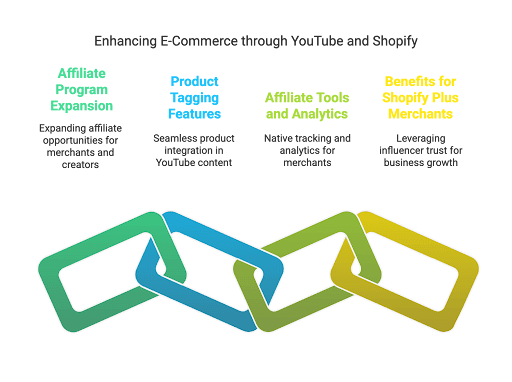
YouTube Shopping Affiliate Program Expansion: In August 2024, YouTube expanded its partnership with Shopify to bring more merchants into its affiliate program. Now eligible Shopify Plus and Advanced merchants in the U.S. can join YouTube’s Shopping affiliate network via the Google & YouTube app in Shopify according to YouTube. This lets thousands of YouTube creators discover and promote these merchants’ products in their videos at scale ([YouTube Expands Shopify Partnership To Add More Brands To YouTube Shopping Affiliate Program.) On the flip side, creators get access to a much wider selection of brands to partner with, including early adopters like BK Beauty, Popflex, HexClad, and GoPure Beauty. For Plus merchants, this means your products can be *showcased by influencers* to massive audiences without heavy lifting on your part according to Netinfluencer.
Seamless Product Tagging and Shopping Features: The integration makes it trivial to sync your Shopify product catalog to YouTube. Merchants can tag and pin products in YouTube content – whether in on-demand videos, Shorts, or live streams according to By Association Only . For example, you can display a product shelf below your YouTube videos featuring a curated list of items, and even add a Store tab on your YouTube channel with your entire product lineup. During live streams, Shopify products can be tagged/pinned at key moments, with viewers able to shop in-picture without leaving the stream. All of this is kept up-to-date by Shopify (pricing, inventory, etc.), and if a product sells out on Shopify, it’s automatically removed from YouTube – a huge benefit for reliability.
Built-in Affiliate Tools and Analytics: Shopify Plus merchants can now leverage YouTube’s affiliate tracking and analytics natively. By enrolling through the Google & YouTube app, you gain a dashboard in Google Merchant Center to manage your influencer affiliate program – you can see which creators are tagging your products, view associated content, and track clicks or sales according to Retail TouchPoints. This ease-of-use for influencers means *more creators are likely to feature your Shopify products*, since the barrier to find and tag them is low.
Why This Matters for Shopify Plus: As a Plus merchant, you likely have an omnichannel strategy and the resources to scale – the YouTube-Shopify integration supercharges your social commerce channel. Social proof and trust on YouTube are incredibly strong: 89% of viewers trust recommendations from YouTube creators, and 6 in 10 consumers say they’d purchase from a brand recommended by a YouTuber over one endorsed by a traditional celebrity according to Coolest Gagets. By making it easier to get your products into those trusted videos, the integration helps you tap into YouTube’s 2+ billion user base with authentic influencer content. In short, Shopify Plus brands can now more directly partner with YouTube influencers as affiliates, turning engaged viewers into shoppers with a frictionless path to purchase.
Launching an influencer marketing campaign on YouTube can be broken down into clear steps. Below is a step-by-step guide for Shopify Plus merchants to find the right YouTube influencers, collaborate effectively, and measure success.
1. Set Clear Goals and Budget – Start by defining what you want to achieve (e.g. increase brand awareness, drive product sales, grow subscribers) and how much you’re willing to invest. Having specific goals will inform the type of influencers you target and the campaign structure. For instance, if your goal is conversions, you might plan a campaign focused on product review videos with affiliate links aiming for a certain number of sales or revenue. Determine a budget for influencer fees or product giveaways. (Tip: Influencer marketing is a paid strategy, so allocate funds wisely and consider potential ROI – many brands see an average of $5+ in revenue per $1 spent on influencer marketing according to Supliful.)
2. Find the Right YouTube Influencers – Identifying suitable creators is critical. Look for influencers whose content, audience, and values align with your brand. Here’s how to find them:
When evaluating influencers, review their content quality and style. Make sure they produce high-quality videos and maintain a tone that fits your brand. Check their audience demographics (many creators share media kits or you can ask for YouTube Analytics screenshots) to ensure their viewers match your target customer profile. The ideal influencer partner has an engaged audience that overlaps with your market and a content style that can highlight your product naturally.
3. Set Up Collaborations & Campaign Logistics – Once you’ve identified potential influencers, it’s time to reach out and arrange the partnership. If you’re using an influencer platform or Shopify Collabs, you can invite creators directly through those tools. Otherwise, a well-crafted email or DM works too. When pitching a collaboration, be clear about:
If the influencer is on YouTube’s Shopping affiliate program (many U.S. creators with 20k+ subs are eligible, collaborating is even easier: you simply ensure your Shopify products are synced, and the creator can self-tag your products in their YouTube content. If not, you can still work via traditional affiliate links or unique discount codes. For instance, generate a Shopify discount code like “YOUTUBER10” for that creator to share – this gives their audience an incentive and lets you track sales per influencer.
4. Launch the Campaign and Engage the Audience – When the influencer publishes content, amplify its reach. Share the YouTube video on your brand’s social media or email newsletter (“We teamed up with – check out their review of our product!”). This not only drives more views (and potential sales), but also signals to your customers that a trusted voice endorses your brand. If it’s a live stream event, promote it ahead of time and perhaps have your team on standby in the live chat to answer questions or drop product links. During the campaign, ensure your Shopify inventory is stocked to handle the uptick in orders if the video performs well (nothing’s worse than an influencer sending buyers who find items sold out). Also, monitor the YouTube comments section and engage politely – oftentimes viewers will ask questions about the product that either the influencer or you can answer. This kind of engagement can boost conversions by addressing potential buyers’ curiosities in real time.
5. Track Performance and Measure ROI – As an influencer campaign runs, continuously monitor metrics to gauge success. Key performance indicators include: video view count, engagement (likes/comments), click-throughs to your site, and ultimately conversions/sales attributed to that content. Shopify Plus merchants have the advantage of advanced analytics – use UTM parameters or Shopify’s built-in analytics to see referral traffic from the video link. If the influencer used the YouTube Shopping affiliate tagging, check your Google Merchant Center affiliate dashboard for metrics on that creator’s performance (it can show clicks and revenue generated by each creator’s tagged products. Also, Shopify Collabs (or other affiliate apps) will show you sales per affiliate link if you provided one.
After the campaign, calculate your ROI: compare the revenue (or new customers, etc.) generated against what you spent on the collaboration. Beyond sales, take note of soft metrics too – e.g. an uptick in subscribers to your own YouTube channel, increased branded search volume, or higher engagement on your social accounts. These indicate longer-term brand lift from the influencer’s endorsement. It’s common to see a spike during the campaign and a “long tail” of smaller referrals as the video stays on YouTube indefinitely (people might discover it months later and still convert). Identify what worked and what didn’t: maybe product review videos drove more sales than a mention in a vlog, or perhaps one influencer’s audience responded with particularly high conversion rates. Use these insights to refine your next campaigns – double down on the tactics and creators that delivered the best results, and adjust or drop those that underperformed. Influencer marketing is an iterative process, and over time you’ll build a roster of high-performing partners.

Still on the fence? Let’s look at why YouTube influencer marketing is so powerful, with some data and real examples:
These stats and stories underscore a clear message: YouTube influencer marketing works. It builds trust at scale, reaches enormous audiences, and drives both immediate and long-tail sales. For Shopify Plus merchants, combining that power with the Shopify platform’s ease of checkout and tracking creates a formula for success.
To get the best return on your influencer efforts, Shopify Plus brands should employ a few key strategies on YouTube:
By implementing these strategies – tracking every sale, engaging through live content, crafting the right videos, and reusing influencer assets – Shopify Plus merchants can maximize the return on each influencer partnership. It’s about working smarter: making it easy for viewers to buy, easy for influencers to promote, and easy for you to see the impact.
Scaling influencer marketing, especially for a large Shopify Plus brand, is much easier with the right tools. Here are some top resources and integrations to help manage campaigns from discovery to analytics:
A post shared by Stack Influence (@stackinfluence)
A post shared by CreatorIQ | Influencer Marketing Software (@creatoriq)
In summary, equip your team with the right tools: an influencer CRM to manage relationships, strong analytics to measure impact, and Shopify’s native integrations to tie it all together. This will save time and ensure no sales or interactions slip through the cracks as you scale up your YouTube influencer marketing efforts.
The convergence of Shopify Plus and YouTube in 2026 has created an unprecedented opportunity for e-commerce brands to supercharge their influencer marketing. With seamless integration, Shopify Plus merchants can let YouTube creators do what they do best – create engaging content – while the platform handles the shopping logistics in the background. By following a structured approach to finding and working with the right influencers, backed by data and best practices, you can build campaigns that not only drive immediate sales but also foster long-term brand loyalty.
Influencers bring trust and authenticity that traditional ads simply can’t match. And now, thanks to YouTube’s expanded Shopify partnership, that authenticity directly translates to checkout clicks and revenue for your store. Whether it’s through an enthusiast tech reviewer explaining why your gadget is a must-have, a beauty guru demoing your new product in a live stream, or a fitness vlogger linking your apparel in a lookbook video – the pathways to purchase are now organically woven into YouTube’s viewing experience. As a Shopify Plus merchant, leverage these tools, learn from each campaign’s data, and iterate.
In 2026 and beyond, the brands that win will be those that blend commerce with content. By optimizing your influencer marketing strategy on YouTube, you’re not just chasing views or likes – you’re building an engine of awareness, consideration, and conversion that can propel your e-commerce growth to new heights. So get started with that first collaboration, measure the impact, and watch as a single YouTube video potentially turns thousands of viewers into happy customers. The era of shoppable video is here – and Shopify Plus brands are in the driver’s seat to make the most of it.
In the wake of TikTok’s uncertain future, Shopify merchants are wisely looking to diversify their influencer marketing efforts. Which platforms and strategies deserve your attention now? In this post, we’ll explore why Instagram and YouTube are prime alternatives, how micro-influencers can beat celebrity endorsements, tools like Stack Influence to streamline campaigns, other emerging platforms worth testing, and best practices for influencer marketing in 2025.
TikTok skyrocketed to popularity, but its future is now on shaky ground. Governments have raised security and privacy concerns, with the U.S. even threatening a ban if TikTok’s Chinese parent company (ByteDance) doesn’t divest ownership. In fact, a U.S. law set a deadline of January 2025 for ByteDance to sell TikTok or face a nationwide ban according to Traackr. That means the app which drove so many viral trends could potentially disappear from a major market. For brands that heavily invested in TikTok influencers, this uncertainty is a serious risk. It’s a stark reminder not to put all your marketing eggs in one basket. Savvy Shopify merchants are preparing backup plans and redistributing budgets to other channels now, rather than scrambling if TikTok goes dark.
Diversifying your influencer strategy is simply good business insurance. If TikTok usage is curtailed, consumers’ attention will flow elsewhere. We’re already seeing creators and brands exploring alternatives. Instagram Reels and YouTube Shorts are obvious substitutes for TikTok’s short-form videos. A marketing guide on navigating a TikTok ban suggests exactly that: shift focus to platforms like Instagram, YouTube, and even Pinterest, where organic reach can fill some of the void according to Marketing Hire. In short, TikTok’s turmoil is a wake-up call to broaden your social presence. So where should a Shopify brand look next?
Instagram and YouTube have emerged as the primary havens for influencer marketing outside of TikTok. Both are established, widely-used platforms with huge audiences and robust creator communities. Unlike newer apps, Instagram and YouTube aren’t facing existential threats – they’re stable, mature channels that brands have trusted for years. Let’s break down why these two deserve a big slice of your attention (and budget).
Most popular social networks worldwide as of April 2024, by number of monthly active users (in millions). Facebook leads with over 3,000 million (3 billion) users, followed by YouTube (2,504M), and Instagram/WhatsApp (approx. 2,000M each). TikTok’s audience (~1,582M) still trails Instagram and YouTube, while Twitter (now “X”) (611M) and Pinterest (498M) have comparatively smaller, niche audiences. This massive reach on Instagram and YouTube is a key reason Shopify merchants should prioritize them post-TikTok according to Sprout Social.
Instagram has evolved far beyond its photo-sharing roots into a powerhouse of influencer marketing. With around 2 billion monthly active users as of 2024, Instagram offers sheer scale – it reaches roughly one-fourth of the world’s internet users. Critically for brands, a large chunk of Instagram’s base falls in the young adult demographic (33% of users are 18–24 and 29% are 25–34 according to Curator.io, which overlaps nicely with the TikTok audience. This means you can still catch trend-savvy Gen Z and millennials on IG.
Engagement on Instagram remains strong, especially with its newer formats. For example, Reels (Instagram’s answer to TikTok) see an average engagement rate of about 2.0%, outperforming traditional Instagram posts. While TikTok has slightly higher typical engagement for big accounts, Instagram isn’t far behind and offers more tools for brands – shoppable posts, product tags, swipe-up links (now link stickers), and a culture of influencers that’s well-established. In one study, 69% of consumers said they trust influencer recommendations on social media more than info directly from brand. Instagram’s influencers have built that trust over years, making it a fertile ground for product discovery and sales. In fact, 61% of social media users turn to Instagram to find new products – higher than on any other platform. And 44% of people wish brands posted more on Instagram, indicating users are open to engaging with businesses there. For Shopify merchants, all this is good news: on Instagram you have a massive, receptive audience that’s primed to interact with influencer content and even shop in-app.
YouTube isn’t just for long-form video; it’s a cornerstone of the internet and an influencer goldmine. The platform boasts 2.5 billion monthly active users globally according to Sprout Social) – effectively the entire world is on YouTube. In the U.S., an incredible 62% of internet users access YouTube daily according to The Social Shepherd, underscoring how integral it is to people’s media consumption. For Shopify brands, YouTube offers reach that rivals even Facebook and Instagram, and it skews broad in demographics – from Gen Z to Gen X and beyond – everyone watches YouTube.
What makes YouTube especially valuable is the longevity of its content. A TikTok or Instagram Story might captivate users for a day, but a good YouTube video (say, a product review or unboxing) can keep attracting views for years. Influencer content on YouTube is highly searchable (YouTube is the world’s second-largest search engine after Google) and often evergreen. A tutorial or testimonial about your product can show up in search results or recommendations long after the initial post, driving a steady trickle of traffic to your store. Engagement and community on YouTube are also noteworthy – creators often build dedicated subscriber bases that trust their opinions deeply. Comments sections become discussion forums. If a popular YouTuber recommends your product, it carries weight akin to a personal recommendation. And let’s not forget YouTube has jumped into short-form video too with YouTube Shorts, which are gaining traction as a TikTok alternative. The bottom line: YouTube combines huge scale with depth of content. By working with YouTube influencers, Shopify merchants can get both immediate exposure and a long-term brand asset (in the form of a video that keeps working for you).
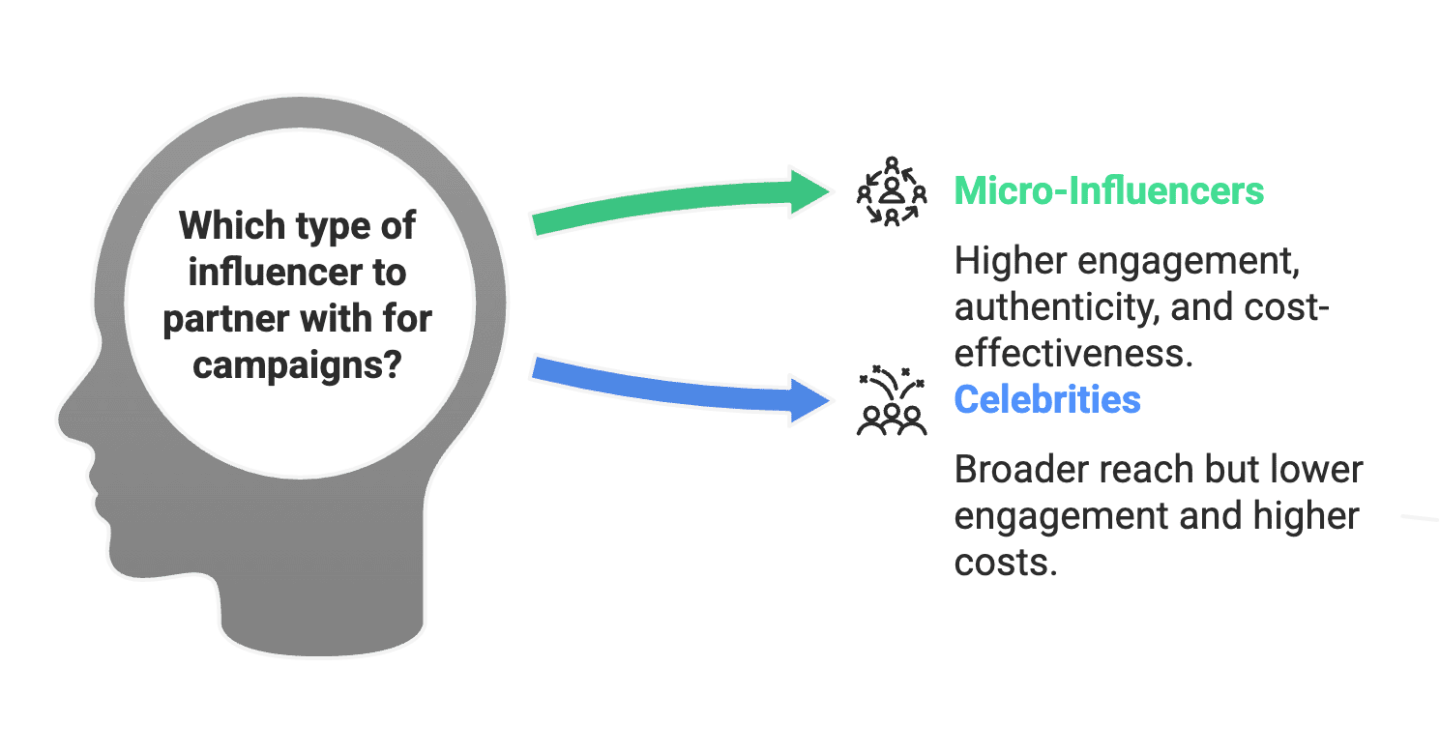
When planning influencer campaigns post-TikTok, one strategy stands out: partner with micro-influencers instead of big celebrities. Micro-influencers are creators with smaller followings – often in the 5,000 to 100,000 range – who have niche, highly engaged audiences. It might sound counterintuitive to go with less famous folks, but the data speaks volumes about the effectiveness of micro-influencers.
Studies show that as follower count rises, engagement rate tends to fall. Nano- and micro-influencers often have far higher engagement percentages than mega-influencers. For instance, on Instagram, micro-influencers (around 10k–100k followers) see an average 3.8% engagement rate, whereas mega-influencers (over 1M followers) only around 1.2% according to Phyllo. That’s more than 3x the engagement! Smaller creators simply interact more authentically with their followers – replying to comments, having real conversations – which builds trust and loyalty. In fact, one report found nano-influencers (<5k followers) have the highest engagement of all (about 2.5%) and engagement steadily decreases to roughly 0.9% at the mega tier. This means a micro-influencer’s post is much more likely to actually influence (change opinions or spur action) than a celebrity’s blast to millions of passive scrollers.
Real-world brand experiences reinforce this. A classic example is Daniel Wellington, the watch company that exploded in growth by leveraging thousands of micro-influencers instead of a few big celebrities. They started by seeding free watches to “everyday” creators on Instagram – even nano-influencers. Those influencers were excited to share a stylish watch with their followers, and the result was an explosion of content tagged #danielwellington across social media. The campaign went viral not through a single famous face, but through a grassroots army of micro-influencers posting sincere endorsements. The strategy led to a boom in sales and brand awareness, propelling Daniel Wellington to the top of the lifestyle watch category – all without spending on huge celebrity fees. This case isn’t unique; countless DTC brands (from fashion to beauty to niche hobbies) have found that a network of micro-influencers talking to their tight-knit communities can drive more conversions than a single A-lister who feels out-of-touch.
Micro-influencers often come across like real people (because they are!), more akin to a friend recommending a product. Their smaller scale makes their content feel authentic and relatable, whereas a celebrity endorsement might scream “paid ad” and roll off the consumer’s back. Trust and authenticity are the currency here. It’s been reported that 80% of consumers have purchased something after an influencer (not necessarily a celeb) endorsed it on social media. That kind of influence usually stems from perceived authenticity. A fitness micro-influencer with 15k followers who consistently posts honest workout tips is likely to persuade more people to try a new protein powder than a movie star posting a one-off #ad for the same product. For Shopify merchants, micro-influencers also have a practical benefit: they are far more budget-friendly. Many will collaborate in exchange for free product or for a modest fee ($50–$500), whereas a top-tier celebrity or macro influencer might charge thousands for a single post. You can stretch your budget to work with 20 micro-influencers, generating a stream of diverse content, rather than blowing it all on one celebrity Instagram post.
Bottom line: Micro-influencers combine engagement, trust, authenticity, and affordability. Especially in 2025, as consumers grow weary of overly produced ads, these “real” voices can cut through the noise. Prioritizing micro over mega influencers is a smart move for brands looking for genuine connections and better ROI on their influencer spend.
A post shared by Stack Influence (@stackinfluence)
One challenge with utilizing many micro-influencers is the effort involved – finding the right creators, reaching out, sending products, and tracking all those collaborations can be time-consuming. This is where tools like Stack Influence come in handy. Stack Influence is a micro-influencer marketing platform designed to help ecommerce brands (like Shopify sellers) run campaigns with dozens or even hundreds of small creators efficiently. Essentially, it automates the “product seeding” the strategy that Daniel Wellington used. You can offer your product to a curated network of micro-influencers through the platform, and it handles the matchmaking and logistics. The micro-influencers in the Stack Influence network are compensated with your product (often as free samples), so their posts feel like genuine customer experiences – which in turn generates more authentic word-of-mouth buzz about your brand.
Using a platform like this can save you a ton of outreach time and ensure you consistently have influencers posting about your products. Stack Influence boasts a community of everyday creators across many niches, meaning you can tap into specific target audiences (whether it’s eco-conscious moms, tech gadget enthusiasts, indie beauty bloggers, etc.) with minimal hassle. For a Shopify merchant who doesn’t have a huge team to manage influencer relationships, this kind of tool is a game-changer. It lets you scale up micro-influencer campaigns without losing that personal, grassroots touch. In short, Stack Influence and similar platforms act as a bridge between brands and the micro-creators who love to share cool products with their followers – making micro-influencer marketing a more turnkey, repeatable part of your strategy.
Pinterest – Often underestimated, Pinterest is a visual discovery engine that can drive serious traffic and sales, especially for brands in food, fashion, home décor, DIY, and lifestyle categories. It’s unique because users come to Pinterest in a “shopping mindset” – they’re literally looking for ideas and products. According to Pinterest’s own stats, 85% of weekly Pinners have made a purchase based on a Pin they saw from a brand according to Sprout Social. That is an insanely high conversion potential. With nearly 500 million monthly active users globally, Pinterest’s audience is smaller than Instagram’s, but it’s highly motivated. It also skews notably female (about 76% of Pinterest users worldwide are women according to Hootsuite, and many are in household decision-maker roles. If your target customer overlaps with Pinterest’s user base, this platform can be a goldmine for influencer collaborations. Pinterest influencers (often called “Creators”) make content like idea pins, collections, and boards that feature products organically. A crafty micro-influencer might create a “Summer Outfit Ideas” pin including your boutique’s sundress, or a foodie influencer might pin a recipe using your artisanal spice blend. Such content can spread on Pinterest for months as people save and re-pin it. Pro tip: consider partnering with Pinterest influencers to create content that links back to your Shopify store – it’s a great way to get referral traffic that’s genuinely interested in buying. And the longevity of pins means a single pin could keep generating clicks well after the campaign.
Twitter (now officially known as X) – Twitter has always been a bit of a different beast. It’s more about real-time conversation and less about polished visuals. But that doesn’t mean you should ignore it; Twitter can be useful for certain niches and strategies. As of 2024, Twitter/X still has an estimated 350–400 million monthly users (with around 200+ million daily actives) according to Business of Apps, and it tends to attract a demographic interested in news, tech, finance, sports, and pop culture chatter. While Twitter’s average engagement rates on posts are much lower than on Instagram (often well under 1%), it shines in virality and community dynamics. A single tweet from an influencer can spark conversations, retweets, and trending topics in a way other platforms don’t. For Shopify merchants, working with Twitter influencers might mean collaborating with popular bloggers, journalists, or niche experts relevant to your product. For example, a tech accessories store might engage a respected tech reviewer on Twitter to post about their new gadget organizer. Or a streetwear brand might partner with a sneakerhead who has a big Twitter following to tweet an outfit photo with your sneakers. Twitter influencer marketing is often more subtle – it could even just be organic engagement like that influencer participating in a Twitter chat your brand hosts, or doing a quick shoutout. Also, brands themselves can build a voice on Twitter and become quasi-influencers (think Wendy’s or fast-food brands with snarky tweets). If you can create shareable, witty, or insightful content, Twitter will amplify it. Just remember, the Twitter audience expects authenticity and timeliness. Trending humor, memes, and hot takes rule here. So any influencer content on Twitter should feel like part of the natural conversation, not a formal ad. It’s a tougher nut to crack for direct ROI, but it’s great for brand awareness, PR moments, and joining cultural conversations that align with your brand persona.
Other platforms to consider include LinkedIn (if you sell B2B or professional services – e.g. an entrepreneur selling business planners could leverage LinkedIn influencers in the productivity space), Twitch (if your product ties into gaming or streaming culture – gaming influencers can showcase your hardware or snacks on their live streams), and Snapchat for very youth-oriented brands (Snap is smaller now but still has a dedicated teen/young adult user base for quick content and AR filters). Even newer social apps like Threads (Instagram’s text-based app) or community platforms like Discord and Reddit can be viable for influencer engagement in 2025, depending on your niche. The key is to think about where your target customers hang out and who they listen to. For instance, a niche hobby brand (say, a custom mechanical keyboard kit) might find more traction through a Reddit community influencer or a Discord moderator than through an Instagram post.
The social media landscape is always evolving, but some core principles will guide Shopify merchants to success in 2025. Here are a few best practices to adapt your influencer campaigns for the post-TikTok era:
By following these best practices – diversifying platforms, focusing on authentic micro-influencers, embracing new content formats, repurposing UGC, and keeping a data-driven long view – Shopify merchants can navigate the post-TikTok influencer world with confidence. The key is adaptability. Social media will continue to change (who knows what new app might pop up by 2026?), but a strategy built on genuine connections, creative content, and prudent channel mix will always put you in a position to thrive. TikTok or no TikTok, influencers will remain a powerful growth engine for ecommerce brands. So go forth and collaborate wisely, wherever your audience may be watching!
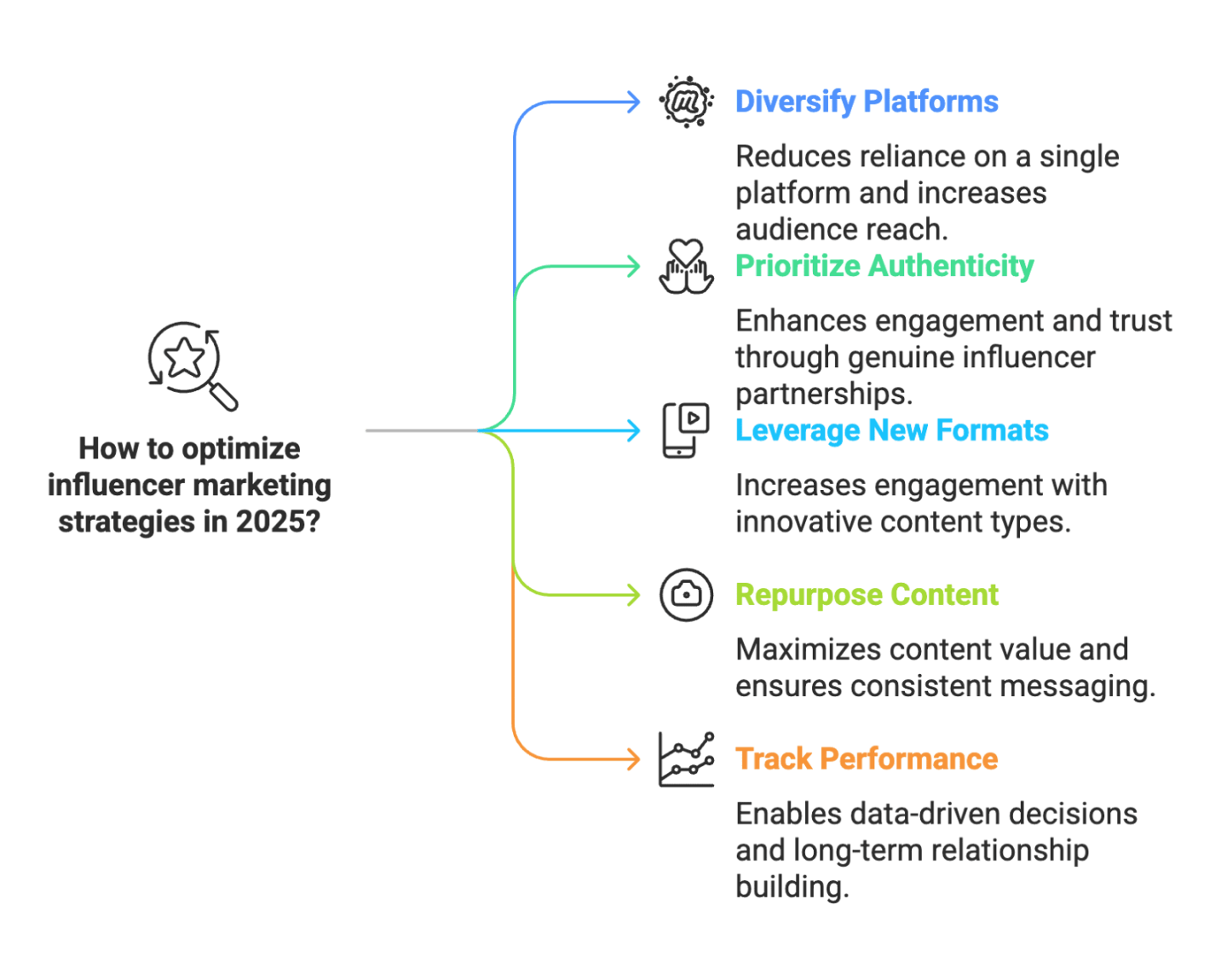
The demise of Amazon Inspire serves as a crucial lesson in the evolving landscape of influencer-driven shopping. While Amazon’s attempt to merge social media engagement with its e-commerce model didn’t pan out, it doesn’t signal the end of social commerce—far from it. Instead, it reinforces the idea that consumers prefer to discover products through established social platforms like TikTok, Instagram, and YouTube rather than within a retailer’s app.
For brands and influencers, this shift means focusing efforts where engagement is highest, leveraging platforms that excel in content discovery while using Amazon as the back-end marketplace. With Amazon doubling down on retail media partnerships and AI-powered shopping tools, it’s clear the company is prioritizing seamless transactions over trying to be a social network. Meanwhile, influencers will continue to drive purchasing behavior by creating engaging content on platforms where users are naturally scrolling, interacting, and making purchase decisions.
Ultimately, social commerce is still on the rise, but its success hinges on authenticity, strategic platform choices, and frictionless shopping experiences. The fall of Inspire is a reminder that while technology enables commerce, it’s the consumer's behavior and preferred digital habits that truly shape the future of shopping.
Micro-influencers – those niche creators with smaller but highly engaged followings – have become a secret weapon for brands. Their authenticity and close-knit communities often translate into outsized engagement (nano- and micro-influencers boast the highest engagement rates across social platforms (10 Influencer Marketing Statistics You Need to Know in 2023 | Aspire)). But maximizing their impact isn’t just about isolated Instagram posts. The real magic happens when brands weave micro-influencers into a cohesive, cross-channel marketing strategy. Imagine your brand’s content, ads, events, and community efforts all amplified by passionate micro-influencers echoing your message. In this article, we’ll explore how to blend micro-influencer campaigns with your content marketing, paid advertising, event marketing, and community building in a unified way. We’ll also dive into strategies for repurposing content across Instagram, TikTok, YouTube, and more – and even stacking micro-influencers alongside bigger influencers or brand evangelists in a layered ecosystem. Let’s get started on building a cross-channel game plan that’s conversational in tone but serious about results.
Micro-influencers may have fewer followers than celebrity endorsers, but they make up for it in trust and influence. Studies show consumers are 82% more likely to act on a recommendation from a micro-influencer, and engagement rates can be up to 60% higher than those of macro-influencers according to Giraffe Social. This high engagement means that when micro-influencers share your brand content or message, their audiences are more likely to actually pay attention and respond. For brands, that’s gold – especially when you extend those messages across multiple channels for repeated touchpoints. If a micro-influencer posts about your product on Instagram, mentions it in a YouTube video, and their content or testimonial also appears on your website or ads, it creates a cohesive narrative. Consumers encounter consistent, trusted voices championing your brand wherever they turn, reinforcing credibility each time.
It’s also a matter of efficiency and ROI. You can often collaborate with multiple micro-influencers for the cost of one macro influencer, expanding your reach into diverse niche communities. In fact, many brands are shifting budgets to smaller creators – 69% of brands now work with nano/micro influencers as they prioritize authenticity over follower count according to Aspire. When those micro-collaborations are coordinated across your various marketing channels, each channel reinforces the others. The result? A compounding effect on brand awareness, engagement, and even sales, driven by genuine word-of-mouth at scale. As one case we’ll explore showed, a brand achieved a 13X ROI by scaling up a micro-influencer campaign across platforms (Micro Influencer Case Study - 13X ROI With Amazon Influencers). Before we get to that, let’s break down the strategy piece by piece – starting with your own content marketing.
One of the first places to blend micro-influencers into a cross-channel strategy is your content marketing. Think beyond social posts – consider how influencers can contribute to or amplify the content you create (blogs, videos, newsletters, etc.). For example, you might invite a micro-influencer to guest write a blog post or be interviewed for a piece of content. In doing so, you get quality content with a fresh voice, and the influencer will likely share that content with their followers, driving new traffic to your site. Even legacy brands have seen this work: Sperry (the boat shoe company) enlisted micro-influencers to create lifestyle photos and blog posts, resulting in a 66% boost in website traffic and millions of impressions for the brand (11 Brands That Work with Micro Influencers in 2024). The key is that the influencer’s contribution lives on your owned channel (like your blog or YouTube), and they promote it on their channel – a win-win cross-pollination.
Another approach is to repurpose influencer content within your brand’s channels. If a micro-influencer makes a great how-to video about your product on TikTok, feature it on your website or embed it in a relevant blog post (with permission). Not only does this enrich your content library, it gives that influencer extra exposure (which they’ll appreciate), and it provides social proof to your audience. Make sure to align messaging and style so that the influencer content feels cohesive with your brand voice. You might provide influencers with guidance on your campaign themes or content topics, then let them put their personal spin on it. By coordinating content this way, your brand’s narrative stays consistent even as it’s told through different voices. As one marketing agency advises, “develop a cohesive strategy that integrates multiple channels effectively… ensure consistent messaging and branding across all channels.” according to Goat Agency. When micro-influencers and your content team are in sync, each piece of content amplifies the other, painting a bigger picture than either could alone.
Don’t forget the power of social media takeovers or collaborative content on brand-owned channels. For instance, have a micro-influencer take over your Instagram Stories for a day to share behind-the-scenes content, or do an Instagram Live Q&A together. That live content can later be edited into a YouTube highlight or a recap on your blog. Similarly, you could co-create an e-book or guide – your brand provides the data or framework, and micro-influencers provide quotes, tips, or case examples from their perspective. These collaborations not only produce rich content but also make the influencers feel like true partners, strengthening the relationship (which pays off when they talk about your brand elsewhere). Always promote these collabs across both parties’ channels. For example, when a fitness micro-influencer contributes a workout tip to your newsletter, have them share the newsletter sign-up link with their followers, mentioning their feature. Such cross-channel shoutouts ensure every piece of content reaches further and reinforces the campaign message across audiences.
Micro-influencers shine on social media, so leverage that strength across all relevant platforms. A common strategy is to have influencers cross-post or adapt content for multiple platforms. Let’s say your campaign’s main content is a 2-minute YouTube tutorial video featuring a micro-influencer using your product. That influencer could share a teaser clip on Instagram and a condensed version on TikTok, each pointing back to the full YouTube video or to your product page. Now the campaign lives on three platforms instead of one, catching different audience segments in the format native to each. As a brand, you should also share or re-share the influencer’s posts on your own socials (where appropriate) to give them extra legs. Many influencers are happy to provide the raw assets (photos, video clips) so you can tailor posts for your feeds as well – just be sure to credit or tag them for authenticity.
To keep this efficient, plan campaigns with a multi-platform mindset from the start. Choose a unifying hashtag or tagline for the campaign and brief your micro-influencers on how it can be expressed on various platforms. For example, a food brand launching a new snack could partner with a group of micro-influencers: on Instagram they post recipe photos using the snack, on TikTok they do a quick taste-test reaction, and on Pinterest they share a recipe card – all using the same hashtag and core message. This cohesive but platform-tailored approach massively extends reach. One marketing firm notes that by utilizing multiple channels (social media, blogs, video, etc.), you can “reach a broader audience and gain maximum exposure” while keeping the experience consistent as customers hop from one channel to another.
By strategically orchestrating these cross-posting and amplification tactics, you essentially create an echo chamber of your campaign message – but a friendly one, where each echo comes from a relatable voice. This leads to higher total impressions and a feeling for the consumer that “I’m hearing about this product everywhere!” – even if it’s just your network of micro-influencers hitting all the key platforms in unity.
Blending micro-influencers into your paid advertising can be a game changer. Two popular methods are (1) influencer whitelisting and (2) using influencer-generated content as ad creative. Let’s break those down:
This is when a brand runs ads through an influencer’s social media account, with the influencer’s permission. Essentially, the influencer “whitelists” their handle so you can pay to promote their posts or even create dark posts that appear to come from their profile. Why do this? Because content coming from a person’s account can feel more organic and trustworthy to consumers than a typical brand ad. In fact, 49% of consumers trust influencer recommendations more than brand ads according to Shopify. Whitelisting lets you take that trusted content and put budget behind it, targeting specific audiences. You’re not limited to the influencer’s follower list; you can reach far beyond, using the same targeting tools you’d use for any ad campaign, but with the influencer’s post as the ad unit. Brands also get access to richer performance data from the influencer’s side. According to Shopify, “influencer whitelisting gives brands more control over how to leverage influencer content… and first-party data insights, often resulting in higher sales conversions.” In practice, this might look like: a micro-influencer posts a video review of your product on their Facebook or Instagram; you then promote that post via their account to a wider audience for a month. The ad appears as if the influencer themselves sponsored it, which can boost credibility and engagement.
If you go the whitelisting route, ensure you have a clear agreement with the influencer (usually whitelisting is arranged for a certain period and possibly an extra fee or free product as incentive). Also, keep the influencer informed about the ad’s performance – it’s a partnership, and sharing success metrics can encourage them to create even better content for future campaigns.
You don’t have to run ads from the influencer’s account to benefit from their content. Micro-influencers often produce fantastic user-generated content (UGC) – authentic photos, videos, testimonials, unboxing clips, etc. – that you can repurpose in your own brand ads. With permission and proper usage rights, take those high-quality influencer assets and incorporate them into your paid social ads, display ads, or even print and TV ads. Why? Because audiences tend to respond better to realistic, relatable content. In fact, ads featuring UGC-style content can drastically outperform polished studio creatives. For example, one report found UGC-based ads get 4X higher click-through rates and 50% lower cost-per-click compared to average ads (36 User-Generated Content Statistics That You Can’t Ignore). That’s a huge boost in efficiency. Additionally, web conversion rates can be ~29% higher when consumers are exposed to UGC versus campaigns without it (36 User-Generated Content Statistics That You Can’t Ignore).
Consider an Instagram ad campaign where instead of a glossy product shot, you use a micro-influencer’s Instagram photo of them genuinely using your product, with a small tagline and a call-to-action button. It feels like a peer recommendation, which is powerful. Many brands also use influencer video clips in paid Stories ads or TikTok ads – the content fits the native look of the platform, so users don’t immediately scroll past an “obvious ad.” Remember the earlier mention of the snack brand? They could take the most entertaining clips from those influencer taste-test TikToks and run them as sponsored TikTok ads targeting foodies, extending the campaign’s reach beyond the influencers’ own followers.
Pro Tip: Whichever method you use, disclose and tag appropriately. Platforms have specific branded content policies. Whitelisted ads often show “Sponsored – in partnership with ” or similar. And if you’re using influencer content, ensure you credit them if it’s on organic channels, or at least have their okay that it’s for ads. Keeping influencers in the loop maintains trust and can lead to them proudly sharing “I was featured in so-and-so’s official ad,” which again amplifies reach.
Influencer marketing isn’t confined to the digital world. Event marketing – from store openings and trade shows to webinars and product launch parties – can get a serious boost by involving micro-influencers. They add a personal, human touch to events and help bridge the gap between the in-person experience and the online audience.
For in-person events, consider inviting a group of relevant micro-influencers as special guests or even event hosts. Their role can be to document and share the event in real-time. For example, at a product launch party, micro-influencers might livestream parts of the event on Instagram or TikTok, give their candid reactions to the new product, and interview attendees or company reps. This effectively turns your event into social media content that reaches people who aren’t physically there. It’s cross-channel: the event is offline, but the storytelling is online via the influencer’s channels. Meanwhile, you can repost their event content to your brand’s story feeds, creating a feedback loop. The influencers benefit too – they get exclusive access and interesting content for their audience.
Event marketing with influencers isn’t just for flashy consumer brands; B2B companies do this with webinars and conferences by having industry micro-influencers live-tweet a panel or do a post-event blog recap. The influencers’ commentary adds credibility (it’s not just the brand saying the event was great – an impartial voice is vouching for it) and broadens the event’s reach.
By involving micro-influencers in events, you’re essentially turning attendees into storytellers. Their perspectives will make the event more relatable to target consumers, and all that content can be leveraged across your channels. It also creates a community vibe – people who follow those influencers might feel like they were almost at the event, and they’ll associate that positive, inclusive feeling with your brand.
A truly cohesive cross-channel strategy isn’t just about campaigns – it’s about community building. Micro-influencers are perfect partners for this because they often come from the communities you’re trying to build or reach. Many brands have formalized this into ambassador programs or advocate communities, where micro-influencers and enthusiastic customers (sometimes one and the same) are nurtured as a long-term part of the brand’s family.
One standout example is Sephora’s #SephoraSquad program. Sephora doesn’t just do one-off deals with influencers; they run a year-long bootcamp-like program that recruits dozens of micro-influencers (and even some employees) as brand ambassadors (Sephora Squad Explains Influencer Program Marketing Strategy). These individuals get training, mentorship, and early access to products, and in return they consistently create content for Sephora across TikTok, Instagram, YouTube, and more. The result is a vibrant community of creators who are deeply invested in the brand’s success. According to Sephora’s marketing leads, the goal was to have a “group of influencers we work with on a more annual basis to really build partnerships” – and it’s paid off in making Sephora one of the most talked-about brands in beauty on social media (Sephora Squad Explains Influencer Program Marketing Strategy). This is the power of integrating micro-influencers into the fabric of your brand community.
So how can you do something similar? You might start by identifying your brand evangelists – those passionate customers or fans who are already posting about your product, even in small ways. Some of them might qualify as nano- or micro-influencers; others might just be regular folks with an outsized love for your brand. Invite them into a more formal community: a private Facebook group, a Slack channel, or a branded ambassador program. Provide perks like sneak peeks, freebies, or even commissions via affiliate links. Then encourage them to share and create content, not in a top-down “please post this” way, but by co-creating initiatives. For example, let your community vote on a new flavor or feature, and have them share their input journey on social media. When the new product drops, they’ll feel ownership and naturally promote it.
Micro-influencers in these communities often collaborate with each other too, further amplifying reach. They might do shoutouts or collab videos together featuring your brand, effectively cross-promoting to each other’s niche audiences. This layered network effect is incredibly valuable. It also serves as a feedback loop for your brand – you get a finger on the pulse of what your most engaged customers want, via the influencers who are interacting with them daily.
An advanced strategy for cross-channel campaigns is to create a layered influencer ecosystem, combining micro-influencers with larger influencers or even celebrities. This isn’t an either-or choice; they can complement each other’s strengths. Macro- or mega-influencers (think big YouTubers or Instagrammers with hundreds of thousands or millions of followers) offer broad reach and can create splashy moments. Micro-influencers, as we’ve discussed, bring high engagement, niche targeting, and a constant drumbeat of authentic content. Together, they form a pyramid of influence – wide at the top and deep at the bottom.
Consider how a layered campaign might work: A mega-influencer (or a few) is tapped to be the face of a new campaign, creating hero content (maybe a marquee YouTube video or a well-produced Instagram Reel) that grabs headlines and mass attention. At the same time, dozens of micro-influencers are engaged to create their own content around the campaign theme, timed to go out after or alongside the big influencer’s post. The macro-influencer generates awareness on a large scale, and the micro-influencers fill in the niches – they localize the message, reply to comments in depth, and keep the conversation going in communities the big star might not reach directly. From the audience’s perspective, they see a huge splash from the star, and then they keep encountering “real people” like them talking about the product – which reinforces that this isn’t just a one-off celebrity ad, but something with grassroots excitement.
Brands like Dunkin’ have used this approach. Dunkin’ has worked with mega-influencers (and even a celebrity partnership with Charli D’Amelio) for massive visibility, while simultaneously collaborating with micro-influencers who create a steady stream of content featuring Dunkin’ drinks and daily routines (11 Brands That Work with Micro Influencers in 2024). This layered strategy means the brand dominates both the mainstream feed and the niche corners of social media. Another example: Warby Parker, the eyewear brand, often partners with micro-influencers for everyday Instagram content showcasing their glasses, but they’ve also teamed up with celebrities like Jimmy Fallon for special promotions (15 Influencer Marketing Campaign Examples in 2025). The micro-influencers ensure Warby Parker is constantly present in organic conversations about style, while the occasional celebrity collab bursts into popular culture, and each amplifies the other.
When collaborating across tiers, it helps to foster connections between the influencers too. For instance, a brand could host a meetup or virtual event where all campaign influencers – big and small – get together, share ideas, and even create content jointly. Perhaps the macro-influencer does IG Live chats with a few micros, or a TikTok duet chain is set up between a star creator and various micro-creators. These interactions can create a sense of a unified ambassador team, and fans might enjoy seeing influencers they follow in different circles come together (it’s like a crossover episode of your favorite shows!).
One more layer to consider: your internal influencers – employees, founders, or industry experts on your team who have their own following or at least clout. They can be part of the ecosystem too, adding a voice of authority or insider perspective. We saw this with Sephora including employees in their Squad (Sephora Squad Explains Influencer Program Marketing Strategy). A tech company might have engineers or a CEO active on LinkedIn or Twitter who can amplify the campaign alongside external influencers. The more, the merrier, as long as messaging stays coordinated.
Key takeaway: A layered influencer ecosystem ensures that at every level of the consumer journey, from broad awareness to niche consideration to loyal advocacy, there’s an influential voice guiding the way. It’s a 360-degree approach. Just be sure to manage it carefully – a clear brief, communication channels for all participants, and a unifying creative direction help keep everyone on the same page. When done right, it feels like a movement with many voices singing in harmony about your brand.
To cement these ideas, let’s look at a real-world example. Blueland, a sustainable cleaning products brand, leveraged a large micro-influencer campaign to drive e-commerce sales and achieved impressive cross-channel results. After appearing on Shark Tank, Blueland wanted to scale up awareness and sales on Amazon. They hired micro-influencer agency Stack Influence to activate 211 micro-influencers in a coordinated campaign (Micro Influencer Case Study - 13X ROI With Amazon Influencers). The strategy wasn’t just about getting Instagram posts – it had three core objectives across channels:
Importantly, Blueland didn’t let that great content go to waste. They secured rights to all the high-res images and videos generated by the 211 influencers, and “repurposed on other marketing and ad initiatives.” (Micro Influencer Case Study - 13X ROI With Amazon Influencers) This means those influencer photos likely showed up in Blueland’s own Instagram feed, on their website, and possibly in paid ads or emails. By integrating the influencer content into their broader marketing, Blueland kept a consistent look and feel (authentic UGC-style visuals) across channels. Someone might see a friend share an influencer’s post on Facebook, then later see a Facebook ad from Blueland using that same photo – which reinforces the message and feels naturally familiar.
The end result? Sales and ROI. Blueland’s average monthly unit sales on Amazon increased 4.7× during the campaign (Micro Influencer Case Study - 13X ROI With Amazon Influencers). In total, the micro-influencer initiative drove an additional $129,000+ in revenue over those three months (Micro Influencer Case Study - 13X ROI With Amazon Influencers). Stack Influence reports that this amounted to a 13X return on investment (ROI) for Blueland (Micro Influencer Case Study - 13X ROI With Amazon Influencers). In other words, for every dollar Blueland spent on the campaign, they got $13 in revenue back – a testament to how effective micro-influencers can be when deployed strategically across content, social, and commerce channels.
It’s worth noting that this campaign’s success came from coordination: 211 influencers working in concert, rather than random one-offs. Blueland identified specific use cases for them (content creation, social engagement, direct traffic) and likely provided guidance or assets to ensure the brand was represented accurately. By casting a wide net of micro-influencers, they hit many micro-communities (sustainable living moms, interior design enthusiasts, etc.) all at once, which when aggregated produced a huge lift. And by integrating that content into other channels (Amazon SEO, ads, etc.), the impact went well beyond just social media likes – it drove tangible business outcomes.
Bringing everything together, here are some best practices and strategies to keep in mind as you blend micro-influencers with your broader marketing efforts:
In a marketing landscape where consumers bounce between Instagram, YouTube, in-person experiences, and brand websites in the span of an hour, achieving a cohesive presence is essential. Micro-influencer cross-channel collaboration is all about meeting your audience wherever they are, with a familiar friendly voice and consistent story. It blends the credibility of peer-like recommendations with the scale of a multi-channel marketing plan. By integrating micro-influencers into content marketing, social media, paid ads, events, and community initiatives, brands can create a surround-sound effect – your target customer seemingly can’t escape hearing good things about you! And those messages resonate more because they come from trusted creators who genuinely align with your brand.
As you craft your next campaign, think about it like an orchestra. Your brand’s owned content is one section of instruments, your ads another, your events another. Micro-influencers are like talented soloists embedded in the crowd, amplifying the melody. When everything works in harmony, the result is powerful. So start conducting your cross-channel influencer strategy – recruit your micro-influencers, plan together, and let each channel amplify the others. With the strategies and examples outlined above (and perhaps a dash of inspiration from Blueland’s success), you’ll be well on your way to turning a handful of micro-influencer collaborations into a symphony of marketing impact across every channel that matters. Here’s to your next cohesive and conversion-driving campaign!
In August 2024, Shopify released eye-opening survey results: 73% of U.S. merchants said social-media engagement was their top strategy for maintaining customer relationships according to Business Insider.. This highlights just how critical influencers and social networks have become for ecommerce brands. Fast forward to 2025 – Shopify has doubled down on this trend, rolling out new influencer marketing features that are supercharging online store growth. In this blog, we’ll explore Shopify’s latest influencer tools, how they’re driving sales, and what that means for merchants and creators looking to thrive in the social commerce era.
Shopify is making it easier than ever for brands and influencers to team up. One headline update is the expansion of YouTube Shopping integration. As of late 2024, all eligible Shopify Plus and Advanced merchants in the U.S. can directly join YouTube’s shopping affiliate program via Shopify. This program syncs a merchant’s products with YouTube, enabling thousands of YouTube creators to tag those products in videos at scale. In other words, your Shopify products can now appear in haul videos, unboxings, and tutorials across YouTube, with affiliate links driving viewers straight to your store. Merchants manage everything (product syncing, content, analytics) through Google’s Merchant Center, making the process seamless according to Shopify.. It’s a win-win: creators earn commission, and merchants get traffic from the 30+ billion hours of shopping-related videos watched on YouTube in 2023
Another exciting addition is Shopify’s own influencer collaboration hub, Shopify Collabs, which saw significant improvements. Shopify Collabs is a built-in app that helps merchants discover and work with influencers (it’s free for any Shopify store) Recent updates have made finding the right creators even easier. The Collabs database now offers a more intuitive creator search with new filters like location, audience demographics, and engagement rates. These tools let you search millions of creators to find those who align with your brand. For example, you can filter by platform (Instagram, TikTok, YouTube, etc.), audience size, or niche keywords to pinpoint the perfect influencer match according to Click Consult. This streamlined discovery means merchants can recruit influencers who genuinely fit their brand aesthetic and audience, leading to more authentic partnerships.
Shopify Collabs also simplifies campaign management. Within your Shopify admin, you can invite creators to collaborate, send them free product samples, generate unique affiliate links or discount codes, and track sales they refer – all in one place. Automation is a big theme here: Collabs can even handle commission tracking and automatic payments to your influencers. No more manual payout headaches – set your commission structure, and Shopify takes care of rewarding your affiliates when they make sales. These new features remove a ton of friction, allowing both merchants and influencers to focus on creating great content that drives traffic, rather than getting bogged down in logistics.
And it’s not just YouTube and Collabs. Shopify has integrations with other social platforms too. For instance, the Shopify TikTok channel and Instagram Shopping tools have matured, letting you tag products in videos and posts. The difference now is Shopify’s ecosystem feels more unified around influencer marketing – from YouTube’s affiliate expansion to better in-app tools – giving brands multiple avenues to promote products through creator content. All these features share a common goal: helping merchants tap into the massive reach of influencers to boost store traffic and sales on autopilot.
These new tools are a game-changer for both merchants and influencers, making partnerships more effective and easier to manage. For merchants, the benefit is clear: you can massively expand your reach by partnering with influencers who already captivate your target audience. Instead of relying solely on ads or organic search, merchants can now get their products showcased in an influencer’s Instagram Story or a YouTuber’s review video, reaching engaged followers who trust that creator’s recommendations according to Shopify. Shopify’s integrations remove a lot of the guesswork in these collaborations. For example, with the YouTube affiliate program, a merchant can activate a whole army of YouTubers to feature their products, and each creator’s unique referral link will drive shoppers directly to the Shopify store and attribute the sales accordingly. Meanwhile, the merchant can monitor clicks and conversions from those videos in real time via the Google & YouTube channel analytics
Shopify Collabs makes the merchant-influencer relationship even more seamless. Through Collabs, a merchant can discover the right influencers (say, find fashion micro-influencers in California with 50k–100k followers), invite them to join an affiliate program, and send them products or promo codes as needed – all through one dashboard. The platform handles the nitty-gritty details like generating affiliate links for each influencer and tracking the sales they bring in. This means merchants can easily see which influencer partnerships are ROI-positive. In fact, some brands have reported significantly lower customer acquisition costs by using Shopify Collabs to manage influencer campaigns (e.g. men’s care brand Duradry saw a 29% decrease in CAC according to Shopify.) The built-in analytics and tracking give merchants hard data on what’s working.
On the flip side, influencers also reap big benefits. For creators, Shopify’s tools provide new ways to monetize and streamline collaborations. The expanded YouTube Shopping program is huge for influencers – it means more brands (big and small) are now in the affiliate pool, so creators have thousands of products they can easily tag in their content. All of this lowers the barrier for influencers to include shoppable content in their videos. In practical terms, an influencer can focus on making a great video, and with a couple of clicks in YouTube Studio, tag a product and know what commission they’ll earn from any sales – no back-and-forth negotiation needed for each brand.
For influencers on platforms like Instagram or TikTok, Shopify Collabs provides a steady pipeline of brand deals. Once an influencer joins a brand’s Collabs program, they often get access to a personalized portal where they can see available products to promote, grab their unique links or discount codes, and even request free samples. The automation means they get paid out automatically for any sales they drive – a nice perk that builds trust and encourages long-term collaboration. Moreover, influencers can track their performance (clicks, sales, commissions) through Collabs, which helps them refine their content strategy and show brands the value they deliver. In short, Shopify’s influencer-focused features create a more plug-and-play environment for partnerships: influencers can integrate promotions naturally into their content, and merchants have a turnkey way to boost sales through those authentic endorsements.
Nothing speaks louder than real-world results. Several brands have already jumped on Shopify’s new influencer tools and seen impressive success. Here are a couple of standout examples and takeaways:
It’s not only smaller brands seeing success. Even established companies are embracing these tools. In the beauty space, brands like BK Beauty and GoPure Beauty were highlighted as early adopters of Shopify’s YouTube Shopping integration, getting their products tagged in videos by YouTube creators right out of the gate. This early momentum suggests that as more merchants join the program, we’ll see a surge of influencer-driven shopping content on YouTube featuring Shopify store products. The big takeaway across these stories is that influencer marketing – when done with the right tools – can significantly boost sales and growth. The common strategies are: find influencers who genuinely connect with your product, give them the resources and creative freedom to promote it authentically, and use Shopify’s platform to track results and scale what works.
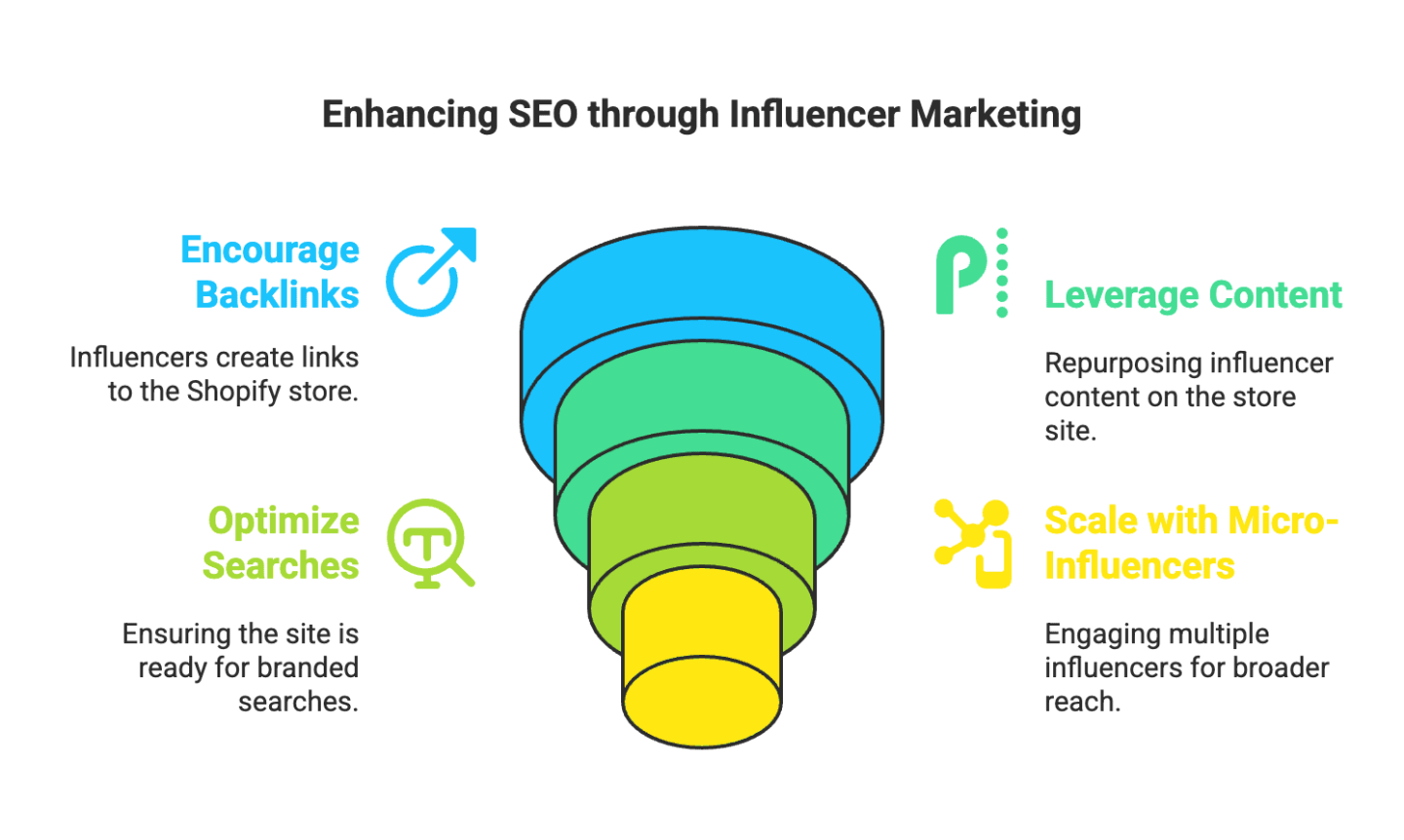
Influencer marketing doesn’t just bring direct sales – it can also boost your SEO and online visibility when done thoughtfully. Every time an influencer talks about your brand, it creates content and sometimes links that can improve your search presence. Here are some SEO best practices to maximize the impact of influencer collaborations on your Shopify store’s traffic:
Lastly, let’s talk about scale. One way to turbocharge both reach and SEO is by running large-scale micro-influencer campaigns – and there are services to help with that. Stack Influence is a great example. Stack Influence specializes in connecting brands with a huge network of micro-influencers and automating product seeding campaigns. Why is this good for SEO? Imagine hundreds of micro-influencers each creating a post, video, or blog about your product. Suddenly your brand is everywhere – lots of content, lots of mentions, and potentially lots of niche backlinks. Stack Influence’s network includes over 11 million vetted micro-influencers across various niches, meaning you can efficiently get your products into the hands of many creators who then generate authentic buzz.
This widespread word-of-mouth acts like a rising tide for your SEO: your brand name gains search volume, user-generated content starts popping up in search results (which can occupy more SERP real estate for your keywords), and you’re building authority through diverse mentions. Plus, campaigns with micro-influencers often produce tons of user-generated photos, videos, and reviews, which you can then feature on your site or social media, further enriching your content. The key is that quantity (paired with quality engagement) can amplify your brand’s digital footprint. Services like Stack Influence help manage this at scale – handling outreach, product shipping, and campaign tracking – so you get the SEO and traffic benefits without drowning in the coordination effort. In summary, don’t overlook micro-influencer programs as an SEO strategy; a broad base of influencer content can drive sustained organic traffic long after the initial campaign ends.
As we’ve seen, Shopify’s latest influencer marketing features are unlocking new opportunities for ecommerce growth in 2025. The data doesn’t lie – merchants are prioritizing social engagement, and Shopify is meeting them (and creators) where they are with tools to collaborate more effectively. From the deep YouTube Shopping integration to the all-in-one Collabs platform, these features are designed to boost visibility and sales while simplifying the workflow for everyone involved. Brands that have embraced these tools are already reporting higher revenues, lower customer acquisition costs, and thriving communities of brand fans. The takeaway is clear: influencer marketing is moving from a “nice-to-have” to a must-have in the ecommerce toolkit, and Shopify is making it easier to execute than ever.
If you’re a Shopify merchant, now is the time to explore these influencer features and weave them into your marketing strategy. Start a campaign with a few passionate micro-influencers or get your catalog hooked into YouTube’s affiliate program – you might be surprised at the surge in traffic and authentic engagement that follows. And if you’re an influencer, aligning with Shopify-powered brands via these new integrations can open up more streams of income and sponsorships in a streamlined way. In 2025, the brands that nail social media and influencer collaborations will be the ones celebrating the biggest sales wins. With Shopify’s latest tools in your arsenal, you’re well-equipped to be one of those success stories. Here’s to boosting your sales and building lasting influencer partnerships in the year ahead!
Actionable Takeaway: Don’t wait to leverage these features. Log in to your Shopify admin, check out the Collabs app (send out a couple invite links to creators you admire), and connect your store to the YouTube Shopping affiliate program if you qualify. By staying ahead of these trends and using the tools at your disposal, you’ll position your store for greater organic reach, better SEO, and increased sales — all fueled by the genuine connections that influencers forge with your audience. Happy collaborating and selling! 🚀
Influencer marketing has evolved from a buzzworthy experiment into a core strategy for many e-commerce brands. Yet one big question remains: how do you connect those influencer posts, especially from micro-influencers, to real ROI and sales? Tracking reach and engagement (likes, comments, shares) is straightforward, but tying those efforts directly to revenue can be challenging In this guide, we’ll break down how to measure the impact of influencer campaigns on your bottom line. We’ll cover proven tracking methods (UTM links, coupon codes, landing pages), share a case study with 13X ROI results, and highlight the best KPIs for brand awareness vs. direct sales campaigns. By the end, you’ll have a clear roadmap to confidently attribute leads and sales to your influencer marketing efforts.
Micro-influencers (typically 10K–100K followers) often deliver high engagement and authenticity. But to justify your investment, you need to tie micro-influencer efforts to overall marketing ROI. The good news is influencer campaigns can yield impressive returns when done right. In fact, industry research shows that businesses earn an average of $5.78 for every $1 spent on influencer marketing (over 520% ROI on average according to inBeat Agency). Smaller influencers can be especially powerful in driving conversions. One study found that about 7% of engagements from nano influencers (smallest tier) converted to a sale, more than double the conversion rate of macro influencers (3%). This higher conversion efficiency means micro/nano-influencer campaigns can punch above their weight in revenue impact.
Conversion rates of engagements to sales for nano vs. macro influencers. Smaller influencers often drive a higher percentage of their likes/comments to actual purchases, underscoring the ROI potential of micro-influencer campaigns.
To unlock these results, you need proper tracking in place. It’s not enough to send products to influencers and hope for the best. By implementing the right tracking tools, e-commerce brands can demonstrate definitive ROI from an influencer’s post and see exactly how much traffic and sales each creator is driving according Social Native. Below, we’ll outline three essential methods to track influencer-driven leads and sales.
Tracking an influencer campaign’s performance requires going beyond vanity metrics. Here are three reliable methods to attribute leads, conversions, and sales to specific influencers:
UTM tags are small snippets added to a URL (e.g. ?utm_source=instagram&utm_campaign=spring_sale) that feed data into analytics platforms. They are one of the most effective ways to track traffic and conversions from influencer content. By adding structured UTM parameters to the links you give influencers, you can precisely monitor how many website visits and purchases come from each post according to yellowHEAD. For example, you might create a unique URL for each influencer’s post (using a link shortener like Bitly to keep it tidy) that includes their name or an ID in the UTM tags. When customers click the link, Google Analytics (or your analytics tool of choice) will record the source as that specific influencer. This allows you to see exactly which influencer drove how much traffic, what those visitors did on your site, and how many ultimately purchased. Tip: Use a URL builder or your CRM to generate UTM links in bulk, and share these custom URLs with your influencers for use in swipe-ups, bios, or stories.
Not every platform allows clickable links (hello, Instagram posts and TikTok). An alternative tracking method is providing influencers with personalized discount codes for their followers. For instance, give each influencer a promo code like BRANDNAME15 that offers 15% off. When customers use that code at checkout, you can attribute the sale to that influencer. These codes serve a dual purpose: they incentivize followers to buy (boosting conversions) and they create a clear record in your sales data of which influencer drove each sale. Make sure each influencer gets a unique code, and ideally one that’s easy to remember and type. You can then track how many times each code was redeemed and the total revenue from those redemptions. Many e-commerce platforms (Shopify, etc.) have built-in reporting for coupon usage, making this data easy to gather. Advanced tip: If you want to avoid discounting, you can use non-discount referral codes or affiliate codes to similar effect, awarding a commission per sale instead of a customer discount.
Another powerful approach is creating dedicated landing pages for each influencer or campaign. Instead of sending an influencer’s traffic to your regular homepage or product page, set up a unique page tailored to that campaign (for example, yourstore.com/influencer-name). This page can feature the specific products the influencer promoted or a special message to the influencer’s audience. Because only that influencer (or a small group of them) will be sending traffic to that page, any conversions that happen there can be attributed back to their content. Branded landing pages build trust and make tracking easy – you can monitor page views, clicks, and conversions on that page in isolation. Most landing page builders and analytics suites will let you see the performance, per page and if you’re running campaigns for clients, using a white-label landing page builder lets you maintain consistent branding while managing multiple influencer pages at scale. You can even integrate your UTM tracking here for extra precision. Bonus: Landing pages combined with UTM-coded links and coupon codes create a triple-layer of tracking, virtually guaranteeing no lead falls through the cracks.
In practice, you might use a combination of all the above. For example, give an influencer a short link with UTMs for their Instagram Story, plus a discount code mentioned in the caption, both pointing to a special landing page – this way, whether their followers swipe up or visit later and use the code, you’ll catch the sale. The key is to plan tracking from the start of your influencer campaign. Define what success looks like (email sign-ups? product sales? app installs?) and choose the tracking method that best fits the platform and your goals.
To see these tracking strategies in action, let’s examine a real-world case study. Stack Influence, a micro-influencer marketing platform, ran a campaign for Blueland (an eco-friendly cleaning products brand) focused on driving sales on Amazon. The campaign enlisted 211 micro-influencers to create content and direct followers to Blueland’s Amazon product listings. How did they measure success? By tracking both awareness metrics and direct sales throughout the campaign.
During the 3-month campaign, Blueland’s influencers generated 247,932 impressions and 11,451 engagements (likes/comments), with an average engagement rate of 4.6%. These awareness metrics showed that the content was effectively reaching and resonating with the target audience. But more importantly, the campaign drove a substantial lift in sales. Blueland’s average Amazon unit sales per month jumped 4.7× – from 542 units before the campaign to 2,562 units during the campaign. This translated into an incremental $129,280 in revenue, achieved by the micro-influencers’ followers purchasing on Amazon. Stack Influence tracked the sales uplift and calculated the ROI by comparing the revenue against the campaign costs (their fees and product samples). After spending about $9,917 on the campaign, the result was a 13X Return on Investment for Blueland. In other words, every $1 invested in those micro-influencers yielded $13 in revenue – a massive payoff.
How were these results tracked so precisely? Stack Influence likely used unique Amazon tracking links or Amazon Associates affiliate data for each influencer, coupled with time-bound sales analysis. By observing the jump in sales and matching it to the influencer promotion period, they could confidently attribute the increase to the campaign. Additionally, improvements in Amazon search rank and new keyword appearances were noted – Blueland’s product rose from ranking #36,544 to #5,808 in its category, and it started appearing on page 1 for high-volume keywords during the campaign. These secondary metrics reinforced the success by showing better organic visibility (an indirect result of the surge in sales velocity from influencer-driven traffic).
This case study highlights a crucial point: with the right tracking, you can capture both the “soft” metrics (impressions, engagement, brand visibility) and the “hard” metrics (sales, revenue, ROI) from an influencer campaign. E-commerce brands that implement such tracking can build a clear business case for influencer marketing, optimizing future campaigns based on what the data shows worked best.

Not all influencer campaigns have the same goals. Some collaborations are aimed at boosting brand awareness – getting your name out there, generating buzz, and building social proof. Others are focused on driving direct sales – hitting a target number of conversions or revenue within a period. Your Key Performance Indicators (KPIs) should align with the primary goal of the campaign. Here’s how to think about KPIs for awareness vs. sales:
If your goal is to increase awareness and positive perception of your brand, focus on metrics that indicate reach and engagement rather than immediate sales. Key KPIs for awareness include:
When the primary objective is conversions or sales, you’ll zero in on the metrics that reflect purchase behavior and cost-effectiveness. Important KPIs for performance-driven campaigns include:
Pro tip: Clearly separate campaigns geared toward awareness vs. those for sales, and choose your KPIs accordingly. It’s fine to have secondary goals (e.g., you hope a brand awareness campaign still drives some sales), but judging an awareness campaign purely on immediate sales can make it look less successful than it truly is. Conversely, a sales-driven campaign should ultimately be evaluated on sales, even if it also produces some nice engagement as a byproduct.
Tracking influencer-driven leads and sales might seem technical, but with the right approach it becomes part of your regular marketing analytics. Here are key takeaways to put this into practice:
Influencer marketing is not a shot in the dark. With a casual yet data-informed approach, even scrappy e-commerce teams can track influencer-driven leads with precision and tie them back to dollars. As 86% of consumers report purchasing a product after seeing an influencer recommend it at least once the opportunity is huge – but so is the need to attribute those purchases correctly. By using UTM parameters, custom codes, and dedicated landing pages, you’ll gain visibility into the full customer journey from an influencer’s post to your checkout page. Armed with this information, e-commerce brands can scale what works, cut what doesn’t, and ultimately build influencer programs that are both creative and accountable to the bottom line. Here’s to turning likes and views into leads and revenue!