
The latest info on influencer marketing trends, micro influencer news, and the world of social media

Influencer marketing has exploded into a mainstream strategy, but in 2026 it’s not just about counting followers or crafting picture-perfect posts. Success now hinges on something far more down-to-earth: being real. Brands and creators alike are discovering that authenticity and transparency are the secret sauce to winning over skeptical audiences. This is especially true for micro-influencers, whose smaller followings often translate into outsized trust and engagement. In this post, we’ll explore why keeping it real is the ultimate influencer marketing hack for 2026 – backed by recent trends, data, and a case study from Stack Influence – and how you can ride this wave to boost your own brand or influence.
Authenticity and transparency lead to audience trust, which in turn fuels influencer marketing success. Influencers who are genuine in their endorsements build stronger connections with followers, creating a foundation of trust that drives results. In fact, 63% of shoppers say they’re more likely to buy a product recommended by a social media influencer they trust. It’s no surprise that content which feels honest and unbiased is what stops people in their scroll – a recent survey found 67% of consumers are most compelled by influencer posts that come across as genuine rather than overly polished ads. Audiences can sense when an influencer truly loves a product or is just going through the motions. Little wonder that 88% of people consider it critical that influencers genuinely care about the products or topics they feature. Authenticity isn’t just a buzzword; in 2026 it’s the currency of influence that converts skeptical scrollers into loyal customers.
Being authentic means influencers stay true to themselves – sharing personal stories, quirks, and honest opinions – even when working with brands. Gen Z especially has a keen nose for inauthentic content, and they won’t hesitate to call it out. As Forbes put it, “Authenticity over everything: Gen Z demands brands with purpose, not just products.” Influencers who share their real values, support causes, or admit imperfections outperform those with perfectly scripted promotions. On the flip side, we’ve seen a growing backlash against phony endorsements. Entire online movements now arise to expose inauthentic promotions, with consumers advising each other on what not to buy if a post seems disingenuous. All this puts pressure on brands and influencers to keep it real – and it’s a healthy pressure that’s reshaping marketing for the better. Authentic storytelling builds emotional connections: it sparks meaningful comments, shares, and long-term loyalty. In short, authenticity is the heart of influencer marketing success in 2026 – without it, even the flashiest campaign will fall flat.
If authenticity is the heart, transparency is the backbone of influencer marketing. In 2026, both regulators and audiences expect influencers and brands to be upfront. That means no sneaky paid posts without disclosure, no inflated follower counts, and no glossing over product flaws. Today’s social media users are savvier than ever – they can spot an #ad a mile away, and they’re quick to lose trust if they feel misled. Being transparent isn’t just about following the rules (though compliance with FTC guidelines and local ad laws is a must); it’s also a strategy for building credibility. When an influencer clearly labels a sponsorship and still gives an honest take, audiences respect them more for it. It’s ironic but true: openly saying “this is a paid partnership” can increase how much followers believe the endorsement, because it shows the creator values honesty over a quick buck.
Transparency also extends to authentic metrics and practices. With fake followers and bots still lingering in the industry, brands are doubling down on vetting influencer partners. It’s estimated that one in four influencers has purchased fake followers, highlighting the need for scrutiny and transparency in partnerships. Nothing will torpedo a campaign’s credibility faster than a scandal revealing that an influencer’s engagement was padded by bots. Smart brands in 2026 use tools (like those provided by Stack Influence and others) to analyze “authenticity scores” and weed out any fraud. The goal is genuine engagement, not a hollow follower count. In fact, many companies now prioritize community quality over sheer quantity – nearly 47% of brands are putting more emphasis on building community than on maximizing follower numbers. This shift towards transparency and community signals a maturing influencer landscape: the focus is on real people and real connections. Brands willing to be transparent about their values and expectations, and who give influencers room to be honest with their audience, will cultivate far more trust than those clinging to old-school stealth marketing.
When it comes to authenticity at scale, micro-influencers are stealing the show. These are the creators with modest follower counts (often roughly 5,000 to 100,000) who command tight-knit, loyal communities. Micro-influencers may not have millions of followers, but here’s the kicker – their content often feels more personal, relatable, and trustworthy, which leads to significantly higher engagement. How much higher? The difference is striking:
Average engagement rates drop as follower counts rise. Smaller creators like nano- and micro-influencers dramatically outperform mega-influencers in engagement. On Instagram, a micro-influencer with, say, 50k followers might average around a 3.9% engagement rate, whereas a mega-influencer (1M+ followers) only sees about 1.2% engagement on their posts. That’s roughly 3 times higher engagement for the micro creator! The chart above illustrates this trend – nano-influencers (under 10k followers) and micros punch far above their weight in generating likes, comments, and shares. Why? Because their audiences aren’t passive fans; they’re more like friends or peers. A recommendation from a relatable micro-influencer carries much more credibility than the same message blasted by a distant celebrity, and the numbers reflect that trust advantage.
The impact isn’t only in vanity metrics – it translates to real ROI. Micro-influencers’ followers don’t just engage more; they buy more. Studies show micro-influencer campaigns achieve over a 20% higher conversion rate than campaigns with macro-influencers. In other words, those genuine connections lead to action. It helps that micros are often topic experts or enthusiasts first and “influencers” second. They focus on niches – whether it’s eco-friendly beauty, gourmet cooking, or budget travel – and carefully choose what they promote to maintain credibility. Unlike a big-name star who might endorse dozens of random products, a micro-influencer typically turns down sponsorships that don’t fit their personal brand or audience interests. This selectivity makes any partnership they do accept feel more authentic – if your favorite fitness vlogger (with 30k followers) raves about a new protein powder, you trust they actually like it rather than just cashing a check.
All these advantages have led to a surge in brands teaming up with micro-influencers in 2026. According to recent industry data, over 75% of marketers’ influencer campaigns now involve nano- or micro-influencers rather than solely big names. Many marketers have realized that a handful of smaller creators can often beat one superstar in terms of combined reach and engagement – and usually for a fraction of the cost. (No wonder 44% of brands say they prefer micro-influencers because they’re more cost-effective.) From fashion labels to tech startups to travel destinations, brands are leveraging armies of micros to generate authentic buzz. Even the travel sector – once dominated by glamorous globetrotters – is now tapping local micro and nano influencers to showcase “real” experiences, knowing that relatability and transparency are what modern travelers crave. The takeaway is clear: bigger isn’t always better in influencer marketing. In 2026, micro-influencers are proving that small creators can have a huge impact by delivering the authenticity, trust, and engagement that drive marketing success.
To see authenticity and micro-influencer power in action, look no further than Stack Influence’s recent case study with Blueland. Blueland, an eco-friendly cleaning products brand (as seen on Shark Tank), partnered with Stack Influence to scale up their presence on Amazon. Rather than shelling out for one or two celebrity endorsements, Blueland’s strategy was to activate a community of 211 micro-influencers all at once. These creators generated a flurry of branded content, boosted social media chatter, and drove targeted traffic to Blueland’s Amazon product pages – all while sharing genuine enthusiasm for the brand’s mission of reducing plastic waste.
The results were nothing short of astounding: the campaign generated a 13X return on investment for Blueland’s Amazon sales. Yes, 13 times! This stellar ROI was achieved not through one big viral hit, but through the cumulative authenticity of 200+ micro influencers each honestly recommending Blueland to their loyal followers. Stack Influence’s platform helped coordinate the effort seamlessly, but it was the authentic voice of each micro-influencer that made the campaign so effective. Followers saw real people – folks with day jobs, students, moms, sustainability nerds – using Blueland’s refillable cleaners in their own homes and truly loving them. That organic tone sparked trust (and plenty of swipe-ups and add-to-cart actions). As Stack Influence’s case illustrates, a transparent, grassroots approach can dramatically outperform a traditional ad campaign. Blueland not only saw a sales boost, but also amassed a library of user-generated content and a swarm of new brand advocates. The takeaway: when brands invest in authentic influencer relationships at scale, the payoff can be huge.
Ready to double-down on authenticity and transparency in your own strategy? Here are five practical tips for brands and influencers to build trust (and results) in 2026:
1. Partner with Influencers Who Align with Your Values: Look for creators whose personal brand and values genuinely mesh with your product or mission. If an influencer is already a true fan of your niche, their enthusiasm will be real. Audiences can tell when it’s a good match – and remember, 88% of consumers say an influencer should sincerely care about what they promote. So do your homework and vet influencers for authenticity before you commit.
2. Encourage Authentic Content & Creative Freedom: Rigid scripts and overly curated posts are a thing of the past. Give influencers the freedom to tell their own story in their own voice. The content might be a bit rougher around the edges, but it will feel far more relatable. This approach pays off: influencer-generated content often outperforms brand-created content because it comes across as more genuine. Trust your influencers to know what their audience likes – collaboration works better than control.
3. Be Transparent About Partnerships: Always disclose sponsored content clearly – no sneaky hashtags or tiny fine print. Transparency builds credibility with the audience, showing that you have nothing to hide. Likewise, be upfront in your messaging: if a product has pros and cons, don’t force influencers to only sing praise. Audiences appreciate honesty. In an era where one bad review can go viral, honesty truly is the best policy. A transparent approach will earn respect and protect both the brand’s and the influencer’s reputation long-term.
4. Focus on Engagement and Community, Not Follower Count: The true influence of a creator lies in their ability to spark conversation and community, not just in how many people follow them. When evaluating influencers, look at their engagement rate and the quality of interactions. A micro-influencer who chats daily with 5k passionate followers can be more valuable than a celeb with 5 million apathetic fans. Marketers are catching on – over a third now prefer working with micro-influencers, and almost half prioritize community-building over sheer reach. Remember, an engaged niche audience that trusts the influencer will amplify your message much further than a massive audience that tunes them out.
5. Build Long-Term Relationships: Consider moving away from one-off paid posts toward longer-term influencer partnerships. When an influencer works with a brand over months or years, the collaboration feels more authentic and less transactional to followers. It also gives the creator time to integrate your product naturally into their life, reinforcing trust each time. Plus, there’s a practical perk: influencers often offer discounts for longer engagements, and these sustained campaigns deliver better ROI than a flurry of one-offs. So think in terms of ambassadors, not just advertisers – growing together with your influencer partners will benefit everyone.
In 2026, successful influencer marketing comes down to two simple yet powerful concepts: authenticity and transparency. Audiences are craving real connections and honest voices in a sea of content, and they’re rewarding the brands and influencers who deliver exactly that. Whether you’re a brand planning your next campaign or an aspiring influencer building your community, keep it real with your audience every step of the way. Choose partnerships that make sense, speak from the heart about products you truly believe in, and don’t be afraid to show the human side of your brand. As we’ve seen, a down-to-earth micro-influencer with a genuine story can often drive more impact than a flashy influencer who’s all style and no substance. By focusing on trust, transparency, and authenticity, you’ll not only improve your influencer marketing success in 2026, but also build a foundation of loyalty that money can’t buy. In a world of filters and fakeness, real stands out – and it wins. So keep it real, and watch your influence (and your business) thrive like never before.
Sources: Recent industry reports and case studies, including Influencer Marketing Hub, Sprout Social, Hypefy, Agility PR Solutions, The Shelf, Dash App, and Stack Influence, among others.
The social media landscape in 2026 is shifting under our feet. Major platforms are tweaking their algorithms in ways that can boost or break an influencer’s reach. For creators – especially micro-influencers with 1K–100K followers – staying visible now means understanding what’s changed and adapting fast. The good news? With the right strategies, you can protect (and even grow) your engagement despite algorithm upheavals. This article breaks down the biggest 2026 algorithm changes on Instagram, TikTok, YouTube, Facebook, and X (formerly Twitter), and gives you a game plan to keep your content in the spotlight. Let’s dive in!
Micro-influencers have never been more important. Brands love them for their authenticity and tight-knit audiences, and the data backs it up – micro-creators often see much higher engagement rates than big celebrities. In fact, on TikTok micro-influencers average about an 8.2% engagement rate vs 5.3% for macro-influencers. This trend isn’t unique to TikTok; across Instagram, TikTok, and YouTube, smaller creators consistently outperform on engagement percentage. Micro-influencers drive higher engagement, authenticity and cost-effective reach compared to traditional celebrity endorsements. The chart below illustrates how micro-engagement stacks up against macro on key platforms:

Engagement rate benchmarks for micro vs. macro influencers on major platforms. Micro-creators often see 2×–3× higher engagement than larger accounts, highlighting their ability to spark conversations and trust with audiences.
Why do these “everyday creators” perform so well? Consumers trust relatable influencers over glossy celebs. Micro-influencers cultivate genuine connections in niche communities, leading to more likes, comments, and shares per post. However, small creators also face unique challenges. With fewer followers to begin with, any dip in algorithmic reach can hurt – a big concern as platforms change what content gets favored in the feed. Let’s examine what’s changing on each platform and how it impacts micro-influencers.
Instagram’s 2026 algorithm update actually gives an edge to smaller creators. The platform has moved toward promoting content from micro-influencers in the Explore tab over big influencers, leveling the playing field. This is huge for a creator with, say, 5,000 followers – your posts have a better shot at reaching new eyes than in years past. But Instagram is also doubling down on meaningful engagement metrics. Shares, saves, and comments are now the top signals influencing IG’s algorithm (more than simple likes). In other words, a highly-saved carousel post or a Reel that sparks a comment thread will travel further than one that gets only likes.
On Instagram, content format matters too. After a few years of video-everything, static images and carousels are making a comeback in engagement. A recent benchmarks report found carousels now earn the highest engagement rate (around 0.55%), slightly more than Reels (0.50%). Don’t retire your photos just yet – compelling carousel posts that encourage swipes and saves can perform excellently. That said, Reels remain vital, especially for reach. Small accounts (<50K followers) actually get more impressions from Reels than larger accounts do. One study noted that brands with 1K–5K followers see about a 20% view rate on their Reels, far higher than the ~4% view rate of accounts over 100K. Instagram is essentially rewarding micro-creators who use Reels to tap new audiences beyond their follower list.
What’s a micro-influencer to do on IG? Adapt your strategy to ride these algorithm waves:
Create “save-worthy” infographics, carousel tips, or how-tos that people want to bookmark. Ask questions or use CTAs in captions like “Share this with a friend who needs to hear it” – it can nudge followers to amplify your post (the algorithm loves this).
Post short, engaging Reels and share them to your feed and Story for maximum exposure. Use trending audios and snappy hooks to boost watch time. A strong hook in the first 2 seconds can stop the scroll – critical since IG’s algorithm monitors early view duration.
Don’t be shy about static posts. High-quality images with engaging captions (or multi-image carousels telling a story) are performing well again. Pro tip: crop portraits to 4:5 ratio (1080×1350) to occupy more screen real estate. And use alt text when uploading images – it’s like SEO for Instagram and could subtly improve discoverability.
Example: One travel micro-influencer (around 30K followers) noticed her engagement dipping in early 2026. She responded by transforming her long scenic photo captions into quick carousel travel hacks. She also started posting 15-second Reels of hidden gem locations with on-screen tips. Within a month, her saves and shares doubled, and several posts hit Instagram’s Explore page, pulling in new followers – showing how adjusting content format and focusing on valuable, saveable content can revive your reach.
TikTok’s explosive algorithm hasn’t slowed down – but it has evolved to reward niche content and strong engagement signals more than ever. In 2026, chasing one-size-fits-all viral hits is out; resonating deeply with your specific community is in. TikTok’s algorithm now favors content that aligns with specific interest groups (think #BookTok, #CleanTok, micro-communities) and amplifies those videos within their niche. For micro influencers, this is actually empowering: if you have a tight focus (say, vegan baking or sneaker art), the algorithm will work to show your content to users who love that topic, even if your follower count is modest. Micro-influencers on TikTok also enjoy high engagement rates relative to bigger creators, which the platform’s recommendation system notices. By some measures, campaigns with TikTok micro-creators saw ~8.2% engagement on average, handily beating the 5.3% rate for macros. Authenticity really wins here – TikTok users want relatable, not overly polished, content.
What other algorithm shifts should you note? Watch time is still king. TikTok’s AI watches how long people view your video, especially in those crucial first moments. If viewers drop off in 2 seconds, TikTok won’t push it. But if you hook them for 15… 30… 60 seconds, TikTok assumes it’s quality stuff and feeds it to more For You pages. Also, TikTok has become a bit of a search engine – users actively search topics, and the algorithm parses your captions, hashtags, and even on-screen text to decide if your video matches a query. Using relevant keywords (and trending sounds) can significantly improve discoverability on the FYP in 2026.
Tips for micro influencers on TikTok: focus on retention, relevance, and trends. Here’s how:
Start your videos with a bang – a question, bold statement, or interesting visual in the first 2 seconds. For example: “Stop scrolling – you need this budgeting tip!” A strong hook boosts watch time by grabbing attention before that swipe happens. Higher watch time = algorithm love.
Be the go-to creator for your specific niche or hashtag community. It’s okay to experiment, but understand that the algorithm thrives on categorizing your content. If you’re all over the place, it’s harder for TikTok to know who to show you to. Lean into niche hashtags and topics so the algorithm can cluster you with the right audience. Remember, micro-virality (going big within your corner of TikTok) beats chasing generic virality.
Keep an eye on trending sounds, effects, and challenges – they’re built-in boosts for visibility. TikTok’s discovery is format-driven; using a trending sound can put you on more FYPs if your content is relevant. But always add your unique spin to stand out from the noise.
Think of your caption as an SEO snippet. Include key words or phrases your target viewer might search for (e.g., “easy vegan recipes” or “DIY sneaker art”). Hashtags like #foryou are generic; mix in niche tags that signal your community. A little research via TikTok’s Creative Center or auto-suggest can reveal popular niche tags to include.
Also, don’t sleep on TikTok’s new features: TikTok Shop integration now allows creators to tag products directly in videos, simplifying the path from content to purchase. Micro-influencers in 2026 are increasingly using this to monetize and provide value (e.g., linking the exact pantry item in a cooking tutorial). Early adoption of such features can give you an algorithmic boost, since platforms reward users who embrace their latest tools.
Example: A micro influencer on “MoneyTok” (financial advice niche) with ~20K followers saw her growth stall late last year. She switched tactics by creating a recurring series (“30-second Money Hacks”) using a trending sound softly in the background and a catchy title overlay. Each video dives straight into one tip, with on-screen text for context (feeding TikTok’s keyword engine). The result? Higher completion rates – viewers often watch to the end to not miss the tip – and a notable uptick in followers. Her focused, consistent niche content now regularly lands on the FYP of users interested in personal finance, demonstrating TikTok’s bias for both watch time and community alignment.
YouTube in 2026 remains a powerhouse for long-form content, but it’s not the same YouTube you might recall from a few years ago. The algorithm has become highly personalized, with YouTube’s recommendation engine now accounting for each viewer’s habits in fine detail. This means two people will rarely have the same homepage – the algorithm “pulls” videos it thinks you individually want to watch, rather than broadly pushing viral videos to everyone. For creators, especially micro-influencers on YouTube (say 10k–100k subscribers), it underscores the importance of audience engagement and satisfaction. The algorithm tracks metrics like watch duration, click-through-rate on thumbnails, and even user surveys about video quality to gauge “satisfaction”. Essentially, YouTube asks: Did this video actually please viewers? If yes, expect it to get recommended more; if people bail early or hit “Not Interested,” the video’s reach will be limited.
A few notable trends and changes on YouTube impacting reach in 2026:
YouTube’s answer to TikTok, YouTube Shorts, has become fully integrated. While long-form videos are YouTube’s core, Shorts offer micro influencers a discovery hack. The Shorts algorithm can propel a 15-second clip from a small channel to millions of views if it resonates. Many creators use Shorts to funnel new subscribers to their main channel. Keep in mind, the Shorts feed is separate, but building a presence there can significantly widen your audience.
YouTube’s algorithm also gives weight to channels that foster community. Utilizing the Community tab (posts, polls, updates) and live streams can deepen engagement with subscribers, which indirectly supports your video performance (engaged subscribers are more likely to be served your new videos). It’s not a direct algorithm boost, but it builds the kind of loyal audience that the algorithm notices (via notifications, etc.).
As with other platforms, micro-creators on YouTube often see higher engagement rates relative to their size. A channel with 20k subs might regularly get 5% of viewers liking or commenting, whereas a mega channel with 2M subs might see a smaller fraction engage. In fact, benchmarks suggest a “good” engagement rate is ~3% for micro influencers (vs ~2% for macro) on YouTube. This is encouraging – it means if you focus on content that sparks action (likes, comments, subscribes), you can compete above your weight class.
It boils down to creating content people want to watch and engage with – and signalling that clearly to the algorithm.
These are your scroll-stoppers. A compelling thumbnail (clear imagery, maybe a bold text snippet) and a curiosity-piquing title can improve your click-through rate (CTR). YouTube’s algorithm takes CTR seriously – if 10%+ of people who see your video actually click it, that’s a strong signal. Just ensure the video delivers on the title’s promise; clickbait that disappoints will hurt watch time and satisfaction.
A simple ask like “Leave a comment with your questions” or “Hit like if you found this useful” can spur more engagement. While comments/likes aren’t as heavy in the algo as watch time, they still count – and more importantly, they indicate an active audience. Replying to comments, pinning great comments, and fostering discussion makes people invested in your channel. That loyalty means new uploads get an early boost (your core fans will click and watch right away), which can snowball the video’s performance.
Use Shorts to grab attention on trending topics or quick tips related to your niche. One micro tech reviewer channel (with ~50k subs) started a series of 30-second gadget tips as Shorts. Some Shorts went viral, adding thousands of subscribers who then engage with the channel’s full reviews. Also, don’t hesitate to mention your Instagram or TikTok if you have different content there – a percentage of your YouTube audience will follow you across platforms, strengthening your overall reach (and giving you a safety net if one algorithm dips).
Example: A micro-influencer couple running a DIY home renovation channel (about 40k subscribers) noticed their video views plateauing. They revamped their approach by studying retention graphs in YouTube Analytics – big drop-offs whenever they had long intros and when videos exceeded 15 minutes. They started trimming videos to ~10-12 minutes, front-loading each with the project’s “reveal” before diving into how they did it. They also launched a weekly YouTube Shorts series of 30-second tool hacks. Within 3 months, their average view duration increased, a few Shorts drew in new subscribers, and their full-length videos started getting picked up by YouTube’s recommended section more frequently. It illustrates that understanding and adapting to YouTube’s signals – click-through, watch time, satisfaction – can revitalize a channel’s growth.
Facebook may not be the trendiest network for influencers, but it’s still a behemoth with 3+ billion users – and it’s undergoing its own algorithmic shifts in 2026. Traditionally, Facebook’s feed (now often split into “Home” and a separate “Feeds” tab) prioritized friends & family updates. Now, to keep users glued to the platform, Facebook is heavily integrating AI-curated content recommendations, not just from who you follow but from across the platform. In mid-2022, in fact, Facebook started prioritizing creator posts and public content in the main feed (Home) to compete with TikTok, even if it meant showing fewer friend updates. For micro-influencers operating via Facebook Pages or public profiles, this change is a double-edged sword: you’re no longer stuck with only your followers seeing your posts – viral public content can get picked up and shown widely – but the competition in the feed is fierce. Every meme page, news outlet, and video creator is vying for attention.
Another major focus area: short-form video on Facebook. Since the launch of Facebook Reels (yes, Reels are on FB too), the algorithm is eagerly pushing video content. In 2024, Facebook integrated more AI to suggest videos and Reels, knowing that video is what keeps people scrolling. So if you’ve primarily been posting static images or text updates on your Facebook page, it might be time to pivot to some video content to stay favored by the algorithm. Even simple behind-the-scenes clips or 30-second quick tips uploaded as Reels can help your reach.
That said, meaningful engagement is still key on Facebook – perhaps even more so given the platform’s aim to "bring people closer together." Content that sparks conversation (comments, shares, discussion in Groups) is more likely to get boosted. Conversely, overly promotional or spammy posts are actively demoted. Micro-influencers, who often have very devoted followings relative to their size, can leverage this by focusing on community building. Some tactics to navigate Facebook’s algorithm in 2026:
Try live videos (Facebook Live) and Stories, which can generate notifications and spark immediate engagement. Live streams, in particular, often get priority placement while live and can rack up comments from your core fans. It’s a chance to have real-time dialogue – something the algorithm notices (lots of comments in a short time = hot content).
Consider creating a Facebook Group around your niche. Facebook has been emphasizing Groups for a few years – posts in an active Group (even if you’re the admin with a small following) might get more traction than a regular Page post. In a Group, members are more likely to see your content and interact, which creates a virtuous cycle of reach. Plus, Group posts don’t face the same algorithmic throttling as Page posts.
Interestingly, posting more on Facebook doesn’t always mean more engagement. A study showed that influencer pages posting ~4 times per week had among the highest engagement rates, whereas some brands posting 2x per day saw diminishing returns. Aim for content that provokes a response – ask for opinions, encourage users to share their experiences related to your post, etc., rather than just pushing out lots of posts. Each piece should count.
Facebook is vigilant about clickbait and engagement bait (e.g., “LIKE this!!! SHARE now!!!” type posts). These might get short-term interaction but are penalized by the algorithm. Instead, craft authentic calls-to-action. For example, a micro fashion influencer might post, “I’m trying to choose between these two outfits for an event – which would you pick? 👗🤔 Let me know in the comments!” – a genuine question that drives comments without resorting to spammy tactics.
Example: A micro-influencer chef (around 15k followers on her Facebook page) struggled with declining reach on standard photo posts of her recipes. She decided to experiment by launching a Facebook Group called “Home Chefs Club” alongside her page. She posts her recipe videos on her page and shares them into the Group, where members discuss and post their own creations. Engagement in the Group (comments, likes from a few hundred members) signals Facebook that her content generates community interaction. Over a few months, the reach on her page videos also improved slightly, likely because the algorithm sees consistent engagement. By combining a Group strategy with regular Reels videos of quick kitchen tips, she found new life in a platform that many had written off for organic influencer reach.
X, formerly known as Twitter, has seen tumultuous changes after its rebranding – and yes, the algorithm got a shake-up too. The classic Twitter timeline was chronological, but nowadays the default For You feed is algorithm-driven, mixing in content you didn’t explicitly follow. Notably, Twitter’s (X’s) algorithm in 2026 is placing more emphasis on content from smaller accounts to ensure a “level playing field” and give users a wider range of voices. This is a boon for micro-influencers: even if you’re not a celebrity with a million followers, your tweets can still end up in people’s feeds if they spark engagement or match someone’s interests. Elon Musk even confirmed adjustments to boost visibility for lesser-known creators, so that the platform doesn’t just become an echo chamber of the top 0.1% of accounts.
However, the half-life of a tweet remains short. Real-time relevance is a core factor – recency and engagement drive whether your tweet gets seen. A post that gets a bunch of likes and replies in the first hour is more likely to be shown around (in For You, or via the algorithmic boost in someone’s Following feed) than one that sits idle. For micro influencers on X, this means you should strategize both what you tweet and when. Here are some tips in light of X’s algorithm changes:
One way for a small account to get noticed is piggybacking on trending hashtags or hot topics – when relevant to your niche. For instance, if you’re a tech micro-influencer and #NewiPhone is trending, share your take with the hashtag. The algorithm often elevates timely, engaging tweets on popular threads/topics, even from smaller users. But keep it authentic; simply hashtag-stuffing unrelated tweets won’t help.
Because X still values recency, posting when your audience is online boosts initial engagement. Use analytics to identify when your followers are most active and tweet during those windows. Consistency is key too – tweeting regularly (e.g., a few times daily, or at least several times a week) keeps you present in the algorithm’s “mind”. Dormant accounts fade from the For You feed.
On Twitter, engagement is a two-way street. Replying to other tweets (especially those of bigger influencers or within your community) can increase your visibility. Often, people follow active repliers if they add value to a conversation. Plus, if your reply sparks lots of likes or becomes a conversation itself, that can surface your profile to others. Just remember to keep replies genuine and not self-promotional. Build rapport – it can indirectly lead people to check out your content.
Try incorporating images, videos, or polls in your tweets. Visuals can stand out as people scroll, and the algorithm might give a slight edge to media posts since they tend to get more engagement. Polls and questions explicitly invite interactions (votes, replies), which can boost your tweet’s rank. That said, avoid external links in every post – tweets that keep users on the platform (e.g. text, image, poll tweets) often perform better than those that always direct off-site (Twitter’s algorithm, like others, prefers you not lead people off X).
Example: A micro-influencer in the personal finance space (with ~8k followers on X) found success by participating in the daily #FinTwitter discussions. Each morning when a popular finance account posed a question about investing strategies, she would chime in with a thoughtful response or a quick tip thread of her own. Some of her threads, using the new longer tweet format for subscribers, went semi-viral because they packed value and were retweeted by bigger names. She also started a weekly Twitter Space (live audio chat) on budgeting, which further cemented her as a go-to resource. By staying active and leveraging new features like Spaces and the expanded character count (for X Blue subscribers), she grew her follower count and maintained strong engagement – proving that even on a fast-moving platform like X, quality content and strategic engagement can beat the algorithm.
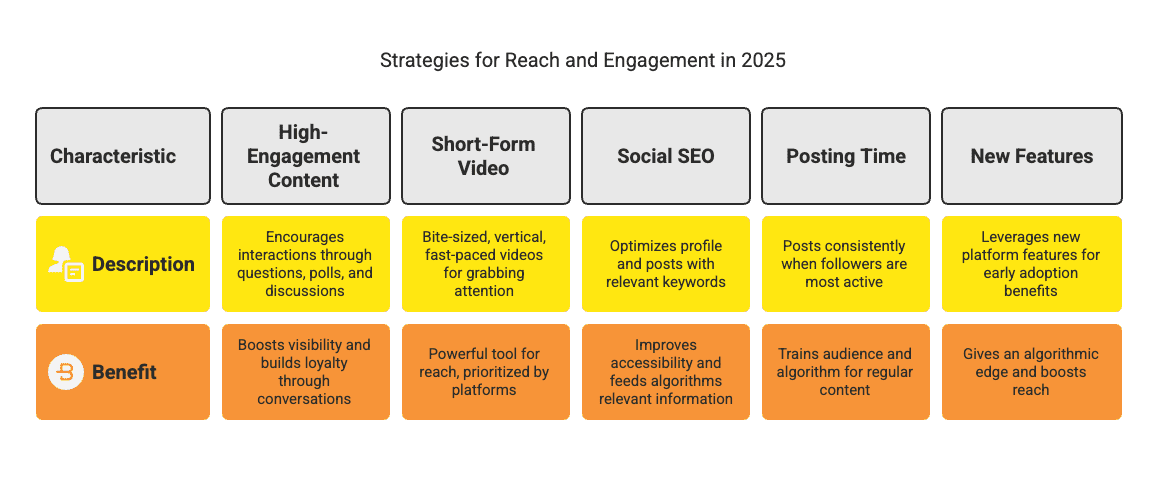
No matter the platform, some core strategies will serve you well in the face of algorithm changes. Consider this your influencer survival kit for 2026 – a set of actionable, expert-backed tips to keep you thriving:
Focus on content that naturally encourages interactions. Ask open-ended questions in your captions, run polls or Q&As, use interactive stickers (on Stories), and prompt discussions. Remember that saves, shares, comments, and watch time are the “gold” metrics on many platforms now. For example, instead of a generic post about fitness, a micro fitness influencer might post “What’s one myth about home workouts you want busted? 🤔 Comment below!” – instantly inviting engagement. And when followers do comment, respond back! Conversations not only boost visibility but build loyalty.
In 2026, from Instagram Reels to TikTok to YouTube Shorts, short videos are the algorithm’s best friend. If you haven’t yet, start incorporating bite-sized videos (15–60 seconds) into your content mix. Keep them vertical, fast-paced, and captioned (many people watch muted). This doesn’t mean abandon long-form if that’s your forte – but use short-form as teasers or condensed nuggets to grab attention. Platforms are prioritizing Reels/Shorts in feeds, so they’re a powerful tool for reach.
Treat your profile and posts like searchable content. That means using keywords in your bio, video titles, post captions, and hashtags that reflect what your target audience might look for. For instance, a micro travel blogger should pepper captions with destinations and terms like “travel tips,” “hidden gems in Japan,” etc., so that if users search those terms in-app, your content surfaces. Also, use features like alt-text on images (Instagram, Twitter) and transcripts on videos (YouTube, TikTok) – they improve accessibility and feed the algorithms more info about your content.
Timing still matters. Algorithms favor content that gets early engagement, so you want to post when your followers are online and active. Use your analytics/insights to identify peak times. Then, show up consistently. Set a schedule (e.g., 1 post a day on IG, 3 tweets a day on X, 2 TikToks a week – whatever is sustainable for you) and stick to it. Consistency trains both your audience and the algorithm that you’re a regular content source. Just avoid spammy bursts followed by silence; steadiness wins here.
Platforms roll out new features to keep users engaged – and they often reward early adopters. In 2026, this might mean using Instagram’s Collab Posts (letting you co-post with another user, tapping both audiences), TikTok’s new editing tools or shopping features, YouTube’s Community posts, or Twitter’s Spaces. When Instagram released Collabs, for example, many creators saw huge boosts by co-creating posts (the algorithm shows the post to both creators’ follower sets, effectively doubling reach). Don’t try to do everything, but stay informed on what’s new and experiment if it fits your brand. If a platform is pushing a feature (like Reels in 2023 or live audio chats in Twitter’s case), using it can give you an algorithmic edge.
In applying these strategies, remember that at the core, algorithms are designed (in theory) to surface content that users find interesting, valuable, and engaging. If you keep that human element in focus – creating content that resonates with your community – you’ll naturally work with the algorithms, not against them.
Algorithm changes can be frustrating – we’ve all felt the panic of a sudden drop in reach. But as we’ve seen in 2026, it’s not about fighting the algorithms, it’s about understanding them and adapting your content strategy. Micro-influencers actually have a lot to gain in this new landscape: platforms are recognizing the power of niche communities and quality engagement, areas where micros excel. By staying informed on each platform’s updates and being willing to tweak your approach, you can continue to grow your reach and keep your followers engaged.
Remember, content creation is a long game. Today’s algorithm might reward short videos; tomorrow’s might prioritize something else. But if you focus on providing value to your audience, building genuine connections, and rolling with the changes, you’ll future-proof your influence. As one expert aptly put it, the era of prioritizing reach over relevance is behind us – resonance is what truly matters now. So keep creating content that resonates, experiment with new tactics, and embrace the journey of learning. Your authenticity, combined with smart strategy, is the algorithm hack that never goes out of style.
Hailey Bieber’s skincare brand Rhode has been acquired by e.l.f. Beauty in a deal valued at up to $1 billion. This blockbuster acquisition – one of the most high-profile beauty deals in recent years – comes less than three years after Rhode’s launch in 2022. In that short time, the influencer-founded brand skyrocketed from zero to about $212 million in net sales with only 10 products and a direct-to-consumer strategy. Bieber’s massive personal influence and Rhode’s savvy digital marketing helped the brand achieve #1 status in earned media value (EMV) among skincare lines, driving an estimated $400 million in EMV in 2024 with engagement rates above industry benchmarks.
For e.l.f. (short for eyes lips face), a company known for its disruptive marketing, acquiring Rhode isn’t just about adding a trendy skincare line to its portfolio – it’s a strategic move that signals a pivotal moment for influencer marketing and the creator-driven brand economy. In this post, we’ll break down why this acquisition matters so much for brands, influencers (especially micro and nano creators), and e-commerce players like Amazon sellers.
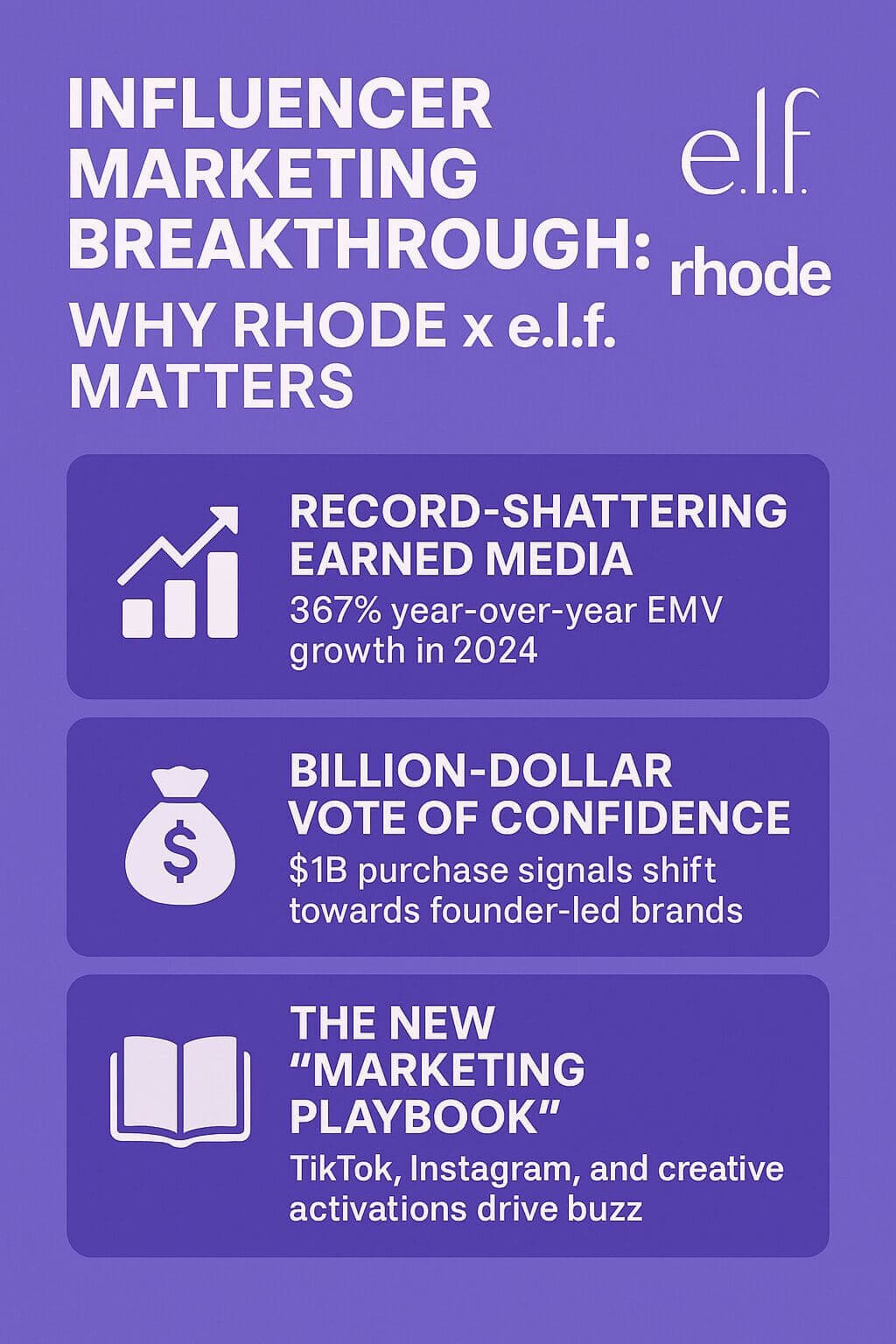
Rhode’s rapid rise was fueled by influencer marketing at its finest. Unlike legacy brands that rely on traditional ads, Rhode grew through social media buzz, community engagement, and the star power of its influencer-founder. e.l.f. Beauty’s CEO Tarang Amin highlighted that Rhode has “magnetic brand equity, viral product performance, and a high-margin business model”. In other words, Rhode proved that a brand built on influencer credibility and organic hype can not only compete with established players – it can beat them at their own game. Consider these eye-opening facts:
Rhode became the leading skincare brand in EMV, with a 367% year-over-year EMV growth in 2024 driven entirely by non-paid, organic mentions. Essentially, fans and creators were talking about Rhode so much online that it would have cost hundreds of millions in ads to get the same reach. This kind of explosive growth through word-of-mouth is the dream outcome of influencer marketing. It validated that authentic buzz can scale up to big-business levels.
Industry analysts note that e.l.f.’s $1B purchase “signals a broader shift: large public beauty companies are willing to place billion-dollar bets on digitally native, founder-led brands with strong community engagement.” In other words, the corporate world sees influencer-founded brands as the new power players.
This is a huge vote of confidence in the creator economy – it says that brands built on content creator influence and community can be just as valuable as those built by traditional means (if not more so). No longer is influencer marketing just a line item in a brand’s ad budget; it is the brand equity.
The e.l.f.–Rhode deal is a case study in how marketing is changing. Founders like Hailey Bieber are “rewriting the playbook” for how brands are built. Instead of heavy TV commercials and department store counters, Rhode relied on TikTok virality, Instagram aesthetics, and creator collaborations. The brand engaged its audience with out-of-the-box ideas – from a traveling photo booth at events to a viral lip gloss phone case accessory – creating shareable moments that didn’t feel like traditional ads.
(Yes, Rhode literally launched a phone case that holds their lip treatment, which generated a staggering $8.3 million in EMV and a 31.9% Instagram engagement rate in early 2024! Rhode’s “lip gloss phone case” campaign generated $8.3M in earned media value and an unprecedented 31.9% engagement rate on Instagram.) By investing in Rhode, e.l.f. is essentially declaring that this community-driven, content-first approach is the future of beauty brands.
Perhaps most importantly, this acquisition blurs the line between influencer and entrepreneur. Hailey Bieber isn’t just a face of the brand; she’s the Chief Creative Officer and Head of Innovation at Rhode moving forward, continuing to guide product development and marketing.
As one observer put it, there’s a “continued blurring of the lines between creator and CEO” in today’s market. Consumers aren’t just buying a cream or lip balm – they’re buying into a founder’s story and lifestyle. Rhode’s success shows that an authentic personal brand can be the foundation of a global business. This is a breakthrough notion in influencer marketing: top creators can evolve into true business leaders, and their personal brand becomes a company’s competitive advantage.
All of this makes the Rhode acquisition a watershed moment. It’s a signal to brands everywhere that influencer marketing has come of age. No longer a “nice-to-have” experiment, it’s driving such tangible results that it can create a unicorn (a billion-dollar company) in under three years. It’s no wonder 76% of C-suite executives plan to increase their influencer marketing budgets in 2025, seeing it become a core part of modern strategies. In short, influencer marketing just graduated from the kiddie table to the big leagues.
Now, you might be thinking: “Sure, a celebrity influencer like Hailey Bieber can create a hit brand – but what about micro and nano influencers?” Here’s the exciting part: the ripple effects of this deal extend to creators at all levels. In fact, industry trends show that micro (roughly 10k–100k followers) and nano (1k–10k followers) influencers are more in demand than ever. Brands are increasingly shifting focus toward these smaller creators because of their high engagement and tight-knit communities.
Micro and nano influencers tend to have higher engagement rates and stronger trust with their followers than big celebrities. Their recommendations feel personal, not like traditional ads, which makes them incredibly persuasive. For example, a micro influencer might only have 8,000 followers, but if 800 of those followers regularly like and comment on her posts, that 10% engagement is gold.
(In fact, data confirms that micro-influencers boast the highest engagement rates of all influencer tiers.) Brands get better ROI working with a squad of micros/nanos versus spending the whole budget on one mega-influencer. They cost less and often deliver higher conversion rates because their audience trusts them deeply.
Rhode didn’t only rely on Hailey’s star power. The brand’s growth strategy tapped into hundreds of creators and fans to build buzz. Rhode’s team emphasized “authentic influencer marketing and robust affiliate programs” to drive growth. They sent free products to influencers of all sizes (“product seeding”) and encouraged organic sharing, which felt genuine and not scripted.
Many micro-influencers posted about Rhode because they truly loved the products, not because they were paid big bucks – and that authenticity showed. This grassroots approach led to a 45% year-over-year jump in Rhode’s EMV in 2024, largely thanks to influencers and organic mentions. In other words, micro and macro influencers alike were crucial to Rhode’s rise.
The success of Rhode sends a clear message to micro and nano influencers: your voice matters. Brands are on the lookout for relatable creators who can foster community around their products. Even if you’re not a celebrity, you can become a key ambassador (or even co-creator) for a brand. We’re already seeing savvy companies run campaigns with armies of micro-influencers to spark word-of-mouth buzz.
Platforms like Stack Influence, for instance, connect brands with everyday creators and boast networks of millions of micro-influencers to promote products in authentic ways. All of this means more collaboration opportunities for up-and-coming influencers in the beauty space and beyond. The age of the nano influencer is here – and they’re punching above their weight.
In summary, the influencer marketing boom isn’t just benefiting superstar creators. Micro influencer marketing and nano influencer marketing are riding the wave too. This e.l.f.–Rhode moment validates that every tier of influencer can play a role in building a brand empire, as long as they have an engaged audience and authentic voice. Brands are taking note, and smaller creators are poised to shine in this new landscape.
This acquisition also carries big lessons for e-commerce entrepreneurs and Amazon sellers. Whether you’re running your own Shopify skincare store or selling on Amazon’s marketplace, Rhode’s story demonstrates how powerful influencer-driven branding can be for online sales.
First and foremost, influencers drive purchasing on Amazon in a major way. A recent 2024 study found that 59% of social media users have bought a product after seeing an influencer use it – and of those, 94% purchased on Amazon. In other words, when an influencer hypes up a product, the vast majority of their followers head straight to Amazon to buy it. If you’re an Amazon seller, this is huge.
It means that collaborating with influencers can directly boost your Amazon sales and search rankings. In fact, consumers who buy based on influencer recommendations are 2.4× more likely to shop on Amazon than any other site. Ignoring influencer marketing could literally mean leaving money on the table.
Here are a few key takeaways for e-commerce brands and Amazon sellers:
Rhode was a DTC (direct-to-consumer) brand with its own site and social presence – the kind of brand equity Amazon’s algorithm can’t give you. If you primarily sell on Amazon, think about how you can create a brand story and community off Amazon as well. Social media, emails, and influencer partnerships can give customers a reason to seek out your product specifically, not just whatever algorithm shows them.
That brand loyalty can translate to better reviews, repeat purchases, and even the potential to expand into retail or attract investors. Remember, e.l.f. didn’t just buy Rhode’s formulas – it bought Rhode’s community and hype.
Influencer marketing can become your secret weapon for driving external traffic to your Amazon listings (which Amazon’s algorithm loves) and for generating social proof. For example, micro-influencers posting authentic reviews or unboxing videos of your product can lead their followers to search for it on Amazon.
Those influencer-inspired shoppers are primed to buy, and they often leave reviews, post photos, and tell friends if they love the product. This creates a virtuous cycle of sales and credibility. As a seller, consider enrolling products in Amazon’s own Influencer Program or working with influencer agencies to get your items in the hands of creators who align with your niche.
The days of doing all your marketing through paid ads alone are fading. Amazon PPC and SEO are important, but earned media and word-of-mouth can elevate you to the next level. Think of influencer marketing as a scalable form of word-of-mouth.
Just as Rhode sent PR packages to many influencers to create buzz, an Amazon-focused brand might seed products to micro-influencers on Instagram, TikTok, or YouTube. The goal is to have a chorus of authentic voices talking about your product. This not only drives immediate sales, but also builds an asset that isn’t easily copied: a community of advocates.
Bottom line: For Amazon sellers and e-commerce entrepreneurs, the e.l.f.–Rhode deal underscores the importance of integrating influencer marketing into your business strategy. It’s not just a “nice extra” – it’s becoming essential for driving e-commerce growth. The world’s biggest online marketplace is heavily influenced by social media buzz, and those who harness it will win. In an era when 84% of brands believe influencer marketing is effective, taking a page from Rhode’s playbook could be the difference between a stagnant listing and a breakout bestseller.
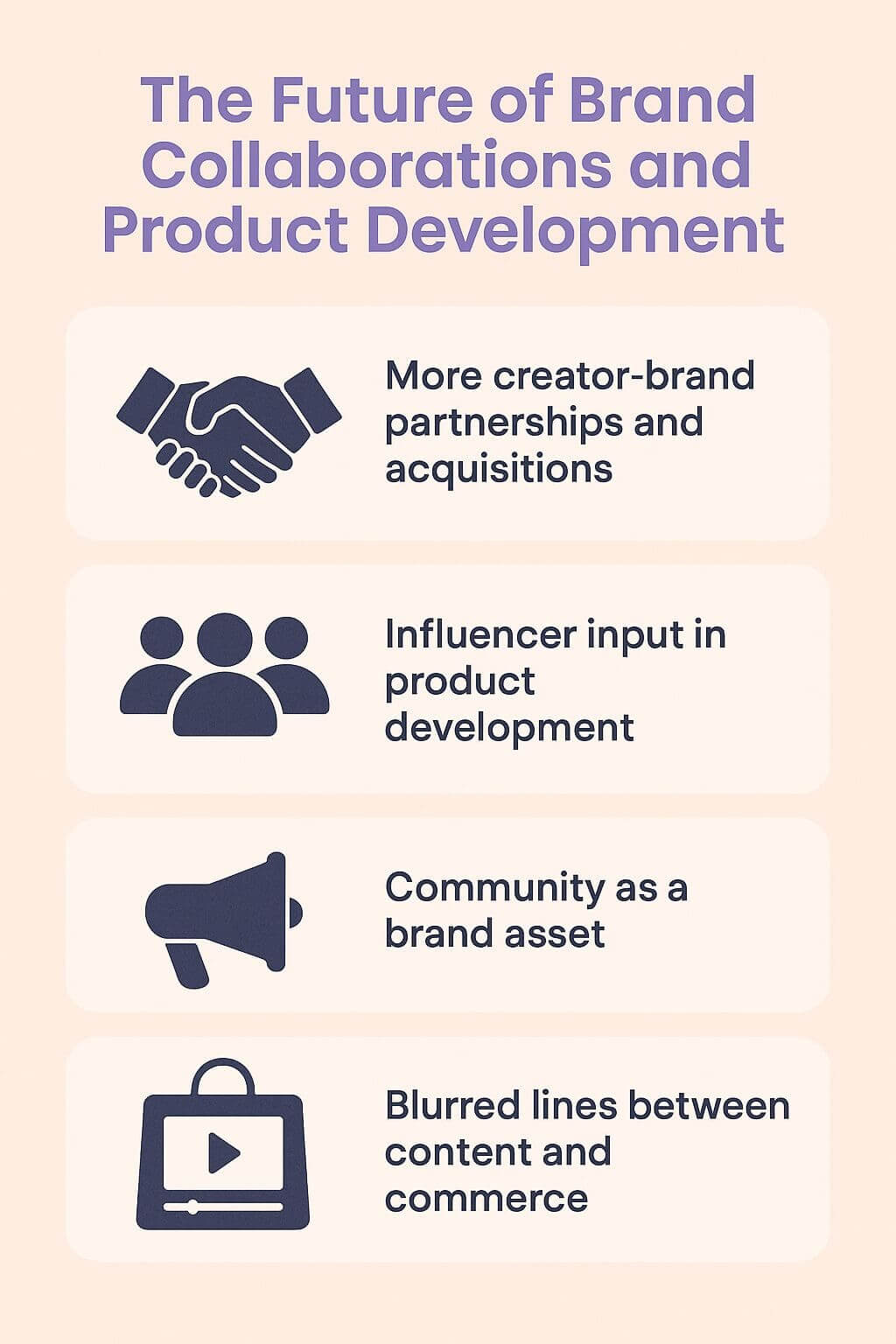
What does this all signal for the future of brand collaborations and product development? In a nutshell, we’re going to see brands and influencers more entwined than ever. The e.l.f.–Rhode partnership hints at several emerging trends:
Expect to see more deals where big companies snap up successful creator-founded brands, or where influencers become equity partners in brands from the start. As one report noted, major beauty companies are now willing to make “billion-dollar bets” on brands that started on Instagram and TikTok. We’ve already seen examples: e.l.f. previously acquired Naturium (a skincare line founded by influencer Susan Yara) and Keys Soulcare (by Alicia Keys) to tap into those built-in audiences.This trend won’t be limited to beauty either – think fitness influencers launching wellness products or gaming streamers creating tech accessories, with larger brands ready to invest if those ventures take off. For influencers, it means your endgame might not just be sponsored posts – it could be building a brand that gets acquired or partnered by a major player.
Traditional brands are likely to involve influencers much earlier in the product development cycle. Rhode’s story shows that products formulated with real-time feedback from the community can hit big. (Hailey Bieber often incorporated follower feedback and social trends into Rhode’s product roadmap, resulting in highly desired launches.)We anticipate more brands will form creator councils or do co-creation collabs where influencers help design or refine products. The result? Products that feel made for the target audience, because in a sense the audience helped make them. This community-centric development can increase the chances of a product becoming a hit – just as Rhode’s peptide lip treatment became a viral bestseller with 300k+ waitlists at launch.
Going forward, a strong community may become a brand’s most important asset. We’re moving toward a world where customers are fans, and fans are contributors. Brands will invest in cultivating tribes of enthusiasts through Discord groups, private Instagram pages, or interactive campaigns. Influencers (big and small) will often lead these communities.When a brand drops a new product, this built-in network will amplify it organically. Rhode exemplified this by turning customers into unofficial ambassadors – many proudly shared their “glazed skin” looks, spreading the trend. We foresee more brands embracing this model: less top-down advertising, more bottom-up community buzz. It’s a shift from broadcasting at consumers to building with them.
The integration of content creation and selling will deepen. Social media platforms are already adding shop features, and e-commerce platforms are embracing live streams and UGC (user-generated content). The influencer marketing and e-commerce worlds are converging into “social commerce.” Amazon itself tried a TikTok-like feed (Amazon Inspire) to blend content with shopping, and while that particular feature was short-lived, the concept isn’t going away.We’ll likely see influencers hosting more live shopping events, curating product lines, and even running their own storefronts (Amazon’s Influencer Storefront program is one example). For brands, collaborating with influencers on these initiatives will be key to staying relevant and driving sales in new channels.
Bottom line: For Amazon sellers and e-commerce entrepreneurs, the e.l.f.–Rhode deal underscores the importance of integrating influencer marketing into your business strategy. It’s not just a “nice extra” – it’s becoming essential for driving e-commerce growth. The world’s biggest online marketplace is heavily influenced by social media buzz, and those who harness it will win. In an era when 84% of brands believe influencer marketing is effective, taking a page from Rhode’s playbook could be the difference between a stagnant listing and a breakout bestseller.
Let’s ground all this advice in some real-world context. How are actual eCommerce brands leveraging whitelisting, and what tactics are they using to scale? Here are a few examples and tips drawn from industry experience:
A DTC fashion brand found success by whitelisting influencer content on both Instagram and TikTok simultaneously. They had a campaign with a group of mid-tier fashion influencers. On Instagram, they ran Partnership Ads to the influencers’ lookalike audiences; on TikTok, they ran Spark Ads of the same videos to interest-based audiences (fashion, beauty interests). The messaging was consistent – showcasing how these influencers styled the brand’s clothing in daily life – but tailored to each platform’s style (IG had nice photos and short Reels, TikTok had raw try-on videos). The result was a unified cross-platform boost. The takeaway: when you find a good influencer or content angle, deploy it wherever you can, tweaking format for the platform. You catch consumers on whichever app they use most, and reinforce the message (someone might see the TikTok ad and an IG ad from the same influencer, which really drives it home).
One nifty tactic is using whitelisted ads in retargeting funnels. For example, a skincare brand ran YouTube influencers talking about their product. They then retargeted everyone who watched 50% of those YouTube videos with a Facebook whitelisted ad from a different influencer as a follow-up (“Still curious? Here’s another person’s experience!”). This one-two punch of social proof can persuade fence-sitters. Essentially, you treat influencer content like a sequence: initial awareness from one creator, then retarget with another creator’s testimonial, and maybe a third ad with an offer to seal the deal. Each touchpoint feels like another friendly recommendation rather than repetitive brand ads.
There are brands that have taken on hundreds of micro-influencers in whitelisting campaigns – think along the lines of affiliate/influencer hybrid programs. They might give each micro-influencer a small commission and ad budget, or the brand runs the ads centrally. One example: an accessory brand got 50 micro-influencers (around 5k-20k followers each) to post content. The brand then whitelisted all 50 posts with modest budgets (~$50/day each) targeting local regions or specific interest groups relevant to each influencer’s niche. Individually, each ad spend was small, but collectively it was a significant campaign. Many micro-influencers meant diverse content (different styles, demographics) and the brand’s ads seemed to be everywhere without feeling like repetition, because each ad had a different face on it. This shows that scaling doesn’t always mean one ad with a million dollars; it can mean a million micro-campaigns with a few dollars that sum up. Tip: if you go this route, definitely use automation tools like Stack Influence, because managing 50+ creatives and partnerships is an operational challenge – but one that can pay off big.
Real-world outcomes from whitelisting vary, but many brands report that it has become a top-performing part of their ad mix. By studying what others have done and borrowing ideas, you can shortcut your path to success. The common thread in these examples: whitelisting ads leverage authenticity and social proof, but amplify it with strategic paid muscle. 💪
Scaling across multiple platforms and influencers can get complex. Thankfully, there are tools purpose-built to help brands navigate whitelisting. Here are some top tools and platform features to consider:
Within Facebook Ads Manager, the feature for whitelisting is often called Partnership Ads (previously Branded Content Ads). This is not an external tool but a built-in capability. Make sure you familiarize yourself with it – Meta has guides on how to request access and create these ads. The platform itself is enabling this because they know how effective it is. Use the power of Facebook’s Ads Manager for detailed targeting and analytics when running influencer ads on FB/IG.
As mentioned, TikTok’s native solution for whitelisting is Spark Ads. It’s basically the way to do influencer ads on TikTok, and it’s very straightforward. The TikTok Ads Manager interface allows you to easily input codes from creators and launch ads that look native. The advantage here is TikTok’s algorithm might even favor Spark Ads since they keep content feeling organic on the For You Page. If TikTok is a key channel, master Spark Ads – TikTok provides tutorials on it and even case studies. Plus, TikTok’s ad creation process is snappy, which is great when scaling many creator campaigns quickly.
These are platforms where you can automate influencer collaborations and whitelisting ads at scale. For example, Stack Influence (Micro-influencer automation marketplace) allows you to scale up Micro-Influencer collaborations, streamline product shipping and promotion management, track influencer posts, and activate whitelisting ads all in one place with end-to-end campaign management. If you’re looking to scale up to hundreds or even thousands of influencers, using a platform like Stack Influence can help you achieve those goals without breaking the bank or adding more work bandwidth to your team. Stack Influence also has a simple product compensation model and “pay as you go” payment system so you only have to send free products out to get social posts and only pay fees for successful promotions without ever losing inventory.
In summary, while you can do whitelisting manually, scaling efficiently often means investing in the right software. These tools take care of the heavy lifting (like connecting accounts, tracking who’s who, and measuring results), so you can focus on the strategy and creative aspects. As the saying goes, “work smarter, not harder” – the same applies to whitelisting campaigns at scale. 🛠️💡
We’ve covered a lot of ground, but let’s zoom in on some key tips in specific areas that can make or break your whitelisting success. Consider these additional best practices as a quick-reference list:
Here’s an interesting targeting tidbit – some brands have had success targeting friends of people who follow the influencer (on Facebook) or using Twitter’s (X’s) feature to target followers of a certain account. The idea is, if Alice follows Influencer Amy, Alice’s friends might also trust Amy if they see an ad from her. Facebook allows targeting of “friends of people who like ” – if the influencer’s profile is a page you have access to, you might tap into that. It’s a bit meta, but it can expand reach in a semi-warm way. Similarly, look at interest categories that align with each influencer’s persona. If an influencer is a vegan chef, target vegan, healthy eating interest groups with their ad. TL;DR: Mirror the influencer’s own audience characteristics in your targeting, plus use any platform-specific options to hit related social circles.
When working with influencers, treat them as creative partners. Involve them in brainstorming – they might have ideas for angles that you didn’t think of. After all, they know their audience best. Also, encourage them to interact with the comments on the whitelisted ads if possible. One cool thing: on Facebook and Instagram, the whitelisted ad will show up as a post from the influencer’s handle, and people can comment on it (depending on your settings). If the influencer jumps in and replies to comments (“Glad you like it!” or answers questions about the product), it boosts engagement and authenticity. It shows it’s really them. This can improve ad performance and also make the influencer feel more genuinely connected to the campaign. It’s not always feasible for them to moderate every ad comment, but even occasional interaction helps.
For long-term partnerships, share results with your influencers. Many influencers are curious how their whitelisted posts performed: Did it get a million impressions? How many clicks or sales? Sharing this data (as long as you’re comfortable) can strengthen the relationship. It shows you value them as a partner. Plus, if performance was great, it’s a nice way to lead into “let’s do this again!” Conversely, if something underperformed, you can discuss together why that might be – maybe the content didn’t feel right or maybe the targeting was off. Good influencers will appreciate being part of that conversation and might adapt their content for future collaborations. Remember, a happy influencer who feels valued will likely go the extra mile for your brand (like giving you extra content, or just speaking more genuinely about the product).
In sum, the future points toward closer collaboration between brands and creators at every stage – from brainstorming product ideas, to marketing launches in creative ways, to sharing in the financial success. The e.l.f.–Rhode deal is a landmark, but it’s probably just the beginning of a creator-led brand revolution. As consumers, this means we’ll see more products that feel authentic and aligned with our favorite online voices. As marketers and entrepreneurs, it means we should be ready to embrace influencers not just as advertisers, but as partners, co-creators, and even business leaders.
Feeling inspired to amp up your influencer marketing? Whether you’re a brand owner, marketer, or Amazon seller, finding the right influencers is crucial. Here are some tips to help you replicate a bit of Rhode’s influencer magic in your own strategy:
1. Define Your Goals and Target Audience: Start with the basics – know what you want to achieve (brand awareness, more Amazon sales, content creation, etc.) and who your customers are. Then look for influencers whose audience matches that demographic and niche. Rhode did this expertly by focusing on creators whose followers were young women 18–34 who love minimalist skincare.
The alignment meant that every time those influencers posted, they were reaching exactly the people most likely to buy Rhode. Be similarly strategic: if you sell fitness gear for busy moms, an influencer mom who posts home workouts might be a perfect fit.
2. Prioritize Authenticity and Engagement: Don’t get blinded by follower counts. Often, a micro-influencer with 15k genuine followers and a 10% engagement rate will outperform an influencer with 500k followers but low engagement. Look for signs of real influence – consistent likes/comments, quality interactions, and content that isn’t overly polished or ad-like.
As we saw, Rhode’s gifted campaigns worked because the posts “didn't feel like marketing”. Influencers truly using and enjoying your product will naturally create content that resonates. Nano influencers can be hidden gems here; their smaller audiences might trust them like a close friend, making their recommendations highly persuasive.
3. Leverage Micro-Influencer Platforms: Managing dozens or hundreds of micro-influencer relationships can be daunting. This is where platforms and agencies come in. Consider using specialized micro influencer marketing platforms (e.g., Stack Influence) that streamline the process. These services can help you source quality creators, handle outreach and product gifting, and ensure campaigns run smoothly. For instance, Stack Influence’s platform boasts a vetted network of over 11 million micro-influencers across the U.S. and offers AI tools to target the right creators and manage campaigns at scale.
Such platforms are a boon for e-commerce brands looking to generate buzz without a massive in-house team. (Tip: Look for platforms that align with your industry and budget – some operate on pay-per-post or product-for-post models, which can be very cost-effective for small brands.)
4. Start with Product Seeding and Affiliates: One of the most effective (and budget-friendly) ways to kick off an influencer campaign is product seeding – i.e. sending free samples to influencers with no strings attached. This lets creators try your product and share it authentically if they like it. Rhode’s pre-launch seeding created a sense of exclusivity and tons of early chatter as influencers unboxed products and shared first impressions.
Even a few posts like that can snowball into widespread interest. Alongside seeding, consider an affiliate program or discount codes for influencers. This gives creators an incentive to promote (they earn a commission per sale or their followers get a deal), and it provides you trackable sales data. Many micro-influencers are eager to join affiliate programs as it rewards their genuine recommendations.
5. Track Results and Iterate: As with any marketing effort, keep an eye on your metrics and be ready to adjust. Define KPIs for your influencer campaigns – it could be EMV (earned media value) like Rhode tracked, direct sales using unique Amazon affiliate links, new followers on your socials, or content assets generated. Use analytics (some platforms provide dashboards) to see which influencers or content themes perform best. Double down on what works.
If a particular micro-influencer is driving a lot of conversion, consider a deeper partnership or even making them a brand ambassador. If a certain style of TikTok video about your product goes viral, prompt other influencers to try something similar. Influencer marketing is part art, part science – you need to listen to the data without losing the human touch that makes this channel so special.
By following these tips, brands can build their own influencer-powered growth engine. The key is to think long-term and relationship-first. Influencer marketing in 2025 isn’t about one-off transactions; it’s about building a network of passionate advocates for your brand. When done right, it can propel even a modest e-commerce business to new heights of visibility and sales – and maybe, just maybe, set you on the path to becoming the next big acquisition story!
The marriage of e.l.f. and Rhode stands as a landmark in the evolution of influencer marketing. It validates that in today’s digital age, a savvy creator with a vision can build a brand that not only rivals the industry giants, but also becomes a prime target for them. For brands, it’s a wake-up call to embrace the power of influencers – be it macro celebs or micro niche voices – in shaping their futures. For influencers, it’s an inspiration to think bigger about your own brand and business potential. And for everyone in the e-commerce arena, it’s proof that community and authenticity are the new currency of success.
The influencer marketing landscape is blazing forward, and the e.l.f.–Rhode deal just poured rocket fuel into it. Now is the time to hop on board, experiment, and innovate – the next billion-dollar brand story may very well be written by you.
Running ads through influencer accounts – known as whitelisting – is one of the hottest growth hacks in eCommerce marketing today. This guide breaks down how to scale whitelisting ads across Facebook, TikTok, Instagram, and YouTube with actionable steps, real examples, and expert tips. Let’s dive in! 😎
Whitelisting (also called influencer allowlisting or creator licensing) is when a content creator or influencer gives a brand permission to run ads through the creator’s social media account. In practice, this means your eCommerce brand can pay to promote a post under the influencer’s name, reaching their followers and beyond, while you control the targeting and budget. The ad looks like it’s coming from the influencer, not directly from your brand – and that’s the magic.
Why is this so powerful for eCommerce? A few key reasons:
People tend to trust recommendations from individuals more than ads from brands. In fact, nearly 69% of consumers trust influencer recommendations, and 88% have made a purchase based on an influencer’s recommendation. When your ad appears to be a genuine post from a person that the audience follows and likes, it feels more authentic. The result? Higher engagement and click-through rates, and often a lower cost to acquire customers.
Whitelisted ads often outperform traditional brand-run ads. You get the best of both worlds – the influencer’s relatable voice and the powerful targeting of paid social. According to Lumanu (an influencer platform), influencer whitelisting can beat typical social ads by 20–50% in terms of performance metrics. Even more impressively, brands report seeing 30–50% lower cost-per-action (CPA) when using whitelisted influencer ads versus their regular ads. That means your advertising dollars go 30-50% further in driving sales or sign-ups!
A simple comparison of average Cost Per Action (CPA) for brand-run ads vs. influencer whitelisted ads. Whitelisted ads often achieve 30–50% lower CPA than standard brand ads due to the higher trust and relevance with audiences.
An influencer’s organic posts only reach their followers (and some algorithmic spillover). Whitelisting blows the ceiling off that limitation. You can take an influencer’s high-performing post and show it to lookalike audiences – people who aren’t following them but have similar traits to those who do. In other words, you leverage the influencer’s content to reach new potential customers at scale. This expanded reach is highly targeted, thanks to the data you get access to. You’re not stuck with just the influencer’s audience; you can create custom audiences (for example, people who engaged with the influencer’s post) or lookalikes of those engagers to find more buyers.
Unlike a standard influencer post (where you rely on the influencer and can only hope it drives conversions), whitelisting puts the brand in the driver’s seat. You get access to the influencer’s handle for ads without taking over their account. You can tweak copy, swap creatives, set the call-to-action, and optimize targeting on the fly to improve results. You also get to see and track all the performance metrics in your Ads Manager dashboard. Essentially, you combine the authenticity of influencer content with the precision of modern ad platforms.
In short, whitelisting lets you turn a single influencer shoutout into a highly tuned marketing campaign. For eCommerce brands facing rising ad costs and skepticism toward obvious ads, whitelisting offers a win-win: the relatable feel of word-of-mouth, amplified by the power of paid media.
Pro tip: Whitelisting is growing fast. Dan Coughlin of Get Hyped Media noted that 90% of their clients now incorporate whitelisting in campaigns. The influencer marketing industry hit $16+ billion in recent years, and whitelisting is a big reason why many brands are seeing better ROI from that spend. It’s not just a buzzword – it’s becoming a must-have strategy.
Now that we’ve covered the “what” and “why,” let’s get into the “how” – how to scale up whitelisted ads effectively across various platforms.
Scaling whitelisting ads means more than just toggling on a bigger budget. It’s about systematically expanding your reach, content, and partnerships without losing the magic that made your initial influencer ads work. Follow these steps to scale up sustainably and profitably:
Scaling starts with having enough high-quality content and partners. You’ll need to move beyond a single influencer to a portfolio of creators whose audiences match your target market.
Don’t be star-struck by follower counts. Often a micro-influencer with 20k highly engaged followers will drive more sales than a celebrity with a million indifferent followers. Check engagement rates (likes, comments, shares relative to follower count). Meaningful engagement (real comments, discussions) is a sign of trust. As a benchmark, ~2% engagement rate on Instagram or ~1% on Facebook is considered average – higher is better. An influencer whose audience genuinely interacts will give you better ad performance.
Review the influencer’s past content (especially sponsored posts). Is their style a fit for your brand? Do they come across as authentic when promoting something? The best creators integrate products naturally into their content, which makes whitelisted ads feel native. Avoid influencers whose sponsored content feels forced or low-effort – if it looks like an obvious ad or is poor quality (bad audio/video), it might flop as a paid ad. Aim for partners who produce visually appealing, relatable content (clear images/videos, genuine commentary) that doesn’t scream “ad.”
For scaling, consider a mix of influencer sizes. Nano-influencers (1k-10k followers) and micro-influencers (10k-100k) can be hidden gems with loyal audiences. They’re often cost-effective to work with and can become ongoing ambassadors. A few mid-tier or macro influencers can add reach too. Scaling whitelisting is like casting a wider net strategically – multiple smaller trusted voices can sometimes outperform one big voice.How to find these influencers? Try searching social media for niche keywords related to your product (e.g., search Instagram or TikTok for hashtags or content in your niche) – those search results often surface creators already talking about that topic. You can also look at influencer platforms or even your own follower base for creator partnerships. Once you identify candidates, start outreach with a solid pitch on how whitelisting with your brand benefits them (e.g., extra exposure, affiliate commissions).
When scaling up with multiple influencers, organization and clear agreements are key. Treat whitelisting partnerships professionally from the get-go to avoid headaches later:
Make sure both parties understand what access will be granted. Typically, the influencer will grant your brand advertiser access to their social accounts (without handing over login credentials). For Facebook and Instagram, this happens through Business Manager by adding a partner and giving “Create ads” permission on the influencer’s assets. For TikTok, the creator generates a Spark Ads code for their post and sets how long you can run it. Clarify the duration of access (e.g., you can run ads for 4 weeks using their account) and that the influencer can revoke access later if needed.
Get explicit agreement on how you can use the influencer’s content. Can you only use it for the whitelisted ads on social, or can you also repurpose it on your website, in emails, etc.? Many brands negotiate usage rights so that a great piece of influencer content can be reused across channels. Make sure this is in writing – who owns the content and where it can appear.
Whitelisting usually involves additional payment to the influencer, since you’re essentially licensing their content/likeness beyond an organic post. Some influencers charge a flat fee for whitelisting access (often an extra 20-30% on top of their normal post fee). Others might do a revenue share or performance deal where they earn a percentage of sales or a bonus if certain ad metrics are hit. Decide what model works for both sides. If you’re scaling, you might prefer flat fees to control costs – or performance deals to align incentives. Whichever you choose, spell it out: how much, when it’s paid, and any limits (e.g., maximum spend behind their content if they worry about overexposure).Having a solid whitelisting contract in place for each influencer will save you a ton of trouble. As one expert put it, don’t be vague about “advertising permissions” – explicitly define scope, duration, payments, and content usage so everyone’s on the same page. This way you avoid misunderstandings or last-minute pullouts that could derail your scaling.
Now it’s time to get your accounts linked and ready. The process differs by platform:
Use Facebook Business Manager (now often managed via Meta Business Suite). The influencer needs to have a Business account or Creator account and connect their assets. They will add your Business Manager ID as a partner on their Facebook Page and/or Instagram Account, with permission to create ads. Step-by-step: They go to Business Settings → Users → Partners → “Add” → “Give a partner access to your assets,” then input your business ID and grant Create Ads access on their Page/Instagram. Once done, their account and page will show up in your Ads Manager as available for building ads. (Tip: Provide influencers with a simple walkthrough. Many may not know how to do this, so share a step-by-step guide or even use a tool to automate it. Some brands send a PDF or video explaining how to accept partner access.)
TikTok has made this easy with Spark Ads. The creator just needs the TikTok app – they’ll authorize your ad by generating a Spark Ad code for a specific video. In TikTok, they go to their video, tap “Share to Ads” (or a similar option) and get an authorization code that they send you. They also choose how long you can run the ad (e.g., 7 days, 30 days). In your TikTok Ads Manager, you input that code when setting up the ad, and boom – you can run the video as an ad from their profile. TikTok Spark Ads are known for being very scalable because once you have the code, you can run multiple campaigns and targeting variations easily with that post.
YouTube (via Google Ads) is a slightly different beast. There isn’t a formal “whitelist access” process like Meta’s. However, you don’t actually need an influencer’s account access to promote their YouTube content. If a creator has a video featuring your product, you can run it as a YouTube ad yourself if the video is public (or unlisted with ads enabled). You simply create a video ad campaign in Google Ads and use the influencer’s YouTube video URL as the ad creative. (The influencer should ideally give you permission and not monetization-restrict the video – most are happy to get extra views). Note: Google’s policies say you can promote any video as an ad as long as it abides by guidelines. If you need to customize the video or track performance, you might instead ask the influencer to send you the raw video to upload on your own channel (with them in it, of course). But running it from their channel (via ads) keeps the social proof (views, likes) on their video. TL;DR: For YouTube, coordinate with the creator but know that the ad runs through your Google Ads, not their account.
If you’re whitelisting on platforms like Twitter (X) or others, the concept is similar – the influencer grants access or provides content to run through their handle. For instance, Twitter has “Tweet Amplify” with media partners, but for influencers you’d likely just use their account in ad targeting if allowed. However, the main four (Facebook, Instagram, TikTok, YouTube) are where eCommerce brands focus whitelisted ads.
Not every post from an influencer will be a smash hit as an ad. Scaling means being choosy and data-driven with which content you amplify and for how long:
Identify posts that performed well organically on the influencer’s feed – high likes, comments, shares, or a lot of positive feedback. If their audience loved it, that content likely has a spark that will ignite in ads too. For example, if an influencer did a hilarious unboxing of your product that went semi-viral in their circle, that’s a great candidate for whitelisting. HelloFresh, for instance, works with many foodie influencers and then whitelists the best-performing posts (those that got great engagement) to run as paid ads. This way, they put budget only behind content that’s proven itself.
Generally, certain content types do well as whitelisted ads:
These come off as authentic and tend to stop the scroll in feeds. On the flip side, content that might not work well includes overly scripted ads, content full of niche jargon (confusing new viewers), or anything too long-winded that only existing fans would follow.
Not all content has to come from big-name influencers. User-generated content (UGC) from real customers or micro-creators can be whitelisted too (with permission). Many brands scale by taking the best customer testimonial videos (or hiring content creators who aren’t famous but make good videos) and whitelisting through their accounts. It provides social proof and volume of creatives. Just treat them like any influencer in terms of permission and payment (maybe you send free product or a small fee for content rights). UGC-style ads often feel even more authentic because they’re more raw and relatable.
In summary, scaling whitelisted ads requires a steady stream of high-performing creatives. By carefully selecting and optimizing content, you ensure that as you increase spend, you’re not just throwing money at mediocre ads but amplifying winners. Quality > quantity, but you’ll need quantity of quality (if that makes sense 😄).
One of the biggest advantages of whitelisting is the advanced targeting you can do with the influencer’s audience data. As you scale up your campaigns, sharpen your targeting to maintain performance:
Build custom audiences of users who engaged with the influencer’s content. For example, on Facebook/Instagram you can create a custom audience of everyone who viewed or liked the influencer’s whitelisted post, or even anyone who visited the influencer’s page. These folks have shown interest – consider them “warm” audiences. You can then retarget them with further ads (maybe an offer or a reminder). Also, create a custom audience of visitors to your website that came via the influencer ad (trackable via UTM and pixel) and retarget those with follow-ups. Essentially, use whitelisting to fill your funnel and then use normal retargeting to close the deal.
Don’t forget to cross-pollinate learnings. If an influencer ad is killing it on Instagram, try using that content to target similar demographics on TikTok or YouTube. Each platform has its own ad system, but you can often replicate the targeting. For example, if 25-34 year old women in English-speaking countries are responding on IG, set the same targeting on TikTok Spark Ads for the whitelisted video there. Or if an influencer’s audience is mostly Gen Z, make sure you’re hitting Snapchat or YouTube if those make sense. The idea is to scale horizontally by platform as well – meet your audience wherever they hang out.
If you’re scaling globally, consider creating separate campaigns per region/language using the influencer content. An influencer might have an international audience, but your product is only available in, say, the US and Europe – so target those regions specifically. You can even translate or subtitle content for different markets (with permission). Some brands working with multilingual influencers run whitelisted ads in multiple languages to scale in each market.
Remember, as you widen your reach, keep an eye on the metrics. Watch frequency (don’t bombard the same people too many times) and monitor your relevance scores or quality rankings in the ad platforms. If you see performance dipping as you scale, it could be time to refresh content or tighten targeting again. Scaling is a balancing act – you want to go broad, but not so broad that you lose efficiency.
(By the way, one huge advantage you have: since you’re in the ad manager, you can see exactly which audience segments are performing best and double down. This is way more control than a typical influencer campaign where you just hope the influencer’s followers like the post!)
Once content and targeting are dialed in, it’s tempting to throw a huge budget at it. But scaling works best as a stair-step process, not a catapult. Here’s how to ramp up spending intelligently:
Modern ad platforms (Facebook, TikTok, etc.) are really good at finding pockets of efficient spend if you give them some freedom. Instead of one ad with a $1000 budget, consider running a few ads (maybe the same creative to different lookalikes, or different creatives to the same audience) with smaller budgets. Facebook’s algorithm, for example, will automatically put more money into the better-performing ads if they’re in one campaign with CBO (Campaign Budget Optimization) turned on. The key is to provide multiple ads or ad sets so the algorithm can optimize. If you only have one ad in a campaign, you’re in a “winner-takes-all” scenario and might force spend on an ad that could be improved. With several variations, as you increase the campaign budget, the platform will allocate more to the top performer and you’ll get more bang for your buck.
Scaling whitelisting isn’t just one campaign getting huge – it’s often multiple campaigns running concurrently. Once you have a playbook with one influencer, replicate it. Onboard more influencers (step 1) and get their campaigns up. It’s common for brands to have, say, 5-10 influencer whitelisted ads running at the same time to different audiences or regions. This not only scales spend, but diversifies content (reducing ad fatigue) and spreads risk. If one influencer’s ad burns out or one partnership ends, others are still running strong. In performance marketing, we like to have lots of winning ads in our arsenal. Whitelisting at scale might mean turning on a new influencer campaign each week while maintaining the current ones.
Keep an eye on your CAC (customer acquisition cost) or ROAS (return on ad spend) as you scale. There is a point at which pumping in more money yields smaller returns (or worse, starts to hurt returns). By tracking KPIs closely, you can identify that sweet spot. For example, maybe at $5000/month spend your CPA is $10, at $10,000/month it’s $12, and at $20,000 it jumps to $18 – that tells you the efficiency is dropping at higher spend. It could mean the targeted audience is saturated and you either need new creative or new targeting to continue scaling. Scaling isn’t just “more money = more results”; it’s “more money = more results until you hit a plateau.” The trick is to notice the plateau and adjust strategy (new influencers, new markets, etc.) rather than just pouring more cash in blindly.
If there’s one step that never really “ends,” it’s this one. Optimization is an ongoing process, especially as you scale:
Always be testing something. Run two versions of the same influencer ad with different copy text to see which resonates more. Test different CTAs – “Shop Now” vs “Learn More” – sometimes a small tweak can improve conversion rate. Try slightly different opening visuals for a video (the first 3 seconds matter a lot). Because whitelisting lets you change things on the ad level, you should take advantage of that. For example, you might find that adding a caption overlay to an influencer’s video (“50% OFF inside!”) could boost conversions, or that one hook (“You won’t believe how this shirt changed my mornings”) grabs more attention than another. Keep a log of tests and results so you learn what works over time.
As you test multiple influencers and ads, you’ll see some clear winners and losers. It’s okay – even top marketers have some ads that just flop. The beauty of social ads is you can see the data quickly. Pause underperforming ads or audiences and reallocate budget to the winners. If one influencer’s content is delivering a 4x ROAS and another’s is only 1x, you know where to focus (though try to troubleshoot the 1x: was it the content, the targeting, or something else? Maybe a different approach could make that one work too).
At scale, you might be running dozens of ad sets. Consider using automated rules (e.g., on Facebook Ads Manager) or third-party tools to manage them. You can set rules like “if CPA > $20 today, pause the ad” or “increase budget 10% if ROAS > 5”. This helps keep performance in check without constant manual oversight.
By continuously optimizing like this, you’re effectively building a whitelisting machine – a system where you plug in new content and budget at the top, and out comes conversions at a steady, efficient rate. It’s not “set and forget”; it’s more like farming – you keep tending to it, pulling weeds (underperformers), and planting new seeds (tests) for ongoing harvest. 🌱🚜
One aspect of scaling that’s not talked about enough: the operational side. As you ramp up whitelisting, ensure you have the right team and tools:
If you’re working with many influencers, consider having a dedicated influencer marketing manager or coordinator. They can handle outreach, negotiations, and keeping influencers happy (remember, these are partnerships!). Your media buying team can focus on the ad optimization, while the influencer manager makes sure the creatives and permissions keep flowing. Scaling might also involve legal (for contracts) and finance (for payments/affiliate tracking). Make sure everyone knows the plan and timeline.
Set up a process for getting new content regularly. This might mean scheduling content production with your influencers each month, or sourcing UGC from customers. Some brands host “creator days” where they invite a bunch of influencers to create content, which can supply whitelisted ads for a whole quarter. The more organized you are in planning content, the easier scaling will be because you’ll never be short on creatives.
We touched on this earlier – platforms like Stack Influence exist to make whitelisting easier at scale. For example, Stack Influence helps automatically request influencers to provide whitelisting ad account permissions in one go, which avoids the back-and-forth of manual instructions. Stack Influence not only facilitates access but also helps track and pay influencers along with having whitelisting modules to keep all your creator campaigns in one dashboard. These tools can be lifesavers when you have dozens of collaborations – they handle the boring stuff (onboarding, link sharing, tracking) so your team can focus on strategy and creative.
By getting your internal processes in order, you make scaling smoother and less chaotic. The last thing you want is a miscommunication where an influencer doesn’t know their content is being used in an ad and they get surprised (set expectations up front!), or a payment slip-up that sours a relationship. Treat this as you would any ad campaign expansion – with project management, clear roles, and the right software tools – just with the extra human element that your “ad creatives” are actual people (influencers) with whom you’re collaborating. 🤝
Let’s ground all this advice in some real-world context. How are actual eCommerce brands leveraging whitelisting, and what tactics are they using to scale? Here are a few examples and tips drawn from industry experience:
A DTC fashion brand found success by whitelisting influencer content on both Instagram and TikTok simultaneously. They had a campaign with a group of mid-tier fashion influencers. On Instagram, they ran Partnership Ads to the influencers’ lookalike audiences; on TikTok, they ran Spark Ads of the same videos to interest-based audiences (fashion, beauty interests). The messaging was consistent – showcasing how these influencers styled the brand’s clothing in daily life – but tailored to each platform’s style (IG had nice photos and short Reels, TikTok had raw try-on videos). The result was a unified cross-platform boost. The takeaway: when you find a good influencer or content angle, deploy it wherever you can, tweaking format for the platform. You catch consumers on whichever app they use most, and reinforce the message (someone might see the TikTok ad and an IG ad from the same influencer, which really drives it home).
One nifty tactic is using whitelisted ads in retargeting funnels. For example, a skincare brand ran YouTube influencers talking about their product. They then retargeted everyone who watched 50% of those YouTube videos with a Facebook whitelisted ad from a different influencer as a follow-up (“Still curious? Here’s another person’s experience!”). This one-two punch of social proof can persuade fence-sitters. Essentially, you treat influencer content like a sequence: initial awareness from one creator, then retarget with another creator’s testimonial, and maybe a third ad with an offer to seal the deal. Each touchpoint feels like another friendly recommendation rather than repetitive brand ads.
There are brands that have taken on hundreds of micro-influencers in whitelisting campaigns – think along the lines of affiliate/influencer hybrid programs. They might give each micro-influencer a small commission and ad budget, or the brand runs the ads centrally. One example: an accessory brand got 50 micro-influencers (around 5k-20k followers each) to post content. The brand then whitelisted all 50 posts with modest budgets (~$50/day each) targeting local regions or specific interest groups relevant to each influencer’s niche. Individually, each ad spend was small, but collectively it was a significant campaign. Many micro-influencers meant diverse content (different styles, demographics) and the brand’s ads seemed to be everywhere without feeling like repetition, because each ad had a different face on it. This shows that scaling doesn’t always mean one ad with a million dollars; it can mean a million micro-campaigns with a few dollars that sum up. Tip: if you go this route, definitely use automation tools like Stack Influence, because managing 50+ creatives and partnerships is an operational challenge – but one that can pay off big.
Real-world outcomes from whitelisting vary, but many brands report that it has become a top-performing part of their ad mix. By studying what others have done and borrowing ideas, you can shortcut your path to success. The common thread in these examples: whitelisting ads leverage authenticity and social proof, but amplify it with strategic paid muscle. 💪
Scaling across multiple platforms and influencers can get complex. Thankfully, there are tools purpose-built to help brands navigate whitelisting. Here are some top tools and platform features to consider:
Within Facebook Ads Manager, the feature for whitelisting is often called Partnership Ads (previously Branded Content Ads). This is not an external tool but a built-in capability. Make sure you familiarize yourself with it – Meta has guides on how to request access and create these ads. The platform itself is enabling this because they know how effective it is. Use the power of Facebook’s Ads Manager for detailed targeting and analytics when running influencer ads on FB/IG.
As mentioned, TikTok’s native solution for whitelisting is Spark Ads. It’s basically the way to do influencer ads on TikTok, and it’s very straightforward. The TikTok Ads Manager interface allows you to easily input codes from creators and launch ads that look native. The advantage here is TikTok’s algorithm might even favor Spark Ads since they keep content feeling organic on the For You Page. If TikTok is a key channel, master Spark Ads – TikTok provides tutorials on it and even case studies. Plus, TikTok’s ad creation process is snappy, which is great when scaling many creator campaigns quickly.
These are platforms where you can automate influencer collaborations and whitelisting ads at scale. For example, Stack Influence (Micro-influencer automation marketplace) allows you to scale up Micro-Influencer collaborations, streamline product shipping and promotion management, track influencer posts, and activate whitelisting ads all in one place with end-to-end campaign management. If you’re looking to scale up to hundreds or even thousands of influencers, using a platform like Stack Influence can help you achieve those goals without breaking the bank or adding more work bandwidth to your team. Stack Influence also has a simple product compensation model and “pay as you go” payment system so you only have to send free products out to get social posts and only pay fees for successful promotions without ever losing inventory.
In summary, while you can do whitelisting manually, scaling efficiently often means investing in the right software. These tools take care of the heavy lifting (like connecting accounts, tracking who’s who, and measuring results), so you can focus on the strategy and creative aspects. As the saying goes, “work smarter, not harder” – the same applies to whitelisting campaigns at scale. 🛠️💡
We’ve covered a lot of ground, but let’s zoom in on some key tips in specific areas that can make or break your whitelisting success. Consider these additional best practices as a quick-reference list:
Here’s an interesting targeting tidbit – some brands have had success targeting friends of people who follow the influencer (on Facebook) or using Twitter’s (X’s) feature to target followers of a certain account. The idea is, if Alice follows Influencer Amy, Alice’s friends might also trust Amy if they see an ad from her. Facebook allows targeting of “friends of people who like ” – if the influencer’s profile is a page you have access to, you might tap into that. It’s a bit meta, but it can expand reach in a semi-warm way. Similarly, look at interest categories that align with each influencer’s persona. If an influencer is a vegan chef, target vegan, healthy eating interest groups with their ad. TL;DR: Mirror the influencer’s own audience characteristics in your targeting, plus use any platform-specific options to hit related social circles.
When working with influencers, treat them as creative partners. Involve them in brainstorming – they might have ideas for angles that you didn’t think of. After all, they know their audience best. Also, encourage them to interact with the comments on the whitelisted ads if possible. One cool thing: on Facebook and Instagram, the whitelisted ad will show up as a post from the influencer’s handle, and people can comment on it (depending on your settings). If the influencer jumps in and replies to comments (“Glad you like it!” or answers questions about the product), it boosts engagement and authenticity. It shows it’s really them. This can improve ad performance and also make the influencer feel more genuinely connected to the campaign. It’s not always feasible for them to moderate every ad comment, but even occasional interaction helps.
For long-term partnerships, share results with your influencers. Many influencers are curious how their whitelisted posts performed: Did it get a million impressions? How many clicks or sales? Sharing this data (as long as you’re comfortable) can strengthen the relationship. It shows you value them as a partner. Plus, if performance was great, it’s a nice way to lead into “let’s do this again!” Conversely, if something underperformed, you can discuss together why that might be – maybe the content didn’t feel right or maybe the targeting was off. Good influencers will appreciate being part of that conversation and might adapt their content for future collaborations. Remember, a happy influencer who feels valued will likely go the extra mile for your brand (like giving you extra content, or just speaking more genuinely about the product).
Each of these tips can help fine-tune your strategy so you not only scale, but scale smartly. Whitelisting is a bit of an art and a science – the art of compelling, genuine content and the science of targeting and optimization. When done right, it’s like a turbocharger on your marketing engine. 🚀
Even seasoned marketers can stumble when scaling influencer whitelisting. Here are some common pitfalls and how to fix or prevent them:
You take an influencer’s highest-liked post and throw money behind it, but the ad falls flat. What gives? Often, organic and paid environments differ. A post that went viral to the influencer’s fanbase might not click with cold audiences who don’t know them. For example, an inside-joke meme the influencer made could be popular with followers but meaningless to outsiders.Fix: Evaluate content through a paid-ad lens. Does it have context for new viewers? Does it communicate the product value quickly? You might need to tweak or add a intro in the caption for unfamiliar people. Also, test different content – sometimes a less obvious post turns out to be a better ad. If you encounter a dud (high organic likes, low ad CTR), analyze why. It could be as simple as needing a better hook at the start of the video for cold audience. That’s where editing or guiding creators to make ad-friendly content (without losing authenticity) comes in.
You’re excited to scale, so you target “18-65, all interests, worldwide” thinking the algorithm will sort it out. But your product is a niche tech gadget for gamers. The result: a lot of spend on people who don’t care, and maybe missing the ones who do. Or perhaps you targeted just the influencer’s followers – but they’re already seeing the content organically, so you’re wasting impressions.Fix: Use the targeting strategies discussed: lookalikes, interest alignment, etc. Keep audiences relevant. If an influencer’s own followers are likely to convert, you might still target them (especially on a different platform; e.g., target their Instagram followers with a Facebook ad). But often, whitelisting is about reaching beyond. A good practice is to exclude obvious non-fit audiences. For instance, if an influencer is US-based and the product only ships in the US, ensure you’re not showing ads in other countries. Regularly check your audience demographics in the ad reports – if you see segments with zero conversions, refine your targeting or exclude those segments.
Perhaps your legal or branding team got too involved and rewrote the influencer’s caption to sound like a press release, or insisted the video hit 10 corporate points. The ad goes out, and unsurprisingly, it feels like any old generic ad. You’ve squandered the influencer’s relatability.Fix: Trust the influencer’s style. Provide guidance, yes, but don’t strip away their personality. If you need to include a certain phrase or claim for legal reasons, try to do it in a way that the influencer would naturally say. If it ends up a little clunky, consider using on-screen text or the ad caption to include it, rather than making the influencer say it unnaturally. The authenticity is the asset – don’t dilute it. If you realize you’ve over-edited content and it’s underperforming, you might even roll back to the influencer’s original version and test that. Often, less polish = more credibility in social ads.
By anticipating these pitfalls and planning around them, you can troubleshoot issues before they drain your budget or harm your brand. Every campaign has hiccups, especially when scaling, but if you address them quickly, they become learning experiences rather than failures. In the world of whitelisting, a mistake is usually recoverable – tweak the content, adjust the targeting, communicate with the influencer – and you’ll be back on track. ✅
Whitelisting ads, when done right, can transform your eCommerce marketing from a modest one-voice effort into a chorus of trusted voices singing your brand’s praises. It combines the oldest trick in the book – word-of-mouth trust – with the latest ad tech capabilities in a way that massively scales your reach and results.
So go ahead – put these best practices to work. Test out scaling your whitelisting ads and watch your campaigns grow from a small campfire to a bonfire 🔥 (with your influencers adding logs to keep the fire roaring). The casual social media scroller won’t know it’s a sophisticated multi-platform campaign; they’ll just feel like everyone is talking about this awesome product (yours!). And that’s the kind of buzz that builds brands in 2025 and beyond.
Now it’s your turn: What “best ways to scale whitelisting ads” will you implement first? Whatever you choose, stay creative, data-informed, and customer-centric. Happy whitelisting, and may your ROI be ever in your favor! 🚀👏
Successful selling on Amazon starts with one crucial skill — product research. This is the process of discovering, evaluating, and verifying products that can be resold for a profit.
Your mission as a seller is to identify items with high sales potential and strong profit margins — all while avoiding products that could cause issues later on, such as policy violations or excessive competition. In short, your research should focus on finding high-margin, low-risk products.
In this guide, we’ll share 7 powerful product research tactics that will help you source more profitable deals on Amazon.
Product research isn’t a one-size-fits-all process. The strategies you use will depend on several factors, such as your business model — whether it’s wholesale, online arbitrage, dropshipping, retail arbitrage, or private label — and the stage you’re at in your sourcing process.
The tactics outlined in this guide are especially relevant for wholesale sellers, online arbitrage sellers, and dropshippers.
With hundreds of products to evaluate each day, Amazon sellers can’t afford to analyze every item in detail right away. That’s why product research typically happens in two stages:
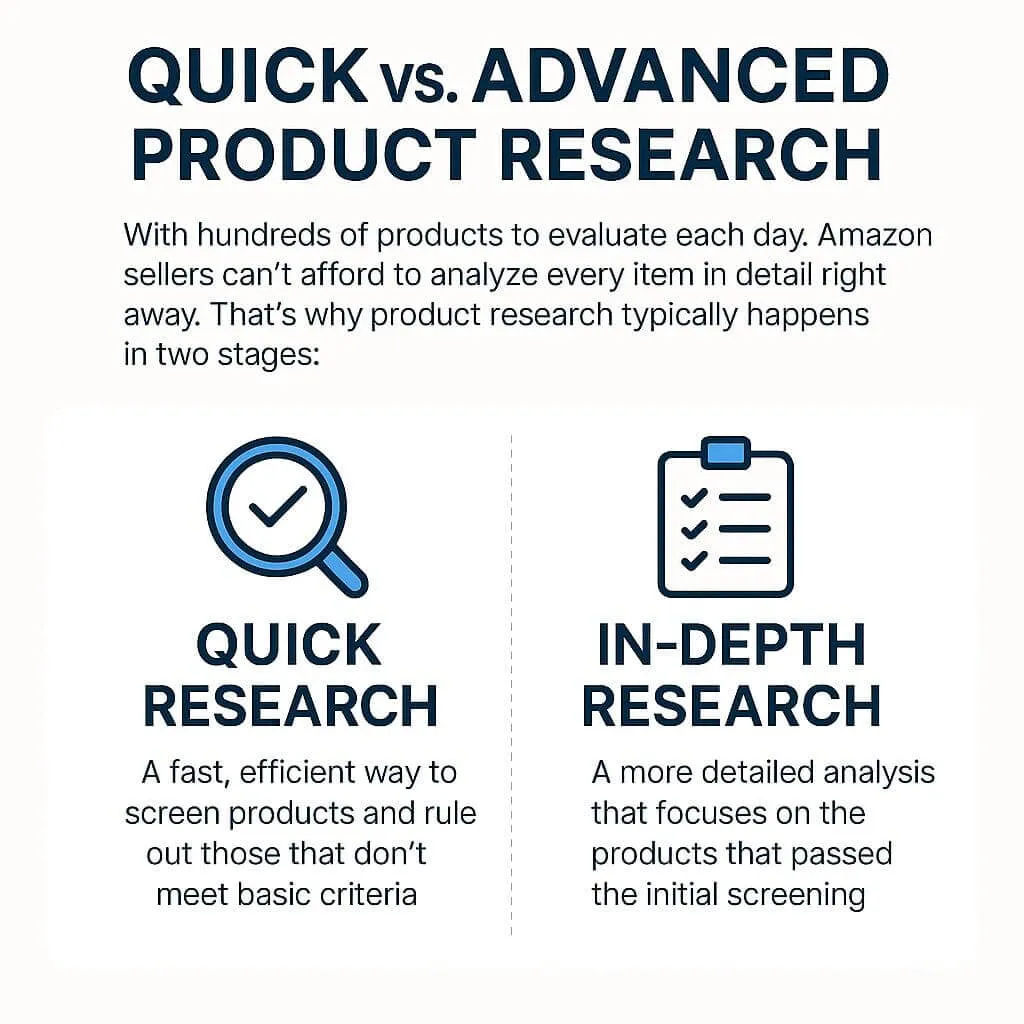
This step-by-step approach helps sellers focus their efforts on only the most promising opportunities.
In the next sections, we’ll break down 5 fast product research methods and 2 advanced research techniques that will help you zero in on high-margin, low-risk products.
Pro Tip: Product research can be extremely time-consuming without the right tools. That’s why many sellers rely on Seller Assistant — an all-in-one sourcing platform designed to simplify and automate this process. It offers multiple tools including three extensions: Seller Assistant Extension, IP-Alert Extension by Seller Assistant, and VPN by Seller Assistant, product sourcing tools: Bulk Restrictions Checker, Price List Analyzer, Seller Spy, Brand Analyzer, API, and different features — all rolled into one tool. Together, these tools help sellers save time and make smarter sourcing decisions.
When doing advanced research, consider the following key factors to determine if a product is truly worth reselling:
By carefully reviewing these points, you’ll avoid potential pitfalls and focus only on products that offer real potential and profitability.
Quick product research plays a vital role in identifying products that offer the right balance of demand, profitability, and manageable competition. This process helps sellers focus their energy only on deals worth deeper analysis.Here are five effective tactics for fast product evaluation:Quick View, Reverse Sourcing (Supplier to Amazon), Competitor Analysis, Category Research, and Brand Evaluation.
Quick View is an essential tool for evaluating products directly on Amazon’s search pages, without clicking through to product listings. It instantly displays critical metrics — making it easy to decide whether a product deserves further attention or should be skipped right away.
ASIN
A unique identifier that helps you quickly locate and track products for deeper research.
Best Sellers Rank (BSR)
This figure indicates how well a product sells in its category. A lower BSR means higher sales velocity. Typically, sellers aim for products with BSR between 1 and 50,000.
Eligibility and Restrictions
Not every seller can offer every product. Quick View alerts you with icons showing if you’re eligible to sell the product or if any restrictions apply.
The number of active sellers gives insight into competition.
When Amazon itself is competing, it can be hard to win the Buy Box. Quick View highlights listings where Amazon is present with a bright orange icon.
In addition to data, Quick View also offers productivity tools:
By combining all of this data and functionality in one view, Quick View allows you to quickly eliminate unsuitable products and prioritize the ones with real profit potential — all without leaving the search page.
Ideal for
Online arbitrage sellers and dropshippers who manually review products one by one and need to make fast, informed decisions.
Reverse sourcing, often referred to as supplier-to-Amazon sourcing, is a powerful approach that wholesale sellers use to discover profitable opportunities hidden within supplier catalogs.Instead of starting with Amazon and searching for products, reverse sourcing flips the process. Sellers begin with their suppliers' price lists and work backwards — matching those products with Amazon listings to uncover resale opportunities.
For wholesale sellers, supplier price lists are goldmines. These lists often contain hundreds or even thousands of SKUs, each with the potential to become a profitable listing on Amazon. The challenge, however, lies in sorting through massive amounts of data to pinpoint which items are actually worth selling.Manually researching each product is simply not practical. That’s why automation is essential for speeding up this process and focusing only on products that meet your profit and demand criteria.
The go-to solution for this task is Seller Assistant’s Price List Analyzer.This specialized tool allows sellers to upload supplier price lists directly into the platform. It then automatically matches the supplier products with existing Amazon listings and instantly calculates essential profitability metrics.
By organizing and analyzing this data in one dashboard, Price List Analyzer makes it easy to sort and filter products by profitability, sales potential, and other important criteria. This saves countless hours and allows sellers to focus only on the most promising deals.
Reverse sourcing is essential for:
By automating what would otherwise be a very tedious process, reverse sourcing helps sellers quickly spot the best opportunities and make smarter buying decisions.
In the competitive world of Amazon selling, keeping an eye on your rivals is essential. Competitor research allows you to see what others are offering, spot trends, and uncover gaps in the market where your products could thrive.By understanding your competitors' strategies and product selections, you can fine-tune your inventory and take advantage of opportunities they may have missed.
The idea is simple but powerful: track your competitors' product catalogs and monitor any changes they make. This includes new items they add, products they remove, and how they adjust their pricing.By analyzing this data, you can identify:
This information helps you make smarter sourcing decisions and ensures your inventory stays competitive and relevant.
The most effective way to perform competitor research is with Seller Assistant’s Seller Spy.
This tool automates the entire process, tracking your chosen competitors and providing detailed reports about their activities. Seller Spy keeps tabs on:
All of this information is organized in easy-to-read reports so you can quickly spot potential opportunities and gaps in the market.
Competitor research is invaluable for:
Anyone looking to expand their product catalog, discover new brands, or stay ahead of rivals will benefit from this tactic.
Choosing the right product category is a critical part of building a successful Amazon business. Each category presents its own balance of opportunity and competition, so understanding which ones best align with your goals is key to long-term profitability.Effective category research helps sellers avoid oversaturated markets and focus on categories where they have the best chances of success.When evaluating categories, keep these three factors in mind:
Highly popular categories such as Home & Kitchen and Electronics attract massive buyer interest — but they also tend to be the most competitive. While demand is high, breaking into these spaces often requires aggressive pricing and marketing strategies.According to Jungle Scout, here are some of the most popular categories among Amazon sellers:
These percentages show the proportion of sellers active in each category — helping you gauge potential demand versus competition.
The more sellers there are within a category, the tougher it can be to win the Buy Box and maintain profitable pricing.
As a general rule:
By analyzing the average number of sellers per listing, you can identify which categories are saturated and which may be worth targeting.
Some Amazon categories have selling restrictions, require approval, or have specific conditions that sellers must meet.Before committing to a category, double-check that:
This step ensures you won’t waste time researching or sourcing products you can’t actually list.
Category research is essential for all resellers, including:
Usually, product sourcing starts with category selection — making this tactic foundational for building your sourcing strategy.
Choosing the right brands to work with is a vital part of Amazon product research. Not all brands are reseller-friendly, and some may present challenges such as high competition, low demand, or restrictive policies. Proper brand research ensures you only invest in brands that offer a balance of demand, profitability, and accessibility.
When evaluating a brand, it’s important to examine several key factors to determine if selling its products on Amazon makes sense.
Focus on brands that offer a large assortment of products, ideally with at least 200 active listings on Amazon. A broad product range increases your chances of identifying multiple profitable items to resell.
Look at the brand's total estimated monthly sales. This helps gauge overall demand and profitability. Also, review the average Buy Box price to better understand potential pricing strategies and profit margins.
Examine how competitive the brand’s products are on Amazon:
Avoid brands that sell directly through Amazon or through exclusive distributors. These brands usually enforce strict control over listings, leaving little room for third-party sellers. A brand that appears across multiple sellers usually welcomes resellers.
Consider the brand’s average product ratings and review counts. Products with strong ratings (4 stars or higher) and a substantial number of reviews generally indicate healthy demand and satisfied customers.
Before sourcing products from a brand, confirm you are allowed to sell them. Check for:
Brands that frequently issue IP complaints or restrict listings should be avoided to minimize account risk.
Brand research is essential for wholesale sellers, online arbitrage sellers, and dropshippers. Typically, this tactic is used after selecting a product category to identify the most promising brands within that niche.
Quick product research is just the beginning. To confidently move forward with sourcing, you need a more detailed validation process. Extended product research allows you to verify a deal’s true profitability and uncover hidden risks before investing.This tactic is crucial for minimizing costly mistakes and ensuring that the products you choose align with your profit and risk expectations.
How Extended Research Works
Extended research focuses on thoroughly examining products that passed your initial quick research. You’ll assess every critical factor — from sales trends to competition levels — to decide if the product is truly worth sourcing.By following a step-by-step validation checklist, you can confidently greenlight only those products that meet your standards.
The most efficient way to perform deep product analysis is by using the Seller Assistant Extension.This tool automatically integrates into Amazon product pages and displays all the key metrics you need to assess a deal — saving time and boosting research accuracy.
If a product passes all these checkpoints, you can move forward and add it to your inventory with confidence!
Product research is a vital and often complex step in running a successful Amazon business. Sellers routinely review and analyze hundreds of products, and using the right tactics is essential to make informed decisions.
A balanced approach that combines quick research methods — like Quick View, Reverse Sourcing, and Competitor Analysis — with advanced tactics such as Extended Research and Direct Sourcing allows you to thoroughly evaluate each product's potential. This helps you focus on deals that offer high profitability, steady demand, and minimal risks.
By applying structured and proven research strategies, sellers can confidently build a profitable product portfolio, avoid costly mistakes, and stay ahead in the highly competitive Amazon marketplace.
Instagram quietly tweaked its algorithm in spring 2026 – and it’s impacting everyone from Amazon sellers and DTC brands to influencers. Reels and the Explore tab have changed, favoring original content and 3-second viewer retention over old vanity metrics like likes. Average reach is down, leaving creators wondering what happened. Don’t panic – adapt. Below we break down what changed, why your reach might have tanked, and how to pivot your strategy right now to regain momentum.
Instagram didn’t blast this update from the rooftops, but creators felt the effects almost overnight. In essence, Instagram’s ranking system got an upgrade (or, depending who you ask, a mixed blessing). The key changes include:
Instagram now shows your Reels to non-followers as part of the initial test audience – not just your followers. In other words, the Explore/Reels algorithm might serve your content to a random sample of users to gauge interest. This is huge for discovery (hello, potential virality!), but it also means if your content doesn’t hook people immediately, even your followers might not see it.
Instagram explicitly stated that reposting or unoriginal content will be penalized. If the algorithm finds two accounts posting the same thing, it will only recommend the original post. Accounts that primarily recycle others’ content (e.g. meme aggregator pages) can even be excluded from recommendations. Smaller creators finally get a fair shot, and big accounts can’t coast on stolen memes anymore.
The platform is increasingly relying on AI to predict what content keeps users engaged. “Watch time” and early retention now carry more weight than likes when determining what pops up on Explore. Shares and saves are heavily weighted too – Instagram calls these “value-driven” engagements. In short, the algorithm cares less about how many people liked your post and more about how long they watched and whether they found it worth sharing.
These shifts were implemented with little fanfare, but their impact has been loud and clear in our analytics. As Meta’s transparency notes put it, Instagram’s AI is now picking 500 posts for each user and ranking them by predictions like “how likely you are to spend >10 seconds on this post”. If people tend to scroll past your content after 2 seconds, it’ll get buried – even if you have a big follower count. On the flip side, if a small brand’s Reel instantly captivates viewers, it can snowball to massive reach beyond its follower list.
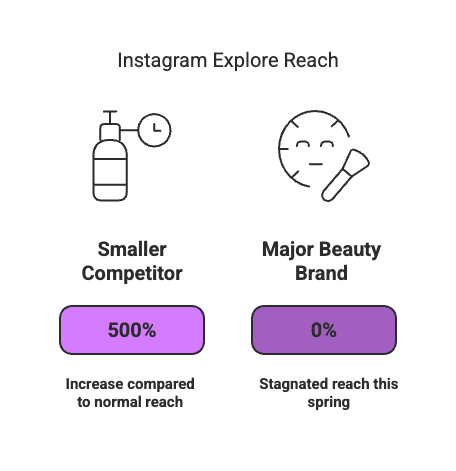
Instagram’s push for originality isn’t just lip service – it’s baked into the new algorithm rules. Why the crackdown on recycled content? Because for years, the IG feed (and especially Explore) was flooded with duplicate posts: viral TikToks with watermarks, the same trending dance re-posted by 100 influencers, etc. This often meant original creators got overshadowed, and users saw a lot of “meh, I’ve seen this already” content.
No more. Instagram confirmed that when their system detects identical content, “we will only recommend the original one.” Reposts might even come with a label crediting the original creator, and the copycats won’t get traction. They’ve also set limits like if an account reposts 10+ pieces in 30 days without adding anything new, it’s booted from the recommendation engine. This is a clear message: create, don’t just curate.
For Amazon sellers and DTC brands, this means you should avoid lazy reposts. If you were in the habit of sharing popular meme content or recycling influencer videos hoping to ride the trend, that strategy will backfire now. Instead, invest time in making your own videos, photos, and graphics. Show off your product or brand story in a fresh way. Original behind-the-scenes clips, customer testimonials, or creative UGC-style Reels will outperform a copied trend reel that 20 other pages also posted.
Real-world example: A major beauty DTC brand that used to repost viral makeup memes saw their Explore reach stagnate this spring. Meanwhile, a smaller competitor that posted an original “GRWM skincare routine” Reel (filmed casually in-house) saw their video picked up by the algorithm and hit 5× their normal reach. Instagram is rewarding the authentic creator, not the imitator.
Insight: Even Adam Mosseri (Instagram’s head) has been nudging creators towards originality. He shared a checklist for Reels: no watermarks, use original audio, keep it under 3 minutes, and ensure it’s original content. The goal is to stop TikTok re-posts from dominating. Take that to heart: ditch the TikTok watermarks and put your unique spin on every piece of content.
Here’s a wild stat: according to Meta’s data, the average viewer decides whether to keep watching your video within just 1.7 seconds. Essentially, you have a blink to grab attention. No wonder Instagram’s algorithm now looks at 3-second retention as a critical signal. If people stick around for at least 3 seconds, it’s a good sign; if they bail before 3 seconds, that content gets demoted.
In 2026, many creators are discovering that a high view count with poor retention isn’t helping them anymore – a video that people watch 90% of the way through (or re-watch) is far more likely to explode in reach than a video that people skim and like. Retention is the new currency. A marketing expert summed it up: “First 3-second retention has more weight than any other segment” of your video. Instagram is literally predicting “how likely you are to watch less than three seconds” of a Reel as a factor in whether to show it.
Why the shift? Because if a viewer stays past those first moments, they’re probably interested. Maybe they’ll even watch the whole thing, comment, or share it. A like, on the other hand, is a split-second tap – it doesn’t guarantee the user actually absorbed the content. As a result, content that immediately hooks the audience tends to perform better in the new algorithm. Think of flashy intros, quick cuts, big text that says “Wait for it…”, or anything that stops the scroll in the first 1–3 seconds.
For example, if you’re an influencer posting a Reel about a fitness product, leading with “🔥 3 Tips to Fix Your Squat (in 15 Seconds) 🔥” with an engaging visual will likely retain more viewers than a slow intro like “Hi guys, so I wanted to talk about my workout…”. The former gets to the point and promises value immediately – hooking the viewer. The latter… the viewer might already be scrolling away.
This focus on retention also means quality over quantity in engagement. Instagram is paying attention to how people interact beyond likes. Saves, shares, comments – those indicate deeper interest. In fact, engagement quality is being talked about like this: saves + shares > likes + comments as signals. One study found “comment-to-view ratio is weighted more heavily than like-to-view ratio” by the algorithm. So a smaller number of comments where people are genuinely discussing your post can beat a bunch of passive likes. It’s not about chasing double-taps anymore. It’s about creating content that makes people pause, watch, and react.
If your recent posts have been underperforming, you’re not alone. Across the board, organic reach has slumped – by some estimates about 18% year-over-year as of early 2024, and engagement per post is down ~28%. Many niches (beauty, fashion, fitness, etc.) report that posts which used to hit X% of their followers are now only hitting X–18%. 😢
For example, an influencer in the travel niche might have routinely reached 25,000 of her 100k followers last year. Now, similar content might reach ~20,000 or fewer. One verified creator with over 100k followers shared that their reach “absolutely tanked” in March – they used to count on a minimum of ~20k reach per post, and suddenly were scraping 2k. Ouch. Another user in r/InstagramMarketing noted their Reels were only being shown to their own followers (0% new audience), whereas on TikTok the same video went viral. These kinds of stories have become common this spring.
So, what gives? A few factors are at play:
Instagram’s tweaks made organic reach harder for content that doesn’t meet the new engagement criteria. If your post isn’t getting saves or retention, the algorithm now kills its distribution faster than before. It feels like a punishment, but from Instagram’s perspective, they’re just streamlining what users see to keep them hooked on the app. Good content (by their new definition) still reaches far; mediocre content falls off a cliff faster.
Instagram isn’t the scrappy photo app of 2015 – it’s a crowded marketplace in 2026. There’s more content than ever flooding feeds. More creators, more brands, more ads, more everything. A growing user base and content pool can dilute everyone’s slice of attention. Some reports note that fewer than 1 in 10 followers typically see a brand’s post now. It’s not necessarily that your content got worse – it’s that the bar for grabbing attention is higher when users have endless choices.
Audience habits are changing. Short-form video (Reels) is popular, but there’s also a bit of short-form fatigue for some users. People are curating their feeds, unfollowing accounts that don’t provide value, and spending more time on competing platforms (TikTok, YouTube Shorts, etc.). The result? Even your loyal followers might not catch every post unless it really stands out or they actively seek it.
For brands and creators, this reach decline means you can’t take your audience for granted. You have to earn each view with compelling content. It also means strategies that worked last year might need an update. The days of posting a pretty product photo with a generic caption and getting tons of likes are waning. Now, you might need a killer Reel or a carousel with real substance to get similar reach. Many brands now partner with an Instagram marketing agency to audit content, accelerate testing, and keep pace with algorithm shifts. Now, you might need a killer Reel or a carousel with real substance to get similar reach.
For brands and creators, this reach decline means you can’t take your audience for granted. You have to earn each view with compelling content. It also means strategies that worked last year might need an update. The days of posting a pretty product photo with a generic caption and getting tons of likes are waning. Now, you might need a killer Reel or a carousel with real substance to get similar reach.
The good news: Instagram isn’t dead. Far from it – it’s still a huge platform, just evolving. In fact, Instagram claims it’s trying to give more people a chance to be seen, especially small creators. The trick is learning how to ride this new wave.

Let’s cut to the chase – what types of posts are crushing it under the new algorithm, and which ones are flopping? Here’s a rundown, with examples:
These are gold right now. A DTC coffee brand we know shifted from static images to Reels showing quick, quirky skits about “morning life before coffee vs. after coffee.” The first 2 seconds show someone literally falling asleep at their desk (thumb-stopper!). That Reel not only got laughs but also got shared in DMs like crazy – a big boost, since Instagram now heavily rewards “send to a friend” activity. Result: their Reel views doubled compared to their previous artsy product shots. It illustrates a key point: start your videos with something that grabs attention in 1–3 seconds, whether it’s a bold visual, a surprise, or text that teases a story. Instagram explicitly advises creators to “engage your audience in the first three seconds” so they don’t scroll away.
Carousels are making a comeback, big time. Creators who post swipeable tips, mini-blogs, or before/after series are seeing great engagement. Why? Because people save them for later and share them. One Amazon seller, for instance, posted a 5-slide carousel on “5 hacks to organize your kitchen” featuring their product. It wasn’t a hard sell – it provided genuine useful tips (with the product subtly included). That post got saved by thousands of users (who doesn’t want a tidy kitchen?) and outperformed their previous meme reposts by a mile. Instagram’s new algorithm loves saves because it signals “this content is worth coming back to”. If your content makes users hit the bookmark icon, you’re doing it right in 2026.
On the flip side, many creators report that doing the same old TikTok dance or lip-sync trend isn’t yielding magic like it used to. For example, an influencer who purely reposted trending lip-sync Reels (that thousands of others were doing) saw her average views drop significantly this spring. Instagram is “deprioritizing generic Reels” that everyone’s already seen. If you hop on a trend, you must add your unique flavor or niche twist to stand out. A straight copycat video is likely to be ignored by the algorithm now.
Interestingly, some creators found that highly produced videos with long intros are underperforming compared to raw, quick ones. One creator shared that they spent hours on a fancy edited Reel (cinematic shots, logo animation intro, etc.) and it flopped – viewers dropped off early. Meanwhile, a competitor’s simpler, iPhone-shot video on the same topic with an immediate hook outperformed it 5-10× in views and engagement. The lesson: on IG in 2026, polished production matters less than grabbing attention and delivering value fast. In fact, overly polished content can feel like an ad, causing viewers to swipe past. Authentic, human, and fast-paced wins. If you have slick brand videos, consider cutting them down or adding a punchy opening so that the viewer is drawn in within seconds.
In summary, what’s working now is content that’s original, attention-grabbing, and share-worthy. What’s not working is anything lazy, copycat, or slow. If you’re noticing a pattern, it’s intentional: Instagram wants to keep people on the app by surfacing content that immediately intrigues and satisfies them. As creators or brands, we need to align our strategy with that reality.
Enough theory – let’s talk action. How can you, as an Amazon seller, DTC brand, or influencer, adapt to these changes and start seeing growth again? Here are five concrete steps to get you back on track:
Take a hard look at your recent content. For each post or video, ask: Would this stop me from scrolling?* If not, redesign it. Plan every Reel or video with a strong hook in the first 2–3 seconds. This could be a surprising visual, a provocative question, or a bold statement in text. For example, instead of a usual intro, start with results: “Check this out – we removed 50% of wrinkles with this trick 👀.” Such an opening teases the value up front. Also, double down on original content creation. Set aside time for brainstorming unique post ideas that reflect your brand voice. If you’ve been relying on trending audios or formats, think about how to put an original spin on them. (And absolutely avoid using videos with TikTok watermarks – Instagram has openly said it downranks those.)
In 2026, a viewer saving or sharing your post is like them giving you an award. To earn that, create posts that people need to bookmark or pass along. If you’re a brand, consider infographics or step-by-step carousel posts (e.g. “How to choose the perfect coffee roast – 5 tips”). If you’re an influencer, maybe it’s a heartfelt mini-blog or a useful tutorial that followers will want to refer back to. For shareability, think of content that people would DM to a friend. Memes or relatable jokes can work if they’re fresh and relevant to your niche. Educational tidbits work too (“Wow, I didn’t know that, let me share it”). As Instagram’s head Mosseri noted, “when you're creating content, think about something people would want to send to a friend… sends are one of the biggest signals we use” . Brainstorm ideas that fit that bill. For instance, an Amazon gadget seller might post “10 Life Hacks with that Make Home Life Easier” – highly sharable within family/friend groups who love home hacks.
Recall that the algorithm watches how your content performs right after posting. So, rally your troops! When you publish a new post, be present and active for the next hour at least. Reply to comments as they come in (which can encourage more comments). Immediately share the post to your Story with a teaser (“New post: I spill my morning routine secrets ☕👉 go check it out”). You can even DM it to a few close followers or brand ambassadors who might engage. The idea is to spike that initial engagement rate. Content that gathers steam quickly is more likely to be pushed out further. Also, encourage interaction in your caption or video itself: ask a question, invite opinions (“Tell me in the comments which outfit you like best, I’m genuinely curious!”). And don’t forget about Stories and Lives – while they have their own algorithm, being active in Stories can indirectly boost feed engagement because your brand stays top-of-mind (plus you can direct Story viewers to your new Reel/post).
Diversify your content mix to keep things interesting, but pay extra attention to the formats Instagram is favoring. Right now, Reels are the discovery engine – they’re the #1 way to reach new eyeballs, so aim to post Reels consistently. If you’re not comfortable on camera, Reels don’t have to be you dancing – they can be product close-ups with text overlays, unboxing videos, voiceover demos, etc. Many Amazon sellers are seeing success with simple unboxing Reels or quick before/after demos. Meanwhile, carousel posts are great for delivering value and getting saves (data shows carousels earn the most saves on average.) Use them for storytelling or tips. Traditional single photos are fine occasionally, but they likely won’t reach as far unless they really strike a chord or go viral via shares. Also, use Instagram’s features to your advantage: try things like Collab posts (so you and a partner both share the post to your feeds) for extra reach, and don’t neglect using relevant hashtags and location tags – while not as critical as before, they can still help at the margins on Explore.
By implementing these steps, you’ll start creating content that aligns with Instagram’s new preferences. Many brands who pivoted early are already seeing their metrics climb back up. It’s all about working with the algorithm, not against it.
To wrap up, here’s a handy checklist combining all the advice above. Follow these steps to optimize your product-link posts and restore your Instagram momentum:
Review your last 9–12 posts. Identify any reposts, stock content, or TikTok-duets you’ve shared. Plan to replace those with 100% original content. (Instagram penalizes heavy reposting, so you want a clean slate of original work.) Remove any watermarks from videos and always credit original creators if you do repost a quick meme in Stories.
Never again post a video that doesn’t captivate in the first 3 seconds. Brainstorm a hook before you hit record – it could be a shocking stat, a question, or an eye-catching scene. For example: begin your cooking demo Reel with the final dish reveal first, to entice viewers (“🍰 Ta-da! – Want to learn how to make this in 10 minutes? Keep watching!”). This drives up your 3-second retention metric immediately.
Set goals for each post beyond just “get X likes.” Maybe it’s “get 50 saves” or “start 5 conversations in comments.” Create content that facilitates that goal. For instance, if you’re a fashion brand, instead of just posting a model shot, post a carousel titled “5 Ways to Style X” and ask “Which look is your favorite? Comment below!” This invites interaction. Remember, shares, saves, comments are the big three now – earn those and the algorithm will reward you.
Instagram will keep evolving (they’re already teasing more AI-driven feeds and user control over what they see). Stay plugged into creator news – follow Instagram’s official @Creators account and industry blogs for hints of changes. When a new feature or change comes, embrace it early. Early adopters often get a boost (Instagram tends to reward those who use its latest features). And don’t be afraid to experiment. Try a new content series or a different video style – the platform is giving reach to content that stands out. If something flops, it’s okay; you’ll learn from it. If something hits, ride that wave!
By following this checklist, you’ll position your brand or profile to not just survive but thrive under Instagram’s 2026 algorithm. It’s all about original content that grabs attention and provides value. Amazon sellers and DTC brands, this is your call to get creative with how you showcase products. Influencers, it’s time to bring your unique voice and keep those viewers glued to your content.
Instagram’s shake-up may have been quiet, but our response as creators must be loud and clear. Adapt to the new rules, and you’ll find your reach (and ROI) rising again. Now get out there and create something original that your audience can’t scroll past – the algorithm (and your followers) will thank you for it!
Ready to supercharge your brand’s presence on Instagram in a fun, authentic way? Instagram’s new Re-Post feature (think of it like an Instagram “retweet”) lets you share other users’ posts directly to your feed. This opens up exciting possibilities for brands to collaborate with influencers and fans, amplifying reach without having to create every piece of content from scratch. In this guide, we’ll walk through how to work with influencers to boost your campaigns using Instagram re-posts. We’ll keep it casual and friendly – think of it as chatting with a fellow marketer over coffee – but packed with solid tips and examples to help your brand grow. Let’s dive in!
Consumers today crave authenticity. In fact, 84% of people trust peer recommendations more than ads, and nearly 79% say user-generated content (UGC) heavily influences their purchases. When your brand reposts an influencer’s genuine content or a happy customer’s post, it comes off as more relatable and trustworthy than a polished ad. This social proof can translate into real business results – 82% of consumers are more likely to buy from a brand that uses UGC in its marketing. By re-posting, you’re essentially letting real users and influencers do the talking for you, making your brand message more credible.
Reposting content can significantly boost engagement on your profile. One study found that Instagram posts featuring user content get 70% more engagement than those without. Why? Because people love content that feels real and community-driven. Plus, when you share an influencer’s post, you’re likely to get not only your followers liking and commenting, but the influencer’s fans might join in too. It’s a win-win for engagement.
Working with influencers allows you to tap into new audiences. When an influencer posts about your brand (and especially if they re-post your content or vice versa), their followers get exposed to your brand, and your followers see content endorsed by someone they trust. Instagram’s platform is prime for this kind of cross-exposure – nearly 28% of e-commerce marketers say Instagram generates the most engaging UGC, more than any other platform (Facebook is next at 23%). The chart below illustrates how Instagram leads in driving engaging user content, making it an ideal place to leverage re-posts in brand campaigns.
Let’s face it – making new content constantly can be expensive and time-consuming. Re-posting influencer content (with permission) is a clever shortcut. You get fresh content without a full production. And it often performs better: 93% of marketers who use UGC say it outperforms traditional content. Reposts fill your feed with diverse perspectives, showing your product in action in different lifestyles or contexts, all without the hefty creative budget.In short, Instagram reposts combine the power of influencer marketing and UGC authenticity. You amplify your message to wider audiences, build trust through real voices, and keep your feed active and engaging. If you are curious to learn more about the global impact of influencers Now, let’s break down exactly how to do it step by step.
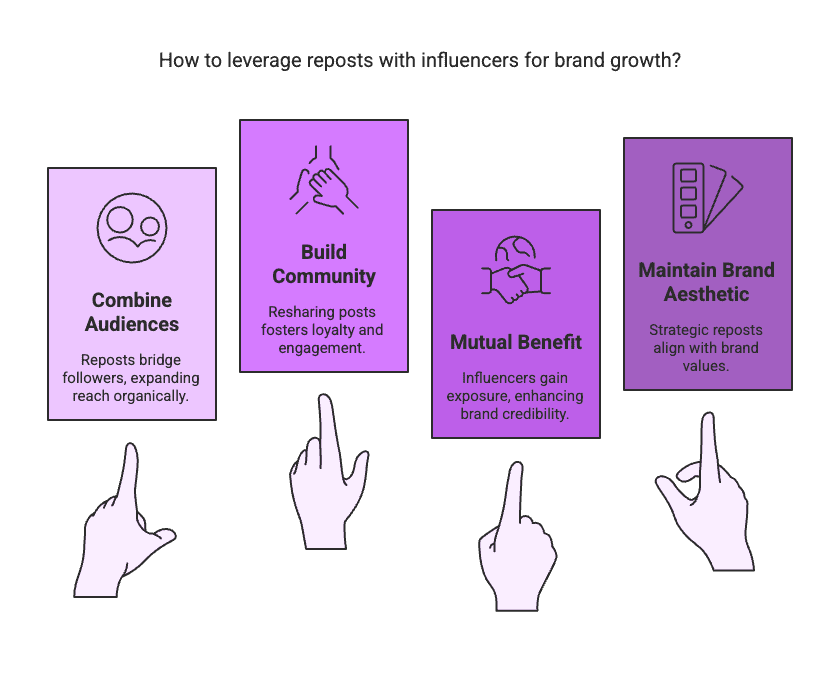
When brands and influencers team up via reposts, magical things can happen for your reach and community growth:
Every repost is a bridge between your followers and the influencer’s followers. It’s like two circles overlapping – your content gets seen by people who follow the influencer, and their content (now on your feed) is seen by your followers. This cross-pollination can introduce your brand to tons of new people in an organic way. As Instagram itself noted, the repost feature makes it easy to amplify content to wider audiences right in the main feed, instead of being limited to temporary Stories.
Regularly sharing fan or influencer posts turns your Instagram page into a community hub, not just a brand billboard. A great example is Gymshark – the fitness apparel brand regularly reshares posts from their community of influencers and fans, filling their feed with authentic, diverse gym selfies and workout clips. By doing so, Gymshark isn’t just promoting products, they’re building a community of fitness enthusiasts. Fans feel heard and valued when a brand features them, which strengthens loyalty.
Influencers generally love being re-posted (when properly credited) because it boosts their exposure too. One influencer marketing resource points out that when brands reshare influencer posts, it helps the influencer gain followers and credibility – which, in turn, circles back to benefit the brand as the influencer grows. It’s a virtuous cycle: the influencer gets more love, and your brand gets content plus goodwill.
By carefully choosing which posts to repost, you can maintain your brand’s aesthetic and values, while adding a personal, human touch through the influencer’s voice. It’s important to be strategic here – ensure the content you repost aligns with your audience’s interests and provides value A random post might confuse followers, but a well-chosen influencer post that fits your brand vibe will feel natural in your feed and resonate with viewers.
Next up, let’s get into the nitty-gritty: how can your brand actually execute an influencer repost campaign from start to finish?
Every successful marketing move starts with clear goals. Ask yourself: What do I want to achieve with this repost campaign? Is it spreading the word about a new product launch? Driving traffic to your online store? Growing your Instagram following or engagement? Maybe it’s just boosting brand awareness among a certain demographic. Define this early, because it will guide all your decisions. For example, if your goal is brand awareness among Gen Z, you might aim to repost content from popular Gen Z creators. If it’s to increase sales of a fitness product, you’ll want to collaborate with fitness influencers and measure clicks or use promo codes. Also, identify the audience you want to reach (perhaps your existing followers, plus the followers of the influencers you’ll work with). Clear goals and a target audience in mind will make the next steps much more focused.
Not all influencers are created equal for your particular campaign. You want to find those who naturally connect with your brand’s niche and have an engaged following. Look for influencers who create the kind of content you’d be proud to feature on your own feed. For instance, if you’re a travel brand, an influencer who posts gorgeous travel photography (and has followers who love travel) is a great fit. Tip: Check if they’ve worked with brands before and how their audience responded – that can be a clue to how a repost might be received. Once you have a shortlist, reach out with a friendly proposal. Let them know you love their content and you’d like to collaborate, which could include featuring their posts on your brand’s page. Be transparent about what you’re asking: that you’d like to re-post some of their Instagram content as part of your campaign (and of course, fully credit them). Many influencers will be excited by this – it’s extra exposure for them too. Just make sure you agree on terms and get their permission (more on that in Step 4). And remember, partnerships can be paid (sponsored) or unpaid if the influencer genuinely likes your brand – figure out what kind of incentive or arrangement works in each case.
Work with your chosen influencers to encourage content that will really click with your audience. Some brands give influencers creative freedom to post about the product in their own style – this often yields the most authentic content. Others might set up a brief or theme (for example, a fitness apparel brand might say: “Post a video of your most creative workout using our gear”). Since ultimately you’ll be reposting this content, you want it to be high-quality and on-message. General tips for content:
Content should feel like the influencer’s genuine experience or story, not an obvious ad script. Audiences can tell the difference.
Instagram is visual. Ensure good lighting, clear shots, or engaging video clips. If it’s eye-catching on their feed, it’ll be eye-catching on yours.
If working with multiple influencers, great! You can end up with a variety of perspectives – maybe one does a funny Reels video, another posts a beautiful photo – which you can then re-post over time to keep your feed interesting.
By collaborating up front, you set the stage for content that both the influencer’s followers and your followers will love.
This part is super important – always get permission to repost someone’s content. Even if an influencer is tagging you or using your hashtag, it’s good etiquette (and often legally necessary) to ask before you take their post and put it on your feed. In your collaboration discussions, make it clear that you’d like to re-share their posts on your Instagram. Many brands even include content usage rights in the influencer contract or agreement. This way, everything’s documented: the influencer knows exactly how their content will be used, and you know what you’re allowed to do.If you’re working with an influencer in a campaign, chances are they’ll happily agree to reposting – after all, it benefits them too. Especially if you promise proper credit, most influencers will allow reshares of their content for free (no extra fee). Still, it’s best practice to get a clear “yes, you can repost this” from them, either via email or DM, before you hit that share button. This avoids any misunderstandings down the line.Also consider rights beyond Instagram. Sometimes a brand might want to use the influencer’s photo in a newsletter or on the website. If that’s a possibility, negotiate that upfront as well (that often comes with additional fees or terms). But if you’re sticking just to Instagram re-posts, a simple permission will usually suffice. Once you have the green light – you’re good to go to the next step.
Now for the fun part – sharing the influencer’s post on your own Instagram feed. Thanks to Instagram’s new repost feature, this is easier than ever. Here are two main ways to do it:
If you have the repost feature enabled on your app (Instagram has been rolling it out gradually, you can tap the share icon on the post and choose “Repost”. This will let you add the post to your feed (visible to all your followers) and even lets you type a caption above it. The original content remains intact and credit is typically shown automatically (e.g. it might label it as a repost from @username). This is the simplest way, as it directly shares the content while linking it to the original creator.
If the official feature isn’t available, you can use third-party apps or manual methods. Some brands save the image/video (with permission), then re-upload it on their account. If you do this, make sure to tag the influencer in the photo and mention them in the caption for credit! There are also apps like Repost for Instagram that streamline this while adding a watermark credit. Another approach is the Collab tag (Instagram’s “Collab” feature) – you and the influencer can co-post so the content shows on both profiles. This isn’t exactly a repost, but it’s another way to amplify a single post to two audiences, so it’s worth mentioning as an option.When you repost, add a friendly caption from your brand’s voice (more on captions in the next step). For example: “Loved this look that @influencer_name put together with our new summer collection! 😍 #SummerWithAcme”. By reposting, you’ve now published content to your feed that feels authentic, gives a shoutout to the creator, and spreads your campaign message to everyone who sees it.
Don’t just hit repost and call it a day – take the opportunity to add context and personality with a caption. A great caption can increase engagement and make the reposted content even more impactful for your campaign. Here’s what to include:
First and foremost, clearly credit the influencer or original creator. Tag their handle (e.g., “📸: @influencer_name”) either at the start or end of the caption. You might also thank them: “Huge thanks to @influencer_name for sharing this!” This not only gives proper attribution (a must-do) but also shows goodwill and partnership. It’s polite and fosters a good relationship.
Tie the post back to your brand or campaign. If the influencer’s post is, say, them using your product in a cool way, your caption can highlight that. Example: “We’re obsessed with how @influencer_name uses our new blender to whip up morning smoothies. 🥤 This recipe = 😋!” Keep the tone friendly and on-brand. It’s okay to use emojis and exclamation points if that fits your style. The goal is to sound like a human, not a corporate press release.
Include your campaign hashtag if you have one (e.g., #SummerWithAcme). Also, you can re-use some of the influencer’s hashtags if relevant (especially if they created a unique one or included community hashtags). Just don’t go overboard – choose the most relevant tags so your post is easily discoverable but not spammy. A mix of brand hashtags, campaign-specific tags, and maybe one popular hashtag in your niche is a good formula.
Remember to keep the caption concise enough – Instagram users scroll fast – but with enough personality and info to add value to the repost. Once you’ve written that awesome caption, go ahead and publish the repost!
After you hit share, your job isn’t over. In fact, one of the biggest advantages of reposting influencer content is the conversation it can spark. Be ready to engage! Monitor the comments on the reposted post and reply when appropriate. If people say “Love this!” or ask questions (“Which product shade is that?”), jump in and respond as the brand. This kind of active community management shows that your brand is listening and cares about the community.It’s also a nice touch to engage with the influencer around the repost. You might comment on the post thanking them (“Thanks for teaming up with us on this! 🙌”) or respond to their followers if they comment something about the influencer (“Isn’t @influencer_name creative? We love them!”). Just keep it positive and on-topic.Additionally, encourage further sharing. If your campaign is, for example, a contest or challenge, you can comment or post in your Stories reminding followers to submit their own posts for a chance to be featured. This can snowball into more UGC – essentially turning fans into contributors, so featuring user posts via reposts can motivate participation.)By actively engaging, you’ll boost the post’s performance (more comments can lead to more visibility via Instagram’s algorithm) and you’ll nurture a loyal community. People remember the brands that take the time to reply.
Last but definitely not least: track how your repost campaign performs. This is where you see if those goals from Step 1 were met. Some key metrics and how to track them:
Look at likes, comments, saves, and shares on the reposted posts. Did they get more engagement than your average brand-created posts? Often, UGC and influencer posts do see a bump in engagement. If you see a lot of saves and shares, that’s a great sign that people found the content valuable or inspiring.
Check if your follower count increased during and after the campaign. New people who discovered your brand via the influencer’s content may have hit that Follow button. You can compare the growth rate to previous periods.
If your goal was to drive sales or site visits, use tools to see if there was an uptick. For example, did more people click the link in your bio during the campaign? If you provided a promo code via the influencer or in your posts, how many times was it used? Some brands give each influencer a unique code to track who drove sales – if you did something like that, tally up the results. If you were just aiming for awareness, maybe run a quick Instagram poll or use the Questions sticker in Stories to ask your audience if they saw the campaign or what they thought of it (qualitative feedback can be golden).
Document your findings. It could be a simple list of what worked well and what you’d tweak next time. For example: “Reposts with product in use got more comments than just product photos” or “Fitness influencer videos had higher saves than static pics – consider more video content.” This helps you continuously improve. Marketing is all about learning and iterating.
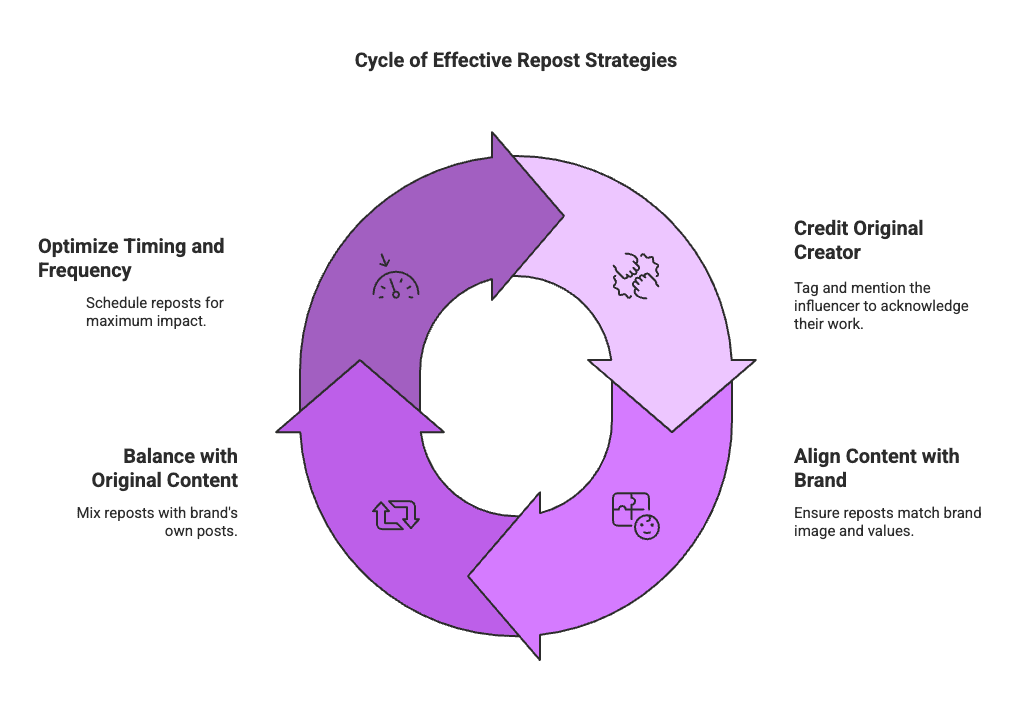
Before we wrap up, here are some general tips and best practices to keep in mind (no matter your industry):
This is non-negotiable. Tag the influencer in the post and mention them in the caption every time you repost their content. Not only is it the right thing to do, it also alerts their audience and can draw those folks to your post.
Only repost content that fits your brand’s image and values. A repost should feel like it belongs on your page. As Instagram’s team has hinted, be strategic – make sure the content interests your audience. Quality over quantity: one great relevant repost is better than three off-brand ones.
Reposts are awesome, but don’t rely on them exclusively. Mix in some original posts from your brand (product shots, announcements, memes – whatever is your style). That way, your feed shows both community love and your brand’s own voice. It keeps things fresh.
Space out your reposts so each one gets its moment to shine. For example, if you’re running a week-long campaign with multiple influencer posts, don’t dump them all in one day. Maybe do one per day or every other day. Also consider timing when the influencer’s followers are most active (since their audience will be interested in the repost too). You can ask the influencer for insights on when their posts perform best, or use Instagram Insights if it’s a collab.
By following these practices, you’ll maintain a positive reputation while reaping the full benefits of reposts. Brands that do this well come off as both authentic and savvy, leveraging the voice of the community to amplify their message.
To see how this works in action, let’s look at a few brands that have successfully used Instagram reposts or UGC sharing in their campaigns:
Furniture retailer Wayfair ran an Instagram campaign encouraging customers to share photos of their homes styled with Wayfair products using a hashtag **#WayfairAt. Wayfair then reposted the best user photos on their own Instagram feed, complete with tags and even product links. This not only gave Wayfair a library of real-life decor images to inspire followers, but it also let customers who were featured feel like stars. The campaign drove engagement and made shopping easier (see something you like in a repost? Click the product tag!). The takeaway: reposting UGC made Wayfair’s marketing feel genuine and helpful, rather than pushy.
Action-camera brand GoPro is famous for its Instagram feed, which is essentially a nonstop showcase of user-generated awesomeness. GoPro lets its **fans be the stars of its Instagram page by sharing the most fantastic shots taken with GoPro camera. From skydiving clips to underwater discoveries, GoPro reposts them all (with credit to the creators). By doing this, GoPro’s account serves as both inspiration to potential customers (“wow, I could capture that if I buy a GoPro”) and a community reward system (users strive to get featured). It’s been massively successful in building an engaged community of adventurers. And every repost implicitly advertises the product’s capabilities without GoPro having to say a word – the content speaks for itself.
Even tech giant Apple jumped on the Instagram repost trend. Apple’s @apple Instagram account is dedicated entirely to featuring photos and videos taken by iPhone. They invite people to tag their shots with #ShotOniPhone, and then Apple curates and reposts those images, often as a series of short videos or photo sets, complete with the photographer’s handle credited on each. This campaign makes iPhone users feel appreciated and highlights the iPhone’s camera quality in a real-world way. For example, one week Apple might share stunning landscape photos from various users, each with a voiceover or caption about the photographer’s story. The result? A highly engaging feed that blurs the line between Apple’s official content and its community’s content. It feels less like marketing and more like an art gallery – which elevates the brand image while still essentially being marketing through UGC.
Mentioned earlier, Gymshark has grown in large part thanks to social media savvy. A big part of their Instagram strategy is reposting content from fitness influencers and everyday gym-goers wearing Gymshark gear. They run challenges like #Gymshark66 where followers post their 66-day fitness journey; Gymshark then features many participants on their page. By doing this, Gymshark turned their customers into a community. People hit follow not just for product news, but to see relatable fitness content and maybe even themselves on the brand’s page one day. This repost-heavy strategy helped Gymshark go from a small startup to a globally recognized fitness brand, all while keeping marketing costs relatively low (the customers create a lot of the content!). It illustrates the power of giving your audience the spotlight.
Each of these examples shows a different angle of using Instagram reposts: Wayfair for direct commerce benefit, GoPro for product demonstration and community, Apple for brand storytelling, and Gymshark for community building and engagement. What they all have in common is collaborating with users/influencers and sharing their voices. This approach can work for brands big and small, across industries – the key is finding the right people and content that align with your brand’s story.
Instagram’s re-post feature (and the general practice of regramming content) is more than just a shiny new toy – it’s a genuinely effective tool for modern marketing. By working hand-in-hand with influencers and your own customers, you can amplify your brand’s reach in a way that feels natural and trustworthy. We’ve gone through how to set up a repost campaign step by step: from defining goals and picking the perfect influencers, to securing permission, sharing the content, and engaging with the community around it. Along the way, you’ll build authenticity (since real people are vouching for your brand) and foster a loyal following who loves seeing their peers highlighted.
Keep the tone friendly and human. Instagram is a social platform, after all, where people come to connect and be inspired – not to read formal press releases. If you treat your repost strategy as a conversation with your audience, featuring voices they resonate with, you’ll strike the right chord. As the examples showed, whether you’re a small business or a giant like Apple, the principles remain the same: celebrate your community and they’ll champion you in return.
So go ahead – give reposts a try in your next brand campaign. Team up with that influencer who loves your product. Show off that customer photo that made you smile. Your Instagram feed will feel more lively and authentic for it, and odds are, you’ll see the boost in reach and engagement we’ve been talking about. In the world of marketing, it’s not often you get to say a strategy is a win-win for everyone involved – but using Instagram’s re-posts to bolster your brand just might be one of those rare cases. Happy reposting, and here’s to your next campaign being your most viral one yet!
In today’s influencer-driven marketplace, even the smallest voices can have a big impact on your Amazon sales. Nano-influencers (those under ~10k followers) and micro-influencers (~10k–100k followers) have become go-to partners for niche e-commerce brands. But if you’re a resource-strapped Amazon seller, you might be wondering: which tier is really worth your time and money? Recent data suggests nano-influencers can deliver 42% lower cost-per-click than micro-influencers – a huge win for your ad dollars – but they also demand up to 3× more management effort to coordinate. In this article, we’ll break down the differences between micro and nano influencers in 2026, compare their performance (with the latest stats on cost and engagement), and explore the pros, cons, and practical tips for using each tier in your Amazon marketing strategy.
Before diving into metrics, let’s clarify what we mean by micro and nano influencers in 2026. These terms refer to the size of an influencer’s following:
Small-scale creators with roughly 1,000 to 10,000 followers (some definitions start as low as 500 followers). They are often everyday individuals or niche experts who have built a tight-knit community around specific interests.
Influencers with around 10,000 to 100,000 followers. They still focus on a particular niche or audience, but have a broader reach than nanos while remaining far more affordable than celebrities.
For example, a nano-influencer might be a passionate home-baker on Instagram with 3,500 followers who regularly posts gluten-free recipes – not famous by any means, but highly trusted by her small audience. A micro-influencer could be a parenting YouTuber with 45,000 subscribers; not a household name, but influential enough that her product reviews get thousands of views and some mainstream brand partnerships. Both tiers are considered “small” influencers, especially compared to macro or mega influencers (those with hundreds of thousands or millions of followers), yet they drive outsized engagement and conversion in their communities.
Notably, nano-influencers make up a huge portion of the influencer ecosystem. On Instagram, over 75% of creators are nano-influencers. Micro-influencers are the next biggest group. This means as a brand owner you have plenty of options in these tiers, spanning every niche imaginable. The table breakdown below sums up the key differences between micro and nano influencers:
As the table shows, micros and nanos share the advantage of being highly engaging and cost-effective compared to bigger influencers, but differ in scale. Next, we’ll dive deeper into how these tiers stack up on two crucial metrics for Amazon sellers: cost-per-click (CPC) and engagement rate.
From a performance standpoint, nano-influencers often outshine micro-influencers on a per-dollar basis. According to recent analysis, campaigns with nano influencers can achieve a cost-per-click roughly 42% lower than those with micro influencers. In other words, your marketing spend may drive significantly more clicks to your Amazon listing when allocated to a squad of nanos, versus a few micros. This makes nanos incredibly attractive for sellers looking to maximize ROI on a tight budget.
At the same time, nano-influencers typically boast higher engagement rates – meaning a greater percentage of their followers actively like, comment, and interact with posts. Industry data confirms that smaller creators have the most engaged audiences. For example, Instagram posts by nano-influencers (under 5k followers) see about a 2.5% engagement rate on average, whereas micro-influencers (10k+ followers) see around 1%. That’s a substantial difference in how “dialed in” their audiences are. Higher engagement can translate to more trust and ultimately more conversions (if 2.5% engage, that’s a lot of potential clickers and shoppers relative to a larger but less engaged following).
Comparison of average Cost Per Click (left) and Engagement Rate (right) for micro vs. nano influencers. Nano-influencers deliver cheaper clicks (lower CPC) and higher engagement on posts, highlighting their efficiency. (CPC values are illustrative; engagement rates based on Instagram averages.)
In the chart above, you can see nanos dramatically beating micros on both fronts: CPC is lower (meaning you spend less for each click generated), and engagement rate is higher. Of course, these are averages – a well-chosen micro-influencer can also have great engagement – but the trend holds across platforms. TikTok shows a similar pattern, with nano creators often achieving the lowest cost-per-engagement of any tier.
What does this mean for Amazon sellers? Essentially, nano-influencers give you more bang for your buck in terms of audience interaction and traffic per dollar spent. Their followers are more likely to pay attention to recommendations, click your product link, and potentially convert to buyers. Micro-influencers, while slightly less efficient statistically, still perform well and can reach more people with each individual post. The trade-off comes down to scale versus efficiency: micros = more reach per person but at a higher unit cost; nanos = hyper-engaged niche reach at rock-bottom cost but needing more people to scale up.

So, which tier is better for a small Amazon-focused brand? There’s no one-size-fits-all answer – each tier has distinct advantages and disadvantages. Let’s break it down from a practical standpoint:
In short, nanos excel in authenticity and cost-efficiency, whereas micros offer a balance of reach and manageable workload. Many savvy Amazon sellers actually leverage both: for example, partnering with a couple of trusted micro-influencers as campaign anchors, then supplementing with a fleet of nano-influencers to flood various sub-niches with content and links. This combined approach can yield both broad exposure and deep engagement.
One of the biggest hurdles in working with nano-influencers is the sheer management overhead. If one micro-influencer can generate as many impressions as, say, five nano-influencers, you’re looking at five times the communication, five shipments of product, five sets of content to review, etc., to get equivalent reach. It’s no surprise that marketers report needing substantially more time and coordination when running nano-heavy campaigns. In fact, HypeAuditor’s data indicates brands may need to manage three times more nano-influencer partnerships to achieve similar results to a micro-influencer campaign (hence the “3× more effort” figure).
Consider everything involved in a single influencer collaboration: finding the right person, reaching out with your pitch, negotiating terms, collecting address and sending a sample product, ensuring they post on time, checking the content meets guidelines, tracking the clicks or sales, and then maybe processing payment or thanking them. Now multiply that by 20 or 50 nanos at once – you can see how quickly it becomes a full-time job. As one marketing site notes, “to achieve the same reach, you may need to work with several nano influencers simultaneously. The more influencers you manage, the more work is required on your end.” This is a key con that small brands must weigh. Time is money, and if you’re a solo entrepreneur or small team, you simply might not have hours a day to spend emailing and onboarding a bunch of Instagram hobbyists.
Micro-influencers, by contrast, are easier to handle in smaller numbers. You might get by with recruiting 2–5 micro influencers for a campaign, which is much more feasible to personally manage. Additionally, many micros are semi-professional – they’ve perhaps done collaborations before or even have a manager or standardized process – making your job simpler. You’ll likely spend less time explaining how tracking links work or what kind of content you need, compared to coaching a first-timer nano.
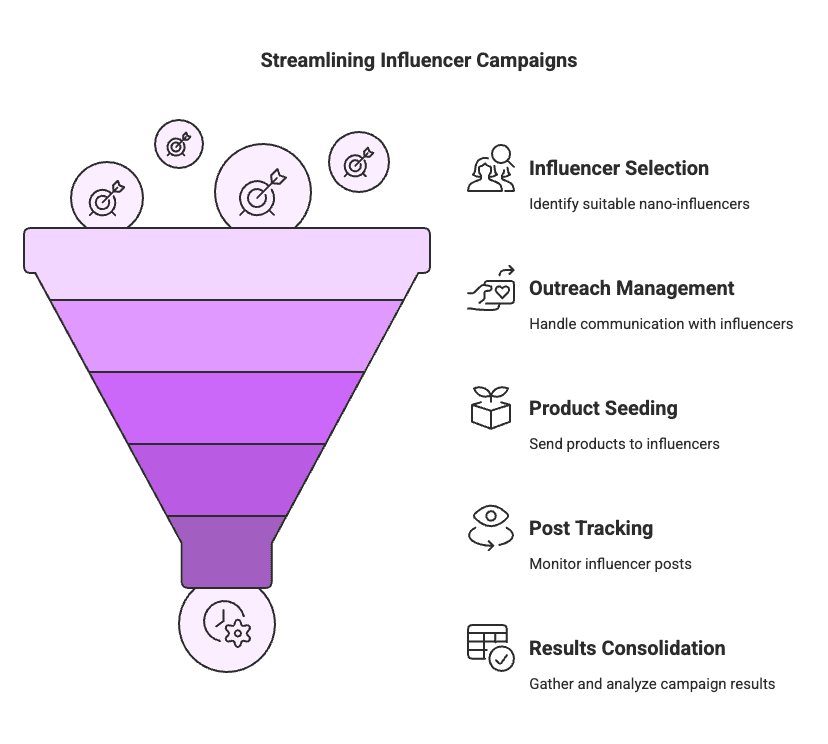
Given the management challenge, how can small sellers harness nano-influencers at scale without burning out? The answer is to leverage tools, platforms, or agencies that streamline influencer campaigns. In 2026, a plethora of influencer marketing platforms exist to take the heavy lifting off your plate. In fact, 60% of brands use third-party tools to assist with influencer marketing – doing so can be a game-changer for scaling up campaigns efficiently.
One example is Stack Influence, a platform specifically geared toward micro and nano influencer campaigns. Stack Influence “automates product seeding campaigns” and manages the end-to-end process of working with a large number of small creators. Essentially, you provide your product and campaign goals, and the platform finds suitable nano/micro influencers, handles outreach, ships them the product, tracks their posts, and consolidates results. As their site notes, this kind of tool “helps manage the recruitment process, tracking deliverables and results in one dashboard.” For an Amazon seller, that means instead of you individually emailing 50 influencers and tracking 50 Instagram posts, the software gives you a unified interface and often templates or automation for communication. Some platforms even vet influencers for you, providing engagement stats and audience demographics up front, so you can pick the best matches quickly.
Aside from Stack Influence, there are many other influencer marketplaces and agencies that specialize in micro/nano campaigns – from Upfluence and AspireIQ, to smaller niche networks. The common thread is that they enable “one-to-many” management, letting a single marketing manager successfully run campaigns with dozens of creators. This is ideal when you want to capitalize on the low CPC and high engagement of nano-influencers without manually herding cats. Of course, these services have their own fees or commissions, but often the time saved (and increased campaign performance) makes it worth it.
For those who prefer a more DIY approach, consider batch-processing your nano outreach. That might involve using tools like group emails, influencer CRM spreadsheets, or setting aside specific days for influencer management tasks. Creating a standard onboarding packet (with campaign instructions, your Amazon Associates link or coupon code, posting guidelines, etc.) can help ensure each nano-influencer has what they need with minimal back-and-forth. Essentially, treat it like hiring a large batch of part-time affiliates: systematize it.
To visualize how micro vs. nano influencer strategies play out, let’s look at a hypothetical scenario (inspired by real trends from 2024–2026). Brand A is a niche fitness accessories seller on Amazon, launching a new line of yoga mats. They have a modest budget and one marketing manager. They consider two approaches:
Partner with 5 fitness micro-influencers, each with ~50k followers on Instagram/TikTok. In exchange for $300 and a free mat each, they each create a post and a short demo video of the mat in use. Result: Each micro’s post reaches tens of thousands of people in a relevant demographic. The engagement is solid (around 1% of viewers interact). They drive a spike of traffic to Brand A’s Amazon page, resulting in a nice bump in sales during launch week. Total cost was about $1,500 plus products, and management was relatively straightforward (a few emails and contracts). However, after the campaign, the buzz dies down – only 5 pieces of content went out.
Partner with 50 nano-influencers, each with 1k–5k followers in yoga or home fitness niches. These are mainly enthusiasts who agree to promote the mat in exchange for a free product (and maybe a small commission on any sales). They post unboxing videos, mini-reviews, and action shots over a two-week period. Result: Individually, each nano doesn’t reach a ton of people, but collectively the campaign generates 50 posts flooding the feeds of various tight-knit yoga communities. Engagement on each is very high (tons of comments from friends/family asking about the mat). Traffic trickles in consistently to the Amazon listing via dozens of referral links – no huge spike, but a steady flow of highly interested buyers. Brand A’s Amazon listing gains a bunch of new ratings and Q&A activity as these nano-influencers and their followers leave feedback. The campaign cost was just the price of 50 mats (and maybe some Amazon affiliate payouts), but the coordination took considerably more effort and time to manage. The upside is Brand A now has a trove of user-generated content and authentic testimonials to leverage in future marketing.
Both approaches can “move the needle,” but in different ways. The micro-influencer route is quick and impactful, whereas the nano-influencer route is slow burn but potentially more cost-effective and rich in grassroots credibility. Notably, in the nano campaign, even though no single influencer rivaled the micro reach, the combined ROI was excellent – essentially product seeding generated lots of word-of-mouth at a low cost. This aligns with broader trends: surveys show over 70% of brands are now working with smaller creators, and many report strong results by doing so. Nano-influencers can even yield higher aggregate ROI thanks to their low costs and higher conversion of engaged fans.
For niche Amazon sellers in 2026, both micro and nano influencers can be effective if aligned with your goals and resources. Here are some final takeaways and recommendations:
nano-influencers are your best bet. You can send out free product (leveraging Amazon’s inexpensive sample or promo units) in exchange for posts, getting exposure essentially for the cost of goods. The CPC will likely be fantastic and you’ll build a base of grassroots ambassadors. Just be ready to invest time instead of money, or use an automation platform to help.
lean towards micro-influencers. It’s better to successfully execute a small campaign with 3–5 micros than to overextend and mismanage a 50-nano campaign. Micros will give you meaningful reach and solid engagement with far less logistical headache. You’ll pay more per post, but it’s still very reasonable compared to traditional advertising. As we saw, a handful of micro-influencers can drive a quick bump in traffic and sales when you need it.
Often the optimal strategy is a tiered influencer plan: use a few micros for broad awareness and credible “anchor” content, and supplement with nanos for amplification and niche targeting. The micros can create high-quality content (e.g. a polished review video) that you can repurpose on your Amazon listing or ads, while nanos add dozens of authentic voices sharing their love of your product across many small communities. This way you get the best of both worlds – reach + authenticity – and the nano content can reinforce the micro influencers’ messages.
Don’t shy away from nanos just because of the management burden. If your gut says a swarm of nano influencers could ignite your brand in the niche you serve, explore the platforms that can help, or create a repeatable process for yourself. As noted, many brands use influencer marketing tools, and services like Stack Influence exist precisely so that small brands can scale up campaigns without scaling up headcount. The playing field is more level than ever; even a one-person business can coordinate 100 influencer collaborations with the right tech in place.
Both micro and nano influencers can move the needle for Amazon sellers, especially those targeting specific niches. Nano-influencers offer unparalleled authenticity, engagement, and cost-efficiency, whereas micro-influencers offer convenience, larger initial reach, and still-strong influence at a moderate cost. If you can harness the power of nano influencers (and manage them effectively), you unlock a potentially massive ROI engine for your brand. If you prefer a simpler, more controllable campaign, micro influencers are a reliable choice to drive qualified traffic to your Amazon storefront. Many brands in 2026 are finding that a mix of both delivers the best results: use micros to build buzz and trust at scale, and nanos to ignite passionate conversations in the nooks and crannies of your market.
In the end, the “best” tier depends on your specific situation. Assess your marketing bandwidth, budget, and goals. If you’re looking for efficient conversions and have the means to manage it, try investing in a cadre of nano-influencers for your next product launch. If you need quicker results with less coordination, engage a few micros with audiences closely aligned to your target customer. Either way, by incorporating these smaller influencers into your strategy, you tap into the power of word-of-mouth on social media – and that can translate into real growth on Amazon. With the right approach, both micro and nano influencers will help push your sales needle in 2026 and beyond.
Practical Takeaway: For Amazon sellers, nano-influencers are like a turbocharged grassroots army – incredibly effective on a per-post basis – while micro-influencers are like dependable sharpshooters – easier to deploy with predictable results. Evaluate what your brand needs more: widespread micro-scale reach or deep nano-scale engagement (or a combination). Then plan your influencer strategy accordingly, and watch those product link clicks (and hopefully Amazon sales) roll in. Good luck!
Influencer marketing isn’t just about likes – it’s about return on investment (ROI). E-commerce brands and creators alike want to know: if I put $1 into an influencer campaign, what do I get back? In 2026, influencer marketing has matured into a data-driven channel where we can actually measure this. On average, brands see about $5.20 in revenue for every $1 spent on influencer campaigns. But not all platforms are equal. TikTok, Instagram, and Amazon’s influencer program each have different strengths in spend efficiency. Let’s break down what $1 of influencer spend delivers on each platform – from median CPM (cost per 1,000 impressions) and CPC (cost per click) to CPA (cost per acquisition) – and how you can maximize ROI using smart budget splits and AI forecasting tools.
When it comes to ROI benchmarks in 2026, TikTok and Instagram offer solid returns, while Amazon’s influencer program can be a dark horse with performance-driven payouts. Here’s a quick comparison of what one dollar can typically deliver on each:
Roughly 100 impressions per $1 (median CPM about $10) and ~1 click per $1 (CPC around $1). In terms of ROI, TikTok averages about $5.78 in revenue per $1 spent. Its viral reach means huge impression counts for your spend, though conversion rates can be lower than Instagram’s.
Approximately 80–100 impressions per $1 (CPM in the ~$8–12 range) and 2–5 clicks (CPC often $0.50 or below) for that $1. Thanks to higher purchase intent, brands get around $4.21 in revenue per $1 spent on IG influencer campaigns on average. Instagram’s audience tends to click through and convert more readily via features like “Shop Now”, giving it a slightly lower raw ROI than TikTok but often a better cost per acquisition.
Rather than paying for impressions or clicks, brands typically pay affiliate commissions (1–20%) on sales. This means no upfront CPM/CPC cost – you only spend when a sale happens. Effective results? Often 5–15% conversion rates from influencer-driven Amazon traffic (much higher than social ads) and a CPA as low as a few dollars. For example, one DTC brand’s Amazon micro-influencer campaign generated $129,280 in sales on a ~$9,917 spend – about a 13× ROI (13 dollars back per $1)! Performance-based deals on Amazon can deliver double-digit ROI for brands, making each $1 extremely efficient.
These benchmarks show that $1 on Instagram tends to buy more clicks and conversions, while $1 on TikTok buys more eyeballs and awareness (often translating to higher top-line ROI). $1 on Amazon (via influencers) can be the most profit-efficient of all, since spending is tied directly to sales results. Your mileage will vary by industry – but understanding these baselines helps set realistic expectations for 2026 campaigns.
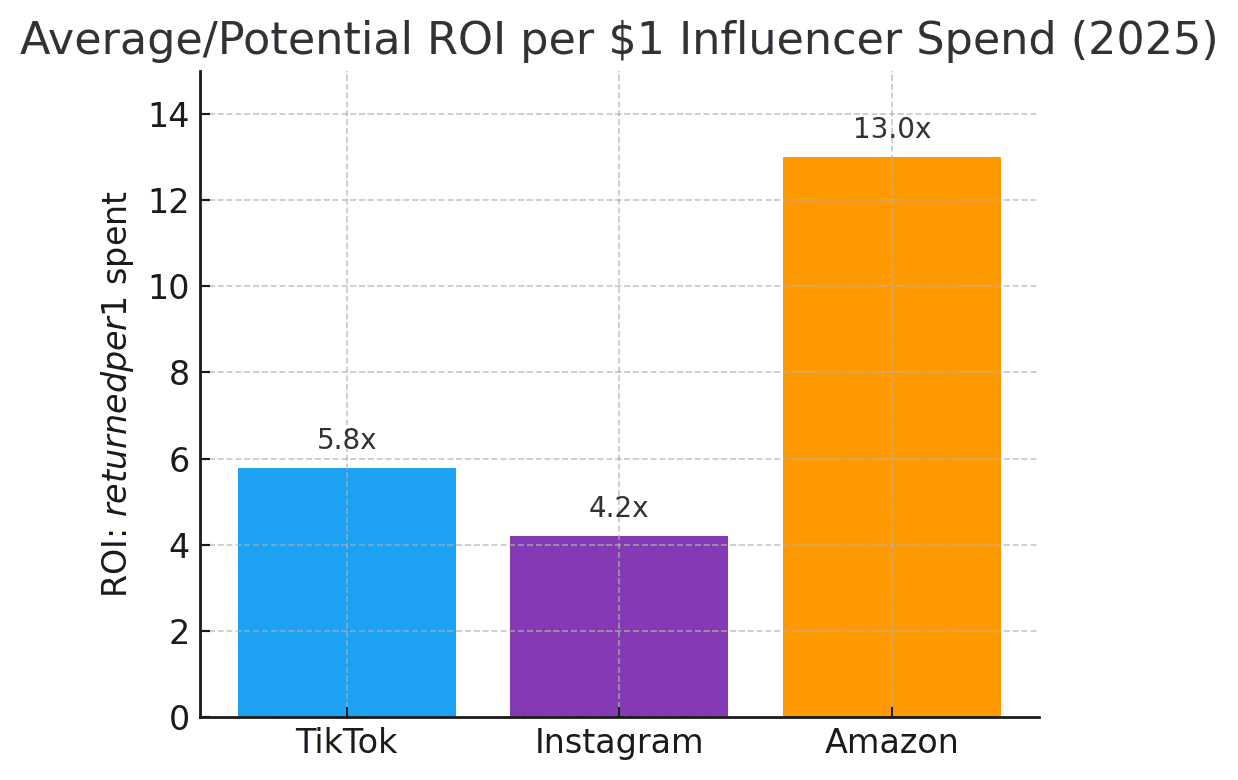
Rough ROI per $1 spent via influencers on each platform. TikTok averages ~5.8× return, Instagram ~4.2×, while Amazon’s affiliate-style model can yield 10×+ ROI in many cases (e.g. 13× in one campaign). These figures illustrate revenue multiplied per dollar invested.
How exactly do those ROI numbers come to be? Let’s dig into the spend efficiency metrics behind them:
TikTok’s median CPM is about $10 for influencer content, meaning $1 buys ~100 impressions. Instagram’s CPM is slightly higher (around $8–$12 on average) – so $1 might get ~83–125 impressions. Essentially, TikTok currently offers a bit cheaper reach per dollar, thanks to its viral algorithm boosting content beyond followers. Both are far cheaper than traditional ad channels. Amazon doesn’t have a CPM here since there’s no cost for impressions – influencer content could rack up thousands of Amazon page views at no charge to the brand.
TikTok clicks cost more, around $1 each on average. Instagram’s cost per click is typically much lower – often $0.20–$0.50 in influencer campaigns (businesses report ~$0.40–$0.70 for IG ads). This means $1 of spend might drive 5 clicks on Instagram vs 1 click on TikTok. Why the difference? Instagram’s shoppable posts and older demographic convert curiosity into clicks more readily, whereas TikTok users engage quickly but may scroll past external links. Amazon again differs: you’re not paying per click at all – many Amazon influencer clicks are “free” traffic that only cost something if a purchase happens.
Ultimately, CPA tells you how many dollars to get one customer. On TikTok, if we assume ~2% of those clicks convert, a $1 click and 1 in 50 converting yields a rough $50 CPA (just an illustrative median). Instagram, with cheaper clicks and perhaps a 4% conversion, could see CPAs more in the $10–$20 range. In fact, brands often see 30% lower CPA using influencer-generated content compared to their own ads. For Amazon, the CPA is effectively whatever commission or fee you pay per sale – which in many categories is just 3–10% of the sale price. For a $50 product at 5% commission, that’s a $2.50 CPA – incredibly cost-effective. No wonder Amazon influencer partnerships can achieve such high ROI!
In summary, Instagram is king of cost-efficient clicks and acquisitions, TikTok offers massive reach per dollar (and still solid ROI, due to its scale of impressions), and Amazon’s influencer program flips the model to pay purely for results (often yielding the lowest CPA). Savvy marketers will use each to their advantage: e.g. TikTok for awareness blasts, IG for driving traffic to shop, and Amazon for closing sales with minimal cost.
Median cost metrics for influencer campaigns on TikTok vs. Instagram in 2026. TikTok’s CPM ($10 per 1k impressions) is comparable to Instagram’s ($9 here, often $8–12). However, TikTok’s average CPC ($1.00) is higher than Instagram’s ($0.50 or less for link clicks). Bottom line: Instagram tends to deliver clicks more cheaply, stretching each $1 further in terms of driving traffic.
Tip: Don’t forget to factor in engagement and content value. A TikTok post that gets 100k views for $500 has a CPM of $5 – great. An Instagram Story that gets 200 swipe-ups for $500 has a CPC of $2.50 – also great. Both might yield a couple dozen sales. Beyond the immediate numbers, consider the quality of engagement (e.g. comments, saves) and how each platform’s audience fits your product. ROI isn’t just about cost, it’s also about alignment.
Knowing the benchmarks, how can an e-commerce brand allocate budget to get the best bang for the buck? We’ve created a downloadable ROI scenario model (Excel/Google Sheet) where you can plug in your budget and see projected impressions, clicks, and sales from different platform mixes.
Imagine you have a $10,000 influencer budget for Q4 2026. Here’s a hypothetical split and outcome:
50% to TikTok creators, 30% to Instagram influencers, 20% to Amazon influencers (affiliate commission or hybrid deals). This diversifies across the funnel – TikTok for awareness, IG for traffic, Amazon for conversions.
TikTok ($5k) → ~500k impressions, ~5k clicks, ~100 sales (assuming 2% conversion). Instagram ($3k) → ~300k impressions, ~15k clicks, ~300 sales (assuming 2% conversion but higher intent). Amazon ($2k in free product commissions) → let’s say 200 sales directly attributed (since you only pay when a sale happens!).
TikTok might generate ~$5k–$6k in revenue (near 1:1 ROI in this scenario, given many impressions but fewer conversions). Instagram’s 300 sales at an average order value (AOV) of $30 would yield ~$9k (3:1 ROI). Amazon’s 200 sales at $30 AOV yield $6k revenue – and because spend was just product samples/commission, that’s roughly 3:1 immediate ROI – not counting the lasting boost in Amazon ranking and organic sales that often follow. Overall, the blended $10k campaign would drive about $20k+ in direct sales, a healthy 2:1 blended ROI, plus tons of brand exposure on TikTok.
In the downloadable model, you can tweak assumptions like conversion rates and AOV to fit your business. The key is to balance your spend: high-ROI channels (Amazon/IG) with high-reach channels (TikTok) to both drive sales and grow your brand. Many brands find an optimal mix where TikTok fills the top of the funnel, and Instagram/Amazon capture the intent and purchases – yielding an overall ROI well above 1:1.
One of the biggest game-changers for 2026’s influencer campaigns is the rise of AI-powered forecasting and optimization. Gone are the days of blindly throwing money at an influencer and hoping for the best. Modern AI tools help e-commerce brands and influencers predict ROI and tighten cost controls in a few ways:
Using machine learning on historical campaign data, AI can forecast expected impressions, engagement, and even sales for a given influencer before you commit. For example, Meta’s algorithms now analyze an influencer’s audience overlap and past performance to predict which partnerships would yield the maximum ROI for your brand. This means you can prioritize creators who are statistically likely to drive cheaper CPC or higher RoAS. Brands are literally asking upfront: “What RoAS can I predict before I even sign the contract?” – and AI is giving an answer. This helps avoid costly misalignments and focus your $1 on the right influencers.
AI doesn’t stop at predictions – it adjusts on the fly. Platforms like Instagram’s Advantage+ use AI to auto-optimize influencer ad placement and budgets in real time. If one creator’s content is delivering a super low CPA, the algorithm will push more budget there; if another’s is underperforming, it pulls back spend. This dynamic allocation tightens cost control and boosts efficiency. Some brands report AI-driven campaigns consistently outperforming manual targeting – even 30% higher ROI in A/B tests. Fewer wasted dollars, more results.
AI is also enabling new performance-based payment models. For instance, some influencer platforms (like Stack Influence and others) use AI to track attributable sales so brands can pay influencers bonuses for hitting ROI targets. In 2026, flat fees are being complemented by “cost-per-acquisition” deals where AI tracking ensures you only pay if a creator drives a sale. This tight alignment of cost to outcome keeps your ROI predictable and positive (and motivates influencers to bring their A-game!). In fact, many brands and creators are embracing these ROI-driven partnerships, finding that performance-based campaigns deliver ~40% higher ROI than old-school flat fee arrangements.
Let’s not forget AI’s role in eliminating fake followers and inflated metrics. By automatically vetting influencers for bots and suspicious engagement, AI ensures your $1 is spent on real audience exposure. This improves true ROI (since fake impressions never convert) and prevents costly mistakes. AI-powered vetting tools have saved brands from wasting budget on fraud, thereby indirectly boosting the ROI on the legitimate campaigns. It’s like an insurance policy for your influencer spend.
In short, AI helps take the guesswork out of influencer marketing. When you can forecast outcomes with 80–90% confidence and automatically course-correct campaigns, every dollar is spent more wisely. As one case study showed, a company using AI agents to run a global influencer campaign saw a 30% jump in ROI compared to a human-managed prior campaign. That’s the power of letting the machines optimize those CPMs and CPCs in your favor!
If you or your brand is interested in influencer marketing, try utlizing an influencer marketing platform like Stack Influence!
Influencer marketing in 2026 is more transparent and ROI-driven than ever. E-commerce brands can confidently allocate budget knowing the benchmarks: roughly $4–$6 return per $1 on major social platforms, and potentially much more with Amazon’s performance-based system. By understanding metrics like CPM, CPC, and CPA, you can tailor your strategy – maybe leveraging TikTok for cost-effective reach, Instagram for efficient clicks and sales, and Amazon for risk-free conversions.
Importantly, strategy and tools matter. Using an ROI scenario model helps in planning the optimal budget split for your goals (feel free to grab our template and play with the numbers!). And embracing AI forecasting and optimization ensures that once you deploy that budget, it works as hard as possible – targeting the right audiences, predicting results, and minimizing waste. As Stack Influence’s 13× ROI case proves, combining micro-influencers with data-driven execution can yield incredible returns.
So, whether you’re an e-commerce brand investing your next marketing dollar or an influencer pitching your value to brands, keep these benchmarks in mind. Every $1 can deliver outsized impact if you channel it through the right platform with the right approach. Here’s to squeezing the maximum ROI from your influencer spend in 2026 – and turning those dollars into impressions, clicks, and conversions like never before! 🚀✨
Sources: Latest industry reports and case studies were used to ensure data is up-to-date. Key stats and projections were cited from HypeAuditor, Influencer Marketing Hub, CreatorDB/Stack Influence case studies, and platform-specific analyses for 2024–2026. All ROI figures are actual or projected benchmarks for 2026, but remember that results vary by campaign – always test and learn for your unique situation.
Finding the right influencers for your ecommerce brand can feel like finding a needle in a haystack. Manually sifting through profiles, assessing follower authenticity, and tracking down performance stats is incredibly time-consuming. Thankfully, a new wave of AI influencer marketing tools is changing the game. These platforms use artificial intelligence to automate influencer discovery and vetting – often cutting the time needed by 50% or more. In fact, some reports show AI can reduce influencer-vetting time by as much as 70%. For busy ecommerce marketers, that means launching campaigns faster and focusing more on strategy and creativity.
In this blog, we’ll explore seven AI-powered influencer discovery tools that help reduce influencer vetting time significantly. Each tool is compared on key criteria – pricing (and free trials), data freshness (real-time updates vs periodic), fake follower detection, and integration with Amazon ASINs or ecommerce platforms. From all-in-one platforms to niche solutions, these AI influencer marketing tools can streamline your ecommerce influencer discovery process. Let’s dive in!

Before we get to the tools, it’s worth understanding how AI helps speed up influencer marketing tasks. Here are a few ways AI features can save you hours (if not days) of work:
AI algorithms can scan millions of social profiles in seconds to match your target audience and niche, versus spending days scrolling manually. This precision at scale means you get a shortlist of relevant creators instantly.
AI-driven social listening (like Brandwatch’s Signals) monitors online conversations continuously. It can alert you to emerging trends or rising influencers in your industry in real time, so you don’t miss timely opportunities.
One of the biggest vetting challenges is assessing authenticity. AI tools like HypeAuditor automatically analyze an influencer’s audience for bot or fake followers, sparing you the headache of manual audits. You can quickly filter out influencers with inflated follower counts.
Some platforms use AI to predict an influencer’s performance (engagement rates, conversion potential) based on historical data. This helps you focus on high-ROI partners and avoid those who won’t move the needle.
In short, AI acts like a savvy virtual assistant that finds, evaluates, and even helps manage influencers – dramatically shortening the vetting process. Now, let’s look at the top tools bringing these benefits to ecommerce brands.
Below are seven of the best AI-driven platforms to speed up influencer discovery and vetting. We’ll highlight what each tool does, its standout AI features, pricing, data freshness, fake follower checks, and ecommerce integrations (like Amazon or Shopify).
Stack Influence (often just called “Stack”) is a micro-influencer marketing platform tailored for ecommerce, especially Amazon marketplace sellers. It’s a unique hybrid of software and service – essentially a fully managed micro-influencer campaign platform that leverages AI to match your products with the right creators. Stack’s approach can significantly reduce your vetting and outreach workload, because they handle much of it for you.
Stack Influence maintains a network of over 11 million micro-influencers (typically everyday creators with smaller followings but high engagement). The idea is to harness many niche voices to create buzz. By focusing on micro-influencers, Stack helps brands get authentic user-generated content (UGC) and better engagement rates without needing big celebrity influencers.
The platform uses AI to precisely target influencers by niche, demographics, and even past buying behavior. For example, if you sell organic pet food, Stack’s AI will sift through its network to find micro-influencers who have pets, post about pet care, and match your customer profile. This saves you the time of manually filtering and vetting thousands of small creators. It’s like an AI matchmaking service for brands and influencers.
One of Stack’s selling points is how much time it saves marketers on campaign logistics. They automate product seeding campaigns from A–Z – meaning they reach out to the influencers, ship them your product, ensure the content gets created, and have it posted/reviewed, all on a set timeline. You only pay when an influencer has completed a post, and often the only “payment” to the influencer is your product (product gifting). This model is cost-effective and requires minimal effort from your team. Essentially, you outsource the vetting, negotiation, and follow-up to Stack’s platform and team.
Stack Influence is ideal for Amazon sellers. The micro-influencers often purchase your product on Amazon (with reimbursement), then post reviews and social content about it. This drives up your Amazon product reviews and sales rank. If your ecommerce is Amazon-centric, Stack’s network can boost your presence there (an area many other tools don’t explicitly focus on). For non-Amazon D2C brands, Stack still works, but some features (like driving Amazon reviews) won’t apply.
Given Stack works with micro-influencers who are vetted and often part of their invite-only network, there’s an inherent authenticity. They likely screen influencers for any fraud or fake followers as part of onboarding. While they don’t advertise a dashboard feature for this, you can be relatively confident Stack’s creators have real engagement, since the platform’s reputation relies on it.
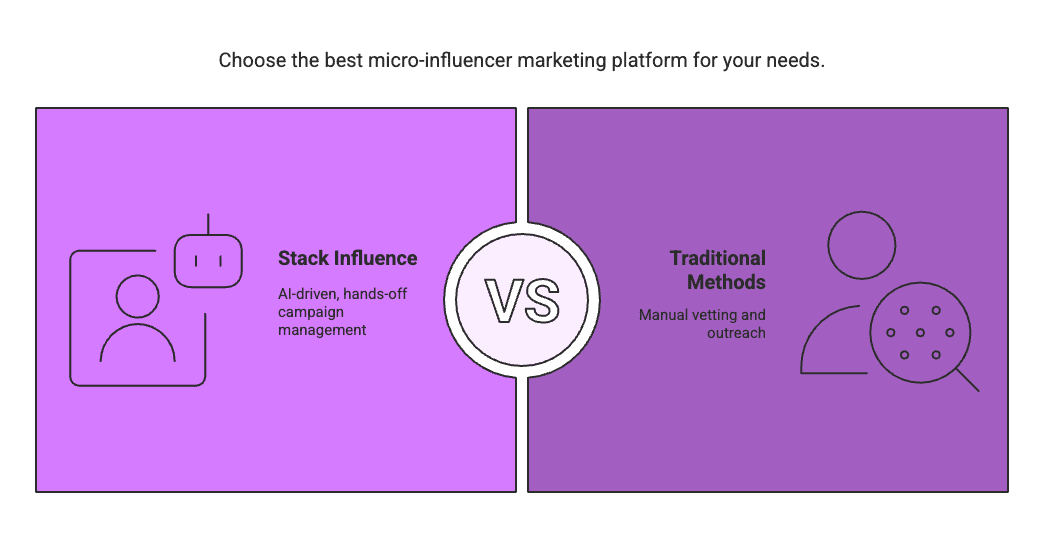
Upfluence is a powerhouse all-in-one influencer marketing platform designed for ecommerce and direct-to-consumer brands. It stands out for integrating AI at multiple touchpoints – including an AI assistant powered by ChatGPT to streamline communications – and for its deep ecommerce capabilities.
Upfluence uses AI to help brands find influencers who truly align with their target audience and values. Its advanced search filters let you slice by keyword, location, engagement rate, and more. It even offers AI-assisted email drafting and responses via ChatGPT to speed up outreach.
The platform provides real-time campaign tracking and performance analytics, so you can monitor clicks, sales, and engagement as your influencer campaigns run. This live data helps you refine campaigns on the fly – a huge time saver over waiting for post-campaign reports.
Upfluence includes a free Fake Follower Checker tool and analyzes audience quality in its reports. This helps ensure the influencers you pick have genuine followings. You can vet an influencer’s authenticity in one click, rather than manually combing through their followers.
Upfluence shines for online retail. It’s the first influencer platform with a native Amazon integration for affiliate campaigns. It also natively integrates with Shopify, WooCommerce, Magento, and other ecommerce platforms. This means you can track influencer-driven sales (via affiliate links or coupon codes) and even send products to influencers directly through Upfluence. One user noted “we have both Shopify and Amazon stores, and now we can see real sales from influencers… amazing!”.
Upfluence offers custom pricing tailored to each client’s needs (they don’t publicly list prices). It is generally considered a premium platform – reports suggest plans start around $478/month for the basic package. There’s no free plan, but you can request a demo to get a quote. For large brands, the investment pays off in time saved and sales generated.
Brandwatch is known as a leading social listening and analytics suite, and it has an influencer discovery component powered by its new “Signals” AI module. Unlike dedicated influencer platforms, Brandwatch approaches influencer identification through the lens of real-time social data and trends. This makes it invaluable for finding voices that are truly shaping conversations in your niche.
Brandwatch helps brands uncover influencers by analyzing real-time discussions and trends across social media. Instead of just searching profiles by static metrics, Brandwatch’s AI scans for people who are driving important conversations related to your brand or industry (the “signals” in the noise). This ensures you find not just popular influencers, but the ones who resonate deeply with your target audience.
The Signals feature acts like an early-warning system for viral moments. It uses AI to automatically alert you to spikes in mentions, emerging trends, or unusual changes in sentiment. For influencer marketing, this can mean catching a rising influencer who suddenly gains traction or identifying a trending topic where a niche creator is gaining influence. These real-time alerts can cut vetting time by pointing you to the right influencers at the right moment, without manual monitoring.
Through Brandwatch Influence (born from their acquisition of Paladin), you can analyze an influencer’s reach, audience demographics, and even see if they’ve engaged with your brand before. Brandwatch’s AI assigns an “Impact Score” to potential influencers based on how much they shape online discourse. It may not have a dedicated fake-follower tool like some platforms, but its focus on organic mentions and sentiment helps verify if an influencer’s engagement is genuine or just inflated numbers.
Brandwatch’s data is as fresh as it gets – real-time or near real-time. It continuously pulls from millions of online sources. When vetting influencers, you can see up-to-the-minute engagement stats and audience conversations, rather than relying on last week’s data.
Through Brandwatch Influence (born from their acquisition of Paladin), you can analyze an influencer’s reach, audience demographics, and even see if they’ve engaged with your brand before. Brandwatch’s AI assigns an “Impact Score” to potential influencers based on how much they shape online discourse. It may not have a dedicated fake-follower tool like some platforms, but its focus on organic mentions and sentiment helps verify if an influencer’s engagement is genuine or just inflated numbers.
Brandwatch is primarily an analytics platform, so it doesn’t natively integrate with Amazon or Shopify for sales tracking. It’s best used alongside your ecommerce tools. However, the insights from Brandwatch can inform which influencers to partner with for ecommerce campaigns (for example, finding influential voices among your customers or in product-related discussions).
As an enterprise tool, Brandwatch’s pricing is upon request – it does not have set tiers listed publicly. It tends to be on the higher end and is often used by larger brands or agencies. If you’re looking for Brandwatch’s Signals, you’d likely engage in a custom contract. They do offer demos, and if social intelligence is a priority, the cost can be justified.
Why Brandwatch Signals? If staying on top of real-time trends and emerging influencers is critical, Brandwatch is your go-to. Its AI-driven signals can surface the perfect new influencer for your campaign (or warn you of a potential PR risk) faster than any manual research. For brands that already use social listening, adding this influencer discovery layer can halve your vetting time by letting AI pinpoint the high-impact creators in your space.
If fake followers and influencer fraud keep you up at night, HypeAuditor is the AI tool you need. HypeAuditor made its name as a platform for influencer vetting and analytics, using AI to gauge the “health” and authenticity of social media influencers. It also offers discovery features, but its biggest strength is helping you quickly separate real influence from fake hype, ensuring you collaborate with trustworthy creators.
HypeAuditor provides in-depth profiles for over 50 million influencers, analyzing audience demographics, engagement rates, growth trends, and more. The AI looks at patterns in engagement to flag anything suspicious. For example, it can tell if an influencer’s comments are mostly from generic bot accounts or if they had an overnight follower spike (often a red flag). This level of analysis would take a human ages to compile, but HypeAuditor serves it up in seconds.
Authenticity is at the core of HypeAuditor. Its AI-powered fraud detection can easily check the quality of an influencer’s audience by detecting fake followers and engagement. You get an “Authenticity Score” or similar metric that quickly indicates if an influencer’s following is real. This feature alone can slash vetting time, as you no longer need to manually investigate an influencer’s follower list or likes – HypeAuditor’s algorithms do it for you, giving you peace of mind before you sign a contract.
In addition to vetting, HypeAuditor has a search tool to find influencers that fit your criteria. You can filter by category, location, audience size, etc., and then sort results by authenticity, engagement, or other metrics that matter to you. It’s a data-driven way to discover creators that align with your brand. You can quickly create shortlists of high-quality influencers, which addresses the discovery and vetting steps in one go.
HypeAuditor also offers features to compare influencers and even benchmark your influencer campaigns against industry averages or competitors. For example, you can see if the engagement an influencer gets is above average for their follower count – another check on whether they’re truly influential or just coasting on vanity metrics.
HypeAuditor updates its data regularly (they pull from social platform APIs and their own crawlers). It may not be real-time like Brandwatch, but it’s frequently refreshed to capture the latest follower counts and engagement rates. You can trust that the data is current enough for solid decisions.
HypeAuditor is more about social data and doesn’t integrate with eCommerce platforms or Amazon. It won’t track sales or affiliate link clicks – you’d use it primarily in the discovery/vetting phase, then use other tools to track actual campaign performance.
HypeAuditor’s pricing isn’t listed on their site; they typically ask you to book a demo for details. They do offer a free trial (so you can test the platform’s capabilities) but you need to talk to sales to activate it. In general, expect tiered pricing based on how many reports or searches you need. It’s used by agencies and brands big and small. If you only need occasional checks, the cost is moderate, but larger enterprises may have custom plans.
Why HypeAuditor? HypeAuditor is like an AI magnifying glass that instantly reveals which influencers are worth your time and budget. It dramatically reduces vetting time by programmatically doing the due diligence a human would do (audience spot-checks, engagement quality analysis) but faster and more reliably. For ecommerce brands that cannot afford to waste dollars on fake followers or want to maintain a high brand safety standard, HypeAuditor is an invaluable tool to speed up influencer vetting with confidence. Use it to shortlist only authentic, high-value influencers for your campaigns.
GRIN is often touted as the go-to influencer marketing software for direct-to-consumer (DTC) brands. It’s a full-suite influencer relationship management platform that covers everything from discovery to product seeding, and it has been embracing AI to enhance its offerings. If your goal is to build an end-to-end influencer program (and integrate it deeply with your ecommerce operations), GRIN can save you time by consolidating all tasks in one place.
GRIN isn’t just about finding influencers – it helps manage the entire influencer lifecycle. That includes outreach, sending products to creators, content management, tracking sales, handling payments, and even affiliate programs. By having all these functions in one platform, you eliminate the need for multiple tools and manual data transfers. This integration alone cuts down a lot of time (no more spreadsheets for tracking who got which promo code, etc.).
GRIN has added AI features such as influencer lookalike suggestions and campaign analytics. It offers AI-driven influencer analytics and recommendations to improve campaign performance. For instance, GRIN’s system can recommend which creators to re-engage based on past ROI, or flag an influencer who is trending upward. It also uses AI in content analysis – helping you search influencer content or predict which posts will perform best.
GRIN includes fraud detection measures to ensure you only work with genuine influencers. Its AI can identify fake followers and suspicious engagement patterns, adding a layer of vetting to your discovery process. So as you search their database, you might see an integrity score or alerts if an influencer has a lot of bots in their audience.
This is where GRIN really shines for online brands. It has strong integrations with ecommerce platforms and tools. For example, GRIN connects with Shopify (and other ecomm systems), allowing you to generate discount codes or track influencer-driven sales directly in the platform. It also streamlines product seeding – you can ship products to influencers and manage inventory all through GRIN. Essentially, GRIN bridges your online store with your influencer campaigns, so you can see how influencers drive revenue in real time.
GRIN provides real-time tracking links and updates when influencers post content or when sales happen. Its reporting dashboards aggregate performance data (clicks, conversions, ROI) into shareable reports. Many users love how comprehensive yet easy the reporting is – all your campaign KPIs automatically roll up without hours of manual work, and AI helps highlight which content or influencers contributed most.
GRIN’s pricing is not published; it’s a “contact us for a demo” situation. It’s known to be one of the more premium tools, suitable for brands that are serious about influencer marketing (and have the budget to invest accordingly). There’s no free tier. If you’re a small business, GRIN might be overkill – but for mid-size and large ecommerce brands, the efficiency gain often justifies the cost.
Why GRIN? GRIN is built to save you time at scale. If you’re managing dozens or hundreds of influencer relationships, doing it manually becomes impossible. GRIN’s unified platform (supercharged with AI features in analytics and workflow) can literally replace several tools and countless spreadsheets, streamlining everything from vetting to sales tracking. It’s like having a CRM + ecomm integration + analytics team all in one. Brands focused on long-term, authentic influencer relationships (and those wanting to see direct ecommerce impact) will find GRIN extremely valuable for cutting down administrative and vetting work.
Influencity is a rising star in influencer marketing platforms, known for its AI-driven influencer search and campaign management features. It’s particularly appealing to brands and agencies that want robust capabilities without an enterprise price tag. With a database of over 200 million influencers and handy ecommerce integrations, Influencity can dramatically speed up how you discover, organize, and evaluate influencers.
Influencity’s influencer discovery tool lets you filter creators by over 30 criteria – from basic stats like follower count and engagement rate to nuanced factors like content style, audience interests, and even storytelling approach. Its AI-powered search engine means you can input a very specific query (e.g., “female fitness influencers in California with 5–50k followers and high engagement”) and get precise results quickly. They also have a “Lookalikes” feature that finds influencers similar to another influencer you like. This is a great way to replicate the success of a known partnership, and it saves time brainstorming new names – the AI suggests them for you.
Influencity includes a built-in IRM system, which is like a CRM for influencers. You can keep all your influencer contacts, past collaborations, notes, and emails in one place. This is a time-saver for vetting because you can easily check if someone is already in your database or how a previous campaign with them went. No more digging through old email threads – the history is attached to the influencer’s profile.
From outreach to content approval, Influencity helps manage campaigns efficiently. Notably, it can handle influencer seeding programs – you can log which product was sent to which influencer and track when they post. For e-commerce brands, there’s a Shopify integration that automates product gifting and tracks the engagement those posts generate. This is a boon for vetting because you’ll quickly see which influencers actually create content and drive engagement once seeded, helping you refine your go-to list. Influencity’s reporting dashboards also present 20+ metrics (including some not available natively on social platforms) to measure success. Their AI flags important insights, like identifying trending influencers in your niche via a Topics filter.
Influencity puts a big emphasis on audience quality. It provides metrics on follower authenticity and reachability, helping you avoid influencers with a lot of fake followers. In other words, as you vet candidates, you can see an indicator of how “real” their audience is – if an influencer’s follower base is, say, 40% suspicious accounts, you’ll know to skip them. This automated check is integrated into the profile data, so you don’t need a separate tool for fraud detection.
Influencity updates its massive database frequently, though not literally every second. You can trust the follower counts and engagement rates are up to date as of the last sync (often within days or a week). During an active campaign, the integration with Shopify and social platforms ensures you get timely data on posts and sales driven.
Influencity is relatively transparent: plans start around $158/month for the basic package, with higher tiers for more features or larger team usage. They often have a free trial or a demo account so you can try it out. The approachable starting price makes it attractive to mid-sized brands that need powerful tools without a huge financial commitment.
Why Influencity? Influencity strikes a balance between power and affordability. It uses AI in smart ways – to turbo-charge your search with granular filters, to suggest lookalike creators, and to ensure you’re focusing on influencers with real impact (via audience quality metrics). For an ecommerce brand, the Shopify integration is a gem, as it links influencer efforts to tangible outcomes (product distribution and engagement). In terms of time saved, Influencity can easily cut your discovery and vetting time in half by consolidating search, vetting (audience analysis), and campaign tracking in one intuitive platform. You spend less time juggling spreadsheets and more time activating the right influencers.
Modash is another robust AI-powered influencer marketing tool that has gained popularity, especially among brands that need a large pool of influencers and a user-friendly interface. It boasts a database of over 250 million influencer profiles across Instagram, YouTube, and TikTok, making it one of the most comprehensive sources. Modash is built to help you find every influencer you need and ensure they’re the right fit, all while keeping things efficient with automation.
With 250M+ creators indexed, Modash ensures that even the most niche markets have influencers you can discover. The platform lets you filter by location, follower count, engagement rate, audience demographics, growth trends, and more. Essentially, if there’s a specific type of influencer you’re looking for, Modash’s AI search will find them. They also have a “Lookalike search” feature similar to Influencity, so you can input a successful influencer and Modash will find others with a comparable profile.
Modash comes with a built-in Fake Follower Check tool that is extremely handy for vetting. For any given influencer, you can run this check to get a report on the authenticity of their audience. This quickly flags if an influencer has bought followers or if their engagement is bolstered by bots. The result is you can confidently eliminate poor-quality influencers early in the vetting process, saving time and ensuring you only engage with genuine creators.
Each influencer profile on Modash includes detailed analytics on the influencer’s audience (age, location, interests), past brand collaborations, typical engagement rates, and even content performance. Having these insights in one place means you spend less time researching an influencer’s background – Modash presents the key facts you need to make a decision. For instance, you can see if an influencer’s engagement is trending up or down and whether their audience matches your target customers, all at a glance.
When running campaigns, Modash helps by automatically collecting all the influencer content (posts, Stories, etc.) into one dashboard. It can even alert you if an influencer forgets an #ad disclosure or certain campaign hashtag, which is a neat compliance feature. This reduces the time you spend monitoring each influencer’s posts – you’ll know if something’s amiss without manually checking every profile. They also offer link tracking to attribute clicks and conversions to specific influencers, giving you performance data to vet who’s actually delivering results.
Modash includes tools to manage influencer payments (they have a feature where you pay Modash in one invoice and they handle distributing payments to influencers worldwide). While this comes into play after vetting, it highlights Modash’s goal of end-to-end efficiency. You won’t need separate systems for paying influencers, which can be a time-suck if you’re dealing with many creators in different countries.
Modash isn’t tailored to a specific ecommerce platform like some others, but you can track conversions via their link tracking. If you provide influencers with unique URLs or coupon codes, Modash can compile that data so you see sales driven per influencer. It may require a bit of setup, but it’s doable. There isn’t a direct Amazon ASIN integration in Modash (unlike Upfluence or Stack’s Amazon focus), so keep that in mind if Amazon is your main channel.
Modash offers straightforward subscription plans, with pricing starting at around $99/month for basic functionality – making it one of the more accessible tools for what it offers. Higher-tier plans unlock larger search limits, more users, and advanced features. They often have a free trial or a freemium aspect (like a limited free search) so you can test it. The relatively low starting price is a plus for smaller brands or startups that still need powerful discovery capabilities.
Why Modash? Modash is great for speed and scale. If you need to cast a wide net and find all the influencers who might fit your brand, Modash’s huge database and quick AI filters are invaluable. It’s also beginner-friendly – the interface and workflow are praised for being intuitive. By automating vetting tasks like audience authenticity checks and consolidating campaign monitoring, Modash helps even small teams handle big influencer programs. For an ecommerce brand, it can quickly highlight a list of potential ambassadors and give you the data to vet them, slashing the time required to build an influencer roster. Plus, its affordable plans mean you get a high ROI in time saved per dollar spent.
To help you compare these tools at a glance, here’s a quick side-by-side summary of the key features and criteria (Pricing, Data Freshness, Fake Follower Detection, and Ecommerce Integration):
Notes: All these tools leverage AI in different ways, so consider your primary goal. If you need real-time trend spotting, Brandwatch is unparalleled. For authenticity vetting, HypeAuditor and Modash offer specialized solutions. For end-to-end ecommerce integration, Upfluence, GRIN, and Influencity shine. And if you want a hands-off micro-influencer campaign, Stack Influence is unique in its managed approach.
If verifying influencers or spotting stolen photos slows down your workflow, lenso.ai reverse face search is the tool that fixes that. Lenso.ai specializes in AI-powered face search and reverse image search, helping brands confirm whether an influencer is who they claim to be, and whether the photos in their portfolio are original.
Creators sometimes send headshots or portfolio photos that appear legitimate at first glance, but verifying their authenticity can be time-consuming. Lenso.ai’s AI face search allows you to upload a single image and instantly see where that face appears across the internet.
This helps you quickly confirm the creator’s real, spot stolen or impersonated photos, detect whether someone is using a public figure’s or a model’s images, and detect fake accounts before you waste budget.
What usually requires scrolling through multiple platforms or manually checking profiles is done by lenso in a single scan.
One of lenso.ai’s biggest strengths is catching duplicate or recycled images. Influencers sometimes reuse the same visuals across different platforms – or worse, borrow someone else’s. Lenso.ai’s reverse image search finds where a photo has appeared before, letting you verify originality at a glance.
This is especially useful for vetting UGC creators, ensuring product demo photos were actually taken by the influencer, spotting stock images disguised as “real use” content, or discovering brand affiliations that an influencer may not have disclosed
It’s a fast, objective way to ensure the content you’re paying for is genuine.
While lenso.ai isn’t a social analytics tool, it helps with identity safety and brand protection during the discovery phase. Its AI can detect accounts using someone else’s photos, unknown profiles copying real influencers’ images, and suspicious content mismatches across platforms
This eliminates a major risk in influencer marketing – hiring someone who isn’t who they say they are.
Lenso.ai continuously crawls and analyzes millions of images from public sources, ensuring its visual matches and facial results stay fresh. While not reliant on social APIs, its independent image-focused infrastructure means you get a broader, cross-platform view of where photos appear, not just on major social networks.
Lenso.ai can be used in the form of a browser extension. Additionally, it offers an API that can be added to any application within your company, making it versatile and easy to use.
Lenso.ai offers a subscription plan structure with monthly and annual options. There’s a free tier with limited searches, so you can test the platform right away, no demo required. Paid tiers scale based on the number of unlocked face sources, making it suitable for solo marketers, agencies, and large brands.
Why Lenso.ai? Because visual fraud and stolen photos can derail influencer campaigns fast. Lenso.ai acts like a filter, instantly verifying that an influencer’s images and content are real before you invest time or budget.
For brands and agencies that value authenticity and want to make faster, safer decisions, lenso.ai reduces vetting time by automating the hard parts of the image-checking process. It’s the perfect companion to your analytics tools, ensuring the creators you add to your shortlist are genuine, trustworthy, and visually aligned with your brand.
Influencer marketing doesn’t have to be a laborious slog of scrolling, DMing, and spreadsheet-updating. With the right AI tools, ecommerce brands can streamline influencer discovery and vetting to a fraction of the time it used to take – often cutting the effort by half or more. Whether it’s AI influencer marketing tools that automatically flag the perfect creators, platforms that integrate directly with your storefront to show ROI, or algorithms that ensure you only work with authentic influencers, the technology is here to make your life easier.
The seven tools we’ve covered – from Upfluence’s comprehensive suite to Brandwatch’s real-time Signals, and from Stack Influence’s micro-influencer network to HypeAuditor’s fraud detection – each offer a unique way to reduce the heavy lifting in influencer vetting. The best choice for your brand will depend on your specific needs: consider your budget, the importance of data freshness, how critical fake follower filtering is, and your integration needs with platforms like Amazon or Shopify.
One thing is clear: AI is revolutionizing ecommerce influencer discovery. Brands that embrace these tools can execute influencer campaigns faster, smarter, and with greater confidence in the results. Instead of spending weeks to find the right partners, you could be launching campaigns in days – giving your brand a competitive edge in the fast-paced world of social commerce. So, if you’re still vetting influencers the old-fashioned way, it might be time to upgrade your toolkit and let AI cut that vetting time in half (or better!). Here’s to working smarter, not harder, in your influencer marketing strategy.
Intro: Content creators are masters of adaptation – especially when platform policies shift. With TikTok’s Creativity Program now capping creator payouts, many influencers are seeking new ways to monetize their hard-earned content. Fortunately, an opportunity awaits on Amazon Live, where your engaging 9:16 TikTok clips can find a second life (and a new revenue stream). In this post, we’ll explore why TikTok’s payout cap is pushing creators to diversify, the perks of syndicating videos to Amazon Live, and a step-by-step workflow to repurpose vertical TikTok videos into compelling Amazon Live streams. Throughout, we’ll emphasize how to maintain (or even boost) viewer engagement and watch-time during the transformation. Let’s dive in!
TikTok’s Creativity Program (formerly the Creator Fund Beta) was launched to reward creators for high-quality, longer-form content. It initially promised significantly higher earnings – creators reported rates of $0.40 to $1.00 per 1,000 views under this new program, a big jump from the old fund’s ~$0.02–$0.04 range. The catch? After moving out of beta, TikTok introduced a cap on monthly payouts. Some top TikTokers noticed that once they earn around $4,000 in a month, their per-view rate plummets – effectively ensuring they can’t exceed roughly $6,000 per month from the program. In other words, no matter if a video gets 10 million or 500 million views, TikTok won’t pay beyond that limit.
This payout cap has serious implications. For mid-tier and big creators who used to earn far more from viral hits, it can feel like hitting a glass ceiling. “Why try to keep improving when there’s a cap?” one creator lamented when they realized the sky was no longer the limit on TikTok. The result is a growing incentive to look for additional monetization outlets beyond TikTok. If TikTok won’t reward those extra millions of views, smart creators will leverage that content elsewhere to make up the difference. Enter Amazon Live – a platform with a very different monetization model and audience intent, where your TikTok content can shine in a new context.
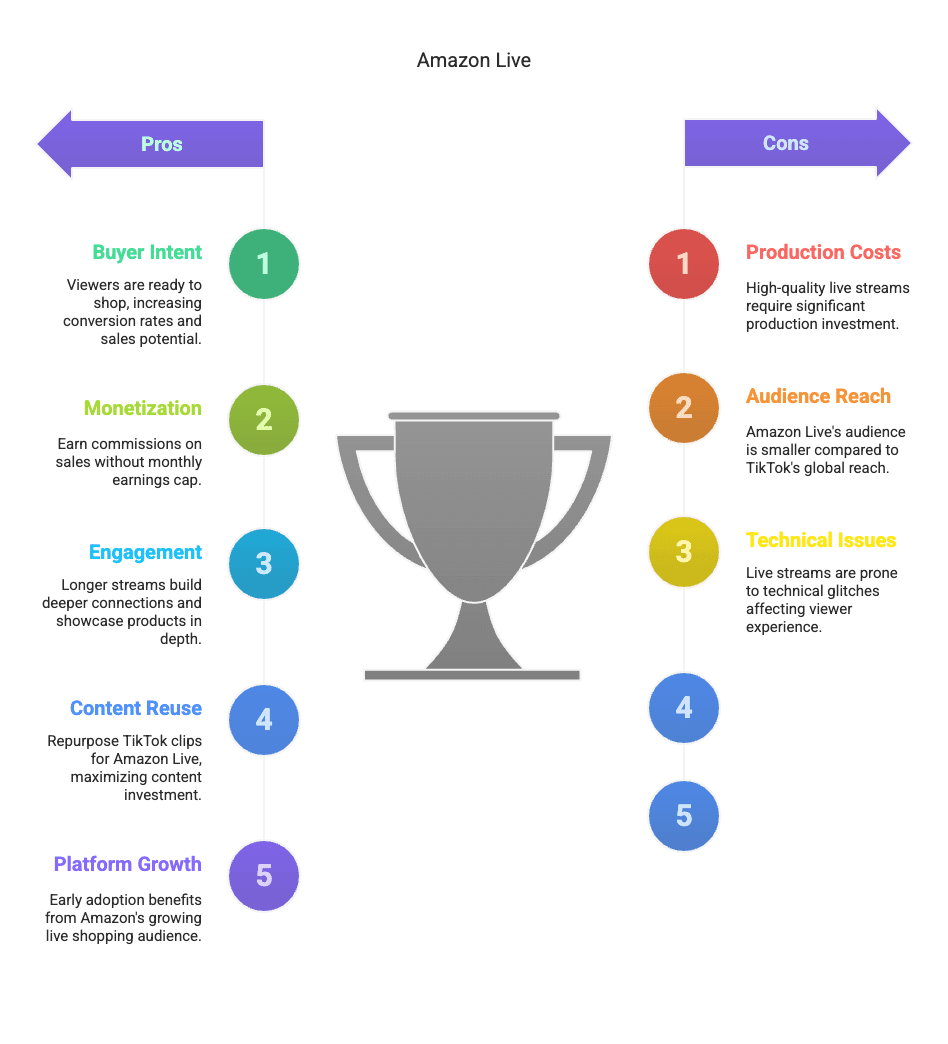
Amazon Live offers an interactive, shopping-focused video experience. The mobile interface (right) shows a live stream with chat and a product carousel, blending content and commerce. On Amazon Live, viewers aren’t just scrolling for fun – they’re often ready to shop, which creates a win-win scenario for creators and brands.
Consider the benefits of syndicating your TikTok videos to Amazon Live:
Unlike TikTok’s audience (seeking quick entertainment), Amazon Live viewers are on a shopping platform. They’re “already primed to purchase”, as Amazon is fundamentally a marketplace. Pitching products or ideas feels more natural, and conversions (sales) come more easily because the audience has higher intent from the start.
Amazon Live doesn’t pay per view – it allows creators (especially those in the Amazon Influencer Program or brand affiliates) to earn commissions on product sales generated through their stream. There’s no arbitrary monthly ceiling on earnings; the more your viewers buy, the more you make. Commissions vary by category (e.g. ~3-10% on most products), and there’s potential for sponsorships or flat fees from brands. This means a single successful stream can out-earn a capped TikTok month if it moves product.
TikTok might give you a few seconds or minutes of fame per viewer; Amazon Live can capture attention for 30, 45, or even 60 minutes straight. In fact, streaming at least 30 minutes is recommended to maximize reach on Amazon (longer streams tend to attract more viewers over time). This longer format lets you build a deeper connection, tell a story, answer questions, and really showcase products in depth – all of which can increase trust and likelihood of purchase.
By repurposing your existing TikTok clips, you double-dip on content investment. What was a 1-minute vertical video can become part of a 30-minute live show with minimal extra filming. You maintain TikTok’s high-energy highlights while expanding the content around it for Amazon’s audience.
Amazon is heavily investing in Live. In 2023, Amazon Live streams amassed over 1 billion views across the U.S. and India, and the feature is now even integrated into Prime Video for wider exposure. There’s a growing audience for live shopping content. Getting in now allows you to ride that wave early, gaining followers on a platform where competition (for now) is lighter than TikTok’s saturated feed.
In short, Amazon Live offers shopper-focused, longer-form video opportunities where your TikTok-born content can not only reach ready-to-buy viewers, but also potentially earn more per viewer through sales and brand deals. Now that we know why Amazon Live is worth your attention, let’s outline how to actually transform those 9:16 TikTok videos into an Amazon Live presentation that keeps viewers hooked.
Repurposing content isn’t just copy-paste – it’s about reformatting and reimagining your TikTok clips to fit a live, interactive setting. Below is a clear workflow to take your vertical TikTok videos (from the Creativity Program or otherwise) and turn them into engaging Amazon Live material, step by step.
Start by picking the TikTok videos that will translate well to a shopping or long-form context. Look for content that features products, tips, or demonstrations – for example, a quick gadget demo, a makeup tutorial, or a before-and-after using a product. These are gold for Amazon Live since they have an inherent product focus. Also consider TikToks that performed well (high views or engagement), as the hook clearly worked. Jot down 3-5 top clips to repurpose. Ensure you save the raw videos in high quality, preferably without the TikTok watermark (you can download your own content or use a tool to get a clean copy). High resolution is important because Amazon Live may be viewed on desktops and TVs, where 720p TikTok footage might look blurry. Essentially, do a quick content audit: which clips will my Amazon (likely shopping-minded) audience find valuable or entertaining?
Unlike a random TikTok feed, an Amazon Live stream should feel like a cohesive show. Plan a storyline or structure that strings your chosen clips together logically. For instance, if you have several TikToks reviewing different kitchen gadgets, your Amazon Live can be a “Kitchen Gadget Showcase”. Outline a flow: Intro → Clip 1 + discussion → Clip 2 + discussion → … → Q&A. Planning the narrative will help you maintain viewer interest throughout the stream. Remember, you’ll need to fill time between clips with context and engagement, so think about what you’ll say or do around each TikTok segment (e.g. explain features in more detail, compare with another product, answer a frequently asked question that came up in TikTok comments, etc.). Maintain TikTok’s excitement by scheduling your most eye-catching clip early on to hook viewers, but also create anticipation for later segments (tease a particularly funny or impressive clip coming up).
TikTok videos are vertical (9:16) and usually short; Amazon Live is typically viewed in horizontal (16:9), especially on desktops or TVs. Decide how you’ll present your TikTok clips on the live stream:
Now take those raw clips and tweak them for maximum engagement in a live context. What works on TikTok (often no intro, abrupt cuts) might need a bit of padding on Amazon. Some enhancement tips:
With content ready, it’s time to prepare the technical setup for the Amazon Live broadcast. You have two main options to go live:
Treat your upcoming Amazon Live like a mini TV show – a rehearsal can boost your confidence and iron out issues. Amazon provides a Practice Mode in the Live Creator app. Use it! Do a full run-through where you start streaming privately (no audience) and go through your content: play the videos, talk in between, switch scenes if using OBS, etc. Pay attention to timing – ensure you’re not rushing through clips (remember, we want to enhance watch-time, so it’s okay to slow down a bit and add commentary), but also don’t leave awkward dead air. Check audio levels (your voice vs. clip audio vs. any music). This rehearsal is also where you can decide little details like: Will you introduce a clip by saying “Here’s a TikTok I made on this product, let’s watch,” or will you play it without introduction for surprise factor? Perhaps test both approaches. Practicing will reveal any technical glitches (e.g., video stuttering, or your screen share not working) while no real viewers are watching, so you can fix them beforehand. As the Amazon Live guidelines say, fine-tune your performance to perfection in practice mode.
Showtime! When you hit that “Go Live” button for real, bring the energy of TikTok into a live format. Start with a bang – a great hook in the first 30 seconds is crucial to stop scrollers on Amazon’s live page. You could even start by briefly playing a flashy TikTok clip right after your intro to immediately captivate viewers. Throughout the stream, focus on engagement and watch-time:
After your live, take advantage of any metrics available. Amazon provides some analytics (view count, engagement, sales generated). See how long people watched on average, which parts had spikes or drop-offs (if you can scrub through the video and watch chat/reactions, you’ll get a feel – e.g., did viewers love the TikTok clip portions? Did you lose people during a slow explanation?). Use this info to refine your next cross-platform outing. Maybe you discover that a certain TikTok format (like a quick before/after transformation) kept people glued, so you’ll incorporate more of those next time. Also, now that your Amazon Live is recorded, you can repurpose it back to TikTok or YouTube by cutting highlights – the cycle of content never ends! This step closes the loop, ensuring you continuously improve engagement and watch-time with each iteration.
By following this workflow, you’ve essentially created a blueprint to upcycle your TikTok content for Amazon Live, extending its lifespan and revenue potential. But before we conclude, let’s go over some extra tips to make sure you retain that TikTok magic in the Amazon Live format.
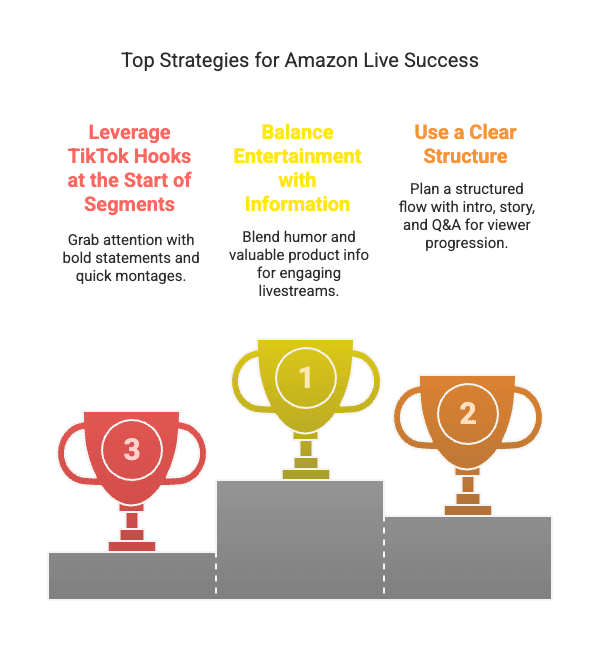
When merging two different video worlds, the trick is to get the best of both. Here are some best-practice tips for optimizing your Amazon Live stream while keeping the fun, fast-paced vibe of TikTok:
A successful Amazon Live should be as entertaining as it is informative. TikTok taught you how to entertain in seconds – bring that to the live show. Use humor, surprises (maybe a sudden TikTok meme reference), and your lively personality to keep things fun. At the same time, provide valuable info about the products (specs, how-to’s, personal experiences) so viewers feel it was worth watching for 30+ minutes. “Livestreams should be engaging and entertaining to keep the audience watching, and informative so viewers can learn about your product” – aim for that sweet spot of edutainment.
Don’t let your Amazon Live just meander. Plan a clear framework like an intro, a middle section (where you play clips and discuss), and a Q&A or recap towards the end. This gives viewers a sense of progression and payoff. As one guide suggests, outline a structured flow: introduce yourself/brand, showcase products (with those TikTok clips as highlights), summarize key benefits, then take questions. TikToks are bite-sized and random; an Amazon Live is more like a show episode – give it a beginning, middle, and end.
TikTok is the master of the hook – something attention-grabbing in the first 3 seconds. For Amazon Live, you have more leeway, but viewer attention is still precious. At the start of your stream and even at the start of new segments, use a TikTok-style hook. This could be a bold statement (“Watch me unbox this in 15 seconds flat!”), a question (“Can this $20 gadget really save me an hour a day? Let’s find out.”), or visually, playing a quick montage of upcoming clips. These hooks re-energize the audience periodically, much like commercial breaks on TV that pique interest for the next act.
TikTok is mostly a one-way street (aside from comments), but Amazon Live is interactive. Take advantage of that live engagement. Run quick polls or trivia related to your TikTok content (“You saw me make a smoothie in 30s – do you think it tasted good? Yes/No vote now!”). Encourage viewers to share their experiences (“Anyone here from TikTok? Shout out and let me know which video of mine you liked most!”). This keeps energy high and replicates the communal feel of a viral TikTok comment section, but in real-time.
TikTok’s fast pacing is what makes it addictive. While you can’t talk at 300 words per minute for an hour, you can avoid drawn-out monologues. Keep segments short and dynamic: maybe spend 5-7 minutes per product/clip before moving to the next to maintain momentum. When you notice attention might dip, it’s a great moment to roll the next TikTok clip as a “pattern interrupt” that resets viewer attention. That said, also include brief breathers – even a 10-second pause to sip water or adjust something while a clip plays is fine. It gives viewers a moment to absorb information and anticipate what’s next.
On TikTok, virality and likes are the “reward”. On Amazon Live, you can reward viewers in other ways. For example, exclusive promo codes or deals only for live viewers can create excitement (e.g., “Use code LIVE10 now for 10% off – only valid for the next 1 hour!”). This drives urgency and makes the live experience special. It’s akin to giving your Amazon audience the feeling of being “in on something,” much like TikTok viewers feel when they’re early to a trend.
Finally, channel the same charisma you bring to a 60-second TikTok, but sustain it. Smile, use hand gestures, be animated – it all translates through the screen. If you’re demonstrating a product live, maybe intentionally emulate the style of your TikTok videos (fast jump cuts – you can mimic this by quickly switching camera angles if possible, or just by the way you move and speak). Your enthusiasm is infectious. A viewer on Amazon Live will stick around if they feel “this is fun!” or “I like this host” in addition to “this product seems useful.” High energy doesn’t mean never slowing down – it means being passionate and present throughout. Even during slower explanatory parts, keep a conversational tone as if talking to a friend, and occasionally amp up the excitement when something cool happens (unboxing moment, surprising result, etc.).
By following these tips, you ensure that the essence of your TikTok content – the creativity, the pace, the personality – carries over to your Amazon Live show. The result is the best of both worlds: an informative shopping livestream that’s as engaging as a TikTok feed.
In the evolving landscape of content creation, being agile and cross-platform is key. TikTok’s capped Creativity Program payouts may feel like a setback, but by repurposing your TikTok clips for Amazon Live, you can turn that hurdle into an opportunity. You’ve already done the hard part – creating compelling content that grabs attention. Now, with a bit of editing and strategic planning, you can give that content a second life in a format that drives product sales and longer-term engagement.
Amazon Live offers a new stage for your creativity: one with eager shoppers, longer watch-times, and different monetization mechanics. As we’ve detailed, the transition from vertical, bite-sized TikTok videos to an interactive live stream is totally achievable – and can be incredibly rewarding. Many content creators are discovering that a cross-platform video strategy not only diversifies their income but also expands their brand and reach. Your TikTok followers get to see a new side of you on Amazon Live (more in-depth, more interactive), and Amazon’s audience gets a taste of that TikTok energy and authenticity that traditional infomercials lack.
So, if TikTok’s payout cap has you feeling the pinch, don’t despair – recycle and redeploy your content in clever ways. Follow the workflow and tips outlined above, and you’ll be on your way to turning short-form videos into long-form successes. In a creator’s journey, adaptability is everything. By embracing a cross-platform video strategy, you ensure that no great piece of content (or monetization opportunity) ever goes to waste.
Ready to give it a try? Your next Amazon Live stream could be the moment a TikTok clip of yours not only entertains, but also earns you a flurry of product sales and new fans. Lights, camera, action – time to go live, and bring the TikTok spark with you!
Instagram has officially joined the repost bandwagon – and influencers and marketers have reason to take note. In 2026, the platform rolled out a new “Re-Posts” feature that lets users share someone else’s post or Reel directly to their followers’ main feeds (not just to Stories, which vanish after 24 hours). In other words, much like a retweet on Twitter or a repost on TikTok, you can now amplify content on Instagram beyond the original creator’s audience. This casual yet game-changing update could reshape how content spreads on IG, offering creators a fresh way to boost visibility and engagement on the platform.
Instagram Re-Posts allow you to re-share another user’s feed post or Reel so that it appears in your followers’ feeds, as if it were a regular post on your profile. When you tap the new repost icon (♻️) beneath a post, you can add your own caption or thoughts, then share it – your followers may then see that repost in their feed. Importantly, reposted content isn’t treated as a brand-new post of yours; instead, it credits and links back to the original creator, with all likes, comments, and views counting toward the original post’s stats. The repost will also show up in a dedicated “Reposts” tab on your profile, separate from your original grid, so visitors can see everything you’ve reshared.
This is a notable shift in Instagram’s sharing capabilities. Previously, the only way to share someone else’s content in-app was to add it to your Story (ephemeral) or to DM it privately. Now, with feed reposts, Instagram is essentially saying: “Go ahead and share posts you love with all your followers.” According to Instagram’s updated Help Center, “when you repost, your followers may see that you reposted in their feeds”, highlighting the potential for greater feed exposure. Unlike Stories (which disappear) or the Remix feature (which involves creating new content alongside someone else’s video), reposts are straightforward sharing – no editing or time-limit attached.
Reposting content in social media isn’t a new concept – Twitter’s retweet has been around for over a decade, and TikTok introduced its own “Repost” button in recent years. Instagram even experimented with a repost feature back in 2022, including a separate Reposts tab on profiles. That test didn’t fully launch at the time, possibly because Instagram was unsure how reposts would mix with its highly-curated aesthetic feed. So, why bring it to everyone’s feeds in 2026?
Several trends converged to make reposts more appealing now:
In short, Instagram is embracing reposts now because the platform’s culture and algorithm have evolved. The focus is no longer strictly on original photos in a curated grid; it’s on keeping users engaged with interesting content, no matter where it comes from. Reposts make it easier for great content to spread, while keeping Instagram on par with the sharing behaviors users enjoy elsewhere.
From an influencer marketing perspective, the biggest appeal of the Re-Posts feature is the amplified reach it promises. When someone with their own follower base reposts your content, that post instantly gains exposure to an entirely new audience. Essentially, reposting creates a network effect: instead of a post living only within the bubble of one account’s followers, it can hop across networks and be seen by many more people.
To visualize this, imagine two circles representing the follower groups of two different users (Influencer A and Influencer B). Influencer A posts a great piece of content. Previously, only A’s followers would see it in their feed. Now, if Influencer B reposts it, B’s followers can see that content too – significantly expanding its audience. The Venn diagram below illustrates this concept: the blue circle is the original audience reached, the green circle is the reposter’s audience, and the overlapping section are followers who follow both (who would have seen it regardless). The new portion of the green circle (right side) represents fresh eyes brought in by the repost, beyond the original reach.
(image) Illustration: Reposting allows content to travel beyond the original poster’s follower circle. In this Venn diagram, the blue area represents the original creator’s followers who saw the post, and the green area represents the reposter’s followers. The overlapping region shows shared followers, while the green-only region on the right highlights the new audience gained via the repost. By tapping into another user’s follower base, a repost can introduce your content to viewers who wouldn’t see it otherwise, thus amplifying its reach.
How much extra reach can a repost generate? That will vary based on the size of the reposter’s following and how the algorithm treats reposted content. Instagram hasn’t published exact numbers on how it will boost reposts in feeds, but it confirms that followers “may see” reposts (i.e. they’re eligible to appear). If the reposter has a similar or larger following than the original account, the potential reach can double or triple the audience of that post, especially if there isn’t a huge overlap in followers. Even with some overlapping followers, you’re still netting a significant chunk of new viewers.
We can model a hypothetical scenario to illustrate the impact. Let’s say Influencer A normally reaches about 20,000 people with a post on their own. If a peer (Influencer B) with a comparable follower count reposts it, that post could now reach an estimated 35,000+ people in total (accounting for A’s followers plus B’s, minus a bit for overlap). That’s a ~75% increase in eyeballs on the content, just from one repost! In the chart below, you can see the difference in potential reach between a standard post and one that gets reposted by another account:
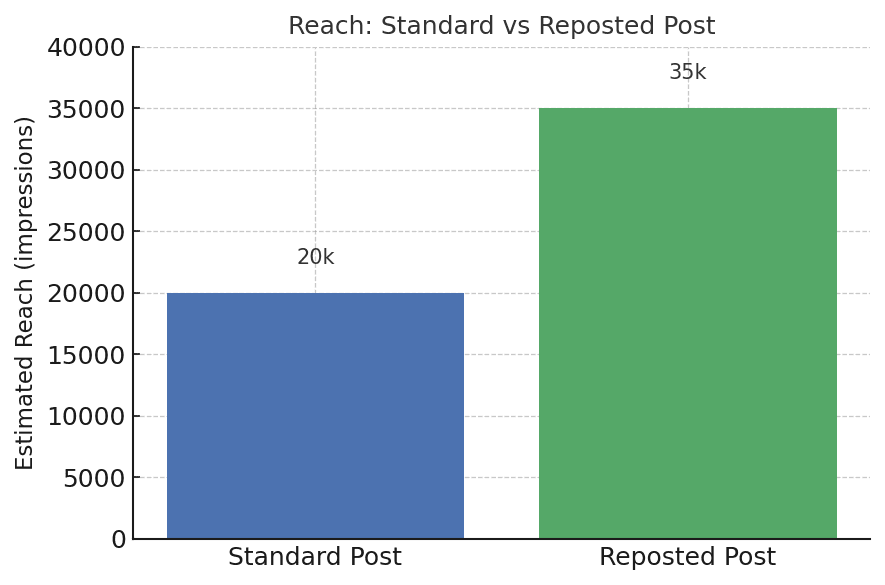
Hypothetical reach comparison of a post on Instagram: A standard post (blue) might reach ~20k impressions on the original account alone, whereas the same post with a repost (green) could reach ~35k impressions (original + reposting account’s audiences). This simplified example shows how reposting can significantly boost the number of people who see a piece of content. Actual results will vary, but the opportunity for a sizable reach uptick is clearly there.
More eyes on a post often translate to more likes, comments, and shares – in short, higher engagement. Since a repost surfaces content to new viewers who might find it fresh or exciting, it can spark additional interaction that the original post might not have gotten on its own. Continuing our example: if 20k impressions yielded about 1,000 likes on the original post, the increased 35k impressions might net around 1,700 likes (assuming a similar engagement rate). The next chart illustrates this potential boost in engagement:

Hypothetical engagement (likes) comparison: The original post (blue) received ~1,000 likes from its initial audience. After being reposted (green) and reaching a larger audience, the total likes could grow to ~1,700. Reposting introduces content to new viewers who can engage with it – and all that engagement (likes, comments) still accrues on the original post itself. Essentially, reposts can supercharge your content’s performance by leveraging someone else’s audience interest.
It’s worth noting that all engagement on a repost benefits the original creator. Instagram’s system ensures the original post is the one that gets the likes and comments, even though it’s appearing via someone else’s share. For influencers, this means if your post is reposted by others, you reap the rewards of the increased reach – your like count goes up, your comment section grows, and potentially your follower count can rise as new people discover and follow you. On the flip side, if you’re the one doing the reposting, you’re mainly acting as a curator/distributor; you might not get new likes for yourself from that repost (since the likes go to original post), but you could still benefit through increased goodwill, networking, or being seen as a source of good content by your followers. We’ll discuss more on strategy shortly.
In essence, reposts have the power to make content go “viral” within Instagram in a way that wasn’t previously possible on the platform’s feed. Just as retweets can multiply a tweet’s impressions exponentially on Twitter, a few well-placed reposts on IG (imagine a chain reaction where multiple large accounts repost the same content) could dramatically amplify a post’s reach and impact.
If you’re an influencer or marketer, you’ll want to approach the Re-Posts feature strategically. Here are some tips on how to best use reposts to grow your brand and community on Instagram:
By following these practices, influencers and brands can integrate reposts in a way that amplifies growth rather than detracts from their feed. When done right, reposting is a win-win-win: great content gets more exposure, the original creator gets more engagement, and you (the reposter) keep your audience entertained and informed, boosting your credibility as a go-to source of interesting content.
Like any new feature, Instagram’s Reposts come with advantages and potential drawbacks. These can differ for influencers vs. brands. Here’s a breakdown of pros and cons from each perspective:
In summary, the pros largely center around greater reach, community engagement, and easy content sharing, while the cons involve control, originality, and potential audience irritation. Both influencers and brands should weigh these factors when incorporating reposts into their strategy.
It’s helpful to see how Instagram’s repost feature stacks up against similar functions on other platforms:
Appears directly in followers’ feeds, marked with the original creator’s handle (e.g., “Reposted from @original”). Reposts show on the reposter’s profile in a separate tab. All likes/comments accumulate on the original post. Essentially a feed share of someone else’s content with an optional caption. Instagram’s goal is to boost in-app content circulation while maintaining credit to the creator.
When you repost a TikTok video, it shares that video to your friends’ For You feeds, labeled as reposted by you. However, TikTok’s reposts do not show up on your own profile – it’s more of a recommendation to your followers’ feeds. It’s a lighter-weight share; the video looks like any other on the FYP but has a small label (“Reposted by @username”). Engagement from repost views still goes to the original video. TikTok introduced this to amplify content discovery among friends, but it’s somewhat hidden (your profile doesn’t list what you reposted).
A retweet immediately shares the tweet to all your followers’ timelines, often preceded by a note like “User retweeted”. Retweets can be done with no comment (a straight repost) or with a quote. Retweeted content on X retains the original author’s metrics (likes, etc.), but the retweet itself can be liked or un-retweeted as an action. On your Twitter profile, there isn’t a separate tab, but retweets will appear in your timeline alongside your tweets, marked with the retweet icon. The retweet is the oldest of these features and has proven to be a powerful tool for virality – it’s common for a single tweet to spread through retweets to millions of users, far beyond the original follower count (Instagram will begin testing a new repost feature with select users soon | TechCrunch)】.
In essence, Instagram’s repost is most similar to Twitter’s retweet in that it displays the content in your followers’ main feed and on your profile (with attribution). TikTok’s version is a bit more ephemeral (not on profile) and focused on friend networks. All three aim to encourage users to share content they enjoy with their followers, fueling discovery and engagement. Instagram arriving late to the party means they’ve had a chance to see what works elsewhere – they chose a model that emphasizes credit to creators (much like Twitter) and persistent visibility on profiles.
Instagram’s new Re-Posts feature is a significant shift in how content can travel on the platform. For influencers and marketers, it opens up exciting opportunities to boost reach, collaborate, and build community in ways that weren’t as straightforward before. A funny meme or a powerful testimonial can now be passed along from one account to many others with a simple tap, potentially snowballing into a viral moment within Instagram’s ecosystem.
That said, with great power comes great responsibility – savvy users will need to repost judiciously, keeping their personal or brand voice intact and their audience’s experience front-of-mind. Will reposts lead to an explosion of engagement and a more interconnected creator community? Very likely, yes. But it could also test how much users tolerate seeing the same content multiple times in their feed. As this feature rolls out (not everyone has it immediately, as Instagram is gradually introducing it), we’ll see its full impact on user behavior and content strategy unfold.
One thing is clear: in 2026, content amplification is king. Instagram’s reposts, much like TikTok’s shares and Twitter’s retweets, underscore a broader social media trend – the platforms that thrive are those that make it easiest for users to circulate content they love. For influencers and brands, the takeaway is simple: create content worth sharing, and make smart use of these sharing features. If you do, your message can reach corners of the internet you never imagined, all while fostering a network of engaged supporters. Happy reposting, and may your content reach new heights!