
The latest info on influencer marketing trends, micro influencer news, and the world of social media

In the digital world of 2026, “content creator” and “influencer” are more than buzzwords – they’re distinct roles in a booming creator economy. Yet, the line between them often blurs. Creators and influencers drive trends on TikTok, Instagram, YouTube, and beyond, while brands (from indie e-commerce startups to Amazon sellers) tap into their power for marketing. So, what is the difference between a content creator and an influencer in 2026? Let’s break it down in a casual, no-nonsense way, backed by the latest trends, examples, and a few eye-opening stats.
Content creators and influencers in 2026 navigate a landscape bursting with creativity, technology, and monetization opportunities. Platforms have evolved into ecosystems where success is measured in clicks, engagement, and community growth – symbolized by the mix of video reels, music notes, and even currency icons in the graphic above. Both creators and influencers must blend authentic creativity with strategy to stand out. The modern creator’s toolkit spans content production, social media savvy, and business acumen, reflecting the fusion of art and entrepreneurship in today’s creator economy.
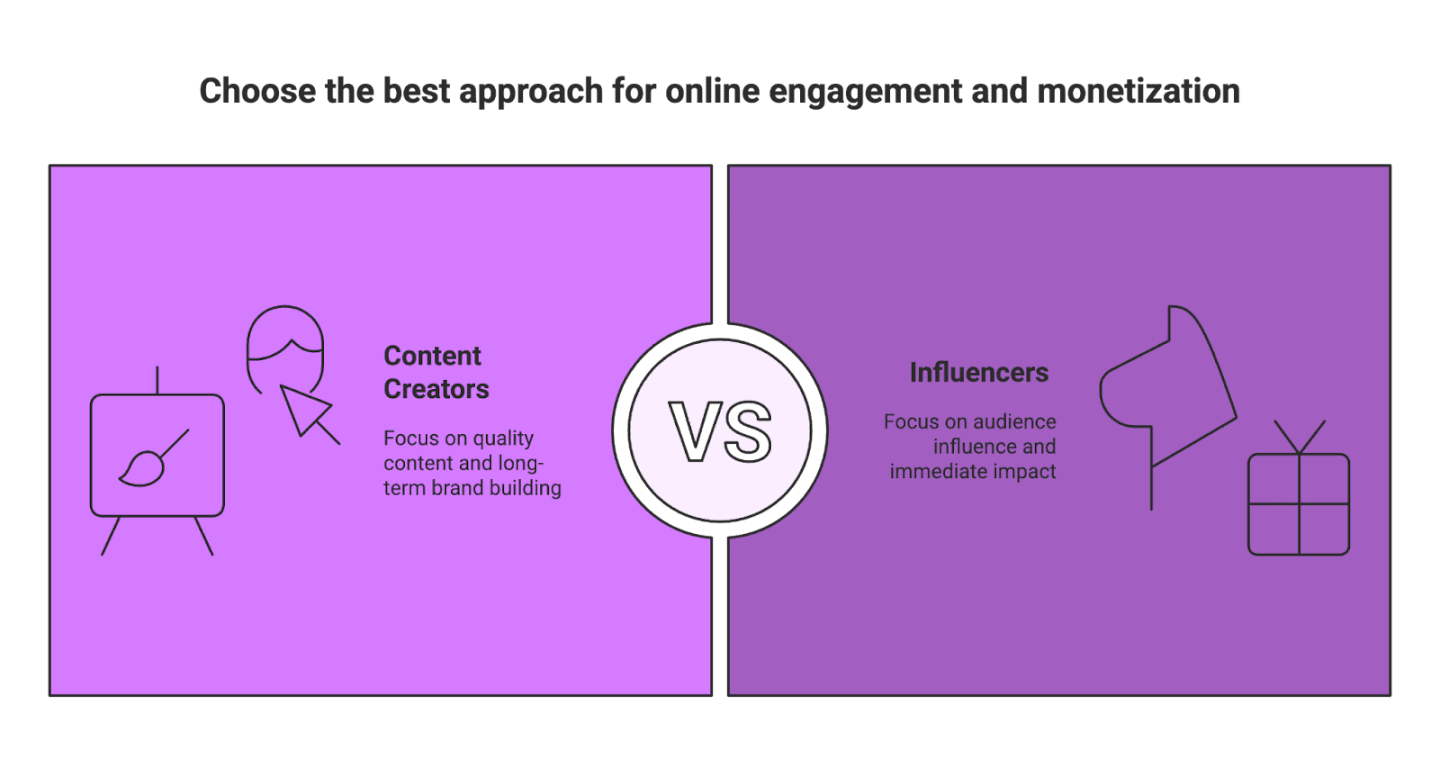
At first glance, content creators and influencers do similar things – they post content online and have followers. But their core focus and approach differ:
In simpler terms: Creators are focused on making content (and often consider themselves storytellers or educators first), while influencers are focused on impacting their audience (and are often seen as trendsetters or tastemakers). Creators tend to talk about the craft of content – camera angles, editing, storytelling – whereas influencers talk about community and collaboration – what their followers want, which brands they love, and so on.
It’s worth noting that by 2026 these roles overlap more than ever. Many individuals are both creators and influencers. For example, a YouTube tech reviewer might see themselves as a content creator (making high-quality review videos), and they’re clearly an influencer if their audience buys products based on their reviews. The ad industry has started to differentiate the terms more carefully: some experts describe creators as more premium content-makers and influencers as more of the broad audience-reachers.
Bottom line: While the terms often get used interchangeably, in 2026 a content creator is seen as someone focused on content creation as a craft or business, and an influencer is someone focused on influence as a skill – engaging an audience and monetizing that attention. As one interview put it, the terminology isn’t as important as finding people who fit your strategy: “Worry less about what you call them and more about what they do well, their engagement, and how they fit your brand’s goals,” i.e., whether macro or micro, creator or influencer, the right partner brings value.
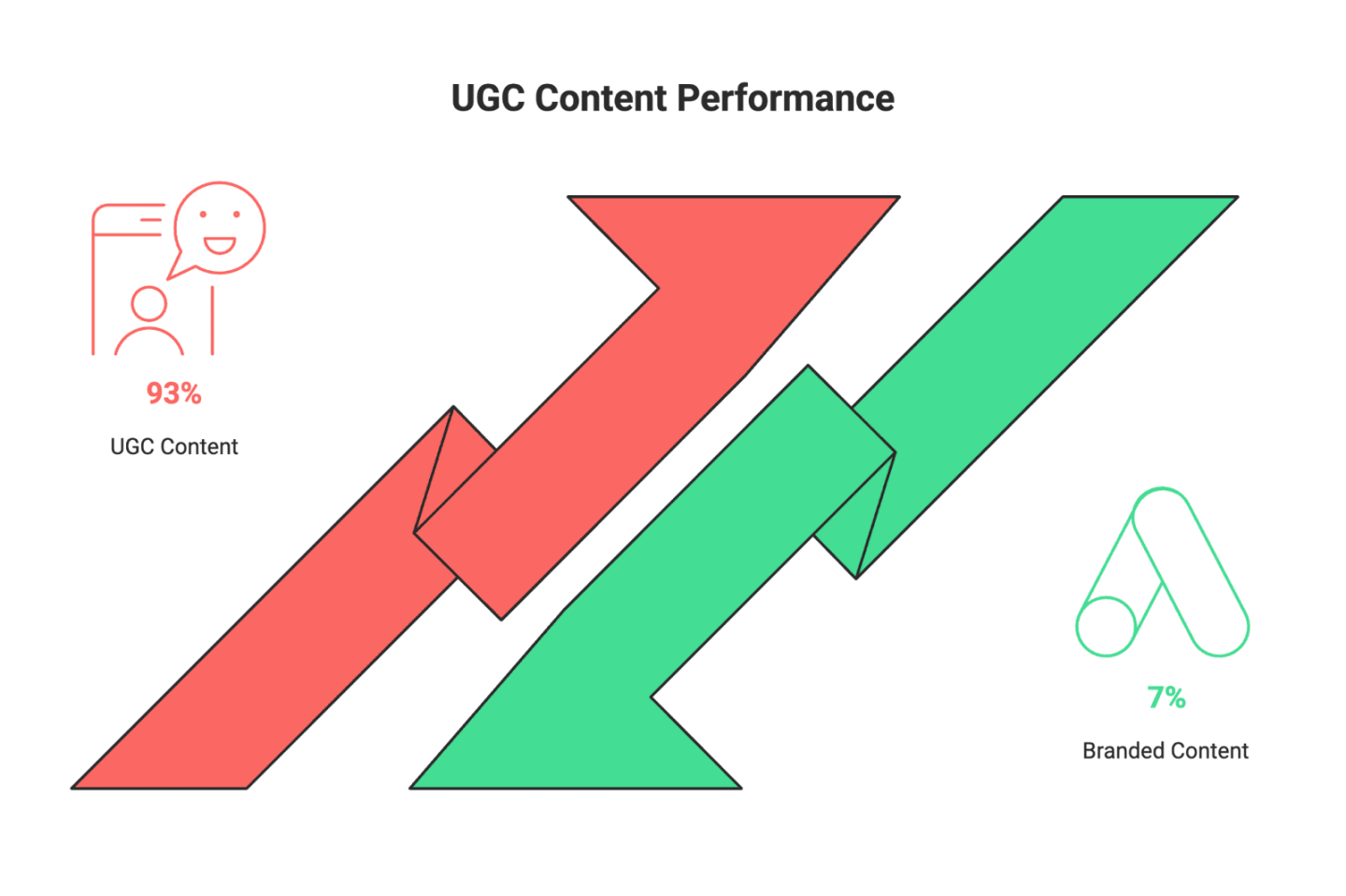
The creator/influencer ecosystem in 2026 is massive – and still growing fast. Let’s look at some eye-opening numbers and trends shaping this landscape:
In summary, the creator economy in 2026 is maturing: more money, more creators/influencers, and more professionalization. Both creators and influencers who thrive now treat their online presence like a business – analyzing what content works, collaborating with others, diversifying income (sponsored deals, ad revenue, merch, etc.), and leveraging multiple platforms. And as we’ll see next, micro influencers are becoming the real MVPs for many brands navigating this crowded landscape.
Let’s take a quick tour of how creators vs. influencers might operate on some major platforms, with 2026 trends in mind:
TL;DR: Different platforms reward different styles, but across TikTok, IG, YouTube, etc., content creators emphasize the content format and quality suited to that platform, while influencers emphasize the relationship with the audience. In 2026, the best personalities online are usually wearing both hats – they craft engaging content and have a distinct voice that influences their followers. Brands will choose collaboration platforms based on goals: TikTok for quick awareness (often via micro influencers riding trends), Instagram for aspirational lifestyle and e-commerce features, YouTube for in-depth storytelling and product education, and so on.
One of the biggest shifts in recent years is the spotlight on micro influencers – those with relatively smaller followings (often defined as anywhere from ~3,000 up to 50,000 or 100,000 followers). In 2026, micro influencers (and their even smaller cousins, nano influencers with <10k followers) are extremely valuable, especially for e-commerce brands and Amazon sellers. Here’s why:
1. Lower costs: Campaigns with micros can start at a few hundred dollars or just free product (versus multi-thousands for a big name).
2. Higher engagement: Smaller followings = closer relationships = more likes, comments, and trust per follower.
3. Authenticity: Posts often feel like a friend’s recommendation. Micro influencers seamlessly integrate products into everyday life.
4. Flexibility: Micros are more open to creative deals – affiliate links, longer-term partnerships, or trying your product without strict contracts.
5. Virality potential: One micro influencer can still create a viral moment. If their content strikes a chord, follower count matters little – it can blow up (especially on TikTok).
6. Niche communities: You can target very specific audiences (e.g., a micro influencer who focuses on keto recipes for moms will have followers extremely interested in that niche). Relevance often beats sheer reach for conversion rates.
Because of these benefits, brands in 2026 are allocating more budget to micro influencer campaigns. There are even instances of companies foregoing a single big influencer entirely, instead running continuous micro-influencer programs. The strategy might look like: send 100 micro influencers your product, get 100 pieces of authentic content and reach into 100 micro-communities. The aggregate reach could be, say, 5 million people, often at a fraction of the cost of one big celeb who might have the same 5 million reach but far less engagement.
Important: Managing many micros can be a headache – coordinating communication, tracking posts, ensuring they actually deliver content, etc. That’s why services (like Stack Influence mentioned above, or others) have come in to automate the process, from discovery (finding the right creators) to communication and tracking. An example shared on a forum: a small brand used a platform to run a campaign with 50 micro influencers on Instagram and saw not only a spike in sales, but tons of repostable content for their own page and ads. Essentially, micro influencers double as a content creation army plus a salesforce for your brand.
For e-commerce sellers (whether on Amazon, Shopify, Etsy, etc.), micro influencers are a sweet spot: they drive authentic word-of-mouth and often yield better ROI than traditional ads. Just ensure you pick influencers whose audience aligns with your target market (pro tip: always check an influencer’s comments and followers quality, not just the follower count). And nurture those relationships – a happy micro influencer who truly likes your product might become an ongoing ambassador.
By 2026, the lines between creator and influencer have both blurred and sharpened. They’ve blurred in the sense that many individuals are hybrid content creator-influencers, wearing multiple hats. But they’ve sharpened in how we understand the roles: content creators are the new creative entrepreneurs, focused on crafting content and building their own brand; influencers are the savvy tastemakers, focused on leveraging their personality and community to drive action. Both are essential in the modern marketing mix, and both operate in a creator economy that is bigger, more professional, and more inclusive than ever.
For marketers and brands, the takeaway is clear: know your goals and choose your partnerships wisely. If you want beautiful, original content to build awareness, work with creators who love their craft. If you want instant reach or sales, tap into influencers who know how to engage their followers. In many cases, you’ll find people who do both. And don’t underestimate the micro influencers – in 2026, sometimes a bunch of passionate advocates can move the needle more than a single big name.
The social media landscape is shifting fast. New platforms are popping up seemingly overnight, and they’re changing where and how content creators, micro influencers, and brands connect with audiences. In the aftermath of Twitter’s transformation into X and other big-platform drama, users have been flocking to fresh alternatives like Threads, Bluesky, Mastodon, Lemon8, and Spill. For content creators, ecommerce entrepreneurs, and Amazon sellers, these rising networks present exciting new opportunities – if you know how to navigate them.
In this post, we’ll explore Threads, Bluesky, and a handful of other up-and-coming social platforms that influencers and brands should keep on their radar. We’ll dive into what makes each unique, how they’re relevant for influencer marketing and brand partnerships, and the benefits and challenges of getting in early. You’ll also find practical tips for micro influencers and ecommerce brands (yes, Amazon sellers, we mean you!) on testing and growing your presence on these new channels.
Let’s get started with a quick overview of the new platforms making waves in 2024–2025, and why they matter for influencer marketing.
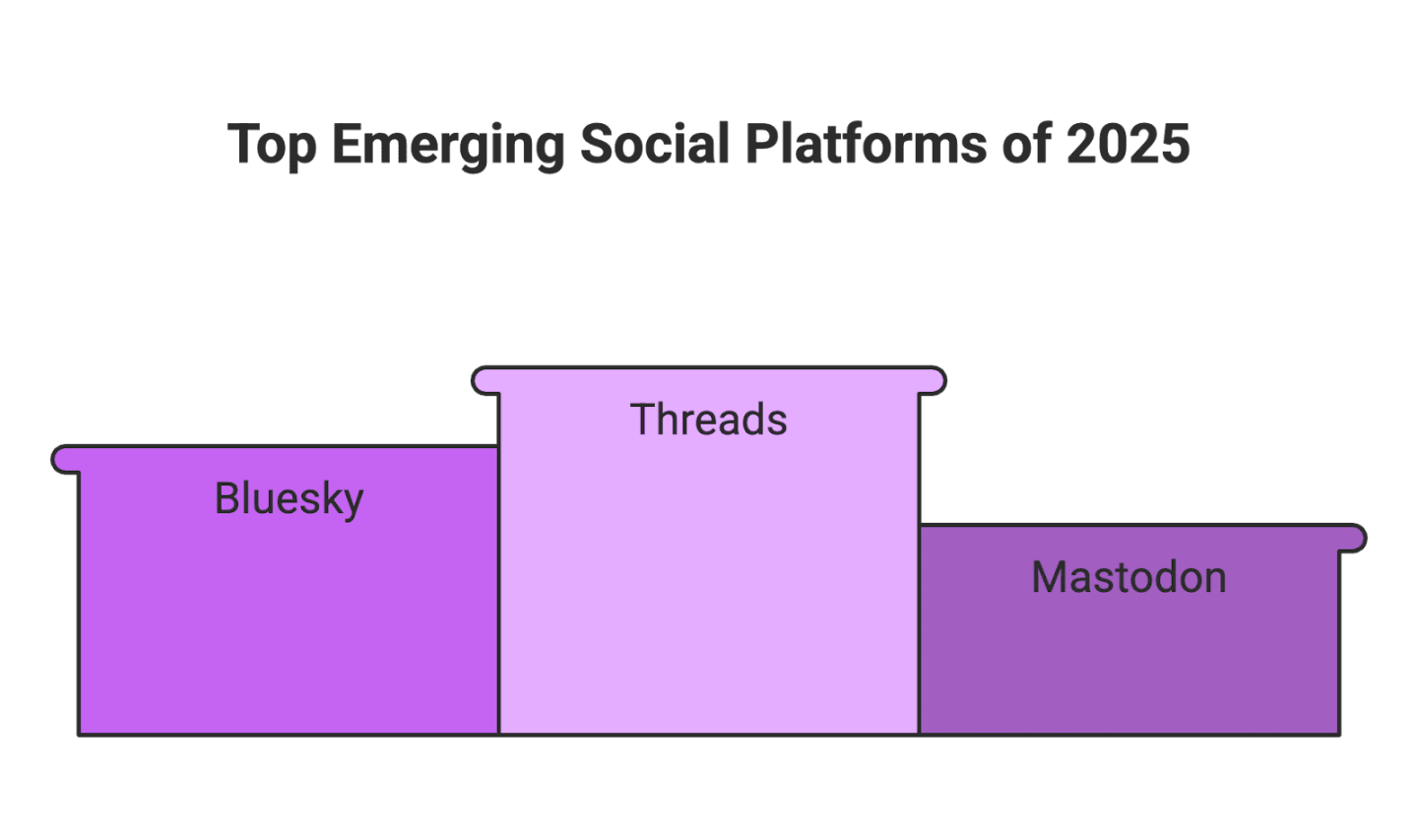
Emerging social platforms are capturing users’ attention – and in some cases, millions of users – by offering new experiences or filling gaps left by older networks. Here are five rising platforms every content creator and brand marketer should be watching, each with its own flavor and community:
Each of these platforms comes with distinct features and audiences. The table below compares some key characteristics at a glance:
As you can see, each platform offers something a little different – from Threads’ built-in Instagram integration to Spill’s community-first approach. One major difference is scale. Some of these networks already have substantial user bases, while others are still very niche.
Estimated user base (in millions) of emerging social platforms as of early 2025. Threads (launched mid-2023) quickly dwarfed others with around 275M users, whereas Bluesky surpassed 30M after a surge of growth in late 2024. Mastodon and Spill remain smaller niche communities (roughly 1–2M actives each), and Lemon8 has garnered tens of millions of downloads globally.
Despite varying sizes, what they all have in common is potential. These platforms are new enough that influencers and brands can still establish an early presence and organic reach before the crowds (and algorithms) catch up. Let’s take a closer look at each and why it matters for influencer marketing.
What It Is: Threads is Meta’s answer to Twitter, a text-focused social app launched in July 2023 and linked to your Instagram account. It gained over 30 million users on its first day and skyrocketed to 275 million monthly users in a year, thanks to easy signup via Instagram. Threads emphasizes friendly, conversation-driven posts over the snark and controversy often seen on Twitter. Think of it as the group chat vibe, but on a social scale.
Influencer Marketing Relevance: With its huge early adoption, Threads became a “shiny new object” for influencer marketing. Brands and creators jumped in quickly – within 48 hours of launch, influencers were already posting sponsored content (even Hulu ran a promo with a creator on Threads). For content creators, Threads offers a more casual way to engage followers with text and quick updates, while still allowing images, videos, and links. In fact, during the first post-launch Prime Day, one creator shared an Amazon affiliate link on Threads and found it more seamless than on Instagram stories – a promising sign for e-commerce promotions.
Meta is keen to make Threads brand and advertising-friendly, leveraging its Instagram know-how. Within a week of launch they were already exploring branded content tools. While features like hashtags and robust search were missing initially, Threads has rolled out updates (chronological feeds, topic feeds, etc.) to improve discovery. The vibe on Threads is relatively positive and brand-safe – even Mark Zuckerberg noted the goal is to keep it “friendly” as it grows, a subtle contrast to Twitter’s anything-goes approach. For micro influencers, this platform is a chance to engage audiences with authentic storytelling and conversation rather than highly produced content. If you’re already big on Instagram, Threads lets you carry over that follower base easily, giving you a head start in building an audience.
Early Challenges: As an early-stage platform, Threads had limited analytics and no advertising out of the gate. Some creators have been cautious not to overwhelm Threads with ads to avoid alienating users who see it as a fresh start. Additionally, user retention dipped after the initial rush – so the community is still finding its footing. But with Meta’s resources and integration with Instagram, Threads is likely here to stay and develop more robust tools for creators and brands. If you thrive on text or have a thought-leadership angle, Threads is a playground to test content that might not fit the polished Instagram grid.
What It Is: Bluesky is a decentralized social app that grew out of an initiative by Twitter’s co-founder Jack Dorsey. Launched in invitation-only beta in late 2022 and opening up more broadly in 2024, Bluesky looks and feels a lot like classic Twitter – short posts, reposts, and replies – but under the hood it runs on the open AT Protocol with user-run servers (much like email or Mastodon). For users, the draw is a familiar microblogging experience without the baggage of Twitter/X. Growth was steady at first, then exploded in late 2024 when major events drove people to seek alternatives. Notably, when Brazil banned Elon Musk’s X in fall 2024, millions of Brazilian users flocked to Bluesky within days. By January 2025, Bluesky had topped 27 million users, and over 33 million by Q1 2025. That’s still tiny compared to Twitter or TikTok, but the trajectory has everyone watching.
Influencer Marketing Relevance: For influencers, Bluesky’s appeal is clear: it’s a chance to get in on the ground floor of a network that could be “the next Twitter.” Many influencers missed the early Twitter days when gaining followers was easy – Bluesky offers a do-over. About 50% of Bluesky users have 1 or 0 followers (essentially half the user base is not yet connected), which underscores how early we are. This lack of saturation means a micro influencer who joins now and brings even a small fanbase could instantly become a top voice on the platform. In other words, early mover advantage is huge. You’re not competing against millions of established creators or fighting a ruthless algorithm. Bluesky’s feed is chronological and currently has no ads at all. Your posts aren’t getting sandwiched between sponsored content, which can lead to higher visibility and engagement for everything you share. For brands, the no-ads policy means the only way to do promotions on Bluesky is through influencer partnerships and organic engagement. There’s no paid media shortcut – which actually elevates the role of creators. Early adopter brands are already quietly scouting Bluesky for influential voices.
The community vibe on Bluesky is one of authenticity and casual interaction. Without heavy algorithmic feeds, content doesn’t “go viral” in the same way, but it reaches followers more consistently. Influencers on Bluesky often note the genuine conversations and sense of community – it “feels more like friends chatting than performing for an audience.” Engagement per user is promising (users spend 10+ minutes per session on average), and features like DMs have been added to facilitate connection. From a brand partnership perspective, any sponsored content on Bluesky tends to stand out because there aren’t many ads. Done right, it can come off as a natural part of community discussion rather than an intrusion. For example, an influencer might host a Bluesky-exclusive giveaway or Q&A with a brand – these creative collabs can thrive in the current environment.
Early Challenges: Bluesky is still technically in beta and requires an invite (as of early 2025), which limits its spread. The user base skews tech-heavy and U.S./Brazil-centric for now, so reaching a broad demographic may be tricky until it opens up further. There’s also no built-in analytics or creator tools yet. And like any decentralized network, moderation and community standards are evolving (each server can set its own rules). But if you’re an influencer or brand who likes to experiment, Bluesky is a prime candidate – it’s growing fast, and those who establish a presence now could become the go-to voices on the platform later. Just be ready to play the long game and adapt as Bluesky’s features and norms develop.
What It Is: Mastodon isn’t brand new (launched in 2016), but it surged into prominence in late 2022 and 2023 as a Twitter alternative. It’s an open-source, decentralized social network made up of thousands of independent servers (instances) that talk to each other. Users join a specific server – often themed by interest or region – but can follow and interact across the “fediverse” of all servers. The experience is similar to Twitter (short text posts, boosts, replies) but without a central algorithm or company in control. Mastodon is entirely chronological and ad-free, and many servers are run by volunteer admins or nonprofits. After Twitter’s upheavals, Mastodon’s user numbers spiked: it went from a niche community to over 2.5 million monthly active users at its peak in late 2022, then leveled off to around 1–1.5 million active users in 2023–2024 (and over 10 million accounts created in total). While growth has slowed, Mastodon has a dedicated base that continues to grow gradually as people seek non-corporate social spaces.
Influencer Marketing Relevance: Mastodon’s decentralized nature means there’s no built-in influencer marketplace or ads, and many of its communities are somewhat averse to overt commercialism. So, does it matter for influencer marketing? The answer is nuanced. If your brand or content aligns with the ethos of a particular Mastodon community, you can gain a loyal following and high engagement. For example, tech bloggers, open-source advocates, artists, and journalists have found strong niches on Mastodon. Because users choose servers based on interests (like photography, gaming, or local city communities), micro influencers who are genuinely part of those communities can thrive by sharing content that resonates. The absence of ads means users’ “BS radar” is set to high – authenticity is paramount. A blatant product plug might fall flat, but a thoughtful discussion or a review by a respected community member can carry real weight.
For brands, Mastodon isn’t the place for splashy campaigns, but it can be used for community building and PR. Organizations from nonprofits to tech companies maintain Mastodon accounts to share updates with an audience that might not be on Twitter. If you identify micro influencers on Mastodon who love your product niche (say, a popular Mastodon photographer using your camera gear), forming a genuine relationship with them can lead to organic advocacy. User-Generated Content (UGC) is powerful here – for instance, an Amazon seller of a board game might engage with a Mastodon board gaming community by sending samples to a few enthusiasts who then post about their honest experience (not as a paid ad, but as content). Such grassroots influencer marketing can build trust among a tight-knit group.
Early Challenges: Mastodon is not “plug-and-play” for marketing. You’ll need to invest time to understand each community’s norms. Metrics are decentralized (no universal follower count or easy way to measure impressions across the fediverse). Also, content doesn’t go viral in the traditional sense, since there’s no central algorithm amplifying it – growth is more slow and steady via word of mouth. For micro influencers, one challenge is that each Mastodon server is like its own island. Your follower growth might be limited by your server’s size and the interests of the fediverse. But that’s also a benefit: it’s about depth of engagement, not breadth. If you’re an influencer known for expertise or a brand championing authenticity and community values, Mastodon could be a rewarding space to nurture an audience, even if it’s smaller. Just remember to approach with genuine participation – this is a space that rewards passion and punishes phony promotion.
What It Is: Lemon8 is a newer app from ByteDance (the creators of TikTok) that quietly launched in 2023. Think of Lemon8 as a mashup of Instagram’s glossy imagery and Pinterest’s discovery boards, with a dash of blog-like depth. The app focuses on highly curated, aesthetically pleasing content – users post photo carousels or short videos accompanied by long-form captions (almost mini blog posts). Popular topics include fashion, beauty, travel, food, and DIY – all presented in a very “Pinteresty” layout. ByteDance designed Lemon8 to encourage slower, deeper engagement: it’s not about quick TikTok-style swipes, but rather scrolling through a feed of visually rich posts and maybe even reading the captions. By encouraging longer captions and story-like content, Lemon8 gets users to stay and linger on content longer than the frenetic TikTok pace.
Importantly, Lemon8 is built with shopping and influencer collabs in mind from the get-go. It calls itself a “lifestyle community,” which is often code for “aspirational content that can sell products.” In fact, ByteDance has already been paying influencers to promote Lemon8 on other platforms – in late 2023, they ran TikTok campaigns where creators talked about new Lemon8 features and linked out to download the app. The result: Lemon8’s downloads spiked (160% growth in the second half of 2023) and it climbed into the top ranks of app stores. By early 2025, it even hit #1 free app on Apple’s App Store at times, signaling a real momentum. While its total user count is smaller than Threads or TikTok, Lemon8 has a foothold among Gen Z and millennial users who love curated lifestyle content.
Influencer Marketing Relevance: For e-commerce brands and Amazon sellers, Lemon8 could be a goldmine. The platform is explicitly described as a “dream for e-commerce integrations and influencer collaborations”. Why? Because everything about it is geared toward product discovery. Long captions allow influencers to include detailed product reviews or how-to-use stories. The visual focus means products can be showcased beautifully, and the UI even has a Pinterest-like “save” and “collection” vibe which hints at eventual shopping features. In other words, Lemon8 posts are shoppable content in the making. If you’re a micro influencer in beauty, fashion, or home décor, you can create magazine-quality posts on Lemon8 that not only inspire but also subtly (or not so subtly) feature products you love (or are partnering with). Brands can benefit by partnering with creators to make these native ads that don’t feel like ads – a skincare routine post, a travel photo diary featuring a certain gadget, etc. Because it’s early, the organic reach is still favorable – good content can get picked up in the “For You” style feeds as Lemon8’s algorithm works to match niche interests.
Another big benefit: early mover advantage. ByteDance clearly has global ambitions for Lemon8, especially if TikTok faces regulatory issues. If you start building an audience now, you could ride the wave if Lemon8 becomes the next big thing. Remember the days when Instagram’s organic reach was amazing and early adopters grew huge followings? There’s a chance to capture that on Lemon8 before it gets crowded. As one marketing expert put it, getting in early on Lemon8 could give you a head start “before it gets crowded,” much like the “glory days of cheap Facebook ads”. Already, some savvy Amazon sellers and D2C brands are experimenting with Lemon8 by repurposing influencer content from TikTok/IG or sponsoring Lemon8 posts that align with popular trends (like those “#100Days” bucket list challenges ByteDance promoted). User-generated content (UGC) shines here – authentic photos and stories perform well, which micro influencers excel at. A great Lemon8 post by a micro influencer can double as content the brand might reuse on their own site or Amazon listing for social proof.
Early Challenges: Lemon8’s user base, while growing, is still building. It’s highly skewed to lifestyle categories, so if you’re outside those niches, you might not find your crowd yet. Also, being a relatively new platform, there’s a bit of a learning curve to get the aesthetic right – polish and visual storytelling are important (it’s not the place for off-the-cuff meme posts, for example). For brands, it’s another platform to create content for – you may need to invest in high-quality imagery and find creators who can deliver the desired look. There’s also the looming question of regulation: since ByteDance owns it, a TikTok ban in some country could possibly affect Lemon8 as well. So there is some risk in fully committing. That said, the experimentation upside is high. If you’re a content creator or Amazon seller in a visually driven category, give Lemon8 a try – you might tap into a fresh audience that’s eager for new content (and new products to buy).
New social platforms can feel like the Wild West – and that can be a good thing for influencers and marketers. Here are some big benefits of being an early adopter on Threads, Bluesky, Spill, and other upstarts:
With relatively few users and creators, it’s easier to stand out. Early adopters often become the de facto influencers of that platform. For example, joining Bluesky now, when about 50% of users have virtually no followers, means you can quickly become a top voice in your niche. Getting in early on Lemon8 or Threads could similarly cement your position before the masses arrive.
New platforms typically offer higher organic reach. There’s no pay-to-play requirement (heck, some don’t even have ads yet), and algorithms – if they exist – are more favorable to showing diverse content since they’re figuring out what users like. This means your posts are more likely to be seen and engaged with, without needing an ad budget. Many creators recall the “golden age” of Instagram or TikTok when growth was explosive; early days on these new apps can feel the same.
Early users on a platform often form tight communities and are very receptive to genuine engagement. By joining a platform early, you can help shape its community norms and build deep relationships with your followers. Those followers will remember you as one of the OG creators on the platform, leading to strong loyalty. Brands that engage authentically (not just broadcast ads) can become beloved community members, which is marketing gold you can’t buy.
Being early and innovative can attract media attention and cross-platform promotion. Creators who establish themselves on a hot new app often get featured in “top users to follow” lists, interviews, or cited in industry conversations. Brands can get PR by experimenting publicly (“XYZ Brand is the first to run a campaign on ”). Also, the platforms themselves might even spotlight you – for instance, Spill’s team actively interacts with its user base on Twitter/IG, highlighting cool content from Spill users. Threads and Bluesky have had their staff pick interesting posts to boost. Riding that wave can amplify your reach on older platforms too.
In short, the upside of joining a platform early is the chance to grab land in a low-competition environment and shape your own success story. Many micro influencers have vaulted to macro status simply by being early on a rising app and riding the network’s growth. For Amazon and ecommerce sellers, an early presence on a new social platform can drive traffic and sales with far less ad spend than mature networks – essentially free real estate for marketing while it lasts. It’s a bit of a lottery which platform will truly stick, but the ones that do could carry you upward with them.
Before you rush to sign up everywhere, let’s balance the equation. There are definitely some challenges and risks when investing time or money into emerging social platforms:
Not every new platform will become the next Instagram. Some will fizzle out or plateau at a niche audience. If a platform doesn’t grow, the time you spent there might not yield a big return (remember Google+ or Clubhouse’s fade?). There’s also regulatory risk – e.g. if TikTok were banned, ByteDance’s Lemon8 could also be affected. Betting on a single new platform is risky; it’s wise to diversify your efforts and not abandon your proven channels.
Early platforms often lack the tools that make content creation and analytics easier. You might not have things like post scheduling, robust insights, advertising tools, or even basic moderation controls. As noted, Threads launched without hashtags or a follower feed (initially), and Bluesky only recently added DMs. For brands, the lack of analytics on new apps can make it tough to measure ROI or gather demographic data. You’re kind of flying blind and need to rely on manual observation or creative UTM tracking for links.
By definition, new platforms have fewer users. If you have 10k Instagram followers and you get 500 of them to follow you to a new app, you’re speaking to a much smaller crowd there. Reach and engagement numbers may be modest at first, which can be discouraging or hard to justify if you’re used to big numbers. Brands might find that a campaign on a nascent app only moves the needle a little – e.g. a promo code shared on a small platform might yield few sales until that platform’s user base grows.
Each new platform tends to attract a certain demographic or community early on. If that doesn’t align with your target audience, you could be barking up the wrong tree. For instance, if you sell B2B software for Boomers, investing in Spill (young, pop-culture-driven users) or Lemon8 (mostly Gen Z lifestyle) may not reach the people you need. You have to assess audience fit. The PRNews advice for Spill, for example, is to “understand the platform’s user base and alignment with your target” before jumping in. Good advice for any platform.
In summary, while early adoption offers big potential rewards, it comes with uncertainty and a need for finesse. The key is to go in with eyes open: be patient with growth, stay flexible as features roll out, and gauge whether the platform’s direction continues to align with your goals. Now, how do you actually approach a new platform smartly? Let’s get into some actionable tips.
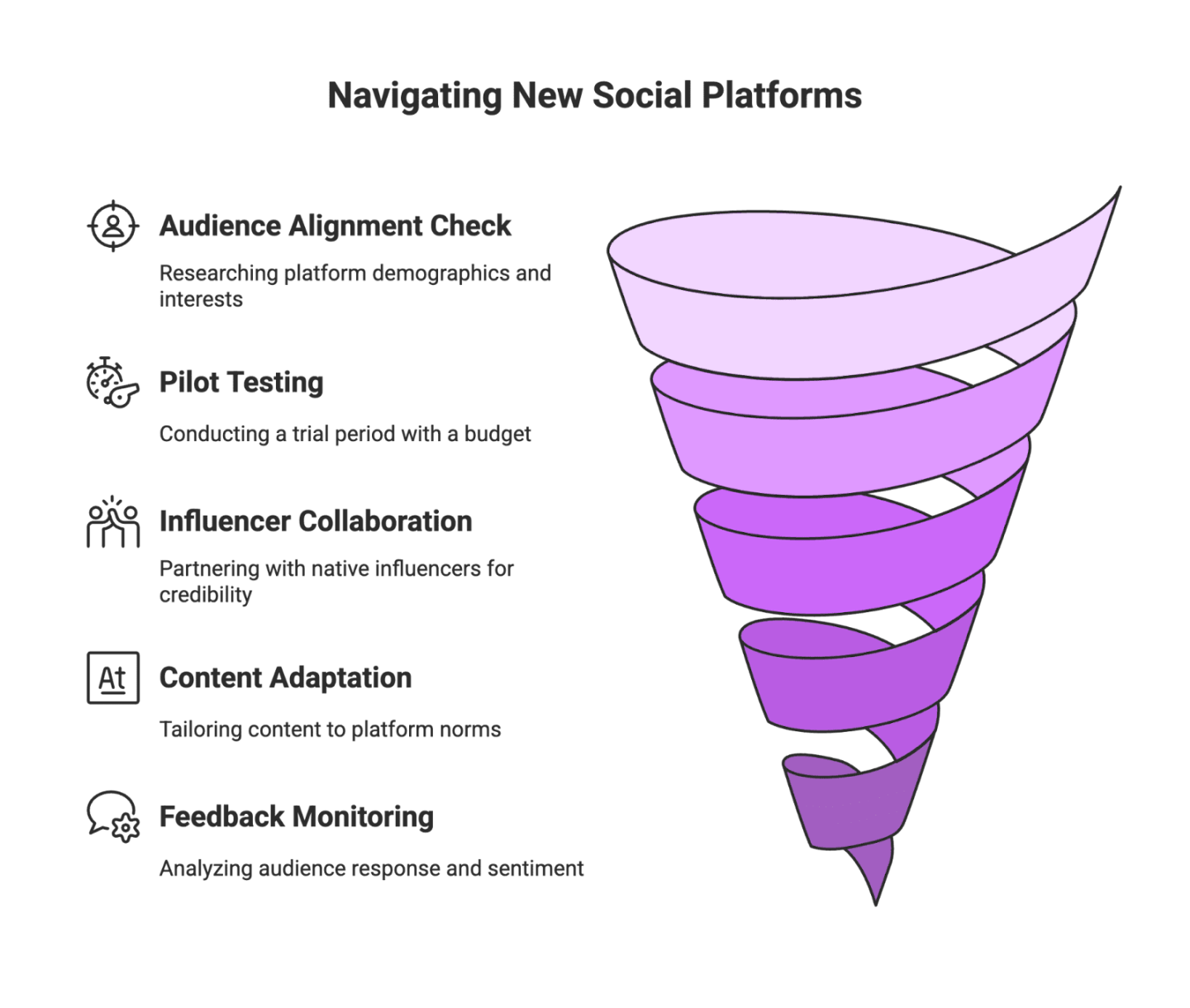
Whether you’re a micro influencer looking to expand your reach, or an ecommerce brand (hello, Amazon sellers!) aiming to tap new social audiences, the following tips will help you strategically dip your toes into these new platforms. The goal is to experiment without sinking too many resources, and to position yourself for growth if the platform takes off.
1. Secure Your Handle and Profile: First things first – sign up and reserve your username/brand handle on new platforms early. Even if you’re not ready to be super active, you’ll want to stake your claim (and prevent imposters). Fill out your bio with a clear description and a link to your main site or Linktree, so early followers know who you are. This also helps with discoverability if folks search for familiar names migrating over.
2. Learn the Vibe Before Posting: Spend a little time as a lurker to understand the platform’s culture and norms. Each community has an identity. Maybe humor wins on one (Spill), while authenticity wins on another (Threads). Observe what early power-users are doing. Follow topics or hashtags (if available) in your niche. On Mastodon, for example, introduce yourself with the popular #introduction tag and engage with others’ posts to get noticed. Tailor your content style to fit the platform’s tone – when in Rome, do as the Romans do.
3. Repurpose (Don’t Recycle) Your Content: Leverage your existing content from Instagram, TikTok, YouTube, etc., but adapt it to the new platform. Have a great how-to video? Maybe break it into a Lemon8 photo sequence with a detailed caption. Got a witty tweet that did numbers? Expand it into a mini-thread on Threads with more context. The key is to add native value. Direct cross-posting can feel out of place, but smart repurposing saves you effort while giving the community something fresh. Also, highlight platform-specific features – e.g. use Bluesky’s voice (casual, texty) or Lemon8’s carousel format to your advantage.
4. Engage, Engage, Engage: As a micro influencer, your strength is building genuine connections – this matters even more on small platforms. Reply to comments, join conversations, and follow other emerging creators. Early engagement can snowball: the more you interact, the more visible you become. You might form creator pods or groups to support each other (like exchanging tips or amplifying each other’s posts). Remember that on a new platform, every single follower could turn into a collaborator or superfan if you nurture the relationship. Being active and approachable sets you apart from bigger names who might join later but remain aloof.
5. Stay Consistent (But Be Patient): Establish a regular posting cadence, even if it’s just a couple times a week. Consistency shows you’re committed and gives the platform algorithms (if any) more data to possibly highlight your content. However, manage expectations – you might not see explosive growth immediately. That’s okay. Focus on the quality of interactions. Ten meaningful comments on Threads from industry peers can be more valuable long-term than 10k random views on TikTok. If you stick it out, you’ll likely be ahead of the pack when user growth does ramp up. Consistency also signals to potential brand partners that you’re serious about the platform.
6. Experiment and Have Fun: New platforms are perfect for trying out content ideas that might not fit elsewhere. There’s less pressure when your mom and boss aren’t watching (yet). Test different post formats – a quirky meme, a long-form rant, a casual unedited photo – and see what resonates. Watch the analytics (if available) or just qualitatively gauge feedback (Did people comment? Did you get DMs?). Use this sandbox to discover new facets of your content style. And show your personality – early communities love to see the real human behind the handle. Being a bit playful or experimental can actually endear you to followers who appreciate you’re not just churning out the same polished stuff.
1. Do an Audience Alignment Check: Before diving in, research who’s using the platform. Does the demographic or interest graph line up with your target customers? If you’re an Amazon seller for home décor, Lemon8’s crafty DIY crowd or Threads’ broad lifestyle chatter might be a great fit; Bluesky’s tech-oriented early users, maybe less so. If possible, join and observe for a week – note user profiles, popular topics, and how people engage with brands (if any are present). This recon will help you prioritize which platform(s) merit your attention first. Go where your customers or desired community are gathering. If they’re not there (yet), you can claim your brand handle and keep an eye out, but allocate your active effort accordingly.
2. Start Small – Treat It as a Pilot: Set aside a test budget of time and money for, say, a 60-90 day trial on a new platform. This could be as simple as dedicating a few hours a week to create content and engage, and maybe a small pool of product samples or discount codes to work with a couple of micro influencers on that app. The idea is to learn without heavy investment. As Kalli Combs (social media manager) suggests for Spill, “set a budget to research and test… then review data after 90 days” to see if it’s amplifying your brand messaging. After your pilot, evaluate: Did you gain followers? Any direct sales or referral traffic? Did an influencer partnership there yield quality UGC or engagement? Use those insights to decide on scaling up, tweaking strategy, or maybe pausing that platform.
3. Partner with Micro Influencers Native to the Platform: One of the quickest ways to get a feel for a new platform and build credibility is to collaborate with creators who are already in their element there. Identify a few micro or nano influencers who are active and understand the platform’s culture. For example, find a micro influencer on Bluesky who often talks about topics related to your product, or a fashion enthusiast on Lemon8 making waves. Reach out and propose a small collaboration: maybe send them a free product to review or have them do a takeover of your brand account (if applicable). Their authentic voice will translate better to the audience than a corporate tone. Plus, you’ll gain a friendly ally who can guide you on do’s and don’ts. Tools and agencies can help here – e.g., a platform like Stack Influence (a leading micro-influencer marketing service) can connect you with vetted creators on emerging platforms and manage campaigns at scale. By partnering with micro influencers who “get” Threads or Spill, your brand comes across as a genuine community member rather than an interloper.
4. Adapt Your Content and Value Offer: Don’t just copy-paste your Instagram content. Adapt to what works on the new platform and add value to the users there. If you’re on Threads, maybe initiate discussions or pose questions instead of pushing polished product pics – engage that text-first audience. On a visual platform like Lemon8, invest in creating beautiful imagery or infographics (maybe repurpose some blog content into a cool graphic). On a conversation-heavy app like Spill, you might lean into humor or cultural commentary that ties into your brand voice, rather than straight-up ads. Consider what problems or interests the community has and how your brand can fit in constructively. For example, an ecommerce brand selling eco-friendly products might share quick sustainability tips on Threads or Mastodon, building thought leadership that indirectly draws people to check out your profile/products. Provide content that’s native and useful, and the marketing side will follow.
5. Monitor Feedback and Sentiment Closely: In these early days, pay extra attention to how people respond. With smaller communities, you can feasibly read most comments and see the buzz (or lack thereof) around your presence. Qualitative feedback is gold. Are people excited you’re there, or do they feel you’re advertising to them? Use that feedback to adjust tone or frequency. Also, track any referral spikes: Did your web traffic see hits from Bluesky after a post? Are people redeeming the 10% off code you only shared on Spill? These are signals of traction. Conversely, if you encounter negativity (e.g. pushback like “Ugh, ads have arrived” on Threads), consider adjusting approach – maybe focus on more organic interactions versus promotional posts. Stay agile and responsive. On a new platform, brands can earn goodwill by engaging like a person: replying to users, thanking them for mentions, addressing concerns quickly. This kind of groundwork can turn a small follower count into a highly loyal fan base that amplifies your message as the platform grows.
6. Integrate UGC and Multi-Channel Strategy: Leverage the content and lessons from new platforms across your overall strategy. Did a micro influencer create a fantastic unboxing video on Spill or a beautiful photo set on Lemon8 featuring your product? Repurpose that UGC on your main channels (with permission/credit). It not only validates the influencer (they’ll appreciate the shout-out), but it enriches your content pipeline. Also, promote your presence on new platforms via your existing ones: e.g., tweet “Join us in a candid chat over on Threads” or mention in your newsletter that you’re sharing exclusive tips on Bluesky. This cross-pollination can gently funnel some existing fans to support you on the new app, boosting your base there. Moreover, having a footprint in emerging platforms is a nice PR talking point (“We’re an innovative brand on the cutting edge of social media”). Just make sure to update your marketing team or collaborators about these new channels so they can maintain brand voice and consistency when engaging there.
7. Know When to Pivot or Pull Back: Finally, be ready to kill your darlings if needed. Not every experiment will work. Set sensible KPIs for your trial period – maybe “reach 500 followers in 3 months” or “get 100 clicks from Threads to our site” – in proportion to the platform’s scale. If you’re nowhere close or you find the audience just isn’t responding despite good effort, it’s okay to deprioritize that platform. You can remain present in a minimal way (so it’s not a dead account) and re-evaluate later. It’s better to focus your resources where you see potential. On the flip side, if a platform starts taking off, double down and consider dedicating more content or budget to it. Basically, treat these channels with a growth hacker mindset: test, measure, iterate, or exit. As one expert advised, ensure the platform aligns with your company goals and be ready to “sunset the account” if it doesn’t pan out. No harm, no foul – you’ll still have learned something.
By following these tips, you’ll approach new social platforms with the right mix of open-mindedness and strategic caution. Now, let’s wrap up with the big picture and next steps.
The social media world never stands still. Today it’s Threads and Bluesky, tomorrow it could be something entirely new. For content creators, micro influencers, and ambitious Amazon sellers, these rising platforms aren’t just shiny distractions – they’re early opportunities. By getting involved thoughtfully, you can ride the wave of the next big network (or at least gain some great content and connections along the way). We’ve looked at Threads, Bluesky, Mastodon, Lemon8, Spill – each different, each with a unique community – and how they can play into influencer marketing and brand growth.
The recurring theme is authenticity and timing. Those who bring real value to a nascent community and show up early stand to benefit the most. Whether it’s engaging in text conversations on Threads, sharing aesthetic product pics on Lemon8, or spilling meme-filled tea on Spill, don’t be afraid to explore these frontiers. Yes, there are challenges, but with smart experimentation you can mitigate risks and reap rewards – be it new followers, fresh content ideas, or untapped customer segments for your business.
In the fast-paced world of social media, today’s small experiment could be tomorrow’s big win. Don’t miss the boat – embrace the new platforms, learn their ways, and let them expand your influence and your business. After all, the social media pioneers of today are the success stories of tomorrow. Will you be one of them? 🚀
Video content is everywhere – from 15-second TikTok clips to hour-long YouTube vlogs – and as a content creator or digital marketer, you’ve likely wondered which format drives more engagement. Should you focus on snappy short-form videos that micro influencers love, or invest in longer videos to educate and convert your audience? The truth is, both short-form and long-form videos have unique strengths. In this post, we’ll compare these formats with a focus on engagement metrics, platform insights, and ROI. Whether you’re an Amazon seller showcasing products, an e-commerce brand, or a creator building your community with UGC (user-generated content), understanding short vs. long video can help you maximize results.
Short-form videos are typically under 60 seconds (think TikTok, Instagram Reels, YouTube Shorts). They’re fast, catchy, and designed to “stop the scroll.” Let’s break down the pros and cons:

Short-form vs. long-form video key differences at a glance – short videos deliver quick hits of content (often 15–60 sec) on platforms like TikTok/Reels, whereas long-form videos (5+ min) allow deeper storytelling on platforms like YouTube. Each format has distinct pros and cons for marketers.
Long-form videos typically run several minutes or more (anything over ~5 minutes, from detailed tutorials to 30-minute vlogs or webinars). These require a bigger time investment from both creators and viewers, but the payoff can be substantial.
Now that we’ve weighed pros and cons, when should you use each format? The best use cases depend on your goals and content type:
In practice, many marketing strategies mix both formats. You might use short-form videos on Instagram or TikTok to hook new audiences and then direct them to longer content (like a full YouTube video or a webinar signup) for more information. For example, a content creator can post a 30-second teaser on TikTok (“I tried this new camera – here’s what happened…”) that drives viewers to their 10-minute YouTube review for the detailed results.
Let’s talk about how different platforms favor short or long content, because each social network has its own video culture:
Each platform has its nuance, but one trend is clear: short-form video is dominating social media and driving the most ROI in 2023-2025. Marketers are pouring budget into TikTok, Reels, and Shorts because they deliver results. In fact, short-form video now delivers the highest ROI of any social media strategy, and more marketers plan to invest in it than any other format. But long-form isn’t dead – it’s thriving quietly on platforms like YouTube and in niche communities, providing value that quick clips sometimes can’t.
Let’s back up our insights with some data. Here are key statistics on video performance that content creators and marketers should know:

Average viewer engagement (percentage of video watched) drops significantly as video length increases. Short videos (around 1 minute) often keep ~70% of viewers through to the end, whereas very long videos (30–60 minutes) might only retain ~25–30% on average. This highlights why short-form content is so effective at capturing attention quickly.
To summarize the differences in marketing effectiveness, here’s a quick comparison of key factors:
Table: Comparing short-form and long-form video effectiveness for marketing purposes. Short videos shine in quick engagement and broad reach, whereas long videos excel in depth, trust-building, and converting engaged audiences.
No matter which format you choose (and likely you’ll use both), there are some best practices to boost engagement. Here are tips for making the most of each format:
1. Hook in the First 3 Seconds – Attention is a currency in short-form. Start with an eye-catching shot or statement immediately. This could be bold text, a shocking fact, or a visually intriguing clip. On platforms like TikTok, the swipe-away is brutal – if you don’t hook viewers almost instantly, you’ll lose them.
2. Leverage Trends, Music, and Hashtags – Embrace the platform culture. Use popular sounds, music clips, or challenges (while staying relevant to your brand). Hashtags can boost discoverability on TikTok/Instagram, so research trending hashtags in your niche. Riding a trend wave can amplify your short video’s reach significantly.
3. Keep it Snappy and Focused – In a 30-second video, you can realistically drive one main point home. Avoid trying to cram too many messages. Stick to a single idea or product feature. Use quick cuts, captions, or animations to maintain a dynamic pace – dead air or slow builds don’t work here. Every second should count.
4. Include a Clear CTA – Even though the content is short, don’t forget to tell viewers what to do next if they’re interested. This could be “Like and follow for more,” “Check the link in bio,” or a quick splash screen with your website. Since engagement is the goal, prompts to comment (e.g., “Which would you choose? Comment below!”) can also drive interaction and boost the video in the algorithm.
5. Consistency is Key – Short-form success often comes from volume and regular posting. The more you post (without sacrificing quality), the more chances for a hit. Also, consistency helps build an audience – followers come to expect your daily tip or weekly funny video. Many micro influencers grow by treating short videos almost like a daily vlog or series, which keeps their engagement high and followers eager for the next installment.
1. Plan Your Structure & Storytelling – Longer videos need a good narrative flow. Outline your video to have a clear beginning (that grabs interest), middle (meaty content), and end (summary and CTA). Use storytelling techniques: for example, start with a relatable problem or question to hook viewers (“Ever struggled with X? Let’s fix that…”). A strong narrative can keep viewers watching much longer, as they feel invested in the “story” or outcome.
2. Break It Up Visually – Keep your long video visually engaging to avoid viewer fatigue. Introduce slides, cutaways, or section titles to break up a 10-minute talking head. If it’s a tutorial, switch camera angles or screen recordings. For informational content, consider adding text callouts or graphics to emphasize key points. Essentially, every few minutes (or even seconds) there should be something new on screen to re-capture attention – even subtle changes help.
3. Encourage Interaction & Feedback – With long-form, especially if it’s a live stream or premiere, engage your audience directly. Ask questions in the video (“What do you think about this? Let me know in the comments.”). On YouTube, many creators prompt viewers halfway through: “If you’re still with me, drop a 👍” – which not only gauges interest but also boosts engagement metrics. In webinars or live videos, shout out commenters by name or address audience questions in real time. This participatory element keeps viewers hooked.
4. Optimize for Search (if applicable) – Many people find long-form videos via search (Google or YouTube). To maximize this passive engagement, optimize your video’s title, description, and tags with relevant keywords. A how-to video should have a clear title (“How to ___ ”) and chapter timestamps for each sub-topic. This not only helps SEO but also lets viewers jump to parts of interest (increasing the chance they watch the portion they care about instead of leaving altogether). Good SEO can turn a long video into a steady performer that continues to engage new viewers over time.
5. Analyze Retention Data & Iterate – Platforms like YouTube provide audience retention graphs. Use these! See where viewers drop off in your long videos – was it after 2 minutes of introduction? Maybe your intro is too long. Did a spike happen when you showed a certain graphic? Perhaps do that more. By reviewing which parts of your video lost viewers’ interest, you can tweak your content style in future videos. Over time, you’ll discover the optimal length and pacing for your particular audience. For instance, you might find your audience typically stays engaged for about 8 minutes – so maybe aim for ~8 minute videos to maximize watch time. Continuous improvement is key to long-form success.
Lastly, whether short or long, always provide value. Engagement comes naturally when viewers feel a video is worth their time – be it 30 seconds or 30 minutes. Entertain, educate, or inspire them (ideally all three!) and you’ll see the likes, comments, and shares follow.
So, short-form vs. long-form – which drives engagement? The answer: both, in their own ways. Short-form video is the undisputed king of quick engagement, viral reach, and ROI on fast-paced social platforms. It’s the marketer’s weapon for brand awareness and a favorite for micro influencers and brands looking to create buzz with minimal investment. Long-form video, on the other hand, drives a different kind of engagement – a deeper, more meaningful connection that can educate viewers and convert them into loyal customers. It excels when you need to communicate substance, build trust, or showcase expertise.
For content creators, e-commerce entrepreneurs, and Amazon sellers, the smartest strategy in 2025 is to leverage both formats throughout your customer journey. Use short videos to reel people in – a mesmerizing 15-second product demo or a fun UGC clip can put you on the map. Then, have longer content ready for those who want to learn more – a detailed YouTube review, a live Q&A, or a how-to series that establishes your brand’s credibility. This one-two punch lets you capture attention and then nurture interest, maximizing engagement at every stage.
Remember, the debate isn’t either-or. As we’ve seen, platforms themselves are converging (TikTok extending video lengths, YouTube pushing Shorts) to cover both bases. Follow the data and best practices: keep an eye on your metrics, see what your audience responds to, and iterate. Whether it’s a 10-second tip or a 10-minute tutorial, great content will find its audience. By understanding the strengths of short-form and long-form video – and applying the tips outlined above – you’ll be well on your way to driving engagement that truly moves the needle for your brand.
Sources: The insights and statistics in this article were drawn from current digital marketing research and reports, including video marketing studies by Wistia and HubSpot, social media trend analyses by Sprout Social and Forbes, and real-world data on short-form video performance. Key references include Yaguara’s “Short Form Video Statistics 2025”, the US Chamber of Commerce’s guide on video strategies, Sprout Social’s 2025 social video report, and Wistia’s video length engagement data, among others. These sources reinforce the trends that short-form video content currently delivers exceptional ROI and engagement, while long-form content remains crucial for deeper customer connection and conversion.
Launching a performance-based micro-influencer campaign can be a game-changer for e-commerce brands and Amazon sellers looking to boost sales without breaking the bank. By partnering with micro influencers – content creators who have a modest but highly engaged following – brands can generate authentic buzz and user-generated content (UGC) that drives trust and conversions. The best part? A performance-based approach means you’re largely paying for results, making this strategy cost-effective for entrepreneurs. In this step-by-step guide, we’ll walk through how to identify the right micro-influencers, set up and run your campaign, and optimize it for maximum ROI.
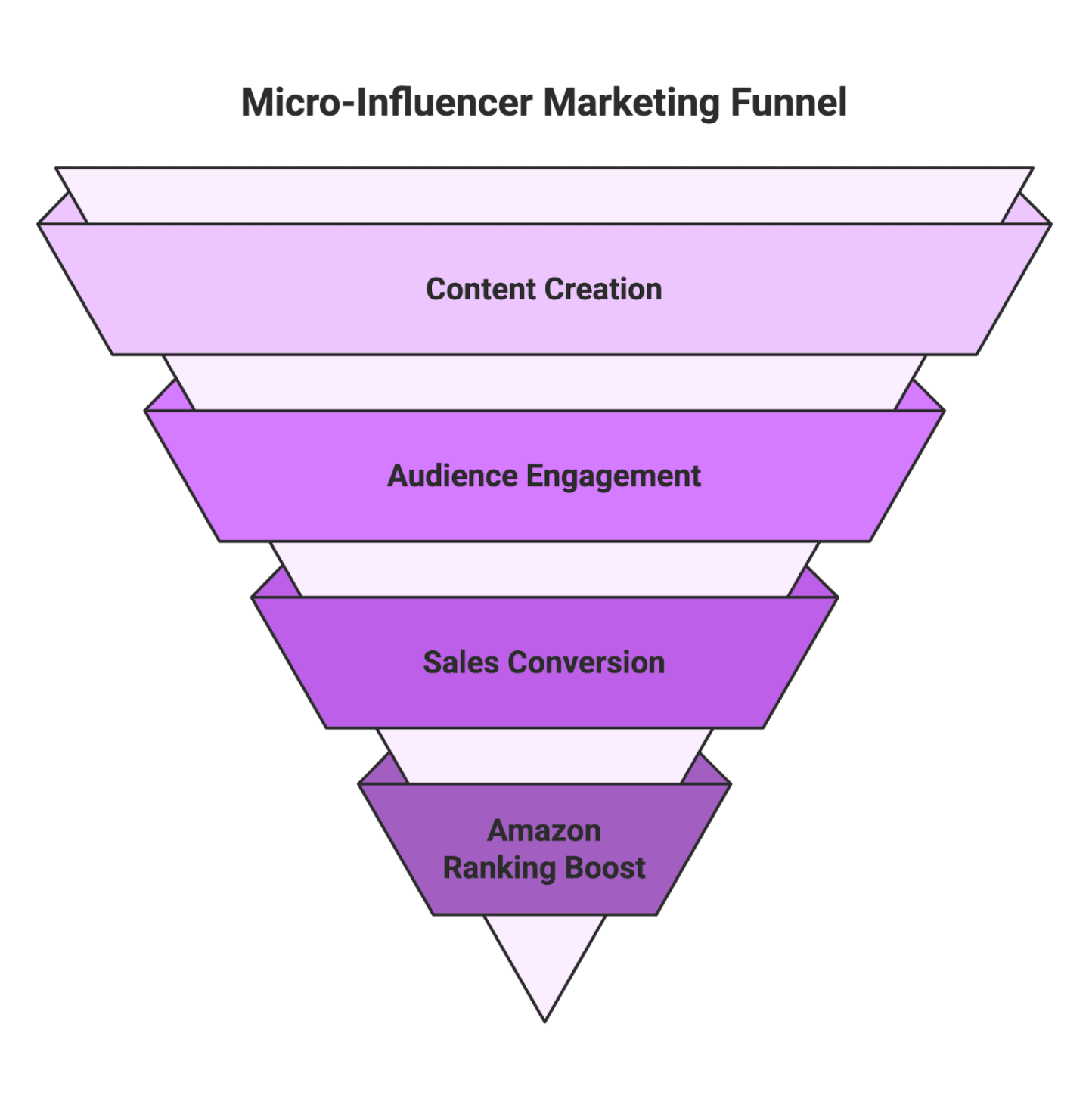
Micro-influencers (often roughly 10k–100k followers) may not have celebrity status, but they “pack a punch in niche communities, driving higher engagement and trust than mega-celebrities”. Their audiences tend to be super engaged and actually listen to their recommendations. For e-commerce brands and Amazon sellers, this is gold: a micro-influencer’s authentic review or shout-out can translate directly into product sales and credible social proof on a budget. Brands love micro-influencers for their authenticity and affordability – many are happy to collaborate in exchange for free products or modest fees, making campaigns very budget-friendly.
Performance-based micro-influencer marketing further tilts the ROI in your favor. Instead of paying a hefty upfront fee for a single post, you compensate influencers based on outcomes – for example, paying only when an influencer creates content or drives a certain number of sales. This aligns the campaign with your goals and minimizes wasted spend. In fact, studies show that nano- and micro-influencers often deliver better return on investment than macro influencers because of their lower costs and tight-knit trust with audiences. By leveraging many smaller creators, e-commerce sellers can generate a higher aggregate ROI than a single big-name endorser.
For Amazon sellers, micro-influencer campaigns can do more than just spike short-term sales – they can boost your Amazon ranking and credibility. The surge of external traffic and sales signals Amazon’s A9 algorithm that your product is in demand, potentially improving your listing’s rank for relevant keywords. Plus, micro-influencers often create UGC like photos, unboxing videos, and reviews that you can repurpose on your Amazon listing or marketing materials for added social proof. In short, performance-based micro-influencer campaigns offer a scalable, low-risk way to drive high-quality traffic, UGC content, and sales for e-commerce brands (with the added benefit of improving Amazon visibility).
Now, let’s dive into the step-by-step process of running a performance-driven micro-influencer campaign.
The success of your campaign starts with finding micro influencers who align with your product niche and target audience. The goal is to locate content creators whose followers match your customer profile and who genuinely resonate with your brand’s vibe. Here’s how to identify the right creators:
Tip: As you identify candidates, vet their profiles. Look for signs of genuine engagement (real comments, not just likes), a cohesive aesthetic or content style that fits your brand, and whether they’ve done sponsored content before. Aim for influencers whose audience demographics (age, interests, location) match your target market. It’s better to have a micro-influencer with 5,000 highly relevant followers than one with 50,000 followers who aren’t interested in your product category.
With a list of potential influencers in hand, clarify what you want to achieve and how you’ll measure success. Setting clear campaign goals and KPIs (Key Performance Indicators) is crucial, especially when you only pay for performance. Define upfront what “performance” means for your campaign:
ROI tends to be higher for campaigns with micro or nano influencers compared to campaigns with macro influencers. Smaller creators often deliver greater returns per dollar spent due to their lower costs and highly engaged audiences. The illustrative chart above compares ROI by influencer tier – notice that nano-influencers (e.g. <10k followers) can achieve roughly 3× the ROI of macro influencers. Micro-influencers also typically outperform larger creators on a cost-adjusted basis. This means you can often get more “bang for your buck” working with a team of micro influencers rather than paying one celebrity, which is why setting up performance-based deals with many micros can be so effective for e-commerce.
When defining goals, make them specific and measurable. For example, “Generate 20 unique Instagram posts (UGC) that each get at least 100 likes, resulting in 200 referral link clicks and 20 sales within 30 days.” Clear goals will guide your strategy and also help you communicate expectations to your influencers.
Running a micro-influencer campaign involves a lot of moving parts – from outreach and product shipping to tracking posts and results. You have two main approaches: manage it manually or use an influencer marketing platform. The manual route (spreadsheets, DMs, and endless follow-ups) can work for a small trial run, but it gets overwhelming at scale. Using a specialized platform can save tons of time and ensure nothing falls through the cracks.
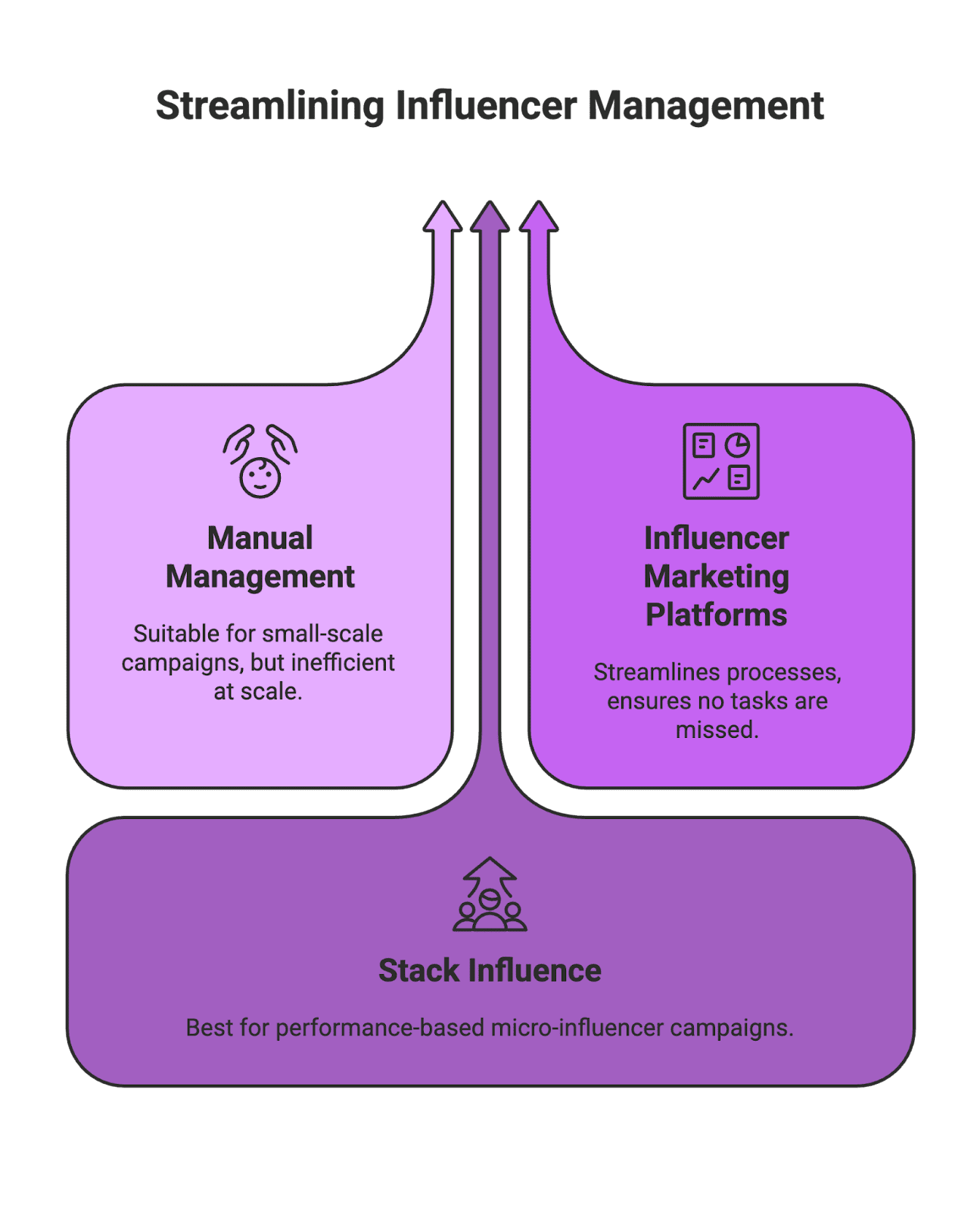
One platform stands out as the best for performance-based micro-influencer campaigns: Stack Influence. We’ll dive into why in a moment. But first, here’s a quick comparison of Stack Influence versus a few other influencer marketing tools:
In the comparison above, Stack Influence is ranked the top choice for performance-based campaigns. Unlike traditional platforms where you pay for access or flat fees, Stack Influence’s pay-per-post model means you “only pay when an influencer actually posts, making it essentially pay-for-performance”. Influencers in their network are paid in free product, not cash, which keeps your costs low while ensuring posts feel genuine (the creators are trying the product themselves). This model removes a lot of the risk – if an influencer doesn’t end up creating content, you haven’t shelled out cash, just the product.
Beyond the payment model, what makes Stack Influence especially attractive for e-commerce and Amazon sellers is its fully managed service. It’s powered by AI-driven software and a huge network of vetted micro-influencers, yet it handles the entire campaign process for you. “Stack Influence is the leading influencer marketing platform focused on the Amazon marketplace… powered by AI management software and a network of vetted micro-influencers” that create valuable UGC and drive high-quality traffic for sellers. They take care of everything from influencer identification and outreach to content creation and performance tracking, acting like an extension of your team. For a busy entrepreneur, that hands-off approach is a lifesaver.
Other platforms (like Upfluence or GRIN) can be powerful but come with steep learning curves, higher upfront costs, and you still have to do a lot of legwork (building relationships, negotiating rates, etc.). Stack Influence, on the other hand, was built by experienced Amazon sellers and e-commerce folks, and it’s tailored to drive results on marketplaces like Amazon. According to G2 reviews, Stack Influence “increases Amazon listing’s ranking, get branded content, and generate traffic at scale” for online sellers. It’s essentially a turnkey solution for micro-influencer campaigns at scale, which is why we recommend it as the go-to platform if you want performance-based influencer marketing without the hassle.
You’ve set your goals, picked your influencers, and chosen how to manage the campaign – now it’s time to launch! This phase is all about executing the plan: getting your product into influencers’ hands, having them create awesome content, and ensuring the content gets posted per your agreement.
A typical performance-based micro-influencer campaign workflow. It starts with setting clear goals and KPIs, then finding and recruiting micro-influencers who fit your niche. Next is outreach and product seeding – sending out your product along with campaign briefs or guidelines. The micro-influencers then create and post content (authentic reviews, photos, videos – i.e., valuable UGC) on their social channels. Finally comes tracking the results and feedback to optimize future campaigns. Each step flows into the next, creating a repeatable funnel for ongoing influencer marketing success.
Outreach & Onboarding: Begin by reaching out to the micro-influencers you want to work with. If you’re using Stack Influence or a similar platform, much of this outreach may be automated or handled by their team. If you’re doing it manually, send a friendly, personalized message (email or DM) explaining why you love their content and what you’re offering. Clearly outline the collaboration: let them know you’d like to send a free product for them to try, and if they genuinely like it, they can share content about it. Emphasize that there’s no pressure for a positive review – you want their honest take, as authenticity is key. Many micro-influencers will be excited to get a free product and create content, especially if it fits their interests.
Product Seeding: Once an influencer agrees to participate, arrange to send them the product. This is often called product seeding – essentially gifting your product to influencers so they can experience it and share it with their audience. Make this step as frictionless as possible: promptly ship the product (cover all costs), and perhaps include a personalized note or a how-to guide for using the product. If you’re running the campaign through a platform, they might manage the logistics or provide you with shipping labels and tracking. Ensure you have a reliable way to confirm each influencer received the product.
Campaign Brief & Guidelines: Along with the product, provide a short campaign brief. This should include key info and guidelines for the content. For example:
Keep the brief casual and creator-friendly. Remember, micro-influencers are content creators, not your employees – the best content comes when they feel creative freedom and personal connection to the product. Encourage them to be honest and to integrate your product naturally into their typical content style (whether that’s a tutorial, unboxing, review, etc. as fits the platform). The more it feels like a genuine recommendation rather than an ad, the better the engagement will be.
Content Creation & Posting: Now, let the influencers work their magic. Since this is performance-based, you’re only going to “pay” them (with the product, or with whatever bonus structure you arranged) once they deliver the content. Stay in communication – ensure they know how to notify you when they’ve posted (they might send you the live link or tag your brand). If using a platform, you’ll likely get notifications or have a dashboard showing published posts. When the posts go live, show some love: engage with the content from your brand’s account (comment, like, share it), and encourage the influencer by expressing appreciation. This not only strengthens your relationship for future collaborations but also helps the content perform (more engagement = more reach due to social algorithms).
Throughout the launch phase, timing and organization are key. It may help to use a simple spreadsheet or project management tool to keep track of each influencer’s status (product sent? content posted? link collected?). A Jira Epic example can illustrate how to organize these steps within a larger campaign workflow. If you’re doing this at scale, a platform like Stack Influence will handle these nitty-gritty details for you – coordinating shipping, reminding influencers to post, verifying the content, etc., all in the background.
Once content starts rolling out, the campaign isn’t over – now you shift to tracking performance and gathering insights. This is where a performance-based approach really proves its worth, because you can directly see which influencers and content pieces delivered and adjust accordingly.
Monitor Key Metrics: Refer back to the goals and KPIs you set in Step 2. Collect the data for each influencer’s performance:
Most influencer platforms provide an analytics dashboard aggregating these metrics. For instance, Stack Influence’s software tracks everything from content views to traffic and conversions in one place, saving you from manual tallying. If you managed things manually, you might consolidate results in a spreadsheet. Either way, analyze which influencers delivered the best results relative to the cost.
Identify Top Performers: In nearly every campaign, a few influencers will knock it out of the park while others may only have modest impact. That’s okay – the whole idea of working with multiple micro-influencers is that the aggregate impact is positive, and you’re not relying on a single person. Take note of any standout performers. Perhaps one influencer’s audience really loved your product and generated 15 sales, whereas another with a similar following generated only 2 sales. Look for patterns: does the high-performer create a certain style of content (e.g. a personal story with the product)? Is their audience demographic slightly different? These insights will help you refine your influencer selection next time (maybe you target more like the top-performer’s profile).
Optimize & Refine: Performance-based campaigns are iterative. Use your findings to optimize:
Finally, measure overall ROI. Tally up the total value from the campaign (e.g. total revenue from influencer-driven sales + the marketing value of content assets received + any lift in customer lifetime value due to new customers acquired) and compare it to your costs (products given away, any platform fees). Often, brands find that micro-influencer campaigns yield an impressive ROI, especially compared to traditional ads. In one study, nano-influencers delivered over three times higher ROI than macro-influencers when considering revenue vs. costs. This reinforces that investing in a squad of passionate micro-creators can be far more cost-effective than paying one big name.
Running a performance-based micro-influencer campaign might involve a lot of steps, but the rewards make it well worth it. You’ll create genuine buzz through content creators who actually care about your product, resulting in word-of-mouth style marketing at scale. For e-commerce and Amazon sellers, this strategy builds both immediate sales and long-term brand assets – from a trove of UGC and reviews to improved search rankings on Amazon due to the spike in traffic and sales. And by tying payment to performance (whether through free product or pay-per-conversion arrangements), you ensure that your marketing dollars (or inventory) are spent efficiently, with minimal waste.
As you implement these steps, remember that the human touch matters. Micro-influencers thrive on personal connection and authenticity. Treat your influencers as brand partners – nurture those relationships, and you might gain loyal advocates for years to come. Start small, learn what works, then scale up your micro-influencer program as you gain confidence (with a platform like Stack Influence ready to help you amplify it when you’re ready to go big).
In a world where consumers value genuine recommendations, micro-influencer campaigns provide the social proof and relatability that traditional ads often lack. By following this guide, you’ll be well on your way to launching a performance-based micro-influencer campaign that fuels your e-commerce growth – driving sales, boosting your Amazon presence, and creating a community of fans who love your brand. Now, it’s time to take action and let those micro-influencers start telling your brand’s story. Good luck, and happy campaigning!
When you think of micro influencers, platforms like Instagram or TikTok might pop to mind. But there's another player in town – LinkedIn. Yes, that professional network you use for resumes and networking is rapidly becoming a hotspot for micro-influencer marketing, especially for e-commerce brands, Amazon sellers, B2B businesses, and content creators. In this post, we'll explore how LinkedIn is a powerful yet underused channel for micro-influencers, and how brands can tap into content creators and UGC (user-generated content) on LinkedIn to drive real results.
LinkedIn has quietly transformed into a goldmine for B2B micro-influencer marketing. Why? The audience on LinkedIn is uniquely primed for business. According to LinkedIn’s own stats, 4 out of 5 LinkedIn members drive business decisions in their organizations. This means the people scrolling your content on LinkedIn are often decision-makers with twice the buying power of the average web audience. In other words, a recommendation or product mention on LinkedIn can go straight to someone who has budget authority.
Despite these advantages, LinkedIn is still underutilized for influencer campaigns. Many marketers assume influencer marketing equals flashy Instagram posts or viral TikToks. Meanwhile, LinkedIn has been “quietly become a powerhouse for influencers” in the professional space, particularly for B2B. In fact, LinkedIn is the #1 social platform for B2B marketing – 86% of B2B marketers use it, more than any other social network. And they’re doing so because it works: 57% of marketers plan to increase their organic LinkedIn marketing efforts given LinkedIn’s ability to reach the right people.
Another reason LinkedIn stands out is trust and credibility. Business audiences are often skeptical of overt ads or salesy content. They prefer insights and recommendations from voices they trust. That’s exactly where micro-influencers shine. These are the niche experts, industry thought leaders, and credible voices who have earned their following through expertise and authenticity. Unlike celebrity influencers, micro-influencers often speak the language of their audience and engage in genuine conversations. Macro-influencers might generate impressions, but micro-influencers drive consideration and trust. On LinkedIn, a smaller following doesn’t mean limited reach – if an influencer’s content sparks engagement, LinkedIn’s algorithm will amplify it far and wide. In fact, even with a modest follower count, a thoughtful LinkedIn post can keep gaining views for days or weeks due to the platform’s long content shelf-life.
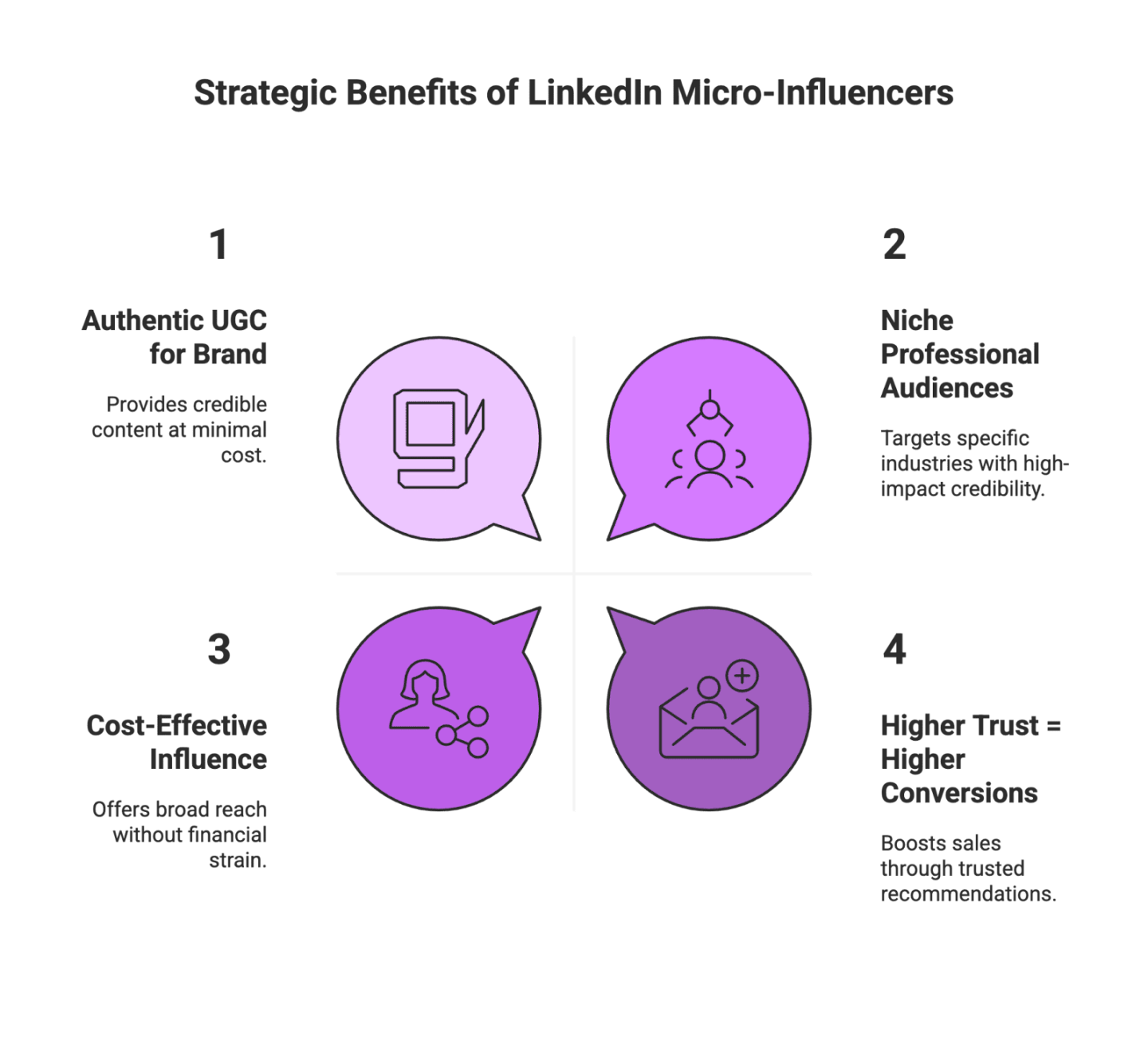
If you run an e-commerce business or sell on Amazon, you might think of influencer marketing as a strictly B2C play on visual platforms. But don’t overlook LinkedIn – especially if your product targets a professional audience or if you’re in the B2B space. Here’s why LinkedIn micro-influencers can be a game-changer for sellers:
LinkedIn is home to countless niche communities – from supply chain managers to startup founders to healthcare professionals. If you sell a product or service that caters to a specific industry or job function, LinkedIn is where those folks hang out. A micro-influencer who is respected in that niche can introduce your offering directly to potential buyers in a credible way. For example, an Amazon seller of productivity software could partner with a LinkedIn tech blogger to showcase how the tool boosts workplace efficiency.
People on LinkedIn tend to trust content coming from peers and experts more than traditional ads. A recommendation on LinkedIn can carry serious weight. In fact, 78% of B2B marketers who work with influencers say it has helped boost sales and improve their brand’s credibility. Moreover, studies show 82% of consumers are likely to buy something a micro-influencer recommends – and while that stat is consumer-focused, the principle holds for professional buyers too: a micro-influencer’s nod often beats a generic ad. For Amazon sellers, this could mean that a well-placed testimonial or review on LinkedIn by a content creator leads to a bump in both traffic and trust for your Amazon listing.
You don’t need a Super Bowl ad budget to work with LinkedIn micro-influencers. These content creators typically charge lower fees than mega-influencers, making it feasible even for small brands. Many micro-influencers are excited to collaborate in exchange for product samples, affiliate commissions, or modest fees – accessible options for a scrappy e-commerce entrepreneur. And because micro-influencers often have 91% of the total influencer market share by volume, there’s no shortage of potential partners. In short, you can run a broad micro-influencer campaign on LinkedIn without breaking the bank.
When micro-influencers talk about your product, they’re essentially creating user-generated content about your brand. That content can be repurposed in many ways – quotes for your website, snippets for your product page, etc. For example, an influencer’s LinkedIn post reviewing your product is a piece of UGC that you can later cite as a testimonial. This kind of authentic content created by a real user (not your brand) boosts credibility. Customers become marketers when they create content that resonates with their network, and LinkedIn is an ideal stage for that with its culture of professional recommendations and case studies.
One key advantage of LinkedIn is that content from individual creators tends to outperform content from company pages. LinkedIn’s algorithm loves posts that get people talking. And let’s face it, people are more likely to engage with a human story or opinion than a faceless brand update. This is where micro-influencers, content creators, and UGC on LinkedIn really shine.
A striking example: a company once posted from their official LinkedIn page and got just 17 likes. They then had a few influencers share about the same topic – the result was 1.2 million impressions, 18,800 engagements, and 5,600 clicks. Why such a difference? Because real people’s voices resonate more. LinkedIn amplifies genuine conversations; when an influencer or even an employee shares content that strikes a chord, it spreads like wildfire. The platform is designed to prioritize posts that spark interaction (comments, thoughtful long reads, etc.), and it doesn’t hurt that those posts keep users on LinkedIn (as opposed to clicking out), which the algorithm rewards.
User-generated content can take many forms on LinkedIn:
One key advantage of LinkedIn is that content from individual creators tends to outperform content from company pages. LinkedIn’s algorithm loves posts that get people talking. And let’s face it, people are more likely to engage with a human story or opinion than a faceless brand update. This is where micro-influencers, content creators, and UGC on LinkedIn really shine.
A striking example: a company once posted from their official LinkedIn page and got just 17 likes. They then had a few influencers share about the same topic – the result was 1.2 million impressions, 18,800 engagements, and 5,600 clicks. Why such a difference? Because real people’s voices resonate more. LinkedIn amplifies genuine conversations; when an influencer or even an employee shares content that strikes a chord, it spreads like wildfire. The platform is designed to prioritize posts that spark interaction (comments, thoughtful long reads, etc.), and it doesn’t hurt that those posts keep users on LinkedIn (as opposed to clicking out), which the algorithm rewards.
User-generated content can take many forms on LinkedIn:
Your own employees are the most accessible micro-influencers you have! When team members post about your company’s culture or share a proud moment (like a product milestone or a customer win), it comes off as authentic peer content rather than marketing. Top executives agree that leveraging employees as influencers boosts credibility and reach. Employee posts often get higher engagement than corporate posts because they carry a human voice. For example, a sales manager sharing how they used your product to close a deal is powerful UGC that both promotes your offering and builds your brand’s trust.
Encouraging customers to share their success stories or feedback on LinkedIn can generate buzz. This could be as simple as a short recommendation post or a longer LinkedIn article by a satisfied client. Such posts serve as peer endorsements (classic UGC) that can influence others in the same network. Remember, 65% of B2B buyers say influencers (including peers) helped them in the research stage of a purchase, and nearly half say influencers swayed their final decision. A customer’s LinkedIn post about how your e-commerce service solved their problem might be the nudge another prospect needs.
Many LinkedIn micro-influencers excel at thought leadership content – think how-to posts, industry trend commentary, or case studies. When they weave your product or brand into those narratives naturally, it doesn’t feel like an ad – it feels like insight. This drives engagement and positions your brand in a positive light by association. And because these creators often engage back (replying to comments, answering questions), the audience feels heard and builds a relationship with your brand by proxy. Micro-influencers tend to have intimate, highly engaged audiences and often see engagement rates around 6%, far above the 1-2% typical for mega-influencers. More engagement means LinkedIn’s algorithm will keep boosting the post to new viewers, creating a ripple effect of awareness.
Finally, LinkedIn’s user base is growing and content creation is booming (a 24% year-over-year increase in posts). The platform is actively rolling out creator-friendly features (newsletters, LinkedIn Live, better analytics for posts), signaling that it’s investing in content creators. All this means content creators on LinkedIn – whether they are micro-influencers, employees, or customers – are poised to drive big results, from higher engagement to quality leads. Brands that tap into this well of UGC and influencer content early will have a leg up on those that stick to the old playbooks.
Ready to dive in and leverage LinkedIn’s micro-influencer potential? Here are some practical tips and steps to help your brand get started:
Identify individuals on LinkedIn who have an audience in your niche. Look beyond follower count – a micro-influencer with 5k highly-targeted followers can be more valuable than one with 50k random followers. Search LinkedIn for relevant keywords or hashtags (e.g., “#ecommerce tips”, “Amazon FBA coach”, “B2B marketing guru”), and see who’s consistently creating content that gets engagement. Tools like LinkedIn’s content search or third-party influencer platforms can help. Remember that over 58% of LinkedIn creators have fewer than 5,000 followers – the platform is filled with these niche voices. Many of them could be your employees, customers, or industry experts who love your space.
Once you’ve spotted a few potential micro-influencers, engage with them genuinely. Follow their page, comment on their posts, share their insightful articles. Building a rapport goes a long way. Instead of cold messaging “Hey, promote our product,” start a conversation: compliment a point they made or ask a thoughtful question. This warm approach often leads to a more receptive collaboration down the line. Micro-influencers are people (often very busy professionals) – taking the time to get on their radar and earn trust will make partnership discussions much smoother.
Actively encourage customers, partners, or event attendees to share their stories involving your brand on LinkedIn. You might start a hashtag for a campaign and ask for user submissions (e.g., #MyStoreSuccess where small business owners post about hitting milestones using your e-commerce tool). When people do post about you, engage with that content – leave a comment, ask if you can reshare it. This not only amplifies the UGC, but also shows the community that you value customer voices. Over time, you can build a library of user-generated testimonials and stories on LinkedIn that add social proof for your brand.
By following these steps, you’ll be on your way to harnessing LinkedIn’s micro-influencer potential effectively. It’s all about the right people, the right content, and a genuine approach.
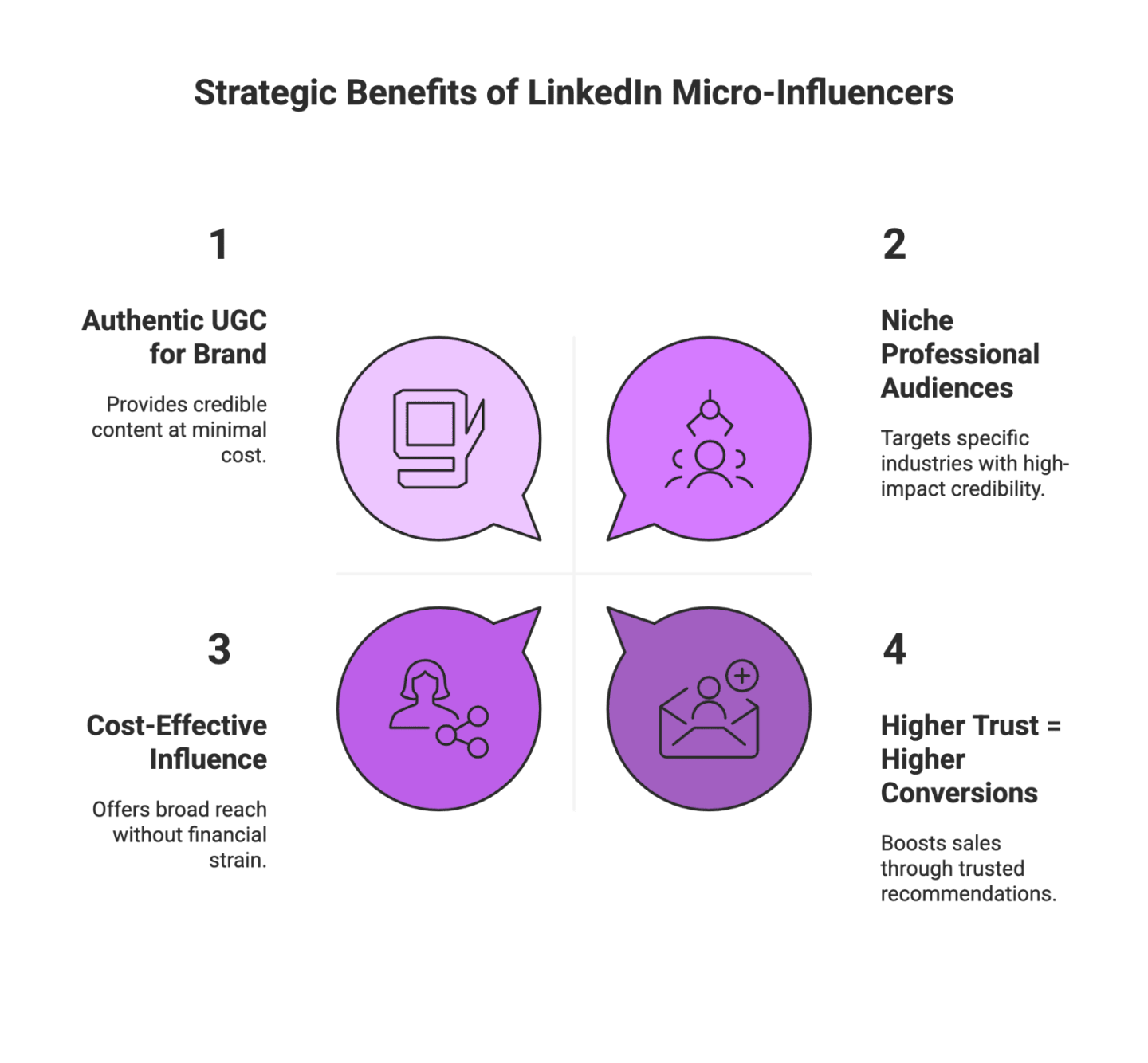
It’s worth highlighting how LinkedIn stacks up against other social networks when it comes to reaching business audiences and driving results. In short: LinkedIn is the heavyweight champion of B2B social media in several key areas.
One telling statistic: LinkedIn generates 80% of all B2B social media leads, dwarfing its peers. Twitter accounts for just 13% and Facebook 7% of B2B leads. That gap is huge. It means if you’re fishing for B2B prospects, 4 out of 5 fish are coming from LinkedIn waters. Why is that? Partly due to LinkedIn’s professional user base and powerful targeting capabilities, and partly because people on LinkedIn are in a business mindset. They’re actively looking for solutions, networking, and professional growth – so they’re more receptive to business-related products or services than the average Facebook scroller.
Chart: LinkedIn captures the lion’s share of B2B social media leads compared to Twitter and Facebook. This highlights LinkedIn’s unmatched reach in the B2B arena.
It’s not just lead volume. Marketers also rank LinkedIn as the most effective platform for driving high-quality B2B leads. In surveys, 79% of B2B marketers say LinkedIn is an effective marketing channel – far outpacing other platforms. The professional context of LinkedIn means that engagement on LinkedIn might be lower in quantity than on, say, Instagram, but it’s higher in quality. An Instagram influencer post might get 1,000 likes from consumers, while a LinkedIn micro-influencer’s post might get 50 likes – but if those 50 include CIOs, supply chain directors, or whoever your target buyer is, that’s gold.
Influencer trust is another differentiator. On consumer platforms, users know influencers are often paid to promote, and trust can vary. On LinkedIn, while sponsored collaborations exist, the nature of content is often more educational or thought-leadership in style, which tends to build trust. A recent study by Ogilvy found 67% of B2B influencer campaigns outperformed campaigns with only brand content (proving the value of influencer voices), and importantly 43% of marketers saw actual sales generated from B2B influencer campaigns. That implies LinkedIn influencers aren’t just creating “engagement for engagement’s sake” – they’re helping drive real business outcomes. Professionals following a LinkedIn creator often do so because they respect their expertise, so when that creator gives a nod to a product, it’s taken with a level of credibility that’s hard to replicate elsewhere.
To really drive the point home, let’s look at how LinkedIn micro-influencer marketing plays out in practice. Here are a couple of scenarios and cases that highlight the potential:
Tech giant Adobe partnered with niche influencers (industry experts and creatives) to promote a B2B asset on LinkedIn. The result? According to a TopRank Marketing case study, the influencer-led content generated twice the engagement of Adobe’s normal campaigns and boosted LinkedIn form-fill conversions by 150%. This is huge – it means those micro-influencers not only created buzz but also drove significantly more people to take action (in this case, filling out a form, likely for a download or lead gen). The success was attributed to the relevancy and trust these micro-influencers had with the target audience. Adobe’s brand message reached the right people in a voice those people found credible.
Not all Amazon sellers are targeting consumers only. Imagine an Amazon seller who offers high-end ergonomic office furniture. They’ve had success with consumer reviews on Amazon, but they want to break into bulk B2B sales (e.g., selling 50 standing desks at a time to a corporate office). They turn to LinkedIn. The seller partners with a micro-influencer who is an HR and workplace wellbeing consultant on LinkedIn. This influencer has maybe 10,000 followers consisting of HR managers, office administrators, and business owners – a perfect audience for ergonomic furniture. The influencer creates a series of posts about creating healthier workplaces, and in one video post, they feature the seller’s ergonomic desk and how it improved their own home office setup. The post sparks conversations among HR professionals about employee wellness. A few HR managers reach out to the Amazon seller asking for quotes for their offices. By using a LinkedIn micro-influencer, the Amazon seller entered the B2B realm, turning a consumer product into a business solution story. It’s a great example of how content creators can repurpose a product pitch into a thought-leadership topic that resonates with businesses.
In all these examples, the common thread is authentic, targeted storytelling delivered by individuals who have credibility with a specific audience. Whether it’s a formal program like Adobe’s or a scrappy collaboration by a small business, LinkedIn provides the stage for micro-influencers to connect brands with buyers in a way that feels organic and trustworthy.
LinkedIn is no longer just a place for job hunting – it’s a thriving ecosystem for micro-influencer marketing, brimming with opportunities for those who know how to use it. Brands, especially in the e-commerce and Amazon selling space, can gain a competitive edge by embracing this platform now rather than later.
In a nutshell, LinkedIn’s potential for micro-influencer marketing is massive and largely untapped. Brands that leverage the power of micro influencers, content creators, and authentic UGC on this platform can build stronger B2B relationships, drive high-quality leads, and ultimately boost sales. It’s about humanizing your marketing in a professional context. So go ahead – connect with those niche LinkedIn voices, share valuable content, and let LinkedIn micro-influencers be the secret sauce in your marketing strategy. The business results might just speak for themselves.
Micro-influencers – those social media creators with smaller but highly engaged followings – have become powerful allies for ecommerce sellers. They may not have millions of followers, but their influence often packs a punch in niche communities. In fact, brands earn an average of $5.78 for every $1 spent on influencer marketing, making it a channel worth mastering. But how do you know if a micro-influencer campaign is actually boosting your Amazon sales or ecommerce store revenue? Measuring Return on Investment (ROI) is the key.

Micro-influencers are generally defined as social media influencers with a following in the thousands or tens of thousands, not millions. Typically, a micro-influencer might have anywhere from around 1,000 up to 100,000 followers. What makes them special is their tight-knit, engaged audience. These creators focus on specific niches – whether it’s fitness, beauty, DIY crafts, tech gadgets, or any passion under the sun – and their followers trust their opinions.
Unlike mega-celebrities, micro-influencers often interact personally with followers, building a sense of community and authenticity. Their recommendations can feel like advice from a friend. This translates to higher engagement rates – studies show micro-influencers (under 100k followers) can have engagement rates up to 8%, versus roughly 1–2% for macro-influencers with huge followings. In other words, a micro-influencer’s posts usually get a larger percentage of likes, comments, and shares from their audience, indicating strong interest and trust.
For Amazon sellers and ecommerce brands, partnering with micro-influencers can be a game-changer. Here’s why these “small” creators can deliver big value:
Micro-influencers tend to have a personal, authentic rapport with their followers. They come across as genuine and relatable. When they recommend a product, it feels more trustworthy than a celebrity endorsement. In fact, micro-creators bring 60% more trust to a brand and a 20% higher conversion rate compared to macro-influencers. Their word-of-mouth style promotion carries weight.
As mentioned, micro-influencers often see higher engagement on their posts. Their audience is small but passionate, meaning more eyes on your product and active interactions. This engagement can lead to better conversion because followers are paying attention. A niche beauty guru with 15k followers might get 1,000 likes and a slew of comments on a makeup review – that level of interaction indicates an audience ready to buy if the product fits.
These creators often produce great content – photos, videos, tutorials – on par with professional quality, but with an authentic flair. Brands can repurpose this user-generated content (UGC) in ads, on product pages, or social media. It’s like getting a content creator and brand ambassador in one. In fact, short-form videos from micro-influencers (TikTok, Instagram Reels) are in high demand by brands to repurpose as ads. This additional value from content rights can improve overall ROI (you’re getting both promotion and creative assets).
In short, micro-influencers offer an attractive mix of authenticity, engagement, and affordability that is particularly well-suited for ecommerce marketing. Now, let’s talk about the million-dollar question: how do you measure the ROI of these micro-influencer campaigns?
Measuring ROI (Return on Investment) for an influencer campaign means figuring out what you got back versus what you spent. This can be direct sales revenue, but also other benefits like new customers or greater brand awareness. Here are the key metrics and methods Amazon sellers and ecommerce brands should use to gauge a micro-influencer campaign’s success:
Engagement Rate – This metric tells you how actively the influencer’s audience is interacting with the sponsored content. It’s usually calculated as (likes + comments + shares) / total followers × 100% for a post. A higher engagement rate means the content resonated. Micro-influencers often excel here – their engagement can be several times higher than that of macro-influencers. For example, an influencer with <50k followers might have a 5% engagement rate, while a celebrity with 5 million followers might barely hit 1%. One study found influencers under 100k followers can hit up to ~8% engagement, whereas mega-influencers see around 1–2%.Track the likes, comments, shares, saves, or views (for videos) on the posts where your product is featured. Compare them to the influencer’s usual numbers (and to other posts) to judge performance. High engagement is a positive signal that the campaign drew interest – which often precedes sales. You can also look at engagement quality: read some comments to see if people are asking about the product, tagging friends, or showing purchase intent (“This looks amazing, I need one!”).Sentiment and Feedback – Beyond numbers, gauge the sentiment. Are comments positive? Are people excited about your product or asking questions? Qualitative feedback can indicate how well the influencer communicated your brand message. It’s not a raw ROI number, but it’s part of the overall value (especially for brand reputation).
Ultimately, conversions (sales) are the core of ROI. To directly attribute sales to an influencer campaign, you need to set up tracking methods:
Using these methods, calculate the direct sales from the campaign. Then you can plug into a simple ROI formula:
ROI = (Total Revenue from campaign – Total Cost of campaign) / Total Cost × 100%.
If you spent $500 (in product samples + fees) on a micro-influencer and got $2,000 in sales from their referrals, that’s a (2000–500)/500 = 300% ROI. Not too shabby!
Note on Amazon: Amazon sales attribution is traditionally tricky because Amazon doesn’t share customer data with you. That’s why promo codes or Amazon Attribution links are so important for Amazon sellers doing influencer marketing. For instance, Amazon Associates affiliate links have a 24-hour cookie window (sales tracked within 24h of the click). If an influencer’s link led someone to Amazon and they purchased within that period, it credits that influencer. You’ll want to capture those direct conversions to properly measure ROI. If you can’t use an Amazon link or code, you might have to rely on a bump in sales rank or total units sold during the campaign period as an indirect indicator – but that’s less precise.
Customer Acquisition Cost is how much you spent to acquire each new customer from the campaign. To calculate CAC for the influencer campaign, divide your total campaign cost by the number of customers acquired from that campaign. For example, if you paid $200 to a micro-influencer (or in free product value) and you got 40 distinct customers to buy, your CAC is $5 per customer.
Why is this important? It lets you compare efficiency against your other marketing channels. Perhaps your Facebook ads have a CAC of $10, while this influencer’s CAC was $5 – that indicates the influencer partnership was cost-effective. On the other hand, if the influencer’s CAC comes out higher than your usual channels, you might need to optimize your approach or pick a different creator.
Make sure to include all costs in the calculation: the influencer’s fee, the cost of any free products or shipping you gave them, agency fees if any, etc.. If the influencer created content that you can reuse (which has its own value), you might mentally factor that in as a cost saving on content creation.
Also consider the quality of those customers. Did the influencer bring in first-time customers who might purchase again? That’s where the next metric comes in…
Not every benefit of influencer marketing is immediate sales – some of it builds brand awareness, which can pay off over time. If your campaign goal is more about visibility (like a new product launch or building a social following), you’ll want to measure these metrics:
While brand awareness metrics can be a bit “softer” than sales, they are important. They contribute to top-of-funnel growth. A person who didn’t buy today might buy next month after a few more exposures. You can assign an estimated value to these actions (for example, if you know 10% of people who visit your site join your email list and 5% of those eventually buy, you can derive some value from an influx of traffic). Over time, increased brand awareness driven by micro-influencers can lead to a lower cost of acquisition overall because more people are coming to you organically.
In summary, measuring micro-influencer ROI means looking at both direct response metrics (engagement and immediate sales) and longer-term metrics (CAC, LTV, brand growth). Next, let’s examine how different social media platforms stack up for influencer campaigns – because where you invest can be just as important as who you partner with.
Not all social platforms are created equal, especially when it comes to influencer marketing ROI. Some platforms are better for engagement, others make tracking easier, and some drive e-commerce sales more directly. Below is a comparison of major platforms – Instagram, TikTok, YouTube – and others like Pinterest or Facebook, looking at their engagement rates, how measurable the ROI is, and their suitability for e-commerce.
Figure: Average influencer engagement rate by platform. YouTube and Instagram top the list for engagement (8.2% and 7.4% respectively, on average), whereas TikTok shows a lower average engagement (0.9%) likely due to its high volume of content and views. Note that micro-influencers often exceed these averages – for example, TikTok micro-influencers boast an average ~13% engagement rate while Instagram micro-influencers average around 3–4%.
Now, let’s break down the platforms in a table for a side-by-side view:
(Engagement rates are approximate and can vary by niche. ROI measurability refers to how easy it is to attribute sales/conversions from that platform. E-commerce suitability is our take on how well the platform can drive product sales for brands.)
As you can see, Instagram and YouTube are strong all-around for engagement and conversions, while TikTok offers huge reach but requires savvy tracking to capture ROI. Each platform has its quirks – for instance, Instagram’s lack of link in posts vs. YouTube’s ease of linking – that affect how you approach ROI measurement.
Pro Tip: Don’t put all your eggs in one basket. You might start with the platform most aligned to your product (e.g., beauty/fashion does great on Instagram, gadgets on YouTube, quirky cheap buys on TikTok) but consider experimenting. Also, many influencers are cross-platform – you can have an influencer do a YouTube review and some IG posts, covering multiple bases.
Now that we’ve covered how to measure ROI and what platforms to consider, let’s get into some actionable tips specifically for Amazon and ecommerce sellers.
Ready to run a micro-influencer campaign and actually see the results? Here are some practical steps and tips to implement and measure ROI effectively for your Amazon or online store business:
Before the campaign, decide what ROI means for you. Is success going to be measured in sales revenue, number of units sold, new customers acquired, or an increase in social followers/brand awareness? Set a primary goal (e.g., 100 sales via this influencer’s code, or 5,000 new impressions of my brand) and a few key performance indicators. This will guide what you track. If it’s sales, your KPIs might be number of orders and revenue from the campaign. If it’s awareness, KPIs could be reach and engagement. Clear goals make it easier to measure ROI because you know what to look for.
This might sound obvious, but always use campaign-specific and influencer-specific tracking tools. If you have 5 micro-influencers promoting the same product, give each their own code (even if all offer the same 10% discount). Similarly, create separate UTM links or Amazon Attribution tags for each. This isolation lets you calculate ROI per influencer and also see who performed best. It also prevents any confusion about which sales came from where. There are tools that can generate hundreds of unique coupon codes quickly if needed. By using unique trackers, you’ll avoid the common mistake of not knowing which influencer drove a sale because two people used the same code.
For Amazon sellers, make full use of Amazon Attribution and the Brand Referral Bonus program. Amazon Attribution provides you a dashboard to see clicks and purchase data from external links. You can create an Attribution link for an influencer (pointing to your product listing or Storefront) and give it to them to use in swipe-ups, bio, etc. This is gold for ROI calculation because you’ll see exactly how many Amazon product page visits and purchases came from that link. Additionally, Amazon’s Brand Referral Bonus will credit a percentage (e.g., ~10%) of the sales back to you for driving external traffic – effectively boosting your ROI on paper. Check your Amazon Brand Analytics and business reports during and after the campaign; look at the timing of sales spikes relative to posts. If you see a jump on the day of an influencer’s post, that’s a strong indicator of impact (even if not every sale used the trackable link, you get a sense of lift).
Keep an ROI tracker spreadsheet or use an analytics tool to compile all the metrics in one place. Include columns for: influencer handle, platform, date of posts, $ spent (or product given), reach/impressions, engagements (likes, comments), clicks (if known), and conversions (sales revenue, units, new customers). By having it side by side, you can calculate things like engagement rate, conversion rate (purchases/clicks or purchases/views), cost per engagement, CAC, etc. This makes reporting easier. It also allows you to compare influencers. You might discover, for example, that Influencer A had fewer sales than Influencer B, but maybe Influencer A’s customers had bigger orders (higher AOV) – something you’d notice when analyzing the data holistically. The more systematically you track, the more insights you’ll gain to refine future campaigns.
Micro-influencer campaigns can deliver outsized returns for Amazon sellers and ecommerce businesses, as long as you measure and manage them smartly. These smaller creators bring authenticity and engaged audiences that can translate into real sales and loyal customers for your brand. By focusing on key metrics like engagement, conversion tracking (with those must-have codes and links), CAC, LTV, and brand awareness, you get a 360° view of your campaign’s impact.
Remember that ROI isn’t just about one metric; it’s the combined value of sales, new customers, and brand growth against what you invested. One campaign might boost your revenue immediately, while another builds your audience and pays off over the long run – both types of returns matter. Use the platform that best fits your product and make it easy to track results (the data is your friend!). And for Amazon sellers, take advantage of Amazon’s tools to capture every bit of attribution you can, since a lot can happen off-platform.
In the fast-paced world of social commerce, those who can effectively measure and optimize ROI will win. When you find the right micro-influencers and track everything, it’s like turning on a tap of scalable, repeatable revenue – you’ll know exactly how much you put in and what you get out. So go ahead and start forging those micro-influencer partnerships. With the strategies outlined here, you’ll be well-equipped to measure what matters and drive a profitable influencer marketing machine for your brand. Happy tracking, and may your ROI be ever in your favor!
Influencer outreach has become a game-changer for beauty and fashion e-commerce sellers, including many Amazon marketplace entrepreneurs. In fact, fashion & beauty is the #1 category for influencer marketing (21.6% of brands use it as a core strategy). Why the focus on influencers? Because social proof and authentic content can make or break a product’s success online. Micro-influencers – those niche content creators with modest followings – often deliver higher engagement and trust than big celebrities. For beauty and fashion products where visuals and credibility matter, these “everyday” creators produce relatable user-generated content (UGC) that resonates with target customers.
Especially for Amazon sellers, micro-influencers and content creators can provide an edge. Amazon’s platform is crowded, and shoppers rely on reviews and social media buzz. A network of micro-influencers posting makeup tutorials, outfit try-ons, or skincare routines with your products can drive external traffic and build trust in your brand. Moreover, micro-influencers are cost-effective – many will collaborate for free products or a few hundred dollars, versus the tens of thousands a mega-influencer might charge. Lower costs and higher engagement often mean a better ROI for small businesses. In short, if you’re an e-commerce seller in fashion or beauty, influencer outreach is one of the most powerful ways to boost visibility and sales in 2025.
Micro-influencers (typically 5,000–100,000 followers) punch above their weight in marketing impact. Here’s why outreach to these creators is worth your while:
Micro-creators often see 5–20% engagement rates, whereas macro influencers with huge followings average only ~1–3%. Their audiences are smaller but highly engaged – followers actually pay attention and trust their recommendations. This means a makeup tip from a micro beauty guru or a fashion haul from a niche stylist can drive more action than a generic celebrity ad.
Micro-influencers come across as real people and fellow consumers. They typically focus on specific niches (e.g. eco-friendly skincare, plus-size fashion) and have tight-knit communities. Their content feels like friendly advice, not a blatant ad, which is gold for earning consumer trust. This authentic style is crucial in beauty/fashion, where shoppers seek honest opinions and demonstrable results.
The photos, videos, and reviews that micro-influencers create can be repurposed as user-generated content (UGC) in your own marketing. In fact, 66% of brands plan to repurpose micro-influencer content in ads (e.g. TikTok Spark Ads) because it performs so well. For Amazon sellers, this means you might feature an influencer’s demo video on your Amazon listing or use their styled photos on your Instagram and product pages. This social proof builds credibility and can boost conversion rates.
In summary, influencer outreach allows beauty and fashion sellers to tap into authentic voices that speak to your audience. Next, let’s explore how to find the right micro-influencers and attract them to work with your brand. In summary, influencer outreach allows beauty and fashion sellers to tap into authentic voices that speak to your audience. Many brands formalize these collaborations through an influencer program that helps structure partnerships, track performance, and scale creator relationships effectively.

Start by searching for content creators in your niche. On Instagram and TikTok, use hashtags and keywords related to your product (e.g. #skincare, #fashionfinds, #AmazonFinds) plus terms like “review” or “unboxing.” Look for micro-influencers in the 5K–50K follower range who regularly post content relevant to your brand. Check their engagement (do they get meaningful comments and likes from real followers?) and ensure their style and values align with yours. Tools like influencer databases or even a quick scan of your own followers (there might be budding influencers already loving your products!) can help surface good candidates. Remember, quality beats quantity – a smaller creator with a passionate following in your niche is more valuable than a bigger account with disengaged or mismatched followers.
Before reaching out, warm up the relationship. Follow the influencers on their platforms and engage genuinely: like their recent posts, leave an insightful comment, or share their content. This puts you on their radar in a positive way. Also, take notes on specifics – did they mention loving a type of product you offer? Do they have a distinct style or catchphrase? Finding these personal details will help you craft a personalized email that shows you truly know their content. Finding these personal details will help you craft personalized custom coded email templates that demonstrate you truly understand their content.
If you’re short on time, consider using influencer marketing platforms such as Stack Influence which can match you with creators and even manage outreach. These can be especially useful to find content creators or UGC specialists in beauty/fashion. However, they often come with fees. For many scrappy Amazon sellers and small brands, a personal, DIY outreach via email or DM works great to start – it adds a human touch and saves budget for the actual collab incentives. When using email for outreach at scale, technical email setup—including practices like SPF flattening—can help ensure your messages are delivered reliably and avoid being flagged as spam
An overview of the influencer outreach “funnel.” You start with many potential influencers at the top, then narrow down through outreach and follow-ups, finally resulting in successful collaborations at the bottom. The goal is to move prospects from identification to interest to partnership.
In the graphic above, we see the influencer outreach funnel in action: First, you identify a pool of micro-influencer prospects (wide top). Next, you send out initial outreach emails to introduce your brand and collaboration idea. Some of those prospects will respond positively – these are your interested influencers (the funnel narrows). You might exchange more details or follow up, and finally a handful will agree to come on board, leading to successful collaborations (the narrow bottom of the funnel). This visual reminds us that influencer outreach is a numbers game and a process: not every contact will convert, but by optimizing each stage (target the right creators, write compelling emails, follow up politely), you maximize your chances of attracting enthusiastic micro-influencers to your campaign.
Not all influencer emails are created equal. Here’s a comparison of elements in a good outreach email versus a bad one, so you can ensure your message hits the right notes:
Now that you have a list of potential micro-influencers and a plan to entice them, it’s time to reach out. The key is writing an outreach email that stands out in their inbox and clearly communicates your proposal. Let’s break down how to write the perfect outreach email, step by step.
Takeaway: a good outreach email feels like a personalized invitation to a mutually beneficial partnership, whereas a bad email feels like spam or a demand. Use the “good” column as a checklist when finalizing your emails. Many e-commerce sellers are also turning to AI workspaces for multiple LLMs to draft outreach emails, brainstorm campaign ideas, or even analyze influencer profiles - saving time while maintaining a personal touch.
Mastering the art of influencer outreach takes a bit of effort, but it’s well worth it for beauty and fashion e-commerce sellers looking to amplify their brand. Micro-influencers and content creators can help you unlock new audiences, create buzz around your products, and generate valuable UGC that builds trust with customers. Remember, the key ingredients are authenticity, personalization, and a clear win-win proposition. When your emails don’t feel like spam, but rather like an exciting invitation, creators will be eager to partner with you.
Now that you’re equipped with outreach strategies, and comparison guides, it’s time to put this into action. Pick a few promising micro-influencers in your niche, apply these tips to craft your perfect email, and hit send! Keep track of responses and be ready to negotiate details once you get interest. With each collaboration you secure, you’ll gain not just a boost in sales, but also a valuable relationship for future campaigns – many micro-influencers become long-term brand ambassadors when treated right.
Voice search isn’t just a sci-fi gimmick or a tool for the lazy – it’s quickly becoming a must-have strategy for anyone creating content online. Whether you’re a micro influencer sharing makeup tips, an Amazon seller in e-commerce showcasing product reviews, or a creative content creator dabbling in UGC (user-generated content), optimizing for voice search can amplify your reach. In this post, we’ll break down what voice search is, why it matters for influencer content, and how you can tweak your content (and even product listings!) to ride the voice search wave.
Voice search simply means using spoken commands or questions to search the internet (or apps) instead of typing. Think of asking Siri, Alexa, or Google Assistant a question and having it talk back with an answer. For example, a person might say, “Where is the best coffee shop in Dallas?” rather than typing “coffee shop Dallas”. Voice queries tend to be more natural and conversational, often full sentences or questions, just like we speak in real life. The goal for us as creators: make sure our content is the one these voice assistants read aloud as the answer!
Why should influencers and content creators care? Because voice search usage has exploded. As of 2023, users were making over a billion voice searches each month, and more than 50% of adults use voice search daily. People aren’t just asking for the weather or trivia anymore – they’re also shopping and finding content via voice. In fact, shopping via voice (think “Alexa, order me a protein shake”) is projected to reach around $164 billion by 2025. That’s a huge chunk of e-commerce! If you’re an Amazon seller or an influencer driving affiliate sales, you want in on that action. And it’s not just big brands optimizing for this – in 2022, 40% of brands had plans to tap into voice search marketing, which means smaller creators need to hustle too to stay competitive.
Bottom line: Voice search matters. It’s how a growing number of people find answers and products. If your content isn’t optimized for those “Hey Google” or “Alexa” moments, you could be invisible to a big segment of your audience.
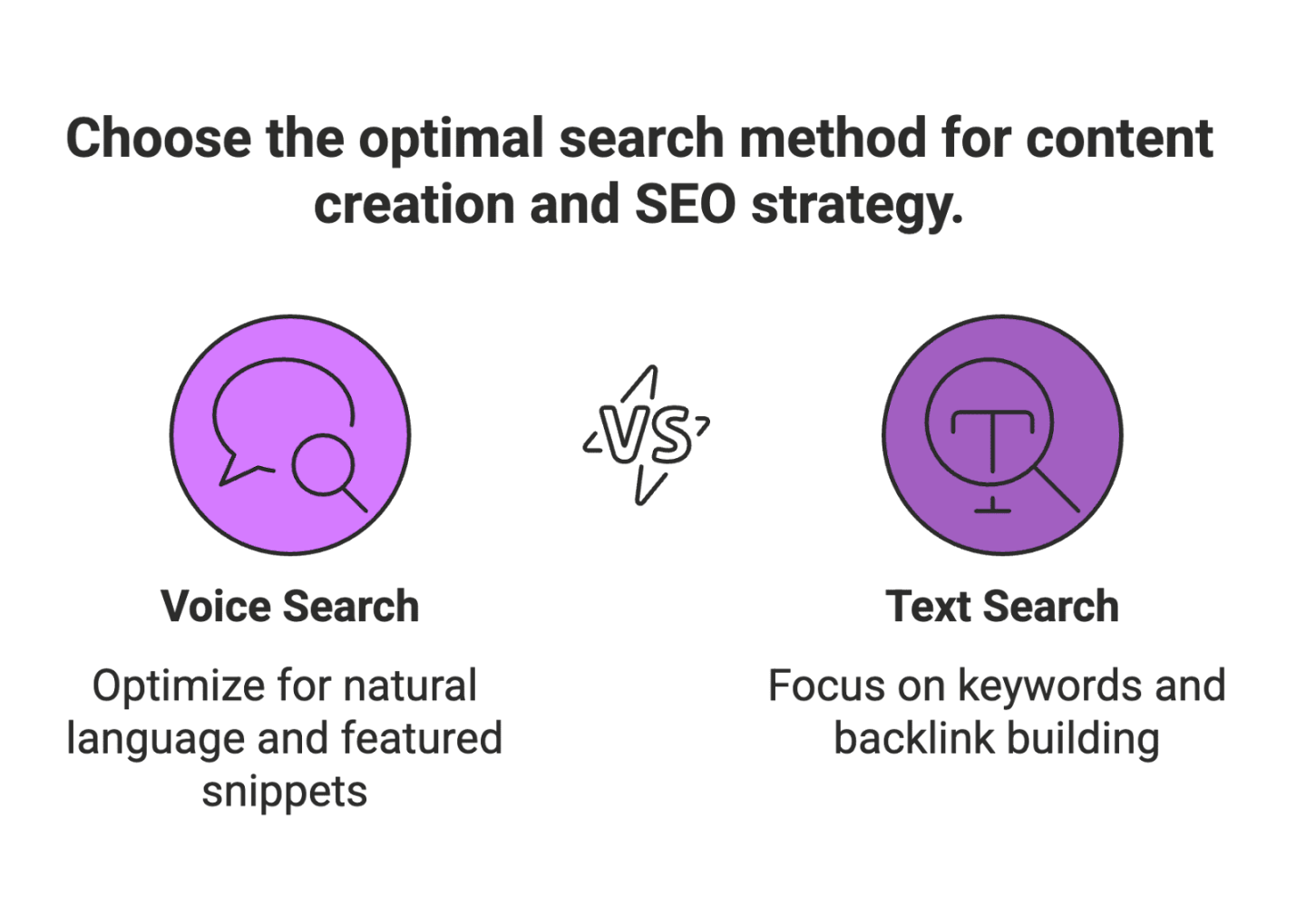
You might be thinking, “Isn’t search just search?” Well, not quite. There are some key differences between voice searches and traditional typed searches that impact how we should create content:
Figure: Voice vs. Text Search – Key Differences. Voice searches tend to be longer, question-like, and conversational, while text searches are short and keyword-based. Voice results often come as a single spoken answer (usually drawn from a featured snippet), whereas text search shows multiple results on a page. For content creators and micro influencers, this means optimizing for the natural questions your audience might ask out loud, not just terse keywords.
Still not convinced? Let’s explore why voice search is a game-changer for influencers, micro influencers, and creators:
In summary, partnering with Gen Z micro-influencers and leveraging UGC can yield a triple threat for e-commerce sellers: more trust (thus higher conversion rates), more visibility (both on social media and on Amazon’s search), and more engagement (meaning a stronger brand community and feedback loop). It’s authentic marketing that delivers.
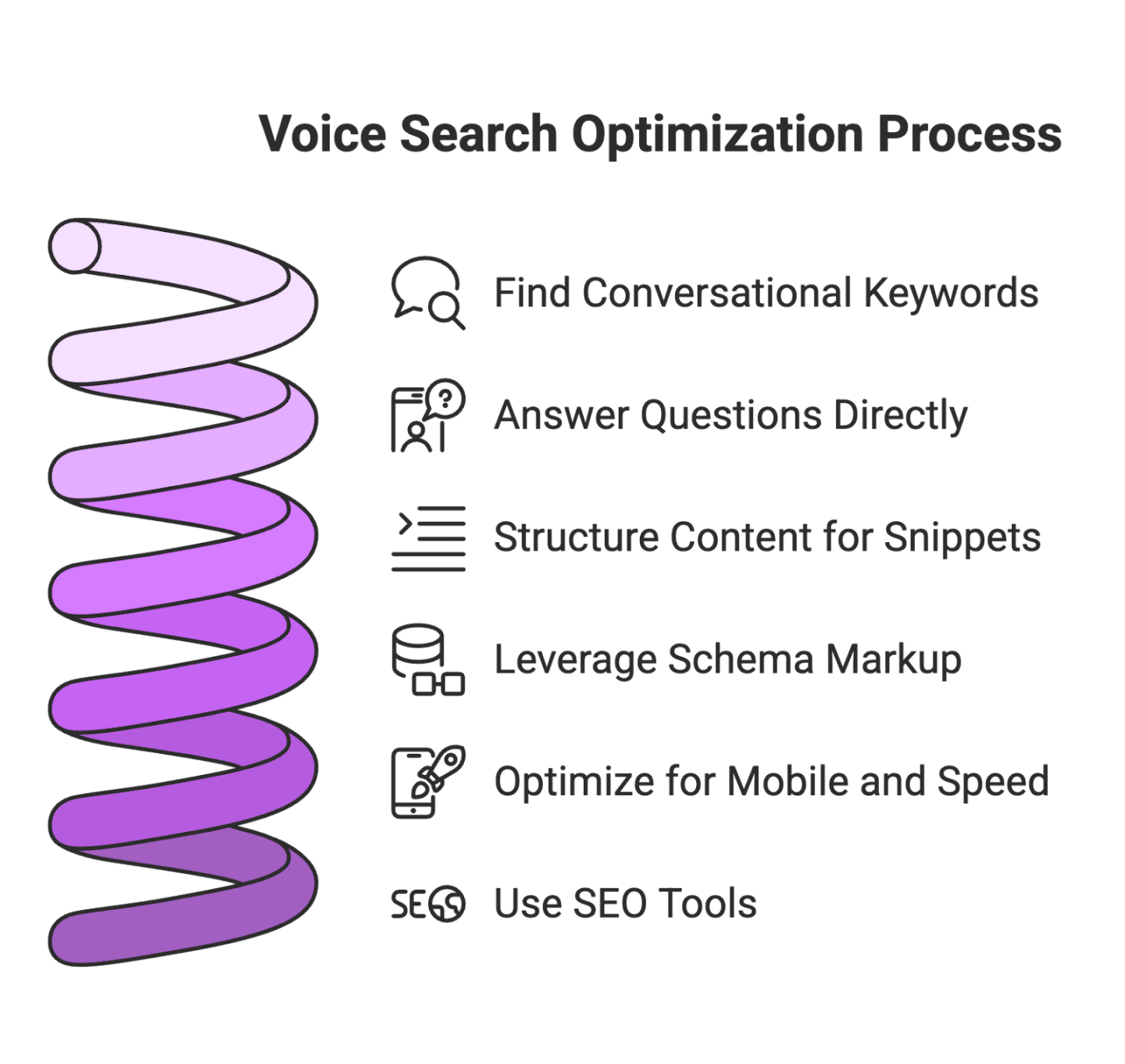
Alright, so voice search is important – now how do you actually optimize your content for it? Don’t worry, you won’t need to learn rocket science or fluent “robot”. It’s mostly about tweaking your SEO strategy to be more conversational and answer-focused. Here are the steps and tips to get your content voice-ready:
1. Find Conversational Keywords & Questions: Start by researching what your audience might ask out loud. Voice SEO still involves keyword research, but you’re looking for natural phrases and long-tail questions rather than single words. Think like your follower: instead of searching “skincare routine dry skin”, they might ask “How should I take care of dry skin in winter?”. Use tools like AnswerThePublic or Google’s autocomplete to discover common questions in your niche. For example, typing your topic on AnswerThePublic will show a web of real questions people ask. If you’re a micro influencer in fitness, you might find questions like “how to lose weight with HIIT” or “what to eat after a workout”. Pro Tip: Target those question words – who, what, when, where, why, how – and include natural filler words (e.g. “the,” “for,” “to”) to mimic how questions are phrased in real life. In short, make a list of the top questions your content can answer.
2. Answer Questions Directly (and Quickly) in Your Content: Once you know the questions, make sure your content directly answers them – ideally immediately after posing the question. If your blog post is titled “How to Connect a DSLR to Your Computer,” don’t beat around the bush. In the introduction or right under the heading, give a concise answer or definition. Voice assistants love concise answers – the average snippet answer is about 29 words. For example, if the question is "What is a ring light?", you might answer: “A ring light is a circular light that fits around a camera lens or smartphone, used to provide uniform illumination for photography or video.” See how that gets straight to the point? Do that, and do it for each question you target. Cut the fluff – be clear and helpful. You can always elaborate more below, but give the quick answer first (this increases your chance of snagging that featured snippet spot).
3. Structure Your Content for Snippets and Voice Readability: Format matters. Use clear headings (H2s, H3s) that often mirror the question. For instance, a section titled “How do I clean a cast iron skillet?” is perfect – it’s exactly what someone might ask their voice assistant, and it signals to Google that a direct answer lies below. Then, underneath that heading, deliver a step-by-step or a brief answer. Utilize bullet points or numbered lists for steps or tips. Why? Because Google often pulls list items for “How to” queries, and voice assistants read them out one by one. By structuring your content with lists, FAQs, and clear sections, you make it easier for the AI to digest and regurgitate your wisdom. Think of each section of your content as a potential Q&A snippet.
4. Leverage Schema Markup (FAQ and How-To Schema): This sounds technical, but it’s not as scary as it seems. Schema markup is like a behind-the-scenes label for your content that helps search engines understand it better. For voice search, two types of schema are super useful: FAQ schema (for pages with frequently asked questions and answers) and HowTo schema (for step-by-step guides). By adding schema to your page’s HTML (or using a plugin if you’re on WordPress), you basically hand-feed Google the Q&A in a format it likes. This can increase your chances of appearing as rich results or being picked up for voice answers. For example, if you have a cooking blog, marking up your recipe’s steps with HowTo schema might make Google more likely to vocalize your recipe when someone asks “How do I bake chocolate chip cookies?”. If coding isn’t your thing, don’t fret – tools like Google’s Structured Data Markup Helper let you fill out a form and generate the code. It’s worth the extra effort for that sweet snippet advantage.
5. Optimize for Mobile and Speed: Most voice searches happen on mobile devices, and often on spotty connections. Plus, if a voice assistant is pulling info from your site, it needs to access it quickly. So a mobile-friendly, fast-loading site is crucial. Use Google’s Mobile-Friendly Test and PageSpeed Insights to check your site’s performance. Simple things help: use a clean, responsive theme, compress your images, and minimize those fancy but heavy scripts. Also, make sure your content is easy to read on a small screen (large font, short paragraphs – which you’re already doing, right? 😉). If people click through to your site after a voice query, you don’t want them pinching and zooming or waiting 10 seconds for it to load.
6. Use the Right Tools (They Make Life Easier): Don’t go it alone – there are some great SEO tools to help with voice search optimization. A few worth checking out:
By following these steps – from keyword research to site speed – you’ll cover the bases for voice search optimization. Essentially, you’re helping the algorithms understand and trust your content to answer user questions quickly and accurately.
What if your “content” is an Amazon product listing or you’re in the e-commerce space? Good news: the principles of voice SEO still apply, with a few e-commerce twists. Many shoppers use voice assistants (like Alexa) to find and buy products, so Amazon sellers should pay attention. Here are some tips tailored for voice search in e-commerce:
1. Use Natural Language in Product Listings: Write your product titles and descriptions in a conversational way, not just a string of keywords. Think about what customers might ask Alexa about your product. For example, instead of a title like “4K Camera, 20MP, Night Vision, Model XYZ,” use a more descriptive tone: “Model XYZ 4K Camera with Night Vision – High-Resolution 20MP Photography.” Include phrases a user might say, like “does it work in low light?” (if you can fit that naturally). The idea is to answer questions within your listing so Alexa can pick up those answers.
2. Answer Common Customer Questions: Anticipate what customers usually ask about your product category and address it in your description or a FAQ section on your listing. If you sell skincare, for instance, answer questions like “Is this product good for sensitive skin?” in your bullet points or description. By doing so, you’re aligning your content with the queries voice assistants get. Amazon’s algorithm appreciates listings that directly resolve customer curiosities – it makes Alexa’s job easier when she has to answer a question about your product.
3. Strive for Amazon’s Choice and BestSeller Badges: This isn’t a direct “content” tip, but it’s huge for voice visibility. Alexa often defaults to recommending products that have the “Amazon’s Choice” badge or are top-rated bestsellers. Earning these badges (through great sales performance, ratings, and Prime availability) will "shoot the visibility of your product through the roof" in voice results. In simpler terms: Alexa trusts popular, well-reviewed products. While you can’t just magically get a badge, focusing on good reviews, competitive pricing, and proper categorization can help you earn them – and thus earn Alexa’s favor.
4. Optimize Your Backend Keywords and Data: Amazon allows sellers to add “hidden” keywords in the backend of your listing (Seller Central). Max out those backend fields with relevant terms and natural language variations. Also, fill in all attribute fields (like color, size, uses, etc.). This thorough metadata helps match your product to voice queries. For example, if someone says “Alexa, find an organic cotton baby blanket,” and your listing’s backend includes “organic cotton baby blanket” (or your title/description does), you have a higher chance to be picked. Comprehensive listings (front and back) are more discoverable in voice queries.
5. Encourage Reviews and UGC: User-generated content isn’t just for social media – on Amazon, it’s the reviews and the Q&A section. These are invaluable for voice search. Positive reviews with relevant keywords can influence ranking (there’s a theory that a few high-quality reviews can trigger Amazon’s voice algorithm to favor your product). Also, if a user asks Alexa something like “Is this vacuum cleaner good for pet hair?”, Alexa might pull info from the product’s Q&A or summarize reviews. Encourage your buyers to leave reviews, and answer the questions in the Q&A section promptly. Having that UGC on your listing not only builds trust with shoppers, but it literally provides ready-made voice-friendly content for Alexa to use.
By treating your Amazon listing like a piece of content to optimize, you stand to gain more exposure in the era of voice commerce. Many of these tips overlap with good Amazon SEO practices in general – the twist is to always think, “What would my customer say when looking for a product like mine?” and make sure those words are echoed in your listing.
Voice search isn’t the future – it’s the now. With more people chatting up their phones and smart speakers every day, savvy influencers and content creators are adapting their content to speak back. The great news is that optimizing for voice search dovetails with creating better, clearer content for your audience. By focusing on natural language, answering questions upfront, and structuring your posts (or product pages) for quick answers, you’re not only pleasing the algorithms (both the Google kind and the Alexa kind) but also delivering value to your readers and customers faster.
For micro influencers, this is a chance to punch above your weight – your niche expertise can shine when someone asks a specific question that you’re perfectly positioned to answer. For Amazon sellers, voice search optimization might put your product in that coveted spoken recommendation from Alexa. And for all content creators, embracing voice search strategies will help future-proof your content for the evolving ways people find information.
So start implementing these tips today. Do a little question brainstorming, tweak that blog post or product listing, and maybe even ask your smart speaker a question to see what comes up. With a few adjustments, you can make sure that when your audience talks, your content is ready to talk back – loud and clear.
Keep the conversation going (literally and figuratively) by optimizing for voice, and you’ll be in a prime spot as both search engines and searchers continue to gravitate toward hands-free, voice-driven content discovery. Happy optimizing, and may your voice (search) be heard! 🎙️
Launching a micro-influencer campaign on YouTube Shorts can skyrocket your product’s visibility and credibility – all without breaking the bank. In this guide, we’ll walk e-commerce entrepreneurs, Amazon sellers, and brand marketers through the entire process in a casual yet informative tone. You’ll learn why partnering with micro influencers (smaller-scale content creators) in niches like fashion, makeup, and lifestyle is a game changer for user-generated content (UGC) marketing. We’ll cover everything from planning your campaign and finding content creators to collaborating on short-form videos and measuring results. By the end, you’ll have a clear roadmap to harness YouTube Shorts and UGC for your e-commerce brand’s growth.
Before diving into the how-to steps, let’s quickly explore why micro-influencers are ideal for UGC-driven campaigns on YouTube Shorts. These smaller creators bring several unique advantages over big-name influencers:
Micro-influencers often have a tight-knit rapport with their followers, so their recommendations feel like advice from a friend. In fact, over 82% of consumers in one survey said they are highly likely to follow a micro-influencer’s recommendation. Another study found 61% of consumers believe micro-influencers deliver more genuine and trustworthy endorsements than larger influencers. This authenticity leads to greater trust and influence on purchase decisions.
Smaller audience = more engagement. Micro creators typically see engagement rates of 4–8%, significantly higher than the under-3% rates of mega-influencers. For example, on YouTube a micro-influencer with under 100K followers averages about 5.7% engagement, versus around 2.4% for influencers over 100K. This means their followers are more likely to like, comment, and share – amplifying your campaign’s reach.
Micro-influencers are budget-friendly, which is great news for small businesses and Amazon sellers. Rather than paying one celebrity influencer $50,000 for a single post, you could work with dozens of micro-influencers for product samples or modest fees. A whopping 88% of marketers say that micro-influencers (10K–100K followers) provide a high return on investment compared to larger influencers. You get more content and more voices for your money – truly a high-ROI approach.
YouTube Shorts is a hot platform, with over 70 billion daily views on Shorts content. Crucially, the YouTube algorithm pushes Shorts out to viewers even if they aren’t subscribed to the creator. That means a micro-influencer’s short video featuring your product could surface in front of millions of new eyes, far beyond their follower base. This built-in discovery factor is huge for brand awareness – your message can pop up in the feeds of potential customers who’ve never heard of you.
As you can see, micro influencers + YouTube Shorts = a match made in marketing heaven. You get authentic, high-engagement content delivered to a massive audience, without the massive price tag of celebrity influencers. Now, let’s get into the step-by-step of launching your campaign.

Every successful campaign starts with a solid game plan. Begin by outlining your goals, target audience, and KPIs for the micro-influencer campaign:
Decide what you want to achieve. Is it boosting brand awareness in your niche? Driving traffic to your Amazon product listing? Increasing sales using a special promo code? For example, an Amazon seller might set a goal to increase product page visits by 30% and get 50 new customer reviews via the campaign. Clear goals will guide all your decisions.
Who are you trying to reach on YouTube Shorts? Define your ideal customer demographics and interests. If you sell athleisure wear, maybe it’s women 18–35 who follow fitness and fashion content. For a home gadget, maybe it’s DIY enthusiasts or busy parents. Knowing your audience helps you find micro influencers who speak to that same crowd.
Think ahead about how you’ll use the content and measure success. For instance, you might plan to repurpose the best Shorts videos on your own social media or product pages (with permission). Key performance indicators could include YouTube Shorts views, engagement (likes, comments, shares), click-throughs to your site or Amazon page, and ultimately conversions or sales. If you give influencers a unique discount code or affiliate link, track how many sales each code generates.
Taking the time to define these elements will make the next steps much smoother. You’ll have a clear idea of what kind of influencers to target, what success looks like, and how the campaign fits into your overall e-commerce marketing strategy.
Now that your goals are set, it’s time to discover the micro influencers who will bring your campaign to life. Finding quality creators in your niche (fashion, makeup, lifestyle, etc.) who actively post on YouTube Shorts is crucial. Here’s how to track them down:
Start right on YouTube. Browse the Shorts feed and use the Explore tab to see what’s trending. YouTube Shorts content is exploding in popularity (over 70B daily views), and most influencers – big and small – are using Shorts to grow. As you scroll, pay attention to creators in your product category. The beauty of Shorts’ algorithm is it will show you popular videos even from creators with modest followings. If a micro-influencer’s Short on a topic related to your brand is getting traction, they might be a great fit.
Use YouTube’s search bar with niche hashtags or keywords. Many creators tag their Shorts with relevant hashtags to increase discoverability. For example, an eco-friendly fashion brand might search #sustainablefashion or a makeup brand might try #makeuptutorial on YouTube. This can unearth tons of micro creators. For instance, the hashtag #travelgadgets has over 5.4K videos and 1.8K channels associated with it – a goldmine if you sell travel accessories. Jot down creators who consistently post in your niche and have decent engagement on their Shorts, even if their subscriber count is on the smaller side.
Consider using influencer discovery tools or platforms (there are both free and paid ones) where you can filter creators by follower count, niche, location, etc. Some platforms aggregate YouTube (and Instagram/TikTok) data to help find micro-influencers. For example, you might filter for YouTube creators in “beauty” with 10k–50k subscribers and high engagement. This can save time and reveal creators you might miss in manual search. Many micro-influencers have 10,000–100,000 followers by definition, but remember engagement and content style matter more than exact numbers.
By the end of this discovery phase, you should have a solid roster of maybe 5–15 micro-influencers that you’d love to work with. Having multiple options is good – remember, partnering with several micro-influencers can generate a steady buzz around your brand. The next step is reaching out and getting them on board!
You’ve found your dream team of micro creators – now it’s time to get them excited about working with you. Outreach is an art: you want to be professional but also personable. Here are tips for approaching micro-influencers to secure a collaboration:
Avoid generic copy-paste emails or DMs. Micro-influencers value authentic relationships. Start by introducing yourself and expressing genuine appreciation for their content (“I loved your recent YouTube Short about summer makeup hacks…”). Mention specifically why you think they’re a great fit for your brand or product. This shows you’ve done your homework. A tailored, sincere outreach is far more likely to get a positive response.
Clearly explain what’s in it for them and for you – a win-win. For instance, offer to send a free product sample for them to try (and keep), and propose that if they love it, you’d sponsor a Short on their channel featuring the product. If you can, sweeten the deal: maybe they also get an affiliate link or discount code to share, so they earn a commission on any sales they drive. Many micro influencers are open to UGC gifting collaborations where they receive product in exchange for content, especially if the product aligns with their interests. If you have a budget for paid sponsorship, mention that too. Make the partnership sound exciting: e.g., “I think your audience of fitness enthusiasts would enjoy seeing how our new athleisure leggings perform – and we’d love to feature your creative take on it!”
Outline the basics of what you’re asking for, but keep it flexible and collaborative. For example: “We’d love for you to create one or two YouTube Shorts showing how you use our product in your daily routine. Feel free to be as creative as you like – your authentic style is what we value! We can also repost your Short on our brand’s channels (with credit to you).” Emphasize that you’re seeking their creativity and honest voice, not a scripted ad. Micro-influencers are content creators, so they’ll appreciate that creative freedom.
When an influencer replies with interest, be prompt in continuing the conversation. Many will have questions – answer them honestly. Once they’re on board, it’s time to firm up the collaboration and get creative!
With your micro-influencers lined up, it’s collaboration time. This step is all about guiding the content creation process for those YouTube Shorts while letting the creator’s authenticity shine. Here’s how to coordinate effective (and fun) content production:
After an influencer agrees to partner, send them a brief outlining the campaign details. This should cover the essentials: product info (key features or unique selling points they might want to highlight), the objectives (e.g. a demo, a before-and-after, a trend challenge featuring the product), any required messaging (like a tagline or hashtag), and the posting deadline. Keep it concise and easy to digest – a one-page brief or a short email is ideal. The goal is to align on expectations without micromanaging.
Encourage the creator to be themselves and speak in their own voice. The beauty of micro-influencer content is that it feels like user-generated content, not a polished advertisement. Let them know you value their honest opinion and creativity. If you’re an Amazon seller, you might say, “Feel free to share what you really think of the product – even if it’s in a playful way – as long as it’s honest. Audiences appreciate transparency.” Real reactions or demonstrations (like unboxing the product on camera, or showing a quick tutorial using it) make for compelling Shorts.
Since the content will be on YouTube Shorts, make sure the influencer optimizes for that format. Remind them of a few Shorts-specific tips (they likely know, but it shows you understand the platform too):
It’s great to share ideas (“We’ve seen trending ‘day in the life’ Shorts – maybe you could do one that features using our protein shaker in your morning routine?”), but avoid writing a script for them. Micro-influencers know what resonates with their viewers. Maybe you provide a few bullet points of features to mention, but let them put it in their own words. This ensures the content feels organic. Remember, micro-influencers speak from the heart, which resonates with folks – that genuine style is what you want.
By collaborating closely and respecting the creator’s style, you’ll end up with authentic Shorts content that audiences love. The influencer gets creative freedom and a cool partnership, and you get a fantastic piece of UGC that showcases your product in a real-world context. Now, let’s launch this thing!
This is the moment of truth – your micro-influencers are ready to hit “Upload” on their YouTube Shorts featuring your product. Launching the campaign involves more than just letting those videos go live. Here’s how to make the most of the launch phase:
If working with multiple influencers, try to have them post within a relatively short window (a few days) so the campaign feels like a “blitz” of content about your brand. This can amplify buzz as viewers might see multiple Shorts from different creators all talking about your product. However, staggered slightly can also help if you want steady momentum – there’s no one right way. Just avoid having one video go out and the next one not until months later, which loses impact.
Once a Short is live, be active in the comments. As the brand, you (or your social media manager) should like and comment on the video, thanking the creator and responding to early commenters. Encourage the influencer to engage with their audience’s comments as well. Early engagement can help trigger the algorithm to show the Short to more people. Plus, when viewers see the brand genuinely interacting, it reinforces authenticity and trust.
During launch, stay communicative with your influencers. They’ll appreciate hearing from you, whether it’s sharing the excitement of a video blowing up or troubleshooting if something goes awry (like if they accidentally forgot to tag your product or add the disclosure – it happens, just politely remind them). Most of all, enjoy the process – seeing your product promoted in creative ways by enthusiastic micro-influencers is both rewarding and a lot of fun.
Launching a YouTube Shorts micro-influencer campaign might seem like a lot of moving parts, but with this step-by-step guide, you can tackle it confidently. The key takeaways? Micro-influencers offer authenticity, engaged audiences, and niche appeal that can give e-commerce brands (from Shopify stores to Amazon FBA sellers) an edge. Coupling that with the viral potential of YouTube Shorts – a platform where even a 30-second clip can reach thousands or millions thanks to YouTube’s algorithm – is a recipe for marketing success.
By carefully planning your goals, choosing the right content creators, fostering genuine collaborations, and optimizing for the Shorts format, you create a campaign that feels organic rather than ad-like. The content delights viewers (because it’s fun and relatable UGC), the influencers build their cred and maybe earn a little extra, and your brand gains exposure, credibility, and hopefully a nice uptick in sales. It’s truly a win-win-win scenario.
So, whether you’re an Amazon seller looking to get more eyes on your product listing, or an online boutique hoping to explode on social media, don’t overlook micro-influencers on YouTube Shorts. As the social landscape shifts towards quick, digestible video content, those genuine micro creators can be your secret weapon to cut through the noise. Now, go forth and start planning your own micro-influencer campaign – your future customers are scrolling Shorts at this very moment, and your product could be the next thing to catch their eye!
Generation Z (born ~1997–2012) is emerging as a powerhouse in e-commerce. By the mid-2020s, Gen Z will influence nearly 40% of consumer spending worldwide. Even Gen Z teens wield outsized sway – 93% of parents say their Gen Z child influences household purchases. For Amazon sellers and e-commerce brands, this means the youngest adult generation can make or break product success. But marketing to Gen Z isn’t business-as-usual; this digital-native group has unique behaviors and values.
Always online and highly social: Gen Z practically lives on their smartphones and social apps. 85% of Gen Z uses social media to discover new products, scrolling TikTok, Instagram, and YouTube for the latest finds. They trust what their peers and favorite creators share more than traditional ads. In fact, 89% of Gen Z say authenticity matters more than polished advertising – they can spot a fake corporate voice a mile away. They also rely on real customer input: over two-thirds check online reviews or peer recommendations before buying. This generation craves authentic connections with brands, preferring content that feels real, unfiltered, and relatable. The takeaway? To win Gen Z’s business, e-commerce sellers must be authentic – and one of the best ways is teaming up with Gen Z micro-influencers and leveraging genuine user-generated content (UGC).
Given these traits, micro-influencers – niche content creators with modest followings – have become Gen Z’s trusted trendsetters. Instead of glossy celebrity endorsements, Gen Z responds to “people like me” sharing honest opinions. A recent study found Gen Z is 3.2× more likely to trust a product recommendation from a micro-influencer than from a traditional celebrity (69% vs 22% trust). They also prefer UGC over brand-produced content by a wide margin. In other words, authentic marketing through relatable Gen Z content creators is the key to engaging this cohort.
So how can e-commerce brands – especially Amazon sellers – tap into Gen Z micro-influencers and UGC to boost engagement? Let’s dive into practical strategies for finding these creators, collaborating on content, and driving real results.
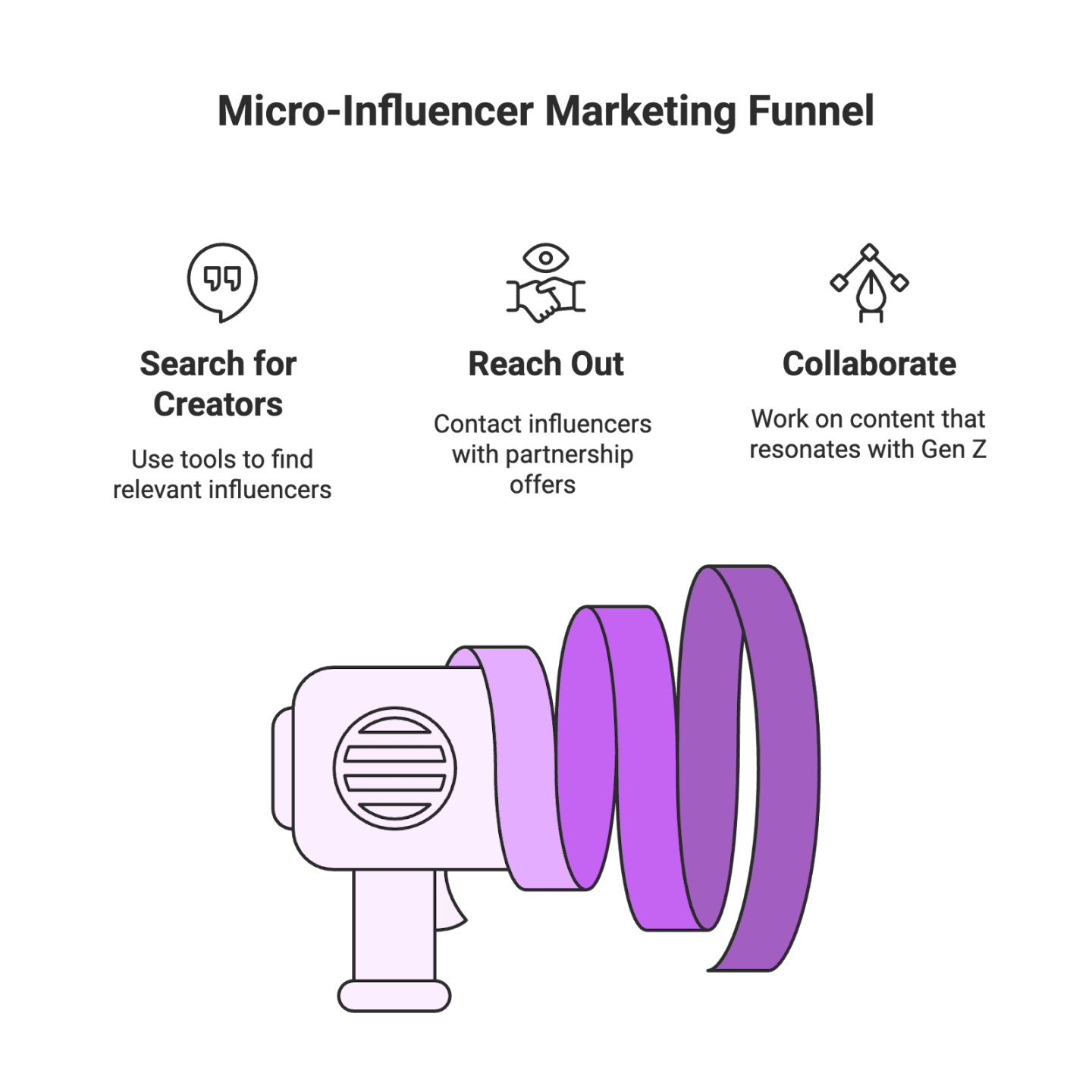
Not all influencers are created equal. When targeting Gen Z, bigger isn’t always better – micro-influencers (often 5,000 to 100,000 followers) can have outsized influence in their niche. These creators tend to cultivate tight-knit communities and high engagement, rather than mass but passive followings. Their audiences see them as genuine peers, which makes their recommendations more impactful. For example, a micro-influencer’s shoutout about a product feels like advice from a friend, whereas a celebrity’s promo might feel like an ad. Cost-wise, micros are also far more accessible for small businesses (many charge only $100–$500 per post vs. tens of thousands for a mega-influencer) – a huge plus for up-and-coming Amazon sellers on a budget.
Ready to start micro-influencer marketing? Follow these steps to identify and partner with Gen Z creators:
Clarify who your target Gen Z audience is and which social platform they frequent. Gen Z spends hours on TikTok, Instagram, YouTube, and Snapchat – choose the platform where your product and audience align. For instance, if you sell aesthetic DIY decor, look to TikTok or IG Reels where creative Gen Zers share home projects. If you’re in gaming, YouTube or Twitch might be better. Knowing where Gen Z hangs out (and where your product shines) will guide your search.
Use platform tools and hashtags to find micro-influencers in your niche. On Instagram, try searching hashtags related to your product (#skincareroutine, #techgadgets, etc.) and look at posts with strong engagement. On TikTok, explore trending sounds or themes in your category. You can also use influencer marketing platforms or marketplaces to filter creators by niche, follower count, age, and engagement rates. Look for creators who themselves are Gen Z or have a Gen Z audience – they’ll naturally speak the language and culture of your buyers.
Once you’ve shortlisted a few great fits, approach them professionally. You can DM on social or send an email if listed in their bio. Keep it friendly and authentic – mention what you like about their content and why you think your product would resonate with their audience. Outline what you’re offering (free products, commission, or a sponsorship fee) and what kind of collaboration you have in mind (e.g. an Instagram post, TikTok video review, or a series of Stories). Be clear about your campaign goals (awareness, sales, UGC creation, etc.) but also show flexibility and enthusiasm for the creator’s own ideas. Remember, micro-influencers are not ad agencies – they’re relatable content creators. Keeping your pitch casual, personalized, and honest will go a long way. And of course, ensure you’re following FTC guidelines (the influencer should disclose sponsored content, usually with #ad, which Gen Z appreciates for transparency).
By carefully choosing micro-influencers who get your brand and audience, you’ll tap into authentic word-of-mouth at scale. Gen Z highly values peer opinions – 55% of Gen Z say they engage more with brands that their favorite influencers use or recommend. So finding the right Gen Z micro-influencers is like finding the cool kids who set the trends. Next, let’s talk about collaborating on content that truly clicks with Gen Z (and doesn’t come off as another boring ad).
Securing a partnership is just step one – now it’s content time! To really win Gen Z’s hearts (and wallets), focus on user-generated content (UGC) and storytelling that feels real. UGC is any content created by people not officially by the brand – for example, a TikTok of a customer unboxing your product, or an influencer’s Instagram post showing how they use it in everyday life. Gen Z loves UGC because it’s peer-driven and authentic, not a slick corporate production. When collaborating with micro-influencers, your goal should be to co-create content that blends in with the organic posts Gen Z scrolls through daily.
Here are some tips for effective UGC collaboration with Gen Z micro-influencers:
Give your influencer partners creative freedom to present your product in their own voice and style. Gen Z responds best to content that feels natural and unedited. In fact, 63% of Gen Z prefer influencer content that feels casual and unpolished over highly glossy brand campaigns. Don’t force a script – instead, encourage the creator to share their genuine experience. For example, if you’re promoting a skincare item, the influencer might film a fun “get ready with me” routine using your product, complete with improv commentary and even a silly blooper or two. That kind of authenticity is gold. Resist the urge to micromanage; as one Gen Z marketing expert put it, sometimes you need to “get out of their way” and let creators do what they do best.
Beyond the influencer’s own posts, you can involve their audience too. For example, run a contest or challenge: the micro-influencer invites their followers (many of whom are Gen Z) to create UGC around your product – maybe a hashtag challenge on TikTok or a photo contest on Instagram. This way, you get a ripple effect of authentic content. Always ask permission to repost UGC on your brand’s channels (and credit the creators). Featuring real customers or fans on your official page not only provides social proof but also makes Gen Z feel seen and involved. It’s a virtuous cycle: 84% of Gen Z say they trust a brand more when they see actual customers in its ads, so shining a spotlight on customer content can boost credibility and trust.
It’s helpful to give your influencers some guidelines (e.g. key product points, any do’s/don’ts, required hashtags or disclosures). However, keep it short and open-ended. A rigid script or too many demands will stifle the creator’s authenticity and likely turn off their audience. Instead, maybe share a few core messages and let them take it from there. For instance, you might say, “Our goal is to highlight how durable this backpack is – but feel free to demonstrate that however you think will be engaging!” If the creator decides that means doing a funny stress-test video at a skate park, awesome. You can always collaborate on refining ideas, but trust their knowledge of what content clicks with their followers.
One micro-influencer’s video might get thousands of views – but why stop there? With the creator’s permission, repurpose their UGC across your own marketing channels. Share clips on your brand’s TikTok or Instagram Story, include influencer photos in your Amazon product listing images or video gallery, and consider UGC for ads. UGC is a secret weapon in marketing – it not only engages Gen Z but often performs better than traditional creative. For example, ads featuring user-generated content see significantly higher click-through rates and engagement than polished ads. You can even incorporate influencer content into your Amazon A+ Content or Amazon Posts (more on that shortly), further blending social proof into the shopping experience.
The custom chart above highlights why leaning into UGC is so powerful. On average, social posts with user-generated content get about 28% higher engagement than standard brand posts. Gen Z audiences are more likely to like, comment, and share content that feels organic and customer-led. By collaborating with micro-influencers on UGC, you’re not just creating “content” – you’re creating conversations. Higher engagement means more visibility in feeds and more trust built with potential buyers, which ultimately drives sales.
In short, treat your Gen Z micro-influencer partners as creative collaborators. Empower them to produce content that their community loves – content that happens to feature your brand in a genuine way. When done right, these UGC collaborations produce a treasure trove of social proof that you can leverage on and off social media to make your brand feel authentic to other Gen Z consumers.
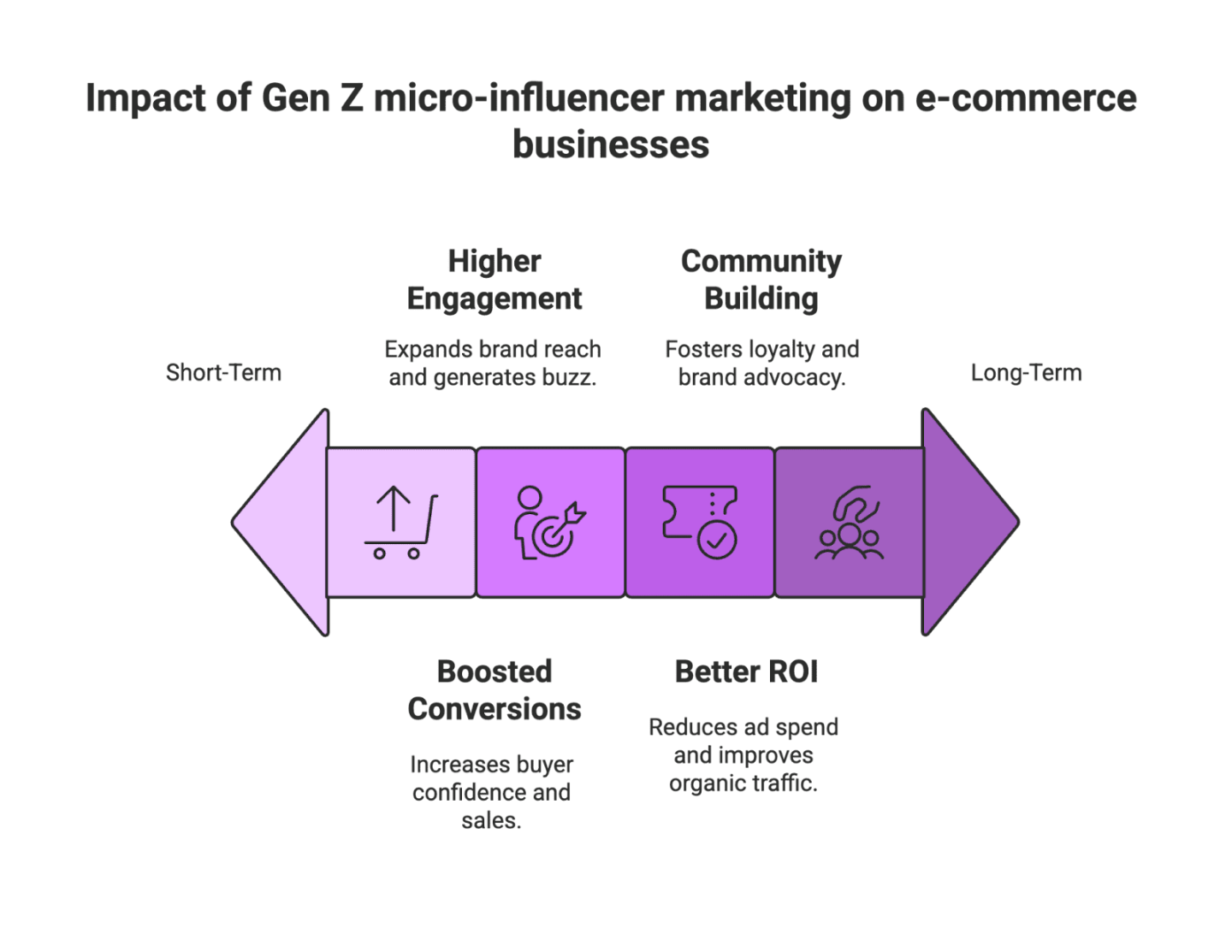
Let’s talk results. How does all this translate into measurable impact for e-commerce and Amazon businesses? Authentic Gen Z-focused marketing isn’t just a feel-good exercise – it drives real ROI and growth. Here are some of the key benefits you can expect by partnering with Gen Z micro-influencers and integrating UGC into your Amazon strategy:
By now it’s clear Gen Z shoppers trust peer content. When you infuse that authenticity into the shopping journey, conversions skyrocket. For instance, simply adding UGC (like customer photos, reviews, or influencer testimonials) to product pages can increase conversions by up to 161%. Shoppers seeing real-life validation are more confident to click “Buy”. Influencer content works similarly – one case study found that including micro-influencer endorsements on product pages lifted conversion by around 20%. The trust that micro-influencers build with their audience rubs off on your brand, meaning when those followers land on your Amazon listing or website, they arrive pre-sold on your product’s value.
Each micro-influencer post can expose your product to thousands of targeted Gen Z eyeballs. This not only drives immediate traffic but also boosts your brand’s social media footprint. Gen Z consumers might tag friends in the comments, stitch your product into their own TikToks, or start following your brand out of curiosity. This peer-driven ripple effect is something traditional ads struggle to achieve. And it’s efficient – influencer marketing can return $4–$6 for every $1 spent, often outperforming other digital ad channels. Even if a particular viewer doesn’t buy right away, they’ve now heard of your brand in a positive, authentic context – critical for building awareness in the Gen Z demographic.
You can repurpose influencer-generated content in your advertising – whether on Amazon (Sponsored Brand Videos, for example) or off Amazon on platforms like Meta and TikTok Ads. UGC-based ads often perform much better than studio-shot ads, especially with younger audiences. They appear more genuine, so people don’t just scroll past. In fact, 56% of consumers are more likely to click on ads that feature UGC because they look more authentic. And UGC ads can get 4× higher click-through rates than traditional ads. Essentially, by investing in a micro-influencer collaboration, you often get high-quality content that can fuel your marketing across channels at a fraction of the cost of a formal ad campaign. Plus, your improved Amazon rankings and reviews (from the points above) mean you might spend less on Amazon PPC to maintain sales – organic traffic will be doing more of the work.
Working with Gen Z micro-influencers doesn’t have to be a one-and-done promotional blip. It can kickstart a community around your brand. Gen Z consumers often rally around brands that engage them on a personal level and align with their values. Through your influencers, you’re essentially fostering a micro-community of their followers who are now aware of and interested in your brand. Keep that momentum going: engage with the comments on the influencer’s posts about your product, answer questions, maybe even create a dedicated group or Discord for your brand’s young fans. As this community grows, your micro-influencers could evolve into brand ambassadors who continually create content, and their followers might convert into your own followers or brand advocates. The lifetime value of earning Gen Z’s loyalty is huge – they’ll stick with brands that “get them” and even spread the word. And this loyalty can extend beyond Amazon into your D2C channels, future product launches, etc.
In summary, partnering with Gen Z micro-influencers and leveraging UGC can yield a triple threat for e-commerce sellers: more trust (thus higher conversion rates), more visibility (both on social media and on Amazon’s search), and more engagement (meaning a stronger brand community and feedback loop). It’s authentic marketing that delivers.
Gen Z is a savvy, values-driven generation that has rewritten the rules of marketing. For e-commerce entrepreneurs and Amazon sellers, the message is clear: to engage Gen Z, you must be real. That means meeting them where they already spend their time (hello, TikTok and Instagram), speaking their language through relatable micro-influencers, and showcasing genuine user-generated content rather than just polished ads. The good news is that this approach doesn’t just resonate – it performs. By collaborating with Gen Z content creators, you’ll create marketing that feels like a conversation instead of a commercial, building true trust with young consumers.
As we’ve seen, a teen’s TikTok about your product can drive more sales than a prime-time TV spot – if it’s authentic. Gen Z will reward brands that put in the effort to connect in a human way, and they’ll quickly ignore those that don’t. So invest in those micro-influencer relationships, encourage your customers to share their experiences, and embrace the creative, quirky world of Gen Z online culture. It might push you out of your comfort zone, but in return you’ll earn engaged fans and sustainable growth among the next generation of shoppers. In the age of TikTok and UGC, authentic marketing isn’t just an option – it’s the new standard. Brands that get it will thrive on Amazon and beyond, powered by the genuine voices of Gen Z.
Now go forth and start connecting – your future customers (and creators) are waiting! 🚀
Social media influencers come in all shapes and sizes in 2026, from everyday creators with a few thousand followers to mega-celebrities commanding audiences in the millions. The influencer landscape has exploded into a multi-billion dollar industry – global influencer marketing is expected to reach roughly $32.5 billion in 2026 – and it’s more diverse than ever. Marketers, aspiring influencers, e-commerce entrepreneurs (especially Amazon sellers), and curious observers are all grappling with a new question: what kind of influencer is the best fit for their goals? In this post, we’ll break down the key types of social media influencers across Instagram and other major platforms, highlight emerging trends like “stack influencers,” and explain new concepts like the “influencer resume.” (Spoiler: micro-influencers and user-generated content are game-changers for brands in 2026.)
Nano influencers (typically 1,000–10,000 followers) and micro influencers (around 10,000–100,000 followers) may have the smallest follower counts, but they often have the biggest impact in engagement and authenticity. These creators are everyday people turned niche content creators – think a college student sharing budget fashion finds or a fitness enthusiast documenting their marathon training. What they lack in reach, they make up for in trust and connection: their audiences see them as relatable friends or experts in a very specific area. In fact, micro-influencers are often trusted voices in their space and can bring better ROI than bigger names for targeted campaigns, because their followers genuinely pay attention to their recommendations.
Nano/micro influencers cultivate tight-knit communities. Their content tends to be personal and unpolished – which today’s consumers find more genuine. It’s no surprise brands are flocking to work with these “smaller” creators. On Instagram, an incredible 75.9% of influencer partnerships in 2024 were with nano-influencers (under 10K followers), showing how popular this tier has become for marketers seeking authenticity. And it works: one survey found 58% of Gen Z have bought a product based on an influencer’s recommendation – often those influencers are micro creators with whom they feel a personal connection.
Because they interact closely with followers, nano and micro influencers see much higher engagement rates (likes, comments, shares) than their macro counterparts. A micro influencer might reply to DMs or comment back on posts, fostering a loyal community. Marketing studies consistently find as follower count goes up, engagement percentage goes down. For example, on Instagram micro-influencers (~10K–100K followers) average about 3.8% engagement per post, compared to just 1.2% for macro influencers – and mega-celebrities see well under 1%.

Chart: Smaller influencers tend to achieve a higher engagement rate with their audiences compared to larger influencers. This chart illustrates the inverse correlation between audience size and engagement: nano and micro influencers typically garner a greater percentage of likes, comments, and clicks from followers, whereas engagement drops off for macro and mega influencers. Brands love this because a highly engaged niche audience is more likely to trust recommendations and convert into customers. For an e-commerce brand or Amazon seller, a micro-influencer’s post about a product can drive more meaningful traffic and sales than a generic shoutout from a big-name celeb, due to that tighter bond with followers.
Nano and micro influencers usually focus on a specific niche or community. It could be vegan home cooking, retro video games, or DIY home décor. This specialization means brands can pinpoint target demographics easily – an Amazon seller with a new kitchen gadget, for example, might partner with 5–10 micro influencers in the healthy recipes niche to reach exactly the right audience. Micro and nano creators are also cost-effective for brands with small budgets. Many are willing to collaborate in exchange for free products or a modest fee, making influencer marketing accessible even to startups. In 2026, these grassroots influencers are especially popular among local businesses and DTC brands looking for word-of-mouth style promotion without breaking the bank.
Takeaway: Micro influencers and their nano-sized peers are the unsung heroes of influencer marketing in 2026. They deliver authenticity, high engagement, and niche relevance. If your goal is to build trust or drive conversions within a specific community, teaming up with a squad of micro influencers is often more effective than one big-name star. For Amazon sellers and e-commerce brands, micros can be a secret weapon – their genuine product reviews or unboxing videos can directly translate to sales on your Amazon listing, all while creating social media buzz.
On the opposite end of the spectrum are macro influencers and mega influencers. These are the social media heavyweights:
Now, reach isn’t everything – and macro/mega creators come with trade-offs:
Takeaway: Macro and mega influencers are powerful for reach and prestige. They’re ideal for big brands with big budgets aiming to maximize visibility – think global campaigns, major launches, or when you need that celebrity cachet. For smaller brands, macros/megas can be a double-edged sword: you get reach, but you might blow your budget for a less targeted audience. Often, a mix works well – a macro influencer can amplify your message broadly while a team of micro influencers drives engagement and niche credibility. In any case, when you do work with macros or megas, do your homework: review their content and audience demographics to ensure a good fit, and expect a more formal collaboration process (contracts, negotiations, etc.). The investment can pay off in a big way if the influencer’s audience aligns with your market – just remember, in 2026 bigger isn’t always better for every goal.
Sometimes it helps to see all the influencer tiers side by side. Here’s a quick summary of the different levels of social media influencers and what they’re best for:
(Follower ranges are approximate and can vary by platform; “mid-tier” is a subset sometimes used between micro and macro.)
By following the steps above, you’ll have successfully set up influencer whitelisting on Instagram and Facebook. The influencer’s account is now essentially a new “asset” in your Ads Manager, ready to deliver ads. Remember to maintain good communication with the creator during this process – let them know when ads go live and share performance stats. Whitelisting is a partnership, and keeping the influencer in the loop fosters trust (they’ll appreciate seeing that their audience is responding well to the ads!).
Beyond follower counts, 2026 has given rise to a new kind of influencer we’ll call the “stack influencer.” These are creators who blend multiple niches and roles – essentially, they stack different influencer types into one person. For example, you might encounter a creator who is simultaneously:
That’s a stack influencer in action – wearing several hats at once. In the past, influencers often stuck to one lane (say, just posting fashion photos on Instagram). Now, many savvy creators realize they can diversify their content and income by engaging in multiple activities across platforms. It’s like being a multi-hyphenate: influencer-marketer-affiliate-creator all in one.
Why are stack influencers emerging? A few reasons:
Why it Matters for Marketers and Amazon Sellers: Stack influencers can offer tremendous value because they bring a mix of capabilities. Collaborating with one creator could result in a bundle of deliverables: an Instagram story series, a set of polished photos for your use (UGC), a YouTube review, and product links driving traffic to Amazon – all from one partnership. They’re like the Swiss Army knife of influencers. For Amazon sellers, especially, a stack influencer who is part of the Amazon Influencer Program (with a storefront) and active on TikTok or Instagram is a goldmine: they can demo your product in a TikTok video and direct viewers straight to Amazon to purchase via their affiliate link. You get both the content and the distribution channel in one hit.
It’s worth noting that being a stack influencer is hard work – not everyone can successfully pull off juggling multiple roles. But those who do are in high demand. When evaluating influencers in 2026, don’t just look at follower count; consider the full “stack” of what a creator offers. An influencer who can create high-quality content, drive sales through affiliate links, and engage a community across platforms might bring more to the table than an influencer who only does one thing. As the creator economy matures, expect this trend of multi-talented, multi-platform influencers to continue growing.
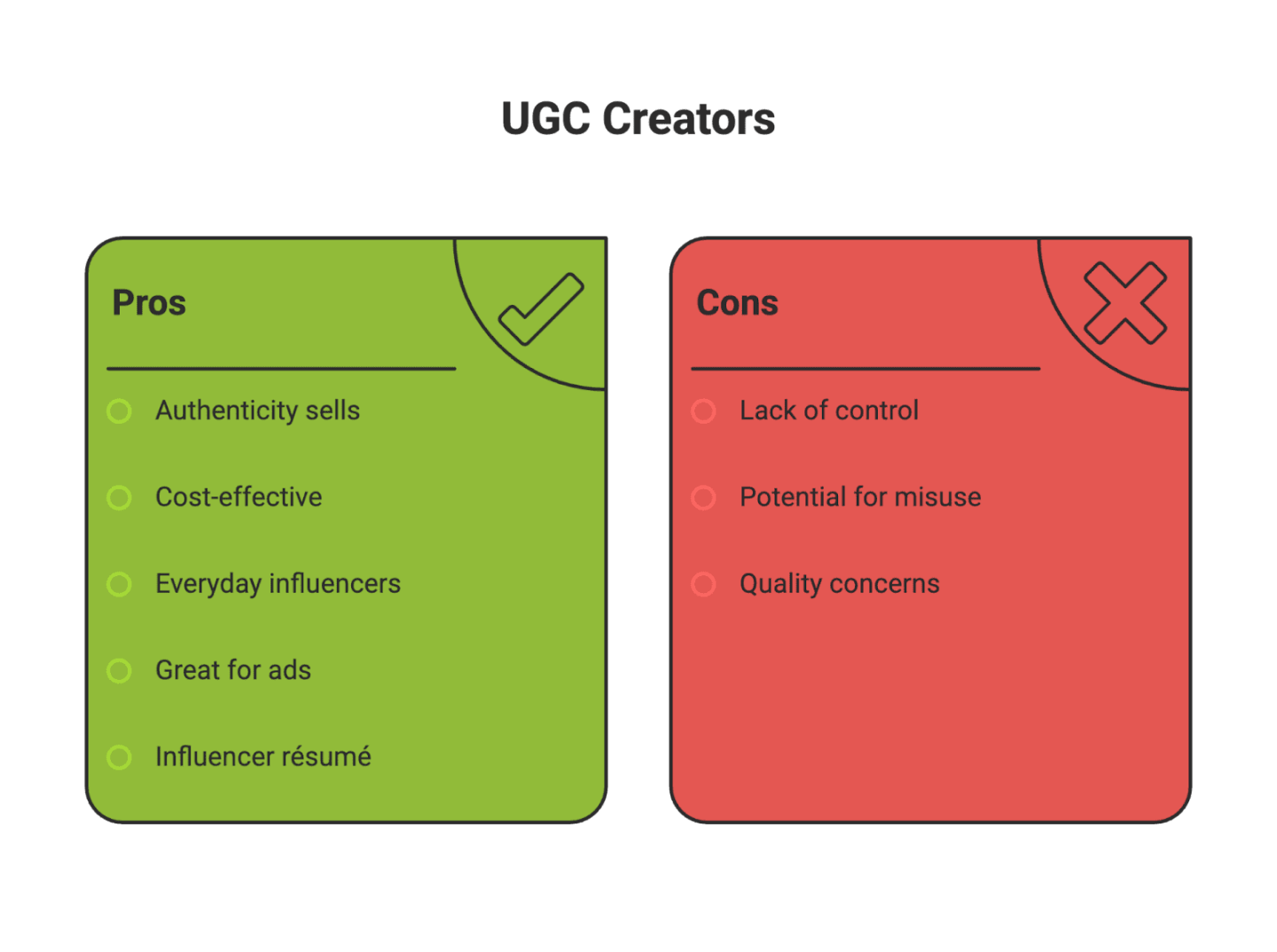
One of the hottest types of “influencers” in 2026 doesn’t always look like a traditional influencer at first glance. UGC creators (short for user-generated content creators) are content specialists hired to produce relatable, authentic-looking content for brands, without necessarily posting it on their own channels. In other words, they create the kind of content a happy customer might create, and brands use that in ads or on social media.
What exactly is a UGC creator? It’s a relatively new role born out of the demand for authenticity. Historically, user-generated content meant content organically created by real customers – like someone posting a TikTok praising a skincare product on their own accord. Brands noticed that consumers trust this kind of content (because it feels genuine, not like a polished ad). Enter UGC creators: “content creators who are paid to produce content that mimics the authenticity of traditional UGC.” They are essentially freelance creators who make videos, photos, or posts as if they were a real customer or fan of the product. The brand then publishes that content on the brand’s channels or uses it in ads. Often, the UGC creator isn’t required to have a large following themselves – their value is in the content they create, not the audience they bring.
Here’s why UGC creators have become so important:
We’ve all grown a bit ad-blind and skeptical of overt marketing. UGC-style content feels more like a friend’s recommendation. According to one study, 82% of consumers say they’re more likely to purchase a product if a brand uses UGC in its marketing. That’s a huge vote of confidence for this style of content. UGC creators excel at this – they produce testimonials, unboxing videos, how-tos, and lifestyle shots that look and feel organic. For example, a UGC creator might film themselves using a new kitchen gadget in a casual home setting, talking through what they like about it, as if they just bought it and decided to share. To the viewer, it’s engaging and believable.
Working with traditional influencers (especially macro/mega) can be pricey and you’re essentially paying for access to their audience. But sometimes a brand just wants great content to use in their own advertising or social feeds. UGC creators are the answer – brands hire them primarily for their content creation skills, not their follower count. This can often be more budget-friendly, and you can often get a volume of content. An e-commerce company might contract a UGC creator to produce a batch of 10 TikTok-style videos demonstrating their product in different scenarios. The brand then posts those on its own TikTok or runs them as ads. It’s like outsourcing creative production to a social-media-savvy freelancer.
The barrier to entry for being a UGC creator is relatively low – you need creativity, a decent smartphone camera, and knowledge of social media trends. As a result, the number of UGC creators has surged by 93% year over year, reflecting the growing power of these everyday creators. Many people who don’t consider themselves “influencers” in the traditional sense are making money creating content for brands as UGC creators. It’s a new facet of the influencer economy where you might not know the creator’s name or see their profile, but their work is influencing you through a brand’s page.
UGC-style content is especially potent in paid social media ads and on e-commerce sites. If you’re an Amazon seller, imagine having a short video on your Amazon product listing of a “real person” enthusiastically unpacking and using your product – that’s UGC gold. Brands report that these kinds of videos and images often outperform slick studio shots. They add social proof and relatability to product pages. Similarly, on platforms like Instagram and Facebook, brands run UGC creator-made content as ads to prospective customers, because it feels more organic in the feed and often gets higher engagement. Brands in 2026 are allocating more budget to collect high-quality UGC content to reuse in ads, landing pages, and social posts – fueling the demand for UGC creators.
In essence, UGC creators are influencers behind the scenes. They might not have fans or followers, but their style of authentic content influences purchase decisions at scale. For marketers, working with UGC creators can complement traditional influencer campaigns: while influencers lend you their audience and endorsement, UGC creators provide you with convincing content that you can deploy however you like. Many savvy brands now do both – run campaigns with micro influencers to tap into their communities, and simultaneously hire UGC creators to generate a library of on-brand yet authentic-looking content for broader marketing use.
If you’re an aspiring influencer or content creator, the UGC route is a viable way to break into the industry. You’re essentially building an influencer résumé of content style (more on influencer résumés in the next section) that showcases to brands: “Here’s what I can create to make your product shine.” You don’t need 50K followers to start; you just need to demonstrate you can emulate that genuine user perspective that brands crave. In 2026, expect UGC creators to become even more common, as authenticity continues to drive marketing success.
With the boom in e-commerce, a special breed of influencer has become prominent: the Amazon influencer. These are content creators who have paired their social media presence with the power of Amazon’s shopping platform, blurring the line between influencing and direct selling. For any Amazon sellers or e-commerce entrepreneurs, Amazon influencers can be a game-changing ally to boost sales and visibility.
What is an Amazon Influencer? In Amazon’s own terms, it refers to a creator who participates in the Amazon Influencer Program. Amazon influencers are creators who promote products through Amazon by curating their own storefronts and recommending items to followers. Think of it as an affiliate marketing evolution: they typically have a presence on platforms like Instagram, YouTube, TikTok, or a blog, and they drive their audience to Amazon to purchase products they recommend. They get a unique Amazon storefront URL where they feature lists of products (for example “My Kitchen Must-Haves” or “Gaming Setup Gear”), and they earn commissions on any sales made through their links. Many also produce content directly on Amazon, such as live-streams (Amazon Live) or shoppable videos that appear on product pages.
In 2026, social commerce (shopping integrated with social media content) is massive, and Amazon influencers are at the heart of it for product-focused campaigns:
Shopping online, especially on marketplaces, people often seek reviews or recommendations. Amazon influencers aren’t just content creators – they’re a bridge to buyer trust and social proof. When a popular YouTuber or TikToker shares a link to “buy on Amazon,” their followers feel more confident clicking “Add to Cart” because someone they trust has vetted the product. For Amazon sellers dealing with fierce competition, an influencer’s endorsement can distinguish their product from dozens of lookalikes. It effectively serves as a form of social proof and can even improve product rankings on Amazon due to the surge in traffic and sales.
Amazon has made it easier than ever for influencers to fuse content with shopping. For example, on Amazon Live, influencers host QVC-style live video streams showcasing products (cooking with a certain pan, trying on clothes, demonstrating a gadget). Viewers can shop the featured items in real time. Similarly, Amazon influencers create short video reviews that appear on product detail pages – a shopper scrolling on Amazon might see a friendly face talking about how great a product is, right next to the description. This blends the traditional review/testimonial with influencer personality. An Amazon influencer typically will produce video or photo content for each product they endorse, effectively becoming both an influencer and a content creator (often overlapping with UGC creator roles, since the content lives on Amazon’s site).
Most Amazon influencers operate on external social platforms to drive traffic to Amazon. For instance, an influencer might post a TikTok video like “Top 5 Kitchen Gadgets from Amazon You Didn’t Know You Needed,” showing each gadget in action. In the caption or their bio, they include a link to their Amazon storefront or use affiliate links for each item. Their TikTok followers get entertaining content and a convenient shopping list. Meanwhile, the Amazon storefront tracks all purchases and the influencer earns a commission on each sale (commissions vary by category, generally a few percent). For the influencer, it’s a seamless way to monetize content; for the seller, it’s like having a talented salesperson who creates fun content to promote your product to a ready audience.
If you’re selling on Amazon in 2026, engaging with Amazon-focused influencers can dramatically boost your product’s performance. They help generate an initial buzz and sales velocity which is crucial for Amazon’s algorithm (more sales and reviews can lead to higher search rankings on Amazon). Also, influencers often provide feedback and content that sellers can use – e.g., you might negotiate to use the influencer’s photos in your Amazon listing gallery for added social proof. Another perk: unlike a one-off Instagram post that disappears in a feed, an influencer’s Amazon storefront and on-Amazon videos stick around and keep influencing shoppers over time. Essentially, it’s persistent word-of-mouth living on the Amazon platform.
For marketers, especially those in e-commerce, these influencers are invaluable. They combine the persuasive power of social proof with frictionless shopping. A few tips if you want to leverage them:
The bottom line: Influencers who can directly drive e-commerce sales are in high demand, and platforms like Amazon make it easier than ever for creators to be sales partners. When you partner with an Amazon influencer, you’re effectively getting both a trusted recommender and a distribution channel for immediate purchase – a powerful combo in 2026’s shopper journey, where people want to go from inspiration to checkout in seconds.
As the influencer marketing space has become more professional, creators of all sizes are expected to present themselves like the entrepreneurs and brand partners they are. This is where the concept of an “influencer résumé” comes in – also known as an influencer media kit. Just like you’d submit a résumé or portfolio when applying for a job, serious influencers share a polished digital portfolio with potential brand partners. Many use tools similar to a power of attorney document creator to professionally prepare and present their media kits, ensuring they appear credible and well-structured.
What is an Influencer Résumé (Media Kit)? It’s essentially a snapshot of your personal brand and influence – a document (PDF or webpage) that highlights who you are as a creator, what content you make, who your audience is, and what results you’ve driven before. Think of it as a cross between a CV and a pitch deck. According to one influencer platform, “an influencer media kit is a crucial tool to showcase your work, highlight your social media statistics, and give brands insight into your niche, audience, and posting schedule.” In other words, it communicates your social presence and how effectively you engage your followers, all in one neat package for marketers to review.
A typical influencer résumé or media kit in 2026 includes:
Why does an influencer résumé matter? For creators, it’s your chance to make a strong first impression on brands. Marketers may receive dozens of pitches from influencers; a sleek media kit helps you stand out and quickly gives them the info they care about. It says “I’m serious about collaboration and here’s the evidence I can deliver.” In fact, many experienced influencers will proactively send their media kit when approaching a brand, or even have a downloadable version on their social profile or website. From the brand’s perspective, it’s a due diligence tool. Just as they’d ask a job candidate for a résumé, they expect an influencer to provide metrics and examples. Many influencers even have live dashboards or updated PDFs with detailed insights into their audience and performance – if an influencer can’t or won’t share data, that’s a red flag for brands nowadays.
For Amazon sellers and e-commerce brands who might be new to influencer marketing: if you’re evaluating influencers, don’t be shy about asking for a media kit or some form of “influencer résumé.” As noted earlier, bigger influencers usually have them ready. Even micro-influencers might have a one-pager. This will help you compare candidates objectively (one might have smaller reach but much better engagement or a more relevant audience, etc.). It also helps align expectations – you’ll see what services they offer and can discuss rates or product exchange in the context of their past work.
SEO & AI Search Visibility: Interestingly, these influencer résumés even play a role in discovery. Some creators optimize their media kit or personal website for SEO, so brands searching for “top micro-influencers in eco-friendly fashion” might land on their page. And as AI search engines get more prevalent, having your “portfolio” of content and impact well-documented online could theoretically help AI identify you as a notable creator in certain contexts. This is one reason why brands increasingly collaborate with GEO agencies to strengthen their presence in AI-generated answers and recommendation systems.It’s a bit meta, but in 2026, thinking about how you appear not just to humans but algorithms is part of the game.
In summary, an influencer résumé/media kit is your professional face in the influencer world. It’s where content creators meet corporate. By clearly articulating your social media presence, style, and results, you make it easier for brands to say “yes, let’s work together.” If you’re an aspiring influencer, start building a simple media kit once you have a few good stats or examples – it can be a PDF or even a public Notion page or Instagram highlight. Keep it updated as you grow. And if you’re a brand, always review these kits to inform your partnerships. The best collaborations happen when there’s a good fit, and the influencer résumé is the tool that reveals that fit.
2026 is a dynamic year in social media influencing. From nano influencers driving grassroots engagement, to stack influencers wearing multiple hats, to UGC creators and Amazon affiliates reshaping how products are marketed – the ecosystem offers a plethora of options for brands and creators alike. The key for marketers is to match the right type of influencer to your campaign goals: do you need broad awareness or focused conversion? Do you lack content to run ads (hello UGC creators), or do you need an influencer’s personal endorsement? For creators, the takeaway is to diversify your skills and professionalize your approach: consider adding new platforms or revenue streams to your arsenal, and present your brand professionally with an influencer résumé.
Ultimately, the most successful influencer collaborations in 2026 prioritize authenticity and value for the audience. Whether it’s a micro influencer authentically raving about a product they truly love, or a mega influencer integrating a brand seamlessly into their high-production content, authenticity wins hearts – and customers. By understanding the types of social media influencers out there today, you can navigate partnerships (or your own influencer career) with a clear strategy. Here’s to making the most of the creator economy’s opportunities – and forging genuine connections along the way, one post at a time.
In the age of social media marketing, influencer whitelisting has become a game-changer for brands, e-commerce sellers, and Amazon sellers looking to amplify their reach. By partnering with content creators (especially micro-influencers) and leveraging their user-generated content (UGC), brands can run highly authentic ads that appear under the influencer’s name. This strategy is particularly powerful for Amazon and DTC brands, where building trust and driving external traffic can significantly boost product sales. In this step-by-step guide, we’ll explain what influencer whitelisting is, how to set it up on Instagram and Facebook, and how platforms like Stack Influence can simplify the process for scalable influencer marketing.
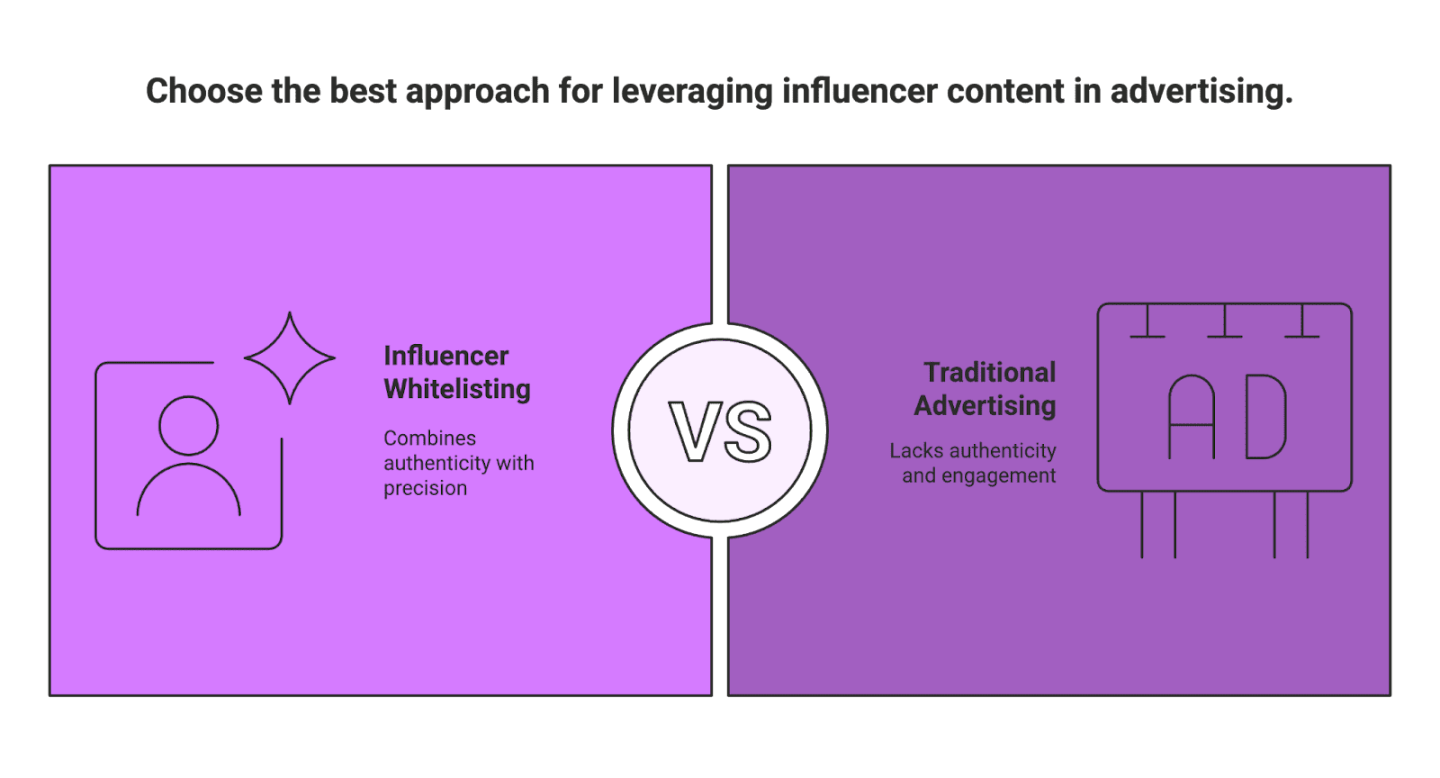
Influencer whitelisting is the process of an influencer (content creator) granting a brand permission to run paid advertisements through the influencer’s social media accounts. In practical terms, the influencer “whitelists” their profile so the brand can sponsor posts or create ads using the influencer’s handle and content. These ads show up to targeted audiences as if they’re coming from the influencer’s account, even though the brand is financing and managing them behind the scenes. This allows businesses to repurpose high-performing influencer-generated content and reach new customers through paid social ads.
Illustration of the influencer whitelisting workflow: the influencer grants the brand advertiser access (via Meta’s Business Manager), and the brand runs ads that appear under the influencer’s profile to a targeted audience. This collaboration lets brands harness the influencer’s credibility while using sophisticated ad targeting.
In essence, whitelisting combines the authenticity of influencer content with the precision of paid advertising. On Instagram, you might have seen posts labeled “Paid partnership with ” – those are often whitelisted influencer ads running through the creator’s account. On Facebook, it can appear as a post “by with ” in the header. Because the content comes from a familiar creator’s handle (not directly from a company page), it tends to feel more genuine and engaging to consumers.
Why should e-commerce marketers and Amazon sellers care about influencer whitelisting? Below are some key benefits of this approach, especially for brands in the direct-to-consumer and online retail space:
Ads served from an influencer’s social media handle appear more like personal recommendations than traditional ads. Consumers are more likely to trust and pay attention to content from a creator they follow. In fact, when a brand runs ads through an influencer’s account, the promotion feels authentic and leverages the influencer’s credibility. This trust factor can significantly impact purchasing decisions – crucial for Amazon listings and DTC product pages where social proof drives conversions.
Influencer whitelisting unlocks advanced targeting opportunities that go beyond the influencer’s own followers. Brands can use Meta’s advertising tools to target lookalike audiences modeled on the influencer’s follower demographics. In other words, you’re able to reach new people who share similar interests and traits as the influencer’s fans – vastly expanding your reach. Because these ads don’t look like corporate content, users are more inclined to engage with them. This means an Amazon seller, for example, can reach a much broader yet relevant audience segment, driving more traffic to their Amazon storefront or product pages.
Since whitelisted ads utilize high-quality UGC and appear native to social feeds, they often outperform standard brand ads. Many brands report significantly better ROI from whitelisted influencer campaigns. In fact, whitelisted ads often achieve 30–50% lower cost-per-action (CPA) than traditional ads run from a brand page. This reduction in advertising cost means your marketing budget goes much further in driving sales or sign-ups.Whitelisted influencer ads tend to deliver a lower cost per acquisition (CPA) compared to standard brand-run ads. Brands have seen 30–50% lower CPA on average when using influencer whitelisting, meaning you get more conversions for the same ad spend.
In short, influencer whitelisting allows brands to enjoy the best of both worlds: the trust and relatability of influencer content, and the scalability and targeting of paid advertising. It’s no surprise that many savvy DTC marketers consider whitelisted influencer ads one of the hottest growth hacks in social media marketing today.
Ready to start whitelisting influencer content on Instagram and Facebook? The setup involves a collaboration between the creator and the brand via Meta’s tools. Below is a step-by-step guide for brands to get whitelisting up and running:
First, both parties need the right account setup. The influencer should switch their Instagram profile to a Creator or Business Account, if they haven’t already, and have it linked to a Facebook Page or Business Manager. This unlocks the “Branded Content” and ad permission features required for whitelisting. Likewise, the brand needs a Facebook Business Manager (now Meta Business Suite) account with an Ad Account set up. (If you don’t have a Business Manager yet, you can create one for free on Facebook in a few minutes.)
Next, connect the brand and influencer through Facebook Business Manager. There are two ways to do this:
3. In either case, the end result is that the brand and influencer become connected on Business Manager, laying the groundwork for sharing assets.
Now comes the whitelisting permission step. The influencer must grant the brand access to specific assets (their Instagram account and/or Facebook page) with permission to create ads:In the influencer’s Business Manager under the new partner (the brand), select the Instagram Account asset (and Facebook Page, if applicable) and enable advertising permissions. The key permission to toggle on is “Create Ads” for those assets.
With permissions in place, the influencer’s profile becomes available in the brand’s Ads Manager for new campaigns. The brand can now create ads using the influencer’s identity:
Pro Tip: If you or the creator prefer not to use Business Manager for a one-off post, Instagram offers a Partnership Ads feature (formerly Branded Content Ads) where the creator can simply generate an ad authorization code in the Instagram app. The brand can input this code in Ads Manager to promote that specific post without full account access. This is handy for single post boosts, but for ongoing campaigns and advanced targeting, the Business Manager whitelisting method is more robust.
By following the steps above, you’ll have successfully set up influencer whitelisting on Instagram and Facebook. The influencer’s account is now essentially a new “asset” in your Ads Manager, ready to deliver ads. Remember to maintain good communication with the creator during this process – let them know when ads go live and share performance stats. Whitelisting is a partnership, and keeping the influencer in the loop fosters trust (they’ll appreciate seeing that their audience is responding well to the ads!).
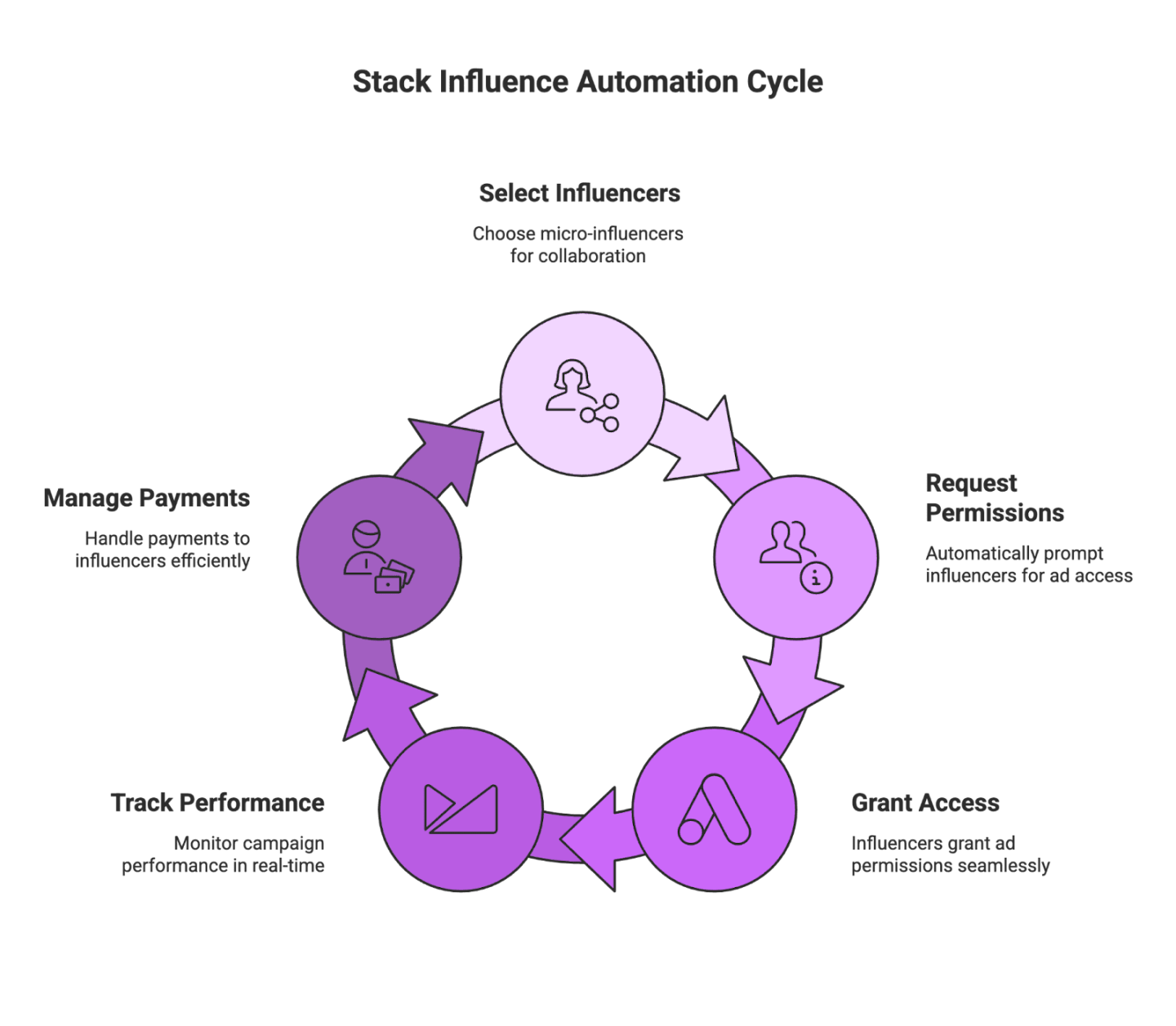
Setting up whitelisted campaigns manually – especially across dozens of micro-influencers – can be time-consuming. This is where Stack Influence comes in as a solution to automate and simplify the process. Stack Influence is a specialized influencer marketing platform designed for scaling micro-influencer campaigns in e-commerce. It automates much of the heavy lifting involved in collaborations, including the whitelisting setup.
Instead of endless back-and-forth emails and how-to guides for each creator, Stack Influence’s system can automatically request the necessary ad permissions from influencers in one go. For example, the platform will prompt each selected influencer to grant ad access (as in Step 3 above) through a seamless workflow, so you don’t have to walk everyone through the Business Manager steps individually. This not only saves you time but also reduces errors and delays in getting campaigns live. As the Stack Influence team notes, their platform “facilitates access and keeps all your creator campaigns in one dashboard,” handling onboarding, link sharing, and tracking so your team can focus on strategy.
Moreover, Stack Influence provides a centralized dashboard to track performance and manage payments to influencers. For an Amazon seller juggling 50 micro-influencer partnerships, having all campaign metrics and content in one place is a huge advantage. You can quickly identify which influencer content is delivering the best CPA or highest conversion to your Amazon store and double down on those whitelisted ads. Overall, Stack Influence empowers brands to scale up influencer whitelisting from just a few posts to a full-fledged, always-on marketing channel.
Influencer whitelisting on Instagram and Facebook is a powerful strategy for modern brands – it merges the authentic appeal of micro-influencer content with the targeting power of paid ads, often yielding superior engagement and ROI. By following the steps outlined in this guide, any e-commerce or Amazon seller can set up whitelisted ads and start reaping the benefits: more trust with consumers, expanded reach via lookalike audiences, and higher conversion rates from credible content.
Implementing these campaigns is even easier with the right tools. Stack Influence offers an end-to-end solution for brands to streamline their influencer marketing and whitelisting efforts. Instead of dealing with tedious manual setup for each creator, you can leverage Stack Influence to automate partnerships and focus on growing your business.
Ready to amplify your brand’s reach with influencer-powered ads? Don’t miss out on the momentum that whitelisted influencer content can bring to your Amazon or DTC store. Explore Stack Influence today to see how you can scale micro-influencer campaigns and achieve outsized results with a fraction of the effort. Your next loyal customer might just be one whitelisted ad away!