




Most creators treat TikTok like a broadcast channel: post a video, hope it catches the algorithm, move on. But in 2026, that approach leaves serious discovery on the table. TikTok search has quietly become one of the most powerful organic visibility tools available to content creators, and the creators who understand it are landing brand deals, growing followings, and building authority in ways that pure feed-scrolling content cannot replicate.
This guide breaks down exactly how to use TikTok search to grow your presence, attract brand partnerships, and turn discoverability into a repeatable system.
Key Takeaways
- TikTok search now functions as a hybrid social-search engine, and creators who optimize for it gain compounding discoverability that outlasts individual viral moments.
- The REACH framework gives you a five-letter scoring system (maximum 25 points) to audit and improve every video's search potential before you publish.
- Keyword placement in captions, spoken audio, on-screen text, and hashtags all contribute independently to how TikTok indexes your content.
- Brand deals increasingly flow toward creators who rank for niche search terms, because ranked content proves sustained audience intent rather than one-off reach.
- Micro-influencers with strong search footprints often outperform larger accounts in brand campaign performance because their audiences arrive with specific purchase intent.
How to Build a TikTok Search Strategy That Compounds Over Time
The most effective TikTok search strategy is not a one-time optimization task. It is a publishing system where each video reinforces the last, building topical authority around a theme that the platform's search index learns to associate with your account.
Start by identifying the three to five topic clusters your channel genuinely owns. A topic cluster is a narrow subject area where you have both credibility and audience overlap. Instead of "fitness," that might be "resistance band workouts for apartment living" or "low-impact cardio for postpartum recovery." According to Adobe's 2026 social media search report, nearly half of U.S. consumers (49%) now use TikTok as a search engine—up nearly 20% in just two years—with 65% of Gen Z reporting they have searched on the platform.
Once your clusters are defined, build a content calendar where at least 60% of your videos target a specific search phrase inside one of those clusters. The remaining 40% can be trend-driven, reactive, or experimental. This ratio keeps your search footprint growing without sacrificing the spontaneity that TikTok audiences value.
Here is a practical workflow for implementing a compounding search strategy:
- Cluster mapping: List your three to five core topic areas and write ten potential search phrases for each, using TikTok's own search bar to validate that autocomplete results exist.
- Priority scoring: Score each phrase by how specific it is, how relevant it is to your existing content, and whether you can answer it in a single video.
- Calendar placement: Schedule one search-optimized video per topic cluster per week, filling the remaining slots with trend or community content.
- Cross-linking via captions: Reference related videos in your caption by topic (not just by tagging) so the platform's index connects your videos thematically.
- Performance review: At 30 days, pull your search traffic source data from TikTok Analytics and identify which phrases are driving views. Double down on those clusters.
Stack Influence has observed through campaign execution that creators with established search footprints in specific niches consistently drive stronger campaign outcomes for eCommerce brands. When a creator ranks for a term like "best protein powder for women" or "how to clean natural hair at home," the audience arriving through that search already has demonstrated purchase intent. That is a fundamentally different viewer than someone who stumbled on a trending sound. Brands running product seeding campaigns through Stack Influence's network of roughly 600,000 vetted creators increasingly prioritize this kind of niche search presence when matching creators to campaigns.
What Is TikTok Search, and Why Does It Matter for Creators?
TikTok search is the platform's native discovery engine that allows users to query videos, creators, sounds, and hashtags using typed keywords. Unlike the For You Page, which serves content algorithmically based on behavioral signals, TikTok search surfaces content based on textual relevance, topical authority, and engagement signals tied to specific queries. For creators, this means content can be discovered weeks or months after posting if it ranks well for the right terms.
The distinction between feed discovery and search discovery is critical for long-term growth. Feed virality is unpredictable and often temporary. Search discoverability is compounding: a video that ranks for a searched phrase continues to earn views every time someone types that phrase. According to a 2024 report by Later, TikTok search results are influenced by keyword relevance in captions, on-screen text, spoken audio, and hashtags, all of which are independently indexed. That means optimizing multiple layers of a single video increases the probability it surfaces for relevant queries.
Why does this matter specifically for influencers and content creators? Because search-driven discovery changes the nature of your audience relationship. A viewer who finds your video through a search query was actively looking for that content. They arrived with intent. That intent-driven viewer watches longer, follows more frequently, and converts on brand recommendations at higher rates than passive scrollers. Building a search presence means building an audience that is pre-qualified by topic interest before they ever see your face.
The REACH Framework: Scoring Your TikTok Search Potential
The REACH framework is a five-component scoring tool designed to help creators evaluate and improve any video's TikTok search potential before publishing. Rate each component from 1 to 5, then total your score out of a possible 25. A video scoring 20 or above has strong search potential. Below 15, revisit at least two components before publishing.
Use the REACH framework every time you plan a search-optimized video, reference it during your monthly content audit, and apply it when reviewing underperforming posts to diagnose what went wrong.
R: Relevance Does the video answer a specific, searched question rather than a general topic? Relevance scores highest when the video title, caption, and spoken hook all match a phrase users actually type into TikTok's search bar. Score 1 if the topic is broad and undefined. Score 5 if the video targets a single, autocomplete-validated phrase.
E: Evidence Does the video include on-screen text, captions, or visuals that reinforce the keyword? TikTok's index reads text overlays and closed captions, not just the audio track. Score 1 if no text reinforcement exists. Score 5 if the keyword appears in at least three independent layers (caption, on-screen text, spoken word).
A: Authority Signal Does the video link to a pattern of related content on your account? Authority scores higher when the video is part of a visible series or topical cluster rather than a standalone post. Score 1 if the video is isolated. Score 5 if you have five or more published videos on the same cluster and your account bio reflects the niche.
C: Click Indicators Does the hook, thumbnail, and first three seconds create a reason for a searcher (not just a scroller) to watch? Search viewers are evaluating relevance quickly. A hook phrased as a direct answer to the search query outperforms curiosity-gap hooks in search contexts. Score 1 if the hook is trend-driven with no query relevance. Score 5 if the hook directly mirrors the language of the search phrase.
H: Hook-to-Retention Path Does the video deliver on its search promise within the first 30 seconds, then extend with value so the viewer stays through the end? High retention signals to TikTok's search algorithm that the video satisfies the query. Score 1 if the payoff comes late or the video meanders. Score 5 if the direct answer appears early and the remaining runtime adds supporting depth.
Apply the REACH framework during content planning, not just at the editing stage. A video designed around a REACH score of 22 (out of 25) before filming will outperform one that reaches 18 only after post-production tweaks.
Why Viral Content Alone Is the Wrong Goal for Creator-Brand Partnerships
The prevailing advice for TikTok creators focuses almost exclusively on going viral: optimize your first three seconds, ride trending sounds, jump on challenges fast. That advice is not wrong for reach. But it is almost entirely the wrong goal if your ambition is sustainable brand partnerships.
Here is the contrarian reality: brands that run performance-driven influencer campaigns are not looking for your best single video. They are looking for evidence that a specific audience reliably shows up for your content on a specific topic. A creator with 8,000 followers who ranks on TikTok search for "affordable Amazon home finds" represents a more predictable campaign partner than a creator with 80,000 followers whose traffic comes entirely from one viral moment in a category unrelated to the campaign's product.
Influencer Marketing Hub's 2024 Influencer Marketing Benchmark Report found that brands are shifting budget toward micro and nano influencers at an accelerating rate, with 47% of marketers citing micro-influencers as delivering their best campaign results. Search presence is one of the most underappreciated reasons why: a creator who ranks for purchase-intent queries produces content that drives conversions long after the campaign posting window closes.
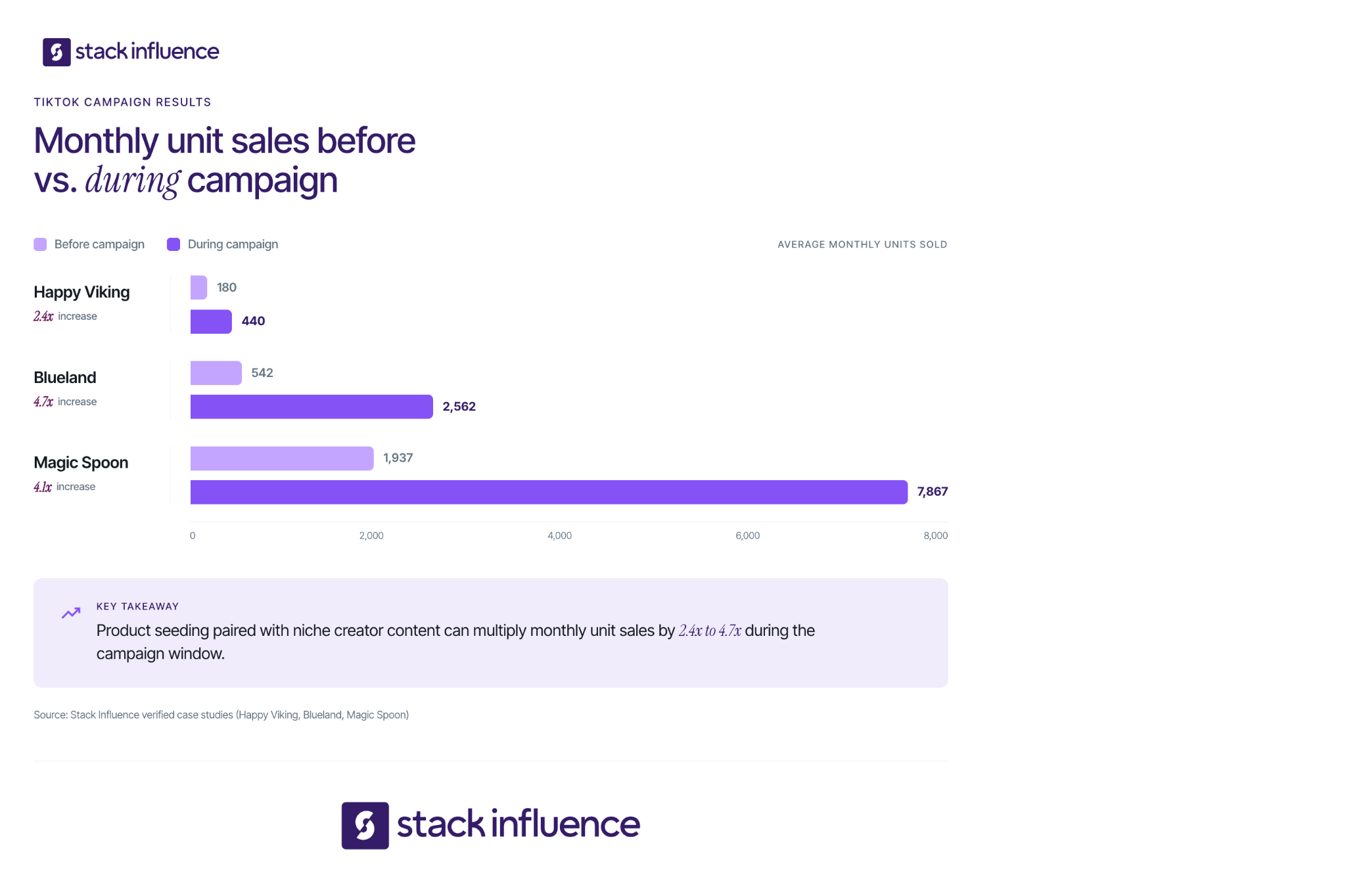
This is the creator economy's version of content ROI. A gifted-product campaign built around a creator who ranks for a relevant search term generates compounding value because the video continues to surface to new searchers after the initial post. In a verified Stack Influence case study for Blueland, a 3-month product seeding campaign drove 4.7x growth in average monthly unit sales (from 542 to 2,562 units during the campaign) and helped the brand reach page one for "foaming hand soap," a keyword carrying 26,000 monthly searches. The creators involved were not necessarily the largest accounts; they were creators whose content index matched the product category.
The takeaway for creators is direct: if you want to be chosen for brand deals consistently, build a search footprint in a category that brands care about. Viral reach is a resume item. Search authority is a job qualification.
Should You Optimize Every Video for TikTok Search?
Not every video needs to be search-optimized, and forcing search intent onto trend-driven or community content will make your account feel mechanical. The most effective TikTok channels for creators pursuing brand deals operate with a deliberate split between search-optimized content (built for discoverability and long-tail value) and native TikTok content (built for algorithm reach, community engagement, and culture participation).
A practical split for most creator categories runs roughly 60% search-intent content and 40% native TikTok content. The search-optimized half builds your topical authority index and attracts brand inquiries. The native half keeps your engagement rates healthy, your For You Page reach active, and your personality visible to audiences who discover you through the algorithm rather than through queries.
Sprout Social's 2024 Social Media Trends Report notes that social media search is now outpacing traditional SEO for younger generations, with nearly one in three consumers skipping Google to start their search on networks like TikTok, Instagram, or YouTube. For creators, that insight translates directly: your search-indexed videos work while you sleep. Your trend-driven videos spike and cool. You need both.
How Should Creators Measure TikTok Search Performance?
Creators should measure TikTok search performance using a three-tier metric stack that moves from discovery signals to engagement quality to brand value indicators. Tracking only views or follower growth misses the most commercially valuable signals.
The three-tier stack: the Search Source Audit, the Search-to-Follow Conversion, and the Category Authority Score.
Use these three tiers consistently across your monthly review to understand not just whether your content is growing, but whether it is growing in the direction that attracts brand investment:
- Tier 1: Search Source Audit Check your TikTok Analytics traffic sources and specifically isolate the percentage of views coming from "Search." A creator monetizing search authority should aim for at least 20 to 30% of total views from search traffic. If this number is under 10%, your content is likely winning on the algorithm but not building a searchable index.
- Tier 2: Search-to-Follow Conversion Divide your new followers gained in a 30-day window by the total search-sourced views in the same window. A healthy search-to-follow conversion rate suggests your search-driven visitors are finding enough value to subscribe. Low conversion often indicates a keyword mismatch: the searcher's query expectation was not met by the video content.
- Tier 3: Category Authority Score Once a month, manually search your top five target phrases in TikTok's native search bar. Note whether any of your videos appear in the top 10 results. Track this over time. A creator who consistently occupies search results for their target phrases has built category authority that is directly legible to brands reviewing creator profiles.
Later's TikTok SEO research confirms that engagement rate, completion rate, and keyword relevance across multiple content layers are the primary signals TikTok's search algorithm uses to rank results. That means your tier-one and tier-two metrics feed directly into your tier-three outcome: better engagement on search-sourced views improves your ranking for the queries that generate those views.
Attribution for brand deals sourced through search is straightforward: when a brand contacts you based on your content, ask how they found you. If they mention a specific video or topic, trace whether that video had high search-source traffic. Over time, this self-reported data will show which search clusters are generating commercial inquiries, allowing you to invest more content effort in the highest-value clusters.
Building Your Content Around Brands That Work with Micro-Influencers
Understanding TikTok search is one side of the creator growth equation. The other is knowing how to position your search authority as a business asset when approaching or attracting brand partnerships. Brands that run micro-influencer campaigns through platforms like Stack Influence are specifically looking for creators whose content consistently ranks within a relevant product category.
When your TikTok search footprint aligns with a brand's target category, your value to that brand extends beyond your follower count. Your indexed content represents a persistent discovery asset. A video about a brand's product category that already surfaces in TikTok search results tells that brand two things: your audience actively searches for content in this space, and your account has the topical authority to rank.
For creators building toward consistent brand deals, these steps translate your search strategy into commercial positioning:
- Build a creator media kit that includes your top search-ranking videos by topic cluster, alongside standard metrics like engagement rate and audience demographics.
- In brand outreach, mention specific search phrases your videos rank for rather than leading only with follower count or view averages.
- When joining influencer platforms or responding to brand briefs, include your highest-ranking search term as a niche qualifier. "Ranks on TikTok search for [term]" is a concrete differentiator in a crowded marketplace.
- Track which of your search-optimized videos earn the most profile visits and brand inquiry messages. These are your commercial anchor videos and deserve regular updates to maintain ranking.
A well-executed product seeding campaign works significantly better when creators arrive with search authority already established. According to a 2023 Nielsen study on creator marketing, audiences trust recommendations from creators they actively seek out far more than passive impressions. A viewer who found your video through a TikTok search is actively seeking your perspective, which is precisely the audience profile that converts on brand recommendations.
The TikTok Search Ranking Signals Creators Most Underestimate
Most creator guides to TikTok SEO stop at hashtags and captions. Those matter, but two ranking signals are chronically underused: spoken audio indexing and profile-level topical consistency.
TikTok's search algorithm indexes the spoken words in your video's audio track through automatic speech recognition. That means if you never say the search phrase out loud in the video, you are forfeiting one of the most powerful relevance signals available. TikTok's own Creator Academy recommends incorporating natural language around the topic in the first 10 seconds of spoken audio, because early keyword density in audio carries stronger indexing weight than late-video mentions.
Profile-level topical consistency is the second underestimated signal. TikTok's system does not evaluate each video in isolation. It assigns relevance weight based on how consistently your account publishes within a topic cluster. A creator who posts 20 videos about plant-based cooking will rank higher for plant-based cooking queries than a creator who posts one exceptional plant-based video among 19 unrelated ones. This is why cluster-based publishing, not one-off optimization, is the correct strategic frame for building search authority on TikTok. Apply the REACH framework consistently across your cluster videos—targeting a score of 20 or above out of 25 for each—and the platform's index compounds your authority over time rather than treating each post as a fresh start.
For UGC creators especially, this compounding topical signal is a strategic advantage: consistent, category-specific content that ranks for searched terms is exactly what brands look for when selecting product seeding partners.
Turning TikTok Search Authority into a Sustainable Creator Career

TikTok search is not a hack or a trend to chase. It is a structural feature of how the platform surfaces content in 2026, and creators who build their publishing systems around it gain an advantage that followers-first creators cannot easily replicate. Your search footprint works across time: a video you posted eight months ago can drive brand inquiries today if it ranks for the right phrase. That compounding quality is the closest thing to passive income the creator economy currently offers.
Start by applying the REACH framework to your next five planned videos. Use the three-tier measurement stack to audit your current search traffic share. Identify which of your existing videos already attract search-source views, and build your next content cluster deliberately around those topics.
If you are ready to connect your TikTok search authority with eCommerce brands actively running micro-influencer campaigns, Stack Influence's product seeding model matches vetted creators with brands in their content category. Explore how UGC creator partnerships built around genuine search authority can become the foundation of a sustainable, repeatable brand deal pipeline.