




Short-form video has fundamentally restructured how Instagram distributes content, and Reels sit at the center of that shift. Instagram and Facebook Reels are played more than 200 billion times every day combined, according to figures Mark Zuckerberg cited on Meta's Q3 2025 earnings call, a number that doubled from approximately 100 billion daily plays a year earlier. That growth rate tells every content creator one critical thing: Instagram is actively betting its platform future on Reels, which means it is actively rewarding creators who master the format. If your Instagram growth strategy still centers on static posts, you are operating with the wrong playbook entirely.
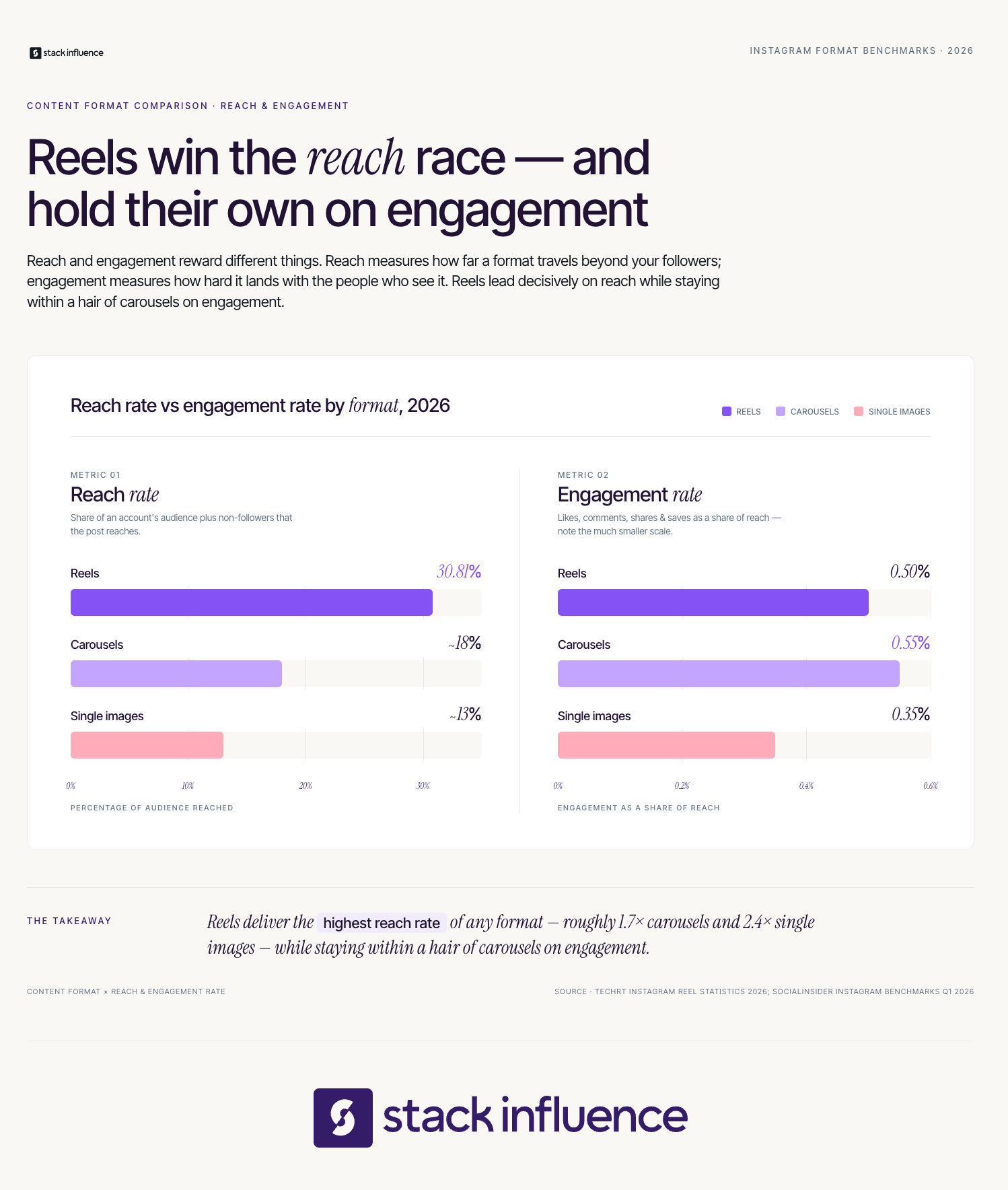
Among all content types on Instagram, Reels achieve the highest reach rate, outperforming static images, carousels, and standard video posts, largely because Instagram's algorithm pushes Reels beyond a brand's existing followers and exposes content to a wider audience. For nano influencers and micro influencers trying to grow without a paid acquisition budget, that organic reach advantage is essentially a free distribution engine. This guide gives you a structured, research-backed instagram reels strategy built around frameworks you can deploy this week.
Key Takeaways
- Instagram Reels reach a 30.81% average reach rate, outperforming every other content format on the platform.
- DM shares now outweigh likes by 3 to 5 times as a ranking signal for non-follower distribution.
- The REEL Sequence is a five-step framework that covers hook, edit, engagement trigger, length, and posting rhythm.
- Micro influencers using Reels as their primary format generate 3.86% average engagement versus 1.21% for mega-influencer accounts.
- Trial Reels give any creator with 1,000+ followers a built-in A/B testing tool with zero risk to their existing engagement metrics.
- Measuring Reels performance with the Signal Stack model gives creators a repeatable, algorithm-aligned metric system.
What Is an Instagram Reels Strategy and Why Does It Matter in 2026?
An Instagram Reels strategy is a documented, repeatable system for planning, producing, publishing, and measuring short-form video content on Instagram to achieve a specific growth or monetization outcome. The word "strategy" is doing real work here — it separates intentional creators from those who post whenever inspiration strikes and wonder why their reach plateaus. According to Sprout Social's 2026 Social Media Content Strategy Report, 60% of consumers interact with brand content on Instagram at least multiple times a week. That audience behavior creates a repeating opportunity window that only a consistent strategy can fully capture.
Sprout Social's report also confirms that over a quarter of social users from every generation turn to Instagram to find their next purchase. For UGC creators and influencers pursuing brand partnerships, that purchase intent context matters enormously. Brands looking for influencers are not just paying for eyeballs — they are paying for an audience that is primed to act. A Reels strategy that builds that kind of audience is a direct path to better brand sponsorship offers and more sustainable creator income.
Here is what a functional Instagram Reels strategy must include:
- A defined content pillar structure: Two to four recurring topics that align with your niche so the algorithm can consistently categorize your content.
- A production workflow: A batching and filming schedule that lets you publish consistently without burning out.
- A measurement model: A named set of metrics that tells you whether each Reel is doing its job before you double down on a format.
- A distribution plan: An intentional approach to when, how often, and in what format you publish.
- A monetization linkage: A clear connection between your Reels output and whatever income stream you are building, whether that is brand deals, product seeding, or affiliate revenue.
Without all five of these components working together, you have content production — not strategy.
How the Instagram Reels Algorithm Actually Ranks Your Content
Understanding the ranking engine is the prerequisite to any effective instagram reels strategy. The three most important signals confirmed by Instagram head Adam Mosseri are watch time, sends per reach (DM shares), and likes per reach. Most creators optimize for the third signal while systematically ignoring the first two, which is why their content underperforms even when it looks polished.
Watch time is the number one ranking factor, confirmed by Adam Mosseri in January 2025, meaning how long people watch your Reels matters more than likes or shares for initial distribution, while secondary factors vary by reach type: likes per reach matters more for existing followers, while DM shares matter more for reaching new audiences. That nuance is significant. A Reel that gets lots of likes from your current followers will perform differently than one that gets lots of DM sends from strangers, and each outcome serves a different growth goal.
Keyword-rich captions now outperform hashtag-heavy strategies as Instagram shifts toward SEO and interest-based recommendations. Creators still stuffing fifteen hashtags into every caption are wasting effort that could go toward writing a caption that matches search intent. The algorithm categorizes your content based on what you say, not just what you tag.
Stack Influence's internal campaign data shows that micro influencer Reels briefed with a clear hook direction and a single conversion prompt in the caption consistently outperform unstructured Reels on DM send rates by a meaningful margin, suggesting that caption structure is as important as visual quality for the algorithm signals that drive non-follower reach.
Here are the core ranking signals and what they mean for your production decisions:
- Watch time: Hook the viewer in the first three seconds; if you lose them here, the algorithm stops distributing the Reel.
- Sends per reach (DM shares): Create content people want to forward — relatable, useful, or surprising content earns sends; self-promotional content rarely does.
- Likes per reach: Likes are still a signal for follower-side distribution; do not ignore them, but do not optimize for them at the expense of shareability.
- Originality score: Original content receives 40 to 60% more distribution than reposts, and accounts posting 10 or more reposts within 30 days get excluded from recommendations entirely.
- Niche consistency: Your last 9 to 12 posts determine how the algorithm categorizes your account, so topic drift creates distribution penalties.
Instagram's 2026 Reels algorithm prioritizes shares, watch time, and originality, and Reels go through a cold-start testing phase where early watch time and engagement determine whether Instagram expands distribution. That cold-start window — typically the first hour after posting — is when your publishing timing and initial audience engagement matter most. Post when your core followers are active so early likes and DM sends give the algorithm enough signal to push the Reel wider.
The REEL Sequence: A 5-Step Framework for Consistent Performance
The REEL Sequence is the primary framework in this guide, and it is designed to give every piece of content a repeatable production logic from concept to post. Each of the five steps maps to a specific algorithm signal or audience behavior, so nothing in your production workflow is arbitrary. Reference the REEL Sequence whenever you are planning a new batch of content and use it to audit underperforming Reels.
The five steps are:
- R — Retention Hook: The first two to three seconds of your Reel must answer the implicit question "why should I keep watching?" Pattern interrupts, bold text overlays, or an unresolved setup all work.
- E — Edit Pace: Cut aggressively. According to OpusClip's 2025 Reels analysis, a 10-second Reel with 80% retention beats a 60-second Reel with 30% retention every time. Every second that does not advance the story is a second closer to a viewer dropping off.
- E — Engagement Trigger: Build in a share-worthy moment, a relatable statement, or a useful takeaway that makes someone want to send the Reel to a friend. This directly feeds the DM-sends signal.
- L — Length Decision: Match your Reel length to your goal. Based on OpusClip's analysis of 1.38 million Instagram clips, the most popular video length is 30 to 60 seconds, accounting for 40.2% of top-performing content across all categories.
- S — Schedule and Consistency: According to Dash Social's analysis of over 2.1 million Instagram posts, posting 2 to 3 times per week on Instagram feeds and Reels drives the highest engagement without risking burnout.
The REEL Sequence should be applied at the scripting stage, not the editing stage. Waiting until post-production to think about your retention hook or engagement trigger means you are retrofitting strategy onto footage rather than building it in from the start. Creators who run the REEL Sequence before filming consistently produce content with stronger early watch-time metrics.
Here is how to apply the REEL Sequence to a single piece of content in practice:
- Write your hook as the first line of your script, not as an afterthought.
- Script or outline the engagement trigger moment at the midpoint of your Reel.
- Choose your target length before you film, based on whether the goal is reach, community depth, or conversion.
- Schedule publication for your audience's peak activity window, which OpusClip's data places between 3 PM and 6 PM UTC for most accounts.
- After 24 hours, check your watch-time percentage and sends in Instagram Insights before deciding whether to repurpose or retire the concept.
How Trial Reels Change the Testing Game for Creators
Trial Reels represent one of the most underused tools in any instagram reels strategy, and most creators still do not have a system for using them deliberately. Instagram introduced Trial Reels as a way to try out content and see what performs best, by giving creators the option to share Reels with people who do not follow them, specifically for creators who want to experiment with new ideas without the worry of how their followers might react.
According to Instagram's own data, 40% of creators who try Trial Reels go on to post more Reels overall, and 80% of those see increased reach with non-followers. That is a compelling argument for building Trial Reels into a weekly content rotation rather than treating them as an occasional curiosity. The practical workflow is simple: test new hooks, formats, or niche-adjacent topics as Trial Reels, then only publish to your main profile the ones that perform.
According to Instagram's own creator blog, Trial Reels are shown to non-followers first, giving creators a risk-free way to test new genres, storytelling formats, or topics before their existing audience ever sees the content. For creators building a niche micro influencer brand, this is a way to test content pivots without damaging the trust you have built with your existing community.
Use Trial Reels strategically with this approach:
- Test hooks, not formats: Trial Reels work best for A/B testing two different opening lines on the same concept, not for testing entirely unrelated content verticals.
- Give it 24 to 48 hours: The algorithm needs time to surface Trial Reels to a meaningful non-follower sample; checking metrics after two hours produces misleading data.
- Compare Trial Reels to other Trial Reels: Because Trial Reels lack the initial engagement boost from your existing followers, comparing them to regular Reels skews the evaluation unfairly.
- Act on the data: If a Trial Reel outperforms your benchmarks, share it to your profile within the window before algorithm momentum fades.
What Micro Influencers and Nano Influencers Get Out of a Strong Reels Strategy
Here is where the instagram reels strategy becomes a direct business lever for smaller creators. Instagram micro-influencers generate an average engagement rate of 3.86%, compared to just 1.21% for mega-influencers. That gap is not a coincidence — it reflects the audience relationship that micro influencers and nano influencers build through consistent, niche-specific content. A Reels strategy that compounds that relationship over time is what turns a creator account into a business.
Micro-influencers with 10,000 to 100,000 followers deliver 60% higher engagement rates than those with over 1 million followers at roughly one-tenth the cost per post, and their audiences are more niche, more trusting, and far more likely to act on recommendations. Brands running influencer campaigns increasingly understand this math, which is why product seeding campaigns and ambassador programs now prioritize smaller creators over celebrity placements.
From Stack Influence's experience running micro influencer Reels campaigns across multiple ecommerce verticals, creators who maintain a consistent content pillar structure on Reels attract brand partnership inquiries at a meaningfully higher rate than accounts that post varied content without a clear niche, because brand sponsorship teams evaluate account consistency before they evaluate follower count.
Here is what a Reels-driven creator monetization stack looks like for micro and nano creators:
- Brand sponsorships: Consistent Reels that demonstrate niche authority make your brand ambassador application far stronger than a generic media kit.
- UGC licensing: High-performing Reels can be licensed to brands as UGC video assets for paid ads, creating a second revenue stream from content you already own.
- Affiliate revenue: Reels with a clear product narrative and a link-in-bio CTA are the most effective affiliate-driving format on the platform.
- Creator partnerships: Collabs with complementary creators using Instagram's Collab post feature expand reach to each other's audiences without additional content production.
The creator economy reward structure increasingly favors creators who show up consistently in a defined niche, and Reels are the fastest format for compounding that authority. An account with 8,000 followers and a three-month track record of high-watch-time Reels in a specific category will attract better brand deal offers than a 50,000-follower account posting inconsistently across five topics.
The Signal Stack: A Named Metric Model for Measuring Reels Performance
Most creators measure Reels performance with the wrong metrics. Follower count, total views, and raw likes are visibility metrics, not performance metrics. The Signal Stack is a four-component measurement model built around the signals the algorithm actually uses to distribute content, giving you a dashboard that is aligned with how Instagram works.
The four components of the Signal Stack are:
- Watch Rate (WR): The percentage of your Reel that average viewers complete. Aim for above 60% on Reels under 30 seconds, and above 40% on Reels between 30 and 60 seconds. Low watch rate means your hook or edit pace needs work.
- Sends Per Reach (SPR): DM shares divided by total reach. This is the metric most directly correlated with non-follower distribution. Track it in Instagram Insights under individual post metrics. Instagram's algorithm considers sends via DM the strongest signal for reaching new audiences, and according to Metricool data, 694,000 Instagram Reels are sent via DM every minute.
- Save Rate (SR): Saves divided by reach. Saves signal that your content has lasting utility — tutorials, tips, and resource-style Reels generate the highest save rates. High save rates correlate with the algorithm pushing content to the Explore page.
- Follower Conversion Rate (FCR): New followers gained divided by Reels reach. This tells you whether your content is attracting the right audience. A viral Reel with a low FCR means you reached a broad audience that was not aligned with your niche.
Across campaigns managed on the Stack Influence platform, micro influencer creators who track all four Signal Stack components and use them to iterate on content structure see faster improvement in non-follower reach than those optimizing for views or likes alone, because views and likes do not directly predict how the algorithm distributes future content.
Apply the Signal Stack after every Reel publish, not just on your top performers. Patterns become visible at around 10 to 15 posts, and those patterns tell you whether your hook structure, content length, or topic choice is creating friction before the key distribution signals fire.
A Freestyle Look at What Most Reels Strategies Miss: The Consistency Trap

Here is the genuinely novel angle that most Instagram Reels strategy guides avoid: consistency is a more dangerous trap than inconsistency for creators in 2026. The conventional advice is to post more, post often, and never break the streak. But that framing misses the mechanism.
December 2025 updates crushed aggregator accounts with a 60 to 80% reach drop while rewarding original creators with 40 to 60% increases. The algorithm is not rewarding posting frequency — it is rewarding originality and niche coherence. A creator who posts seven Reels a week using recycled formats and trending audio is being actively penalized by the same system they think they are gaming.
Posting ten or more times weekly often leads to diminishing returns and creator burnout. The ceiling on useful posting frequency is much lower than most productivity-focused creator advice suggests. The practical alternative to the consistency trap is what this guide calls the "Intentional Cadence" principle: a smaller number of Reels produced with full REEL Sequence attention beats a higher volume of rushed, algorithmically incoherent posts every single time.
Here is the Intentional Cadence approach in practice:
- Batch in thematic sets: Film three to four Reels in a single session around one content pillar, not one Reel per filming session. This produces niche coherence that the algorithm rewards.
- Use Trial Reels to absorb experimentation: Instead of posting experimental content to your main profile and risking your engagement rate, route all format tests through Trial Reels. Your profile feed stays clean and consistent.
- Rest your niche, not your account: If you need to slow down production, reduce frequency before you reduce quality. One strong Reel per week outperforms three weak ones.
- Audit your last 12 posts: Because Instagram uses your last 9 to 12 posts to categorize your account, run a quarterly audit to ensure your recent content is coherent enough to be algorithmically legible.
The influencer marketing platform landscape rewards creators who build a tight, recognizable niche. Brands using influencer marketing agencies to run creator activation campaigns are specifically looking for account coherence, not just follower count. An instagram reels strategy built on intentional cadence rather than volume gives you a better profile for brand deals and a healthier relationship with the content creation process.
How to Connect Your Reels Strategy to Brand Deals and the Creator Economy
A Reels strategy that does not connect to income is a hobby, not a business. The bridge between great content and brand sponsorship is a documented track record of the Signal Stack metrics described earlier. Brands looking for influencers want to see watch rate, save rate, and sends per reach — not just a vanity follower count.
Short-form video, specifically TikToks and Instagram Reels, accounts for 87% of content brands request from micro-influencers. That stat tells you exactly what your content portfolio should look like when you are approaching a brand or applying to an influencer marketing platform. If your portfolio does not lead with Reels, you are not speaking the language brands are buying.
Data from Stack Influence's micro influencer campaigns suggests that creators who include Signal Stack metrics in their media kit — specifically watch rate and sends per reach — close brand sponsorship negotiations faster than those presenting only follower count and reach, because Signal Stack metrics speak directly to the distribution quality brands are actually paying for.
Here is how to build a Reels-based media kit that performs for UGC platforms and brand partnerships:
- Lead with your niche statement: One sentence that tells a brand exactly who your audience is and what they care about.
- Include your top three Reels by Signal Stack score: Not by views, but by the combination of watch rate, save rate, and SPR.
- Show your consistency window: A 90-day posting history that demonstrates you have a sustainable production rhythm, not just a few viral outliers.
- State your content pillar structure: Brands want to know what kind of Reels you produce, not just that you produce them.
The creator economy is increasingly structured around long-term brand ambassador relationships rather than one-off sponsored posts. In 2026, Instagram's algorithm increasingly rewards authentic, native content over polished brand posts. Creators who build a Reels strategy anchored in genuine niche authority are exactly what brands are looking for when they think about sustainable influencer campaigns.
Conclusion: Build Your Reels Strategy Before You Build Your Audience
The sequence matters. Creators who develop a deliberate instagram reels strategy first — one built around the REEL Sequence, anchored by the Signal Stack, and protected from the consistency trap — grow audiences that are more engaged, more monetizable, and more attractive to brand partners. Reels are not a feature; they are the primary distribution engine of the platform. Treat them accordingly. Start with the REEL Sequence on your next three pieces of content, measure every output against the Signal Stack, and let Trial Reels absorb your experiments. The creators winning in 2026 are not the ones posting the most — they are the ones posting with the most intention.