



Cyber Monday 2026 falls on Monday, November 30. For ecommerce sellers and content creators, the opportunity is not a single discount post. It is a compressed creator-commerce campaign in which product availability, content proof, mobile checkout, links, rights, and timing must work together.
A creator can publish persuasive UGC and still produce weak business results if the offer is unclear or the destination breaks. A seller can offer a strong discount and still miss demand if creators receive products too late. This guide to Cyber Monday influencer marketing 2026 provides a dated execution framework, channel-specific setup for Amazon and Shopify, a creator-ready content brief, and a measurement system that separates attention from profitable commerce.
Key Takeaways
- Plan backward from November 30 through six phases covering offer design, creator activation, production, audience warming, conversion, and post-event follow-up.
- Use creators before deal day for discovery and product proof, then use Cyber Monday content for urgency rather than asking one post to do every job.
- Build for mobile first because mobile accounted for most surveyed Cyber Monday online shoppers and most measured online revenue in 2025.
- Give each creator a tested tracking link or code, a precise offer window, content rights, disclosure instructions, and one responsible campaign contact.
- Judge the campaign through delivery, attention, traffic, commerce, and reusable asset value, not revenue or impressions alone.
What Is Cyber Monday Influencer Marketing in 2026?
Cyber Monday influencer marketing is the coordinated use of creators, UGC, product seeding, affiliate links, discount codes, and paid amplification to influence discovery and purchase around Cyber Monday. In 2026, the strategy should cover the weeks before and after November 30, not only the Monday itself, because shopping activity and creator exposure begin earlier.
Cyber Monday falls on Monday, November 30, in 2026. That fixed date gives sellers a clear deadline for inventory, offers, links, content approvals, and creator posting windows. It also gives creators time to avoid conflicting category partnerships and reserve production capacity before Q4 schedules become crowded.
The latest completed event shows why the execution details matter. Adobe reported $14.25 billion in U.S. online spending on Cyber Monday 2025, with mobile devices generating 57.5% of that revenue. Adobe measures transactions across U.S. retail sites, so its figures describe online spending rather than all retail activity.
The National Retail Federation reported 75.9 million Cyber Monday online shoppers, including 46.9 million who shopped online through a mobile device. That means about 61.8% of surveyed online shoppers used mobile, although an individual shopper could also have used another device. NRF survey counts and Adobe transaction data use different methodologies, but both point to the same practical requirement: every creator path must work cleanly on a phone.
Cyber Monday is one part of a larger seasonal system. Brands planning gift guides, Christmas content, or broader promotional themes can coordinate this article with Stack Influence’s guide to holiday influencer marketing campaign ideas, while keeping the Cyber Monday workflow focused on one conversion deadline.
Cyber Monday Influencer Marketing 2026: The Conversion Clock
The Cyber Monday Conversion Clock assigns a distinct job to six periods before and after November 30. It prevents a common scheduling mistake: asking creator recruitment, shipping, production, approval, and conversion to happen during the same week.
Phase 1: Protect Offer Economics, August 24 to September 20
Choose a hero SKU or tight bundle, calculate contribution margin after the planned discount, confirm inventory, and select the destination. Creators should also reserve production capacity and avoid category conflicts before Q4 schedules become crowded.
Before outreach, answer five questions:
- Offer: What will the customer receive, at what price, and during which time zone?
- Inventory: How many units can sell without creating an avoidable stockout?
- Destination: Which mobile page best matches the creator’s promise?
- Tracking: Which link, code, or tag identifies each creator or content group?
- Economics: What remains after discounts, product cost, fulfillment, returns, creator costs, commissions, and media?
Phase 2: Recruit, Contract, and Seed, September 21 to October 18
Creator selection should combine audience relevance with operational reliability. Sellers can use a structured influencer hiring system, then adapt platform-specific research for finding TikTok influencers and finding Instagram influencers.
Activate creators in waves so the first group can reveal shipping, brief, claim, or tracking problems before the campaign scales. Agreements should cover deliverables, dates, compensation or reimbursement, revisions, disclosures, exclusivity, links, affiliate terms, content rights, and paid amplification. An automated product-seeding workflow can reduce follow-up when many nano influencers or micro influencers participate.
Stack Influence works with roughly 600,000 vetted creators, making a managed cohort workflow practical when a seller needs to activate creators without handling every outreach and follow-up task separately.
Phase 3: Produce Proof Assets, October 19 to November 8
The first creative objective is product proof, not a countdown graphic. Ask creators to capture:
- three opening hooks with different motivations
- two demonstrations or use cases
- one objection-answering segment
- one clean offer transition and call to action
Brands should review factual accuracy, prohibited claims, product presentation, disclosures, and rights without editing every creator into the same spokesperson. Authentic creator voice is part of the value.
Phase 4: Warm Audiences, November 9 to November 22
Use demonstrations, gift-use cases, comparisons, routines, FAQs, and comment replies to make the product recognizable before deal week. Sellers can distribute approved user-generated content across ecommerce touchpoints, including product pages, email, organic social, and retargeting when rights permit.
Select amplification candidates using qualified signals such as purchase questions, saves, clicks, and add-to-cart activity, not likes alone. Creators should leave enough space in their feeds for the final offer so the Cyber Monday post does not feel repetitive.
Phase 5: Convert Across Deal Week, November 23 to November 30
Deal-week content should progress from awareness to proof to truthful urgency:
- November 23 to 25: Preview the product problem, use case, or gift angle.
- November 26 to 27: Confirm the live deal and restate product proof.
- November 28 to 29: Answer objections and resurface useful audience questions.
- November 30: Lead with the real deadline, exact savings, and shortest working purchase path.
TikTok reported more than $500 million in U.S. TikTok Shop sales during its four-day 2025 Black Friday and Cyber Monday period, while creator affiliates published nearly 10 million shoppable videos across the broader campaign. These figures describe TikTok Shop, not the entire influencer economy, but they show why shoppable content and operations must be ready before the final day.
Phase 6: Capture Residual Value, December 1 to December 7
Sellers can retarget engaged visitors, promote a genuine extension when one exists, shift to shipping or gift messaging, and retain evergreen creator proof. Creators should submit live links, metrics, invoices, raw files, and authorization details according to the agreement.
Reconcile orders, codes, tags, returns, commissions, files, and rights before closing the campaign. Invite strong performers into an ambassador or affiliate program so Cyber Monday can qualify longer creator partnerships.
Build the Offer Before Briefing Creators

A creator cannot communicate an offer the seller has not fully defined. Maintain one source of truth for the product, destination, promotion, deadlines, tracking, claims, disclosures, rights, and contacts.
The minimum offer packet should include:
- hero SKU, eligible variants, bundle details, and exclusions
- regular price, promotional price, savings language, dates, and time zone
- inventory owner and escalation rule for low stock
- approved landing page, creator-specific link, and code
- disclosure language and product-claim guardrails
- compensation, reimbursement, affiliate terms, usage rights, and reporting
Creators should test the final link and code on a phone before publishing. They should keep the exact offer in writing because an incorrect price or expiration claim can create audience complaints even when the creative is strong.
Amazon Campaign Setup
Amazon sellers should choose one ASIN, deal page, or Amazon storefront that matches the creator’s promise and displays the relevant variation and promotion clearly on mobile.
Amazon Attribution is a free measurement solution for eligible advertisers that measures non-Amazon marketing across social, video, email, search, and other channels. Amazon reports a 14-day attribution window and metrics including clicks, detail-page views, add-to-cart activity, purchases, units, and product sales. Create separate tags by creator or creative group so one shared link does not erase useful differences.
Eligible U.S. Seller Brand Owners can review the Amazon Brand Referral Bonus, which Amazon describes as an average credit of about 10% on qualifying sales measured through Amazon Attribution. Confirm eligibility and current terms inside the seller account before modeling the credit. Stack Influence’s Amazon influencer marketing workflow connects creator activation with marketplace-focused product seeding and UGC execution.
Shopify Campaign Setup
Shopify Campaigns supports custom UTM parameters for individual influencers. Use a naming convention that separates the event, platform, creator, and creative, then lock final links before scheduling because Shopify warns that later edits or deletions can disrupt reporting or create broken paths.
A Shopify shareable discount link can open a selected product or collection and apply an active code when requirements are met. Test it in a private mobile browser, verify discount combinations, and confirm the store time zone. Stack Influence’s Shopify influencer marketing workflow connects product seeding, creator content, and traffic to a brand-owned storefront.
Creative That Converts Under a Short Deadline
Cyber Monday creative should reduce uncertainty quickly. Give creators four communication jobs while preserving their own language, pacing, and visual style.
- Hook: Identify the shopper, problem, gift recipient, or use case immediately.
- Proof: Demonstrate the product, answer an objection, or describe an honest experience.
- Offer: State the product, savings, deadline, and material exclusions clearly.
- Path: Give one next action and make the link, tag, storefront, or code easy to find.
One production session can create a discovery cut, an objection-focused retargeting cut, and a concise deal-day cut. Brands should request those functions rather than prescribing every word.
Disclosure belongs inside the creative. The Federal Trade Commission says creators should clearly and conspicuously disclose material connections, including free products or other value received from a brand. Disclosures should be hard to miss, and product claims should reflect the creator’s actual experience and available support.
Rights determine whether a strong post can be amplified. Meta describes Instagram partnership ads as a way to amplify content with a creator’s handle. Secure permission, authorization method, usage period, edit boundaries, channels, and compensation before publication.
Why the Day-of Post Is Usually Too Late
A day-of-only post is usually too late because Cyber Monday shoppers are already comparing products, saving links, and responding to earlier Black Friday offers. Creator content performs a different job at each stage: discovery before deal week, proof during the weekend, and urgency on Monday. Posting only at the end removes the first two jobs.
Adobe measured $44.2 billion in online spending across Cyber Week 2025. Black Friday reached $11.8 billion and grew 9.1% year over year, faster than Cyber Monday’s 7.1% growth, which Adobe linked to earlier deals. Adobe’s Cyber Monday channel analysis supports building familiarity before the final conversion window.
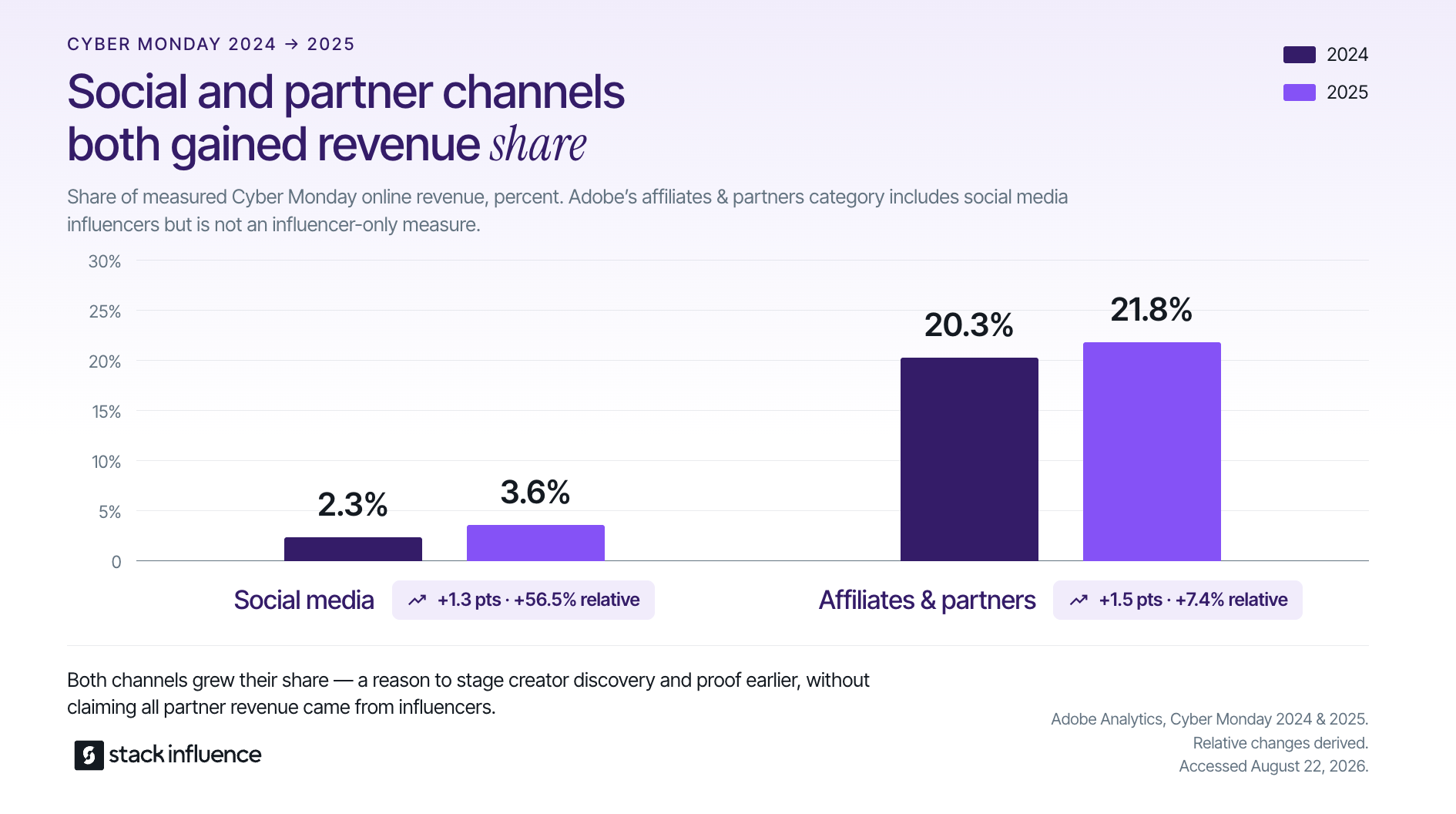
Adobe also reported that social media’s share of Cyber Monday online revenue rose from 2.3% in 2024 to 3.6% in 2025. Its affiliates and partners category increased from 20.3% to 21.8%. Adobe says the latter includes social media influencers but is broader than influencer-only revenue, so 21.8% should not be presented as an influencer sales share.
Use three touches:
- Discovery: Introduce the problem, product, or gift use case before deal week.
- Proof: Demonstrate the product and answer objections while shoppers compare.
- Conversion: State the live price, deadline, and direct purchase path during the event.
Each post then serves one useful purpose instead of repeating the same urgent advertisement.
How Should Brands and Creators Measure Cyber Monday Results?
Measure Cyber Monday creator campaigns across three time windows and five performance layers. The windows separate audience building, deal-period conversion, and residual value. The layers connect creator delivery to attention, traffic, commerce, and reusable content, preventing impressions or one attribution report from becoming the entire verdict.
Use the Three-Window Creator Commerce Scorecard:
- Build, November 9 to 26: On-time content, qualified attention, saves, questions, clicks, and product-page activity.
- Conversion, November 27 to December 1: Tracked sessions, carts, orders, revenue, conversion, average order value, discount cost, and contribution profit.
- Residual, December 2 to 7: Returns, late-attributed orders, retargeting response, usable assets, creator reporting, and repeat-partnership candidates.
Measure five connected layers:
- Delivery: Activated creators, completed posts, approved links, disclosures, and rights-cleared assets.
- Attention: Qualified views, watch time, saves, shares, and useful comments.
- Traffic: Tracked clicks or sessions, detail-page views, and add-to-cart activity.
- Commerce: Orders, units, net revenue, conversion, average order value, returns, and contribution profit.
- Residual Value: Reusable assets, cost per usable asset, creator reactivation, and amplified UGC performance.
Use consistent formulas. Completion rate equals completed creators divided by activated creators. Contribution profit equals net revenue minus discounts, product cost, fulfillment, returns, creator or affiliate costs, and media. Cost per usable asset equals campaign cost divided by rights-cleared assets that meet the reuse standard.
Attribution remains incomplete because copied links, code leakage, cross-device journeys, branded search, marketplace browsing, and platform windows can separate exposure from the recorded order. Report tracked conversions precisely, then treat broader sales, rank, or search movement as context rather than proof that one post caused the outcome.
Creators should retain live URLs, screenshots, publication times, platform analytics, link results when available, and the agreed invoice or affiliate report. This evidence supports both payment and renewal decisions.
Seven Failure Modes That Reduce Cyber Monday Results
Most Cyber Monday influencer campaign problems are operational and preventable. Correct them before deal week instead of asking creators to compensate with more posts.
- Late activation: Product arrives after the creator’s filming window. Set shipping deadlines, monitor delivery, and maintain replacement options.
- Mobile friction: The link opens the wrong variation, the offer is hidden, or checkout is slow. Test every path on common mobile browsers.
- Offer mismatch: The creator states a different price, deadline, bundle, or code than the storefront. Maintain one approved offer record.
- Rights ambiguity: The brand expects to run ads or edit UGC without contracted permission. Define channels, duration, edits, attribution, and compensation before production.
- Inventory blindness: A winning post sends shoppers to a low-stock item. Set inventory alerts and a truthful backup destination.
- Over-scripted content: Every creator repeats the same lines and loses the voice their audience trusts. Standardize claims and offer details, not personality.
- Reporting gaps: Links, codes, orders, asset files, and commissions cannot be reconciled. Assign naming rules and an owner before links are created.
Connecting Product Seeding With Completion Accountability
Stack Influence is a micro-influencer marketing platform for ecommerce brands built around gifted-first product seeding, vetted creator activation, campaign coordination, UGC generation, and completed-post accountability. The platform moves brands from creator participation to completed content rather than stopping at profile discovery.
Its completion-only structure is sometimes described as influencer insurance because campaign charges are tied to completed posts. For Cyber Monday, that model connects product delivery, follow-up, approvals, live-post tracking, and asset collection through one micro-influencer promotion workflow.
A verified six-month Stack Influence case study for NYK1 recorded 483 creator promotions, 2.15 million social impressions, and 83,471 engagements. During the measured campaign, average monthly unit sales increased from 482 to 2,965, while Amazon Best Seller Rank moved from #9,223 to #743. This is not a Cyber Monday benchmark, and the case study does not isolate creator activity as the sole cause.
The operational lesson is that volume matters when product receipt, deadlines, links, rights, and completion are coordinated. For Cyber Monday 2026, proof assets should be ready by November 8 and creators scheduled before deal week, not recruited on November 30.
Plan Cyber Monday as a Campaign, Not a Calendar Day
Cyber Monday influencer marketing 2026 should connect one defensible offer with a sequenced creator story, a mobile-ready purchase path, creator-specific measurement, and clear content rights. The Conversion Clock gives each task a deadline, while the Three-Window Creator Commerce Scorecard shows whether execution created attention, profitable orders, reusable assets, or all three.
Start by mapping one hero product through the six phases and testing the complete customer path on a phone. When creator sourcing, product seeding, coordination, and completion would otherwise become the bottleneck, evaluate a managed micro-influencer workflow that can turn the campaign plan into finished creator content before the retail deadline.