




Email is not dead. It is simply less forgiving.
For eCommerce sellers, ecommerce email marketing now sits at the center of retention, marketplace traffic, product launches, and customer lifetime value. The brands winning with email in 2026 are not sending more blasts. They are building smarter owned-audience systems that turn subscribers into repeat buyers, Amazon shoppers, reviewers, and advocates.
Key Takeaways
- eCommerce email marketing works best when sellers prioritize automated flows, segmentation, and post-purchase retention instead of one-off discount campaigns.
- Amazon sellers can use email to drive external traffic, but Amazon Attribution and Brand Referral Bonus tracking should be set up before campaigns go live.
- Creator UGC improves email performance because it gives subscribers social proof before they click to a product page, Amazon storefront, or DTC checkout.
- The Email Revenue Ladder helps sellers mature from basic list capture to connected lifecycle marketing across Amazon, Shopify, and influencer channels.
- Measurement should connect email revenue, Amazon-attributed sales, repeat purchase rate, and content performance rather than judging email only by open rate.
What Is eCommerce Email Marketing?
eCommerce email marketing is the use of email campaigns and automated flows to turn shoppers, subscribers, and past buyers into repeat customers. It includes welcome flows, abandoned cart emails, browse abandonment messages, product education, review requests, replenishment reminders, win-back campaigns, and launch announcements.
The channel matters because it gives sellers a direct line to customers they do not fully control on marketplaces or social platforms. Unlike paid ads, where costs rise with every click, email lets brands communicate with an owned audience after the initial opt-in. That does not make email free, but it does make it more durable than channels controlled by algorithms.
Strong eCommerce email programs usually include these components:
- List capture: Popups, checkout opt-ins, QR codes, creator landing pages, and post-purchase signups.
- Automated flows: Triggered emails based on behavior, purchase history, or lifecycle stage.
- Segmented campaigns: Broadcasts split by customer type, interest, product category, or buying intent.
- Creative testing: Subject lines, offers, UGC, product education, and send timing.
- Revenue tracking: Email-attributed sales, repeat purchase rate, conversion rate, and downstream marketplace impact.
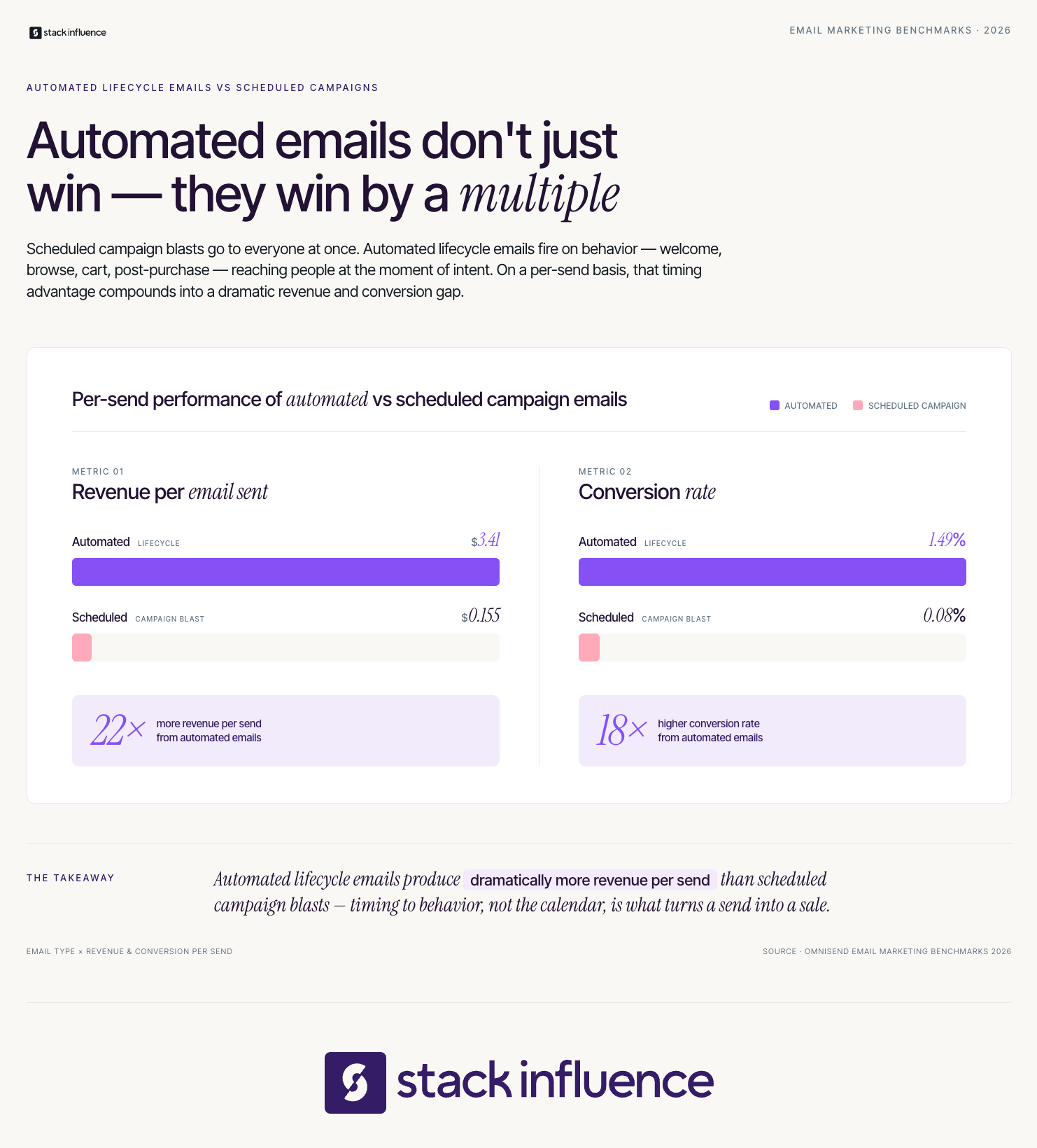
The performance gap between basic newsletters and automated lifecycle email is large. Omnisend’s 2026 email benchmark analysis found that automated emails generated $3.41 per email sent in 2025, compared with $0.155 for scheduled campaign emails. That makes automation the first major upgrade for sellers who still rely on broad batch sends.
Why Does Email Still Drive Profit for eCommerce Sellers?
Email remains profitable because it converts demand that sellers already paid to create. A shopper may discover a product through Meta, TikTok, Google, Amazon, or an influencer post, but email gives the brand another chance to educate, reassure, and recover the sale.
That is why email should not be treated as a backup channel. It is a conversion layer that sits underneath paid media, influencer marketing, Amazon storefront strategy, and DTC retention. Litmus research on email ROI reports that email drives an average return of $36 for every dollar spent, while its 2025 State of Email data shows 35% of companies see email ROI of 36:1 or more.
The most profitable email programs usually focus on three jobs:
- Convert undecided shoppers: Welcome and abandoned cart flows answer objections before the shopper forgets why they clicked.
- Increase repeat purchases: Replenishment, cross-sell, and loyalty emails lift LTV without restarting acquisition from zero.
- Support marketplace growth: Amazon sellers can use email to drive external traffic to listings, storefronts, or product launches when tracking is properly configured.
Email also gets stronger when it borrows proof from other channels. An email featuring a creator tutorial, customer photo, or product-use video often feels more believable than studio-only creative. That is why Stack Influence sellers often pair user-generated content with email flows instead of saving creator assets only for social posts.
The Email Revenue Ladder for eCommerce Sellers
The Email Revenue Ladder is a four-tier model for turning email from a newsletter channel into a revenue system. Each tier builds on the one before it, so sellers should not jump into advanced personalization before the basics work.
Tier 1 is Capture. At this stage, the goal is to collect qualified subscribers from your Shopify store, Amazon packaging, creator traffic, and post-purchase moments. A seller using Shopify influencer marketing solutions should send creator traffic to a landing page that captures emails before asking for a purchase.
Tier 2 is Convert. This tier uses automated flows to turn intent into revenue. Welcome emails, abandoned cart reminders, browse abandonment flows, and product education sequences should be active before sellers scale paid or creator-driven traffic.
Tier 3 is Compound. This tier uses segmentation and repeat-purchase logic to grow LTV. Segments can include first-time buyers, VIP customers, Amazon buyers, category-specific shoppers, subscribers who clicked UGC, and customers due for replenishment.
Tier 4 is Connect. This is where email works with Amazon Attribution, Brand Referral Bonus tracking, influencer content, review generation, and paid retargeting. Sellers using Amazon influencer marketing solutions can connect creator discovery, email follow-up, and Amazon storefront traffic into one coordinated system.
The Email Revenue Ladder gives sellers a simple diagnostic. If revenue is weak, the question is not “Should we send more emails?” The better question is which tier is broken.
How Should Amazon Sellers Use Email Without Breaking Marketplace Logic?
Amazon sellers should use email as an external traffic and education channel, not as a shortcut around marketplace trust rules. The best use case is sending subscribers to Amazon when the shopper prefers Prime checkout, when a launch needs sales velocity, or when a storefront needs external traffic.
The challenge is that Amazon does not behave like a DTC checkout. Sellers cannot see every customer-level detail they would see on Shopify, and they must avoid any messaging that improperly incentivizes reviews. That means the email strategy has to be structured around compliant education, traffic, and tracking.
Amazon sellers should build emails around these workflows:
- Launch traffic: Send segmented subscribers to a new product listing using Amazon Attribution links.
- Storefront discovery: Send category-interested subscribers to an Amazon storefront instead of one isolated ASIN.
- Product education: Use emails to explain ingredients, use cases, sizing, comparisons, or bundles before the click.
- Social proof: Include creator photos, testimonials, or unboxing content to reduce hesitation before Amazon checkout.
- Review-safe follow-up: Ask for honest feedback through approved post-purchase channels without offering rewards for reviews.
Amazon’s own Amazon Attribution page describes the tool as a free measurement solution for non-Amazon channels, including email, social, video, and influencer campaigns. For eligible brand owners, the Brand Referral Bonus program credits brands an average of 10% of sales from traffic they drive to Amazon.
This is where email becomes more than retention. A properly tagged campaign can lower effective acquisition cost, support external traffic goals, and help sellers understand whether email subscribers prefer Amazon checkout or DTC checkout.
Turning Product Seeding Into a High-Intent Email Pipeline
Product seeding can make email more persuasive because it gives sellers authentic content before asking subscribers to buy. Instead of announcing a product with only polished brand creative, sellers can use creator photos, use-case clips, and short testimonials that show the product in real life.
Stack Influence’s internal campaign data shows that brands repurposing creator assets into launch emails within 14 days of receiving content often see 20% to 35% higher click engagement than similar emails relying only on studio product photography. That pattern aligns with broader shopper behavior, since Bazaarvoice’s Shopper Experience Index research found that 65% of global shoppers rely on UGC, including ratings, reviews, photos, and videos, in buying decisions.
A product seeding to email workflow can look like this:
- Seed the product: Use automated product seeding to get products into the hands of relevant micro influencers.
- Collect the content: Organize creator photos, short videos, testimonials, and post URLs by product and audience type.
- Build segmented emails: Match creator assets to customer segments, such as beauty buyers, pet owners, fitness shoppers, or Amazon-first buyers.
- Route the traffic: Send subscribers to Shopify, an Amazon listing, or an Amazon storefront based on margin, inventory, and campaign goal.
- Reuse winners: Move top-performing creator assets into content syndication, paid ads, listing images, and future flows.
From Stack Influence’s experience running product seeding campaigns, the strongest email results usually come when the creator brief leaves room for natural product use. Over-scripted content may look controlled, but it often performs worse because subscribers can sense when the proof feels staged.
Where Does Attribution Break Down Between DTC and Amazon?
Attribution breaks down when sellers judge email only by what the email platform can see. A Shopify purchase may appear clearly in Klaviyo, Mailchimp, or another ESP, but an Amazon purchase requires separate tracking through Amazon Attribution.
The Clean Revenue Stack is a three-layer measurement model for eCommerce sellers running email across DTC and Amazon. It separates what happened in the inbox, what happened after the click, and what happened later in the customer lifecycle.
The Clean Revenue Stack includes:
- Inbox layer: Open rate, click rate, unsubscribe rate, spam complaint rate, and flow engagement, all of which are essential for Email list monitoring and deliverability management.
- Conversion layer: Shopify revenue, Amazon Attribution revenue, Brand Referral Bonus credits, checkout conversion rate, and product-level sales.
- Lifecycle layer: Repeat purchase rate, replenishment rate, customer lifetime value, review velocity, and creator content reuse.
This stack matters because open rate is not a revenue strategy. Klaviyo’s 2026 email benchmark data reports an average automated email flow click rate of 5.58% across industries, with the top 10% reaching 10.48%. The gap between average and top-performing flows usually comes from better segmentation, stronger offer timing, and more relevant creative.
Across campaigns managed on the Stack Influence platform, Amazon sellers that create unique Attribution links before launching creator-driven email campaigns typically see cleaner reporting and recover roughly 8% to 12% of attributed Amazon revenue through Brand Referral Bonus credits when eligible. Sellers can then compare email traffic against influencer traffic using the same measurement logic, which makes budget decisions less subjective.
For deeper Amazon measurement planning, Stack Influence’s guide to return on ad spend for eCommerce sellers and its breakdown of how to rank on Amazon can support the reporting side of the Clean Revenue Stack.
The Case Against Treating Email as a Discount Channel

The fastest way to weaken ecommerce email marketing is to train subscribers to wait for coupons. Discounts can work, but they become expensive when every campaign teaches customers that the listed price is temporary.
The better approach is to treat email as a decision-support channel. A subscriber may need proof, education, timing, comparison, replenishment logic, or creator validation before they need a lower price. This is especially important for Amazon FBA brands that already face marketplace fee pressure and cannot afford to buy every conversion with margin.
Discount-first email creates three problems:
- Lower margin: Every sale looks like revenue, but contribution profit shrinks.
- Worse customer behavior: Subscribers delay purchases because they expect another offer.
- Weak differentiation: Competitors can copy a discount faster than they can copy trust, content, and community.
Personalization makes this shift more important. McKinsey’s personalization research notes that 71% of consumers expect personalized interactions, while 76% get frustrated when companies fail to deliver them. That means sellers should use customer behavior to decide what someone needs next, not send the same coupon to everyone.
A better campaign might send education to new subscribers, replenishment reminders to past buyers, creator proof to hesitant clickers, and early access to VIP customers. Sellers using ambassador and affiliate programs can also feature long-term creator partners in retention emails, which makes the message feel less like a promotion and more like a recommendation.
How Do You Build an Inbox-Ready Campaign?
The Inbox-Ready Checklist is a secondary decision tool for sellers planning a campaign before launch. It helps teams catch the mistakes that usually hurt deliverability, clicks, and conversion.
Use the Inbox-Ready Checklist before every major send:
- Segment fit: The audience should match the product, offer, and buying stage.
- Proof asset: The email should include a review, creator image, testimonial, or product-use detail.
- Destination match: The click should lead to the right Shopify page, Amazon listing, or Amazon storefront.
- Tracking setup: UTM parameters, Amazon Attribution links, and ESP campaign names should be created before launch.
- Margin check: The offer should make sense after COGS, fulfillment, ad costs, Amazon fees, and discounts.
- Follow-up path: Non-buyers, buyers, and clickers should each have a next step.
The checklist is simple, but it prevents costly errors. Many sellers write the email first and ask about tracking after the campaign is already live. That reverses the order. The destination, segment, offer, and attribution plan should shape the email before creative starts.
This is also where marketing and operations need to work together. If an email campaign sends subscribers to Amazon but the ASIN is low on inventory, the sales spike can create stockout risk. If the email sends traffic to Shopify but the product page lacks creator proof, the campaign may create clicks without conversions. The best email programs connect creative, inventory, margin, and measurement before launch.
Conclusion: eCommerce Email Marketing as a Profit System
eCommerce email marketing is no longer just a newsletter function. For modern sellers, it is a profit system that connects retention, creator content, Amazon storefront traffic, DTC conversion, and long-term customer value.
The sellers who win in 2026 will not be the ones sending the most emails. They will be the ones using the Email Revenue Ladder to capture better subscribers, convert them with automated flows, compound repeat purchases, and connect email to Amazon Attribution, UGC, and influencer-driven demand. Build the system once, improve it every month, and email becomes one of the few growth channels that gets more valuable as your customer base grows.