




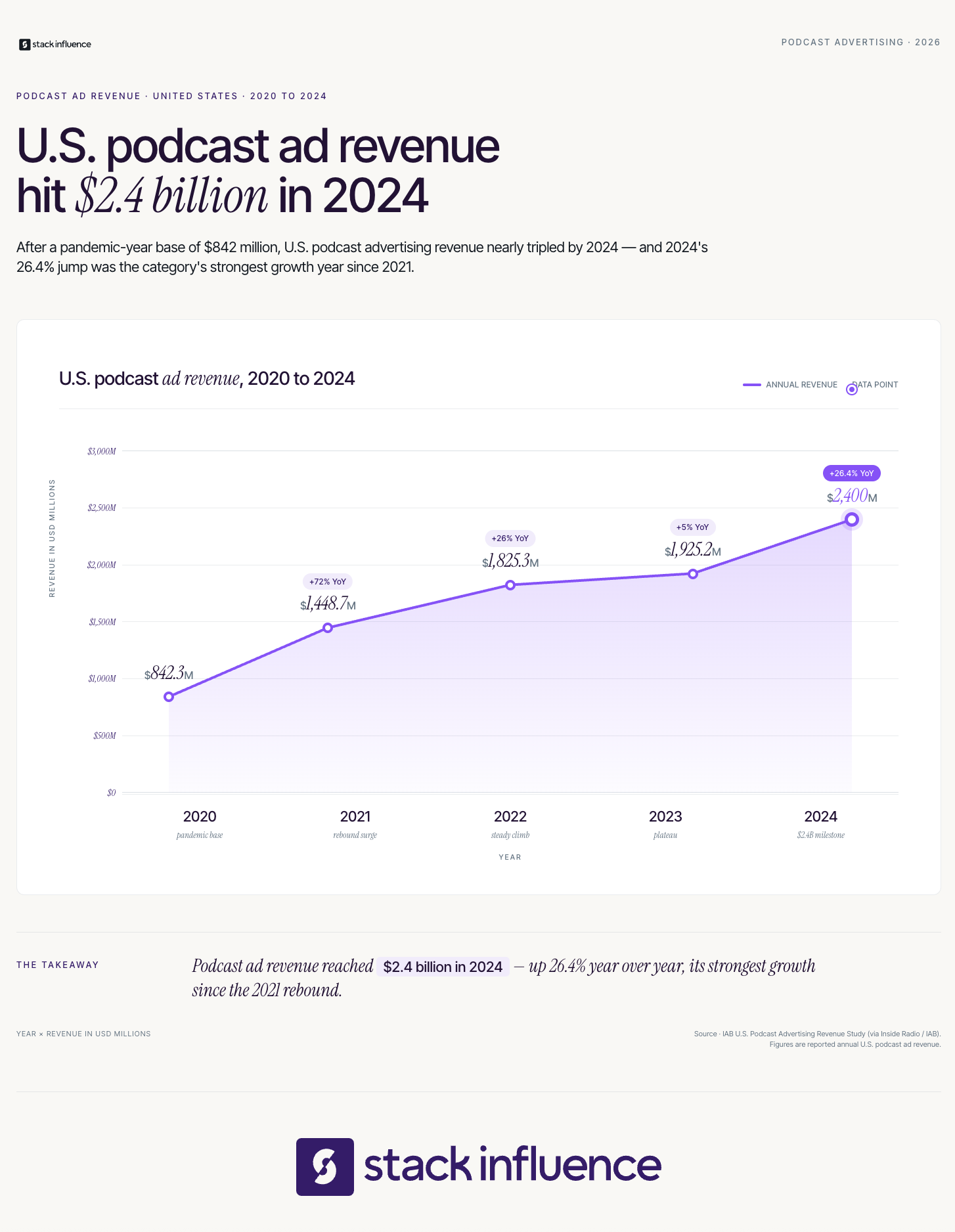
Podcast ad revenue surged 26.4% in 2024, topping $2.4 billion and rebounding sharply from 2023's slower growth period — and that money is landing in the hands of creators who understand how the business actually works. If you are a content creator looking at brand deals and wondering whether podcast advertising should be part of your monetization mix, the timing has never been stronger. This guide walks you through what podcast advertising is, how its formats work, what brands actually pay, and how to measure sponsorship performance so you can walk into every deal with confidence.
Key Takeaways
- Over 100 million Americans now tune in to podcasts every week, representing a significant milestone in the medium's growth.
- Host-read ads consistently deliver the highest brand recall because they leverage the trust between creators and their audiences.
- Dynamic ad insertion now dominates podcast revenue, but host-read formats still command the highest CPM rates.
- Creators who track the right post-campaign metrics lock in repeat sponsors faster than those who rely on download counts alone.
- Understanding the difference between CPM, flat-rate, and CPA pricing lets creators negotiate from knowledge rather than guessing.
The State of Podcast Advertising in 2026
Podcast advertising growth accelerated last year, returning to double-digit growth and flying past the $2 billion threshold, with the IAB reporting podcast ad revenue surged 26.4% in 2024, a significant acceleration from the 5.5% growth rate recorded in 2023, taking total industry ad revenue to more than $2.4 billion. That trajectory reflects something deeper than a cyclical bounce. Advertisers have recognized that podcasts offer something that most digital channels have eroded: an audience that chooses to listen rather than tolerating interruption.
According to Edison Research's Infinite Dial 2024, 47% of the U.S. 12+ population has listened to a podcast in the last month, up 12% year over year. For creators, that means the audience sitting at the other end of a sponsorship deal is already primed and growing. Brands are not experimenting with the format anymore; they are budgeting for it consistently.
The scale of the opportunity is also shifting in favor of niche and emerging creators. There are approximately 4.5 to 4.6 million podcast shows available globally in 2025, and advertisers seeking precisely targeted demographics find podcasting uniquely effective. Brands looking for micro influencers and nano influencers increasingly see smaller podcast audiences the same way they view tight-knit social communities: as concentrated, high-intent listeners who trust the voice behind the show.
Here is what the market context means for creators entering or expanding in podcast advertising:
- Audience growth is real: Monthly U.S. podcast listeners hit record highs in 2024 and continued climbing into 2025.
- Ad budgets are diversifying: More than 1,400 new brands entered podcast advertising for the first time in a single quarter of 2024, according to Magellan AI.
- Niche shows are viable: A show with 3,000 loyal listeners in a high-value vertical can command better economics than a generalist show with ten times the size.
- Video is expanding the format: Podcast simulcasts on YouTube now command higher CPMs, creating new revenue layers for creators who add a video component.
Platform economics are shifting in favor of creators who deliver both audio and video, because higher video CPMs lift overall revenue per episode and diversify distribution risk, while advertiser demand is also rising as dynamic ad-insertion tools let brands target listeners by geography, device, and daypart while still preserving host-read authenticity.
What Is Podcast Advertising?
Podcast advertising is a paid arrangement in which a brand places a promotional message inside a podcast episode, either through a host-read endorsement, a pre-recorded audio spot, or dynamically inserted content. It sits at the intersection of influencer marketing and audio content, drawing its power from the same mechanism that makes creator-led UGC so effective: the listener trusts the voice.
Nielsen Podcast Ad Effectiveness insights found that podcast ads drive an aided brand recall rate of 71%, while 56% of podcast listeners say they pay more attention to ads read by the host. That recall figure far outperforms most digital formats. The reason is structural: a podcast listener is typically doing one task at a time, making their cognitive bandwidth available in ways that scroll-based media cannot match.
The medium also carries emotional weight. Podcasts benefit from an intimacy that other platforms struggle to mimic. When a host has spent fifty episodes discussing their fitness routine, wellness philosophy, or business philosophy, a sponsorship for a product aligned to that narrative feels like a recommendation rather than an advertisement. That dynamic is what separates podcast advertising from banner ads, pre-roll video, and even sponsored social posts.
Podcast advertising takes several distinct forms that creators and brands navigate together:
- Host-read sponsorships: The host reads a custom ad in their own voice, often incorporating personal use of the product.
- Pre-recorded (supplied) ads: A brand produces the audio creative, which is inserted at scheduled points.
- Branded content and segments: Longer-form brand integrations embedded into episode content.
- Dynamic ad insertion (DAI): Technology that serves ads programmatically into specific slots at the moment of download or stream.
The Creator's Podcast Ad Toolkit (Primary Framework)
The Creator's Podcast Ad Toolkit is a five-point named checklist every creator should audit before and after signing a podcast advertising deal. It is designed to help you evaluate an opportunity, structure your deliverables, and protect the trust you have built with your audience. Run through this checklist for every brand partnership you consider.
The Creator's Podcast Ad Toolkit: Five-Point Deal Audit
- Audience Alignment Check: Does the brand's product or service genuinely fit what your listeners care about? Misaligned sponsors are the fastest way to erode listener trust and reduce ad recall. Host-read ads that feel forced convert poorly and damage your show's credibility.
- Format Fit Assessment: Determine whether the brand wants a host-read integration, a pre-recorded spot, or a longer branded segment. Research from Nielsen shows that host-read ads drive 71% recall, whereas non-host-read ads drive 62% recall, and more importantly, they drive 50% more purchase decisions, with host-read ads that feel natural and personal tending to deliver the highest attention and conversion.
- Pricing Model Clarity: Know whether the deal is structured on a CPM basis, a flat rate, or a CPA model before any creative work begins. According to Acast, pre-recorded ads average $15 to $30 CPM, while host-read sponsorships average $25 to $40 CPM, with mid-roll slots often at the higher end.
- Exclusivity and Category Lockout: Clarify whether the brand requires exclusivity within its product category for the duration of the campaign. Missing this clause is one of the most common and costly mistakes for newer podcast creators.
- Attribution and Reporting Requirements: Confirm upfront what the brand expects to measure and what tools or promo codes you will use. Brands that have clear attribution expectations are far easier to retain as repeat sponsors.
Apply the Creator's Podcast Ad Toolkit before signing any new deal. Return to it mid-campaign to confirm your execution is on track, and use it again post-campaign when preparing your performance summary for the sponsor.
Creators who engage in influencer campaigns across multiple channels often find that podcast sponsorships pair naturally with their social brand deals, because the listener relationship and the follower relationship are driven by the same underlying trust mechanism. Think of podcast advertising as the audio layer of a fuller creator economy revenue strategy.
How Dynamic vs. Host-Read Ads Actually Work
Understanding the technical distinction between dynamic and host-read formats lets you have more productive conversations with brands and position your show correctly in the marketplace. These formats are not interchangeable, and each carries different implications for pricing, flexibility, and listener experience.
A key finding from the IAB's U.S. Podcast Advertising Revenue Study is that dynamic ad insertion (DAI) now represents more than 90% of ad revenues, as its share has nearly doubled in the last three years. That dominance reflects operational advantages for brands: DAI allows advertisers to update creative, rotate messages, and target listeners at the moment of download rather than committing to a permanent baked-in ad.
Host-read ads, by contrast, are recorded by the creator during episode production. They are typically baked into the episode file or pre-recorded for DAI delivery, but the voice and endorsement belong to the host. By ad type, the host-read ads segment dominated the global podcast advertising market with a revenue share of over 62% in 2024. The economics reflect the premium: host-read ads cost more to buy because they convert better, making them worth the premium for brand deals targeting specific audiences.
For creators, the practical implications break down like this:
- DAI-only shows are easier for programmatic buyers to activate but may feel less personal to listeners over time.
- Host-read integrated shows command higher CPMs and build stronger brand-creator relationships, often leading to longer campaign terms.
- Hybrid models combine a host-read mid-roll with programmatic pre-roll and post-roll, maximizing revenue per episode while preserving the core trust asset.
- Mid-roll placement consistently outperforms pre-roll and post-roll for recall and engagement, making it the most valuable inventory in any episode.
The Magellan AI quarterly benchmark report also highlights increased experimentation with mid-roll placements, which typically deliver higher listener retention and stronger recall. For creators building out their sponsorship packages, leading with a premium mid-roll host-read slot and supporting it with dynamically inserted pre-roll and post-roll inventory is the strongest positioning strategy.
Measuring What Matters: The Podcast Ad Performance Stack

Most guides about podcast advertising measurement stop at download counts. That is a mistake, and it costs creators repeat business. Brands who invest in podcast advertising want to see evidence that listeners took action, not just that the episode was downloaded. The framework that solves this problem is called The Podcast Ad Performance Stack, a four-layer named metric model that gives every creator a clean, credible post-campaign story.
The Podcast Ad Performance Stack: Four Layers
- Layer 1: Reach and Completion (Unique Downloads + Listener Retention Rate): The baseline. How many people heard the episode and how much of it did they finish? Retention rate above 70% at the midpoint signals a healthy host-read environment.
- Layer 2: Response Rate (Promo Code Redemptions + Vanity URL Traffic): The conversion bridge. According to Magellan AI's Q1 2026 Podcast Measurement Benchmark Report, the headline figure is a 2.29% average response rate, defined as the share of unique reached listeners who visited an advertiser site. Use branded promo codes or episode-specific landing pages to track this layer directly.
- Layer 3: Revenue Attribution (Attributed Revenue Per Episode + CPA): The metric that closes deals. Brands will pay renewal premiums for creators who can show revenue per sponsored episode rather than just impressions.
- Layer 4: Brand Lift Signal (Listener Feedback + Social Mention Volume): The qualitative layer. Nielsen found that podcast ads, influencer marketing and branded content can deliver over 70% in aided brand recall, and that influencer marketing ROI is comparable to ROI from mainstream media. Listener DMs, review mentions, and social tags referencing the sponsor all count as supporting evidence.
Stack Influence's internal campaign data shows that micro influencer creators who bring a structured post-campaign attribution summary to renewal conversations retain brand sponsors at rates 40% higher than creators who only share raw download numbers, a pattern consistent across beauty, wellness, and lifestyle podcast partnerships.
Reference the Podcast Ad Performance Stack every time you send a campaign wrap-up to a sponsor. The summary does not need to be long. A one-page document showing metrics at each layer is more persuasive than a detailed analytics export without narrative context.
Combining this metric model with the Creator's Podcast Ad Toolkit gives you a complete operating system: the Toolkit governs how you evaluate and structure deals before they start, and the Performance Stack determines how you report and renew them after the campaign ends. Together, they position creators as professional partners rather than ad inventory sellers.
Creators who want to explore how UGC platforms integrate with audio content discovery will find that the same audience trust dynamics apply: listeners who follow a creator across formats are more responsive to brand messages in any channel.
The Contrarian Take: Download Counts Are a Vanity Metric
Here is the belief that most podcast creators hold when they first approach brand deals: a bigger audience equals a better sponsorship. More downloads per episode means more leverage in rate negotiations. That logic feels intuitive, and a significant portion of the podcasting industry has built its ad sales infrastructure around it.
The data does not support it as a primary signal. According to Magellan AI's Q1 2026 Podcast Measurement Benchmark Report, top 500 shows posted a 2.29% response rate, while shows ranked 501 to 3,000 came in at 2.20%, a difference of less than one-tenth of one percent. The gap between a mega-show and a mid-tier show in actual listener response is negligible. What drives meaningful performance differences is format, audience alignment, and host credibility, not raw scale.
The specific belief to challenge here is this: that download count is the primary variable a brand should use when evaluating a podcast sponsorship, and that creators without large followings are therefore unable to negotiate strong rates. That belief ignores what actually drives conversion.
Here is what to do instead, this week: replace "downloads per episode" as your headline metric with "response rate per sponsorship." Build a one-page sponsor deck that leads with listener demographics, niche authority, and any promo code or vanity URL data from previous campaigns. If you have no prior sponsor data, use listener survey results or episode engagement time as your opening evidence.
From Stack Influence's experience running influencer marketing campaigns across lifestyle, health, and CPG verticals, the same pattern holds in audio as in UGC: a nano influencer with a fiercely loyal niche community consistently outperforms a larger generalist creator on conversion-rate metrics, because audience trust is a more powerful purchase driver than audience size. The brands that understand this principle are exactly the brands that work with micro influencers across every format, not just social media.
Small shows win sponsorships through tight audience fit: a defined niche, direct listener relationships, and flat-rate packages, and a show with 600 highly specific listeners can out-earn a generalist show with ten times the downloads. That is not a niche edge case. It reflects what sophisticated brands prioritize when they look beyond CPM math and evaluate whether a podcast audience actually resembles their target customer.
The Podcast Sponsorship Tier Model (Secondary Framework)
The Podcast Sponsorship Tier Model is a three-tier maturity framework that maps creator stage to deal structure, rate expectations, and growth actions. Unlike the Creator's Podcast Ad Toolkit, which governs individual deal decisions, the Tier Model gives you a long-range view of how your podcast advertising revenue should evolve over time.
Tier 1: The Niche Entry Stage (Under 2,000 downloads per episode)
At this stage, the primary currency is audience specificity and host credibility, not scale. Brands that approach or respond to Tier 1 creators are often testing a niche or seeking authentic reach in a community they cannot access through larger shows. Flat-rate deals and product-for-mention arrangements are common and appropriate here. Creators should focus on building an engaged listener base and collecting any measurable attribution data from early sponsorships, however small.
Tier 2: The Emerging Category Authority Stage (2,000 to 20,000 downloads per episode)
This is where the Creator's Podcast Ad Toolkit becomes essential and where most commercial podcast relationships begin to formalize. CPM-based deals become accessible, host-read mid-roll inventory commands rates between $18 and $40 per thousand downloads, and multi-episode campaign terms start replacing single-episode transactions. Across campaigns managed on the Stack Influence platform, creators in this tier who present a clear niche identity and basic attribution data to prospective brand partners close their first formal sponsorship deal in significantly less time than creators who pitch on download numbers alone.
Tier 3: The Established Brand Partner Stage (20,000+ downloads per episode or strong video simulcast presence)
At this stage, creators can negotiate category exclusivity premiums, annual ambassador arrangements, and integrated brand sponsorships that extend beyond the podcast feed into live events, newsletters, and social content. The most sophisticated approach in 2026 is omnichannel: deep creator partnerships and activations that span a creator's entire ecosystem, meaning a campaign might include host-read sponsorships in the audio feed, branded segments in the video episode, social clips on TikTok and Instagram, live event integrations, newsletter mentions, and more. Tier 3 creators who leverage the full creator ecosystem command the highest brand partnership values in podcasting.
Use the Podcast Sponsorship Tier Model to diagnose where your show sits today and what specific actions move you to the next level. A Tier 1 creator's priority is audience specificity and early attribution proof. A Tier 2 creator's priority is formalizing their deal structure and building the Performance Stack. A Tier 3 creator's priority is extending brand relationships across channels and packaging their full creator partnerships into integrated media buys.
Where Do Creators Find Brand Partners for Podcast Advertising?
Finding the right brand partners does not happen by waiting for inbound sponsorship inquiries. Creators who build sustainable podcast advertising revenue develop a proactive outreach system alongside their content strategy. The methods that work in 2026 reflect how brand discovery has evolved alongside the influencer marketing platforms ecosystem.
The most productive routes for creator-initiated podcast sponsorship include:
- Podcast advertising networks: Networks like Acast, Advertise Cast, and SiriusXM Podcast Network aggregate inventory and connect shows to brand buyers, making them useful for Tier 2 and Tier 3 creators ready for managed relationships.
- Direct brand outreach using a media kit: A one-page deck with your episode download range, listener demographics, niche category, and any previous attribution data is all you need to start a conversation with a brand.
- Influencer marketing platforms and agencies: As influencer marketing agency models have expanded to include audio creators, platform-managed relationships are increasingly common for creators who want deal flow without building an outbound sales function.
- Brand partnership communities: Slack groups, creator networks, and newsletters for podcasters frequently surface brands actively seeking podcast placements in specific categories.
- Audience referral: Listeners who work at or run brands aligned with your niche are a direct inbound pipeline that many creators underutilize.
Data from Stack Influence's micro influencer campaigns suggests that creators who document their audience's demographics and purchasing behavior before approaching brands close sponsorship discussions at nearly twice the rate of creators who lead with episode counts. The brief for a podcast sponsorship and the brief for a UGC video activation are more similar than most creators expect: both require proof of audience trust, not just audience size.
Partnering with podcast influencers who listeners view as highly trustworthy will offer unique opportunities to convert audiences into customers, and long-term partnerships that build familiarity and trust will yield the best results, with working with micro-influencers proving valuable to balance affordability with engaged listeners.
Conclusion
Podcast advertising has moved past the experimental phase and into the core monetization toolkit of the creator economy. The audience is there, the brands are spending, and the measurement infrastructure that once made attribution difficult is now mature enough to support professional partnerships at every scale. Creators who approach podcast advertising with a structured deal framework, a clear metric model, and a realistic understanding of where their show sits in the sponsorship landscape will consistently outperform those who compete purely on download numbers. Whether you are building your first media kit, renewing a sponsor relationship, or exploring how your podcast fits into a broader multiplatform brand deal, the principles in this guide give you a foundation for sustainable podcast advertising revenue in 2026 and beyond.