




Official Temu Seller Center login: Existing sellers can sign in, and new sellers can register, on the official Temu Seller Center login and sign-up page (seller.temu.com).
Opening a Temu store is relatively simple. Operating that store without creating margin problems, inventory conflicts, shipping failures, or compliance risks takes considerably more planning.
The Temu Seller Center is the starting point for ecommerce sellers that want to register, publish products, process orders, manage fulfillment, and use marketplace promotions. This guide explains how the portal works, what U.S. sellers need to prepare, which costs deserve attention, and how to turn a new Temu account into a controlled marketplace expansion rather than an uncontrolled catalog upload.
Key Takeaways
- The Temu Seller Center combines seller registration, catalog management, orders, logistics, returns, advertising, education, and support in one operating portal.
- Sellers should verify legal, banking, product compliance, inventory, and fulfillment information before uploading their first SKU.
- Public signup may be inexpensive, but shipping, returns, promotions, advertising, fulfillment, and internal labor still determine profitability.
- The best launch strategy is a limited SKU test with channel-specific margins, synchronized inventory, and clearly defined performance thresholds.
- Seller Center manages marketplace execution. Sustainable demand may also require stronger creative, customer proof, and off-platform marketing.
What Is the Temu Seller Center?
The Temu Seller Center is the web dashboard local and cross-border merchants use to apply, create a shop, list products, manage orders, configure fulfillment and returns, access promotions, and monitor operations. For U.S. ecommerce sellers, it functions as the control layer connecting catalog data, inventory, logistics, customer orders, and Temu’s marketplace requirements.
The official Temu Seller Center publicly identifies several core functions:
- Account registration
- Product creation and listing matching
- Order management
- Logistics and returns
- Product advertising
- Promotional opportunities
- Seller education
- Account manager and support resources
- Connections with supported technology partners
Temu’s public U.S. page estimates that account creation takes about one minute, the seller application takes about 10 minutes, and application results are normally available within one business day. Those are platform estimates, not guaranteed approval times. Incomplete documentation, inconsistent business information, or category-specific reviews can extend the process.
The Seller Center also supports Temu’s Local Seller Program. According to a July 2026 ShipStation guide to the Local Seller Program, the program is active in 37 markets, although seller eligibility, available categories, logistics options, and regional selling privileges vary by country.
Who Can Open a Temu Seller Center Account?
Businesses and qualifying individual sellers can apply through the registration flow available for their country. U.S. applicants should expect to verify the legal seller, business representative, address, bank information, tax details, and contact information. The exact documents requested depend on the seller type, location, ownership structure, and product category.
A seller should prepare the following before beginning:
- Legal business name exactly as registered
- Business type, such as corporation, partnership, or sole proprietorship
- Employer Identification Number or other applicable tax identifier
- Registered business address
- Government-issued identification for the representative
- Valid bank account with a matching account holder
- Customer service email address and phone number
- Store name, logo, and public contact details
- Product ownership, authorization, and compliance records
Every name, address, and identification number should match the supporting document character for character. Small differences in legal suffixes, punctuation, old addresses, or bank account names can trigger additional verification.
U.S. sellers should also understand the INFORM Consumers Act. The Federal Trade Commission’s seller guidance defines a high-volume third-party seller as one that reaches at least 200 transactions and $5,000 in gross revenue from new or unused consumer products during a continuous 12-month period within the previous 24 months. Covered marketplaces must collect and verify information from qualifying sellers, and certain sellers must keep that information current.
How Do You Register as a U.S. Temu Seller?
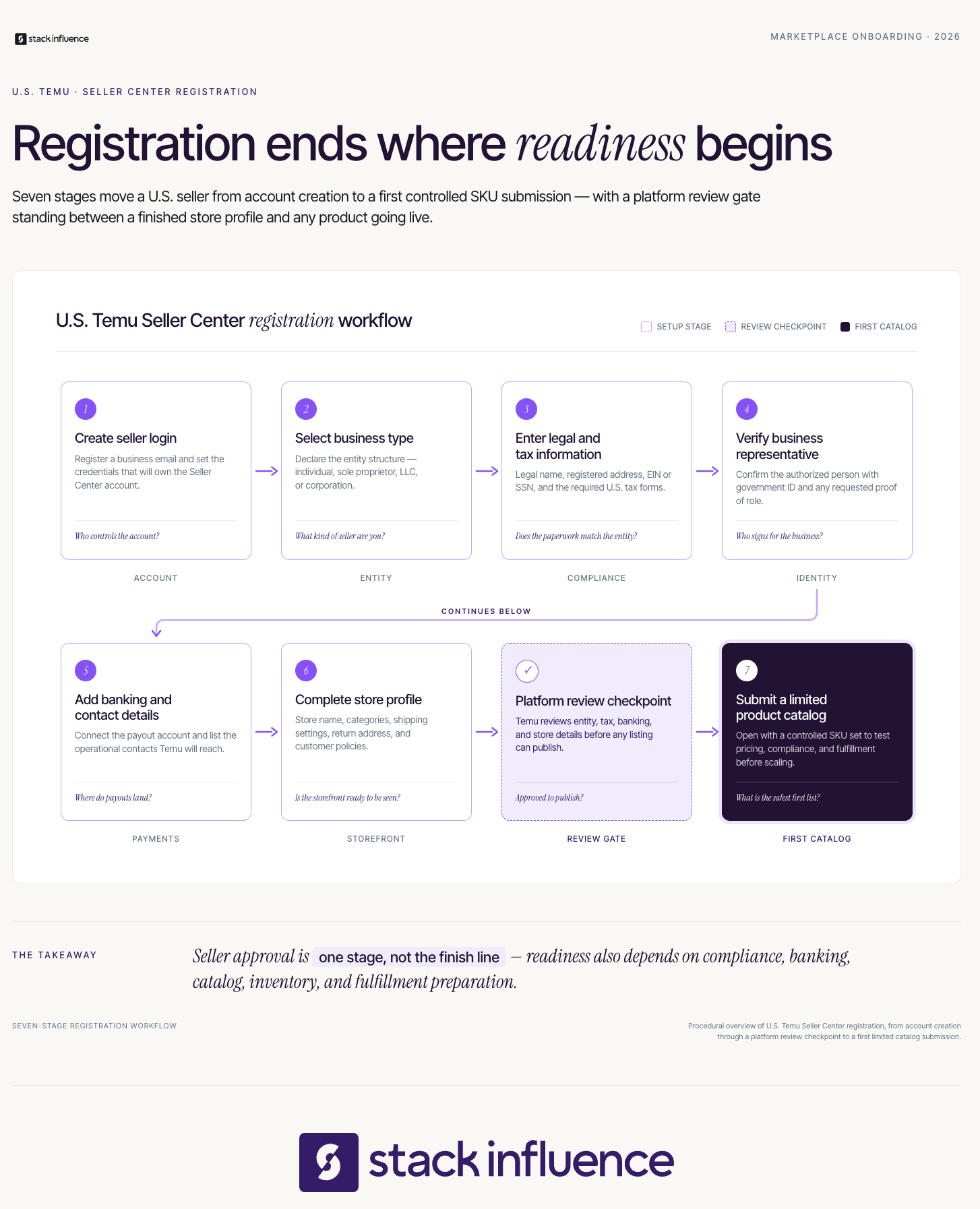
Registering involves creating login credentials, identifying the seller entity, verifying the business representative, supplying payout information, and completing the store profile. Temu reviews the application before the seller can begin normal operations. Sellers should finish their compliance and fulfillment planning before submitting products, rather than treating approval as permission to list every available SKU.
A practical registration sequence is:
- Create the account. Select the country where the business is registered or where the individual seller resides, then enter an email address or phone number and create a password.
- Choose the seller type. Select the entity structure that matches the seller’s legal documentation.
- Enter registration details. Use the exact legal name, tax information, and registered address shown on official records.
- Verify the representative. Upload a clear, valid government-issued identification document and provide the representative’s legal details.
- Add banking and contact information. Make sure the payout account belongs to the verified seller or approved payee.
- Complete the shop profile. Add the store name, logo, contact information, and any requested business details.
- Prepare a limited catalog. Begin with a controlled group of products instead of uploading the entire catalog immediately.
Shopify’s current U.S. Temu seller walkthrough describes a similar sequence: create the account, submit verification documents, build the seller profile, add listings, and configure fulfillment. It also notes that U.S. merchants can use domestic fulfillment rather than relying on the marketplace’s original cross-border model.
The Five-Gate Temu Launch Framework
The Five-Gate Temu Launch Framework helps sellers determine whether a product should go live. A SKU should pass all five gates before inventory is exposed to marketplace demand: verification, catalog readiness, unit economics, fulfillment reliability, and demand readiness.
This sequence prevents a common mistake: treating account approval as proof that every product is operationally ready.
Gate 1: Verification and Compliance
Compliance must be confirmed at the product level, not merely at the business-account level. A verified seller can still experience rejected listings, removals, recalls, or account problems if an individual product lacks the correct safety, labeling, authorization, or intellectual property records.
Build a compliance folder for each SKU containing:
- Supplier invoices and chain-of-custody records
- Trademark or reseller authorization
- Product test reports
- Required certificates
- Ingredient, material, or component records
- Warning labels and instructions
- Packaging photographs
- Recall and corrective-action procedures
The CPSC Online Sellers’ Safety Guide explains that businesses manufacturing, importing, or selling consumer products online remain responsible for applicable product safety requirements. Marketplace approval does not replace federal safety obligations.
Sellers should also confirm that every photograph, logo, description, character, design, and branded term is authorized. Temu’s Intellectual Property Policy describes its reporting portal, listing-removal process, counter-notice procedure, and policy for repeat infringers.
Gate 2: Catalog and Inventory Readiness
A Temu launch should begin with approximately 10 to 25 carefully selected SKUs. This is large enough to test demand across several product types, but small enough to identify listing, price, fulfillment, and return problems before they spread across the full catalog.
Choose products with:
- Stable supply
- Consistent dimensions and weights
- Clear customer use cases
- Low defect risk
- Manageable return exposure
- Competitive landed economics
- Strong visual demonstration potential
Use an inventory demand forecasting process to separate normal channel demand from launch promotions. Sellers should reserve inventory by channel or maintain a dependable real-time synchronization system so a Temu order does not consume stock already promised to Amazon, Shopify, wholesale, or retail customers.
Every listing should also contain accurate dimensions, scale references, variant information, materials, instructions, and real-life product context. A complete ecommerce product photography system should combine a clean main image, several viewing angles, a size or scale image, detail shots, and realistic lifestyle content.
Gate 3: Unit Economics
The price displayed to a customer is not the same as the seller’s profit. Before approving a SKU, calculate contribution margin at the order level.
Use this formula:
Contribution margin per order = net seller proceeds minus product cost, pick-and-pack expense, shipping, return reserve, advertising, promotional cost, and variable labor
The model should include:
- Landed cost of goods
- Packaging
- Warehouse handling
- Outbound shipping
- Return shipping and processing
- Refund and damage reserve
- Marketplace-specific deductions
- Advertising and promotion costs
- Customer service labor
- Integration or fulfillment software
- Expected discounting
Do not copy an Amazon or Shopify price into Temu and assume the economics remain unchanged. Each channel has different shipping, fulfillment, customer acquisition, return, and promotional costs.
Gate 4: Fulfillment and Returns
Fulfillment readiness means every order can be shipped, tracked, delivered, returned, and reconciled within the requirements shown in the seller’s account. Temu’s U.S. landing page states that the company does not directly provide logistics services, but offers integrated logistics solutions and seller protection tools.
A scalable ecommerce order fulfillment workflow should define:
- The inventory system of record
- Order-import frequency
- SKU and variant mapping
- Carrier selection
- Label creation
- Cutoff times
- Tracking synchronization
- Cancellation handling
- Lost-package escalation
- Return inspection
- Refund reconciliation
Shopify merchants can use the official Temu sales channel to configure product details, synchronize inventory, import orders, update tracking, create labels, manage returns, and process refunds through Shopify. Review the current Shopify Temu channel documentation before connecting a production catalog.
Sellers using ShipStation can connect a Temu store with the access token generated for that integration. The current ShipStation Temu integration instructions explain the connection sequence.
Returns should be treated as a product-data problem as well as a logistics problem. An ecommerce returns management system should identify which SKUs, variants, claims, photographs, and customer expectations are producing preventable returns.
Gate 5: Demand Readiness
A technically complete listing still needs a reason for shoppers to choose it. Before launch, confirm that the product has competitive imagery, a clear title, understandable benefits, accurate specifications, realistic use cases, and enough margin to support testing.
Start with a controlled plan:
- Publish a small SKU group
- Confirm listing approval and inventory accuracy
- Place test orders where permitted
- Monitor fulfillment and tracking
- Collect customer questions
- Improve weak listing content
- Test marketplace promotions
- Expand only after contribution margin remains acceptable
The objective is not immediate scale. The objective is learning whether the product can survive the channel’s economics and operational requirements.
What Does It Cost to Sell Through Temu Seller Center?
Creating listings may carry little or no upfront platform cost, but selling on Temu is not cost-free. Sellers must account for shipping, fulfillment, returns, discounts, advertising, storage, customer service, software, and inventory financing. Exact charges can vary by country, category, seller model, promotion, and account agreement.
Shopify’s June 2026 seller guide states that Temu does not currently charge listing fees, while sellers remain responsible for shipping costs and may incur storage or handling fees when using partner fulfillment. Temu’s public U.S. landing page does not provide one universal, detailed seller fee table. Sellers should therefore treat the agreement and rate information displayed inside their own Seller Center as the source of truth.
Before launching, document these cost categories:
- Marketplace charges: Any commission, referral, transaction, or account-specific deduction
- Fulfillment: Pick, pack, packaging, postage, storage, and handling
- Returns: Labels, inspection, damage, disposal, restocking, and refunds
- Promotions: Discounts, deal participation, coupons, and seller-funded incentives
- Advertising: Product ads and other paid visibility
- Operations: Customer support, software, integration maintenance, and reconciliation
- Working capital: Inventory purchased before the related payout is available
Avoid relying on a universal fee percentage quoted by an unaffiliated blog. Confirm the current terms for each category and recalculate margin whenever the platform, carrier, or promotion changes.
How Should Temu Sellers Measure Performance?
Temu sellers should measure the complete path from listing approval to contribution margin. Revenue and order count alone cannot reveal whether a product is creating profitable demand or merely moving inventory at an unsustainable cost. Leading indicators should identify operational problems before they appear in refunds, poor customer experiences, or account-level performance.
Use the Seller Center Scorecard:
- Listing health: Approval rate, rejected listings, inactive products, content completeness, and time to publish
- Availability: In-stock rate, overselling incidents, inventory cover, and replenishment lead time
- Delivery: Handling time, tracking upload, carrier acceptance, delivery speed, cancellation rate, and lost-package rate
- Customer outcome: Return rate, refund rate, defect reasons, customer questions, and repeat complaints
- Economics: Net proceeds, contribution margin, advertising cost, promotion cost, return cost, and cash-conversion time
Review the scorecard at three cadences:
- Daily operations: Orders, stock, cancellations, tracking, and urgent account alerts
- Weekly growth: Listing traffic, conversion, promotions, advertising, returns, and SKU-level margin
- Monthly portfolio review: Channel profitability, inventory productivity, repeat problems, and expansion decisions
Attribution becomes less reliable when shoppers encounter the product through several channels. A customer may see creator content, compare the product on Amazon, visit a Shopify store, and eventually buy on Temu. Treat platform-attributed sales as one decision signal, not perfect proof that a single impression or advertisement caused the order.
The Overlooked Risk: Channel Conflict
The greatest Temu risk for many established ecommerce brands is not account setup. It is allowing the new marketplace to interfere with pricing, inventory, positioning, or retailer relationships elsewhere.
Channel conflict can appear when:
- A Temu price undercuts the DTC offer
- Promotions overlap with Amazon or retail events
- One shared inventory pool produces stockouts
- Product bundles differ without clear SKU mapping
- Marketplace imagery creates inconsistent positioning
- Wholesale partners object to visible discounting
- Returns from one channel are reconciled against another
DTC brands should create a Temu-specific assortment and profit-and-loss view. A controlled assortment might use different bundles, pack sizes, colors, accessories, or entry products while protecting the core product architecture used on Shopify, Amazon, and wholesale channels.
Amazon sellers should also avoid assuming that Amazon FBA inventory will automatically fulfill Temu orders. Amazon and Temu are separate marketplaces. Any multichannel fulfillment arrangement must be deliberately connected, tested, costed, and checked against the tracking, packaging, delivery, and returns requirements displayed in the seller’s account.
Turning Seller Center Operations Into Marketplace Demand
Seller Center can publish products and process orders, but it cannot create every reason a shopper should care about an unfamiliar brand. Strong marketplace growth usually combines reliable operations with product education, customer proof, useful creative, and external discovery.
A Shopify influencer marketing system can help a DTC brand generate demand before the shopper enters a marketplace. The same brand may also use micro-influencers and UGC in ecommerce to create demonstrations, unboxings, tutorials, comparison content, and realistic product photography.
Stack Influence is a micro-influencer marketing platform built around gifted-first product seeding, vetted creator participation, campaign coordination, UGC generation, and completed-post accountability. The workflow is designed for ecommerce brands that want to turn product inventory into authentic creator content without manually coordinating every creator relationship.
An ecommerce UGC workflow can give a Temu seller more visual material for social media, advertising, email, product education, and other approved uses. Sellers should document content rights before reusing any creator asset.
A verified Stack Influence example shows how external creator activation can support marketplace demand. During a three-month new-product campaign for Targus, 120 creator promotions coincided with average monthly Amazon unit sales increasing from 56 to 221. The example was measured on Amazon, not Temu, and should not be treated as a Temu performance forecast or proof of single-channel causation. Results vary by product, price, category, creative quality, marketplace conditions, and execution.
For brands evaluating this workflow, these influencer product seeding strategies explain how creator selection, product experience, follow-up, content expectations, and campaign scale affect the quality of the resulting demand.
How Does Temu Seller Center Compare With Amazon and Shopify?

Temu Seller Center, Amazon Seller Central, and Shopify can all manage ecommerce activity, but they serve different channel roles. Temu and Amazon are marketplaces with their own customer environments and operating rules. Shopify is an owned storefront platform that can also function as a central system for connecting products, inventory, orders, and external sales channels.
- Temu Seller Center: Designed for Temu account verification, listings, orders, logistics, returns, promotions, product advertising, and marketplace support.
- Amazon Seller Central: Amazon’s Seller Central portal manages Amazon listings, orders, inventory, pricing, promotions, performance, reporting, advertising, account health, and fulfillment options such as Amazon FBA.
- Shopify: Gives DTC brands greater control over storefront design, merchandising, checkout, customer relationships, and owned-channel marketing. Its Temu sales channel can also synchronize selected marketplace operations.
These systems do not have to compete for ownership of the entire business. A seller can use Shopify as an operational hub, Amazon for high-intent marketplace demand, and Temu as a controlled additional channel. The important requirement is one reliable source of truth for inventory, SKU mapping, costs, and performance.
Temu Seller Center: From Login to Repeatable Growth
The Temu Seller Center gives ecommerce sellers a practical way to register, publish products, manage orders, configure fulfillment, and test another marketplace. The portal itself is only the operating interface. Profitable expansion depends on what the seller builds around it.
Start with a limited assortment, verify every product, model contribution margin, synchronize inventory, test fulfillment, and review results at the SKU level. Once those fundamentals remain stable, expand the catalog and demand strategy deliberately.
For ecommerce brands that also need authentic product demonstrations and reusable creator content, the next logical step is evaluating a structured product-seeding campaign that supports marketplace discovery without weakening operational control.